Siegfried Sassoon: Context, War Poetry, and Literary Significance
Siegfried Sassoon is one of the most important voices to emerge from First World War poetry, remembered for writing that exposes the violence, waste, psychological damage, and moral contradictions of modern warfare. A soldier who served on the Western Front and was decorated for extraordinary bravery, Sassoon later became one of the most outspoken literary critics of the war’s continuation. His poetry repeatedly confronts the distance between those who experience war and those who describe, direct, or justify it from elsewhere.
Sassoon’s position is particularly fascinating because he cannot be reduced to the simple image of an anti-war poet who rejected military service. He volunteered for the army, fought with remarkable courage, received the Military Cross, and repeatedly placed himself in danger alongside his men. His increasingly bitter opposition to the war developed through experience rather than distance from it. By 1917, that opposition had become public when he issued A Soldier’s Declaration, protesting against what he believed had become the deliberate prolongation of a conflict that could no longer be justified as purely defensive.
That tension runs throughout Sassoon’s writing. His poems challenge the language of glory, honour, patriotism, sacrifice, heroism, and duty, but they rarely attack the ordinary soldier. Instead, Sassoon frequently directs his anger towards the structures surrounding soldiers: military leadership, politicians, patriotic civilians, propaganda, social expectations, and the comfortable language used to make suffering appear meaningful. His characteristic weapons are not elaborate argument but satire, irony, understatement, direct address, abrupt tonal shifts, and deliberately uncomfortable contrasts.
Sassoon also occupies a crucial position in the development of twentieth-century war poetry. Writing within a culture that had inherited powerful traditions of heroic and patriotic representations of warfare, he helped expose how inadequate those traditions could become when confronted with trench warfare, industrialised killing, mass casualties, and psychological trauma. His influence became especially important through his relationship with Wilfred Owen, whom he met while both men were being treated at Craiglockhart War Hospital in 1917.
Reading Sassoon in context therefore means understanding more than his anger at the First World War. His poetry emerges from a society negotiating conflicting ideas about patriotism, masculinity, courage, authority, sacrifice, trauma, and responsibility. Sassoon forces readers to ask difficult questions about who is permitted to speak for soldiers, who makes decisions about their lives, and what happens when patriotic ideals encounter the physical reality of combat.
This guide explores Sassoon’s life, historical and social context, literary influences, major themes, poetic methods, and lasting literary significance. For more author studies, poetry analysis, contextual resources, and guides to major literary texts, explore the Literature Library.

Who Was Siegfried Sassoon?
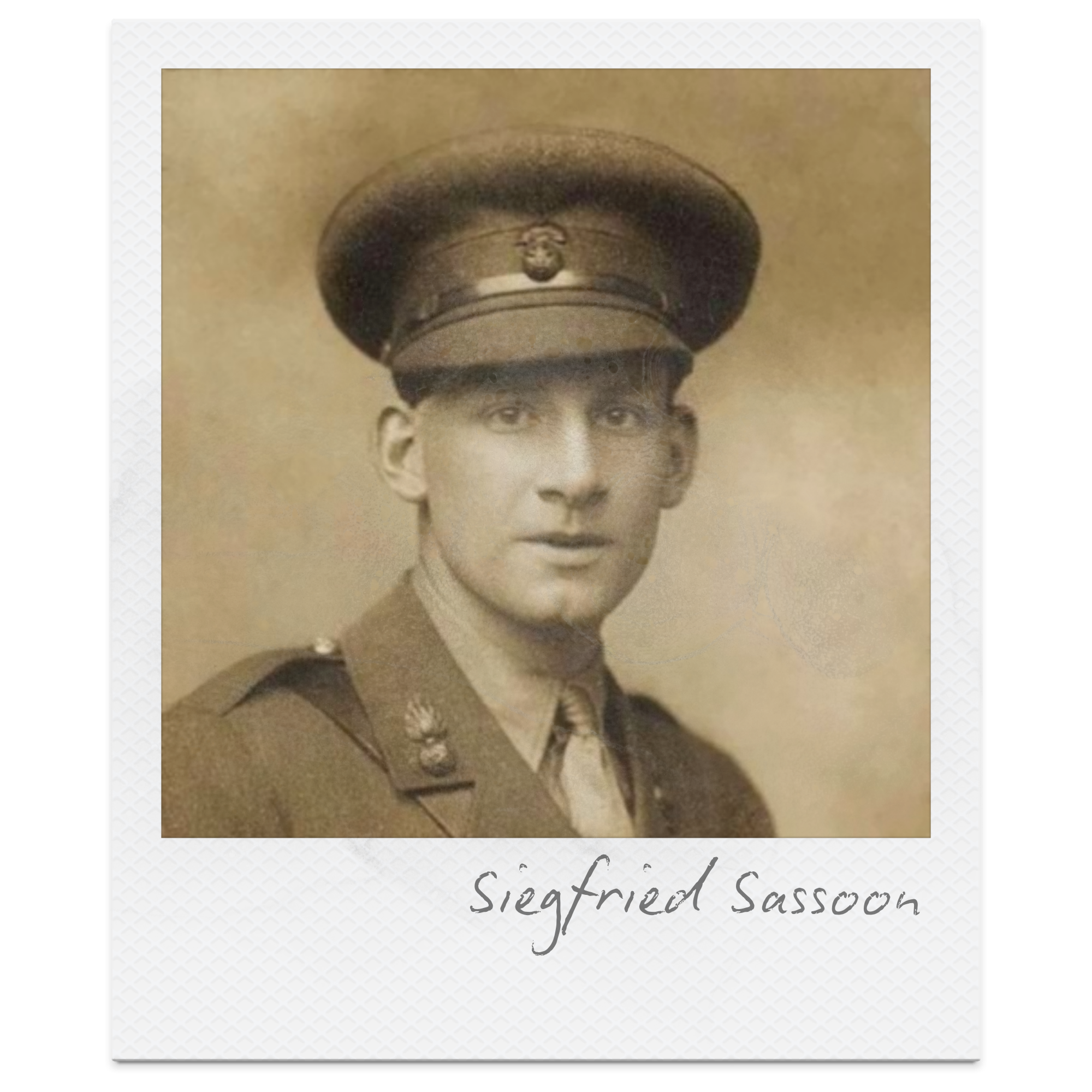
Who Was Siegfried Sassoon?
Siegfried Loraine Sassoon (1886–1967) was an English poet, writer, and soldier whose experiences during the First World War transformed him from a willing volunteer into one of the conflict’s most outspoken literary critics. Decorated for bravery on the Western Front, Sassoon became known both for his extraordinary courage as an officer and for poetry that attacked the waste, hypocrisy, and human cost of war.
Sassoon was born on 8 September 1886 in Matfield, Kent, into a wealthy and culturally distinctive family. His father, Alfred Ezra Sassoon, came from the prominent Sassoon merchant family, while his mother, Theresa Thornycroft, belonged to the artistic Thornycroft family. Her relatives included well-known sculptors and painters, placing Sassoon within a family environment shaped by both wealth and the arts.
His parents separated when Sassoon was young, and his father died when he was still a child. Sassoon and his brothers were largely raised by their mother in the Kent countryside. The rural landscape of his childhood became important to his imagination, and his early life was shaped by interests very different from the mechanised world he would later encounter in France: poetry, cricket, horses, hunting, and the English countryside.
Sassoon was educated at Marlborough College before studying history at Clare College, Cambridge. He left Cambridge without taking a degree and spent much of his early adulthood living the life of a financially independent country gentleman. He hunted, played cricket, read extensively, and wrote poetry, privately publishing several early collections before the First World War.
This pre-war background is important when reading Sassoon. The poet who would later become famous for exposing the brutality of industrialised warfare had grown up within a world strongly associated with traditional English rural life, social privilege, sporting culture, and established ideas of masculinity and gentlemanly behaviour. The First World War would place many of those assumptions under extraordinary pressure.
Sassoon and the First World War
When war began in August 1914, Sassoon did not initially resist military service. He volunteered almost immediately, first joining the Sussex Yeomanry. Before he could see active service with them, however, a riding accident delayed his deployment. He later received a commission in the Royal Welch Fusiliers, the regiment with which his wartime experience became closely associated.
At the Front, Sassoon developed a reputation for remarkable — and sometimes reckless — courage. He undertook dangerous patrols and raids, repeatedly exposing himself to enemy fire and demonstrating intense loyalty towards the men serving alongside him.
His behaviour earned him the nickname “Mad Jack” among fellow soldiers.
Sassoon's later opposition to the war therefore cannot easily be dismissed as the response of someone unwilling to fight. He had experienced combat directly and had demonstrated considerable personal bravery within it. That contradiction — the courageous soldier who becomes a fierce critic of the war — is essential to understanding both his life and his poetry.
In 1916, Sassoon was awarded the Military Cross for bravery after bringing wounded men back under heavy fire. Yet the same period brought devastating personal losses. Among the deaths that affected him deeply was that of David Cuthbert Thomas, a close friend killed during the war. Sassoon's brother Hamo had also died after being wounded during the Gallipoli campaign in 1915.
As Sassoon witnessed more death and destruction, his attitude towards the conflict became increasingly critical. His anger was directed not primarily towards the ordinary soldiers fighting beside him, but towards the political and military structures that continued to send them into battle and towards civilians who could speak casually or enthusiastically about a war they did not personally experience.
A Soldier's Declaration
In 1917, Sassoon transformed his private disillusionment into a public act of protest.
After recovering from a wound and while expected to return to military service, he wrote a statement usually known as “A Soldier's Declaration.” In it, Sassoon announced that he was deliberately refusing to return to duty because he believed the war had changed from a conflict of defence into one that was being unnecessarily prolonged.
This was an extraordinary position for a serving officer to take.
Sassoon was not declaring himself a lifelong pacifist, nor was he denying the courage of the soldiers still fighting. Instead, he argued that the continuation of the war had become morally indefensible and that soldiers were being sacrificed because of decisions made by those removed from the immediate consequences of combat.
His statement was sent to his commanding officer, circulated publicly, and eventually read in the House of Commons.
Sassoon risked serious disciplinary consequences. However, friends and fellow officers intervened, and rather than court-martialling him, the military authorities treated his behaviour as connected to psychological illness. He was sent to Craiglockhart War Hospital near Edinburgh, where officers suffering from what was then commonly described as shell shock were treated.
Craiglockhart and Wilfred Owen
Craiglockhart became one of the most important periods of Sassoon's literary life.
While there, he met the younger poet Wilfred Owen, who had been sent to the hospital following severe psychological trauma during active service. Owen already wrote poetry, but Sassoon became an important mentor and literary influence.
Sassoon read Owen's work, offered criticism and encouragement, and pushed him towards writing more directly about the realities of combat. Their relationship helped Owen develop the distinctive poetic voice that would later produce some of the most famous poems of the First World War.
The influence was not simply one-way. Their friendship placed two very different poetic responses to warfare beside one another. Sassoon frequently uses satire, anger, irony, and accusation, while Owen increasingly develops a poetry centred on pity, suffering, psychological trauma, and compassion.
Together, they became central figures in what later generations would understand as First World War poetry.
Returning to the War
One of the most revealing aspects of Sassoon's life is that his protest did not end his military service.
After leaving Craiglockhart, he eventually returned to duty. He served in Palestine before returning to France in 1918.
This complicates any attempt to describe Sassoon simply as either a patriotic soldier or an anti-war protester. He could oppose the continuation and conduct of the war while still feeling loyalty and responsibility towards the soldiers who remained within it.
That tension appears throughout his writing. Sassoon's poetry can be furious about the systems surrounding warfare while remaining deeply protective of the ordinary men required to endure it.
In July 1918, Sassoon was accidentally shot in the head by a fellow British soldier who mistook him for an enemy combatant. He survived and was sent back to Britain, bringing his active wartime service effectively to an end.
Sassoon After the War
Unlike Wilfred Owen, Sassoon survived the First World War and therefore had decades in which to reflect upon it.
After 1918, he continued writing poetry and prose, while the war remained a defining presence in his literary career. His experiences became particularly important in his autobiographical writing.
His fictionalised autobiographical trilogy beginning with Memoirs of a Fox-Hunting Man (1928) explores the world Sassoon had inhabited before the war and the transformation brought about by military service. It was followed by Memoirs of an Infantry Officer (1930) and Sherston's Progress (1936).
These works allowed Sassoon to examine something his wartime poetry could only begin to capture: the contrast between the apparently stable world of Edwardian England and the psychological and cultural rupture produced by the First World War.
He later wrote more explicitly autobiographical works under his own name, continuing to reconsider his childhood, literary development, military experience, and changing beliefs.
Sassoon's personal and spiritual life also continued to develop. In 1933, he married Hester Gatty, with whom he had a son, George Sassoon. The marriage later broke down. In his later years, Sassoon became increasingly interested in religion and was received into the Roman Catholic Church in 1957.
He died on 1 September 1967, shortly before his eighty-first birthday.
Sassoon therefore occupies an unusual position among the major poets of the First World War. Unlike Owen, Isaac Rosenberg, and others whose lives were ended by the conflict, Sassoon lived for almost half a century after the Armistice. He had time to reconsider the war, reconstruct his memories, and witness the emergence of the First World War as both history and cultural memory.
His life also resists simple categorisation. Sassoon was a privileged country gentleman and a trench soldier; a decorated officer and a military protester; a fierce satirist and a deeply reflective memoirist; a mentor to Wilfred Owen and a major writer in his own right.
Understanding those contradictions is essential to understanding his poetry. Sassoon's attacks on patriotism, military authority, civilian complacency, propaganda, and romanticised heroism did not emerge from a rejection of soldiers or courage. They emerged from the experience of a man who had fought bravely himself and became increasingly unwilling to accept the language used to justify what he had witnessed.
Historical and Social Context
Siegfried Sassoon wrote against the background of the First World War (1914–1918), a conflict that transformed British society and exposed millions of people to forms of violence on an unprecedented scale. Understanding his poetry requires recognising the enormous distance that could exist between the ideals associated with warfare and the experiences of the soldiers required to fight it.
Like Wilfred Owen, Sassoon should not be read through the simplified assumption that British society entered the war already knowing it would become a symbol of futility and mass suffering. When Britain entered the conflict in August 1914, significant numbers of people supported the war effort, and hundreds of thousands of men volunteered for military service. Ideas of patriotism, duty, courage, masculinity, loyalty, honour, and service to King and country could carry genuine emotional and moral force.
Sassoon himself initially participated in this culture of voluntary service. His later protest is therefore particularly significant: his criticism of the war developed not because he had always rejected military values, but because his experiences forced him to reconsider what ideas such as duty, sacrifice, and honour meant when confronted with prolonged industrialised warfare.
Patriotism, Duty, and “King and Country”
When Britain declared war on Germany on 4 August 1914, the conflict could be presented as a necessary response to German aggression and, particularly, the invasion of neutral Belgium.
For many Britons, military service was connected to established ideas about national identity. Britain was a global imperial power ruled by George V, and concepts of loyalty to King, country, Empire, community, and family formed part of the cultural environment in which young men had been raised.
Joining the armed forces could therefore represent more than participation in a military campaign. It could signify courage, responsibility, patriotism, adventure, masculine maturity, and willingness to protect others.
Sassoon himself volunteered shortly after the outbreak of war.
That fact matters enormously when interpreting his later poetry. Sassoon's work does not emerge from someone who had always regarded patriotic duty as meaningless. He had accepted many of the values associated with military service and demonstrated extraordinary courage once he reached the Front.
His later anger is consequently directed not simply against the existence of courage or patriotism, but against the possibility that these values could be used to justify the continued sacrifice of soldiers.
Recruitment, Propaganda, and Social Pressure
During the early years of the war, Britain depended heavily upon voluntary enlistment. Conscription was not introduced until 1916, meaning the government needed enormous numbers of men to choose to join the armed forces.
Recruitment campaigns therefore appealed strongly to emotion and identity.
Posters, newspapers, public speeches, patriotic organisations, and recruitment drives connected enlistment with masculinity, courage, duty, family, and national responsibility. Some messages implied that respectable or courageous men ought to volunteer, while those who remained at home could face uncomfortable questions about why they were not serving.
The creation of Pals Battalions strengthened this appeal by allowing men to enlist alongside friends, neighbours, relatives, and work colleagues. Military service could therefore become a collective expression of community identity.
However, this also meant that heavy battlefield losses could devastate individual communities.
Sassoon's later poetry repeatedly attacks the language through which war could be made to appear clean, meaningful, heroic, or distant. His satire becomes particularly powerful when understood against a society in which patriotic language was not merely decorative: it could help persuade real people to place themselves in mortal danger.
Traditional Ideas of Heroism and the Gentleman-Soldier
Sassoon's social background makes contemporary ideas about masculinity and heroism particularly important.
Before the war, he had lived much of his life within the culture of the English country gentleman. Hunting, horses, cricket, physical courage, self-control, competition, and sporting behaviour all formed part of the world he knew.
These values could translate easily into military ideals.
War might be imagined through concepts such as bravery, endurance, loyalty, leadership, honour, and masculine courage. Older literary and cultural traditions could also present battle as an arena in which individuals proved their character.
The First World War did not make courage disappear. Sassoon himself repeatedly demonstrated it.
What the war destabilised was the relationship between individual courage and the larger purpose for which that courage was being used.
A soldier might behave heroically while participating in an operation that achieved little. An officer might show extraordinary bravery while believing that the strategy placing his men in danger was wasteful. Loyalty towards fellow soldiers could coexist with growing hostility towards the institutions directing the war.
This distinction becomes fundamental to Sassoon's poetry.
He does not simply destroy the idea of the heroic soldier. Instead, he repeatedly separates the courage of soldiers from the decisions of those who command them.
The Reality of Industrialised Warfare
The conditions of the First World War placed enormous pressure on inherited ideas about combat.
The Western Front developed into an extensive system of trenches stretching across France and Belgium, while technological developments allowed destruction to occur on an immense scale. Soldiers faced heavy artillery, machine guns, grenades, barbed wire, poison gas, snipers, and prolonged bombardment.
Life in the trenches also involved dangers that had little resemblance to romantic images of battlefield glory.
Soldiers experienced mud, flooding, rats, lice, disease, exhaustion, extreme weather, interrupted sleep, fear, boredom, decomposing bodies, and the constant possibility of sudden death.
Major offensives could produce enormous casualties for limited territorial gains. The Battle of the Somme in 1916, in which Sassoon served, became particularly associated with the scale of British losses and the destructive potential of modern warfare.
This is essential context for Sassoon's poetic style.
His bluntness, irony, grotesque imagery, and sudden tonal shifts repeatedly puncture the distance between how war sounds when discussed from safety and how it feels when experienced by the body.
The Soldier and the Civilian
One of the most important social divisions in Sassoon's poetry is the divide between soldiers at the Front and civilians at home.
The First World War created experiences that could be extraordinarily difficult to communicate. Civilians might read casualty figures, newspaper reports, patriotic speeches, or stories of military success without experiencing the physical conditions behind those narratives.
For soldiers returning from the Front, ordinary civilian life could consequently appear strange or even offensive.
Sassoon became particularly hostile towards civilians whom he believed treated the war casually, enthusiastically, or sentimentally while remaining protected from its consequences.
This tension appears repeatedly in his poetry.
His civilian figures may admire soldiers, celebrate military heroism, discuss victories, attend church, or express patriotic enthusiasm while failing to understand what combat actually requires of the men involved.
Sassoon's satire therefore asks an uncomfortable question:
Can someone who does not experience the consequences of war speak comfortably about the glory of sacrifice?
The question is especially powerful because Sassoon had experienced both worlds. His privileged pre-war background gave him intimate knowledge of the civilian society he later criticised, while his military service exposed him to the reality that society could not fully see.
Military Leadership and Responsibility
Sassoon's anger also became increasingly directed towards military and political authority.
The scale of casualties produced difficult questions about leadership. Soldiers could be ordered to attack heavily defended positions under conditions in which severe losses were predictable, while senior commanders were physically removed from the immediate violence experienced by frontline troops.
Popular memory has sometimes reduced First World War leadership to the simple image of incompetent generals deliberately sacrificing soldiers. The historical reality was more complicated: commanders faced unprecedented technological, logistical, and strategic problems, and military methods changed considerably during the conflict.
Sassoon's poetry, however, records the perspective of a soldier increasingly furious about the distance between those who made decisions and those whose bodies absorbed their consequences.
That distinction is central to understanding his satire.
Generals and other authority figures can become symbols of a system in which success is discussed abstractly while individual soldiers are wounded, traumatised, or killed.
Sassoon continually restores the human consequence to decisions that might otherwise be expressed through maps, objectives, casualty figures, and official reports.
Changing Attitudes and Disillusionment
As the war continued, British society accumulated an enormous burden of death, injury, bereavement, and psychological trauma.
The expectation that the conflict might be short disappeared. Families received news of deaths and injuries. Wounded men returned home. Communities experienced repeated losses, while battles involving hundreds of thousands of casualties became part of the continuing war.
Yet it is important not to replace one simplified story with another.
Britain did not move neatly from universal enthusiasm in 1914 to universal disillusionment in 1918. Attitudes remained varied. Many people continued to support the war effort, while others questioned particular military decisions, political leadership, the scale of casualties, or the purposes for which the conflict was continuing.
The same individual could experience apparently contradictory emotions: patriotism and anger, courage and fear, loyalty and resentment, duty and doubt.
Sassoon embodies precisely this complexity.
He could be extraordinarily brave in combat while becoming increasingly opposed to the war's continuation. He could condemn military leadership while remaining deeply loyal to fellow soldiers. He could issue a public protest and later return to military service.
His experience demonstrates that disillusionment did not necessarily erase duty or courage.
Instead, it could transform what those ideas meant.
“A Soldier's Declaration” and Public Protest
Sassoon's 1917 protest must be understood within this changing wartime environment.
In what became known as “A Soldier's Declaration,” he argued that the war was being deliberately prolonged and that a conflict he had initially understood as defensive had become one of aggression and conquest.
The significance of the statement lay partly in Sassoon's identity.
He was not a civilian commentator writing from outside military experience. He was a serving officer, decorated for bravery, who had fought on the Western Front.
His protest therefore challenged the assumption that criticism of the war necessarily resulted from cowardice or unwillingness to serve.
It also raised a profound question about military obedience.
What should a soldier do when personal conscience conflicts with military duty?
For Sassoon, the answer in 1917 was public protest. Yet the authorities' decision to send him to Craiglockhart War Hospital rather than prosecute him transformed a political act into something that could also be interpreted through the language of psychological illness.
That intersection between protest, authority, medicine, and mental health is an important part of Sassoon's historical context.
Shell Shock and Psychological Trauma
The First World War forced doctors and military authorities to confront psychological injuries on an enormous scale.
Soldiers exposed to prolonged combat and bombardment could develop symptoms including nightmares, tremors, paralysis, memory problems, panic, insomnia, confusion, emotional numbness, and extreme anxiety. The broad term “shell shock” came to describe many different forms of psychological disturbance.
Understanding of these conditions remained incomplete.
Some doctors increasingly recognised that the conditions of modern warfare could overwhelm individuals psychologically. Elsewhere, military assumptions about discipline, courage, masculinity, and weakness could influence how psychological symptoms were interpreted.
Craiglockhart placed Sassoon within a community of officers struggling with the mental consequences of war. It was there that he met Wilfred Owen, creating one of the most important literary relationships to emerge from the conflict.
For both poets, the psychological damage of warfare challenged the traditional image of the soldier whose courage allows him simply to endure whatever happens.
The mind, like the body, could be wounded.
Death, Grief, and Comradeship
Mass death was not abstract for Sassoon.
He experienced the deaths of men with whom he served, as well as devastating personal losses including his brother Hamo Sassoon and his close friend David Cuthbert Thomas.
Within frontline units, intense forms of comradeship developed between people living under constant danger. Soldiers depended upon one another for practical survival, emotional support, and a sense of shared understanding that could be difficult to reproduce outside the military environment.
This helps explain one of the central emotional structures of Sassoon's work.
His anger at the war is repeatedly connected to his loyalty towards soldiers.
The more valuable individual soldiers become within his poetry, the more intolerable their unnecessary suffering appears.
His protest is therefore not simply destructive or cynical. Beneath the satire lies grief: for individual men, for damaged minds and bodies, and for lives reduced to casualty figures.
Sassoon's Historical Contradiction
Sassoon's historical context cannot be reduced to a simple opposition between patriotism and anti-war protest.
He inhabited both worlds.
He came from a culture that valued courage, duty, masculinity, loyalty, sporting heroism, and national service. He volunteered. He fought. He was decorated. He cared deeply about the soldiers alongside him.
And he became furious about what he believed was being done to them.
That contradiction gives Sassoon's poetry much of its power. When he attacks patriotic rhetoric, civilian complacency, military authority, romanticised heroism, and the language of noble sacrifice, he does so as someone who understood why those ideas could be compelling.
His poetry therefore asks something more difficult than whether courage or patriotism are valuable.
It asks what happens when valuable ideals are used to make unacceptable suffering appear necessary.
Literary Context and Movement
Siegfried Sassoon occupies an important position in the development of early twentieth-century poetry. Like Wilfred Owen, he is most commonly classified as a First World War poet, but his writing developed from literary traditions that existed long before he entered the trenches. His early poetry was shaped by English pastoral writing, Romantic influence, Georgian poetry, and the lyrical representation of nature and rural life. The war did not erase these influences. Instead, it forced Sassoon to confront how inadequate traditional poetic ideas of beauty, heroism, sacrifice, and honour could become when placed beside the realities of industrialised warfare.
This makes Sassoon particularly interesting as a transitional figure. His wartime poetry frequently retains traditional forms, accessible language, rhyme, rhythm, and familiar images, but uses them for increasingly confrontational purposes. The result is poetry that can appear deceptively simple while functioning as satire, testimony, accusation, and protest.
Sassoon Before the War: Pastoral and Romantic Influences
Sassoon was already writing poetry before the outbreak of the First World War.
His early literary imagination was closely connected to the English countryside in which he had grown up. Hunting, horses, fields, seasons, gardens, birds, weather, and rural landscapes belonged naturally to the world of his poetry.
This placed him within a much older English poetic tradition in which nature and the countryside could become sources of beauty, continuity, memory, identity, and emotional reflection.
Sassoon was also influenced by earlier poets, including writers associated with the Romantic tradition. Like many poets of his generation, he inherited a literary language capable of idealising natural beauty and intense personal experience.
That pre-war background becomes important once Sassoon begins writing about combat.
The landscapes of his war poetry are no longer simply pastoral spaces. Fields can contain bodies. Dawn can signal another attack. Roads carry exhausted soldiers. Woods become military positions. Rain and mud become part of physical suffering.
The war therefore creates a violent collision between the landscape Sassoon knew before 1914 and the landscapes he encountered as a soldier.
Georgian Poetry and Sassoon's Generation
Sassoon also belonged to the literary world associated with Georgian poetry, a broad grouping of British poets writing during the early reign of George V.
The influential Georgian Poetry anthologies, beginning in 1912, promoted contemporary poets whose work often favoured accessible language, lyricism, nature, rural life, ordinary experience, and relatively traditional poetic forms.
Georgian poetry was diverse rather than a single unified movement, but its emphasis on clarity and recognisable experience provides useful context for Sassoon.
He rarely requires the extreme fragmentation or dense allusion later associated with some forms of Modernism. His poems can instead appear strikingly direct.
That accessibility becomes one of his greatest weapons.
Sassoon can establish an apparently ordinary situation, recognisable character, cheerful rhythm, or conventional poetic structure before suddenly exposing something horrifying beneath it.
The reader understands the surface immediately.
The disturbance comes from what Sassoon does to it.
Patriotic War Poetry and the Language of Heroism
When the First World War began, poetry became one of the cultural forms through which the conflict was interpreted.
Some early war poetry drew upon established ideas of heroism, national identity, honour, sacrifice, spiritual purpose, and patriotic duty. Death in battle could be represented as meaningful because the individual soldier became part of something larger than himself.
Rupert Brooke became one of the writers most closely associated with this early idealistic representation of the war. In poems such as “The Soldier,” the possibility of death abroad is transformed through images of England, purity, belonging, and spiritual continuity.
Sassoon's major wartime poetry develops in a dramatically different direction.
Years of combat had made it increasingly difficult for him to accept language that transformed suffering into uncomplicated heroism. Instead of elevating the soldier into an abstract symbol of national sacrifice, Sassoon repeatedly returns attention to the ordinary human being who must experience the consequences of war physically and psychologically.
This does not mean that Sassoon rejects courage.
His own military record makes that interpretation particularly difficult.
Instead, he questions whether the genuine courage of soldiers should be used to romanticise the system that places them in danger.
From Romanticised War to Confrontational Realism
Sassoon's wartime poetry participates in a broader movement away from romanticised representations of combat towards more direct representations of suffering.
As with Owen, it would be misleading to describe this literally as a movement from the historical period of Romanticism to the literary movement of Realism. Both had developed long before the First World War.
What changes is the treatment of war itself.
Sassoon refuses to allow inherited concepts such as glory, honour, noble sacrifice, masculine courage, and patriotic duty to remain detached from physical experience.
His soldiers can be exhausted, terrified, traumatised, wounded, bitter, suicidal, or dead.
Yet Sassoon's realism is not simply documentary.
He does not reproduce battlefield experience neutrally. He selects, exaggerates, contrasts, structures, and manipulates language in order to force the reader towards a moral confrontation.
His poetry therefore combines realistic subject matter with highly deliberate literary construction.
Satire as a Weapon
One of Sassoon's most important contributions to First World War poetry is his use of satire.
Satire allows a writer to expose foolishness, hypocrisy, corruption, or moral failure through techniques such as irony, exaggeration, parody, ridicule, contrast, and apparent understatement.
For Sassoon, this becomes an extraordinarily effective way of writing about war.
Rather than simply telling readers that military leadership or civilian attitudes are wrong, he can create speakers and situations that expose their own absurdity.
A general can appear cheerful while the reader understands that his decisions have contributed to mass death.
A civilian can praise the heroism of soldiers while revealing complete ignorance of what soldiers actually endure.
A seemingly cheerful poem can suddenly end in suicide, mutilation, or death.
The resulting discomfort is deliberate.
Sassoon makes readers recognise the gap between what is being said and what they know to be true.
Irony and the Double Voice
Closely connected to Sassoon's satire is his extraordinary use of irony.
His poems frequently operate through a kind of double voice. The surface meaning may appear cheerful, patriotic, approving, innocent, or conventional, while the deeper meaning communicates something radically different.
This technique allows Sassoon to imitate the very language he wants to attack.
Instead of standing outside patriotic rhetoric and explaining why it is misleading, he can temporarily reproduce its assumptions before exposing their consequences.
The reader therefore has to participate actively in interpretation.
We must recognise that the poem does not necessarily mean what its speaker appears to say.
This is one reason tone is so important when studying Sassoon. A line that appears straightforward in isolation may become bitterly ironic when placed within the structure of the complete poem.
Simple Language and Controlled Form
Sassoon's language can appear unusually straightforward compared with poets whose work depends heavily upon symbolic complexity or experimental form.
That simplicity is deceptive.
Short sentences, regular rhyme, familiar rhythms, conversational phrasing, direct address, and recognisable characters can make his poems immediately accessible. Yet these apparently simple techniques allow Sassoon to control the reader with great precision.
Regular rhythms can imitate marching, popular songs, nursery rhymes, hymns, or cheerful conversation.
When the subject suddenly becomes death or psychological collapse, the contrast can become deeply disturbing.
A neat rhyme can contain an ugly truth.
A cheerful rhythm can carry a bitter accusation.
A simple narrative can end with an image that forces the reader to reinterpret everything that came before it.
Sassoon therefore demonstrates that formal simplicity does not mean intellectual simplicity.
The Influence of Popular Forms
Some of Sassoon's most memorable wartime poetry also draws power from forms and rhythms familiar beyond elite literary culture.
Songs, hymns, marching rhythms, comic verse, nursery-rhyme simplicity, and conversational speech could all provide models that readers recognised immediately.
Sassoon frequently exploits that familiarity.
A rhythm that feels almost playful can become grotesque when attached to suffering. A structure that seems suitable for entertainment can expose death. Familiarity itself becomes unstable.
This is particularly effective because patriotic culture also relied upon songs, slogans, speeches, posters, repeated phrases, and easily remembered messages.
Sassoon fights memorable rhetoric with rhetoric of his own.
His poems are often concise, quotable, rhythmically forceful, and difficult to forget.
Direct Address and Confrontation
Another distinctive feature of Sassoon's wartime writing is his willingness to confront particular audiences.
His poetry does not always speak vaguely about society.
It can address generals, civilians, politicians, patriotic women, religious figures, military authorities, and readers themselves.
This creates a different relationship between poet and audience from traditional elegy.
The reader is not always invited simply to mourn.
Sometimes the reader is made uncomfortable.
Sometimes the reader may even feel accused.
Direct address collapses the safe distance between the world of the poem and the person reading it. Sassoon repeatedly asks readers to consider whether they are merely observing wartime suffering or are somehow implicated in the culture that allows it to continue.
His poetry therefore becomes not only representation but confrontation.
Sassoon and Wilfred Owen
Sassoon's literary relationship with Wilfred Owen is one of the most important connections within First World War poetry.
When the two met at Craiglockhart War Hospital in 1917, Sassoon was already the more established writer. He read Owen's poetry, offered criticism, suggested revisions, and encouraged him to write more directly about his experiences of combat.
Their work shares important concerns.
Both poets challenge romanticised representations of warfare. Both expose the suffering of ordinary soldiers. Both question the language of glory, sacrifice, patriotism, and heroic death.
Yet their poetic voices remain distinctly different.
Sassoon frequently accuses.
Owen frequently mourns.
Sassoon's characteristic mode is often satirical, outward-facing, angry, and confrontational. He identifies targets: generals, civilians, institutions, political rhetoric, complacency.
Owen's poetry more frequently draws readers inward towards pity, physical suffering, psychological trauma, and shared humanity.
The distinction should not be made absolute — Sassoon can be compassionate and Owen can be furious — but it provides a useful way of understanding their different literary identities.
Together, they demonstrate that First World War poetry was not a single style or viewpoint but a field in which writers developed different techniques for confronting the same historical catastrophe.
Sassoon and Modernism
Sassoon is not generally classified as a central Modernist poet in the way that T. S. Eliot or Ezra Pound are.
His poetry usually retains clearer narrative situations, more conventional structures, and more immediately accessible language than the fragmentation and allusive difficulty associated with major High Modernist writing.
Nevertheless, Sassoon belongs to the same broader historical transformation.
The First World War contributed to profound cultural questions about authority, civilisation, progress, religion, technology, national identity, masculinity, and inherited moral values.
Sassoon's poetry repeatedly exposes the instability of those values.
Words such as honour, victory, duty, heroism, sacrifice, and glory still exist, but their meanings can no longer be accepted automatically.
In that sense, Sassoon participates in one of the central impulses of early twentieth-century literature: the growing suspicion that inherited language and inherited institutions may no longer adequately explain modern experience.
His response is not radical formal fragmentation.
It is radical distrust.
From Pastoral Poet to War Satirist
Perhaps the clearest way to understand Sassoon's literary development is through the extraordinary distance between the world of his early poetry and the voice of his mature war writing.
Before the war, the countryside could represent beauty, leisure, continuity, memory, and belonging.
During the war, familiar poetic language encounters trenches, corpses, mutilation, suicide, military bureaucracy, propaganda, and psychological trauma.
Sassoon does not entirely abandon the poet he had been.
Instead, the war changes what his poetic tools are required to do.
Clarity becomes accusation.
Rhyme becomes irony.
Humour becomes satire.
Pastoral beauty becomes contrast.
Simple language becomes a means of exposing complicated moral failures.
This transformation places Sassoon at an important point in the history of war literature. He demonstrates how traditional poetic forms can be turned against the very ideals they might once have celebrated.
His literary significance therefore lies partly in this reversal: Sassoon takes the familiar language of English poetry and makes it expose a world that familiar language can no longer comfortably contain.
Core Themes Across Siegfried Sassoon’s Writing
Across Siegfried Sassoon’s poetry, war is presented not simply as a battlefield experience but as a system involving soldiers, officers, politicians, civilians, institutions, propaganda, and powerful ideas about patriotism and heroism. Sassoon repeatedly asks who experiences the consequences of war, who makes decisions about it, and who is able to remain safely distant from its suffering.
His poetry is particularly concerned with the gap between language and reality. Words such as glory, honour, victory, sacrifice, and duty can sound noble when spoken away from the battlefield. Sassoon places those words beside wounded bodies, psychological trauma, exhaustion, grief, and death, forcing readers to reconsider what they mean.
The Futility and Waste of War
One of the most persistent themes in Sassoon’s poetry is the waste of human life.
Soldiers die, suffer, and return psychologically or physically damaged, while the larger machinery of war continues. Sassoon repeatedly questions whether the objectives used to justify this suffering can possibly equal its human cost.
This sense of waste is intensified by his representation of soldiers as individual people rather than anonymous military units. They possess personalities, relationships, fears, memories, and futures that can disappear suddenly through combat.
Death therefore becomes more than a military statistic.
It is the destruction of a particular human life.
Sassoon’s anger emerges partly from the apparent repetition of this process: men are sent into danger, casualties accumulate, official language continues, and new soldiers take the places of those who have been lost.
War can consequently appear not as a purposeful movement towards heroic victory but as a cycle of suffering capable of consuming one group of young men after another.
Anger, Protest, and Moral Outrage
Sassoon is one of the most recognisably angry voices of First World War poetry.
Yet his anger is rarely uncontrolled.
His poems transform outrage into satire, irony, contrast, understatement, direct address, and carefully constructed shifts in tone. Rather than simply declaring that something is wrong, Sassoon frequently creates situations in which the reader is forced to recognise the moral contradiction for themselves.
This makes anger part of both his subject matter and his poetic method.
His targets can include military leadership, politicians, civilians, patriotic rhetoric, religious complacency, and the broader social structures that allow suffering to be discussed abstractly.
The anger matters because it emerges alongside Sassoon’s own military service.
He is not condemning courage from a position of safety. He had fought, been wounded, received the Military Cross, and witnessed men around him die.
His protest therefore develops from experience.
Patriotism and the Language of Glory
Sassoon repeatedly interrogates the language through which warfare is made to appear honourable, meaningful, and heroic.
Patriotism itself is not necessarily presented as inherently false. Sassoon had volunteered for military service and clearly understood the emotional force of duty, loyalty, courage, and responsibility.
His poetry becomes suspicious when those ideals are separated from the suffering required to sustain them.
Words such as honour, glory, sacrifice, victory, and heroism can conceal as much as they reveal. A soldier’s death can be transformed into a noble abstraction, making it easier for people elsewhere to avoid confronting what dying in war actually means.
Sassoon repeatedly reverses this process.
He takes abstract language and restores its physical consequences.
Behind sacrifice is a dead soldier.
Behind victory may be thousands of casualties.
Behind courage may be terror.
Behind duty may be a person ordered towards almost certain death.
His poetry therefore asks readers to be suspicious of language that makes suffering sound beautiful.
Military Authority and Responsibility
Questions of authority and responsibility appear throughout Sassoon’s wartime writing.
As an officer, Sassoon understood military hierarchy from within. He knew that armies depended upon command, obedience, discipline, and the willingness of individuals to follow orders.
Yet his experiences also made him increasingly concerned about the distance between those who make decisions and those who physically experience their consequences.
Senior officers can therefore become important targets within his poetry.
Sassoon’s generals may appear cheerful, confident, respectable, or professionally detached while soldiers suffer and die because of decisions made far from immediate danger.
The contrast creates a moral question that runs throughout his work:
Who should be held responsible when obedience produces suffering?
Sassoon does not always provide a simple answer. Instead, he repeatedly forces readers to examine the structures through which responsibility can become dispersed. Orders pass down hierarchies; soldiers carry them out; casualties become numbers; and individuals responsible for strategic decisions may never witness the bodies those decisions produce.
His poetry restores that connection.
The Divide Between Soldiers and Civilians
Few themes are more characteristic of Sassoon than the gulf between the soldiers fighting the war and the civilians experiencing it from home.
Frontline soldiers inhabit a world of mud, fear, exhaustion, bombardment, injury, death, and intense comradeship. Civilians may encounter the same conflict through newspapers, speeches, recruitment campaigns, church services, patriotic conversations, and casualty reports.
Sassoon repeatedly explores what happens when those two versions of the war collide.
He can be particularly hostile towards civilians who speak enthusiastically about military glory without understanding what combat demands from soldiers.
This hostility is not necessarily directed towards every person who remained at home. Rather, Sassoon attacks complacency: the ability to praise sacrifice when somebody else is being sacrificed.
His poems therefore expose the privilege of distance.
The further someone stands from the battlefield, the easier it may become to speak confidently about honour, victory, courage, and national duty.
Sassoon brings the battlefield back into that conversation.
Hypocrisy and Complacency
Closely connected to the soldier–civilian divide is Sassoon’s fascination with hypocrisy.
His poems repeatedly expose contradictions between what individuals claim to value and what their behaviour reveals.
A society may claim to honour soldiers while accepting their repeated destruction.
A civilian may admire courage while knowing nothing of combat.
A military leader may speak proudly about success while enormous numbers of soldiers have been lost.
Religious language may promise consolation while failing to address the suffering occurring directly in front of it.
Sassoon often reveals these contradictions through irony rather than explanation.
A character may speak confidently without realising that the poem has made them appear absurd.
This allows readers to experience the hypocrisy for themselves.
We recognise the distance between what the speaker believes and what the poem reveals.
Psychological Trauma and the Damage of War
Although Sassoon is particularly associated with satire and protest, his poetry also explores the psychological consequences of warfare.
Combat does not simply injure bodies.
It alters minds.
Soldiers can experience terror, nightmares, emotional exhaustion, despair, numbness, and profound difficulty reconnecting with ordinary life. Sassoon’s own treatment at Craiglockhart War Hospital placed him within an environment where the psychological consequences of combat were impossible to ignore.
The theme becomes particularly devastating when Sassoon represents soldiers who have reached the limits of what they can endure.
In “Suicide in the Trenches,” the cheerful young soldier introduced at the beginning of the poem is transformed by the conditions of war until he takes his own life.
The poem refuses to interpret his death as evidence of personal weakness.
Instead, the transformation of the soldier becomes an accusation against the circumstances that destroyed him.
Sassoon thereby challenges traditional expectations of masculine endurance. A soldier can be brave and still be psychologically overwhelmed. Human beings have limits, and warfare can exceed them.
Death and the Loss of Youth
Sassoon’s soldiers are frequently young men whose futures have been interrupted.
This gives death in his poetry a particular emotional force.
A casualty represents not merely a soldier removed from battle but an entire life that will not continue: friendships, relationships, ambitions, ordinary pleasures, ageing, family, and identity.
Youth can also intensify Sassoon’s anger towards patriotic rhetoric.
The people speaking most confidently about national glory are not necessarily the young men required to die for it.
In poems such as “Suicide in the Trenches,” the transformation from youthful innocence to psychological destruction can occur with shocking speed.
The young soldier who once possessed ordinary pleasures becomes almost unrecognisable within the machinery of war.
Sassoon therefore repeatedly places youth beside death, forcing readers to confront the scale of human possibility destroyed by conflict.
Comradeship and Loyalty to Soldiers
Beneath Sassoon’s anger lies a powerful sense of loyalty towards fellow soldiers.
This is essential to understanding his work.
His poetry can attack institutions, authority figures, civilians, and patriotic rhetoric with extraordinary bitterness, yet the ordinary soldier is frequently treated with sympathy, protectiveness, grief, or respect.
The distinction reflects Sassoon’s own wartime experience.
Frontline soldiers depended upon one another under conditions of extreme danger. Shared experience could create forms of understanding difficult to reproduce among people who had never encountered combat.
This comradeship also helps explain the apparent contradiction between Sassoon’s protest against the war and his eventual return to military service.
Opposition to the conduct or continuation of the war did not erase his attachment to the men still fighting it.
Indeed, his anger often seems to grow from that attachment.
Because soldiers matter, their suffering matters.
Because their lives possess value, wasting those lives becomes intolerable.
Masculinity and the Meaning of Courage
Sassoon’s poetry also complicates traditional ideas about masculinity.
Early twentieth-century British culture frequently associated ideal masculinity with courage, endurance, emotional control, physical strength, duty, and willingness to protect others.
Military service could become one of the most powerful demonstrations of these qualities.
Sassoon himself appeared to embody the heroic masculine ideal. His battlefield behaviour was famously courageous, sometimes to the point of recklessness.
Yet his poetry reveals the limitations of defining courage simply as the ability to endure suffering without complaint.
Soldiers can be frightened.
They can break down psychologically.
They can resent authority.
They can become exhausted, bitter, or hopeless.
None of these experiences automatically erase their courage.
Sassoon therefore separates human vulnerability from cowardice.
At the same time, his own protest raises another possibility: perhaps courage can also involve refusing obedience when conscience demands it.
The battlefield is not the only place in which bravery can be tested.
Religion, Faith, and Moral Failure
Religious imagery appears throughout First World War literature because ideas of sacrifice, death, resurrection, suffering, morality, and consolation were deeply embedded within British culture.
Sassoon’s wartime writing can treat institutional religion with considerable scepticism, particularly when religious language appears disconnected from the suffering of soldiers.
Christian ideas of sacrifice could potentially give wartime death a larger spiritual meaning. Sassoon, however, repeatedly resists forms of consolation that make suffering too easy to accept.
The question becomes similar to his treatment of patriotism:
Does the language used to honour suffering actually help us understand it, or does it make that suffering easier to tolerate from a distance?
This tension is particularly interesting in light of Sassoon’s later life. His spiritual beliefs continued to develop long after the war, and he eventually became a Roman Catholic in 1957.
His wartime scepticism should therefore not simply be read as permanent rejection of faith. Instead, it forms part of his wider interrogation of institutions and languages that claim to provide meaning while human beings suffer.
Bitter Humour, Irony, and the Absurdity of War
Sassoon frequently responds to horror through humour.
But his humour is rarely comforting.
It is bitter, satirical, unsettling, and sometimes deliberately cruel.
This allows him to expose the absurdity of warfare: situations in which enormous suffering exists alongside bureaucracy, cheerful language, social politeness, military routine, or patriotic optimism.
Humour becomes a method of moral exposure.
Readers may initially recognise something comic before realising that the subject beneath the joke is death.
That sudden change in emotional register is characteristic of Sassoon.
Laughter catches in the throat.
The technique also prevents his poetry from becoming predictable lament. Sassoon does not always ask readers to cry for soldiers.
Sometimes he makes the culture surrounding war look ridiculous.
And ridicule can be politically powerful because it removes the dignity from ideas and institutions that depend upon appearing authoritative.
The Failure of Traditional Heroism
Running through many of these themes is Sassoon’s interrogation of heroism.
This is particularly complicated because Sassoon himself was undeniably courageous.
His poetry therefore does not need to argue that battlefield bravery is imaginary.
Instead, it asks whether individual heroism can justify the system in which that heroism becomes necessary.
A soldier can behave magnificently within terrible circumstances.
That does not make the circumstances magnificent.
This distinction allows Sassoon simultaneously to honour soldiers and attack war.
The courage of ordinary men can become evidence not of warfare’s glory but of the extraordinary demands placed upon human beings by circumstances they did not create.
Sassoon thus separates the heroic individual from the heroic narrative of war.
Memory, Survival, and the Aftermath of War
Unlike many major First World War poets, Sassoon survived the conflict and lived for almost another fifty years.
This gives memory and survival particular importance across his wider body of writing.
War does not end simply because combat ends.
Experiences are remembered, reconstructed, questioned, and rewritten. Sassoon returned repeatedly to the world before 1914 and to the conflict that transformed it, particularly through his later autobiographical prose.
Survival creates its own complicated position.
The survivor remembers people who did not return. He possesses knowledge that later generations encounter only through history. He must reconcile the person he became with the person who existed before the war.
Sassoon’s work therefore contributes to a larger question within First World War literature:
How do people live after experiences that permanently divide their lives into a before and an after?
Across Sassoon’s writing, these themes continually intersect. Patriotism encounters suffering; courage encounters vulnerability; authority encounters responsibility; civilian confidence encounters frontline experience; humour encounters horror; and loyalty to soldiers develops into anger at the systems that sacrifice them.
This is what gives Sassoon’s poetry its distinctive moral force.
He does not simply argue that war causes suffering. He examines the language, institutions, beliefs, and social attitudes that allow suffering to be justified, repeatedly forcing readers to confront the distance between noble ideas and their human consequences.
Siegfried Sassoon’s Literary Significance
Siegfried Sassoon’s literary significance lies in the way he transformed personal experience of the First World War into poetry that is simultaneously testimony, satire, protest, and carefully controlled literary art. His work helped challenge inherited representations of warfare by exposing the distance between the language used to describe war and the experiences of the people required to fight it.
Sassoon was not the only writer to question the First World War, nor did every soldier share his increasingly critical perspective. His importance lies instead in the distinctive methods through which he makes readers confront waste, hypocrisy, psychological damage, civilian complacency, military authority, and the manipulation of patriotic ideals.
Rather than simply describing the horrors of the battlefield, Sassoon repeatedly turns his attention towards the culture surrounding it.
His poetry asks not only what happens in war, but how societies talk about what happens in war — and what that language allows them to ignore.
Transforming War Poetry into Protest
One of Sassoon’s most important contributions was demonstrating how poetry could become a form of direct moral and political confrontation.
War poetry had long been capable of commemorating the dead, celebrating courage, expressing patriotism, or mourning loss. Sassoon expands its possibilities by making the poem itself an act of accusation.
His speakers can challenge generals, civilians, politicians, religious figures, patriotic supporters of the war, and readers themselves.
This creates a different relationship between poetry and audience.
The reader is not always allowed to remain a sympathetic observer.
Sassoon can make the reader uncomfortable, implicating them within the assumptions or attitudes being exposed. A poem may therefore function not simply as a representation of suffering but as a demand that someone accept responsibility for recognising it.
This confrontational quality helped establish a model of war poetry in which the poet could act not merely as witness or mourner but as critic and protester.
Redefining the Language of Heroism
Sassoon’s poetry also contributed to a profound reconsideration of the traditional language surrounding warfare.
Ideas such as glory, honour, victory, courage, duty, sacrifice, and patriotism had enormous cultural power. Sassoon understood that power personally: he volunteered for military service and demonstrated extraordinary bravery in combat.
His poetry therefore does not simply dismiss courage as an illusion.
Instead, Sassoon separates the courage of individual soldiers from the idea that war itself must therefore be glorious.
This distinction is crucial.
A soldier may act heroically within circumstances that are wasteful, badly managed, or morally questionable. Individual bravery does not automatically justify the system that requires it.
Sassoon repeatedly forces readers to examine the human reality hidden inside abstract words.
Sacrifice becomes a particular person who has died.
Victory acquires a casualty list.
Duty may involve terror and obedience.
Glory looks different when viewed from a trench.
By reconnecting elevated language with physical consequences, Sassoon makes familiar patriotic vocabulary difficult to use innocently.
Making Satire Central to War Poetry
Sassoon’s mastery of satire is one of the most distinctive aspects of his literary legacy.
Rather than representing war exclusively through solemn mourning, he demonstrates that ridicule, irony, parody, understatement, and bitter humour can expose its contradictions with extraordinary force.
This is particularly effective when his targets possess social or institutional authority.
Generals can become absurd.
Patriotic civilians can expose their own ignorance.
Respectable language can become grotesque.
Cheerful optimism can become morally disturbing.
Sassoon frequently allows the target of a poem to appear to condemn themselves. The poet does not always need to explain what is wrong because the structure of the poem allows readers to recognise the contradiction.
This gives his satire unusual efficiency.
A short poem can establish a familiar voice, create an apparently simple situation, and then use a final line or tonal shift to transform the reader’s understanding of everything that preceded it.
His satire therefore demonstrates that war poetry does not need to sound tragic in order to communicate tragedy.
Sometimes laughter can make the horror worse.
The Importance of Voice and Tone
Sassoon’s significance also lies in his sophisticated manipulation of voice and tone.
His poems may sound conversational, cheerful, innocent, patriotic, respectful, humorous, bitter, or detached. Yet the apparent voice of the poem cannot always be trusted.
This creates layers of meaning.
A speaker may say one thing while the poem communicates another.
A cheerful rhythm may accompany a horrifying subject.
A polite statement may conceal fury.
A seemingly comic situation may end in death.
These contrasts make tone essential to interpreting Sassoon.
Meaning is rarely contained in vocabulary alone. It emerges through the relationship between what is being said, who appears to be saying it, and what the reader understands beneath the surface.
For students of poetry, this makes Sassoon particularly valuable. His work demonstrates clearly that literary meaning can depend upon irony, perspective, structure, rhythm, and tonal contrast, not simply upon identifying imagery or extracting quotations.
Giving Ordinary Soldiers Individual Humanity
Although Sassoon is famous for his anger, his poetry is equally important for its representation of ordinary soldiers.
The First World War involved armies of millions, creating the possibility that individual deaths could disappear into statistics.
Sassoon repeatedly reverses that process.
His soldiers possess personalities, fears, habits, memories, vulnerabilities, and relationships. They can be cheerful, exhausted, frightened, bitter, traumatised, wounded, or psychologically overwhelmed.
This humanisation matters because Sassoon’s protest depends upon it.
If soldiers become merely military units, their deaths can be absorbed into strategic calculations.
If they remain recognisable human beings, those calculations become harder to accept without question.
Sassoon therefore restores individuality to people whom industrialised warfare threatens to reduce to numbers, ranks, casualties, and replacements.
Expanding the Representation of Psychological War
Sassoon also contributed to the literary representation of the psychological consequences of combat.
War does not end at the edge of the battlefield in his writing.
Fear, exhaustion, despair, nightmares, emotional damage, and psychological collapse become part of the experience of military service.
This is especially important within a culture that associated masculinity with self-control, endurance, courage, and emotional restraint.
Sassoon’s representation of psychologically damaged soldiers challenges the assumption that mental suffering represents personal weakness.
In poems such as “Suicide in the Trenches,” psychological destruction becomes part of the violence inflicted by war itself.
The soldier who cannot continue is not simply presented as someone who has failed to be courageous.
Instead, the poem directs attention towards the circumstances that have made continued endurance impossible.
This helped broaden what war literature could represent. The consequences of combat could be internal as well as external, and survival did not necessarily mean remaining psychologically unharmed.
Connecting the Battlefield and the Home Front
Another important feature of Sassoon’s work is his insistence that the First World War cannot be understood solely through the battlefield.
His poetry repeatedly moves between the Front and the home front.
The behaviour of civilians matters.
Newspapers matter.
Patriotic attitudes matter.
Public speeches matter.
Religion matters.
Military leadership matters.
The language through which society interprets soldiers’ deaths matters.
Sassoon therefore presents warfare as a social system, not merely a sequence of battles.
This greatly expands the moral territory of war poetry.
Responsibility is no longer confined to the person firing a weapon. Sassoon asks readers to consider the networks of belief, authority, rhetoric, obedience, expectation, and distance that allow wars to continue.
His poetry consequently remains relevant beyond the particular historical circumstances of 1914–1918 because it raises larger questions about the relationship between language, power, and violence.
Influencing Wilfred Owen
Sassoon’s literary significance also extends beyond his own writing through his influence on Wilfred Owen.
Their meeting at Craiglockhart War Hospital in 1917 became one of the defining literary encounters of the First World War.
Sassoon was already an established poet and read Owen’s developing work, offering criticism, encouragement, and practical suggestions. He encouraged Owen to draw more directly upon his experiences of warfare and helped introduce him to a wider literary network.
Owen would ultimately develop a poetic voice very different from Sassoon’s.
Where Sassoon often uses satire, accusation, and bitter irony, Owen frequently develops a language of pity, psychological suffering, physical horror, and compassion.
Yet Sassoon’s encouragement played an important role in Owen’s development.
His influence therefore enters the history of First World War literature twice: through the poetry he produced himself and through his contribution to the development of another of the war’s most significant poets.
A Bridge Between Pre-War and Post-War Literature
Sassoon also occupies an unusual literary position because he lived through both the world that preceded the First World War and the decades that followed it.
His early writing emerged from a culture shaped by pastoral poetry, Georgian lyricism, rural England, sporting life, traditional masculinity, and established social hierarchies.
The war fractured that world.
His wartime poetry subjects familiar values to intense scrutiny, while his later prose returns repeatedly to the contrast between pre-war stability and wartime disruption.
Works such as Memoirs of a Fox-Hunting Man, Memoirs of an Infantry Officer, and Sherston’s Progress allowed Sassoon to examine the transformation of an individual life across this historical divide.
This makes his wider career particularly valuable for understanding the First World War as a cultural rupture.
The war is not simply an event within Sassoon’s life.
It becomes the dividing line through which the worlds before and after it are understood.
Shaping Cultural Memory of the First World War
Sassoon’s writing has also influenced how later generations imagine the First World War.
Images of mud, trenches, incompetent or distant authority, traumatised soldiers, patriotic civilians, wasted youth, and bitter disillusionment became central to twentieth-century British cultural memory of the conflict.
Sassoon contributed powerfully to that tradition.
However, his influence also requires historical caution.
His poetry represents an important perspective on the war, but not the only one. Soldiers and civilians held a wide range of beliefs, and wartime writing includes patriotism, religious conviction, humour, loyalty, adventure, grief, protest, anger, comradeship, and continued belief in the necessity of the war.
Sassoon should therefore not be treated as proof that every soldier ultimately understood the First World War exactly as he did.
His importance lies in the force with which he articulated one increasingly critical response to industrialised warfare and the culture surrounding it.
That response became enormously influential.
The Significance of the Soldier-Poet
Sassoon’s authority as a writer is inseparable from the complicated identity of the soldier-poet.
He was not merely observing warfare.
He had volunteered, commanded soldiers, fought on the Western Front, been wounded, lost people close to him, received the Military Cross, protested against the continuation of the war, experienced treatment at Craiglockhart, and eventually returned to military service.
These experiences do not automatically make every judgment within his poetry historically objective.
But they profoundly shape the position from which he writes.
When Sassoon questions courage, he has demonstrated courage.
When he criticises military authority, he has served within military hierarchy.
When he writes about soldiers, he has commanded and fought alongside them.
When he attacks comfortable attitudes towards sacrifice, he has personally experienced the conditions in which soldiers were sacrificed.
This gives his poetic voice one of its defining tensions.
Sassoon is simultaneously participant and critic.
A Legacy of Witness and Protest
Sassoon’s lasting literary importance therefore cannot be reduced simply to the fact that he wrote realistically about trench warfare.
His larger achievement lies in demonstrating how poetry can interrogate the systems of language and authority surrounding violence.
He transforms irony into accusation.
He turns humour into protest.
He uses familiar rhythms to carry unfamiliar horror.
He separates the courage of soldiers from the morality of the circumstances in which that courage is required.
And he repeatedly restores individual human beings to a conflict capable of reducing them to statistics.
Alongside writers such as Wilfred Owen, Isaac Rosenberg, Rupert Brooke, and Ivor Gurney, Sassoon helped create a body of First World War literature remarkable for the diversity of ways in which writers attempted to understand an experience that challenged inherited ideas about heroism, patriotism, civilisation, masculinity, sacrifice, and progress.
Sassoon’s particular contribution is his refusal to allow those ideas to remain comfortable.
His poetry asks readers not simply to pity the people who suffer in war, but to examine who speaks about that suffering, who gives it meaning, who benefits from particular narratives, who makes decisions — and who ultimately pays the cost.
Go Deeper into Siegfried Sassoon and War Poetry
Understanding Siegfried Sassoon’s life, historical context, and literary development provides a foundation for exploring how his ideas emerge within individual poems. His writing repeatedly returns to war, authority, psychological trauma, patriotism, masculinity, hypocrisy, comradeship, death, and the divide between soldiers and civilians, but his use of satire and irony means that these ideas are often more complicated than they first appear.
If you want a deeper understanding of Sassoon’s work, read or explore the following:
◆ “Suicide in the Trenches”
Explore Sassoon’s devastating contrast between youthful innocence and psychological destruction, and consider how the poem uses a deceptively simple form to attack civilian attitudes towards soldiers and war.
◆ “The General”
Examine Sassoon’s use of bitter humour and irony to question military leadership, responsibility, and the human consequences of decisions made by those in authority.
◆ “They”
Explore Sassoon’s treatment of religion, sacrifice, patriotic rhetoric, and the enormous distance between idealised descriptions of war and the physical reality experienced by soldiers.
◆ “Base Details”
Consider Sassoon’s satirical portrayal of senior military officers and the contrast he creates between comfort, authority, and the suffering of frontline soldiers.
◆ “Glory of Women”
Explore Sassoon’s provocative representation of the home front, gender, romanticised heroism, and the gulf between civilian ideas about warfare and the experiences of soldiers.
◆ “Does It Matter?”
Examine Sassoon’s use of irony to expose inadequate responses to disability, psychological trauma, blindness, and the lasting consequences of war.
◆ “Everyone Sang”
Explore a different side of Sassoon’s writing through a poem associated with release, collective emotion, freedom, and the possibility of transformation after suffering.
◆ Satire and Irony in Siegfried Sassoon’s War Poetry
Explore how Sassoon uses humour, understatement, parody, tonal shifts, and double meanings to expose hypocrisy and transform poetry into a form of protest.
◆ Patriotism, Propaganda, and the Myth of Glory in First World War Poetry
Examine how Sassoon and other war poets respond to ideas of King and Country, duty, sacrifice, honour, heroism, and national identity.
◆ Shell Shock and Psychological Trauma in First World War Poetry
Explore changing understandings of wartime psychological injury and how poets represent fear, nightmares, emotional exhaustion, trauma, and the limits of human endurance.
◆ Soldiers and Civilians in Siegfried Sassoon’s Poetry
Examine one of Sassoon’s most important recurring conflicts: the divide between those who experience warfare directly and those who discuss, celebrate, or justify it from a distance.
◆ Siegfried Sassoon and Wilfred Owen — Comparing Two War Poets
Compare two of the most influential voices of First World War poetry, considering their different approaches to anger, pity, satire, suffering, authority, psychological trauma, and the experiences of ordinary soldiers.
For more poetry, contextual studies, author guides, and close analysis, explore the Literature Library, where resources are organised to support deeper reading and confident interpretation across First World War poetry and English literature.
Final Thoughts
Understanding Siegfried Sassoon starts with context — not because his life is the point, but because the war he wrote out of was a machine designed to break people. Sassoon’s poems don’t offer comfort, and they don’t ask for admiration. They expose what gets hidden when a society turns mass death into duty, honour, and patriotism.
What makes Sassoon so teachable is the way his poetry forces a moral question. He isn’t simply describing trench warfare. He is interrogating responsibility — who benefits, who speaks, who decides, and who pays the cost. The voice is sharp, but it’s also controlled. The anger is not chaos. It’s judgement.
Approaching Sassoon through context and theme rather than isolated quotation helps students see the coherence of his work: the sustained pressure he applies to propaganda, civilians, military authority, and the language used to make suffering sound acceptable. This is why poems like “Suicide in the Trenches” land so hard — they aren’t just “sad.” They are deliberate acts of exposure.
For further exploration of First World War poetry, war literature, and other major authors and texts, visit the Literature Library, where contextual studies and thematic guides are organised to support deeper reading and confident interpretation across English literature.
