How and Why to Teach Dulce et Decorum Est: Context, Meaning, and Classroom Approach
Dulce et Decorum Est remains one of the most widely taught war poems in the English curriculum — and one of the most frequently misunderstood. Often reduced to a set of quotations to memorise or a straightforward example of anti-war poetry, Wilfred Owen’s poem is far more unsettling, confrontational, and purposeful than it is sometimes allowed to be in the classroom.
Alongside poems such as For the Fallen, Dulce et Decorum Est is now widely regarded as one of the most famous poems of the First World War, not because it commemorates sacrifice, but because it actively dismantles the language used to glorify it. Written from lived experience rather than patriotic distance, the poem rejects the romantic narratives that dominated early representations of the First World War, forcing readers instead to confront the physical reality of modern warfare: exhaustion, terror, disorientation, and the slow erosion of humanity.
For students, this makes Dulce et Decorum Est both powerful and difficult. The imagery is deliberately uncomfortable. The tone shifts sharply from grim observation to direct address. And the poem’s final condemnation — “the old Lie” — demands historical context as much as literary analysis. Without context, the poem risks becoming another exam text. With it, the poem becomes a challenge to the values that once sustained the war itself.
This guide explores how and why to teach Dulce et Decorum Est in a way that does justice to its intent. It situates the poem within the wider surge of First World War literature, traces the changing attitudes to war reflected in writing from the period, and offers a classroom approach that prioritises meaning before assessment. Taught carefully, Owen’s poem does more than support exam success — it reshapes how students understand war, truth, and the power of language.
Just a quick note, you’ll find more teaching strategies, prompts, and resources for other set texts in the Literature Library.
World War One Writing and the Changing Attitudes to War
The First World War produced an unprecedented surge in writing. Poems, novels, plays, memoirs, and personal letters poured out of the period, written not only by professional authors but by soldiers, nurses, and civilians attempting to make sense of a conflict that reshaped every aspect of life. This volume of writing matters, not simply because of its scale, but because it allows us to trace a clear shift in attitudes to war as the conflict unfolded.
Early war writing is often characterised by patriotism, honour, and a belief in sacrifice. Poems published in the opening years of the war frequently frame combat as noble and purposeful, drawing on established romantic and heroic traditions. Works such as For the Fallen reflect a desire to commemorate loss while still affirming the values that sent men to fight. At this stage, literature often works alongside propaganda, reinforcing the idea that suffering is meaningful and justified.
As the war dragged on, however, these narratives became increasingly difficult to sustain. The realities of trench warfare, industrialised violence, and mass death challenged the language of honour and glory. Writing from the later years of the war reflects growing disillusionment, anger, and grief. Rather than celebrating sacrifice, many writers began to expose its cost — physical, psychological, and moral.
Poetry became the dominant literary form through which this shift was expressed. Its immediacy, emotional compression, and accessibility made it particularly suited to capturing extreme experience. For soldier-poets such as Wilfred Owen, poetry offered a way to record what could not easily be contained within traditional prose narratives. Vivid imagery, fractured rhythms, and stark tonal shifts reflect a world that no longer made sense under inherited literary conventions.
This period also signals a broader literary turning point. While the First World War did not neatly begin Modernism, it accelerated a move away from romantic idealism and towards irony, fragmentation, and scepticism about authority. Dulce et Decorum Est sits at this hinge point. Owen draws on familiar poetic structures, yet fills them with imagery that deliberately undermines the values those structures once upheld. The result is a poem that does not merely describe war, but actively interrogates the language used to justify it.
Understanding this context is essential when teaching Dulce et Decorum Est. The poem gains its power not in isolation, but as part of a wider literary conversation about truth, memory, and responsibility. When students recognise that Owen is writing against an established tradition — not simply expressing personal anger — the poem’s final condemnation becomes sharper, more unsettling, and far more meaningful.
Why Context Must Come Before Analysis
Dulce et Decorum Est is often taught as a poem to be analysed rather than a poem to be understood. In many classrooms, students encounter the text through isolated quotations, language techniques, or model exam paragraphs before they have any sense of the world that produced it. Stripped of context, Owen’s poem can appear exaggerated, melodramatic, or simply bleak — reactions that miss its purpose entirely.
Context matters because Dulce et Decorum Est is not an abstract meditation on war. It is a response to a specific moment in history, written in direct opposition to the language of patriotism that shaped early war writing and recruitment propaganda. Without an understanding of the ideals Owen is writing against, students struggle to grasp why the poem is so accusatory, or why its final stanza feels deliberately confrontational rather than reflective.
This approach helps explain why the poem is so often taught incorrectly. When analysis comes first, students are encouraged to hunt for techniques rather than meaning. Similes become items to label. Violent imagery is reduced to evidence for exam answers. The emotional force of the gas attack — the exhaustion, panic, and helplessness — is flattened into a checklist of literary features.
Placing context first changes how students read the poem. When they understand the cultural pressure to glorify war, the prevalence of patriotic verse, and Owen’s own experience as a soldier, the poem’s imagery becomes purposeful rather than shocking for its own sake. The shift in tone in the final stanza reads as accusation, not anger. The address to the reader becomes moral challenge, not rhetorical flourish.
Teaching Dulce et Decorum Est through context does not dilute its analytical value; it deepens it. Students who understand why Owen is writing are better equipped to explain how his language works. Meaning anchors analysis. Without that anchor, the poem risks becoming another text to decode rather than a voice that demands to be heard.
First Encounters with the Poem: Reading Before Analysis
A first encounter with Dulce et Decorum Est should prioritise response over interpretation. Before students are asked to identify techniques or annotate language, they need space to experience the poem as Owen intended it to be received — unsettling, disorientating, and emotionally charged. Reading the poem aloud, without interruption, allows its rhythm, pace, and imagery to register fully.
At this stage, restraint matters. Immediate analysis can short-circuit students’ reactions, encouraging them to look for “right answers” rather than engaging honestly with the poem’s impact. Simple questions — What stood out? What felt uncomfortable? What confused you? — keep the focus on meaning and atmosphere. These initial responses become a foundation for later analysis, grounding interpretation in lived reaction rather than imposed structure.
Teaching the Gas Attack: Imagery, Trauma, and Dehumanisation
The gas attack sits at the centre of the poem and should be taught with similar care. Owen’s imagery is deliberately chaotic: broken commands, blurred movement, bodies reduced to instinct rather than heroism. Teaching this section works best when students are encouraged to trace experience, not technique — confusion, panic, physical collapse — before naming language choices.
Focusing on sensory detail helps students understand how Owen strips soldiers of dignity and control. The attack is not heroic or cinematic; it is clumsy, terrifying, and bodily. By keeping analysis anchored in what the soldiers endure, students begin to see how Owen’s language enacts trauma rather than simply describing it. Only then does close analysis add value, revealing how imagery and structure reinforce the poem’s moral force rather than distract from it.
The Final Stanza: Accusation, Address, and “the Old Lie”
The final stanza marks a deliberate shift in both tone and purpose. Having forced the reader to witness the physical reality of the gas attack, Owen turns outward, addressing those who continue to promote war as noble and honourable. This change is not sudden; it is earned. Without the preceding imagery, the accusation would lack weight. With it, the stanza becomes unavoidable.
Owen’s direct address transforms the poem from description into confrontation. The phrase “the old Lie” strips patriotic rhetoric of its authority, exposing it as inherited and unquestioned rather than true. Teaching this stanza works best when students are encouraged to consider who is being addressed and why. The poem’s power lies not in anger alone, but in its moral clarity: war is not glorious, and language that suggests otherwise is complicit in harm.
From Meaning to Assessment: Supporting Strong Responses Without Dilution
Assessment should come after students have fully engaged with the poem’s meaning. When Dulce et Decorum Est is taught through context, lived response, and careful reading, students are far better prepared to write perceptive, developed answers. They understand not just what Owen is saying, but why he is saying it — and that depth shows in their analysis.
At this stage, assessment works best when it reinforces understanding rather than narrowing it. Effective approaches include:
◆ Discussion-based tasks that allow students to articulate complex ideas orally or in writing before formal assessment
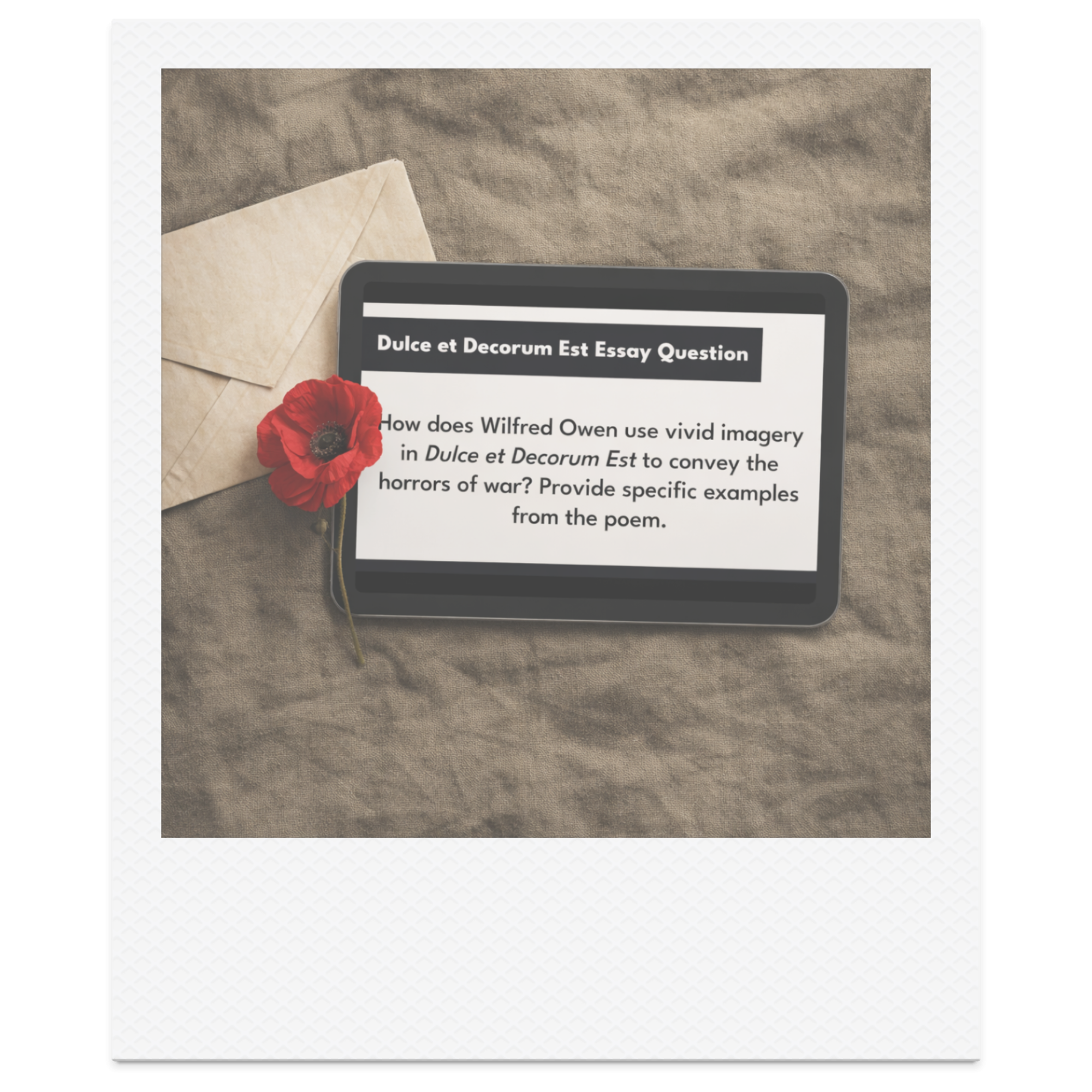
◆ Essay questions that focus on purpose, tone, and moral challenge rather than technique spotting
◆ Short quizzes and retrieval activities that consolidate key vocabulary, imagery, and contextual knowledge
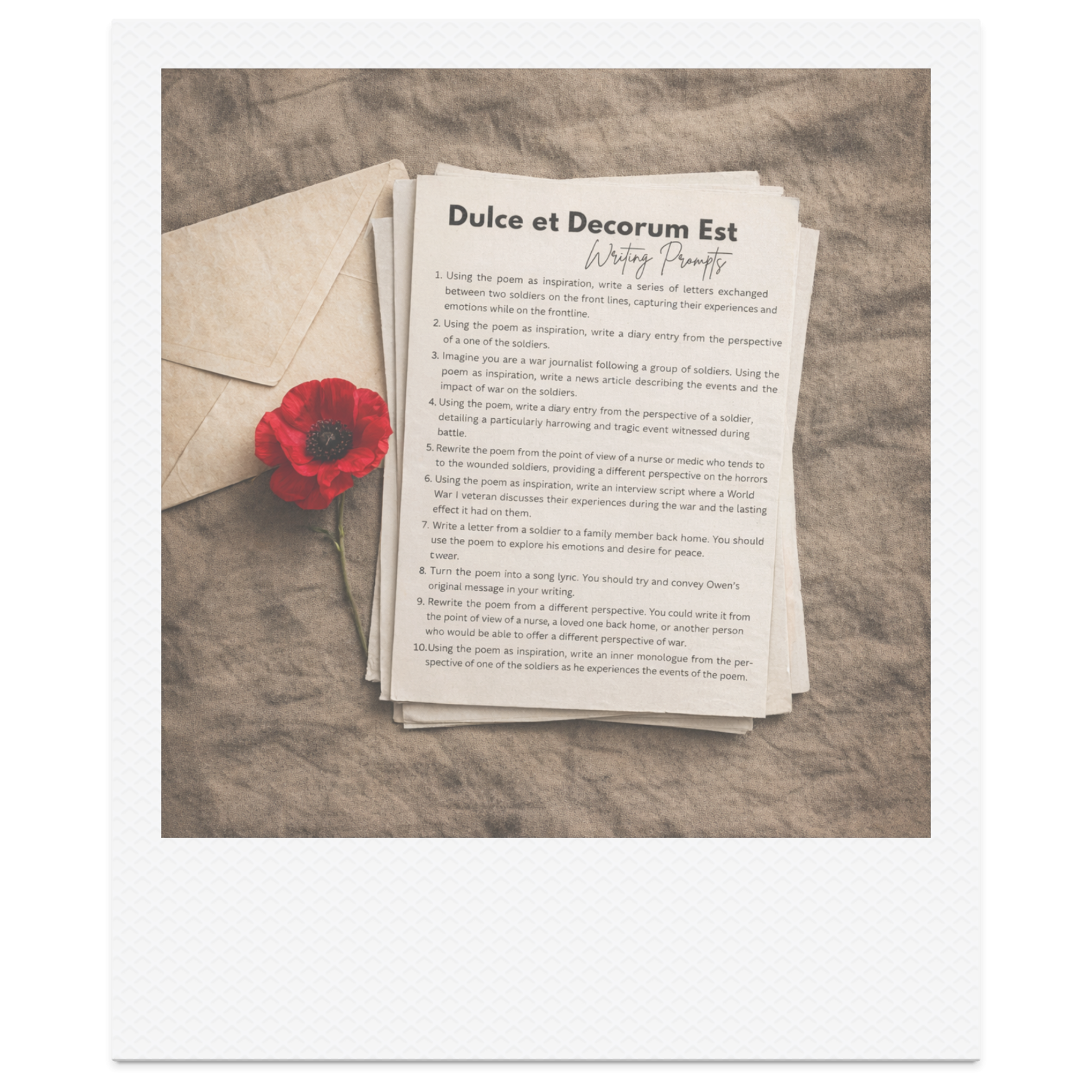
◆ Creative response tasks that encourage reflection while remaining grounded in the poem’s meaning
Used thoughtfully, these approaches help students return to the poem with clarity, tracing how imagery, tone, and address work together to convey Owen’s message.
For teachers looking to support this stage of learning with ready-made, flexible resources, I’ve put together a comprehensive Dulce et Decorum Est Growing Activities Bundle. It includes:
◆ Roll-the-dice discussion boards and silent debate questions to deepen interpretation
◆ Essay questions designed for extended writing and assessment
◆ Digital review quizzes, crosswords, and word searches to reinforce understanding
◆ Creative writing prompts (print and digital) that explore theme and imagery
◆ Atmospheric picture prompts that support descriptive and reflective responses
All resources are adaptable for whole-class teaching, revision, homework, or independent work, and the bundle continues to grow as new materials are added.
Handled carefully, assessment becomes an extension of understanding rather than a reduction of it. When students are assessed on Dulce et Decorum Est with context and purpose firmly in place, their responses reflect not just what the poem does, but why it still matters.
Common Pitfalls When Teaching Dulce et Decorum Est
Even experienced teachers can fall into patterns that unintentionally flatten the power of Owen’s poem. Being aware of these pitfalls helps ensure that Dulce et Decorum Est remains challenging, meaningful, and ethically taught.
◆ Rushing into analysis too early
Beginning with language techniques or exam-style paragraphs before students understand the poem’s context often leads to shallow responses. Without historical and emotional grounding, analysis becomes mechanical rather than meaningful.
◆ Reducing the poem to “anti-war”
While Dulce et Decorum Est is undoubtedly critical of war, treating it as a simple anti-war statement oversimplifies Owen’s purpose. The poem is an accusation — aimed at specific narratives and values — not a general expression of protest.
◆ Treating imagery as shock value
The graphic imagery of the gas attack is not included to provoke horror for its own sake. When taught without care, this section can feel sensationalised or uncomfortable in unproductive ways. Taught well, it reveals the human cost of modern warfare and the moral weight of Owen’s message.
◆ Over-assessing at the expense of understanding
Frequent written assessment can push students towards formulaic responses, encouraging them to write what they think is expected rather than engaging critically with the poem. Discussion, reflection, and guided exploration should come first.
◆ Ignoring the poem’s final address
The final stanza is sometimes rushed or treated as a conclusion rather than the poem’s turning point. Failing to explore who Owen is addressing, and why, weakens students’ understanding of the poem’s moral force.
Avoiding these pitfalls allows Dulce et Decorum Est to be taught with the seriousness and respect it demands — not just as an exam text, but as a poem that challenges how war is remembered, justified, and taught.
Go Deeper into World War One Poetry
Teaching Dulce et Decorum Est often opens the door to wider conversations about war, memory, and truth — and this is where WW1 poetry becomes particularly powerful as a body of work. Reading Owen alongside other poets from the period allows students to see how attitudes to the war shift over time, and how different writers respond to the same conflict in radically different ways.
To deepen students’ understanding of WW1 poetry, it can be useful to:
◆ Compare poems written early in the war with those written later, focusing on how tone, imagery, and purpose change
◆ Explore how commemoration and protest coexist within WW1 writing, rather than treating war poetry as a single viewpoint
◆ Pair poems that uphold traditional ideas of honour with poems that actively challenge them, encouraging students to interrogate language and values
◆ Revisit context repeatedly, showing how historical pressure shapes both form and message
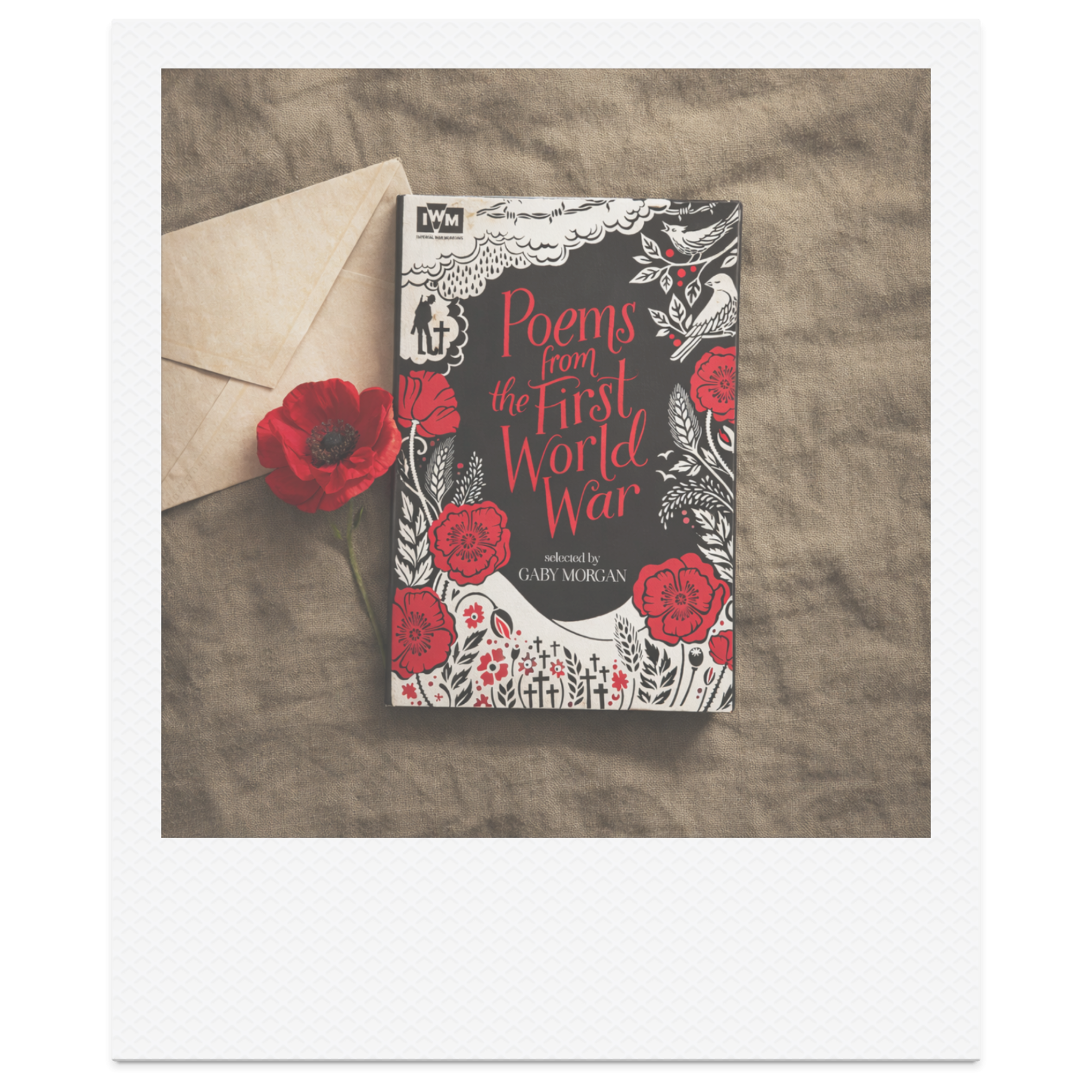
For a wider exploration of key poems from the period, you may also find it helpful to read 10 Best WWI Poems to Teach (And How to Teach Them), which looks at a range of war poems and practical ways to approach them in the classroom. Studying Dulce et Decorum Est as part of a broader poetic conversation helps students recognise that Owen is not writing in isolation, but responding to — and reshaping — an entire literary tradition.
Final Thoughts
Dulce et Decorum Est endures because it refuses to be comfortable. It challenges inherited narratives, confronts readers with the realities of modern warfare, and questions the language used to justify suffering. When taught carefully, it becomes more than a set poem for assessment; it becomes a lesson in how literature can expose truth and resist simplification.
Approaching the poem through context, first response, and purposeful analysis allows students to engage with its moral weight as well as its craft. Rather than memorising interpretations, they learn to read critically, question authority, and recognise how language can both conceal and reveal reality.
Taught well, Dulce et Decorum Est does not just support exam success — it reshapes how students think about war, poetry, and the responsibility of the writer. That is why it continues to hold its place in the curriculum, and why it still matters.
