10 Celestial Poetry Prompts for Teens & Adults: Exploring Stars, Silence, and Scale
Celestial poetry is not about scientific explanation or grand spectacle. At its most effective, it is quiet, precise, and reflective — shaped by distance, scale, and silence rather than drama. Drawing on images of stars, moons, constellations, and night skies, celestial poems explore perspective: how small moments sit against vast time, how light travels long after its source is gone, and how human feeling is altered by looking outward rather than inward.
These celestial poetry prompts for teens and adults are designed to support thoughtful, craft-focused writing in classrooms, writing groups, and independent practice. Each prompt encourages writers to work with imagery, line breaks, and white space, using the language of astronomy and night observation as a way into poems about wonder, isolation, longing, and time. Alongside the prompts, you’ll find writing techniques, suggested opening lines, and ekphrastic poetry images intended to help overcome the blank page and spark ideas rooted in mood rather than narrative.
Whether you’re teaching poetry, developing your own voice, or exploring how scale and distance reshape emotion, these prompts are designed to guide — not overwhelm — the writing process.
If you’re looking for more celestial or space-themed ideas, explore the Poetry Writing Hub or Sci-Fi Writing Hub or browse the Creative Writing Archive for a wider range of prompts and storytelling inspiration.
Short on time?
Scroll down for the 10 celestial poetry prompts, or keep reading for writing techniques and examples to support your work.
How to Approach Celestial Poetry
Writing celestial poetry isn’t about describing stars or naming constellations. It’s about perspective — using the night sky to rethink scale, time, and emotional distance. The most effective celestial poems feel restrained rather than expansive, allowing meaning to emerge through observation rather than explanation.
Begin by grounding your poem in a single point of focus. A moon seen through a window, a constellation half-hidden by cloud, or a satellite crossing the sky can carry emotional weight without commentary. Celestial poetry works best when cosmic imagery is filtered through human limitation — what can be seen, counted, or understood from one place on the ground.
Pay attention to how form reflects scale. Short lines and wide white space can echo distance and silence, while enjambment can suggest motion — orbit, drift, or slow passage. Let the structure of the poem mirror the feeling of looking outward, where meaning unfolds gradually rather than arriving all at once.
Resist the urge to explain the science. Precision in celestial poetry comes from selection, not information. Choose one image, one moment, or one metaphor, and allow it to resonate. A strong ending doesn’t resolve the poem; it widens it, leaving the reader with a sense of space still unfolding beyond the final line.
Above all, approach celestial themes with restraint and curiosity. Focus on awe rather than grandeur, and on the quiet shift in perspective that occurs when the sky reminds us how much lies beyond our immediate reach.
Techniques to Try in Celestial Poetry
Celestial poetry relies on restraint, perspective, and precision. These techniques help writers work with vast ideas — time, distance, the universe — without losing emotional focus. Rather than expanding outward endlessly, each technique encourages control, silence, and intentional choice.
Try one or two at a time, paying attention to how form and imagery shape the reader’s sense of scale.
◆ Distance as Meaning
Let physical distance carry emotional weight. The gap between stars, the time it takes for light to reach Earth, or the impossibility of touch can stand in for longing, separation, or inevitability. Avoid explaining the emotion — let distance imply it.
◆ White Space and Line Length
Use space on the page to suggest silence, scale, or emptiness. Short lines can feel fragile against the vastness of the sky, while longer lines may mimic slow drift or orbit. Allow white space to slow the reader and create stillness.
◆ Enjambment for Motion
Break lines mid-thought to echo movement — orbiting, falling, rotating, or passing overhead. Enjambment prevents closure and keeps the poem in motion, mirroring celestial cycles that never truly end.
◆ Muted or Limited Colour Palette
Restrict colour to deepen atmosphere. Focus on darkness, pale light, silver, shadow, or cold blue tones. Limiting colour prevents spectacle and keeps the poem grounded in mood rather than description.
◆ Time Compression
Collapse vast spans of time into a single moment. A star’s lifespan, an eclipse, or the age of light can be held against one human action or thought, creating tension between the brief and the infinite.
◆ Human Anchors
Balance cosmic imagery with something small and human — a hand on glass, a body lying awake, a voice counting stars. This contrast keeps the poem emotionally accessible and prevents abstraction.
◆ Absence and Uncertainty
Write around what cannot be known. Use questions, incomplete statements, or withheld information to reflect the limits of human understanding. Celestial poetry often gains power from what it refuses to explain.
◆ Second-Person Distance
Using “you” can create intimacy or alienation. Addressing the sky, a star, or an unnamed observer blurs boundaries between the human and the cosmic.
◆ Controlled Metaphor
Limit yourself to one sustained metaphor — orbit, gravity, light, or shadow — and let it carry the poem. Avoid stacking images; repetition with variation is more effective than abundance.
◆ Unresolved Endings
End the poem at a moment of widening rather than closure. A strong celestial ending leaves the reader looking outward, aware that the sky — and the question it raised — continues beyond the page.
Read for Inspiration: Celestial Poetry
Celestial poetry often uses the sky not as spectacle, but as perspective — a way of thinking about time, distance, scale, and human smallness. The poets below engage with stars, planets, light, and space to explore observation, wonder, uncertainty, and quiet existential reflection rather than darkness or dread.
Read these poems for how celestial imagery shapes tone and structure, and for how much is left deliberately unsaid.
◆ Walt Whitman — When I Heard the Learn’d Astronomer
Whitman contrasts scientific explanation with personal awe, showing how direct observation can feel more powerful than knowledge. A strong model for poems that privilege feeling over fact.
◆ Adrienne Rich — Planetarium
A feminist reworking of astronomical history that blends stars, science, and voice. This poem shows how celestial imagery can carry political, personal, and historical meaning without losing lyric restraint.
◆ Seamus Heaney — Lightenings viii
Heaney uses sudden light and sky imagery to explore interruption and perspective. The poem demonstrates how brief celestial moments can reframe human experience.
◆ Derek Walcott — Moon
Walcott’s poem treats the moon as both presence and observer, offering a quiet meditation on time, memory, and repetition. A strong example of sustained, restrained metaphor.
◆ Tracy K. Smith — My God, It’s Full of Stars
Blending science, history, and personal reflection, this poem shows how cosmic imagery can be intimate rather than abstract. Particularly effective for writers interested in time, ancestry, and scale.
◆ Mary Oliver — The Sun
Oliver’s work demonstrates how celestial bodies can be approached with simplicity and wonder, grounding vastness in clarity and attention rather than grandeur.
Choose one or two poems to read closely before writing. Notice how these poets avoid technical explanation, instead using light, distance, and observation to shift perspective.
Celestial poetry often works best when the sky is not the subject — but the lens.
Celestial Poetry Writing Prompts
The celestial poetry prompts below are designed to help writers work with scale, distance, and stillness rather than narrative or explanation. Instead of describing stars or planets literally, these prompts use the night sky as a way to explore time, isolation, wonder, insignificance, and quiet awe — allowing meaning to emerge through image, form, and restraint.
Each prompt encourages writers to focus on atmosphere-driven poetry, using light, darkness, and space as emotional tools. They are suitable for teen and adult writers, classroom poetry units, or independent practice, and work particularly well for short poems that prioritise imagery, line control, and unresolved endings over story.
You can approach the prompts in order or select one that resonates. Focus on capturing a single moment or observation, and let the vastness of the sky do the emotional work.
Celestial Poetry Prompt 1: The Star That Vanished
Write a poem about noticing a star that is no longer there. The focus is not on explanation, but on the quiet disturbance of absence in something you assumed would remain.
Possible opening line:
Last night, there was one less light.
Techniques to try:
Use short lines and white space to emphasise the gap. Keep the language observational, allowing the missing star to suggest meaning without naming what it represents.
Celestial Poetry Prompt 2: Light Older Than Your Life
Write about the moment you realise the light reaching you from the sky began its journey long before you existed. Hold the vastness of time against a small, human detail.
Possible opening line:
This light left before my name did.
Techniques to try:
Anchor the poem in one concrete action (standing at a window, walking home, lying awake). Use enjambment to stretch time across lines without turning the poem into philosophy.
Celestial Poetry Prompt 3: The Sky During a Power Cut
Write a poem set during a blackout, when artificial light disappears and the sky returns in full. Focus on what becomes visible — and what becomes quiet.
Possible opening line:
The street went dark, and the sky answered.
Techniques to try:
Use contrast in imagery: electric glare versus natural light. Let the tone shift gradually, as if the poem is adjusting its eyes, rather than announcing a change.
Celestial Poetry Prompt 4: A Constellation No One Else Sees
Write about a constellation the speaker traces incorrectly on purpose — a pattern that exists only for them. Treat the act of naming as intimate, not factual.
Possible opening line:
I connect the stars differently.
Techniques to try:
Use controlled repetition (a repeated phrase or image that alters slightly). Keep the constellation’s meaning implied through association, not explanation.
Celestial Poetry Prompt 5: Waiting for an Eclipse
Write a poem about anticipation rather than the eclipse itself. Focus on waiting, gathering, looking up, and the peculiar tension of expecting darkness on purpose.
Possible opening line:
Everyone said it would be brief.
Techniques to try:
Slow the poem with caesura and short lines. Let the “event” remain mostly off-page, and build atmosphere through sound, temperature, and stillness.
Celestial Poetry Prompt 6: The Moon Through a Bedroom Window
Write about the moon seen through glass — framed, distant, and unreachable. Let the window act as a boundary between the speaker and the sky.
Possible opening line:
The moon keeps its distance politely.
Techniques to try:
Use a limited colour palette (silver, grey, shadow) to keep the poem restrained. Focus on texture and light, allowing the moon to mirror emotional distance without stating it.
Celestial Poetry Prompt 7: A Message Sent Into Space
Write a poem about sending something outward — a signal, a name, a wish — knowing it may never be received. Keep the poem grounded in the act, not the outcome.
Possible opening line:
I send it anyway, despite the silence.
Techniques to try:
Use second-person address sparingly (speaking to “you” as the unknown recipient, or to the sky itself). End without closure, letting the unanswered message remain suspended.
Celestial Poetry Prompt 8: The Night the Sky Looked Too Close
Write about a night when the sky feels unusually near — as if the distance has thinned. The poem should focus on sensation and unease without turning to horror.
Possible opening line:
The stars feel nearer than they should.
Techniques to try:
Use line breaks that interrupt certainty, creating a slightly unsettled rhythm. Keep imagery precise and physical (pressure, breath, cold air), avoiding dramatic language.
Celestial Poetry Prompt 9: Counting Stars Like a Habit
Write a poem about counting stars the way someone might count worries, days, or losses — not as a game, but as a ritual. Let repetition shape the poem’s emotional logic.
Possible opening line:
One, two — as if it helps.
Techniques to try:
Build repetition with variation, subtly shifting what is being counted. Keep the poem close to the body (hands, eyes, breath) so the cosmic doesn’t become abstract.
Celestial Poetry Prompt 10: The Smallest Thing Under the Biggest Sky
Write about a small, ordinary moment occurring under a vast night sky — a quiet walk, a late train, an unlocked door, a cup left on a step. Let scale reframe the moment without explaining it.
Possible opening line:
Nothing changed, except the size of everything.
Techniques to try:
Use juxtaposition: the mundane detail beside cosmic imagery. Keep the ending unresolved but widened, so the poem finishes with space rather than conclusion.
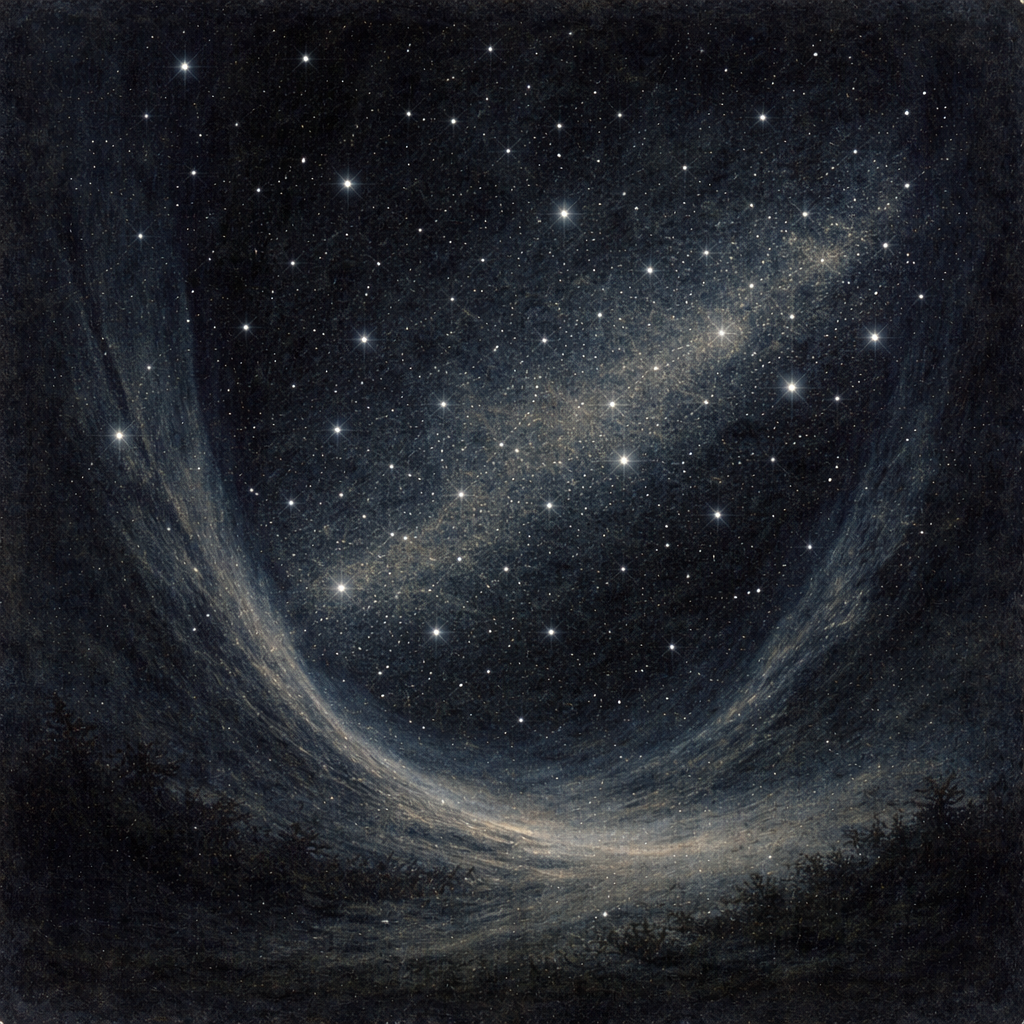
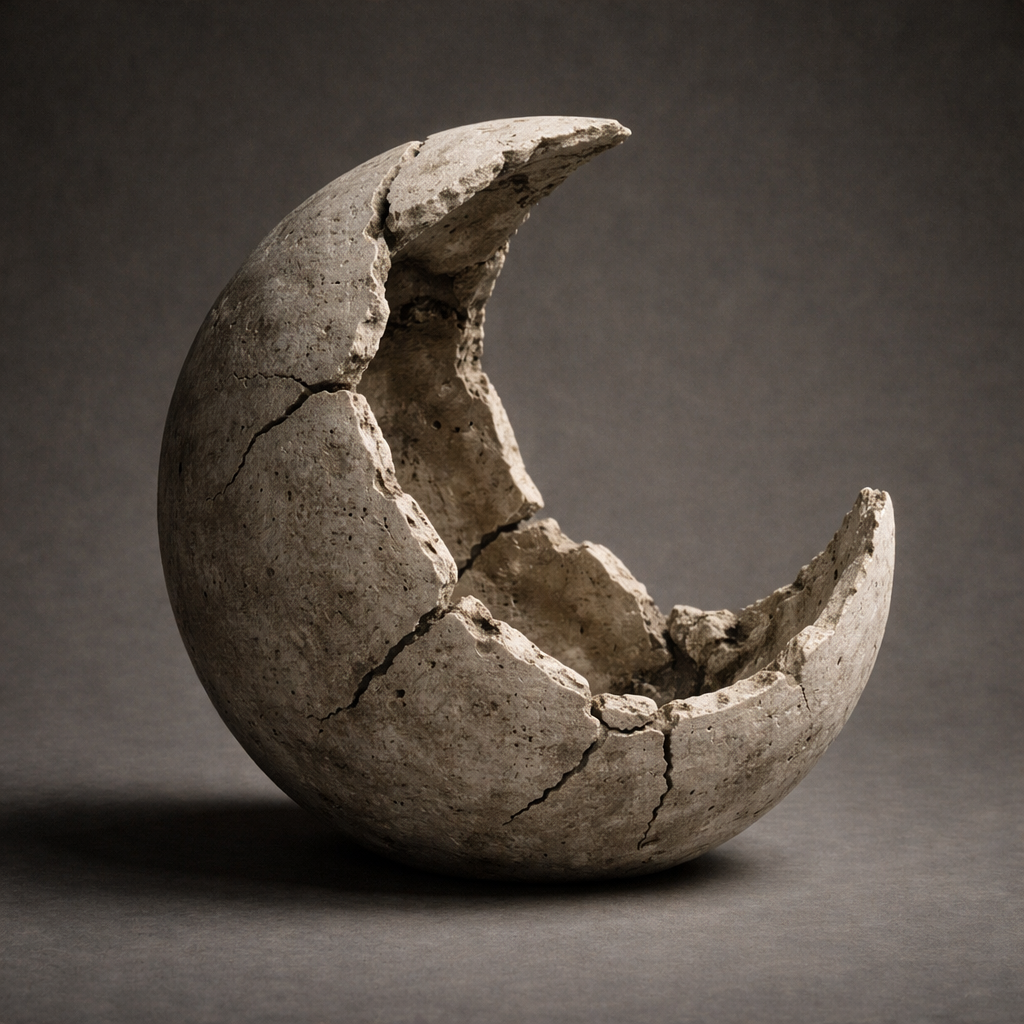
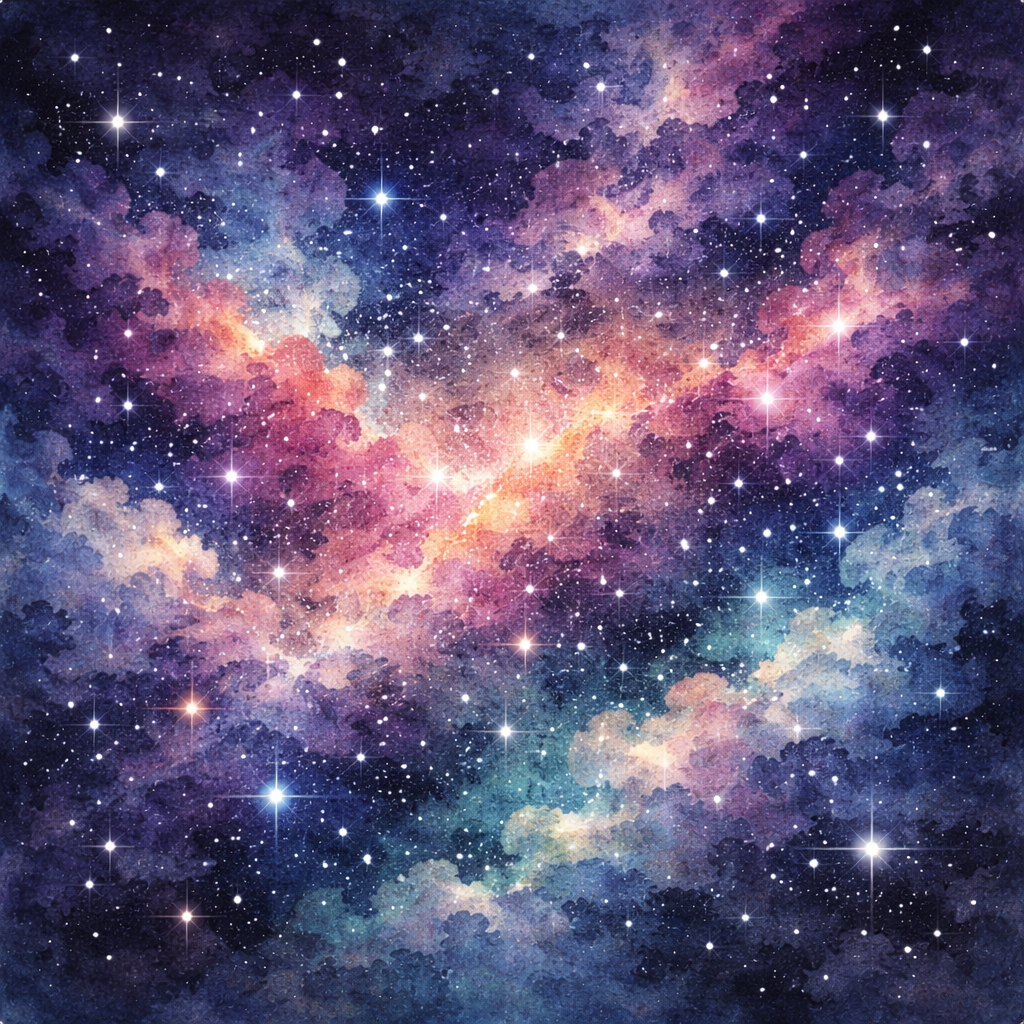
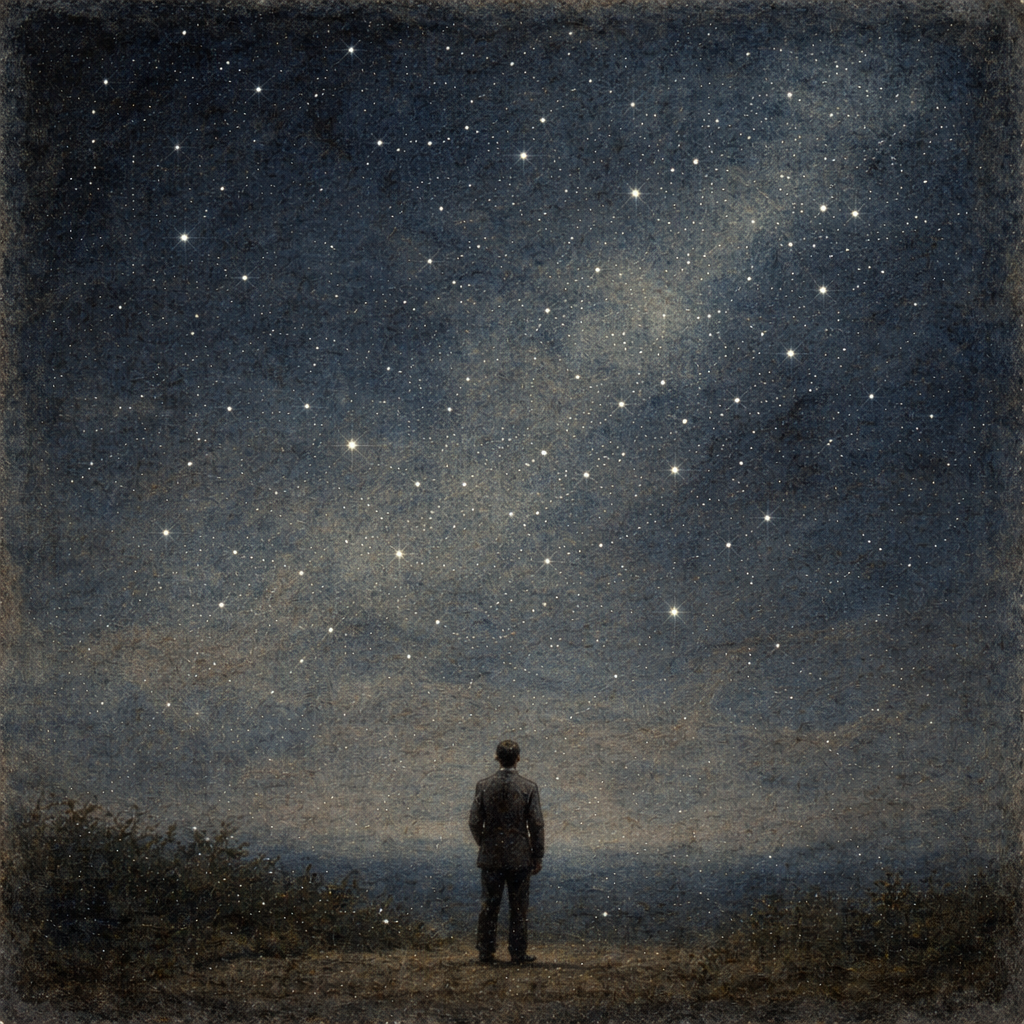
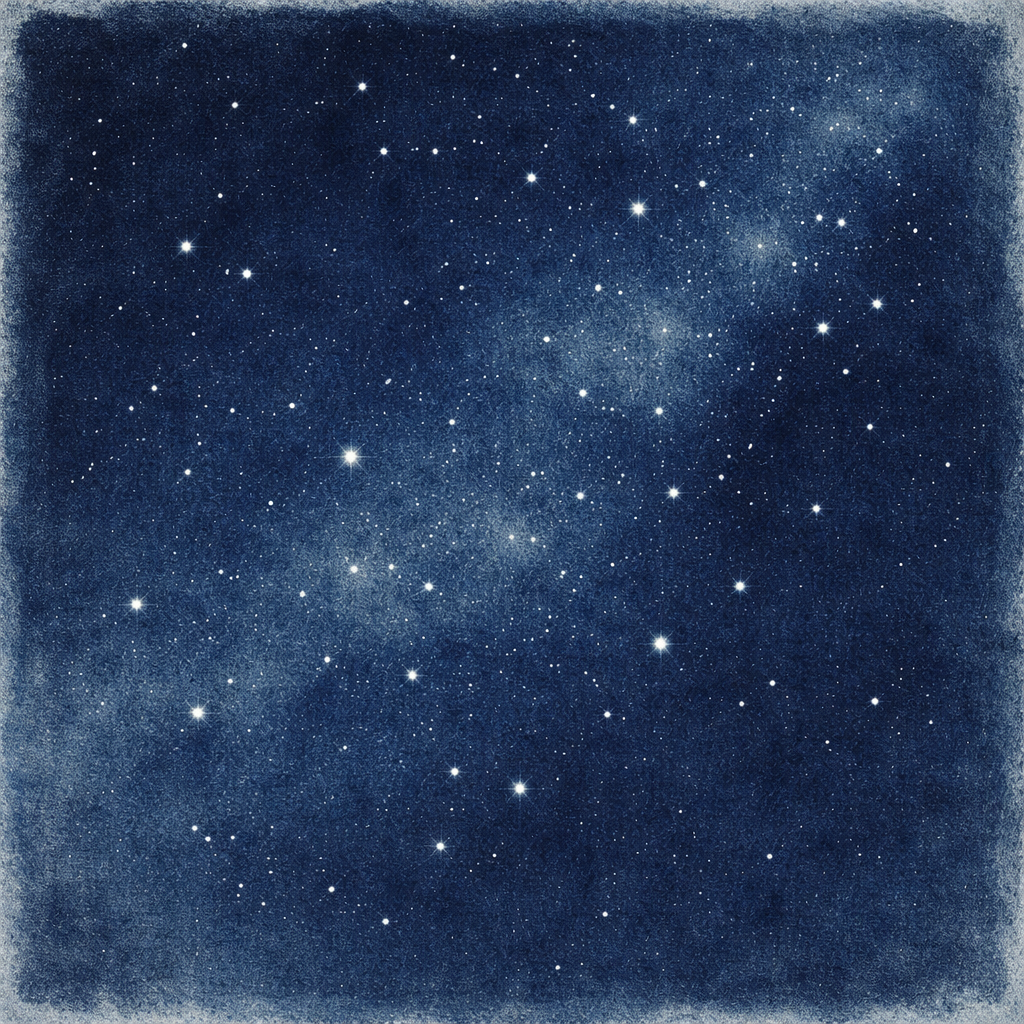
Ekphrastic Poetry: Writing From Celestial Images
Ekphrastic poetry begins with looking — not explaining. When working with celestial imagery, the aim is not to describe stars, planets, or skies accurately, but to respond to the emotional and symbolic weight they carry.
Celestial images often suggest distance, scale, silence, and time beyond the human. Used carefully, they allow poets to explore insignificance, wonder, isolation, hope, or quiet connection without narrative or confession. The strongest celestial poems treat the sky not as spectacle, but as presence — something that watches, waits, or endures.
The images in this collection are designed to support atmosphere-driven poetry rather than literal interpretation. They may include night skies, astronomical diagrams, abstract star fields, lunar surfaces, silhouettes beneath constellations, or historic celestial illustrations. Writers should feel free to move away from what the image “shows” and toward what it suggests.
When writing ekphrastic celestial poetry, try one or more of the approaches below:
◆ Focus on a single detail rather than the whole image — a pinprick of light, a shadowed edge, an absence
◆ Treat the image as a moment before or after something has happened, rather than the event itself
◆ Let the image trigger a question, memory, or unease rather than a description
◆ Write from the perspective of the observer, not the sky — noticing distance, scale, or silence
◆ Allow space on the page to mirror the emptiness or vastness of the image
◆ Avoid naming constellations, planets, or scientific terms unless they serve the poem’s emotional logic
There is no requirement to describe the image directly. A successful ekphrastic poem may only touch the image briefly before moving elsewhere. What matters is the response — how the image alters the speaker’s sense of time, place, or self.
Celestial imagery works best when paired with restraint. Let the image open the door, then step through quietly.
Go Deeper into Celestial Poetry
If these prompts resonated, one of the most effective ways to deepen celestial writing is to move beyond “night sky imagery” and focus instead on scale, distance, and time as craft tools. Celestial poems become stronger when the universe is not a backdrop, but a pressure — something that changes how the speaker thinks, speaks, and measures their own life.
◆ Write one poem that stays entirely grounded on Earth, but uses the sky to alter the speaker’s perspective. Keep the language observational and let meaning emerge through implication rather than statement.
◆ Rewrite a prompt twice: once as a poem of awe, and once as a poem of unease. Use the same image, but shift tone through line breaks, silence, and what the poem refuses to explain.
◆ Practise image discipline. Choose one celestial element — a moon, a single star, an eclipse, a satellite — and return to it throughout the poem instead of adding new images. Celestial writing gains power from restraint, not abundance.
◆ Experiment with white space as scale. Let gaps, short lines, and pauses mirror emptiness and distance. Make the page feel like sky: open, quiet, and difficult to fill.
◆ Use time compression. Place a vast timescale beside something small — a text message, a late walk, a body lying awake — and let the contrast create tension without explanation.
◆ Try writing from an unusual vantage point: a person on a rooftop, a night-shift worker, a driver on an empty road, someone standing outside a hospital, a teenager on the back step at midnight. Keep the poem specific so the cosmic doesn’t become abstract.
◆ End without closure. Celestial poems often work best when they widen rather than resolve — finishing on a line that leaves the reader looking outward, aware of space still unfolding beyond the page.
If you’d like to explore more poetry writing prompts, ekphrastic poetry, and atmosphere-led collections for teens and adults, you can browse the full Creative Writing Archive and choose your next theme.
Final Thoughts
Celestial poetry invites writers to slow down and look outward. By working with stars, light, and distance, these poems shift attention away from certainty and toward perspective — asking what changes when we measure our lives against something vast, silent, and largely unknowable.
You may find that these prompts open differently over time. A sky that feels distant now may later feel intimate. An image that once suggested wonder may begin to carry unease or quiet comfort. That openness is part of the form. Celestial poetry does not rush meaning; it allows it to arrive gradually, or not at all.
If you’d like to continue exploring poetry writing prompts, ekphrastic writing, and atmosphere-led approaches to creative writing, you can browse the full Creative Writing Archive or Poetry Writing Hub to discover related collections shaped by image, mood, and restraint.
If you’re looking for more celestial or space-themed ideas, explore the Sci-Fi Writing Hub.
Write carefully. Leave space. Let the sky do the rest.
Choose Your Next Theme