The Soldier by Rupert Brooke: Meaning, Themes, and How to Teach the Poem
The Soldier by Rupert Brooke is often one of the first war poems students encounter, and for good reason. Its language is clear, its imagery is familiar, and its message feels confident and reassuring. Written at the beginning of the First World War, the poem presents death in service of one’s country as meaningful, noble, and enduring — an idea that reflects early twentieth-century attitudes towards patriotism, sacrifice, and national identity.
For many students, The Soldier offers an accessible entry point into conflict poetry. The poem does not dwell on violence or trauma. Instead, it frames war through ideas of home, belonging, and legacy, allowing readers to engage emotionally before they are asked to question or critique. That clarity makes it particularly effective in the classroom, but it also means the poem benefits from careful teaching that attends to what it assumes as well as what it celebrates.
This post explores the meaning, themes, form, and structure of The Soldier, focusing on how Rupert Brooke presents war before the realities of trench warfare disrupted idealised narratives. Along the way, it offers classroom-focused insight into how the poem works and how it can be taught through discussion and creative response. If you’re looking for ways to help students step inside the poem’s voice and values before moving into analysis, keep reading — there’s a free creative writing resource later in this post designed to support exactly that.
Just a quick note, you’ll find more teaching strategies, prompts, and resources for other set texts in the Literature Library.
Rupert Brooke and Early Attitudes to War
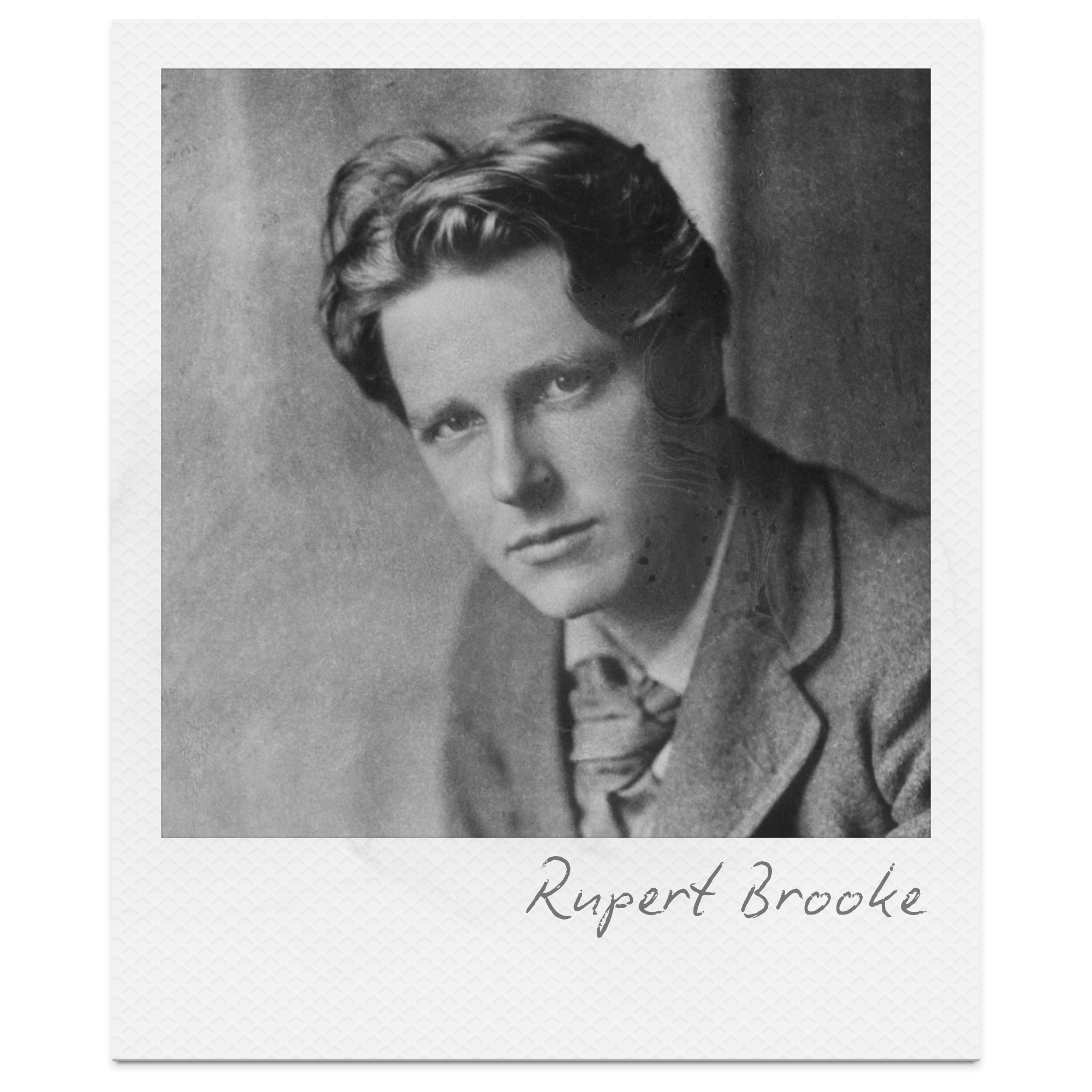
To understand The Soldier by Rupert Brooke, it is essential to place the poem within its historical moment. Brooke wrote during the early stages of the First World War, before the realities of trench warfare, mass casualties, and prolonged combat had fundamentally altered how war was experienced and understood. At this point, conflict was still widely framed through ideas of honour, duty, and sacrifice, rather than trauma or disillusionment.
Brooke himself never fought in the trenches. He died in 1915 from blood poisoning after a mosquito bite while travelling to Gallipoli, and his reputation was shaped as much by his early death as by his poetry. As a result, The Soldier reflects a perspective on war that is idealised rather than experiential. The poem is not written from the battlefield, but from a position of belief — belief in nation, in purpose, and in the redemptive value of sacrifice.
This context matters because it explains the poem’s tone. The Soldier is calm, assured, and resolute. There is no sense of fear, chaos, or moral uncertainty. Instead, death is framed as meaningful and even peaceful, absorbed into the idea of the nation itself. England is not simply a place, but a moral and spiritual presence that gives value to the soldier’s life and death.
In this way, Brooke’s poem captures a set of attitudes that were widely shared at the outbreak of the war. Conflict is imagined as a test of character rather than a source of suffering. Patriotism is presented as natural and sustaining. Sacrifice is not questioned, but accepted as purposeful. These assumptions would later be challenged — and in many cases dismantled — by poets writing from direct combat experience, but The Soldier predates that shift.
Teaching the poem with this context in mind helps students understand that Brooke is not being naïve or evasive. He is articulating a worldview that made sense to many at the time. The poem’s power lies in how confidently it expresses those beliefs — and its limitations lie in what it cannot yet see.
This makes The Soldier an important starting point in the study of war poetry. It captures a moment before doubt enters the literature, before language fractures under pressure, and before certainty begins to fail. Understanding that moment allows students to read the poem on its own terms, while also preparing them to recognise how attitudes to war change as the conflict unfolds.
The Title, Form, and Structure: Certainty, Order, and the Sonnet
From the outset, the title The Soldier signals the poem’s intent. Brooke does not name an individual. Instead, he presents the speaker as representative — a figure who stands in for a wider idea of service, sacrifice, and national identity. The absence of a personal name allows the soldier to become symbolic rather than specific, reinforcing the poem’s confidence and clarity of purpose.
Brooke’s choice of sonnet form further supports this certainty. Traditionally associated with love, devotion, and idealised feeling, the sonnet gives the poem a sense of balance and control. Its regular structure mirrors the poem’s worldview: ordered, harmonious, and resolved. There is no fragmentation or disruption here, and that formal stability reflects the poem’s belief that death in service of one’s country can be absorbed meaningfully rather than resisted or questioned.
Structurally, the poem moves with calm progression rather than tension. The opening octave establishes the idea that the soldier’s death will transform foreign land into England itself, turning loss into permanence. The sestet then shifts inward, focusing on the heart, the mind, and spiritual legacy. This movement from physical body to inner life allows the poem to close not with fear or uncertainty, but with peace.
Importantly, the poem resolves itself fully. There are no unanswered questions, no tonal breaks, and no moments of doubt. Death is presented as purposeful, cleansing, and enduring. The structure reinforces this sense of completion, leaving the reader with a feeling of reassurance rather than unease.
In this way, form and structure are not decorative. They actively uphold the poem’s beliefs. The sonnet contains death, transforms it, and renders it meaningful — reflecting a moment in war poetry before certainty fractured under the weight of experience.
Stanza One: Patriotism, Belonging, and the Idea of Home
The opening stanza of The Soldier by Rupert Brooke establishes the poem’s central belief: that death in war can be absorbed into the idea of home. From the first line, the speaker asks the reader to remember him not as an individual life lost, but as a presence that continues through the land itself. A “foreign field” becomes “for ever England”, transforming unfamiliar ground into something meaningful and familiar.
This transformation is rooted in patriotism, but it is a gentle and idealised form of it. England is not presented as a political power or a military force. Instead, it is associated with nurture and belonging — a place that “bore” the soldier, “shaped” him, and taught him how to live. The repeated references to air, rivers, sunlight, and flowers create an image of England as a life-giving presence rather than an abstract nation.
The soldier’s body is described as “a body of England’s”, suggesting that individual identity is inseparable from national identity. This idea allows death to feel purposeful rather than tragic. The land receives him, and in doing so, England extends beyond its borders. Loss is reframed as continuity.
What is striking about this stanza is what it leaves out. There is no mention of violence, fear, or suffering. War itself is almost absent. The focus remains on memory, belonging, and the reassurance that nothing of value is truly lost. This absence is deliberate, and it contributes to the poem’s calm, confident tone.
For students, this stanza often feels comforting. The language is familiar, the imagery is natural, and the emotional movement is clear. The poem does not demand interrogation at this stage; it invites acceptance. That sense of ease is central to understanding how the poem works — and why it resonated so strongly at the beginning of the war.
Stanza One presents death not as an end, but as a form of return. The soldier is not leaving England behind; he is becoming part of it. And within the poem’s worldview, that transformation feels complete and unquestioned.
Stanza Two: Sacrifice, Legacy, and Peace
The second stanza of The Soldier by Rupert Brooke turns inward. Having established how the soldier’s body will belong to England, the poem now focuses on what remains of him beyond the physical — his heart, his thoughts, and his spirit. This shift allows the poem to move from place to legacy, and from national identity to inner life.
The heart is described as having “all evil shed away”, suggesting that death purifies rather than destroys. War does not damage the soldier’s moral self; instead, it removes corruption and leaves something refined. This reinforces the poem’s idealism. Conflict is not shown as traumatic or brutal, but as a process that leads to spiritual clarity.
Brooke presents the soldier’s thoughts as returning to England, “giv[ing] somewhere back the thoughts by England given.” This circular movement is crucial. Nothing is lost. What England shaped and nurtured is returned intact. Memory becomes a form of continuity, allowing the soldier to live on through shared culture, friendships, and everyday experiences — “laughter,” “gentleness,” and familiar sights and sounds.
The stanza ends with an image of peace. Hearts are “at peace, under an English heaven,” closing the poem with calm resolution rather than uncertainty. Death is not feared or resisted. It is accepted as meaningful, purposeful, and serene. There is no suggestion of doubt, regret, or unfinished business.
As with the opening stanza, what stands out is what the poem chooses not to acknowledge. There is no suffering, no disruption, and no questioning of sacrifice. The poem does not ask whether this vision of war is sustainable or realistic. Instead, it offers reassurance — a belief that life, identity, and values endure beyond death.
Stanza Two completes the poem’s emotional and philosophical arc. Where the first stanza transforms land into home, the second transforms death into legacy. Together, they present a vision of war that is ordered, confident, and resolved — a vision that reflects the moment in which the poem was written, and prepares the ground for later poets who would begin to question it.
What the Poem Believes — and What It Does Not Question
The Soldier by Rupert Brooke is built on a series of clear, confident beliefs. The poem assumes that patriotism is natural and sustaining, that sacrifice carries meaning, and that death in war can be absorbed into a larger idea of national and spiritual continuity. These beliefs are not argued for; they are presented as self-evident.
Within the poem’s worldview, England is a moral presence that shapes identity and gives life purpose. The soldier does not lose himself in war. Instead, he becomes more fully part of something enduring. Death is framed as peaceful, cleansing, and complete. There is no suggestion that sacrifice might be wasted or that belief might fail.
At the same time, the poem leaves important questions unasked. It does not acknowledge violence, fear, or physical suffering. It does not consider the impact of war on those left behind, nor does it explore the possibility that national ideals might fracture under pressure. The poem offers no space for doubt, conflict, or moral unease.
This does not make The Soldier dishonest. It makes it historically situated. Brooke is articulating a set of attitudes that felt coherent and persuasive at the beginning of the war, before prolonged combat and mass loss altered how sacrifice was understood. Reading the poem with this in mind allows students to appreciate its conviction without mistaking it for the whole story.
Importantly, the poem does not invite interrogation from within. Its language is harmonious, its structure is controlled, and its tone is resolute. Questioning enters only when the poem is placed alongside other voices — later poets, different perspectives, or lived experience.
This is what makes The Soldier such a valuable teaching text. It models belief clearly and sincerely, while also creating space for comparison. Students can engage with what the poem affirms, and then begin to consider how those affirmations hold up once war is experienced rather than imagined.
In doing so, The Soldier becomes not just a poem about war, but a record of how war was once understood — and why that understanding would later be challenged.
Teaching The Soldier Through Creative Response
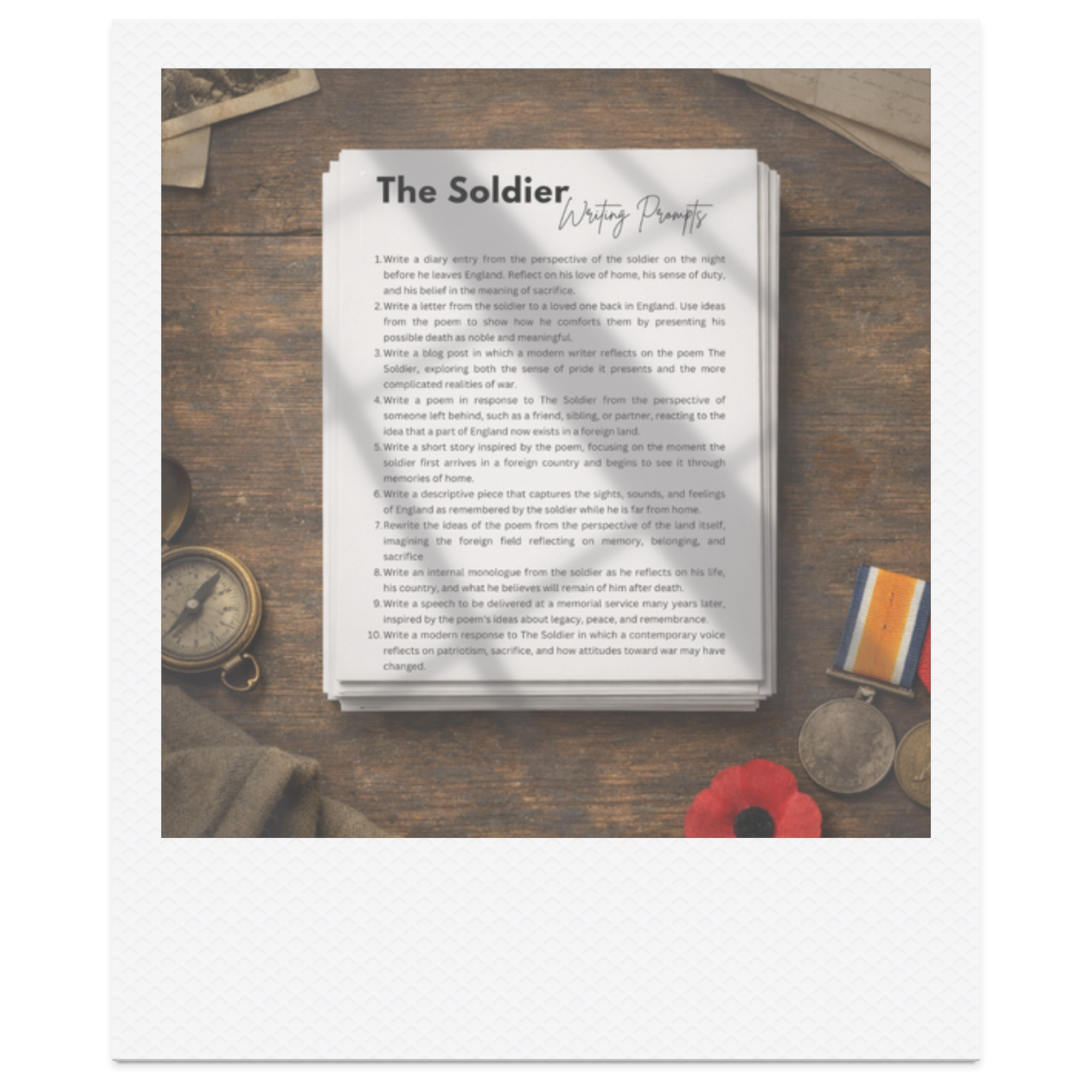
Because The Soldier by Rupert Brooke presents its ideas with such confidence and emotional clarity, it works particularly well when taught through creative response before formal analysis. The poem speaks in a single, assured voice, and inviting students to step inside that voice helps them understand its beliefs from the inside, rather than treating them as abstract ideas to decode.
Creative approaches are especially effective here because the poem does not invite doubt or interrogation on its own. Instead, it offers certainty. Writing within that certainty first allows students to recognise how the poem constructs meaning — and prepares them to reflect more thoughtfully on its assumptions later.
I often teach The Soldier using short, focused creative tasks that explore voice, identity, and legacy. These tasks are designed to deepen understanding, not replace analysis.
◆ Writing from the soldier’s perspective
Letters, diary entries, or reflective monologues allow students to articulate how the poem frames duty, belonging, and peace.
◆ Exploring ideas of home and identity
Creative responses that focus on place help students connect personally with the poem’s presentation of national identity and belonging.
◆ Thinking about legacy and remembrance
Tasks centred on how the soldier wishes to be remembered reinforce the poem’s emphasis on continuity rather than loss.
◆ Responding before questioning
Allowing students to write within the poem’s worldview first makes later discussion about what the poem believes — and what it does not question — far more meaningful.
To support this approach, I’ve created a free set of creative writing prompts for The Soldier, designed specifically to help students engage with the poem’s voice and values before moving into analysis. The prompts are available via the email sign-up form included in this post and can be used flexibly for lessons, homework, or exploratory writing.
Simply enter your email address below to access the resource.
Used this way, creative response becomes a bridge rather than a detour — supporting emotional engagement while building the confidence and language students need for deeper discussion and written interpretation.
Go Deeper into The Soldier
Once students have a secure understanding of The Soldier by Rupert Brooke, the poem works best as a starting point rather than a conclusion. Its confidence, clarity, and lack of doubt make it an ideal foundation for exploring how attitudes to war change once conflict is experienced rather than imagined.
Going deeper with The Soldier is most effective when students are encouraged to compare belief with later uncertainty, and to recognise how early war poetry frames sacrifice before its consequences become visible.
◆ Use the poem as a baseline for comparison
Return to The Soldier after studying later conflict poems and ask students what feels missing. This encourages reflection on how violence, fear, and trauma reshape poetic voice and purpose over time.
◆ Track how certainty gives way to doubt
Invite students to identify where The Soldier offers reassurance and where later poems resist it. This helps students see war poetry as a conversation across time rather than isolated texts.
◆ Explore how ideas of sacrifice evolve
Compare Brooke’s confident presentation of sacrifice with poems that question whether loss is justified, remembered, or forgotten. This supports discussion around responsibility and consequence without moralising.
◆ Shift focus from nation to individual experience
Use The Soldier as a contrast text when introducing poems written from direct combat experience or reflective distance, encouraging students to notice how voice, imagery, and tone change as perspective shifts.
◆ Encourage thematic pairings rather than chronology alone
Pair The Soldier with poems that explore aftermath, witnessing, or moral unease to help students recognise that conflict poetry develops through contrast as much as through time.
For teachers looking to place The Soldier within a wider sequence, it fits naturally into a broader exploration of conflict poetry across time. I explore this progression in more detail in 20 Conflict Poems to Teach: A Timeline from WW1 to Modern Warfare, where poems are grouped to show how war poetry moves from early idealism to disillusionment, reflection, and ethical questioning.
Seen in this wider context, The Soldier becomes more than a patriotic poem. It becomes a reference point — a way for students to understand what war poetry believed before experience complicated those beliefs.
Final Thoughts
The Soldier by Rupert Brooke remains a powerful poem not because it questions war, but because it captures a moment when belief still felt possible. Its confidence, order, and clarity reflect a set of ideas about patriotism, sacrifice, and national identity that shaped how conflict was understood at the beginning of the First World War.
In the classroom, this makes The Soldier both accessible and revealing. Students often connect quickly with its imagery of home and belonging, and its calm presentation of death offers reassurance rather than discomfort. When taught thoughtfully, the poem allows students to explore how meaning is constructed — and how certainty can be sustained through language, form, and tone.
At the same time, The Soldier gains depth when it is read alongside other conflict poems. Placed within a wider tradition of war poetry, its assumptions become visible, not as flaws to dismiss, but as beliefs shaped by context and expectation. The poem does not ask the questions that later poets would raise, but that absence is precisely what gives it significance.
Approached with care, The Soldier becomes more than an early war poem. It becomes a point of reference — a way for students to recognise how attitudes to conflict shift as experience replaces idealism. In doing so, it prepares them not only to read later poems with greater insight, but to understand how literature records belief, doubt, and change over time.
That clarity, and the quiet confidence with which it is expressed, is what continues to make The Soldier such a valuable text to teach.
Choose Your Next Text