100 Poetry Prompts for the Classroom: Teen-Friendly and Teacher-Tested
Finding the right poetry writing prompt can unlock a poem. Whether you’re exploring how to write poetry, planning lessons for National Poetry Month, or looking for engaging poetry writing activities for students, strong prompts give writers something concrete to begin with — an image, an idea, a line, or a feeling worth shaping into language.
This collection of 100 poetry writing prompts is designed for teens but works just as well for beginners, classrooms, and independent writers. The prompts support a wide range of approaches to writing poetry, from quick creative warm-ups and journaling to more developed pieces that focus on imagery, voice, form, and meaning.
For even more inspiration, explore the Poetry Writing Hub or visit the Creative Writing Archive, where hundreds of additional prompts, picture prompts, story ideas, character collections, and writing resources are waiting to be discovered.
If you’d like free poetry writing resources — including blackout poetry, ekphrastic prompts, and fragment-led writing tasks — you can sign up here to download them at no cost.
Below, you’ll find 100 poetry prompts, organised into 10 teacher-friendly categories. Some are personal, some playful, some designed for deeper reflection. Each prompt can stand alone or be expanded into a full poetry writing lesson.
1. Identity & Memory
Prompts that help students reflect on identity, memory, and personal experiences through poetry.
Write a poem titled "I Am From..."
Describe a sound from your childhood and how it still lives in you
Write about an inherited object or family tradition
Describe your name as if it were a season
Write a letter to your past self, in poem form
Begin with: “No one told me that...”
Write about a moment you felt like a stranger — or completely at home
Write a poem using only memories tied to food
Use a photo from your childhood as a jumping-off point
Tell a coming-of-age story in ten short lines
2. Imagery-Driven
Prompts that build sensory-rich poems through vivid detail and imagery.
Describe a place using only sounds
Write a color as if it were a living creature
Use all five senses to write about the first five minutes of your morning
Write a poem in which every line starts with “I see...”
Describe an everyday object as if it were sacred
Write about a storm using only texture
Create a poem that smells like a season
Describe a shadow in three sensory images
Write a poem titled "The Taste of Fear"
End every stanza with the same image, slightly changed each time
3. Strange & Surreal
Prompts that let students invent, dream, and bend the rules of reality through poetry.
Write from the point of view of the moon during a solar eclipse
Imagine you’ve woken up with someone else’s memories
Describe a town where everyone only speaks in metaphors
Write a poem where gravity has stopped working
Create a weather forecast for a day in your dream world
Start with: “Today, my shadow left me.”
Write a poem where time is melting
Imagine a vending machine that gives out emotions
Describe a forest that has one rule no one can break
Write a breakup poem from the perspective of a ghost
4. Social & Political
Voice-driven poetry prompts for students exploring opinion, perspective, and lived experience.
Write a poem that starts with a question you wish adults would ask
Begin with: “This is the part they don’t show in history class”
Write a poem from the perspective of protest graffiti
Use repetition to emphasize an injustice or truth
Write a letter-poem to your future generation
Begin with: “They told me not to speak...”
Write about a law, rule, or unspoken norm you’ve had to live with
Tell a story through the voice of a bystander
Write a praise poem to resistance, even if it’s quiet
Use a newspaper headline as your title
5. Nature & Environment
Poetry prompts grounded in the natural world — both literal and metaphorical.
Describe a season as if it were a person
Write about an animal you’ve never seen in real life
Imagine a city slowly being overtaken by plants
Write a weather report that doubles as a mood
Begin with: “The river doesn’t remember me...”
Write a poem entirely from a tree’s perspective
Choose a natural element (ice, fog, fire) and give it a voice
Describe a storm without using the word "storm"
Write about the last wild place you’ve been
Use a constellation as a metaphor for something personal
6. Sound & Structure
Form-based prompts that stretch rhythm, repetition, and style.
Write a poem with only questions
Use a chorus or refrain every third line
Write a list poem that slowly shifts into a story
Try a golden shovel using a favorite lyric
Create a poem where each stanza begins and ends with the same word
Write in two voices: opposites or reflections
Start and end with the same line, but make it mean something different
Write a palindrome poem (same lines in reverse order)
Use internal rhyme in every line
Write a poem with no adjectives or adverbs — only nouns and verbs
7. Emotion-Based
Use emotion as a frame — but come at it sideways.
Describe the color of anger without naming the feeling
Write a love poem to something overlooked
Begin with: “The last time I felt brave...”
Turn envy into a monster and describe it
Write about joy as if it were a place
Describe heartbreak as a machine
Write a poem that gets louder with each stanza
Use metaphor to explain fear to someone who’s never felt it
Write about an emotion that changed you over time
Write about silence as an emotional space
8. Object & Place Poems
Tangible jumping-off points with deep potential.
Write a poem from the perspective of your shoes
Describe a room that no longer exists
Choose a single object on your desk and turn it into a myth
Write about the most important place you can’t go back to
Write an ode to something disposable
Begin with: “This is where it happened.”
Imagine the secret life of a backpack
Write a poem that lives inside a drawer
Use the blueprint of a house as a metaphor for memory
Write about a doorway and what waits behind it
9. Quick Constraints & Challenges
Short, fast, or rule-based prompts that work well under time pressure.
Write a 5-line poem using only one-syllable words
Create a poem without the letter “e”
Write a poem in 10 minutes with no erasing
Use only concrete nouns — no abstract language
Write a haiku with a twist ending
List 10 unrelated objects and write a poem connecting them
Create a "found" poem using a text message or email thread
Write a poem using only questions from a quiz or test
Cut up an old poem you wrote and rearrange it into something new
Write a poem in two columns — two perspectives, one page
10. Ekphrastic (Art-Inspired) Prompts
Use visual art as a starting point for voice, tone, and story.
Choose a painting and describe what's happening just outside the frame
Write a monologue from a figure in a famous painting
Describe a sculpture as if it were waking up
Use a photograph as a metaphor for memory
Write about a piece of art you’ve never seen in person
Choose an artwork and respond in a love letter, argument, or apology
Imagine you’re a tour guide lying about what the art means
Write a poem in the voice of the canvas
Respond to the mood of a photo with a completely opposite poem
Use this public domain art gallery as your prompt library. Pick an image and write a poem about it.
Go Deeper into Poetry Writing
If you want to develop these poetry prompts further, try approaching them in ways that deepen meaning, precision, and voice rather than simply producing more lines. Strong poetry writing often comes from how something is said — through image, sound, structure, and omission — rather than what is explained directly.
◆ Revisit a completed poem and remove explanatory lines, allowing imagery and metaphor to carry the meaning instead.
◆ Rewrite a poem by focusing on one sensory detail only (sound, texture, light, or movement) and letting it shape the entire piece.
◆ Experiment with fragmentation — broken lines, isolated phrases, white space — to reflect memory, distance, or emotional tension.
◆ Rewrite a poem twice: once as a complete narrative, and once as a series of fragments or moments, noticing how meaning shifts.
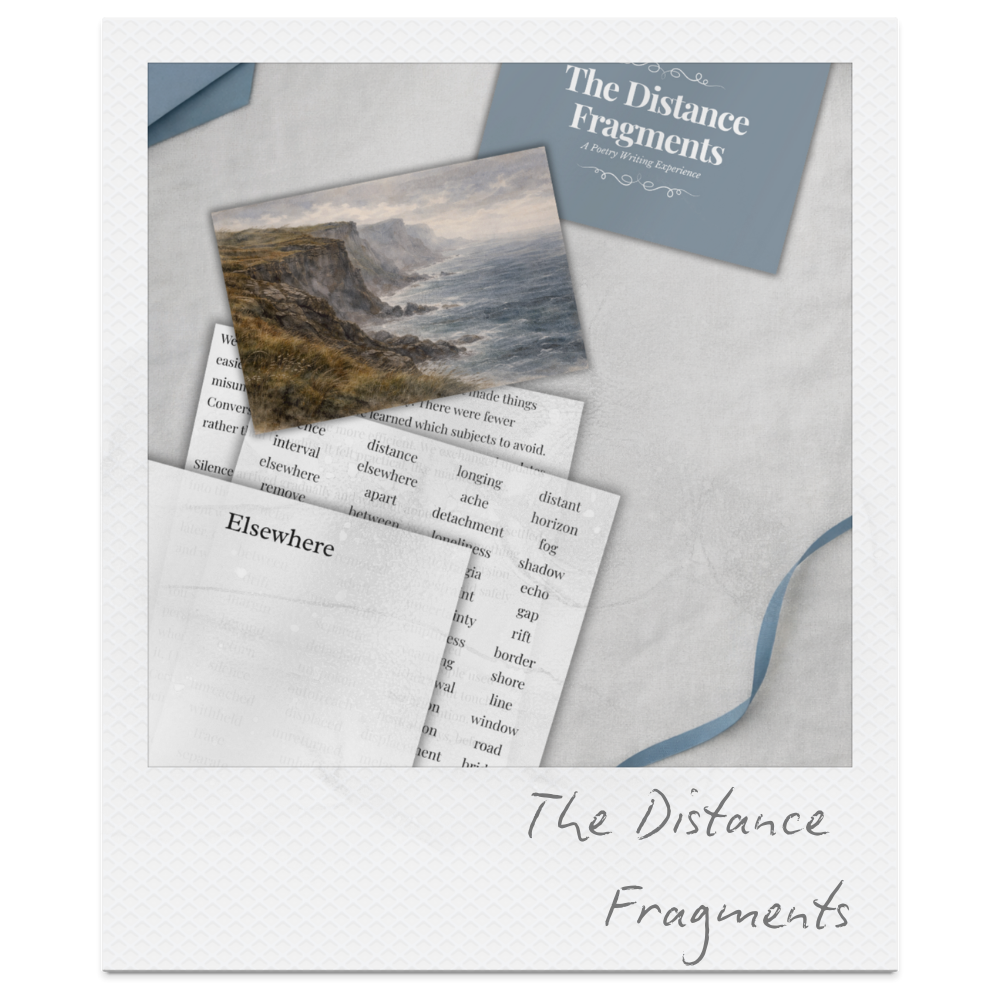
For writers interested in poetry that works through absence, restraint, and emotional space, The Distance Fragments offers a natural extension. This free, fragment-led poetry resource explores distance, longing, memory, and what exists between moments rather than what is fully stated. It’s especially effective for writers developing subtle, image-driven poems where meaning accumulates gradually rather than resolving neatly.
Final Thoughts
Poetry writing isn’t about finding the perfect words — it’s about learning how language carries feeling, image, rhythm, and thought. From personal reflection and vivid imagery to surreal ideas, social voices, and formal experimentation, poetry gives writers space to explore meaning in flexible, powerful ways.
These poetry writing prompts are designed to help teen writers practise imagery, voice, structure, and emotional clarity while building confidence with poetic language. Whether used as quick writes, journaling prompts, classroom activities, or the starting point for longer pieces, each prompt supports meaningful creative exploration rather than surface-level responses.
For even more inspiration, explore the Poetry Writing Hub or visit the Creative Writing Archive, where hundreds of additional prompts, picture prompts, story ideas, character collections, and writing resources are waiting to be discovered.
Choose Your Next Theme