The Ultimate Guide to Ekphrasis (for Secondary Classrooms)
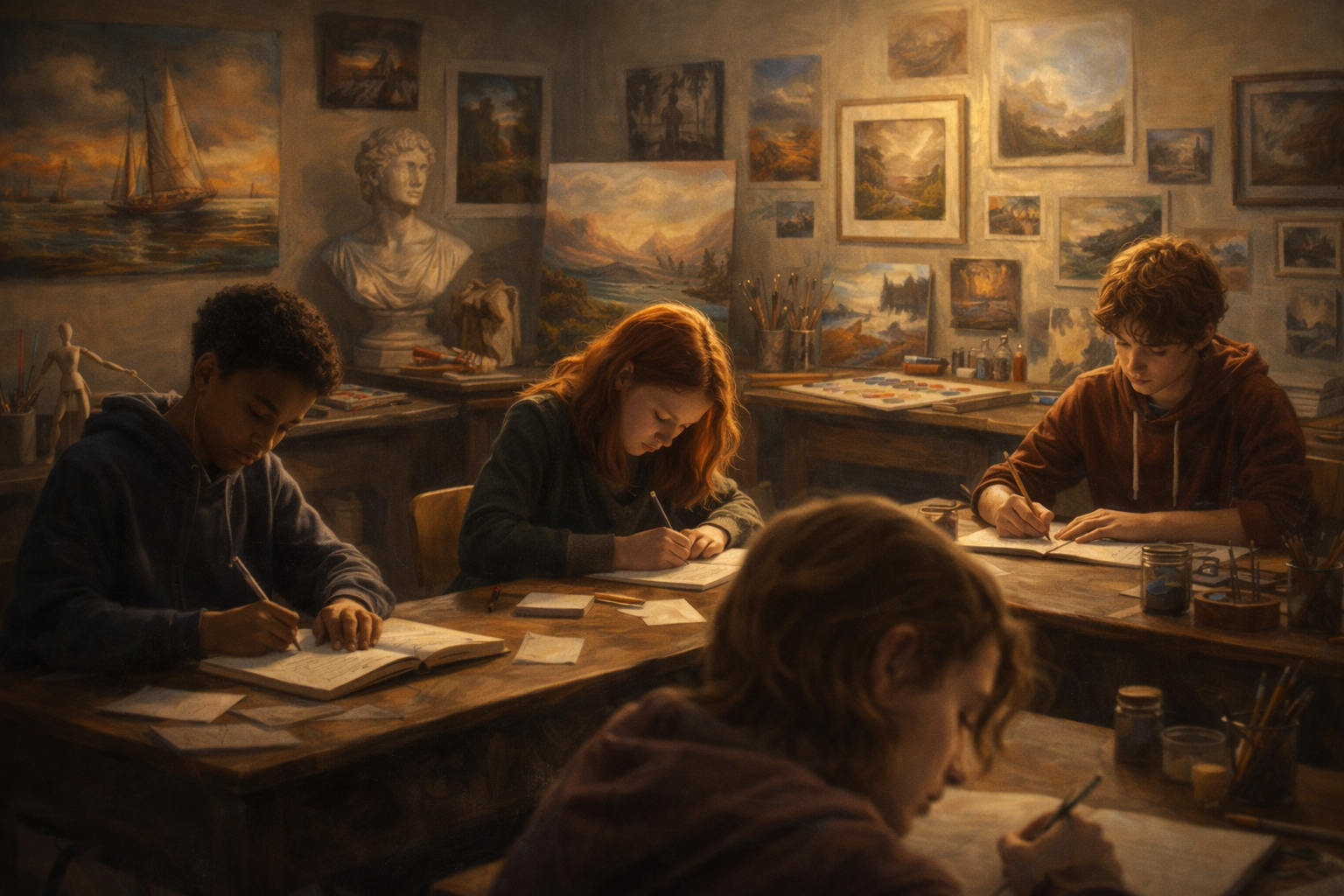
Ekphrastic writing is one of the most powerful ways to connect language and visuals — and it works beautifully in middle and high school classrooms. Whether you’re teaching poetry, creative writing, or trying a cross-curricular unit with Art, this guide will give you everything you need to bring ekphrasis to life.
You’ll find clear definitions, literary and student-level examples, classroom activities for both poetry and prose, and ideas for integrating art, photography, and museum work. Perfect for ELA teachers, creative writing instructors, and anyone who wants students to write with imagination and voice.
If you’d like free classroom resources for ekphrastic writing, including blackout poetry and fragment-led prompts, you can sign up here to download them free.
Looking for even more ways to get students writing? Try our Poetry Writing Activities for the Classroom, 100 Poetry Prompts, or explore this curated image bank for ekphrastic writing — packed with art, photography, and AI-generated visuals to spark creativity.
What Is Ekphrasis?
Ekphrasis (also spelled ecphrasis) comes from the Greek ek (out) and phrazein (to speak). At its core, it's writing that vividly describes a visual work of art. In classrooms, we expand this to include any creative response to visual stimuli — a painting, sculpture, photo, or even a moment in film.
It can take the form of:
◆ A poem responding to a painting
◆ A short story inspired by a photograph
◆ A journal entry written in the voice of a sculpture
◆ A monologue addressed to a figure in an image
The goal? To bring image and imagination together — and give students a new, layered way to observe, interpret, and write.
A Brief History of Ekphrasis (and Why It Still Matters)
Ekphrasis isn’t a trend — it’s one of the oldest forms of writing we have. The roots go all the way back to Homer’s Iliad, where he describes the detailed scenes etched into Achilles’ shield. That moment — where writing stops to dwell on art — is one of the earliest and most famous examples of ekphrastic description.
Later, poets like John Keats embraced ekphrasis to reflect on beauty, mortality, and time. His Ode on a Grecian Urn doesn’t just describe the vase — it becomes a meditation on what art can capture that life cannot.
W.H. Auden’s Musée des Beaux Arts responds to Bruegel’s painting Landscape with the Fall of Icarus, using the quiet background details to explore human indifference. And in more recent years, writers across genres have continued the tradition — using photos, sculpture, and multimedia as fuel for both poetry and prose.
Why bring this into the classroom? Because ekphrasis teaches students how to:
◆ Observe closely and write descriptively
◆ Make connections between art, language, and lived experience
◆ Use imagination as a bridge between disciplines
◆ Engage with visual culture in a deeper, more personal way
It’s not just writing about art. It’s writing through art — and often, discovering something unexpected on the other side.
Why Teach Ekphrasis? (Creative and Cross-Curricular Wins)
Ekphrastic writing pulls together everything we want students to do: look closely, think deeply, and write meaningfully. Whether they’re analyzing a painting or inventing a backstory for a photo, students are practicing essential skills — with creativity at the center.
Here’s what makes it so powerful in the classroom:
◆ It strengthens visual literacy. Students learn to read images with nuance and intention — a crucial skill in today’s media-heavy world.
◆ It encourages personal voice. Whether responding to a sculpture or snapshot, students bring their own interpretation and emotion to the page.
◆ It bridges disciplines. Art teachers, ELA teachers, and creative writing instructors can all share ownership. Ekphrasis lives naturally between subjects.
◆ It deepens descriptive writing. Students move beyond vague language and generalizations — they have something real to describe, interpret, and transform.
◆ It invites all learners in. You don’t have to be “good at writing” to write about art. The image becomes a starting point that lowers the barrier to entry.
This makes ekphrasis ideal for collaborative units, gallery visits, museum partnerships, or even art-infused warm-ups in a standard poetry unit. Students aren’t just writing about art — they’re in dialogue with it.
Examples of Ekphrastic Writing (Classic and Classroom-Ready)
A well-chosen example helps students understand what ekphrasis is — and what it can do. Here are several standout pieces, from canonical works to student-accessible models, that illustrate the range of ekphrastic writing.
“Ode on a Grecian Urn” by John Keats
Inspiration: An ancient Greek vase
Why it’s powerful: Keats doesn’t just describe the urn — he reflects on the scenes it holds, frozen in time. He writes about lovers who never quite kiss, music that’s never played, and joy that never fades. It’s a classic meditation on art’s ability to preserve moments that life inevitably moves past.
Classroom tip: Read it aloud, then ask students to describe an object that “holds” a moment in time
The Shield of Achilles (from The Iliad, Book 18) by Homer
Inspiration: A detailed visual on the hero’s shield
Why it’s powerful: This early example of ekphrasis is vivid and cinematic. Homer describes a blacksmith god crafting scenes of cities, wars, and festivals onto a shield — turning a weapon into a tapestry of human experience.
Classroom tip: Invite students to use the description to sketch what they think the shield looks like, or get them to sketch their own “shield” with symbolic imagery, then write about it.
“Musée des Beaux Arts” by W.H. Auden
Inspiration: Landscape with the Fall of Icarus by Pieter Bruegel the Elder
Why it’s powerful: Auden uses the painting to explore how tragedy often unfolds unnoticed. While Icarus falls into the sea, the world keeps turning — ploughmen keep ploughing, ships keep sailing. It’s a masterclass in tone and subtext.
Classroom tip: Pair the poem with a viewing of the painting; ask students what stories the background characters might tell.
“My Last Duchess” by Robert Browning
Inspiration: A fictional portrait
Why it’s powerful: This dramatic monologue is spoken by a powerful man showing off a painting of his late wife. It’s subtle, sinister, and dripping with implication — what isn’t said is just as important as what is.
Classroom tip: Use it to introduce voice, unreliable narrators, or inference.
“Photograph from September 11” by Wislawa Szymborska
Inspiration: A news photograph of falling bodies during the World Trade Center attack
Why it’s powerful: Szymborska focuses on the frozen moment in the photograph — people caught mid-fall, suspended. She does not sensationalize; instead, she dwells in the image’s stillness and humanity.
Classroom tip: Handle with care and context. Useful for upper secondary students discussing ethics, media, or stillness in poetry.
“The Starry Night” by Anne Sexton
Inspiration: The Starry Night by Vincent van Gogh
Why it’s powerful: Sexton turns van Gogh’s famous painting into a deeply personal meditation on mental illness, chaos, and longing. Her voice blends observation with emotional honesty, and the poem becomes a kind of prayer.
Classroom tip: Pair poem and painting. Ask students to choose a painting and write a poem that overlays personal experience with visual detail.
“Girl Powdering Her Neck” by Cathy Song
Inspiration: A woodblock print by Kitagawa Utamaro
Why it’s powerful: Song uses delicate imagery and calm detail to mirror the style of the Japanese print — but she also suggests quiet sadness, performance, and restraint. It’s a great example of tone matching subject.
Classroom tip: Invite students to choose an artwork from a different culture and write in a voice or tone that mirrors its style.
“Not My Best Side” by U.A. Fanthorpe
Inspiration: St. George and the Dragon by Paolo Uccello
Why it’s powerful: This witty poem gives voice to three characters from a Renaissance painting — the knight, the dragon, and the damsel — and lets each one tell their side of the story. It’s sharp, funny, and totally accessible.
Classroom tip: Show the painting, then assign students characters in pairs or groups. Have them write short monologues or poems in response.
“Self-Portrait” by Edward Hirsch
Inspiration: The idea of self as image
Why it’s powerful: Rather than describing a specific artwork, Hirsch treats the self as a canvas — fragmented, incomplete, and evolving. It’s abstract, metaphorical, and shows that ekphrasis doesn’t always need to begin with something literal.
Classroom tip: Have students write a “self-portrait” poem, describing themselves as an artwork (unfinished, layered, weathered, etc.).
“Standing Female Nude” by Carol Ann Duffy
Inspiration: A painting of a nude woman by a male artist
Why it’s powerful: Duffy writes from the perspective of the model — not idealized, not silent, but painfully aware of how she’s being seen. The poem critiques class, gender, and the power imbalance between artist and subject, all in direct, conversational language.
Classroom tip: Use this as a model for voice poems. Ask students to choose a visual subject and write as if they’ve been painted, photographed, or objectified — and now get to speak back.
10 Ekphrastic Writing Activities for the Classroom
These activities go far beyond “write a poem about a painting.” They’re flexible, creative, and designed for middle and high school students — with crossovers into Art, Drama, History, and Creative Writing.
1. Reverse Ekphrasis: Create the Art from the Poem
How it works: Instead of starting with an artwork, students begin with a piece of ekphrastic writing (e.g. Ode on a Grecian Urn, Standing Female Nude, or The Starry Night). They interpret the text visually and produce the artwork they think inspired it — through drawing, collage, sculpture, or digital tools.
Why it works: Deepens literary analysis, encourages close reading, and makes abstract poems feel tangible.
2. Memory Suitcases: Poems as Personal Still Life
How it works: Use a memory-based poem (e.g. Duffy’s In Mrs Tilscher’s Class) as a model. In English, students write poems about a formative memory or influence. In Art, they create a symbolic suitcase or box containing objects that represent that memory.
Why it works: This is more metaphorical than traditional ekphrasis, but deeply connected. Students are creating a personal “still life” or “installation” that becomes both source and response — art and poem in conversation.
3. Gallery Walk Quick Writes
How it works: Display a series of artworks around the room (or digitally). Students rotate through, jotting short creative responses at each: lines of poetry, flash fiction starters, dialogue, or observations.
Why it works: Builds confidence with low-stakes, high-engagement writing. Great warm-up or transition activity.
4. Persona Poem or Monologue
How it works: Students choose a figure in an artwork — central or background — and write in their voice. This could be a poem, a dramatic monologue, or a short interior narrative.
Why it works: Encourages empathy, strengthens voice, and connects visual storytelling to literary craft.
5. Dual Genre Challenge
How it works: Students respond to a single artwork with both a poem and a prose piece. For example: a haiku from the subject’s point of view, and a short story imagining what happened before or after the moment.
Why it works: Reinforces genre awareness, structure, and tone. Ideal for creative writing classes or end-of-unit portfolios.
6. Found Voices: Writing from Historic Photographs
How it works: Give students documentary or archival photos (e.g. from the Library of Congress or National Archives). They choose one and write a fictional diary entry, poem, or letter from a person in the image.
Why it works: Connects writing to real-world history, builds observation skills, and supports cross-curricular integration with social studies.
7. Compare the Image, Contrast the Response
How it works: Show students two artworks with similar subjects (e.g. two portraits, two landscapes, two mythological scenes). They choose one to write about — then reflect on why it spoke to them more than the other.
Why it works: Teaches critical decision-making and comparative analysis while centering creativity.
8. Curate Your Own Exhibit
How it works: Students select 3–5 related artworks (theme, color, emotion, time period) and create a mini "exhibit" with a written guide: poem, story, or caption for each image.
Why it works: Encourages synthesis, theme development, and student choice. Ideal for digital slideshows, gallery walks, or final projects.
9. Soundtrack to a Painting
How it works: Students choose an artwork and imagine a musical playlist or soundtrack to accompany it. Then, they write a poetic or narrative piece that connects visual and musical mood.
Why it works: Activates cross-sensory thinking and appeals to music-loving students. Helps deepen tone and atmosphere in writing.
10. AI, Apps, and Augmented Ekphrasis
How it works: Use AI image generators (like DALL·E), museum apps, or creative platforms like Google Arts & Culture. Students can generate, remix, or curate art to use as inspiration for their writing, or use examples of ekphrasis to write prompts and generate AI art.
Why it works: Keeps the task contemporary, integrates tech meaningfully, and offers endless visual prompts for hybrid or digital classrooms.
Final Thoughts
Ekphrastic writing unlocks something special in the classroom: a chance for students to slow down, look closely, and speak back to the world they see. Whether they’re writing poems to paintings, stories from sculpture, or inventing voices for forgotten figures in photographs, they’re developing creative confidence — and connecting disciplines in the process.
This guide is designed to be something you return to: for a single lesson, a week-long unit, or a cross-curricular project. Bookmark it, share it with your Art or History colleagues, and most of all — make it your own.
If you’d like to go further, you can sign up to download free poetry writing resources, including ekphrastic prompts, blackout poetry, and fragment-led activities you can use straight away in secondary classrooms.
Need more inspiration? Explore our Poetry Writing Activities for classroom-tested ideas that pair beautifully with ekphrasis. Or browse our Ekphrastic Image Library — a growing collection of paintings, photographs, and AI visuals ready to prompt writing in any genre.
