The Chimney Sweeper by William Blake: Summary, Themes & Analysis
William Blake’s The Chimney Sweeper presents a powerful critique of child exploitation, religious hypocrisy, and social injustice, using the voice of a vulnerable child to expose the harsh realities of poverty and labour. The poem centres on a young chimney sweeper, whose innocence is contrasted with the suffering he experiences, creating a striking tension between appearance and reality. Through symbolism, voice, and irony, Blake reveals how those in positions of authority justify and ignore this suffering.
At its core, the poem explores how systems of power—particularly family, religion, and society—work together to normalise injustice. The child’s voice appears simple and even accepting, but this creates a deeper irony, as the reader recognises the cruelty behind his situation. Blake uses this contrast to challenge the idea of moral righteousness, suggesting that those who believe they are doing good are, in fact, complicit in harm. The poem’s impact comes from how it exposes this contradiction, encouraging the reader to question accepted beliefs about morality, happiness, and responsibility.
If you are studying or teaching Songs of Ourselves Volume 1 for CIE English Literature (0475), you can explore in-depth analyses of every poem from the 2026 and 2027 Paper 1 syllabus in our our Songs of Ourselves: Volume 1 Hub or a wider range of texts and resources in the Literature Library.

Context of The Chimney Sweeper
The Chimney Sweeper appears in Songs of Innocence and Experience (1794), where William Blake explores the contrast between innocence and experience. This poem is the counterpart to an earlier poem with the same title from Songs of Innocence, but it presents a much darker perspective. Instead of offering comfort or hope, this version shows a child who has become aware of the reality of his situation, suggesting a loss of innocence and a deeper understanding of suffering and injustice.
The poem reflects the historical reality of child chimney sweepers in eighteenth-century England, who were often forced into dangerous and exploitative labour at a very young age. Blake uses this context to criticise not only the treatment of children, but also the role of religion and authority in justifying that treatment. The reference to the parents going “to the church to pray” highlights a key tension: while they appear morally responsible, they are complicit in their child’s suffering. This exposes a wider social problem, where institutions such as the Church and the state maintain systems of inequality. Through this, the poem becomes a critique of how society suppresses natural joy and replaces it with hardship, while still presenting itself as moral and just.
The Chimney Sweeper: At a Glance
Form: Dramatic monologue / lyric poem
Mood: Bitter, ironic, accusatory
Central tension: The child’s apparent acceptance and “happiness” versus the reality of exploitation and suffering
Core themes: Child labour and exploitation, religious hypocrisy, innocence vs experience, social injustice, appearance vs reality
One-sentence meaning: Blake uses the voice of a child chimney sweeper to expose how society and religion justify exploitation, showing that apparent happiness can mask deep injustice.
Quick Summary of The Chimney Sweeper
The poem begins with the image of a “little black thing among the snow,” immediately presenting the child as isolated and dehumanised. His cry of “’weep! ’weep!” suggests both his work as a chimney sweeper and his suffering. When questioned about his parents, he explains that they have gone to church, introducing the idea that those who should protect him are absent and disconnected from his reality.
As the poem develops, the child reflects on his past, recalling that he was once “happy upon the heath” and free. However, this natural joy has been replaced by exploitation, as he has been forced into labour and dressed in the “clothes of death.” Despite this, he has been taught to sing, suggesting that his suffering has been normalised and disguised, creating a contrast between outward expression and inner reality.
In the final stanza, the child exposes the full extent of this injustice. He explains that because he appears happy, others believe they have done him no harm. The reference to “God and his Priest and King” reveals that religion and authority are complicit in maintaining this system. The poem ends with a powerful sense of irony, showing that society creates a false “heaven” while ignoring the suffering it causes, reinforcing the idea that appearance can hide deep injustice.
Title, Form, Structure, and Metre of The Chimney Sweeper
The form of The Chimney Sweeper is deceptively simple, but this simplicity is central to its meaning. William Blake uses a controlled, almost childlike structure to present deeply uncomfortable ideas about exploitation, innocence, and social injustice, creating a contrast between how the poem sounds and what it reveals.
Title
The title The Chimney Sweeper immediately directs attention to the child’s role rather than his identity. This reduces him to his labour, suggesting a loss of individuality. Readers familiar with Blake’s work may also recognise that this poem is paired with another of the same name, but here the focus is much darker. Instead of offering comfort, the title prepares the reader for a poem that exposes the reality behind the role, showing how the child is defined by work, suffering, and social neglect.
Form and Structure
The poem is made up of three quatrains, giving it a clear and regular shape. However, within this simple structure, Blake creates a shift in voice. The opening lines introduce an observer who notices the child and asks about his parents, before the poem moves into the child’s response. This shift allows the reader to hear directly from the chimney sweeper, making his experience more immediate and personal.
The poem also develops through contrast. The child describes a past where he was “happy upon the heath,” which is set against his present condition in the “clothes of death.” This contrast reflects the wider idea of innocence versus experience, showing how natural joy has been replaced by suffering. The final stanza intensifies this by exposing the role of authority figures, ending the poem with a direct and critical statement rather than resolution. This creates a sense of discomfort, as the poem refuses to offer any comforting conclusion.
Rhyme Scheme and Poetic Pattern
The poem’s rhyme scheme shifts between stanzas, reflecting changes in voice and tone. The first stanza follows a clear AABB pattern:
snow (A)
woe (A)
say (B)
pray (B)
This creates a simple, nursery rhyme-like sound, which contrasts with the seriousness of the subject. The neat couplets give a sense of control, even though the content suggests suffering.
In the second stanza, the pattern becomes more varied (CACA), which disrupts the earlier regularity. This shift reflects the movement into the child’s perspective and suggests a less controlled, more complex emotional reality.
Blake also uses half rhyme to deepen meaning. The pairing of “heath” and “death” is not a perfect rhyme, creating a slight disruption in sound. This reflects the loss of harmony between the child’s past happiness (“heath”) and his present suffering (“death”), reinforcing the idea that something is wrong or incomplete.
In the final stanza, the rhyme continues to shift (EFEF), maintaining the song-like quality while also preventing full resolution. The repeated sounds, particularly around “woe,” create a sense of echo, reinforcing the idea that the child’s suffering is ongoing.
Overall, the changing rhyme scheme moves from apparent simplicity to subtle instability, mirroring the poem’s shift from surface innocence to deeper experience and critique.
Metre and Rhythmic Movement
The metre of the poem is relatively loose, but generally follows a pattern of four beats per line, often using iambic and anapaestic rhythms. This creates a flowing, almost musical quality that reflects the idea of the child “singing” his suffering.
For example, a steady, controlled rhythm appears in:
They CLOTHED | me IN | the CLOTHES | of DEATH
The regular stress pattern here creates a serious, measured tone, reinforcing the weight of the child’s experience.
In contrast, lighter, more flowing rhythms appear in:
And beCAUSE | I am HAP- | py and DANCE | and SING
The quicker movement of the line reflects energy and movement, echoing the idea of childhood joy. However, this creates irony, as this “happiness” is shown to be misunderstood by others.
Blake also uses rhythm to emphasise emotion. The repeated cry:
“weep! ’weep!”
creates a heavy, stressed sound that draws attention to the child’s suffering, while also reflecting how his voice has been shaped by his work.
Overall, the metre supports the poem’s central contrast. The song-like rhythm reflects childhood and innocence, while the content reveals exploitation and experience. This tension between sound and meaning strengthens the poem’s impact, making its criticism of society more powerful.
The Speaker in The Chimney Sweeper
The speaker in The Chimney Sweeper is primarily the child chimney sweeper—the “little black thing among the snow”—but the poem begins with a brief intervention from an unnamed adult observer. The opening question, “Where are thy father and mother? say?” introduces this voice, which notices the child’s suffering. However, this speaker quickly disappears, acting only to prompt the child’s response. The focus then shifts entirely to the chimney sweeper, whose voice carries the rest of the poem.
The child’s voice is simple but perceptive, revealing more than it first appears. Unlike the earlier version of the poem in Songs of Innocence, this speaker shows clear awareness of his situation. He explains that his parents have gone to church, highlighting their absence and neglect. This creates a strong sense of irony, as those who should care for him are instead part of the system that allows his suffering.
The tone of the speaker is particularly complex. At times, he appears outwardly “happy”, claiming that he can “dance and sing.” However, this contrasts sharply with the reality of his condition, suggesting that this happiness is either forced, misunderstood, or used to justify his exploitation. This tension between what the speaker says and what the reader understands creates a powerful sense of dramatic irony.
By the final stanza, the speaker becomes more direct and critical, identifying “God and his Priest and King” as responsible for maintaining the system that exploits him. The phrase “make up a heaven of our misery” captures this contradiction clearly, exposing how authority figures present themselves as moral while benefiting from suffering. This shows the speaker’s growing sense of awareness and insight.
There is also a suggestion that the speaker represents more than just one individual. The reference to the “clothes of death” hints at how his identity has been shaped—or even erased—by his labour. This creates the possibility that the voice stands for a wider experience of child exploitation and social injustice.
Overall, the speaker is both vulnerable and insightful. His childlike voice makes the poem accessible, but his understanding exposes the deeper hypocrisy of society, showing how innocence has been replaced by experience and awareness of injustice.
Stanza-by-Stanza Analysis of The Chimney Sweeper
This section explores how William Blake develops meaning step by step, focusing on how each stanza builds the poem’s critique of child exploitation, religious hypocrisy, and social injustice. Through imagery, voice, and contrast, the poem moves from observation to a powerful exposure of how suffering is ignored and justified.
Each stanza will be analysed closely, showing how Blake uses method → purpose → impact to shape the reader’s understanding and create a lasting emotional and moral response.
Stanza 1: Isolation and Irony
“A little black thing among the snow,
Crying "weep! 'weep!" in notes of woe!
"Where are thy father and mother? say?"
"They are both gone up to the church to pray.”
Blake immediately creates a striking image through contrast. The phrase “little black thing” reduces the child to something almost object-like and dehumanised, while the whiteness of the “snow” highlights his vulnerability and isolation. This visual contrast emphasises how the child stands out as neglected and out of place, reinforcing the theme of social exclusion.
The cry “’weep! ’weep!” works on multiple levels. It reflects the child’s job as a chimney sweeper (unable to pronounce “sweep”), but also acts as a direct expression of suffering and distress. The repetition creates a sense of ongoing pain, while the phrase “notes of woe” links his voice to something almost musical, suggesting that his suffering has been turned into something routine or expected.
The introduction of the adult speaker through the question “Where are thy father and mother?” highlights the child’s abandonment. However, the response—“gone up to the church to pray”—introduces irony. The parents appear morally responsible, engaging in religious devotion, but are actually neglecting their child’s suffering. This creates a powerful criticism of religious hypocrisy, as those who believe they are doing good are complicit in injustice.
Overall, this stanza establishes the poem’s central ideas through imagery, contrast, and irony, presenting a child who is visibly suffering while the society around him continues as if nothing is wrong.
Stanza 2: Lost Innocence and Forced Suffering
“Because I was happy upon the heath,
And smil'd among the winter's snow,
They clothed me in the clothes of death,
And taught me to sing the notes of woe.”
In this stanza, the child reflects on his past, creating a clear contrast between natural happiness and his present suffering. The image of being “happy upon the heath” suggests freedom, openness, and a connection to nature, while “smil’d among the winter’s snow” reinforces a sense of innocence and joy despite hardship. This establishes what childhood should be, making his current condition more disturbing.
The shift comes sharply with “They clothed me in the clothes of death,” a powerful metaphor that suggests both physical and symbolic harm. On a literal level, it may refer to the soot-covered uniform of the chimney sweeper, but it also implies a loss of identity and vitality. The phrase suggests that the child has been forced into a role associated with danger, suffering, and even early death, reinforcing the idea that his childhood has been taken from him.
The verb “clothed” is significant, as it suggests something imposed upon him rather than chosen. This highlights the lack of agency the child has, emphasising how adults control and shape his life. This idea continues in “taught me to sing the notes of woe,” where suffering is not only experienced but learned and repeated. The word “taught” suggests a deliberate process, as if the child has been trained to accept and even express his own misery.
There is also a strong sense of irony in the idea of “singing” sorrow. Singing is usually associated with joy, but here it becomes a way of expressing pain. This creates a disturbing contrast, showing how the child’s suffering has been normalised and disguised as something acceptable.
Overall, this stanza deepens the poem’s critique by showing how innocence is replaced with experience, and how society actively shapes children to accept their own exploitation.
Stanza 3: Irony, Responsibility, and Social Critique
“And because I am happy and dance and sing,
They think they have done me no injury,
And are gone to praise God and his Priest and King,
Who make up a heaven of our misery.”
In the final stanza, Blake intensifies the poem’s critique through irony and direct accusation. The claim “I am happy and dance and sing” appears positive on the surface, but it is deeply ironic. The child’s outward behaviour is used by others as proof that he is unharmed, revealing how easily suffering can be ignored when it is not openly resisted. This highlights the theme of appearance versus reality, as happiness becomes something that masks exploitation.
The line “They think they have done me no injury” exposes a disturbing misunderstanding. The verb “think” suggests a deliberate self-deception, where adults convince themselves that they are not responsible. This reinforces the idea that society avoids confronting its own cruelty by relying on visible signs of compliance rather than recognising real suffering.
Blake then broadens the criticism to include wider systems of power. The reference to “God and his Priest and King” uses a tricolon to group together religion, authority, and the state, suggesting that all are involved in maintaining this system. The verb “praise” contrasts sharply with the child’s condition, creating a powerful sense of hypocrisy, as those who appear morally righteous are actually complicit in injustice.
The final line, “make up a heaven of our misery,” is particularly striking. The phrase suggests that authority figures construct an idea of “heaven” that depends on the suffering of others. The collective pronoun “our” widens the scope beyond one child, implying that this is a shared experience of exploitation. This creates a powerful and unsettling conclusion, showing that society not only allows suffering but relies on it while presenting itself as just and moral.
Overall, this stanza delivers the poem’s strongest message, using irony, contrast, and direct criticism to expose how systems of power justify and sustain injustice.
Key Quotes and Methods in The Chimney Sweeper
This section explores how William Blake uses key quotations to present ideas about child exploitation, religious hypocrisy, and social injustice, focusing on technique → purpose → impact.
“A little black thing among the snow”
◆ Technique: Imagery and dehumanisation
◆ Meaning: The child is reduced to an object rather than a person
◆ Purpose: Emphasises loss of identity and neglect
◆ Impact: Creates a striking visual contrast that highlights isolation and vulnerability
“’weep! ’weep!”
◆ Technique: Repetition and phonetic spelling
◆ Meaning: Reflects both the child’s cry and his job as a chimney sweeper
◆ Purpose: Shows how his identity is shaped by labour and suffering
◆ Impact: Reinforces the child’s vulnerability and makes his distress memorable
“notes of woe”
◆ Technique: Metaphor
◆ Meaning: The child’s suffering is presented as something sung or performed
◆ Purpose: Suggests that pain has been normalised and repeated
◆ Impact: Creates discomfort by linking suffering with something musical or routine
“They are both gone up to the church to pray”
◆ Technique: Irony
◆ Meaning: The parents appear morally responsible but neglect their child
◆ Purpose: Criticises religious behaviour that ignores real suffering
◆ Impact: Highlights hypocrisy and challenges the idea of moral righteousness
“happy upon the heath”
◆ Technique: Symbolism and contrast
◆ Meaning: Represents freedom, innocence, and natural joy
◆ Purpose: Establishes what childhood should be like
◆ Impact: Makes the child’s present suffering more shocking and unjust
“clothes of death”
◆ Technique: Metaphor / symbolism
◆ Meaning: Suggests both the soot-covered uniform and the danger of the job
◆ Purpose: Links the child’s work to loss of life and identity
◆ Impact: Creates a dark, unsettling image that emphasises exploitation
“taught me to sing the notes of woe”
◆ Technique: Irony and metaphor
◆ Meaning: The child has been trained to express his own suffering
◆ Purpose: Suggests that exploitation is learned and reinforced by society
◆ Impact: Highlights how suffering is normalised and accepted
“I am happy and dance and sing”
◆ Technique: Dramatic irony
◆ Meaning: The child claims happiness despite clear suffering
◆ Purpose: Shows how outward behaviour can be misinterpreted
◆ Impact: Creates tension between what is said and what the reader understands
“They think they have done me no injury”
◆ Technique: Diction and irony
◆ Meaning: Adults believe they are not responsible for harm
◆ Purpose: Reveals self-deception and avoidance of guilt
◆ Impact: Criticises how society justifies exploitation
“God and his Priest and King”
◆ Technique: Tricolon and listing
◆ Meaning: Groups together religion and authority
◆ Purpose: Suggests these institutions are linked in maintaining injustice
◆ Impact: Broadens the poem’s criticism beyond individuals to society as a whole
“make up a heaven of our misery”
◆ Technique: Paradox and irony
◆ Meaning: A “heaven” is created from suffering
◆ Purpose: Exposes the contradiction at the heart of society’s values
◆ Impact: Leaves a powerful final impression, showing how injustice is hidden behind moral language
Key Techniques in The Chimney Sweeper
This section explores how William Blake uses a range of poetic devices, sound patterns, and structural methods to present ideas about child exploitation, religious hypocrisy, and social injustice.
◆ Contrast (innocence vs experience) – The poem constantly contrasts natural childhood joy (“happy upon the heath”) with forced suffering (“clothes of death”). This highlights how innocence has been replaced by experience, reinforcing the idea that society destroys what should be natural and free.
◆ Symbolism (snow, heath, clothes of death) –
“Snow” symbolises purity and innocence, making the child’s suffering more visible.
“Heath” symbolises freedom and natural childhood, representing what has been lost.
“Clothes of death” symbolises oppression, danger, and loss of identity, suggesting the child has been forced into a life of suffering.
Together, these symbols show how society replaces freedom with control and harm.
◆ Irony (appearance vs reality) – The child claims to be “happy and dance and sing,” yet his situation clearly shows suffering. This creates dramatic irony, where the reader understands more than the speaker’s words suggest. Blake uses this to expose how society misreads or ignores suffering when it is not openly resisted.
◆ Alliteration (sound linking meaning) – Repeated consonant sounds reinforce key ideas. The repetition of the /w/ sound in “weep… woe” links the act of crying directly to suffering, creating a mournful tone. The softer /h/ sounds in “happy… heath” create a lighter, more open feeling, reflecting freedom. Later, the /g/ sound in “gone… God” subtly connects absence with religious authority, reinforcing the poem’s criticism of the Church.
◆ Assonance (vowel sound repetition) – Repeated vowel sounds create a musical, song-like quality, particularly in phrases like “weep… weep” and “notes of woe.” This contributes to the unsettling contrast between the pleasant sound of the poem and its disturbing subject, reinforcing how suffering is disguised.
◆ Consonance (echoing sounds) – Repeated consonant sounds, such as the “th” in “they think they,” create a soft, continuous rhythm. This gentle sound contrasts with the harsh reality being described, highlighting how adults calmly justify cruelty.
◆ Repetition (reinforcing suffering) – The repeated cry “’weep! ’weep!” emphasises the child’s ongoing distress. This repetition suggests that suffering is constant and inescapable, reinforcing the idea that the child’s identity is shaped by his labour and pain.
◆ Epizeuxis (“weep! ’weep!”) – The immediate repetition of the same word intensifies emotion, making the child’s cry feel urgent and uncontrollable. This highlights vulnerability and draws attention to the reality of his suffering.
◆ Paradox (“heaven of our misery”) – The idea that a “heaven” can be created from misery is deeply contradictory. This exposes the hypocrisy of authority figures, showing how they justify suffering while presenting themselves as moral.
◆ Polysyndeton (“dance and sing”) – The repeated use of conjunctions creates a flowing, almost excessive rhythm. This reflects energy and movement, but in context, it becomes ironic, as this “happiness” is used to justify exploitation.
◆ Juxtaposition (joy vs suffering) – Words associated with happiness (“smil’d,” “happy,” “dance”) are placed alongside images of suffering (“woe,” “death”). This sharp contrast highlights the gap between what is shown and what is real, reinforcing the poem’s critique of society.
◆ Dramatic monologue (child’s voice) – The poem allows the child to speak directly, creating immediacy and emotional impact. This voice appears simple but reveals deeper understanding, allowing Blake to expose injustice through the perspective of someone experiencing it.
◆ Tricolon (“God and his Priest and King”) – The grouping of three authority figures emphasises the scale of responsibility. It suggests that religion, leadership, and social systems are all involved in maintaining injustice.
◆ Nursery rhyme rhythm (deceptive simplicity) – The poem’s simple, song-like rhythm contrasts with its dark subject matter. This creates discomfort, as the form reflects childhood while the content reveals exploitation, reinforcing the loss of innocence.
How the Writer Creates Meaning and Impact in The Chimney Sweeper
This section focuses on how William Blake presents ideas about child exploitation, religious hypocrisy, and social injustice, using a range of methods to create a powerful and unsettling effect on the reader.
◆ Language (imagery, symbolism, diction) – Blake uses striking visual imagery such as “a little black thing among the snow” to create an immediate sense of contrast and isolation. The child is dehumanised, while the whiteness of the snow symbolises innocence, making his suffering more visible. Symbolic phrases like “clothes of death” suggest not just physical danger, but a loss of identity and childhood. This language forces the reader to confront the reality of exploitation, making the child’s situation both vivid and disturbing.
◆ Structure (voice and progression) – The poem begins with an external observer, before shifting into the child’s voice. This structural change allows the reader to move from noticing the child’s suffering to hearing his explanation, creating a deeper emotional impact. The poem then builds towards a final, direct critique of authority in the last stanza. This progression from observation to accusation makes the poem’s message feel increasingly forceful and unavoidable.
◆ Voice and tone (childlike but critical) – The speaker’s voice is simple and childlike, but it reveals a deeper awareness of injustice. The tone shifts between apparent acceptance (“I am happy and dance and sing”) and underlying criticism. This creates dramatic irony, as the reader recognises the truth behind the child’s words. Blake uses this contrast to expose how suffering is ignored when it is not openly expressed.
◆ Sound and rhythm (song-like but unsettling) – The poem’s rhythm is regular and almost like a nursery rhyme, which reflects the idea of a child “singing.” However, this creates a disturbing contrast with the subject matter. Sound devices such as repetition (“’weep! ’weep!”) and alliteration (“weep… woe”) reinforce the sense of ongoing suffering. The musical quality of the poem makes the content more memorable, while also highlighting how pain has been normalised.
◆ Repetition and pattern (reinforcing ideas) – Blake repeats key ideas and sounds to emphasise the child’s condition. The repeated references to “woe” and the echoing sound patterns create a sense of continuity, suggesting that the child’s suffering is ongoing and unavoidable. This repetition reinforces the idea that exploitation is not a one-time event, but a sustained condition.
◆ Contrast (appearance vs reality) – Throughout the poem, Blake contrasts happiness with suffering, and religious devotion with neglect. The child’s claim to be “happy” is set against images of death and misery, while the parents’ act of prayer contrasts with their failure to care for their child. This contrast exposes the gap between what society claims to be and what it actually does, strengthening the poem’s criticism.
◆ Critique of authority (religion and power) – The reference to “God and his Priest and King” brings together different forms of authority, suggesting they are all responsible for maintaining injustice. By presenting them as part of the same system, Blake shows how power operates collectively to justify exploitation. This creates a broader social critique, moving the poem beyond an individual experience to a systemic issue.
Overall, Blake creates meaning by combining simple, childlike form with complex and critical ideas, using contrast, irony, and symbolism to show that while society presents itself as moral and just, it is built on neglect, exploitation, and hidden suffering.
Themes in The Chimney Sweeper
This section explores the central ideas in The Chimney Sweeper, focusing on how William Blake presents them through language, structure, and voice to create meaning and impact.
Child Exploitation and Social Injustice
A key theme in the poem is the exploitation of children and the wider injustice within society. Blake presents the chimney sweeper as vulnerable and dehumanised through the image of “a little black thing,” reducing him to something object-like. The metaphor of the “clothes of death” reinforces the danger and harm associated with his work. Through these methods, the poem exposes how society allows children to suffer while treating their labour as acceptable, highlighting a system built on neglect and inequality.
Religious Hypocrisy
Blake strongly criticises the role of religion in justifying suffering. The parents are described as going “to the church to pray,” suggesting outward morality, but this contrasts with their failure to care for their child. The reference to “God and his Priest and King” links religious and social authority, showing how these institutions work together. The paradox “make up a heaven of our misery” exposes the contradiction at the heart of this system, suggesting that religion is used to justify rather than challenge injustice.
Innocence vs Experience
The poem explores the contrast between natural innocence and harsh experience. The child recalls being “happy upon the heath,” representing freedom and joy, but this is replaced by suffering and exploitation. This shift reflects the wider idea that society destroys innocence, forcing children to grow up too quickly. Through this contrast, Blake shows how experience brings awareness of injustice, but at the cost of lost childhood and freedom.
Appearance vs Reality
Blake highlights the difference between what is seen and what is true. The child claims to be “happy and dance and sing,” but this outward behaviour hides deep suffering. Similarly, the parents and religious figures appear morally good, but are complicit in harm. This theme is developed through irony and contrast, showing how society often ignores suffering when it is not immediately visible.
Power, Authority, and Responsibility
The poem examines how authority figures maintain systems of exploitation. The tricolon “God and his Priest and King” suggests that religion, leadership, and social structures are all responsible for the child’s condition. Blake presents power as something that protects itself rather than the vulnerable, raising questions about responsibility and moral accountability.
Loss of Identity and Dehumanisation
The chimney sweeper is presented as someone who has lost his individuality. Being described as a “little black thing” removes his identity, while the “clothes of death” symbolise how his role defines him. This theme shows how exploitation strips individuals of their humanity, reducing them to their function within society.
Together, these themes reinforce the poem’s central message: that a society which presents itself as moral and just can, in reality, be built on exploitation, hypocrisy, and hidden suffering.
Alternative Interpretations of The Chimney Sweeper
This section explores different ways The Chimney Sweeper can be interpreted, showing how William Blake presents ideas that go beyond a simple social critique. Strong responses consider how meaning can shift depending on perspective.
Psychological Interpretation: Internalised Suffering
From a psychological perspective, the poem can be read as showing how the child has internalised his suffering. His claim that he is “happy and dance and sing” suggests that he has learned to accept his situation, repeating what he has been taught rather than expressing his true feelings. This reflects a coping mechanism, where the child suppresses pain in order to survive. In this reading, the poem explores how oppression shapes identity, showing how individuals can come to believe in the systems that harm them.
Social Interpretation: A Critique of Society and Class
In a social context, the poem is a direct criticism of class inequality and systemic exploitation. The child’s condition reflects the reality of working-class children in Blake’s time, while the reference to “God and his Priest and King” suggests that those in power benefit from this system. The parents’ absence highlights how poverty forces difficult choices, while also exposing neglect. This interpretation presents the poem as a critique of a society that maintains its structure through the suffering of the vulnerable, revealing how power protects itself rather than the powerless.
Religious Interpretation: Corruption of Faith
The poem can also be read as a critique of organised religion. The parents’ act of going “to the church to pray” suggests devotion, but their actions contradict the values they claim to follow. The final line, “make up a heaven of our misery,” suggests that religion creates a false sense of moral righteousness while ignoring real suffering. In this interpretation, Blake is not rejecting faith itself, but exposing how it can be misused to justify injustice and avoid responsibility.
Existential Interpretation: Meaning in a Harsh World
From an existential perspective, the poem raises questions about how individuals find meaning in a world shaped by suffering. The child’s “happiness” may be seen as an attempt to create meaning in a situation he cannot change. Rather than resisting openly, he adapts, finding a way to continue despite his circumstances. This interpretation suggests that human beings may construct their own sense of purpose, even in oppressive conditions, highlighting the tension between acceptance and resistance.
Symbolic Interpretation: The Child as a Wider Voice
The chimney sweeper can also be interpreted as a symbolic figure rather than a single individual. The use of the collective “our misery” suggests that he represents many children in similar situations. In this reading, the child becomes a voice for a wider experience of exploitation and suffering, allowing Blake to move beyond a personal story to a broader statement about society and injustice.
These interpretations show that The Chimney Sweeper can be read in multiple ways, from a personal account of suffering to a wider critique of society, religion, and human behaviour.
Exam-Ready Insight for The Chimney Sweeper
This section shows how to turn your understanding of The Chimney Sweeper into a strong, exam-focused response for IGCSE Literature (0475), with a clear focus on how meaning is created through methods.
What strong responses do
◆ focus closely on the question
◆ analyse methods (language, structure, and sound), not just ideas
◆ explain how effects are created, not just what happens
◆ track shifts in voice and tone across the poem
◆ use short, precise quotations to support points
Conceptual argument
A strong thesis for The Chimney Sweeper might be:
Blake presents the exploitation of the chimney sweeper through a child’s voice that appears simple but reveals deeper irony, using contrast, symbolism, and a shift from observation to direct criticism to show how society and religion justify suffering while appearing moral.
Model analytical paragraph
Blake presents the suffering of the chimney sweeper through contrast and irony to expose social injustice. In the image “a little black thing among the snow,” the contrast between “black” and “snow” highlights the child’s isolation and vulnerability, while also dehumanising him. This is reinforced by the metaphor “clothes of death,” which suggests that his work is both dangerous and destructive, stripping him of identity. However, this suffering is hidden by the claim “I am happy and dance and sing,” creating dramatic irony, as the reader understands the reality behind the words. The final line, “make up a heaven of our misery,” uses paradox to criticise authority figures, showing how religion and power justify exploitation. Through these methods, Blake exposes how society ignores suffering while presenting itself as moral.
Teaching Ideas for The Chimney Sweeper
This poem is ideal for exploring how writers use language, structure, and voice to present ideas, while also building collaborative and discussion-based classroom approaches.
1. Collaborative Analytical Paragraph (Paired Writing)
Give students a focused question, for example:
How does Blake present the effects of exploitation in The Chimney Sweeper?
Students work together to produce a single paragraph, combining their ideas and interpretations. They should:
◆ select and embed quotations
◆ identify methods (language, structure, sound)
◆ explain meaning → purpose → impact
Because both students contribute, they can challenge and refine each other’s ideas, leading to a stronger, more developed response. This approach helps students understand that effective analytical writing is built through discussion, comparison, and improvement, not just individual effort.
2. Structured Group Close Analysis (Role-Based)
Instead of traditional annotation, assign students specific roles in small groups for a stanza-by-stanza reading of the poem:
◆ Structure specialist – tracks shifts, voice, and progression
◆ Language analyst – explores word choices and imagery
◆ Methods expert – identifies poetic devices and techniques
◆ Tone tracker – comments on voice and emotional shifts
Each group analyses a stanza, then feeds back to the class. As responses are shared, build a full analysis together.
This approach makes close reading more active and collaborative, avoiding a “talk and chalk” lesson while still developing detailed analytical skills.
3. Silent Debate
Set up a silent debate around the question:
Is The Chimney Sweeper more a criticism of religion or of society as a whole?
Students respond to prompts in writing, building on and challenging each other’s ideas. They should:
◆ use quotations as evidence
◆ respond directly to others’ interpretations
◆ develop and refine arguments over time
This encourages deeper thinking, ensures all students participate, and allows ideas to develop more thoughtfully than in fast-paced verbal discussion. For guidance on structuring this activity, see this post on how to run an effective silent debate in your classroom.
4. Creative Writing: Rewriting the Voice
Ask students to write a short piece from the perspective of someone whose experience is misunderstood or ignored.
Prompt:
Write in the voice of a character who appears “happy” on the surface, but whose situation tells a different story.
Students should aim to:
◆ use contrast between appearance and reality
◆ include imagery and symbolism
◆ develop a clear voice
◆ show how meaning is shaped through language choices
This activity helps students put literary methods into practice by using techniques such as imagery, contrast, and voice in their own writing. Many of the texts they study in Literature are strong starting points for creative writing, giving them regular practice with the skills they need for their Language paper. For more ideas and structured prompts, explore the Creative Writing Hub.
Teach The Chimney Sweeper with minimal preparation.
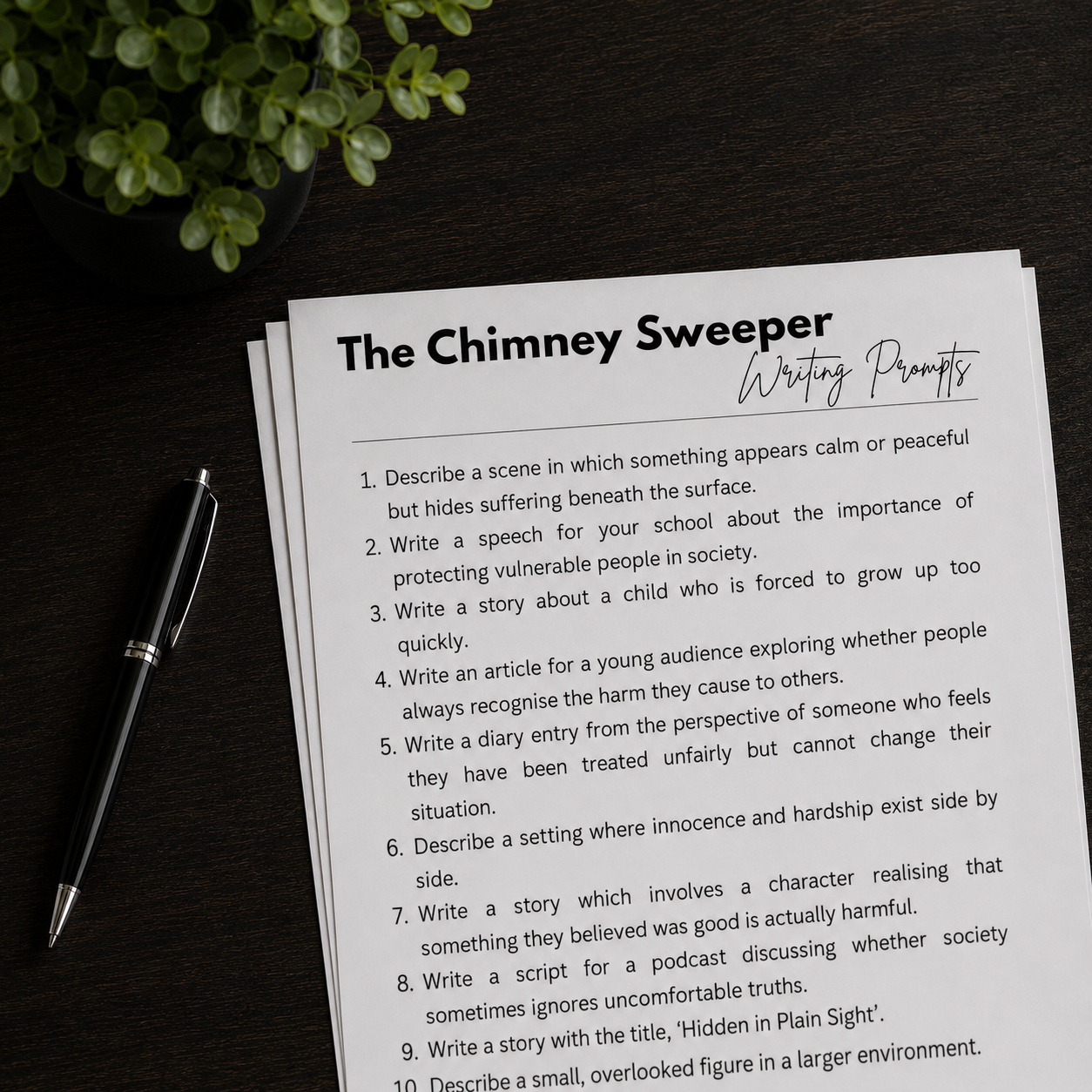
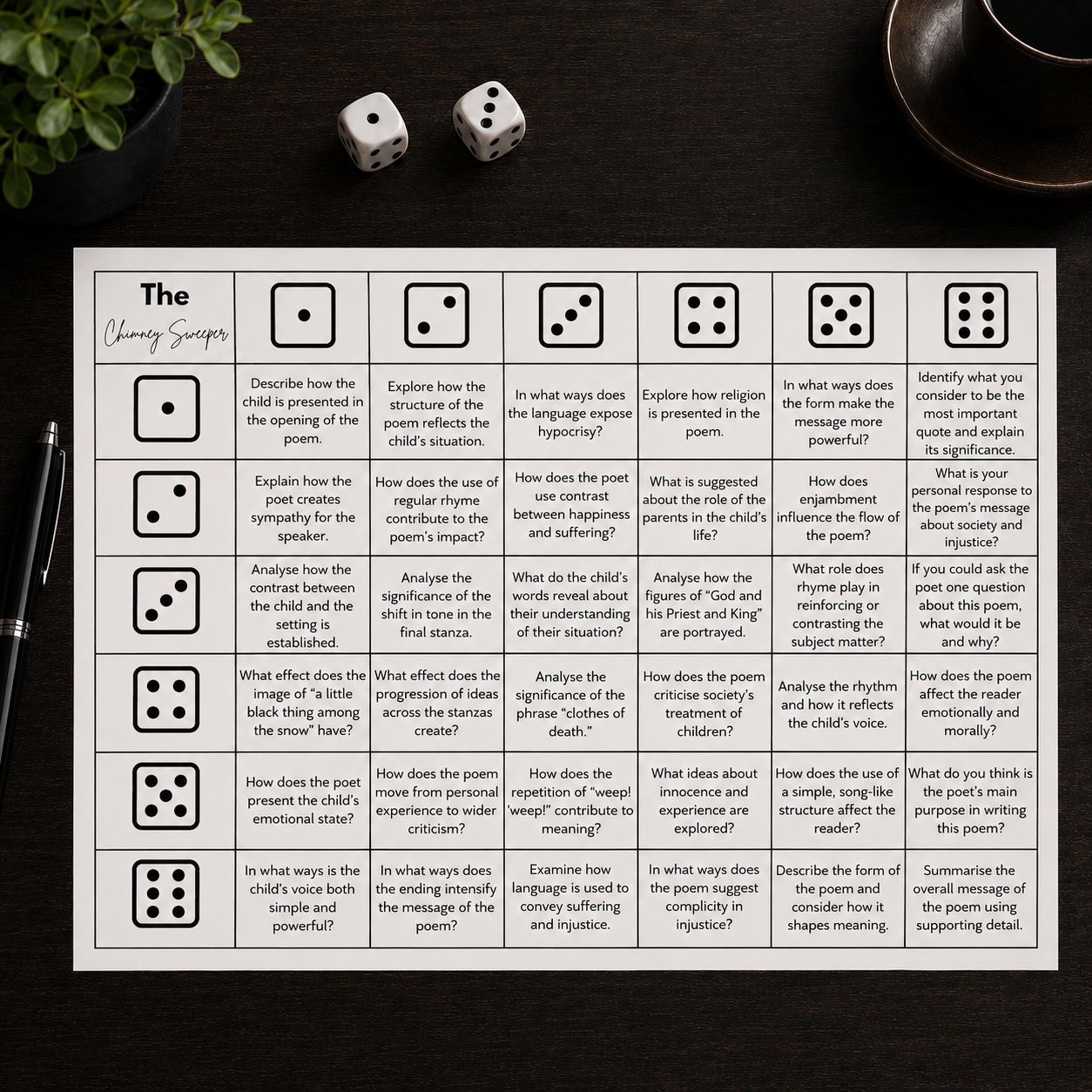
Download the complete teaching resource pack for The Chimney Sweeper by William Blake, featuring analytical task cards, exam-style essay questions, creative writing prompts, silent debates, and discussion-led activities designed to develop confident, independent literary analysis and stronger written responses. Originally created for CIE IGCSE English Literature (0475 & 0922, 2027 syllabus), the pack also works effectively across a broad range of secondary English, GCSE, IGCSE, and high school literature classrooms — making it easier to teach Blake’s poetry in a thoughtful, engaging, and low-prep way.

Go Deeper into The Chimney Sweeper
If you’re exploring The Chimney Sweeper, it’s useful to compare how William Blake presents innocence, experience, and social injustice across other texts.
You might also explore:
◆ The Chimney Sweeper (Songs of Innocence) by William Blake – contrasts sharply with this version, showing a more hopeful and naïve perspective shaped by false comfort and belief
◆ London by William Blake – explores oppression and control in society, particularly how institutions restrict freedom and contribute to suffering
◆ Holy Thursday (Songs of Experience) by William Blake – examines poverty and inequality, questioning whether society can truly be moral while children suffer
◆ Ozymandias by Percy Bysshe Shelley – explores how power and authority are temporary, offering a useful contrast to Blake’s focus on systemic control
◆ Remains by Simon Armitage – presents the lasting psychological impact of experience, linking to the theme of how suffering shapes identity
◆ War Photographer by Carol Ann Duffy – explores how suffering can be observed but not acted upon, linking to the idea of society witnessing injustice without intervening
These comparisons help deepen understanding of how writers present power, responsibility, and human suffering, and support more developed, top-band responses by making connections across texts.
Final Thoughts
The Chimney Sweeper is a powerful and unsettling poem that exposes the reality of child exploitation, religious hypocrisy, and social injustice. Through the voice of a child, William Blake reveals how suffering can be hidden behind appearances of happiness and morality. The contrast between innocence and experience, along with the use of irony, symbolism, and voice, allows Blake to challenge the reader’s assumptions about what is right and just.
What makes the poem particularly memorable is its ability to present complex ideas through a simple, childlike form. The song-like rhythm and clear structure make the poem accessible, but also deepen its impact by highlighting the gap between how the world appears and how it truly functions. By the final lines, Blake moves beyond individual suffering to expose a wider system in which authority figures maintain and justify injustice.
Ultimately, the poem forces the reader to confront uncomfortable truths about society, showing that true morality cannot exist alongside neglect and exploitation. It remains a relevant and thought-provoking text, encouraging readers to question systems of power and their own role within them.
For more analysis of poetry from this collection, explore the Songs of Ourselves Volume 1 hub, or browse a wider range of texts in the Literature Library.
Choose Your Next Text