Carpet-Weavers, Morocco by Carol Rumens: Summary, Themes & Analysis
Carol Rumens’ Carpet-Weavers, Morocco explores child labour, tradition and exploitation, and the tension between beauty and suffering, using vivid imagery and controlled structure to present a world where creativity is shaped by constraint. The poem contrasts the intricate, almost magical creation of the carpet with the children’s limited agency, suggesting that something beautiful is produced through hidden hardship. Rumens develops meaning through juxtaposition and a shifting perspective, moving from admiration of the craft to a more unsettling awareness of the children’s reality. If you are studying or teaching Songs of Ourselves Volume 1 for CIE English Literature (0475), you can explore in-depth analyses of every poem in the Songs of Ourselves Volume 1 hub, or a wider range of texts in the Literature Library.

Context of Carpet-Weavers, Morocco
Carol Rumens is known for writing poems that explore global perspectives, often focusing on lives and cultures beyond a Western viewpoint. In Carpet-Weavers, Morocco, she adopts an observational voice to depict children working at looms, drawing attention to the contrast between artistic creation and hidden labour. Rather than presenting direct judgement, Rumens allows the imagery to reveal the tension between beauty and exploitation, encouraging readers to question what lies behind the finished product.
The poem reflects a broader context of child labour and traditional craft industries, where skills are passed down through generations but may also limit opportunity. The reference to the “garden of Islam” places the work within a cultural and religious framework, suggesting that the carpets hold spiritual and social value. However, this also highlights a contrast between the sacred use of the carpet and the children’s lived reality, reinforcing the poem’s exploration of value, labour, and inequality.
Carpet-Weavers, Morocco: At a Glance
Form: Free verse with controlled, flowing structure
Mood: Observational, reflective, quietly unsettling
Central tension: The creation of beauty and tradition vs the reality of child labour and limited freedom
Core themes: Child labour, tradition and exploitation, beauty vs suffering, time and permanence, cultural value and inequality
One-sentence meaning: The poem presents the intricate beauty of carpet-making while revealing the hidden labour and constraint behind it, suggesting that something valued and sacred is created through unseen sacrifice.
Quick Summary of Carpet-Weavers, Morocco
The poem begins by describing a group of children working at looms, presented almost as part of “another world,” where their appearance and arrangement create a sense of harmony and beauty. Their braided hair, bright clothing, and differing heights form a melodic image, suggesting artistry and order. As they work, they watch their “flickering knots” as if mesmerised, and the carpet they are creating is described as growing like a “garden of Islam,” linking their labour to something culturally and spiritually significant.
As the poem develops, the focus shifts from the act of weaving to the future journey of the carpet, which will be transported, displayed, and used in a sacred space. The finished product is presented as luxurious and meaningful, especially in its role within prayer. However, the final stanza returns to the children, reframing their work as part of the “school of days,” suggesting routine and lack of choice. The colours they produce become fixed into the past, emphasising how their labour creates something lasting, while their own lives remain restricted and controlled.
Title, Form, Structure, and Metre
Rumens uses a carefully controlled free verse structure to mirror the act of weaving, creating a poem that feels both ordered and subtly constrained, reflecting the children’s labour and the tension between art and restriction.
Title
The title, “Carpet-Weavers, Morocco,” immediately foregrounds both occupation and place, suggesting a focus on cultural identity and traditional craft. The specificity of “Morocco” situates the poem within a particular cultural context, while “carpet-weavers” draws attention to manual labour and skill. However, the neutral tone of the title also reflects the poem’s initial detached observation, which gradually develops into a more critical awareness of the children’s situation.
Form and Structure
The poem is written in free verse, allowing Rumens to shape the structure to reflect the process of weaving rather than following a rigid poetic form. It is organised into four tercets (three-line stanzas), creating a balanced, almost rectangular visual shape on the page. This regularity mirrors the patterned design of a carpet, reinforcing the connection between the poem’s form and the children’s work.
The progression of the stanzas reflects a movement from observation of the children, to the creation of the carpet, to its future use, and finally back to the children themselves. This cyclical structure highlights the contrast between the lasting beauty of the product and the children’s repetitive, confined experience. The final stanza shifts perspective, emphasising how their labour contributes to something permanent while their own lives remain restricted.
Rhyme Scheme and Poetic Pattern
As a free verse poem, there is no fixed rhyme scheme. Instead, Rumens creates a sense of musicality through subtle sound patterns such as internal rhyme, assonance, and alliteration.
For example, the echo between “bright” and “heights” creates a soft internal connection, while repeated consonant sounds in phrases like “braids” and “bright” contribute to a sense of harmony. These sound patterns reflect the careful, interwoven nature of the carpet itself, reinforcing the idea of artistic creation.
Later, softer repeated sounds, particularly sibilance in phrases describing the carpet’s use, create a gentle, hushed tone, suggesting both the soft texture of the carpet and the quiet atmosphere of prayer. In this way, sound is used to mirror both physical sensation and emotional atmosphere.
Metre and Rhythmic Movement
Although the poem does not follow a regular metre, its lines are of similar length, creating a steady and controlled rhythm that reflects the repetitive process of weaving. Most lines are end-stopped, slowing the pace and giving the poem a deliberate, measured movement, mirroring the careful, continuous work of the children.
This controlled rhythm is briefly disrupted near the end, where a line flows into the next without pause. This moment of enjambment creates a sense of movement and release, reflecting the idea of colours “flying” before becoming fixed. The contrast between steady pacing and this brief shift highlights the tension between creative possibility and final restriction, reinforcing the poem’s central ideas.
The Speaker in Carpet-Weavers, Morocco
The speaker remains largely unidentified, adopting a detached, observational voice that focuses closely on the children and their work. This careful attention mirrors the children’s own precision and concentration, as the speaker records details with a sense of quiet control. Rather than inserting personal opinion directly, the voice allows meaning to emerge through imagery and subtle shifts in perspective.
However, there are indications that the speaker is viewing the scene from an outsider’s perspective. The comparison of the children watching their work “like television” suggests a cultural reference more familiar to a Western audience, implying a distance between observer and subject. This distance reinforces the sense that the speaker is interpreting, rather than fully understanding, the children’s experience.
The tone throughout is reflective and restrained, showing both admiration for the beauty and skill of the weaving and an underlying awareness of its implications. By the final stanza, the voice becomes more contemplative, recognising how the children’s labour contributes to something lasting while their own lives remain confined. This creates a speaker who is both appreciative and quietly critical, shaped by sensitivity to both art and inequality.
Stanza-by-Stanza Analysis of Carpet-Weavers, Morocco
This section offers a close reading of how each stanza develops meaning, focusing on how Rumens uses imagery, structure, and shifts in perspective to move from careful observation to a more complex reflection on labour, beauty, and constraint. As the poem progresses, the focus shifts from the children themselves to the future of the carpet, before returning to the children, revealing the contrast between what is created and those who create it.
Stanza 1: Beauty, Harmony, and Distance
The opening presents the children as part of “another world,” immediately creating a sense of distance and separation. This phrase suggests both cultural difference and a kind of othering, positioning the children as observed rather than fully understood. At the same time, the image elevates their work, implying something almost magical or self-contained, as if the loom creates its own reality.
Rumens then focuses on visual and sensory imagery, describing the children’s “braids,” “black” hair, and “bright” dresses. The contrast between dark and bright colours creates a vivid, almost decorative effect, mirroring the patterns of the carpet itself. This emphasis on appearance suggests beauty and harmony, but also risks reducing the children to part of an aesthetic image, reinforcing the idea that they are being viewed from a distance.
The final line develops this sense of harmony through the metaphor of a “melodious chime,” where the children’s differing heights are compared to musical notes. This suggests order, balance, and collective unity, presenting the group as working together in a coordinated, almost artistic way. However, this musical image also smooths over individuality, hinting that the children are valued more for their collective function than their individual identities.
Stanza 2: Control, Growth, and Cultural Meaning
The opening simile, “watch their flickering knots like television,” introduces a modern, almost casual comparison that contrasts sharply with the traditional setting. The verb “watch” suggests passivity, implying that the children are absorbed in repetitive work rather than actively shaping it. This comparison also highlights distance, as the speaker uses a familiar, likely Western reference point, reinforcing the idea that this scene is being interpreted from the outside.
The phrase “the garden of Islam grows” transforms the carpet into something organic and symbolic, suggesting beauty, spirituality, and cultural identity. The metaphor of a “garden” implies careful cultivation, linking the children’s labour to something meaningful and sacred. However, the future tense (“will be raised”) shifts focus away from the present moment, suggesting that the value of their work lies in its future use, not in the children themselves.
The final line develops this imagery through metaphor, as the children “lace the dark-rose veins of the tree-tops.” The language is intricate and layered, with “lace” suggesting both delicate craftsmanship and restriction, while “veins” evokes something living and interconnected. This creates a sense of beauty and complexity, but also hints at control, as the children’s work becomes part of a larger, structured design.
Stanza 3: Journey, Value, and Sacred Use
The stanza shifts fully into the future, emphasising what the carpet will become rather than the conditions of its creation. The repeated structure “It will…” creates a sense of inevitability, suggesting that the carpet’s journey is predetermined and beyond the children’s control. The image of it travelling in a “merchant’s truck” introduces ideas of trade and profit, implying that the children’s labour feeds into a wider economic system from which they are distanced.
The next line places the carpet in a religious setting, where it will be “spread by the servants of the mosque.” This elevates the object’s significance, linking it to spiritual practice and communal ritual. However, the presence of “servants” reinforces a hierarchy, subtly echoing the children’s own position within a system of labour and service.
The final line focuses on sensory imagery, describing the carpet as “deep and soft” and responsive when “heaped with prayer.” The verb “give” suggests both physical softness and a kind of yielding, reinforcing the idea of comfort and devotion. This creates a striking contrast between the carpet’s sacred, valued role and the hidden labour that produced it, highlighting the gap between use and origin.
Stanza 4: Time, Constraint, and Lasting Creation
The final stanza returns to the children, but reframes their work as part of the “school of days,” a metaphor that suggests both learning and repetition. While “school” might imply development or opportunity, the phrase here instead emphasises routine and lack of choice, as the children are trained into a fixed role. The expression “hard at work” reinforces the reality of labour, cutting through the earlier aestheticised imagery.
The second line introduces a powerful image of creation, as “the colours of all-that-will-be fly” from their fingers. The verb “fly” suggests energy, freedom, and creative potential, momentarily presenting the children’s work as dynamic and imaginative. However, this sense of movement is immediately constrained by what follows, creating a tension between possibility and limitation.
The final line resolves this tension as the colours “freeze into the frame of all-that-was.” The verb “freeze” suggests permanence but also loss of movement, implying that the children’s creative energy becomes fixed and unchanging. The phrase contrasts future (“will be”) with past (“was”), highlighting how their labour creates something lasting while their own lives remain confined to repetition. This ending reinforces the poem’s central idea: that beauty and permanence are produced through restriction and control.
Key Quotes and Methods in Carpet-Weavers, Morocco
These key quotations show how Rumens uses imagery, structure, and contrast to present the tension between beauty and labour, and between creation and constraint.
“The children are at the loom of another world”
◆ Technique: Metaphor
◆ Meaning: The children’s work is presented as separate and distant, almost self-contained
◆ Purpose: To create a sense of othering and cultural distance
◆ Impact: Encourages the reader to question whether the scene is being romanticised or misunderstood
“Their dresses bright”
◆ Technique: Colour imagery
◆ Meaning: The children are associated with vivid, decorative detail
◆ Purpose: To mirror the colours of the carpet they are creating
◆ Impact: Links the children visually to the product, suggesting they are part of the design rather than individuals
“A melodious chime”
◆ Technique: Metaphor and auditory imagery
◆ Meaning: The children’s differing heights are compared to musical harmony
◆ Purpose: To present the group as ordered and coordinated
◆ Impact: Creates a sense of beauty and unity, while also smoothing over individuality
“Watch their flickering knots like television”
◆ Technique: Simile
◆ Meaning: The children’s work is compared to passive entertainment
◆ Purpose: To suggest repetition and detachment from the process
◆ Impact: Highlights a contrast between creative labour and passive observation, reinforcing distance
“The garden of Islam grows”
◆ Technique: Extended metaphor
◆ Meaning: The carpet is imagined as something organic and spiritually significant
◆ Purpose: To connect the children’s work to cultural and religious meaning
◆ Impact: Elevates the product while contrasting with the children’s restricted experience
“The carpet will travel in the merchant’s truck”
◆ Technique: Future tense and imagery
◆ Meaning: The carpet is part of a wider system of trade
◆ Purpose: To show how the children’s work moves beyond them
◆ Impact: Emphasises their separation from the value and outcome of their labour
“Deep and soft, it will give when heaped with prayer”
◆ Technique: Sensory imagery and personification
◆ Meaning: The carpet is presented as comforting and responsive
◆ Purpose: To highlight its role in religious practice
◆ Impact: Creates a contrast between the carpet’s sacred use and the conditions of its creation
“The school of days”
◆ Technique: Metaphor
◆ Meaning: The children’s work is framed as a form of education
◆ Purpose: To suggest routine and training rather than freedom
◆ Impact: Highlights the restriction of their lives, reinforcing the theme of constraint
“The colours of all-that-will-be fly”
◆ Technique: Dynamic imagery
◆ Meaning: The act of creation is presented as energetic and full of potential
◆ Purpose: To show the children’s creative power
◆ Impact: Suggests possibility and movement before it is restricted
“Freeze into the frame of all-that-was”
◆ Technique: Metaphor and contrast
◆ Meaning: The colours become fixed and unchanging
◆ Purpose: To show how creativity is ultimately contained
◆ Impact: Reinforces the tension between freedom and control, ending the poem on a reflective note
Key Techniques in Carpet-Weavers, Morocco
Rumens uses a range of language, structural, and sound techniques to present the tension between beauty, tradition, and hidden labour, gradually revealing how something visually harmonious is created through constraint.
◆ Imagery – The poem is rich in visual and sensory imagery, from the children’s “oiled” braids and “bright” dresses to the “deep and soft” carpet. These details create a sense of beauty and harmony, mirroring the patterns of the carpet itself. However, this focus on appearance also risks aestheticising the children, suggesting they are viewed as part of the design rather than as individuals
◆ Extended metaphor (weaving as creation) – The act of weaving becomes a metaphor for artistic and cultural creation, particularly in images such as the “garden of Islam.” This suggests that the children’s labour produces something spiritually and culturally valuable, while also highlighting the contrast between the value of the product and the conditions of its creation
◆ Synaesthesia – The phrase “melodious chime” blends sound and sight, turning the children’s differing heights into something musical. This creates a sense of harmony and unity, reinforcing the idea of collective beauty while subtly diminishing individual identity
◆ Simile – The comparison “like television” introduces a modern, familiar reference that contrasts with the traditional setting. This suggests passivity and repetition, implying that the children are absorbed in routine rather than exercising control
◆ Contrast and juxtaposition – The poem consistently contrasts beauty with labour, creation with restriction, and product with producer. For example, the luxurious, sacred use of the carpet is set against the children’s repetitive work, highlighting the gap between value and experience
◆ Future tense – Repeated use of “will” shifts focus to the carpet’s future journey, emphasising its importance beyond the present moment. This distances the children from the outcome of their labour, suggesting they do not share in its value or significance
◆ End-stopped lines – Many lines end with full stops, creating a measured, controlled rhythm. This mirrors the steady, repetitive nature of the weaving process, reinforcing the sense of discipline and constraint
◆ Enjambment – The final stanza introduces a flowing line that moves into the next without pause, particularly in the phrase where colours “fly.” This creates a brief sense of movement and freedom, which is immediately restricted, reinforcing the tension between possibility and limitation
◆ Alliteration and sound patterning – Subtle repetition of consonant sounds (e.g. “braids” / “bright”) creates a sense of texture and cohesion, mirroring the interwoven threads of the carpet. Softer sounds later in the poem contribute to a calm, reflective tone, particularly in the description of the carpet’s use in prayer
◆ Symbolism – The carpet itself becomes a symbol of cultural identity, spiritual value, and lasting creation, while also representing the hidden labour behind such objects. It embodies the idea that beauty can be produced through restriction and sacrifice
◆ Structural framing – The poem begins and ends with the children, but shifts in the middle to focus on the carpet’s future. This framing highlights the contrast between the temporary lives of the children and the lasting nature of their work, reinforcing the poem’s central message
How the Writer Creates Meaning and Impact in Carpet-Weavers, Morocco
Rumens creates meaning through the careful interplay of imagery, structure, voice, and contrast, transforming an apparently beautiful scene into a reflection on labour, value, and constraint.
The poem’s imagery initially presents the children and their work as harmonious and visually appealing. Descriptions of “bright” dresses and carefully maintained braids create a sense of order and beauty, while the carpet is imagined as a “garden,” suggesting growth and cultural richness. However, this imagery also distances the reader from the reality of the children’s lives, encouraging an initial response of admiration before prompting deeper reflection. As the poem progresses, sensory details such as the carpet being “deep and soft” reinforce its value, creating a contrast between the luxury of the product and the conditions of its creation.
The structure reinforces this contrast. The poem moves from observing the children, to imagining the carpet’s future, and then returns to the children in the final stanza. This shift highlights how the children’s labour becomes separated from its outcome. The use of the future tense (“will travel,” “will be spread”) emphasises that the carpet’s significance lies beyond the present moment, while the return to the children as part of the “school of days” suggests repetition and limited freedom. This cyclical structure links creation and confinement, showing how something permanent is produced through ongoing routine.
The voice and tone also shape meaning. The speaker adopts a calm, observational tone that avoids direct judgement, allowing the reader to notice the contrast between beauty and exploitation independently. However, subtle choices—such as the simile “like television” and the metaphor of the “school”—introduce a more critical perspective, suggesting passivity and lack of choice. This restrained voice makes the poem more powerful, as the implications emerge gradually rather than being stated directly.
Finally, sound and rhythm contribute to the poem’s impact. The steady pacing created by similar line lengths and frequent end-stopping reflects the repetitive nature of the children’s work, while subtle sound patterns create a sense of cohesion and harmony. This controlled rhythm is briefly disrupted near the end, where movement is suggested through the idea of colours that “fly” before becoming fixed. This contrast between movement and stillness reinforces the tension between creative potential and restriction, leaving the reader with a sense of unresolved unease.
Themes in Carpet-Weavers, Morocco
Rumens explores a range of interconnected themes, using imagery, structure, and contrast to reveal the tension between beauty, labour, and value.
Child Labour and Exploitation
The poem centres on child labour, presenting the children as “hard at work” within a structured, repetitive environment. While their work is skilled and culturally significant, it is also shown to be restrictive, with the metaphor of the “school of days” suggesting routine rather than opportunity. This highlights how the children’s labour is essential yet limiting, raising questions about exploitation beneath the surface of tradition.
Beauty and Hidden Suffering
Rumens contrasts the visual beauty of the children and the carpet with the reality of their working conditions. Descriptions of “bright” dresses and harmonious imagery create an initially positive impression, while the finished carpet is presented as luxurious and sacred. However, this beauty is underpinned by unseen effort and constraint, suggesting that something admired and valued can be produced through hidden hardship.
Tradition and Cultural Value
The poem presents weaving as part of a long-standing cultural tradition, particularly through references such as the “garden of Islam.” This connects the children’s work to spiritual and communal meaning, suggesting that the carpet holds significance beyond its material value. At the same time, this tradition may also contribute to the children’s lack of choice, highlighting a tension between cultural preservation and individual freedom.
Control vs Freedom
A central tension in the poem lies between control and freedom. The structured environment of the loom and the repetitive nature of the work suggest restriction, while moments such as the colours that “fly” hint at creative energy and possibility. However, this movement is ultimately contained, as the colours “freeze,” reinforcing the idea that potential is limited by circumstance.
Time and Permanence
The poem explores how the children’s labour creates something that will outlast them. The use of the future tense emphasises the carpet’s journey and lasting significance, while the final line contrasts “all-that-will-be” with “all-that-was.” This highlights how their work becomes fixed and permanent, even as their own lives are shaped by ongoing repetition, suggesting a contrast between lasting creation and temporary experience.
Value and Inequality
Rumens highlights the disparity between the value of the product and the status of the producers. The carpet is associated with luxury, spirituality, and communal importance, while the children remain largely invisible within this system. This contrast raises questions about who benefits from labour and how value is assigned, reinforcing the theme of inequality.
Alternative Interpretations of Carpet-Weavers, Morocco
While the poem can be read as a critique of child labour and inequality, Rumens’ use of imagery, structure, and voice allows for multiple interpretations that deepen its meaning.
Psychological Interpretation: Internalising Routine
From a psychological perspective, the poem can be read as an exploration of how individuals become shaped by repetition and routine. The children’s work, described as part of the “school of days,” suggests that their identities are formed through habit and discipline. The careful, almost mesmerised attention to “flickering knots” reflects a state of absorption, where external demands become internalised. This interpretation suggests that the poem is not only about labour, but about how environments shape thought and identity.
Social Interpretation: Inequality and Hidden Labour
The poem can also be read as a commentary on social and economic inequality, particularly the gap between those who produce and those who benefit. The children’s labour creates an object of beauty, luxury, and spiritual value, yet they remain distant from its use and significance. The movement of the carpet—from loom to merchant to mosque—highlights a system in which value increases as it moves away from its creators. This interpretation emphasises the invisibility of labour and the structures that sustain inequality.
Philosophical / Existential Interpretation: Time, Creation, and Permanence
On a philosophical level, the poem explores the relationship between creation and time. The contrast between “all-that-will-be” and “all-that-was” suggests that human actions become fixed into the past, creating something permanent while limiting future possibility. The children’s work becomes a metaphor for how individuals contribute to something larger than themselves, yet remain constrained within it. This interpretation raises questions about purpose, legacy, and the extent to which individuals have control over their own lives.
Exam-Ready Insight for Carpet-Weavers, Morocco
This section shows how to turn your understanding of Carpet-Weavers, Morocco into a strong, exam-focused response for IGCSE Literature (0475), with a clear focus on how meaning is created through methods.
What strong responses do
◆ focus closely on the question
◆ analyse methods (language, structure, and sound), not just ideas
◆ explain how effects are created, not just what happens
◆ track shifts in voice and tone across the poem
◆ use short, precise quotations to support points
Conceptual argument
A strong thesis for Carpet-Weavers, Morocco might be:
Rumens presents the children’s weaving as both beautiful and restrictive, using imagery, structure, and contrast to show how cultural value and artistic creation are shaped by systems of labour and control, revealing the tension between tradition and exploitation.
Model analytical paragraph
Rumens presents the children’s work as visually harmonious while subtly revealing its restrictive nature through imagery and contrast. In the description of their “dresses bright,” the adjective “bright” creates a vivid, decorative image, suggesting beauty and order. This is reinforced by the metaphor of a “melodious chime,” where the children’s differing heights are presented as harmonious, linking visual arrangement to musical balance. However, this sense of unity also reduces the children to part of a collective pattern, emphasising their function rather than individuality. This contrast becomes more striking when their work is later described as part of the “school of days,” where the metaphor suggests repetition and lack of choice. Through these methods, Rumens transforms an image of beauty into a commentary on constraint, highlighting how something aesthetically pleasing can be shaped by underlying restriction.
Teaching Ideas for Carpet-Weavers, Morocco
This poem is ideal for exploring how writers use language, structure, and voice to present ideas about labour, beauty, and constraint, while supporting collaborative and discussion-based approaches.
1. Collaborative Analytical Paragraph (Paired Writing)
Give students a focused question, for example:
How does Rumens present the children’s work in Carpet-Weavers, Morocco?
Students work together to produce a single analytical paragraph. They should:
◆ select and embed quotations
◆ identify methods (language, structure, sound)
◆ explain meaning → purpose → impact
Because both students contribute, they can challenge and refine each other’s ideas, leading to a more developed and precise response. This reinforces that strong analytical writing is built through discussion and refinement, not just individual effort.
2. Structured Group Close Analysis (Role-Based)
Instead of traditional annotation, assign students specific roles in small groups for a stanza-by-stanza reading:
◆ Structure specialist – tracks shifts from observation to reflection
◆ Language analyst – explores imagery and metaphor
◆ Methods expert – identifies techniques and effects
◆ Tone tracker – comments on shifts in voice and mood
Each group analyses a stanza, then feeds back to the class. As responses are shared, build a full interpretation together.
This approach makes close reading more active and collaborative, while still developing detailed analytical skills.
3. Silent Debate
Set up a silent debate around the question:
Is the poem more a celebration of tradition or a criticism of exploitation?
Students respond to prompts in writing, building on and challenging each other’s ideas. They should:
◆ use quotations as evidence
◆ respond directly to others’ interpretations
◆ develop and refine arguments over time
This encourages deeper thinking and ensures all students participate. For guidance on structuring this activity, see the Silent Debate post.
4. Creative Writing: Hidden Stories Behind Objects
Ask students to write a short piece imagining the story behind an everyday object.
Prompt:
Choose an object and write about how it was made, revealing the hidden people or processes behind it.
Students should aim to:
◆ use detailed imagery
◆ shift from description to reflection
◆ explore contrasts between appearance and reality
◆ develop a clear narrative voice
This activity helps students apply literary methods such as imagery, structure, and contrast in their own writing. For more ideas and structured prompts, explore the Creative Writing Archive.
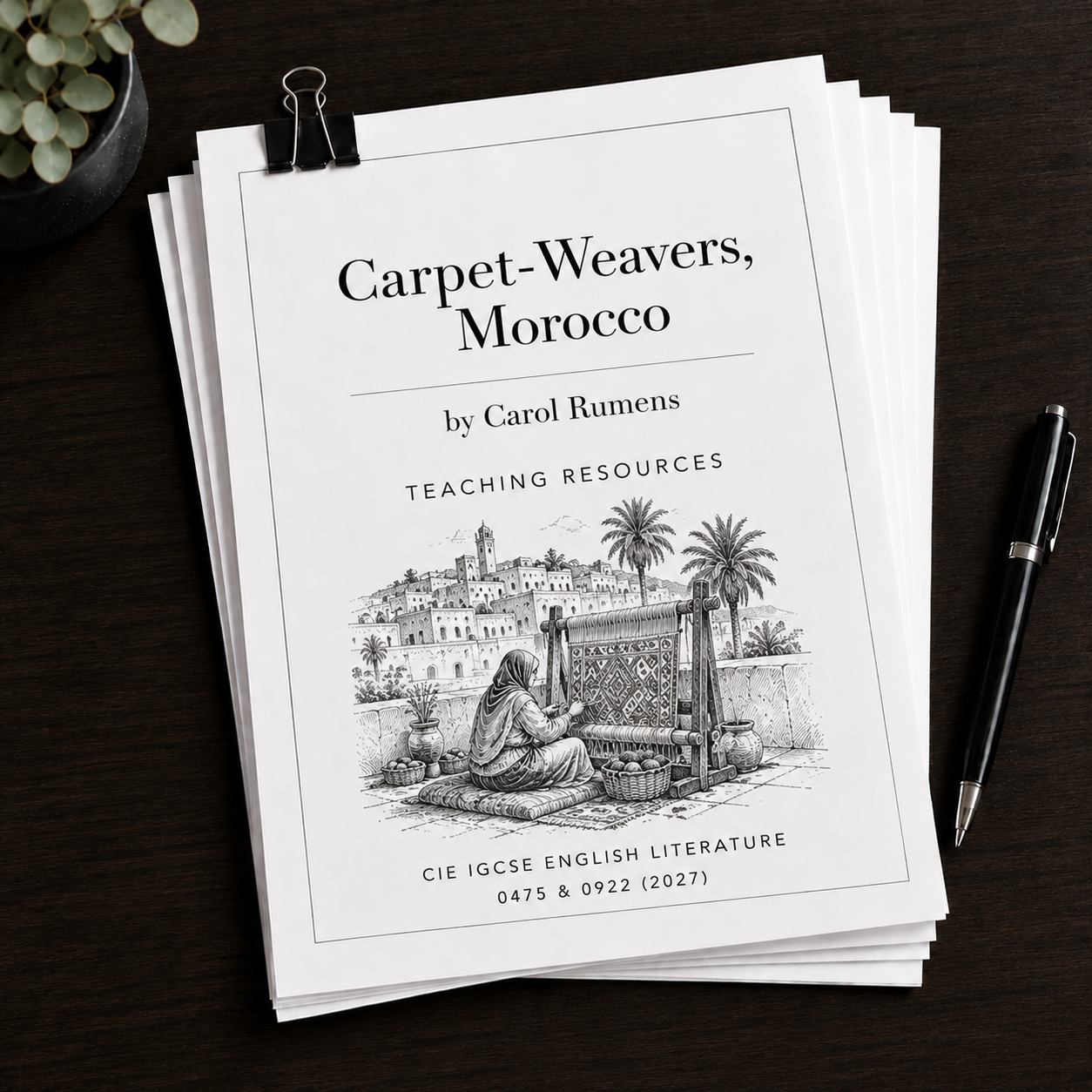
Teach Carpet-Weavers, Morocco with minimal prep.
If you’re teaching Carpet-Weavers, Morocco by Carol Rumens, you don’t need to spend hours building lessons, discussion tasks, and analytical activities from scratch.
This complete teaching resource pack provides a clear, structured way to guide students from first reading and initial interpretation to confident, developed exam-style analysis — while saving valuable planning time.
Designed for CIE IGCSE English Literature (0475 & 0922, 2027 syllabus), the pack also works flexibly for broader secondary poetry teaching and poetry exploration. It can be used across a full sequence of lessons, whether you’re introducing the poem, analysing Rumens’ language and imagery, exploring the lives of the child carpet-weavers, developing discussion and interpretation, or preparing students for analytical writing and assessment.
Our in-depth study guide for the poem is also available to support teaching and deepen students’ understanding of Rumens’ exploration of child labour, poverty, exploitation, innocence, inequality, beauty, craftsmanship, freedom, and the contrast between the carpets being created and the lives of the children who create them.
Why this works
This is not just a collection of disconnected worksheets. It’s a carefully designed set of discussion-led, analysis-focused activities created to help students develop confident, independent interpretations of poetry.
Designed for paired, group, and independent learning
Encourages active thinking, discussion, and interpretation
Includes exam-style questions suitable for Literature and Language preparation
Develops analytical confidence and independent interpretation
Encourages thoughtful debate, discussion, and extended written responses
Helps students explore Rumens’ use of imagery, colour, contrast, symbolism, metaphor, perspective, structure, tone, and sensory description
What’s included
Poetry analysis task cards covering context, structure, form, language, tone, imagery, symbolism, personal response, and more
10 exam-style essay questions for developing and assessing analytical responses
10 creative writing prompts designed to support skills needed for the Language Paper
Roll the Dice discussion board for low-prep, high-engagement lessons
Silent debate activities built around thought-provoking statements to encourage independent thinking and discussion
Teacher instructions for quick and straightforward implementation
How you can use it
Introduce the poem and build initial understanding
Structure analysis lessons without excessive scaffolding
Run engaging, discussion-led poetry lessons
Explore ideas surrounding child labour, poverty, exploitation, innocence, inequality, beauty, craftsmanship and freedom
Examine the contrast between the beautiful carpets the children create and the difficult conditions of their own lives
Explore how Rumens uses vivid imagery, colour, sensory detail and contrasting perspectives to shape the reader’s response
Set up independent written responses and revision activities
Prepare students for exam-style analytical questions with confidence
What students gain
Greater confidence analysing poetry independently
Experience answering exam-style questions
Stronger ability to form and support interpretations
Improved discussion and analytical writing skills
Greater independence in their thinking
Deeper understanding of Rumens’ language, imagery, structure, themes, contrasts and presentation of the child carpet-weavers
Download Now
Download the full Carpet-Weavers, Morocco teaching resource pack and start using it immediately — from first reading through to confident, exam-style analysis, interpretation and discussion.
Take Your Study of Carpet-Weavers, Morocco Further
Help students move beyond first impressions of Carpet-Weavers, Morocco and develop confident, independent interpretations of Rumens’ presentation of child labour, poverty, exploitation, beauty and inequality.
The Carpet-Weavers, Morocco Teaching Resource Pack gives you a complete collection of ready-to-use activities for exploring the poem in depth — without spending hours creating additional resources. With analysis task cards, 10 exam-style essay questions, 10 creative writing prompts, a Roll the Dice discussion board, thought-provoking debate activities and teacher guidance, it can support everything from initial exploration and close analysis to independent work and revision.
Or, if you’re teaching the complete Songs of Ourselves Volume 1 selection, the Complete Teaching Resource Bundle includes resources for all 15 poems on the 2027 CIE IGCSE English Literature syllabus, giving you a consistent bank of analysis, discussion, writing and revision activities for the entire poetry unit.
Spend less time creating resources from scratch and more time helping students develop the interpretations they’ll need for the exam.
Go Deeper into Carpet-Weavers, Morocco
To develop stronger comparative analysis and more conceptual responses, explore how Carpet-Weavers, Morocco connects to other texts that examine labour, identity, and the relationship between creation and control.
◆ The Chimney Sweeper – William Blake
Explores child labour and exploitation, presenting suffering through controlled imagery and voice. Both poems contrast innocence with harsh realities, allowing comparison of how writers reveal inequality through indirect methods.
◆Follower – Seamus Heaney
Examines labour and identity through the lens of traditional work. While Heaney presents admiration and personal connection, Rumens introduces distance and critique, offering a contrast in how work shapes identity.
◆ Half-Caste – John Agard
Challenges how value and identity are constructed and judged. Both poems encourage readers to question assumptions and consider how perspective influences meaning.
◆ The Tyger – William Blake
Uses symbolic imagery to explore creation and power. Like Rumens, Blake presents something visually striking while prompting deeper reflection on what lies beneath the surface.
◆ Prayer Before Birth – Louis MacNeice
Explores vulnerability within larger social and cultural systems. Both poems highlight individuals shaped by forces beyond their control, allowing comparison of how writers present constraint and lack of agency.
◆ Mirror – Sylvia Plath
Examines how observation leads to truth and self-awareness. Both poems use an external focus to reveal deeper insights into identity and reality.
These connections help students move beyond single-text responses, linking themes, methods, and interpretations to build more sophisticated, top-band comparisons.
Final Thoughts
Carpet-Weavers, Morocco presents a carefully balanced exploration of beauty, labour, and constraint, using controlled imagery and structure to move from admiration to quiet critique. Rumens captures the visual harmony of the children and their work, but gradually reveals the tension between creative skill and limited freedom, showing how something culturally and spiritually valuable can be produced through repetitive, controlled labour.
What makes the poem particularly powerful is its restraint. Rather than directly condemning or celebrating, Rumens allows meaning to emerge through contrast, shifts in focus, and subtle details, encouraging the reader to reflect on the relationship between art, value, and human experience. The final image of creation becoming fixed in time reinforces the idea that while the children’s work may endure, their own lives remain shaped by routine and restriction.
If you are studying this poem as part of the Songs of Ourselves Volume 1 Hub, it offers rich opportunities for comparison with other texts exploring identity, labour, and inequality. You can also explore a wider range of poetry and prose in the Literature Library to deepen your understanding of how writers present complex social ideas through method and form.
Choose Your Next Text