Sonnet 18 by William Shakespeare: Summary, Themes & Analysis of “Shall I compare thee to a summer’s day?”
William Shakespeare’s Sonnet 18 explores the enduring power of poetry, the transience of natural beauty, and the human desire to preserve what fades. The poem begins with a seemingly simple comparison between a beloved figure and a summer’s day, but quickly develops into a meditation on time, change, and permanence, where nature is shown to be unstable and unreliable, while poetry offers a form of immortality.
At its core, the sonnet presents a central tension between the fleeting nature of physical beauty and the lasting power of art to preserve it. Through controlled structure, idealised imagery, and a decisive tonal shift, Shakespeare moves from questioning comparison to confidently asserting that the subject will live on forever through verse. The poem’s impact lies in how it transforms a personal expression of admiration into a universal statement about art, memory, and legacy, ultimately suggesting that language can outlast both time and death.
If you are studying or teaching Songs of Ourselves Volume 1 for CIE English Literature (0475), you can explore in-depth analyses of every poem from the 2026 and 2027 Paper 1 syllabus in our Songs of Ourselves: Volume 1 Hub, or a wider range of texts and resources in the Literature Library.
Sonnet 18 (Original Text)
Shall I compare thee to a summer’s day?
Thou art more lovely and more temperate:
Rough winds do shake the darling buds of May,
And summer’s lease hath all too short a date;
Sometime too hot the eye of heaven shines,
And often is his gold complexion dimm'd;
And every fair from fair sometime declines,
By chance or nature’s changing course untrimm'd;
But thy eternal summer shall not fade,
Nor lose possession of that fair thou ow’st;
Nor shall death brag thou wander’st in his shade,
When in eternal lines to time thou grow’st:
So long as men can breathe or eyes can see,
So long lives this, and this gives life to thee.
Sonnet 18 (Modern English Version)
Should I compare you to a summer’s day?
You are more beautiful and more gentle.
Strong winds shake the delicate buds of May,
And summer doesn’t last very long.
Sometimes the sun is too hot,
And often its golden light is dimmed by clouds,
And everything beautiful eventually fades,
Either by chance or by the natural passage of time.
But your eternal beauty will not fade,
Nor will you lose the beauty you possess,
Nor will death be able to claim you,
Because you will live on in these eternal lines of poetry.
As long as people can breathe or eyes can see,
This poem will live on—and it will keep you alive.


Context of Sonnet 18
Sonnet 18 is part of Shakespeare’s Fair Youth sequence, a group of poems traditionally understood to be addressed to a young man. This context is important because it shapes how we interpret the poem’s idealisation of beauty, emotional intensity, and desire for preservation, suggesting that the speaker’s admiration is directed toward a male subject rather than a conventional female beloved. This challenges typical expectations of love poetry and adds complexity to the poem’s exploration of affection, admiration, and legacy.
Written in the late 16th century, the sonnet reflects a period deeply influenced by Renaissance ideas about beauty, art, and immortality, where poetry was often seen as a means of preserving what time would otherwise destroy. Shakespeare draws on this tradition but develops it further, presenting poetry not just as a tribute, but as something powerful enough to defy time and death itself. For a broader understanding of how these ideas connect across Shakespeare’s work, see the William Shakespeare Context Post.
Sonnet 18: At a Glance
Form: Shakespearean sonnet (three quatrains and a final rhyming couplet)
Mood: Admiring, reflective, assured
Central tension: The temporary nature of beauty in the natural world versus the ability of poetry to preserve beauty permanently
Core themes: Time and transience, beauty and idealisation, art and immortality, nature versus permanence, memory and legacy
One-sentence meaning: Shakespeare argues that while natural beauty inevitably fades, the beloved’s beauty will live on forever through the lasting power of poetry.
Quick Summary of Sonnet 18
The poem begins with the speaker considering whether to compare the subject to a summer’s day, but quickly establishes that the subject is more beautiful and more balanced. Unlike summer, which can be disrupted by rough winds or become too hot, the subject’s beauty appears more stable and refined.
As the poem develops, the speaker reflects on the unpredictability and impermanence of nature, noting that all forms of beauty eventually fade due to chance or the natural passage of time. Summer itself is temporary, and even the most perfect conditions cannot last, reinforcing the idea that natural beauty is inherently fragile and short-lived.
In the final section, the poem shifts decisively, asserting that the subject’s beauty will not fade because it has been captured in poetry. Through the “eternal lines” of the sonnet, the subject will live on as long as people continue to read it, meaning that poetry becomes a powerful force that preserves beauty beyond time and even death.
Title, Form, Structure, and Metre of Sonnet 18
The formal precision of Sonnet 18 is not decorative; it is central to how meaning is created. Shakespeare uses structure, rhyme, and rhythm to reinforce the poem’s argument that poetry can impose order on time, preserving beauty in a way that nature cannot.
Title
The title Sonnet 18 is deliberately neutral, positioning the poem within a wider sequence rather than defining its subject. This allows meaning to emerge through the poem itself. What begins as a tentative comparison develops into a confident assertion of poetic immortality, mirroring the movement from uncertainty to control.
Form and Structure
The poem follows the Shakespearean sonnet form: fourteen lines divided into three quatrains and a final rhyming couplet. Each quatrain advances the argument. The first introduces the comparison to a summer’s day, the second exposes the instability of natural beauty, and the third intensifies this by generalising that all beauty fades.
A clear volta occurs at line nine: “But thy eternal summer shall not fade.” Here, the poem shifts from describing loss to asserting permanence. This structural turn is crucial, as it marks the moment where the speaker moves from observation to declaration and control.
The final couplet delivers resolution:
“So long as men can breathe or eyes can see,
So long lives this, and this gives life to thee.”
Rather than complicating the argument, the couplet reinforces it, creating a sense of closure and certainty. Structurally, the poem moves from questioning to answering, mirroring the speaker’s growing confidence.
Rhyme Scheme and Poetic Pattern
The sonnet follows a regular ABABCDCDEFEFGG rhyme scheme. This can be seen clearly in the opening quatrain:
day (A)
temperate (B)
May (A)
date (B)
The repeated end rhymes (“day” / “May”, “temperate” / “date”) create a sense of balance and control, reinforcing the speaker’s attempt to organise and define beauty.
This pattern continues across the quatrains:
shines (C) / dimm’d (D) / declines (C) / untrimm’d (D)
fade (E) / ow’st (F) / shade (E) / grow’st (F)
The consistency of these pairings creates a strong structural framework, suggesting order, permanence, and cohesion—qualities the speaker ultimately attributes to poetry itself.
The final couplet forms a distinct sonic unit:
see (G)
thee (G)
This immediate rhyme creates a sense of resolution and emphasis. The closeness of “see” and “thee” reinforces the link between the act of reading and the preservation of the beloved, suggesting that as long as the poem is read, the subject endures.
There are also subtle internal and near-rhymes that deepen meaning. For example, the echo between “lines” and “time” in line twelve (“When in eternal lines to time thou grow’st”) creates a sonic connection between poetry (“lines”) and temporality (“time”), reinforcing the idea that poetry can shape or contain time.
Metre and Rhythmic Movement
The poem is written primarily in iambic pentameter, a metre consisting of five iambs (unstressed followed by stressed syllables) per line. This creates a steady, controlled rhythm that mirrors natural speech while maintaining poetic form.
A typical line follows this pattern:
And SUM | mer’s LEASE | hath ALL | too SHORT | a DATE
Here, each foot follows the unstressed–stressed pattern, producing a smooth, balanced rhythm that supports the poem’s calm and assured tone.
However, Shakespeare introduces subtle variations to reflect moments of disruption. In line three:
Rough WINDS | do SHAKE | the DAR | ling BUDS | of MAY
The opening stresses on “Rough WINDS” create a heavier, more forceful rhythm than expected. This variation disrupts the regular iambic flow, mirroring the disruptive effect of the winds themselves. The metre enacts the meaning: just as the winds disturb the “darling buds,” the rhythm disturbs the poem’s pattern.
Elsewhere, the metre remains largely regular, reinforcing the sense of control:
So LONG | as MEN | can BREATHE | or EYES | can SEE
The steady rhythm here contributes to the tone of certainty and endurance, reflecting the speaker’s confident claim that the poem will last.
Overall, the interplay between regular metre and occasional disruption reflects the poem’s central tension. The controlled rhythm suggests order and permanence, while moments of variation highlight the instability of the natural world. This contrast strengthens the poem’s argument that, unlike nature, poetry can create a lasting and structured form that resists the effects of time.
The Speaker in Sonnet 18
The speaker in Sonnet 18 is not clearly identified, and this is important to how the poem works. Although the sonnet is part of the Fair Youth sequence, which is often understood to be written about a young man, the poem itself does not directly state who the speaker or the subject is. This makes the ideas about beauty, admiration, and time feel more universal, rather than limited to one specific relationship.
At the start of the poem, the speaker sounds uncertain, shown by the question “Shall I compare thee to a summer’s day?” This suggests they are testing whether the comparison is good enough. However, as the poem develops, the speaker becomes more confident, moving from questioning to making clear statements. By the final couplet, the tone is certain and controlled: “So long lives this, and this gives life to thee.” This shows that the speaker now fully believes in the power of the poem.
The speaker clearly values beauty, but their focus is not just emotional. Instead of describing their own feelings in detail, they focus on the subject and on the idea of preserving that beauty. This creates a slightly more controlled and thoughtful tone, where the speaker seems more interested in how poetry can last than in personal emotion alone.
Overall, the speaker is presented as confident and deliberate by the end of the poem. The shift from uncertainty to certainty reflects the poem’s main idea: that while natural beauty fades, poetry has the power to preserve it permanently.
Line-by-Line Analysis of Sonnet 18
This section explores how meaning develops step by step, focusing on how William Shakespeare uses language, imagery, and structure to move from uncertainty to a confident claim about poetry’s power to preserve beauty.
Lines 1–2: Questioning the Comparison
“Shall I compare thee to a summer’s day?
Thou art more lovely and more temperate:”
The poem opens with a rhetorical question, showing hesitation as the speaker considers whether a summer’s day is an appropriate comparison. This suggests that even a traditionally perfect image may not be sufficient.
The speaker quickly answers their own question using comparative language (“more lovely,” “more temperate”), establishing that the subject is superior. The word “temperate” suggests balance and calmness, contrasting with the extremes of nature. This begins the shift from uncertainty to confidence, while also introducing the idea that natural beauty is imperfect.
Lines 3–4: The Instability of Nature
“Rough winds do shake the darling buds of May,
And summer’s lease hath all too short a date;”
Shakespeare uses personification and contrast to show nature as unstable. “Rough winds” suggests force and disruption, while “darling buds” presents something delicate and vulnerable. This highlights how easily natural beauty can be damaged.
The metaphor of “summer’s lease” presents summer as temporary, as if it is only borrowed for a short time. The phrase “all too short” emphasises how quickly it passes. Together, these lines reinforce the idea that natural beauty cannot last, strengthening the speaker’s argument.
Lines 5–6: Imperfection Even at Its Peak
“Sometime too hot the eye of heaven shines,
And often is his gold complexion dimm'd;”
The “eye of heaven” (the sun) is personified, giving it power and presence. However, the phrase “too hot” suggests excess, showing that even at its best, nature can be uncomfortable or overwhelming.
The contrast in “often… dimm’d” shows inconsistency, as the sun’s “gold complexion” is not reliable. This continues the pattern of highlighting flaws in nature, reinforcing that it is not a perfect standard of beauty.
Lines 7–8: The Inevitability of Decline
“And every fair from fair sometime declines,
By chance or nature’s changing course untrimm'd;”
Here, the poem moves from specific examples to a general truth. The repetition of “fair” emphasises beauty, while “declines” introduces the idea that all beauty fades.
The phrase “by chance or nature’s changing course” suggests that decline is unavoidable, whether through random events or the natural passage of time. This reinforces the central idea that nothing in the natural world remains perfect.
Lines 9–12: The Turning Point – Defying Time
“But thy eternal summer shall not fade,
Nor lose possession of that fair thou ow’st;
Nor shall death brag thou wander’st in his shade,
When in eternal lines to time thou grow’st:”
The conjunction “But” signals the volta, marking a clear shift in the poem. The speaker moves from describing the limits of nature to asserting that the subject is different.
The phrase “eternal summer” acts as a metaphor, suggesting that the subject’s beauty will not fade like natural summer. The repetition of “Nor” creates a sense of certainty and control, rejecting loss and decay.
“Death” is personified as something that could “brag,” but the speaker denies it power. The phrase “eternal lines” refers to the poem itself, suggesting that through poetry, the subject will continue to exist. This is the key idea of the sonnet: poetry can preserve beauty beyond time and death.
Lines 13–14: Final Assertion of Immortality
“So long as men can breathe or eyes can see,
So long lives this, and this gives life to thee.”
The repetition of “So long” creates a strong, confident rhythm, reinforcing the idea of endurance. The speaker links human existence (“breathe,” “see”) with the life of the poem, suggesting that as long as people read, the poem will survive.
The final line uses direct, declarative language to assert that the poem itself gives life to the subject. This provides a clear and powerful conclusion, showing that while natural beauty fades, poetry can make it last forever.
Key Quotes and Methods in Sonnet 18
This section explores how William Shakespeare uses key quotations to develop meaning, focusing on technique, purpose, and impact.
“Shall I compare thee to a summer’s day?”
◆ Technique: Rhetorical question
◆ Meaning: The speaker is unsure whether a summer’s day is a suitable comparison
◆ Purpose: Introduces hesitation and sets up the central comparison
◆ Impact: Engages the reader and establishes that the subject may surpass even idealised natural beauty
“Thou art more lovely and more temperate”
◆ Technique: Comparative language
◆ Meaning: The subject is presented as superior to summer
◆ Purpose: Challenges the traditional idea that nature represents perfection
◆ Impact: Immediately elevates the subject, reinforcing admiration while shifting the poem towards assertion
“Rough winds do shake the darling buds of May”
◆ Technique: Personification and contrast
◆ Meaning: Nature is shown as violent and unpredictable, damaging delicate beauty
◆ Purpose: Highlights the instability of natural beauty
◆ Impact: Creates a sense of vulnerability, reinforcing that nature cannot preserve perfection
“summer’s lease hath all too short a date”
◆ Technique: Metaphor
◆ Meaning: Summer is temporary, as if it is only borrowed for a limited time
◆ Purpose: Emphasises the short lifespan of natural beauty
◆ Impact: Reinforces the theme of time and loss, making the subject’s permanence more significant
“Sometime too hot the eye of heaven shines”
◆ Technique: Personification
◆ Meaning: The sun is given human qualities, but is shown as excessive
◆ Purpose: Suggests that even the most powerful natural forces are flawed
◆ Impact: Undermines the idea of nature as a perfect standard of beauty
“every fair from fair sometime declines”
◆ Technique: Repetition and generalisation
◆ Meaning: All beauty will eventually fade
◆ Purpose: Expands the argument from one example to a universal truth
◆ Impact: Strengthens the inevitability of decay, increasing the importance of the poem’s solution
“thy eternal summer shall not fade”
◆ Technique: Metaphor / symbolism
◆ Meaning: The subject’s beauty is presented as permanent and unchanging
◆ Purpose: Contrasts directly with the temporary nature of real summer
◆ Impact: Marks a turning point, introducing the idea that the subject escapes time
“Nor shall death brag thou wander’st in his shade”
◆ Technique: Personification
◆ Meaning: Death is given power and pride, but is ultimately denied control
◆ Purpose: Presents death as something that can be challenged
◆ Impact: Reinforces the speaker’s confidence that poetry can overcome mortality
“eternal lines to time thou grow’st”
◆ Technique: Metaphor / symbolism
◆ Meaning: “eternal lines” refers to the poem itself
◆ Purpose: Suggests that poetry allows the subject to exist beyond time
◆ Impact: Connects language directly to immortality, reinforcing the poem’s central idea
“So long lives this, and this gives life to thee”
◆ Technique: Declarative statement and repetition
◆ Meaning: The poem itself keeps the subject alive
◆ Purpose: Concludes the argument with certainty
◆ Impact: Leaves the reader with a strong sense of permanence, showing that poetry can outlast both time and death
Key Techniques in Sonnet 18
This section explores how William Shakespeare uses a range of poetic devices, structural methods, and sound patterns to present ideas about beauty, time, and permanence, including key symbolic elements.
◆ Extended metaphor (summer vs subject) – The comparison between a summer’s day and the subject runs throughout the poem, but is gradually undermined. Summer is shown as unstable and temporary, while the subject is presented as more balanced and enduring. This develops the central idea that natural beauty fades, but the subject’s beauty can be preserved through poetry.
◆ Symbolism (summer, sun, and eternal lines) –
“Summer” symbolises youth, beauty, and peak natural perfection, but also its short lifespan.
“The eye of heaven” symbolises the sun and natural power, yet its inconsistency highlights nature’s flaws.
“Eternal lines” symbolise poetry itself, suggesting that verse can preserve beauty beyond time.
These symbols reinforce the idea that art is more lasting than the natural world.
◆ Personification – Nature and abstract forces are given human qualities, such as “Rough winds” that “shake” and “Death” that can “brag.” This makes these forces feel active and threatening. By ultimately denying Death power, Shakespeare suggests that poetry can overcome even death itself.
◆ Juxtaposition (nature vs permanence) – The poem repeatedly contrasts the instability of nature with the permanence of the subject. For example, “too hot” is set against “temperate,” and “declines” against “eternal.” This contrast highlights the difference between temporary natural beauty and lasting poetic preservation.
◆ Volta (structural shift) – The turning point at line nine (“But thy eternal summer shall not fade”) marks a clear shift from describing the limits of nature to asserting permanence. This structural change moves the poem from uncertainty to confidence, reinforcing the speaker’s control and the poem’s central argument.
◆ Anaphora (“Nor… Nor…”) – The repeated use of “Nor” at the start of consecutive lines creates a sense of accumulation and certainty. Each repetition rejects another threat (fading, loss, death), building a powerful, controlled argument that the subject will not be affected by time.
◆ Aporia (opening uncertainty) – The rhetorical question “Shall I compare thee…?” introduces a moment of doubt. This technique presents the speaker as uncertain at first, which makes the later confidence more convincing. The movement from doubt to certainty reflects the poem’s development of thought.
◆ Diacope (“So long… So long”) – The repetition of “So long” in the final couplet reinforces duration and endurance. By repeating the phrase with a slight gap, Shakespeare emphasises continuity, linking the existence of the poem with the ongoing life of the subject.
◆ Alliteration (sound patterning) – Repeated consonant sounds create cohesion and reinforce meaning. For example, the repeated “sh” sound in “shall” and “shade” creates a soft, controlled tone, while the repeated “ch” sound in “chance” and “changing” emphasises instability. These sound patterns mirror the poem’s ideas about control versus unpredictability.
◆ Euphony (harmonious sound) – The poem often uses smooth, flowing sounds, particularly in the final lines, to create a sense of calm and permanence. This pleasant sound quality reinforces the idea that the poem itself is stable and enduring, contrasting with the harsher sounds used to describe nature’s disruption.
◆ End-stopped lines – Many lines end with clear punctuation, creating a controlled and measured pace. This structure reflects the speaker’s attempt to impose order on time and meaning. The steady progression of ideas reinforces the sense that poetry can organise and contain experience.
◆ Rhyme and structural control – The consistent ABABCDCDEFEFGG rhyme scheme creates a sense of balance and cohesion. Each quatrain develops the argument logically, while the final couplet provides a clear resolution. This controlled structure mirrors the idea that poetry can create permanence through form.
◆ Iambic pentameter with variation – The regular rhythm creates a steady, natural flow, reflecting confidence and control. However, slight disruptions, such as the heavier stress at the start of “Rough winds,” mirror the instability of nature. This contrast reinforces the tension between order (poetry) and disorder (nature).
◆ Direct address (“thee”) – The use of direct address creates intimacy, but the lack of specific detail keeps the subject universal. This allows the poem to move beyond a personal relationship and become a broader statement about beauty, memory, and legacy.
How the Writer Creates Meaning and Impact in Sonnet 18
This section focuses on how William Shakespeare presents ideas about beauty, time, and permanence, using a range of methods to create a lasting and memorable effect on the reader.
◆ Language (imagery, metaphor, symbolism) – Shakespeare uses the extended comparison between a summer’s day and the subject to explore beauty. However, this image is gradually undermined through phrases such as “Rough winds” and “too hot,” which show nature as unstable. In contrast, the metaphor of “eternal summer” presents the subject’s beauty as unchanging. This shift in imagery highlights the idea that natural beauty fades, but the subject’s beauty can be preserved through poetry, creating a strong contrast that makes the final claim more convincing.
◆ Structure (progression and shift) – The poem is carefully structured to build an argument. The opening question introduces uncertainty, while the following quatrains develop the idea that nature is imperfect and temporary. The volta at line nine (“But thy eternal summer shall not fade”) marks a clear turning point, where the speaker moves from description to assertion. The final couplet then provides a confident conclusion. This structured progression helps the reader follow the speaker’s thinking, making the final claim about poetic immortality feel logical and powerful.
◆ Voice and tone (shift from uncertainty to certainty) – The speaker’s tone develops across the poem. The initial rhetorical question suggests hesitation, but this quickly shifts into confident, declarative statements. By the final lines, the tone is assured and authoritative: “So long lives this…” This shift reflects the speaker’s growing confidence in the power of poetry, reinforcing the idea that language can preserve beauty beyond time.
◆ Sound and rhythm (control vs disruption) – The steady iambic pentameter creates a controlled, natural rhythm that reflects stability and balance. However, moments such as the heavier stress in “Rough winds” disrupt this pattern, mirroring the instability of nature. The consistent rhyme scheme also creates a sense of order, while the repetition in the final couplet (“So long… So long”) reinforces endurance. Together, these sound patterns support the idea that poetry can create lasting structure, even when nature is unpredictable.
◆ Repetition and parallel structure – The repeated use of “Nor” builds a sense of certainty, as each line rejects another threat to beauty (fading, loss, death). This accumulation strengthens the argument, making the final claim feel inevitable. Similarly, the repetition in the final couplet emphasises continuity, reinforcing the idea that the poem—and therefore the subject—will endure.
◆ Contrast (nature vs permanence) – Throughout the poem, Shakespeare contrasts the imperfections of nature with the permanence of the subject. Words such as “declines” and “dimm’d” are set against “eternal” and “shall not fade.” This contrast highlights the difference between temporary natural beauty and lasting artistic preservation, making the poem’s final message more impactful.
Overall, Shakespeare creates meaning by moving from questioning to certainty, using controlled structure, vivid imagery, and carefully patterned sound to show that while nature is temporary and unreliable, poetry has the power to preserve beauty permanently.
Themes in Sonnet 18
This section explores the central ideas in Sonnet 18, focusing on how William Shakespeare presents them through language, structure, and imagery to create meaning and impact.
Time and Transience
A key theme in the poem is the idea that time inevitably causes decay. Shakespeare presents nature as temporary and unstable through phrases such as “summer’s lease hath all too short a date” and “every fair… declines.” The metaphor of a “lease” suggests that beauty is only borrowed for a short time, while the verb “declines” reinforces the inevitability of loss. Through these methods, the poem highlights that nothing in the natural world can escape the effects of time, creating a sense of urgency that drives the speaker’s argument.
Beauty and Idealisation
The poem explores the nature of beauty, initially using the image of a summer’s day as a standard of perfection. However, this ideal is quickly challenged, as summer is shown to be flawed and inconsistent (“too hot,” “dimm’d”). In contrast, the subject is described as “more lovely and more temperate,” suggesting a more balanced and enduring form of beauty. This contrast allows Shakespeare to present beauty not as something fixed in nature, but as something that can be redefined and elevated through poetry.
Art and Immortality
One of the most important themes is the idea that poetry can preserve beauty beyond time and death. The phrase “eternal lines” symbolises the poem itself, suggesting that writing has the power to fix the subject in time. The final couplet reinforces this idea, as the speaker claims that the poem will continue to “give life” to the subject. Through this, Shakespeare presents art as a powerful force that can defy natural limits and create permanence.
Nature vs Permanence
Throughout the poem, Shakespeare contrasts the instability of nature with the permanence offered by poetry. Natural elements are shown to be unpredictable and imperfect, while the poem itself is structured, controlled, and lasting. This contrast is reinforced through imagery and structure, particularly the shift at the volta. As a result, the poem suggests that nature cannot preserve beauty, but art can, positioning poetry as something more powerful than the natural world.
Memory and Legacy
The poem also explores the idea of leaving a lasting legacy. By preserving the subject in “eternal lines,” the speaker ensures that they will continue to exist in the minds of future readers. The connection between “breathe,” “see,” and the life of the poem suggests that memory is sustained through human experience. This presents poetry as a way of extending existence beyond physical life, allowing the subject to remain present even after death.
Together, these themes combine to reinforce the poem’s central idea: while time inevitably leads to decay, poetry has the power to preserve beauty and create lasting meaning.
Alternative Interpretations of Sonnet 18
This section explores different ways Sonnet 18 can be interpreted, showing how William Shakespeare presents ideas that go beyond a simple love poem. Strong responses consider how meaning can shift depending on perspective.
Psychological Interpretation: Control Over Time and Loss
From a psychological perspective, the poem can be read as an attempt to cope with the fear of loss and change. The speaker begins with uncertainty, questioning how to represent beauty, but gradually moves towards a confident claim that poetry can preserve it. This shift suggests a desire for control in the face of time’s inevitability. By creating “eternal lines,” the speaker reassures themselves that beauty—and perhaps emotional connection—can be fixed and protected. In this reading, the poem reflects a deeper anxiety about decay, mortality, and the need to hold onto what cannot naturally last.
Social Interpretation: Challenging Traditional Love Poetry
In a social context, the poem can be seen as engaging with and subtly challenging the conventions of Renaissance love poetry. Traditionally, poets compared their beloved to idealised aspects of nature. However, Shakespeare rejects this standard, arguing that even the most admired natural image is flawed. Additionally, the association of the poem with the Fair Youth sequence suggests that the subject may be male, which complicates expectations of typical romantic poetry at the time. This interpretation highlights how the poem not only expresses admiration but also redefines ideas about beauty, relationships, and poetic tradition.
Philosophical Interpretation: Art vs Nature
Philosophically, the poem can be read as an exploration of the relationship between art and reality. Nature is presented as imperfect, temporary, and subject to change, while poetry is structured, controlled, and enduring. The claim that the subject will live on through “eternal lines” suggests that art has the power to outlast and even surpass reality. This raises questions about what is more “real”: the physical world, which fades, or artistic representation, which endures. In this interpretation, the poem becomes less about an individual and more about the idea that human creativity can transcend natural limits.
Existential Interpretation: Meaning Through Creation
An existential reading focuses on how the poem creates meaning in the face of inevitable mortality. The repeated emphasis on time and decline suggests that everything in the natural world is temporary. However, instead of accepting this passively, the speaker responds by creating something lasting. The poem itself becomes an act of resistance, asserting that meaning can be constructed through human effort. In this view, the final couplet is not just confident, but defiant, suggesting that while life is temporary, art allows humans to leave something permanent behind.
These interpretations show that Sonnet 18 can be read in multiple ways, moving beyond a simple expression of admiration to explore deeper ideas about time, identity, art, and human experience.
Exam-Ready Insight for Sonnet 18
This section shows how to turn your understanding of William Shakespeare’s Sonnet 18 into a strong, exam-focused response for IGCSE Literature (0475), with a clear focus on how meaning is created through methods.
What strong responses do
◆ Focus closely on the wording of the question and select relevant parts of the poem
◆ Analyse methods (language, structure, and sound) rather than just explaining ideas
◆ Explain how effects are created, not just what happens
◆ Track shifts in tone and argument, especially the volta
◆ Use short, well-chosen quotations to support analysis
Conceptual argument
A strong thesis for Sonnet 18 might be:
Shakespeare presents the subject’s beauty as more lasting than nature by first exposing the instability of a summer’s day, then using a clear structural shift and controlled poetic form to show that while natural beauty fades, poetry has the power to preserve it permanently.
Model analytical paragraph
Shakespeare presents the limitations of natural beauty in order to highlight the permanence of poetry. In the line “Rough winds do shake the darling buds of May,” the personification of “Rough winds” suggests force and disruption, while “darling buds” implies something delicate and vulnerable. This contrast shows how easily natural beauty can be damaged. However, this instability is later challenged in the line “thy eternal summer shall not fade,” where the metaphor of “eternal summer” presents the subject’s beauty as unchanging. The shift at “But” marks a clear turning point in the poem, moving from the flaws of nature to the idea of permanence. This development reinforces the idea that while nature is temporary, poetry can preserve beauty beyond time.
This approach ensures responses are focused, analytical, and method-driven, which is essential for achieving top marks.
Teaching Ideas for Sonnet 18
This poem is ideal for exploring how writers use language, structure, and imagery to present ideas, while also building collaborative and discussion-based classroom approaches.
1. Collaborative Analytical Paragraph (Paired Writing)
Give students a focused question, for example:
How does Shakespeare present the effects of time in Sonnet 18?
Students work together to produce a single paragraph, combining their ideas and interpretations. They should:
◆ select and embed quotations
◆ identify methods (language, structure, sound)
◆ explain meaning → purpose → impact
Because both students contribute, they can challenge and refine each other’s ideas, leading to a stronger, more developed response. This approach helps students understand that effective analytical writing is built through discussion, comparison, and improvement, not just individual effort.
2. Structured Group Close Analysis (Role-Based)
Instead of traditional annotation, assign students specific roles in small groups for a line-by-line reading of the poem:
◆ Structure specialist – tracks shifts, volta, and progression
◆ Language analyst – explores word choices and imagery
◆ Methods expert – identifies poetic devices and techniques
◆ Tone tracker – comments on voice and emotional shifts
Each group analyses a section of the poem, then feeds back to the class. As responses are shared, build a full line-by-line analysis together.
This approach makes close reading more active and collaborative, avoiding a “talk and chalk” lesson while still developing detailed analytical skills.
3. Silent Debate
Set up a silent debate around the question:
Is Sonnet 18 more about love or the power of poetry?
Students respond to prompts in writing, building on and challenging each other’s ideas. They should:
◆ use quotations as evidence
◆ respond directly to others’ interpretations
◆ develop and refine arguments over time
This encourages deeper thinking, ensures all students participate, and allows ideas to develop more thoughtfully than in fast-paced verbal discussion.
If you would like more details on how to run an effective silent debate in your classroom, then check out this post.
4. Creative Writing: Rewriting the Comparison
Ask students to write their own modern version of the opening of Sonnet 18.
Prompt:
Choose something people often describe as “perfect” (e.g. a season, place, or moment), then challenge that idea by showing its flaws before presenting something or someone as better.
Students should aim to:
◆ use comparative language (“more… than…”)
◆ include imagery and symbolism
◆ show a clear shift from uncertainty to confidence
◆ experiment with sound and rhythm
This activity helps students put literary methods into practice by using techniques like metaphor, contrast, and structure in their own writing. Many of the texts they study in Literature are perfect starting points for creative writing, giving them regular practice with the skills they need for their Language paper.
For more structured creative tasks and genre-based prompts, explore the Romance Writing Hub and the Creative Writing Archive.
Teach Sonnet 18 with minimal preparation.
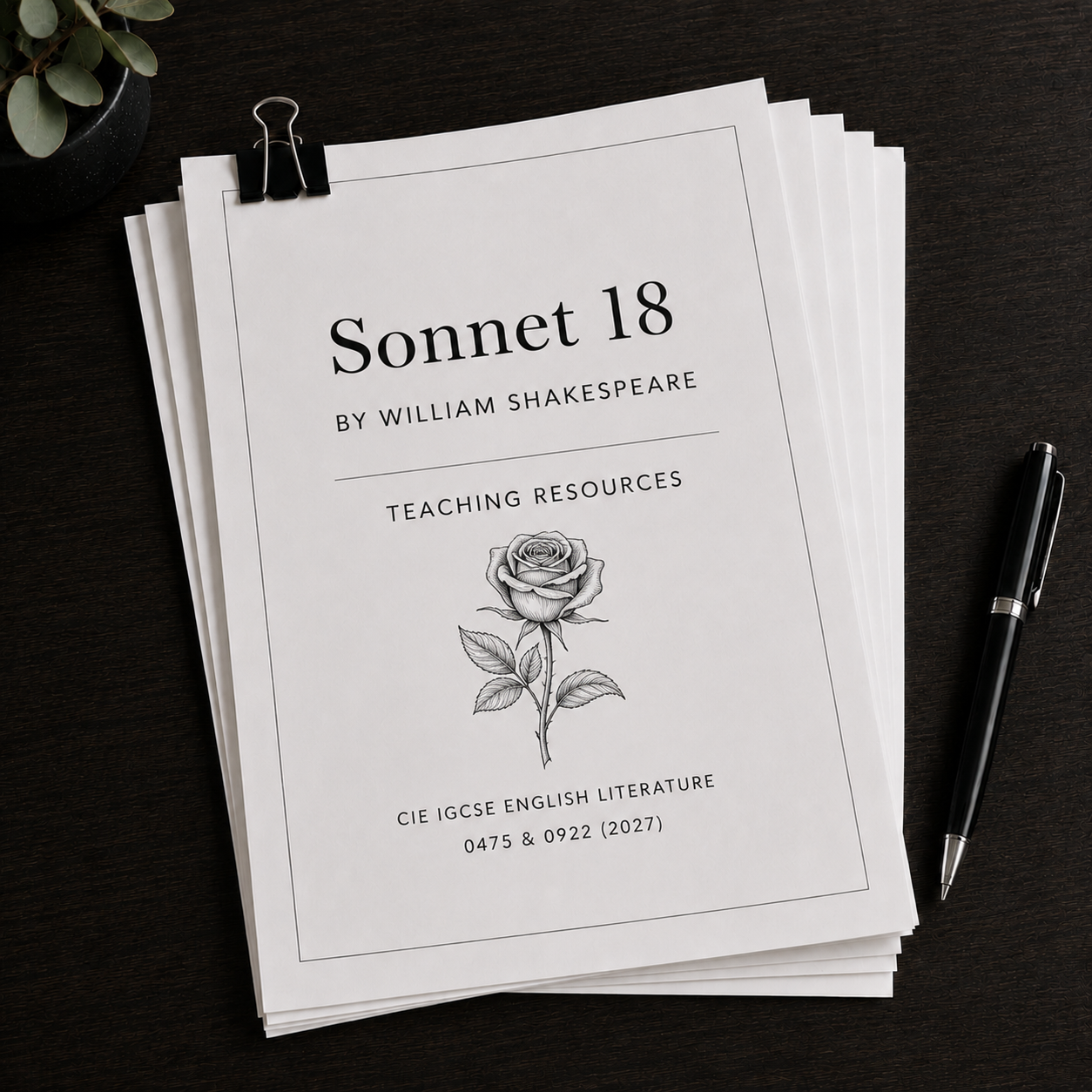
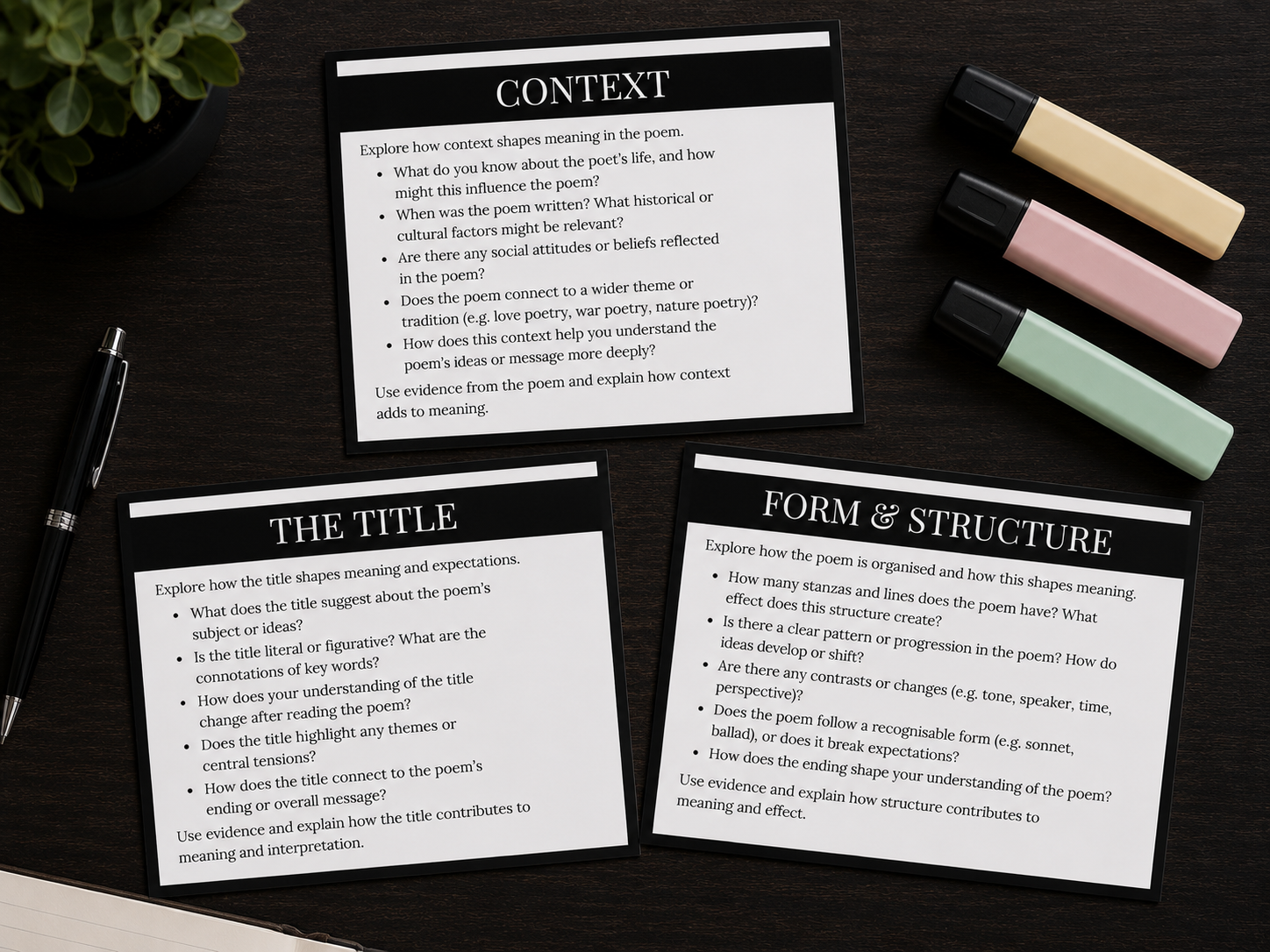
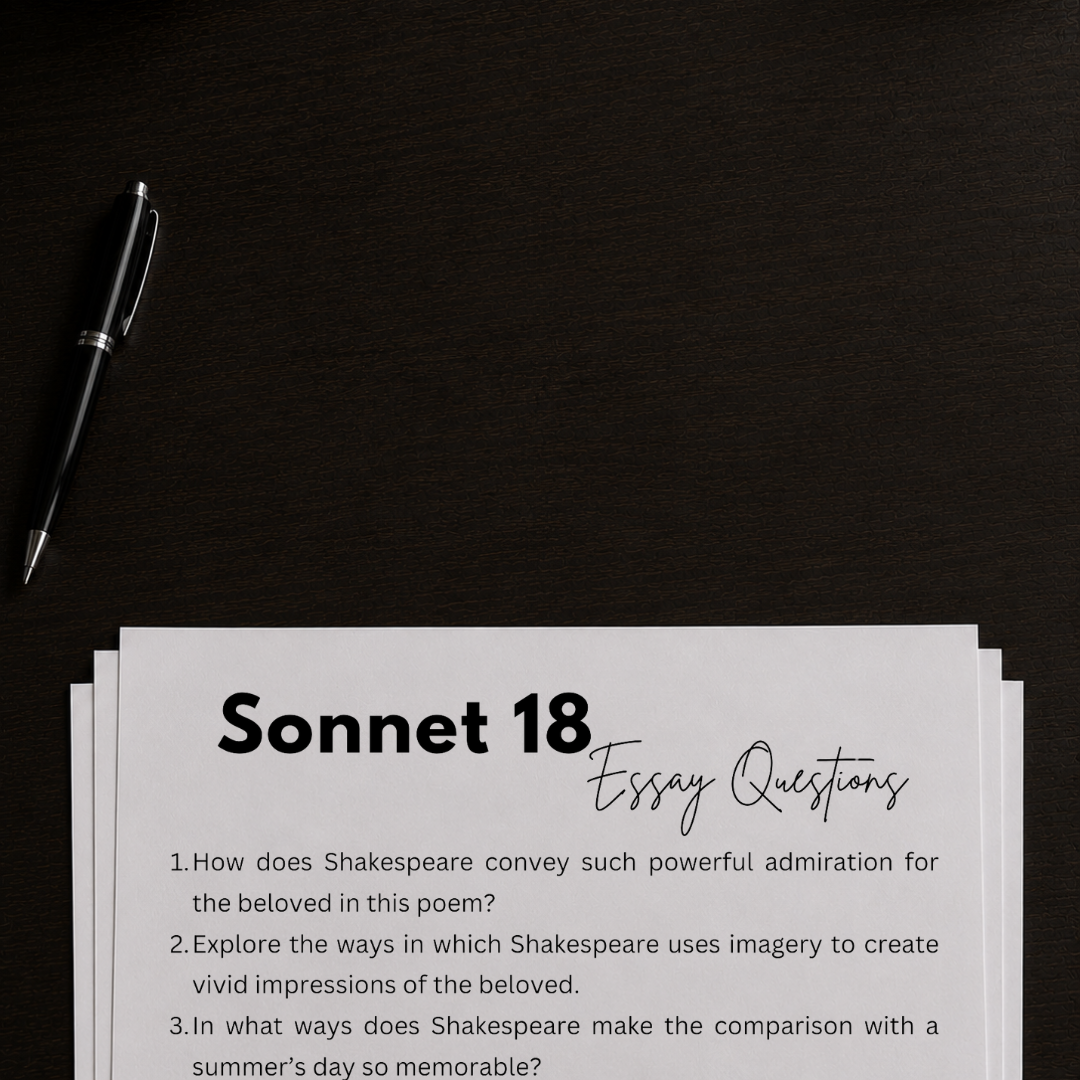
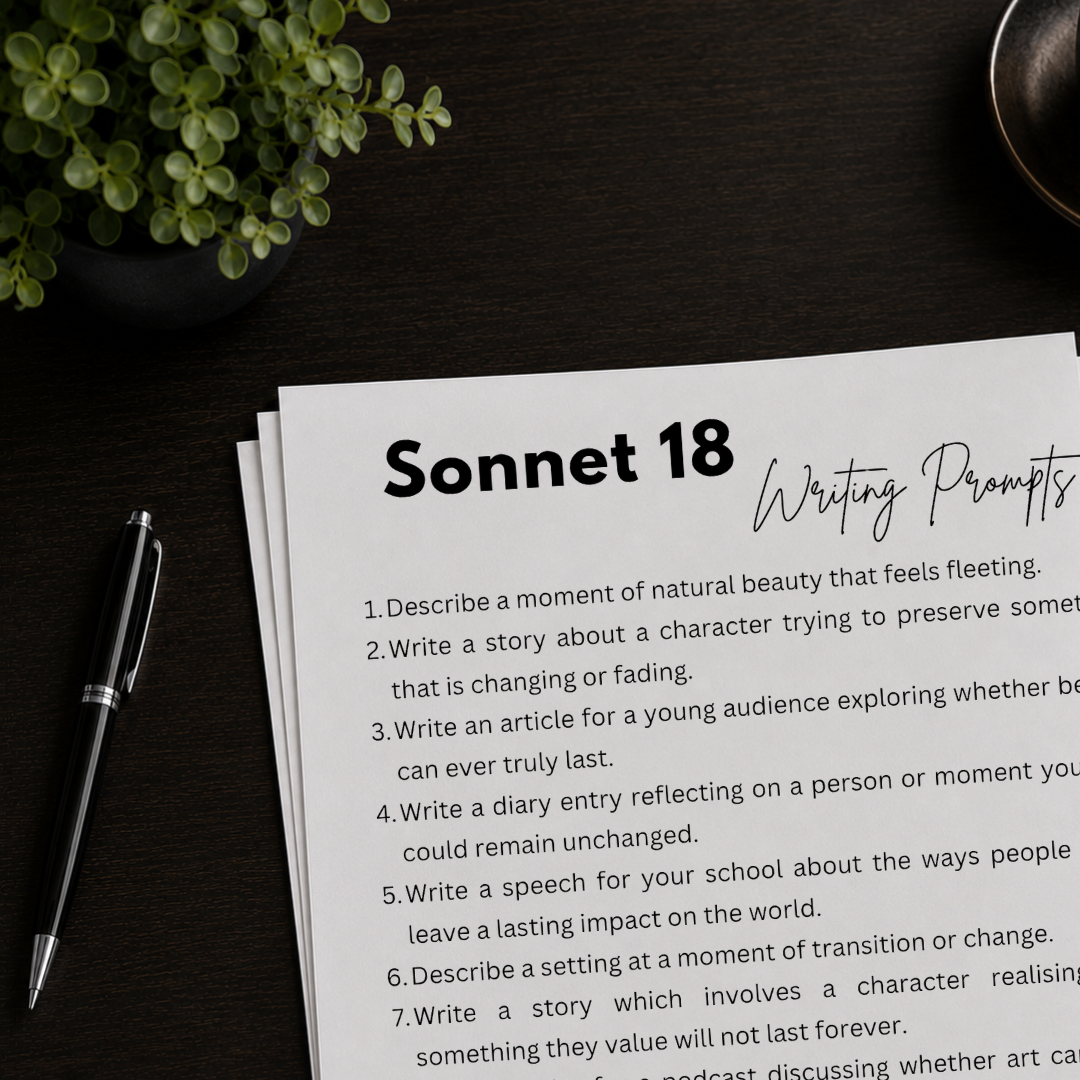
Download the complete teaching resource pack for Sonnet 18 by William Shakespeare — designed for CIE IGCSE English Literature (0475 & 0922, 2027 syllabus) but flexible enough for a wide range of secondary English, GCSE, and high school literature classrooms. This ready-to-use bundle includes analytical task cards, exam-style essay questions, creative writing prompts, silent debate activities, and discussion-based lessons that help students move beyond basic understanding towards confident, independent literary analysis and stronger written responses — without spending hours creating resources from scratch.
Go Deeper into Sonnet 18
If you’re exploring Sonnet 18, it’s useful to compare how William Shakespeare presents time, beauty, and permanence across other texts.
You might also explore:
◆ Sonnet 116 – presents love as constant and unchanging, offering a clear comparison with the idea of permanence in Sonnet 18
◆ Sonnet 130 – challenges traditional ideas of beauty, showing a more realistic and less idealised view of the beloved
◆ Ozymandias by Percy Bysshe Shelley – explores how time destroys human achievements, contrasting with the idea that poetry can preserve memory
◆ To His Coy Mistress by Andrew Marvell – examines time and urgency, showing a different response to the inevitability of decay
◆ Bright Star by John Keats – explores the desire for permanence in contrast with human change
◆ Remember by Christina Rossetti – considers memory and what it means to be remembered after death
These comparisons help deepen understanding of how writers explore time, beauty, and legacy, and support more developed, top-band responses by making connections across texts.
Final Thoughts
Sonnet 18 remains one of the most powerful and famous explorations of time, beauty, and permanence in poetry. Through a carefully controlled structure, William Shakespeare moves from questioning comparison to confidently asserting that while nature is unstable and temporary, poetry has the power to preserve what would otherwise be lost.
The poem’s impact lies in this shift. What begins as a familiar comparison to a summer’s day develops into something far more significant: a claim that language itself can resist time and outlast death. By combining imagery, contrast, sound, and structure, Shakespeare creates a piece that not only describes lasting beauty, but actively demonstrates it through its own endurance.
Ultimately, Sonnet 18 is memorable not just for its expression of admiration, but for its belief in the lasting power of art. It transforms a personal moment into a universal idea, showing that while human life is temporary, poetry can give it a form of permanence.
For more poetry analysis, explore the Songs of Ourselves Volume 1 Hub or the Literature Library.
Choose Your Next Text