Hunting Snake by Judith Wright: Summary, Themes & Analysis
Judith Wright’s Hunting Snake presents a moment of sudden encounter that explores fear, fascination, and the power of nature, using imagery, contrast, and controlled structure to capture the tension between human stillness and the snake’s fluid movement. The poem traces how an ordinary walk is disrupted by the presence of something both threatening and beautiful, revealing a shift from instinctive fear to quiet admiration. If you are studying or teaching Songs of Ourselves Volume 1 for CIE English Literature (0475), you can explore in-depth analyses of every poem in the Songs of Ourselves Volume 1 hub, or a wider range of texts in the Literature Library.

Context of Hunting Snake
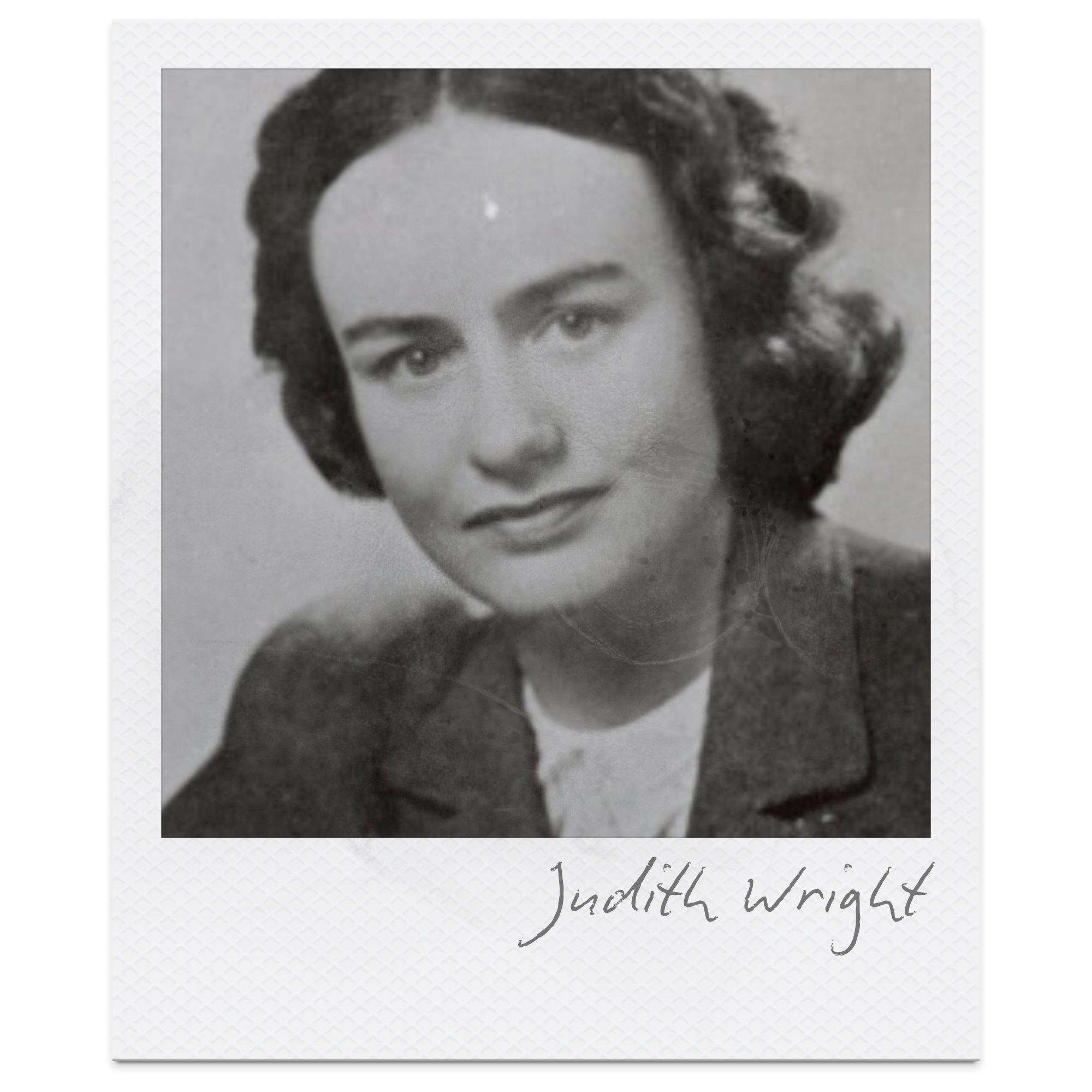
Judith Wright was an Australian poet known for her focus on nature, landscape, and the relationship between humans and the natural world. Her work often explores moments where ordinary experience is interrupted by a deeper awareness of nature’s power and presence.
In Hunting Snake, this context is reflected in the encounter between humans and a wild animal, where the snake is not simply a threat but a symbol of natural instinct and independence. The poem reflects a broader idea that nature operates beyond human control, encouraging reflection on respect, fear, and coexistence.
Hunting Snake: At a Glance
Form: Regular quatrains (four-line stanzas)
Mood: Tense, awed, reflective
Central tension: Human fear and stillness vs the snake’s calm, purposeful movement
Core themes: Nature’s power, fear and fascination, human vs animal instinct, momentary transformation
One-sentence meaning: The poem captures how a brief encounter with a snake disrupts ordinary life, revealing both the fear and beauty of the natural world while prompting a moment of reflection before life resumes.
Quick Summary of Hunting Snake
The poem begins with a calm, almost idyllic scene as the speakers walk under the “autumn’s gentlest sky,” a moment of ease and harmony that is immediately disrupted when they “freeze half-through a pace.” The sudden appearance of the “great black snake” interrupts both movement and thought, creating a moment of intense suspension. As the snake moves past, the focus shifts to its controlled, purposeful motion—its “tongue flickering” and body gliding through the grass—while the observers remain physically and mentally fixed, unable to act.
As the poem develops, attention turns away from the speakers and fully onto the snake, whose instinct-driven purpose dominates the moment. Questions about its prey are raised but not pursued, showing how human reasoning gives way to absorbed observation. By the final stanza, the snake disappears “cold, dark and splendid,” leaving behind a sense of awe rather than fear. The speakers then resume their walk, but the “deeper breath of day” suggests they have been briefly altered by the encounter, having experienced a moment where nature’s presence interrupts and redefines human perception.
Title, Form, Structure, and Metre
Wright uses a controlled, regular structure to mirror the speakers’ initial calm and restraint, while subtle disruptions reflect the moment of shock, suspension, and heightened awareness created by the snake.
Title
The title, Hunting Snake, immediately foregrounds action and threat, positioning the snake as active and purposeful. The present participle “hunting” suggests ongoing movement and instinct, while the noun “snake” carries associations of danger, fear, and primal nature. However, the poem complicates this expectation, shifting from fear to admiration, so that the snake becomes not just a threat but a figure of beauty and control.
Form and Structure
The poem is organised into four quatrains, creating a clear and balanced structure that reflects the speakers’ initial sense of order and calm. Each stanza marks a stage in the encounter:
the sudden interruption
the focused observation of the snake
the suspension of thought
the return to movement
This progression mirrors the shift from ordinary experience to heightened awareness and back again.
The turning point occurs in the third stanza, where the rhetorical questions (“What track he followed…”) suggest an attempt to impose logic. However, this is immediately undermined by “we scarcely thought,” showing that the encounter resists rational explanation. The final stanza resolves the moment structurally, returning to action (“went on”), but the pause before this emphasises that the experience has temporarily altered perception.
Rhyme Scheme and Poetic Pattern
The poem follows a regular ABAB rhyme scheme in each quatrain:
grace / sky / pace / by
trail / grass / scale / pass
food / intent / stood / went
gone / prey / day / on
This consistent pattern creates a sense of control and predictability, reflecting the measured tone of the speakers. However, this regularity contrasts with the unpredictable appearance of the snake, highlighting the tension between structured human perception and natural instinct.
Metre and Rhythmic Movement
The poem broadly follows iambic tetrameter, with four beats per line, creating a steady, walking rhythm that reflects the speakers’ movement at the beginning:
Sun-WARMED | in THIS | late SEA | son’s GRACE
This regular rhythm reinforces the sense of calm before the encounter. However, Wright introduces subtle variations that mirror disruption. For example:
we WALKED, | and FROZE | half-THROUGH | a PACE
The stress on “FROZE” creates a sudden rhythmic halt, mirroring the physical stopping of the speakers.
Similarly, the flowing rhythm of the snake’s movement is captured through smoother lines such as:
sun GLAZED | his CURVES | of DIA | mond SCALE
The even distribution of stresses here reflects the snake’s controlled, fluid motion, contrasting with the speakers’ earlier interruption.
Overall, the metre moves between steady progression and momentary disruption, reinforcing the poem’s central tension between human stillness and natural movement.
The Speaker in Hunting Snake
The speaker presents a first-person plural perspective (“we”), positioning the experience as shared while maintaining a controlled, observational tone. This collective voice creates a sense of distance and restraint, as the speakers do not react impulsively but instead become absorbed in watching the snake. Their initial response—“froze half-through a pace”—reveals instinctive fear, but this quickly shifts into focused attention, suggesting a movement from reaction to reflection.
The speaker’s tone remains measured and contemplative, avoiding exaggeration and allowing the moment to unfold through careful description. The brief attempt to impose logic through questions (“What track he followed…”) is immediately undermined by “we scarcely thought,” showing that the encounter disrupts rational control. By the end, the speaker’s calm return to movement suggests that the experience has been internalised rather than resolved, shaping interpretation through a voice that is both detached and quietly transformed.
Stanza-by-Stanza Analysis of Hunting Snake
This section offers a close reading of how each stanza develops meaning, focusing on how Wright uses imagery, structure, and rhythm to move from calm observation to a moment of suspension and awe, before returning to controlled movement. As the poem progresses, the speakers shift from instinctive reaction to absorbed attention, revealing how the encounter with the snake disrupts ordinary perception and briefly redefines their relationship with the natural world.
Stanza 1: Sudden Interruption and Suspended Movement
The stanza opens with a calm, almost idealised setting—“late season’s grace” and “autumn’s gentlest sky”—creating a sense of harmony and ease. This soft, controlled imagery establishes a stable rhythm that mirrors the speakers’ relaxed movement, suggesting a world that feels ordered and predictable.
This calm is abruptly disrupted by the phrase “we walked, and froze half-through a pace,” where the verb “froze” creates a sharp break in both action and rhythm. The interruption is physical and psychological, capturing a moment of suspension where movement is halted mid-action. This shift marks the intrusion of something beyond human control.
The final line introduces the snake as “the great black snake,” with the adjective “great” elevating its presence and “black” reinforcing associations of danger and mystery. The verb “reeling” suggests fluid, continuous motion, contrasting with the speakers’ stillness. This contrast establishes the central tension of the poem: human paralysis versus natural movement, where the snake dominates the moment through its effortless control.
Stanza 2: Controlled Movement and Absorbed Attention
The focus shifts entirely onto the snake, whose movement is presented as purposeful and instinctive. The participle “Head down” immediately suggests concentration, while the image of the “tongue flickering” conveys alertness and sensory awareness. The verb “quested” elevates the snake’s action, giving it a sense of deliberate purpose rather than mindless motion, reinforcing its authority within the scene.
Wright’s imagery emphasises both fluidity and precision, as the snake moves “through the parting grass.” The verb “parting” suggests that the landscape yields to the snake, highlighting its dominance and ease within its environment. This is further reinforced by the visual image of “diamond scale,” where the metaphor suggests both beauty and sharpness, combining attraction with an underlying sense of danger.
In contrast, the speakers become increasingly passive. The phrase “we lost breath” suggests both fear and awe, indicating that the intensity of the moment overwhelms normal physical response. This loss of breath mirrors their earlier stillness, reinforcing how the snake’s controlled movement contrasts with human immobility and absorption, as the speakers are drawn into observing rather than acting.
Stanza 3: Suspended Thought and Total Absorption
The stanza begins with rhetorical questions—“What track he followed, what small food…”—which suggest an attempt to impose logic and explanation onto the encounter. However, these questions remain unanswered, indicating that rational thought is disrupted by the intensity of the moment. The phrase “fled living from his fierce intent” emphasises the snake’s role as a predator, with “fierce” reinforcing its instinctive power, while “fled living” highlights the unseen presence of prey and the wider natural cycle.
This brief movement toward understanding is immediately undermined by “we scarcely thought,” where the adverb “scarcely” suggests that thought is almost entirely suspended. The semi-colon acts as a structural pause, reinforcing the shift from attempted reasoning to complete stillness. The speakers are no longer analysing but simply experiencing the moment.
The final line—“our eyes went with him as he went”—emphasises this total absorption. The repetition of “went” creates a sense of continuity and inevitability, mirroring the snake’s uninterrupted movement. While the speakers remain physically still, their attention is entirely controlled by the snake, reinforcing the central contrast between human passivity and natural purpose.
Stanza 4: Awe, Release, and Return to Movement
The stanza opens with the striking description “Cold, dark and splendid,” where the juxtaposition of threat (“cold,” “dark”) and admiration (“splendid”) captures the complexity of the speakers’ response. The snake is no longer simply dangerous but something powerful and awe-inspiring, suggesting a shift from fear to recognition of its place within nature. The phrase “he was gone” is abrupt, marking the sudden disappearance of the moment.
The image of the snake moving “into the grass that hid his prey” returns attention to the natural cycle of predation, reinforcing the idea that the snake operates according to instinct beyond human control. The verb “hid” suggests both concealment and inevitability, as the snake disappears back into a world the speakers cannot fully access.
The final two lines mark a clear structural resolution. “We took a deeper breath of day” suggests both physical recovery and a renewed awareness of the surrounding world, as if the encounter has intensified perception. The simple sequence—“looked at each other, and went on”—restores normal movement, but the pause before it implies that something has shifted. The encounter is brief, yet it leaves a lingering effect, highlighting how moments of contact with nature can interrupt, transform, and then release human experience back into routine.
Key Quotes and Methods in Hunting Snake
These quotations show how Wright uses imagery, structure, and contrast to present the tension between human response and natural instinct, moving from fear to controlled admiration.
“we walked, and froze half-through a pace”
◆ Technique: Juxtaposition and verb contrast
◆ Meaning: Movement is abruptly interrupted by stillness
◆ Purpose: To show the sudden shock of the encounter
◆ Impact: Emphasises human vulnerability and lack of control in contrast to the snake
“The great black snake”
◆ Technique: Adjective choice (semantic field of threat)
◆ Meaning: The snake is presented as powerful and potentially dangerous
◆ Purpose: To establish its dominance within the scene
◆ Impact: Creates tension while elevating the snake’s presence beyond something ordinary
“tongue flickering on the trail”
◆ Technique: Visual imagery and present participle
◆ Meaning: The snake is alert and actively sensing its environment
◆ Purpose: To highlight instinctive, controlled movement
◆ Impact: Reinforces the idea of the snake as purposeful and precise
“he quested through the parting grass”
◆ Technique: Elevated diction and personification
◆ Meaning: The snake’s movement is given a sense of intention and purpose
◆ Purpose: To present it as focused and almost heroic
◆ Impact: Shifts the reader from fear to admiration of its control and direction
“sun glazed his curves of diamond scale”
◆ Technique: Metaphor and visual imagery
◆ Meaning: The snake’s body is presented as shining and intricate
◆ Purpose: To emphasise beauty as well as danger
◆ Impact: Creates a sense of awe, complicating the reader’s emotional response
“we lost breath to see him pass”
◆ Technique: Physical response imagery
◆ Meaning: The speakers are overwhelmed by the encounter
◆ Purpose: To show the intensity of their reaction
◆ Impact: Suggests a shift from fear to absorbed fascination
“we scarcely thought”
◆ Technique: Adverbial phrase and structural pause
◆ Meaning: Rational thought is almost completely suspended
◆ Purpose: To highlight the power of the moment over human logic
◆ Impact: Reinforces the idea of instinctive response overtaking reasoning
“our eyes went with him as he went”
◆ Technique: Repetition and parallel structure
◆ Meaning: The speakers are mentally following the snake
◆ Purpose: To show total absorption in the moment
◆ Impact: Emphasises the dominance of the snake over their attention
“Cold, dark and splendid”
◆ Technique: Juxtaposition
◆ Meaning: The snake is both threatening and beautiful
◆ Purpose: To capture the complexity of the speakers’ response
◆ Impact: Reflects the shift from fear to admiration
“We took a deeper breath of day”
◆ Technique: Metaphor
◆ Meaning: The speakers return to normal life with heightened awareness
◆ Purpose: To show the lingering effect of the encounter
◆ Impact: Suggests transformation, even within a brief moment
Key Techniques in Hunting Snake
Wright uses a precise combination of structural control, imagery, and contrast to reflect the tension between human stillness and the snake’s fluid, instinctive movement, while presenting it as both beautiful and threatening.
◆ Enjambment – Lines often flow into one another without pause, mirroring the snake’s continuous, gliding movement. This creates a sense of momentum, particularly in descriptions of the snake, reinforcing its effortless control within the natural world
◆ Caesura – Strategic pauses within lines (e.g. “we walked, and froze…”) interrupt the rhythm, reflecting the speakers’ sudden halt and psychological shock. These breaks contrast with the snake’s fluid motion, highlighting the difference between human disruption and natural continuity
◆ Imagery (visual and sensory) – Wright’s imagery is vivid and carefully controlled, presenting the snake through precise detail such as “diamond scale” and “tongue flickering.” This creates a strong visual presence, allowing the reader to experience the moment with clarity and intensity
◆ Juxtaposition (beauty vs danger) – Phrases such as “diamond scale,” “fierce intent,” and “cold, dark and splendid” combine admiration with threat. The snake is presented as something visually striking and almost majestic, while also remaining dangerous. This duality shapes the reader’s response, creating both awe and unease
◆ Elevated diction – Words like “quested” and “splendid” give the snake a sense of importance and authority, elevating it beyond an ordinary animal. This contributes to the shift from fear to respect and admiration
◆ Contrast – The poem consistently contrasts human stillness with animal movement, and calm setting with sudden disruption. This structural and thematic contrast reinforces the central tension between control and instinct
◆ Repetition and parallel structure – The repetition in phrases like “as he went” creates a sense of continuity and inevitability, mirroring the snake’s steady movement and reinforcing its dominance over the moment
◆ Metaphor and descriptive language – The snake is described using language that suggests both precision and intensity, such as “fierce intent.” This frames its behaviour as purposeful and instinct-driven, emphasising the idea that nature operates beyond human reasoning
◆ Controlled rhythm – The steady underlying rhythm reflects the speakers’ initial calm and later return to normality, while subtle disruptions mirror the moment of interruption. This balance between control and variation reinforces the poem’s exploration of temporary disruption within an ordered world
Overall, these techniques work together to present the snake as something both mesmerising and dangerous, shaping a response that moves from instinctive fear to reflective admiration.
How the Writer Creates Meaning and Impact in Hunting Snake
Wright creates meaning through a careful balance of imagery, structure, and contrast, shaping a moment where human experience is briefly interrupted by the presence of something more instinctive and powerful.
◆ Imagery (beauty and danger combined) – Descriptions such as “diamond scale,” “fierce intent,” and “cold, dark and splendid” present the snake as both visually striking and potentially threatening. This duality forces the reader to hold two responses at once—awe and fear—reflecting how nature can be admired but never fully controlled or understood
◆ Structure (interruption and resolution) – The poem moves from calm movement to sudden stillness, then back to motion. The moment of interruption—“froze half-through a pace”—creates a clear structural shift, while the final return to “went on” restores order. This pattern reflects how encounters with nature can disrupt and then reshape human perception, even if only briefly
◆ Enjambment and caesura (movement vs pause) – Flowing lines mirror the snake’s smooth, continuous motion, while pauses within lines reflect the speakers’ shock and immobility. This contrast reinforces the central tension between natural instinct and human reaction, making the snake appear controlled and the humans reactive
◆ Voice and perspective (shared experience) – The use of “we” creates a collective response, suggesting that this reaction to nature is universal rather than individual. The restrained tone avoids exaggeration, allowing the moment to feel observed rather than dramatized, which increases its realism and impact
◆ Contrast (human vs natural world) – The speakers are defined by hesitation, stillness, and limited understanding, while the snake is defined by purpose and direction. This contrast highlights the idea that nature operates with a clarity and certainty that humans lack, reinforcing themes of respect and humility
◆ Shift in perception – The movement from fear to admiration is central to the poem’s meaning. Initially, the snake disrupts and threatens, but by the end it is described as “splendid,” showing how the encounter leads to a more complex understanding. This shift suggests that moments of contact with nature can expand perception rather than simply provoke fear
Overall, Wright creates a moment that is brief but transformative, showing how the natural world can interrupt routine and leave behind a heightened awareness of beauty, danger, and the limits of human control.
Themes in Hunting Snake
Wright explores how a brief encounter with nature reveals deeper ideas about fear, perception, and human limitation, using imagery and structure to move from instinctive reaction to reflective awareness.
Fear and Fascination
The snake initially provokes an instinctive response of fear, as shown by the speakers who “froze half-through a pace.” However, this fear quickly develops into absorbed fascination, particularly through detailed descriptions of the snake’s movement and appearance. The juxtaposition in “cold, dark and splendid” captures this dual response, suggesting that what is feared can also be admired. This theme highlights how human reactions to nature are often complex, combining threat and beauty rather than remaining purely one or the other.
Nature’s Power and Independence
The snake is presented as entirely self-contained and purposeful, moving with “fierce intent” and unaffected by the presence of the observers. In contrast, the humans are passive and uncertain, unable to act or fully understand what they are witnessing. This contrast reinforces the idea that nature operates according to its own logic, beyond human control, emphasising a theme of respect for natural instinct and autonomy.
Human Stillness vs Natural Movement
A key tension in the poem lies in the contrast between the speakers’ immobility and the snake’s fluid motion. Structural features such as caesura reflect the human pause, while enjambment mirrors the snake’s continuous movement. This contrast highlights how humans become disrupted and suspended, while nature continues uninterrupted, reinforcing the idea that human experience is fragile when confronted with the natural world.
Momentary Transformation
Although the encounter is brief, it creates a moment of heightened awareness. The line “We took a deeper breath of day” suggests that the speakers return to normal life with a changed perception, even if subtly. The experience does not permanently alter their lives, but it provides a moment of clarity that interrupts routine, reflecting how small encounters can produce temporary but meaningful shifts in understanding.
Limits of Human Understanding
The rhetorical questions in the third stanza show an attempt to understand the snake’s purpose, but this is quickly abandoned with “we scarcely thought.” This suggests that some aspects of nature resist explanation, reinforcing the idea that human logic is limited. The poem therefore presents nature as something that must be experienced rather than fully understood, emphasising uncertainty and the boundaries of knowledge.
Alternative Interpretations of Hunting Snake
Wright’s poem can be read in different ways depending on how the encounter is understood—whether as a psychological moment, a reflection on human perspective, or a broader philosophical statement about existence.
Psychological Interpretation: Confronting Instinct and the Unknown
The snake can be seen as a representation of instinctive fear and the unconscious mind, something that interrupts controlled, rational experience. The speakers’ reaction—“froze half-through a pace”—suggests an involuntary response, while “we scarcely thought” shows how quickly logic is overridden by instinct. In this reading, the poem explores how humans are still governed by primal reactions, and how moments like this expose the tension between civilised control and deeper, instinctive responses.
Social Interpretation: Human Distance from Nature
The poem can also be read as highlighting a growing separation between humans and the natural world. The speakers are observers rather than participants, unable to fully understand the snake’s purpose or environment. Their attempt to interpret its actions (“What track he followed…”) fails, suggesting a lack of connection or knowledge. This interpretation presents the encounter as a reminder that modern humans are often detached from natural processes, reacting with uncertainty rather than familiarity or integration.
Philosophical / Existential Interpretation: Purpose vs Uncertainty
The snake’s movement is driven by “fierce intent,” suggesting a clear, instinctive purpose, while the humans remain passive and uncertain. This contrast can be read as a reflection on human existence, where people search for meaning but often lack the clarity seen in the natural world. The snake becomes a symbol of certainty and direction, while the speakers represent hesitation and limited understanding, raising questions about whether human life is more complex—or simply more uncertain.
Symbolic Interpretation: Beauty and Danger as Intertwined
The description “cold, dark and splendid” suggests that the snake embodies both threat and beauty simultaneously. In this reading, the snake symbolises forces that are both attractive and dangerous—whether nature, power, or the unknown. The poem therefore becomes an exploration of how humans respond to things that cannot be neatly categorised, showing that meaning often lies in tension rather than resolution.
Exam-Ready Insight for Hunting Snake
This section shows how to turn your understanding of Hunting Snake into a strong, exam-focused response for IGCSE Literature (0475), with a clear focus on how meaning is created through methods.
What strong responses do
◆ focus closely on the question
◆ analyse methods (language, structure, and sound), not just ideas
◆ explain how effects are created, not just what happens
◆ track shifts in voice, tone, and movement across the poem
◆ use short, precise quotations to support points
Conceptual argument
A strong thesis for Hunting Snake might be:
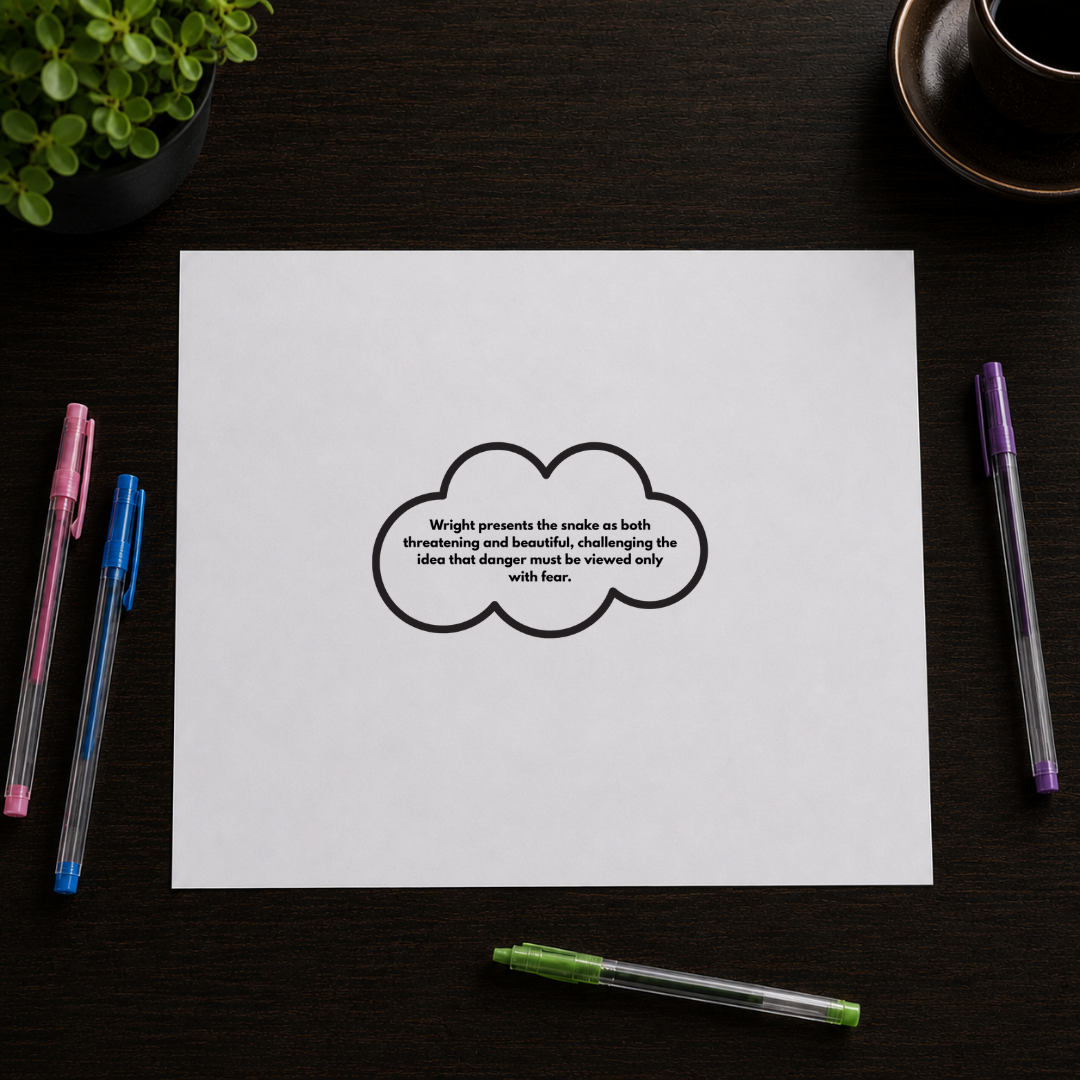
Wright presents the encounter with the snake as a moment where human control is disrupted by natural instinct, using contrast, imagery, and structural shifts to move from fear to admiration, revealing the complexity of human responses to the natural world.
Model analytical paragraph
Wright presents the snake as both threatening and awe-inspiring to explore the complexity of human response to nature. In the description “cold, dark and splendid,” the use of juxtaposition combines opposing connotations, suggesting that the snake cannot be understood in simple terms. This reflects Wright’s purpose of presenting nature as both dangerous and beautiful, resisting clear categorisation. The effect on the reader is a sense of uneasy admiration, as fear is complicated by fascination. This is reinforced by “we walked, and froze half-through a pace,” where the verb “froze” disrupts movement and highlights the speakers’ immediate vulnerability. As a result, Wright shows how encounters with nature can interrupt ordinary experience and force a shift from instinctive fear to reflective awareness.
Teaching Ideas for Hunting Snake
This poem is ideal for exploring how writers use language, structure, and voice to present ideas, while also building collaborative and discussion-based classroom approaches.
1. Collaborative Analytical Paragraph (Paired Writing)
Give students a focused question, for example:
How does Wright present the relationship between humans and nature in Hunting Snake?
Students work together to produce a single paragraph, combining their ideas and interpretations. They should:
◆ select and embed quotations
◆ identify methods (language, structure, sound)
◆ explain meaning → purpose → impact
Because both students contribute, they can challenge and refine each other’s ideas, leading to a stronger, more developed response. This reinforces that effective analytical writing is built through discussion and refinement, not just individual effort.
2. Structured Group Close Analysis (Role-Based)
Assign students specific roles in small groups for a stanza-by-stanza reading of the poem:
◆ Structure specialist – tracks shifts, progression, and contrast
◆ Language analyst – explores imagery and diction
◆ Methods expert – identifies poetic techniques and effects
◆ Tone tracker – comments on voice and emotional shifts
Each group analyses a stanza, then feeds back to the class. As responses are shared, build a full interpretation together.
This approach makes close reading more active and collaborative, while still developing detailed analytical skills.
3. Silent Debate
Set up a silent debate around the question:
Is Hunting Snake more about fear or admiration of nature?
Students respond to prompts in writing, building on and challenging each other’s ideas. They should:
◆ use quotations as evidence
◆ respond directly to others’ interpretations
◆ develop and refine arguments over time
This encourages deeper thinking, ensures all students participate, and allows ideas to develop more thoughtfully than in fast-paced verbal discussion. For guidance on structuring this activity, see this post on how to run an effective silent debate in your classroom.
4. Creative Writing: Capturing a Moment of Encounter
Ask students to write a short piece describing a sudden encounter with something powerful or unexpected.
Prompt:
Write about a moment where something interrupts an ordinary experience and changes how you see the world.
Students should aim to:
◆ use imagery and sensory detail
◆ show contrast between before and after
◆ develop a clear narrative voice
◆ reflect a shift in perception
This activity helps students apply literary methods in their own writing while reinforcing how meaning is shaped through language and structure. For more ideas and structured prompts, explore the Creative Writing Archive.
Hunting Snake Teaching Resources
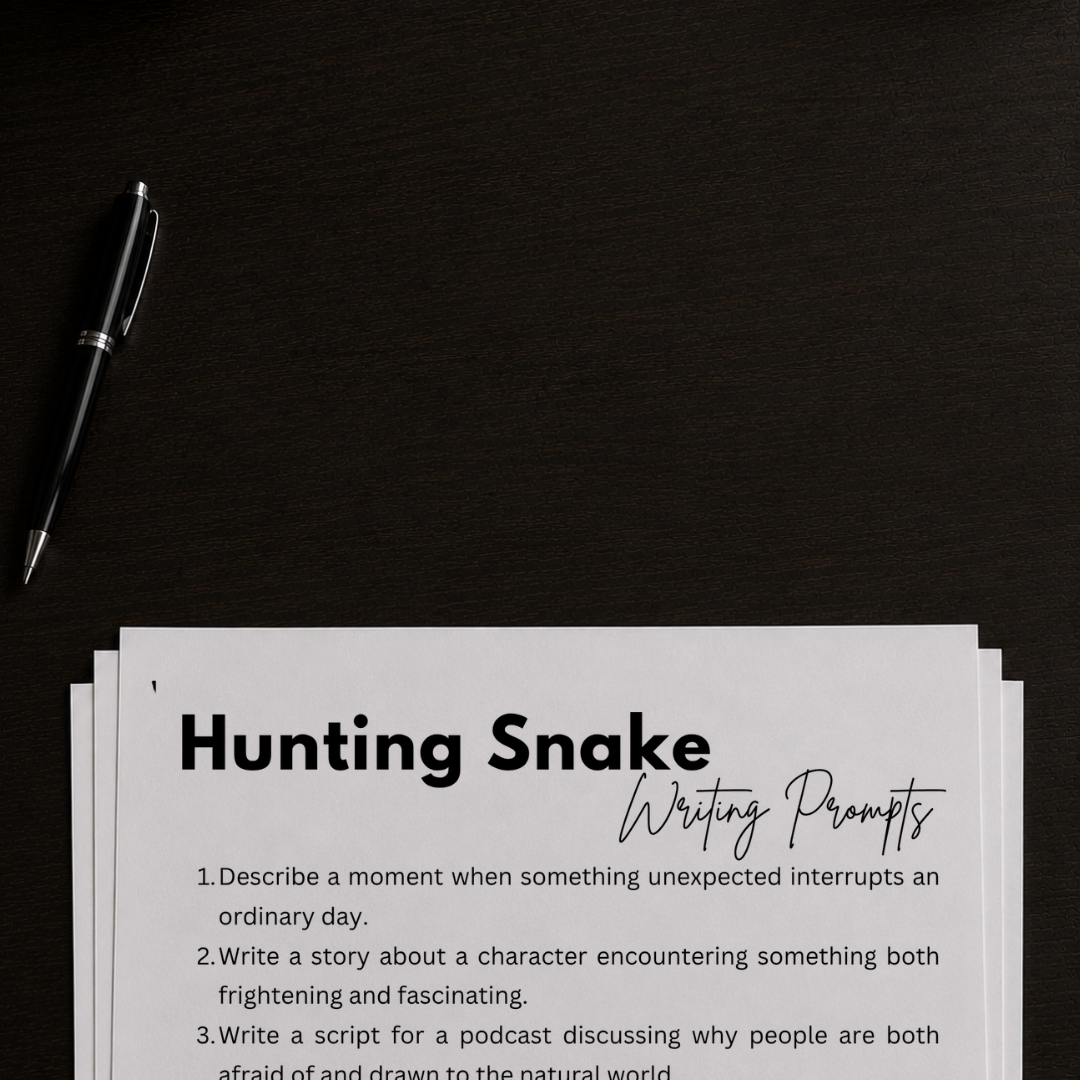
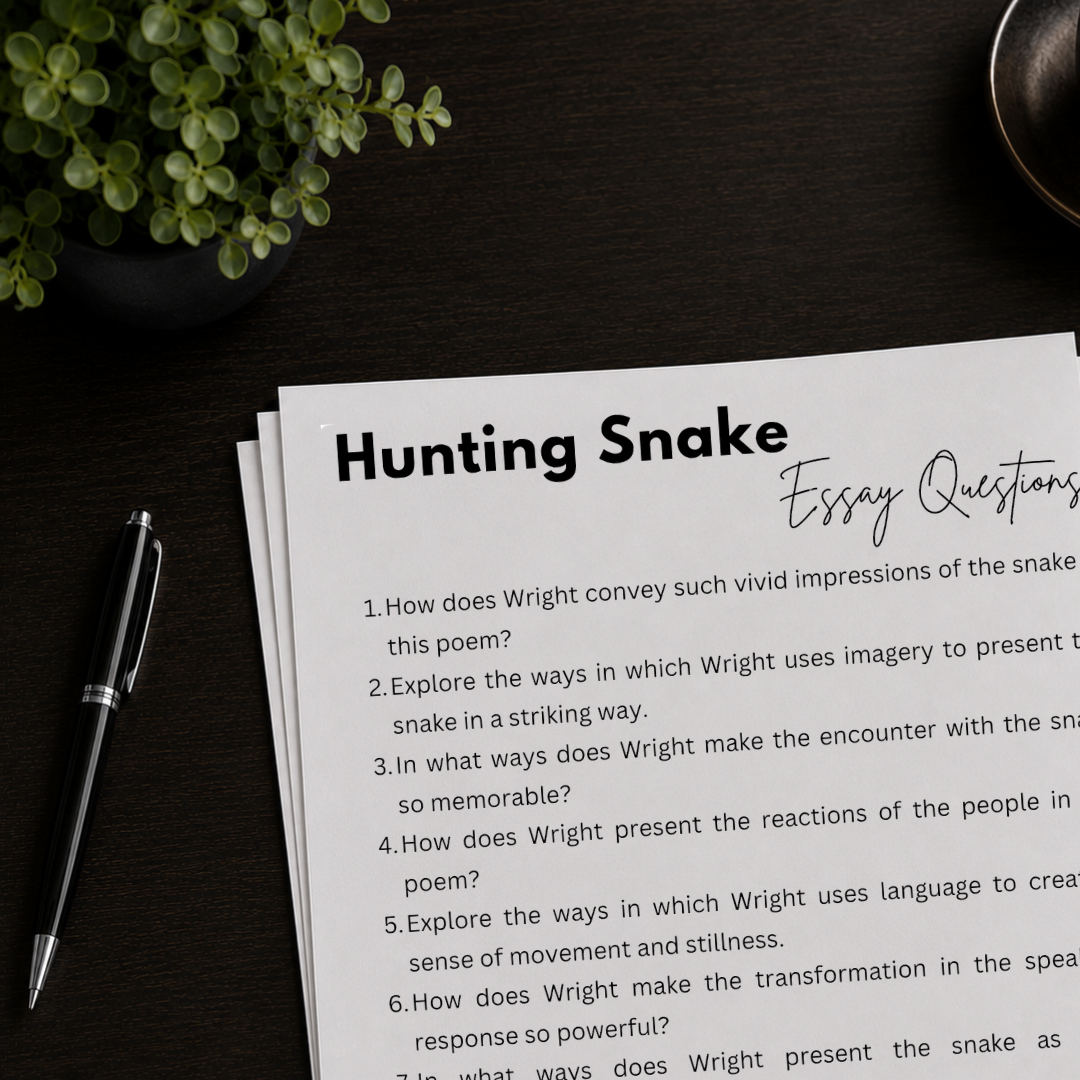
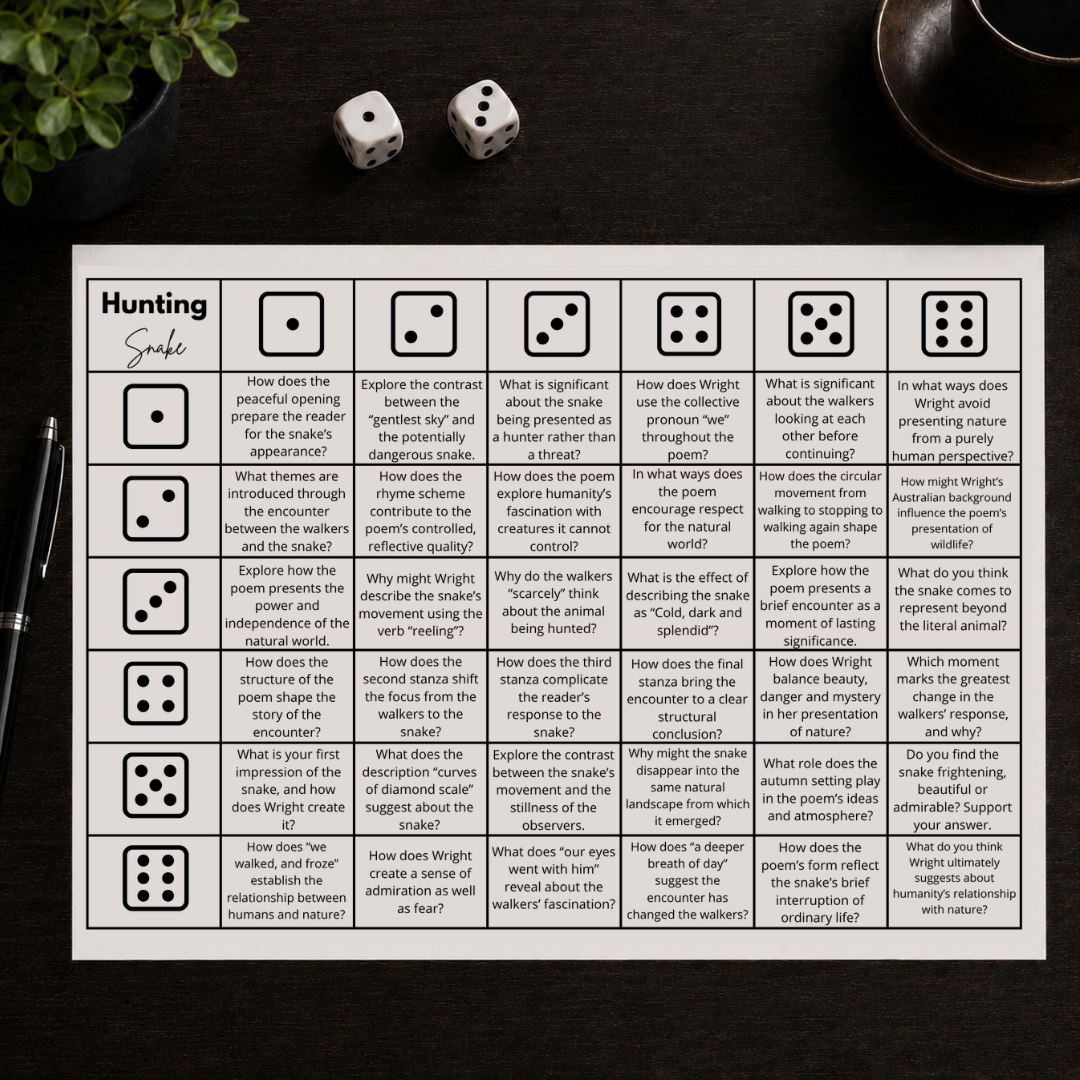
If you’re teaching Hunting Snake and want to take the analysis and classroom activities further, I’ve created a complete Hunting Snake by Judith Wright Teaching Resource Pack designed for CIE IGCSE English Literature (0475 & 0922, 2027 syllabus).
The pack builds on the close reading, discussion, personal response, and analytical work explored in this guide, giving you ready-to-use activities that can be used across individual lessons, revision sessions, or a complete sequence of study.
Inside the pack, you’ll find:
◆ Poetry analysis task cards exploring language, structure, form, imagery, tone, symbolism, context, and personal response
◆ 10 exam-style essay questions for developing analytical responses
◆ 10 creative writing prompts supporting skills needed for the Language Paper
◆ A Roll the Dice discussion board for quick, low-prep classroom discussion
◆ Silent debate activities designed to encourage students to develop, challenge, and defend different interpretations
◆ Teacher instructions for straightforward classroom implementation
The activities are designed to help students move beyond identifying individual techniques and towards exploring how Wright uses language, structure, form, movement, sound, and shifts in tone to shape the encounter with the snake. They also encourage students to consider the poem’s wider ideas about nature, beauty and danger, fear and fascination, human vulnerability, and the relationship between people and the natural world.
Explore the Hunting Snake by Judith Wright Teaching Resources → instant digital download.
Go Deeper into Hunting Snake
To strengthen comparison skills and push responses into the top band, connect Hunting Snake to other texts that explore nature, perception, and human response to the unknown.
◆Carpet Weavers, Morocco – Carol Rumens
Both poems focus on careful observation, but while Hunting Snake captures a sudden, instinctive encounter, Rumens’ poem presents sustained attention to human craft. Comparing them highlights how writers explore stillness, focus, and meaning through observation.
◆ Hawk Roosting – Ted Hughes
Like the snake, the hawk is presented as a creature of absolute control and instinct. Hughes’ use of a confident, dominating voice contrasts with Wright’s reflective tone, allowing comparison of how writers present animal power and authority.
◆ Snake – D. H. Lawrence
Both poems describe a direct human encounter with a snake, but Lawrence’s speaker experiences conflict and guilt, while Wright’s speakers move toward quiet admiration. This is ideal for analysing shifts in human response to nature.
◆ The Prelude (extract) – William Wordsworth
Wordsworth often presents moments where nature interrupts human experience, creating fear followed by reflection. This mirrors the structure of Hunting Snake, supporting comparison of momentary transformation and memory.
◆ Blessing – Imtiaz Dharker
Although focused on water rather than an animal, Blessing explores how a natural force disrupts ordinary life and reshapes perception. Both poems highlight how brief encounters carry deeper significance.
◆ The Fish – Elizabeth Bishop
Bishop’s detailed observation leads to a shift from control to respect and release, similar to Wright’s movement from fear to admiration. Both poems use imagery and close attention to transform perspective.
These comparisons help develop conceptual arguments, allowing students to move beyond single-text analysis and demonstrate how writers explore similar ideas through different methods and perspectives.
Final Thoughts
Hunting Snake captures a brief but powerful moment where ordinary experience is interrupted by the presence of something instinctive, controlled, and unknowable. Through imagery, contrast, and structured progression, Wright moves the reader from initial fear to a more complex response of awe and admiration, revealing how nature resists simple interpretation.
The poem’s impact lies in its restraint: the speakers do not fully understand the snake, nor do they attempt to control it. Instead, they experience a moment of heightened awareness before returning to routine, suggesting that such encounters do not need resolution to be meaningful.
If you are studying or teaching Songs of Ourselves Volume 1 for CIE English Literature (0475), you can explore more analyses in the Songs of Ourselves Volume 1 Hub, or broaden your comparisons in the Literature Library.
Choose Your Next Text