Where I Come From by Elizabeth Brewster: Summary, Themes & Analysis
Elizabeth Brewster’s Where I Come From explores identity, memory, and the influence of place, suggesting that people are shaped not just by where they live, but by what they carry within them. Through sensory imagery, contrast, and metaphor, the poem presents the idea that environments—whether natural or urban—leave lasting impressions on the mind, shaping how individuals see the world and themselves. The central tension lies between external environments and internal landscapes, as the speaker contrasts different types of places before focusing on a more personal, rural origin rooted in memory and experience. If you are studying or teaching Songs of Ourselves Volume 1 for CIE English Literature (0475), you can explore in-depth analyses of every poem from the 2026 and 2027 Paper 1 syllabus in the Songs of Ourselves Volume 1 Hub, or a wider range of texts in the Literature Library.

Context of Where I Come From
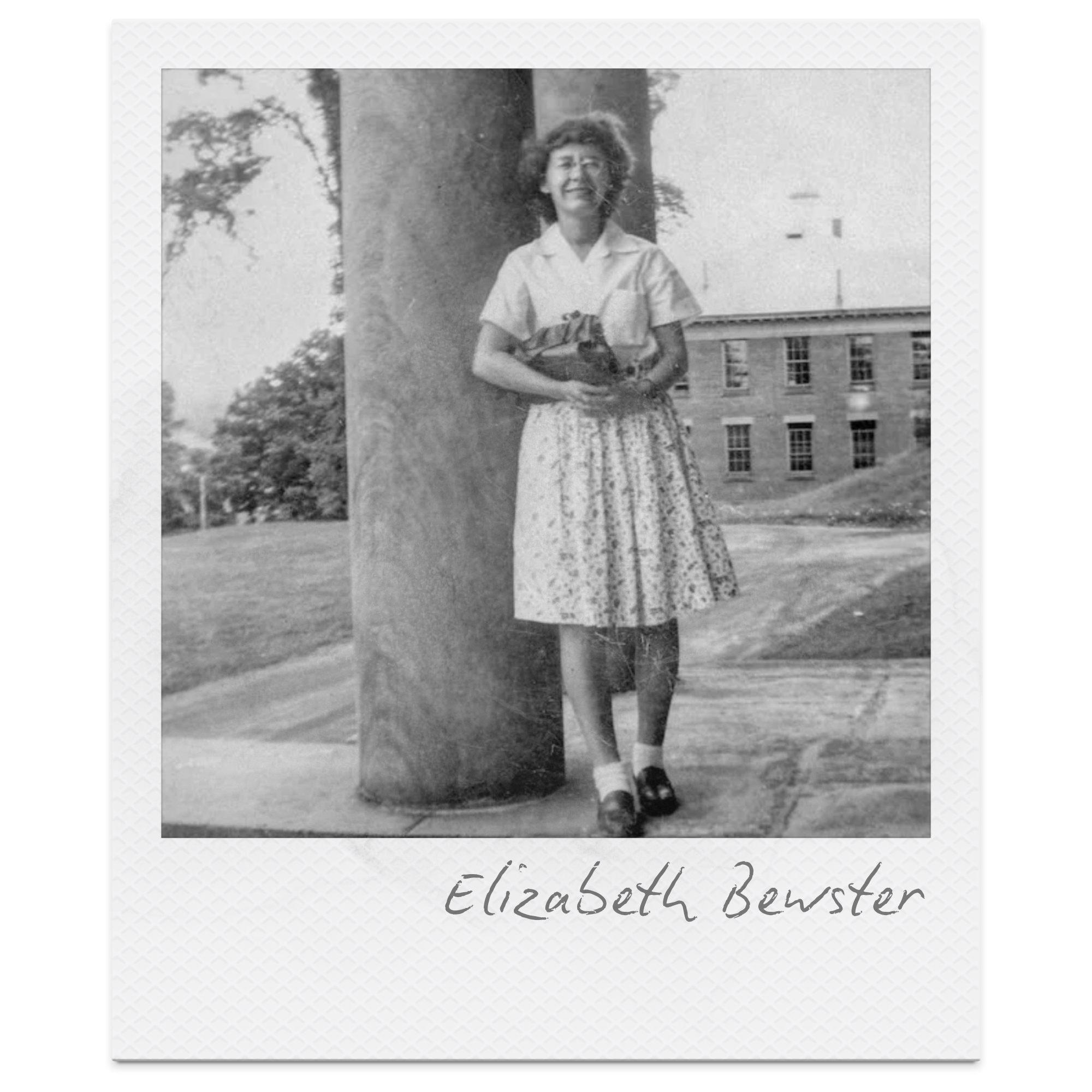
Elizabeth Brewster was a Canadian poet whose work often explores identity, memory, and the relationship between people and place. Writing in the twentieth century, Brewster is interested in how environments shape human experience, particularly through sensory detail and personal reflection rather than dramatic narrative.
Where I Come From reflects this focus by presenting identity as something formed through landscape, memory, and atmosphere. The poem moves from general observations about how people carry traces of different places to a more personal depiction of rural life, suggesting that identity is rooted in lived experience. The contrast between urban and natural environments highlights how different settings leave distinct impressions on individuals, shaping how they think, remember, and understand themselves.
Where I Come From: At a Glance
Form: Free verse (three stanzas, no fixed rhyme scheme)
Mood: Reflective, nostalgic, quietly contemplative
Central tension: External environments vs internal identity (what we come from vs what we carry within us)
Core themes: Identity and place; memory and landscape; rural vs urban environments; sensory experience; belonging
One-sentence meaning: The poem suggests that people are shaped by the places they come from, carrying those environments within their memories and identity.
Quick Summary of Where I Come From
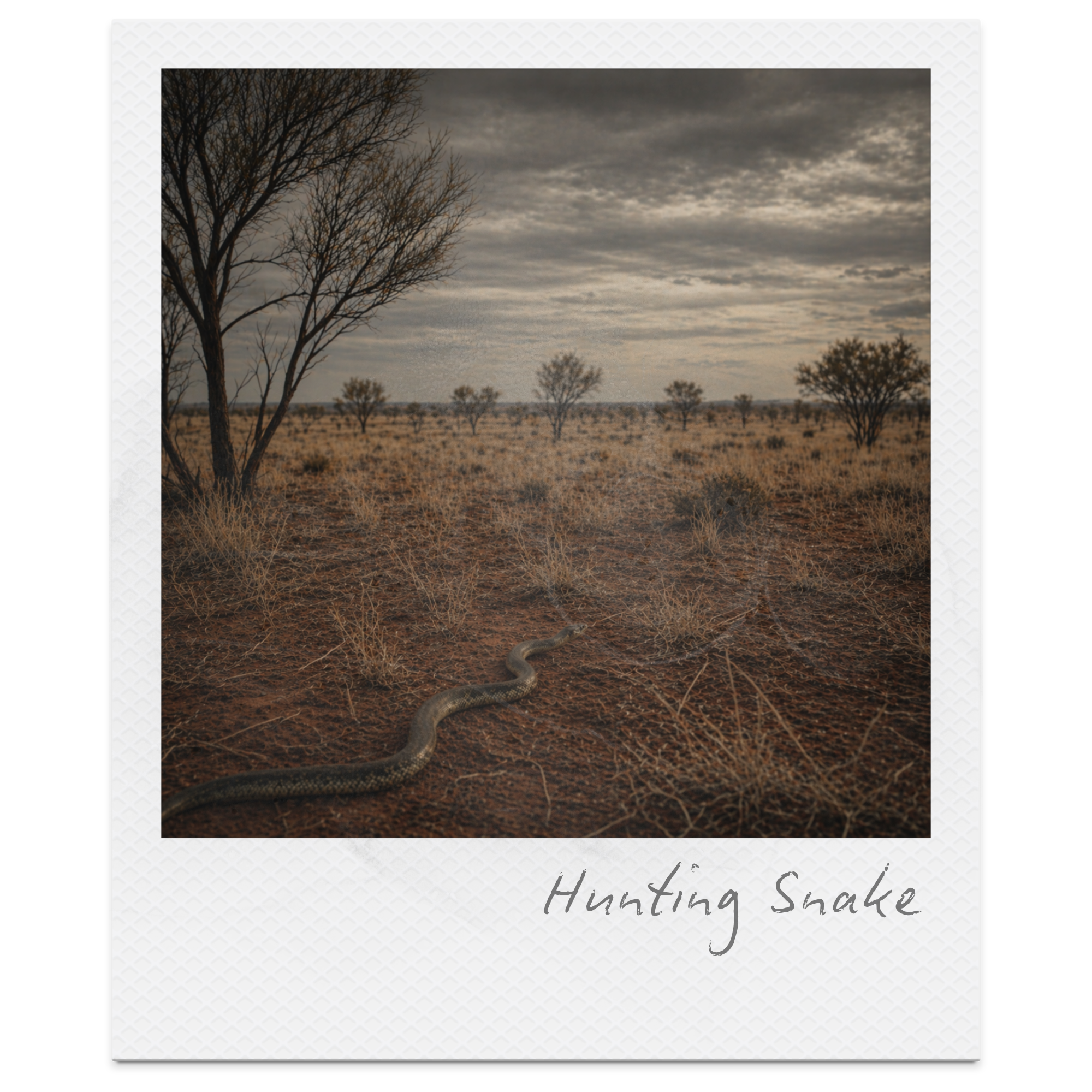
The poem begins with a general reflection that people are shaped by the places they come from, carrying traces of different environments within them. Through sensory imagery, the speaker describes how individuals might reflect jungles, mountains, or cities, suggesting that identity is influenced by surroundings such as nature, climate, and urban life. The variety of examples, from “smog” to “tulips,” highlights how different places leave distinct impressions.
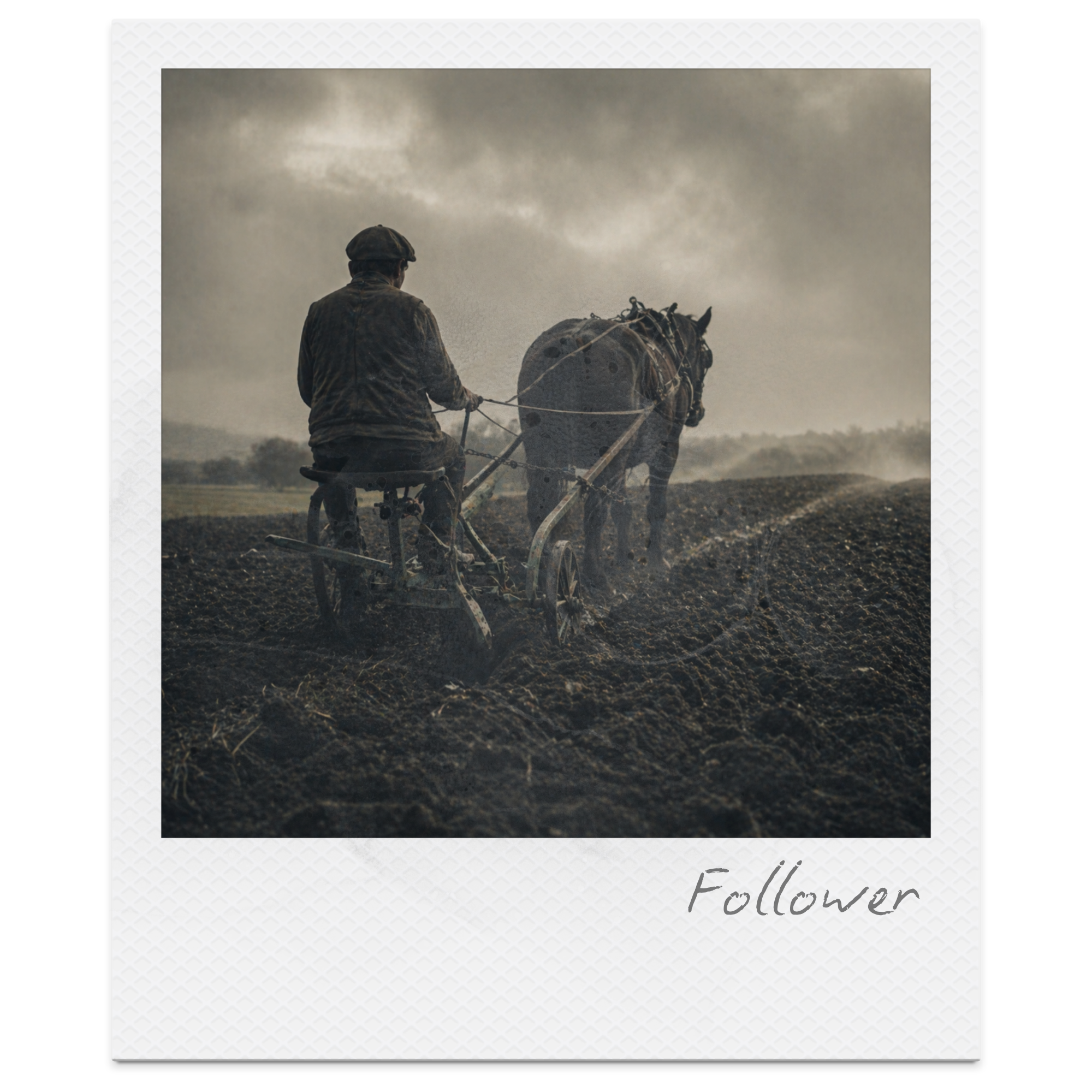
The focus then shifts to the speaker’s own background, presenting a more personal and detailed image of a rural landscape filled with woods, farmhouses, and seasonal change. This creates a sense of memory and belonging, as the speaker describes what is carried internally. The final lines emphasise how these places exist within the mind, with the image of a door opening to release a frosty wind, suggesting that identity is shaped by deeply rooted, enduring experiences.
Title, Form, Structure, and Metre in Where I Come From
The formal choices in Where I Come From reflect its central idea: that identity is layered, fluid, and shaped by experience rather than fixed rules. The poem’s structure moves from general observation to personal reflection, mirroring how the speaker narrows their focus from the world to their own internal landscape.
Title
The title Where I Come From immediately suggests a focus on origin and identity, but it is deliberately open-ended. Rather than referring to a single location, the poem expands this idea to suggest that “where” someone comes from includes multiple environments, memories, and sensory experiences. As the poem develops, the title shifts in meaning from a general statement about people to a more personal and psychological exploration of the speaker’s own background.
Form and Structure
The poem is written in free verse and is organised into three uneven stanzas (longer opening, shorter middle, and a brief closing couplet). This uneven structure reflects the way memory and identity are not neatly ordered, but instead build through fragments and impressions.
Both the first and second stanzas begin with a broad, declarative statement (“People are made of places” / “Where I come from, people…”), followed by detailed imagery. This creates a clear pattern: idea → example → expansion, reinforcing the poem’s reflective tone.
The progression of the poem also becomes increasingly specific and inward-looking. The first stanza speaks generally about people, the second focuses on a particular rural background, and the final couplet presents a sudden, vivid image of memory. This narrowing structure mirrors how identity moves from shared experience to personal internal reality, with the ending acting as a sharp, almost physical reminder of the speaker’s origins.
Rhyme Scheme and Poetic Pattern
There is no fixed rhyme scheme, which reflects the poem’s natural, conversational tone and its focus on lived experience rather than controlled argument. However, subtle sound patterns still create cohesion.
For example, the final couplet uses a half rhyme between “blows” and “snow,” linked by the repeated long o sound in “blows open” and “snow.” This creates a sense of echo and continuation, reinforcing the idea that memory returns repeatedly. The soft internal sound pattern gives the ending a quiet but powerful impact, as if the memory is unfolding naturally rather than being forced.
Metre and Rhythmic Movement
The poem does not follow a strict metre, which allows the rhythm to feel flexible and reflective, mirroring the speaker’s thought process. Line lengths vary, and the rhythm often follows natural speech patterns, reinforcing the idea that this is a personal reflection rather than a formal argument.
At times, the rhythm becomes more flowing and descriptive, particularly in lists such as “smell of smog… smell of work… smell of subways,” where repetition creates a steady, accumulating effect. This mirrors how sensory memories build over time.
In contrast, the final lines slow down and feel more deliberate:
A door in the MIND blows O-pen, and THERE blows
a FROST-y WIND from FIELDS of SNOW
The heavier stresses and longer vowel sounds give the ending a more forceful, physical rhythm, reflecting the sudden intrusion of memory. This shift in rhythm helps emphasise how the past continues to shape the speaker’s present identity.
The Speaker in Where I Come From
The speaker presents themselves as both an observer and participant, beginning with a broad, almost universal claim about how people are shaped by place, before gradually revealing their own background. At first, the voice feels detached and reflective, describing different environments in a generalised way, but this shifts as the poem becomes more personal and rooted in memory.
As the poem develops, it becomes clear that the speaker comes from a rural environment, characterised by woods, farms, and strong seasonal change. Their tone is nostalgic but not idealised—the imagery includes both natural beauty and signs of wear or hardship, suggesting a realistic, lived experience rather than romanticisation. This balanced perspective gives the voice a sense of authenticity and quiet authority.
By the final lines, the speaker’s voice becomes more intimate and psychological, revealing how these places continue to exist within the mind. The image of the “frosty wind” suggests that memory is not passive, but something that can return suddenly and powerfully. Overall, the speaker’s voice shapes interpretation by showing that identity is not fixed, but formed through internalised experiences of place, which continue to influence thought and feeling over time.
Stanza-by-Stanza Analysis of Where I Come From
This section explores how Elizabeth Brewster develops meaning through imagery, contrast, and sensory detail, showing how identity is shaped by place. Each stanza builds on the central idea that people carry environments within them, moving from general observation to personal memory and finally to a vivid psychological experience.
Stanza 1: Identity Shaped by Environment
The opening line, “People are made of places,” presents a clear metaphor, immediately establishing the central idea that identity is constructed through environment. The phrase suggests that place is not just influential but foundational, shaping who people are at a deep level. This declarative statement sets a confident, reflective tone, positioning the speaker as someone presenting an observed truth.
Brewster then develops this idea through a wide range of sensory imagery, moving across different landscapes and experiences. References to “jungles,” “mountains,” and “sea gazers” evoke natural environments, while phrases like “tropic grace” and “cool eyes” suggest how these places influence personality and behaviour. This creates the impression that environments are internalised, becoming part of a person’s identity.
The stanza then shifts towards urban imagery, introducing contrasts between nature and city life. The “smell of smog” and “glue factories” create a harsher, more industrial atmosphere, while the “almost-not-smell of tulips” suggests something artificial or controlled. This contrast highlights how different environments produce different identities, reinforcing the idea that place shapes experience in varied ways.
The repeated use of sensory detail, particularly smell (“smell of smog,” “smell of work,” “smell of subways”), creates an accumulating effect, as if identities are built layer by layer. This technique emphasises how deeply embedded these influences are, making the idea of place feel immediate and physical.
Overall, this stanza establishes the poem’s central argument through metaphor, contrast, and sensory imagery, showing that identity is formed through the environments people experience and carry with them.
Stanza 2: Memory, Landscape, and Personal Identity
The second stanza shifts from general observation to a more personal perspective, signalled by the phrase “Where I come from”. This immediately narrows the focus, suggesting that identity is not only shaped broadly by place, but also deeply rooted in individual experience and memory.
Brewster develops this through vivid rural imagery, describing “woods,” “pine woods,” and “blueberry patches.” These natural images suggest a strong connection to the land, while the detail of a “burned-out bush” introduces a subtle sense of decay and resilience, showing that this environment is not idealised but lived-in and imperfect. The inclusion of “wooden farmhouses… in need of paint” reinforces this realism, presenting a place shaped by time and use.
The imagery of “hens and chickens… clucking aimlessly” adds a slightly mundane, almost repetitive quality, reflecting the rhythms of rural life. Meanwhile, “battered schoolhouses” suggest age and wear, but the image of “violets” growing behind them introduces a quiet sense of renewal and persistence, contrasting fragility with endurance.
The final line of the stanza moves from physical landscape to psychological metaphor: “Spring and winter are the mind’s chief seasons.” This suggests that the speaker’s identity is shaped by cycles of hardness and renewal, with “ice and the breaking of ice” symbolising emotional states or ways of thinking. The shift from concrete imagery to metaphor shows how external environments become internal experiences, reinforcing the poem’s central idea that place is carried within the mind.
Overall, this stanza deepens the poem’s argument through imagery, contrast, and metaphor, showing how a specific environment shapes not just memory, but the speaker’s inner emotional world.
Stanza 3: Memory as a Sudden, Physical Force
The final stanza shifts fully into psychological imagery, presenting memory as something active and powerful rather than passive. The metaphor “A door in the mind blows open” suggests that the speaker’s thoughts are not entirely controlled—memories can return suddenly and unexpectedly. The verb “blows” implies force, as if the past pushes its way back into the present.
This is developed through the image of a “frosty wind”, which continues the seasonal imagery from the previous stanza. The wind symbolises how the speaker’s rural, wintry environment has been internalised, becoming part of their emotional and mental state. The fact that it comes from “fields of snow” reinforces the idea that the speaker carries their place of origin within them, even when physically removed from it.
The repetition of “blows” creates a sense of movement and continuity, suggesting that this experience is not a one-off moment but something that recurs. The imagery is both sensory and symbolic, allowing the reader to feel the coldness while also understanding it as a reflection of identity shaped by place.
Overall, this brief stanza acts as a powerful conclusion, using metaphor, repetition, and imagery to show that memory is not distant or abstract, but something that can return with force, shaping how the speaker experiences the present.
Key Quotes and Methods in Where I Come From
This section explores how Elizabeth Brewster uses key quotations, imagery, and techniques to present the idea that identity is shaped by place. Each example shows how language choices create meaning and impact, helping to build a clear, exam-focused understanding of the poem.
“People are made of places.”
◆ Technique: Metaphor
◆ Meaning: Suggests identity is constructed from environments and experiences
◆ Purpose: To introduce the central idea clearly and memorably
◆ Impact: Establishes a strong conceptual argument that frames the poem
“hints of jungles or mountains”
◆ Technique: Imagery (natural landscape)
◆ Meaning: Suggests people carry traces of different environments
◆ Purpose: To show the variety of influences shaping identity
◆ Impact: Creates a broad, global sense of human experience
“cool eyes of sea gazers”
◆ Technique: Metaphor
◆ Meaning: Links environment to personality traits (calm, reflective)
◆ Purpose: To show how place shapes behaviour and outlook
◆ Impact: Personalises the idea of environmental influence
“smell of smog” / “almost-not-smell of tulips”
◆ Technique: Sensory imagery + contrast
◆ Meaning: Contrasts harsh urban life with controlled or artificial nature
◆ Purpose: To highlight differences between environments
◆ Impact: Emphasises how place shapes experience in distinct ways
“smell of work… smell of subways”
◆ Technique: Repetition + sensory imagery
◆ Meaning: Reinforces the physical presence of urban life
◆ Purpose: To show how identity is built through repeated experiences
◆ Impact: Creates an accumulating effect, suggesting identity forms over time
“carry woods in their minds”
◆ Technique: Metaphor
◆ Meaning: Suggests environments become internalised
◆ Purpose: To link physical place to memory and identity
◆ Impact: Reinforces the idea that place exists within the mind
“blueberry patches in the burned-out bush”
◆ Technique: Juxtaposition
◆ Meaning: Combines growth with destruction
◆ Purpose: To show complexity of the speaker’s environment
◆ Impact: Prevents romanticising rural life, adding realism
“battered schoolhouses”
◆ Technique: Imagery
◆ Meaning: Suggests neglect, age, and hardship
◆ Purpose: To reflect the reality of the speaker’s upbringing
◆ Impact: Adds a tone of quiet resilience
“Spring and winter are the mind’s chief seasons”
◆ Technique: Extended metaphor
◆ Meaning: Suggests emotional states are shaped by cycles of renewal and hardship
◆ Purpose: To link environment to internal psychological experience
◆ Impact: Deepens the idea that identity is shaped by lived experience
“A door in the mind blows open”
◆ Technique: Metaphor
◆ Meaning: Memory is presented as sudden and uncontrollable
◆ Purpose: To show how the past can return unexpectedly
◆ Impact: Creates a sense of force and immediacy
“a frosty wind from fields of snow”
◆ Technique: Symbolism + sensory imagery
◆ Meaning: Represents the lasting influence of the speaker’s environment
◆ Purpose: To show how place continues to shape identity over time
◆ Impact: Leaves the reader with a vivid, memorable image of memory’s power
Key Techniques in Where I Come From
Elizabeth Brewster uses a range of language, structural, and sound techniques to explore how identity is shaped by place. These methods work together to create a reflective tone while reinforcing the idea that environments are internalised and carried within the mind.
◆ Metaphor – The central idea that “people are made of places” presents identity as something constructed from environment. This extended metaphor continues throughout the poem (“carry woods in their minds,” “a door in the mind”), showing how physical landscapes become part of psychological experience.
◆ Imagery (sensory detail) – The poem relies heavily on visual and olfactory imagery, particularly smell (“smell of smog,” “smell of subways”), to make environments feel immediate and physical. This helps the reader experience how place shapes identity through the senses.
◆ Contrast (urban vs rural) – The shift from city imagery (“smog,” “subways”) to rural imagery (“pine woods,” “farmhouses”) highlights how different environments create different identities. This contrast reinforces the poem’s central argument about the diversity of experience.
◆ Juxtaposition – Images such as “blueberry patches in the burned-out bush” combine growth and destruction, showing that environments are complex and often contain both hardship and renewal. This prevents the rural setting from being idealised.
◆ Repetition – The repeated structure of phrases like “smell of…” creates a cumulative effect, suggesting that identity is built gradually through repeated experiences. It also reinforces the sensory focus of the poem.
◆ Alliteration – Sound patterns subtly link ideas and emphasise key images. For example, the repeated /p/ sound in “People… places” reinforces the connection between identity and environment, while the /b/ sounds in “blueberry… burned-out bush” highlight vivid natural imagery. In the final lines, softer sounds in “frosty… fields” echo the movement of cold air, enhancing atmosphere.
◆ Enjambment – The poem frequently runs lines into one another without pause, reflecting a flowing, reflective train of thought. This creates a sense that ideas are unfolding naturally, mirroring how memory and identity develop.
◆ Caesura – Pauses within lines (often created by punctuation such as commas and semicolons) break up the flow, mimicking moments of reflection. This balance between enjambment and caesura mirrors the way thought moves between continuous reflection and pause.
◆ Listing / accumulation – The poem uses extended lists of images (jungles, mountains, cities, smells) to show the variety of influences shaping identity. This creates a sense of layering, as if identity is built from multiple experiences.
◆ Symbolism – The final image of the “frosty wind” symbolises the lasting influence of the speaker’s origin. It represents how memory can return suddenly and shape present identity, linking physical environment to emotional experience.
◆ Free verse structure – The absence of a fixed rhyme scheme or metre reflects the fluid and personal nature of identity. This loose structure allows the poem to feel exploratory rather than controlled, reinforcing its reflective tone.
◆ Shift in focus (structure) – The poem moves from general (“People”) to specific (“Where I come from”) to internal (“a door in the mind”), mirroring how identity is formed from shared experience but ultimately becomes personal and psychological.
These techniques work together to show that identity is not fixed, but built through layers of experience, memory, and environment, making the poem both reflective and deeply personal.
How the Writer Creates Meaning and Impact in Where I Come From
Elizabeth Brewster presents identity as something shaped by place through a combination of imagery, structure, voice, and sound. The poem builds meaning by moving from general ideas to personal experience, showing how environments become part of the mind.
◆ Language (imagery and sensory detail) – Brewster uses vivid sensory imagery, especially smell (“smell of smog,” “smell of subways”), to make environments feel immediate and physical. This shows that identity is formed through lived, sensory experience rather than abstract ideas, making the reader feel the impact of place.
◆ Contrast (urban vs rural imagery) – The shift from industrial, urban settings to detailed rural landscapes highlights how different environments shape different identities. This contrast reinforces the idea that identity is not fixed, but varies depending on experience.
◆ Metaphor and symbolism – The extended metaphor that “people are made of places” and images such as “carry woods in their minds” show how environments become internalised. The final image of the “frosty wind” symbolises how memory can return suddenly, suggesting that place continues to shape identity over time.
◆ Structure (progression and narrowing focus) – The poem moves from a general statement about people to a specific description of the speaker’s background, and finally to a brief, powerful image of memory. This narrowing structure mirrors how identity develops from shared experience into something deeply personal and internal.
◆ Voice and tone – The reflective, observational tone gives the poem a sense of quiet authority. The speaker does not argue aggressively, but presents ideas as natural and self-evident, encouraging the reader to reflect rather than resist.
◆ Sound and rhythm – The use of repetition (“smell of…”) and soft sound patterns creates a flowing, reflective rhythm. In contrast, the final lines feel more forceful, with stronger stresses and longer vowel sounds, emphasising the sudden impact of memory.
Overall, Brewster creates meaning by combining sensory language, structural progression, and metaphor, showing that identity is shaped by environments that are not just remembered, but actively experienced and carried within the mind.
Themes in Where I Come From
Elizabeth Brewster explores how identity is shaped by environment, memory, and experience, using imagery and structure to show that place is not just physical, but deeply internal.
Identity and Place
The central theme of the poem is that identity is shaped by place. The metaphor “people are made of places” suggests that environments become part of who we are. Through imagery and sensory detail, Brewster shows that identity is built from the landscapes, cities, and experiences individuals encounter, making place a defining influence on personality and perspective.
Memory and Internal Landscape
The poem presents memory as something active and powerful, not passive. Phrases like “carry woods in their minds” and the final image of the “frosty wind” show that places are internalised and continue to shape thought and feeling. This suggests that identity is formed not just by where someone is, but by what they remember and carry within them.
Urban vs Rural Environments
Brewster contrasts urban and rural settings to highlight how different environments produce different experiences. The harsh imagery of “smog” and “subways” contrasts with the natural imagery of woods and farmhouses. This contrast shows that identity is influenced by surroundings, reinforcing the idea that environment shapes how people think and feel.
Nature and Human Experience
Natural imagery plays a key role in the poem, particularly in the second stanza. The description of woods, seasons, and growth suggests a strong connection between nature and identity. The metaphor of “spring and winter” as the “mind’s chief seasons” links the natural world to emotional and psychological experience.
Change and Continuity
The poem explores how identity is shaped over time through a balance of change and continuity. While environments differ and evolve, their influence remains. The final image of the “frosty wind” suggests that the past continues to affect the present, showing that identity is both shaped by experience and constantly influenced by memory.
Belonging and Origin
The shift from general observation to personal reflection highlights a sense of belonging. The phrase “Where I come from” emphasises the importance of origin, suggesting that identity is rooted in specific places and experiences. At the same time, the poem suggests that this belonging exists within the mind, not just in physical location.
Alternative Interpretations of Where I Come From
This poem can be read in different ways depending on how the reader interprets the relationship between place, identity, and memory. Brewster’s use of metaphor and imagery leaves space for multiple valid interpretations.
Psychological Interpretation: Identity as Internal Memory
From a psychological perspective, the poem suggests that identity is shaped by internalised experiences. The idea that people “carry” places and that a “door in the mind blows open” presents memory as something active and sometimes uncontrollable. The “frosty wind” may symbolise how past environments continue to influence emotions and behaviour, suggesting that identity is formed through repeated mental returns to lived experience.
Social Interpretation: Environment Shapes Behaviour and Outlook
From a social perspective, the poem can be read as an exploration of how different environments create different types of people. The contrast between urban and rural imagery suggests that surroundings influence attitudes, lifestyles, and perspectives. This interpretation emphasises that identity is not purely individual, but shaped by social and environmental conditions, including work, community, and daily experience.
Philosophical Interpretation: Identity as Fluid and Constructed
Philosophically, the poem raises questions about whether identity is fixed or constantly evolving. The idea that people are “made of places” suggests identity is a constructed and layered concept, built from experiences rather than innate qualities. The shifting imagery and lack of fixed structure reinforce the idea that identity is fluid, subjective, and shaped over time, rather than stable or clearly defined.
Exam-Ready Insight for Where I Come From
This section focuses on how to shape strong, exam-ready responses by linking method, meaning, and impact clearly and consistently.
What strong responses do
◆ focus closely on the question
◆ analyse methods, not just ideas
◆ explain how effects are created
◆ explore structure, tone, and shifts
◆ use well-selected quotations
Conceptual Argument
Elizabeth Brewster presents identity as something constructed through environment and internalised memory, using sensory imagery, contrast, and structural progression to show that people do not simply come from places, but continue to carry them within their minds, shaping how they think, feel, and experience the world.
Model Analytical Paragraph
Brewster presents identity as something shaped by environment through the use of metaphor. The opening line, “People are made of places,” directly links identity to surroundings. This metaphor suggests that place is not just influential but foundational, implying that experiences of environment form the core of who someone is. The idea is reinforced through the poem’s use of sensory imagery, particularly smell, which makes these environments feel immediate and physical, showing how deeply they are internalised. As a result, the reader understands that identity is not fixed, but built from lived experience, reinforcing the poem’s central idea that people carry their environments within them.
Teaching Ideas for Where I Come From
This poem is ideal for exploring how writers use language, structure, and voice to present ideas, while also building collaborative and discussion-based classroom approaches.
1. Collaborative Analytical Paragraph (Paired Writing)
Give students a focused question, for example:
How does Brewster present the idea that identity is shaped by place in Where I Come From?
Students work together to produce a single paragraph, combining their ideas and interpretations. They should:
◆ select and embed quotations
◆ identify methods (language, structure, sound)
◆ explain meaning → purpose → impact
Because both students contribute, they can challenge and refine each other’s ideas, leading to a stronger, more developed response. This reinforces that effective analytical writing is built through discussion and refinement, not just individual effort.
2. Structured Group Close Analysis (Role-Based)
Assign students specific roles in small groups for a stanza-by-stanza reading of the poem:
◆ Structure specialist – tracks shifts, progression, and contrast
◆ Language analyst – explores imagery and diction
◆ Methods expert – identifies poetic techniques and effects
◆ Tone tracker – comments on voice and emotional shifts
Each group analyses a stanza, then feeds back to the class. As responses are shared, build a full interpretation together.
This approach makes close reading more active and collaborative, while still developing detailed analytical skills.
3. Silent Debate
Set up a silent debate around the question:
Is Where I Come From more about memory or identity?
Students respond to prompts in writing, building on and challenging each other’s ideas. They should:
◆ use quotations as evidence
◆ respond directly to others’ interpretations
◆ develop and refine arguments over time
This encourages deeper thinking, ensures all students participate, and allows ideas to develop more thoughtfully than in fast-paced verbal discussion. For guidance on structuring this activity, see this post on how to run an effective silent debate in your classroom.
4. Creative Writing: Capturing Identity Through Place
Ask students to write a short piece exploring how a place has shaped who they are.
Prompt:
Write about a place that has influenced your identity. Focus on how it feels, smells, and looks, and how it continues to affect you.
Students should aim to:
◆ use imagery and sensory detail
◆ show contrast between different environments or time periods
◆ develop a clear narrative voice
◆ reflect a shift in perspective
This activity helps students apply literary methods in their own writing while reinforcing how meaning is shaped through language and structure. For more ideas and structured prompts, explore the Creative Writing Archive.
Teach Where I Come From with minimal preparation.
Download the complete teaching resource pack, featuring analytical task cards, exam-style essay questions, creative writing prompts, silent debates, and discussion-led activities designed to build confident, independent analysis and stronger written responses across a wide range of secondary English, GCSE, IGCSE, and high school literature classrooms — without spending hours planning lessons from scratch.
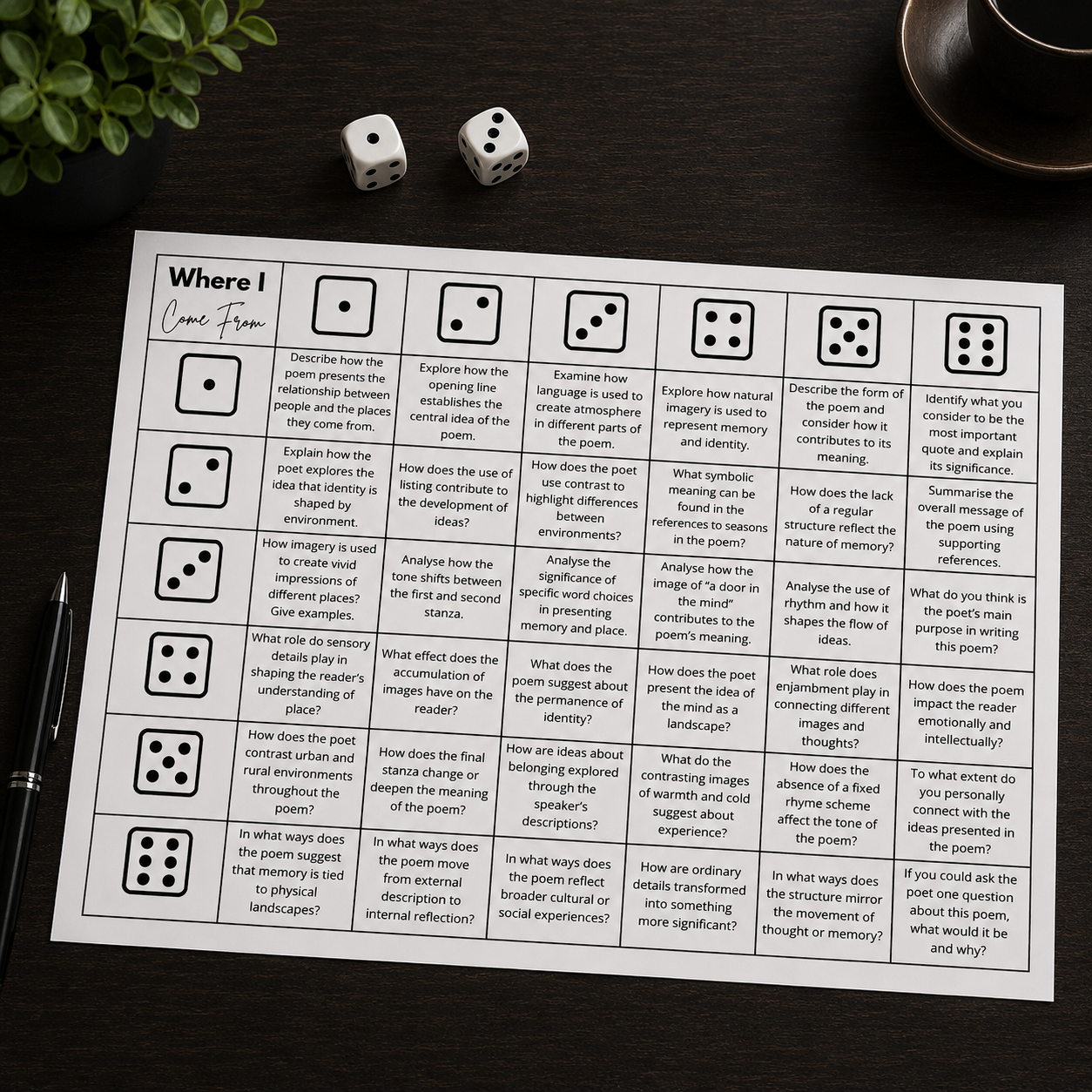

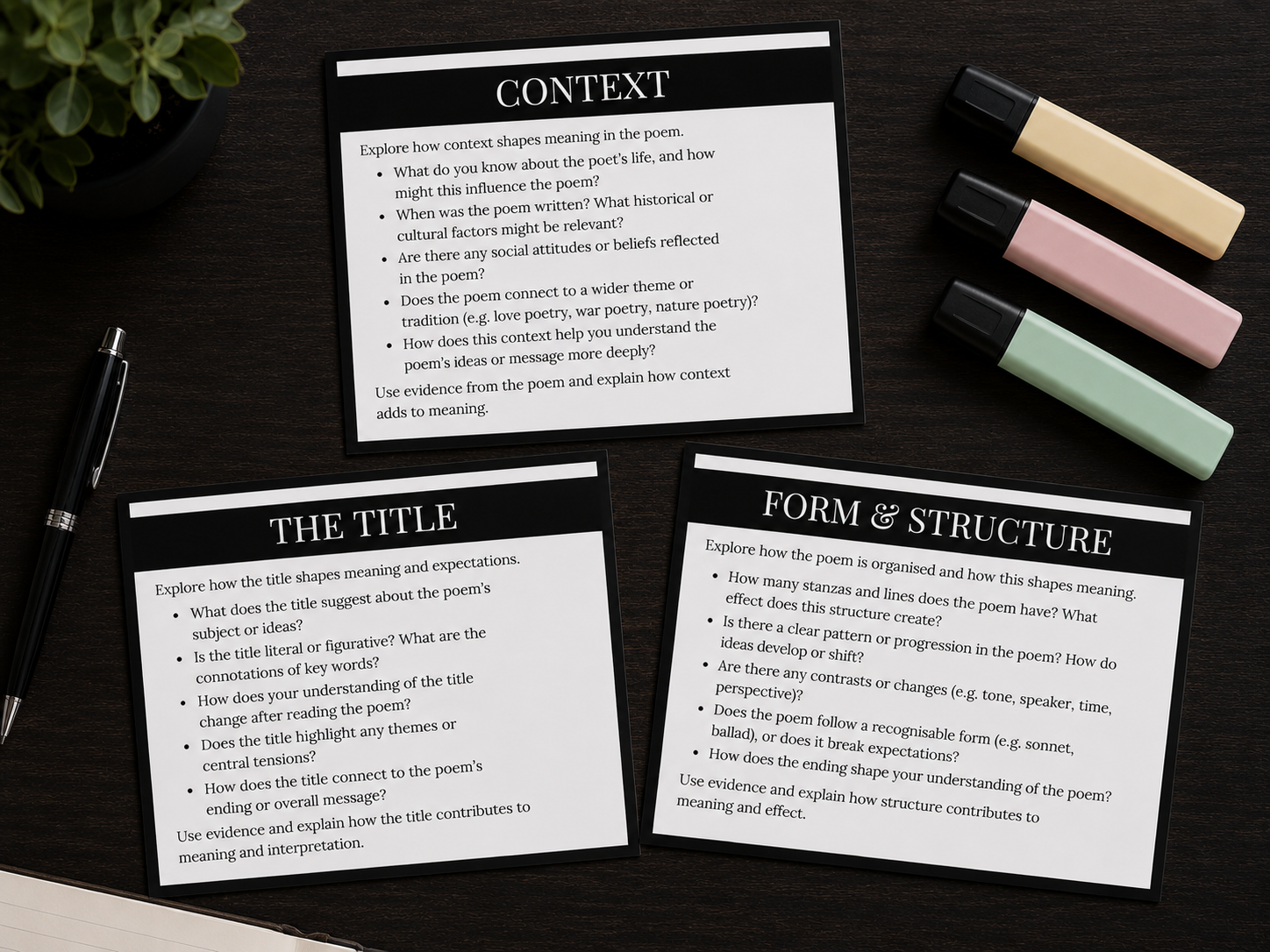
Go Deeper into Where I Come From
If you’re looking to build comparison skills and develop more conceptual responses, these texts connect strongly to Where I Come From through themes of identity, place, memory, and environment:
◆ “The Emigrée” – Carol Rumens
Explores how memory shapes identity, particularly through an idealised vision of place. Like Brewster, Rumens presents place as something carried within the mind rather than fixed in reality.
◆ “Presents from my Aunts in Pakistan” – Moniza Alvi
Examines cultural identity and belonging, showing how different environments create tension within the self. This links to Brewster’s idea that identity is influenced by multiple places.
◆ “Half-caste” – John Agard
Challenges ideas of identity and categorisation, suggesting that identity is not fixed or easily defined. This connects to Brewster’s presentation of identity as layered and constructed.
◆ “Search for My Tongue” – Sujata Bhatt
Focuses on language, identity, and cultural memory, showing how internalised experience shapes the self. Like Brewster, Bhatt presents identity as something carried within the mind.
◆ “Cold Knap Lake” – Gillian Clarke
Explores how place and memory influence identity over time, particularly through childhood experience. This links closely to Brewster’s use of landscape as psychological memory.
◆ “The Prelude (Boat Stealing)” – William Wordsworth
Examines the relationship between nature and psychological development, showing how environment shapes perception and identity. This provides a more extended, Romantic exploration of similar ideas.
These comparisons help students move beyond single-text analysis, developing interpretive depth and conceptual links, which are essential for top-band responses.
Final Thoughts
Where I Come From presents identity as something shaped, layered, and carried, rather than fixed. Through sensory imagery, contrast, and metaphor, Brewster shows how environments become part of the mind, influencing how people think, feel, and remember. The movement from general observation to personal reflection reinforces the idea that identity is both shared and deeply individual.
Ultimately, the poem is memorable because of its quiet but powerful insight: we do not simply leave places behind—we carry them within us. The final image of the “frosty wind” captures this perfectly, suggesting that memory can return suddenly and shape the present in lasting ways.
For more detailed analyses, explore the Songs of Ourselves Volume 1 hub or browse a wider range of texts in the Literature Library.
Choose Your Next Text