A Midsummer Night’s Dream: Overview, Context, Key Ideas & Teaching Approaches
A Midsummer Night’s Dream is often introduced as one of William Shakespeare’s lightest and most accessible comedies, yet beneath its playful surface sits a complex exploration of power, desire, identity, and control. Writing in the late sixteenth century, Shakespeare uses comedy, magic, and mistaken identity not to escape social reality, but to expose its tensions. The play’s laughter is frequently uneasy, revealing how easily love becomes unstable, authority becomes arbitrary, and individual agency is compromised.
To understand A Midsummer Night’s Dream in context is to recognise how deeply it reflects early modern attitudes toward marriage, obedience, gender roles, and social hierarchy. Set between the rigid law of Athens and the disruptive freedom of the forest, the play stages a temporary collapse of order that allows hidden desires and power imbalances to surface. Comedy here does not resolve conflict by eliminating it, but by containing it, restoring social harmony while leaving questions of consent, memory, and control unresolved.
This post situates A Midsummer Night’s Dream within its historical and dramatic context, framing the play not as light entertainment, but as a controlled exploration of power, desire, and social order — and as a text that rewards performance-led teaching, discussion, and creative response.
Shakespeare’s Context and the World of the Play

A Midsummer Night’s Dream was written in the late sixteenth century, during a period when early modern England was shaped by rigid social hierarchies, patriarchal authority, and a legal system that prioritised order over individual desire. Marriage was not primarily a romantic institution, but a social contract governed by family interest, inheritance, and obedience. These assumptions underpin the opening conflict of the play, where personal choice is subordinated to law and paternal control.
Shakespeare sets the play between two contrasting worlds: the ordered authority of Athens and the destabilising freedom of the forest. Athens represents law, hierarchy, and public accountability, embodied by Theseus and the legal power he wields over Hermia’s future. The forest, by contrast, operates outside civic structures. It becomes a space where identities loosen, roles blur, and desire escapes regulation. This division reflects early modern anxieties about what happens when social order is suspended, even temporarily.
The presence of the fairy world further complicates this context. Figures such as Oberon and Titania are not benevolent guides but volatile rulers whose conflicts spill into the human realm. Their authority mirrors that of the Athenian court, suggesting that power operates similarly across social and supernatural structures. Magic does not liberate characters from control; instead, it exposes how fragile and contingent authority becomes when it is driven by impulse rather than consent.
Comedy, in the Renaissance theatre, was expected to restore order. Yet Shakespeare’s comedy here is uneasy. Although the play concludes with marriage, celebration, and harmony, it does so by reasserting social structures rather than resolving the tensions that produced conflict in the first place. Understanding this historical context allows readers to see A Midsummer Night’s Dream not as escapist fantasy, but as a play deeply engaged with the pressures of obedience, authority, and control in early modern society.
For a broader understanding of how these pressures of authority, obedience, and social order operate across Shakespeare’s work, this play can be read alongside the wider William Shakespeare context overview, which situates A Midsummer Night’s Dream within the political and cultural tensions of early modern England.
Genre: Comedy, Romance, and Controlled Chaos
Although classified as a comedy, A Midsummer Night’s Dream resists the idea that comedy is simply light, harmless entertainment. Shakespeare draws on comic conventions — mistaken identity, romantic confusion, transformation, and resolution through marriage — but uses them to explore instability rather than comfort. Laughter in the play often emerges from imbalance, humiliation, or loss of control, creating a tone that is playful on the surface but uneasy beneath.
The play also draws heavily on romance and pastoral fantasy, genres associated with escape, transformation, and temporary suspension of social rules. The forest functions as a romantic space where desire is intensified and identity becomes fluid. Yet this freedom is carefully contained. The chaos of the forest does not dismantle social order; it briefly disrupts it, allowing tensions to surface before being managed and redirected back into acceptable forms.
Shakespeare’s comedy operates through controlled chaos. Disorder is permitted, even encouraged, but only within limits. Love becomes irrational, authority is mocked, and power shifts unpredictably, yet these disruptions are always temporary. By the final act, harmony is restored not because conflict has been resolved, but because it has been absorbed into the existing social framework. Marriage, celebration, and performance function as mechanisms of containment rather than genuine reconciliation.
Understanding the play’s genre positioning helps explain why A Midsummer Night’s Dream can feel simultaneously joyful and troubling. Comedy here does not deny the presence of coercion, imbalance, or emotional harm; it masks them. Shakespeare uses the expectations of comic resolution to explore how societies manage disorder, reinforcing stability while leaving deeper questions about consent, memory, and agency deliberately unresolved.
Core Themes in A Midsummer Night’s Dream
Although often approached as a light-hearted comedy, A Midsummer Night’s Dream is structured around a series of recurring tensions that shape character behaviour and drive conflict. Shakespeare uses comedy, magic, and mistaken identity to explore how power operates, how desire destabilises reason, and how social order is temporarily disrupted and then restored. These themes overlap and interact, revealing that the play’s apparent harmony is carefully managed rather than naturally achieved.
Power, Authority, and Control
Questions of authority sit at the centre of the play’s opening conflict. Athenian law prioritises paternal control over individual choice, positioning obedience as a social necessity rather than a moral good. Throughout the play, power is exercised through legal structures, social expectation, and supernatural influence, suggesting that control operates across all levels of the play’s world. Even in the forest, where order appears suspended, authority re-emerges in different forms rather than disappearing altogether.
Love, Desire, and Instability
Love in A Midsummer Night’s Dream is presented as volatile, irrational, and deeply unstable. Shakespeare repeatedly exposes how desire disrupts logic, loyalty, and self-knowledge. Romantic attachment shifts rapidly, often without explanation, reinforcing the idea that love is not a stable foundation for decision-making. Rather than idealising romance, the play highlights how easily desire becomes a source of confusion, imbalance, and emotional harm.
Order, Disorder, and Restoration
The movement between Athens and the forest reflects a broader tension between order and disorder. The forest allows social rules to loosen, identities to blur, and suppressed desires to surface. However, this disruption is temporary. By the final act, social order is restored through marriage, celebration, and performance. Shakespeare suggests that disorder can be tolerated, even enjoyed, but only within controlled limits that ultimately reinforce existing structures.
Magic, Illusion, and Transformation
Magic in the play does not create desire; it exposes it. The use of enchantment accelerates emotional shifts that are already possible within the characters, revealing how fragile identity and intention can be. Illusion becomes a tool for exploring performance, self-deception, and the gap between appearance and reality. The dream-like quality of the play encourages audiences to question how much control characters truly possess over their thoughts and actions.
Performance, Identity, and Role-Playing
From the mechanicals’ play to the lovers’ shifting identities, performance operates as both a literal and symbolic force. Characters adopt roles imposed by law, love, or magic, often without full awareness of the consequences. Shakespeare uses role-playing to suggest that identity is shaped as much by circumstance and expectation as by inner truth. The theatre itself becomes part of the play’s meaning, reinforcing the idea that social life, like drama, depends on performance.
Teaching A Midsummer Night’s Dream
Teaching A Midsummer Night’s Dream works best when students are allowed to experience the play as something lived and performed, rather than reduced to plot recall. The play’s confusion, humour, and instability are part of its meaning, and lessons that foreground discussion, creative response, and performance help students grasp its deeper concerns with power, desire, illusion, and control.
Because the play is structured around shifting loyalties and misunderstandings, regular opportunities for reflection and consolidation are essential. Act-by-act review tasks, low-stakes assessment, and structured discussion allow students to track how relationships change over time, while creative responses encourage exploration of character motivation, emotional consequence, and perspective.
Effective approaches to teaching Midsummer often include:
◆ discussion-led activities that allow students to test interpretations before formal writing
◆ act-by-act review quizzes that support comprehension without overloading recall
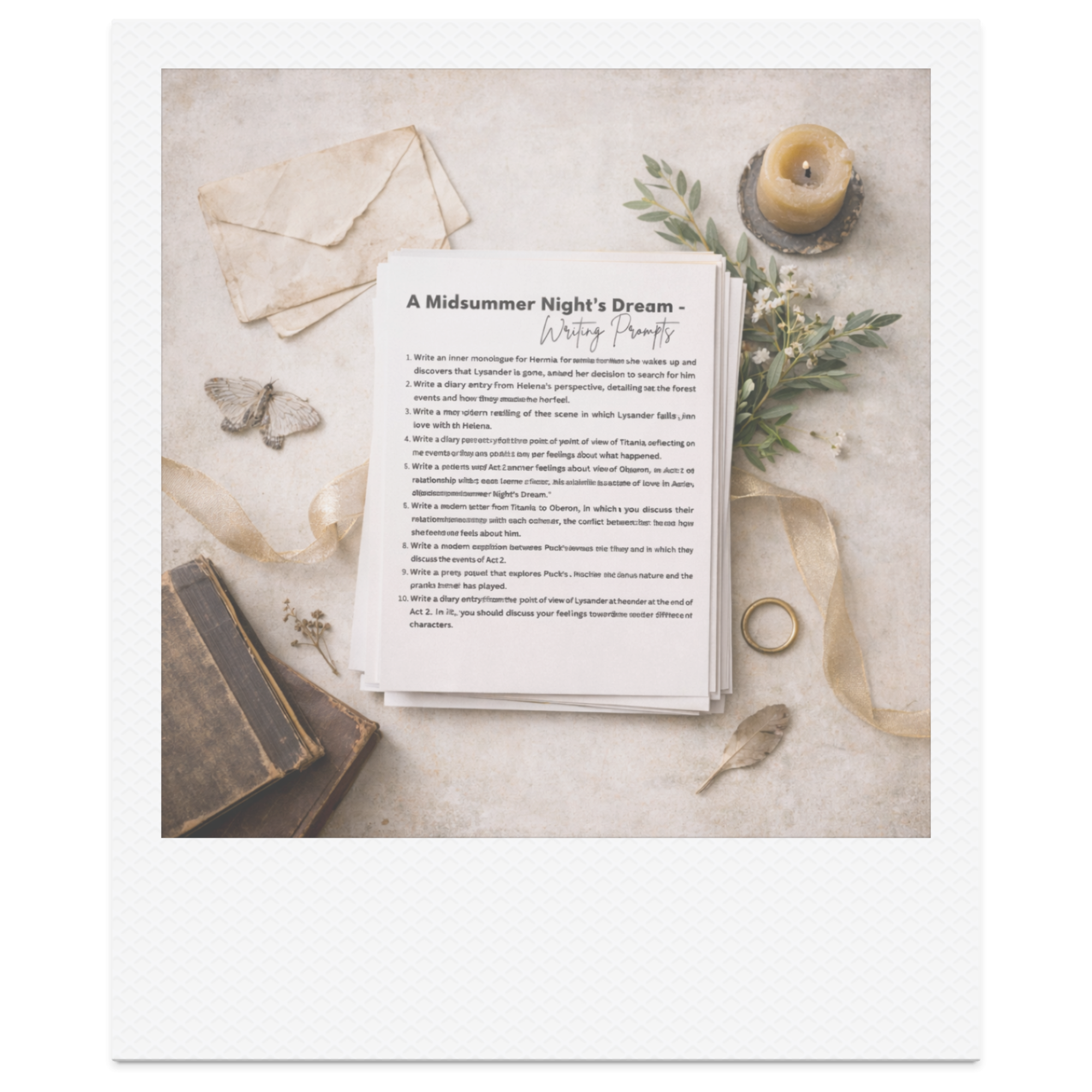
◆ creative writing prompts that explore voice, perspective, and consequence
◆ performance-based tasks that foreground movement, speech, and staging
◆ visual and design responses that deepen understanding of setting, symbolism, and atmosphere
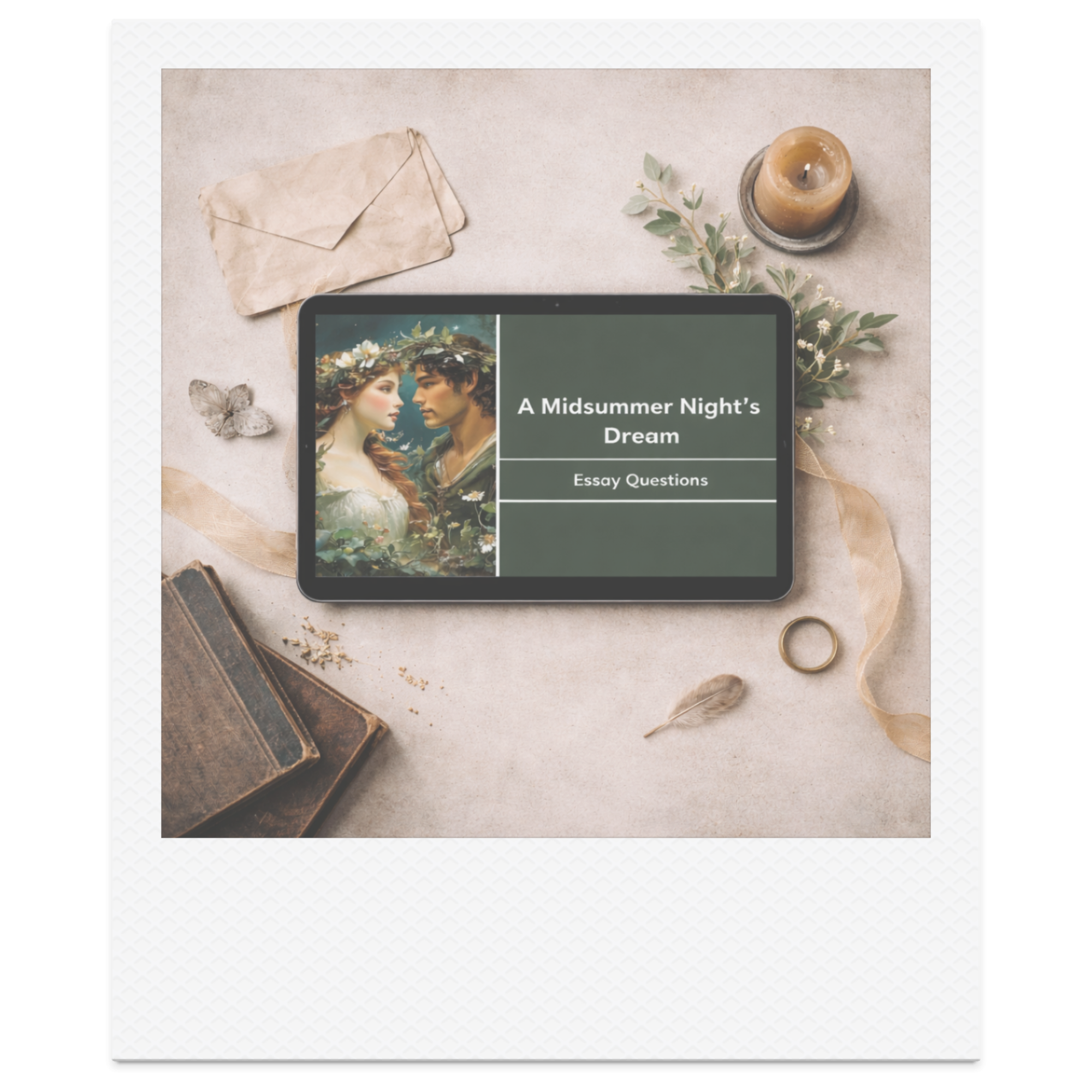
◆ structured analytical questions that prepare students for extended writing and assessment
Small-group strategies such as discussion boards, silent debates, and quick-write prompts are particularly effective, creating space for students to engage critically with themes of authority, consent, illusion, and responsibility. These approaches support participation, encourage textual evidence, and reduce reliance on teacher-led questioning.
For teachers looking to plan a cohesive sequence of lessons, a growing teaching bundle can support this layered approach by bringing together creative tasks, discussion strategies, review activities, and analytical questions into a single, adaptable framework — allowing engagement to build across several weeks while keeping interpretation and textual understanding at the centre.
A Midsummer Night’s Dream as a Springboard for Creative Writing
Beyond analysis and performance, A Midsummer Night’s Dream offers rich opportunities for creative writing rooted in character, conflict, and consequence. Shakespeare’s play is built around instability — shifting desire, mistaken identity, blurred boundaries between reality and illusion — making it an ideal text for exploring how narrative tension develops when control is lost and order is temporarily suspended.
The play’s structure encourages students to think imaginatively about perspective and voice. Characters are frequently misled, manipulated, or transformed, often without full awareness of what is happening to them. This opens space for creative responses that explore interior thought, emotional aftermath, and moments left unresolved by the comic ending. Writing tasks grounded in these gaps help students deepen their understanding of character motivation while practising narrative craft.
Midsummer is also particularly effective for experimenting with setting and atmosphere. The contrast between the rigid order of Athens and the fluid, dream-like forest allows students to explore how place shapes behaviour and emotion. Rewriting scenes, inventing new moments, or shifting the setting encourages careful attention to tone, symbolism, and descriptive detail, reinforcing how environment functions as more than a backdrop.
Creative approaches to the play might include:
◆ writing from an overlooked perspective, such as Helena, Hippolyta, or one of the mechanicals
◆ exploring moments of consequence, focusing on what characters remember or suppress after the forest
◆ reimagining the setting, using the play’s tensions in a modern or alternative context
◆ expanding minor moments, such as the aftermath of enchantment or public humiliation
◆ using image or sensory prompts to capture the play’s dream-like quality and emotional shifts
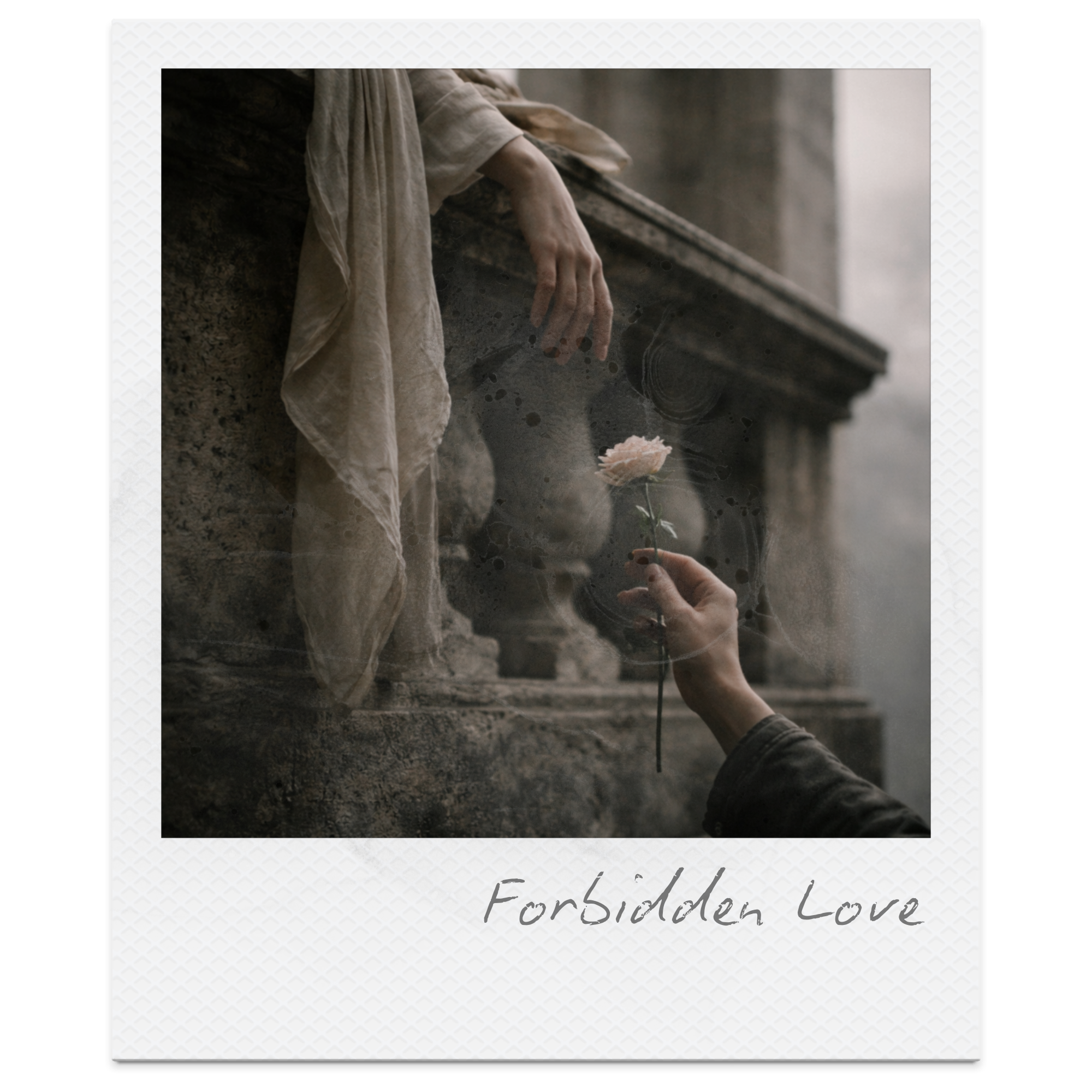
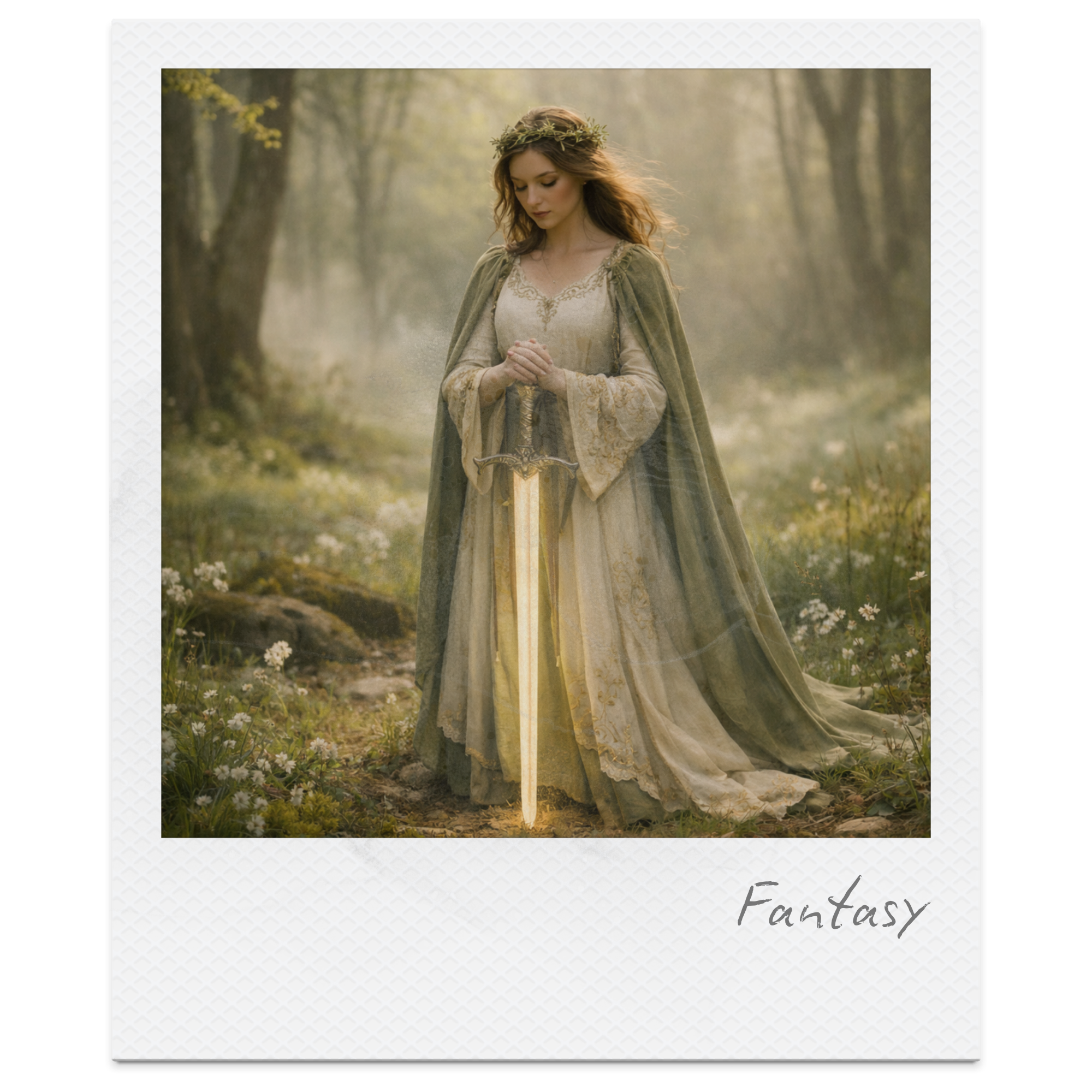
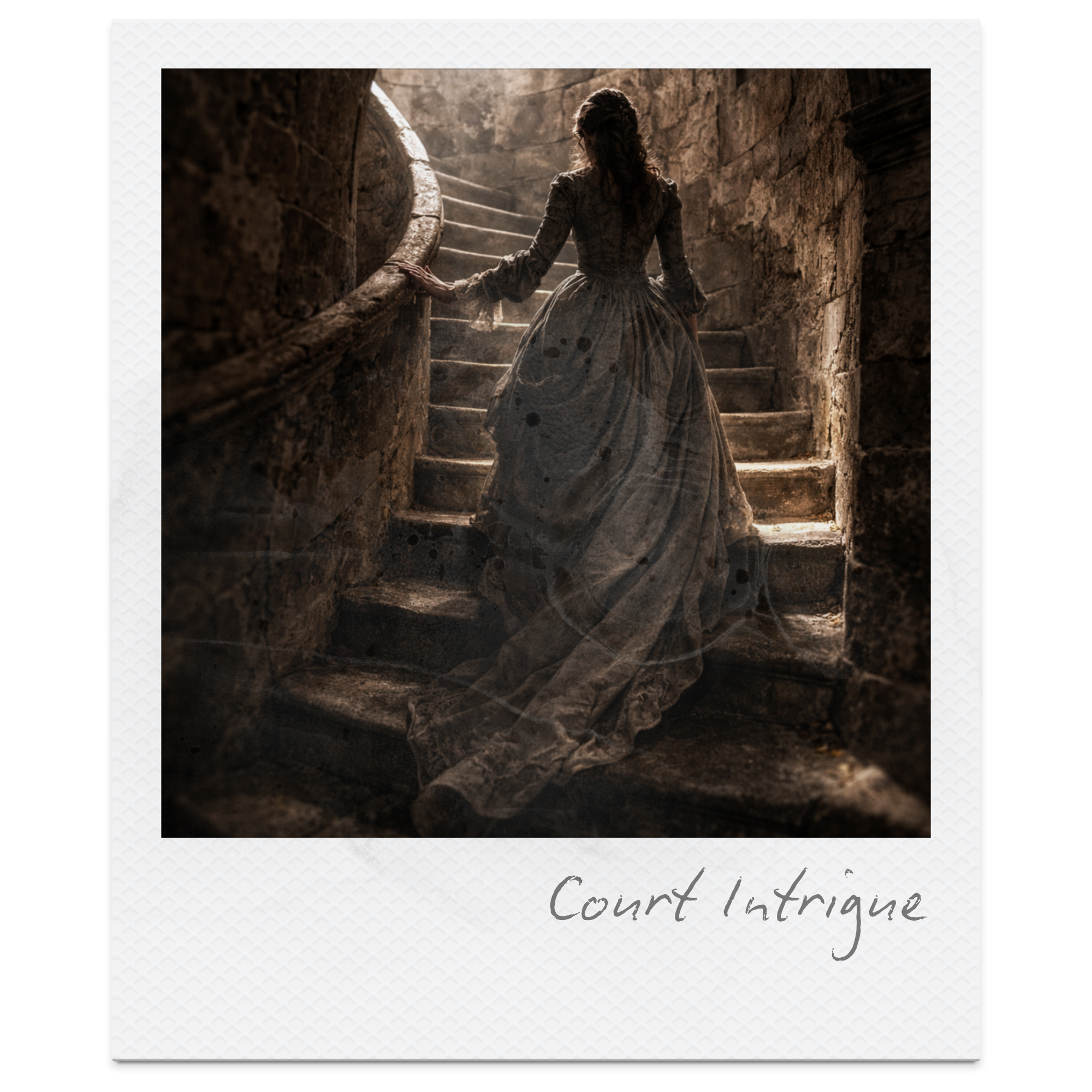
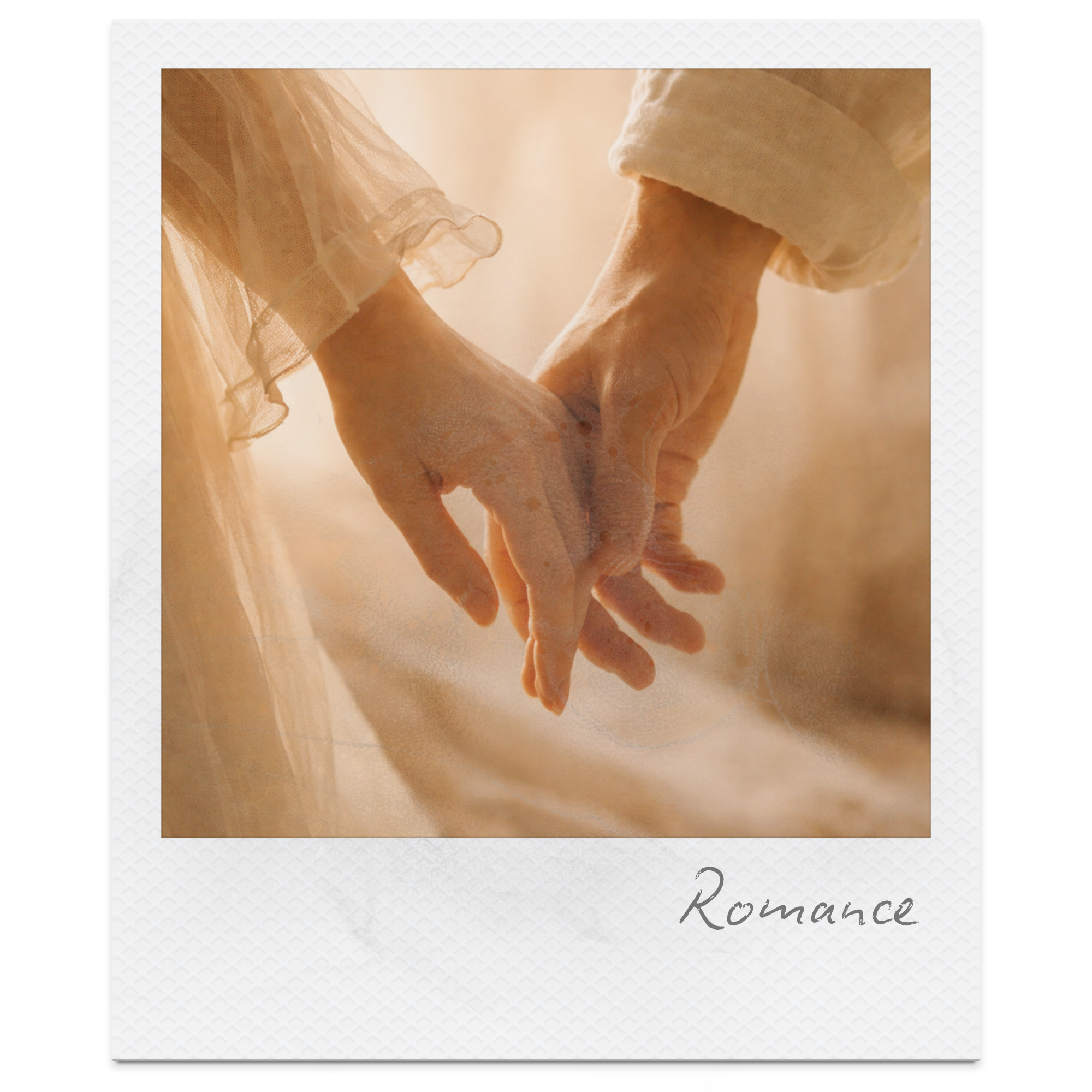
Taken further, A Midsummer Night’s Dream functions as a natural gateway into wider creative writing traditions, particularly those shaped by court intrigue, forbidden love, fantasy, and romance. The play’s tensions around secrecy, power, desire, and transformation mirror the narrative pressures found in these genres, making it an ideal starting point for extending students’ writing beyond the text itself.
To explore these ideas further, students can use the Polaroid prompt gallery below as a visual springboard. Each image links to a curated 70 prompts collection — click the Polaroid to explore how the play’s themes connect to broader genre-based writing, from political secrecy and forbidden relationships to dream-like fantasy and romantic conflict.
When framed carefully, creative writing does not replace analytical study; it strengthens it. By asking students to inhabit uncertainty, conflict, and transformation through writing, A Midsummer Night’s Dream becomes a text that supports both critical thinking and imaginative engagement — reinforcing the idea that interpretation and creativity are not opposing skills, but complementary ways of understanding literature.
Go Deeper Into A Midsummer Night’s Dream
Teaching A Midsummer Night’s Dream benefits from approaches that acknowledge both its accessibility and its underlying complexity. The play rewards teachers who resist treating it as “light relief” and instead allow its tensions around power, desire, and control to remain visible. The following considerations can help deepen students’ engagement with the play while maintaining clarity and pace.
◆ Treat comedy as a vehicle for critique
Encourage students to look beyond humour and ask what the comedy makes acceptable or uncomfortable. Moments of laughter often mask imbalance, humiliation, or coercion, and recognising this shifts the play from entertainment to analysis.
◆ Use the Athens–forest contrast deliberately
Rather than presenting the forest as pure freedom, explore how power simply changes form. This helps students understand that disorder in the play is temporary and managed, not liberating.
◆ Keep consent and authority in view
Return regularly to questions of choice, obedience, and control, particularly in discussions of marriage and law. This grounds the play in early modern context while opening space for modern relevance.
◆ Balance performance with reflection
Performance-based tasks are powerful, but they work best when paired with structured discussion or writing. Asking students to reflect on how staging choices affect meaning deepens interpretation.
◆ Track emotional consequence, not just resolution
The play ends with harmony, but emotional disruption remains. Encourage students to consider what characters remember, forget, or suppress once order is restored.
◆ Use creative tasks to clarify, not replace, analysis
Creative responses are most effective when they are anchored to textual moments, encouraging students to explore motivation, perspective, and consequence rather than retelling plot.
These approaches allow A Midsummer Night’s Dream to function as both an engaging classroom text and a rigorous exploration of social order, identity, and human behaviour.
Final Thoughts
Although often taught as a light-hearted comedy, A Midsummer Night’s Dream rewards sustained, critical attention. Beneath its enchantment and humour, the play interrogates authority, desire, and social order, revealing how easily control can be disguised as harmony. Shakespeare’s comedy does not dissolve conflict; it manages it, restoring stability while leaving deeper questions of consent, memory, and agency unresolved.
Approached with attention to context, genre, and performance, Midsummer becomes a powerful text for exploring how societies regulate behaviour and how individuals navigate competing demands of law, love, and identity. Its accessibility makes it ideal for the classroom, but its complexity ensures that it continues to provoke discussion, reinterpretation, and creative response.
For further exploration of A Midsummer Night’s Dream, Shakespeare’s wider body of work, and other major literary texts and themes, visit the Literature Library, where related context studies, teaching frameworks, and critical approaches are organised to support deeper reading across English literature.
Choose Your Next Text