Why I Still Teach Romeo and Juliet (Even Though I Hate It) — And Why It Still Works in the Classroom
I hate Romeo and Juliet.
There. I said it.
Not because it’s poorly written — it’s Shakespeare, after all — but because it is one of the most misunderstood and over-romanticised texts in the English classroom. That misunderstanding makes it harder to teach well, especially when students arrive expecting a sweeping love story rather than a play driven by impulsiveness, conflict, and consequence.
Despite all of that, I still teach Romeo and Juliet every year. I teach it because it works. Students come in with strong opinions, half-formed ideas, and cultural assumptions about what the play is, and that makes it a powerful starting point for discussion, debate, and reinterpretation. In secondary English classrooms, few Shakespeare plays provoke such immediate reaction — and that reaction is exactly what makes the play worth teaching.
Note: This post is part of a wider collection of classroom ideas for teaching literature — you can browse the full Literature Library for more texts and approaches.
Why Romeo and Juliet Still Matters: Context, Shakespeare, and Relevance
Romeo and Juliet was written in the mid-1590s, early in Shakespeare’s career, and it shows. Structurally, it is fast, emotionally charged, and relentless in its pace. Unlike the later tragedies, which unfold slowly and deliberately, Romeo and Juliet accelerates towards catastrophe almost from the opening prologue.
This matters.
At this point in his career, Shakespeare was experimenting with form, audience expectation, and emotional intensity. Romeo and Juliet sits between the early comedies and the later tragedies, borrowing elements from both. It contains moments of humour, lyricism, and romance, but it ultimately refuses a comic ending. That refusal is precisely what makes the play so unsettling — and so useful in the classroom.
The play’s focus is not mature, enduring love, but impulsiveness, youth, and misjudgement. Decisions are made quickly, emotions override reason, and authority figures repeatedly fail to intervene effectively. Friar Lawrence, the Nurse, and the heads of the Capulet and Montague households all contribute, through action or inaction, to the outcome. Responsibility is dispersed rather than neatly assigned.
For modern students, this makes Romeo and Juliet far more relevant than its reputation suggests. The play speaks directly to peer pressure, identity, loyalty, and the consequences of acting without reflection. The lovers’ youth is not incidental — it is central. Shakespeare presents a world where adolescence collides with rigid social structures, and where emotional intensity is treated as both powerful and dangerous.
What often undermines the teaching of Romeo and Juliet is not the text itself, but the way it is framed. When the play is presented primarily as a romantic ideal, students struggle to reconcile that narrative with the speed of the plot and the scale of the tragedy. When it is reframed as a study of haste, conflict, and avoidable loss, the play becomes clearer — and far more compelling.
This is where Romeo and Juliet earns its place. Not as a celebration of love, but as an exploration of how miscommunication, impulse, and social pressure can turn intense emotion into catastrophe. That tension — between what characters feel and what they choose — is what keeps the play relevant, and what makes it worth revisiting in contemporary classrooms.
Why Romeo and Juliet Provokes Strong Reactions in Students
One of the reasons Romeo and Juliet continues to work in the English classroom is that students rarely feel neutral about it. They react quickly — and often intensely — to the characters, the decisions, and the consequences that follow.
That reaction is useful.
Students arrive with assumptions about romance, love, and destiny, and the play immediately disrupts them. Romeo’s impulsiveness, Juliet’s rapid shift from obedience to defiance, and the adults’ repeated failures create a tension that students instinctively want to argue with. They question motives. They challenge decisions. They disagree with one another.
This polarity drives discussion.
◆ Some students defend Romeo, viewing him as passionate and sincere
◆ Others are frustrated by his emotional volatility and rapid decision-making
◆ Juliet’s age unsettles students, forcing them to confront the imbalance of power and maturity
◆ Authority figures like Friar Lawrence and the Nurse invite debate around responsibility and influence
What makes these conversations productive is that Shakespeare does not offer a single moral centre. Responsibility is shared, deferred, and complicated by loyalty, secrecy, and fear of conflict. Students are not asked to identify a villain; they are asked to examine how a sequence of small, human decisions produces irreversible loss.
This is where Romeo and Juliet becomes more than a tragic love story. It becomes a study of impulse, pressure, and avoidability. Students begin to see how quickly emotion can override judgement — and how easily silence or hesitation can become complicity.
In classroom discussion, this often leads to deeper thinking than texts that arrive without cultural baggage. Students care enough to argue, and that investment creates space for close analysis, reinterpretation, and challenge.

How I Teach Romeo and Juliet
When teaching Romeo and Juliet, my priority is clarity. Students don’t struggle with this play because they lack intelligence or insight — they struggle because the language, pace, and assumptions about romance get in the way of understanding what is actually happening.
To counter that, I make the structure of the play visible from the start.
I teach the prologue early, and we return to it often. Understanding the full arc of the tragedy upfront frees students from plot confusion later on and allows lessons to focus on language, character shifts, and decision-making rather than basic comprehension.
I also teach the play using both the original text and a modern English translation side by side. Rather than diluting Shakespeare’s language, this approach helps students see how meaning is constructed and how emotional nuance is embedded in word choice. Translation becomes an analytical act, not a shortcut.
My classroom approach is deliberately varied, but always text-led:
◆ Whole-class debates that ask students to justify whether Romeo’s actions are impulsive, romantic, or reckless
◆ Creative rewrites of scenes as text messages, direct messages, or modern conversations to explore tone and intention
◆ Hot seating activities where students speak in role and defend their characters’ decisions
◆ Set and costume design tasks that require students to interpret theme, power, and conflict across different contexts
Across all of these activities, the emphasis is on justification. Students are expected to explain why they have made creative or interpretative choices, linking them back to language, action, and consequence in the play.
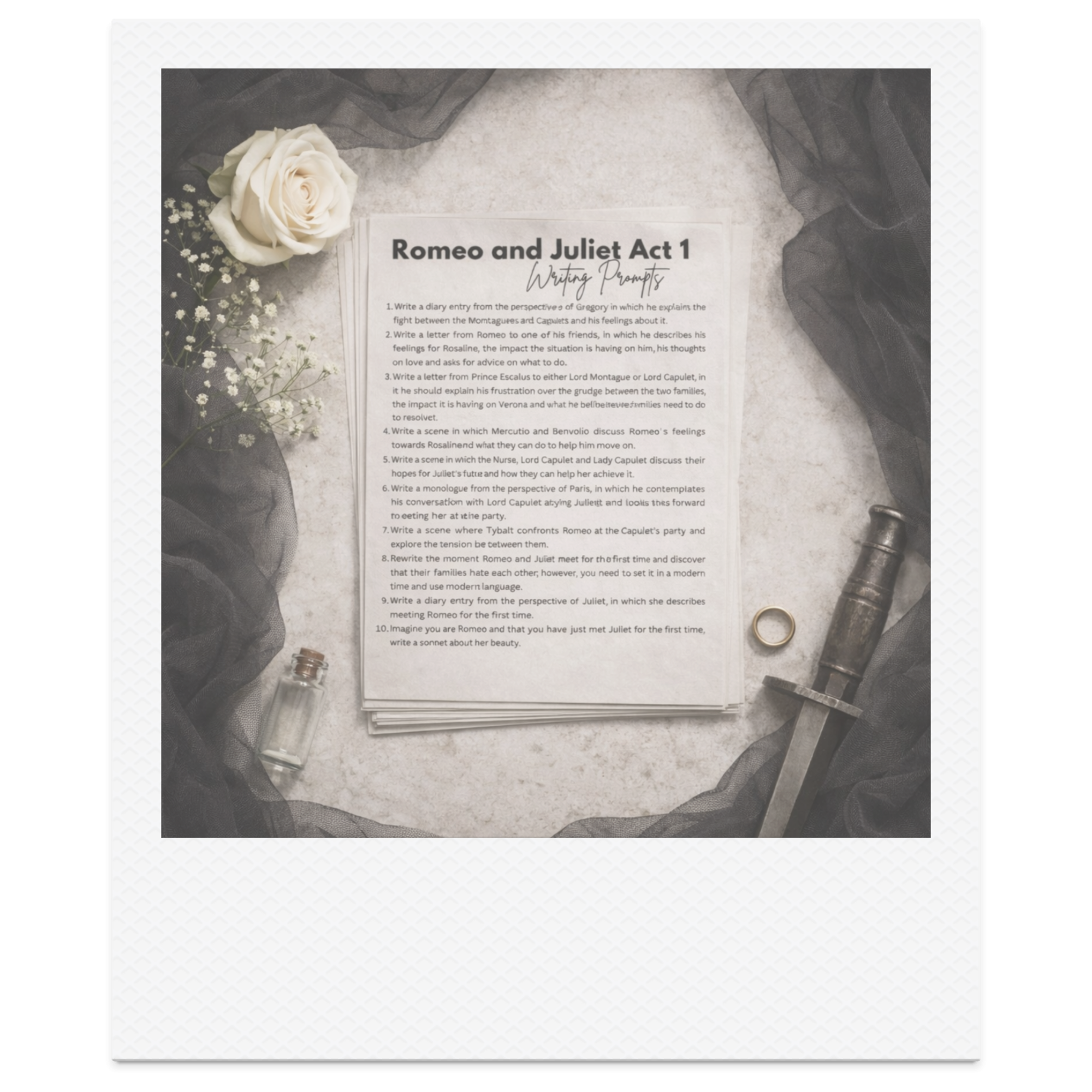
I also use key moments from Romeo and Juliet as creative writing prompts, allowing students to explore emotion and motivation without immediately defaulting to formal analysis. This often surfaces ideas that later strengthen essay responses.
Because students understand the plot early on, lesson time can be spent analysing turning points, language shifts, and moments of hesitation — the places where tragedy becomes inevitable.
My Full Romeo and Juliet Teaching Bundle
Teaching Romeo and Juliet well requires more than a handful of worksheets. Students need repeated opportunities to enter the play, test ideas, and revisit key moments from different angles — analytically, creatively, and collaboratively.
That’s the thinking behind my full Romeo and Juliet teaching bundle.
Rather than separating creative work from analysis, the resources in this bundle are designed to work together across the play. Discussion, creative writing, retrieval, and formal response are treated as connected parts of the same process, allowing students to build understanding gradually rather than jumping straight to essays.
The bundle includes a wide range of classroom-ready resources, such as:
◆ Act-by-act creative writing prompts (PDF and editable digital versions) that encourage students to explore character, emotion, and consequence at key moments
◆ Silent debate questions, roll-the-dice discussion boards, and act discussion cards to structure meaningful, evidence-based discussion
◆ Picture prompts and creative tasks that support interpretation, symbolism, and descriptive writing
◆ Quotation crosswords, review crosswords, word searches, and bingo to reinforce key ideas and vocabulary without reducing the play to recall alone
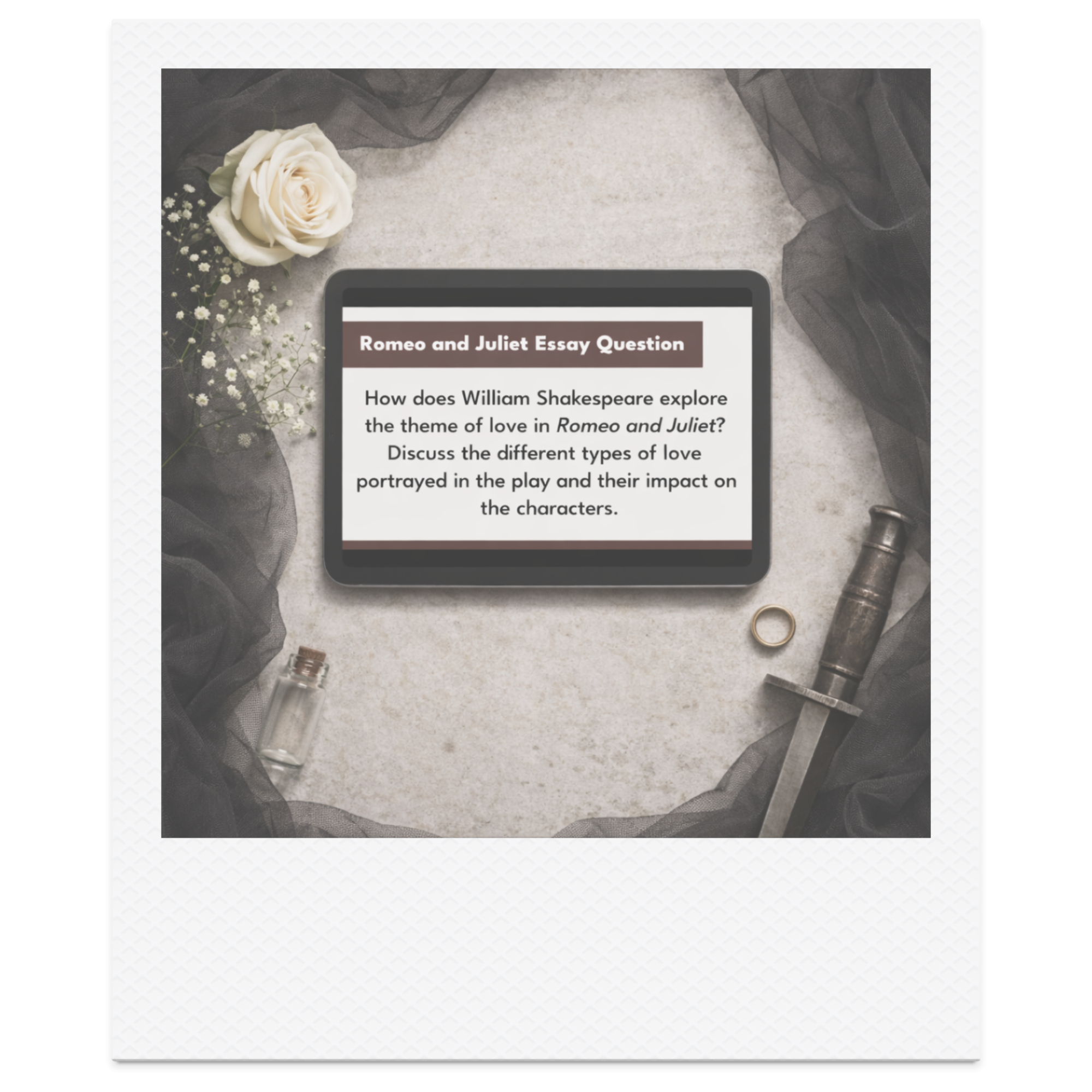
◆ Digital review quizzes and essay questions to support assessment, consolidation, and exam preparation
Many of the resources are available in both printable and editable digital formats, making them easy to adapt for different classrooms, time constraints, and confidence levels.
What matters most is how these resources function together. The bundle allows students to engage with the play creatively, articulate ideas through discussion, and refine understanding through analytical writing, without treating any one approach as optional or secondary.
If you teach Romeo and Juliet regularly and want a resource bank that supports depth, flexibility, and sustained engagement across the unit, this bundle is designed to do exactly that.
You can explore the full Romeo and Juliet bundle on TpT.
Go Deeper into Romeo and Juliet
Once students understand the plot of Romeo and Juliet, the play opens into far more challenging territory. This is where teaching it becomes less about recounting events and more about examining judgement, responsibility, and the consequences of acting on emotion without reflection.
Going deeper with Romeo and Juliet means resisting the urge to frame it as a simple tragedy of fate. Shakespeare is far more interested in human choice — and the systems that allow poor decisions to go unchallenged.
Ways to deepen thinking beyond surface-level readings include:
◆ Shifting the focus from romance to impulsiveness
Rather than asking whether Romeo and Juliet are “in love”, invite students to examine how quickly decisions are made and how little space there is for reflection. This reframes the play as a study of haste rather than destiny.
◆ Examining adult authority and failure
Friar Lawrence, the Nurse, and the heads of the feuding families all hold power, yet repeatedly fail to act responsibly. Exploring inaction, misjudgement, and misplaced loyalty helps students see how tragedy emerges from systems, not just individuals.
◆ Interrogating blame as shared and cumulative
Like Macbeth, responsibility in Romeo and Juliet is dispersed. No single character causes the outcome, but each contributes. Tracking how small choices compound over time encourages more nuanced ethical discussion.
◆ Treating secrecy and silence as active forces
The tragedy depends on withheld information, private decisions, and unspoken doubts. Analysing what is not said — and who chooses silence — pushes students towards more sophisticated interpretations.
◆ Comparing patterns across Shakespeare’s plays
When students place Romeo and Juliet alongside other Shakespeare plays, recurring concerns emerge: impulsive action, misuse of power, persuasive language, and the cost of moral blindness. These patterns help students see Shakespeare’s work as a connected body of ideas rather than isolated texts.
This is where teaching Shakespeare becomes especially powerful. When students recognise that similar questions recur across tragedies, comedies, and histories, they move beyond plot into interpretation, evaluation, and judgement.
For teachers who regularly teach multiple Shakespeare texts, having consistent tools across plays makes this kind of comparison much easier. My Shakespeare Growing Mega Bundle brings together discussion boards, creative writing prompts, retrieval activities, and review tasks for a wide range of plays — from Romeo and Juliet and Macbeth to Hamlet, Othello, The Tempest, and beyond — allowing students to revisit shared themes while encountering new contexts.
Used thoughtfully, this approach helps students understand Romeo and Juliet not as an outlier or a “problem text”, but as part of Shakespeare’s ongoing exploration of impulse, authority, and avoidable loss.
Final Thoughts
Romeo and Juliet endures not because it is a great love story, but because it is a precise examination of impulse, misjudgement, and the cost of decisions made too quickly. Shakespeare does not ask us to admire his characters’ choices. He asks us to notice how easily emotion, loyalty, and fear override reason — and how little intervention it takes for tragedy to become inevitable.
In the classroom, this makes the play unusually powerful. Students recognise the speed of the action, the pressure of expectation, and the discomfort of watching adults fail to act responsibly. The play’s relevance lies in its familiarity. These are not distant, romanticised problems, but recognisable patterns of behaviour that still shape how people respond to conflict and authority.
Teaching Romeo and Juliet well means allowing that discomfort to remain unresolved. There is no single villain, no clean moral, and no comforting explanation that makes the ending feel fair. What the play offers instead is a space for interpretation, ethical judgement, and sustained discussion — the very things literature is best placed to develop.
That is why, despite my frustrations with the text, Romeo and Juliet still earns its place. Not because it is easy or idealised, but because it rewards close attention and honest questioning. When students are encouraged to look beyond the romance and examine what drives the tragedy, the play reveals itself as one of Shakespeare’s most instructive — and unsettling — works.
Choose Your Next Text