Fantasy Landscapes: The Ultimate Guide to Magical Settings & Worldbuilding
Fantasy landscapes do more than provide a beautiful backdrop. Mountains create barriers, coastlines connect distant worlds, forests conceal forgotten places, deserts make water and shelter precious, and oceans turn every journey into an encounter with the unknown. The landscape beneath a fantasy world can shape how its people live, where they build, what they fear, the magic they believe in and the stories that become possible there.
For writers, starting with landscape can be one of the easiest ways to discover a new fantasy world. A mist-covered woodland might suggest ancient spirits, hidden paths and settlements built beneath enormous trees. A volcanic landscape could inspire obsidian cities, fire magic and civilisations living beneath the constant threat of eruption. Along a rugged coastline, you might find storm-battered villages, mysterious islands, sea creatures, smugglers, sacred lighthouses or kingdoms whose fortunes depend entirely upon the tides.
This guide explores fantasy inspired by landscapes from around the world, including forests, mountains, highlands, coastlines, tropical environments, jungles, swamps, islands, oceans, deserts, volcanic regions and frozen Arctic wildernesses. Each landscape offers its own atmosphere, challenges and worldbuilding possibilities, with ideas for the stories, characters, cultures, creatures and forms of magic that might grow from the environment.
You'll also find examples of how landscapes have been used in fantasy literature, practical ideas for transforming real environments into original fantasy settings and dedicated collections of 70 fantasy writing prompts for every landscape. Use the guide to develop the geography of an existing world, find inspiration for a new setting or simply choose a landscape and discover what kind of story might be waiting there.
For even more magical inspiration, explore the Fantasy Writing Hub, or browse the Creative Writing Archive for more fantasy prompts, story ideas, generators and worldbuilding resources.
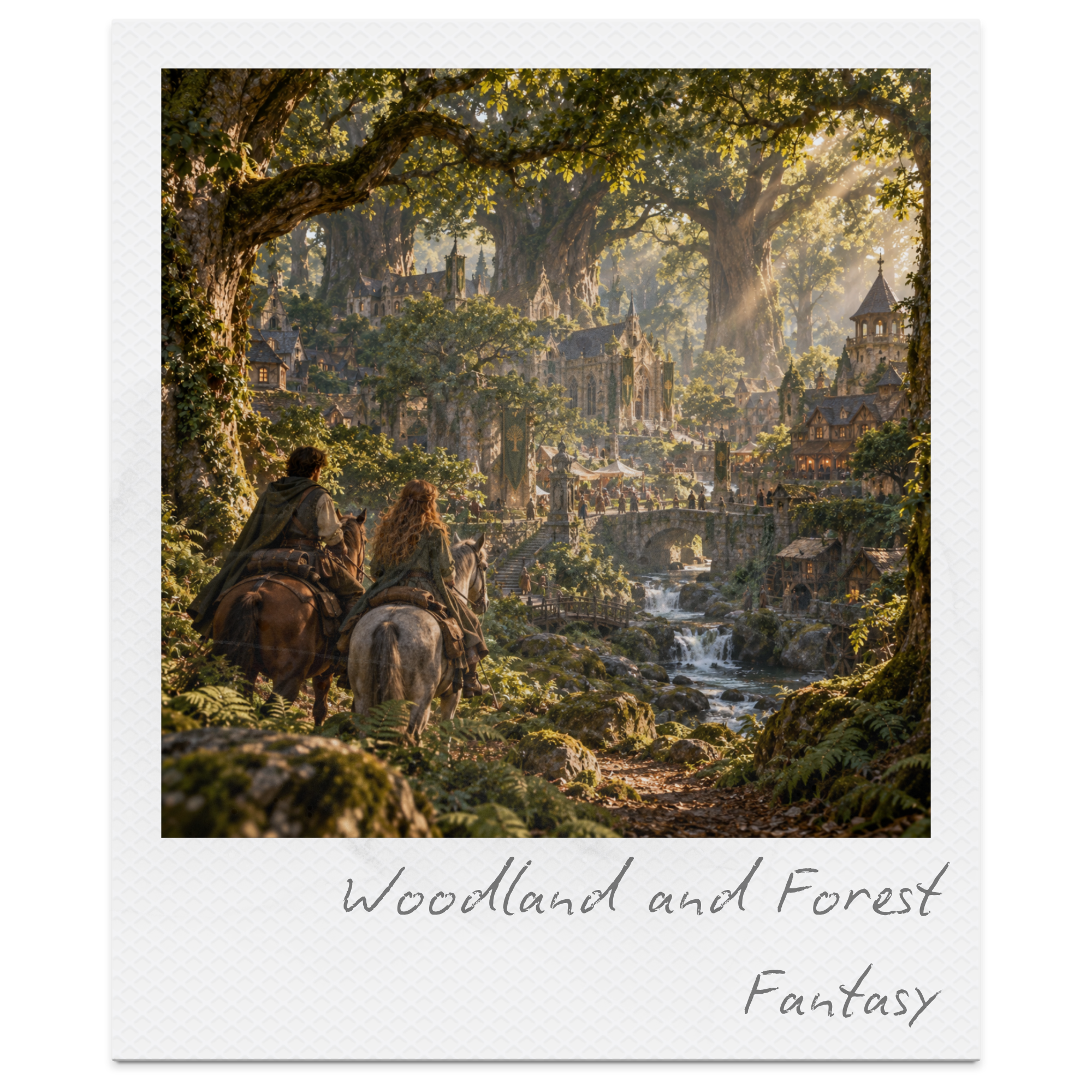
Woodland & Forest Fantasy
Forests are natural fantasy landscapes because they create an immediate sense of separation from the ordinary world. Trees obscure what lies ahead, paths can disappear beneath undergrowth, settlements can remain hidden for generations and even familiar woodland can change dramatically with the weather or seasons. A character travelling through a forest rarely sees their destination clearly, making woodland particularly effective for stories built around discovery, uncertainty and crossing into the unknown.
Why Use Woodland & Forest Landscapes in Fantasy?
Few landscapes offer quite as much variety. A sunlit bluebell wood can feel romantic or whimsical, while dense pine wilderness, tangled ancient woodland or a forest buried beneath winter snow can become threatening and isolating. Forests can provide food, timber, medicines and livelihoods for nearby communities, but they can also contain predators, dangerous terrain and places beyond human control.
That relationship between civilisation and wilderness creates particularly rich worldbuilding. Perhaps a kingdom carefully manages its forests, villages depend upon woodland trades, certain trees are sacred or an old road through the woods connects communities that would otherwise remain isolated. Add fantasy, and those same landscapes might contain forgotten shrines, impossible paths, sleeping creatures, ruined settlements or magic older than the people now living among the trees.
What Stories Work Well in Woodland Fantasy?
Woodland can support almost any branch of fantasy. Fairytales and folklore-inspired stories can draw upon forests as places of transformation, temptation and encounters with the supernatural, while high and epic fantasy can use vast forests as territories containing kingdoms, borders, journeys and ancient histories.
Smaller woodland settings work beautifully for cosy fantasy, with cottages, craftspeople, village communities and seasonal traditions creating intimate stories centred on everyday magic. Forests can equally become settings for dark fantasy, mystery, romantasy and adventure, particularly when characters become lost, discover somewhere that should not exist or realise that something within the landscape has begun to change.
Woodland & Forest Fantasy in Literature
Forests have played important roles across fantasy literature. In J. R. R. Tolkien's The Lord of the Rings, places such as Lothlórien and Fangorn Forest are distinct environments with their own histories, inhabitants and relationships with the wider world. C. S. Lewis uses woodland differently in The Lion, the Witch and the Wardrobe, where the snowy forest of Narnia is one of the first landscapes Lucy encounters after passing through the wardrobe.
The forest can also function as a threshold between the familiar and unfamiliar. In Neil Gaiman's Stardust, the world beyond the wall contains woods as part of a wider fairy realm, while traditional European fairytales repeatedly send characters away from roads, villages and parental protection and into the woods, where the normal rules of their lives no longer necessarily apply.
Explore 70 Woodland & Forest Fantasy Writing Prompts
Ready to disappear beneath the trees? 70 Woodland & Forest Fantasy Writing Prompts explores woodland in all its forms, from ancient oak forests, colourful autumn woods and bright spring landscapes to snowy pine wildernesses, royal hunting forests, remote settlements and forests hiding traces of forgotten civilisations.
The collection includes plot prompts, title ideas, opening lines, closing lines, characters, settings and picture prompts, with inspiration spanning cosy fantasy, folklore, romance, adventure, mystery and darker woodland stories. Follow an unfamiliar path, discover a kingdom beneath the leaves, investigate ruins swallowed by the forest or create a community whose entire way of life depends upon the trees surrounding it.
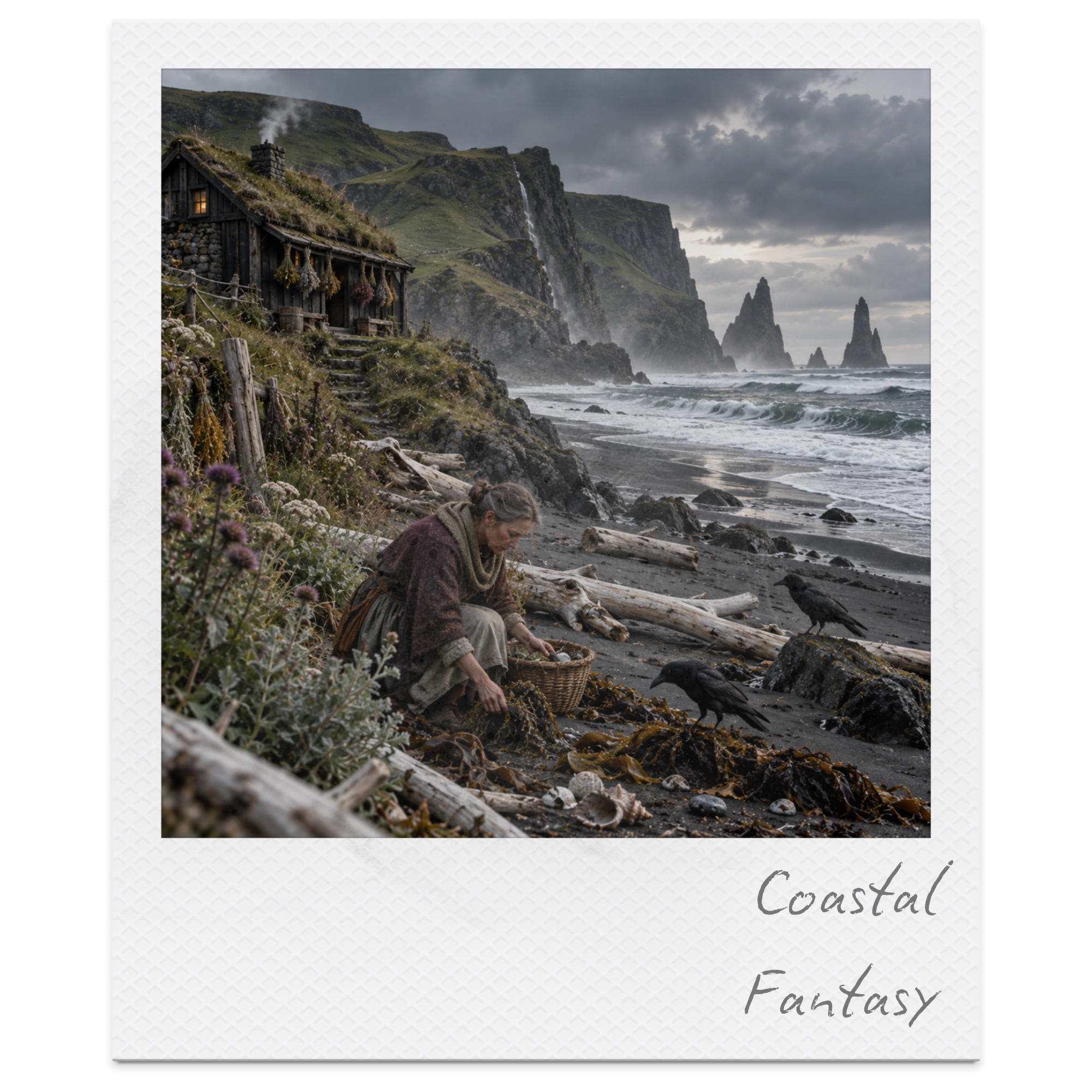
Coastal Fantasy
Where land meets sea, the landscape is never entirely stable. Tides redraw the shoreline, storms reshape beaches and cliffs, ships bring strangers from distant places, and the horizon constantly suggests a world beyond the one your characters know. That makes the coast particularly useful in fantasy: it is both a place to live and a boundary that invites characters to cross it.
Why Use Coastal Landscapes in Fantasy?
Coastlines naturally create contrasts. A sheltered harbour might support a wealthy trading city while an exposed headland only a few miles away is battered by storms. Cliffs can protect settlements or trap them against the sea; coves can shelter fishing boats, smugglers or creatures; tidal flats can reveal places that disappear beneath the water hours later.
These physical features can shape an entire fantasy society. Communities might depend upon fishing, shipbuilding, salt, seaweed, coastal plants or international trade, while architecture must withstand wind, salt and storms. Travel may be dictated by tides, and control of a harbour, strait or navigable stretch of coastline could determine the wealth and political influence of an entire kingdom.
Fantasy adds another layer. A tide might expose a road to a forgotten city. Lighthouses could perform magical as well as practical functions. People might leave offerings before voyages, believe certain coves belong to supernatural creatures or build their settlements away from parts of the shoreline that nobody approaches after dark.
What Stories Work Well in Coastal Fantasy?
The constant movement of people and ships makes the coast particularly good for adventure and quest fantasy. A harbour can bring explorers, merchants, diplomats, refugees, pirates and enemies into the same place, while the sea provides an obvious route towards lands beyond the familiar world.
But coastal fantasy does not have to involve epic voyages. A tiny fishing village can support a cosy fantasy, folklore-inspired tale, mystery or romance, while lonely lighthouses, ruined fortresses, caves and storm-battered cliffs lend themselves beautifully to Gothic and dark fantasy. Political fantasy can grow around valuable ports and contested waters, while romantasy can use secluded coves, summer palaces and glamorous coastal cities without losing the dangers of the landscape.
The coast is especially effective for stories about arrival and departure. Someone can wash ashore, a long-awaited ship can fail to return, an unfamiliar vessel can appear on the horizon or a character who has spent their entire life looking out to sea can finally decide to leave.
Coastal Landscapes in Fantasy Literature
Coastal landscapes are central to Ursula K. Le Guin's Earthsea, an archipelagic fantasy world where islands, ports and journeys across open water determine how its characters move through the world. Geography is not decorative: separation by sea helps give individual islands their own communities and traditions while sailing connects them to the wider world.
Coasts also play an important role in C. S. Lewis's The Voyage of the Dawn Treader, where leaving familiar shores opens the story into increasingly strange islands and unknown waters. In Tolkien's Middle-earth, coastal places such as the Grey Havens carry a different significance: the shoreline becomes associated with departure, distance and the possibility of leaving the known world behind.
These examples show how useful the coast can be symbolically as well as physically. It can represent the edge of knowledge, the promise of elsewhere or the point at which one stage of a journey ends and another begins.
Explore 70 Coastal Fantasy Writing Prompts
From colourful fishing villages and wealthy ports to secret beaches, dangerous cliffs and storm-battered kingdoms, 70 Coastal Fantasy Writing Prompts explores the many different stories that can begin where land meets sea. The collection uses the landscape itself as a source of conflict and discovery, with changing tides, strange arrivals, submerged ruins, coastal traditions and secrets hidden beneath the cliffs.
Inside you'll find 10 plot prompts, 10 titles, 10 opening lines, 10 closing lines, 10 characters, 10 settings and 10 picture prompts, giving you 70 different ways to begin a coastal fantasy story. Use them to create anything from a cosy seaside adventure or romantic fantasy to a political struggle over a vital harbour or a dark mystery unfolding along an isolated shore.
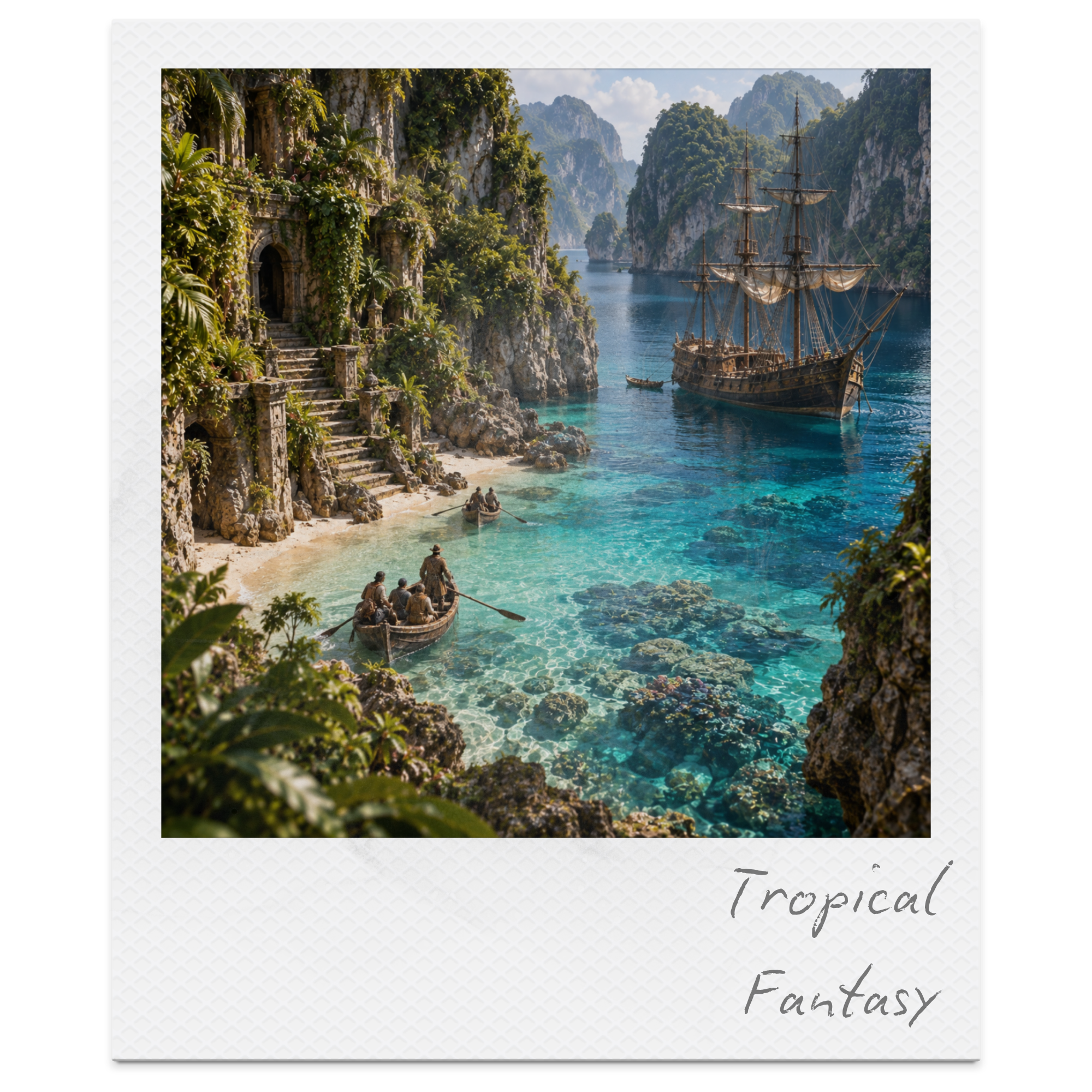
Tropical Fantasy
Tropical landscapes can feel fantastical before a writer introduces a single spell. Brilliant flowers, dense green vegetation, turquoise water, dramatic waterfalls, volcanic mountains and sudden tropical storms create environments filled with colour, movement and contrast. Yet the tropics are far more varied than the familiar image of palms surrounding a perfect beach. Rainforests, mangroves, cloud forests, river valleys, volcanic highlands and sprawling archipelagos can each produce completely different fantasy worlds.
That variety makes tropical landscapes particularly useful when you want to move beyond the temperate forests, stone castles and snowy mountains traditionally associated with fantasy. The environment can become one of the forces shaping the world rather than simply somewhere beautiful for the story to happen.
Why Use Tropical Landscapes in Fantasy?
Tropical environments offer abundance and danger at the same time. Warm temperatures and heavy rainfall can support extraordinary biodiversity and fertile farmland, while dense vegetation, floods, storms, humidity, difficult terrain and active volcanoes can make travel and settlement challenging.
Those conditions create fascinating possibilities for worldbuilding. Communities might organise their year around monsoon seasons, build above floodwater or travel primarily along rivers and coastlines. Valuable spices, hardwoods, dyes, fruits, medicines or magical plants could create prosperous trading kingdoms, while reefs, mountains and dense rainforest form natural boundaries between neighbouring societies.
Magic can grow directly from the environment too. Perhaps certain flowers store memories, storms can be summoned or diverted, a sacred grove produces the kingdom's most powerful medicine or volcanic activity is connected to something sleeping beneath the mountains. In tropical fantasy, nature can be beautiful without being passive.
What Stories Work Well in Tropical Fantasy?
Tropical landscapes are particularly suited to stories of exploration and discovery. Ancient roads can disappear beneath vegetation, ruined cities can remain hidden for centuries and scattered islands allow characters to move continually between unfamiliar cultures and environments. Expeditions, quests, archaeological mysteries and searches for lost places all fit naturally here.
But tropical fantasy can be much more intimate. A colourful harbour or riverside community could become the setting for cosy fantasy or romantasy, while political fantasy might centre on control of fertile land, rare resources or important maritime routes. Monsoon rains and tropical storms create natural deadlines for adventures, and isolated islands, abandoned temples and seemingly idyllic resorts can easily shift towards mystery or dark fantasy.
The contrast between apparent paradise and hidden danger is especially powerful. A place can be breathtakingly beautiful while still containing political conflict, dangerous wildlife, difficult weather, ancient secrets or magic nobody fully understands.
Tropical Landscapes in Fantasy Literature
Tropical and subtropical environments can help fantasy writers escape the visual vocabulary of medieval Europe. In Samantha Shannon's The Priory of the Orange Tree, different climates and environments contribute to the distinctions between its imagined regions, while natural features, trade, religion and political relationships help create a world that feels geographically expansive.
Nnedi Okorafor's Akata Witch offers another approach, drawing its fantasy from Nigeria rather than relocating familiar European fantasy conventions into a warmer climate. Environment, culture, folklore and everyday life work together, demonstrating how place can influence the entire identity of a fantasy rather than functioning as interchangeable scenery.
Fantasy writers can take the same principle without copying any particular culture or setting: ask how climate, vegetation, weather, geography and the ways people have adapted to them would change the world you're creating.
Explore 70 Tropical Fantasy Writing Prompts
The 70 Tropical Fantasy Writing Prompts collection explores tropical fantasy far beyond palm-fringed beaches, travelling through rainforest, volcanic valleys, mangrove settlements, colourful trading cities, scattered archipelagos, mountain cloud forests and places transformed by the arrival of the monsoon.
You'll find 10 plot prompts, 10 title ideas, 10 opening lines, 10 closing lines, 10 characters, 10 settings and 10 picture prompts, with ideas ranging from magical plants and disappearing islands to weather-workers, ancient ruins, tropical kingdoms and secrets hidden beneath apparently idyllic landscapes. Use one idea as a quick writing challenge or combine several to begin building an entirely new tropical fantasy world.
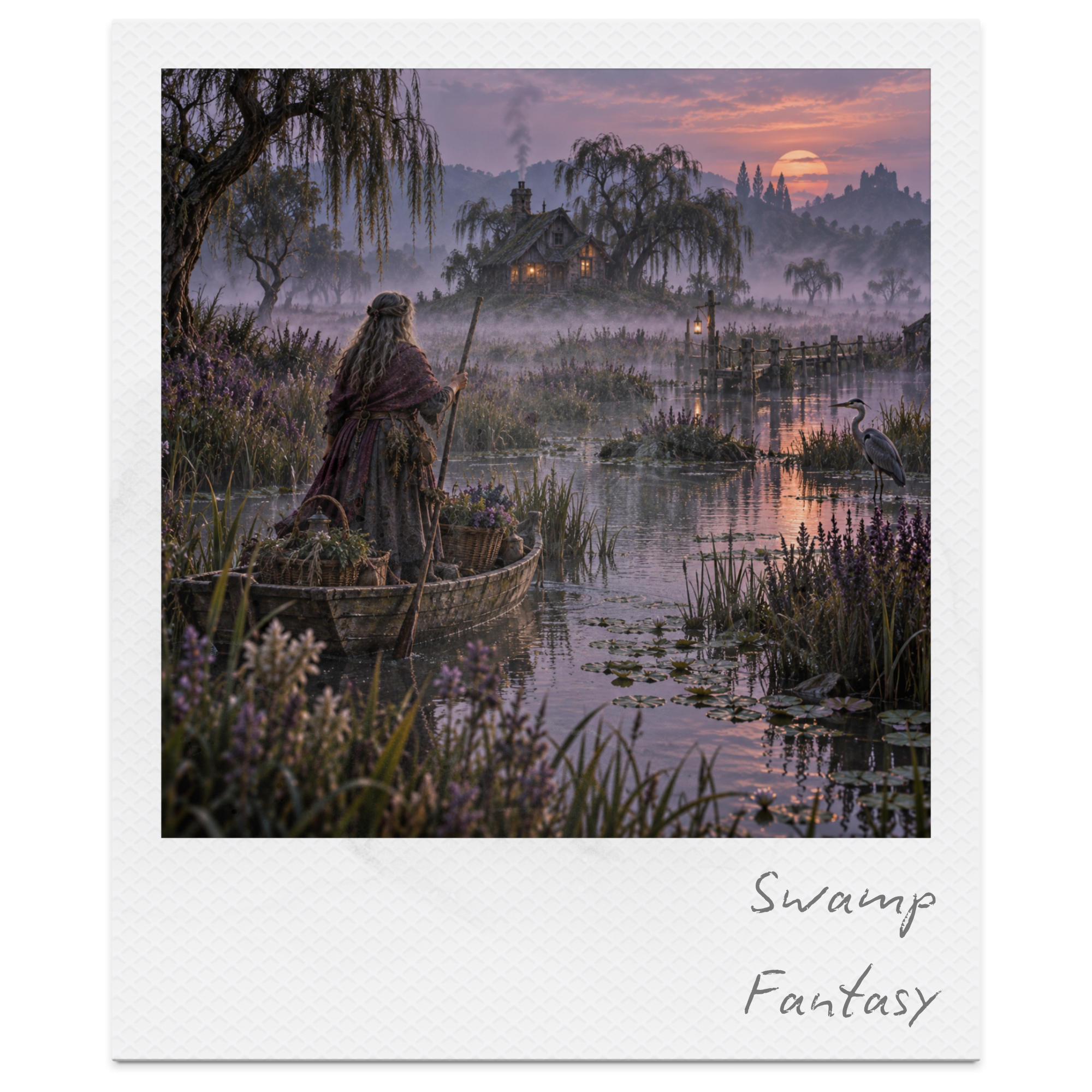
Swamp Fantasy
Swamps are landscapes where the boundaries between land and water, safety and danger, beauty and decay are never entirely fixed. Paths disappear beneath rising water, mist obscures familiar landmarks and apparently solid ground can give way without warning. For fantasy writers, that uncertainty makes swamps particularly effective settings for stories in which characters cannot completely trust the world around them.
Yet swamp fantasy does not have to be relentlessly dark. Wetlands can be colourful, abundant and extraordinarily beautiful, filled with flowering plants, enormous trees, birds, insects and waterways reflecting the sky. A fantasy swamp might contain a thriving city built above the water just as easily as a ruined palace slowly sinking beneath it.
Why Use Swamps in Fantasy?
Swamps force people to adapt to the landscape. Boats can replace roads, houses can rise on stilts, floating markets can connect isolated communities and seasonal floods can determine when people travel, trade or harvest. Someone who understands the waterways may possess knowledge far more valuable than a conventional map, while outsiders can become lost within landscapes local inhabitants navigate effortlessly.
They also offer unusual natural resources. Medicinal plants, rare dyes, timber, fish, reeds and magical ingredients could make a swamp economically important even if neighbouring kingdoms dismiss it as useless land. Attempts to drain, conquer or exploit it can therefore become sources of political and environmental conflict.
And swamps preserve things. Roads, artefacts, buildings and even evidence of vanished communities can remain hidden beneath mud, peat and water for generations. Add magic, and there is almost no limit to what might be waiting beneath the surface.
What Stories Work Well in Swamp Fantasy?
Swamps naturally lend themselves to mystery, folklore, Gothic fantasy and dark fantasy. Strange lights moving between reeds, abandoned buildings surrounded by water, isolated communities and stories about travellers who never returned can create tension without requiring an obvious monster.
But the same landscape can support adventure, romantasy and even cosy fantasy. A herbalist might travel between colourful floating gardens, two rival families could control competing routes through the waterways or an isolated community might prepare for the arrival of the annual floods. Swamps are particularly good for discovery stories, because something can emerge whenever water levels fall, a new channel opens or a character ventures beyond the routes everyone else follows.
The landscape can also become part of the conflict itself. Characters may need to cross it before the rains arrive, protect it from outsiders or decide whether something buried beneath the wetlands should ever be uncovered.
Swamps in Fantasy Literature
One famous fantasy swamp appears in Tolkien's The Lord of the Rings, where Frodo, Sam and Gollum cross the Dead Marshes. The landscape preserves traces of an earlier battle and turns history into something disturbingly present beneath the water, making the marsh much more than an obstacle on the journey.
Swamp-like landscapes also appear frequently in folklore and fairytale traditions, where wetlands occupy an uncertain space beyond cultivated land. For a modern fantasy writer, that makes the swamp particularly useful as a threshold landscape: somewhere characters leave familiar roads and social structures behind and enter a place governed by different knowledge, dangers and rules.
Explore 70 Swamp Fantasy Writing Prompts
The 70 Swamp Fantasy Writing Prompts collection explores swamps from eerie mist-covered marshes and submerged ruins to colourful floating markets, cypress forests, secluded monasteries and entire communities built above the water. The landscape shapes the stories throughout, with disappearing routes, seasonal floods, valuable plants, hidden roads and secrets preserved beneath the mud.
Inside you'll find 10 plot prompts, 10 titles, 10 opening lines, 10 closing lines, 10 characters, 10 settings and 10 picture prompts, with inspiration for dark fantasy, Gothic mysteries, folklore-inspired adventures, romantasy and magical kingdoms among the reeds.
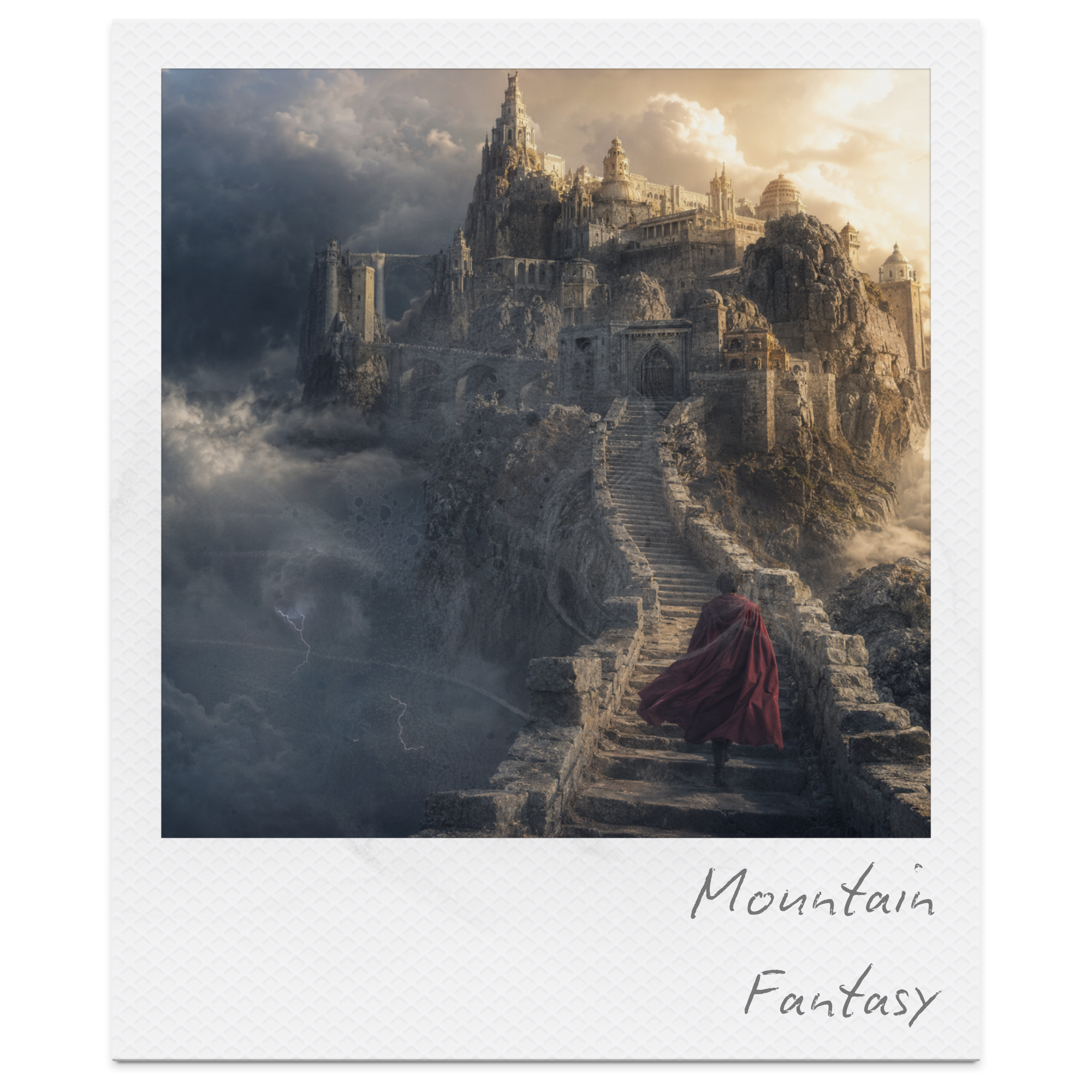
Mountain Fantasy
Mountains naturally make fantasy worlds feel larger. They rise above the landscape, divide territories and conceal whatever lies beyond them, creating places that can feel remote, ancient and difficult to reach even when they stand within sight of civilisation. A single mountain range can contain fertile valleys, windswept plateaus, deep caves, alpine meadows, glaciers, forests, volcanic slopes and settlements built at dramatically different elevations.
For fantasy writers, that vertical landscape creates possibilities that flatter terrain cannot. Characters can travel upwards, downwards, through or beneath the mountains, while altitude itself can separate communities, cultures and even entire kingdoms from the wider world.
Why Use Mountains in Fantasy?
Mountains create natural boundaries. A difficult pass might be the only route between two kingdoms, making control of it politically and economically valuable. Settlements on opposite sides of the same range could remain separated long enough to develop different languages, beliefs and versions of their shared history. A hidden valley might even contain a civilisation that has had almost no contact with the outside world.
The terrain can shape everyday life too. Mountain communities must adapt their architecture, transport, food, clothing, occupations and trade to altitude and weather. Valuable metals, gemstones, medicinal plants, freshwater or magical resources could make an inaccessible region unexpectedly wealthy, while bridges, tunnels, stairways and cliff roads become essential pieces of infrastructure.
Fantasy can push those possibilities much further. Mountains might be sleeping creatures, sacred places where rulers are crowned or enormous natural prisons containing something that should never be released. A glacier could preserve an ancient palace, caves might descend into another civilisation and a summit hidden permanently above the clouds could contain something nobody in the valleys knows exists.
What Stories Work Well in Mountain Fantasy?
Mountains are particularly suited to quests, adventures and epic fantasy because simply reaching somewhere can become part of the story. Avalanches, narrow passes, sheer cliffs, sudden storms and extreme altitude turn travel into conflict, while summits provide natural destinations for pilgrimages, expeditions, rites of passage and dangerous missions.
Their isolation also works beautifully for mystery and dark fantasy. A monastery stops communicating with the valley. An abandoned fortress suddenly shows signs of occupation. A road appears after a landslide. Something begins moving beneath a glacier.
But mountain fantasy does not need enormous stakes. Alpine villages, remote inns, hot-spring towns and communities tucked into fertile valleys can support cosy fantasy, folklore and romance, while competing kingdoms fighting over passes, mines or mountain borders provide fertile ground for political fantasy and court intrigue.
Mountains in Fantasy Literature
Mountains perform several very different roles in Tolkien's Middle-earth. The Misty Mountains act as a formidable geographical barrier that characters must find ways across or beneath, while Mount Doom becomes both a physical destination and the place where the central quest must ultimately be resolved. The landscape therefore shapes the journey rather than merely decorating it.
In The Hobbit, the Lonely Mountain works differently again. Erebor is a lost homeland, a source of enormous wealth and the lair of Smaug, so the mountain becomes inseparable from questions of inheritance, belonging, greed and political power.
Mountains can therefore be barriers, destinations, homes, sacred places or sources of conflict. Their usefulness comes not simply from their dramatic appearance but from deciding what the mountain means to the people who live around it — and what changes when somebody finally reaches, crosses or enters it.
Explore 70 Mountain Fantasy Writing Prompts
The 70 Mountain Fantasy Writing Prompts collection travels far beyond conventional snow-covered peaks, exploring hidden valleys, volcanic kingdoms, desert cliffs, glacial palaces, cloud-top cities, sacred mountains, underground settlements and dangerous roads through the high country. The landscapes themselves generate many of the stories, whether an avalanche reveals something buried for centuries or an isolated kingdom discovers the world beyond its mountains.
Inside you'll find 10 plot prompts, 10 story titles, 10 opening lines, 10 closing lines, 10 characters, 10 settings and 10 picture prompts, with inspiration for high fantasy, dark fantasy, romantasy, folklore, fairytale and adventure. Use one prompt to begin a story or combine several to create an entire mountain realm shaped by altitude, isolation, geology, weather and whatever might be waiting beyond the next peak.
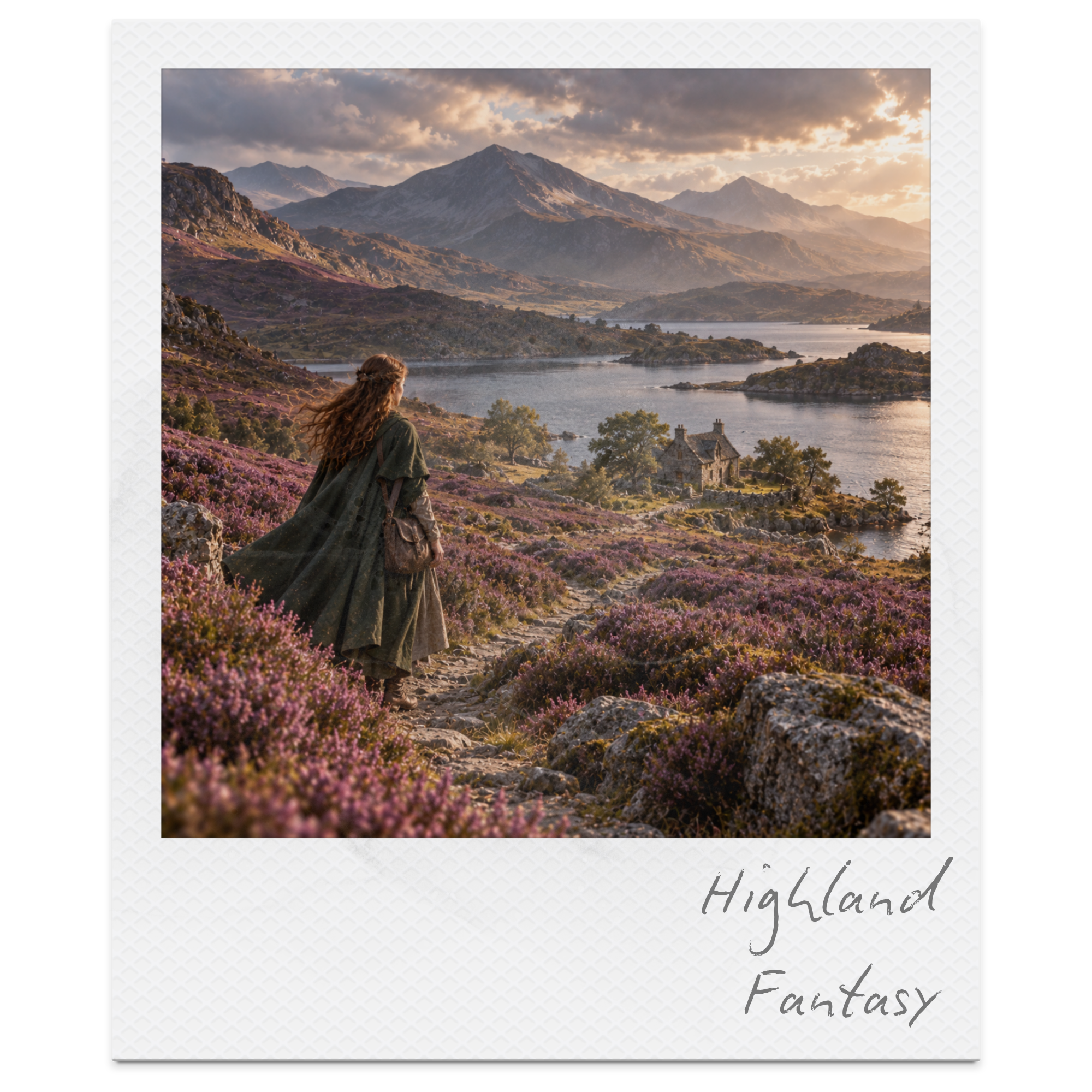
Highland Fantasy
Highland landscapes create fantasy worlds with an immediate sense of distance, history and scale. Broad glens lie between long ridges, dark lochs fill ancient valleys and stretches of heather-covered moorland can extend for miles between scattered settlements. Unlike the towering peaks of mountain fantasy, highland landscapes are often defined by the relationship between open uplands, sheltered valleys, freshwater, exposed moors and the communities spread across them.
They can feel wild without being empty. Roads, grazing land, ruined buildings, old boundaries and isolated strongholds all suggest generations of people living within the landscape, making the highlands particularly rich territory for stories about belonging, inheritance, memory and contested land. Your prompt collection itself uses this range, moving between moors, glens, lochs, peatlands, wooded valleys, waterfalls and windswept plateaus.
Why Use Highland Landscapes in Fantasy?
Distance matters in the highlands. Settlements separated by ridges and miles of open country may depend upon particular passes, bridges, ferries and old tracks to remain connected. Winter weather or flooding can sever those connections entirely, while someone who knows an obscure route across the moors can travel where an invading army or unfamiliar visitor cannot.
That geography can influence trade, politics, relationships and identity. Several glens might answer to different ruling families. Grazing rights or disputed boundaries could cause conflicts that have lasted generations. A strategically placed stronghold might control the only reliable road into a region, while seasonal fairs become important because they bring otherwise scattered communities together.
Highlands also make history unusually visible. Standing stones, abandoned cottages, ruined towers, old roads and forgotten settlements can remain embedded within the landscape long after their original purpose has disappeared. Fantasy gives writers the opportunity to decide whether those remnants merely preserve the past — or whether something of that past is still present.
What Stories Work Well in Highland Fantasy?
Highlands work beautifully for folklore-inspired fantasy, historical fantasy and family sagas, particularly when stories revolve around land, inheritance, old rivalries or traditions tied to particular places. A character returning to an ancestral estate might discover that the history they were taught differs considerably from the stories remembered by the people living there.
The landscape also suits adventure, political fantasy and mystery. Messages must cross difficult country, rival groups compete for strategically important land, travellers disappear between settlements and ruins provide physical evidence of events somebody would prefer forgotten. Mist, isolated houses and vast stretches of empty-looking moor can introduce Gothic or darker elements without turning the landscape itself into something sinister.
And there is plenty of room for romance and quieter fantasy: remote inns, estates, lochside villages, seasonal gatherings and characters whose attachment to the landscape becomes as important as their attachment to one another.
Highland Landscapes in Fantasy Literature
Scottish highland and island landscapes have had a particularly strong influence on fantasy and fantasy-adjacent literature. In Diana Wynne Jones's Howl's Moving Castle, the fictional kingdom of Ingary combines mountains, moors and small settlements into a landscape crossed by Howl's magical moving home, allowing geography itself to become unusually flexible.
More broadly, writers drawing upon northern and Celtic-influenced landscapes frequently use remote water, uplands, islands, ancient monuments and oral tradition to create places where history and folklore seem physically embedded in the environment. For a fantasy writer, the useful lesson is not to reproduce a particular real culture, but to consider how generations of inhabiting the same difficult landscape might produce distinctive stories, traditions and relationships with the land.
Explore 70 Highland Fantasy Writing Prompts
The 70 Highland Fantasy Writing Prompts collection explores misty glens, purple heather moors, dark lochs, isolated estates, ancient strongholds, forgotten roads and remote communities shaped by the surrounding landscape. Its stories range from disputed land and political rebellion to vanished villages, mysterious ruins and histories concealed across the moors.
You'll find 10 plot prompts, 10 title ideas, 10 opening lines, 10 closing lines, 10 characters, 10 settings and 10 picture prompts, with inspiration for adventure, political fantasy, folklore, mystery, romance and stories about the people who call these wild uplands home.
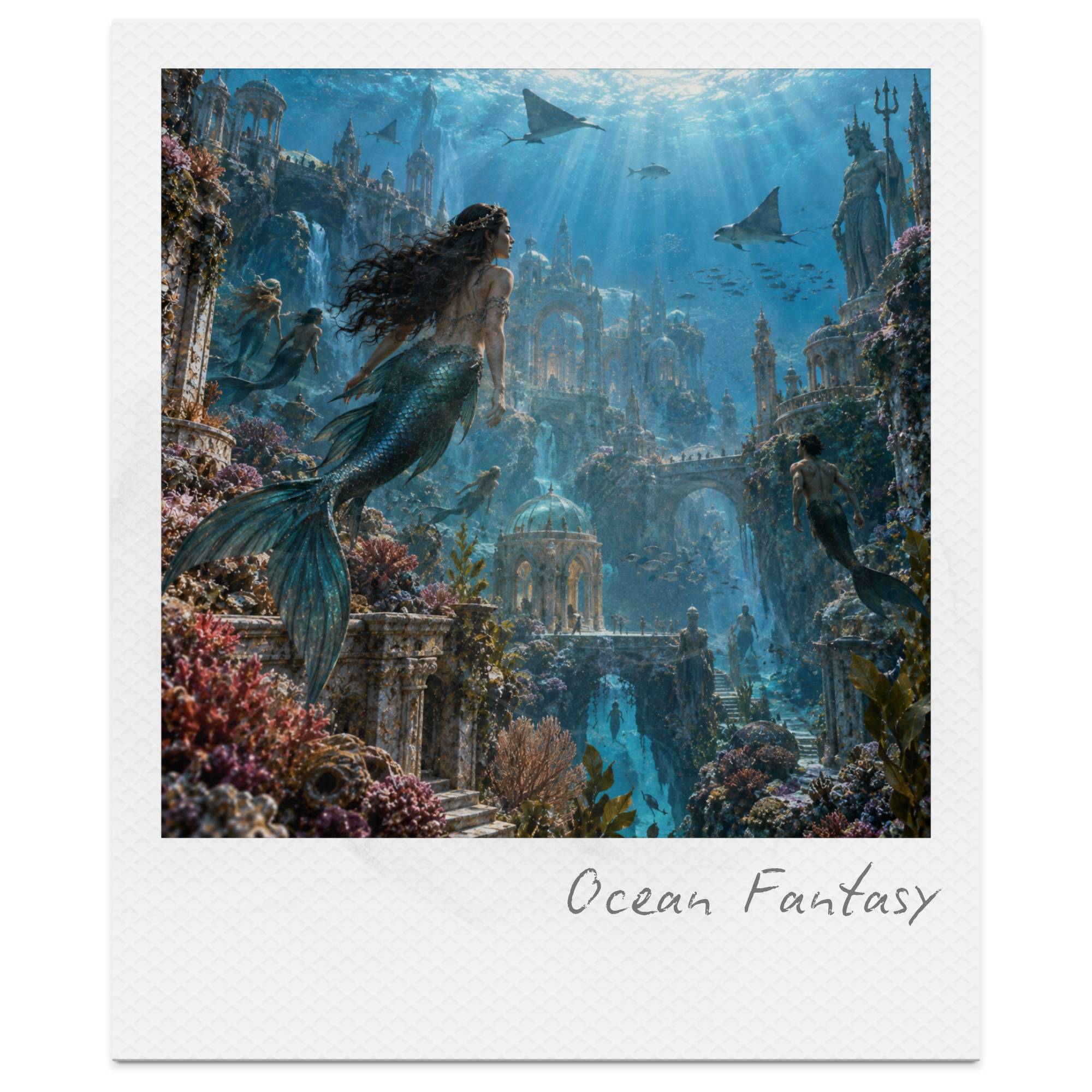
Ocean Fantasy
The ocean offers fantasy writers something few other landscapes can: an environment that can contain entire worlds while remaining largely unknown to the people living beside it. Its surface can connect distant kingdoms through trade and exploration, while beneath the waves lie reefs, trenches, submerged landscapes and depths that sunlight never reaches. Even in a world covered with maps, the ocean can preserve enormous spaces where almost anything might still exist.
Unlike a fixed road or mountain pass, the sea is constantly moving. Currents change, storms alter journeys, tides reveal and conceal places, and ships can travel for weeks without seeing land. That movement makes the ocean both a setting and a force capable of shaping the cultures, economies, politics and stories developing around it.
Why Use Oceans in Fantasy?
Oceans simultaneously connect and separate. A maritime kingdom might trade with places thousands of miles away while knowing almost nothing about a neighbouring civilisation hidden beneath its own waters. Control of a narrow strait, reliable current or sheltered harbour could make one realm enormously wealthy, while islands outside established sailing routes might remain isolated for centuries.
Life around the ocean creates its own forms of knowledge. Navigators learn currents and stars, shipwrights adapt vessels to dangerous waters, fishing communities understand migrations and seasons, and sailors develop traditions around storms, reefs and creatures encountered far from shore. Underwater societies would face entirely different questions surrounding depth, pressure, light, movement, communication and resources.
Fantasy lets those natural mysteries become literal. Islands can move. Cities can exist along ocean trenches. Merfolk might negotiate treaties with surface kingdoms. Ancient roads can stretch across the seabed, enormous creatures can alter shipping routes and currents themselves might possess magical properties.
What Stories Work Well in Ocean Fantasy?
The scale of the ocean makes it ideal for adventure, exploration and quest fantasy. Ships can carry characters beyond the boundaries of familiar maps, expeditions can search for lost islands and explorers can encounter cultures that have developed without contact with the world they know.
Ocean fantasy also lends itself beautifully to political stories. Maritime kingdoms can compete over trade routes, naval power and strategically important waters, while relationships between surface and underwater civilisations introduce entirely different borders and territorial disputes. Pirates, merchants, cartographers, diplomats, naval officers and explorers can all become central characters.
Beneath the surface, the tone can shift towards mystery, dark fantasy and wonder. Sunken cities, deep-sea creatures and lightless environments create opportunities for discovery and fear, while merfolk kingdoms, tropical voyages and magical islands can support romantasy, folklore and more colourful adventures. Your existing collection deliberately spans all of these, from maritime rivalry and disappearing islands to mermaid diplomats, krakens and cities beneath the waves.
Oceans in Fantasy Literature
Ursula K. Le Guin's Earthsea is one of fantasy's clearest examples of geography shaping an entire imagined world. Its archipelago makes sailing fundamental to travel, communication and adventure, while the separation between islands helps different communities develop distinctive identities.
C. S. Lewis makes the sea itself central to The Voyage of the Dawn Treader. The voyage continually carries its characters away from familiar geography and towards stranger islands and increasingly unknown waters, allowing the ocean to become the route through which the boundaries of the known world expand.
Ocean fantasy can therefore use the sea as much more than scenery. It can be the road between worlds, the barrier separating them or an unexplored world in its own right.
Explore 70 Ocean Fantasy Writing Prompts
The 70 Ocean Fantasy Writing Prompts collection travels from crowded maritime capitals and warm turquoise archipelagos to floating cities, underwater kingdoms, ancient ruins and the lightless depths of ocean trenches. Stories explore voyages, trade, strange currents, maritime rivalries, disappearing islands and the creatures and civilisations sharing the waters with humanity.
You'll find 10 plot prompts, 10 title ideas, 10 opening lines, 10 closing lines, 10 characters, 10 settings and 10 picture prompts, with mermaids, pirates, navigators, explorers, sea creatures, submerged empires and kingdoms both above and below the waves. Use them to begin a single maritime adventure or start imagining an entire fantasy world shaped by the ocean.
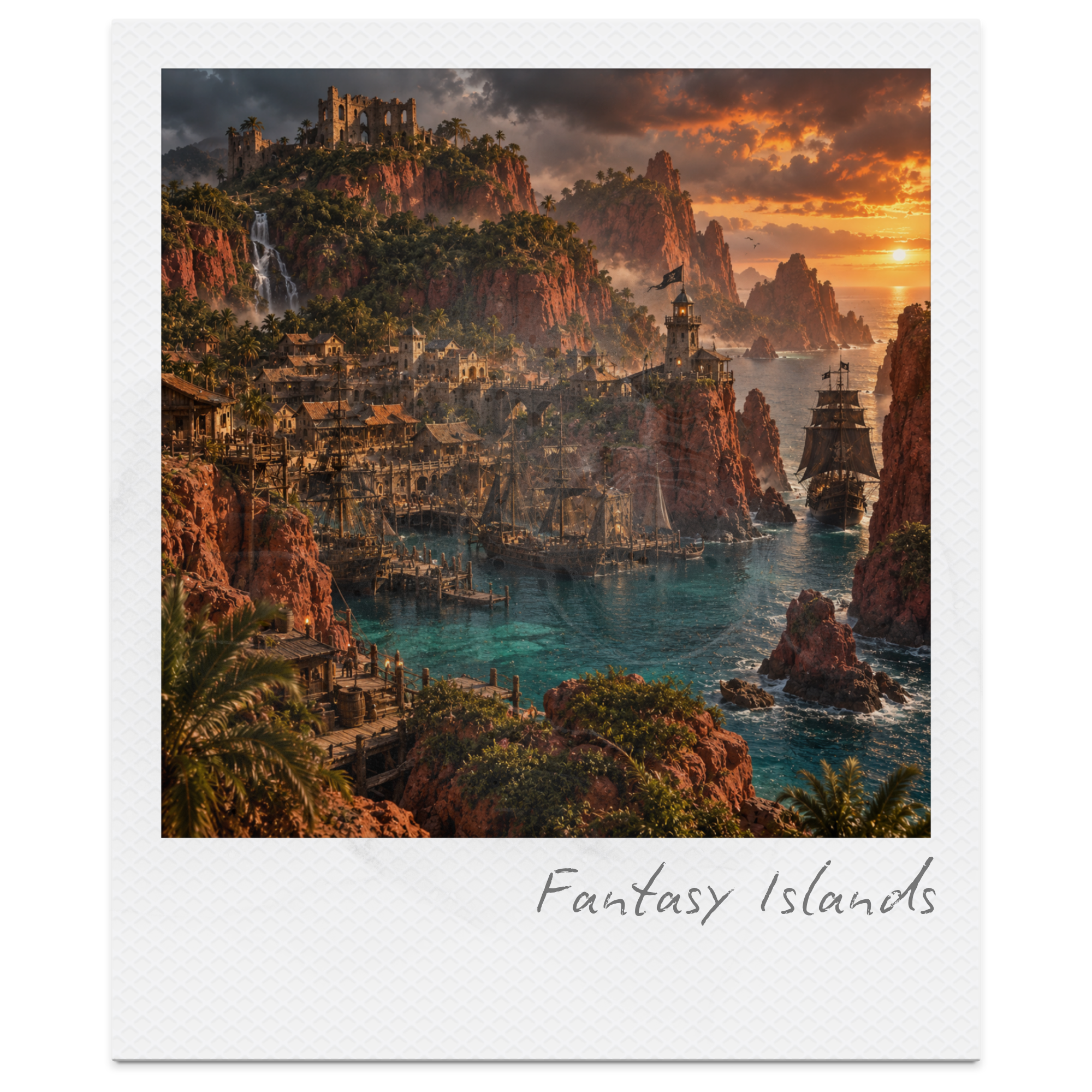
Island Fantasy
An island gives a fantasy writer something extraordinarily useful: a world with a natural boundary. The sea draws a visible line around the setting, separating its inhabitants from neighbouring lands and allowing distinctive cultures, ecosystems, histories and magical traditions to develop within a relatively contained space. Yet that boundary is never completely closed. Ships arrive, storms bring unexpected visitors, currents carry objects from distant shores and the horizon continually reminds the people living there that another world exists beyond their own.
Islands can also be almost anything. A tiny rock supporting a lighthouse and a handful of inhabitants creates very different stories from a sprawling island kingdom containing mountains, forests, rivers and cities. An archipelago can become an entire interconnected world, while an island missing from every map can preserve creatures, magic or histories that have disappeared everywhere else. Your prompt collection already ranges from tropical and volcanic islands to rugged northern settlements, pirate territories, frozen islands and magical archipelagos.
Why Use Islands in Fantasy?
Isolation is one of the greatest advantages of an island setting. Distance from other lands can influence language, religion, politics, technology, folklore and attitudes towards outsiders, particularly if travel across the surrounding sea is difficult or rare. A community receiving one trading ship each year will understand the wider world very differently from a maritime kingdom whose harbours are crowded with vessels from dozens of nations.
Resources matter too. Fresh water, farmland, timber and safe harbours can determine where settlements develop, while something found nowhere else — a medicinal plant, magical mineral, rare creature or extraordinary crop — might make a remote island strategically important. Conversely, scarcity can make inhabitants dependent upon trade or force them to develop unusual solutions to problems mainland societies rarely encounter.
The sea provides both protection and vulnerability. Dangerous reefs might prevent invasion for centuries, but they can also prevent escape. A prosperous island kingdom may control important shipping routes, while a small island positioned beside a narrow strait could possess political importance completely disproportionate to its size.
What Stories Work Well in Island Fantasy?
Islands are perfect for stories about discovery, isolation and arrival. A shipwreck survivor can encounter a society nobody knew existed. Explorers might find an island absent from their maps. A community isolated for generations could suddenly see unfamiliar sails on the horizon. Alternatively, the protagonist might be an islander who has spent their entire life wondering what exists beyond the sea.
The natural containment of an island also makes it excellent for mystery and dark fantasy. When something goes wrong, characters cannot necessarily leave. A storm can close the harbour, ships can disappear, a magical barrier can surround the coast or the only vessel capable of reaching the mainland can be destroyed.
But island fantasy can equally support pirate adventures, romantasy, folklore, political fantasy and quieter community stories. Rival islands can feud across narrow stretches of water; an archipelago can contain competing kingdoms and cultures; merfolk can control the waters between human settlements; or an apparently idyllic island can become the setting for a cosy story centred on everyday magic.
Islands in Fantasy Literature
Islands have a long history in fantasy precisely because their boundaries allow writers to create self-contained worlds. Ursula K. Le Guin takes that idea to an enormous scale in Earthsea, where an archipelago of islands shapes travel, trade and the identities of different communities.
C. S. Lewis uses islands differently in The Voyage of the Dawn Treader. Rather than remaining within one contained setting, the characters travel between increasingly unfamiliar islands, allowing each new landfall to introduce its own mysteries, inhabitants and magical rules. The island becomes a structure for episodic discovery: crossing the sea means leaving one strange world without knowing what the next shore will contain.
For writers, both approaches are useful. One island can become an entire storyworld, while an archipelago can give you dozens of smaller worlds connected by the same sea.
Explore 70 Fantasy Island Writing Prompts
The 70 Fantasy Island Writing Prompts collection explores just how different island worlds can become, from enchanted tropical shores and coral kingdoms to volcanic islands, pirate-controlled archipelagos, rugged northern settlements and frozen communities surrounded by drifting sea ice. There are islands protected by living reefs, places that appear only once every twenty years, rival island kingdoms and lighthouses guarding their shores from things lurking beyond them.
You'll find 10 plot prompts, 10 story titles, 10 opening lines, 10 closing lines, 10 character ideas, 10 settings and 10 picture prompts, giving you 70 different ways to explore isolation, maritime cultures, hidden civilisations, magical seas and the mysteries that can survive when a place is separated from the wider world.
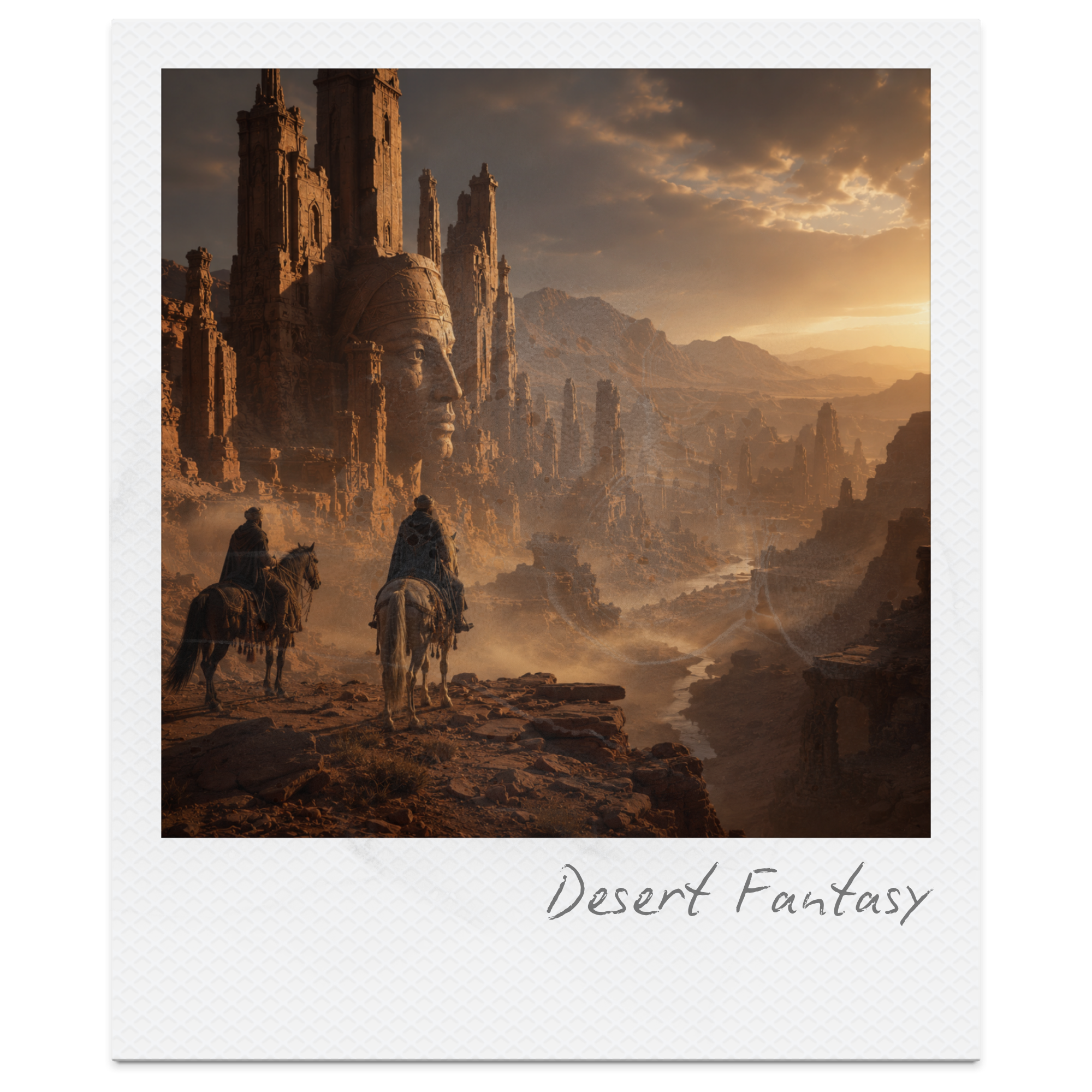
Desert Fantasy
Deserts can appear empty from a distance, but for fantasy writers that apparent emptiness creates enormous possibilities. Dunes can conceal cities, canyons can shelter entire kingdoms, salt flats can stretch beyond the horizon and a single oasis can determine where people settle, trade and survive. The landscape strips away many of the resources characters might ordinarily take for granted, making water, shelter, navigation and knowledge unusually valuable.
Desert fantasy can also extend far beyond endless seas of sand. Rocky plateaus, dry valleys, desert mountains, wadis, salt deserts, canyons and fertile oases create dramatically different environments within the same wider landscape. Your existing prompt collection builds on this idea of scarcity and survival, while combining it with lost civilisations, prophecy, trade, politics and ancient magic.
Why Use Deserts in Fantasy?
Scarcity makes almost every worldbuilding decision more consequential. Where does water come from? Who controls it? How do people travel safely between settlements? What happens when a well fails, a river changes course or an expected rainy season never arrives? In a fantasy world, control of an enchanted spring or underground reservoir could be as politically important as possession of a throne.
Distance creates another challenge. Settlements may develop around oases, rivers, caravan routes and defensible rocky terrain, leaving enormous areas sparsely inhabited. Merchants and travellers who understand the landscape can therefore become essential links between distant communities, carrying news, goods and ideas alongside spices, metals, textiles or magical materials.
The desert is also exceptionally good at hiding the past. Sand can cover roads and buildings, abandoned settlements can survive in inaccessible valleys and changing conditions can reveal places thought lost for centuries. Your existing prompts already exploit this particularly well, with buried temples, lost empires, sacred oases, canyon kingdoms and ruins emerging from shifting dunes.
What Stories Work Well in Desert Fantasy?
Deserts naturally suit quests, exploration and survival fantasy because crossing the landscape can become an adventure in itself. Characters might follow an ancient trade route, search for a legendary oasis, escort something valuable between kingdoms or race to reach shelter before a sandstorm arrives.
They are equally strong settings for political and epic fantasy. Rival cities might compete for water, caravan guilds could control international trade, nomadic and settled societies may hold very different forms of power, and possession of a river valley or mountain pass could determine which kingdom prospers.
Desert landscapes also lend themselves to mystery, mythology and dark fantasy. Ruins can emerge after storms, forgotten gods can remain buried beneath abandoned temples and mirages make perception itself unreliable. Romantasy and adventure can flourish here too, particularly when long journeys force characters together or rival loyalties collide far from the protection of either character's home.
Deserts in Fantasy Literature
Frank Herbert's Dune, although science fiction rather than conventional fantasy, is one of the clearest examples of how a desert environment can shape an entire speculative society. On Arrakis, water scarcity affects customs, technology, politics and survival, while control of the planet's most valuable resource gives the landscape significance far beyond its physical geography.
Desert landscapes also feature prominently in The Horse and His Boy by C. S. Lewis, where crossing the desert separating Calormen from Archenland becomes a major physical challenge within the journey. Rather than functioning merely as scenery, distance, heat and the difficulty of crossing open country help determine how the characters travel and what risks they face.
The useful principle for fantasy writers is simple: don't merely put a kingdom in a desert. Ask what being surrounded by desert has forced that kingdom to become.
Explore 70 Desert Fantasy Writing Prompts
The 70 Desert Fantasy Writing Prompts collection explores worlds shaped by heat, distance, scarcity and histories buried beneath the landscape. Discover vanished cities, sacred oases, rival caravan routes, ancient temples, desert kingdoms, dangerous artefacts and characters attempting to survive journeys across places where even the maps eventually become unreliable.
The collection includes 10 plot hooks, 10 title ideas, 10 opening lines, 10 closing lines, 10 character ideas, 10 settings and 10 picture prompts, providing inspiration for lost-civilisation mysteries, political struggles, quests, survival stories, ancient magic and epic journeys across the sands.
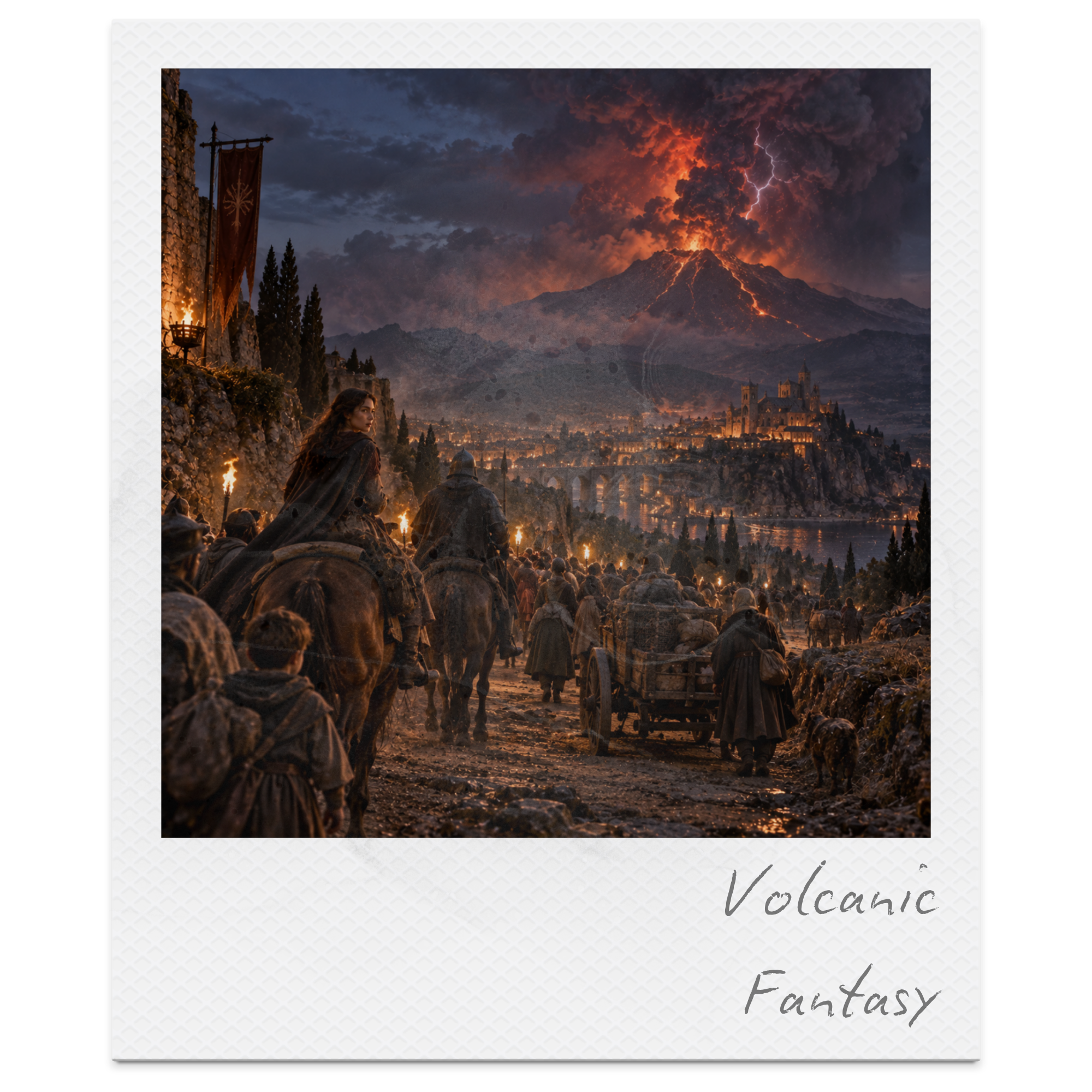
Volcanic Fantasy
Volcanic landscapes make the world itself feel alive. Mountains smoke above fertile valleys, geothermal pools steam between fields of black rock, crater lakes fill ancient calderas and new islands can rise from the sea. Few landscapes offer such a natural combination of beauty, abundance and danger, making volcanic regions particularly rich settings for fantasy.
They are also much more varied than endless rivers of lava. A volcanic fantasy world might contain lush vineyards growing in exceptionally fertile soil, black-sand beaches beneath basalt cliffs, colourful mineral terraces, obsidian cities, steaming hot springs or settlements built inside extinct calderas. The landscape carries evidence of both destruction and creation, allowing the history of the world to remain physically visible long after an eruption has ended. Your existing prompts deliberately explore that wider range, including fertile valleys, geothermal settlements, volcanic islands, buried cities and landscapes slowly reclaiming old lava flows.
Why Use Volcanic Landscapes in Fantasy?
Volcanoes immediately give a fantasy society something it must learn to live alongside. Communities might develop warning systems, evacuation routes and architecture designed for earthquakes or ashfall. Generations of eruptions could become part of local memory, religion and folklore, with stories explaining why the mountain sleeps, what will awaken it or why particular places must never be disturbed.
Yet volcanic landscapes can provide extraordinary benefits too. Fertile soils can support valuable crops, geothermal heat can warm buildings and volcanic stone can provide distinctive construction materials. Obsidian, rare minerals or magical crystals might create entire industries, turning an otherwise remote region into an important centre of wealth and trade. These possibilities already run throughout the volcanic prompt collection.
Volcanic activity can even alter the geography during the story. An eruption might create a new island, collapse part of a mountain, block a river, expose an ancient settlement or bury a road that connected two kingdoms. In volcanic fantasy, the map itself does not necessarily remain permanent.
What Stories Work Well in Volcanic Fantasy?
Volcanic settings naturally lend themselves to epic fantasy, adventure and disaster stories, particularly when a supposedly dormant mountain begins showing signs of activity. An impending eruption creates an immediate deadline, while earthquakes, ashfall and blocked routes can continually change what characters are able to do.
But destruction does not have to dominate the story. Political fantasy could revolve around control of fertile volcanic valleys, mines or geothermal resources. A mystery might begin when an earthquake exposes a sealed doorway. Archaeologists could enter a perfectly preserved city buried beneath ash, while explorers investigate a newly formed island only to discover evidence that someone reached it before them.
Volcanic landscapes can even support cosy fantasy and romantasy. Imagine a mountain inn beside steaming springs, colourful gardens warmed by geothermal water or a romance developing in a vineyard beneath a sleeping volcano. The tension comes from knowing that beneath an apparently peaceful landscape exists a force powerful enough to transform everything.
Volcanic Landscapes in Fantasy Literature
J. R. R. Tolkien's Mount Doom is perhaps fantasy's most famous volcanic landscape. In The Lord of the Rings, the volcano is not simply an impressive feature of Mordor: it is the place where the One Ring was forged and the only place where it can ultimately be destroyed. Geography therefore determines the quest's destination and makes reaching a particular landscape essential to resolving the story.
Volcanic environments can also work particularly well in stories influenced by mythology. Across different mythological traditions, volcanoes have been associated with fire, creation, destruction and powerful supernatural beings, providing writers with a useful model for imagining cultures that interpret geological activity through religion and storytelling.
The interesting worldbuilding question is not simply what happens when the volcano erupts? It is what centuries of living beside that volcano have already done to the people beneath it.
Explore 70 Volcanic Fantasy Writing Prompts
The 70 Volcanic Fantasy Writing Prompts collection explores fiery landscapes without limiting them to catastrophe. There are sleeping mountains, obsidian cities, fertile valleys, geothermal towns, crater lakes, volcanic archipelagos, black-sand islands, buried civilisations and mysterious networks of ancient lava tunnels.
You'll find 10 plot prompts, 10 title ideas, 10 opening lines, 10 closing lines, 10 character ideas, 10 setting ideas and 10 picture prompts, with inspiration for epic adventures, political conflicts, mysteries, volcanic romantasy, cosy fantasy and worlds where the landscape can transform within a single generation.
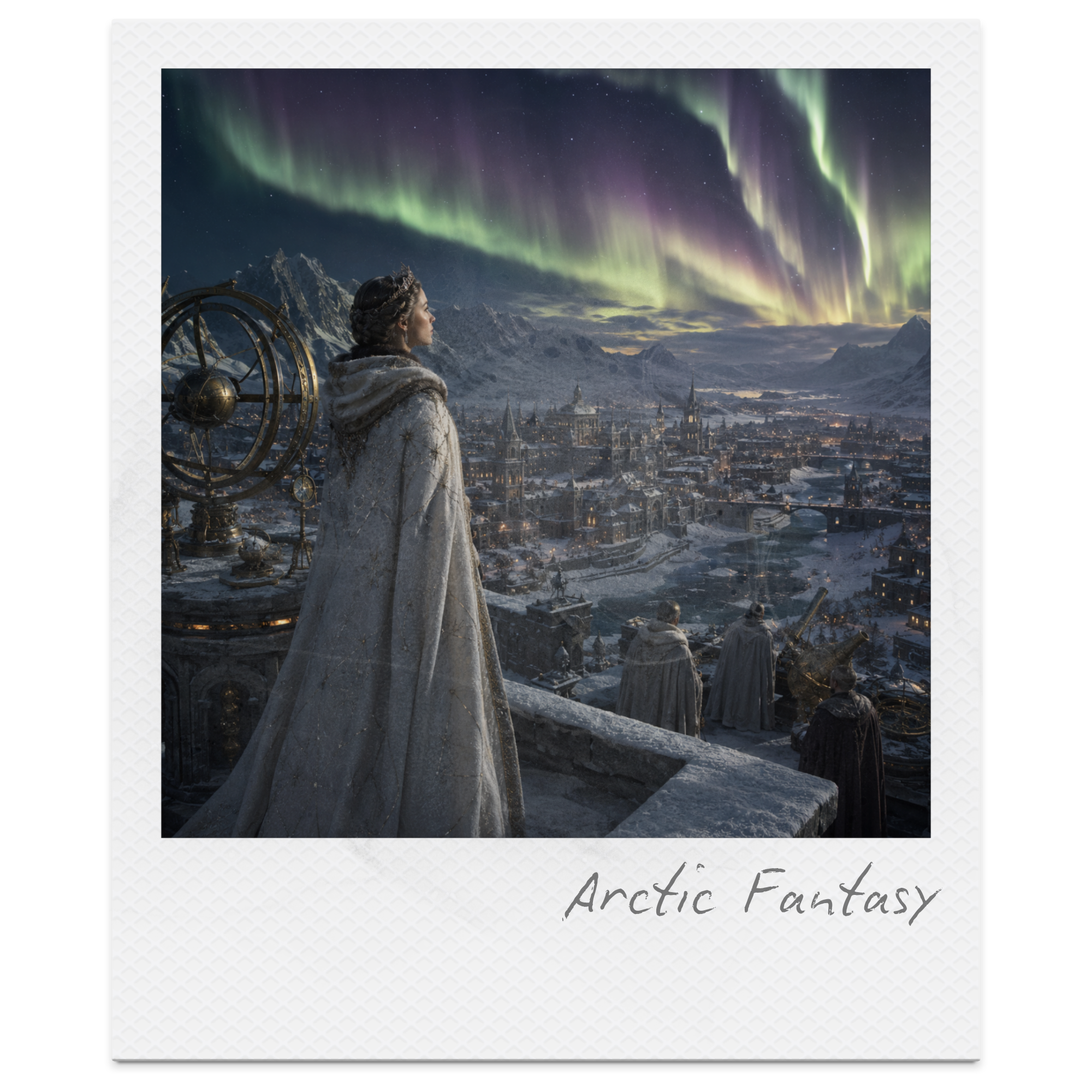
Arctic & Frozen Fantasy
Frozen landscapes can make a fantasy world feel enormous. Glaciers stretch beyond the horizon, mountain ranges disappear into snowstorms, seas become temporary roads and months of darkness transform the rhythms of everyday life. Yet Arctic fantasy does not have to mean an empty white wilderness. Frozen forests, volcanic coastlines, tundra, icebound islands, geothermal valleys and colourful northern settlements can create remarkably varied worlds.
Cold also changes the rules by which a society operates. Travel routes can exist only during certain seasons, food must be stored for long winters and entire communities may organise their year around the freezing and thawing of rivers and seas. In your existing prompt collection, this environmental approach is central: the cold isn't simply scenery but something that influences journeys, kingdoms, mysteries and the people living within them.
Why Use Arctic & Frozen Landscapes in Fantasy?
Seasonal change becomes unusually powerful in a frozen world. A river that separates two kingdoms in summer might become a road in winter. Sea ice could connect islands for several months before disappearing again. The arrival of spring might reopen trade routes — or expose something that has spent centuries beneath a retreating glacier.
Extreme environments also encourage distinctive approaches to architecture, food, clothing, transport and settlement. A fantasy city might use geothermal springs for heat, maintain enormous glasshouses throughout the polar night or migrate across the tundra rather than occupying a permanent capital. Your prompts already explore possibilities such as geothermal cities, travelling kingdoms, seasonal settlements constructed on frozen lakes and communities following animal migrations.
And then there is light. The aurora, polar night, midnight sun and winter sunlight reflected across snow and ice can influence mythology, calendars, festivals and magic as easily as they influence the atmosphere of individual scenes.
What Stories Work Well in Arctic Fantasy?
Frozen landscapes are naturally suited to expeditions, quests and exploration fantasy. Characters can cross unmapped tundra, follow ancient roads across frozen seas, investigate abandoned northern settlements or venture into glaciers containing evidence of forgotten civilisations.
Isolation also makes these environments powerful settings for mystery and dark fantasy. A ship trapped in pack ice cannot simply sail away. A mountain settlement might spend months separated from the outside world. Snow can erase tracks and roads, while ice can preserve ruins, artefacts and secrets that would have disappeared elsewhere.
But Arctic fantasy can be warm as well as dangerous. Cosy fantasy, folklore, romance and political fantasy can centre on winter markets, communal celebrations, hot springs, glasshouse gardens, northern courts and settlements where people have spent generations learning how to thrive. The contrast between bitter weather outside and warmth within can become part of the appeal rather than merely another obstacle.
Frozen Landscapes in Fantasy Literature
Philip Pullman's Northern Lights (The Golden Compass in North America) makes the far north central to its sense of wonder and exploration. Lyra's journey carries her into increasingly remote northern landscapes, while phenomena such as the aurora become entwined with the larger mysteries of the story.
Naomi Novik's Spinning Silver uses a very different form of winter fantasy. Its increasingly unnatural cold is tied to the magical Staryk and affects the human world, allowing winter itself to become part of the conflict rather than simply the season in which events occur.
Both approaches offer something useful for worldbuilding. A frozen landscape can be a place characters must journey into, but it can also be a force capable of reaching into supposedly safe places and changing them.
Explore 70 Arctic Fantasy Writing Prompts
The 70 Arctic Fantasy Writing Prompts collection explores frozen worlds far beyond familiar ice palaces and winter queens. There are retreating glaciers revealing forgotten kingdoms, roads appearing across frozen seas, travelling communities, geothermal valleys, polar-night monasteries, icebound ships, northern ports, mysterious observatories and cities swallowed by glaciers.
You'll find 10 plot prompts, 10 story titles, 10 opening lines, 10 closing lines, 10 character ideas, 10 settings and 10 picture prompts, spanning high fantasy, folklore, mystery, dark fantasy, adventure, romance and science fantasy. Use them to create a world where winter is not merely something characters endure, but something that has shaped the cultures, histories and stories of the people who call it home.
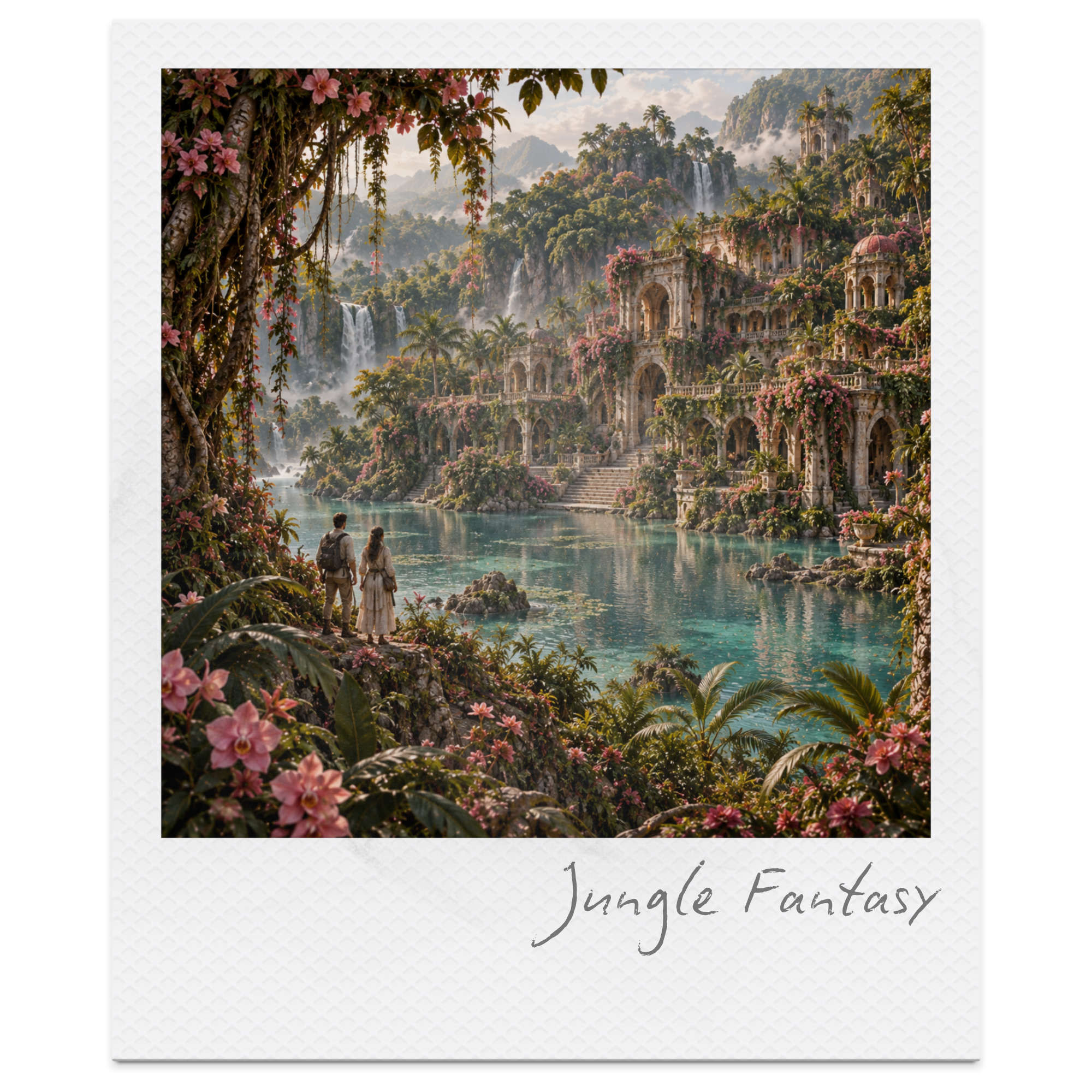
Jungle Fantasy
A jungle can make a fantasy world feel overwhelmingly alive. Enormous trees block the sky, rivers become roads, vines reclaim abandoned buildings and layers of vegetation can conceal entire kingdoms only a few miles from inhabited settlements. Unlike an open landscape where characters can see danger approaching, the jungle restricts visibility and makes even a short journey feel uncertain.
But jungle fantasy does not have to revolve around hostile wilderness and lost explorers. Jungles can support thriving cities, river kingdoms, farming communities, temples, trade networks and cultures with generations of knowledge about the landscape around them. Your prompt collection deliberately explores both sides of the setting, moving between overgrown ruins and dangerous expeditions to prosperous kingdoms, magical ecosystems and communities that understand the jungle far better than outsiders do.
Why Use Jungles in Fantasy?
Jungles offer extraordinary opportunities for vertical worldbuilding. Life can exist on the forest floor, among enormous roots, beside rivers and high within the canopy. Settlements might be connected by bridges between trees, while creatures inhabiting the upper canopy could be almost unknown to people living below. Ancient towers may disappear into vegetation until their highest floors resemble buildings suspended above the forest.
Water can be equally important. Dense vegetation can make conventional roads difficult to maintain, allowing rivers to become major transport routes connecting settlements, markets and kingdoms. Seasonal rains and monsoons might flood forests, alter waterways and temporarily transform which parts of the landscape are accessible.
Then there is biodiversity. Medicinal plants, poisonous fruit, enormous flowers, unusual fungi and magical creatures can become part of an interconnected fantasy ecosystem. Instead of adding magic on top of the landscape, writers can ask how magic functions as part of the jungle's ecology — what pollinates a magical flower, what feeds upon supernatural creatures or what happens when an enchanted species disappears.
What Stories Work Well in Jungle Fantasy?
Jungles are natural settings for exploration, adventure and discovery. Expeditions can search for kingdoms erased from maps, rivers can lead towards unknown settlements and ruins can gradually emerge as vegetation retreats. The density of the landscape means something extraordinary might exist remarkably close to civilisation without ever having been discovered.
They also work beautifully for mystery and dark fantasy. Paths can vanish, rivers can change course, familiar animal sounds can suddenly stop and abandoned structures can appear beneath centuries of growth. The landscape itself can create uncertainty without requiring a conventional monster or villain.
High fantasy, folklore and political fantasy offer completely different possibilities. Rival kingdoms might be separated by supposedly impassable jungle, control of navigable rivers could determine political power, and valuable medicines or magical plants might make particular territories fiercely contested. A jungle can therefore be a civilisation, an ecosystem and a source of conflict simultaneously, rather than simply the dangerous space between important locations.
Jungles in Fantasy Literature
In Terry Pratchett's The Last Continent, tropical wilderness becomes part of the novel's exaggerated and fantastical treatment of environment, while other speculative traditions have frequently used dense, difficult-to-map landscapes to create places where the familiar rules of civilisation begin to disappear.
Jungle fantasy also draws on the much older literary tradition of the lost world: stories in which geographical isolation allows unknown creatures, forgotten places or surviving civilisations to remain hidden from the wider world. Fantasy can take that premise further by making the isolation magical. A kingdom might not merely be difficult to find — the jungle itself might prevent outsiders from reaching it.
For worldbuilding, that creates a particularly interesting question: what if the jungle isn't hiding something accidentally, but deliberately?
Explore 70 Jungle Fantasy Writing Prompts
The 70 Jungle Fantasy Writing Prompts collection ventures beneath the canopy into overgrown kingdoms, ancient ruins, magical rivers, tropical cities, flooded forests, dangerous expeditions and impossible ecosystems. There are sacred trees beginning to die, rivers that disappear overnight, extinct creatures returning and ancient temples emerging from flooded jungle lakes.
You'll find 10 plot prompts, 10 story titles, 10 opening lines, 10 closing lines, 10 character ideas, 10 settings and 10 picture prompts, spanning high fantasy, adventure, folklore, dark fantasy and magical exploration. Use them to discover lost civilisations, create thriving jungle kingdoms or build a fantasy ecosystem where the landscape itself becomes one of the forces shaping the story.
🌿 Explore 70 Jungle Fantasy Writing Prompts
Go Deeper into Fantasy Worldbuilding
Choosing the landscape is only the beginning. Once you know whether your story unfolds among ancient forests, isolated islands, frozen wildernesses, volcanic valleys or sprawling deserts, you can start asking how that environment has shaped everything built upon it.
◆ Build a world shaped by its geography. Consider where people settle, which resources they depend upon, how they travel and what natural barriers separate one region from another. Mountains can create borders, rivers can become trade routes, coastlines can produce maritime powers and fertile valleys can become territories worth fighting over.
◆ Let the landscape shape your cultures. Think about how climate and geography influence architecture, clothing, food, occupations, traditions and beliefs. People who have lived beside an unpredictable volcano for centuries should understand their world differently from a civilisation surrounded by an apparently endless forest.
◆ Connect magic to the natural world. Forests might contain ancient sources of magic, ocean currents could carry enchantments between distant lands, mineral-rich mountains might fuel magical industries and seasonal changes could determine when particular powers can be used. Making magic part of the environment helps the world feel interconnected rather than assembled from separate pieces.
◆ Use geography to create conflict. Valuable resources, disputed borders, dangerous passes, navigable rivers and strategic islands can all create reasons for kingdoms to cooperate, compete or go to war. Sometimes the simplest way to discover the political history of a fantasy world is to look at its map and ask what everyone wants to control.
◆ Turn your landscape into an entire fantasy world. If you're ready to move beyond the environment itself, explore Fantasy Kingdoms: The Ultimate Guide to Names, Ideas & Worldbuilding. It takes you through the process of developing a kingdom from the ground up, including terrain, settlements, rulers, government, culture, magic, history, conflict, symbols and the details that make an imagined realm feel real. Use your chosen landscape as the foundation, then begin building everything that exists within it.
Final Thoughts
A memorable fantasy landscape should do more than make a world beautiful. It should influence how people live, where kingdoms rise, how characters travel, what resources they value and which stories are possible there. Whether your world begins with an ancient woodland, a volcanic island, a frozen wilderness or an endless ocean, let the environment become part of the history and identity of the world you create.
For more inspiration, explore the Fantasy Writing Hub for fantasy prompts, worldbuilding ideas, names and generators, or browse the Creative Writing Archive to discover even more resources for developing your next story.
