Fantasy Sigil Generator: Create a House Banner, Crest & Coat of Arms
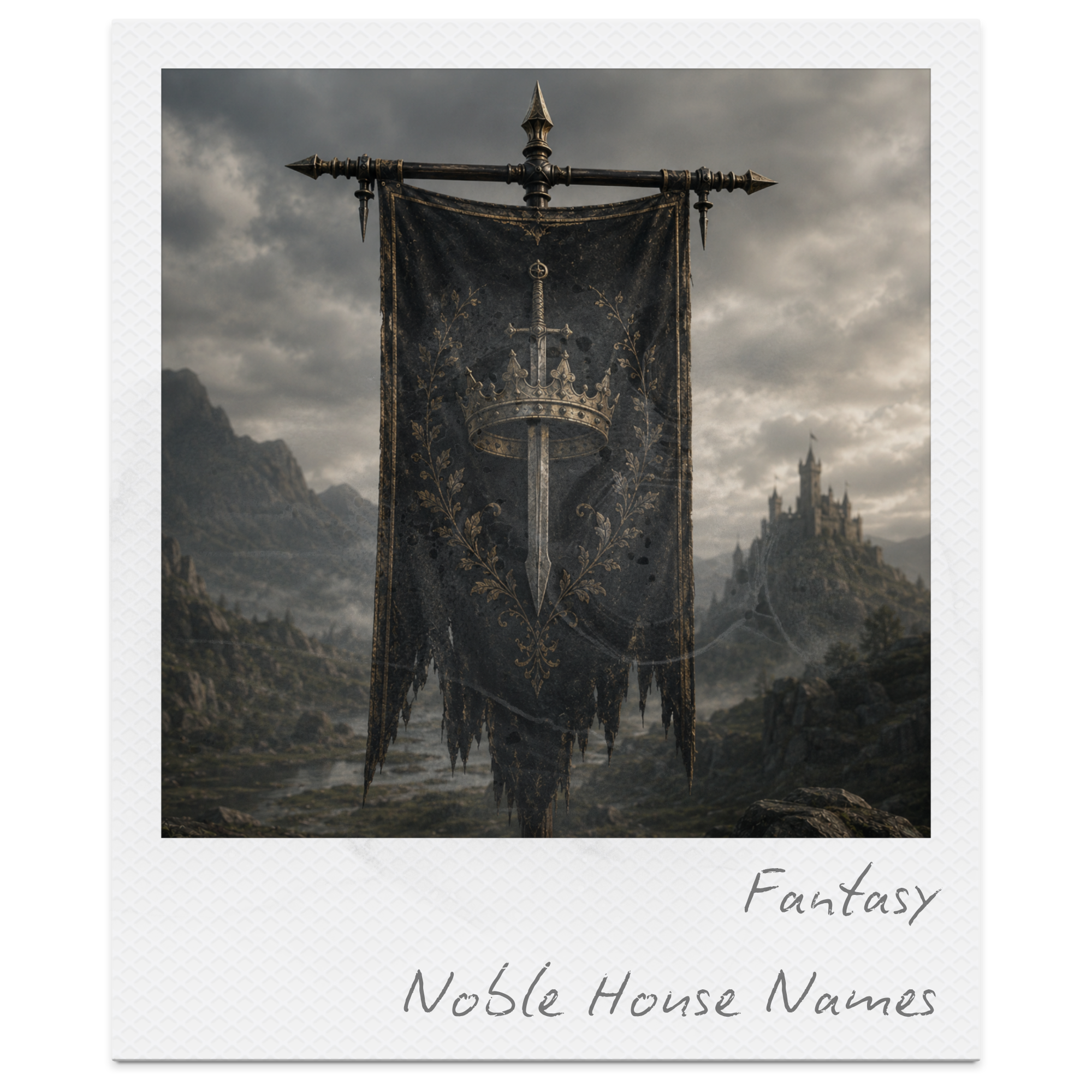
In fantasy, a sigil can tell you who someone is before they ever speak. A wolf stitched onto a battle standard, a silver tree carved above a castle gate, or a black dragon stamped into sealing wax can represent a noble house, royal dynasty, kingdom, clan, military order or ancient bloodline.
Heraldry and symbolic emblems appear throughout fantasy literature. Tolkien gave Gondor its White Tree and Seven Stars and Rohan its white horse on a green field, while the houses of Hogwarts use distinctive animals and colours — from Gryffindor’s scarlet-and-gold lion to Slytherin’s green-and-silver serpent. These symbols do more than decorate banners: they communicate identity, history, loyalty, reputation and power.
The Fantasy Sigil Generator below creates a complete emblem for your world, combining colours, a central symbol, decorative details, a motto and the reputation attached to those who carry it. Use the results for noble houses, rival dynasties, kingdoms, clans, factions or any group that needs a symbol readers will remember.
For more tools, prompts and worldbuilding inspiration, explore the Fantasy Writing Hub or browse the Creative Writing Archive.
Fantasy House Crest & Sigil Generator
Create a fantasy house emblem with colours, symbols, framing details, a motto, meaning and reputation.
How to Use the Fantasy Sigil Generator
The Fantasy Sigil Generator is designed to give you the foundations of a distinctive emblem for any house, kingdom, clan or faction in your fantasy world.
Click Generate Sigil to create a complete combination, including a background colour, accent colour, central symbol, decorative details, motto and reputation. If you love most of your result but one element does not quite fit, simply refresh that individual section without changing everything else.
You can use the result exactly as it appears, mix elements from several generations, or treat it as a starting point for your own design. A peaceful coastal dynasty might carry a silver whale on a sea-green banner, while an infamous mountain house could be represented by a black wolf beneath crossed axes.
There are no fixed rules. Your sigil should feel as though it belongs to the people who carry it — and ideally hint at a story behind the symbol.
What Makes a Good Fantasy Sigil?
A good fantasy sigil should do more than look impressive. At its best, it becomes a tiny piece of worldbuilding: a combination of colour, imagery, history and meaning that tells us something about the people who carry it.
Think about what a sigil might reveal before anyone explains it. A silver stag beneath a crescent moon creates a very different impression from a black tower surrounded by thorns. A golden sun suggests something different from a broken crown. Even colours can carry associations with wealth, death, magic, nature, religion, royalty or war.
The most memorable fantasy symbols often work on several levels at once. They might represent the landscape a family comes from, commemorate an ancient victory, reference a legendary founder or creature, embody the qualities a group values, or deliberately create a particular reputation.
Literature offers some brilliant examples of how much worldbuilding can be packed into a simple emblem.
Slytherin — Serpent, Green and Silver
Slytherin is a particularly good example of layers of symbolism working together.
Its emblem is the serpent, while its house colours are emerald green and silver. The serpent immediately connects the house to its founder, Salazar Slytherin, who was famous for his ability to speak Parseltongue. That association becomes much darker through the Chamber of Secrets and the basilisk hidden within it. The symbol therefore isn't an arbitrary choice of animal: snakes are woven into the history and mythology of Slytherin itself.
The colours add another layer. Slytherin is associated with the element of water, reflected in its green and silver colours and its common room beneath the Great Lake. Water can suggest depth, adaptability and something concealed beneath an apparently calm surface — qualities that work remarkably well alongside a house associated with cunning, ambition and resourcefulness.
But green carries other meanings within the wider wizarding world. J. K. Rowling has described green as having longstanding supernatural associations in British folklore and as a colour connected with Dark magic in the books. Voldemort's Dark Mark appears in emerald-green imagery, while Avada Kedavra produces a flash of green light. Green therefore exists throughout the series as both a magical and potentially threatening colour.
Outside the fictional world, readers can bring still more associations to it: green can suggest ambition, envy, growth, poison, nature or renewal. Not all of these meanings define Slytherin, but together they demonstrate why colour can be so effective. One colour can carry several meanings at once.
That is exactly what you want from a strong fantasy sigil. The serpent, green, silver, water, secrecy, magic and Slytherin's reputation all reinforce one another without every element meaning precisely the same thing.
House Stark — The Direwolf and “Winter Is Coming”
House Stark demonstrates how a sigil can grow directly from place.
The Starks rule the North, and their sigil is a grey direwolf on white. The palette evokes a cold northern landscape of snow, stone and long winters, while the direwolf belongs to the dangerous wilderness beyond the comparative safety of castles and settlements.
The connection becomes more powerful because direwolves actually exist within the story. When the Stark children discover a litter of direwolf pups, the heraldic animal becomes something tangible. Each child develops a relationship with a creature that already represents their family.
Then there are the Stark words: “Winter Is Coming.”
They are unusual because they aren't really a boast. They don't promise victory, declare superiority or celebrate the family's wealth. They are a warning.
Winter will come. Hardship will return. You must be prepared.
That fits both the environment in which the Starks live and the family's role within the larger story. Symbol, landscape, family philosophy and narrative foreshadowing all begin to overlap.
For your own worldbuilding, consider whether a house's motto could do the same. It doesn't have to tell everyone how powerful they are. It could express a warning, duty, memory, promise or fear.
Gondor — The White Tree, Seven Stars and Crown
Gondor shows how heraldry can represent history and legitimacy, rather than simply personality.
Its royal imagery combines a White Tree with seven stars and a crown on a black field. Tolkien's heraldic imagery appears not only on shields but on banners, standards, clothing and other objects, allowing the same symbols to follow a people through different parts of their world.
The White Tree has a history extending far beyond the immediate events of The Lord of the Rings. The trees of Gondor descend through a much older lineage, connecting the kingdom with Númenor and, ultimately, with the ancient history of Middle-earth. The seven stars likewise have connections to Elendil and the palantíri carried from Númenor.
That makes the emblem almost a compressed version of Gondor's history.
The tree can represent survival and continuity. The crown evokes kingship. The stars recall an older inheritance. Their meaning becomes particularly powerful in a kingdom that has spent generations without a king.
This is a useful approach when designing an ancient fantasy kingdom. Your sigil does not have to represent what the kingdom is now. It can represent what its people remember.
Perhaps the dragon on a royal banner has been extinct for five hundred years. Perhaps three stars represent three kingdoms that were once united. Perhaps a flowering tree remembers a homeland that no longer exists.
A symbol can outlive the thing it originally represented.
The Mockingjay — A Symbol That Changes Meaning
Not every memorable fantasy or speculative emblem begins as official heraldry.
In The Hunger Games, the mockingjay becomes associated with Katniss Everdeen and eventually with rebellion against the Capitol. What begins as a personal token develops a much larger political and cultural meaning.
That makes it especially useful from a worldbuilding perspective because it demonstrates that symbols can evolve.
A kingdom might create one emblem deliberately, while another emerges naturally among ordinary people. A flower left at executions could become the symbol of a resistance movement. An animal once used as an insult might be reclaimed by the people it was intended to mock. A defeated army's broken sword could become more powerful as a symbol than it ever was as a weapon.
The person who creates a symbol does not necessarily control what it eventually means.
The White Tree of Narnia — Symbols Can Carry Ancient Memory
Fantasy symbols can also reach backwards into mythology and the distant history of a world.
In The Chronicles of Narnia, trees, lions, crowns and other recurring images acquire meaning through their relationship with Narnia's creation, rulers and deeper magical history. This kind of symbolism shows another possibility for your own sigils: an emblem might be much older than the family or kingdom currently using it.
Perhaps a royal house claims an ancient symbol to strengthen its legitimacy. Perhaps nobody remembers what the emblem originally meant. Perhaps historians and priests disagree about its interpretation.
That immediately gives a seemingly simple design something more valuable: a past.
A Sigil Should Tell a Story
The most effective fantasy sigils rarely rely on a single obvious meaning.
Think instead about how the different elements interact:
The main symbol can represent ancestry, geography, mythology, personality or power.
The colours can reinforce that meaning or deliberately complicate it.
The motto can express a belief, warning, promise or inherited duty.
The reputation tells us what other people think when they see that symbol.
The history explains why those elements were chosen in the first place.
And those things do not always have to agree.
A house whose banner depicts a white dove might now be notorious for brutality. A dynasty whose motto promises We Never Abandon Our Own might have been founded through betrayal. A kingdom might still carry the golden sun of a god nobody worships anymore.
That tension is often where the interesting worldbuilding begins.
When you use the generator, don't just ask “Does this look good?”
Ask “Why would these people have chosen this?”
Once you can answer that question, you aren't just creating a fantasy crest.
You're creating a piece of your world's history.
What Can a Fantasy Sigil Represent?
Sigils, crests and banners do not have to belong to kings and noble families. Any group with a shared identity, history or purpose can develop a symbol — and in fantasy, that gives you plenty of possibilities.
You could use the generator to create an emblem for a:
Noble house or ancient bloodline — a symbol inherited through generations, perhaps carrying centuries of history, alliances and rivalries.
Royal dynasty or ruling family — an emblem associated with the throne itself, displayed throughout palaces, castles and royal territories.
Kingdom or realm — a national symbol carried by soldiers, flown from fortifications and recognised beyond its borders.
Clan or tribe — imagery connected to ancestry, landscape, sacred animals or legendary founders.
Military order or mercenary company — a banner designed to be recognised instantly on the battlefield.
Guild or organisation — merchants, assassins, thieves, healers, explorers and craftspeople might all use distinctive emblems.
Magical order or academy — symbols could represent a particular school of magic, philosophy, element or magical tradition.
Religious order or cult — an emblem associated with a god, prophecy, saint, sacred creature or ancient belief.
Rebellion or resistance movement — a simple symbol that begins appearing on walls, clothing and secret messages before becoming the banner of a revolution.
Secret society — a sigil whose meaning is deliberately hidden from outsiders.
You can also use sigils for pirate crews, knightly orders, witch covens, adventuring companies, criminal organisations, rival schools, trading companies or entire empires.
And they do not need to appear only on a traditional shield. Your symbol might be embroidered onto a banner, stamped into coins, carved above doorways, painted onto ships, engraved into weapons, pressed into sealing wax or worn discreetly as a ring or pendant.
Where the symbol appears can tell you almost as much about a group as the symbol itself.
Choosing Symbols for Your Fantasy Sigil
The central symbol is usually the most recognisable part of a sigil. It might represent where a family came from, what they value, an important event in their history, a legendary ancestor — or simply the reputation they want the rest of the world to believe.
Animals
Animals are a natural choice because they already carry strong associations. Wolves can suggest loyalty, wilderness or ferocity; stags might evoke nobility and the forest; ravens can suggest intelligence, prophecy or death; while foxes might suit a house known for cunning and diplomacy.
Don't overlook less traditionally heroic animals either. A hare, moth, spider, swan, boar, owl or even a tiny wren can become memorable when it has a reason to matter.
Mythical Creatures
Dragons, griffins, phoenixes, unicorns, wyverns and other mythical creatures can connect a group to the supernatural history of your world.
Perhaps the creature actually exists. Perhaps an ancestor supposedly killed one. Perhaps the family claims to descend from one — whether anyone believes them is another matter.
Creatures of the Sea
Coastal and underwater cultures can draw their symbols from the ocean. Kraken, whales, sharks, sea serpents, mermaids, octopuses, dolphins and seahorses can all create very different identities.
A kraken might belong to a feared naval empire, while a silver whale could represent an ancient seafaring people who value endurance and memory.
Trees, Flowers and Plants
Nature can be just as powerful as an animal or weapon. An oak might represent strength and longevity, while a rowan tree could have protective or magical associations. Roses can suggest beauty, love or nobility — but add thorns, blood or a broken stem and their meaning changes immediately.
Flowers and plants are particularly useful when you want a sigil that feels elegant without making its owner seem harmless.
Celestial Symbols
Suns, moons, stars, eclipses, comets and constellations work particularly well for magical, religious or ancient cultures.
A crescent moon might represent night, transformation or a lunar deity, while a falling star could commemorate an event that happened centuries before your story begins.
Weapons and Objects
Swords, axes, spears, crowns, keys, chalices, ships, towers, bells, lanterns and other objects can represent occupations, victories, duties or defining moments from the past.
The most interesting choice is not necessarily the grandest one. A broken sword can tell a better story than a perfect blade, while an unlocked chain immediately raises questions that a crown might not.
The important question is not simply “What does this symbol mean?” but “Why does it mean something to these people?”
That answer is what turns an image into part of your world.
Choosing Colours for Your Fantasy Sigil
Colour can completely change how a fantasy sigil feels. The same silver wolf might appear noble against deep blue, ominous against black, ancient against forest green or striking against crimson.
There are no universal meanings you have to follow. Colour symbolism changes between cultures — and your fantasy world can have its own traditions — but familiar associations are a useful place to start.
Red — War, Passion and Power
Red naturally attracts attention. It can suggest blood, fire, courage, passion, danger, sacrifice or conquest, making it particularly effective for warrior houses, revolutionary movements and powerful dynasties.
But context matters. A red rose creates a very different impression from a red sword dripping with blood.
Blue — Loyalty, Wisdom and the Sea
Blue can evoke loyalty, stability, wisdom, peace and authority, but it also has obvious connections to water and the sky.
Deep navy might suit an old naval dynasty, while a brighter blue could belong to an island kingdom, scholarly order or house associated with rivers and lakes.
Green — Nature, Magic and Ambition
Green has an unusually broad range of associations. It can represent growth, fertility, forests and renewal, but also envy, poison, ambition, the supernatural and magic.
That makes it particularly versatile for fantasy. Emerald might suit an ambitious magical house, moss green an ancient woodland clan, and a sickly yellow-green something considerably more sinister.
Purple — Royalty, Wealth and Magic
Purple has long-standing associations with status, luxury and royalty, making it an obvious choice for wealthy houses and ruling dynasties.
In fantasy, it can also feel mystical or otherworldly, working particularly well for sorcerers, magical academies, religious orders and cultures connected to prophecy or the stars.
Black — Power, Death and Mystery
Black can suggest authority, mourning, secrecy, death, night or intimidation. It is especially effective when a group deliberately wants its banner to inspire fear.
It doesn't automatically make a faction evil. Black could equally commemorate a historical tragedy, represent the night sky or be the traditional colour of an ancient royal line.
White — Purity, Peace and the Sacred
White might represent purity, peace, innocence, snow, light or holiness, making it suitable for religious orders, healers, northern kingdoms and groups that value honour or truth.
It can also become unsettling. A stark white banner belonging to a ruthless religious order could feel far more threatening precisely because of what the colour claims to represent.
Gold — Wealth, Glory and the Sun
Gold suggests wealth, prestige, victory, divinity and power. Its connection with sunlight also makes it particularly effective for solar religions, desert kingdoms and dynasties claiming divine ancestry.
Used as an accent rather than the main colour, it can make even a relatively simple emblem feel important.
Silver — Moonlight, Honour and Magic
Silver can evoke moonlight, purity, refinement, magic and the supernatural. It pairs particularly well with wolves, stars, moons, swords and creatures associated with night.
It can also suggest wealth without carrying quite the same sense of extravagance as gold.
Brown, Bronze and Earth Tones — Land, Labour and Tradition
Earthier colours can suggest stability, agriculture, craftsmanship, endurance and connection to the land.
They are especially useful when creating houses, clans or guilds that aren't supposed to feel extravagantly royal. A bronze oak on a deep brown field could belong just as convincingly to an ancient farming dynasty as to a woodland military order.
Let Your World Change the Meaning
You don't have to use real-world colour symbolism at all.
Perhaps white is the colour of mourning in your kingdom. Purple might be associated with criminals because convicted traitors were once forced to wear it. Blue could be sacred because the culture's most important goddess is believed to live beneath the sea.
You can even create political meaning. Two rival dynasties might deliberately avoid one another's colours, while wearing a forbidden colour could quietly reveal someone's allegiance.
The strongest approach is to ask not only what a colour means to us, but what it means to the people in your world.
Turn Your Fantasy Sigil Into a Story
Once you have created your sigil, don't stop at deciding what it looks like. Ask why it exists, what it means and what has happened beneath it.
A banner can carry centuries of history. Its symbol might commemorate a forgotten victory, conceal an uncomfortable truth or represent values its current owners no longer possess. Its motto might be a promise that somebody is about to break.
Try using your generated sigil as the starting point for a story:
Who created the sigil, and why did they choose its symbol?
What event made the emblem famous — or infamous?
Has its meaning changed since it was first created?
What does the motto promise, and who is about to break that promise?
Is there something deliberately missing from the official version of the family's history?
What happens when the banner appears somewhere it should not be?
Who is forbidden from carrying or wearing the sigil?
Has another house ever stolen, altered or deliberately defaced it?
Does the symbol represent something that no longer exists — an extinct creature, fallen kingdom, dead god or lost homeland?
What would make someone who has served beneath this banner all their life finally turn against it?
You could build an entire story from a single generated combination. A black stag, silver thorns and the motto “We Remember the First Winter” immediately raises questions. What happened during the First Winter? Why must it be remembered? And what happens if winter is coming again?
If you want to take the idea in a completely unexpected direction, try the Fantasy Story Sparks Generator to generate characters, settings, conflicts and complications that you can combine with your sigil. Sometimes the most interesting stories begin when two ideas that were never designed to fit together suddenly do.
Go Deeper into Creating Your Fantasy Sigil
The generator gives you the foundations of your sigil, but the most convincing fantasy heraldry feels as though it has existed long before the story begins. Once you have a combination you like, start asking what lies behind it.
◆ Give the symbol an origin story. Why was this particular creature, plant, weapon or object chosen? Perhaps an ancestor killed the beast, survived beneath the tree, carried the weapon into a famous battle or claimed to receive the symbol in a vision.
◆ Decide how old the sigil is. A newly founded house might have chosen its emblem deliberately, while an ancient dynasty could carry a symbol whose original meaning has been partly forgotten.
◆ Create different versions of it. The formal royal banner might be elaborate, while soldiers wear a simplified version on their shields. A cadet branch of the family could change the colours or add another symbol to distinguish itself.
◆ Give it scars. Perhaps the banner was torn during a famous siege, the crown was removed after a rebellion, or one part of the crest was deliberately erased following a family betrayal.
◆ Think about who is allowed to use it. Can every member of the family wear the sigil? Is it reserved for the ruler? Could displaying it without permission be considered impersonation, treason or a declaration of allegiance?
◆ Decide where it appears. Put it beyond the obvious banners and shields. It might be carved into castle gates, stamped onto coins, embroidered inside cloaks, engraved on swords, pressed into sealing wax or hidden within the architecture of an ancestral home.
◆ Consider what enemies do to it. Burning a banner, turning it upside down, breaking its symbol or displaying a captured standard could carry enormous significance during a war or rebellion.
◆ Let its meaning change. A lion once associated with courage might eventually become a symbol of tyranny. A crest belonging to a defeated dynasty could become the secret emblem of people who want to restore it.
◆ Connect it to other houses. Marriage, conquest and inheritance can change heraldry. Two symbols might be combined after a political union, while rival families could deliberately adopt opposing creatures, colours or mottos.
◆ Give the people behind it a name. Once you know what their banner represents, explore 100 Fantasy Noble House Names With Meanings & Story Ideas to find a house name that feels as though it belongs beneath it.
The more history you give your sigil, the less it feels like a decorative emblem and the more it becomes a piece of evidence from your fantasy world.
Final Thoughts
A fantasy sigil might begin with something as simple as a colour and a symbol, but it can quickly become a small piece of your world's history. The best crests and banners tell us something about the people who carry them — where they came from, what they value, what they fear, and perhaps even what they would rather the rest of the world forget.
Use the generator as a starting point, then change, combine and reinterpret the results until the sigil feels completely at home in your world. Give it an origin, let its meaning evolve, and think about what your characters feel when they see that banner approaching.
For more inspiration, explore the Fantasy Writing Hub for fantasy prompts, generators and worldbuilding ideas, or browse the Creative Writing Archive to discover ideas across every genre.
Sometimes an entire dynasty can begin with nothing more than a wolf, a silver moon and a few words stitched onto a banner.
Choose Your Next Adventure