Wilfred Owen: Context, War Poetry, and Literary Significance
Wilfred Owen is one of the most significant voices of First World War poetry, remembered for writing that strips away romantic ideas of battle and confronts readers with the physical and psychological reality of modern warfare. Drawing directly on his experience as a soldier on the Western Front, Owen writes about exhaustion, terror, injury, trauma, death, and the devastating distance between patriotic ideals and what soldiers actually endured.
At the centre of Owen’s poetry is his determination to tell the truth about war. He rejected the language of glory, honour, and heroic sacrifice that surrounded recruitment and patriotic propaganda, replacing it with images of damaged bodies, terrified young men, ruined landscapes, and minds pushed beyond endurance. Yet his poetry is not simply an expression of anger. Owen combines compassion, irony, technical control, and haunting imagery, repeatedly asking readers to recognise the individual human suffering hidden behind abstract ideas of victory and national duty.
Owen’s own life gives his work particular poignancy. After experiencing severe psychological trauma during active service, he was treated for shell shock at Craiglockhart War Hospital, where he met Siegfried Sassoon, whose encouragement profoundly influenced his development as a poet. Owen later returned voluntarily to the Western Front and was killed in action on 4 November 1918, just one week before the Armistice ended the fighting. The telegram informing his family of his death arrived at their home as church bells were ringing to celebrate the end of the war — an extraordinary collision between private grief and public celebration that seems to embody many of the contradictions his poetry exposes.
Reading Owen in context therefore means understanding more than the events of the First World War. His poetry emerges from a world in which traditional ideas about heroism, masculinity, patriotism, religion, and sacrifice were being tested against industrialised violence on an unprecedented scale. Owen transforms that conflict into poetry that refuses to let suffering become an abstraction. His work asks readers not simply to remember the dead, but to look closely at what was done to them — and to question the language used to make that suffering seem necessary.
Who Was Wilfred Owen?
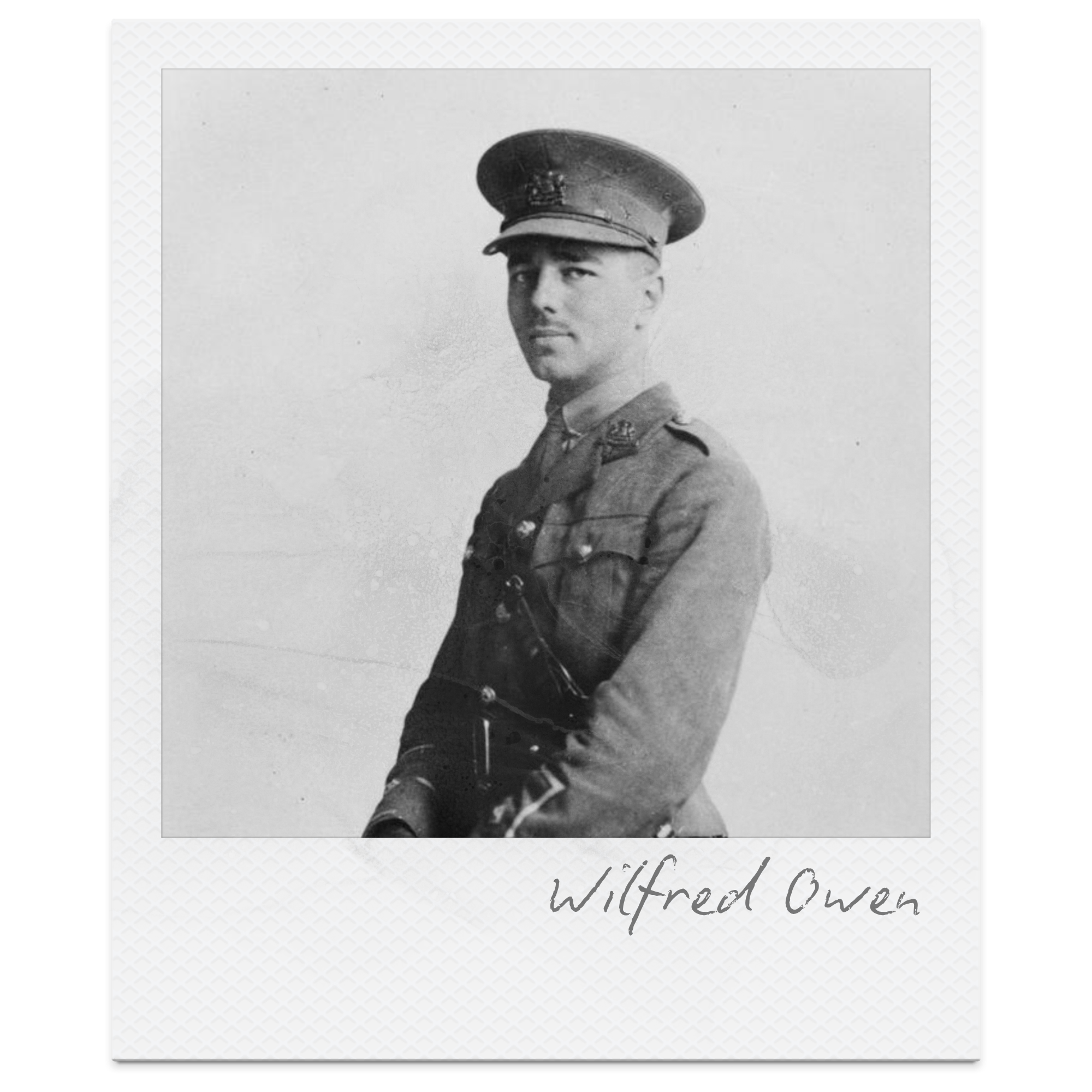
Wilfred Edward Salter Owen (1893–1918) was an English poet and soldier whose writing became some of the most influential literature to emerge from the First World War. Although his reputation now rests largely on his war poetry, Owen wrote for many years before experiencing combat, and his development as a poet was shaped by his family, education, religious upbringing, literary influences, and ultimately his experiences on the Western Front.
Owen was born on 18 March 1893 in Oswestry, Shropshire, the eldest of four children of Thomas and Susan Owen. His family later lived in Birkenhead and Shrewsbury, and Owen grew particularly close to his mother. The family was religious, and Christianity played an important role in Owen’s early life. As he grew older, however, he became increasingly uncomfortable with the relationship between organised religion, suffering, and social inequality — questions that would later surface powerfully in his war poetry.
As a young man, Owen hoped to attend university but was unable to secure the scholarship he needed. He worked as a lay assistant to a vicar in Dunsden, Oxfordshire, where his encounters with poverty and illness contributed to his growing disillusionment with the institutional Church. He later travelled to France, working as a teacher of English before the outbreak of the First World War transformed the direction of his life.
Owen initially hesitated to enlist. In 1915, however, he returned to Britain and joined the Artists Rifles Officers’ Training Corps, later receiving a commission in the Manchester Regiment. He was sent to France at the end of 1916 and entered active combat on the Western Front early the following year.
The conditions Owen encountered were brutal. He experienced bombardment, freezing trenches, mud, exhaustion and the deaths of men around him. During one traumatic episode, Owen was trapped close to the remains of a fellow officer. His experiences contributed to severe psychological symptoms, and in 1917 he was diagnosed with shell shock and sent back to Britain for treatment.
Owen was admitted to Craiglockhart War Hospital near Edinburgh, a military psychiatric hospital treating officers suffering from war-related psychological trauma. There he met Siegfried Sassoon, already an established poet and outspoken critic of the war. Their friendship became one of the most important relationships in Owen’s literary development. Sassoon read and commented on Owen’s poems, encouraged him to write more directly about his experiences, and helped introduce him to a wider literary circle.
During and after his time at Craiglockhart, Owen produced and revised much of the poetry for which he is now famous. Poems including “Dulce et Decorum Est,” “Anthem for Doomed Youth,” “Disabled,” “Exposure,” and “Strange Meeting” reject conventional representations of military glory. Instead, Owen concentrates on the suffering of individual soldiers: their bodies, memories, fears and deaths.
Despite what he had experienced, Owen returned to active service in France in 1918. His reasons were complex. He felt a powerful sense of responsibility towards the soldiers fighting at the Front and believed that returning gave him the authority to continue speaking about their experiences. During this final period of service, Owen demonstrated considerable courage and was awarded the Military Cross.
On 4 November 1918, Owen was leading his men during an attempt to cross the Sambre–Oise Canal near Ors in northern France when he was killed by enemy fire. He was 25 years old.
Exactly one week later, on 11 November 1918, the Armistice came into effect and the fighting of the First World War ended. Owen's family received the telegram informing them of his death that day. According to the account later given by his mother, Susan Owen, the telegram arrived as church bells were ringing in Shrewsbury to celebrate the end of the war.
The timing has become one of the most poignant details associated with Owen's life: while communities celebrated peace and survival, his family learned that their son would never return home. The contrast between public celebration and private grief echoes one of the central tensions of Owen's poetry — the enormous distance between the language and rituals surrounding war and the individual human suffering concealed beneath them.
Owen did not live to see himself become a major literary figure. Only a small number of his poems were published during his lifetime. After his death, Siegfried Sassoon and Edith Sitwell helped bring his work to a wider audience, and his reputation grew dramatically over the following decades.
Today, Owen is regarded as one of the defining poets of the First World War. His extraordinarily short life produced a body of work that fundamentally changed the literary representation of combat. Rather than presenting soldiers primarily as symbols of national sacrifice, Owen insists that readers encounter them as individual human beings capable of fear, tenderness, despair, courage and suffering.
Historical and Social Context
Wilfred Owen wrote against the background of the First World War (1914–1918), a conflict that transformed European society and changed the way war could be represented in literature. To understand the force of Owen’s poetry, it is important to recognise that attitudes towards the war were not universally anti-war. Particularly during its early stages, many people in Britain supported the conflict and understood participation in it through ideas of patriotism, duty, honour, masculinity, and service to King and country.
Patriotism, Duty, and “King and Country”
When Britain entered the war against Germany in August 1914, there was significant public support for the war effort. For many, Britain was fighting a necessary and justified war following the German invasion of neutral Belgium, and military service could be understood as a patriotic responsibility.
Ideas of “King and Country” were culturally powerful. Britain was still an imperial power, George V was king, and loyalty to the nation, monarchy, and British Empire formed part of the social world in which many young men had grown up. Military service could therefore represent courage, honour, adventure, duty, and masculine respectability.
This does not mean that everyone enthusiastically supported the war or that attitudes remained unchanged. There were anti-war voices from the beginning, and enthusiasm differed according to class, politics, religion, location, and individual circumstances. Nevertheless, patriotic support was sufficiently widespread for enormous numbers of men to volunteer.
Before the introduction of conscription in 1916, Britain relied heavily on voluntary enlistment. Recruitment campaigns appealed directly to men's sense of responsibility, encouraging them to believe that joining the army was something honourable men ought to do.
This cultural background matters when reading Owen. His poetry attacks powerful ideas that his contemporary readers would have immediately recognised.
Recruitment and Propaganda
The British government used posters, newspapers, public speeches, recruitment campaigns, and patriotic imagery to maintain support for the war and encourage enlistment. Some of the most famous recruitment messages appealed not to military strategy but to personal identity: whether a man was sufficiently brave, patriotic, or responsible to serve.
Social pressure could reinforce these messages. Men who remained at home might face questions about why they had not enlisted, while women were sometimes encouraged to persuade husbands, brothers, sons, and sweethearts to join the armed forces.
The formation of “Pals Battalions” strengthened the appeal. Men could enlist alongside friends, relatives, neighbours, and work colleagues, creating units built around existing communities. This encouraged recruitment but could have devastating consequences when individual battalions suffered enormous casualties, concentrating grief within particular towns and communities.
Owen's poetry later exposes the gulf between this language of honour and patriotic obligation and the physical experiences awaiting soldiers at the Front.
Romantic Ideas of War
The generation that entered the First World War inherited cultural traditions in which warfare could be associated with heroism, sacrifice, courage, honour, and national glory. These ideas appeared in literature, education, religion, newspapers, and public commemorations.
Early wartime poetry could reinforce them. Writers such as Rupert Brooke produced poetry in which death in battle could be imagined as meaningful sacrifice for one's country. Brooke's “The Soldier”, for example, presents the possibility of dying abroad through an idealised language of England, belonging, and spiritual transformation.
Owen's poetry belongs to the same war but frequently presents an extraordinarily different vision.
In poems such as “Dulce et Decorum Est,” he deliberately confronts the traditional claim that dying for one's country is glorious. The poem's famous rejection of dulce et decorum est pro patria mori — the Latin idea that it is sweet and fitting to die for one's country — becomes much more powerful when understood against a society in which patriotic sacrifice could genuinely be celebrated as an ideal.
The Reality of Industrialised Warfare
The First World War exposed soldiers to forms of warfare on a scale that earlier heroic traditions struggled to accommodate. Machine guns, heavy artillery, poison gas, barbed wire, grenades, and increasingly mechanised military technology allowed death and injury to occur on an enormous scale.
On the Western Front, soldiers lived and fought within systems of trenches stretching across France and Belgium. Conditions could include mud, flooding, rats, lice, disease, cold, sleep deprivation, bombardment, and the constant presence of death.
Major offensives could produce staggering casualties while achieving relatively limited territorial gains. The Battle of the Somme in 1916, for example, became particularly associated in British memory with mass casualties and the destructive possibilities of modern warfare.
This collision between traditional heroic language and industrialised killing lies at the heart of much of Owen's poetry. The soldier in his work is rarely a distant heroic figure. Owen repeatedly brings the reader close to the body — coughing, bleeding, freezing, drowning, ageing, limping, sleeping, dreaming, or dying.
Changing Attitudes and Disillusionment
As the war continued, its enormous human cost became increasingly difficult to separate from public understanding of the conflict. Casualty lists grew, families experienced bereavement, wounded soldiers returned home, and the expectation of a short war disappeared.
However, it would be too simple to suggest that Britain moved neatly from enthusiasm in 1914 to universal disillusionment by 1918. Many civilians and soldiers continued to believe strongly in the war effort, while others became critical of its conduct, leadership, or human cost. Individuals could simultaneously experience patriotism, grief, duty, anger, and doubt.
That complexity is important when reading Owen. He was not writing in a society where everyone already agreed that war was futile. His poetry intervenes in an ongoing argument about what sacrifice means, whether suffering can be justified, and who has the right to describe war as glorious.
Masculinity and Expectations of Soldiers
Ideas about masculinity also shaped wartime attitudes. Men were commonly expected to demonstrate courage, emotional control, physical endurance, and willingness to protect others. Fear and psychological collapse could conflict with cultural expectations of how a soldier — and how a man — was supposed to behave.
The war placed enormous pressure on these ideals.
Soldiers exposed to prolonged bombardment and combat sometimes developed symptoms including tremors, nightmares, paralysis, memory problems, panic, confusion, and extreme anxiety. These experiences came to be described under the broad term “shell shock.”
Understanding of psychological trauma was still developing, and responses to affected soldiers varied considerably. Some medical practitioners increasingly recognised that combat itself could produce profound psychological injury, while military culture could still interpret certain symptoms through ideas of weakness, discipline, or failure of nerve.
Owen's poetry repeatedly undermines the image of the endlessly resilient heroic soldier. His men are psychologically as well as physically vulnerable, and their vulnerability is presented as part of the reality of warfare rather than something that makes them less worthy of compassion.
Death, Mourning, and a Generation at War
The First World War brought death into the lives of millions of families. More than 700,000 British military personnel died during the conflict, alongside enormous losses elsewhere across Europe and the wider world. Countless more returned wounded or psychologically affected.
Traditional rituals of mourning were also disrupted. Many soldiers were buried close to where they died rather than returned to their families, while some bodies were never identified or recovered. Families could therefore be left grieving without a grave they could visit at home.
This helps explain the importance of mourning in Owen's poetry. “Anthem for Doomed Youth” asks what rituals can adequately commemorate men dying in enormous numbers on the battlefield. Instead of church bells, prayers, choirs, and funerals, Owen substitutes the sounds and images of warfare.
The poem reflects a much broader question created by the conflict: how does a society mourn death on this scale?
Owen's historical context is therefore defined by a profound contradiction. The First World War was surrounded by genuine ideals of patriotism, courage, loyalty, duty, and sacrifice, while simultaneously producing suffering on a scale that challenged the language traditionally used to describe warfare.
Owen's poetry derives much of its power from placing those two realities beside one another. He does not simply tell readers that war is terrible. He asks them to examine the stories societies tell about war — and what happens when those stories encounter the bodies and minds of the people actually sent to fight.
Literary Context and Movement
Wilfred Owen occupies an important position in the development of early twentieth-century poetry. He is most commonly classified as a First World War poet rather than as belonging neatly to a single literary movement, but his writing emerges during a period of enormous change. Traditional poetic ideas about beauty, heroism, nature, patriotism, and noble sacrifice were increasingly difficult to reconcile with the realities of modern industrial warfare.
Owen's poetry is particularly significant because it stands between literary traditions. He inherits techniques associated with earlier Romantic and Victorian poetry, while using them to represent experiences that resist romanticisation. At the same time, his fractured world of trauma, alienation, uncertainty, and mechanised violence anticipates some of the concerns that would become central to Modernist literature.
Moving Away from Romanticised War
It is tempting to describe Owen as helping poetry move from Romanticism to Realism, and there is an important truth behind that idea. Strictly speaking, however, the literary periods do not align so neatly. The major Romantic poets — including William Wordsworth, Samuel Taylor Coleridge, Percy Bysshe Shelley, John Keats, and Lord Byron — belonged primarily to an earlier period, while literary Realism had already developed considerably during the nineteenth century.
What Owen helps overturn is something slightly different: the romanticisation of war.
War had long been represented through ideas of heroism, courage, honour, adventure, glory, sacrifice, and patriotic duty. These traditions did not disappear when the First World War began. Indeed, some early wartime writing continued to present military service and death through elevated, idealistic language.
Owen's poetry deliberately places this inherited language against the physical reality of combat.
His soldiers do not simply march heroically towards death. They cough, stumble, freeze, bleed, scream, dream, panic, lose limbs, suffer nightmares, and watch other men die.
The effect is a movement away from idealised representations of warfare towards an intensely physical and psychological realism.
Romantic Influence on Owen
Importantly, Owen does not simply reject the literary traditions that came before him.
He was deeply influenced by Romantic poetry, particularly John Keats, whose musical language, sensual imagery, and fascination with beauty and mortality can be felt throughout Owen's writing. Owen's poetry frequently demonstrates considerable lyrical beauty even when its subject matter is horrifying.
That creates one of the most distinctive tensions in his work.
Owen can use beautiful language to describe terrible things.
Nature, light, sound, dreams, seasons, landscapes, and the human body all appear in richly poetic forms. But instead of allowing beauty to provide escape from suffering, Owen frequently turns it against the reader. A beautiful image can suddenly become grotesque; a peaceful landscape can become threatening; sleep can become nightmare; youth can become premature death.
Owen therefore adapts rather than abandons the Romantic tradition.
He takes a poetic language capable of expressing beauty, emotion, nature, and human experience and forces it to confront the conditions of twentieth-century warfare.
Georgian Poetry and the Early Twentieth Century
Owen was also writing during the period associated with Georgian poetry, a broad term applied to a number of British poets writing during the reign of George V before and during the First World War.
Georgian poetry frequently favoured accessible language and traditional poetic forms, with subjects including nature, rural life, beauty, childhood, and ordinary experience. Owen shares some of its accessibility and lyrical qualities, but the war radically transforms what those techniques are required to represent.
This makes the First World War an important literary turning point.
The countryside that might traditionally represent beauty or tranquillity can become a battlefield. Youth does not necessarily lead towards maturity but towards death. Dawn does not automatically promise renewal. Christian imagery does not necessarily provide reassurance.
Traditional symbols remain, but their meanings become unstable.
Rupert Brooke and the Tradition of Patriotic War Poetry
The contrast between Owen and Rupert Brooke is particularly useful for understanding this transition.
Brooke's early war poetry, especially “The Soldier,” presents the possibility of death in battle through elevated and idealised language. The soldier's death becomes connected with England, purity, belonging, sacrifice, and spiritual transcendence.
Brooke died in 1915 before experiencing the prolonged trench warfare that later poets such as Owen and Sassoon encountered.
Owen writes from a radically different position.
By the time Owen produced his major war poems, years of trench warfare had exposed soldiers to mass casualties, artillery bombardment, gas attacks, psychological trauma, and the repetitive destruction of industrialised combat.
Where patriotic poetry could transform the dead soldier into a symbol, Owen repeatedly returns him to his individual body.
The distinction is crucial. Owen's soldiers are not simply representations of national sacrifice. They are particular human beings whose suffering demands attention.
Siegfried Sassoon and the Development of Owen's Voice
Owen's meeting with Siegfried Sassoon at Craiglockhart War Hospital in 1917 was enormously important to his development.
Sassoon was already writing poetry that attacked the conduct of the war through satire, irony, anger, and direct accusation. He encouraged Owen to write more directly about his own experiences and offered detailed criticism of his poetry.
Their approaches nevertheless remained distinctive.
Sassoon often attacks.
Owen frequently mourns.
Sassoon's poetry can turn its anger towards generals, politicians, civilians, and institutions, whereas Owen repeatedly draws the reader towards the suffering of the soldiers themselves.
This difference helps explain Owen's famous description of his artistic purpose. In the draft preface intended for a future collection of his poems, he wrote that his subject was “War, and the pity of War.”
The statement places human suffering rather than military achievement at the centre of his poetry.
Owen and the Beginnings of Modernism
Owen is not usually classified simply as a Modernist poet in the same way as writers such as T. S. Eliot or Ezra Pound, but his work belongs to the historical moment from which literary Modernism emerged.
Modernist writing was partly shaped by a growing sense that inherited ways of understanding the world were no longer adequate. The First World War intensified questions about progress, civilisation, religion, authority, technology, identity, and human rationality.
How could a supposedly advanced civilisation produce destruction on such a scale?
That contradiction runs throughout Owen's poetry.
Traditional structures remain — sonnets, rhyme, religious imagery, classical references — but they are repeatedly disturbed. Owen's famous use of pararhyme, in which words almost rhyme without producing complete resolution, is particularly appropriate to this unsettled world.
Words such as hall/hell or groined/groaned approach harmony without fully achieving it.
The reader hears something that feels almost resolved, but isn't.
That instability becomes part of Owen's meaning.
From Heroic War to the Individual Soldier
Perhaps Owen's greatest contribution to the development of war literature is therefore not that he replaces Romanticism with Realism, but that he participates in a profound transformation in how warfare can be represented.
The focus shifts:
from glory to suffering;
from the nation to the individual;
from heroic death to the physical process of dying;
from patriotic abstraction to lived experience;
from unquestioned sacrifice to moral uncertainty.
Yet Owen achieves this without abandoning poetry's capacity for beauty.
That contradiction is central to his literary significance. His poems can be lyrical and horrifying, traditional and experimental, beautiful and grotesque at the same time.
Owen stands at a literary crossroads. He inherits the language and forms of nineteenth-century poetry, subjects them to the unprecedented pressures of the First World War, and produces something recognisably different: poetry in which the old language of heroism and sacrifice can no longer be accepted without interrogation.
Core Themes Across Wilfred Owen’s Writing
Across Wilfred Owen’s poetry, the First World War is rarely presented simply as a military conflict. Owen is interested in what war does to individual human beings: their bodies, minds, beliefs, relationships, identities, and futures. His poems repeatedly challenge the language traditionally used to make warfare appear glorious, replacing abstraction with intensely physical and emotional experience.
The Pity and Suffering of War
At the centre of Owen’s poetry is what he famously called “the pity of War.” Rather than concentrating on victories, strategies, or national achievement, Owen directs attention towards the people required to endure war.
His soldiers are exhausted, frightened, injured, traumatised, and dying. Even when they survive physically, they may return permanently altered by what they have experienced.
This emphasis on suffering transforms the soldier from a symbol of patriotic sacrifice into an individual human being. Owen continually asks readers to look beyond statistics and heroic narratives and recognise the personal cost concealed within them.
The Futility of War
A powerful sense of futility runs throughout Owen’s writing. Soldiers endure extraordinary suffering, yet his poems repeatedly question what that suffering actually achieves.
This is particularly powerful when Owen places war against nature, youth, or human potential. Young men who should have entire lives ahead of them are reduced to bodies in trenches and fields. Their deaths can appear arbitrary rather than meaningful.
In poems such as “Futility,” this develops into an almost existential question. Owen moves beyond asking whether a particular battle is worthwhile and begins questioning how human beings capable of life, consciousness, and creation can devote themselves to destruction.
Patriotism, Propaganda, and the Myth of Glory
Owen repeatedly challenges the idealised language surrounding warfare.
Ideas such as honour, glory, heroism, duty, and sacrifice become deeply unstable in his poetry because they are placed beside what soldiers actually experience.
This conflict is central to “Dulce et Decorum Est,” where the traditional claim that it is glorious to die for one's country is confronted with the horrifying physical reality of a gas attack.
Owen is particularly suspicious of language that allows people who have not experienced combat to imagine warfare as noble. His poetry therefore becomes partly an argument about who gets to tell the story of war.
Death and the Loss of Youth
Owen's soldiers are frequently strikingly young.
Their deaths represent more than the loss of individual lives. They represent futures that will never happen: relationships, families, careers, ageing, ordinary experiences, and identities that the soldiers will never have the opportunity to develop.
In “Anthem for Doomed Youth,” the very phrase doomed youth emphasises this destruction of possibility.
Owen repeatedly removes the distance that can make wartime death seem abstract. These are not simply soldiers who have fallen for their country. They are young people whose lives have been interrupted.
Physical Suffering and the Human Body
The body is impossible to ignore in Owen's poetry.
Soldiers cough, bleed, limp, freeze, drown, suffocate, lose limbs, and collapse from exhaustion. Owen's physical imagery prevents the reader from turning warfare into something clean or abstract.
This is one of the clearest ways in which he dismantles romanticised representations of combat.
The heroic soldier of patriotic imagination becomes a vulnerable human body exposed to machinery, weather, disease, weapons, and exhaustion.
In poems such as “Disabled,” bodily injury also continues long after the battlefield has been left behind. War changes not only whether someone survives, but how that person will experience the remainder of their life.
Psychological Trauma
Owen's representation of warfare extends beyond physical injury to the psychological consequences of combat.
His own experience of shell shock informs a poetic world filled with nightmares, disturbing memories, altered perceptions, exhaustion, fear, and emotional numbness.
The battlefield does not necessarily disappear when the soldier leaves it.
In “Dulce et Decorum Est,” for example, the dying soldier repeatedly returns to the speaker through dreams. The memory becomes something that cannot simply be placed safely in the past.
Owen therefore presents trauma as one of war's lasting consequences: violence can continue inside the mind even when immediate physical danger has ended.
Nature Versus Human Destruction
Nature occupies a fascinating and often contradictory position in Owen's poetry.
Sunlight, snow, frost, mud, rain, fields, flowers, and changing seasons appear repeatedly. Sometimes nature seems indifferent to human suffering. Elsewhere, it appears capable of creating and sustaining life in direct contrast to humanity's capacity to destroy it.
In “Futility,” the sun that once seemed capable of awakening life becomes central to the speaker's questioning of death itself.
In “Exposure,” however, nature becomes almost another enemy. The soldiers are attacked not only by opposing forces but by wind, snow, cold, and endless waiting.
These contrasts allow Owen to ask a disturbing question: if the natural world continually creates life, why are human beings so determined to destroy it?
Religion, Faith, and Spiritual Doubt
Christian language and imagery appear throughout Owen's poetry, but they rarely provide uncomplicated comfort.
Having grown up within a strongly religious environment, Owen understood the language of Christ, sacrifice, resurrection, prayer, church ritual, and salvation intimately. In his war poetry, however, these ideas are frequently questioned or transformed.
Traditional religious rituals can appear inadequate beside industrialised death. “Anthem for Doomed Youth” replaces bells, prayers, choirs, and funeral ceremonies with gunfire and artillery.
Elsewhere, the suffering of soldiers can evoke the suffering of Christ, turning the ordinary soldier into a figure of sacrifice.
Owen does not reduce these questions to a simple rejection of religion. Instead, his poetry repeatedly tests whether inherited structures of faith can adequately explain suffering on such a scale.
Comradeship and Compassion
Despite the horror of Owen's poetry, it contains a profound sense of compassion.
He writes about soldiers from a position of shared experience. They are not distant subjects observed from safety but men alongside whom he lived and fought.
This creates an important counterpoint to the violence surrounding them. Within a world organised around killing, Owen repeatedly preserves the humanity of individual soldiers.
That compassion can even cross enemy lines. In “Strange Meeting,” the distinction between British soldier and enemy becomes less important than their shared suffering. Both men have been trapped within the same machinery of war.
War divides them politically; suffering reconnects them as human beings.
Isolation and Disconnection
War also creates profound separation.
Soldiers are separated from their homes, families, previous identities, and civilian society. Those who return may discover that survival does not automatically restore the lives they once possessed.
This is particularly devastating in “Disabled,” where the wounded soldier exists between two worlds. He remembers the social life, physical confidence, attention, and possibilities he once enjoyed but cannot fully return to them.
Owen therefore explores one of war's quieter forms of destruction: the possibility that a soldier can come home without truly being able to return to his former life.
The Failure of Traditional Heroism
Running through all these themes is Owen's interrogation of heroism.
His poetry does not suggest that soldiers lack courage. Indeed, Owen himself returned to combat and was decorated for bravery. Instead, he questions a culture that turns individual courage into evidence that warfare itself must therefore be glorious.
Owen separates the bravery of the soldier from the morality of war.
A man can behave courageously within circumstances that are horrific, wasteful, or futile.
That distinction is fundamental to Owen's writing. His poetry honours the humanity and endurance of soldiers while refusing to transform their suffering into a comforting story about glory, patriotism, and noble death.
Across Owen's work, these themes continually intersect. Youth becomes death; patriotism becomes disillusionment; beauty becomes horror; nature confronts destruction; faith encounters doubt; and survival does not necessarily mean escape.
This complexity is what makes Owen's poetry so enduring. He does not simply tell readers that war causes suffering. He examines what happens when the traditional language used to explain that suffering — honour, sacrifice, duty, glory, faith, and heroism — begins to fail.
Wilfred Owen’s Literary Significance
Wilfred Owen’s literary significance lies in the way he transformed the representation of warfare by bringing together first-hand experience, technical poetic skill, psychological insight, and profound compassion. Although he died at only twenty-five and published very little during his lifetime, his poetry became one of the defining literary responses to the First World War and profoundly influenced how later generations imagined the conflict.
Owen did not invent anti-war poetry, nor was he the only First World War writer to challenge patriotic representations of battle. His importance comes instead from the extraordinary effectiveness with which he exposes the distance between the idea of war and the experience of war.
Redefining the Language of War
One of Owen's greatest achievements is his challenge to the traditional vocabulary surrounding warfare.
Words such as glory, honour, sacrifice, courage, patriotism, and duty had long been used to describe military service. Owen does not simply replace these words with an argument that war is terrible. Instead, he makes readers test them against what actually happens to individual soldiers.
The result is deliberately uncomfortable.
A phrase such as dying for one's country sounds very different after Owen has forced the reader to witness a soldier suffocating during a gas attack.
This is why “Dulce et Decorum Est” has become one of the most famous poems of the First World War. Owen takes an ancient statement about the honour of patriotic death and places it against a modern battlefield until the ideal can no longer remain unquestioned.
Giving the Individual Soldier a Voice
Owen also helped shift attention away from war as a story about nations, generals, victories, and defeats towards the experiences of individual soldiers.
His poetry repeatedly reduces the enormous scale of the First World War to something intensely personal: one body, one memory, one nightmare, one injury, one death.
This matters because mass warfare can make individual suffering disappear into numbers.
Owen reverses that process.
The dead become sons. The wounded have memories. The traumatised dream. The disabled imagine the lives they might have lived.
By restoring individuality to soldiers, Owen makes it much more difficult for readers to encounter war only as an abstract historical event.
Expanding What War Poetry Could Represent
Owen also broadened the emotional and psychological territory available to war poetry.
His soldiers are not simply brave or cowardly, victorious or defeated. They can be frightened, exhausted, traumatised, compassionate, bitter, numb, confused, lonely, or psychologically trapped within memories of combat.
This complexity helped create a more psychologically realistic representation of warfare.
Poems such as “Exposure,” “Disabled,” “Dulce et Decorum Est,” and “Strange Meeting” demonstrate that the consequences of war extend beyond the moment of battle. Waiting can be traumatic. Memory can be traumatic. Survival can be traumatic.
The battlefield therefore continues long after the guns themselves have stopped.
Technical Innovation
Owen's significance is not based only on what he writes about, but on how he writes.
He was an exceptionally controlled poetic craftsman. His use of pararhyme or half-rhyme, sound patterning, imagery, metaphor, rhythm, traditional forms, disrupted expectations, and shifts in voice allows the structure of his poetry to reinforce its meaning.
Pararhyme is particularly associated with Owen. Rather than giving readers the satisfaction of a complete rhyme, he frequently pairs words whose consonants correspond while their vowel sounds differ.
The words seem as though they should fit together.
They almost do.
But something remains wrong.
That unresolved sound is particularly suited to Owen's poetic world, where familiar structures — religion, patriotism, heroism, civilisation, even language itself — remain recognisable but no longer provide complete reassurance.
Beauty and Horror
Another distinctive feature of Owen's achievement is his ability to combine lyrical beauty with extreme suffering.
He does not abandon poetic beauty in order to write realistically about war. Instead, he uses beautiful language to make horror more disturbing.
A battlefield can contain extraordinary imagery. A dying soldier can be described through carefully constructed sound and rhythm. A poem about mass death can take the form of a sonnet.
This tension prevents readers from separating art from atrocity.
Owen demonstrates that poetry can represent horrifying experiences without making those experiences heroic or desirable. Beauty becomes a means of forcing the reader to look more closely rather than a means of disguising suffering.
A Bridge Between Literary Traditions
Owen also occupies an important position within the development of twentieth-century literature.
His poetry retains elements of Romantic, Victorian, and Georgian traditions: lyricism, formal structure, attention to nature, religious imagery, and an interest in intense individual experience.
Yet he subjects those traditions to the pressures of a radically changed world.
Industrial warfare, psychological trauma, technological destruction, fractured belief, and distrust of established authority all enter his poetry. These concerns connect Owen to the wider cultural changes from which literary Modernism emerged.
He therefore stands at an important literary crossroads: using inherited poetic forms while demonstrating that the assumptions those forms once expressed can no longer remain secure.
Changing How the First World War Is Remembered
Owen's influence extends beyond literature into cultural memory.
For later generations, poems such as “Dulce et Decorum Est,” “Anthem for Doomed Youth,” “Exposure,” and “Futility” became some of the most familiar ways of encountering the First World War.
This influence requires some caution. Owen represents one powerful perspective on the conflict rather than the experience or beliefs of every soldier who fought. First World War literature contains patriotism, humour, adventure, loyalty, grief, anger, religious belief, political conviction, disillusionment, and protest.
Nevertheless, Owen's work became central to the modern understanding of the war because his poetry provides language through which later generations can confront its human cost.
The Influence of “The Pity of War”
Perhaps the clearest statement of Owen's literary purpose appears in the preface he drafted for the collection he never lived to publish. He declared:
“My subject is War, and the pity of War.”
That idea has become inseparable from his literary legacy.
The word “pity” is crucial. Owen's poetry is not interested only in condemnation. Beneath its anger lies an extraordinary insistence on compassion.
He wants readers to recognise suffering.
That compassion extends beyond nationality. In poems such as “Strange Meeting,” even the enemy can become a fellow victim of the same destructive system. The boundaries created by warfare begin to collapse when two soldiers recognise their shared humanity.
A Legacy Owen Never Saw
There is a final poignancy to Owen's literary significance: he never knew that he would become significant.
Only a handful of his poems appeared in print during his lifetime. When he was killed on 4 November 1918, the body of work for which he would eventually become famous remained largely unpublished.
After his death, Siegfried Sassoon and Edith Sitwell played important roles in bringing his poetry before a wider audience. His reputation continued to grow throughout the twentieth century until he became one of the writers most closely associated with the literature of the First World War.
Today, Owen's poetry survives not because it provides a simple message that “war is bad,” but because it asks much more difficult questions.
What happens when patriotic ideals encounter physical reality? What does society owe the people it sends to fight? Can sacrifice still be called glorious when we look closely at the person being sacrificed? How can language represent suffering without turning it into spectacle? And what remains of humanity when people have been trained to destroy one another?
Owen never provides comfortable answers.
Instead, his literary significance lies in making it impossible to ask those questions without first looking directly at the individual human cost of war.
Go Deeper into Wilfred Owen and War Poetry
Understanding Wilfred Owen’s life, historical context, and literary influences provides a foundation for exploring how these ideas emerge within individual poems. His writing repeatedly returns to suffering, psychological trauma, patriotism, death, sacrifice, nature, religion, and the loss of youth, but each poem approaches these concerns differently.
If you want a deeper understanding of Owen’s work, read or explore the following:
◆ “Dulce et Decorum Est”
Explore Owen’s devastating representation of a gas attack and his rejection of the idea that dying for one’s country is inherently glorious.
◆ “Anthem for Doomed Youth”
Examine how Owen transforms the traditional language and rituals of mourning to represent young soldiers dying far from home.
◆ “Exposure”
Explore Owen’s portrayal of waiting, exhaustion, extreme weather, psychological suffering, and the apparent futility of trench warfare.
◆ “Futility”
Consider Owen’s use of nature, sunlight, life, and death as the poem develops from personal grief into a much larger question about human existence.
◆ “Disabled”
Examine Owen’s portrayal of physical disability, lost youth, isolation, memory, masculinity, and the consequences of war that continue after combat ends.
◆ “Strange Meeting”
Explore one of Owen’s most complex representations of war, in which enemies encounter one another through their shared suffering and humanity.
◆ Patriotism, Propaganda, and the Myth of Glory in Owen’s Poetry
Explore how Owen challenges traditional ideas of honour, sacrifice, duty, heroism, and “King and Country.”
◆ Shell Shock and Psychological Trauma in First World War Poetry
Examine how Owen and other war poets represent the psychological consequences of prolonged combat.
◆ Religion, Faith, and Doubt in Wilfred Owen’s Poetry
Explore Owen’s use of Christian imagery, sacrifice, prayer, funeral ritual, resurrection, and spiritual uncertainty.
◆ Nature in Wilfred Owen’s War Poetry
Consider the changing role of sunlight, snow, mud, wind, fields, seasons, and the natural world across Owen’s writing.
◆ Wilfred Owen and Siegfried Sassoon — Comparing Two War Poets
Compare two of the most influential voices of First World War poetry, considering their approaches to protest, pity, anger, irony, trauma, and the experiences of ordinary soldiers.
Final Thoughts
Understanding Wilfred Owen means recognising the tension at the heart of his poetry: between patriotism and suffering, beauty and horror, heroism and vulnerability, sacrifice and waste. Drawing on his own experiences of the First World War, Owen challenged romanticised representations of combat and placed the individual soldier at the centre of the story.
His poetry remains powerful because it does more than document war. It asks readers to question the language societies use to justify conflict and to consider the human beings hidden behind ideas of glory, duty, and national sacrifice.
Explore more author studies, poetry guides, contextual resources, and close analysis in the Literature Library.
