Know Then Thyself – An Essay on Man by Alexander Pope: Summary, Themes & Analysis
In this extract from An Essay on Man, Alexander Pope explores the limits of human understanding through philosophical argument, balanced structure, and paradox, presenting humanity as caught between reason and weakness, knowledge and ignorance, and power and vulnerability. The central tension lies in the command to “Know then thyself,” as the poem uses antithesis and rhythmic couplets to reveal the instability of human identity and the danger of overreaching beyond natural limits. If you are studying or teaching Songs of Ourselves Volume 1 for CIE English Literature (0475), you can explore in-depth analyses of every poem from the 2026 and 2027 Paper 1 syllabus in the Songs of Ourselves Volume 1 hub, or a wider range of texts in the Literature Library.

Context of Know Then Thyself
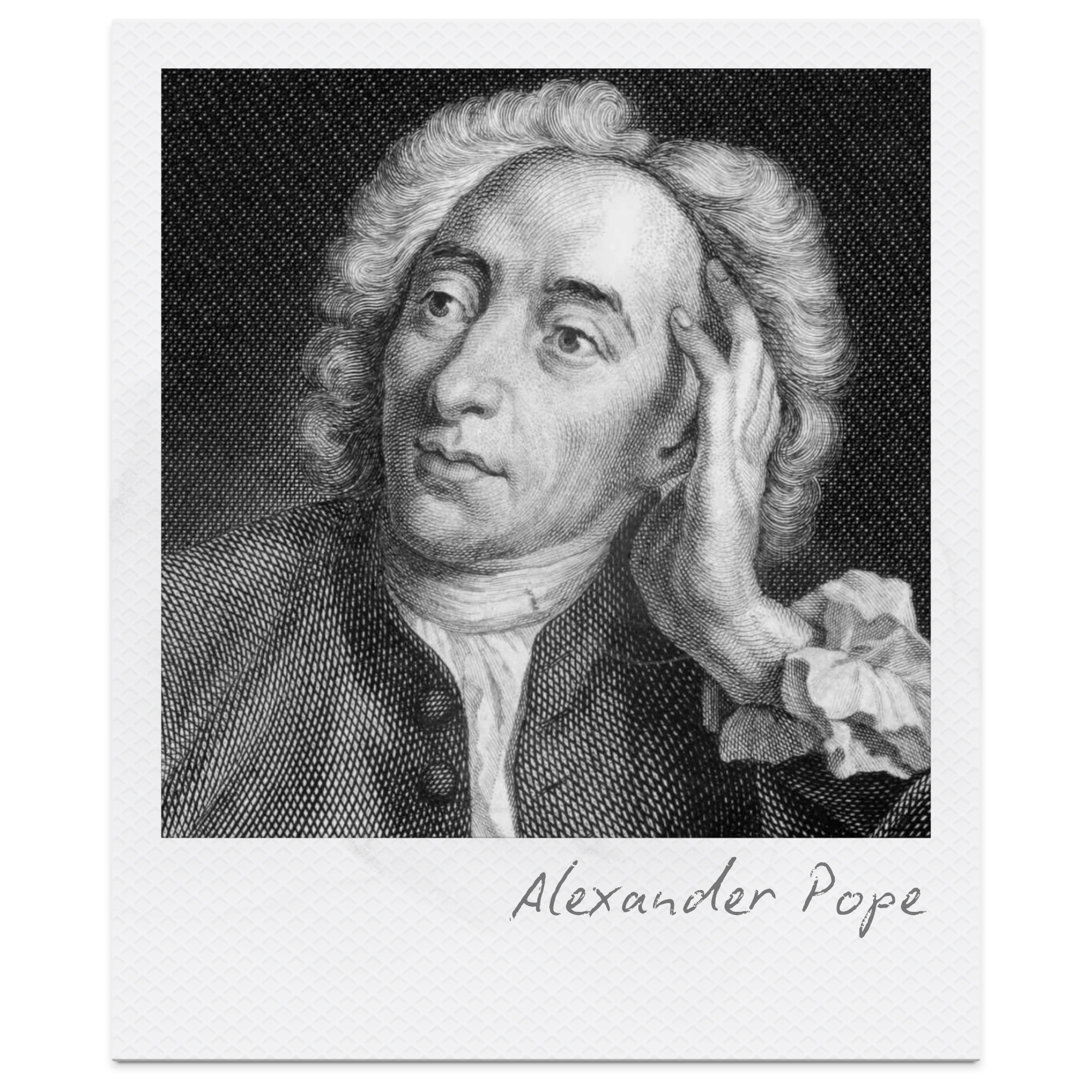
Alexander Pope was a key writer of the Augustan period, a time that valued reason, order, and philosophical reflection. His poetry often explores human behaviour through carefully structured verse, using balance and control to reflect ideas about the world.
An Essay on Man is a longer philosophical poem that attempts to explain humanity’s place in the universe. Influenced by Enlightenment thinking, it presents the idea of a “Great Chain of Being,” where everything has a fixed position, and humans exist in a middle state between animals and the divine. The poem argues that human beings should accept their limits rather than question divine order.
This extract focuses on that central idea, urging humans to “know” themselves instead of trying to understand God. It reflects the belief that human suffering and confusion come from overreaching ambition and misunderstanding our place, linking directly to the poem’s portrayal of humanity as divided, uncertain, and caught between opposing forces.
Know Then Thyself: At a Glance
Form: Heroic couplets (rhyming iambic pentameter)
Mood: Reflective, critical, balanced
Central tension: Human beings are caught between knowledge and ignorance, power and limitation, unsure of their true place
Core themes: Human limitation; reason vs weakness; identity and self-knowledge; order and hierarchy; pride and error
One-sentence meaning: Pope presents humanity as a contradictory “middle state,” arguing that true wisdom lies in recognising our limits rather than overestimating our power or understanding.
Quick Summary of Know Then Thyself
The extract begins with a direct command to “Know then thyself,” establishing the idea that humans should focus on understanding their own nature rather than attempting to comprehend God. Pope presents humanity as existing in a “middle state,” neither fully rational nor entirely instinctive, but suspended between opposing qualities such as knowledge and ignorance, strength and weakness. This creates a sense of uncertainty, as humans struggle to define themselves or act with confidence.
As the extract develops, Pope emphasises this instability through a series of contrasts, showing how humans are capable of both greatness and failure. They are described as a “Chaos of thought and passion,” suggesting inner conflict and confusion, and are ultimately presented as both powerful and vulnerable—“Great lord of all things, yet a prey to all.” The ending reinforces this contradiction, portraying humanity as both significant and absurd, “The glory, jest, and riddle of the world,” highlighting the complexity and unresolved nature of human existence.
Title, Form, Structure, and Metre of Know Then Thyself
Pope’s formal choices reflect his aim to present a clear, controlled philosophical argument, using structure and rhythm to mirror the tension between order and human uncertainty.
Title
Although the extract is commonly referred to as “Know Then Thyself,” it forms part of An Essay on Man, a title that signals a broad philosophical investigation into human nature. The imperative “Know then thyself” immediately establishes a didactic tone, positioning the poem as instructive and authoritative. However, as the extract develops, the complexity and contradictions of humanity suggest that true self-knowledge is difficult, perhaps even unattainable, complicating the apparent certainty of the command.
Form and Structure
The poem is written in heroic couplets, with each pair of lines forming a self-contained unit of thought. This creates a sense of balance and order, reinforcing the idea that the speaker is presenting a reasoned argument. However, within this controlled structure, Pope repeatedly uses antithesis and contrast—“darkly wise and rudely great,” “Great lord of all things, yet a prey to all”—to reveal the instability of human nature.
The progression of the extract moves from instruction (“Know then thyself”) to description of humanity’s “middle state,” before expanding into a series of contradictions that build toward the final summary. The ending line, “The glory, jest, and riddle of the world!”, functions as a concluding statement, encapsulating the paradox of human existence and leaving the reader with a sense of unresolved complexity.
Rhyme Scheme and Poetic Pattern
The regular rhyming couplets (AA, BB, CC) create a consistent and predictable pattern, reinforcing the poem’s logical and authoritative tone. This structure allows Pope to present ideas in clear, memorable statements, almost like philosophical maxims. However, the neatness of the rhyme contrasts with the confusion and contradiction within the content, highlighting the gap between human attempts to impose order and the reality of human uncertainty.
Metre and Rhythmic Movement
The poem is written in iambic pentameter, a steady and controlled rhythm that supports its formal, reasoned voice. For example:
Know THEN | thySELF, | preSUME | not GOD | to SCAN
The regular beat reinforces the sense of authority and control, as if the speaker is guiding the reader through a logical argument. However, the accumulation of balanced phrases and contrasts creates a rhythmic pattern that mirrors the poem’s central idea: humanity is constantly caught between extremes, moving back and forth without resolution.
The Speaker in Know Then Thyself
The speaker presents themselves as an authoritative, philosophical voice, offering guidance on how humans should understand their place in the world. The opening command “Know then thyself” establishes a didactic tone, positioning the speaker as someone who instructs rather than questions. This creates a sense of confidence and control, reinforced by the poem’s balanced structure and measured rhythm.
However, while the speaker appears certain, their description of humanity reveals deep uncertainty and contradiction. Humans are shown as caught between reason and weakness, knowledge and ignorance, suggesting that the speaker’s authority comes not from absolute knowledge, but from recognising these limits. The tone remains reflective and critical, guiding the reader toward humility, as the speaker ultimately shapes our interpretation by framing human identity as unstable, complex, and impossible to fully resolve.
Line-by-Line Analysis of Know Then Thyself
This section explores how Pope develops his philosophical argument through each heroic couplet, using antithesis, balance, and contrast to reveal the contradictions within human nature. Each pair of lines presents a self-contained idea, but together they build a cumulative picture of humanity as unstable, divided, and limited.
Line-by-Line Analysis of Know Then Thyself
This section explores how Pope develops his philosophical argument through each heroic couplet, using antithesis, balance, and contrast to reveal the contradictions within human nature. Each pair of lines presents a self-contained idea, but together they build a cumulative picture of humanity as unstable, divided, and fundamentally limited.
Lines 1–2: Limits of Human Knowledge
Know then thyself, presume not God to scan;
The proper study of mankind is Man.
Pope begins with an imperative, immediately establishing a didactic and authoritative tone. The contrast between “thyself” and “God” introduces the central idea of human limitation, suggesting that attempting to understand the divine is both inappropriate and impossible. The balanced structure of the couplet reinforces a sense of order and control, yet this confidence contrasts with the complexity of the subject, highlighting the tension between certainty in expression and uncertainty in reality.
Lines 3–4: Humanity as a “Middle State”
Placed on this isthmus of a middle state,
A being darkly wise and rudely great:
The metaphor of an “isthmus” suggests a narrow space between two larger bodies, reinforcing the idea that humans exist in a precarious middle position. Pope develops this through antithesis in “darkly wise and rudely great,” showing how human qualities are inherently contradictory. This balance reflects the poem’s wider argument: humans are neither fully rational nor entirely primitive, but unstably positioned between extremes.
Lines 5–6: Limits of Philosophy
With too much knowledge for the Sceptic side,
With too much weakness for the Stoic's pride,
Pope references philosophical extremes, positioning humans between Scepticism and Stoicism. The repetition of “too much” emphasises imbalance, suggesting that humans are unsuited to either position. This reinforces the idea that human nature resists certainty and control, undermining philosophical systems that attempt to define it.
Lines 7–8: Paralysis and Identity Crisis
He hangs between; in doubt to act or rest,
In doubt to deem himself a God or Beast,
The phrase “hangs between” suggests suspension and instability, reinforcing the idea of a middle state. The repetition of “in doubt” highlights human indecision and uncertainty, while the contrast between “God or Beast” presents identity as an unresolved tension between divinity and animal instinct. This creates a sense of psychological conflict and lack of control.
Lines 9–10: Mind vs Body
In doubt his mind or body to prefer;
Born but to die, and reasoning but to err;
Pope continues the pattern of antithesis, presenting the conflict between mind and body. The parallel structure reinforces balance, but the content reveals limitation: humans are defined by mortality and error. The phrase “reasoning but to err” suggests that even humanity’s greatest strength—reason—is flawed, reinforcing the poem’s sceptical view of human capability.
Lines 11–12: The Failure of Reason
Alike in ignorance, his reason such
Whether he thinks too little or too much:
This couplet presents a paradox, suggesting that both overthinking and underthinking lead to ignorance. The balanced phrasing mirrors logical reasoning, yet the conclusion undermines it, reinforcing the idea that reason cannot fully resolve human uncertainty.
Lines 13–14: Inner Chaos
Chaos of thought and passion, all confused;
Still by himself abused, or disabused;
The metaphor “Chaos” conveys a lack of order, contrasting sharply with the poem’s structured form. This highlights the gap between external control (form) and internal disorder (human nature). The repetition of “abused / disabused” suggests a cycle of self-deception and self-correction, reinforcing the idea that humans are trapped within their own flawed thinking.
Lines 15–16: Rise and Fall
Created half to rise and half to fall;
Great lord of all things, yet a prey to all;
Pope intensifies his use of antithesis, presenting humanity as both powerful and vulnerable. The phrase “Great lord of all things” suggests dominance, but this is immediately undermined by “a prey to all,” revealing human exposure and fragility. This contrast reinforces the instability at the heart of human identity.
Lines 17–18: Final Paradox
Sole judge of truth, in endless error hurled:
The glory, jest, and riddle of the world!
The final couplet summarises the poem’s argument through compressed paradox. Humans are both “judge of truth” and trapped in “endless error,” highlighting the failure of reason. The triplet “glory, jest, and riddle” captures the full contradiction of human existence—simultaneously significant, absurd, and unknowable. The exclamatory ending reinforces the sense that humanity cannot be neatly resolved, leaving the reader with a powerful sense of complexity and ambiguity.
Key Quotes and Methods in Know Then Thyself
This section highlights how Pope uses language, structure, and contrast to present a philosophical argument about human limitation and identity.
“Know then thyself, presume not God to scan”
◆ Technique: Imperative / contrast
◆ Meaning: The speaker commands humans to focus on self-knowledge rather than attempting to understand God
◆ Purpose: To establish the poem’s central idea of human limitation from the outset
◆ Impact: Positions the reader within a framework of humility, reinforcing the danger of intellectual overreach
“Placed on this isthmus of a middle state”
◆ Technique: Metaphor
◆ Meaning: Humans are compared to an isthmus, suggesting a narrow position between two extremes
◆ Purpose: To present humanity as existing in an unstable middle ground
◆ Impact: Creates a sense of precariousness, reinforcing the idea that human identity is not fixed
“A being darkly wise and rudely great”
◆ Technique: Antithesis
◆ Meaning: Humans possess both wisdom and ignorance, refinement and crudeness
◆ Purpose: To highlight the contradictory nature of humanity
◆ Impact: Emphasises internal conflict, showing that human qualities cannot be easily defined
“In doubt to deem himself a God or Beast”
◆ Technique: Juxtaposition / antithesis
◆ Meaning: Humans are caught between divine potential and animal instinct
◆ Purpose: To illustrate the uncertainty of human identity
◆ Impact: Reinforces the idea that humans lack a clear or stable sense of self
“Born but to die, and reasoning but to err”
◆ Technique: Parallelism / paradox
◆ Meaning: Human life is defined by mortality and error, even in reasoning
◆ Purpose: To undermine confidence in human abilities, particularly reason
◆ Impact: Creates a pessimistic view of human existence, suggesting limitation is unavoidable
“Chaos of thought and passion, all confused”
◆ Technique: Metaphor
◆ Meaning: The human mind is presented as disordered and unstable
◆ Purpose: To contrast with the poem’s structured form, highlighting inner disorder
◆ Impact: Emphasises the gap between appearance of control and reality of confusion
“Great lord of all things, yet a prey to all”
◆ Technique: Antithesis
◆ Meaning: Humans are both powerful and vulnerable
◆ Purpose: To demonstrate the contradiction at the heart of human existence
◆ Impact: Reinforces instability, showing that human power is ultimately limited
“Sole judge of truth, in endless error hurled”
◆ Technique: Paradox
◆ Meaning: Humans believe they can determine truth but are trapped in constant error
◆ Purpose: To question the reliability of human judgment
◆ Impact: Undermines intellectual confidence, reinforcing the limits of reason
“The glory, jest, and riddle of the world!”
◆ Technique: Triplet / paradox / exclamatory tone
◆ Meaning: Humanity is simultaneously important, ridiculous, and unknowable
◆ Purpose: To summarise the poem’s central argument in a striking, memorable way
◆ Impact: Leaves the reader with a sense of complexity and ambiguity, reinforcing that human nature cannot be fully resolved
Key Techniques in Know Then Thyself
Pope uses a tightly controlled range of language, structure, voice, and sound to present a philosophical argument about human limitation, with form reinforcing meaning throughout.
◆ Antithesis – Pope repeatedly balances opposing ideas such as “darkly wise and rudely great” and “Great lord of all things, yet a prey to all” to show that human nature is fundamentally contradictory. This constant pairing of opposites reinforces the idea that humans exist in a state of tension, unable to resolve their identity.
◆ Paradox – Statements like “reasoning but to err” and “Sole judge of truth, in endless error hurled” suggest that human strengths are also weaknesses. This technique challenges the reliability of reason, showing that the very ability humans pride themselves on leads to uncertainty and error.
◆ Metaphor – The image of humanity as an “isthmus of a middle state” presents human existence as a narrow space between extremes. This reinforces the idea of instability and limitation, suggesting that humans are trapped between opposing forces rather than in control of their position.
◆ Parallelism – The repeated structural patterns, such as “In doubt to…” and “Born but to…”, create a sense of balance and rhythm. However, this formal control contrasts with the confusion and doubt being described, highlighting the gap between ordered expression and disordered human experience.
◆ Repetition – The recurring phrase “In doubt” emphasises human uncertainty and indecision, reinforcing the idea that doubt is not temporary but a defining condition of human existence.
◆ Juxtaposition – Pope places extreme ideas side by side, such as “God or Beast,” to highlight the range of human potential. This sharp contrast forces the reader to confront the instability of human identity.
◆ Heroic Couplet Form – The use of rhyming couplets creates a sense of order, logic, and authority, allowing Pope to present ideas as clear, self-contained statements. However, this controlled structure contrasts with the poem’s theme of human confusion, reinforcing the tension between form and meaning.
◆ Iambic Pentameter – The regular rhythm gives the poem a measured, authoritative tone, reflecting the voice of reason. This steady movement suggests control, even as the content reveals the limits of human understanding.
◆ Didactic Voice – The speaker uses instruction and assertion, particularly in the opening command, to position themselves as a guide. This authoritative tone shapes the reader’s interpretation, encouraging reflection and humility.
◆ Accumulation of Contrasts – Rather than presenting a single idea, Pope builds meaning through a series of balanced contradictions, creating a cumulative effect. This technique mirrors the complexity of human nature, showing that no single definition is sufficient.
How the Writer Creates Meaning and Impact in Know Then Thyself
Pope constructs meaning through the interaction of controlled form, contrasting language, and a didactic voice, using these methods to expose the contradictions and limitations of human nature. His use of antithesis and paradox—seen in phrases such as “darkly wise and rudely great” and “Great lord of all things, yet a prey to all”—presents humanity as fundamentally divided, forcing the reader to recognise that human identity cannot be reduced to a single idea. The metaphor of the “isthmus of a middle state” reinforces this instability, suggesting a narrow, precarious position between extremes rather than a place of control.
At the same time, the poem’s heroic couplet structure creates a sense of balance, order, and authority, with each pair of lines presenting a clear, self-contained idea. However, this formal control contrasts with the content, which repeatedly emphasises uncertainty and contradiction. The accumulation of balanced phrases, particularly the repetition of “In doubt,” mirrors the theme of indecision, while the steady rhythm of iambic pentameter reinforces the speaker’s confident tone even as the argument undermines human certainty. This contrast between structured form and disordered meaning highlights the gap between how humans try to understand the world and the reality of their limited perspective.
The speaker’s authoritative, instructive voice further shapes meaning, guiding the reader toward humility while exposing the flaws in human reasoning. Although the tone appears confident, the content reveals that humans are defined by error, limitation, and contradiction. The final line—“The glory, jest, and riddle of the world!”—brings these ideas together through compressed paradox, leaving the reader with a sense that human existence is both significant and absurd, and ultimately impossible to fully resolve.
Themes in Know Then Thyself
Pope explores how human beings exist within a state of limitation, contradiction, and uncertainty, using balanced language and structure to show that identity and knowledge are never fully stable or resolved.
Human Limitation
A central theme is the idea that humans must recognise their limits, particularly in relation to knowledge and understanding. The command “Know then thyself” establishes that humans should focus on self-awareness rather than attempting to “scan” God. Through paradoxes such as “reasoning but to err,” Pope suggests that even human reason is flawed, reinforcing the idea that limitation is an essential part of being human.
The “Middle State” of Humanity
Humans are presented as existing in a “middle state,” caught between extremes such as God and beast, knowledge and ignorance, mind and body. This theme is developed through repeated antithesis, showing that humans cannot fully belong to any single category. Instead, they are defined by tension and instability, unable to resolve their position.
Reason vs Weakness
Pope challenges the Enlightenment belief in reason as a source of certainty by showing that humans possess both intellectual capacity and fundamental weakness. The contrast between philosophical positions—Sceptic and Stoic—highlights that humans are unsuited to either extreme, reinforcing the idea that reason does not provide complete control or understanding.
Pride and Overreaching Ambition
The poem warns against human pride, particularly the desire to understand or rival divine knowledge. The instruction not to “presume” to understand God suggests that overconfidence leads to error. This theme connects to the wider argument that humans must accept their place rather than attempt to exceed it.
Inner Conflict and Instability
Through phrases such as “Chaos of thought and passion,” Pope presents the human mind as divided and disordered. This theme emphasises that conflict exists not only between humans and the world, but within the self. The repeated focus on doubt and contradiction reinforces the idea that instability is a defining feature of human existence.
Power and Vulnerability
Pope presents humanity as both dominant and fragile, captured in the contrast “Great lord of all things, yet a prey to all.” This theme highlights the illusion of control, showing that human power is always limited by external forces and internal weaknesses.
The Complexity of Human Identity
The final line, “The glory, jest, and riddle of the world,” encapsulates the theme of human complexity. Humans are presented as simultaneously important, absurd, and unknowable, suggesting that identity cannot be fully understood or resolved.
Alternative Interpretations of Know Then Thyself
While Pope presents a clear argument about human limitation, the poem’s use of paradox, balance, and philosophical language allows for multiple interpretations of what it means to “know” oneself.
Psychological Interpretation: Inner Conflict and Self-Perception
From a psychological perspective, the poem explores the instability of self-identity. The repeated emphasis on doubt—“In doubt to act or rest,” “In doubt to deem himself a God or Beast”—suggests that humans struggle to form a consistent sense of self. The description of humanity as a “Chaos of thought and passion” reflects an internal conflict between reason and emotion, implying that self-knowledge is not straightforward but constantly shifting. In this reading, the command to “Know then thyself” becomes almost ironic, as the poem demonstrates how difficult true self-understanding is.
Social Interpretation: Human Position and Hierarchy
The poem can be read as reinforcing a social and philosophical belief in order and hierarchy, particularly the idea that humans occupy a fixed place in the world. By presenting humanity as part of a “middle state,” Pope reflects a worldview in which everything has a defined position. The warning against attempting to “scan” God suggests that individuals should accept their role rather than challenge authority. In this interpretation, the poem supports the idea of maintaining structure and stability, discouraging ambition that disrupts established order.
Philosophical Interpretation: Limits of Reason
On a broader level, the poem questions the reliability of reason itself. Although the structured couplets and logical progression suggest clarity and control, statements such as “reasoning but to err” and “Sole judge of truth, in endless error hurled” undermine confidence in human thought. This creates a tension between form and meaning, where the poem appears rational but ultimately reveals the failure of rationality to fully explain human existence. In this reading, the poem does not simply instruct humility, but exposes the limits of all attempts to fully understand the human condition.
Exam-Ready Insight for Know Then Thyself
This section shows how to turn your understanding of Know Then Thyself into a strong, exam-focused response for IGCSE Literature (0475), with a clear focus on how meaning is created through methods.
What strong responses do
◆ focus closely on the question
◆ analyse methods (language, structure, and sound), not just ideas
◆ explain how effects are created, not just what happens
◆ track how Pope builds meaning through contrast and accumulation
◆ use short, precise quotations to support points
Conceptual argument
A strong thesis for Know Then Thyself might be:
Pope presents humanity as a contradictory “middle state,” using antithesis, paradox, and balanced heroic couplets to show that, although humans seek certainty through reason, they remain trapped in doubt, limitation, and error, making true self-knowledge both necessary and ultimately incomplete.
Model analytical paragraph
Pope presents human nature as unstable through his use of antithesis to reveal contradiction. In the phrase “darkly wise and rudely great,” the pairing of opposing qualities suggests that humans cannot be defined by a single identity, but instead exist in a state of tension. This is reinforced by the structured heroic couplets, which create a sense of balance and control in form, while the content exposes confusion and instability. The contrast in “Great lord of all things, yet a prey to all” further develops this idea, showing that human power is always undermined by vulnerability. Through these methods, Pope challenges the reliability of human judgement, suggesting that reason cannot fully resolve the contradictions of human existence.
Teaching Ideas for Know Then Thyself
This poem is ideal for exploring how writers use structure, contrast, and philosophical argument, while also developing precise, method-focused analytical skills.
1. Collaborative Analytical Paragraph (Paired Writing)
Give students a focused question, for example:
How does Pope present the limitations of human understanding in Know Then Thyself?
Students work together to produce a single paragraph, combining their ideas and interpretations. They should:
◆ select and embed quotations
◆ identify methods (language, structure, sound)
◆ explain meaning → purpose → impact
Because both students contribute, they can challenge and refine each other’s ideas, leading to a stronger, more developed response. This approach reinforces that analytical writing is built through discussion and refinement, not just individual effort.
2. Structured Group Close Analysis (Couplet Focus)
Instead of stanza work, assign groups a set of heroic couplets and give each student a role:
◆ Structure specialist – explores how the couplet functions as a unit
◆ Language analyst – examines imagery and word choices
◆ Methods expert – identifies techniques such as antithesis and paradox
◆ Meaning tracker – explains what the couplet suggests about human nature
Each group feeds back, building a full interpretation of how the poem develops its argument. This approach aligns closely with the poem’s form-driven meaning, helping students see how structure shapes interpretation.
3. Silent Debate
Set up a silent debate around the question:
Is Pope criticising human beings, or encouraging them to accept their limitations?
Students respond to prompts in writing, building on and challenging each other’s ideas. They should:
◆ use quotations as evidence
◆ respond directly to others’ interpretations
◆ refine arguments over time
This encourages deeper thinking and ensures all students participate. For guidance on structuring this activity, see this post on how to run an effective silent debate in your classroom.
4. Creative Writing: The “Middle State”
Ask students to write a short piece exploring a character caught between two extremes.
Prompt:
Write about a character who is divided between two opposing identities, roles, or choices.
Students should aim to:
◆ use contrast and contradiction
◆ develop a clear sense of internal conflict
◆ include imagery and balanced phrasing
◆ reflect on limits or uncertainty
This activity helps students apply techniques such as antithesis and paradox in their own writing. Many of the texts they study in Literature can act as models for this. For more structured prompts and ideas, explore the Creative Writing Archive.

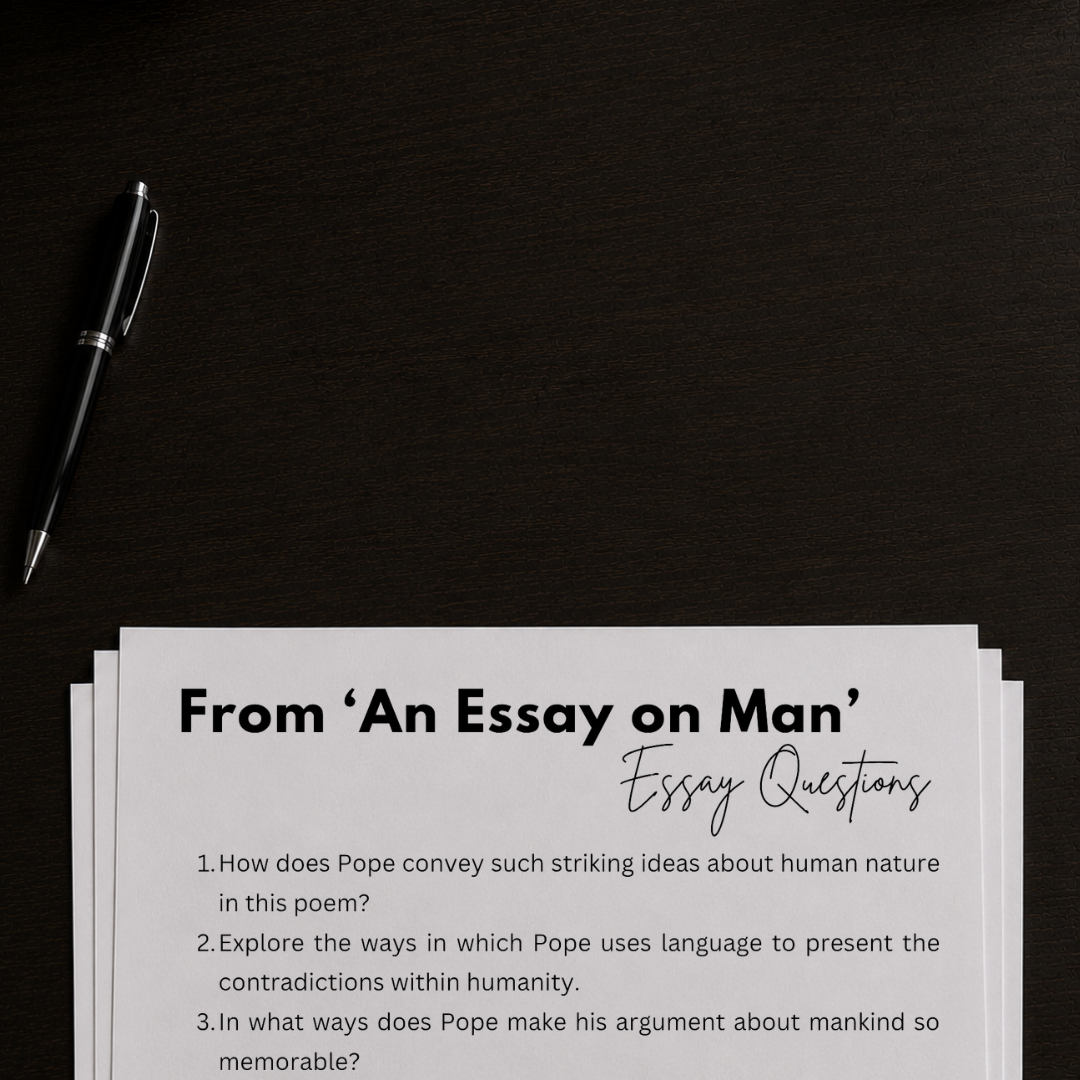
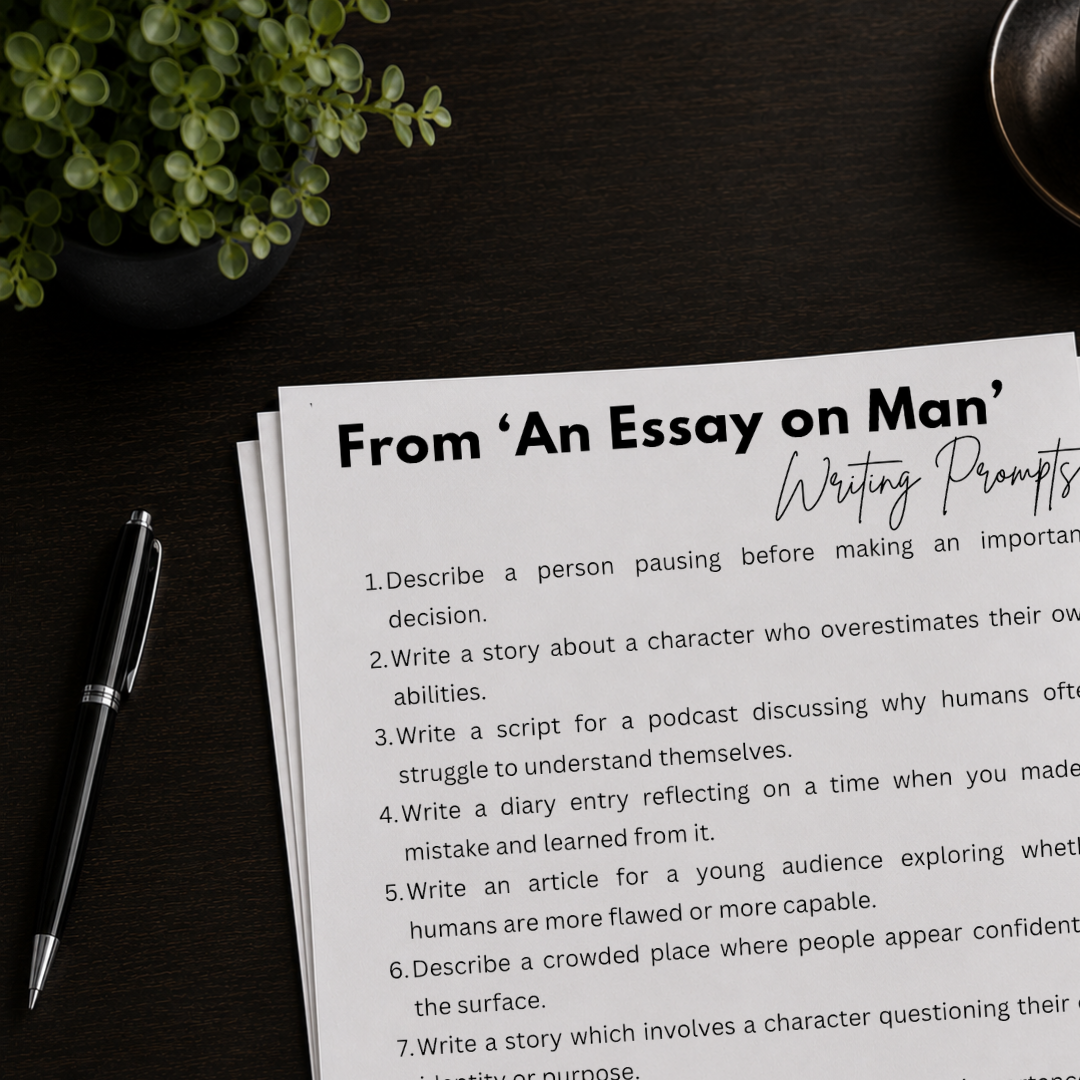
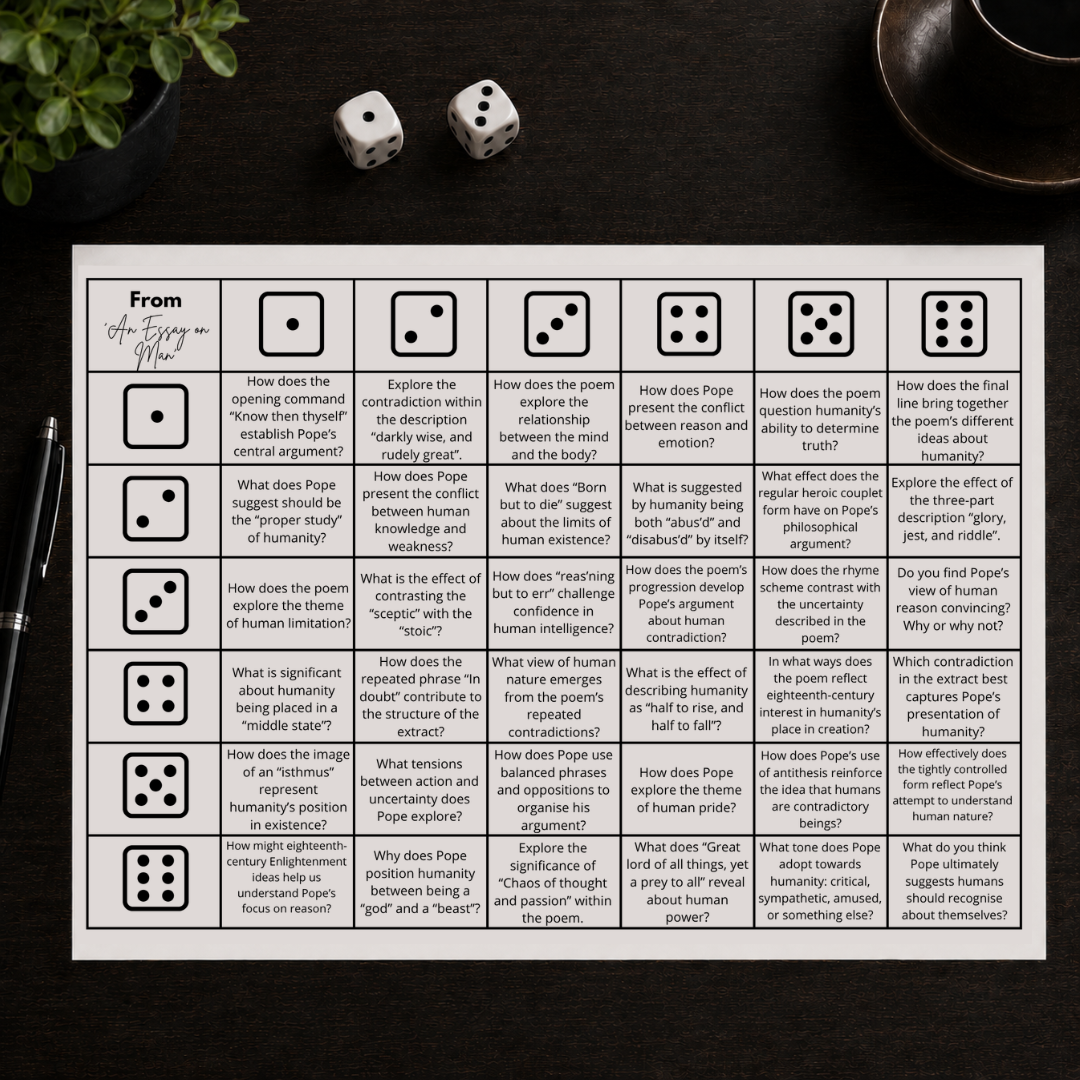
From An Essay on Man Teaching Resources
If you’re teaching From An Essay on Man and want to take the analysis and classroom activities further, I’ve created a complete From An Essay on Man by Alexander Pope Teaching Resource Pack designed for CIE IGCSE English Literature (0475 & 0922, 2027 syllabus).
The pack builds on the close reading, discussion, personal response, and analytical work explored in this guide, giving you ready-to-use activities that can be used across individual lessons, revision sessions, or a complete sequence of study.
Inside the pack, you’ll find:
◆ Poetry analysis task cards exploring language, structure, form, imagery, tone, context, personal response, and more
◆ 10 exam-style essay questions for developing analytical responses
◆ 10 creative writing prompts supporting skills needed for the Language Paper
◆ A Roll the Dice discussion board for quick, low-prep classroom discussion
◆ Silent debate activities designed to encourage students to develop, challenge, and defend different interpretations
◆ Teacher instructions for straightforward classroom implementation
The activities are designed to help students move beyond identifying techniques and towards exploring how Pope constructs and develops his philosophical argument through language, structure, and form. Students are encouraged to examine his use of antithesis, paradox, balance, heroic couplets, imagery, and contrast while developing their own interpretations of the extract’s ideas about human nature, reason, knowledge, ignorance, pride, mortality, contradiction, and humanity’s uncertain place in the universe.
Explore the From An Essay on Man by Alexander Pope Teaching Resources → instant digital download.
Go Deeper into Know then Thyself
To strengthen comparison skills and develop more conceptual responses, it is useful to connect Know Then Thyself to other texts that explore human limitation, identity, and the search for meaning.
◆ An Essay on Man (wider text) – Situates this extract within Pope’s broader argument about the Great Chain of Being, reinforcing ideas about order and limitation
◆ The Tyger – William Blake explores creation and destruction, offering a more questioning perspective on existence
◆ Ozymandias – Percy Bysshe Shelley examines human pride and limitation, showing the fragility of power
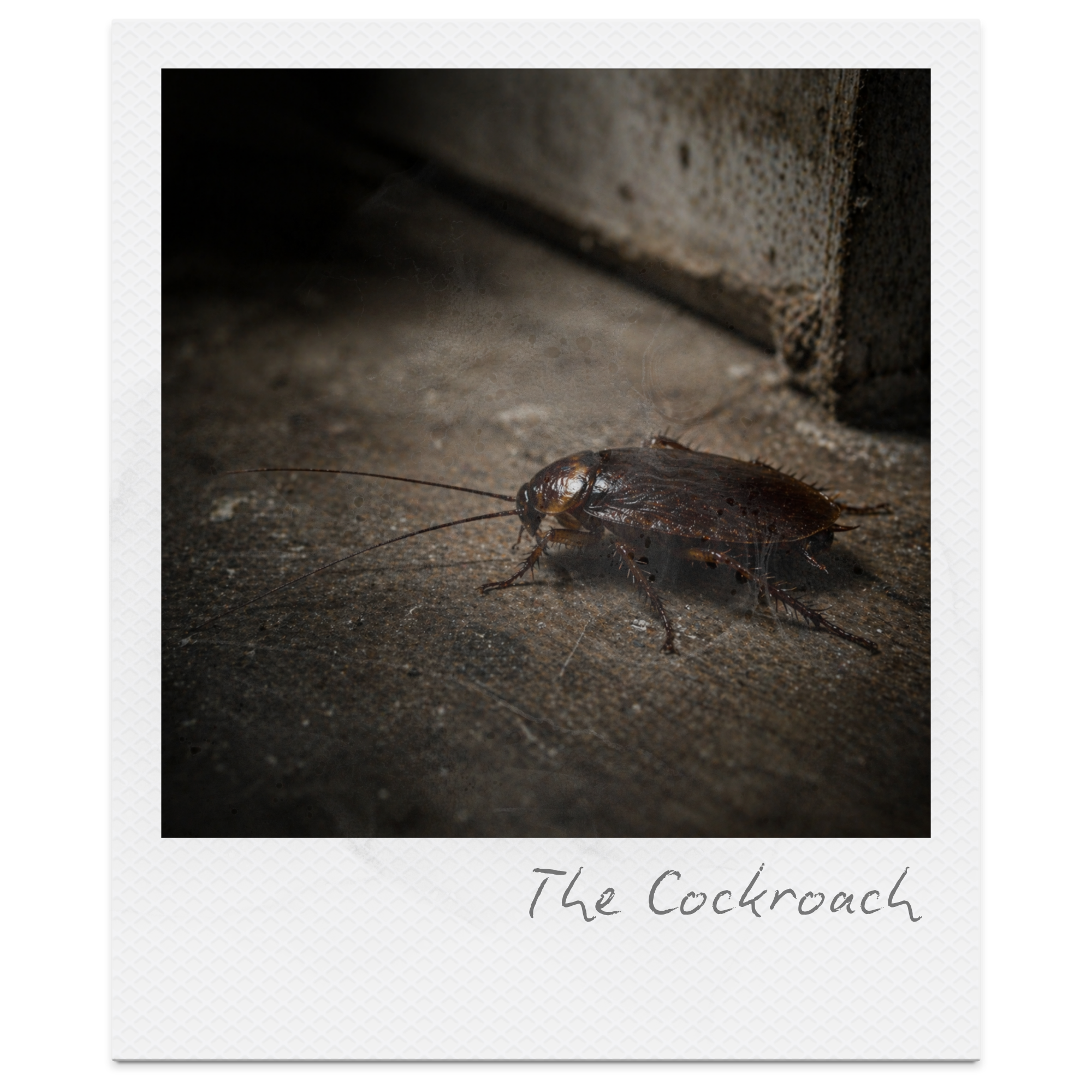
◆ The Cockroach – Kevin Halligan explores self-perception and identity, linking to Pope’s focus on how humans interpret themselves
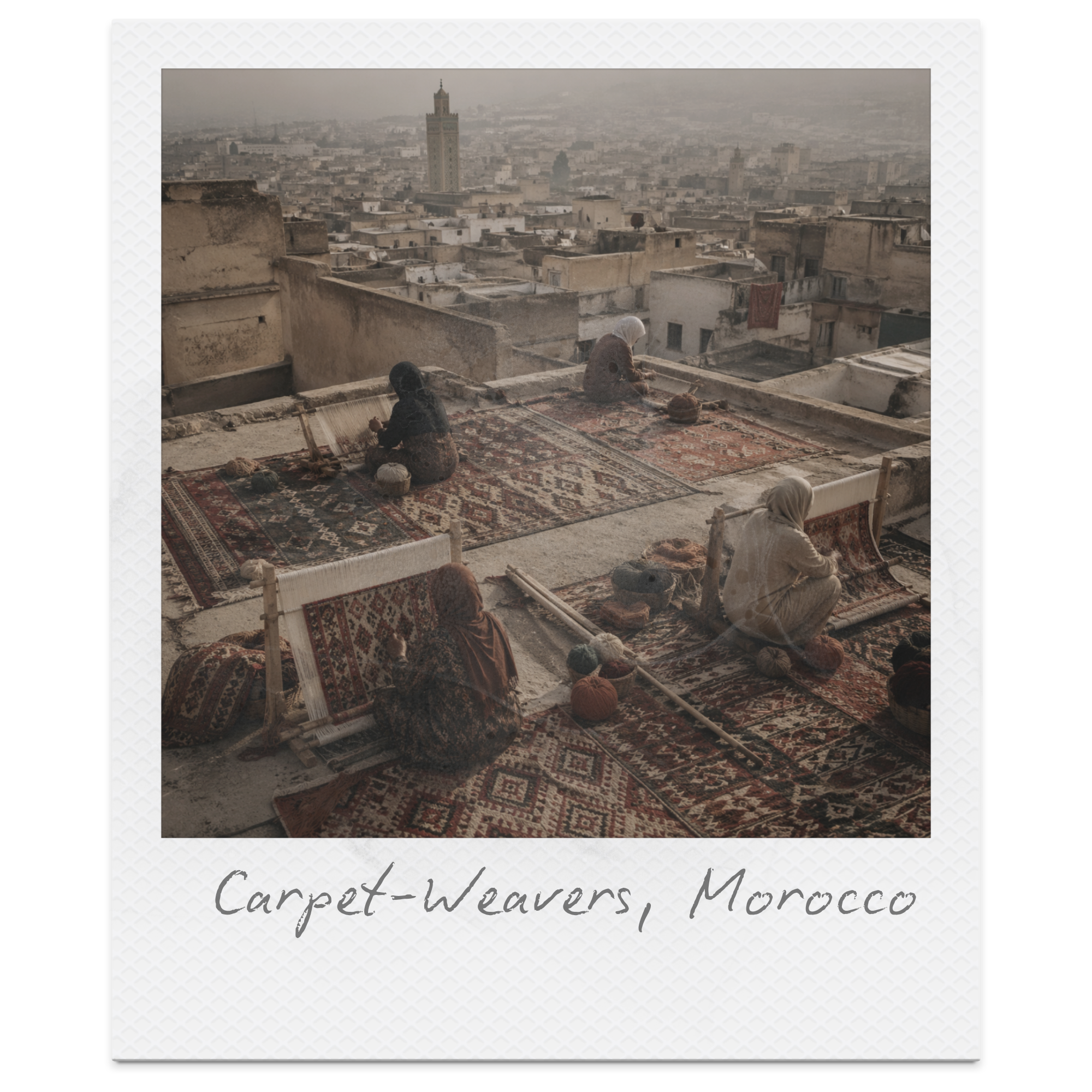
◆ Carpet-Weavers, Morocco – Carol Rumens explores individuals within larger systems, connecting to ideas of human positioning
◆ Hunting Snake – Judith Wright examines the limits of human perception, linking to Pope’s focus on understanding
Final Thoughts
In Know Then Thyself, Alexander Pope presents humanity as a contradictory and unstable “middle state,” using antithesis, paradox, and tightly controlled heroic couplets to explore the limits of human understanding. The poem’s balanced structure creates a sense of order and authority, yet the ideas it contains repeatedly expose uncertainty, error, and internal conflict, reinforcing the gap between how humans attempt to understand themselves and the reality of their limitations.
Ultimately, the poem suggests that true wisdom lies not in certainty, but in recognising the boundaries of human knowledge. By ending with the compressed paradox “The glory, jest, and riddle of the world,” Pope leaves the reader with a powerful sense of complexity and ambiguity, showing that human identity cannot be fully resolved. For further study, explore the Songs of Ourselves Volume 1 Hub and the Literature Library to deepen your understanding and build strong comparative responses.
Choose Your Next Text