70 Celestial Fantasy Writing Prompts: Starlit Kingdoms, Cosmic Magic & Heavenly Worlds
There are fantasy worlds hidden in forests, beneath oceans and beyond enchanted doorways — and then there are those waiting above the clouds. Celestial fantasy transforms the night sky into something tangible: stars become kingdoms, constellations become living beings, moons conceal glittering palaces and entire royal dynasties draw their power from the heavens. Queens descend staircases made from moonlight, princes wear constellations embroidered across their cloaks, celestial gardens bloom beneath violet skies and distant palaces appear to have been constructed from pieces of the universe itself.
These 70 celestial fantasy writing prompts explore the breathtaking possibilities of fantasy inspired by stars, moons, planets, constellations and the wider cosmos. You will encounter royalty clothed in starlight, kingdoms suspended among the heavens, celestial creatures, fallen stars, moonlit courts, astronomical prophecies, cosmic romances and magic powerful enough to alter the night sky. Some ideas are luminous and romantic, others mysterious or dangerous, but all approach the heavens as something magical rather than scientific: a place of beauty, mythology, impossible architecture and powers that mortals were never necessarily meant to possess.
Whether you want to write about a princess who wears the night sky as a gown, a palace built among the constellations, a kingdom preparing for an eclipse or a traveller who discovers that the stars are places rather than distant lights, celestial fantasy offers an extraordinary canvas for imaginative storytelling. Explore more magical worlds through the Fantasy Writing Hub, or browse the Creative Writing Archive for even more prompts, characters, settings and ideas to inspire your next fantasy story.
1. Plot Prompts
Celestial fantasy allows the heavens to become part of the world itself. Stars can be stolen, inherited or worn; moons can harbour kingdoms; constellations might be ancient creatures; and royal families can rule territories stretching across the night sky. Use these prompts to explore worlds where celestial beauty conceals rivalries, impossible romances, dangerous magic and secrets written among the stars.
The queen's coronation gown is woven from living starlight, with every star representing one of the kingdoms she is destined to rule. On the morning of her coronation, her dressmaker discovers a thirteenth star glowing in the fabric — belonging to a kingdom that has not existed for a thousand years.
Beyond the highest clouds stands an enormous celestial palace constructed from constellations, its towers connected by bridges of shimmering light. Each night, the palace moves as the stars cross the sky. When one constellation unexpectedly disappears, an entire wing of the palace vanishes with the royal family still inside.
Every princess of the Moon Court receives a celestial companion at birth: a tiny star that follows her through childhood before eventually becoming part of her crown. One princess's star refuses to remain beside her and repeatedly escapes towards the forbidden darkness beyond the edge of the kingdom.
Two rival kingdoms occupy opposite halves of the sky. One rules beneath an eternal golden sun; the other beneath a vast silver moon. Their borders can touch only during an eclipse, giving their heirs seven minutes to meet once every hundred years. This time, one of them intends to prevent the eclipse from ending.
In a kingdom where status is displayed through the night sky, every noble family owns a constellation. The most powerful houses shine above the capital while disgraced bloodlines are erased from the heavens. A young astronomer notices that one supposedly destroyed constellation has begun quietly rebuilding itself star by star.
A celestial dressmaker creates gowns from moonlight, meteor trails, auroras and fragments of fallen stars for the royal courts of the heavens. When an unknown woman requests a wedding dress made entirely from the darkness between stars, the dressmaker realises she is preparing to marry something that has never belonged to the sky.
Once every thousand years, the stars descend from the heavens and spend one night disguised as mortals at an extravagant masked ball. Nobody is permitted to ask which guests are human and which are celestial. A lonely prince falls in love with a mysterious woman knowing that at sunrise she may be forced to return to the sky forever.
The capital of a celestial empire is built across twelve enormous floating stars, each containing gardens, palaces, lakes and glittering cities. For centuries they have travelled together through the heavens. One morning, the smallest star begins drifting away — and everyone living upon it refuses to return.
A princess has been raised to believe that the enormous constellation visible above her kingdom depicts the goddess who founded her dynasty. During a meteor shower, the constellation lowers its head, looks directly at her and whispers, “That is not my name.”
Everyone knows fallen stars grant wishes, and royal collectors have spent centuries gathering them in a magnificent underground vault. When the new queen opens the chamber for the first time, she discovers thousands of human-shaped celestial beings imprisoned inside — and learns that every wish her family ever made required taking something from them.
2. Title Ideas
Celestial fantasy titles can feel luminous, romantic, mythological or mysterious, evoking worlds suspended above the clouds and characters whose lives are intertwined with the heavens. These titles mix intimate stories with the enormous scale of stars, moons and constellations.
Starborn
The Astral Court
She Wore the Night
Moonfall
A Palace Among the Stars
Constellation
Where Starlight Goes to Die
Heavenbound
The Girl Who Collected Moons
When the Stars Came Down
3. Opening Lines
Celestial fantasy can begin with something magnificent becoming unexpectedly personal: a star falling into a garden, a constellation changing shape, a moon disappearing or someone discovering that the heavens have been watching them back. Use these openings as doorways into worlds where the sky is alive with possibility.
The star fell into my mother's rose garden three nights before the royal wedding.
Every constellation had a name, a history and a purpose, except the new one glowing directly above my bedroom.
The queen entered the ballroom wearing the night sky, and somewhere above us the heavens went completely dark.
My father had spent forty years mapping the stars before one of them finally wrote back.
Nobody in the Moon Palace had seen the sun until the morning it rose inside the throne room.
I was halfway across the Bridge of Stars when the constellation beneath my feet began to move.
My grandmother kept a tiny moon in a birdcage beside her bed.
There were thirteen guests at the celestial banquet and only twelve chairs.
The astronomers announced that heaven was falling at breakfast, so naturally the palace continued preparing for the ball.
On my eighteenth birthday, I learned that the beautiful woman who visited my dreams had been watching me from the same star for centuries.
4. Closing Lines
Celestial fantasy endings can be triumphant, romantic, haunting or filled with wonder. A character might finally reach the place they have spent their life searching for, surrender something precious to restore the heavens or discover that the night sky will never look quite the same again.
Above the palace, thirteen stars burned where there had once been twelve.
She stepped into the constellation, and the heavens rearranged themselves around her.
By sunrise, there was nothing left of the Moon Court except silver flowers growing through the clouds.
I returned the star to the sky, though I knew I would spend the rest of my life looking for it.
The darkness closed around us, and then, one by one, we began to shine.
She removed the celestial crown and discovered that the universe continued perfectly well without a queen.
For the first time in a thousand years, the sun and moon rose together.
He had promised me a kingdom among the stars; instead, we built a small house beneath them.
Somewhere beyond the clouds, the lost constellation was coming home.
That night, every child in the kingdom looked upwards and found a new story written across the sky.
5. Character Ideas
Celestial characters do not all need to be gods, monarchs or chosen heroes. The scale of the heavens becomes even more magical when extraordinary celestial power intersects with recognisably human desires: belonging, curiosity, love, ambition, loneliness, freedom or simply the wish to see what exists beyond the familiar sky.
A star-cloaked queen whose elaborate gowns are woven directly from the heavens, causing entire constellations to disappear whenever she dresses for important occasions.
A celestial gardener who tends enormous fields of infant stars before they are planted in the night sky, secretly protecting one star that refuses to grow.
A fallen constellation living in human form after being torn from the heavens, recognisable only by the tiny points of light moving beneath her skin.
A royal astronomer who has spent her life interpreting celestial movements for the crown but increasingly suspects that the stars are deliberately sending her false prophecies.
A moon princess whose silver hair changes with the lunar cycle, disappearing completely during the new moon along with her magical abilities.
A seamstress of the heavens who creates clothing from auroras, moonlight, meteor trails and stardust but dreams of making something from ordinary earthly materials.
A constellation hunter tasked with capturing celestial creatures that escape from the night sky, who begins questioning why they are so desperate to flee.
A boy born during an eclipse whose shadow contains a miniature night sky where unfamiliar stars and planets appear whenever he dreams.
An immortal celestial dancer whose performances control the movement of planets, trapped in an ancient choreography because nobody knows what will happen if she stops.
A traveller from an ordinary village who discovers a staircase made from moonlight and climbs it expecting to reach the heavens, only to find an abandoned celestial kingdom waiting at the top.
6. Setting Ideas
Celestial fantasy settings can ignore almost every ordinary rule of geography. Build upwards, across the heavens and even directly into the night sky itself. Let stars become architecture, moonlight become roads and constellations become landscapes large enough for characters to inhabit.
The Starlight Palace — an enormous translucent royal palace floating above permanent clouds, with towers sculpted from frozen light, constellation ceilings and balconies overlooking the entire night sky.
The Astral Gardens — vast celestial gardens where stars grow like flowers, comets nest among silver trees and enormous luminous moths pollinate moon blossoms beneath a violet sky.
The Constellation Kingdoms — twelve magnificent realms constructed across living constellations, connected by delicate bridges of starlight that stretch across the darkness between them.
The Moon Court — an ivory palace carved into a crescent moon, filled with pearl halls, silver fountains, moonstone staircases and enormous windows looking down upon the sleeping world.
The Celestial Ballroom — a ballroom suspended in open space with no visible walls, where dancers move across a transparent floor while planets drift slowly beneath their feet and constellations form chandeliers overhead.
The Fallen Star Valley — a remote valley where fallen stars accumulate instead of disappearing, creating luminous rivers, glittering forests and warm pools of liquid starlight.
The Observatory at Heaven's Edge — a towering observatory built at the highest point in the mortal world, where a final staircase extends beyond the mountain and continues unsupported into the stars.
The Palace of Eternal Twilight — a sprawling lilac-and-gold palace existing precisely between day and night, where one horizon holds an enormous setting sun while the opposite sky is filled with stars.
The Celestial Sea — an endless dark-blue ocean suspended among the heavens, its waves filled with stars and its islands formed from enormous sleeping celestial creatures.
The City Beneath the Constellations — a luminous city where every street, palace and garden mirrors a constellation overhead. Whenever a star dies, the corresponding building below quietly disappears.
7. Picture Prompts
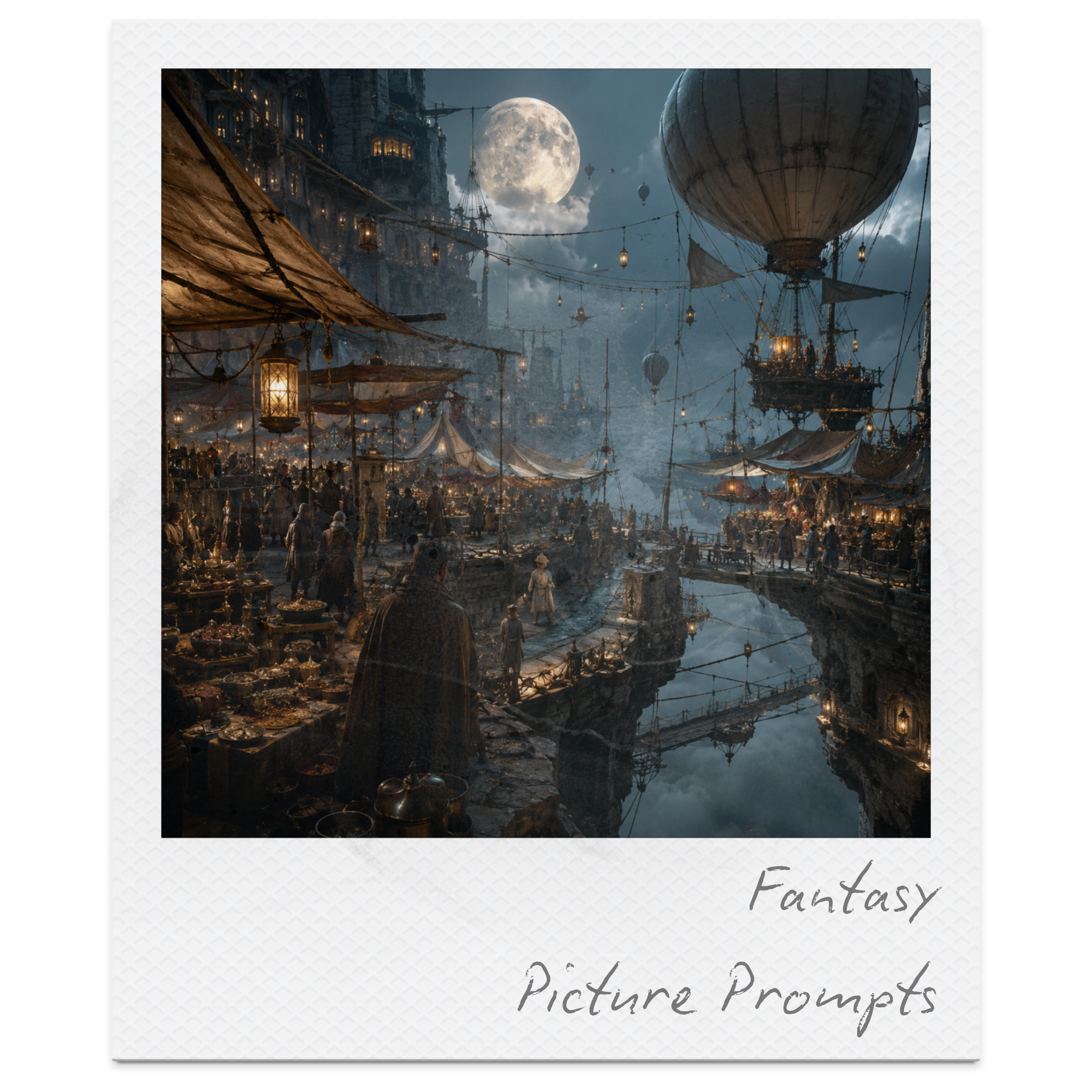
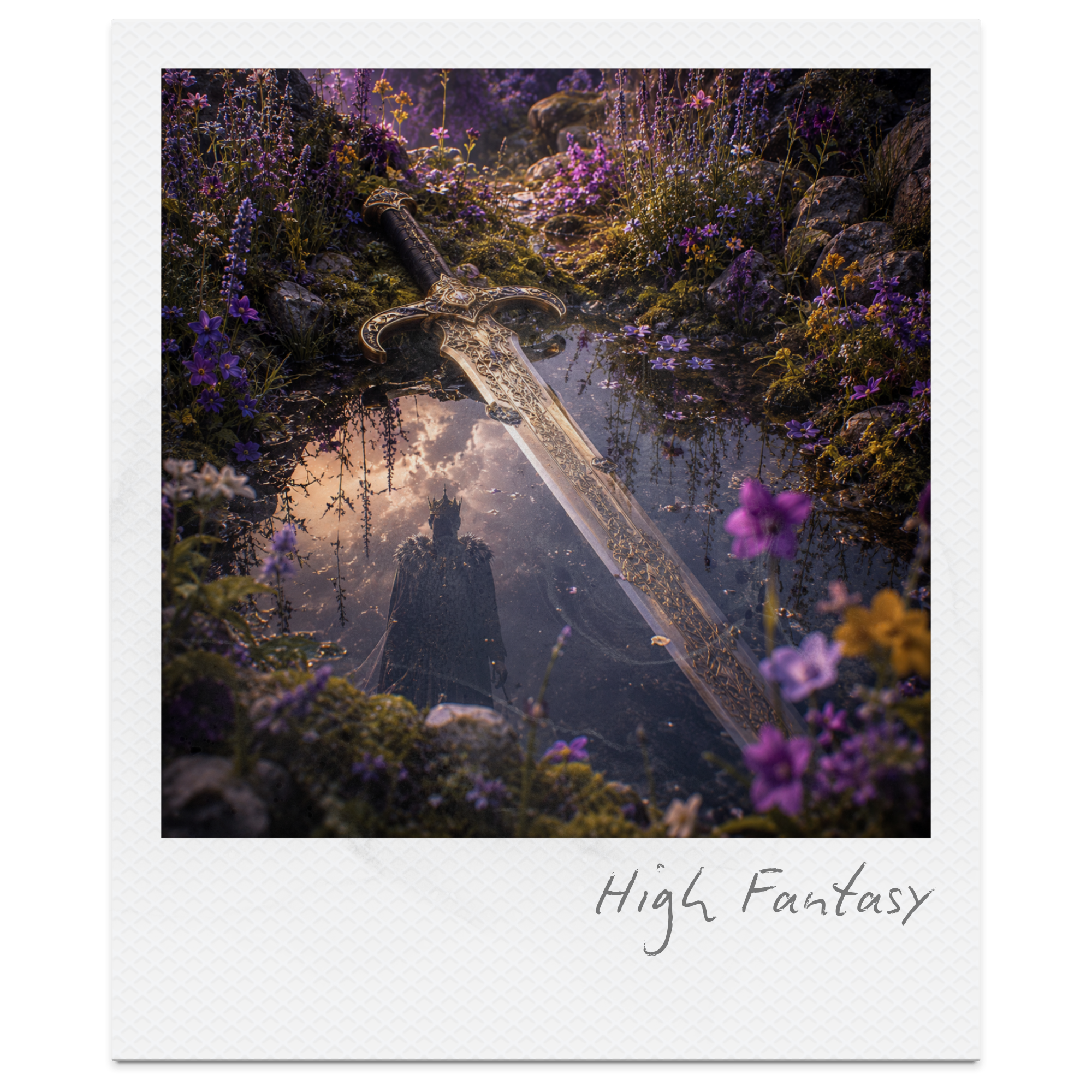
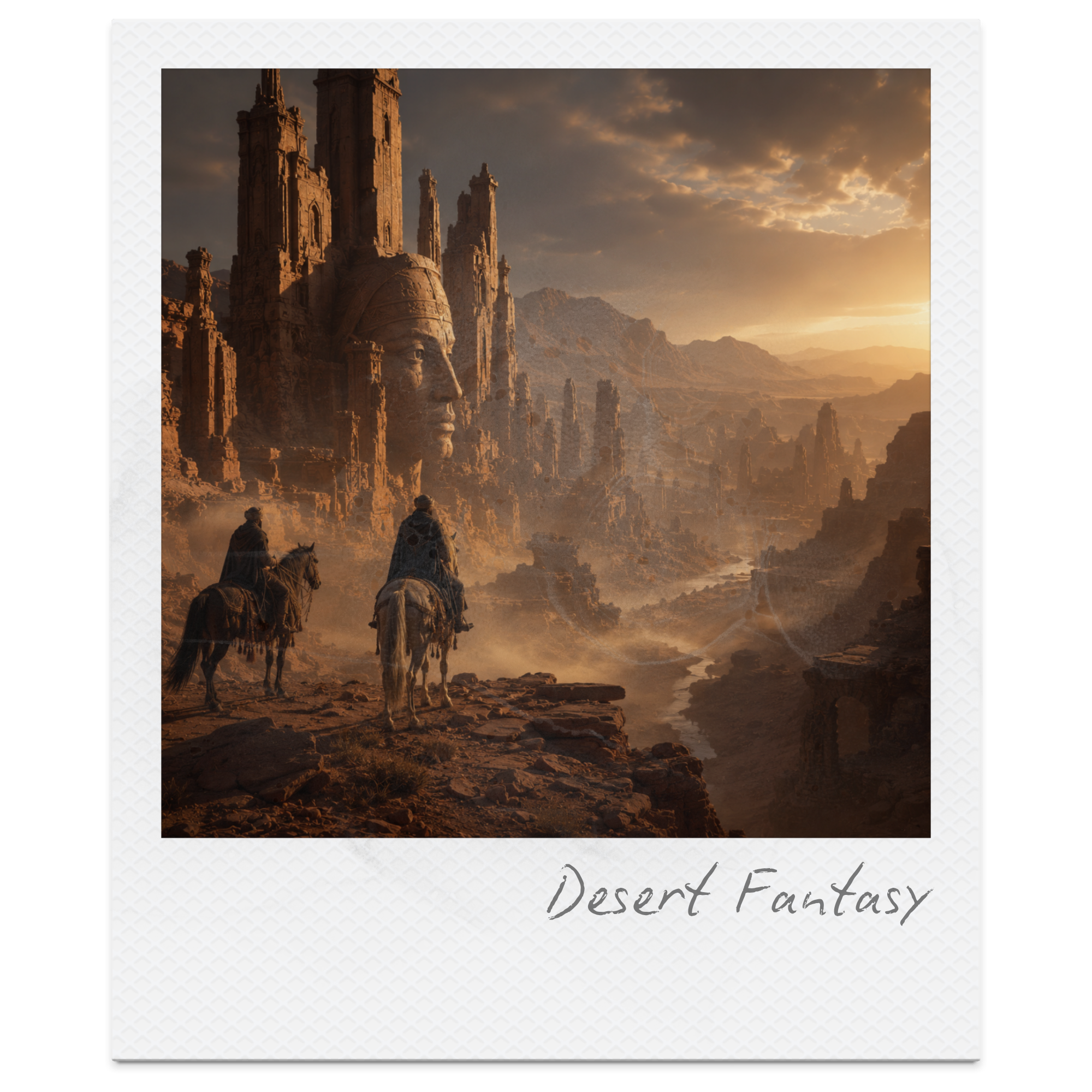
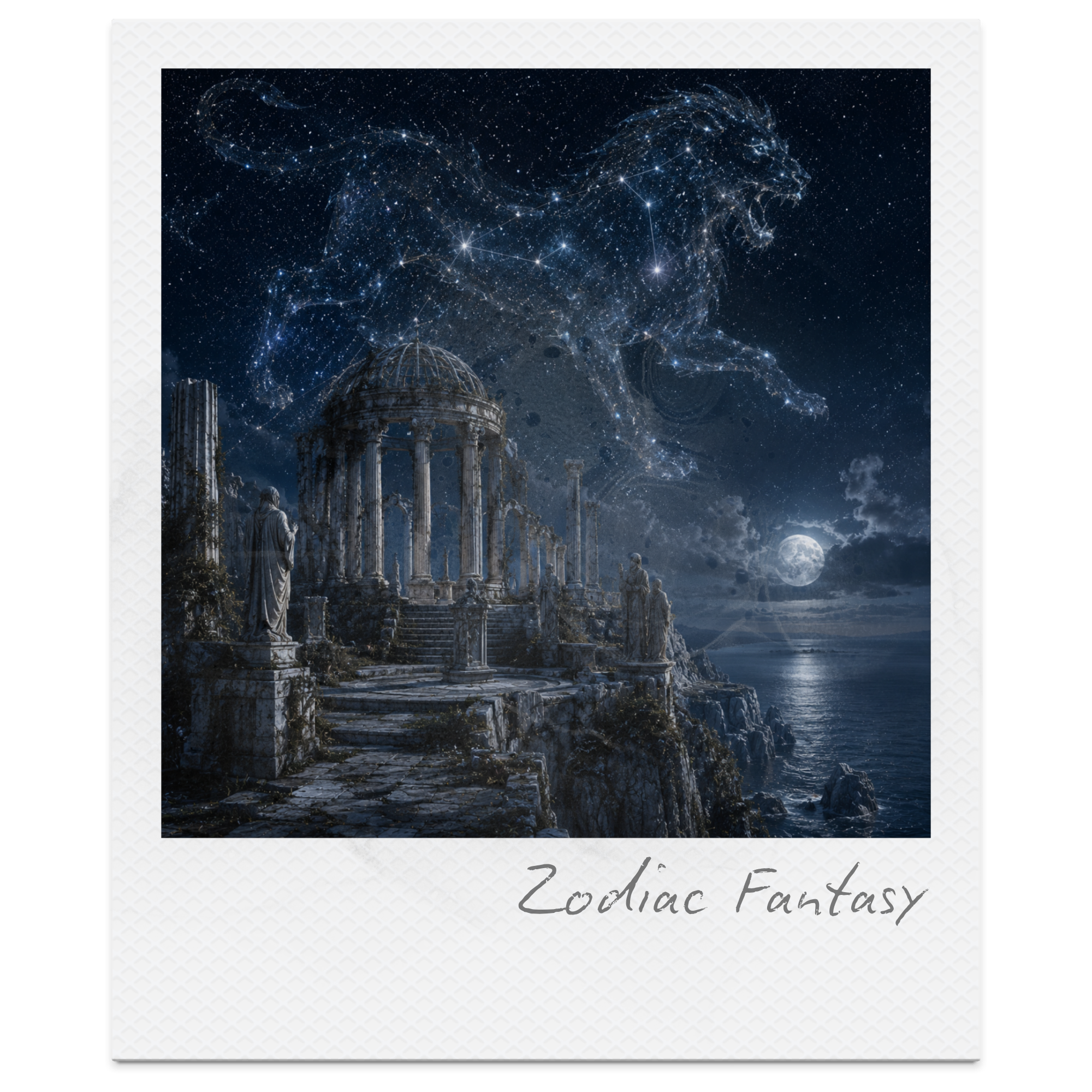
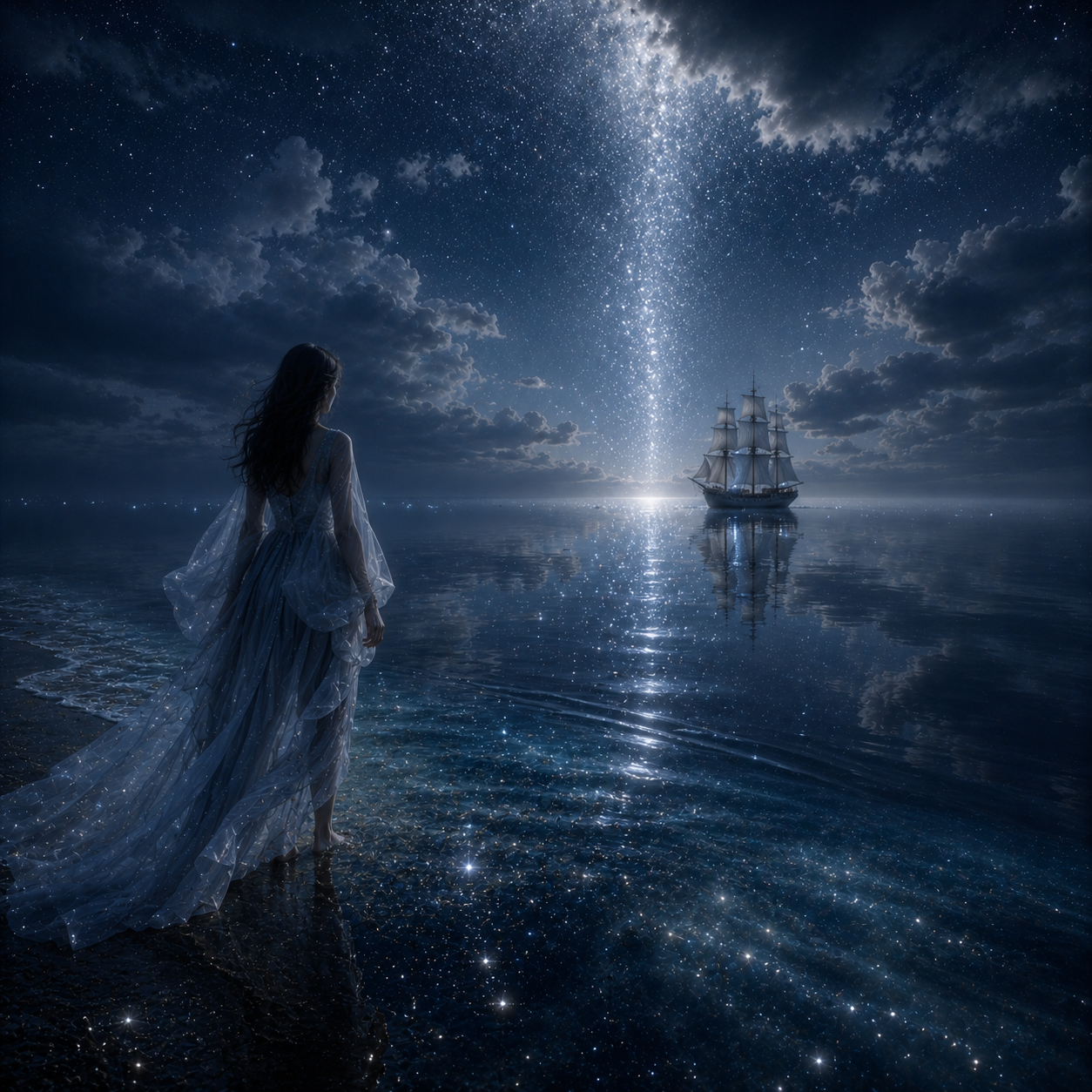
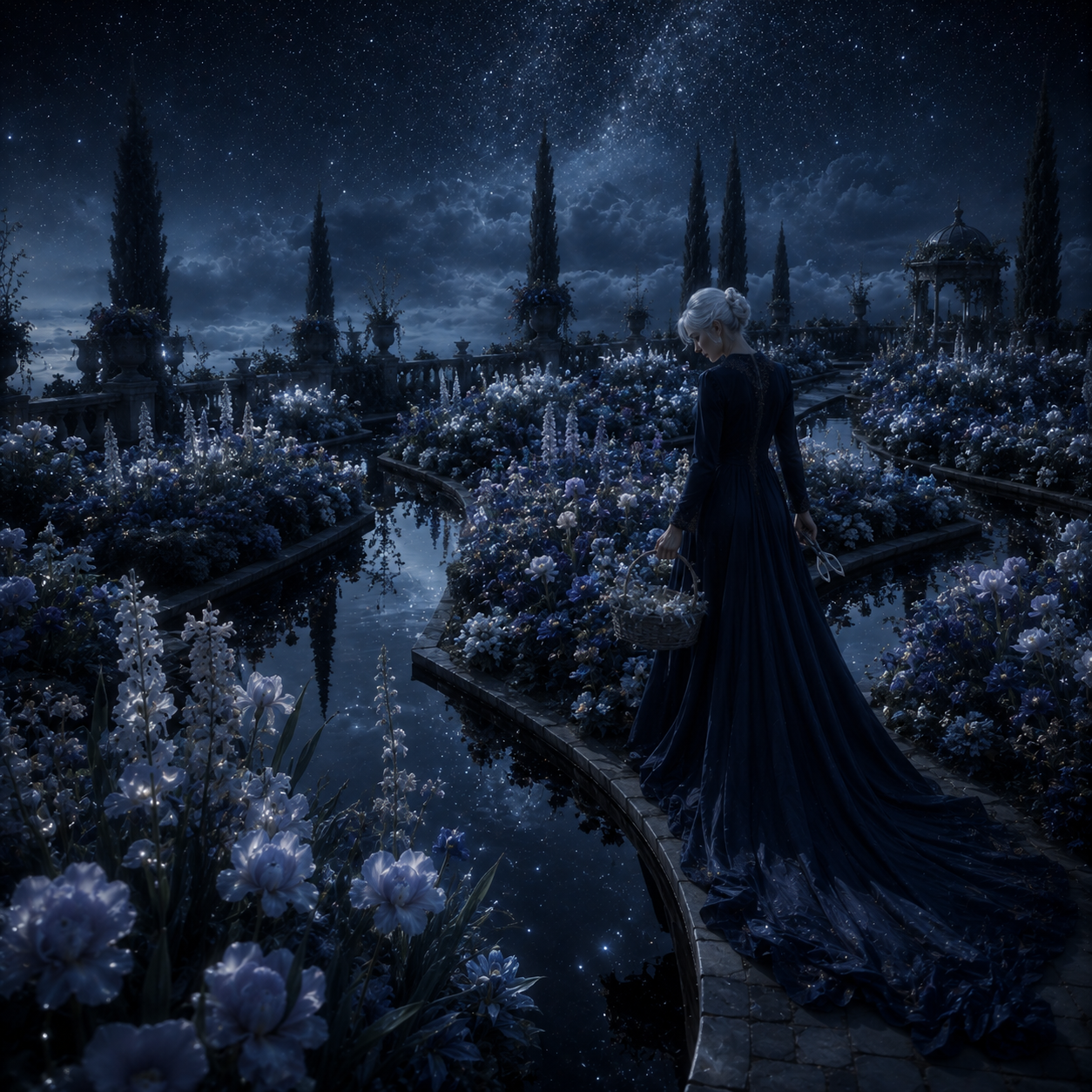
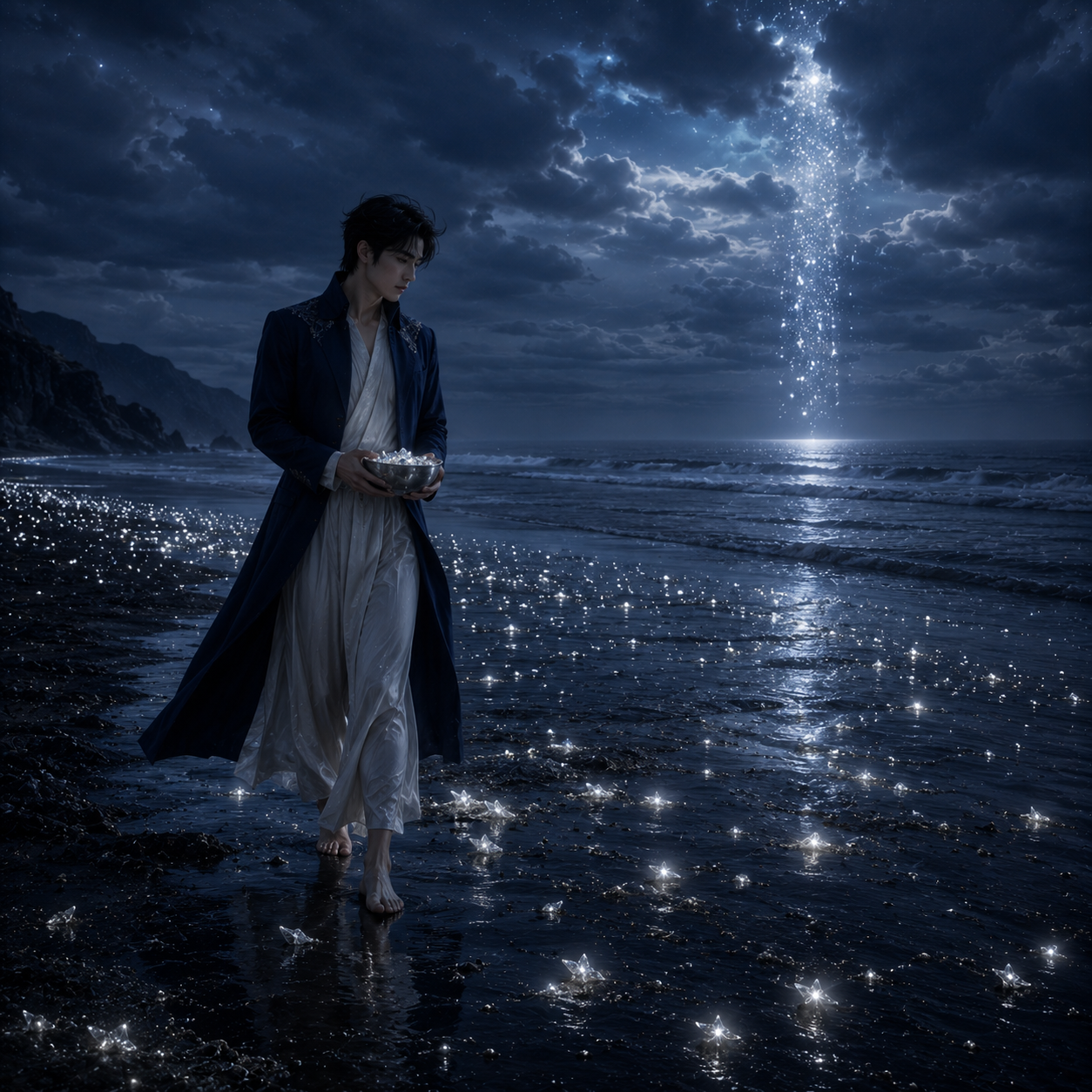
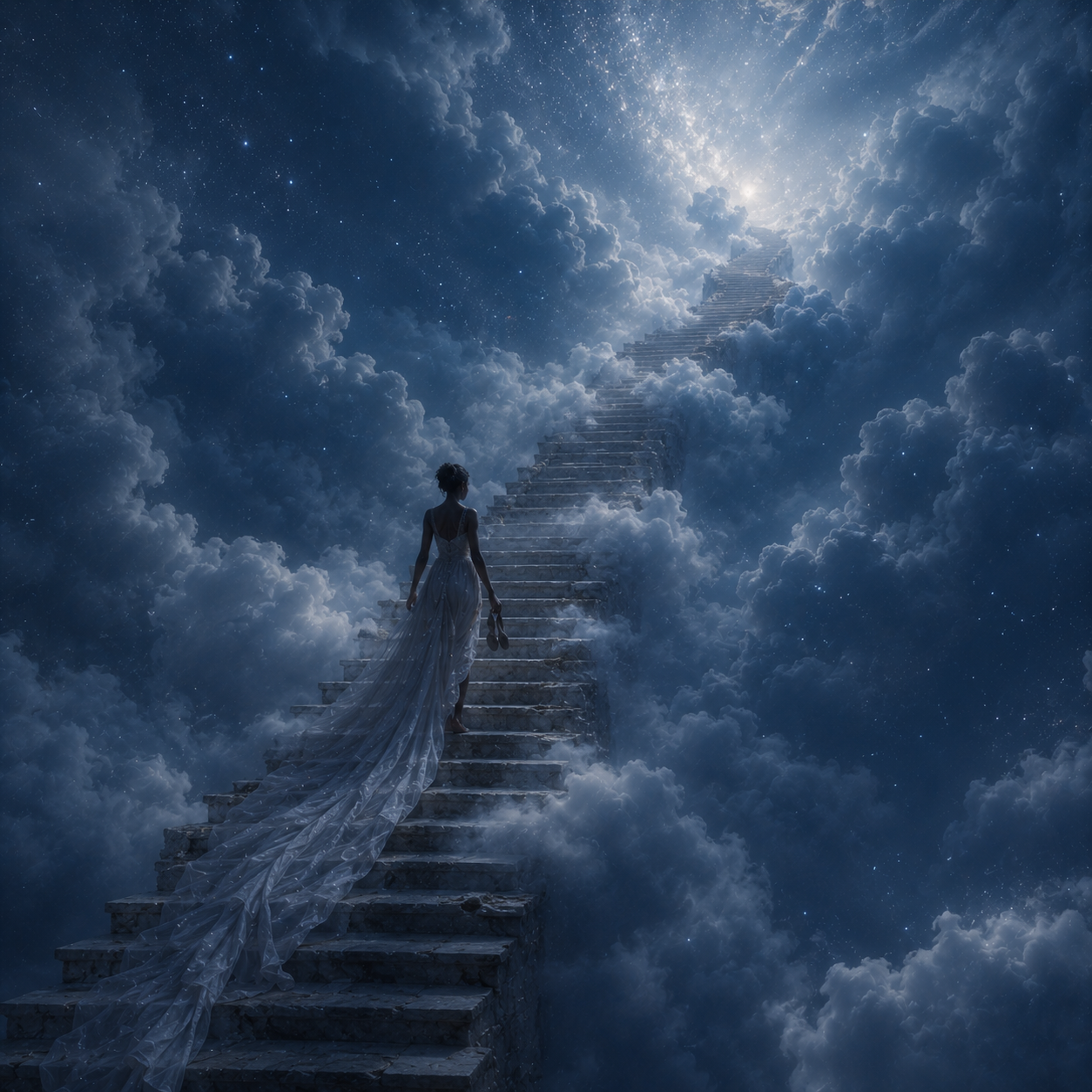
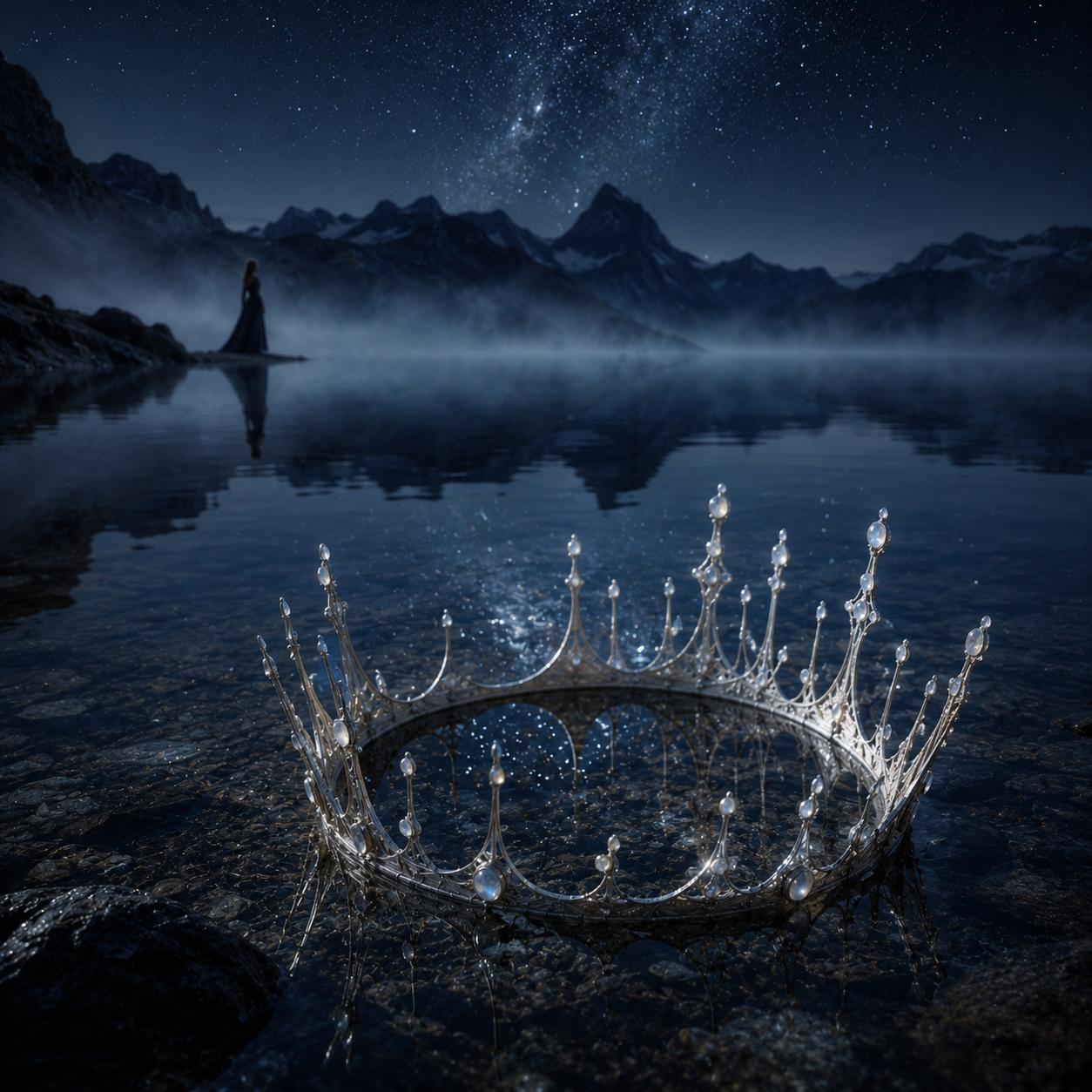
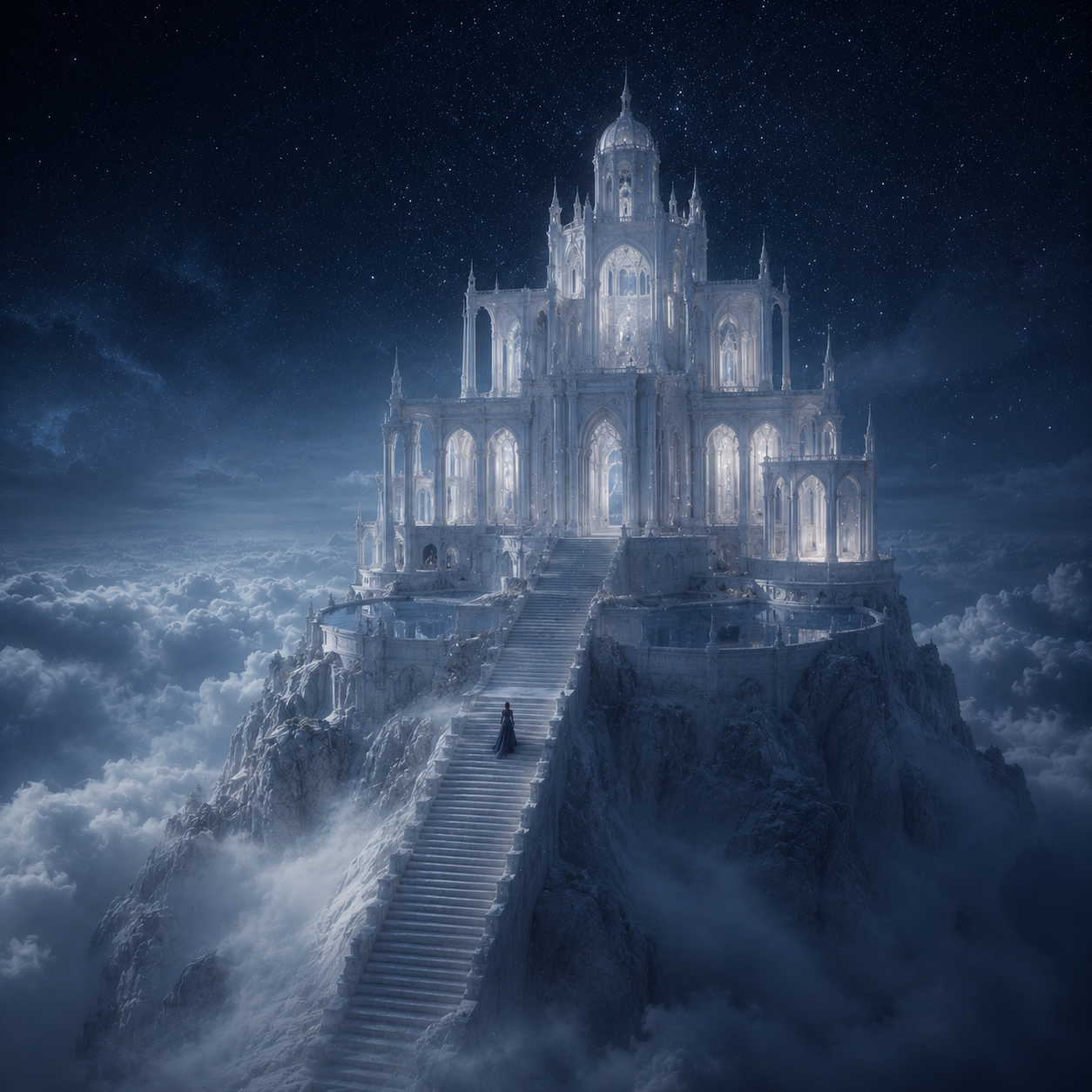
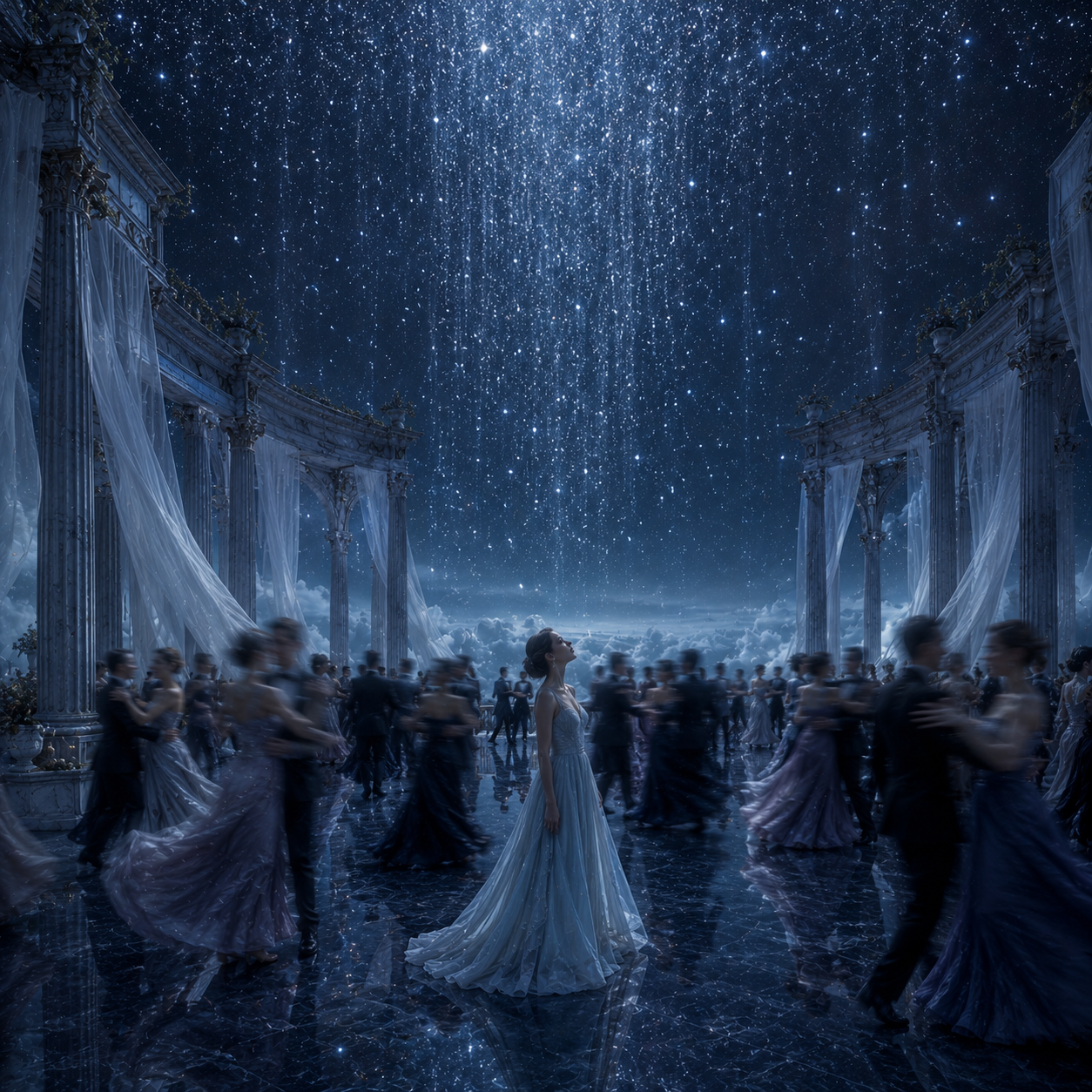
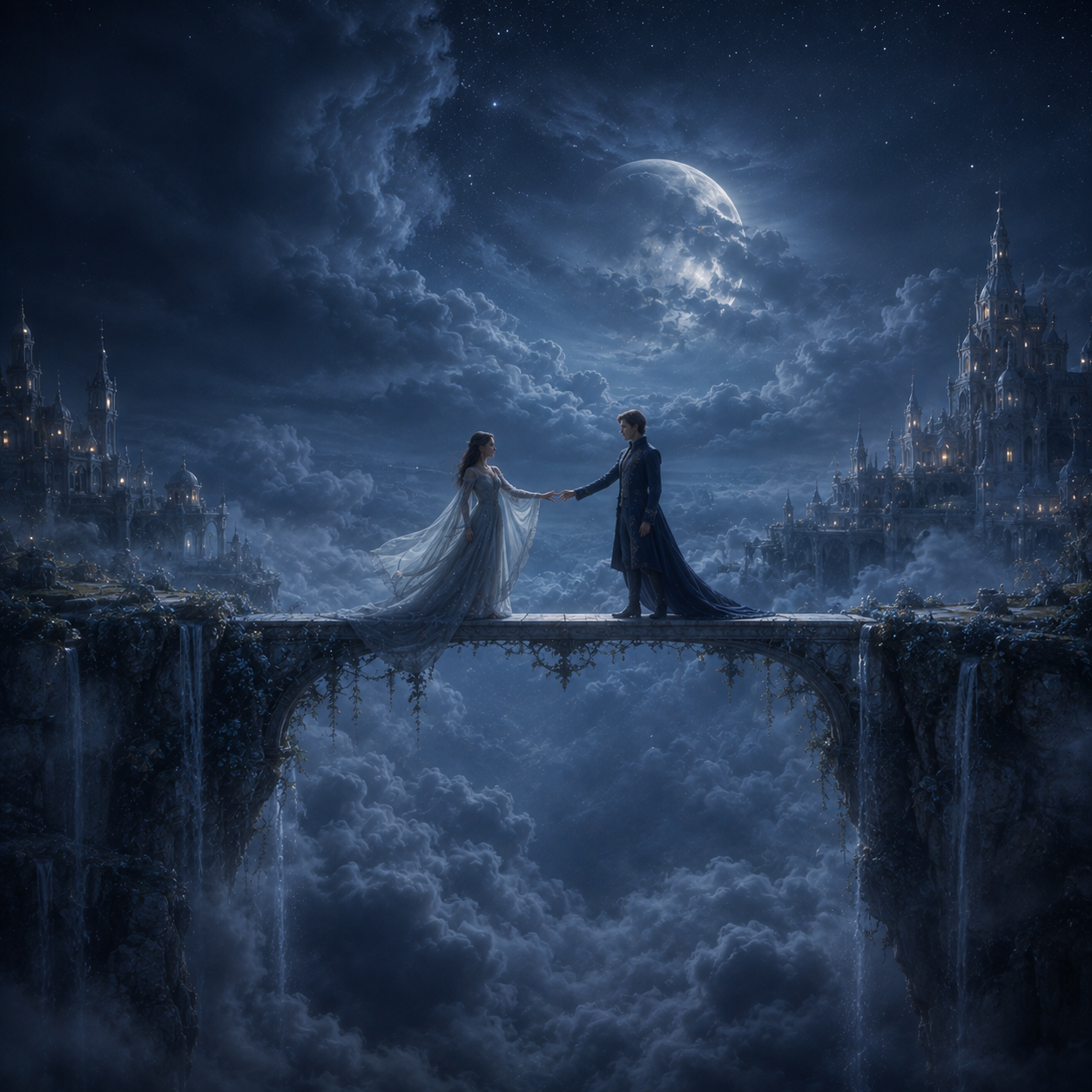
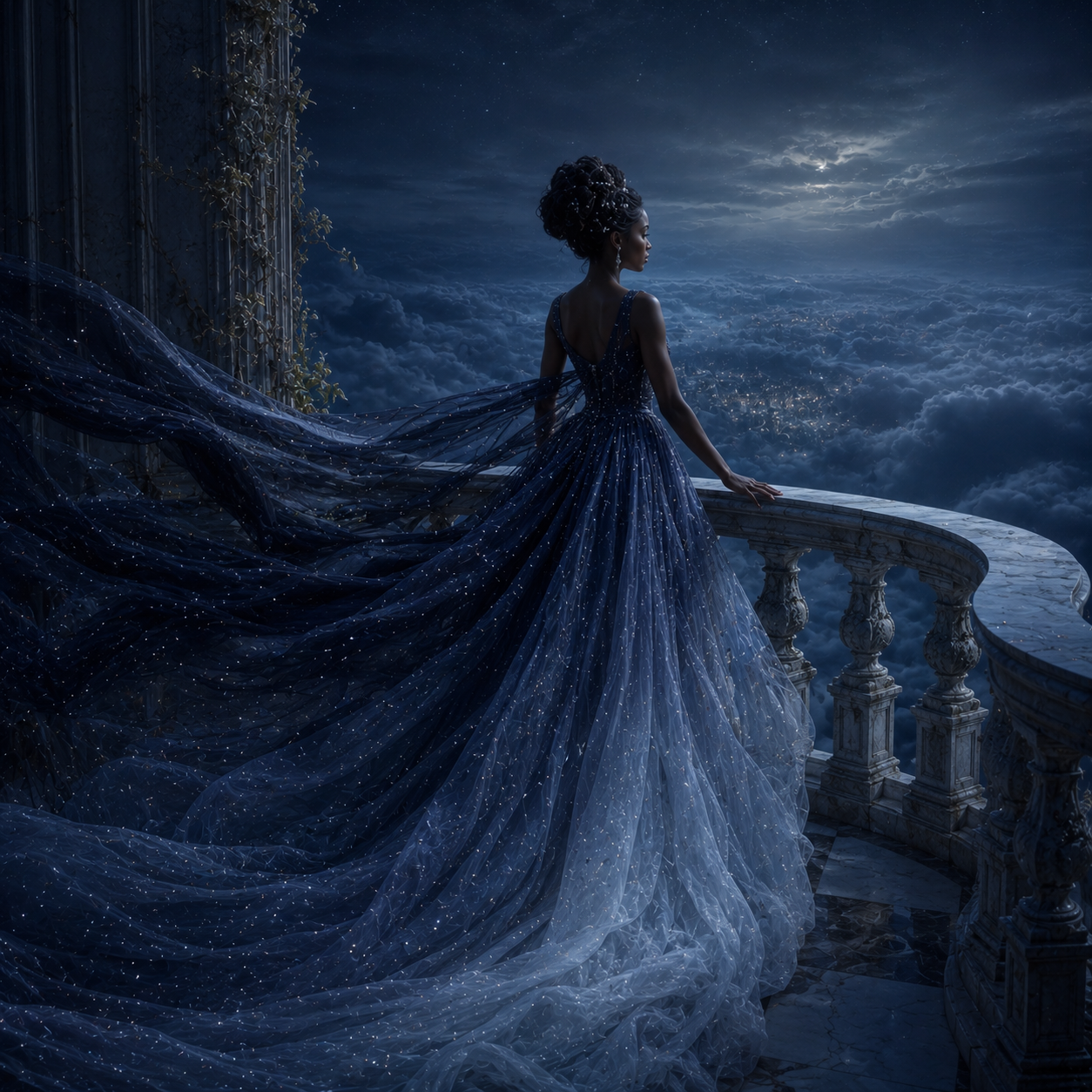
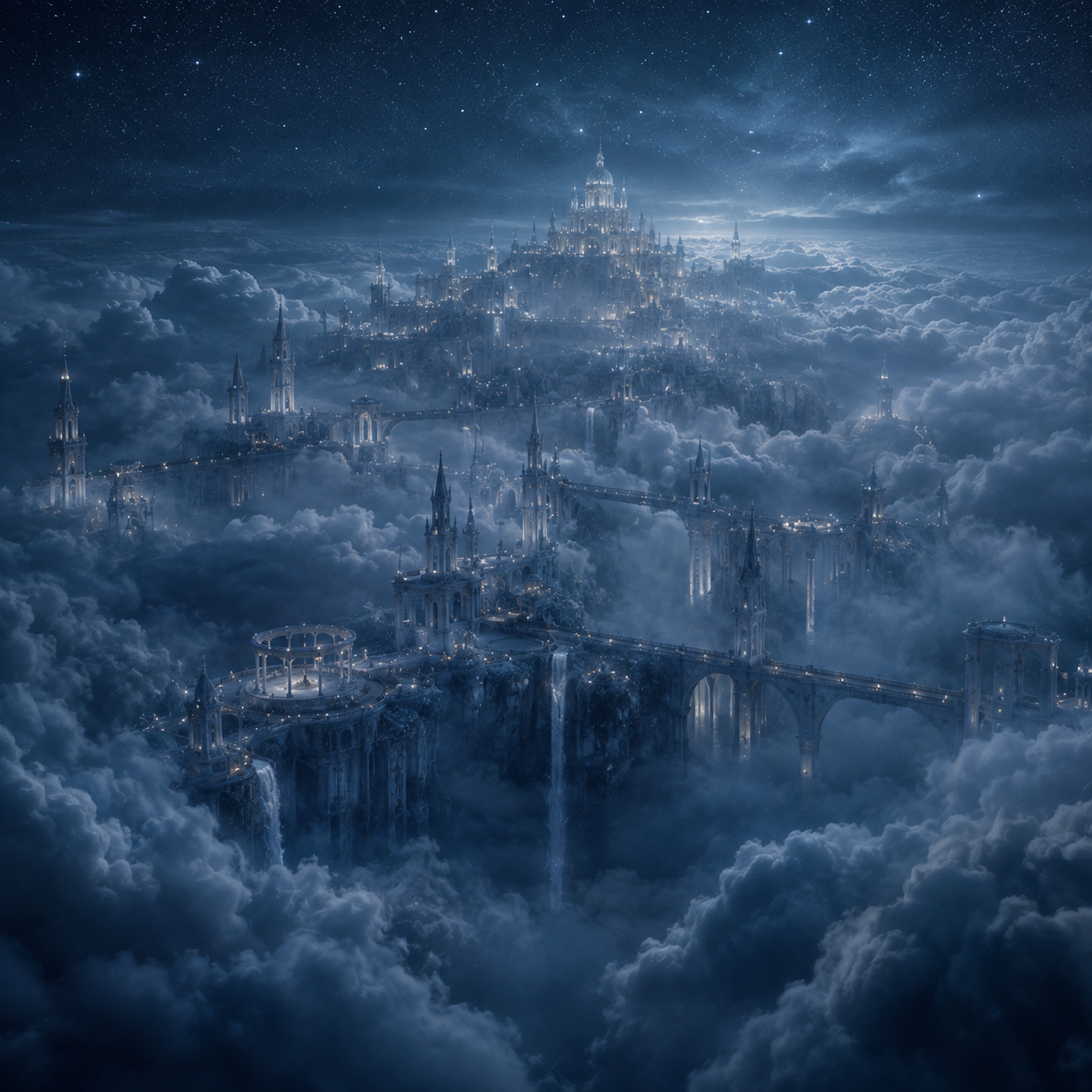
These celestial fantasy picture prompts invite you to begin with beauty and wonder before searching for the story hidden inside them. Look beyond the immediate spectacle of a starlit gown, a celestial palace, an impossible moon or a kingdom suspended among constellations. Who lives here? What does this extraordinary place demand from them? Why is the queen standing alone beneath a sky filled with falling stars? Where does the staircase disappearing into the heavens lead? What happened to the person whose empty throne still glows with celestial light?
Pay particular attention to scale and contrast. A tiny human figure beneath an enormous moon can suggest awe, loneliness, destiny or defiance, while a queen casually holding a star in her hands immediately raises questions about power and ownership. A magnificent palace might be a sanctuary or a prison; a beautiful celestial creature could be a guardian, deity or captive; and a gown made from constellations may represent extraordinary privilege while concealing what had to be taken from the heavens to create it.
Use stars, moons, celestial architecture, light, clothing, expressions, distance, colour, unusual objects and the relationship between characters and their surroundings as clues rather than fixed explanations. Imagine what happened immediately before the captured moment and what will happen once it ends. Celestial fantasy can be enormous in scale while remaining deeply personal, so allow the heavens to provide the spectacle — then find the human desire, secret, sacrifice or conflict glowing somewhere underneath.
Go Deeper into Celestial Fantasy
Celestial fantasy can be breathtakingly beautiful, but its strongest worlds make that beauty meaningful. If a palace is constructed from stars, consider what happens when one of those stars dies. If royalty can wear constellations as jewellery, ask who has the right to take pieces of the heavens and whether anything lives within them. A moon suspended above a kingdom might influence magic, religion, agriculture, inheritance or even the emotions of its inhabitants. Treat the celestial elements of your world as more than decoration. The stars, planets, moons and constellations should have histories, rules and consequences that affect the people living beneath — or among — them.
The enormous scale of the heavens also creates fascinating contrasts with very human desires. A queen may command an entire constellation yet be unable to make someone love her. An immortal celestial being might envy a mortal's brief, unpredictable existence. Someone could spend decades climbing towards a legendary palace among the stars only to discover that the person they hoped to find there has already returned to Earth. Celestial fantasy does not always need threats capable of destroying the universe. Sometimes the most compelling story places an intimate problem against an impossibly magnificent backdrop.
You can also decide how closely your celestial world is connected to fate. Stars have long been associated with prophecy, destiny and attempts to understand what lies ahead, making them perfect foundations for magical systems built around predetermined futures. Perhaps every person's life appears as a star, royal marriages are arranged according to constellations or astronomers can watch future events moving slowly across the heavens. Then introduce disruption. What happens when a star appears where none was predicted, somebody refuses the destiny written for them, or the constellations themselves begin changing the stories they have told humanity for thousands of years?
◆ Make the heavens tangible. Allow characters to touch, wear, harvest, trade, climb, enter or even damage celestial things. Stardust might be gathered from fields, moonlight spun into fabric and constellations crossed like enormous countries.
◆ Give celestial beauty a cost. A palace made from stars becomes more interesting when readers discover where those stars came from. Perhaps every magnificent celestial object requires something to be removed from somewhere else.
◆ Create hierarchies among the heavens. Suns, moons, planets, stars and constellations might belong to different courts, dynasties or magical orders. Their relationships can create alliances, rivalries and ancient celestial politics.
◆ Let clothing tell stories. In an ethereal celestial world, fashion can become part of the magic. A queen's gown might display her constellation, a mourning veil could contain a dead star's final light or a princess might be forbidden from wearing moonstone until she inherits the throne.
◆ Think vertically. Fantasy worlds often spread horizontally across maps, but celestial fantasy gives you permission to build upwards. Create staircases through clouds, kingdoms at different heights, palaces orbiting moons, suspended gardens and forbidden territories beyond the highest stars.
◆ Turn constellations into more than patterns. They could be sleeping gods, enormous creatures, ancestral spirits, kingdoms, maps, prisons or ancient stories physically embedded in the heavens. Ask what would happen if one moved.
◆ Use celestial events as turning points. Eclipses, meteor showers, planetary alignments, solstices and disappearing stars can affect magic, open inaccessible places, alter royal succession or create rare moments when normally separated worlds can touch.
◆ Contrast immortality with mortality. Celestial beings may experience centuries as casually as humans experience seasons. Relationships between mortal and immortal characters can explore what it means to love someone whose experience of time is fundamentally different.
◆ Bring the cosmic down to the personal. Not every character needs to save the heavens. A celestial seamstress might simply want recognition for her work; a palace servant may secretly collect fallen stardust; an astronomer could be searching the sky for one particular star. Small desires can make enormous worlds feel inhabited.
◆ Allow wonder to remain. Celestial fantasy does not need to explain every star, creature or impossible phenomenon. Leave distant palaces unexplored, constellations unnamed and mysterious lights moving beyond the known heavens. Sometimes knowing that something extraordinary exists just beyond the edge of the story makes the world feel larger than any map could contain.
Final Thoughts
Celestial fantasy invites you to treat the heavens as somewhere characters can actually belong. Stars can become kingdoms, constellations can stretch beneath a traveller's feet and moons can hold palaces filled with generations of secrets. A queen might wear the night sky across her shoulders while a gardener quietly raises newborn stars, and somewhere beyond the recognised constellations an entire civilisation may be glowing unseen. The scale can be immense, but what makes these worlds memorable is the sense that every beautiful celestial detail has a story behind it.
These 70 Celestial Fantasy Writing Prompts explore starlit kingdoms, moon courts, living constellations, cosmic magic, celestial royalty, fallen stars, heavenly creatures and impossible places suspended above the clouds. Use them to create lavish courts and ancient rivalries, intimate romances beneath extraordinary skies, adventures across celestial landscapes or quiet stories about ordinary people encountering something impossibly beautiful. Let the stars become more than scenery: make them characters, destinations, sources of magic, symbols of power and pieces of the world that can be touched, stolen, inherited, loved or lost.
Most importantly, allow your celestial world to retain its sense of wonder. Not every distant light needs to be mapped and not every constellation needs to surrender its secrets. Leave another palace shimmering beyond the horizon, another staircase climbing higher than anyone has travelled and another unexplained star appearing in the darkness. If you are ready to explore more impossible worlds, visit the Fantasy Writing Hub, or wander through the Creative Writing Archive for more prompts, settings, characters and inspiration.
Choose Your Next Adventure