Futuristic City Name Generator: Create a Sci-Fi City
What will the cities of the future look like? Towering megacities stretching kilometres into the sky, underground settlements hidden beneath hostile planets, floating cities above alien oceans, corporate capitals controlled by technology, or sprawling communities built inside enormous Martian craters?
This Futuristic City Name Generator creates a complete science-fiction city in seconds, combining a unique city name with its location, identity and a glimpse of everyday life for the people who live there. Generate everything from crowded Earth megacities and futuristic capitals to off-world settlements, underwater cities, orbital communities and strange cities on distant planets — then refresh individual details until you find a combination that sparks a story.
Use the generator below to create your city, then develop its districts, people, technology and secrets. For more inspiration, explore Sci-Fi Story Sparks, visit the Sci-Fi Writing Hub, discover more interactive tools in the Creative Writing Generator Hub, or browse the Creative Writing Archive for prompts, worldbuilding ideas and writing guides.
Futuristic City Generator
Generate a futuristic city, then refresh individual details until you find a world you want to explore.
How to Use the Futuristic City Name Generator
Click Generate New City to create a completely new futuristic city. Each result combines four elements:
City Name – a name for your futuristic or science-fiction city.
Location – where the city has been built, from Earth and Mars to distant planets, moons and hostile alien worlds.
City Identity – the industry, technology, culture or purpose that defines the city.
Life in the City – a small detail revealing what everyday life might actually feel like for the people who live there.
Don't like one part of your result? Use the refresh button beside that section to generate a new option while keeping everything else.
Once you have a city you want to develop, select Copy Full Result and use it as the starting point for your worldbuilding.
What Makes a Good Futuristic City?
A convincing futuristic city needs more than enormous skyscrapers, flying vehicles and glowing technology.
Think about why the city exists, where its resources come from, how people move through it, who holds power and what ordinary life looks like once the spectacular technology becomes completely normal.
The best science-fiction cities often combine something extraordinary with something recognisably human.
Think About Where the City Was Built
Location immediately creates problems your city needs to solve.
A city on Mars needs to provide breathable air, water and protection from radiation. An underground city needs ventilation, artificial light and ways of moving thousands or millions of people through enclosed spaces. A floating city needs to remain stable. A city on a hostile alien planet may need to keep almost everything outside its walls.
Even cities on a future Earth will be shaped by geography.
A coastal megacity might have expanded onto artificial islands. A desert city could have been built around enormous solar farms. An overcrowded capital might grow upwards rather than outwards, creating hundreds of inhabited levels above the original streets.
Ask yourself: why was this particular location worth building a city in?
Decide What Defines the City
Real cities develop identities.
Some become financial centres. Others are associated with universities, manufacturing, government, tourism, entertainment, technology or particular industries.
Your futuristic city should have one too.
Perhaps it contains the largest spacecraft factories on Mars. Perhaps almost every major robotics company has its headquarters there. Maybe it is a political capital, a notorious trading hub, an experimental eco-city or a luxury destination where wealthy visitors travel from several planets.
That identity can influence everything from architecture and employment to immigration, wealth and crime.
Imagine Everyday Life
One of the easiest ways to make a sci-fi future city feel real is to stop looking at its skyline and walk down one of its streets.
Where do people buy food?
How do children get to school?
How expensive is housing?
How does public transport work?
Where does rubbish go?
What happens when someone becomes ill?
Where do teenagers hang out?
Which neighbourhoods are expensive?
Which ones do people avoid after dark?
Technology becomes much more interesting when you explore how ordinary people actually live with it.
A delivery drone might be technologically impressive to us. To someone who has watched thousands of them fly past their apartment window every day since childhood, it is probably just annoying.
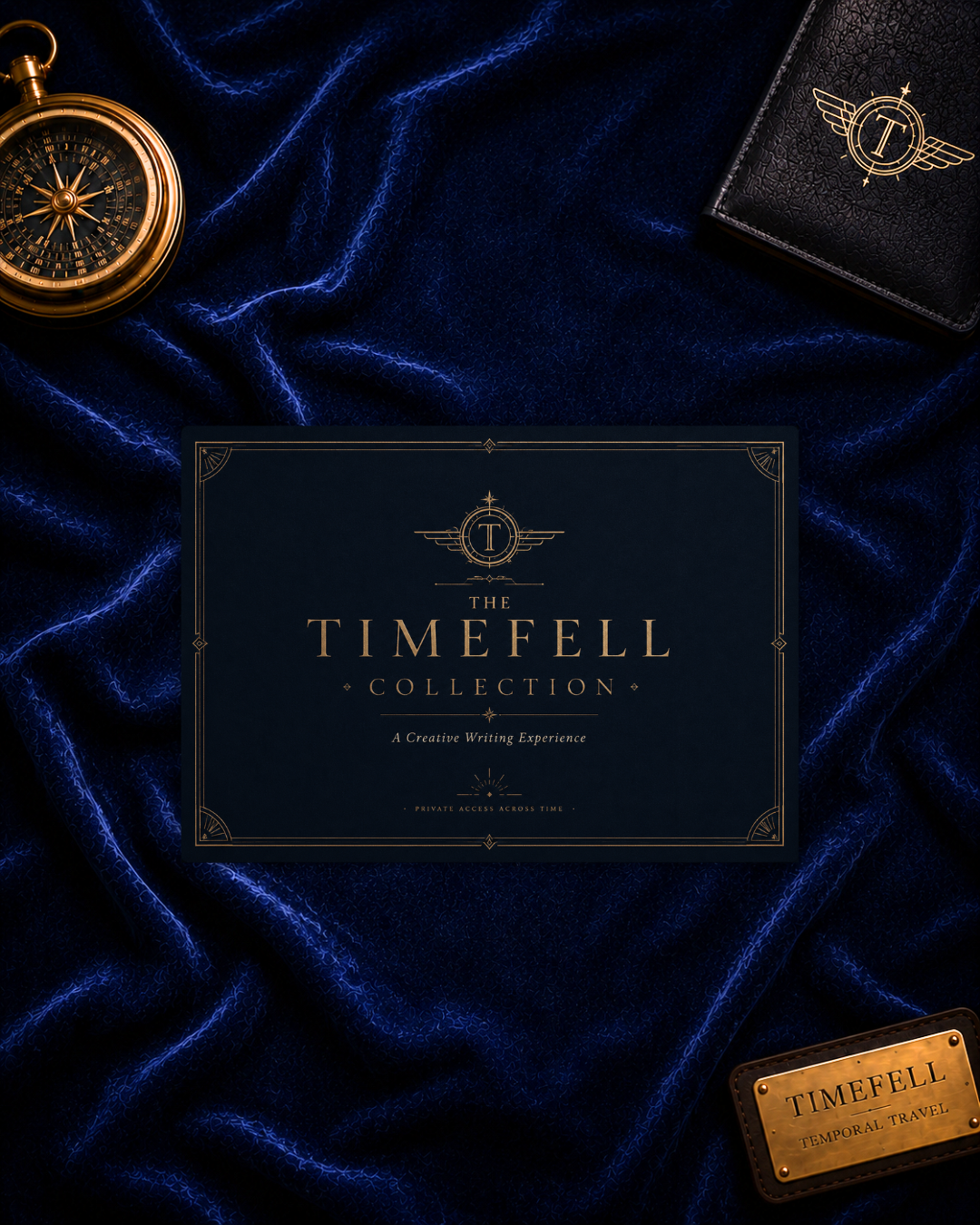
Time travel became public in 2020.
By 2046, it had become a business.
Ancient cities welcome paying visitors. Dinosaurs roam protected reserves. Luxury cruises travel between centuries. Future societies open their gates to carefully managed excursions beyond the present day.
For those who can afford it, every era is a destination.
But not every story appears in the brochure.
The Timefell Collection is an immersive archive from a world where history has become tourism. Inside you'll find travel posters, boarding passes, newspaper articles, diary entries, hotel records, reviews, private correspondence, handwritten notes, and other forgotten artefacts left behind by travellers.
Some documents fit neatly together.
Others raise uncomfortable questions.
Why have certain excursions disappeared from public records?
What experiences are reserved for Meridian Black members?
Why do some travellers become obsessed with returning?
And why do some people come back... changed?
There is no official explanation.
No final answer.
No single truth.
Only fragments of lives, stories, and secrets waiting to be uncovered.
What's Inside?
◆ 50+ printable documents and artefacts from the world of Timefell
◆ Travel posters, tickets, hotel records, reviews, newspaper articles, diary entries, correspondence, notes, and more
◆ A printable prompt card to inspire exploration and storytelling
◆ Instant digital download in PDF format
Who Is It For?
Perfect for:
◆ Writers and worldbuilders
◆ Mystery lovers and curious minds
◆ Journalers and roleplayers
◆ Fans of fictional archives and found-document storytelling
◆ Anyone who enjoys uncovering hidden connections and creating their own theories
What Makes This Different?
This isn't a mystery with a solution.
It's an archive.
Every document reveals part of a larger story, but none reveal the whole truth.
Follow the clues that interest you.
Ignore the ones that don't.
Decide what matters.
Decide what is simply a distraction.
And discover the story hidden between the pages.
Want to Step Inside a Sci-Fi World?
If you love imagining strange futures, futuristic societies and worlds revealed through the ordinary objects people leave behind, explore The Timefell Collection.
Set in a future where time travel has become a commercial industry, Timefell is an immersive fictional archive containing 50+ printable documents and artefacts from inside its world — including travel posters, boarding passes, newspaper reports, diary entries, hotel records and private correspondence.
There is no single story telling you what happened. Instead, you explore the fragments its inhabitants left behind, uncover connections between documents and gradually piece together the people, places and mysteries hidden inside the archive.
If you enjoy creating science-fiction worlds through the details of everyday life — the journeys people take, the places they stay, the advertisements they see and the systems they barely notice — explore The Timefell Collection.
Different Types of Futuristic Cities
There is no single blueprint for a futuristic city. The environment, technology, history and people of your world can produce completely different kinds of settlements.
Futuristic Megacities
A megacity might contain tens of millions of people spread across enormous urban regions.
As populations grow, cities could expand vertically as well as horizontally. Residential towers might contain schools, hospitals, shops, parks and workplaces, allowing residents to spend weeks without ever leaving their building.
But scale creates problems.
Who controls transport? How are resources distributed? Where does waste go? What happens when one section of the city's infrastructure fails?
A city designed for fifty million people can create enormous possibilities for both worldbuilding and conflict.
Underground Cities
A sci-fi underground city could exist beneath a hostile planet, beneath the ruins of an older civilisation or underneath the surface of a future Earth.
Living underground provides protection from extreme temperatures, radiation, storms and other environmental dangers, but it creates different problems.
Natural light becomes precious. Ventilation is essential. Space may be limited. Residents might spend their entire lives without seeing an open sky.
The oldest levels could also hide abandoned tunnels, forgotten infrastructure or entire districts sealed away from the modern city.
Floating and Ocean Cities
Future populations may build cities where there was once no land at all.
Floating settlements could drift across Earth's oceans, while cities on alien worlds might exist above seas thousands of kilometres deep.
Others could be constructed underwater.
These cities would depend heavily on engineering, energy and constant maintenance. A tiny structural failure could become a city-wide emergency.
They could also develop cultures completely different from those of people living on land.
Cities on Mars and Other Planets
A small planetary settlement might eventually grow into something much larger.
A research base becomes a permanent colony. The colony attracts workers. Workers bring families. Businesses appear. Roads connect neighbouring settlements. Decades later, what began as a collection of habitats has become a city.
Off-world cities could develop identities completely separate from Earth, particularly once generations are born there who have never lived anywhere else.
Corporate Cities
What happens when a company doesn't simply own the factories in a city, but the city itself?
A corporation might provide housing, transport, healthcare, education and employment while controlling almost every part of daily life.
Residents could receive better services than people elsewhere while sacrificing privacy or political freedom.
Leaving might mean losing your job, home, healthcare and even access to the systems required to function within the wider world.
Eco-Cities and Solarpunk Cities
Not every science-fiction city needs to be dark or dystopian.
A future city might be designed around renewable energy, enormous public gardens, vertical farms, pedestrian neighbourhoods and highly efficient public transport.
Buildings could produce their own electricity. Water could be continually recycled. Food might be grown within walking distance of the people who eat it.
The interesting question then becomes: what problems remain after some of today's biggest problems have been solved?
10 Futuristic City Story Ideas
A maintenance worker discovers that an abandoned underground railway line still carries one train every night.
Residents of a perfectly planned eco-city learn that one neighbourhood has been quietly removed from every official map.
A teenager living in a Martian megacity becomes obsessed with visiting Earth after discovering recordings of rain.
An entire district loses access to the city's automated systems, leaving thousands of residents unable to open doors, use transport or purchase food.
A delivery drone repeatedly brings packages to an apartment that has been empty for twenty years.
The residents of an underwater city are told that a small leak has been contained, but maintenance workers are quietly evacuating their families.
A corporate city announces that residents can now purchase permanent citizenship — but only by signing lifetime employment contracts.
Construction workers extending an underground city break through a wall into streets that do not appear on any historical plans.
A city famous for having no crime discovers that its predictive policing system has been hiding crimes rather than preventing them.
Every screen in a futuristic capital suddenly displays the same message: LEAVE THE CITY BEFORE MIDNIGHT.
10 Questions to Develop Your Futuristic City
Why was the city originally built?
What is the city famous for?
Who actually controls the city?
Where do its food, water and energy come from?
How do most residents travel around it?
Which district is the wealthiest, and which is the poorest?
What piece of technology do residents consider completely ordinary?
What part of the city are people warned not to visit?
What do outsiders misunderstand about life there?
What would happen if the city's most important system stopped working for twenty-four hours?
Go Deeper into Creating Futuristic Cities
Once you have generated your city, use the result as the foundation rather than the finished world. The details surrounding it are where your setting begins to feel real.
◆ Follow the infrastructure. Decide how water, food, electricity, waste, transport and communications move through the city. Then ask what happens when one of those systems fails.
◆ Build different neighbourhoods. Avoid making the entire city look and feel identical. Create wealthy districts, industrial areas, entertainment quarters, old neighbourhoods, transport hubs, forgotten streets and places tourists never see.
◆ Think vertically. Futuristic cities don't have to spread outwards. Wealth, pollution, sunlight, transport and social class could all change depending on how high or low someone lives.
◆ Make technology ordinary. Your characters probably won't stop to admire technology they use every day. Let futuristic details appear naturally through commuting, shopping, working, eating and socialising.
◆ Decide who owns the city. Governments, corporations, wealthy families, artificial intelligence systems or competing organisations could all influence how the city functions and who benefits from it.
◆ Find the city beneath the city. Think about what existed before the futuristic skyline appeared. Old tunnels, abandoned buildings, buried streets, obsolete technology and forgotten communities can give even the newest science-fiction city a sense of history.
Final Thoughts
A futuristic city can be dazzling, overcrowded, beautiful, oppressive, sustainable, chaotic or all of those things at once.
The skyline might catch your reader's attention, but the tiny details will make them believe people actually live there.
Use the Futuristic City Name Generator to create a city name, location, identity and detail of everyday life, then start asking questions. Who built it? Who controls it? Where do ordinary people live? What technology has become mundane? What does the city promise its residents — and what does it hide from them?
For more science-fiction inspiration, explore Sci-Fi Story Sparks, continue building your world in the Sci-Fi Writing Hub, try another tool from the Creative Writing Generator Hub, or browse the Creative Writing Archive for more prompts, story ideas and worldbuilding guides.
Choose Your Next Adventure