Space Colony Name Generator: Create a Sci-Fi Settlement
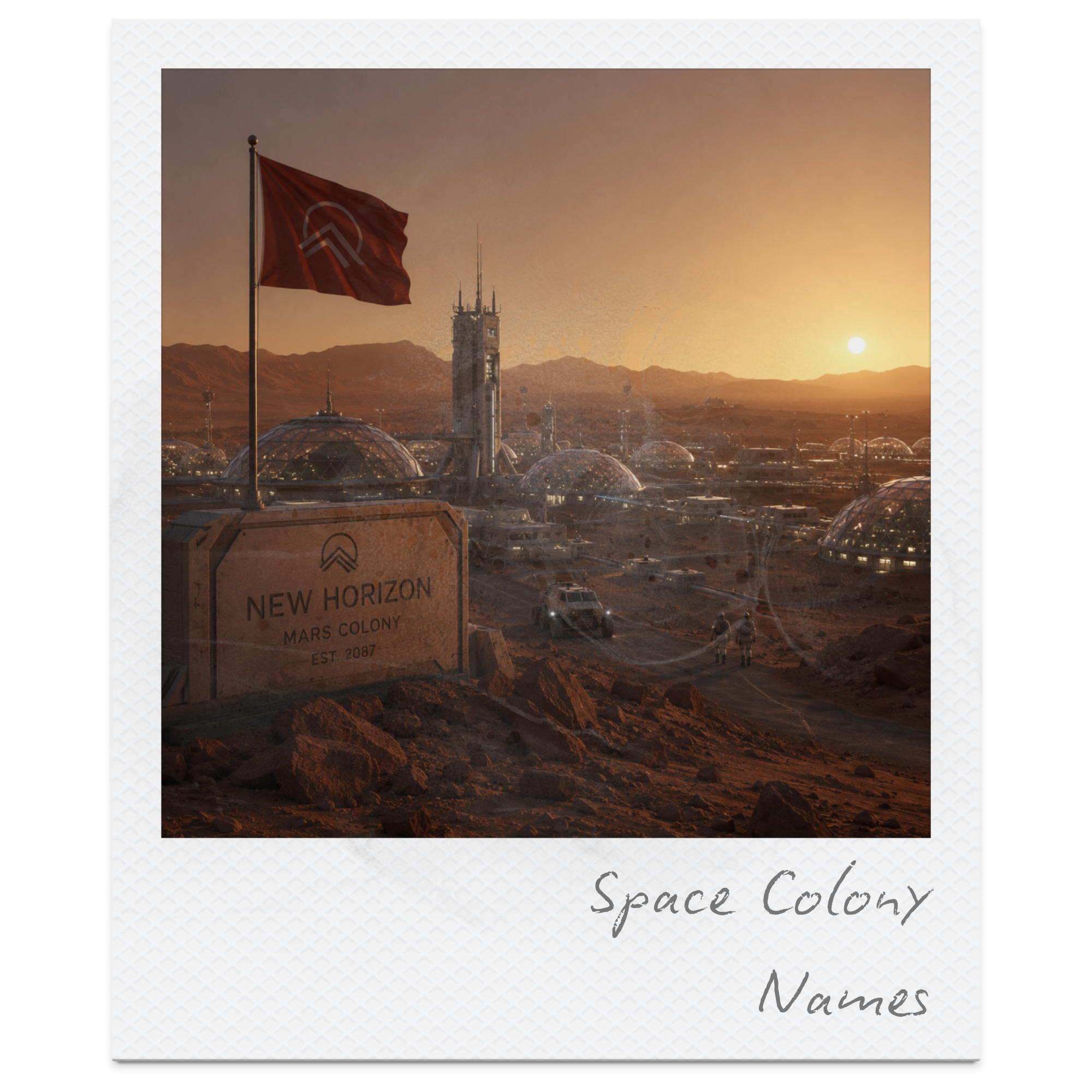
What would life look like in a human settlement far beyond Earth? Whether your characters are building the first permanent colony on Mars, surviving beneath the ice of a distant moon or living in a settlement at the edge of explored space, a convincing colony needs more than a name.
This Space Colony Name Generator creates an instant science-fiction settlement, combining a colony name and location with its living conditions, homes and details of everyday colony life. With more than a trillion possible combinations, you can use it to build everything from a struggling Moon colony to a vast future space settlement on a distant planet.
Use the generator below to create your colony, then refresh individual sections to develop the idea you want to explore. For more worldbuilding inspiration, visit the Sci-Fi Writing Hub, explore more interactive tools in the Creative Writing Generator Hub, or browse the Creative Writing Archive for prompts, ideas and writing guides.
Space Colony Generator
Generate a name, location and details for a human settlement beyond Earth.
How to Use the Space Colony Generator
Click Generate New Colony to create a completely new science-fiction settlement. Each result includes five elements:
Colony Name: the name of your new settlement.
Location: where the colony has been established, from Mars and the Moon to orbital habitats and distant invented planets.
Living Conditions: the environmental and practical realities that shape everyday survival.
Homes: what houses and residential spaces look like within the colony.
Colony Life: a detail about the society itself, from childhood and family structures to education, laws, traditions and work.
You do not have to keep the entire result. Use the refresh button beside an individual section to change that element while keeping everything else.
If you find a combination you want to develop, use Copy Full Result to save the complete colony as a starting point for your story or worldbuilding notes.
What Makes a Good Space Colony?
A believable space colony is not simply a city with spaceships outside it. Where people live affects almost every part of the society they create.
Start with the environment. A colony on Mars has very different problems from a settlement floating in the atmosphere of Venus, buried beneath Europa's ice or travelling between stars aboard a generation ship. Gravity, temperature, radiation, atmosphere, water and access to food all determine what survival actually requires.
Then think about how those conditions have changed ordinary life.
If oxygen is limited, is wasting it a crime? If housing is difficult to construct, do several generations live together? If the nearest hospital is on another planet, what happens during a medical emergency? If children have never experienced rain, oceans or an open blue sky, what do they imagine Earth is like?
The strongest science-fiction settlements often emerge when the practical realities of survival begin shaping the culture itself.
Living Conditions
Think about what your colonists need every single day.
Where does their oxygen come from? How is water collected? What can they grow? How dangerous is it to leave the settlement? How much gravity do they experience?
A colony might be technologically advanced while remaining incredibly vulnerable. One damaged oxygen processor, contaminated crop or failed reactor could threaten thousands of people.
Scarcity can also change behaviour. Water rationing might make baths an unimaginable luxury. Real fruit might be reserved for celebrations. A wooden table transported from Earth could become a family heirloom worth more than jewellery.
Homes
Space-colony homes do not have to be sleek white rooms filled with futuristic technology.
Your settlers might live inside converted cargo modules, underground tunnels, lava tubes, enormous rotating habitats, floating platforms, excavated asteroids or houses constructed from local rock.
Think about what people would do to make those places feel like home.
Perhaps families project artificial windows onto windowless walls. Children paint ceilings blue because they have never seen an Earth sky. Houseplants might be treasured possessions, while furniture brought from Earth is passed down for generations.
The contrast between what people need to survive and what they need to feel human can create some of the most interesting details in your world.
Colony Life
This is where a space settlement can become much more than a location.
Think about what growing up there would actually mean.
Children might learn emergency oxygen repairs at school. Every citizen could be required to perform community maintenance. Families might consist of several unrelated adults raising children together because dangerous work makes traditional family structures impractical.
Even celebrations can evolve around the environment. A colony might celebrate the first sunrise after months of darkness, give fresh fruit as a wedding gift or hold an annual feast commemorating the arrival of the original settlement ship.
Small details like these make a fictional society feel as though people have actually lived there for generations.
Time travel became public in 2020.
By 2046, it had become a business.
Ancient cities welcome paying visitors. Dinosaurs roam protected reserves. Luxury cruises travel between centuries. Future societies open their gates to carefully managed excursions beyond the present day.
For those who can afford it, every era is a destination.
But not every story appears in the brochure.
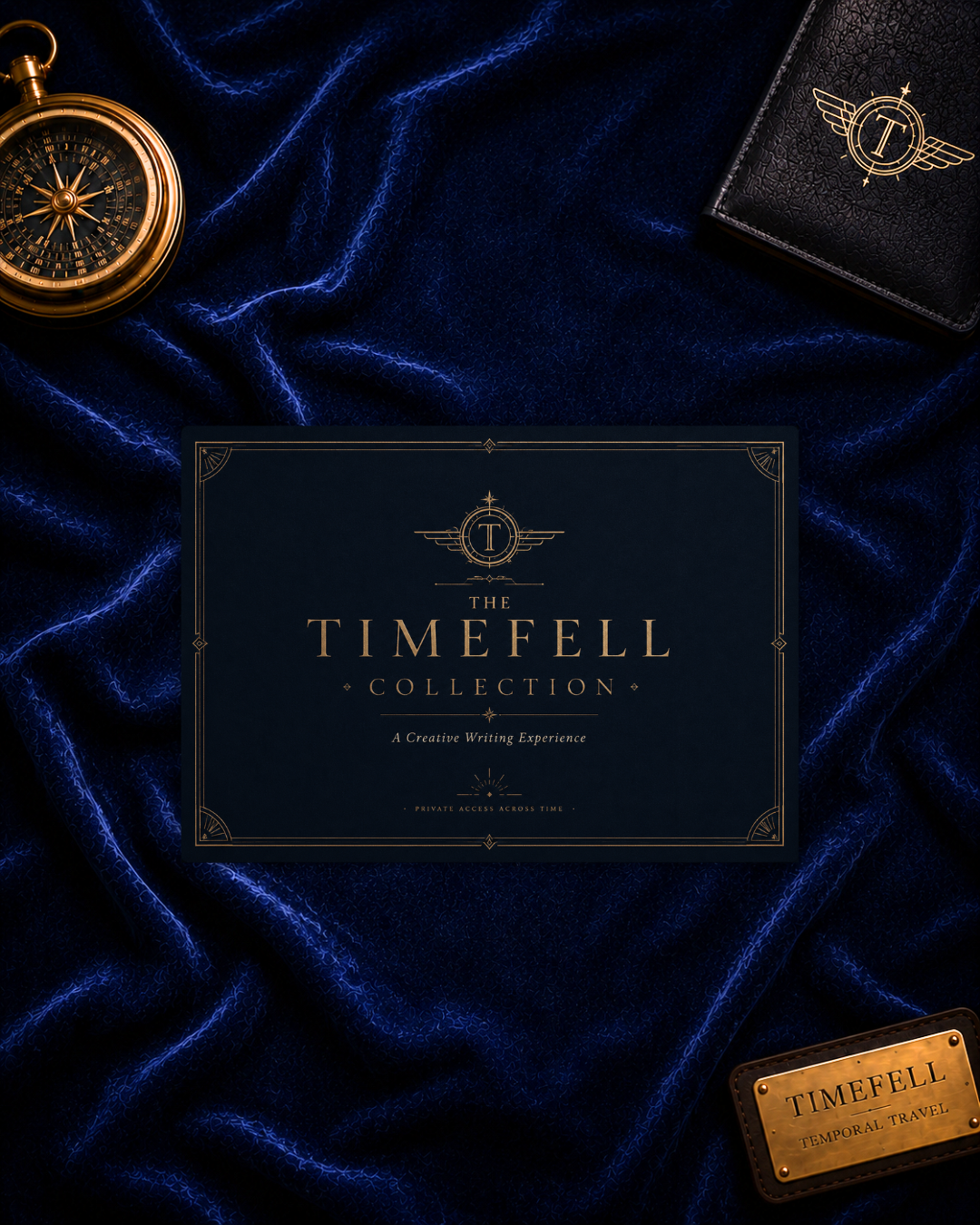
The Timefell Collection is an immersive archive from a world where history has become tourism. Inside you'll find travel posters, boarding passes, newspaper articles, diary entries, hotel records, reviews, private correspondence, handwritten notes, and other forgotten artefacts left behind by travellers.
Some documents fit neatly together.
Others raise uncomfortable questions.
Why have certain excursions disappeared from public records?
What experiences are reserved for Meridian Black members?
Why do some travellers become obsessed with returning?
And why do some people come back... changed?
There is no official explanation.
No final answer.
No single truth.
Only fragments of lives, stories, and secrets waiting to be uncovered.
What's Inside?
◆ 50+ printable documents and artefacts from the world of Timefell
◆ Travel posters, tickets, hotel records, reviews, newspaper articles, diary entries, correspondence, notes, and more
◆ A printable prompt card to inspire exploration and storytelling
◆ Instant digital download in PDF format
Who Is It For?
Perfect for:
◆ Writers and worldbuilders
◆ Mystery lovers and curious minds
◆ Journalers and roleplayers
◆ Fans of fictional archives and found-document storytelling
◆ Anyone who enjoys uncovering hidden connections and creating their own theories
What Makes This Different?
This isn't a mystery with a solution.
It's an archive.
Every document reveals part of a larger story, but none reveal the whole truth.
Follow the clues that interest you.
Ignore the ones that don't.
Decide what matters.
Decide what is simply a distraction.
And discover the story hidden between the pages.
Want to Step Inside a Sci-Fi World?
If you love building strange futures, imagined societies and worlds that feel as though they might really exist, explore The Timefell Collection.
Set in a future where time travel has become a commercial industry, Timefell is an immersive fictional archive filled with 50+ printable documents and artefacts — from travel posters and boarding passes to newspaper reports, diary entries, hotel records and private correspondence.
There is no single story to follow. Instead, you piece together the world through the fragments its inhabitants left behind, uncovering strange connections, unanswered questions and stories hidden between the pages.
Explore The Timefell Collection now!
Where Could Humans Build a Space Colony?
Science-fiction gives you considerably more freedom than simply choosing between a Moon colony and a Mars colony.
The Moon
A lunar colony could be one of humanity's earliest permanent settlements beyond Earth. Your characters might live inside lava tubes, beneath layers of protective lunar soil or close to the Moon's poles where access to water ice becomes essential.
Its proximity to Earth also creates an interesting tension: home is visible in the sky, but still impossibly far away.
Mars
Mars is an obvious setting for space colonisation stories, but that does not make every Mars colony the same.
A settlement buried beneath the surface would feel very different from an isolated scientific station, a vast terraforming project or a colony that has survived long enough to develop its own identity and resent interference from Earth.
Moons and Asteroids
Europa, Titan, Ganymede, Callisto and other moons offer environments very different from Mars.
You could also place a colony inside a hollowed asteroid, transforming a piece of rock into a rotating settlement containing homes, farms and industry.
Orbital Space Settlements
Your colony does not need a planet at all.
Large rotating habitats could create artificial gravity while supporting entire cities in space. A settlement might orbit Earth, another planet or simply exist at a strategically useful point between worlds.
An orbital colony also raises an interesting question: after several generations, would its inhabitants still consider themselves Earthlings?
Distant Planets
For stories set farther into humanity's future, invent your own world.
A planet could be tidally locked, leaving one side in permanent daylight and the other in darkness. It might have stronger gravity than Earth, a toxic atmosphere, enormous oceans or seasons lasting decades.
You do not need to design every geological detail. Start with one environmental difference and ask how humans would adapt to it.
10 Space Colony Story Ideas
A Mars colony suddenly stops receiving messages from Earth. At first, everyone assumes the communication system has failed. Then they intercept a transmission that was never intended for them.
Children born in a low-gravity settlement discover that their bodies could never tolerate permanent life on Earth.
A colony ship reaches the planet its passengers have spent generations travelling towards, only to discover another human settlement already there.
A remote colony introduces strict population controls after calculations reveal its life-support system can sustain only a few hundred additional people.
Workers expanding an underground settlement discover a sealed chamber that predates the arrival of humans.
A settlement survives entirely because of one enormous oxygen-production system. When it begins failing, the engineers discover someone has been deliberately damaging it.
The inhabitants of an orbital colony vote to declare independence from Earth, but Earth controls the supply ships carrying technology they cannot manufacture themselves.
A teenager living on a planet where outdoor travel is forbidden discovers that her family has been secretly leaving the settlement for years.
The first generation born aboard a colony ship begins questioning why they should spend their entire lives travelling towards a planet chosen by people who died centuries ago.
A thriving colony learns that its supposedly lifeless planet once supported an intelligent civilisation — and something beneath the settlement is beginning to reactivate.
10 Questions to Develop Your Space Colony
Use your generated result as the beginning rather than the finished world.
Why was the colony originally established?
Who paid for or organised the first settlement?
What is the single most important resource keeping the colony alive?
What does the colony still depend on Earth or another settlement to provide?
What happens if somebody deliberately wastes an essential resource?
What would a child born here consider completely normal that an Earth-born visitor would find strange?
What is the most dangerous job in the colony?
Which tradition has developed since the settlement was founded?
What part of the colony's history would its leaders rather people forgot?
What would happen if the colony were suddenly cut off from the rest of humanity?
You do not need to answer all ten before you begin writing. Sometimes one unexpected answer is enough to transform a generated settlement into the beginning of an entire story.
Go Deeper in Creating Space Colonies
Once you have generated your space colony, start looking beyond the individual details and think about how they connect. The most convincing science-fiction settings feel as though their societies have developed naturally in response to the worlds around them.
◆ Let the environment shape the society. If water is scarce, decide how that changes laws, manners, wealth and everyday habits. If gravity is low, consider how it affects everything from architecture and sport to childhood and ageing.
◆ Think about what your colonists have lost. A settlement far from Earth may have no oceans, forests, animals, weather or natural sky. Consider which ordinary Earth experiences have become luxuries, memories or even myths.
◆ Make survival part of ordinary life. Oxygen shortages and radiation storms do not always need to create dramatic disasters. They can appear through school lessons, household rules, emergency kits, architecture and the routines your characters barely think about.
◆ Give the colony its own culture. Invent celebrations, slang, food, superstitions, traditions and social expectations that could only have developed in this particular settlement.
◆ Explore generational differences. Someone who remembers Earth may see the colony very differently from a child whose family has lived there for three generations. Ask what each considers home — and whether either would willingly leave it.
◆ Find the pressure point. Once your colony feels established, decide what could destabilise it. A failed harvest, political dispute, damaged life-support system, unexpected transmission or discovery beyond the settlement can turn your worldbuilding into the beginning of a story.
Final Thoughts
A memorable space colony is shaped as much by ordinary life as it is by technology. Think beyond rockets, domes and distant planets to the people who actually have to build homes, raise children, form relationships, make rules and create traditions there.
Generate a colony above, keep the details that spark something and change anything that doesn't. A single strange rule, impossible location or detail about everyday life might be all you need to discover your next science-fiction world.
For more ideas, continue exploring the Sci-Fi Writing Hub, try another tool from the Creative Writing Generator Hub, or browse the Creative Writing Archive for your next story.
Choose Your Next Adventure