Getting Started with Writing Fiction: Finding Your Voice as a Beginner Writer
Getting started with writing fiction can feel overwhelming, especially if you’re worried about whether you have a “real” writing voice yet. Many beginner writers assume that voice is something you need to discover before you can begin — as if other writers have it figured out and you don’t. In reality, writing voice isn’t something you wait for. It’s something that emerges through the act of writing itself.
A useful way to think about voice in writing is as a fingerprint. Everyone has one, no two are the same, and you don’t design it deliberately. Your writing voice already exists — it’s shaped by the stories you’re drawn to, the details you notice, and how you instinctively frame emotion, tension, and meaning. Writing doesn’t create your voice; it reveals it.
This post is the first in a series on getting started with writing fiction, designed for beginner writers of any age. You don’t need experience, a finished idea, or a clear sense of genre to begin. Instead, we’ll look at what writing voice actually means, why starting often feels harder than it should, and how simple, low-pressure writing can help you develop confidence and direction over time.
Why Getting Started with Writing Fiction Feels So Hard
For many beginner writers, the hardest part of writing fiction isn’t skill — it’s permission. There’s often an unspoken belief that you should know what you’re doing before you begin, or that your writing should sound confident, original, and polished from the very first sentence. That expectation alone is enough to stop people before they start.
Another reason getting started with writing fiction feels difficult is comparison. New writers often measure their early drafts against finished novels, short stories, or writers who have been developing their craft for years. When your work doesn’t match what you admire yet, it’s easy to assume something is missing — talent, voice, or originality — rather than recognising that you’re simply at an earlier stage.
There’s also a misunderstanding about how stories are supposed to begin. Many people feel pressure to start with a fully formed plot, a clear genre, or a strong opening line. In reality, most fiction begins much smaller: with a moment, an image, a line of dialogue, or a feeling you want to explore. Waiting for a “perfect” idea often delays the very writing that would help that idea take shape.
It’s also worth naming that uncertainty is not a sign you’re doing something wrong. Feeling unsure, scattered, or dissatisfied at the start is a normal part of the creative writing process. Writing fiction involves making choices without knowing where they’ll lead, and that discomfort doesn’t disappear with experience — writers simply learn how to work alongside it.
Understanding this can be freeing. You don’t need confidence before you begin writing; confidence develops because you write. The goal at the start isn’t to produce something finished or impressive — it’s to get words on the page so your thinking, instincts, and writing voice have room to emerge.
What Writing Voice Actually Means (and What It Isn’t)
When people talk about writing voice, it’s often described in vague or intimidating ways — as something instinctive, distinctive, or immediately recognisable. This can make beginners feel as though voice is a talent you either have or don’t. In reality, writing voice is much simpler and more grounded than that.
Your writing voice is the pattern of choices you make on the page. It shows up in the kinds of stories you’re drawn to, the details you notice, how you handle emotion, and the rhythm of your sentences. These choices aren’t usually deliberate at first. They emerge naturally as you write, often before you’re aware of them.
What’s important to understand is what writing voice is not. It isn’t a gimmick, a tone you perform, or a set of stylistic tricks. It’s not about sounding literary, dramatic, or original on demand. Trying to “sound like a writer” is one of the fastest ways to lose confidence, because it puts pressure on every sentence to prove something.
Voice also isn’t fixed from the beginning. Early drafts often feel inconsistent, uncertain, or unfinished — and that’s normal. As you write more fiction, certain habits begin to repeat. You might notice that you focus on atmosphere, or that your dialogue tends to be understated, or that you’re drawn to moments of tension rather than action. These patterns are not mistakes; they are signals.
This is why the idea of voice as a fingerprint is so useful. You don’t design a fingerprint, and you don’t practise having one. It exists whether or not you think about it. Writing fiction works the same way. Your voice doesn’t appear because you’ve decided what it should sound like — it appears because you’ve written enough for it to reveal itself.
Understanding this takes pressure off the process. You don’t need to “find” your voice before you start writing fiction. You develop it by writing, noticing what feels natural, and allowing those instincts to repeat over time.
How to Start Finding Your Writing Voice
Finding your writing voice doesn’t happen through big declarations or labels. It develops gradually, through repeated choices and small pieces of writing that allow patterns to emerge. The key is to work in ways that reduce pressure and increase familiarity with how you think on the page.
Read Widely (and Notice What Pulls You In)
Reading is one of the most effective ways writers begin to understand their own voice — not by copying style, but by noticing what engages them as readers. The things that hold your attention often reflect the kinds of choices you’re instinctively drawn to in your own writing.
As you read fiction, pay attention to:
◆ tone (the writer’s attitude or approach — for example, reflective, tense, ironic, warm, or detached)
◆ mood (the emotional feeling the writing creates for the reader, such as unease, calm, sadness, or anticipation)
◆ pacing and sentence rhythm (whether the writing moves quickly or lingers on moments)
◆ focus (what the writer chooses to dwell on — action, thought, setting, or emotion)
You don’t need to analyse everything you read. Simply noticing what pulls you in — and what doesn’t — gives you valuable clues about the kinds of stories, voices, and emotional registers you respond to most strongly.
Write Short Pieces Instead of Full Stories
One of the biggest obstacles for beginner writers is the belief that fiction must begin with a complete story. In reality, short pieces are far more useful for developing voice because they allow experimentation without the pressure of plot or structure.
Forms that work particularly well include:
◆ brief scenes or images focused on a single moment
◆ flash fiction (very short stories that prioritise implication over explanation)
◆ fragments or snapshots rather than full narratives
◆ single-paragraph character or setting sketches
Short writing makes it easier to experiment with atmosphere — the overall emotional environment of a piece, created through setting, detail, and language choices. Because the scale is small, you can focus on how something is written rather than worrying about where the story is going.
Capture Ideas, Even When They’re Vague
Many writers discard ideas too early because they don’t arrive fully formed. However, vague or incomplete ideas are often the raw material of voice-led writing. They reveal what your imagination returns to before logic steps in.
It’s worth jotting down:
◆ lines of dialogue without context
◆ images or settings that feel charged or uneasy
◆ situations that spark curiosity, tension, or discomfort
◆ emotional moments without explanation
You don’t need to understand these ideas yet. Writing them down helps you notice recurring interests — and those repetitions are often more important than polished concepts at this stage.
Write the Scenes That Appear Uninvited
Sometimes writing voice announces itself through moments that arrive unexpectedly — a sentence, an image, or a scene that keeps resurfacing. These fragments are worth following, even if they don’t seem useful or story-ready.
Writing these moments allows you to:
◆ follow instinct rather than plan
◆ explore tone and mood freely
◆ practise writing without outcome pressure
Voice often becomes clearer when you stop asking whether something is “good” and start asking whether it feels compelling to write.
Use Flash Fiction to Experiment Safely
Flash fiction is particularly useful for beginner writers because it encourages precision without scale. Writing very short fiction allows you to focus on language and emotional impact rather than plot complexity.
Flash fiction helps you practise:
◆ choosing details carefully
◆ using implication (suggesting meaning rather than explaining everything)
◆ creating atmosphere quickly
◆ finishing pieces without exhaustion
Because flash pieces are small, you can write more of them — and repetition is one of the fastest ways to notice patterns in your writing.
Let Repetition Do the Work
Writing voice doesn’t appear because you decide what it should sound like. It appears because certain choices repeat themselves over time. You might notice that you keep returning to:
◆ quiet tension rather than action
◆ internal thought over dialogue
◆ setting as a source of meaning
◆ emotionally restrained moments
These repetitions aren’t weaknesses — they’re information. Paying attention to them helps you understand your writing voice without forcing it into a category too early.
If you’d like structured starting points for this kind of writing, the Creative Writing Archive offers prompts designed to work at scene-level and flash-length, making them ideal for experimenting, practising, and discovering what feels natural to write.
How to Start Writing Fiction Without a Full Story Idea
One of the biggest myths about writing fiction is that you need a complete story before you begin. Many beginner writers wait for a clear plot, a defined genre, or a strong opening line — and end up waiting far longer than necessary. In practice, most stories don’t begin fully formed. They grow out of scenes, moments, and questions discovered through writing.
Instead of asking “What is my story about?”, it’s often more useful to ask “What moment do I want to explore?” Fiction frequently starts small and expands later.
Start with a Moment, Not a Plot
A moment is a short stretch of time where something changes, even slightly. It might involve tension, uncertainty, or emotional shift — but it doesn’t need resolution.
You might begin with:
◆ a character entering a room
◆ a conversation that starts mid-way
◆ a discovery or interruption
◆ a quiet moment charged with emotion
Moments work well because they give you something concrete to write now, without requiring you to know what comes next. Once a moment exists on the page, it often suggests what the story might become.
Write in the Middle (You Can Go Back Later)
Beginners often feel pressure to write a “proper” beginning. In reality, many writers draft scenes out of order. Writing in the middle allows you to focus on voice, tone, and atmosphere rather than explanation.
Starting mid-scene helps you:
◆ avoid over-explaining
◆ trust implication rather than backstory
◆ practise writing with immediacy
You can always add context later — or decide it isn’t needed at all.
Let Characters Lead Before You Understand Them
You don’t need a fully developed character profile to begin writing fiction. Often, characters become clearer because you write them.
Try starting with:
◆ a character reacting to something unexpected
◆ a character who wants something small but specific
◆ a character placed slightly out of their depth
As you write, details will emerge naturally — how they think, what they notice, how they respond under pressure. These discoveries are part of the writing process, not preparation you’ve missed.
Allow Uncertainty While You Write
Not knowing where a piece is going can feel uncomfortable, but uncertainty is a normal part of creative writing. Writing fiction often involves making choices without knowing whether they’ll matter yet.
Rather than stopping when you feel unsure, try:
◆ continuing for a few more paragraphs
◆ following the emotional thread of the scene
◆ asking what would complicate the moment slightly
You don’t need confidence to keep writing — momentum often creates it.
Use Prompts as Entry Points, Not Instructions
Writing prompts are most helpful when they act as starting points, not rules. A prompt doesn’t need to be followed closely or completed. Its job is simply to give you something to respond to so you can begin writing.
If you find it easier to start with guidance, the Creative Writing Archive includes prompts designed to help writers begin at scene level, experiment with voice, and write without needing a full story idea.
What Matters Most at the Start
At this stage, progress doesn’t come from planning harder — it comes from writing more often and paying attention to what happens when you do.
The goal isn’t to finish a story or define yourself as a writer. It’s to:
◆ get words on the page
◆ notice what feels natural to write
◆ allow voice and direction to develop over time
Stories grow out of practice. Starting small is not avoiding real writing — it is real writing.
Where to Find Inspiration for Writing Fiction
Inspiration for writing fiction doesn’t usually arrive as a fully formed idea. More often, it begins as something small — a feeling, a place, a question, or a fragment of experience that lingers. Learning where to look for inspiration is less about chasing ideas and more about noticing what already stays with you.
Many beginner writers assume inspiration has to be dramatic or original. In reality, some of the most compelling fiction grows out of ordinary experiences observed closely.
Personal Experiences (and Emotional Truth)
You don’t need to write autobiographically to draw on personal experience. What matters more than events is emotional truth — how something felt, not exactly what happened.
Personal experience can inspire fiction through:
◆ moments of change or uncertainty
◆ feelings you didn’t fully understand at the time
◆ relationships that left an emotional imprint
◆ situations where something felt unresolved
These experiences can be reshaped, exaggerated, or entirely reimagined. Fiction allows you to explore emotional reality without needing factual accuracy.
Places You’ve Been (and How They Felt)
Settings often hold more inspiration than plots. Places you’ve visited — or lived in — carry atmosphere, memory, and sensory detail that can anchor a piece of fiction.
You might draw inspiration from:
◆ a location that felt comforting, unsettling, or unfamiliar
◆ places tied to particular seasons or times of day
◆ spaces associated with waiting, transition, or isolation
When writing about place, focus less on description and more on how the setting affects the character. Setting becomes powerful when it shapes mood, behaviour, or tension.
Dreams, Half-Memories, and Fleeting Images
Dreams and half-remembered images are especially useful for fiction because they don’t arrive logically. They often carry mood before meaning, which makes them ideal starting points.
You might use:
◆ a single image from a dream
◆ a conversation fragment without context
◆ a sense of unease or familiarity without explanation
These fragments don’t need to make sense yet. Writing them down preserves their emotional charge before it fades, allowing you to explore them later through fiction.
Questions, “What Ifs”, and Quiet Curiosity
Some stories begin not with inspiration, but with curiosity. A small question can be enough to open up a fictional space.
For example:
◆ What if someone returned to a place they never planned to see again?
◆ What if a character misunderstood an important moment?
◆ What if something ordinary suddenly felt charged or threatening?
These questions don’t need answers immediately. Writing fiction is often the process of thinking through a question on the page.
Paying Attention to What Lingers
Perhaps the most reliable source of inspiration is noticing what stays with you. Ideas worth exploring often return repeatedly, even when you try to ignore them.
Pay attention to:
◆ images or scenes that resurface unprompted
◆ themes you keep circling in your writing
◆ emotions that feel unfinished or unresolved
These recurring elements are not distractions — they’re signals. Over time, they often shape both voice and subject matter.
If you’d like structured ways to explore inspiration without pressure, the Creative Writing Archive includes prompts designed to draw on memory, place, emotion, and imagination, helping writers begin without needing a clear story idea.
Where to Go Next as a Beginner Writer
As you continue writing fiction, it’s worth remembering that feeling unsure doesn’t mean you’re doing it wrong. Uncertainty is part of the process, especially at the beginning, when you’re still learning how your ideas take shape on the page. Most writers don’t feel a clear sense of voice or direction while it’s developing — they recognise it later, looking back.
At this stage, progress comes less from planning and more from regular, low-pressure writing. Short sessions, unfinished pieces, and experimental drafts all count. The aim isn’t to produce something polished, but to build familiarity with your own instincts — what you notice, what you return to, and what feels worth exploring further.
As you keep going, it can help to:
◆ write little and often, rather than waiting for long stretches of time
◆ return to short forms like scenes or flash fiction when motivation dips
◆ reread your work occasionally to notice patterns, not flaws
◆ allow your interests to shift without forcing consistency too early
If you’d like support as you continue, structured prompts can provide useful entry points without limiting creativity. The Creative Writing Archive offers a wide range of prompts designed to help writers experiment with voice, explore different types of scenes, and keep writing even when ideas feel uncertain.
This post is the first step in a wider series on getting started with writing fiction. As you move forward, we’ll look more closely at building scenes, developing characters, shaping ideas into stories, and continuing to write with confidence — one small piece at a time.
You don’t need to have everything figured out to begin. Writing fiction is something you learn by doing, and every page you write is part of that learning.
Go Deeper into Developing Your Writing Practice
Go Deeper: Developing Your Writing Practice
Once you’ve started writing fiction, the next step isn’t to rush towards finished stories, but to create conditions that help you keep writing. Developing your writing voice happens through regular practice, experimentation, and allowing yourself to work without knowing the outcome in advance.
The following approaches can help you deepen your writing practice while keeping pressure low:
◆ Return to short forms regularly, such as scenes, fragments, or flash fiction, to stay focused on voice rather than plot
◆ Reread your work occasionally to notice patterns and recurring interests, not to judge quality
◆ Collect ideas in one place — images, overheard lines, moments, questions — and let them sit until they’re ready to be explored
◆ Write without explaining everything, trusting implication and atmosphere to do some of the work
◆ Revisit the same idea more than once, allowing it to change each time you write it
◆ Pay attention to what feels compelling to write, even if it doesn’t seem useful or finished
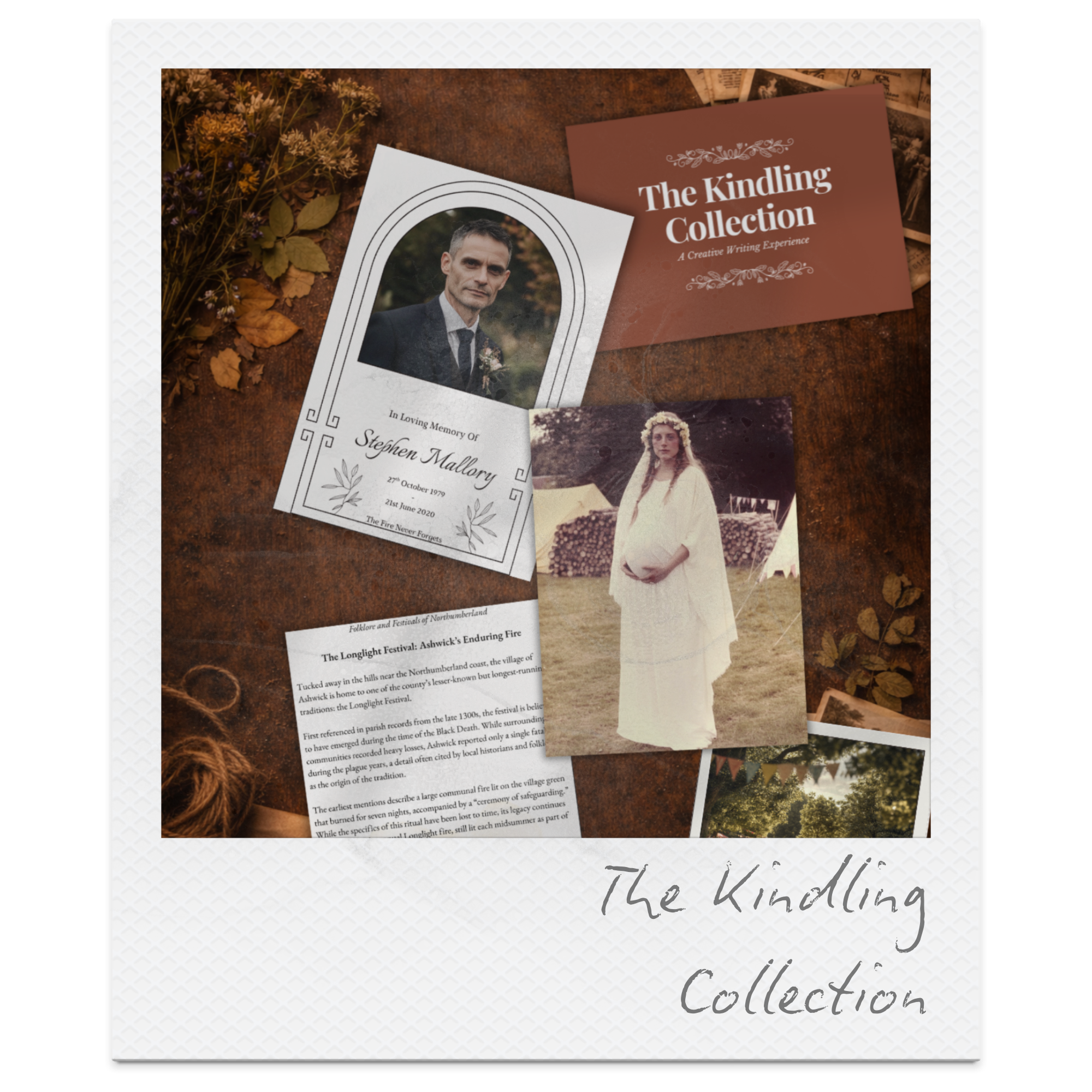
If starting feels overwhelming, structured scene-level prompts can remove decision fatigue and help you write within minutes. The Kindling Collection is a digital creative writing box built around fragments, atmosphere, and unanswered questions. Inspired by folklore, ritual, and eerie village traditions, it offers letters, warnings, journal pages, and unsettling ephemera designed to spark fiction through mood, suggestion, and choice, rather than instructions or linear plots.
There are no set rules and no single storyline — just a series of moments that invite you to write, interpret, and shape your own version of events. It’s particularly well suited to writers who enjoy working with atmosphere, short scenes, and layered ideas, and who want to develop their voice through exploration rather than planning.
Final Thoughts
Getting started with writing fiction doesn’t require certainty, confidence, or a fully formed idea. It begins with attention — to what interests you, what lingers in your mind, and what feels natural when you write. Your writing voice isn’t something you need to invent or perform; it develops gradually through practice, repetition, and permission to write imperfectly.
As you continue, it’s worth remembering that uncertainty is not a problem to solve — it’s part of the process. Writing fiction often starts with fragments, scenes, or questions rather than answers. Over time, those small pieces begin to connect, and patterns emerge. That’s how voice takes shape: quietly, and often without you noticing at first.
This post is the starting point of a wider series on getting started with writing fiction. As you move forward, the focus will shift towards building scenes, developing characters, shaping ideas into stories, and continuing to write with confidence. You don’t need to rush any of it. Writing is something you learn by doing, and every page you write is part of that learning.
Wherever you’re starting from, the most important step is simply to keep going — one small piece of writing at a time.
