Laurence Binyon: Context, War Poetry, and Literary Significance
Laurence Binyon was an English poet, art historian and museum curator whose writing became deeply connected with the remembrance of the First World War. He is best known for “For the Fallen,” written in September 1914 as Britain confronted some of its first major losses of the conflict. Its famous fourth stanza, beginning “They shall grow not old,” later became known as the Ode of Remembrance and remains an important part of commemorative ceremonies today.
Binyon offers a different perspective from many of the young soldier-poets now associated with the war. Already forty-five when the conflict began, he was an established literary and cultural figure who initially wrote about war from the position of a civilian observer, although he later volunteered with the British Red Cross in France. His poetry explores death, sacrifice, remembrance, national identity and collective grief, asking how those killed in war might continue to be remembered by the living.
This guide explores Laurence Binyon’s life, historical and social context, literary influences, major themes and lasting significance, including the remarkable transformation of For the Fallen from a wartime poem into part of the language of public remembrance. For more author studies, poetry analysis and literary context, explore the Literature Library.

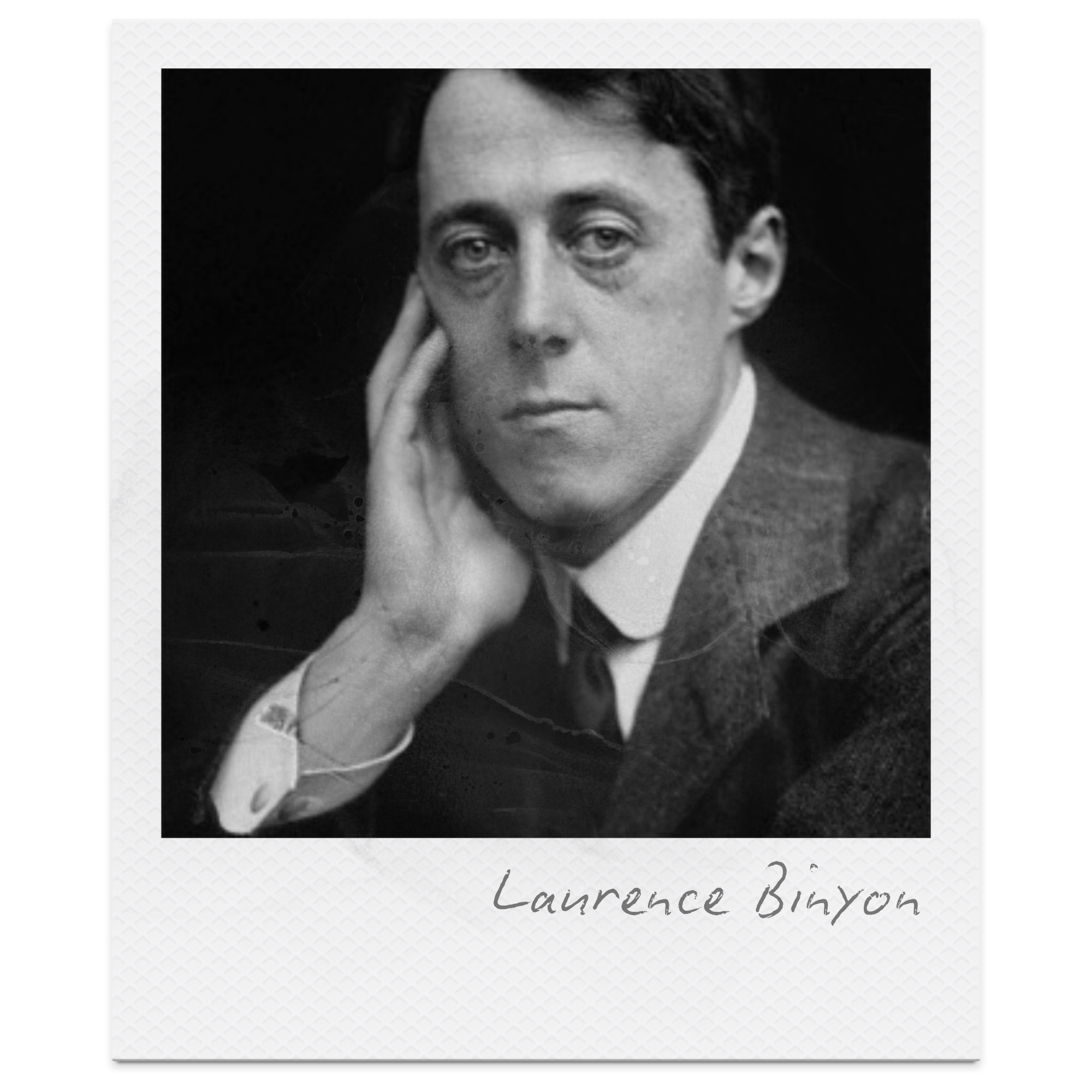
Who Was Laurence Binyon?
Robert Laurence Binyon (1869–1943) was an English poet, art historian, curator, critic and translator whose long literary career stretched from the late Victorian period into the Second World War. Today, he is remembered above all for “For the Fallen,” but he had already spent decades writing poetry and establishing himself within Britain's artistic and literary culture before the First World War began.
Binyon was born on 10 August 1869 in Lancaster, England, into a clerical family. He was educated at St Paul’s School in London before studying at Trinity College, Oxford, where he read Classics. His literary ambitions were already apparent during his university years: in 1891, he won the prestigious Newdigate Prize for poetry.
After Oxford, Binyon began the career that would shape much of his intellectual life. In 1893, he joined the British Museum, initially working within its Department of Printed Books before moving into the department responsible for prints and drawings. He would remain associated with the museum for more than four decades.
This was far more than a conventional administrative career.
Binyon became a respected scholar of visual art, developing particular expertise in British, Chinese and Japanese art. His work contributed to the study and appreciation of East Asian art in Britain, while his professional environment placed him in daily contact with works that had survived across centuries and cultures.
This aspect of Binyon’s life is especially interesting when considering his later poetry of remembrance. His professional career was fundamentally concerned with cultural preservation: studying objects from the past, interpreting them for contemporary audiences and helping ensure their survival for future generations.
Similar questions would later emerge in his poetry.
How can something survive the people who created it?
How does one generation preserve the memory of another?
And what role can art play in resisting disappearance?
An Established Poet Before the First World War
It is important not to imagine Binyon as a writer who suddenly became a poet because of the First World War.
He had been publishing poetry for many years before 1914.
His early collections included Lyric Poems (1894) and Porphyrion and Other Poems (1898), followed by further volumes during the Edwardian period. His poetry explored subjects including beauty, nature, mortality, spirituality, human experience and the relationship between the individual and the wider patterns of history.
Binyon therefore belonged to a significantly older literary generation than the young writers who would later become the most familiar faces of First World War poetry.
When war began in August 1914, Rupert Brooke was twenty-seven, Siegfried Sassoon was twenty-seven and Wilfred Owen was twenty-one.
Binyon was forty-five.
That difference in age shaped his relationship with the conflict. He was not a young man encountering adulthood through military service. He was already an established professional, scholar and poet with a developed intellectual life behind him.
His wartime writing consequently emerged from a different position.
Writing “For the Fallen”
Binyon wrote his most famous poem, “For the Fallen,” in September 1914, only weeks after Britain entered the war.
British forces had already suffered significant casualties during the opening campaigns on the Western Front, including at the Battle of Mons and the subsequent retreat from Mons and the Battle of Le Cateau.
Reports of the dead were reaching Britain.
Binyon later recalled composing the poem while visiting the north coast of Cornwall, with the landscape and sea around him as he reflected upon those who had already been killed.
This setting contributes an important dimension to the poem.
Binyon was physically distant from the battlefield, yet he was attempting to imagine what the deaths taking place across the Channel meant for those at home.
The poem therefore occupies the space between battlefield death and civilian remembrance.
Rather than describing combat itself, Binyon asks what happens afterwards.
How should the dead be spoken about?
How should the living respond to their absence?
And how can those killed remain part of a community from which they have physically disappeared?
“They Shall Grow Not Old”
The most famous passage of For the Fallen occurs in its fourth stanza:
“They shall grow not old…”
The lines imagine a permanent separation between the dead and those who survive them.
The living will continue to age.
The fallen will remain fixed in memory at the age at which they died.
Binyon could not have known in September 1914 how deeply this idea would eventually become embedded within the culture of remembrance surrounding the First World War.
The stanza later became known as the Ode of Remembrance and began to be recited at commemorative ceremonies. Its language became particularly important within remembrance traditions in Britain, Australia, New Zealand and other Commonwealth countries.
As a result, Binyon achieved something unusual for a poet.
His words did not merely remain on the printed page.
They became part of a ritual performed collectively by other people.
Millions who may never have read For the Fallen in its entirety have nevertheless encountered Binyon’s language through acts of remembrance.
A Civilian Poet of War
Binyon’s position as a civilian when For the Fallen was written is important, particularly because modern discussions of First World War poetry often privilege direct combat experience.
He was not attempting to describe what trench warfare physically felt like.
Nor does For the Fallen pretend to provide eyewitness testimony from the battlefield.
Instead, Binyon writes about one of the central experiences of the home front: receiving and processing news of death.
This perspective became increasingly important as the war continued.
Military casualties affected families and communities across Britain and throughout the wider British Empire. The dead were often buried far from home, leaving relatives without the familiar rituals of local burial and mourning.
Poetry could help bridge that distance.
It could give public language to grief that was simultaneously personal and collective.
Binyon’s contribution to First World War literature therefore differs fundamentally from that of Owen or Sassoon. Where their poetry frequently draws authority from direct military experience, Binyon’s most famous poem derives its power from the act of remembering those who are absent.
Volunteering During the War
Binyon did not remain physically removed from the consequences of the conflict.
Although his age made him considerably older than the majority of combatants, he later volunteered to serve with the British Red Cross in France.
He worked as a hospital orderly, assisting with the care of wounded soldiers.
This later experience brought him much closer to the bodily consequences of warfare than he had been when he wrote For the Fallen in 1914.
The chronology is important.
His most famous war poem was not produced from this medical experience. It came first.
Binyon’s direct encounter with wounded servicemen therefore should not be used retrospectively to explain the circumstances in which For the Fallen was written. Instead, it shows how his own relationship with the war developed as the conflict continued.
The civilian poet who had written about the dead eventually found himself helping to care for the wounded.
Binyon and the Visual Arts
Alongside his poetry, Binyon continued to build an important reputation as an art historian and curator.
His scholarship on Asian art was particularly significant. He wrote extensively about Chinese and Japanese painting and helped introduce British audiences to artistic traditions that were still comparatively unfamiliar to many Western readers.
This makes Binyon an unusually interdisciplinary literary figure.
His understanding of imagery was not simply that of a poet choosing descriptive language. He spent his professional life studying how artists created meaning through composition, form, symbolism, perspective and visual representation.
His poetry can therefore be read alongside a much broader intellectual fascination with the ways human beings attempt to represent experience.
His career also placed him within a network of writers and artists rather than within a narrowly defined circle of war poets.
Binyon belonged to the cultural world of museums, galleries, publishing, scholarship and poetry — a world that existed long before 1914 and continued long after the Armistice.
Poetry After the War
Unlike Rupert Brooke and Wilfred Owen, Binyon survived the First World War.
His literary career therefore continued for decades after the conflict that produced his most famous poem.
This matters because Binyon was able to witness the development of the culture of remembrance in which For the Fallen acquired such an important place.
The First World War gradually became history.
Memorials were constructed.
Annual remembrance ceremonies developed.
A literary canon of war poetry began to form.
And Binyon lived to see words he had written during the uncertain opening weeks of the conflict become part of the public language through which later generations remembered it.
His relationship with war also did not end in 1918. Binyon lived through the interwar period and into the Second World War, giving his career an unusually broad historical span.
Translator of Dante
One of Binyon’s most important later literary achievements was his translation of Dante Alighieri’s Divine Comedy.
Published across the 1930s and early 1940s, the translation demonstrates the extraordinary breadth of his literary interests.
Dante’s poem is itself deeply concerned with death, memory, judgement, spiritual existence and the relationship between the living and the dead.
Those subjects inevitably create interesting resonances with Binyon’s own writing.
His engagement with Dante also connected him to another major twentieth-century poet: Ezra Pound, who offered advice and encouragement during Binyon’s work on the translation.
The association demonstrates how difficult it is to place Binyon neatly within a single literary category. His career stretched across changing movements and generations, from late Victorian and Edwardian poetry through the emergence of Modernism and into the literature of the Second World War.
Death and Legacy
Laurence Binyon died on 10 March 1943, aged seventy-three.
By then, For the Fallen had long since acquired a cultural existence extending beyond its author.
This creates one of the most remarkable aspects of Binyon’s legacy.
Many poets are remembered because readers continue to encounter their poems.
Binyon is remembered partly because communities continue to perform his words.
Every time the Ode of Remembrance is recited, language written in September 1914 is brought into the present again.
That continuing ritual would eventually make Binyon inseparable from the history of First World War remembrance — but his life was considerably richer than those famous lines alone suggest.
He was a poet, scholar, curator, art historian, translator and wartime volunteer whose career repeatedly returned to questions of art, mortality, preservation and memory.
Understanding that wider life helps explain why For the Fallen possesses such enduring power. Binyon spent decades studying how human cultures preserve what would otherwise disappear.
In his most famous poem, he attempted to do the same thing with the dead.
Historical & Social Context
To understand Laurence Binyon’s war poetry, it is important to begin not with the trench warfare that later came to dominate popular memory of the First World War, but with the uncertainty of 1914. When Binyon wrote For the Fallen in September of that year, Britain had been at war for only a matter of weeks. No one yet knew that the conflict would continue until November 1918, cause millions of military and civilian deaths, or permanently alter the political and social landscape of Europe.
Binyon was therefore writing at a moment when the meaning of the war was still being formed. His poem captures one of the earliest attempts to find a public language for British military death — a language of mourning, sacrifice, honour and remembrance that would become increasingly significant as the scale of the conflict grew.
Britain Goes to War
Britain declared war on Germany on 4 August 1914, following Germany’s invasion of neutral Belgium as part of the wider European crisis that developed after the assassination of Archduke Franz Ferdinand.
Public responses were varied. There was genuine patriotism and enthusiasm among some sections of society, alongside anxiety, uncertainty, opposition and fear. Many people believed that Britain had a duty to defend Belgium, while ideas surrounding national loyalty, honour, military service and defence of the country became prominent within public discussion.
Unlike the enormous conscript armies maintained by several continental European powers, Britain entered the war with a relatively small professional army. The government initially relied upon voluntary recruitment, with hundreds of thousands of men joining the armed forces during the first months of the conflict.
The war was also imperial and global from its beginning. Britain drew upon an empire spanning large parts of the world, and troops and resources from India, Canada, Australia, New Zealand, Newfoundland, South Africa, the Caribbean and elsewhere contributed to the war effort.
When Binyon writes about national sacrifice, therefore, it is important to recognise both the power of ideas of British and English identity within his poetry and the much broader imperial and international reality of the conflict.
The First British Casualties
For the Fallen was written against the background of the first significant British casualties on the Western Front.
The British Expeditionary Force encountered German forces at Mons in August 1914 and subsequently participated in a fighting retreat through France. Battles including Mons and Le Cateau demonstrated almost immediately that modern European warfare could produce casualties on a scale that shocked those following events at home.
These losses were tiny compared with those that would occur later in the war, particularly during battles such as the Somme. But people living in September 1914 did not possess that later point of comparison.
The deaths were already significant.
Names and casualty reports began appearing in newspapers. Families received news that sons, husbands, brothers and fathers had been killed, wounded or were missing. Communities that had watched men leave for military service began confronting the possibility that some would never return.
Binyon wrote For the Fallen within this early atmosphere of shock and mourning.
This distinguishes the poem from wartime writing primarily concerned with encouraging enlistment. Although Binyon honours the courage and sacrifice of soldiers, his attention has already shifted towards the consequences of war.
Men are already dead.
The question is how the living should remember them.
Death at a Distance
For many civilians, one of the defining experiences of the First World War was distance from the people who were fighting.
Families might know that a relative was somewhere in France or Belgium without knowing precisely where. Communication could be delayed. Letters offered connection, but information about military operations was restricted, and news of death could arrive abruptly through official channels.
The physical distance became particularly painful when soldiers died.
British policy generally meant that servicemen killed overseas were buried close to where they had died rather than returned home for burial. Families therefore often had no body to bury and no nearby grave to visit.
This altered familiar practices surrounding death and mourning.
In civilian life, bereavement traditionally involved physical rituals: viewing or caring for the dead, funerals, burial, grave visits and communal mourning. Wartime death could remove several of those experiences.
The person had disappeared across the Channel, sometimes leaving relatives with little more than a letter, photograph, personal possessions and an official notification.
Literature could help occupy the space created by that absence.
Poetry could imagine the dead as still belonging to the communities from which they had gone. It could give grief a shared language and offer forms of symbolic permanence when physical return was impossible.
This is particularly important when reading For the Fallen. Binyon is not describing the mechanics of battle. He is addressing the relationship between the absent dead and the people who remain alive to remember them.
The Growing Scale of Loss
As the war continued, the problem Binyon addressed in 1914 became vastly larger.
The conflict developed into prolonged industrial warfare involving artillery bombardment, machine guns, barbed wire, trench systems, poison gas, aircraft and increasingly sophisticated military technology. Battles could produce enormous numbers of casualties within extraordinarily short periods.
The Battle of the Somme in 1916, for example, became one of the defining experiences of the British Army and later British memory of the war. By 1918, few communities had remained untouched by death, injury or bereavement.
This scale created a profound cultural problem.
How could societies comprehend hundreds of thousands of individual deaths?
Numbers could communicate scale, but they could also make people disappear into statistics.
Poetry, memorials and commemorative practices offered one response by insisting upon the continued significance of individual lives.
Binyon’s declaration that the dead would remain present in memory therefore became increasingly resonant as the war progressed. Words written in response to the casualties of 1914 acquired new meanings as the number of dead grew beyond anything Binyon could have known when he composed the poem.
The Home Front and Collective Grief
The First World War blurred the boundary between military and civilian life.
Those who remained at home participated in the conflict through industrial labour, nursing, fundraising, voluntary organisations, food production, recruitment campaigns and support for serving relatives. Women entered or expanded their presence in many areas of work, while families adapted to the absence of men serving overseas.
Bereavement was similarly both private and public.
A family might mourn one particular person, but thousands of families were experiencing comparable losses simultaneously.
This produced a form of collective grief.
Church services, newspapers, public ceremonies, poetry and eventually memorials helped communities acknowledge deaths that were intensely personal while also belonging to a national and international catastrophe.
Binyon’s poetry sits directly within this intersection.
For the Fallen does not tell us much about the individual identities of particular soldiers. Instead, it transforms them into a collective group — “the fallen” — while simultaneously insisting that they should not disappear from memory.
That tension between individual life and collective commemoration would become central to remembrance after the war.
Honour, Sacrifice and the Language of Death
The language available to people discussing military death in 1914 drew upon traditions that existed long before the First World War.
Ideas of honour, courage, duty and sacrifice could be found within Christianity, classical literature, imperial culture, military tradition, public-school education and earlier writing about warfare.
Religious language was particularly important.
Christian ideas surrounding sacrifice, resurrection and eternal life offered ways of understanding death that could provide consolation to bereaved families. The idea that someone might give their life for others also carried powerful associations with the sacrifice of Christ.
These traditions helped shape the language through which wartime deaths could be represented as meaningful rather than merely destructive.
Binyon draws upon this cultural vocabulary, but it should not automatically be dismissed as propaganda or naïve idealisation. For many contemporary readers, ideas of sacrifice and honour were genuine frameworks through which they understood military service and bereavement.
At the same time, such language could make the realities of violent death more abstract.
This tension became increasingly important within First World War literature. Writers such as Wilfred Owen and Siegfried Sassoon would later challenge particular forms of heroic or consolatory representation, especially when they believed that conventional language concealed the physical suffering experienced by soldiers.
Binyon represents a different response: an attempt to create dignity around death without concentrating upon its bodily violence.
Binyon as an Older Civilian
Age also shaped Binyon’s position within wartime society.
At forty-five in 1914, he belonged to a different generation from the young men volunteering for military service. He was already an established professional with a career at the British Museum and decades of literary experience.
His perspective was therefore closer to that of an older observer watching a younger generation depart for war.
This gives the imagery of youth in For the Fallen particular significance.
The contrast between those who will continue to age and those whose youth has been permanently interrupted reflects one of the most painful realities created by wartime death.
As Binyon himself grew older, the soldiers killed in 1914 would remain forever the ages they had been when they died.
That idea eventually became one of the defining concepts within the culture of remembrance.
Binyon’s Red Cross Service
Although Binyon initially experienced the war from Britain, he later chose to become more directly involved.
In 1916, he travelled to France to work voluntarily as an orderly with the British Red Cross, caring for wounded soldiers at a hospital for French troops.
His age prevented his wartime experience from resembling that of the younger combatant poets, but hospital work exposed him directly to some of the physical consequences of industrial warfare.
He encountered men whose bodies carried the evidence of battle.
This experience contributed to later wartime writing, including The Winnowing Fan (1914) and The Anvil (1916), while his experiences in France were also reflected in prose.
The chronology remains crucial: For the Fallen was written before Binyon undertook this work.
His most famous poem therefore represents his response to military death as it was understood from the home front in 1914, rather than a retrospective account shaped by hospital service.
His later volunteering nevertheless complicates any attempt to divide First World War writers neatly into “soldiers” and “civilians.” Wartime experience took many forms, and Binyon moved between different relationships with the conflict as it developed.
The Armistice and the Problem of Remembrance
When fighting ended with the Armistice on 11 November 1918, the question of how the dead should be remembered became even more urgent.
The end of the war did not end its presence within society.
Families remained bereaved. Wounded and disabled veterans returned home. Communities attempted to account for those who had not returned. Across Britain and the wider Empire, enormous numbers of people had to negotiate the transition from wartime mobilisation to post-war life.
Physical memorials became one answer.
War memorials appeared in towns, villages, schools, universities, workplaces and churches. Names were carved into stone so that individuals killed far from home could have a permanent place within their communities.
National ceremonies also developed.
The Cenotaph in Whitehall became a central focus of British remembrance, while the two-minute silence and annual observance of Armistice Day created shared rituals through which the dead could be collectively acknowledged.
The Unknown Warrior, buried in Westminster Abbey in 1920, offered another powerful symbol: one unidentified soldier could represent the enormous number of individuals who had died.
These practices attempted to solve the same fundamental problem that Binyon had confronted poetically in 1914.
How could the absent dead be made present again?
From Wartime Poem to the Ode of Remembrance
It was within this developing culture of commemoration that a stanza from For the Fallen acquired a life independent of the complete poem.
The words beginning “They shall grow not old” became increasingly incorporated into remembrance services and eventually became known as the Ode of Remembrance.
Their continued use demonstrates how literature can become embedded within social practice.
The stanza does not simply describe remembrance.
Its recitation performs remembrance.
When spoken collectively, Binyon’s words allow later generations to participate in an act that began with the deaths of 1914 but has expanded far beyond their original historical moment.
The context of For the Fallen therefore stretches in two directions.
To understand its creation, we need to return to September 1914, when Britain was only beginning to comprehend the human cost of the war.
To understand its cultural significance, however, we also need to look beyond 1918, as bereaved societies created memorials, ceremonies and traditions designed to ensure that the dead would continue to have a place among the living.
Binyon wrote before anyone could know what the First World War would become.
Yet the language he created in its opening weeks would eventually help shape how the war itself was remembered.
Literary Context & Movement
Laurence Binyon is difficult to place within a single literary movement. Born in 1869, he began publishing during the late Victorian period, continued writing throughout the Edwardian era and the First World War, and remained active during the decades in which Modernism transformed British poetry. His career therefore crossed several important literary periods rather than belonging neatly to one of them.
This long perspective distinguishes Binyon from many poets now associated with the First World War. He was already an experienced writer when the conflict began, and the formal, elevated qualities of For the Fallen developed from literary traditions he had been working within for decades. Understanding those traditions helps explain why Binyon responded to modern warfare through ceremony, rhythm, symbolism and controlled lyricism rather than the graphic physical detail that would characterise some later war poetry.
Late Victorian Influences
Binyon began writing in a literary culture still strongly influenced by nineteenth-century poetry.
Victorian poets had frequently addressed large philosophical and cultural questions: faith, mortality, history, national identity, beauty, nature, social change and humanity’s relationship with the past. Poetry could be intensely personal, but it could also adopt a public voice and speak about experiences imagined as belonging to a wider community.
Binyon inherited elements of this tradition.
His poetry often possesses a seriousness of tone and an interest in experiences extending beyond the immediate individual. Death can become a question of permanence and memory; landscape can acquire symbolic significance; individual lives can be positioned within larger patterns of history.
This becomes especially important in For the Fallen.
Binyon does not construct the poem as an intimate portrait of one particular soldier. Instead, individual deaths are incorporated into a larger meditation on youth, sacrifice, community, mortality and remembrance.
The result is poetry that can sound simultaneously personal and ceremonial.
The Lyric Tradition
Binyon was fundamentally a lyric poet, drawing upon a long tradition of relatively concentrated poetry concerned with emotion, reflection and human experience.
Lyric poetry allowed him to move between external observation and inward contemplation. Landscape, death, memory and beauty could become starting points for reflection rather than simply subjects to be described.
This helps explain why For the Fallen contains very little conventional narrative.
There is no named protagonist.
There is no sequence of battlefield events.
There is no attempt to recreate a particular military engagement.
Instead, the poem moves through a series of images and reflections upon those who have died and those who remain.
The battlefield itself becomes less important than the emotional and philosophical meaning of death.
Elegy and the Poetry of Mourning
The most important literary tradition behind For the Fallen is elegy.
Elegiac poetry has existed for centuries as a means of responding to death and loss. Although individual elegies vary enormously, they frequently move between grief, praise, memory and consolation, attempting to find some form of meaning or continuity in the face of death.
Binyon adapts this tradition to the extraordinary circumstances of modern warfare.
Rather than mourning one known individual, he mourns a growing collective of military dead.
This creates a challenge.
Traditional elegy can preserve a person's individuality by recording their character, relationships or achievements. Binyon cannot do this for thousands of strangers. Instead, he constructs a collective identity for them through shared qualities such as youth, courage and sacrifice.
The poem therefore becomes a form of public elegy.
Private bereavement is transformed into communal mourning.
This helps explain why For the Fallen could later function so effectively within remembrance ceremonies. Its language was never limited to one specific dead person. It could be repeated whenever a community wished to honour many individuals simultaneously.
Classical Traditions and the Commemoration of the Dead
Binyon had studied Classics at Oxford, and his poetry belongs to a much older literary tradition in which societies commemorate those killed in war.
Greek and Roman literature repeatedly explores the relationship between warfare, courage, death, honour and remembrance. One of the fundamental ideas within these traditions is that poetry can preserve the reputation of people after their physical lives have ended.
The individual dies.
The name, story or memory can remain.
That principle is central to For the Fallen.
Binyon cannot prevent death, but poetry can resist a second kind of disappearance: being forgotten.
His formal and ceremonial treatment of the dead consequently places the soldiers of a modern industrial conflict within a tradition of commemoration stretching far beyond 1914.
This also helps explain the poem's sense of dignity. Binyon elevates the fallen through language rather than concentrating upon the physical destruction that caused their deaths.
Religious and Spiritual Traditions
Christian language and imagery also formed an important part of the literary culture Binyon inherited.
British poetry had long drawn upon ideas of sacrifice, resurrection, immortality, eternity and spiritual continuation, and these concepts became especially powerful when writers attempted to represent wartime death.
For the Fallen does not operate simply as a Christian devotional poem, but its movement from physical death towards continuing presence in memory can resonate with religious traditions in which death is not understood as absolute disappearance.
Binyon's language repeatedly searches for forms of permanence.
The bodies of the soldiers are gone, but they continue to exist through memory, ritual and the community that remembers them.
The poem therefore offers consolation without attempting to deny death itself.
Romanticism, Nature and the Sublime
Binyon's poetry also retains elements of the Romantic inheritance, particularly in its treatment of nature and the relationship between landscape and human emotion.
For Romantic poets, the natural world could become far more than scenery. Landscape might stimulate memory, reflection, spiritual experience or awareness of forces larger than the individual.
Binyon uses nature in similarly symbolic ways.
Earth, stars, landscape and the rhythms of the natural world provide images of continuity against which individual human mortality can be measured.
This becomes particularly powerful in a poem concerned with premature death.
Human lives are interrupted.
Nature continues.
The contrast can intensify grief, but it can also provide a form of permanence. The dead become associated with something extending beyond the brief duration of an individual life.
This is one reason Binyon's treatment of war feels so different from the enclosed, damaged landscapes that appear in much later trench poetry.
Art and the Visual Imagination
One of the most distinctive influences upon Binyon's writing was his professional involvement with visual art.
His work at the British Museum required sustained attention to images: how they are composed, what they preserve, how symbolism operates and how artistic works communicate across historical periods.
He became particularly knowledgeable about Chinese and Japanese painting, as well as European art.
This visual education matters when approaching his poetry.
Binyon frequently constructs clear, memorable images rather than overwhelming the reader with descriptive detail. In For the Fallen, the soldiers are transformed into almost monumental figures, while images of stars and landscape place human death within a much larger visual field.
The effect can resemble commemoration in visual art.
Like a monument, the poem simplifies experience in order to preserve it.
This does not mean that Binyon ignores the complexity of war. Rather, his poetic method selects particular qualities — youth, courage, loss, permanence — and gives them symbolic form.
Poetry as Preservation
Binyon's work as a curator also creates an unusual parallel with his poetry.
Museums preserve objects that have survived their original makers and owners. Art historians reconstruct the contexts of works created by people who are no longer alive. Archives allow later generations to encounter traces of lives and cultures that might otherwise disappear.
Poetry can perform a similar function.
This idea is central to Binyon's literary significance.
For the Fallen attempts to preserve the dead not physically but culturally.
The soldiers continue to exist because their community continues to remember them.
The poem therefore does more than describe remembrance. It becomes one of the mechanisms through which remembrance occurs.
This relationship between art, preservation and memory is particularly appropriate for a poet whose professional life was devoted to studying and conserving cultural objects from the past.
Traditional Form in an Age of Literary Experiment
Binyon's career also coincided with major changes in twentieth-century poetry.
In the years immediately before and during the First World War, writers associated with Modernism were experimenting with fragmented structures, free verse, shifting perspectives, difficult allusion and radically different approaches to poetic language.
Figures including Ezra Pound, T. S. Eliot and H.D. would become associated with a literary movement increasingly suspicious of inherited forms and conventional ways of representing modern experience.
Binyon followed a different path.
His poetry generally retained metrical organisation, formal structure, elevated diction and recognisable lyric traditions.
This should not simply be interpreted as evidence that Binyon was old-fashioned.
Instead, form performs an important function in his poetry.
War creates disorder.
The poem creates order.
Death destroys continuity.
Rhythm creates continuity.
Individuals disappear.
Repeated language preserves them.
The formal control of For the Fallen therefore contributes directly to its meaning. Binyon uses poetic structure to impose a sense of dignity and permanence upon an experience defined by destruction and absence.
Binyon and Emerging Modernism
Although Binyon is not normally classified as a Modernist poet, his career intersects fascinatingly with Modernism.
His interest in East Asian art belonged to a much wider early twentieth-century fascination with artistic traditions beyond Europe. Modernist writers and artists were themselves looking beyond established Western conventions as they searched for new approaches to form and representation.
Binyon also later developed a relationship with Ezra Pound, who assisted and encouraged him during his translation of Dante.
The connection is striking.
Pound became one of the most influential figures of literary Modernism, while Binyon remained much more closely associated with traditional lyric and commemorative poetry.
Their interaction demonstrates that early twentieth-century literary culture was not divided into completely isolated movements. Writers working in very different styles could share interests, influences and intellectual networks.
Binyon therefore occupies an interesting position beside Modernism rather than comfortably inside it.
Dante and the Literary Past
Binyon's later translation of Dante's Divine Comedy also reveals the depth of his engagement with literary tradition.
Dante's enormous medieval poem journeys through Hell, Purgatory and Paradise, confronting questions of death, judgement, memory, love, history and the possibility of spiritual permanence.
These themes overlap strikingly with concerns visible throughout Binyon's own writing.
His interest in Dante demonstrates that Binyon did not view the literary past as something obsolete. Older texts remained active sources through which modern experiences could be understood.
This attitude helps explain his response to the First World War.
Rather than assuming that an unprecedented technological conflict required an entirely unprecedented poetic language, Binyon drew upon some of literature's oldest resources: elegy, lyric poetry, ritual, religious symbolism and commemoration.
Public Poetry and the Spoken Word
Another important feature of Binyon's style is its suitability for public recitation.
The rhythm of For the Fallen gives the poem a ceremonial quality when spoken aloud. Its measured sentences and repeated structures allow listeners to participate collectively in its language.
This characteristic became increasingly important as the poem entered remembrance ceremonies.
A poem written to be read became a poem repeatedly spoken.
The famous fourth stanza works particularly effectively in this context because its meaning does not depend upon detailed knowledge of a specific battle or historical event. Its language is broad enough to accommodate successive generations of dead and successive communities of mourners.
The poem therefore demonstrates how sound and rhythm can influence the cultural afterlife of literature.
Its survival is partly connected to what it says, but also to how its language feels when voiced collectively.
Binyon's Place in First World War Poetry
Binyon complicates any attempt to describe First World War poetry as a straightforward movement from patriotic idealism towards bitter realism.
His work occupies a different literary territory.
For the Fallen is neither a recruitment poem in the manner commonly associated with Jessie Pope nor a celebration of personal sacrifice quite like Rupert Brooke's 1914 sonnets. Equally, it does not expose physical suffering through the methods associated with Wilfred Owen, nor does it use the satirical anger characteristic of much of Siegfried Sassoon's wartime writing.
Binyon's central mode is commemoration.
That makes him crucial to understanding the range of purposes poetry served during and after the First World War.
Poetry could encourage.
It could protest.
It could witness.
It could accuse.
But it could also mourn and remember.
Binyon's literary achievement lies partly in his ability to combine very old poetic traditions with an unprecedented historical catastrophe. Elegy, lyricism, classical ideas of remembrance, religious echoes, natural imagery and controlled form gave him a language through which the first military deaths of 1914 could be understood.
The extraordinary afterlife of For the Fallen demonstrates the effectiveness of that language.
Binyon did not need to abandon literary tradition in order to respond to modern war.
Instead, he showed how an ancient purpose of poetry — preserving the dead in the memory of the living — could acquire new significance in the twentieth century.
Core Themes
Laurence Binyon’s poetry explores many of the enduring concerns of lyric and elegiac poetry: death, memory, time, beauty, nature and the human desire to preserve what has been lost. These themes became particularly powerful during the First World War, when the unprecedented scale of military death created an urgent need for language through which individuals and communities could mourn.
In For the Fallen, Binyon transforms the deaths of soldiers into a meditation on what remains after a human life has ended. The poem does not attempt to recreate the battlefield in graphic detail. Instead, it turns repeatedly towards the relationship between the dead, the living and the act of remembrance itself.
Remembrance
The most important theme associated with Binyon is remembrance.
For the Fallen is fundamentally concerned with what the living owe to the dead. Physical life has ended, but Binyon refuses to allow death to become equivalent to disappearance.
The dead can continue to occupy a place within the consciousness of the living.
This gives memory an almost protective function.
The fallen cannot be restored to life, but they can be protected from being forgotten.
Binyon therefore presents remembrance as an active responsibility rather than a passive recollection of the past. The living must continue to carry the dead with them.
The later use of the poem within remembrance ceremonies makes this theme especially significant. Binyon wrote about the importance of remembering the fallen, and the poem itself subsequently became one of the ways in which societies perform that remembrance.
Death and Mortality
Death lies at the centre of For the Fallen, but Binyon rarely represents it through physical detail.
There are no graphic descriptions of wounds or decomposing bodies of the kind readers may encounter in later trench poetry.
Instead, death appears primarily as absence.
People who were once young and alive are no longer present among those who loved them.
This makes Binyon’s treatment of mortality particularly suited to elegy. His interest lies less in the precise moment of dying than in what death means afterwards.
The theme also extends beyond Binyon’s war poetry. Mortality, transience and the passage of time appear repeatedly within his wider writing, reflecting his long-standing interest in the relationship between temporary human lives and forms of beauty or art that can survive them.
Youth
The youth of the dead becomes one of the most poignant elements of Binyon’s representation of war.
The soldiers have died before experiencing the ordinary process of ageing.
This creates the central paradox behind the famous assertion that they will not grow old.
Their deaths are tragic precisely because their lives have been interrupted, yet death also fixes them permanently within memory at the age they were when they died.
The living continue changing.
The dead do not.
Over time, this creates an increasingly powerful separation between generations. Parents can become older than their dead children ever had the opportunity to become. Friends grow old while remembering companions who remain permanently young in photographs and memory.
Binyon transforms this painful reality into one of the defining images of First World War remembrance.
Time and Ageing
Closely connected with youth is Binyon’s fascination with time.
Human life normally depends upon change. People age, relationships develop, communities transform and generations replace one another.
Death interrupts that process.
The contrast between the ageing living and the unchanging dead therefore becomes central to For the Fallen.
Yet Binyon also imagines remembrance as capable of crossing time.
Future generations who never knew the soldiers personally can still remember them.
This gives poetry an unusual power. Words can travel through time even when the people they describe cannot.
The extraordinary cultural survival of Binyon’s poem has made this theme almost literal: language written in 1914 continues to be spoken by people born generations after the First World War ended.
Sacrifice
Sacrifice is another central theme within Binyon’s war poetry.
The soldiers are represented as having given their lives in service to something larger than themselves. Their deaths therefore acquire collective significance rather than being presented simply as isolated personal tragedies.
This reflects a powerful wartime vocabulary of duty and service.
Sacrifice also carries religious associations, particularly within a predominantly Christian cultural context in which giving one’s life for others could evoke ideas of spiritual nobility and selflessness.
However, the theme requires careful reading.
To describe a death as a sacrifice is already to interpret it.
The word suggests purpose.
Later war poets sometimes questioned whether conventional language of sacrifice could adequately represent the violent realities of industrial warfare. Binyon’s poetry occupies a different position, attempting to provide meaning and dignity in response to deaths that had already occurred.
Honour and Duty
Binyon repeatedly associates the fallen with honour, courage and duty.
These concepts belonged to a much older cultural vocabulary surrounding military service and were deeply embedded within British society before 1914.
In Binyon’s writing, they provide a way of distinguishing the significance of the soldiers’ actions from the destruction that killed them.
War may be devastating, but the qualities displayed by individuals within it can still be presented as worthy of respect.
This distinction is important.
Binyon’s commemorative poetry does not need to celebrate every aspect of warfare in order to honour those who participated in it. His focus remains upon the human qualities attributed to the dead and the obligation of the living to recognise them.
Collective Grief
Although death is individual, Binyon presents mourning as a collective experience.
This was particularly appropriate to the First World War.
Thousands of families might simultaneously experience losses that were intensely personal to each of them. A mother mourned her son, a wife her husband, a child a father or a friend a companion — yet these private bereavements were occurring across entire communities.
For the Fallen creates a language capable of holding these experiences together.
The soldiers become a collective body of “the fallen,” allowing individual grief to participate in something larger.
This partly explains the poem’s later suitability for public ceremonies.
A remembrance service does not normally mourn only one person. It brings many individual losses together within a shared act.
Binyon’s poetry performs the same movement from private grief towards communal remembrance.
Individual and Collective Identity
The scale of the First World War created a difficult relationship between the individual and the collective.
Military language necessarily groups people together: soldiers, battalions, armies, casualties, the dead.
Yet every casualty represents a particular human life.
Binyon negotiates this tension by writing about the fallen collectively while insisting upon their continued human significance.
The soldiers are not individually named within For the Fallen, but neither are they treated merely as statistics.
Instead, they are remembered through shared qualities: their youth, courage, vitality and absence.
This reflects one of the central challenges of war commemoration: how to acknowledge enormous numbers without allowing individual lives to disappear inside those numbers.
Memory and Immortality
Binyon repeatedly approaches the possibility of a form of immortality through memory.
The dead cannot continue their physical lives, but remembrance allows something of them to persist.
This does not necessarily require a literal belief in an afterlife.
Cultural memory itself can provide continuity.
Names carved into memorials, photographs preserved by families, stories repeated across generations and poems recited publicly all allow the dead to remain present within communities long after living memory has disappeared.
Binyon’s own poem became an extraordinary example of this process.
The men whose deaths helped inspire For the Fallen belonged to a particular historical moment, but the language created to remember them has survived far beyond it.
Nature and Permanence
Nature provides Binyon with images through which he can explore the contrast between human mortality and continuity.
Human lives end, but the natural world continues.
Stars remain visible.
Days return.
Landscapes persist beyond individual generations.
This contrast can intensify the tragedy of death: the world continues despite the absence of those who have died.
Yet nature can also provide consolation.
By placing human memory within recurring natural patterns, Binyon imagines the fallen as participating in something larger and more enduring than an individual lifespan.
The effect is very different from much later trench poetry, where landscapes can appear shattered, polluted, flooded or transformed by warfare.
Binyon more often turns towards nature as a source of continuity and symbolic permanence.
Beauty
Beauty is an important theme across Binyon’s wider writing and reflects both his poetic career and his professional engagement with art.
Beauty can offer a form of resistance to mortality.
A human life ends, but a beautiful object, image or poem may survive.
This creates a fascinating connection between Binyon the poet and Binyon the museum curator.
His professional life involved preserving and interpreting works created by people who had died centuries earlier. Art allowed something created in the past to remain meaningful in the present.
Poetry can perform a similar function.
The beauty and formal control of For the Fallen create something enduring from an experience of destruction.
Loss and Absence
Binyon’s representation of grief depends heavily upon absence.
The emotional force of For the Fallen comes partly from recognising that the people being remembered are no longer physically present.
This is especially significant within the context of the First World War, when many British and Commonwealth soldiers were buried overseas.
Families often mourned without a body or nearby grave.
Absence therefore became both emotional and geographical.
Binyon’s poetry attempts to overcome this distance symbolically. The dead may be absent from homes and communities, but memory allows them to remain connected to those places.
National Identity
For the Fallen also engages with national identity, particularly through its representation of England.
The nation can become more than a political territory. It becomes a community of the living and the dead, connected through memory, landscape and shared history.
Binyon’s use of national imagery reflects the historical circumstances of 1914, when ideas of service to country carried enormous cultural power.
However, this should be read alongside the wider reality of the war.
The First World War was an imperial and global conflict involving soldiers from across Britain, its Empire and many other nations. The later adoption of Binyon’s words within remembrance traditions across the Commonwealth demonstrates how language originally rooted in a particular British context acquired much wider associations.
Patriotism
Patriotism is present within Binyon’s war poetry, but it functions differently from the more intensely personal Englishness found in some of Rupert Brooke’s writing.
Binyon is less interested in imagining the soldier becoming part of England than in imagining a community honouring those who have died in its service.
His patriotism is therefore closely connected with mourning and obligation.
The nation has received the sacrifice of the dead.
The living inherit the responsibility of remembering them.
This gives patriotic feeling an ethical dimension: remembrance becomes something owed.
Consolation
Elegiac poetry often attempts to provide some form of consolation, and Binyon participates in this tradition.
Consolation does not require the denial of grief.
Instead, it attempts to make grief bearable by finding continuity within loss.
The dead remain remembered.
Their actions retain meaning.
Their identities are preserved within collective memory.
Binyon therefore does not undo death. He searches for something that death cannot entirely destroy.
This distinction helps explain the lasting emotional appeal of For the Fallen. The poem acknowledges that the dead are gone while refusing to accept that they have therefore become meaningless.
The Living and the Dead
Underlying many of these themes is the relationship between the living and the dead.
Binyon does not treat death as a complete severing of that relationship.
Instead, he imagines an ongoing connection created through remembrance.
The dead depend upon the living to preserve their memory.
The living, in turn, construct part of their own identity through the people and histories they choose to remember.
This relationship gives remembrance a reciprocal quality.
The living honour the dead, but the dead also shape the values, traditions and collective memory of the living.
Cultural Memory
Perhaps the most important theme when considering Binyon’s later significance is cultural memory.
Personal memory disappears when the last people who directly experienced an event die.
Cultural memory works differently.
Stories, monuments, ceremonies, photographs, archives and literature allow experiences to be transmitted to people who were not there.
Binyon’s poetry crossed this boundary.
For the Fallen began as a contemporary response to deaths occurring in 1914. It later became part of the mechanism through which people with no personal memory of the First World War could participate in remembering it.
This makes the poem particularly valuable for studying how literature shapes historical memory.
Poetry does not merely record what societies remember.
It can influence how they remember it.
Art as a Defence Against Forgetting
Across Binyon’s work, these themes ultimately converge around one central idea: art can preserve what time threatens to erase.
People die.
Witnesses die.
Living memory eventually disappears.
Yet words can survive.
This idea links Binyon’s poetry with his work as an art historian, curator and later translator. Much of his intellectual life was concerned with bringing the creations of the past into contact with audiences in the present.
For the Fallen performs the same act.
Its subject is death, but its purpose is preservation.
This is what makes Binyon’s thematic contribution to First World War poetry distinctive. Where other writers use poetry to expose suffering, challenge rhetoric, encourage service or record battlefield experience, Binyon concentrates upon what happens after loss has occurred.
His poetry asks how the living can carry the dead forward.
More than a century later, the continued recitation of his words provides one possible answer.
Literary Significance
Laurence Binyon occupies an unusual position within the literature of the First World War. He is not remembered primarily as a combat poet, nor is his reputation built upon graphic representations of battlefield experience. Instead, his greatest literary contribution lies in the language he created for mourning, commemoration and remembrance.
Through For the Fallen, Binyon helped articulate one of the central questions created by mass warfare: how can the living preserve the memory of people whose lives have been lost? The extraordinary afterlife of the poem means that his significance extends beyond literary history. His words became part of the ceremonies through which later generations remember war itself.
A Major Voice of Early First World War Poetry
For the Fallen was written in September 1914, placing it among the important literary responses produced during the opening months of the First World War.
Its date is central to understanding its significance.
Binyon was writing before the prolonged trench warfare of the Western Front had become the dominant British experience of the conflict and before battles such as the Somme and Passchendaele had entered national memory.
Yet the poem is already preoccupied with death.
This distinguishes Binyon from early wartime writing focused principally upon enlistment, adventure or anticipation. His attention turns immediately towards those who have already been killed and the responsibilities inherited by those who survive them.
For the Fallen therefore demonstrates that mourning was present within First World War poetry from the conflict's earliest months.
Giving Public Language to Private Grief
One of Binyon's most important achievements was his ability to create language that could express both personal bereavement and collective loss.
The First World War created an unusual problem for writers.
Every military death represented the destruction of an individual life, but the enormous scale of casualties meant that societies also needed ways to speak about thousands of deaths simultaneously.
Binyon's poem moves between these two scales.
The soldiers are presented collectively as “the fallen,” yet the poem refuses to allow that collective identity to reduce them to statistics. Their youth, vitality and absence remain emotionally significant.
This balance helped make the poem particularly suitable for public mourning.
A bereaved family could recognise an individual within its language.
A community could use the same language to remember many people.
Eventually, an entire nation — and communities far beyond Britain — could participate in that act of remembrance.
The Creation of the Ode of Remembrance
The clearest evidence of Binyon's cultural significance is the extraordinary afterlife of the fourth stanza of For the Fallen.
Beginning with “They shall grow not old,” the stanza became known as the Ode of Remembrance and was incorporated into commemorative ceremonies in Britain, Australia, New Zealand and elsewhere.
This represents an unusual transformation of literary text into public ritual.
Most poetry is encountered through reading.
Binyon's words are repeatedly spoken aloud by groups of people gathered for a shared purpose.
In that setting, the stanza no longer functions only as something Binyon once wrote. Each recitation becomes a new act of remembrance.
The poem therefore does not simply discuss the preservation of memory.
It actively participates in preserving memory.
This makes For the Fallen one of the clearest examples of poetry escaping the boundaries of the page and becoming embedded within cultural practice.
Literature Becoming Tradition
The transformation of Binyon's poem also demonstrates how traditions are created.
The Ode can now feel inseparable from remembrance culture, yet its language originated with an individual writer responding to a particular historical moment in 1914.
Over time, repetition changed its cultural status.
Words became ceremony.
Ceremony became tradition.
Tradition allowed the words to pass between generations.
This makes Binyon especially valuable for studying cultural memory. His work demonstrates that literature does not merely reflect how a society remembers its past. Literature can become one of the mechanisms through which that memory is constructed and transmitted.
People born long after the First World War can participate in its remembrance partly through language Binyon created while the conflict was still beginning.
Expanding Our Understanding of War Poetry
Binyon's importance also challenges narrow definitions of what counts as significant war poetry.
Modern readers frequently encounter the First World War through writers such as Wilfred Owen and Siegfried Sassoon. Their work is enormously important, particularly for its representation of trench warfare, physical suffering, anger, pity and the gulf between combat experience and some civilian representations of war.
But their poetry represents only part of the literary response to the conflict.
War poetry was also written by people who mourned, encouraged, questioned, commemorated, protested, waited, feared and attempted to make sense of events from the home front.
Binyon demonstrates why the civilian perspective matters.
He did not need to witness a particular soldier's death in order to experience the consequences of wartime loss as a member of the society to which those soldiers belonged.
His subject is not primarily what happens during battle.
It is what happens after someone does not come home.
An Important Counterpoint to Wilfred Owen
Reading Binyon alongside Wilfred Owen reveals two very different literary approaches to wartime death.
Owen frequently forces readers towards the physical body.
In poems such as Dulce et Decorum Est and Disabled, injury and death are difficult to abstract. Bodies choke, bleed, suffer and change.
Binyon's approach is almost the opposite.
The physical violence causing death largely disappears from For the Fallen. Instead, the dead are transformed through elegiac language into figures of youth, courage, memory and permanence.
Neither approach needs to be treated as the single correct way to write about war.
They perform different literary functions.
Owen can make it difficult for readers to look away from what war does to the body.
Binyon asks what the living should do once the body is gone.
Reading them together therefore reveals the extraordinary range of purposes war poetry can serve.
Binyon and Rupert Brooke
Binyon also provides an illuminating comparison with Rupert Brooke.
Both produced famous poetry during the early stages of the First World War, and both use elevated language to give military death significance.
Yet their emphasis differs.
Brooke's 1914 sonnets frequently explore the meaning that military service and sacrifice might hold for the individual soldier. The Soldier, in particular, imagines the dead serviceman's continuing relationship with England.
Binyon turns more strongly towards the people who remain.
His central concern is commemoration.
The important relationship is not simply between soldier and nation but between the dead and the generations responsible for remembering them.
Together, Brooke and Binyon reveal that even poetry commonly grouped under the broad label of early-war patriotism contains significantly different ideas about service, death, nationhood and memory.
Complicating the Story of First World War Poetry
Binyon is particularly useful for challenging a simplified narrative in which First World War poetry progresses neatly from patriotic enthusiasm in 1914 to disillusionment and protest by 1918.
Literary history was considerably more complicated.
Patriotic writing did not disappear.
Critical writing existed before the final years of the war.
Grief, pride, anger, duty, fear, protest and commitment could coexist.
Individual writers could also change their attitudes as their experiences changed.
Binyon's work adds another category that does not fit comfortably into a simple opposition between patriotism and protest: remembrance.
Mourning a soldier does not necessarily reveal whether the mourner supports every political or military decision associated with the conflict.
Commemoration can concentrate instead upon the value of the individual who has died.
This distinction became increasingly important after 1918, when remembrance practices needed to accommodate people holding very different attitudes towards the war itself.
The Literary Importance of Elegy
Binyon also helped demonstrate the continuing importance of the elegiac tradition within modern literature.
The First World War was technologically modern, but the human problem of mourning the dead was ancient.
Binyon responded by drawing upon literary forms and ideas with deep historical roots.
Elegy allowed grief to become poetry.
Classical traditions offered models of commemoration.
Religious language provided associations with sacrifice and permanence.
Natural imagery connected temporary human life with patterns extending beyond the individual.
Binyon's achievement lies partly in adapting these inherited resources to the enormous scale of modern warfare.
He did not attempt to invent an entirely new language for grief.
Instead, he demonstrated that some of literature's oldest functions remained urgently necessary in the twentieth century.
Form as a Source of Permanence
The formal qualities of Binyon's poetry also contribute to its significance.
For the Fallen is controlled and rhythmic despite the destruction that forms its subject.
This creates an important contrast.
War produces rupture.
Poetry produces pattern.
Death interrupts human lives.
The poem continues.
That formal stability can itself become consolatory.
The reader encounters an experience of loss organised into language that can be remembered, repeated and transmitted.
The later ceremonial use of Binyon's poetry demonstrates how effective this formal control proved. Rhythm assists memorisation and recitation, while the measured quality of the language gives it the gravity expected of public commemoration.
Form therefore became part of the poem's cultural survival.
The Poet as Curator of Memory
Binyon's career at the British Museum provides an especially powerful way of understanding his wider literary significance.
As a curator and art historian, he spent much of his professional life working with objects that had survived the people and cultures that produced them.
Museums depend upon preservation.
So does cultural memory.
In his poetry, Binyon performs a comparable act with human experience.
He cannot preserve the lives of the soldiers who died, but he can help preserve their presence within language.
The connection should not be reduced to a simple biographical explanation for For the Fallen, but it does illuminate a concern visible across Binyon's intellectual life: the relationship between the temporary human being and the cultural forms capable of surviving them.
His work as poet and curator therefore intersects around a shared question of preservation.
Binyon Beyond For the Fallen
Binyon's literary reputation has inevitably been overshadowed by the enormous success of his most famous poem.
Yet reducing him to the Ode of Remembrance obscures a much broader career.
He published poetry for decades, wrote extensively about art, became an important scholar of Chinese and Japanese painting, produced literary and artistic criticism, and translated Dante's Divine Comedy.
His relationship with figures such as Ezra Pound also places him within a broader twentieth-century literary network than his reputation as a commemorative poet might suggest.
Binyon therefore offers students an interesting example of how literary reputation is constructed.
A writer can produce a substantial and varied body of work, yet one text — or even one stanza — can come to dominate how later generations remember them.
The Problem of Familiarity
The cultural success of the Ode of Remembrance can actually make For the Fallen more difficult to study as literature.
Its most famous lines are so familiar that readers may encounter them as ceremonial language before ever reading the complete poem.
Familiarity can make language appear inevitable.
Literary analysis asks us to reverse that process.
Before the words became tradition, Binyon had to create them.
Their rhythm, imagery, structure and treatment of time were artistic decisions.
Studying the complete poem allows readers to recover the literary work behind the ceremony and to examine how one stanza acquired such unusual cultural power.
Poetry and the Construction of Historical Memory
Binyon's greatest significance may ultimately lie in the relationship between literature and historical memory.
No society remembers the past in its entirety.
Historical events are preserved through selected stories, images, objects, monuments, documents and rituals. Certain phrases become attached to events and influence how later generations imagine them.
Binyon's poetry became one of those cultural forms.
His representation of the fallen as permanently young has helped shape the emotional vocabulary through which wartime death is remembered.
That does not mean For the Fallen provides a complete representation of the First World War. No individual poem could.
Instead, it provides one particularly influential way of understanding loss.
Reading Binyon alongside Brooke, Pope, Sassoon, Owen and other wartime writers allows those different representations to challenge and illuminate one another.
An Enduring Literary Legacy
Laurence Binyon's place within First World War literature ultimately rests upon an extraordinary achievement.
He wrote a poem about the necessity of remembering the dead, and that poem itself became a means by which the dead are remembered.
Few literary texts demonstrate their own central idea so completely.
The historical circumstances surrounding For the Fallen have passed. The generation Binyon originally addressed has disappeared. Even the children born during the First World War are now part of history.
Yet the words remain.
That endurance captures something fundamental about Binyon's wider literary vision. Human beings are mortal, and personal memory cannot survive indefinitely. Art, however, can carry fragments of human experience beyond the lives that created it.
For Binyon, poetry became one way of ensuring that absence did not become oblivion.
That is why his importance extends beyond the history of war poetry. His work demonstrates one of literature's oldest and most powerful functions:
to remember what time would otherwise erase.
Go Deeper
Laurence Binyon’s poetry opens up wider questions about remembrance, collective grief, sacrifice and the ways literature shapes cultural memory. Explore For the Fallen in greater detail, or place Binyon alongside other First World War poets to see how dramatically writers differed in their representations of war and its dead.
◆ “For the Fallen” — Analysis, Context & Themes
Explore Binyon’s most famous war poem in detail, including its imagery, structure, language, treatment of sacrifice and representation of the relationship between the living and the dead.
◆ The Ode of Remembrance — Meaning, Language & Significance
Examine the famous fourth stanza of For the Fallen, from its original place within Binyon’s poem to its extraordinary afterlife within remembrance ceremonies.
◆ Laurence Binyon and Rupert Brooke — Comparing Early First World War Poetry
Compare two important poetic responses from the opening months of the war, exploring how Brooke and Binyon represent patriotism, sacrifice, death, national identity and the meaning attached to military service.
◆ Laurence Binyon and Wilfred Owen — Comparing Representations of War and Death
Explore the contrast between Binyon’s elegiac treatment of the fallen and Owen’s frequently physical representations of injury, suffering and death.
◆ Patriotism and Protest in First World War Poetry
Discover why First World War poetry cannot be reduced to a simple journey from patriotic enthusiasm to disillusionment, and explore the different ways poets responded to service, sacrifice, suffering and national identity.
◆ Remembrance and Mourning in First World War Poetry
Explore how poets represented bereavement, absence, collective grief and the responsibility of the living to remember those who died.
◆ The First World War and the Idea of the Soldier-Poet
Discover why direct military experience became so important to the later reputation of First World War poets — and what can be missed when civilian writers and other wartime perspectives are pushed to the margins.
◆ Masculinity, Courage & Duty During the First World War
Explore the cultural ideals surrounding courage, service, honour, sacrifice and masculinity that shaped both wartime expectations and the literature produced during the conflict.
◆ Remembering the First World War — Poetry, Memorials & Cultural Memory
Explore how poetry, war memorials, remembrance ceremonies, the Cenotaph and other commemorative traditions helped shape the ways later generations understand and remember the First World War.
You can also explore more First World War poetry, author context, poem analysis and literary resources in the Ink & Insights Literature Library.
