Rupert Brooke: Context, War Poetry, and Literary Significance
Rupert Brooke became one of the most famous poetic voices of the early First World War. Best known for “The Soldier”, with its idealised vision of patriotic sacrifice and an English soldier buried in foreign soil, Brooke came to represent a particular moment in the cultural history of the conflict: a period when military service could still be imagined through ideas of honour, youth, duty, adventure, national identity, and meaningful sacrifice.
Yet Brooke’s place within First World War literature is more complicated than the label “patriotic war poet” suggests.
Unlike Jessie Pope, Brooke was himself a serving member of the armed forces. He joined the Royal Naval Division in 1914, participated in the Antwerp expedition, and later sailed with forces preparing for the Gallipoli campaign. He died from illness in April 1915, aged just twenty-seven, before reaching the battlefield.
His famous war sonnets were therefore written by a serviceman — but by one whose experience of the conflict was very different from the prolonged trench warfare later encountered by poets such as Wilfred Owen and Siegfried Sassoon.
That distinction is crucial.
Brooke died before the Somme, Passchendaele, and some of the most devastating years of the Western Front. Reading his poetry through knowledge of what came later can make his idealism appear naïve, but doing so risks imposing hindsight upon writing produced during a very different stage of the war.
Brooke was also an established literary figure before 1914. Educated at Rugby and Cambridge, he moved within influential literary and intellectual circles and became associated with the Georgian poets. His earlier poetry explored subjects including love, desire, beauty, nature, mortality, relationships, and emotional uncertainty, revealing a writer considerably more complex than the patriotic image later constructed around him.
The outbreak of war transformed both his poetry and his public reputation.
His sequence of five 1914 sonnets — “Peace,” “Safety,” “The Dead” I and II, and “The Soldier” — explores war through ideas of purification, courage, immortality, sacrifice, and belonging. Their elevated language and traditional sonnet form contrast sharply with the visceral imagery and fractured experience that would later become associated with some of the best-known poetry of the trenches.
Brooke’s death intensified his fame. The handsome young poet who had written about dying for England and then died while serving his country became a powerful cultural symbol. His life and poetry were absorbed into a wider mythology of youthful sacrifice, making it difficult to separate Rupert Brooke the writer from Rupert Brooke the national icon.
Studying Brooke therefore allows us to explore more than patriotic war poetry. His work raises important questions about how attitudes towards the First World War changed, how nations commemorate their dead, how literary reputations are constructed, and how later historical knowledge affects the way we interpret earlier writing.
It also complicates any simple division between patriotic civilians and disillusioned soldiers. First World War writers responded to the conflict in profoundly different ways, and those responses were shaped by personality, experience, historical moment, literary tradition, audience, and belief.
This guide explores Rupert Brooke’s life, historical and social context, literary influences, major themes, war poetry, and changing literary significance, placing his famous 1914 sonnets within the much broader story of his writing and the First World War.
For more author studies, poetry analysis, historical context, and literary resources, explore the Literature Library.

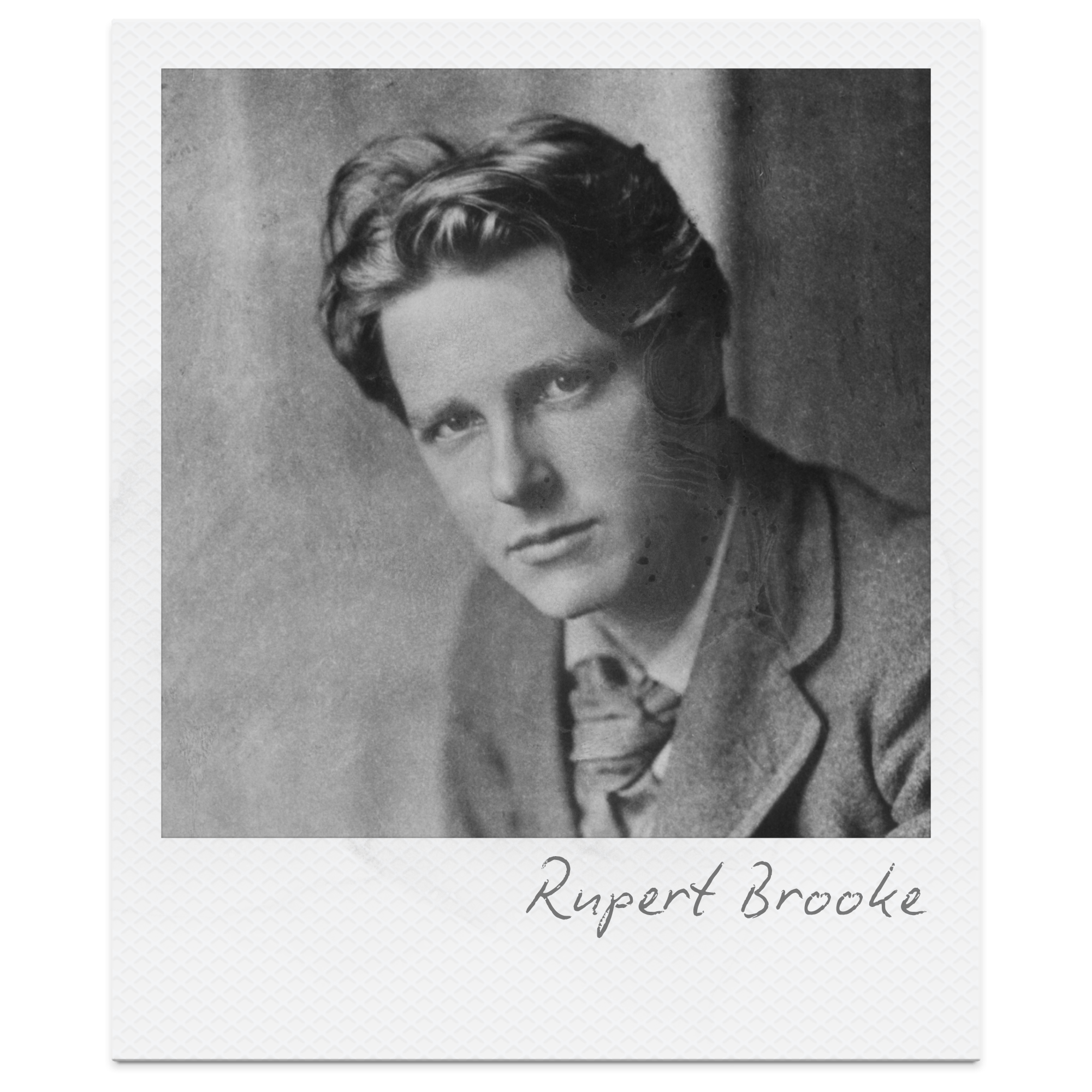
Who Was Rupert Brooke?
Rupert Chawner Brooke (1887–1915) was an English poet best known today for his First World War sonnets, particularly “The Soldier.” His early death while serving in the armed forces, combined with his poetry about patriotism and sacrifice, transformed him into one of the most recognisable literary figures of the early war.
However, Brooke had already developed a significant literary reputation before 1914.
He was born on 3 August 1887 in Rugby, Warwickshire, where his father, William Parker Brooke, worked as a schoolmaster at Rugby School. Growing up within the environment of one of Britain’s most famous public schools exposed Brooke from an early age to the educational culture associated with the late Victorian and Edwardian upper-middle classes.
Brooke later attended Rugby himself, where he demonstrated considerable academic and literary ability.
Cambridge and Intellectual Life
In 1906, Brooke went to King’s College, Cambridge, where he studied Classics before moving towards English literature.
Cambridge became enormously important to his intellectual and social development.
Brooke became involved with the Cambridge University Fabian Society, reflecting an early interest in socialist politics and social reform, and participated enthusiastically in university literary and theatrical life.
He also became part of a remarkable network of young writers, artists, intellectuals, and academics.
Brooke knew figures connected with the Bloomsbury Group, including Virginia Woolf and Lytton Strachey, although he was not himself simply a member of Bloomsbury. He also became associated with a circle of Cambridge friends later known as the Neo-Pagans, whose gatherings, friendships, outdoor pursuits, and unconventional attitudes contributed to the romantic mythology surrounding his youth.
These relationships place Brooke within the rapidly changing cultural world of Edwardian Britain, when younger writers and intellectuals were questioning established Victorian assumptions about politics, relationships, sexuality, art, and society.
Brooke Before the War
Brooke’s pre-war poetry is important because the extraordinary fame of “The Soldier” can obscure the writer he had been before 1914.
His first collection, Poems, was published in 1911.
His early work explores subjects including love, desire, beauty, nature, mortality, emotional disappointment, memory, relationships, and the passage of time. Some poems are lyrical and idealistic; others reveal irony, bitterness, humour, or emotional instability.
Brooke therefore cannot be understood solely as a straightforward poet of patriotic idealism.
His personal life was similarly complicated.
He formed intense friendships and romantic attachments, and his relationships sometimes involved jealousy, uncertainty, emotional turmoil, and conflicting desires. A severe emotional crisis around 1912, following difficulties within his relationships and social circle, contributed to a period of psychological distress.
Brooke subsequently travelled abroad, spending time in Germany and North America before travelling through the Pacific.
Travel and the South Pacific
In 1913–14, Brooke travelled through the United States, Canada, New Zealand, and the South Pacific, eventually spending several months in Tahiti.
Travel provided both distance from the personal difficulties he had experienced in Britain and new material for his writing.
His time in the Pacific produced poems including “Tiare Tahiti,” which explores beauty, desire, memory, and imagined paradise.
Brooke returned to Britain shortly before the outbreak of the First World War.
By this point, he was already known within British literary circles and had become associated with the emerging group of writers known as the Georgian poets.
Rupert Brooke and Georgian Poetry
Brooke appeared in Edward Marsh’s influential Georgian Poetry anthologies, which helped establish a new generation of British poets during the years immediately before the First World War.
Georgian poetry was not a single unified movement, but writers associated with it frequently favoured accessible language, lyricism, rural or natural imagery, emotional immediacy, and traditional poetic forms.
Brooke’s lyrical style and interest in beauty, nature, youth, love, and mortality fitted comfortably within parts of this literary environment.
His connection with Georgian poetry is important because his famous war sonnets did not emerge from nowhere.
When Brooke later wrote about England, death, sacrifice, and immortality, he drew upon a poetic style already shaped by lyric poetry, traditional forms, idealised landscapes, and meditations on beauty and mortality.
The Outbreak of the First World War
When Britain entered the First World War in August 1914, Brooke volunteered for military service.
Through connections including Edward Marsh, who was private secretary to Winston Churchill, Brooke received a commission in the Royal Naval Division, a land-based formation created from naval reservists and volunteers.
In October 1914, Brooke participated in the expedition to Antwerp, where British forces attempted to assist Belgian resistance to the advancing German army.
The operation ended in withdrawal.
Although Brooke had now experienced military deployment and danger, his experience was still very different from the prolonged trench warfare that would later shape the poetry of Wilfred Owen and Siegfried Sassoon.
This distinction is fundamental to understanding his war poetry.
Brooke was a soldier.
But he was not a poet writing after years in the trenches.
The 1914 Sonnets
During the closing months of 1914, Brooke wrote the five sonnets that would define his literary reputation:
“Peace,” “Safety,” “The Dead” I, “The Dead” II, and “The Soldier.”
Collectively known as the 1914 sonnets, these poems approach war through ideas of purification, courage, spiritual renewal, honour, death, immortality, England, and sacrifice.
Their representation of conflict differs dramatically from much of the war poetry that later became canonical.
Brooke rarely concentrates upon mutilated bodies, mud, artillery, psychological trauma, or the physical conditions of trench warfare.
Instead, death can become meaningful.
Sacrifice can become beautiful.
Military service can offer escape from the perceived emptiness or corruption of ordinary civilian life.
In “The Soldier,” even the soldier’s grave becomes symbolically transformed: foreign earth containing the English dead becomes permanently connected with England.
These ideas reflected one strand of early wartime feeling, but they should not be treated as representing every soldier or civilian in 1914.
“The Soldier” and Brooke’s Growing Fame
Brooke’s public reputation increased dramatically in 1915.
On Easter Sunday, 4 April 1915, the Dean of St Paul’s Cathedral quoted from “The Soldier” during a sermon attended by a large congregation. The sermon was subsequently reported in the press, bringing Brooke’s poetry to an even wider audience.
The timing proved extraordinary.
Brooke was already travelling with British forces towards the Dardanelles, where troops were preparing for the Gallipoli campaign.
Within weeks, he was dead.
The Death of Rupert Brooke
Brooke did not die in battle.
While travelling with the Mediterranean Expeditionary Force, he developed an infection after an insect bite, which led to blood poisoning.
He died aboard a French hospital ship on 23 April 1915, aged twenty-seven.
Because the ship was expected to continue its journey, Brooke was buried that evening on the Greek island of Skyros.
The circumstances of his death gave his poetry an extraordinary additional resonance.
A young poet who had written about the possibility of dying abroad in service to England was now buried on foreign soil.
The parallels between Brooke’s death and the imagery of “The Soldier” were irresistible to contemporary readers.
The Creation of a National Symbol
After his death, Brooke rapidly became more than a poet.
He became a symbol of youthful wartime sacrifice.
His appearance contributed to this mythology. Photographs presented an exceptionally handsome young man, while his education, literary talent, military service, and early death seemed to embody an idealised image of a generation sacrificing its youth for the nation.
His friend Winston Churchill wrote a highly admiring obituary in The Times, helping establish Brooke as an emblematic figure of the war.
This public image could simplify a much more complicated person.
The actual Brooke had experienced political experimentation, complicated relationships, emotional crises, extensive travel, intellectual uncertainty, humour, desire, and personal contradiction.
The memorialised Brooke was easier to understand: the beautiful young English poet who wrote of sacrifice and then died serving his country.
Brooke, Owen, and the Changing Memory of the War
Brooke's reputation also reveals how the cultural memory of the First World War has changed.
During the early war, his poetry could embody idealism, patriotism, honour, and meaningful sacrifice.
Later generations increasingly encountered the conflict through the writing of poets such as Owen and Sassoon, whose representations of suffering, anger, trauma, and physical destruction challenged romanticised ideas of warfare.
Brooke could consequently appear naïve beside them.
But that comparison can become historically misleading if it assumes that Brooke simply misunderstood something Owen later understood.
They wrote from different experiences and different moments within a rapidly changing war.
Brooke died in April 1915.
He never saw the Somme in 1916, the battles of Passchendaele in 1917, or the accumulated devastation of four years of industrialised warfare.
His poetry preserves an earlier moment in the conflict — and that is precisely part of its historical and literary value.
Rupert Brooke therefore matters not because he provides the definitive interpretation of the First World War, but because his work reveals one important way the war could be imagined before its later horrors transformed both literature and cultural memory.
Historical & Social Context
To understand Rupert Brooke’s war poetry, it is important to resist reading 1914 through the knowledge of 1918.
The First World War now carries powerful cultural associations: trenches filled with mud, enormous casualty lists, shell shock, barbed wire, gas attacks, the Somme, Passchendaele, and a generation of young men destroyed by industrialised warfare. Brooke, however, wrote his most famous war poems before many of these images had become part of British experience.
His 1914 sonnets belong to the opening months of the conflict.
Brooke died in April 1915.
The historical world from which poems such as “Peace” and “The Soldier” emerged was therefore not simply an earlier version of the disillusioned world represented by Wilfred Owen and Siegfried Sassoon. It was a society still attempting to understand what this new European war meant, how long it might last, what participation demanded, and what values could be attached to military service.
Brooke’s poetry captures something of that uncertain and distinctive moment.
Edwardian Britain Before the War
Brooke belonged to a generation that came of age during the final years of the Edwardian period.
Britain remained the centre of an enormous global empire, and ideas about British power, national identity, military prestige, and imperial responsibility were embedded within public life. Yet the country Brooke knew before 1914 was far from politically or socially settled.
The years preceding the First World War saw fierce arguments over women’s suffrage, Irish Home Rule, workers’ rights, industrial unrest, class inequality, and constitutional power. Strikes and labour disputes challenged established economic relationships, while the suffrage movement exposed deep disagreements about gender and political citizenship.
Younger intellectuals were also questioning inherited assumptions about religion, morality, sexuality, marriage, class, and social convention.
Brooke himself moved within some of these questioning circles. At Cambridge he became involved with the Fabian Society, while his friendships brought him into contact with writers and intellectuals interested in alternative political and social ideas.
This matters because the generation that entered the war in 1914 had not been living in a peaceful society united around a single set of values.
Britain already contained substantial political, cultural, and generational tensions.
For some young people, the outbreak of war could therefore appear not merely as a threat but as a dramatic interruption to a complicated and sometimes frustrating civilian world.
A Generation Searching for Purpose
One of the most striking features of Brooke’s early war poetry is the suggestion that war might provide clarity and purpose.
This is particularly important in “Peace.”
The poem does not simply celebrate Britain fighting another country. Instead, war appears capable of rescuing young men from what Brooke presents as a stagnant civilian existence.
That idea makes more sense when placed within broader pre-war anxieties about modern life.
Some early twentieth-century writers worried that comfort, materialism, urbanisation, bureaucracy, and prolonged peace had weakened qualities traditionally associated with masculine strength. Public debate could idealise physical fitness, discipline, courage, endurance, adventure, and service.
Military conflict appeared, to some, to provide an arena in which these qualities could be tested.
Such attitudes were not universal, nor were they necessarily held consistently by the same people throughout the war. They were nevertheless available within the culture Brooke inhabited.
For a young man already preoccupied with questions of mortality, identity, emotional dissatisfaction, and personal purpose, war could be interpreted as something capable of stripping life back to apparently fundamental values.
This helps explain why Brooke's early response can seem almost spiritually energised.
August 1914
Britain declared war on Germany on 4 August 1914, following Germany’s invasion of neutral Belgium and the escalating European crisis created by the alliance system and the conflict between Austria-Hungary and Serbia.
The public response was complex.
There were demonstrations of patriotism and large crowds in major cities, and many people genuinely believed that Britain had a moral obligation to resist German aggression and defend Belgium. Others responded with anxiety, uncertainty, opposition, or fear.
It is therefore misleading to imagine August 1914 either as a moment when the entire country enthusiastically demanded war or as a population cynically manipulated into supporting a conflict nobody understood.
Different responses existed simultaneously.
Brooke’s poetry represents one response within that larger spectrum.
His early wartime idealism was genuine, and similar ideas about duty, honour, national service, and sacrifice were shared by many contemporaries. Recognising this does not require accepting those ideas uncritically. It allows us to understand why they possessed such power in 1914.
The Volunteer Army
When war began, Britain did not immediately introduce compulsory military service.
The British Army relied upon professional soldiers and volunteers, and the government launched a vast recruitment effort to expand its forces.
Hundreds of thousands of men enlisted during the opening months of the conflict.
Their reasons varied enormously.
Some were motivated by patriotism or duty. Some wanted adventure. Others enlisted alongside friends or colleagues, responded to social expectations, sought regular pay, wished to escape difficult civilian circumstances, or feared being judged for remaining at home.
Many men probably carried several of these motivations at once.
The famous image of Lord Kitchener declaring “Your Country Needs You” became associated with the recruitment culture of the period, while posters, newspapers, public meetings, speeches, songs, and personal networks all contributed to an atmosphere in which enlistment became highly visible.
Brooke's decision to serve belonged to this volunteer culture.
His poetry therefore differs in an important respect from writing that merely asks other men to fight. Brooke accepted military service himself and imagined the possibility of his own death within it.
Brooke as a Serving Soldier
Brooke received a commission in the Royal Naval Division and took part in the expedition to Antwerp in October 1914.
His military experience should neither be exaggerated nor dismissed.
He had been deployed.
He had encountered the instability and danger of military operations.
But he had not experienced the years of sustained trench warfare that would later define the work of some other soldier-poets.
The Antwerp expedition itself was relatively brief. British forces were sent to assist in the defence of the Belgian city but ultimately withdrew as German forces advanced.
Brooke returned to Britain.
His famous 1914 sonnets emerged around this period, when his experience of war combined military participation with anticipation. Much of what the conflict might ultimately become remained unknown.
This position — neither civilian observer nor veteran of prolonged trench warfare — is central to understanding him.
Before the Somme and Passchendaele
Chronology becomes especially important when Brooke is compared with later war poets.
Brooke died on 23 April 1915.
The first day of the Battle of the Somme, which would become one of the defining events in British memory of the war, did not occur until 1 July 1916.
The Third Battle of Ypres, commonly associated with Passchendaele, came in 1917.
Brooke therefore never witnessed the years in which enormous casualty figures, prolonged trench warfare, artillery bombardment, increasingly mechanised killing, and psychological trauma became embedded within the experience of millions of servicemen and their families.
Even some technologies now strongly associated with the First World War had barely entered the conflict before his death. The first large-scale use of poison gas on the Western Front occurred at Second Ypres in April 1915, during Brooke’s final days.
This does not mean that warfare in 1914 and early 1915 was safe or bloodless.
It was already extraordinarily destructive.
It means that Brooke's historical horizon was different.
He could not respond poetically to events he never lived to see.
Ideas of Honour, Duty, and Sacrifice
The language Brooke uses in his war sonnets also belongs to much older traditions surrounding military service.
Concepts such as honour, courage, duty, sacrifice, glory, and noble death had deep roots in European culture.
They appeared in classical literature, religious traditions, school education, historical narratives, imperial stories, memorial practices, and popular representations of warfare.
Brooke had received a classical education.
For an educated young man of his generation, stories of warriors, heroic death, service, and sacrifice formed part of a substantial cultural inheritance.
The idea that dying for a community might possess meaning was therefore not created by the First World War.
What industrialised warfare would increasingly expose was the tension between these inherited ideals and the physical reality of modern combat.
Brooke's poetry sits close to the beginning of that confrontation.
Public Schools and Masculine Ideals
Brooke's upbringing also connected him to Britain's public-school culture.
Schools such as Rugby placed considerable emphasis upon ideas of character, leadership, loyalty, physical courage, teamwork, and service.
Sport could be presented as preparation for wider life, teaching boys to endure discomfort, cooperate with others, accept discipline, and demonstrate courage.
These values were closely connected to contemporary constructions of masculinity.
The ideal young man was often expected to exercise emotional control, physical resilience, courage, and willingness to serve something beyond himself.
War gave these abstract ideals immediate consequences.
For men from Brooke's social and educational background, military leadership could appear a natural extension of expectations already attached to class and gender.
Again, this should not be interpreted as evidence that every public-school-educated man welcomed the war.
It does, however, help explain the cultural vocabulary through which men such as Brooke could understand service.
England, Landscape, and National Identity
Brooke's patriotism is often expressed not through political argument but through landscape, memory, and sensory experience.
This becomes particularly important in “The Soldier.”
England is imagined through familiar natural and domestic details rather than through government institutions or military objectives.
This version of national identity draws upon a long literary tradition in which the English countryside becomes symbolic of the nation itself.
Fields, rivers, flowers, air, sunlight, and familiar landscapes can carry emotional meanings connected to childhood, belonging, continuity, and home.
Such imagery became especially powerful during wartime because soldiers were physically separated from the places they associated with home.
Brooke transforms patriotism into something intimate.
England is not merely territory.
It becomes something that has shaped the individual physically and spiritually.
That helps explain why the famous foreign grave imagined in “The Soldier” can remain symbolically English: the dead soldier carries the nation within himself.
Empire and the Meaning of “England”
Brooke's repeated use of England also deserves historical attention.
He was writing while Britain governed a global empire and fought alongside troops drawn from across that empire and the wider British world.
Soldiers from India, Canada, Australia, New Zealand, Newfoundland, South Africa, the Caribbean, and other territories participated in the conflict, while colonial labour and resources were essential to Britain's war effort.
Brooke's intensely English vision therefore represents a particular perspective rather than the complete identity of the forces fighting on Britain's side.
For modern readers, this distinction matters.
The First World War was a global conflict, even when individual poems imagine it through the landscapes and identity of one nation.
Brooke's poetry can consequently be studied both for the emotional power of its Englishness and for what that Englishness reveals about the cultural viewpoint from which he wrote.
Christianity, Death, and Immortality
Religious language also shaped the way sacrifice could be understood.
Britain in 1914 was religiously diverse in belief and practice, and levels of personal faith varied considerably. Nevertheless, Christian imagery and vocabulary remained deeply embedded within public culture.
Ideas of sacrifice, purification, resurrection, eternal life, the soul, and redemption were immediately recognisable.
Brooke's war sonnets draw upon this vocabulary without functioning simply as conventional devotional poetry.
Death can become a form of transformation.
The individual body may die, yet something purified or eternal survives.
In this way, patriotic and spiritual meanings can overlap.
The soldier's death is not represented simply as biological destruction. It can become sacrifice, continuation, and transcendence.
Later war poetry would often interrogate precisely these kinds of consoling narratives.
In Brooke, they retain considerable imaginative force.
Death Was Already Part of Brooke's Poetry
It is also important not to assume that Brooke suddenly became fascinated by death because war began.
Mortality had already occupied his imagination.
His pre-war writing repeatedly considers time, decay, memory, lost love, physical existence, beauty, and death.
The war therefore gave Brooke a new historical framework through which existing poetic concerns could be expressed.
This helps explain why death in the 1914 sonnets can appear both national and intensely personal.
The war did not invent Brooke's interest in mortality.
It changed its meaning.
Newspapers, Sermons, and a Growing Public Reputation
The First World War was experienced not only on battlefields but through an expanding culture of mass communication.
Newspapers carried casualty lists, military reports, political speeches, personal stories, photographs, letters, and poetry. Churches interpreted the conflict through sermons. Public ceremonies helped communities understand death and service. Poems could move rapidly from literary circles into national discussion.
Brooke became a striking example of this process.
On Easter Sunday 1915, the Dean of St Paul's Cathedral quoted “The Soldier” during his sermon.
The poem therefore entered a setting in which religion, national identity, sacrifice, and remembrance could reinforce one another.
Brooke's death only weeks later dramatically altered the way the poem could be read.
Words that had imagined the possibility of a soldier dying abroad suddenly seemed prophetic.
The Death of a Young Poet
Brooke died from illness rather than enemy action while his unit was travelling towards the Dardanelles.
Yet to the British public, the distinction did not prevent him from becoming part of the war dead.
His burial on Skyros, far from England, appeared to mirror the imagined burial in “The Soldier” with extraordinary precision.
This coincidence helped turn biography into mythology.
The poet and the poem became difficult to separate.
Brooke could now embody the very sacrifice he had written about.
Youth and the Idealisation of Sacrifice
Brooke's age intensified this response.
He was only twenty-seven.
The death of young men became one of the central emotional realities of the First World War, and Brooke's combination of youth, beauty, education, literary talent, military service, and early death made him especially suited to public commemoration.
Photographs of Brooke helped construct an image of lost youth.
This matters because remembrance is never created by poetry alone.
It is produced through the interaction of text, biography, photography, journalism, public ceremony, obituary, and later historical memory.
The Brooke remembered by wartime Britain was therefore partly a real person and partly a cultural construction.
A War Whose Meaning Had Not Yet Been Settled
Perhaps the most important historical context for Brooke is simply when he died.
In April 1915, nobody knew that the war would continue until November 1918.
Nobody knew its final casualty figures.
Nobody knew which battles later generations would treat as symbolic of the conflict.
And nobody knew that poets such as Wilfred Owen — at that point not yet serving on the Western Front — would eventually become central to the way British readers imagined First World War poetry.
Brooke wrote without that hindsight.
His work preserves a moment when the meaning of the conflict was still being formed.
That does not make his patriotic idealism historically representative of everyone, nor does it make his vision of sacrifice objectively true.
It makes it historically significant.
Reading Brooke alongside later poets allows us to see not simply two opposing opinions about war, but how radically the circumstances through which war was understood could change between 1914 and 1918.
His poetry belongs to a Britain standing near the beginning of that transformation — still drawing upon inherited ideas of honour, masculinity, service, national identity, spiritual sacrifice, and heroic death, without yet knowing how severely the coming years would test them.
Literary Context & Movement
Rupert Brooke occupies an unusual position in the history of twentieth-century poetry.
He belonged to a generation writing at a moment of significant literary change. The traditions of the nineteenth century remained influential, but writers were beginning to experiment with new ways of representing modernity, psychology, sexuality, urban life, uncertainty, and social change. Within only a few years, the movement now known as Modernism would radically challenge established assumptions about poetic form, language, narrative, and artistic authority.
Brooke participated in this changing literary culture without becoming a Modernist poet in the conventional sense.
His work remained strongly connected to lyric poetry, traditional metre and rhyme, the sonnet, natural imagery, Romantic inheritance, and the emerging Georgian movement.
Understanding those traditions is essential because Brooke did not suddenly adopt an elevated poetic language when war began.
The 1914 sonnets developed from techniques, forms, and preoccupations already present within his writing.
Georgian Poetry
Brooke is closely associated with the literary movement known as Georgian poetry.
The term comes from a series of anthologies edited by Edward Marsh, beginning with Georgian Poetry 1911–1912. The collections brought together contemporary British poets whom Marsh believed represented an exciting new generation of writers.
Brooke appeared in the anthologies and became one of the most recognisable poets associated with the group.
Other writers connected with Georgian poetry included Walter de la Mare, John Masefield, W. H. Davies, Lascelles Abercrombie, and later Siegfried Sassoon, although their individual styles and concerns varied considerably.
This variation is important.
Georgian poetry was never a tightly organised movement with a manifesto or a single poetic method. The writers grouped beneath the label did not all write in the same style or share identical beliefs.
Nevertheless, certain tendencies recur.
Georgian poetry frequently favoured clarity, lyricism, natural imagery, rural settings, emotional accessibility, traditional forms, and direct engagement with ordinary experience.
In its early years, it could appear fresh partly because it seemed to reject what some younger writers regarded as the excessive artificiality or grandiosity of certain late Victorian poetic conventions.
Brooke's writing fitted comfortably within this literary environment.
Nature and the Georgian Imagination
Nature occupies an important place within Brooke's poetry.
Landscapes, flowers, rivers, fields, weather, seasons, sunlight, and physical sensations frequently become vehicles through which larger emotional ideas can be explored.
This tendency becomes particularly significant in his war poetry.
In “The Soldier,” England is not primarily defined through politicians, borders, armies, or institutions. It is imagined through physical and sensory experience: earth, air, rivers, flowers, sunlight, and the environment that has formed the speaker.
This allows national identity to become intimate.
England is not simply the country for which the soldier fights.
It is something that has entered his body and consciousness.
The natural imagery therefore performs ideological as well as aesthetic work. It makes patriotism feel personal, organic, beautiful, and emotionally familiar.
The Lyric Tradition
Brooke was fundamentally a lyric poet.
Lyric poetry traditionally concentrates upon individual perception, emotion, memory, or meditation rather than extended narrative. The speaking voice often appears immediate and personal, even when the speaker should not automatically be identified with the poet.
Brooke's poetry repeatedly uses this concentrated form to explore experiences such as desire, loss, mortality, love, nostalgia, beauty, and belonging.
The war sonnets continue this practice.
They do not attempt to provide detailed documentary accounts of military operations.
Instead, they transform war into an occasion for meditation upon what military service, death, courage, and national identity might mean.
This helps explain one of the most important differences between Brooke and some later war poets.
His poems are rarely interested in recording the material environment of warfare in extensive detail.
Their focus is frequently philosophical and emotional rather than documentary.
Brooke and the Romantic Tradition
Brooke's poetry also inherits elements from Romanticism, particularly in its relationship with nature, emotion, individual consciousness, beauty, and transcendence.
However, describing Brooke simply as a “Romantic poet” can be misleading.
The major British Romantic poets — including William Wordsworth, Samuel Taylor Coleridge, Lord Byron, Percy Bysshe Shelley, and John Keats — belonged primarily to the late eighteenth and early nineteenth centuries. Brooke was writing almost a century later within a very different literary and historical environment.
It is more accurate to identify Romantic inheritances within his work.
Nature can reflect or transform human emotion.
Beauty can appear capable of revealing something beyond ordinary existence.
Death may be imagined not solely as extinction but as transformation.
Individual experience can acquire spiritual or universal significance.
These tendencies become particularly powerful when Brooke turns to war.
Beauty and Death
One of Brooke's most persistent poetic concerns is the relationship between beauty and mortality.
This predates the First World War.
His earlier writing frequently confronts the uncomfortable fact that youth, desire, relationships, physical beauty, and human life are temporary.
War gives that existing concern a new intensity.
In the 1914 sequence, death can be transformed aesthetically.
The dead are not presented primarily as decomposing or mutilated bodies. Instead, sacrifice can be purified through poetic language until death becomes connected with peace, permanence, spiritual survival, and national continuity.
This is one of the areas in which comparison with Wilfred Owen becomes particularly revealing.
Owen frequently forces readers to confront what elevated language about sacrifice may conceal.
Brooke often performs the opposite movement: physical death is translated into something abstract, beautiful, or transcendent.
Neither technique is accidental.
Both demonstrate the power of poetic language to determine what readers are encouraged to see — and what they are not.
The Sonnet Tradition
Brooke's choice of the sonnet for his most famous war poems carries considerable literary significance.
The sonnet is one of the most established forms in European poetry.
Traditionally associated with writers such as Petrarch and Shakespeare, it became especially important as a form for exploring love, beauty, desire, time, mortality, spiritual devotion, and intense personal feeling.
By placing the First World War within this form, Brooke connects modern military conflict to a long literary tradition.
The choice can give war order, seriousness, beauty, and permanence.
Fourteen lines impose structure upon an event that in reality was chaotic and unpredictable.
The poet can organise experience.
War becomes something that can be contemplated, shaped, and given meaning.
That relationship between form and subject becomes especially important when Brooke is compared with poets whose writing later exposes fragmentation, confusion, repetition, or psychological disturbance.
The 1914 Sonnet Sequence
Brooke's five war sonnets form a deliberate sequence:
“Peace”
“Safety”
“The Dead” I
“The Dead” II
“The Soldier”
Reading them together reveals a progression that can be lost when “The Soldier” is studied in isolation.
The sequence begins by considering the effect of war upon the living.
“Peace” imagines conflict as a release from the perceived corruption and emptiness of civilian existence. War appears capable of restoring seriousness, courage, and purpose.
“Safety” develops the idea that the individual who has accepted death may become psychologically free from fear.
The two poems titled “The Dead” then turn towards sacrifice and remembrance, considering what those who die have given and what might survive them.
Finally, “The Soldier” imagines the speaker's own possible death abroad and transforms his burial into a continuation of England.
The sequence therefore moves increasingly towards death, memory, and transcendence.
Rather than functioning merely as recruitment poetry, the sonnets attempt to construct a philosophical framework through which wartime mortality can be understood.
Traditional Form and Modern Warfare
Brooke's use of traditional form creates an important tension.
The First World War was a profoundly modern conflict.
Machine guns, heavy artillery, industrial production, railway networks, mass mobilisation, telecommunications, and increasingly mechanised systems of warfare transformed the scale and experience of combat.
Yet Brooke frequently represents this modern conflict through old poetic structures and inherited cultural ideas.
This should not automatically be treated as a weakness.
Instead, it raises an important literary question:
What happens when inherited poetic forms are asked to make sense of unprecedented historical experience?
For Brooke, traditional forms remain capable of creating meaning.
The sonnet can contain war.
Religious and classical ideas can explain sacrifice.
Nature can represent national identity.
Beauty can survive death.
For some later poets, these inherited structures become much more difficult to sustain.
Brooke and Modernism
At the same time Brooke was writing, other authors were beginning to transform English-language literature.
Writers including Ezra Pound, T. S. Eliot, H.D., and Wyndham Lewis were experimenting with forms that challenged conventional poetic structure, stable perspective, and familiar literary language.
The First World War would later become closely associated with broader Modernist concerns about fragmentation, instability, alienation, broken traditions, and the difficulty of constructing coherent meaning in the modern world.
Brooke stands close to this transformation without fully participating in it.
His war sonnets generally seek coherence rather than fragmentation.
Death can be explained.
Sacrifice can be meaningful.
National identity can remain stable.
The individual can locate himself within a larger system of values.
This makes Brooke especially valuable when studying the transition into twentieth-century literature.
He demonstrates that literary change does not occur neatly, with one movement ending before another begins.
Different traditions coexist.
War Poetry Did Not Simply Move from Romanticism to Realism
First World War poetry is sometimes taught through a simplified narrative.
According to this version, poets such as Brooke initially romanticised war, while later writers such as Owen and Sassoon finally revealed its reality.
There is some historical usefulness in comparing their dramatically different representations of conflict, but the model becomes misleading when treated as a straightforward literary progression from Romanticism to Realism.
Romanticism was already a historical movement long before 1914.
Realistic representations of suffering and violence existed before Owen.
Patriotic poetry continued to be written after Brooke's death.
Soldiers themselves could hold patriotic beliefs.
And Owen and Sassoon continued to use highly literary techniques, inherited poetic forms, symbolism, metaphor, classical references, religious imagery, and carefully constructed sound patterns.
They did not simply replace “poetry” with factual reporting.
The more important development lies in how different writers used literary techniques to construct competing meanings around the same conflict.
The Language of Purification
Brooke's war poetry frequently presents conflict through the language of cleansing or purification.
This is particularly evident in “Peace.”
Civilian life appears compromised by weakness, hesitation, or emotional complexity, while the outbreak of war creates an opportunity to escape these conditions.
This is not realistic description of combat.
It is metaphorical transformation.
War becomes capable of washing away what the speaker considers trivial or corrupt.
Such imagery gives the conflict a spiritual dimension.
The soldier is not simply joining an army.
He may be entering a state in which ordinary anxieties become irrelevant because life and death have acquired greater significance.
This pattern connects Brooke's war poetry to both religious language and his broader interest in transcendence.
Religious and Spiritual Imagery
Christian vocabulary appears throughout the 1914 sequence, although Brooke's personal relationship with religious belief was more complicated than the poems might initially suggest.
The sonnets repeatedly draw upon concepts familiar from Christian culture:
cleansing, sacrifice, the soul, peace, resurrection, immortality, and redemption.
This vocabulary allows military death to be imagined through structures already associated with spiritual meaning.
Sacrifice becomes potentially redemptive.
Death does not necessarily represent defeat.
The physical body may disappear while something purer survives.
In “The Soldier,” the individual can even become absorbed into an eternalised conception of England.
Religious language therefore helps Brooke move from the physical fact of death to the imagined meaning of death.
Classical Influence
Brooke's education also exposed him deeply to Greek and Latin literature.
Classical culture provided another powerful vocabulary through which warfare could be imagined.
Ancient literature contains warriors, heroic deaths, loyalty to communities, honour, sacrifice, fate, and the desire for lasting remembrance.
For generations of British schoolboys educated in the classics, these narratives formed part of the intellectual background through which military service could be understood.
Brooke does not simply reproduce classical epic.
Nevertheless, his willingness to treat courage and death as potentially meaningful belongs partly to a literary culture in which heroic sacrifice already possessed established narrative forms.
The First World War would place extraordinary pressure upon those inherited models.
Idealisation as a Literary Technique
Brooke is sometimes criticised for “idealising” war as though idealisation were merely a failure to observe reality.
From a literary perspective, however, idealisation itself deserves analysis.
Writers select.
They emphasise.
They omit.
They transform experience through metaphor, rhythm, imagery, form, and perspective.
Brooke's war poetry often removes the material details that later readers expect from trench poetry.
There is little mud.
There are few weapons.
Bodies are rarely mutilated.
The enemy is surprisingly absent.
Instead, attention falls upon the internal meaning of service and sacrifice.
The absence of physical horror therefore becomes part of the poems' method.
Brooke creates a conceptual version of war in which what conflict means matters more than what conflict looks like.
The Absence of the Enemy
One striking feature of Brooke's famous war sonnets is how little attention they give to Germany or German soldiers.
This distinguishes them from propaganda that depends upon demonising an enemy.
Brooke's focus is largely inward.
The central subjects are the British or English soldier, his emotional transformation, his relationship with death, and his connection to home.
War becomes a test of identity rather than simply a struggle against a particular opponent.
This helps explain why “The Soldier” can continue to resonate outside its immediate military circumstances.
The poem is deeply patriotic, but its emotional structure centres upon home, belonging, memory, death, and the desire for continuity.
England as a Poetic Construction
The England of “The Soldier” is itself a literary creation.
It is selective, beautiful, pastoral, nurturing, and harmonious.
Industrial cities, poverty, political conflict, class inequality, and imperial power largely disappear.
Instead, England becomes a landscape of earth, flowers, rivers, air, laughter, friendship, and peace.
This is not simply geographical description.
It is idealisation.
Brooke constructs an England worth carrying into death.
The poem's patriotism therefore depends partly upon poetry's ability to transform a complicated modern nation into an emotionally coherent image of home.
Sound, Rhythm, and Emotional Control
Brooke's technical control contributes significantly to this effect.
His use of regular rhythm, rhyme, balanced syntax, repetition, and carefully patterned sound creates a sense of stability.
These techniques matter particularly in poems concerned with death.
Form can control fear.
A subject that might produce chaos becomes ordered through verse.
This is especially important in “The Soldier,” where the speaker calmly imagines his own death.
The measured structure helps prevent panic from entering the poem.
Death becomes contemplative rather than terrifying.
Form therefore reinforces meaning.
Brooke Beyond the War Sonnets
Brooke's literary reputation has become so dominated by the 1914 sequence that his broader work is sometimes neglected.
Yet poems such as “The Old Vicarage, Grantchester,” “The Great Lover,” “Tiare Tahiti,” and his earlier love poetry reveal a much wider writer.
They show his interest in nostalgia, sensual experience, comedy, desire, travel, memory, Englishness, and emotional contradiction.
“The Old Vicarage, Grantchester,” for example, combines affection for England with humour and exaggerated nostalgia.
This complicates the solemn patriotic image created after Brooke's death.
The poet who became a national symbol could also be playful, ironic, sensual, emotionally troubled, and irreverent.
Reading the pre-war Brooke therefore helps recover the writer hidden behind the icon.
A Poet at a Literary Crossroads
Rupert Brooke ultimately stands at a fascinating literary crossroads.
Behind him lie powerful traditions of Romantic lyricism, classical education, Christian symbolism, pastoral writing, patriotic literature, and the sonnet.
Around him emerges Georgian poetry, with its emphasis upon accessibility, nature, lyric experience, and renewed attention to contemporary writing.
Ahead lies a literary culture increasingly shaped by Modernism, prolonged industrial warfare, psychological trauma, and profound challenges to inherited systems of meaning.
Brooke belongs to all of these contexts without fitting perfectly into any one of them.
That is precisely what makes him significant.
His poetry demonstrates how a writer at the beginning of the First World War could still use inherited literary forms to make conflict appear ordered, meaningful, beautiful, and potentially transcendent.
Later war poets would challenge many of those representations.
But they did not simply replace Brooke's “false” poetry with the “truth.”
They created different literary responses to different experiences of a conflict whose meaning was continually changing.
Reading Brooke within his literary context therefore allows us to ask a more revealing question than whether he was naïve:
How does poetry transform an experience as chaotic and destructive as war into something that readers can understand, value, mourn, or believe in?
Core Themes
Rupert Brooke’s reputation is dominated by the five sonnets he wrote during the opening months of the First World War, but many of the ideas within those poems had occupied him long before 1914.
Across his writing, Brooke repeatedly returns to death, beauty, love, memory, nature, belonging, youth, identity, and the search for permanence in a world defined by change. The outbreak of war gave these existing concerns a new context. Personal mortality could become military sacrifice; attachment to familiar landscapes could become patriotism; and the desire for something permanent beyond individual life could become an imagined form of national or spiritual immortality.
Understanding these connections makes Brooke’s war poetry considerably more complex.
Patriotism and National Identity
Patriotism is the theme most immediately associated with Brooke’s First World War poetry.
However, his patriotism is rarely expressed through detailed political arguments about Britain’s reasons for entering the conflict.
Instead, Brooke frequently constructs national identity through emotion, memory, landscape, physical sensation, and belonging.
This is particularly evident in “The Soldier.”
England becomes more than a political state. It is imagined as something that has physically and spiritually created the speaker. The country has provided the earth from which he came, the landscapes he remembers, the air he breathed, and the experiences that shaped his consciousness.
Patriotism therefore becomes intimate.
The speaker does not simply belong to England.
In a symbolic sense, England exists within him.
This allows Brooke to imagine military death abroad without imagining complete separation from home. Wherever the soldier is buried, something English remains.
The theme raises important questions about how nations become emotionally meaningful. Brooke's England is partly geographical, but it is also remembered, idealised, and constructed through poetry.
England and the Idea of Home
Closely connected with patriotism is Brooke's fascination with home.
This theme predates the war.
In poems such as “The Old Vicarage, Grantchester,” written while Brooke was living in Germany, distance from England intensifies his affection for familiar places. The poem creates an exaggerated and partly humorous vision of Grantchester filled with remembered landscapes, routines, people, and sensory details.
Brooke repeatedly demonstrates that absence can make home more powerful.
Once something is distant, it can be reconstructed through memory.
The First World War gives this existing tendency a much more serious dimension.
For the soldier abroad, home is no longer simply somewhere temporarily left behind. It becomes something that may never be seen again.
In “The Soldier,” Brooke turns this possibility into permanence. If the speaker cannot return to England, his identity allows England symbolically to travel with him.
Home consequently becomes both place and state of mind.
Sacrifice
The idea of sacrifice lies at the centre of Brooke’s war sonnets.
Military death is rarely represented as meaningless destruction.
Instead, the individual can surrender his life to something larger than himself.
This idea depends upon a particular understanding of value.
If individual survival is the highest possible good, death in war represents absolute loss. Brooke's sonnets instead imagine values — including country, honour, courage, collective identity, and spiritual meaning — that may survive the individual.
This does not mean that Brooke simply celebrates dying.
Rather, his poems repeatedly attempt to answer an enormous question created by war:
How can death be given meaning?
The answer offered by the 1914 sequence is frequently that the individual may become part of something larger and more enduring.
Death and Mortality
Death was important to Brooke long before the First World War.
His poetry repeatedly confronts the temporary nature of human existence.
People age.
Relationships end.
Beauty disappears.
Bodies decay.
Experiences become memories.
The arrival of war intensifies rather than creates this fascination with mortality.
What changes is the scale and context.
In the 1914 sonnets, death is no longer only a private human inevitability. It becomes connected to military service and collective sacrifice.
Brooke often responds by transforming death.
Rather than concentrating upon the physical processes of injury and decay, he moves towards abstraction: peace, spirit, memory, purity, permanence, and transcendence.
This distinguishes his representation of death sharply from poets such as Owen, whose work frequently returns the reader to the damaged physical body.
Brooke often moves in the opposite direction.
He takes the vulnerable body and attempts to imagine what might survive it.
Immortality and the Desire for Permanence
Because Brooke is so conscious of mortality, his poetry repeatedly searches for forms of continuation.
What remains after an individual dies?
Memory may remain.
Love may remain.
Beauty may survive through recollection.
Poetry itself can preserve experience.
And in the war sonnets, national identity can provide another form of imagined permanence.
This is particularly powerful in “The Soldier.”
The speaker anticipates his own disappearance but imagines that the values and identity that formed him will continue.
The foreign grave becomes more than a place containing a dead body. It becomes a symbolic extension of England.
Brooke therefore turns burial into continuity.
The individual dies, but something larger persists.
There is a striking irony here. Brooke's own early death helped ensure precisely the kind of cultural survival his poetry imagines. More than a century later, his name, image, and poems remain connected to the historical memory of the First World War.
War as Purification
One of Brooke's more challenging themes is the idea that war might purify.
This appears most strongly in “Peace.”
The outbreak of war seems to release the speaker from a civilian world he experiences as emotionally unsatisfying, morally compromised, or trivial.
Conflict strips away uncertainty.
Suddenly, life and death matter.
The individual has something definite to do.
This idea can feel deeply uncomfortable to modern readers familiar with the enormous destruction that followed.
Yet understanding it is essential to understanding Brooke's early response to war.
Purification here is not primarily about military strategy.
It is psychological and spiritual.
War seems capable of removing superficial concerns and returning the individual to supposedly fundamental qualities such as courage, purpose, discipline, loyalty, and acceptance of mortality.
The theme reveals how profoundly different an imagined war can be from an experienced one.
Courage and the Conquest of Fear
Brooke's war poetry repeatedly examines fear, but often by imagining ways in which fear can be overcome.
In “Safety,” the apparent paradox is that accepting the possibility of death can make the soldier feel secure.
If death has already been accepted, what remains to fear?
This creates a form of psychological freedom.
Courage in Brooke is therefore not necessarily the absence of danger. It can emerge from a changed relationship with mortality.
The soldier gains emotional control by accepting that his body is vulnerable.
This idea reflects the broader emphasis within Brooke's poetry on finding something permanent beyond physical existence.
If the self is understood only as a body, death destroys it.
If identity is connected with memory, spirit, nation, love, or enduring values, physical death may appear less absolute.
Heroism
Brooke's poetry participates in older traditions of heroic sacrifice, but his heroes are often surprisingly quiet.
“The Soldier” does not describe a spectacular battlefield victory.
There is no enemy defeated, no dramatic combat scene, and no military triumph.
The imagined heroic act is simply the willingness to die.
This shifts heroism away from conquest and towards self-sacrifice.
The soldier becomes heroic because he gives himself to something he believes exceeds his individual life.
This form of heroism has strong connections with both religious sacrifice and older military traditions.
It also helps explain the power Brooke acquired after his own death. His biography appeared to reproduce the values his poetry had celebrated.
Youth
Youth became one of the most powerful themes attached to Brooke, even when it is sometimes produced as much by his biography as by individual poems.
The First World War killed enormous numbers of young men, and Brooke's death at twenty-seven allowed him to become an especially potent symbol of interrupted potential.
Youth carries several meanings within his cultural image.
It can suggest physical beauty, energy, idealism, possibility, innocence, and a future that should have existed.
Death freezes these qualities.
Brooke never becomes an elderly writer looking back upon his younger self.
The public image remains permanently young.
This contributes significantly to the elegiac power surrounding his reputation.
Beauty
Brooke was deeply interested in beauty — natural, physical, emotional, and poetic.
Beauty in his writing is often intensified by its impermanence.
Something matters precisely because it cannot last.
A landscape changes.
Youth disappears.
A relationship ends.
A body ages.
A moment becomes memory.
This relationship between beauty and transience helps explain why death can become aesthetically powerful within his poetry.
Brooke does not necessarily deny mortality.
Instead, he repeatedly attempts to make mortality beautiful.
That tendency becomes ethically and politically complicated when applied to war.
Beautiful language can provide consolation, but it can also distance readers from physical suffering.
This tension is one of the most productive areas for analysing Brooke.
Nature and Landscape
Nature is rarely just decorative in Brooke's poetry.
Fields, rivers, flowers, earth, sunlight, air, water, seasons, and familiar landscapes frequently carry emotional or symbolic meaning.
Nature can represent home.
It can trigger memory.
It can embody beauty.
It can provide continuity beyond individual human life.
And in the war sonnets, it can become connected with national identity.
The natural world also helps Brooke soften the boundary between individual and environment.
In “The Soldier,” the body returns to earth, but this does not necessarily mean disappearance. Earth itself becomes part of the poem's understanding of belonging.
Human mortality is placed within a landscape that continues.
Love and Desire
Brooke's broader poetry contains a much more complicated treatment of love and desire than the solemn public image of the war poet might suggest.
His pre-war writing explores attraction, intimacy, longing, disappointment, jealousy, memory, and the instability of relationships.
Love is not always presented as permanent or ideal.
It can be painful, absurd, sensual, temporary, or contradictory.
This is important because it reveals Brooke as a writer concerned with the difficulty of attaching lasting meaning to human experience.
Romantic relationships can fail.
Desire can change.
People leave.
Memory distorts.
These concerns connect unexpectedly with the later war sonnets.
In both, Brooke asks what can remain when the physical circumstances of life disappear.
Memory
Memory provides one possible answer.
Brooke's poetry frequently reconstructs absent people and places through recollection.
Memory allows the mind to preserve what time has removed.
However, remembered experience is not necessarily identical to reality.
Distance can idealise.
A remembered England may become more beautiful than the England actually experienced.
A lost relationship can be transformed once it exists only in the mind.
This makes memory particularly important to Brooke's representation of national identity.
The England carried abroad by the soldier is partly a remembered England.
It is emotionally real precisely because it has been selected and reconstructed.
Nostalgia
Brooke often writes with a powerful sense of nostalgia.
His nostalgia can be sincere and playful at the same time.
“The Old Vicarage, Grantchester” famously transforms homesickness into an elaborate celebration of English life while also containing humour and exaggeration.
This combination is useful when reading his later patriotic writing.
Brooke's idealisation of England did not suddenly appear in 1914.
He had already demonstrated a tendency to turn geographical distance into imaginative attachment.
War makes the same process more urgent.
The possibility of permanent separation transforms nostalgia into something closer to elegy.
The Body and the Spirit
A recurring tension throughout Brooke's writing exists between physical existence and something imagined beyond it.
Brooke was capable of intensely sensual writing. Bodies, physical attraction, landscapes, food, water, warmth, and touch matter.
Yet physical existence is temporary.
The body ages and dies.
His poetry therefore repeatedly searches for ways to move beyond physical limitation.
In the war sonnets, this tension becomes explicit.
The soldier's body may be buried, but the poem imagines an identity capable of surviving bodily death.
This movement from body to spirit, earth to memory, individual to nation becomes one of Brooke's characteristic poetic patterns.
Englishness
Brooke's concept of Englishness deserves to be distinguished from patriotism more generally.
The England of his poetry has a particular character.
It is frequently pastoral, familiar, green, peaceful, cultivated, and deeply connected with sensory memory.
This is not a comprehensive representation of early twentieth-century England.
Brooke largely excludes industrial landscapes, poverty, urban crowding, political conflict, and social inequality from his most idealised visions of the nation.
Englishness becomes selective.
That selectivity is important because national identities are often constructed through the things cultures choose to remember about themselves.
Brooke's England is powerful partly because it is an imagined England.
Belonging and Identity
Behind many of Brooke's individual themes lies a larger concern with belonging.
Where does the self belong?
To another person?
To a landscape?
To a generation?
To a country?
To the physical body?
To memory?
Brooke's war poetry offers an unusually confident answer: the individual can belong to England so completely that even death cannot sever the connection.
His broader writing is often less certain.
Relationships shift. People travel. Homes are left behind. Emotional attachments become unstable.
This makes the certainty of the 1914 sonnets particularly interesting.
War appears to provide a powerful collective identity at a moment when Brooke's earlier writing had frequently explored personal instability.
Individual Identity and Collective Purpose
The First World War also creates tension between the individual and the collective.
Military service requires individuals to become part of a much larger institution.
Brooke's sonnets often present this surrender positively.
The individual does not necessarily disappear by becoming part of something larger. Instead, participation may give individual existence greater meaning.
This distinguishes Brooke from writing in which military systems crush or dehumanise the individual.
His early-war poetry often imagines collective purpose as a solution to personal uncertainty.
The self gains meaning through belonging.
Peace
The word peace carries an intriguing double meaning in Brooke's work.
Ordinarily, peace means the absence of war.
Yet Brooke can locate a different kind of peace within acceptance of war and death.
Once fear has been overcome, the speaker may achieve psychological or spiritual calm.
This paradox appears throughout the 1914 sequence.
External violence can produce imagined internal stillness.
Death itself can become peaceful.
The idea contributes strongly to the sonnets' consolatory power, but it also demonstrates how radically poetic representation can transform the physical reality of warfare.
The Search for Meaning
Ultimately, many of Brooke's major themes converge upon a single concern:
How can temporary human life be made meaningful?
Love offers one answer.
Beauty offers another.
Memory can preserve what has vanished.
Nature provides continuity.
Poetry can record experience.
National identity can connect the individual to something larger.
Sacrifice can transform death into purpose.
The First World War did not create Brooke's search for meaning, but it gave that search an enormous new subject.
His 1914 sonnets attempt to construct a world in which even wartime death can be absorbed into a coherent system of beauty, courage, belonging, sacrifice, memory, and spiritual continuation.
Later events would make such certainty increasingly difficult for many writers to sustain.
That historical knowledge can make Brooke's poetry uncomfortable for modern readers, but it is also what makes it so revealing.
His work preserves the attempt to make war meaningful before the course of the war profoundly altered the terms through which meaning itself could be imagined.
Literary Significance
Rupert Brooke occupies a distinctive place within both First World War literature and the wider history of twentieth-century poetry.
His significance does not rest simply upon the popularity of “The Soldier.” Brooke allows readers to encounter a version of the First World War that later cultural memory can easily obscure: a moment when ideas of service, honour, spiritual renewal, national belonging, and meaningful sacrifice could still provide a convincing poetic framework through which some writers understood the conflict.
His poetry also demonstrates how dramatically literary reputation can change.
Brooke became one of the most celebrated British poets of the early war. Later, as poets such as Wilfred Owen and Siegfried Sassoon became increasingly central to the literary canon, Brooke’s patriotic idealism was often treated much more critically.
His changing reputation therefore tells us almost as much about how later generations remember the First World War as it does about Brooke himself.
A Major Voice of the Early War
Brooke is one of the most important poetic voices for understanding the opening phase of the First World War.
His 1914 sonnets preserve attitudes and imaginative possibilities that became increasingly difficult to sustain as the conflict continued.
In poems such as “Peace,” “Safety,” “The Dead,” and “The Soldier,” war can provide purpose. Fear can be overcome. Sacrifice can become meaningful. Death can be transformed into spiritual or national continuity.
These ideas were not unique to Brooke, nor were they universally shared.
Their literary significance lies partly in the fact that they demonstrate what war could mean to some people at that historical moment.
The sonnets therefore function not simply as poems about war but as evidence of the ways in which war was being culturally interpreted before later events transformed public understanding of the conflict.
The 1914 Sonnets as a Sequence
Brooke's literary significance is also strengthened when the five 1914 sonnets are read together rather than reducing his achievement to “The Soldier.”
The sequence constructs an increasingly developed meditation upon war.
“Peace” considers the apparent renewal produced by the outbreak of conflict.
“Safety” examines the possibility of overcoming fear through accepting mortality.
The two poems titled “The Dead” turn towards sacrifice, remembrance, and what the fallen have surrendered.
“The Soldier” then imagines the speaker's own possible death and absorption into an idealised England.
Together, the poems attempt to create a coherent philosophy of military service and mortality.
That coherence is important.
Brooke does not simply announce that war is glorious. He attempts to create a system through which the prospect of death can be understood and emotionally endured.
Transforming Death Through Poetry
One of Brooke's most significant poetic achievements is his transformation of physical death into symbolic meaning.
War kills bodies.
Brooke's poetry repeatedly asks whether something can survive that destruction.
His answers include memory, spirit, national identity, beauty, love, and cultural remembrance.
In “The Soldier,” this transformation becomes particularly powerful. The imagined grave does not remain merely foreign soil containing a corpse. Through the speaker's identity, it becomes connected permanently with England.
This is a striking example of what literary language can do.
Poetry cannot prevent death.
It can, however, determine how death is imagined.
Brooke transforms mortality from an ending into a form of continuation.
Whether readers find that transformation comforting, idealistic, troubling, or politically dangerous, its literary power is difficult to ignore.
“The Soldier” and the Canon of War Poetry
“The Soldier” remains one of the most recognisable poems associated with the First World War.
Its opening proposition — the possibility of the speaker dying abroad — immediately connects individual mortality with national identity.
The poem has consequently become useful far beyond the study of Brooke himself.
It allows readers to explore questions surrounding patriotism, sacrifice, remembrance, national identity, idealisation, pastoral imagery, religion, and the representation of military death.
It also provides an important counterpoint to poems such as Owen's “Dulce et Decorum Est.”
The two poems imagine military death in dramatically different ways.
Brooke moves away from the damaged body towards abstraction and transcendence.
Owen repeatedly forces the body back into view.
Studying these differences helps students recognise that war poetry does not simply record historical events.
Poets construct different versions of what those events mean.
The Soldier-Poet
Brooke also became important to the cultural image of the soldier-poet.
The relationship between his biography and his poetry proved unusually powerful.
He wrote about the possibility of dying abroad.
He served in the armed forces.
He travelled towards a major military campaign.
He died young.
He was buried on a foreign island.
The parallels between life and poem encouraged readers to interpret Brooke's death through the language he had already created.
The distinction between poet, soldier, poem, and national symbol became increasingly blurred.
This demonstrates how literary reputations are often produced by more than texts alone.
Biography can change the way poetry is read.
Brooke's Death and the Meaning of “The Soldier”
Had Brooke survived the First World War, “The Soldier” might have acquired a very different cultural history.
His death in April 1915 made the poem appear almost prophetic.
The imagined possibility of a young English serviceman buried abroad had become Brooke's own reality.
This biographical coincidence gave the poem an emotional force that could not have existed in quite the same way when it was written.
It also encouraged a particular interpretation of Brooke himself.
The complicated pre-war writer — politically curious, widely travelled, emotionally turbulent, sexually and romantically complicated, sometimes humorous and irreverent — could be replaced by a much simpler image:
the beautiful young poet who willingly gave his life for England.
That image became extraordinarily powerful.
The Construction of a Literary Myth
Brooke's posthumous reputation therefore provides an excellent example of literary myth-making.
Photographs, obituaries, memoirs, newspaper coverage, publication history, personal recollections, and Brooke's own poems combined to produce a public identity.
His physical appearance played an unusual role in this process.
Brooke was repeatedly described as exceptionally handsome, and photographs of the young poet reinforced the idea of beauty, youth, promise, and sacrifice.
His death could consequently be interpreted not simply as the loss of one serviceman but as the symbolic destruction of youthful potential.
The Brooke who survived in cultural memory was therefore partly historical individual and partly constructed icon.
Recognising this distinction does not diminish his poetry.
It allows us to study how societies create symbolic figures through whom enormous historical events can be understood.
Poetry, Public Culture, and National Mourning
Brooke also demonstrates the ability of poetry to move beyond specialist literary readerships during moments of national crisis.
The wartime circulation of his work brought poetry into contact with newspapers, sermons, public mourning, military service, and national identity.
The use of “The Soldier” in the Easter sermon at St Paul's Cathedral in 1915 is particularly revealing.
A literary text could become part of a religious and national ritual.
Once Brooke himself died, the poem gained further commemorative significance.
Poetry therefore participated in the cultural work of mourning.
It provided language through which death could be interpreted not simply as loss but as service, sacrifice, continuity, and remembrance.
Brooke and the Language of Remembrance
This makes Brooke important to the broader history of war commemoration.
Societies experiencing mass death require ways of speaking about the dead.
Families need language.
Religious institutions need language.
Governments need language.
Communities need language.
Literature contributes to that vocabulary.
Brooke's poetry offered an elevated, consolatory way of imagining military death.
The dead could remain connected to home.
Sacrifice could possess meaning.
Individual life could continue symbolically through nation and memory.
Later writers might challenge these consolations, but the need they answered remained real.
Brooke therefore helps us understand not only how war was promoted or imagined, but how societies attempted to live emotionally with wartime death.
A Counterpoint to Owen and Sassoon
Brooke's later literary reputation has been shaped enormously by comparison with Owen and Sassoon.
This comparison is valuable, provided it is not turned into a simplistic competition over which poet understood war correctly.
The three writers occupied different historical positions.
Brooke's famous war poetry belongs largely to 1914 and early 1915.
Sassoon's most powerful protest poetry emerged after substantial experience of the Western Front.
Owen's mature war poetry developed even later, shaped by trench warfare, psychological trauma, hospitalisation, and his encounter with Sassoon.
Their poetry consequently provides a remarkable record of different ways of representing the same conflict.
Brooke can imagine sacrifice through beauty.
Sassoon frequently employs anger, satire, and accusation.
Owen repeatedly combines pity with visceral descriptions of suffering.
Together, they demonstrate the extraordinary range contained within the category “war poetry.”
Challenging the Standard Story of First World War Poetry
Brooke is particularly valuable because he complicates one of the most persistent stories told about First World War literature.
That story often begins with innocent young men enthusiastically going to war, continues with the discovery of trench horror, and ends in universal disillusionment.
The reality was considerably less tidy.
Patriotism did not disappear.
Some soldiers remained committed to the war.
Others became deeply critical.
Individuals could simultaneously experience duty, fear, loyalty, grief, anger, comradeship, patriotism, and disillusionment.
Brooke's work should therefore not simply occupy the “naïve beginning” of an inevitable journey towards Owen.
It represents a historically important response in its own right.
The Problem of Hindsight
Brooke also teaches readers something important about historical interpretation.
Modern readers know how the First World War ended.
Brooke did not.
We know about the Somme, Passchendaele, mass casualties, shell shock, war cemeteries, and the later poetry of Owen.
Brooke died before most of that history existed.
Judging his poetry entirely through events that occurred after his death risks creating an unfair historical comparison.
This does not mean readers cannot criticise his representation of warfare.
It means that criticism should recognise the historical conditions under which the poems were produced.
Brooke becomes especially useful for teaching the distinction between contextual understanding and retrospective judgement.
Patriotism as a Serious Literary Subject
Brooke's poetry also reminds us that patriotism deserves literary analysis rather than automatic dismissal.
Patriotic writing can construct powerful emotional relationships between the individual and the nation.
Brooke achieves this through landscape, memory, personification, sensory imagery, spiritual language, and the symbolism of earth.
England becomes something felt rather than simply argued for.
This makes his work valuable when studying how literature creates collective identities.
Readers can ask:
What does the poem choose to represent as England?
What does it exclude?
Why does landscape become so important?
How does national identity become connected to the body?
How does poetic beauty make patriotic ideas emotionally persuasive?
These questions move analysis beyond simply labelling the poem “patriotic.”
The Idealised Nation
Brooke is equally significant for the highly selective England his poetry constructs.
His England is associated with beauty, peace, nature, nourishment, memory, and belonging.
It is not primarily industrial, urban, divided by class, or politically conflicted.
This idealisation allows students to explore how national identities are created through cultural representation.
A nation is far too complex to fit inside a sonnet.
The poet must select.
What Brooke selects reveals the values he wishes England to embody.
His poetry therefore provides a particularly clear example of the difference between a geographical country and a literary idea of a country.
Brooke and Georgian Poetry
Beyond war literature, Brooke remains significant as one of the best-known figures associated with Georgian poetry.
His work demonstrates the importance of lyricism, natural imagery, emotional accessibility, and traditional poetic form during the years immediately before Modernism became increasingly influential.
This position has sometimes worked against his later reputation.
Twentieth-century literary history often privileged formal experimentation and Modernist innovation, making poets associated with more traditional styles appear less revolutionary.
Yet literary importance is not determined solely by technical experimentation.
Brooke's popularity, cultural influence, and ability to transform personal and national emotion into memorable lyric poetry remain historically significant.
Traditional Form at a Moment of Rupture
Brooke's sonnets are also important because they demonstrate the continued power of traditional poetic form at the beginning of a radically modern war.
The sonnet carries centuries of literary history.
The First World War brought technologies and forms of destruction associated with modern industrial society.
Placing these together creates a fascinating tension.
Brooke uses inherited forms to impose order upon an experience whose scale and consequences were not yet understood.
His poetry therefore stands close to a historical threshold.
Traditional structures still appear capable of containing modern experience.
Later twentieth-century literature would increasingly question whether such coherence remained possible.
Brooke and the Development of Twentieth-Century Poetry
Brooke's position near the emergence of Modernism also gives him wider literary significance.
His poetry preserves many features that Modernist writers would increasingly challenge: stable lyric speakers, recognisable forms, coherent imagery, elevated themes, and confidence that experience can be shaped into meaningful patterns.
Yet Brooke was not simply an outdated Victorian poet.
He belonged to a younger Edwardian literary culture already experimenting socially and intellectually.
This makes him a useful transitional figure.
His work reminds us that literary movements overlap.
Modernism did not suddenly replace everything that came before it.
Traditional and experimental writing existed simultaneously.
Brooke Beyond “The Soldier”
Recovering Brooke's wider poetry is itself an important part of reassessing his literary significance.
“The Old Vicarage, Grantchester” reveals nostalgia, humour, and an affectionate but exaggerated Englishness.
“The Great Lover” catalogues the physical pleasures and ordinary objects to which the speaker feels attached.
“Tiare Tahiti” emerges from Brooke's travels and demonstrates his fascination with beauty, desire, memory, and imagined paradise.
His love poetry can be emotionally complicated, sensual, bitter, vulnerable, or ironic.
These works reveal continuities with the war sonnets.
Brooke was already interested in what humans love, what disappears, what survives through memory, and how temporary experiences can acquire lasting value.
The war sonnets redirected those concerns towards collective history.
The Changing Literary Canon
Brooke's reputation also demonstrates that the literary canon changes.
Writers considered enormously important by one generation may become less fashionable to another.
During the First World War, Brooke possessed immense cultural visibility.
As the twentieth century progressed, Owen increasingly became the poet through whom British readers were taught to understand the conflict.
That shift reflects changing literary preferences, but it also reflects changing attitudes towards the war itself.
The canon therefore does not simply identify the objectively “best” writers.
It reveals what later cultures choose to value, teach, preserve, and remember.
Brooke's changing status gives students an unusually clear example of this process.
Literature and Cultural Memory
Perhaps Brooke's greatest significance lies in the relationship between literature and cultural memory.
Most people living today have no direct memory of the First World War.
Our understanding is constructed through surviving evidence: photographs, letters, diaries, official records, memorials, films, museums, family histories — and literature.
Poetry has played an especially powerful role in Britain.
But if readers encounter only Owen and Sassoon, they may come to imagine that their attitudes represent the complete emotional experience of the conflict.
Brooke preserves another voice.
Jessie Pope preserves another.
Other soldiers, civilians, nurses, women writers, colonial writers, and poets from across the countries involved preserve still more.
Reading them together produces a more complicated and historically responsible picture.
Why Rupert Brooke Still Matters
Rupert Brooke matters because his poetry captures a particular attempt to make sense of war before the conflict's later history had been written.
His poems reveal the cultural power of patriotism, landscape, masculinity, sacrifice, religious imagery, traditional form, and national identity.
His biography demonstrates how a writer can become a symbol.
His posthumous reputation shows how public mourning can transform an individual into a cultural myth.
And his changing place within the literary canon reveals how each generation reconstructs the First World War according to its own questions and values.
Brooke should therefore be read neither as the definitive voice of 1914 nor simply as the naïve poet whom Owen later corrected.
He is more valuable than either interpretation allows.
Placed alongside Owen, Sassoon, Pope, and the many other voices of First World War literature, Brooke helps reveal a conflict whose literary history contains idealism and protest, patriotism and anger, consolation and grief, inherited traditions and radical challenges to them.
His poetry ultimately demonstrates one of literature's most important functions during periods of historical crisis:
it does not merely record what happened. It gives people language through which they attempt to decide what what happened means.
Go Deeper
Rupert Brooke’s poetry becomes particularly revealing when his individual poems are placed alongside the changing literary and historical landscape of the First World War. Explore his major poems in greater depth, compare his representation of conflict with other wartime writers, or investigate the ideas about patriotism, sacrifice, Englishness, remembrance, and masculinity that shaped the literature of the period.
◆ “The Soldier” — Analysis, Context & Themes
Explore Brooke’s most famous poem in detail, including its sonnet form, pastoral imagery, idealised representation of England, religious language, attitudes towards death, and transformation of the soldier’s foreign grave into a symbol of national belonging.
◆ “Peace” — Analysis, Context & Themes
Examine one of Brooke’s most striking early responses to the First World War, in which conflict appears to offer escape from the uncertainty and perceived emptiness of civilian life. Explore ideas of purification, youth, masculinity, purpose, courage, and spiritual renewal.
◆ “Safety” — Analysis, Context & Themes
Discover how Brooke develops the paradoxical idea that accepting death can free the soldier from fear. Explore the poem’s treatment of mortality, courage, security, faith, and the relationship between physical vulnerability and spiritual survival.
◆ “The Dead” — Analysis, Context & Themes
Explore Brooke’s two sonnets titled “The Dead” and their representations of sacrifice, memory, beauty, youth, loss, and what those killed in war are imagined to have given to their country.
◆ The 1914 Sonnets — Rupert Brooke’s War Poetry
Read Brooke’s five war sonnets as a complete sequence, tracing the movement from the apparent renewal of “Peace” through courage, mortality, sacrifice, remembrance, and finally the imagined foreign burial of “The Soldier.”
◆ “The Old Vicarage, Grantchester” — Analysis, Context & Themes
Go beyond Brooke’s war poetry with one of his best-known pre-war poems. Explore nostalgia, Englishness, landscape, homesickness, humour, memory, and the difference between a real place and the idealised home created through recollection.
◆ Rupert Brooke and Wilfred Owen — Comparing Representations of War
Compare two dramatically different poetic responses to the First World War. Explore how historical moment, military experience, imagery, form, the body, patriotism, death, and sacrifice shape Brooke and Owen’s representations of conflict without reducing them to a simple opposition between patriotism and disillusionment.
◆ Rupert Brooke and Jessie Pope — Patriotism in First World War Poetry
Compare two early wartime writers whose work is frequently described as patriotic but whose poetry operates in significantly different ways. Explore Brooke’s spiritual and personal treatment of sacrifice alongside Pope’s direct appeals to participation, courage, masculinity, and recruitment.
◆ Patriotism and Protest in First World War Poetry
Explore the competing ways poets represented national duty, military service, sacrifice, suffering, anger, loyalty, and opposition during the First World War — and why the literature of 1914–1918 cannot be reduced to a simple movement from enthusiasm to disillusionment.
◆ The First World War and the Idea of the Soldier-Poet
Discover how military experience influenced the cultural authority of poets including Brooke, Sassoon, and Owen, and explore how biography, combat experience, publication, death, and remembrance contributed to the creation of the First World War soldier-poet.
◆ Masculinity, Courage & Duty During the First World War
Explore the expectations placed upon men during the early twentieth century, including ideas surrounding courage, emotional control, physical endurance, public-school culture, patriotism, military service, and the fear of being judged for failing to fulfil masculine expectations.
◆ Remembering the First World War — Poetry, Memorials & Cultural Memory
Explore how poetry helped Britain understand and commemorate wartime death, and how later generations reshaped the memory of the conflict through literature, memorials, education, popular culture, and the changing First World War literary canon.
Final Thoughts
Rupert Brooke’s poetry preserves one of the most recognisable literary responses to the opening months of the First World War.
In the 1914 sonnets, military service can offer purpose, courage can overcome fear, sacrifice can acquire spiritual meaning, and death can become part of something larger than the individual. Most famously, “The Soldier” transforms the possibility of burial on foreign soil into an expression of permanent belonging to England.
For later readers, these ideas can be difficult to separate from everything Brooke did not live to see.
He died in April 1915, before the Somme, Passchendaele, and the prolonged experience of industrialised warfare that would shape some of the most famous poetry of Wilfred Owen and Siegfried Sassoon. Reading Brooke only through those later events can make his poetry appear simply naïve or misguided.
But Brooke was not writing with the benefit of hindsight.
Nor was he a civilian imagining a sacrifice he expected somebody else to make. He volunteered, served with the Royal Naval Division, participated in the Antwerp expedition, and died while travelling with forces preparing for the Gallipoli campaign.
His poetry therefore complicates any simple distinction between patriotic civilians and disillusioned soldiers.
Different servicemen understood the war differently. Their responses could also change according to when and where they served, what they experienced, and the cultural ideas through which they interpreted those experiences.
Brooke’s wider writing complicates his reputation further.
Before becoming the famous young war poet, he had written about love, desire, beauty, mortality, nostalgia, nature, travel, memory, and emotional uncertainty. The themes of the 1914 sonnets did not suddenly appear with the declaration of war. Instead, the conflict transformed questions that had already fascinated him.
What survives when a person dies?
What gives temporary human life meaning?
Can memory defeat absence?
Can beauty survive loss?
Where do we belong?
The war allowed Brooke to answer those questions through the language of service, sacrifice, England, and spiritual continuation.
His extraordinary posthumous reputation adds another layer to his significance. The young poet who imagined an English soldier buried abroad was himself buried on Skyros. Poetry and biography appeared to merge, helping turn Brooke into a national symbol of youthful sacrifice.
That image was powerful, but it was also selective.
Behind the idealised soldier-poet was a much more complicated writer: intellectually curious, widely travelled, politically interested, emotionally turbulent, humorous, sensual, and deeply preoccupied with the instability of human experience.
Recovering that Brooke allows us to see more than the icon.
It also allows us to understand something fundamental about First World War literature.
There was never a single poetic response to the conflict.
The literature of the period contains patriotism and protest, consolation and accusation, idealism and horror, grief and pride, spiritual certainty and profound doubt. Reading Brooke alongside Jessie Pope, Sassoon, Owen, and the many other writers shaped by the conflict reveals not a simple progression from ignorance to understanding, but a continuing struggle to decide what war meant.
Brooke remains important precisely because his answer was so different from the answers that later became dominant.
His poetry shows us a moment when inherited ideas of honour, beauty, courage, sacrifice, national identity, and meaningful death could still provide a coherent language for modern warfare.
The years that followed would place those ideas under extraordinary pressure.
For more author studies, poetry analysis, historical context, and literary resources, explore the Literature Library.
