My Favourite Shakespeare Plays for the Classroom (And How I Teach Them)
Shakespeare has a reputation for being difficult, inaccessible, or taught out of obligation — but that has never been my experience in the classroom. When given space for discussion, ambiguity, and disagreement, Shakespeare’s plays consistently generate some of the most thoughtful and emotionally engaged responses from students. The challenge is not whether Shakespeare can work in the classroom, but which plays genuinely reward the time, energy, and close reading we ask of young readers.
Over the years, I’ve returned to certain Shakespeare plays for the classroom again and again — not because they are the most famous or most frequently taught, but because they reliably spark discussion. These are the plays where students argue about motivation, question authority, interrogate power, and wrestle with moral ambiguity rather than searching for neat answers. They invite students to think, rather than simply decode language or memorise interpretations.
One of the reasons teaching Shakespeare remains so effective is that his plays resist simplification. Across tragedy, comedy, and romance, Shakespeare presents characters who are contradictory, impulsive, and emotionally complex. Power is unstable, justice is contested, and identity is often performed rather than fixed. These tensions make his work particularly well suited to discussion-led teaching, where students are encouraged to explore multiple readings rather than settle on a single “correct” interpretation.
In this post, I’ve gathered my favourite Shakespeare plays to teach and shared how I approach them in the classroom. Rather than full lesson plans or schemes of work, this is a practical overview of the texts that generate the richest discussion, along with thematic entry points and classroom angles that work across different age groups and settings. If you’re deciding which Shakespeare plays to introduce, revisit, or prioritise, this is where I would start.
Shakespeare: Life, Work, and Why It Still Matters

William Shakespeare is often positioned as a monumental literary figure — distant, canonical, untouchable — but his writing was never intended to be static or reverent. He was a working playwright, actor, and shareholder in a commercial theatre company, writing for live audiences who expected to be entertained, challenged, and moved. Understanding Shakespeare’s life and work as part of a thriving performance culture helps students see his plays not as sacred texts, but as living works shaped by audience response, political pressure, and social change.
Writing in late sixteenth- and early seventeenth-century England, Shakespeare lived through periods of political uncertainty, plague closures, religious tension, and shifting ideas about authority and identity. These pressures surface repeatedly in his plays. Questions of power, legitimacy, obedience, and rebellion run through tragedies such as Macbeth, King Lear, and Hamlet, while comedies and romances like Twelfth Night, Much Ado About Nothing, and The Winter’s Tale interrogate social roles, gender performance, and the fragility of reputation. Shakespeare’s work reflects a world in transition — one where old hierarchies were being tested and certainty was increasingly unstable.
One of the reasons Shakespeare’s plays work so well in the classroom is that they resist moral simplicity. His characters are rarely straightforward heroes or villains. Instead, they are contradictory, emotionally driven, and shaped by circumstance as much as choice. Figures such as Othello, Lear, and Hamlet invite students to debate responsibility rather than assign blame, while characters like Portia, Viola, and Beatrice complicate ideas about gender, power, and voice. This ambiguity encourages interpretation rather than recall, making Shakespeare particularly effective for discussion-led teaching.
Shakespeare’s language, often seen as a barrier, is also one of his greatest teaching strengths. His writing is rich in imagery, pattern, and rhetorical strategy, allowing students to explore how language persuades, manipulates, conceals, and reveals. Soliloquies, letters, overheard conversations, and public performances of speech are not decorative features; they are mechanisms of power. Teaching Shakespeare through language as action — rather than ornament — helps students understand why words matter, both on stage and beyond it.
Perhaps most importantly, Shakespeare wrote for performance. His plays are built around movement, tension, silence, and audience awareness. Scenes hinge on what is seen, what is hidden, and what is misunderstood. Approaching Shakespeare in the classroom as drama rather than purely literature allows students to engage with character motivation, staging, and interpretation in active ways, whether through discussion, performance choices, or close analysis of key moments.
Taken together, Shakespeare’s work offers a flexible foundation for teaching literature that values complexity, debate, and critical thinking. His plays do not ask students to admire them unquestioningly. Instead, they invite challenge, disagreement, and reinterpretation — which is precisely why they continue to earn their place in classrooms around the world.
This broader understanding of Shakespeare’s work sits within the historical and thematic framework outlined in William Shakespeare: Context, Themes, Plays & Literary Significance, where his writing is explored as part of the social, political, and theatrical pressures of early modern England.
How I Approach Teaching Shakespeare
When teaching Shakespeare, success in the classroom rarely comes from students understanding every line of language. It comes from giving them space to question motivation, power, and consequence — and to disagree. My approach to teaching Shakespeare in the classroom prioritises discussion, interpretation, and uncertainty over coverage or correctness. Students do not need to “get” Shakespeare immediately; they need permission to wrestle with him.
One of the most effective ways to approach Shakespeare plays for students is to treat meaning as provisional. Shakespeare’s plays are built on misunderstanding, concealment, and shifting perspectives, so lessons that allow multiple interpretations tend to mirror the texts themselves. Rather than moving quickly towards fixed explanations, I encourage students to sit with ambiguity — to ask why characters behave as they do, what pressures shape their choices, and where responsibility lies when outcomes turn destructive.
Performance also matters when teaching Shakespeare’s plays. Even in non-drama classrooms, approaching scenes as moments of action rather than blocks of text changes how students engage. Small decisions — who speaks first, who is watched, who is ignored — can radically alter interpretation. Reading Shakespeare as performance helps students see language as something characters use, not simply something the playwright decorates the page with.
Another key principle is resisting moral shorthand. Shakespeare’s characters are rarely simple heroes or villains, and flattening them into good and bad undermines the complexity that makes the plays worth studying. Characters such as Macbeth, Othello, Lear, and even figures in the comedies are shaped by insecurity, social pressure, and flawed judgement. Exploring those tensions often leads to richer discussion than searching for moral messages.
Finally, I treat Shakespeare’s language as strategic rather than ornamental. His imagery, repetition, and rhetorical patterns reveal how characters manipulate, persuade, perform, or deceive. Focusing on language as action — what it achieves rather than how poetic it sounds — helps students engage with Shakespeare more confidently, even when the vocabulary feels unfamiliar.
With those principles in mind, the Shakespeare plays to teach below are the ones I return to most often. They are not the only texts worth studying, but they are the plays that consistently generate discussion, invite interpretation, and reward close reading in the classroom.
Power, Authority, and Moral Collapse in Shakespeare
Many of the Shakespeare plays taught in the classroom are preoccupied with power — how it is gained, how it is justified, and how easily it unravels. Kings, generals, rulers, and those who serve them repeatedly face moments where authority collides with conscience, ambition, or fear. Shakespeare rarely presents power as stable or righteous; instead, it is shown to be fragile, corruptible, and deeply entangled with personal weakness.
When teaching Shakespeare’s tragedies, this focus on authority creates rich opportunities for discussion. Characters such as Macbeth, King Lear, and Othello are not destroyed by external villains alone, but by a combination of internal insecurity and external pressure. Power amplifies flaws rather than conceals them, revealing how fear, pride, and the desire for control can distort judgement and fracture relationships.
These plays work particularly well in the classroom because they resist simple moral conclusions. Students are invited to debate responsibility, leadership, and accountability rather than label characters as purely good or evil. Exploring power and authority in Shakespeare encourages students to think critically about how decisions are made, who bears the consequences, and how easily systems of control can fail when built on unstable foundations.
Macbeth

Macbeth follows a respected nobleman whose encounter with prophecy awakens an ambition he cannot control. As Macbeth and Lady Macbeth pursue power through violence and deception, the play charts a rapid moral collapse driven by fear, guilt, and the desire to secure authority at any cost. Rather than presenting ambition as heroic, Shakespeare exposes how power and ambition in Macbeth corrode judgement, relationships, and identity.
Why this text works in the classroom
Macbeth is one of the most effective Shakespeare plays to teach because its central conflict is immediately accessible. Students recognise the pull of ambition, the pressure to succeed, and the fear of failure, even when the setting feels distant. Shakespeare grounds the tragedy in psychological tension rather than political complexity, allowing discussion to focus on themes in Macbeth such as choice, responsibility, and consequence. The play’s tight structure, recurring imagery, and intense character dynamics make it ideal for teaching Macbeth in the classroom through close reading and discussion-led lessons.
Classroom entry points and discussion ideas
◆ Track how Macbeth’s language shifts from certainty to fragmentation as his power increases. What does this reveal about guilt and control?
◆ Explore Lady Macbeth’s role as instigator, partner, and eventual casualty of ambition. Where does responsibility sit between them?
◆ Examine the witches as catalysts rather than controllers. Do they create Macbeth’s fate, or simply expose it?
◆ Discuss how fear — not ambition alone — drives Macbeth’s later violence and paranoia.
I’ve written a full Macbeth classroom deep dive exploring its themes, symbolism, and teaching approaches in more detail. I also have a complete Macbeth teaching resources bundle designed to support flexible, discussion-led lessons and close textual analysis.
King Lear

King Lear follows an ageing king who attempts to divide his kingdom based on public declarations of loyalty, mistaking performance for truth. As Lear relinquishes power, the play exposes how authority built on ego and flattery collapses, leaving vulnerability, cruelty, and moral chaos in its wake. Shakespeare presents power not as a stabilising force, but as something that, once surrendered or abused, reveals the fragility of human judgement and relationships.
Why this text works in the classroom
King Lear is one of the most powerful Shakespeare tragedies to teach because it refuses emotional comfort. Students are confronted with questions of authority, responsibility, loyalty, and neglect, all played out across both political and familial relationships. The play’s stark treatment of suffering and injustice allows for rich discussion around power and authority in King Lear, particularly how status shapes who is heard, protected, or discarded. Although the play is demanding, its emotional clarity and repeated patterns of blindness and recognition make it especially effective for discussion-led teaching and close analysis.
Classroom entry points and discussion ideas
◆ Explore how Lear confuses love with obedience. What does this reveal about leadership and power in King Lear?
◆ Track moments of literal and metaphorical blindness across the play. How do characters fail to see truth until it is too late?
◆ Discuss the role of suffering. Does the play suggest that pain leads to understanding, or simply exposes cruelty?
◆ Compare Lear’s loss of power with Macbeth’s pursuit of it. Which form of authority proves more destructive — holding power or giving it up?
I’m currently building a King Lear teaching resources growing bundle designed to support flexible, discussion-focused lessons and deep textual exploration. The bundle is growing over time and will be updated as new materials are added.
Othello

Othello centres on a respected military leader whose trust in reputation, loyalty, and reason is systematically dismantled. Through manipulation, insecurity, and social pressure, Shakespeare exposes how authority can be undermined from within, not through open rebellion but through suggestion and doubt. The play traces a rapid psychological collapse in which love, identity, and judgement are eroded by fear and internalised prejudice.
Why this text works in the classroom
Othello is one of the most effective Shakespeare tragedies to teach because it foregrounds manipulation rather than violence. Students are drawn into the mechanics of persuasion, learning how language, implication, and repetition shape belief. The play supports rich discussion of power and control in Othello, particularly how authority operates through trust, reputation, and social hierarchy. Its focus on insecurity, honour, and jealousy allows students to examine how internal conflict can be exploited, making it especially powerful for discussion-led lessons and close language analysis.
Classroom entry points and discussion ideas
◆ Track how Iago’s language operates through suggestion rather than accusation. How does this shift responsibility?
◆ Explore Othello’s identity as both insider and outsider. How do status and prejudice shape his vulnerability to manipulation?
◆ Discuss the role of trust. At what point does belief replace evidence in the play?
◆ Compare Othello’s collapse with Macbeth’s. How do fear and insecurity function differently in each tragedy?
I’m currently developing a growing Othello teaching resources bundle designed to support discussion-based lessons, close language analysis, and thematic exploration. The bundle will continue to expand over time and will be updated as new materials are added.
The Tempest

The Tempest centres on Prospero, a deposed ruler who uses knowledge, surveillance, and control to orchestrate events on a remote island. Through illusion, manipulation, and enforced obedience, Shakespeare explores how power can be maintained without open violence, raising questions about authority, legitimacy, and moral restraint. Unlike other tragedies, the conflict in The Tempest unfolds through control rather than collapse, making it a distinctive study of power exercised behind the scenes.
Why this text works in the classroom
The Tempest is one of the most effective Shakespeare plays to teach when exploring power and authority without overt brutality. Students are invited to examine power and control in The Tempest, particularly how knowledge, isolation, and surveillance allow Prospero to dominate others while framing his actions as just or restorative. The play’s ambiguity — especially surrounding forgiveness, freedom, and consent — encourages discussion rather than resolution, making it ideal for interpretation-led lessons and close reading.
Classroom entry points and discussion ideas
◆ Explore how Prospero’s authority depends on control of knowledge and access to language. Who is allowed to speak, and who is silenced?
◆ Examine the presentation of forgiveness in The Tempest. Is Prospero’s mercy genuine, or another form of control?
◆ Discuss Ariel and Caliban as contrasting responses to power. How do obedience, resistance, and survival operate under domination?
◆ Compare Prospero’s control with Macbeth’s ambition or Othello’s insecurity. Which form of power proves most sustainable?
I have a complete The Tempest teaching resources bundle designed to support discussion-based lessons, close language analysis, and thematic exploration of power, authority, and freedom. The bundle brings together classroom-ready materials that can be used flexibly across different age groups and settings.
Identity, Performance, and Disguise in Shakespeare
Across many Shakespeare plays taught in the classroom, identity is something characters construct, conceal, or perform rather than something fixed or stable. Disguise, mistaken identity, and role-playing are not limited to comedy; they are central mechanisms through which Shakespeare explores gender, desire, power, and social expectation. By placing characters in situations where appearance and reality collide, Shakespeare exposes how easily identity can be manipulated — and how much of it depends on audience perception.
When teaching Shakespeare’s comedies, this focus on performance creates particularly rich opportunities for discussion. Characters adopt roles to survive, to test loyalty, or to gain freedom within rigid social structures. Plays such as Twelfth Night, Much Ado About Nothing, and A Midsummer Night’s Dream invite students to consider how identity shifts depending on context, status, and audience, and how misunderstanding can both disrupt and reinforce social order.
These texts work especially well in the classroom because they resist tidy conclusions. Disguise may be resolved, but the tensions it reveals remain. Questions of gender, voice, reputation, and consent linger beneath the surface, encouraging students to move beyond plot resolution and examine what performance makes possible — and what it costs. Exploring identity and disguise in Shakespeare allows students to interrogate how roles are imposed, resisted, or internalised, both within the plays and beyond them.
Twelfth Night

Twelfth Night follows Viola, a young woman who disguises herself as a man to survive in an unfamiliar social world. As her assumed identity entangles her in misplaced desire, mistaken loyalty, and emotional confusion, Shakespeare uses disguise to expose how fragile gender roles, attraction, and social hierarchy really are. The comedy’s momentum comes not from deception alone, but from the emotional consequences of being misread — and of choosing performance over honesty.
Why this text works in the classroom
Twelfth Night is one of the most effective Shakespeare comedies to teach because disguise operates as both protection and disruption. Students quickly engage with identity and disguise in Twelfth Night, particularly how gender, power, and desire shift depending on who is perceived to be speaking. The play supports rich discussion around performance, agency, and voice, while also allowing students to question whether resolution truly restores order or simply reasserts social norms. Its blend of humour and emotional unease makes it ideal for discussion-led lessons and close analysis.
Classroom entry points and discussion ideas
◆ Explore Viola’s disguise as a survival strategy. What does it allow her to do — and what does it cost her?
◆ Examine how attraction operates in the play. Who desires whom, and how much of that desire depends on performance rather than identity?
◆ Discuss the role of language and wit. How do speech and verbal performance create power in social interactions?
◆ Consider the ending of the play. Does the resolution genuinely resolve the tensions around identity and gender, or simply contain them?
I have a complete Twelfth Night teaching resources bundle designed to support discussion-based lessons, close language analysis, and thematic exploration of identity, disguise, and performance. The bundle offers flexible materials that can be adapted across different age groups and classroom contexts.
Much Ado About Nothing

Much Ado About Nothing centres on reputation, performance, and the ease with which truth can be manipulated. As overheard conversations, staged scenes, and public accusations drive the plot, Shakespeare exposes how identity is shaped not by who people are, but by what others choose to believe. The play’s comedy is undercut by moments of cruelty and silence, revealing how social performance can both entertain and destroy.
Why this text works in the classroom
Much Ado About Nothing is one of the most effective Shakespeare comedies to teach when exploring reputation and performance in Much Ado About Nothing. Students are often struck by how quickly perception becomes fact, and how little evidence is required to condemn or excuse behaviour. The contrast between Beatrice and Benedick’s verbal sparring and Hero’s public shaming opens up rich discussion around gender, voice, and credibility. The play supports close analysis of language, silence, and spectacle, making it ideal for discussion-led teaching.
Classroom entry points and discussion ideas
◆ Explore how reputation functions as power in the play. Who controls it, and who is most vulnerable to its loss?
◆ Examine the role of overhearing and staged performance. How do public and private spaces blur?
◆ Compare Beatrice’s verbal freedom with Hero’s enforced silence. What does the play suggest about gender and voice?
◆ Discuss whether the resolution truly restores justice, or merely repairs appearances.
I have a Much Ado About Nothing teaching resources bundle designed to support discussion-based lessons, close language analysis, and thematic exploration of identity, reputation, and performance. The bundle includes flexible classroom materials that can be adapted across different age groups and teaching contexts.
A Midsummer Night’s Dream
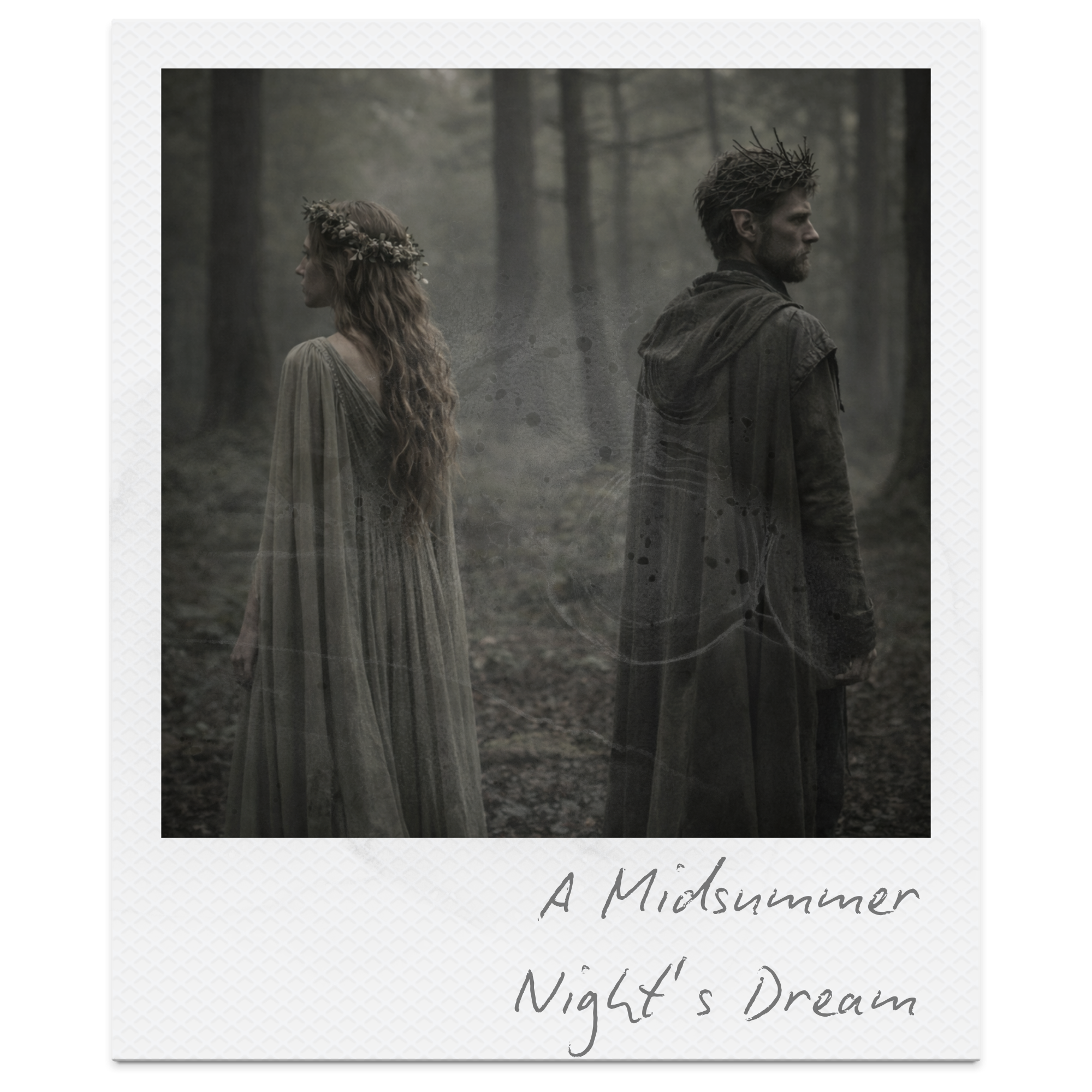
A Midsummer Night’s Dream places identity, desire, and authority into deliberate chaos. As characters move between the ordered world of the court and the destabilising space of the forest, Shakespeare exposes how fragile reason, loyalty, and attraction become when social rules loosen. Disguise, enchantment, and performance blur the boundaries between choice and compulsion, revealing how easily identity can be reshaped by context and power.
Why this text works in the classroom
A Midsummer Night’s Dream is one of the most effective Shakespeare plays to teach when exploring identity and performance in Shakespeare. Students quickly engage with the instability of desire and the arbitrariness of attraction, particularly as love becomes something imposed rather than chosen. The play supports discussion around consent, control, and transformation, while also allowing students to examine how authority operates differently in structured versus liminal spaces. Its blend of comedy and unease makes it especially rich for interpretation-led teaching rather than surface-level analysis.
Classroom entry points and discussion ideas
◆ Explore the contrast between the court and the forest. How does setting reshape power and identity in A Midsummer Night’s Dream?
◆ Examine the role of magic as a tool of control rather than fantasy. Who benefits from confusion, and who suffers?
◆ Discuss how desire is portrayed as unstable and irrational. What does the play suggest about choice and agency?
◆ Compare the lovers’ loss of control with Viola’s deliberate performance or Beatrice’s verbal authority. How does identity operate differently across the comedies?
I have a complete A Midsummer Night’s Dream teaching resources bundle designed to support discussion-based lessons, close language analysis, and thematic exploration of identity, performance, and desire. The materials are flexible and can be adapted across different age groups and classroom settings. I also have a blog post about the play so you can read about it in more depth.
Justice, Mercy, and Moral Ambiguity in Shakespeare
Across several Shakespeare plays taught in the classroom, justice is presented not as a neutral system, but as something shaped by power, prejudice, and interpretation. Courts, contracts, and public judgement become spaces where moral certainty collapses and ethical questions resist resolution. Shakespeare repeatedly asks not what the law allows, but who the law protects — and at whose expense.
When teaching Shakespeare, these tensions create some of the most challenging and rewarding classroom discussions. Rather than offering clear moral positions, Shakespeare exposes the instability of legal authority and the discomfort of mercy when it conflicts with fairness. Characters argue persuasively on all sides, forcing students to confront competing values rather than settle on simple answers.
Plays that centre on justice and mercy in Shakespeare are particularly effective because they invite disagreement. Students must weigh intention against outcome, legality against morality, and rhetoric against reality. Exploring these tensions encourages careful reading of language, power dynamics, and silence — and helps students recognise how systems of judgement can be both persuasive and deeply flawed.
The Merchant of Venice

The Merchant of Venice centres on contracts, obligation, and the uneasy boundary between justice and cruelty. Through the bond between Antonio and Shylock, and the courtroom performance that follows, Shakespeare exposes how law can be used to legitimise prejudice while disguising itself as fairness. The play refuses to offer moral comfort, instead forcing audiences to confront the consequences of systems that value legality over humanity.
Why this text works in the classroom
The Merchant of Venice is one of the most challenging yet rewarding Shakespeare plays to teach because it resists simple interpretation. Students are compelled to grapple with justice and mercy in The Merchant of Venice, particularly how power operates within legal language, social exclusion, and public judgement. The courtroom scene offers rich opportunities for close language analysis, while the play’s unresolved ethical tensions encourage debate rather than consensus. When taught carefully, the text becomes a powerful vehicle for discussing bias, authority, and moral ambiguity.
Classroom entry points and discussion ideas
◆ Explore how the law functions as power in the play. Who benefits from its rigidity, and who is harmed by it?
◆ Examine Portia’s role in the courtroom. Is her appeal to mercy an act of justice, performance, or control?
◆ Discuss Shylock’s position within Venetian society. How do exclusion and prejudice shape his choices?
◆ Debate the ending of the play. Does it resolve conflict, or simply silence it?
I have a complete The Merchant of Venice teaching resources bundle designed to support discussion-based lessons, close language analysis, and careful exploration of justice, mercy, and moral ambiguity. The resources are flexible and adaptable across different classroom contexts.
Love, Loss, and Consequence in Shakespeare
Love in Shakespeare is rarely gentle or uncomplicated. Across several Shakespeare plays taught in the classroom, affection is shaped by impulse, social pressure, misunderstanding, and time. Rather than presenting love as purely redemptive, Shakespeare repeatedly exposes how desire can collide with family, authority, and circumstance — often with irreversible consequences.
When teaching Shakespeare, plays that focus on love and loss allow students to examine how private emotion is constrained or distorted by public systems. Decisions made in haste, secrecy, or fear rarely remain personal. Instead, they ripple outward, affecting families, communities, and future generations. This makes these texts particularly effective for exploring responsibility, maturity, and the cost of silence or delay.
Plays that centre on love and consequence in Shakespeare also invite comparison. Youthful passion can lead to destruction, while older, more reflective love is shaped by regret, endurance, and the hope of repair. Exploring these contrasts encourages students to move beyond romanticised readings and consider how time, power, and experience alter emotional judgement.
The plays below approach love from different angles, but both ask similar questions: what happens when love is rushed, denied, or misunderstood — and who pays the price?
Romeo and Juliet

Romeo and Juliet follows two young people whose relationship unfolds under intense social pressure, secrecy, and inherited conflict. While often framed as a tragic love story, the play is just as concerned with impulsivity, silence, and the consequences of adult authority failing to protect the young. Shakespeare presents love not as a private refuge, but as something shaped — and ultimately destroyed — by family loyalty, public violence, and haste.
Why this text works in the classroom
Romeo and Juliet is one of the most effective Shakespeare plays to teach because students immediately connect to its emotional intensity while still being challenged by its complexity. Exploring love and conflict in Romeo and Juliet allows students to move beyond romanticised readings and examine how pressure, honour, and reputation drive decision-making. The play’s focus on speed — rushed love, hurried plans, delayed messages — makes it particularly powerful for discussion around responsibility and consequence, while its mix of private emotion and public conflict supports close language analysis and debate.
Classroom entry points and discussion ideas
◆ Explore how haste and impulsivity in Romeo and Juliet shape the tragedy. Which decisions feel avoidable, and which feel inevitable?
◆ Examine the role of adult authority. How do figures like the Prince, Friar Lawrence, and the parents contribute to the outcome?
◆ Discuss the tension between private love and public loyalty. Why is secrecy presented as both necessary and destructive?
◆ Debate whether the tragedy is driven more by love itself or by the social structures surrounding it.
I’ve written a detailed Romeo and Juliet classroom deep dive that explores teaching approaches in more depth. I also have a complete Romeo and Juliet teaching resources bundle designed to support discussion-led lessons, close textual analysis, and flexible classroom use.
The Winter’s Tale

The Winter’s Tale traces the devastating consequences of jealousy, suspicion, and unchecked authority within an intimate domestic setting. When King Leontes becomes convinced of his wife’s infidelity without evidence, love is replaced by control, punishment, and loss. Shakespeare divides the play sharply between destruction and restoration, forcing audiences to sit with the damage caused by mistrust long before offering the possibility of repair.
Why this text works in the classroom
The Winter’s Tale is one of the most rewarding Shakespeare plays to teach when exploring love, loss, and consequence in Shakespeare. Students are often struck by how quickly affection collapses into cruelty, and how irreversible the damage feels. The play supports rich discussion around jealousy and power in The Winter’s Tale, particularly how authority enables emotional harm to be reframed as justice. Its unusual structure — tragedy followed by tentative restoration — allows students to examine whether forgiveness is earned, imposed, or simply necessary for survival.
Classroom entry points and discussion ideas
◆ Explore how Leontes’ jealousy develops without evidence. What does the play suggest about fear, power, and imagination?
◆ Examine the treatment of Hermione. How does silence function as both suffering and resistance?
◆ Discuss the role of time in the play. Does the passage of years heal harm, or merely distance it?
◆ Debate the ending. Is restoration convincing, or does it sit uneasily with what has been lost?
I have a range of The Winter’s Tale teaching resources designed to support discussion-based lessons, close language analysis, and thematic exploration of jealousy, authority, and restoration. These materials can be used flexibly alongside other Shakespeare texts or as part of a wider unit.
Bonus: Teaching Shakespeare’s Sonnets

Shakespeare’s sonnets are often treated as an optional extra or reserved for older students, but they can be some of the most powerful texts to teach when approached thoughtfully. Compact, emotionally intense, and structurally controlled, the sonnets allow students to explore voice, desire, time, and identity without the narrative demands of a full play.
One of the strengths of teaching Shakespeare’s sonnets is their immediacy. Unlike the plays, there is no plot to follow and no cast of characters to track. Instead, students are confronted with a speaking voice — persuasive, conflicted, vulnerable, or defiant — and asked to engage directly with language, argument, and emotion. This makes the sonnets particularly effective for close reading, annotation, and discussion-led lessons.
Why Shakespeare’s sonnets work in the classroom
◆ Their short length allows for deep analysis without cognitive overload
◆ They foreground language as persuasion, making rhetorical choices visible
◆ Themes of love, time, power, and identity link naturally to the plays
◆ They encourage multiple interpretations rather than fixed readings
Sonnets also work well as bridges between texts. Pairing a sonnet with a play — for example, exploring jealousy, desire, or time alongside Othello, Romeo and Juliet, or The Winter’s Tale — helps students recognise Shakespeare’s recurring concerns across forms. Rather than feeling separate from the plays, the sonnets often sharpen understanding of them.
When taught as moments of voice rather than puzzles to decode, Shakespeare’s sonnets give students confidence in handling complex language and recognising how tightly form and meaning are connected. They reward slow reading, discussion, and disagreement — the same qualities that make Shakespeare’s plays endure in the classroom.
Go Deeper into Teaching Shakespeare
Once students are familiar with individual Shakespeare plays, the most meaningful learning happens when those texts are treated as part of a wider conversation rather than isolated units. Across tragedies, comedies, and romances, Shakespeare returns repeatedly to questions of power, identity, justice, love, and consequence — often refusing to resolve them cleanly. That refusal is what makes his work so valuable in the classroom.
Going deeper with teaching Shakespeare works best when students are encouraged to interrogate systems rather than characters alone. Harm in Shakespeare rarely comes from simple villainy. It emerges through insecurity, social pressure, performance, silence, haste, or the misuse of authority. Shifting discussion away from “who is good or bad” and towards how decisions are shaped allows students to engage more critically and confidently.
These approaches tend to support deeper thinking across texts:
◆ Treat ambiguity as deliberate
Shakespeare often withholds moral certainty. Allowing students to sit with unresolved questions mirrors the plays themselves.
◆ Read language as strategy
Focus on what language does — persuades, manipulates, reassures, conceals — rather than treating it as decorative.
◆ Look at power beyond titles
Authority operates through reputation, silence, access to speech, and social pressure as much as through formal power.
◆ Encourage comparison across plays
Patterns become clearer when students recognise how similar tensions play out differently across tragedies, comedies, and romances.
Approaching Shakespeare in the classroom this way helps students see his work as a connected exploration of human behaviour — one that rewards discussion, disagreement, and rethinking rather than quick conclusions.
If you’re looking for classroom materials that support this kind of discussion-led, flexible teaching, I’ve created a Shakespeare Growing Mega Bundle that brings together all of my Shakespeare resources in one evolving collection. The bundle is designed to work across plays and year groups, and it’s updated regularly as new resources are added.
Final Thoughts
Shakespeare continues to earn his place in the classroom not because his work is easy or comfortable, but because it resists simplification. Across tragedies, comedies, and romances, his plays ask students to sit with uncertainty, question authority, and recognise how language, power, and choice shape human behaviour. When taught with space for discussion and disagreement, Shakespeare’s plays consistently reward close reading and thoughtful debate.
Approaching teaching Shakespeare as a connected body of work rather than a series of isolated texts allows patterns to emerge more clearly. Ambition, jealousy, performance, justice, love, and consequence recur across plays, inviting students to compare, challenge, and refine their interpretations over time. This approach shifts learning away from memorised readings and towards genuine engagement with ideas.
If you’re looking to extend this work, you’ll find more in-depth analysis, teaching approaches, and classroom resources for individual texts in the Literature Library, where Shakespeare sits alongside other frequently taught authors and works. The library is designed to support discussion-led teaching and flexible lesson planning, whether you’re revisiting a familiar play or introducing a text for the first time.
Taken together, these plays demonstrate why Shakespeare remains so effective in the classroom. His writing does not demand reverence — it demands thinking. And that, ultimately, is what makes it worth teaching.
