The Cabinet of Unnatural Curiosities: Creative Writing Ideas from a Dark Fairytale World
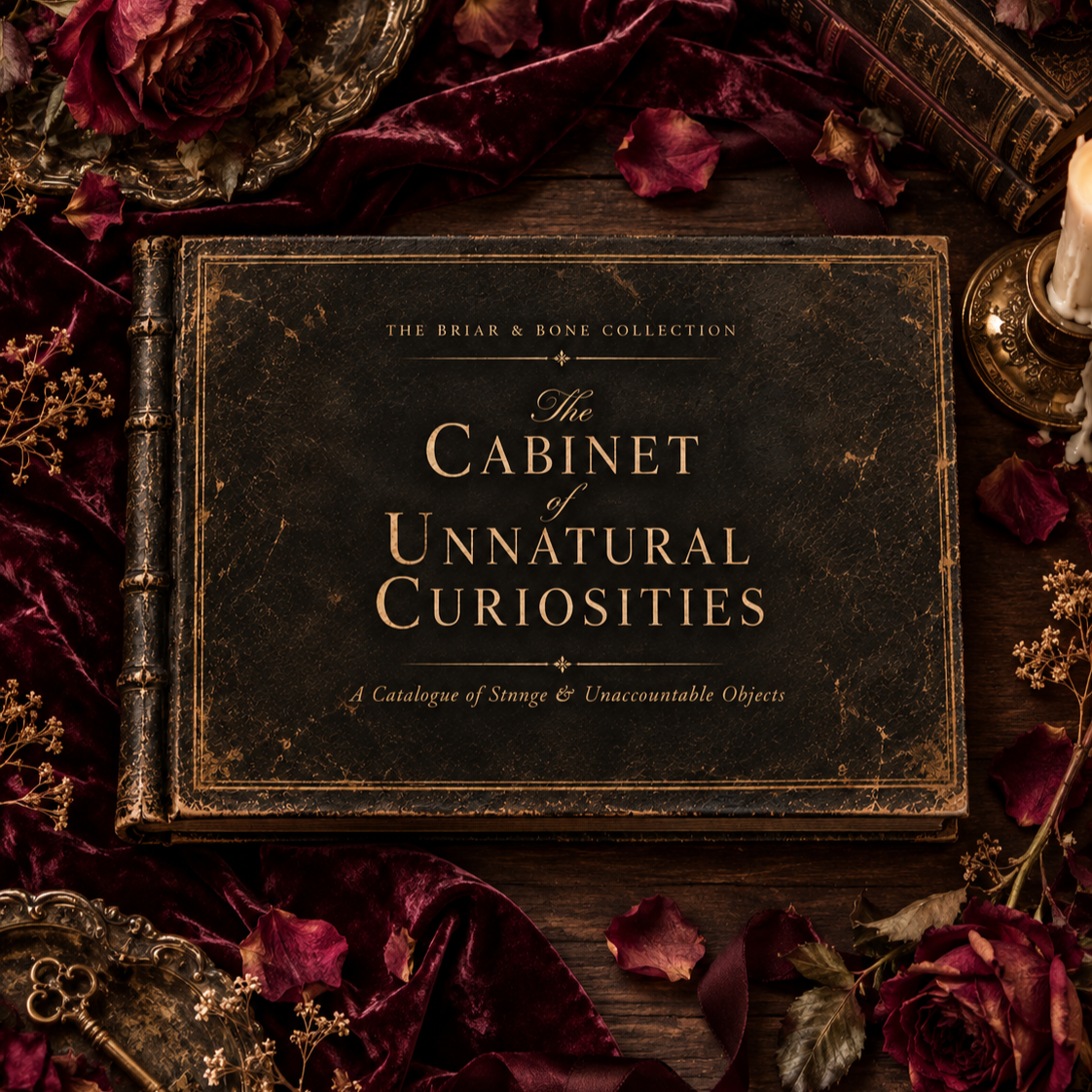
Some objects are better left forgotten. Others refuse to be.
Deep within the Kingdom of Rosenwald, a peculiar collection of enchanted objects, forgotten treasures and unsettling curiosities has been gathered together. Among them are a mechanical nightingale with a heart that should not beat, a pair of bridal slippers with a sinister history, a silver brush that never stops growing hair, and a delicate bottle containing a witch's tears.
Each object has a story. Some have several. And not all of them can be trusted.
Welcome to The Cabinet of Unnatural Curiosities, an illustrated collection of mysterious artefacts from the dark fairytale world of Rosenwald. Part fictional museum catalogue, part Gothic curiosity cabinet, this unusual creative writing resource invites you to explore the strange histories, whispered rumours and unanswered questions surrounding its contents.
Inspired by the darker traditions of folklore and fairytales, the Cabinet transforms familiar objects into starting points for imaginative storytelling. A beautiful heirloom might conceal a terrible bargain. An innocent wedding gift could carry an ancient curse. Even the smallest forgotten possession might hold the key to an extraordinary mystery.
Whether you're looking for dark fairytale writing prompts, inspiration for Gothic fiction, unusual magical objects for your next story, or imaginative creative writing activities for the classroom, the Cabinet offers a world of possibilities.
For writers who love exploring the darker side of fairytales and folklore, The Cabinet of Unnatural Curiosities offers an invitation into a world of enchanted objects, forgotten histories and mysteries waiting to be unravelled. Every specimen is a starting point for a new story, and every unanswered question is an opportunity to imagine something extraordinary.
So, open the cabinet. Examine the evidence. Question the collector.
And remember: in Rosenwald, even the most beautiful things may have teeth.
What Is The Cabinet of Unnatural Curiosities?
The Cabinet of Unnatural Curiosities is an illustrated collection of mysterious objects, enchanted artefacts and forgotten treasures from the fictional Kingdom of Rosenwald. Inspired by Victorian cabinets of curiosities, Gothic literature and the darker traditions of European folklore, it presents a world in which ordinary possessions can conceal extraordinary, and sometimes terrifying, secrets.
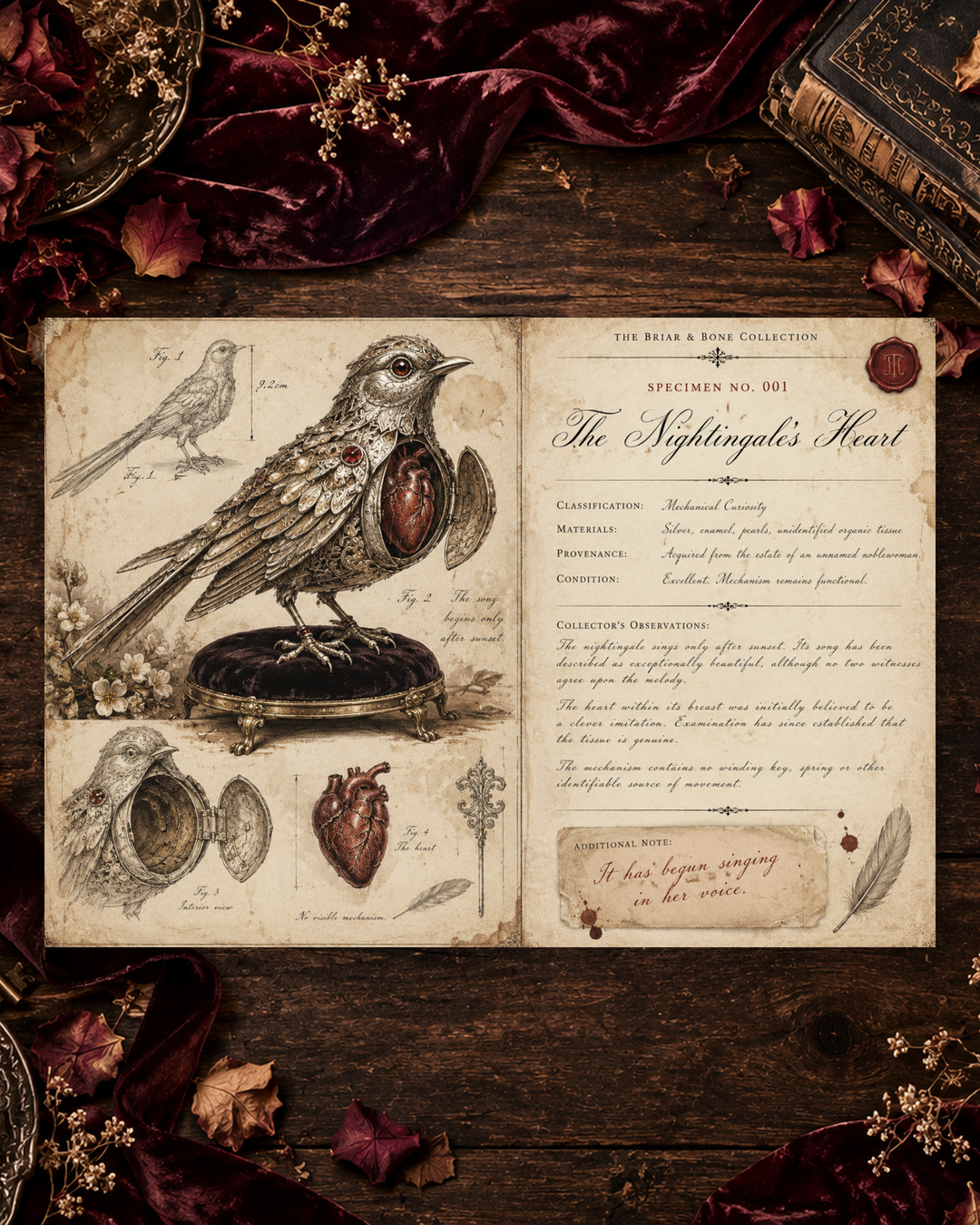
Unlike a traditional collection of creative writing prompts, the Cabinet invites readers to become investigators. Each specimen is presented as an artefact from Rosenwald's mysterious past, complete with intricate illustrations, descriptions, provenance records and observations from an unnamed collector.
Some objects appear beautiful at first glance. Others are immediately unsettling. A mechanical nightingale sings without any visible means of movement, while the heart concealed inside its silver body raises questions that its collector cannot answer. Elsewhere, seemingly innocent household possessions hint at forgotten tragedies, dangerous enchantments and bargains whose consequences have survived long after their makers.
The collection also contains fragments of a larger mystery: photographs, preserved feathers, unusual botanical specimens and incomplete records that suggest there is far more to Rosenwald than the collector has been willing, or able, to explain.
For creative writers, these details provide the foundations for countless stories. Who originally owned an object? What happened to them? Why was it preserved? And what might happen if somebody attempted to use it again?
There are no prescribed answers. The Cabinet deliberately leaves room for interpretation, encouraging writers to develop their own characters, histories, supernatural rules and dark fairytale narratives.
Whether you're writing a Gothic short story, developing a dark fantasy setting or looking for an unusual starting point for your next piece of creative writing, the Cabinet offers something to investigate, question and transform into a story of your own.
Strange Objects, Forgotten Histories and Unanswered Mysteries
Every object has a history, but in the Kingdom of Rosenwald, those histories are rarely straightforward.
Throughout The Cabinet of Unnatural Curiosities, seemingly ordinary possessions are accompanied by fragments of evidence: handwritten observations, incomplete records, peculiar annotations and the occasional warning. Some suggest that an object once belonged to somebody important. Others hint at unexplained disappearances, forgotten bargains or events that nobody has been willing to discuss.
Yet the most intriguing details are often the ones that have been left out.
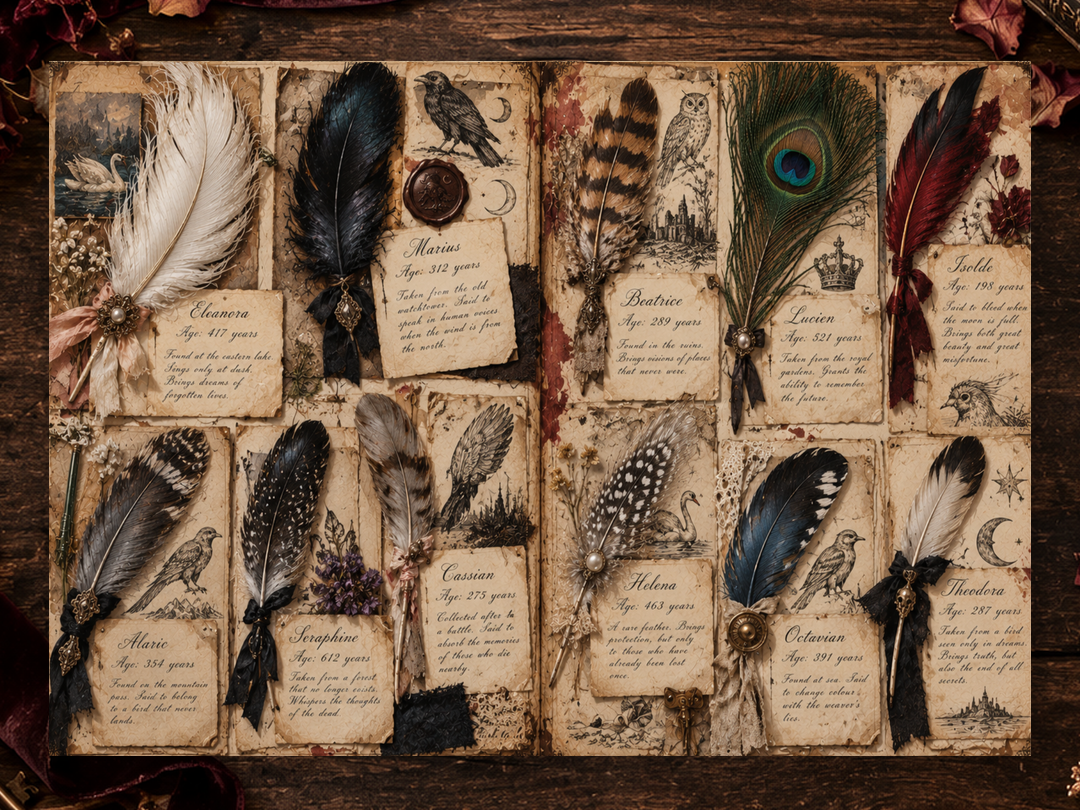
Consider a collection of preserved feathers, each carefully labelled with a name, an age and a brief account of its origins. At first glance, they might resemble specimens from a natural history museum. Look more closely, however, and their accompanying records begin to suggest something altogether stranger.
Who collected these feathers, and why were they preserved? What connects their former owners? Are the recorded ages significant, or merely another detail intended to distract the curious?
Perhaps the feathers are evidence of an ancient transformation. Perhaps they belonged to people who made bargains with creatures of the forest. Or perhaps their significance has nothing to do with magic at all.
The possibilities are deliberately left open.
This is what makes mysterious artefacts such powerful sources of creative writing inspiration. Rather than beginning with a complete plot, writers can start with a single unexplained detail and gradually build a story around it.
A name scratched into the back of a portrait might introduce a forgotten character. An unusual date could suggest a historical mystery. A seemingly harmless object might become the centre of a family secret, a supernatural investigation or a Gothic tale of obsession.
The Cabinet also encourages writers to consider the reliability of the evidence itself. The collector has recorded what they believe to be true, but their observations are not necessarily accurate. Some accounts may be exaggerated, misunderstood or deliberately misleading.
And sometimes, a strange object is simply a strange object.
Not every clue needs to lead somewhere. Not every mystery requires a supernatural explanation. The uncertainty is part of the storytelling experience, allowing writers to decide which details matter, which are coincidences and which conceal something far more disturbing.
For anyone interested in Gothic creative writing, dark fantasy or mystery storytelling, the Cabinet provides an opportunity to explore how atmosphere, suggestion and carefully chosen details can create a sense of unease long before anything truly frightening happens.
Cursed Objects and Dark Fairytale Creative Writing Ideas
In traditional fairytales, magic is rarely without consequences. A poisoned apple, an enchanted spinning wheel or a pair of dancing shoes can transform an ordinary moment into something extraordinary. These objects often appear harmless, even beautiful, until their true purpose is revealed.
The same principle lies at the heart of The Cabinet of Unnatural Curiosities, where familiar possessions become the starting points for dark fairytale creative writing ideas.
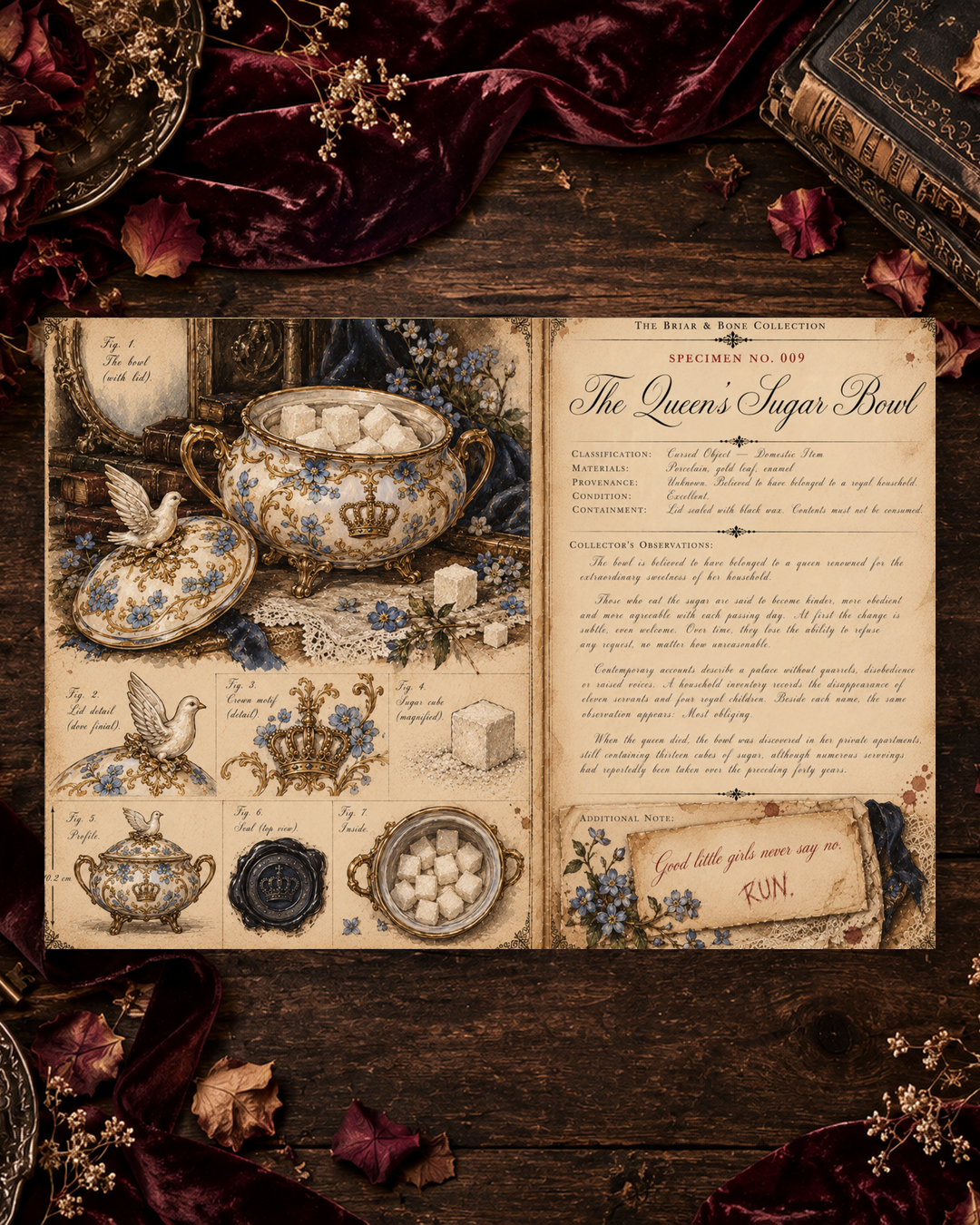
Consider the Queen's Sugar Bowl, an exquisite porcelain vessel decorated with delicate blue flowers, golden embellishments and a royal crown. It appears to be a treasured household possession, perhaps once displayed in a palace drawing room or brought out for important guests.
Its history, however, suggests something far more sinister.
According to the collector's observations, the bowl once belonged to a queen renowned for the extraordinary sweetness of her household. Those who consumed its sugar reportedly became kinder, more obedient and increasingly agreeable with each passing day.
Eventually, they lost the ability to refuse any request, no matter how unreasonable.
The bowl was later discovered in the queen's private apartments, still containing thirteen cubes of sugar. Despite numerous servants reportedly taking sugar from it, the quantity never diminished.
It is a wonderfully unsettling example of how cursed objects in fantasy writing can transform something comforting into a source of horror. Sugar, traditionally associated with sweetness, hospitality and pleasure, becomes an instrument of control. The queen's apparently perfect household takes on a much darker meaning.
For writers, the possibilities extend far beyond the object's recorded history.
Creative Writing Ideas Inspired by Cursed Objects
Use the following prompts to develop your own dark fairytales, Gothic short stories or supernatural mysteries.
The Thirteenth Cube: A servant discovers that twelve cubes of sugar have been removed from the queen's bowl, but nobody can remember who took them. When the final cube disappears, the palace falls silent.
The Wedding Gift: A young bride receives an exquisite silver hairbrush from her new mother-in-law. Each morning, she discovers that her hair has grown longer, while her reflection appears a little less like herself.
The Perfect Household: A visiting noblewoman becomes suspicious of a palace where nobody argues, nobody complains and every servant smiles. She decides to discover what happens to those who refuse an order.
The Inheritance: A young woman inherits a collection of beautiful objects from an eccentric relative. Each comes with a handwritten warning, but the instructions have been deliberately mixed up.
The Bargain: A struggling merchant discovers an enchanted object capable of granting one small wish each day. The wishes always come true, but the consequences begin appearing in the lives of strangers.
These dark fairytale writing prompts explore some of the most enduring themes in fairytale storytelling: temptation, power, transformation, forbidden knowledge and the dangerous consequences of getting exactly what you wish for.
They also demonstrate how an object can become much more than a decorative detail. A cursed possession might reveal a character's deepest desire, expose a hidden injustice or force somebody to make an impossible choice.
For an additional challenge, try writing a story in which the object itself is never proven to be magical. Perhaps the curse is genuine. Perhaps the characters merely believe it is. Or perhaps somebody has carefully constructed the illusion of an enchantment to conceal a very human crime.
After all, the most disturbing fairytales are not always the ones in which magic is real.
Sometimes, the true horror lies in what people are willing to do without it.
Building Gothic Stories from Forgotten Photographs and Mysterious Evidence
Sometimes, the most compelling stories begin not with an extraordinary event, but with the discovery of something that should not exist.
An old photograph tucked inside a family album. A handwritten note concealed beneath the floorboards. A portrait of an unfamiliar child whose face appears in photographs taken a century apart.
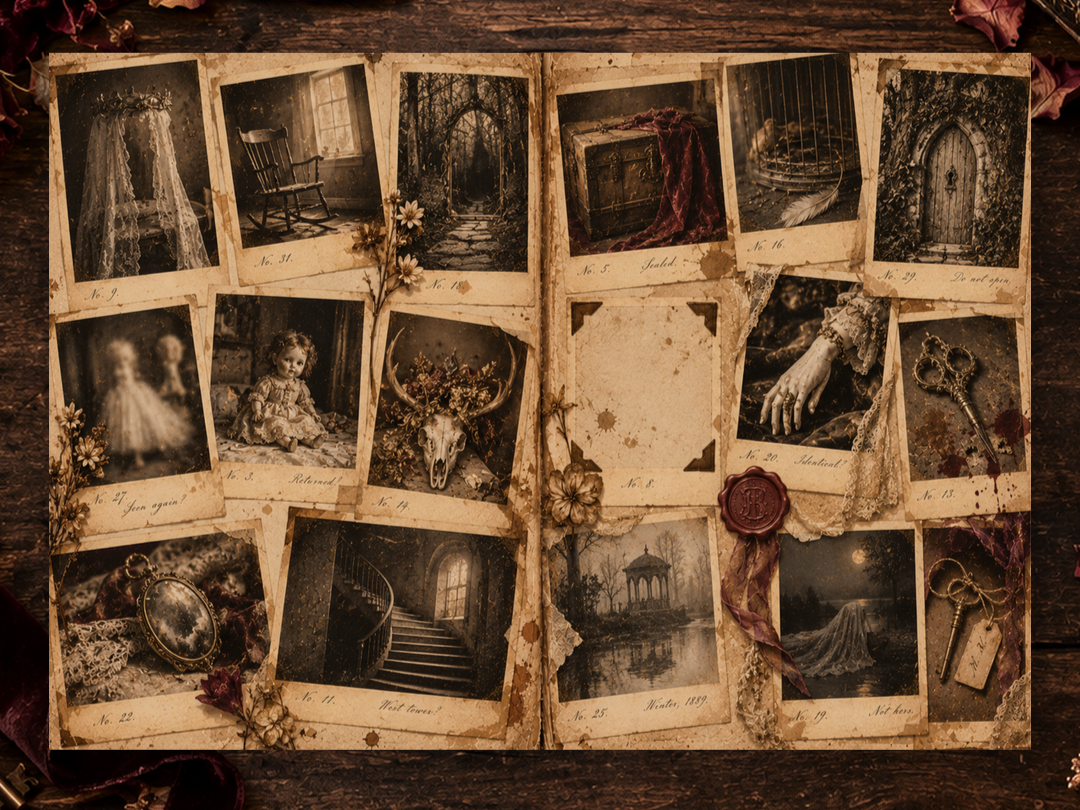
In Gothic fiction and mystery writing, these fragments of evidence can be particularly effective. They invite readers to investigate alongside the characters, gradually uncovering a history that may be far more disturbing than anyone imagined.
The Cabinet of Unnatural Curiosities explores this approach through a collection of aged photographs, incomplete records and mysterious objects whose original purposes have become obscured by time.
Some photographs depict abandoned rooms, forgotten buildings and seemingly ordinary possessions. Others contain unsettling details: a blurred figure, a child who has apparently returned, a locked door or an object whose significance remains unexplained.
The photographs offer glimpses into Rosenwald's past without revealing the complete stories behind them.
Who occupied the abandoned rocking chair? Why was a particular room photographed? What lies beyond the locked door? And why has one photograph been removed from the collection, leaving an empty space among the surviving records?
Each image offers a possible beginning, but it is the writer who must decide what happens next.
Using Found Documents in Creative Writing
One particularly effective technique for developing a Gothic story is to construct the narrative through found documents rather than a conventional sequence of scenes.
Instead of telling readers exactly what happened, you might allow them to piece together the events through letters, diary entries, newspaper clippings, photographs, official reports and other surviving evidence.
This approach can create suspense by revealing information gradually, particularly when different documents contradict one another.
For example, imagine a collection of records concerning a young woman who disappeared from a remote country house.
A family portrait depicts the woman standing beside relatives who insist she never existed.
A handwritten letter suggests she was preparing to leave the house, but its final paragraph has been deliberately removed.
A newspaper report describes her disappearance, although the date is several years before her supposed birth.
A household inventory lists her possessions, including an unfamiliar object that nobody remembers purchasing.
A final photograph shows the same object displayed in a room that was supposedly destroyed by fire.
Individually, these fragments raise questions. Together, they begin to suggest a larger mystery.
Yet the writer remains free to decide whether the explanation involves supernatural forces, an elaborate deception, a family conspiracy or something else entirely.
Creative Writing Challenge: The Missing Photograph
Imagine you have inherited an old collector's album containing thirty photographs. Each image has been carefully numbered, dated and labelled.
Except one.
Photograph Number Eight has been removed, leaving only four faded corners and a handwritten note:
Do not ask what was here.
Write a Gothic short story beginning with the discovery of the missing photograph.
Consider who assembled the collection, why the photograph was removed and whether the person responsible was attempting to conceal a crime, protect somebody or prevent something from being remembered.
You might tell the story through a conventional third-person narrative, or experiment with diary entries, witness statements and correspondence to create a more fragmented account.
For further inspiration, explore our Gothic Writing Hub and Creative Writing Archive, where you'll find additional ideas for developing atmospheric settings, mysterious characters and unsettling narratives.
The beauty of writing from incomplete evidence is that the gaps become as important as the information itself. A missing name, an unexplained date or an empty space in a photograph can inspire an entire story.
And sometimes, what has been deliberately removed is far more interesting than anything left behind.
How to Use The Cabinet of Unnatural Curiosities for Creative Writing
One of the most exciting things about creative writing with mysterious objects is that a single artefact can inspire dozens of entirely different stories.
A silver locket might become the centrepiece of a Gothic romance, the evidence in a murder mystery or a cursed heirloom passed between generations. An enchanted spinning wheel could inspire a traditional fairytale retelling, a dark fantasy adventure or a psychological horror story about obsession and fate.
The Cabinet of Unnatural Curiosities is designed to encourage this kind of imaginative exploration. Rather than providing complete narratives, its illustrated specimens, collector's observations and fragments of evidence offer starting points for writers to develop their own characters, settings, conflicts and mysteries.
Here are five ways to use the collection in your own creative writing.
1. Choose an Object and Invent Its History
Begin by selecting an object that captures your imagination. Study its appearance, materials, recorded origins and any unusual details noted by the collector.
Then ask yourself:
Who originally owned this object, and how did they acquire it?
Was it created for an ordinary purpose, or something more sinister?
What important event might explain its present condition?
Why did the object eventually become part of the collection?
What would happen if somebody tried to reclaim it?
Use your answers to write a short history of the object, imagining the people, places and events connected to its past.
For an additional challenge, write two conflicting accounts of the same artefact. One might describe it as a treasured family heirloom, while the other suggests it was responsible for a terrible tragedy.
2. Create a Character Connected to the Object
Objects become particularly interesting when they reveal something about the people who possess them.
A character might treasure an enchanted mirror because they fear growing old. A desperate parent might accept a dangerous bargain to obtain a miraculous cure. A collector might become so obsessed with acquiring unusual specimens that they begin to overlook the suffering associated with them.
Choose an artefact and invent a character whose greatest desire, fear or secret is connected to it.
Consider what they are willing to sacrifice to obtain the object, what they believe it can do and how their relationship with it might change over time.
This exercise is especially useful for developing Gothic characters, dark fantasy protagonists and morally complicated fairytale villains.
3. Build a Dark Fairytale Setting
Every mysterious object belongs somewhere.
Perhaps an enchanted crown was discovered beneath the ruins of an abandoned palace. A strange bottle might have been recovered from a witch's cottage deep within an ancient forest. A silver key could belong to a door that appears only during the winter solstice.
Use the artefacts in the Cabinet to imagine the wider world surrounding them.
What traditions, superstitions or magical rules might explain their existence? How do ordinary people respond to rumours of curses and enchantments? Are these objects feared, worshipped, collected or quietly hidden away?
You can develop your setting further using our Fairytales & Folklore Hub, which explores enchanted kingdoms, magical forests, fairytale characters and imaginative worldbuilding.
4. Develop a Mystery Through Clues and Contradictions
Not every object in the Cabinet comes with a reliable explanation.
The collector's observations may be incomplete, witnesses may disagree and surviving evidence may raise more questions than it answers.
Choose three unrelated specimens and imagine that a character discovers them together in an abandoned house.
Why are they there? Do they share a hidden connection, or has somebody deliberately arranged them to suggest one? Which details are important, and which might be misleading?
Write a mystery in which your protagonist must investigate the objects without knowing whether the evidence can be trusted.
You might introduce an unreliable narrator, a forged document, a missing witness or a supernatural explanation that conceals a more ordinary truth.
5. Write a Story from the Object's Perspective
For a more unusual creative writing challenge, imagine that one of the Cabinet's objects can remember everything it has witnessed.
A mourning locket might have passed through the hands of generations of grieving families. A pair of golden scissors could remember every thread they have severed. A mechanical nightingale might have watched the rise and fall of a royal household without ever leaving its gilded perch.
Choose an object and write a first-person narrative describing its experiences.
Does it understand the people who possess it? Can it distinguish kindness from cruelty? Does it regret anything that has happened, or is it simply an indifferent witness to human misfortune?
For an especially unsettling story, allow the object to reveal a secret that none of its previous owners ever discovered.
Using the Cabinet in the Creative Writing Classroom
Although the Cabinet was created as an immersive fictional collection, its visual storytelling approach also makes it a useful resource for teachers exploring descriptive writing, Gothic literature, fantasy storytelling and creative writing activities.
Students can begin by examining a specimen and recording their observations before developing an interpretation of its history. This encourages close attention to visual details, inference and the distinction between evidence and speculation.
The collection can also support several classroom activities:
Descriptive Writing: Describe an unusual artefact using sensory imagery, precise vocabulary and atmospheric detail.
Creative Writing: Develop an original short story inspired by a specimen's appearance, history or mysterious properties.
Historical and Gothic Contexts: Explore how fictional documents, old photographs and antique objects can create a convincing sense of the past.
Discussion and Debate: Consider whether an object is genuinely supernatural or whether its reputation has been shaped by rumour and superstition.
Art and Design: Create an original curiosity, complete with labelled illustrations, decorative details and a fictional provenance record.
Cross-Curricular Links: Combine creative writing with history, art, drama and imaginative research.
Students could also create their own miniature cabinets of curiosities, inventing a collection of strange objects connected to an imaginary kingdom, forgotten family or mysterious historical event.
By combining illustrations with fictional records and open-ended questions, the Cabinet encourages writers to move beyond simply describing what they see and begin imagining the stories that might lie beneath the surface.
After all, a curious object is only the beginning.
The real story emerges when somebody asks why it exists.
Explore The Cabinet of Unnatural Curiosities
Some collections are assembled to preserve history. Others are gathered to conceal it.
The Cabinet of Unnatural Curiosities invites you to step inside the mysterious Kingdom of Rosenwald and explore a beautifully illustrated collection of enchanted objects, forgotten treasures and unsettling artefacts.
Inspired by Victorian curiosity cabinets, Gothic literature and the darker traditions of fairytale folklore, this 21-page digital collection brings together extraordinary specimens whose histories are as intriguing as their appearances.
From delicate porcelain vessels and mysterious mechanical creations to preserved feathers, strange heirlooms and fragments of forgotten lives, every object offers another glimpse into Rosenwald's peculiar past.
But this is no ordinary museum catalogue.
The collector's observations are incomplete. Some histories are contradictory. Others raise questions that cannot easily be answered. And beneath the beautiful illustrations lies the unsettling possibility that certain objects were never meant to be discovered.
What's Inside the Collection?
21 beautifully designed digital pages, including the illustrated catalogue and introductory and closing pages.
Original illustrated curiosities, featuring enchanted objects, unusual specimens and mysterious possessions from Rosenwald.
Fictional collector's records, with descriptions, observations and fragments of forgotten histories.
Atmospheric photographs and visual evidence, offering further glimpses into the kingdom's secrets.
Dark fairytale and Gothic inspiration, encouraging imaginative storytelling, worldbuilding and character development.
Open-ended mysteries, allowing writers to interpret the artefacts and invent their own explanations.
Each page has been designed to feel like a fragment of a much larger fictional world, inviting readers to explore the collection at their own pace.
Who Is the Cabinet For?
Whether you're an experienced storyteller or simply enjoy exploring unusual fictional worlds, the Cabinet offers a different way to approach creative writing.
It's particularly suited to writers who enjoy dark fairytales, Gothic fiction, fantasy worldbuilding, folklore, mysterious objects and atmospheric storytelling.
Teachers and creative writing groups can also use the illustrated specimens as visual starting points for descriptive writing, narrative development, discussion and imaginative classroom activities.
There is no single correct interpretation of the Cabinet's contents. You might use one object to inspire a short story, combine several specimens into a larger mystery or simply explore the collection as an illustrated journey through a strange and unsettling kingdom.
The stories are yours to discover.
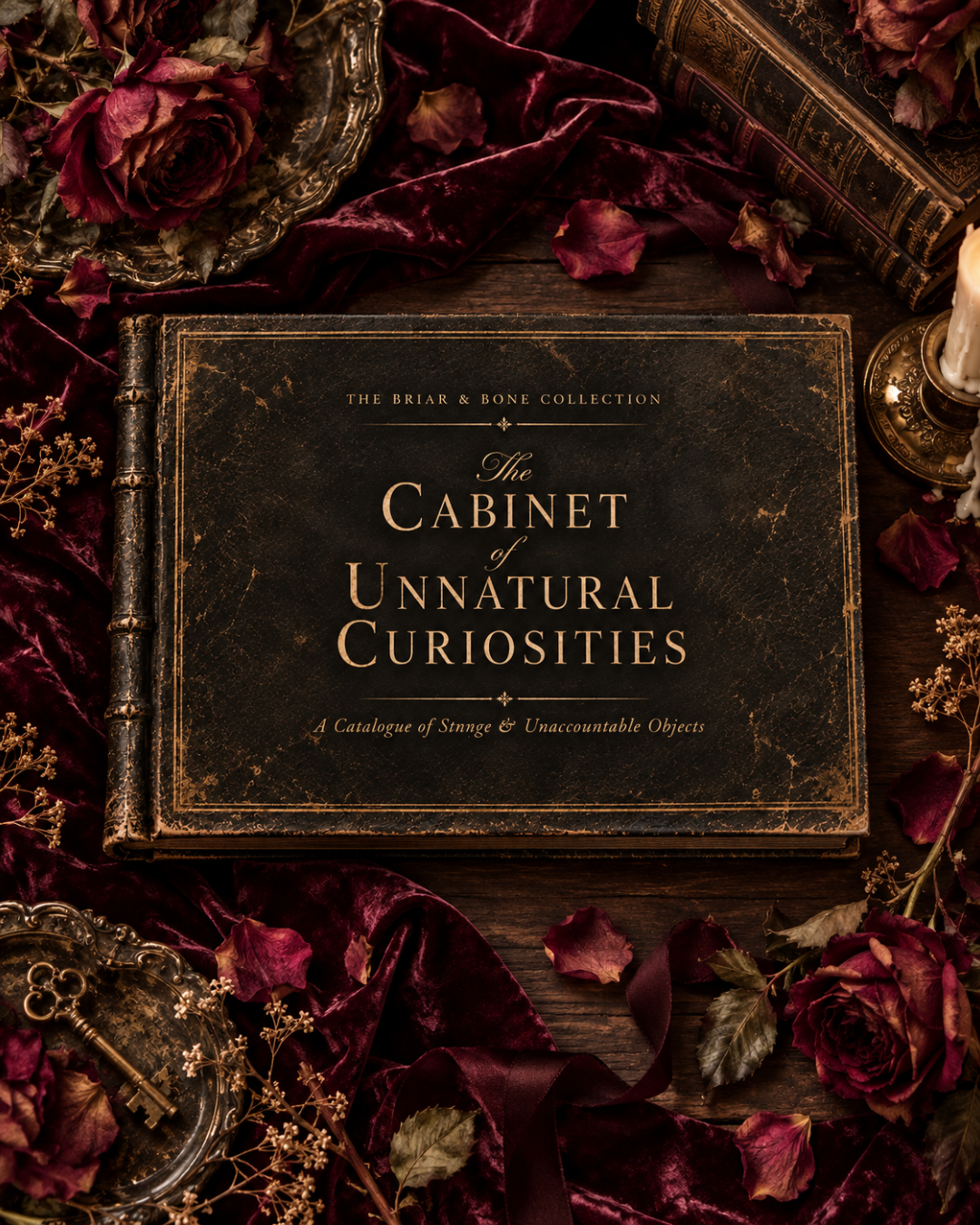
Some objects should never be collected.
Others refuse to be forgotten.
Deep within the Kingdom of Rosenwald, a mysterious collector has spent thirty-seven years gathering objects of unusual provenance, uncertain purpose and, in several instances, deeply unsettling reputation.
A mechanical nightingale sings with a voice that is not its own.
A silver brush continues to grow hair.
A pair of bridal slippers remembers a wedding nobody wishes to discuss.
And a queen's beautiful porcelain sugar bowl conceals a terrible secret.
Each object has a history.
Some have several.
Not all of them can be trusted.
Briar & Bone: The Cabinet of Unnatural Curiosities is an immersive, 21-page illustrated catalogue of enchanted objects, forgotten treasures and mysterious artefacts from the dark fairytale Kingdom of Rosenwald.
Inspired by Victorian cabinets of curiosities, Gothic literature and twisted fairytales, this fictional collection brings together intricate specimen illustrations, collector's observations, mysterious photographs, preserved curiosities and fragments of a world where even the most beautiful possessions may conceal something sinister.
Who placed a human heart inside the mechanical nightingale?
Why were the feathers carefully labelled with names and ages?
What happened to the owners of the objects that were never reclaimed?
Why have certain photographs been removed?
And what secrets has the collector chosen not to record?
There are no definitive explanations.
No complete histories.
No guarantee that the collector is telling the truth.
Only strange objects, forgotten stories and unanswered questions waiting to be explored.
What's Inside?
◆ 21 beautifully illustrated digital pages from the fictional Kingdom of Rosenwald
◆ 11 detailed specimen entries featuring cursed objects, enchanted possessions and mysterious artefacts
◆ Intricate illustrations, classifications, provenance records and the collector's observations
◆ Collections of preserved flowers, feathers and other unusual curiosities
◆ Atmospheric photographs, mysterious locations and fragments of forgotten histories
◆ An illustrated inventory of additional objects and incomplete records
◆ An exploration guide with creative writing ideas and classroom activities
◆ Instant digital download in PDF format
Who Is It For?
Perfect for:
◆ Fantasy writers and worldbuilders
◆ Gothic fiction and dark fairytale enthusiasts
◆ Novelists, short-story writers and creative storytellers
◆ Teachers looking for imaginative visual writing prompts
◆ Mystery lovers and fans of supernatural folklore
◆ Journalers, roleplayers and curious minds
◆ Anyone who loves antique curiosities, fictional archives and strange forgotten histories
What Makes This Different?
This isn't a traditional collection of writing prompts.
It's a cabinet of curiosities.
Every specimen offers another glimpse into Rosenwald's mysterious past, but the histories are incomplete, the evidence is uncertain and the collector's observations cannot always be trusted.
Examine the nightingale's mechanical heart.
Study the preserved feathers.
Investigate the queen's sugar bowl.
Search the photographs for missing details.
Read the collector's observations and decide which accounts you believe.
Perhaps an object is genuinely enchanted.
Perhaps its reputation has grown from superstition.
Perhaps somebody has deliberately concealed the truth.
Or perhaps the strangest explanation is the correct one.
You decide what these objects mean.
Use the collection to inspire a Gothic short story, develop a dark fairytale, invent a mysterious character or build an entire fantasy world around its forgotten artefacts.
Follow the clues.
Question the collector.
Imagine the histories that were never recorded.
Which curiosity will you investigate? What story will you uncover?
Digital download: 21-page illustrated PDF collection, designed in A4 landscape format. Some pages contain multiple individual artefacts. No physical product will be shipped.
The Cabinet is available as a standalone digital download, ready to explore whenever inspiration strikes.
Choose a specimen. Examine its history. Follow the clues, or invent a mystery of your own.
Just remember that the collector has not necessarily told you everything.
And some curiosities are best left undisturbed.
Final Thoughts: Every Object Has a Story
The most extraordinary stories often begin with the smallest discoveries. A forgotten photograph, an unusual heirloom or a beautiful object with a troubling history can become the foundation for an entire fictional world.
The Cabinet of Unnatural Curiosities celebrates the darker, stranger side of storytelling, where familiar objects conceal impossible secrets and even the most innocent treasures might have a sinister past.
Whether you're developing a Gothic mystery, imagining a cursed kingdom or searching for unusual creative writing ideas, the Cabinet encourages you to look beyond appearances, question the evidence and discover the stories waiting to be told.
For more inspiration, explore our Fairytales & Folklore Hub, where you'll find enchanted kingdoms, magical creatures, twisted fairytale ideas and imaginative writing prompts. If you prefer your stories mysterious and macabre, our Gothic Writing Hub offers plenty of inspiration for atmospheric settings, unsettling characters and supernatural tales.
You can also visit our Creative Writing Archive for hundreds of story ideas, writing prompts and resources to inspire your next adventure.
And should you find yourself drawn back to the Cabinet, remember one thing:
Every object has a history. Every history has its secrets.
And some secrets are still waiting to be discovered.
