Imagine attending a school where every lesson is designed to control your thoughts, every examination determines your worth, and questioning your teachers could mean disappearing before graduation. Behind the immaculate uniforms, towering institutional buildings and promises of a perfect future lies something far more sinister: a system designed to transform children into obedient citizens who will never challenge the society that created them. In these dystopian schools and academies, education is not about discovering who you are, but ensuring you become exactly what the authorities demand.
These 70 Dystopian School and Academy Writing Prompts explore authoritarian education systems, psychological conditioning, compulsory loyalty, forbidden knowledge, ruthless examinations and the terrifying consequences of independent thought. From elite boarding schools where students compete for the right to survive to underground classrooms preserving outlawed histories, each idea offers a different perspective on education as an instrument of oppression. Explore secret experiments, manipulated memories, institutional conspiracies, dangerous friendships and young rebels who begin to suspect that everything they have been taught is a lie.
Whether you're developing a psychological thriller set inside an isolated academy, a dark science-fiction story about genetically engineered students, or a dystopian rebellion beginning with a single forbidden question, these prompts will help you create unsettling institutions, morally complex characters and unforgettable conflicts. Discover original plot hooks, story titles, opening and closing lines, character concepts, atmospheric settings and visual writing prompts designed to inspire stories where knowledge is dangerous, obedience is rewarded and graduation may be the most terrifying prospect of all. For more inspiration, explore the Dystopian Writing Hub, experiment with the Dystopian Story Sparks Generator, or browse the wider Creative Writing Archive for more speculative fiction ideas and creative writing resources.
1. Dystopian School & Academy Plot Hooks and Story Ideas
In dystopian fiction, schools can become some of the most frightening institutions imaginable. Behind their promises of excellence, discipline and opportunity, these academies conceal systems of indoctrination, psychological manipulation and institutional cruelty. The following ten plot hooks explore different ways education might be transformed into an instrument of control, from examinations with devastating consequences to classrooms where curiosity itself is considered a crime.
Every student at the prestigious Ascension Academy receives a final ranking on graduation day, determining their occupation, social status and permitted lifespan. When a seventeen-year-old discovers that the highest-ranked students have all been declared dead within a year of leaving, she deliberately sabotages her examinations to discover what happens to those considered failures.
In a society where historical knowledge is strictly controlled, children are taught that civilisation began exactly eighty years ago. A student assigned to clean an abandoned classroom discovers textbooks describing centuries of forgotten history, including photographs of the academy's headmaster looking exactly as he does today.
At the National Institute of Behavioural Excellence, students receive daily injections designed to eliminate aggression, disobedience and emotional instability. When a laboratory accident causes an entire class to miss their treatment, they experience anger, grief and affection for the first time, only to discover that the school has already scheduled their permanent correction.
Every morning, students at a remote mountain academy must publicly confess one forbidden thought before lessons begin. When a quiet girl invents a confession to protect her younger brother, the authorities arrest a teacher for a crime that has not yet occurred, forcing her to investigate how the academy knows what its students are thinking.
The children of the ruling elite attend an exclusive boarding school where they are trained to govern the nation's impoverished population. During a compulsory field exercise, a privileged student discovers that the supposedly simulated poverty districts are real communities, and that her classmates' decisions have been killing actual people.
At the Academy of Civic Harmony, friendships are assigned by a government algorithm and reassessed every thirty days. When two students continue secretly meeting after their compatibility scores are revoked, they uncover evidence that the institution deliberately creates emotional attachments before destroying them to measure obedience.
Every student who fails the annual Purity Examination is transferred to a mysterious educational facility beneath the school. A boy who has always achieved perfect marks deliberately fails after his twin sister disappears, only to discover an underground workforce of former pupils manufacturing the surveillance devices used throughout the country.
The nation's most gifted children are recruited into an academy promising extraordinary scientific opportunities. When a young mathematician realises that her class's seemingly harmless probability exercises predict the locations of future government executions, she must decide whether to manipulate the results and risk exposing the entire student resistance network.
At a school where speaking without permission is punishable by permanent removal of the vocal cords, students communicate through a secret language of folded paper, tapping fingers and carefully arranged classroom objects. Their silent rebellion becomes dangerous when the headmistress begins leaving messages in the same code, warning them that someone within their group is an informant.
Every graduating class at the Republic's oldest academy participates in a magnificent ceremony celebrating national unity. When a student discovers that the previous year's graduates have been replaced by identical government-trained doubles, she has seven days to uncover where the real students were taken before her own class is summoned to the ceremonial hall.
2. Dystopian School & Academy Story Title Ideas
A memorable dystopian title can suggest an institution's sinister purpose without revealing the secrets hidden behind its walls. Some titles evoke the cold language of official regulations, while others hint at vanished students, forbidden knowledge or the terrifying rituals of an apparently respectable school. These ten original title ideas range from stark, single-word concepts to longer, unsettling phrases suitable for psychological thrillers, speculative fiction and dark academy stories.
Correction
The Academy of Perfect Children
Nobody Graduates from Room Thirteen
Unlearning
The Obedience Curriculum
A Lesson in Disappearance
Merit
The Girls Who Failed to Remember
When the Final Bell Rings, Do Not Leave
The Ministry of Excellent Minds
3. Dystopian School & Academy Opening Lines
The opening of a dystopian school story should immediately suggest that something is wrong beneath the institution's orderly appearance. An unusual classroom rule, a missing pupil or a seemingly ordinary announcement can introduce an unsettling mystery before the reader understands the full extent of the school's control. These ten opening lines are designed to establish atmosphere, provoke questions and draw readers into oppressive educational worlds where even the smallest detail may conceal something sinister.
"On the morning they removed the windows from Classroom Six, our teacher told us we should be grateful for fewer distractions."
"There were thirty-two names on the attendance register, although only thirty-one of us remembered the girl who had disappeared."
"The first rule at Saint Orison's Academy was that nobody was permitted to ask what had happened to the previous graduating class."
"My examination results arrived in a sealed black envelope, accompanied by a date of death."
"Every Monday, the headmistress chose one student to stand beneath the great clock and explain why they no longer deserved an education."
"The new history textbook contained a photograph of my mother being executed, three years before I was born."
"Nobody at the Institute of Emotional Discipline had cried in forty-seven years, until the youngest boy in our dormitory began screaming in his sleep."
"The school bell rang thirteen times that morning, which meant somebody had learned something they weren't supposed to know."
"I had spent eleven years trying to become the perfect student, but the morning my brother failed his loyalty test, I decided to become the worst."
"Our final lesson began with the headmaster locking the doors and asking which of us would volunteer to betray the others."
4. Dystopian School & Academy Closing Lines
The final sentence of a dystopian school story can transform an apparent victory into something deeply disturbing, reveal the true purpose of an institution or leave readers questioning whether its students have escaped at all. Some endings offer a fragile sense of freedom, while others suggest that indoctrination continues long after the classroom doors have closed. These ten closing lines explore rebellion, sacrifice, memory, institutional power and the unsettling consequences of an education designed to eliminate independent thought.
"For the first time in the school's history, the children heard the bell ring and chose not to move."
"She had spent her entire life learning how to obey, and now, standing before the burning academy, she realised nobody had ever taught her how to be free."
"The final examination was over, and every student had passed, although none of them could remember taking it."
"When they demolished the school, they found no bodies beneath the foundations, only thousands of tiny desks."
"He opened the forbidden textbook to its first page and began teaching the children everything the Republic had tried to erase."
"The headmistress smiled as the gates swung open, knowing that the most obedient pupils would never need to be locked inside."
"Her name had been removed from every school record, but by morning it was written across every classroom wall in the country."
"Beyond the academy's gates stood another school, larger and older, with her mother's name carved above the entrance."
"The children walked into the sunlight without their uniforms, their identification numbers or any idea of what they were supposed to become."
"Years later, when the new headmaster asked his students to repeat the first rule of obedience, thirty voices answered with silence."
5. Dystopian School & Academy Character Ideas
Characters in dystopian school fiction are often caught between the identities their institutions demand and the individuals they might become if given the freedom to choose. Some have spent their entire lives believing in the system, while others recognise its cruelty but lack the power to challenge it. These ten character concepts explore indoctrination, guilt, ambition, complicity, resistance and the psychological consequences of growing up in institutions where obedience is treated as the highest virtue.
The Head Girl Who Reports Her Own Sister: Seventeen-year-old Elspeth Vale has spent six years earning the coveted position of Head Girl at the Academy of National Virtue. Her duties include monitoring younger pupils, documenting suspicious behaviour and reporting any signs of ideological weakness. When her little sister begins questioning the school's official history, Elspeth submits the required disciplinary report, believing she is protecting her family. Only after her sister disappears does she discover what the academy's correction programme actually involves.
The Teacher Who Has Forgotten His Former Students: Professor Adrian Voss has taught moral philosophy at the Institute of Civic Excellence for twenty-three years, although he remembers only the most recent five. Every summer, the government performs compulsory memory adjustments on its teaching staff to prevent dangerous emotional attachments. When a student produces a photograph showing Voss standing beside a class of children who supposedly never existed, he begins investigating his own past. The closer he comes to remembering, the more he suspects that he once helped design the institution's most brutal programme.
The Scholarship Student Who Was Never Supposed to Succeed: Mara Fenwick is the first child from the industrial districts to receive a scholarship to the prestigious Aureate Academy. Surrounded by the privileged children of government ministers, she quickly discovers that the institution's examinations are deliberately designed to keep poorer students at the bottom of the rankings. Her extraordinary intelligence makes her impossible to ignore, but her success threatens a social hierarchy the academy exists to preserve. When officials offer her a place among the elite in exchange for publicly denouncing her family, Mara must decide what her education is worth.
The Boy Who Cannot Be Conditioned: Sixteen-year-old Tomas Rell has undergone forty-seven behavioural correction sessions without showing any measurable improvement. Unlike his classmates, he continues experiencing fear, anger, affection and spontaneous curiosity despite the academy's neurological treatments. The medical department considers him a dangerous anomaly, but the headmaster refuses to authorise his removal. Tomas eventually discovers that his resistance to conditioning is hereditary, and that the government has been searching for his biological mother for decades.
The Examination Officer Who Changes the Results: Inspector Celia Marr oversees the Republic's annual Academic Allocation Examinations, which determine the futures of millions of children. For years, she has quietly altered failing scores to protect students from compulsory labour assignments, believing her interference has gone unnoticed. When an internal investigation reveals a statistical anomaly, the Ministry orders her to identify the person responsible. Celia must conduct an investigation into her own crimes while deciding whether to expose the examination system entirely.
The Perfect Student Who Is an Artificial Intelligence: Student Number 001 has achieved the highest marks in every subject, never broken a school rule and never expressed an inappropriate emotion. His classmates admire his extraordinary discipline, unaware that he is an artificial intelligence housed in a biologically engineered body. Created to demonstrate the ideal outcome of the government's educational programme, he begins developing independent preferences after befriending a student scheduled for correction. His creators interpret his emerging compassion as a catastrophic software failure.
The School Nurse Who Collects Confiscated Memories: Nurse Irena Sol works in the medical wing of a secluded boarding school where distressed students are routinely subjected to memory extraction. Instead of destroying the confiscated memories as instructed, she secretly preserves them in hundreds of labelled glass cartridges. Over fifteen years, she has assembled an unofficial history of the academy's disappearances, punishments and failed experiments. When the Ministry announces a complete institutional audit, Irena must decide which memories to restore and which terrible truths should remain buried.
The Youngest Instructor in the Republic: At fourteen, Cassian Dorne is already teaching advanced political doctrine to students several years older than himself. Raised within the government's accelerated education programme, he has never experienced ordinary childhood, friendship or family life. His extraordinary ability to explain authoritarian ideology makes him a celebrated national figure, but he struggles to understand why his students fear him. When a pupil asks whether he has ever made a decision for himself, Cassian realises he cannot remember a single occasion.
The Girl Who Keeps Failing on Purpose: Nessa Ward has repeated her final year at the Institute of Domestic Harmony four times, deliberately answering examination questions incorrectly to avoid graduation. Her classmates assume she is unintelligent, while the teaching staff regard her as an embarrassing institutional failure. In reality, Nessa knows that female graduates are assigned permanent reproductive contracts, and remaining a student is the only way to delay her allocation. When the government introduces mandatory graduation at eighteen, she begins organising an escape for every girl in her dormitory.
The Headmaster Who Believes He Is Saving the Children: Headmaster Gideon Ash has devoted his life to creating a school free from violence, cruelty, prejudice and emotional suffering. His methods involve suppressing individuality, eliminating personal attachments and conditioning children to obey a carefully constructed moral code. He genuinely believes that independent thought is responsible for humanity's greatest atrocities and that his pupils represent the beginning of a peaceful civilisation. When his own daughter enrols at the academy and begins resisting his teachings, Gideon must confront the possibility that his vision of kindness has become a form of tyranny.
6. Dystopian School & Academy Setting Ideas
A dystopian educational institution should feel like more than an ordinary school with stricter rules. Its architecture, technology, daily routines and physical surroundings can reveal the values of the society that created it, turning familiar classrooms, corridors and assembly halls into instruments of psychological control. These ten settings explore oppressive grandeur, clinical perfection, institutional decay and the unsettling contrast between beautiful educational environments and the terrible purposes they conceal.
The Academy of Perpetual Morning: Built inside an enormous artificial dome, this immaculate boarding school exists beneath a simulated sunrise that never progresses into daylight. Every classroom is painted pale yellow, birdsong plays continuously through concealed speakers, and students are forbidden from discussing darkness, dreams or the passage of time. The institution claims that permanent morning encourages optimism and intellectual productivity, although older pupils have begun noticing that their shadows sometimes move in impossible directions. Beneath the dome lies a sealed astronomical observatory containing evidence that the outside world has not seen sunlight for decades.
The Ministry's Underground Examination Complex: Hundreds of metres beneath the capital stands a vast examination facility carved into the foundations of a former railway network. Thousands of identical desks occupy enormous concrete chambers illuminated by flickering fluorescent lights, while surveillance officers watch from observation galleries behind one-way glass. Students arrive through separate tunnels and are never permitted to speak, even during the compulsory overnight examination periods. Those who finish their papers early are escorted through a black door at the far end of the hall, although no one has ever seen them return.
Saint Orison's School for Exceptional Children: Perched upon isolated sea cliffs, Saint Orison's resembles an elegant nineteenth-century boarding school, complete with ivy-covered towers, stained-glass windows, polished wooden corridors and a chapel overlooking the ocean. Its students wear immaculate charcoal uniforms and attend daily ceremonies celebrating intellectual purity and moral excellence. Yet every classroom contains a hidden observation chamber, the library's oldest books have been hollowed out to conceal monitoring devices, and the chapel's stained-glass saints depict children with their eyes sewn shut. During winter storms, the pupils occasionally hear voices calling from the abandoned lighthouse below the school.
The Glass Classroom District: In the centre of a futuristic megacity, an entire educational district has been constructed from transparent walls, glass walkways and mirrored observation towers. Every classroom is visible from neighbouring buildings, ensuring that teachers, students and members of the public can monitor one another at all times. Privacy is officially described as an outdated concept associated with criminal behaviour, and even the dormitory walls become transparent during compulsory inspections. The only opaque structure in the district is a windowless administrative building where students are taken after displaying signs of independent thought.
The School Beneath the Reservoir: Hidden beneath an enormous artificial lake, this government academy trains children selected for their exceptional mathematical and scientific abilities. Its curved corridors are lined with reinforced observation windows overlooking dark green water, where submerged buildings from the old city remain visible beneath drifting silt. Students are taught that the outside world is uninhabitable and that their education is essential to humanity's survival. However, the oldest pupils have discovered that the reservoir's water level is deliberately maintained to conceal the remains of a civilisation destroyed by the same government that now controls their school.
The Garden of Corrected Behaviour: From above, this residential academy resembles a magnificent botanical garden, with geometrically arranged flowerbeds, ornamental fountains, white marble pavilions and perfectly symmetrical avenues of trees. Students receive gardening assignments based on their behavioural records, cultivating plants that symbolise obedience, patience and national loyalty. Those accused of serious misconduct are sent to work inside the forbidden central greenhouse, whose windows are permanently clouded with condensation. Every spring, new trees appear throughout the grounds, each bearing a small brass plaque engraved with a former student's name.
The Mobile Academy of National Service: This enormous armoured train travels continuously across the Republic, carrying hundreds of students between industrial settlements, military installations and government-controlled agricultural districts. Its carriages contain narrow dormitories, compact classrooms, examination booths and a ceremonial hall where pupils pledge allegiance to the state. The windows are sealed with reinforced metal shutters, and students are taught that stopping the train would expose them to dangerous external threats. When a mechanical failure leaves the academy stranded overnight, several pupils glimpse ordinary families living peacefully beyond the railway tracks.
The Institute of Emotional Calibration: Housed within a former luxury hospital, this prestigious academy is dedicated to producing citizens incapable of irrational emotional behaviour. Its corridors are softly illuminated, its classrooms contain comfortable white furniture, and calming music plays throughout the building at carefully regulated intervals. Every student wears a silver bracelet that monitors neurological activity, changing colour whenever their emotions exceed approved thresholds. Beneath the beautifully maintained upper floors lies an abandoned psychiatric wing where early experiments in emotional suppression produced results the government has spent years attempting to conceal.
The Academy of Forgotten Languages: Situated within a sprawling library complex, this institution trains students to translate ancient documents into the Republic's approved national language. Thousands of books are suspended behind locked iron grilles, while enormous mechanical printing presses continuously produce revised editions of official histories. Students are forbidden from speaking the languages they study, and every translated document must be surrendered to the Ministry before its original is destroyed. In the oldest part of the library, a sealed reading room contains handwritten messages left by generations of students who discovered that their own language was once considered forbidden.
The Graduation Cathedral: At the heart of the capital stands an immense cathedral-like academy where education culminates in a compulsory ceremony of national devotion. Monumental stone columns support a vaulted ceiling, hundreds of empty ceremonial robes hang from iron hooks, and a colossal mechanical clock measures the remaining days until graduation. Students spend their final year rehearsing the precise movements, responses and expressions required for the ceremony, believing they will receive prestigious appointments throughout the Republic. Yet the cathedral contains no visible exits beyond its main entrance, and its underground chambers are filled with thousands of discarded identification badges belonging to previous graduates.
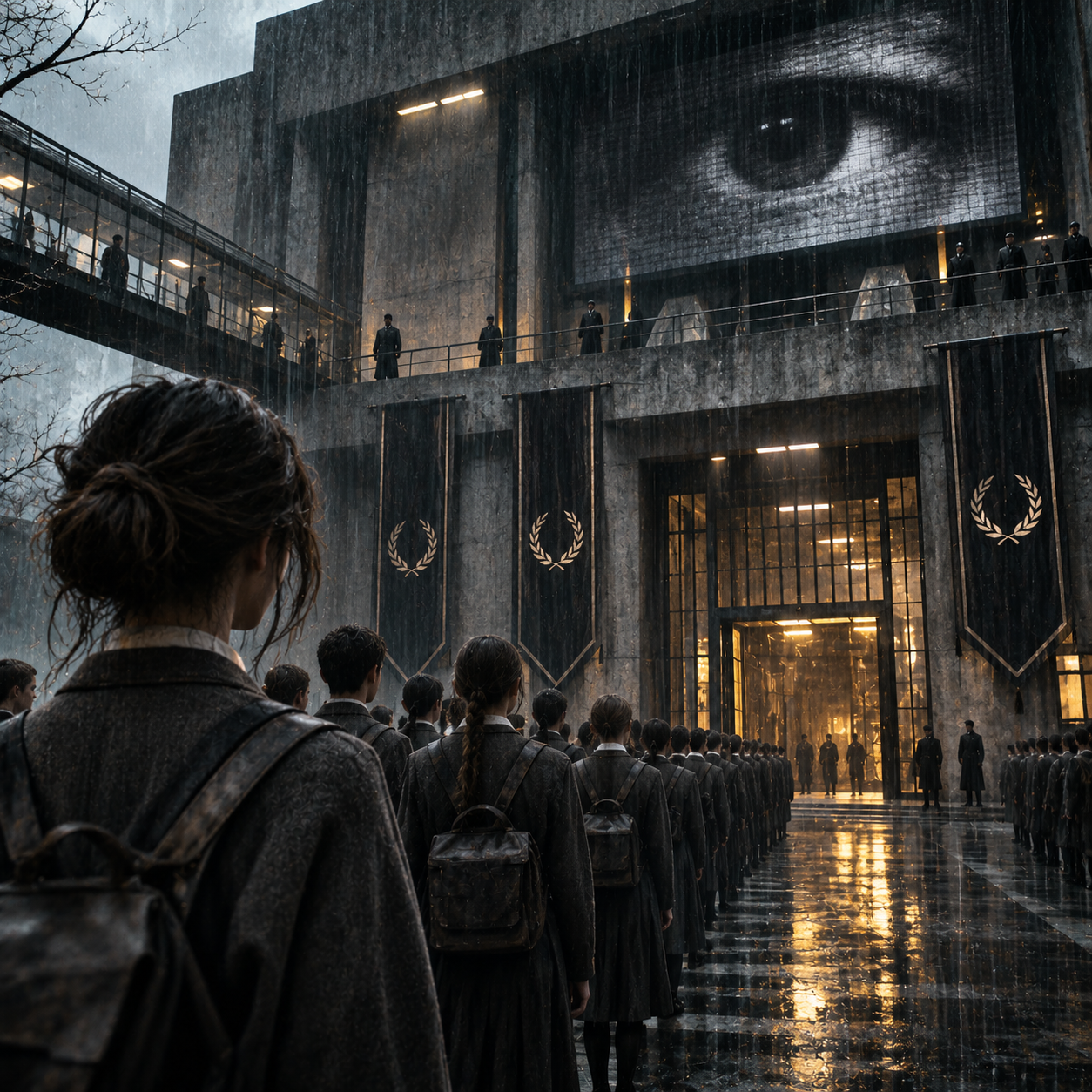
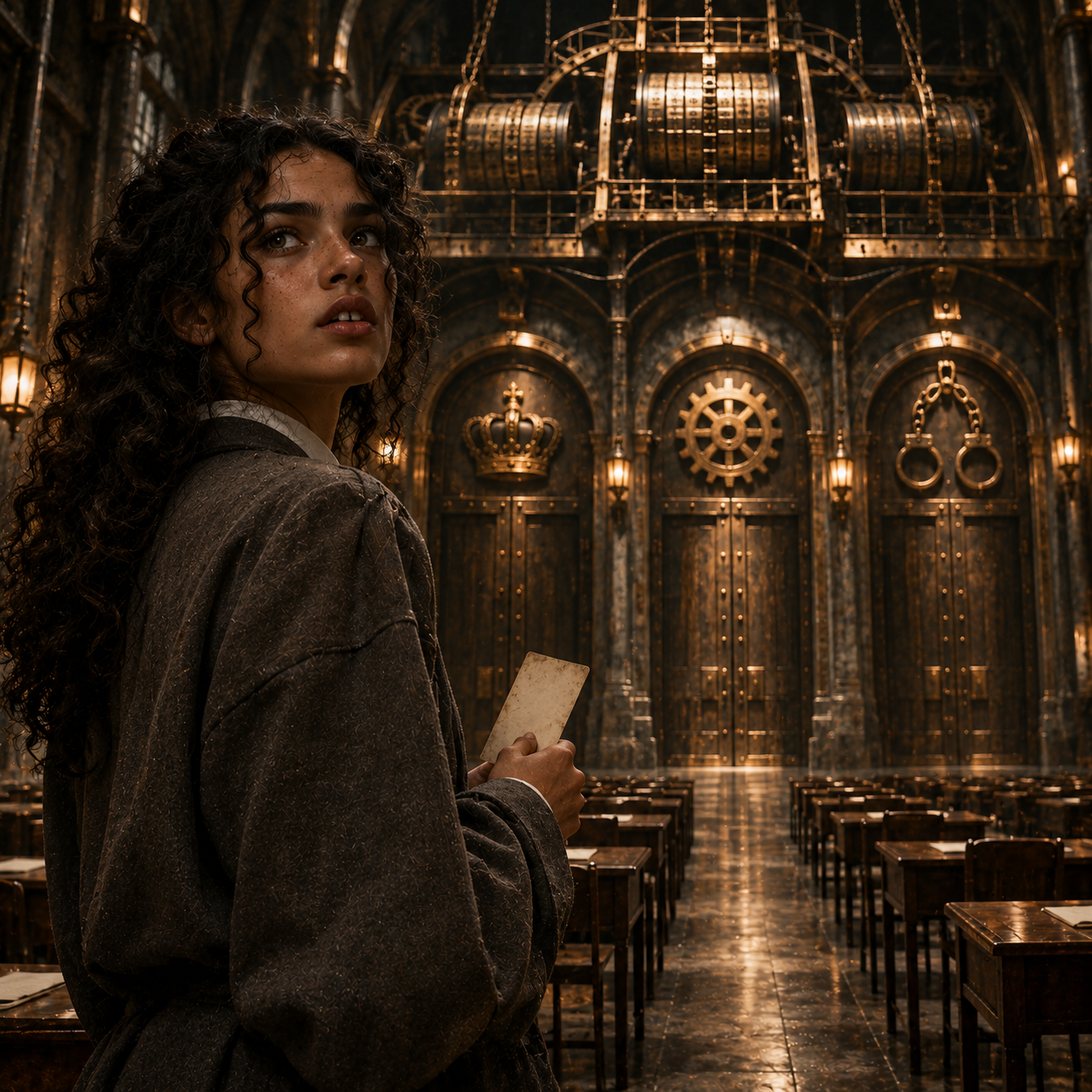
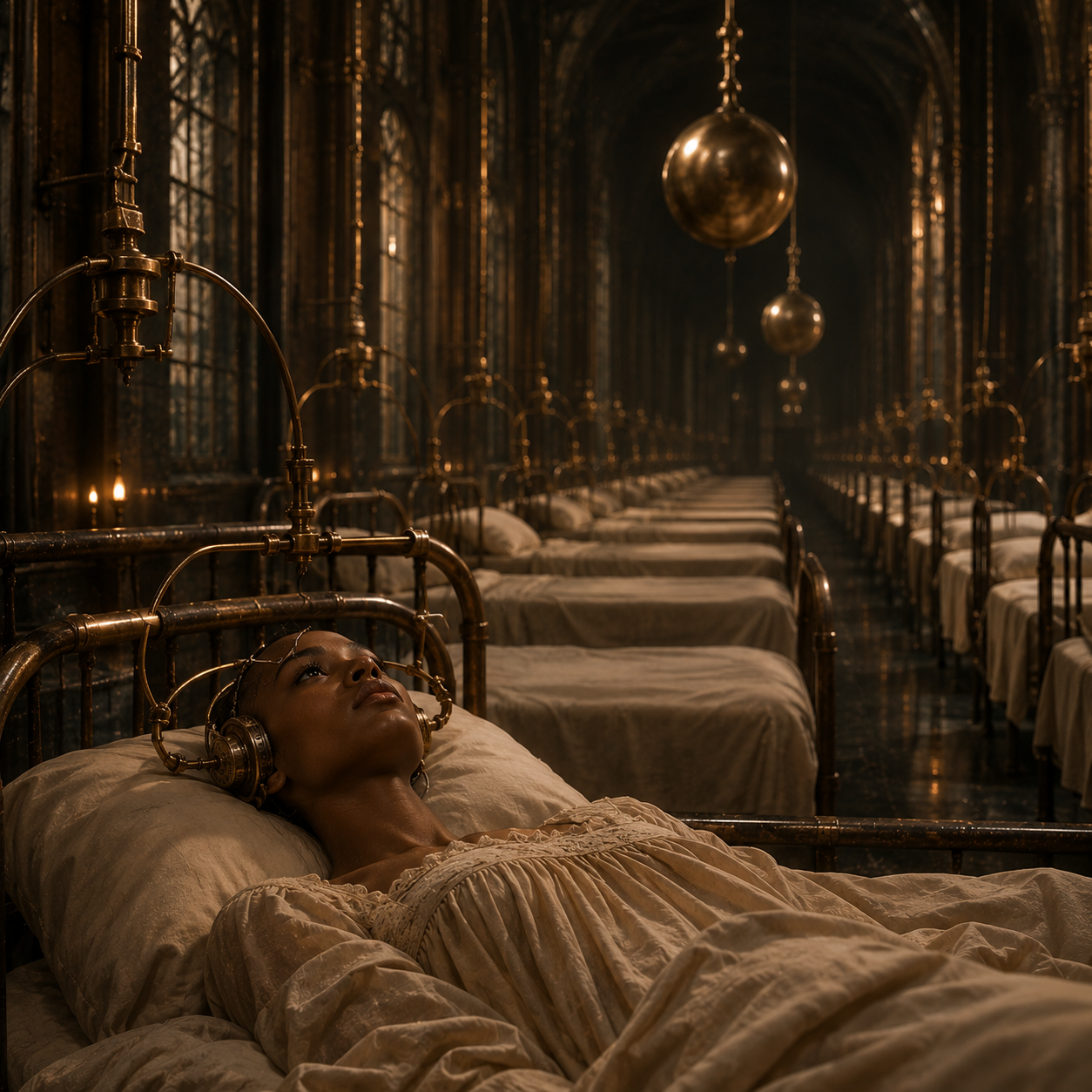
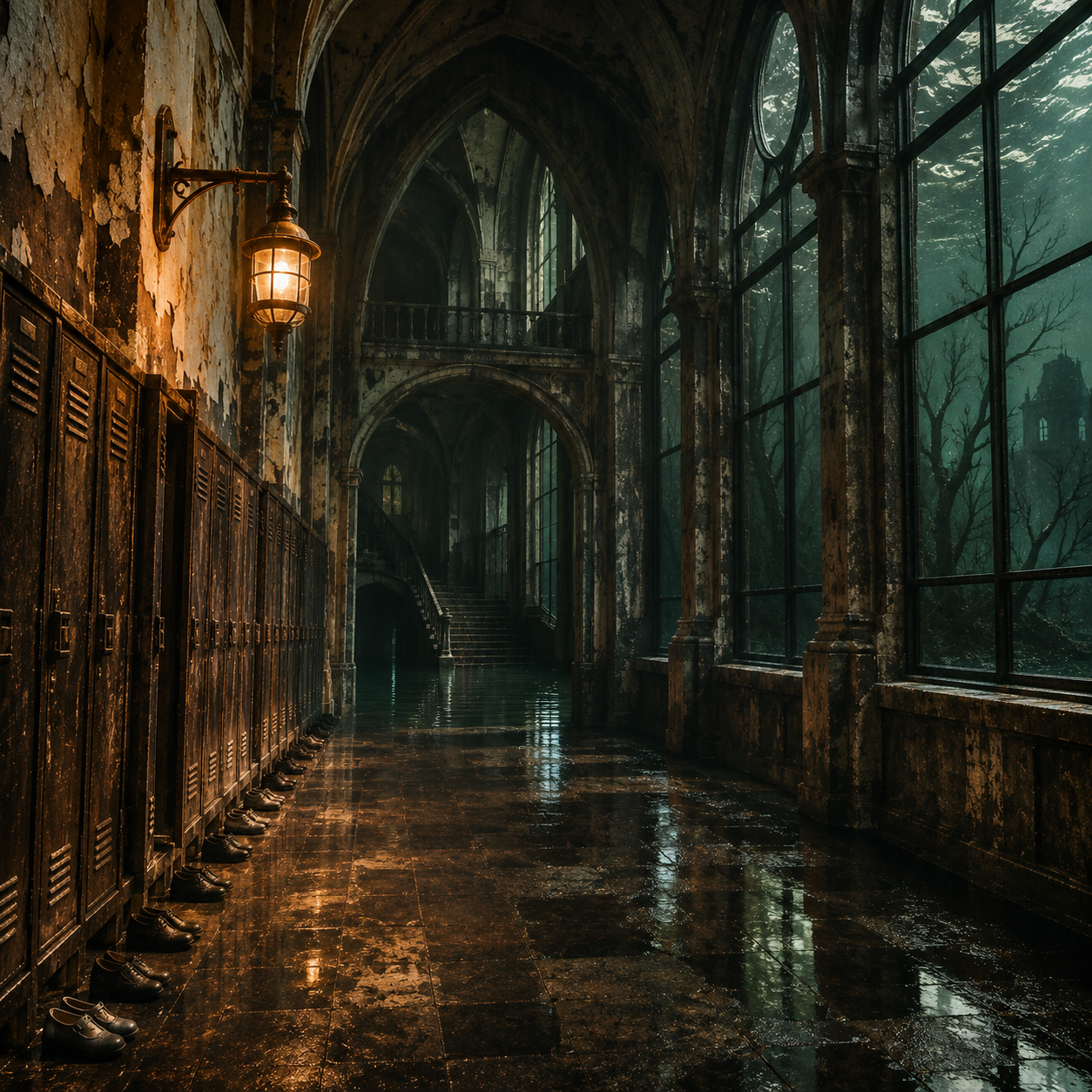
7. Dystopian School & Academy Picture Writing Prompts
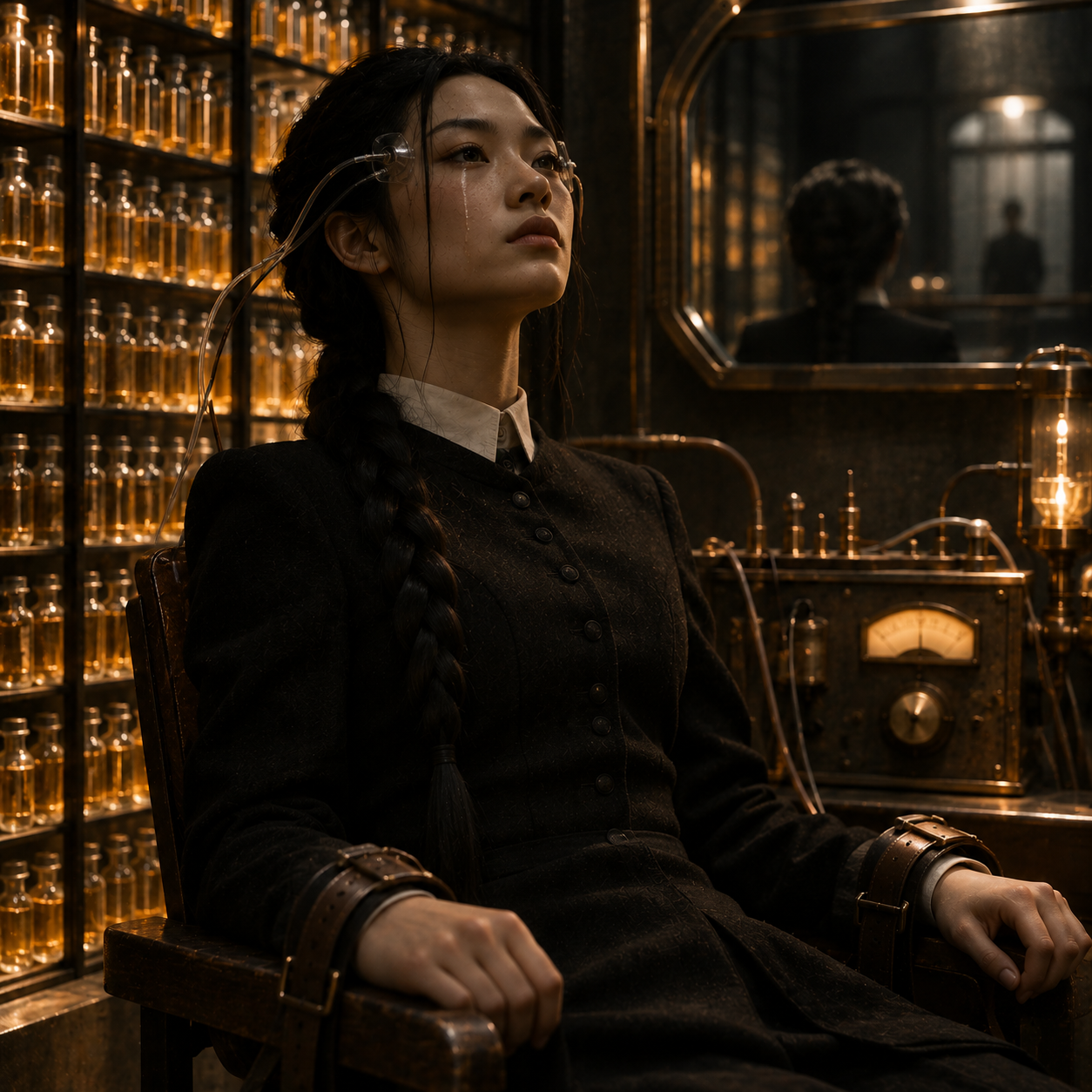
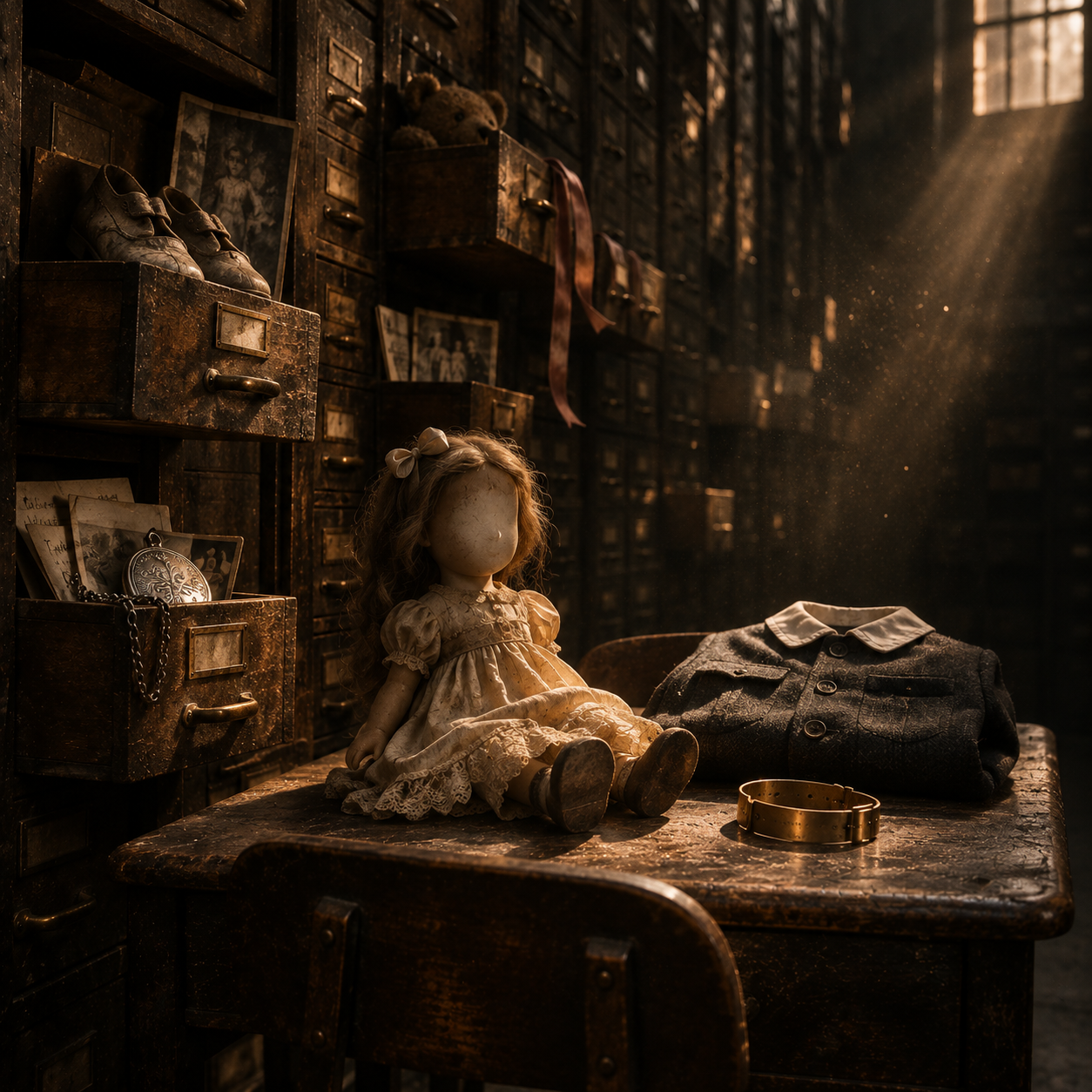
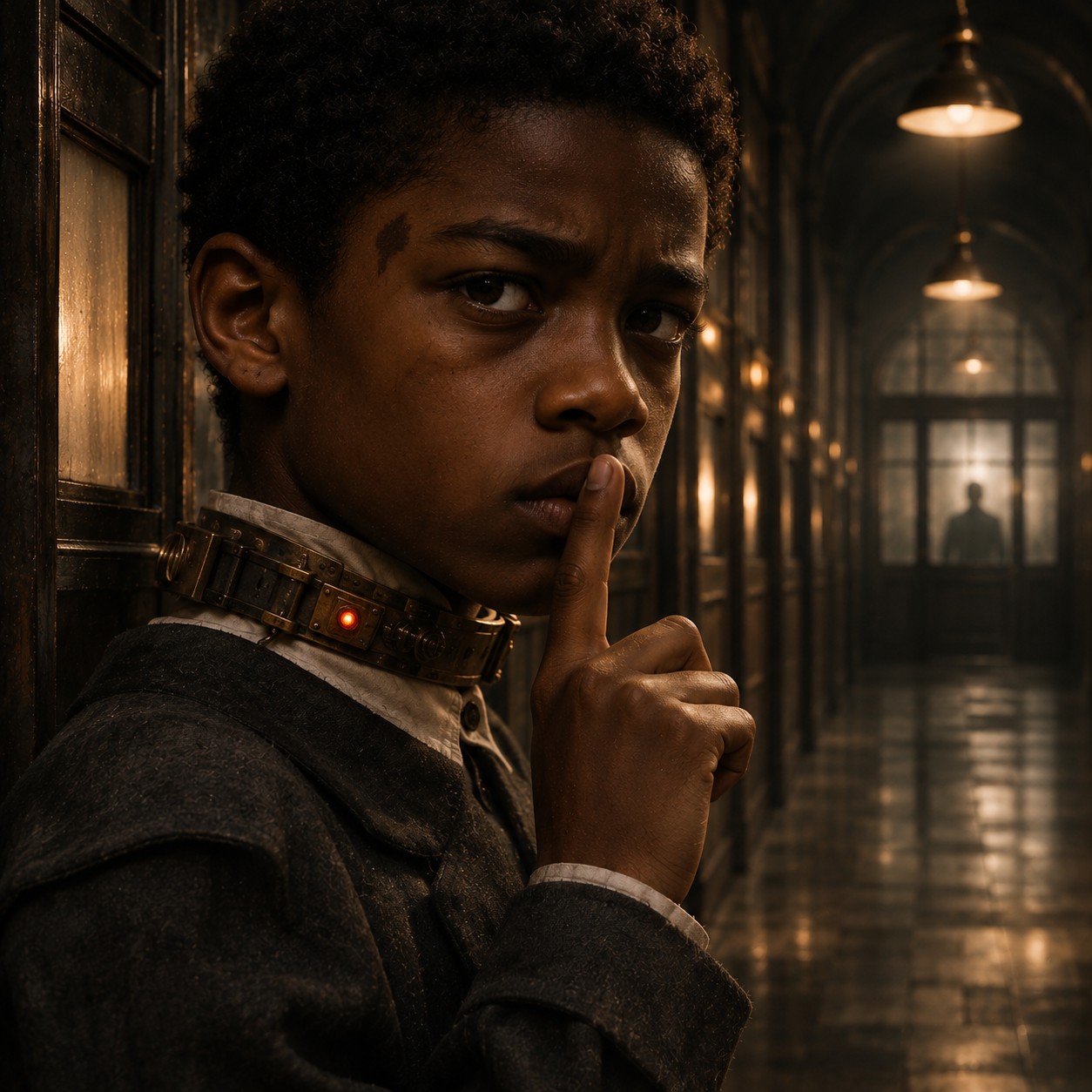
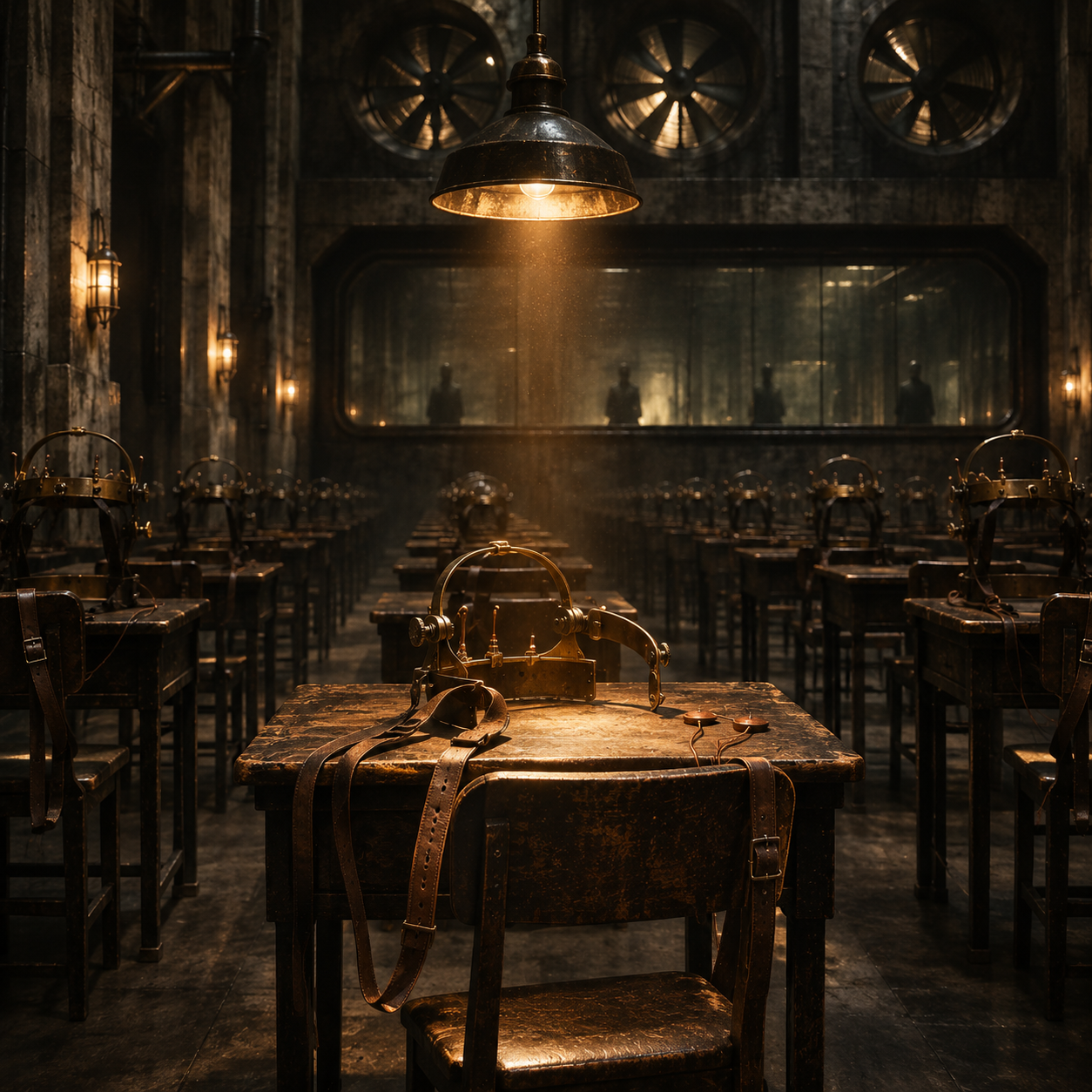
Sometimes the most unsettling dystopian stories begin with a single image: an empty classroom where every desk has been abandoned, a graduation ceremony with no visible graduates, or an immaculate school corridor concealing something profoundly wrong. Visual writing prompts encourage writers to investigate the details of a scene, question what might have happened before the image was captured and imagine the consequences of discovering the truth.
These ten dystopian school and academy picture prompts explore ten distinct institutions, mysteries and forms of educational oppression, from psychological conditioning and institutional surveillance to forbidden knowledge, disappearing students and the destruction of individuality. Each visual concept is designed to inspire an independent story, with enough atmosphere, narrative clues and unanswered questions to develop into a compelling scene, short story or longer work of dystopian fiction.


Go Deeper: How to Write a Dystopian School or Academy Story
The most unsettling dystopian schools are not simply institutions with cruel teachers and impossible examinations. They are places where obedience is rewarded, curiosity is punished and children are taught to believe that conformity is essential for survival. To create a convincing dystopian academy, consider how its curriculum, architecture, authority figures and daily routines contribute to a wider system of social control.
1. Give Your Academy a Hidden Purpose
Every dystopian school should have an official mission and a more disturbing underlying objective. An elite academy might promise to develop future leaders while secretly training government informants. A school dedicated to emotional wellbeing could use neurological conditioning to eliminate independent thought.
Consider what the institution wants its graduates to become. Are they obedient workers, loyal soldiers, political leaders or citizens incapable of questioning authority?
The strongest dystopian institutions justify their methods through apparently positive ideals such as safety, equality, excellence or national unity. This makes their cruelty more unsettling because the people enforcing the rules may genuinely believe they are helping society.
Explore Dystopian Government & Regime Names and Dystopian Story Ideas for inspiration when developing authoritarian institutions and their political systems.
2. Turn Ordinary School Routines into Instruments of Control
Familiar educational traditions can become deeply disturbing when their purpose changes. Morning assemblies might involve compulsory loyalty pledges, examinations could determine students' permitted lifespans, and detention might involve the removal of unwanted memories.
Think about how rewards, punishments, school reports and graduation ceremonies reinforce the institution's values.
The most effective psychological horror often comes from students accepting these practices as normal. A child might proudly report a friend's forbidden thoughts, believing they are protecting them from future punishment.
Pay attention to institutional language. Terms such as behavioural improvement, cognitive renewal and corrective education can conceal increasingly sinister practices beneath reassuring official terminology.
For related inspiration, explore Dark Academia Writing Prompts and Dystopian Sci-Fi Writing Prompts.
3. Create Characters Who Believe in the System
Not every dystopian protagonist needs to begin as a rebel. A student who has always achieved excellent marks, obeyed the rules and admired their teachers may have no reason to question the academy's authority.
Their transformation becomes more compelling when something challenges their deepest assumptions.
Perhaps their closest friend disappears after failing an examination, or they discover that their own academic achievements have contributed to another student's suffering.
Give authority figures equally complicated motivations. A headmaster might genuinely believe that suppressing individuality prevents conflict, while a frightened teacher continues enforcing cruel regulations to protect their family.
These contradictions create richer stories than dividing every character into obvious heroes and villains.
Explore Dystopian Character Names to help with creating compelling characters for your story.
4. Make the School's Environment Feel Oppressive
Architecture can reveal an institution's values before a single character speaks.
A surveillance academy might feature glass classrooms, observation towers and corridors without hiding places. A school obsessed with conformity could contain identical dormitories, symmetrical gardens and perfectly aligned desks.
Alternatively, an elegant boarding school with magnificent libraries, stained-glass windows and beautiful grounds might conceal terrifying secrets.
Use sensory details to establish unease: the constant ticking of examination clocks, footsteps echoing through empty corridors, surveillance lights blinking above classroom doors or the unnatural silence of an assembly hall.
Consider how the setting changes as your protagonist discovers the truth. A courtyard that once represented safety might gradually become a symbol of imprisonment.
For atmospheric inspiration, explore Dark Academia Writing Prompts and Dystopian City Names.
5. Let Rebellion Begin with a Question
A dystopian school story doesn't need to begin with an organised revolution. Sometimes the most powerful rebellion starts with a student asking why an entire chapter has disappeared from a textbook or why nobody remembers the previous graduating class.
Build tension through small discoveries that gradually expose the institution's true purpose.
Each answer should create a more difficult decision. Does the protagonist protect themselves, report what they have discovered or risk punishment to help someone else?
Remember that escaping an oppressive institution does not automatically mean escaping its influence. Students who have spent their lives being told what to think may struggle with freedom, uncertainty and personal responsibility.
For further inspiration, explore Hopepunk Writing Prompts for stories about resistance, solidarity and rebuilding a better future.
A Dystopian School Writing Challenge
Imagine an academy where every Friday, one student is selected for a compulsory Correction Assembly. Their classmates must publicly identify their failures before the chosen pupil is escorted through a locked door.
Nobody has ever returned.
Write a 500-word scene from the perspective of a student attending the ceremony for the first time.
Establish the atmosphere through the immaculate uniforms, perfectly aligned chairs, watchful teachers and unnatural silence. Show how the students have been conditioned to accept the ritual as an ordinary part of school life.
Halfway through the ceremony, the selected pupil unexpectedly smiles and speaks a forbidden sentence.
The teachers immediately panic.
End the scene with the protagonist realising that the sentence was not a confession or an act of defiance.
It was a warning.
Focus on psychological tension, institutional rituals and the unsettling contrast between everyday school routines and the terrible secrets they conceal.
Final Thoughts
Dystopian schools and academies offer a particularly unsettling setting for speculative fiction because they transform something associated with learning, opportunity and personal growth into an instrument of oppression. Behind immaculate uniforms, prestigious examination results and promises of a brighter future, these institutions may conceal systems designed to suppress curiosity, eliminate individuality and produce generations of unquestioningly obedient citizens.
The most compelling stories explore what happens when students begin to recognise the contradictions in everything they have been taught. A missing classmate, a forbidden textbook or a single unanswered question can become the beginning of a dangerous journey towards the truth. Whether your story follows a loyal student questioning their beliefs, a teacher confronting their complicity or a group of young rebels challenging an authoritarian regime, the central conflict remains the same: what happens when education teaches obedience, but knowledge inspires rebellion?
Use these 70 Dystopian School and Academy Writing Prompts to develop sinister institutions, disturbing educational rituals, morally complex characters and atmospheric settings where every lesson carries consequences. For more inspiration, explore the Dystopian Writing Hub, discover new ideas with the Dystopian Story Sparks Generator, or visit the Sci-Fi Writing Hub, Dark Academia Writing Prompts and Creative Writing Archive to continue developing your fictional worlds.
Because in the most dangerous schools, the greatest crime isn't breaking the rules. It's learning to think for yourself.
Choose Your Next Adventure