70 Magical & Impossible Fantasy Kingdom Writing Prompts: Strange Realms, Impossible Magic & Extraordinary Worlds
Fantasy kingdoms do not have to obey the ordinary rules of geography, nature or reality. A kingdom might bloom and wither according to its monarch's emotions, exist inside the hollow trunk of a tree large enough to contain mountains, rearrange its borders every night or experience a century while only a single day passes beyond its walls. Rivers can flow upwards, palaces can contain rooms larger than the kingdom surrounding them, and entire civilisations can survive in places that should be physically impossible.
These impossible qualities can shape far more than the appearance of a fantasy world. Imagine a royal succession where crowning the wrong monarch could change the climate, a war fought over territory that refuses to remain in one place, or a romance between people living on opposite sides of a kingdom where time moves at different speeds. Magic might be woven into architecture, weather, memory, dreams, seasons, gravity or the landscape itself, creating societies that have developed around rules unlike anything in the ordinary world.
This collection of 70 Magical and Impossible Fantasy Kingdom Writing Prompts explores strange realms across high fantasy, dark fantasy, fairytale, folklore, gothic fantasy, romantasy, cosmic fantasy and more surreal forms of speculative storytelling. Across plot prompts, story titles, opening and closing lines, character ideas, settings and visual inspiration, you'll encounter living kingdoms, impossible cities, enchanted landscapes, unnatural seasons, shifting geography, bizarre royal traditions and worlds where even the laws of reality can become part of the story.
Whether you're building an enormous secondary world or searching for one extraordinary idea around which to construct a story, use these prompts to ask the most exciting fantasy question of all: what becomes possible when your kingdom no longer has to be possible? For even more magical worlds, characters and story inspiration, explore the Fantasy Writing Hub or browse the Creative Writing Archive.
1. Plot Prompts
Impossible kingdoms create conflicts that could exist nowhere else. Their strange laws of nature can determine who rules, where people live, how wars are fought and even whether a kingdom survives at all. Use these prompts to build stories where magic is embedded in the foundations of the realm itself.
The health of an entire kingdom is magically connected to its monarch. When the newly crowned queen begins dying from an unknown illness, autumn arrives in the middle of summer and spreads outward from the palace.
Two kingdoms have occupied exactly the same land for thousands of years but exist at different times of day. For the first time, dawn fails to separate them.
A fairytale kingdom moves to a completely different location every midnight, carrying its cities, forests and inhabitants with it. One morning, the kingdom arrives somewhere its oldest maps warn should not exist.
Everyone who crosses the border of a peaceful mountain realm forgets one important memory. When an invading army marches through, thousands of soldiers suddenly cannot remember why they came.
A dark kingdom survives beneath an artificial moon created centuries ago by its royal magicians. When the moon begins falling slowly towards the capital, the court discovers someone has been deliberately weakening the spell holding it in the sky.
A prosperous kingdom possesses twelve seasons, each controlled by one of twelve noble families. The disappearance of the Winter Duchess traps the realm permanently between autumn and spring.
A royal city grows larger on the inside every year, producing new streets, palaces and districts that should not physically fit within its walls. Explorers entering its newest quarter discover buildings belonging to a civilisation that has not been founded yet.
A kingdom can only be reached while someone is dreaming about it. When its inhabitants discover that fewer people in the outside world are dreaming, they send their first emissary into reality to prevent their realm from disappearing.
Every lie spoken by the royal family physically alters the kingdom. After centuries of political deception, rivers flow towards mountains, roads lead to places that do not exist and entire villages wake beneath unfamiliar stars.
A cosmic kingdom exists on the back of an enormous creature travelling endlessly through darkness. When the creature changes direction for the first time in recorded history, ancient astronomers realise it is returning home.
2. Story Titles
Titles for magical and impossible kingdoms can suggest wonder, mystery, romance, darkness or realities that do not quite behave as they should. Use these as complete titles or starting points for imagining the extraordinary realms behind them.
Elsewhere
The Thirteenth Season
Glassbound
Where Kingdoms Dream
The Impossible Crown
Evernight
A Palace Larger Than the World
Rootborn
The Country That Forgot Tomorrow
Beneath a Borrowed Moon
3. Opening Lines
An impossible kingdom gives you the opportunity to make something extraordinary happen from the very first sentence. These opening lines introduce strange laws, magical landscapes and mysteries that immediately suggest the world does not operate according to ordinary rules.
The kingdom disappeared every Tuesday, and until that morning nobody had considered it a problem.
Three days after the king died, the mountains began to mourn.
There had always been thirteen seasons, although nobody remembered what happened during the last one.
Princess Elianor discovered the door to the neighbouring kingdom at the bottom of her teacup.
At precisely midnight, gravity abandoned the western half of the city.
The palace had grown another tower while everyone slept.
Nobody born in Evermere possessed a shadow until the stranger crossed its border.
The first snowflake fell upwards.
Every mirror in the kingdom reflected the same ruined castle, although no such castle had ever existed.
On the morning of her coronation, the new queen woke to discover the sea waiting outside her bedroom window.
4. Closing Lines
Impossible worlds can leave behind equally impossible endings. These final lines can complete a transformation, reveal one last secret or suggest that the strange laws governing the kingdom were never quite what its inhabitants believed.
When she removed the crown, spring returned.
And somewhere beyond the final mountain, another kingdom opened its eyes.
At midnight, the city vanished exactly as it always had, only this time she vanished with it.
He looked towards the two moons and finally understood which one was real.
The door closed behind them, leaving an entire kingdom inside a room no larger than a cupboard.
For the first time in nine hundred years, tomorrow arrived.
She planted the final seed where the palace had stood and waited for the new kingdom to grow.
As the stars disappeared one by one, the great creature beneath their world finally woke.
Nobody remembered the queen after that, but every winter the roses still bloomed on her birthday.
Beyond the border, gravity took hold of them again.
5. Character Ideas
People raised within impossible kingdoms would understand reality very differently from outsiders. Their professions, beliefs, relationships and responsibilities can all emerge from the unusual rules of their worlds, creating characters who could only belong to these extraordinary places.
An impossibly old queen whose kingdom ages instead of her, leaving its buildings, forests and mountains increasingly ancient while she remains unchanged.
A young royal cartographer responsible for redrawing the kingdom every morning because its rivers, roads and borders move while everyone sleeps.
A gothic prince born without a reflection in a kingdom where mirrors are believed to reveal the condition of a person's soul.
A gardener who tends the enormous flowers from which new villages are grown and secretly discovers one beginning to produce an entire palace.
A royal historian who remembers every previous version of reality whenever the kingdom rewrites its own past.
A knight from a realm where wounds become beautiful flowers rather than scars, whose body has slowly transformed into a living record of every battle she has survived.
A palace servant responsible for feeding the rooms so they do not move, disappear or consume the people sleeping inside them.
A young woman promised in marriage to the heir of a neighbouring kingdom that can only be reached for seven minutes during each full moon.
An astronomer-priest who discovers that the stars above the kingdom are not distant suns but thousands of tiny windows looking in from somewhere else.
A child born during a forbidden thirteenth season who can walk through places where the ordinary laws of the kingdom stop working.
6. Setting Ideas
Impossible fantasy settings can transform familiar castles, cities and landscapes into places that could never exist outside fantasy. Consider not only what makes each kingdom extraordinary, but how generations of people might have learned to live within its unusual reality.
A kingdom of enormous transparent trees whose glass branches chime in the wind and produce crystal fruit containing tiny concentrations of raw magic.
A sprawling fairytale capital grown from a single living rose, with streets curling along its stems and an ivory palace hidden inside a flower that never completely opens.
A gothic kingdom trapped beneath permanent twilight, where the setting sun has remained motionless on the horizon for five hundred years and enormous shadows stretch continuously eastward.
A desert realm where the dunes become a vast golden sea after sunset, forcing caravans to transform into ships until the sand returns at dawn.
A kingdom built inside an impossibly enormous library where forests grow between bookshelves, rivers run through reading rooms and entire cities occupy forgotten volumes.
A romantic kingdom divided by a river that flows through different centuries, with people standing on opposite banks able to see one another but living hundreds of years apart.
A mountainous realm where gravity points towards the nearest peak rather than towards the ground, creating cities built across cliffs at impossible angles and roads that climb vertically between valleys.
A folklore-inspired kingdom grown across the antlers of an ancient white stag that walks endlessly through an enormous forest, carrying villages, castles and farmland between the branches.
A surreal ocean kingdom where islands emerge from the sea according to people's memories, causing forgotten places to sink while beloved landscapes slowly rise from the water.
A cosmic kingdom beneath a transparent night sky through which enormous celestial creatures can occasionally be seen moving between the stars.
7. Picture Prompts
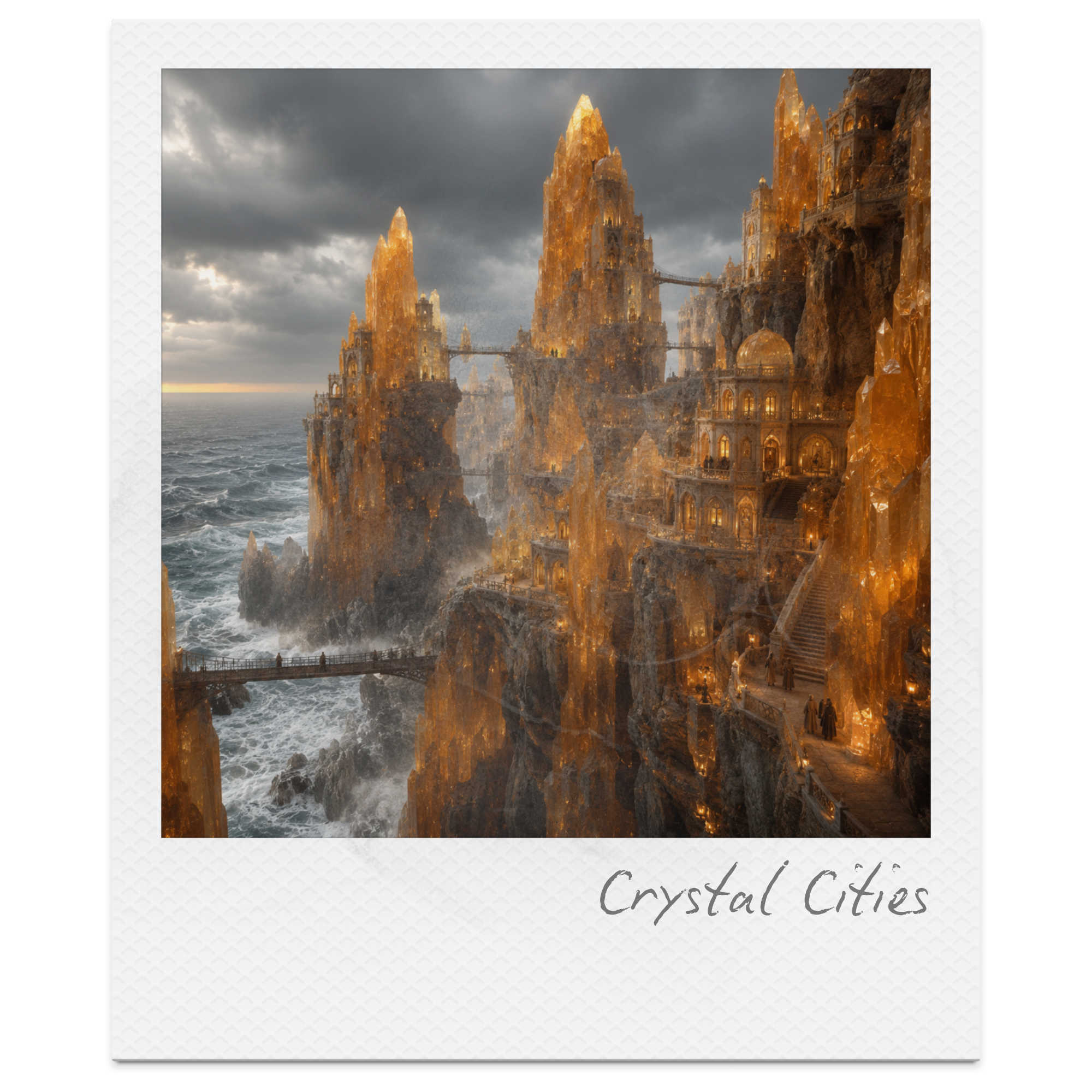
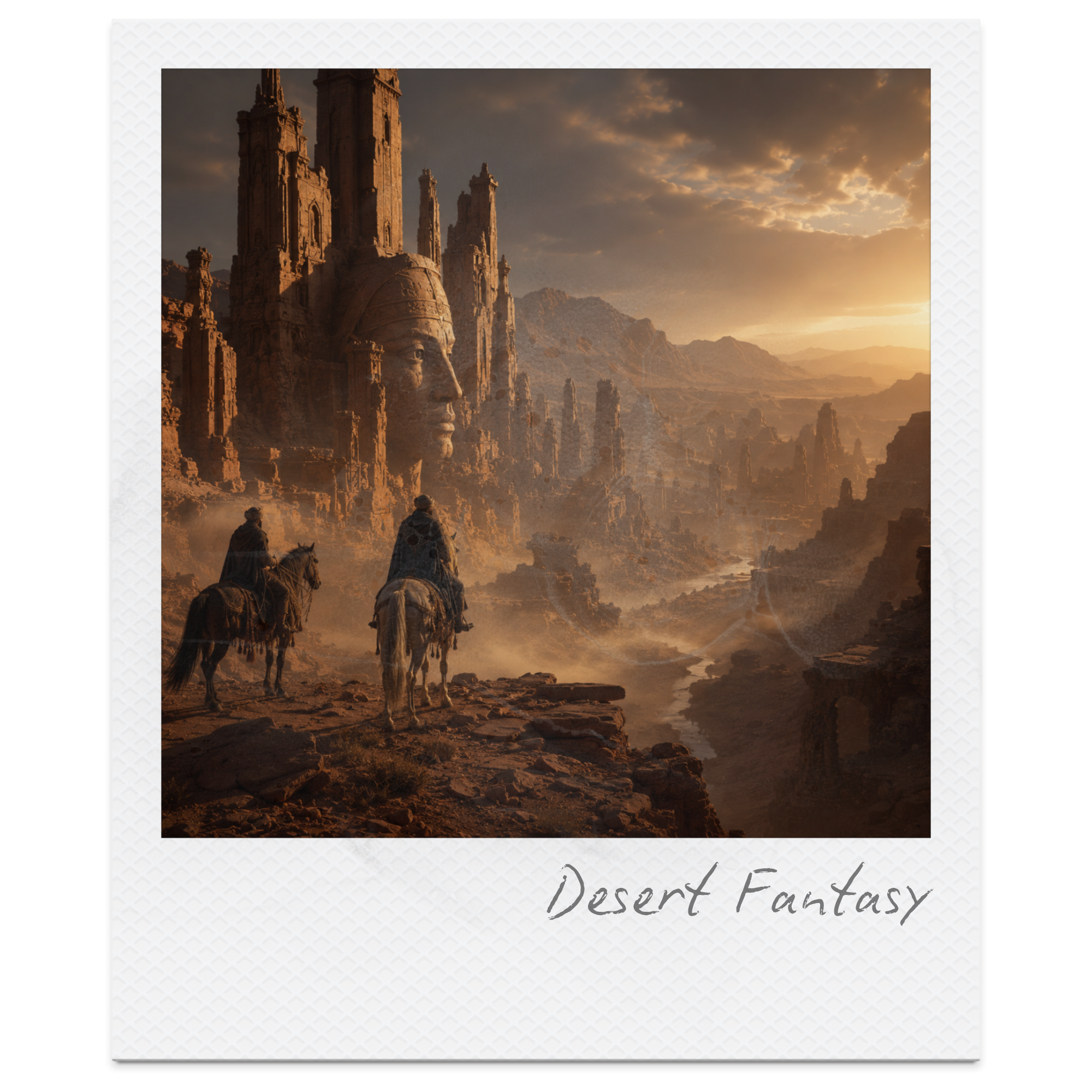
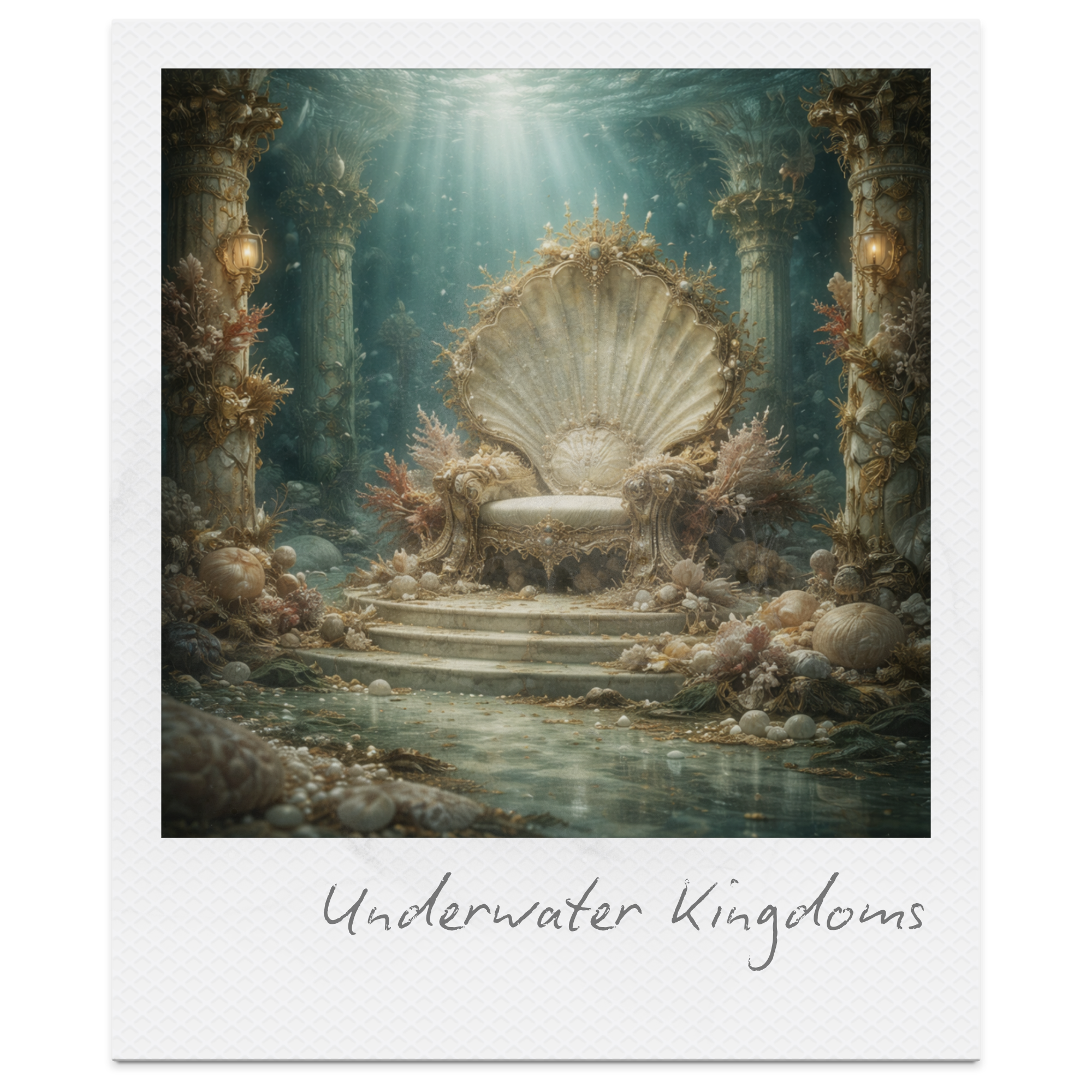
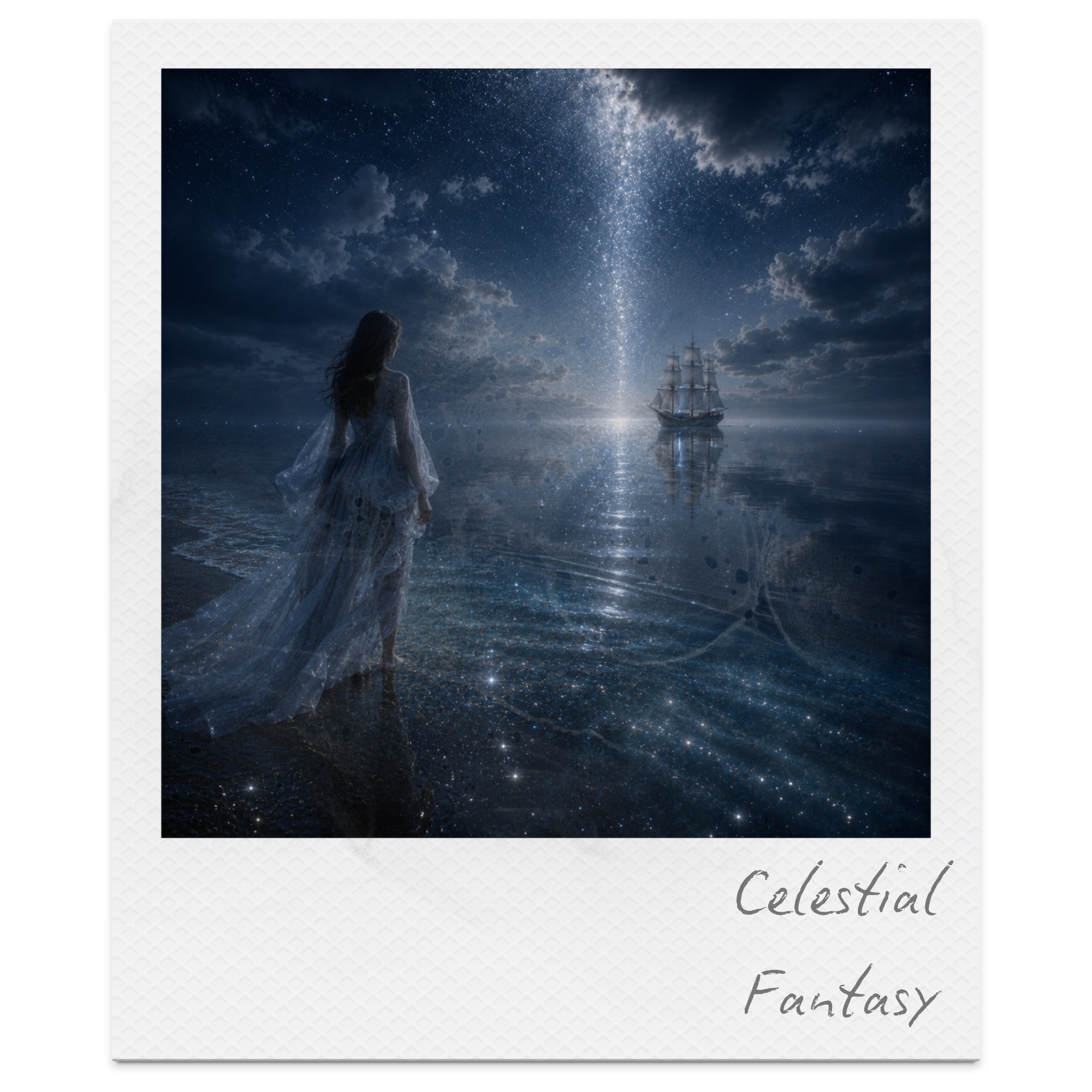
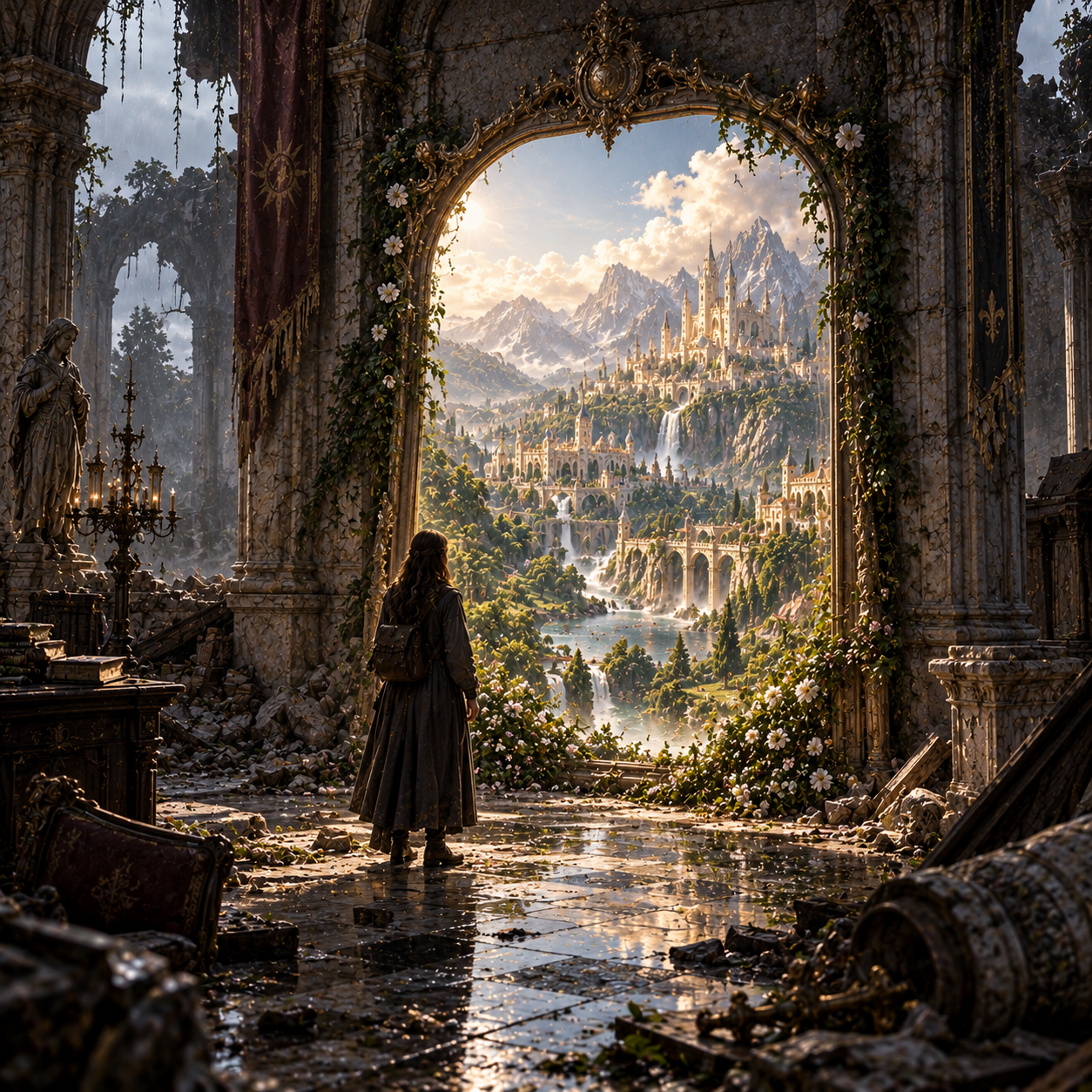
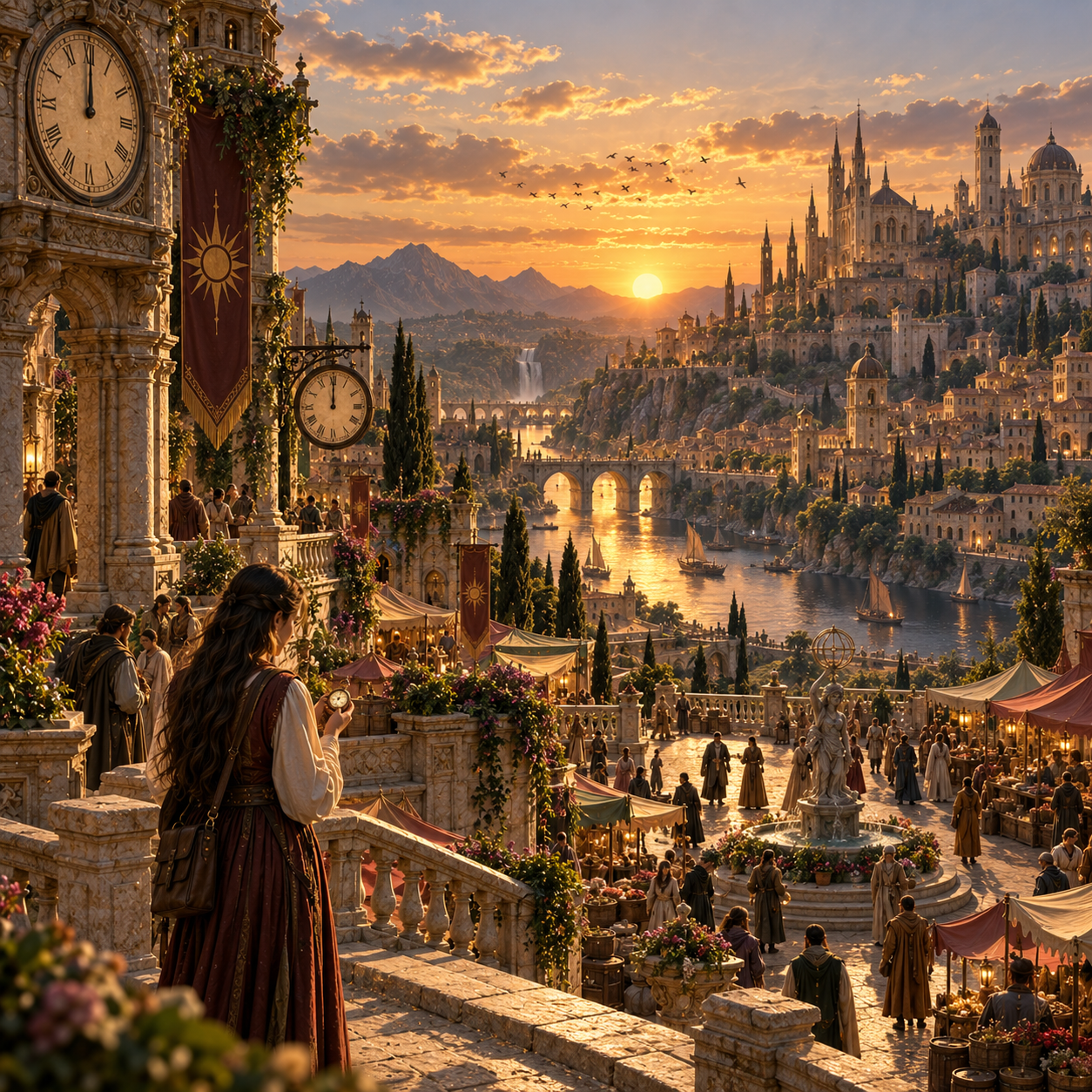
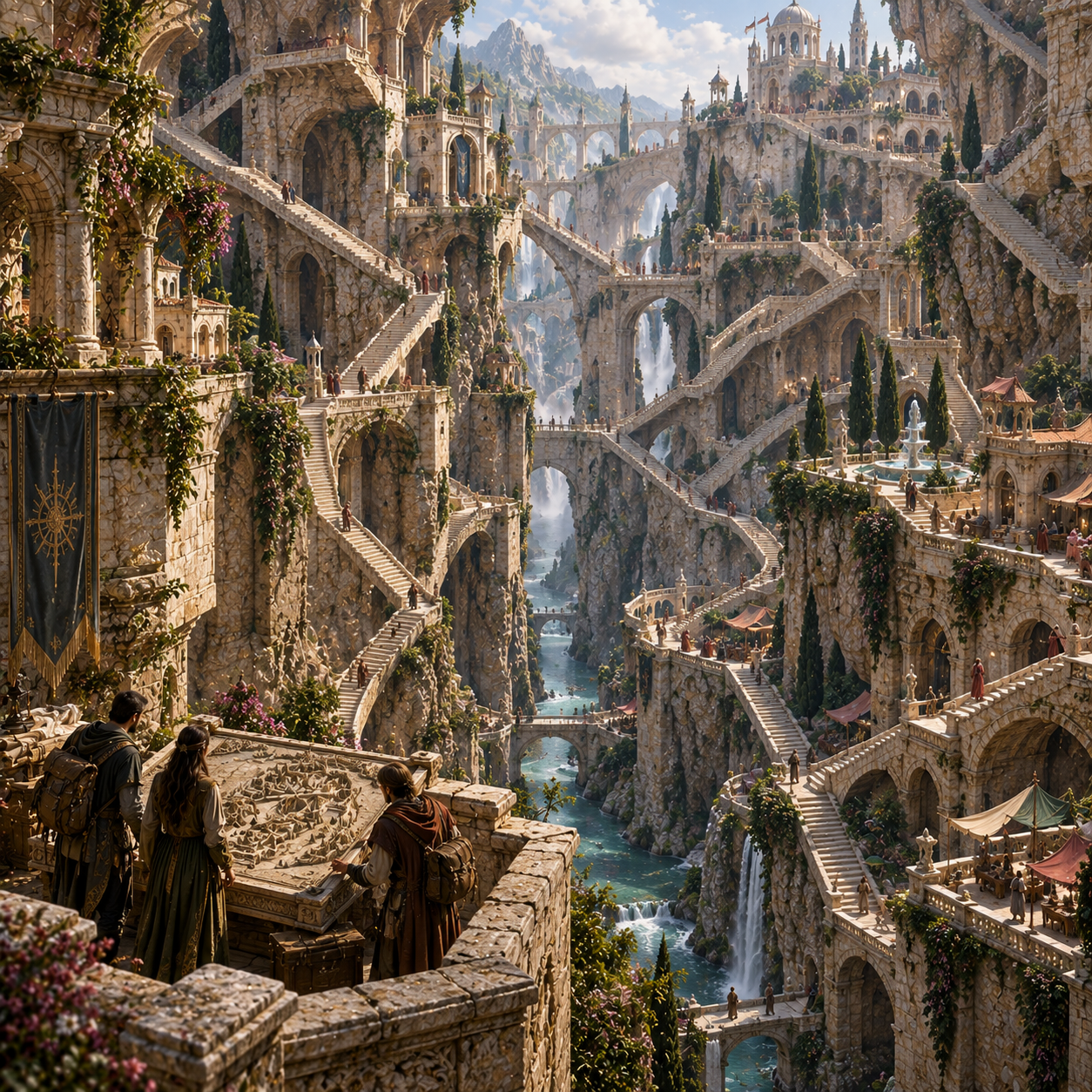
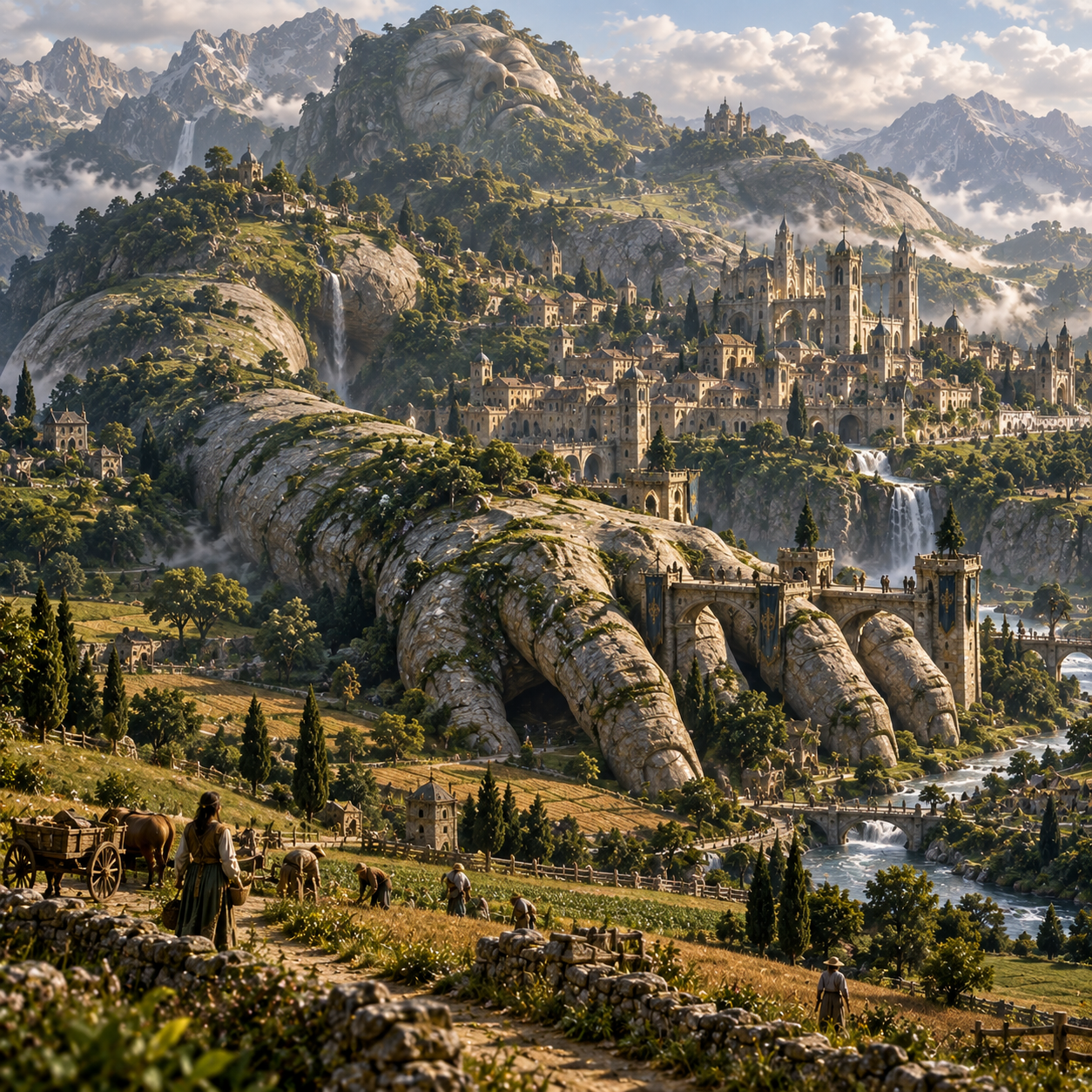
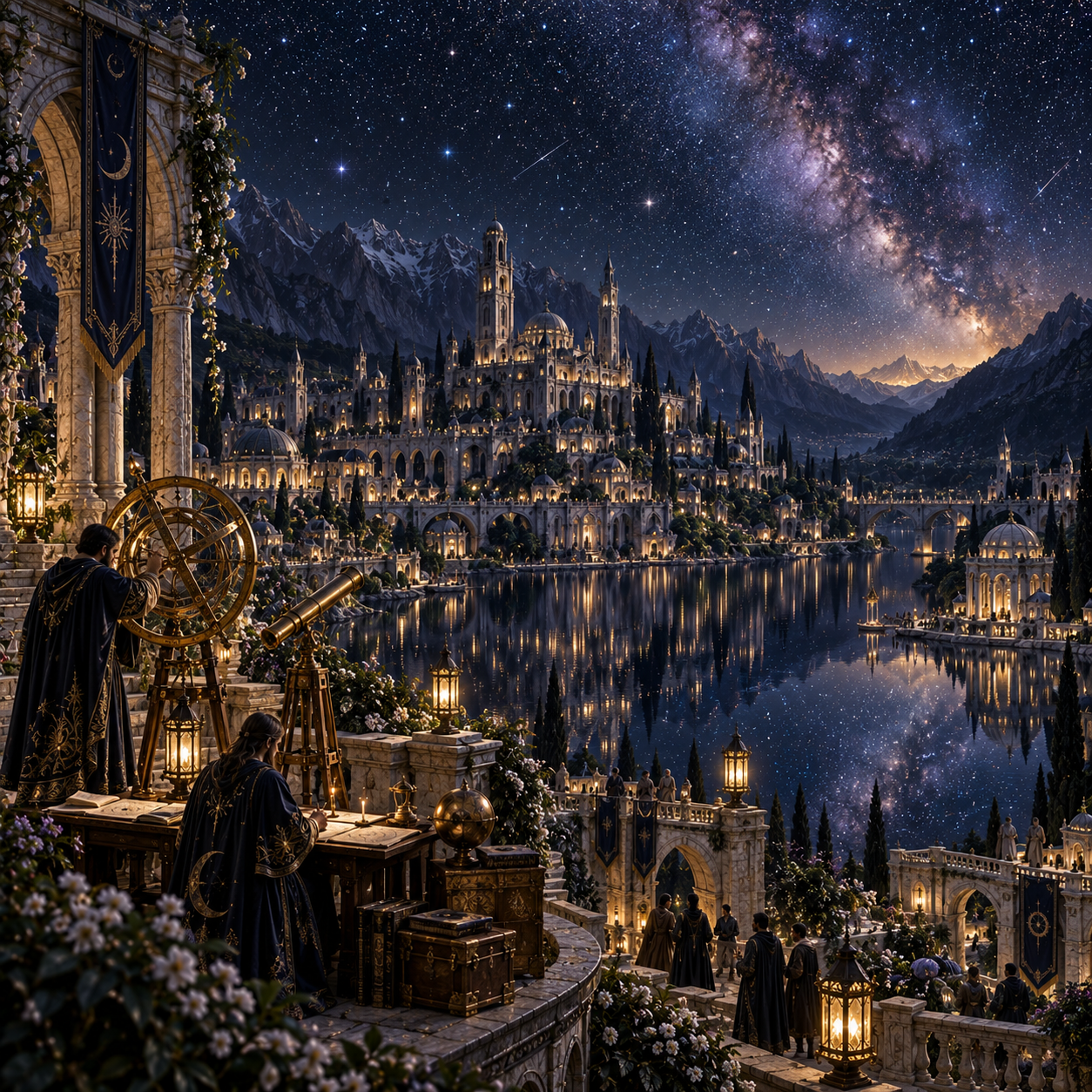
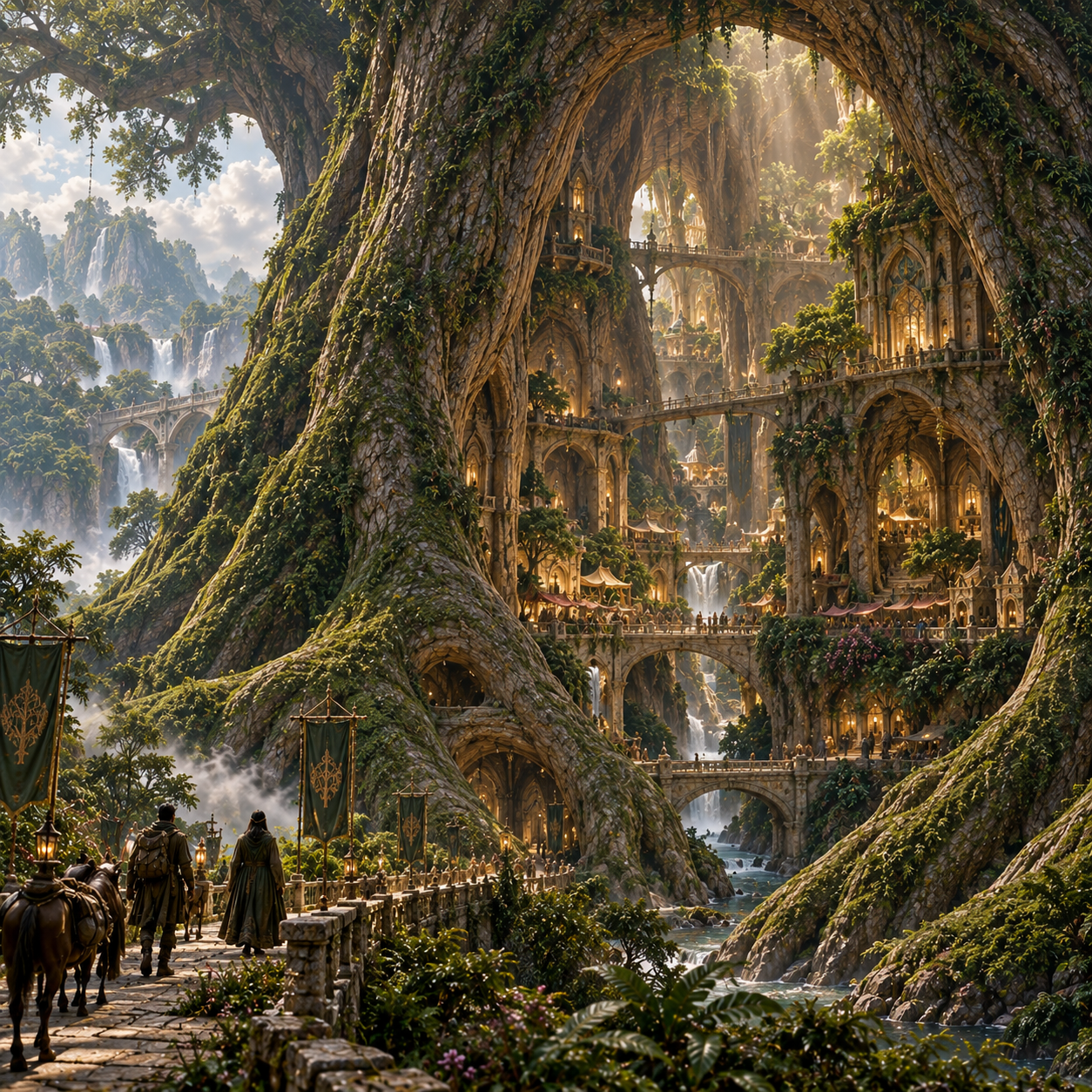
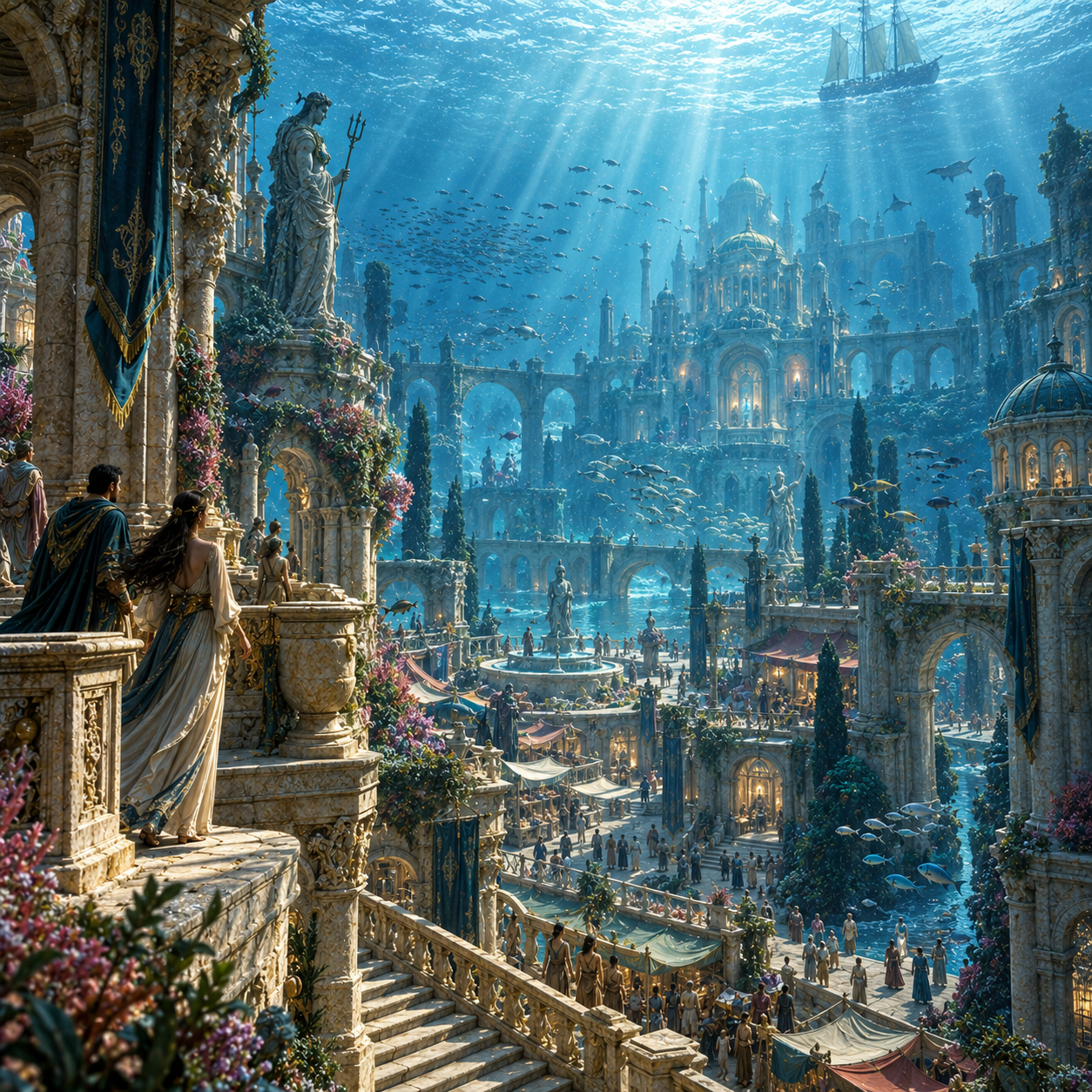
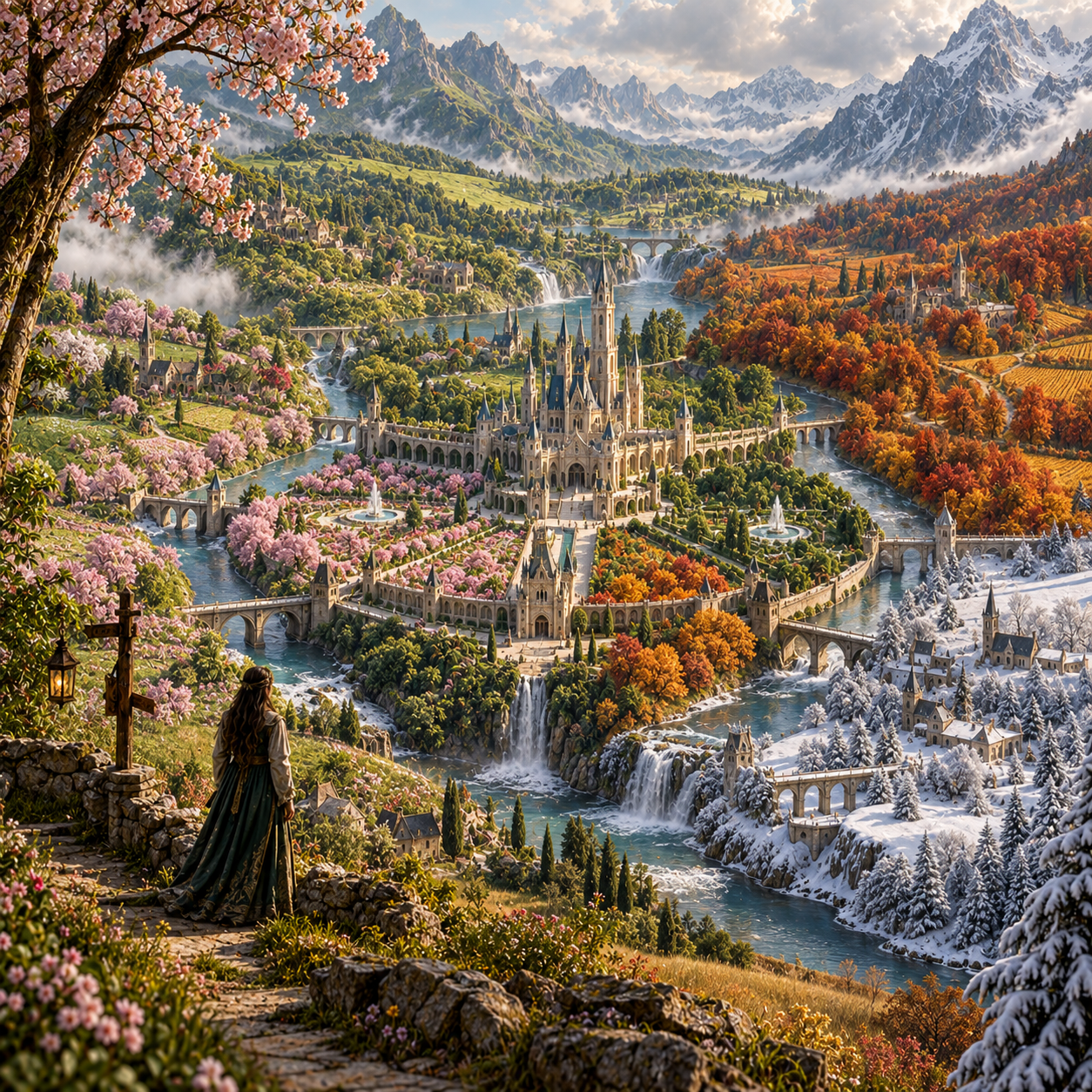
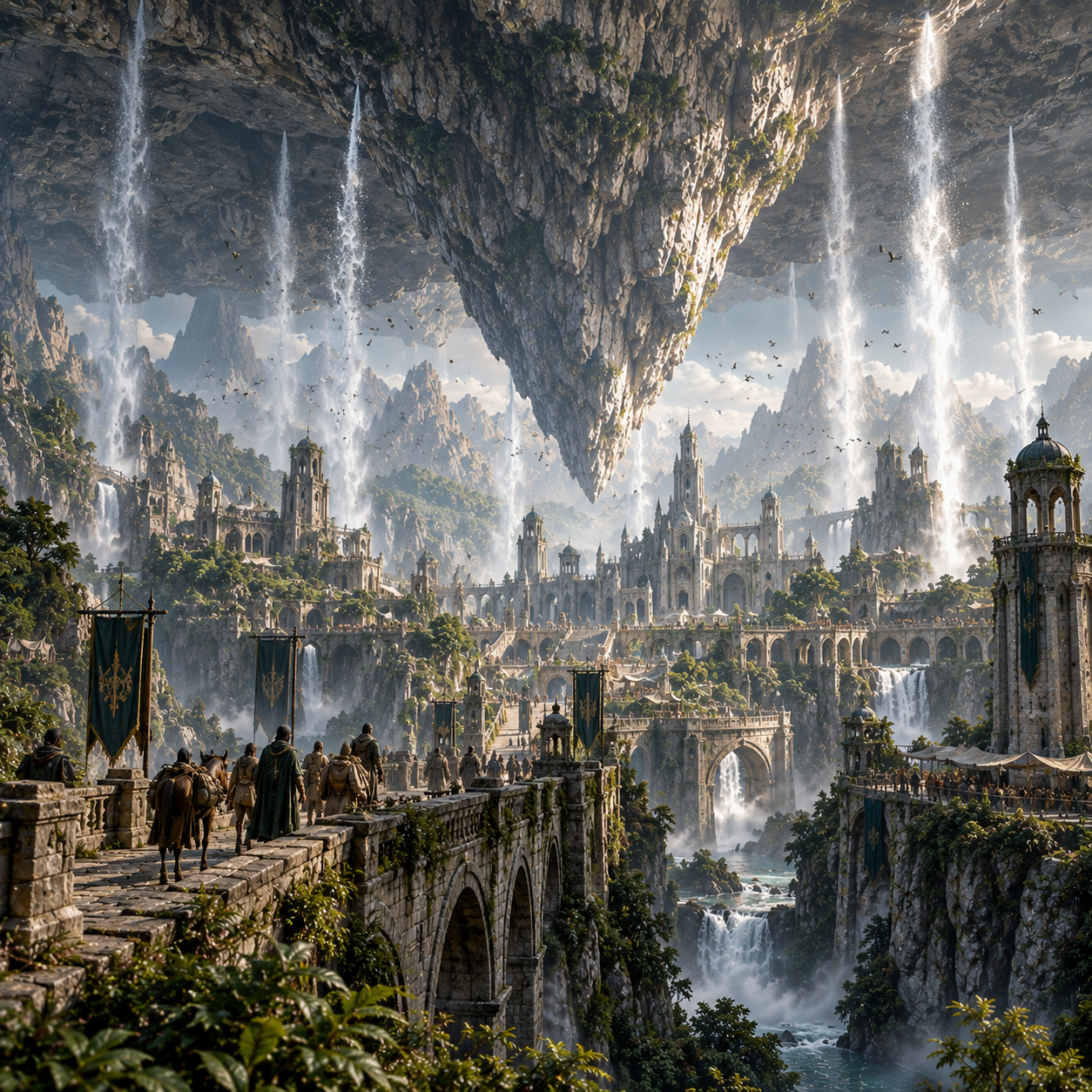
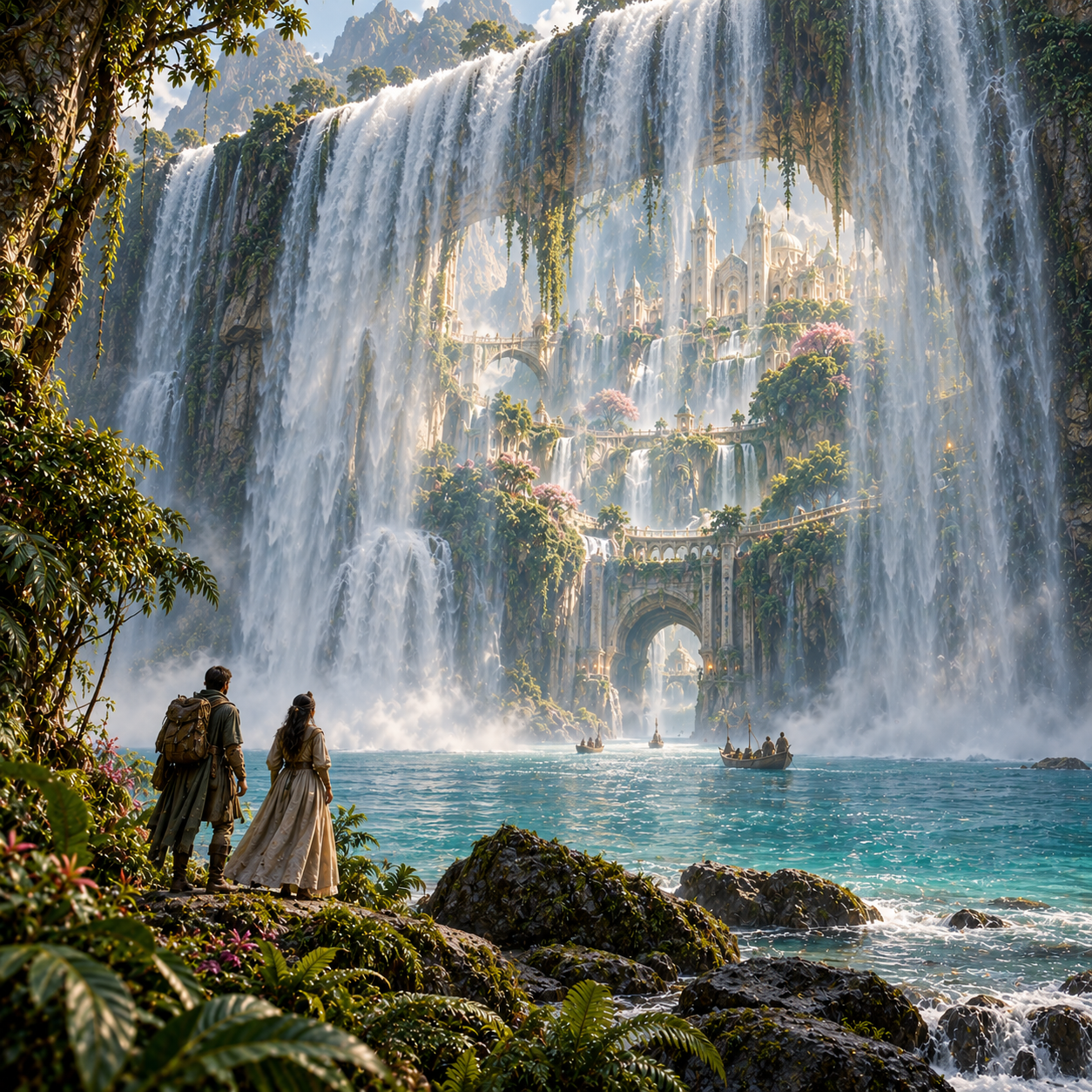
Pictures are particularly powerful starting points for impossible fantasy because a single strange detail can raise dozens of questions about how a world works. Look closely at each magical kingdom picture prompt and imagine what rule of reality has been broken, whether the inhabitants consider it unusual, how people have adapted to it, what happened immediately before the scene and what might exist beyond the edges of the image. The strangest detail does not necessarily have to be the story's greatest mystery — sometimes the most interesting question is what ordinary life looks like in a place that should not be able to exist.
Go Deeper into Magical and Impossible Fantasy Kingdom Writing
An impossible kingdom becomes much more interesting when its strangest feature influences everything around it. Once you have decided what rule of reality your kingdom breaks, explore how generations of people have learned to live with something that readers would consider extraordinary.
◆ Choose the central impossibility – Give the kingdom one defining idea you can describe clearly. Perhaps time runs backwards, the landscape responds to emotion, buildings grow like plants or the entire realm exists inside somebody's dream.
◆ Create rules for the impossible – Even surreal magic becomes more convincing when it has patterns. Decide when the phenomenon happens, what controls it, whether it can fail and which parts of it remain mysterious even to the people who live there.
◆ Follow the consequences – If rivers flow upwards, people will build around them. If nobody ages while inside the capital, that will affect inheritance, marriage, crime and power. Keep asking what else changes because the impossible thing exists.
◆ Make extraordinary things ordinary to somebody – A visitor might be astonished by houses hanging upside down beneath bridges, while the person who lives there is annoyed because the morning gravity shift has made them late for work.
◆ Build everyday life around the magic – Consider food, transport, farming, architecture, education and work. A kingdom where buildings constantly rearrange themselves might employ professional route-finders, while one with twelve seasons could organise its entire agricultural calendar around magical transitions.
◆ Ask who benefits from the kingdom's strange rules – Magic can create privilege. Perhaps nobles control the only doors capable of travelling between regions, the royal family determines the weather or wealthy citizens can purchase additional years of life.
◆ Ask who pays the price – An apparently beautiful enchantment might depend upon somebody else's sacrifice. Eternal spring could require stolen years, magnificent crystal cities might slowly poison the surrounding land or an immortal monarchy could prevent younger generations from ever inheriting power.
◆ Connect impossibility to politics – When magic affects territory, climate, memory or time, controlling that magic becomes political power. Revolutions and wars can emerge directly from attempts to control the kingdom's unusual reality.
◆ Think about neighbouring kingdoms – Outsiders may fear, envy, exploit or worship an impossible realm. Consider what happens at its borders and whether its strange laws continue working when its inhabitants travel elsewhere.
◆ Create professions that could exist nowhere else – Employ cartographers who map moving landscapes, gardeners who grow houses, historians who remember erased timelines, architects who understand changing gravity or diplomats trained to negotiate with kingdoms existing in different centuries.
◆ Let religion interpret the impossible – Some people may believe the phenomenon is divine, while others consider it a curse, natural force or ancient magical technology. Different interpretations can create conflict even when everyone witnesses the same impossible event.
◆ Give the phenomenon a history – Decide whether the kingdom has always been this way. Perhaps somebody caused the enchantment, the impossible landscape is the aftermath of an ancient catastrophe or nobody remembers what the realm looked like before reality changed.
◆ Consider what happens when the magic fails – A kingdom adapted to impossible conditions may be threatened by normality rather than further magic. Gravity returning, the seasons becoming ordinary or an immortal population suddenly beginning to age could be catastrophic.
◆ Match the impossibility to your fantasy genre – The same kingdom can generate completely different stories. A realm where people exchange memories could become a dark fantasy about exploitation, a romantasy about lovers forgetting one another, a gothic story about inherited memories or a surreal fairytale about a child trying to recover something their family deliberately surrendered.
◆ Keep some things unexplained – You do not necessarily need to reveal why the moon follows the queen or what exists beneath an endless staircase. Sometimes the unanswered question is what makes an impossible world continue to feel genuinely magical.
◆ Put a character in conflict with the rules – The strongest impossible setting can generate its own story. Create someone who cannot, will not or desperately needs to obey the rule everyone else accepts, then explore what happens when they challenge the foundations of their world.
Final Thoughts
Magical and impossible kingdoms offer writers the freedom to move beyond familiar castles, borders and landscapes and imagine realms governed by completely different rules. A kingdom can exist inside a dream, grow from an enormous flower, experience twelve seasons, travel across the world while its inhabitants sleep or survive beneath a moon that should never have existed. Once reality itself becomes part of the worldbuilding, almost anything can become possible.
These 70 Magical and Impossible Fantasy Kingdom Writing Prompts are designed to provide starting points rather than finished worlds. Take one strange idea and change its genre, consequences or rules. A beautiful kingdom connected to its monarch could become an enchanted fairytale, a brutal political fantasy, a gothic tragedy or a romantasy in which falling in love has consequences for an entire landscape. An impossible place becomes particularly powerful when its magic does more than make the setting beautiful — it changes what characters can do, what they fear and what they stand to lose.
Most importantly, allow yourself to create worlds that could never exist anywhere except fantasy. Break gravity. Invent another season. Put a civilisation somewhere physically impossible. Let the landscape remember its dead. Make tomorrow optional. Then ask what it would actually mean to be born, fall in love, seize power, start a war or simply live an ordinary life in a kingdom where the impossible is completely normal.
For even more extraordinary worlds and storytelling inspiration, explore the Fantasy Writing Hub, where you'll find fantasy prompts, kingdom ideas, names, settings and worldbuilding resources, or browse the Creative Writing Archive for hundreds of writing prompts and creative resources across fantasy, gothic, horror, romance, mystery, science fiction and more.
Choose Your Next Adventure