Jessie Pope: Context, War Poetry, and Literary Significance
Jessie Pope occupies a fascinating and controversial position within First World War literature. Best remembered today for patriotic poems that encouraged British men to enlist, she wrote from the home front, using humour, energetic rhythms, sporting imagery, and direct appeals to courage to present military service as an expression of masculinity, patriotism, and national duty.
For readers familiar with the poetry of Wilfred Owen and Siegfried Sassoon, Pope’s representation of war can feel strikingly different. Where their poetry exposes suffering, psychological trauma, death, and disillusionment, poems such as “Who’s for the Game?” use the language of sport and competition to frame enlistment as a challenge in which young men are invited to participate.
However, Pope should not simply be reduced to the role of a misguided patriotic poet against whom Owen and Sassoon can be compared.
She was already an established journalist, poet, humourist, and popular writer before the outbreak of war in 1914. Her accessible language, memorable rhythms, and conversational style belonged to a successful career writing for newspapers and magazines. During the early years of the war, those techniques became part of a wider culture of voluntary recruitment, in which ideas about courage, duty, honour, masculinity, and service to King and Country were used to encourage men to enlist.
Pope’s later reputation has been shaped particularly strongly by her connection with Wilfred Owen’s “Dulce et Decorum Est.” An early manuscript of the poem was addressed “To Jessie Pope etc.”, linking her with the patriotic voices Owen would famously challenge through his description of the belief that it is glorious to die for one’s country as “the old Lie.”
Reading Pope in context therefore allows us to explore more than patriotic war poetry. Her writing raises important questions about propaganda, persuasion, gender expectations, recruitment, popular culture, and the distance between imagining warfare and experiencing it.
It also provides an important reminder that First World War literature contains competing perspectives. The conflict was represented through patriotism and protest, enthusiasm and grief, duty and disillusionment, and those attitudes changed as the war continued.
This guide explores Jessie Pope’s life, historical and social context, literary career, major themes, poetic methods, and changing literary significance. For more author studies, poetry analysis, contextual resources, and guides to major literary texts, explore the Literature Library.
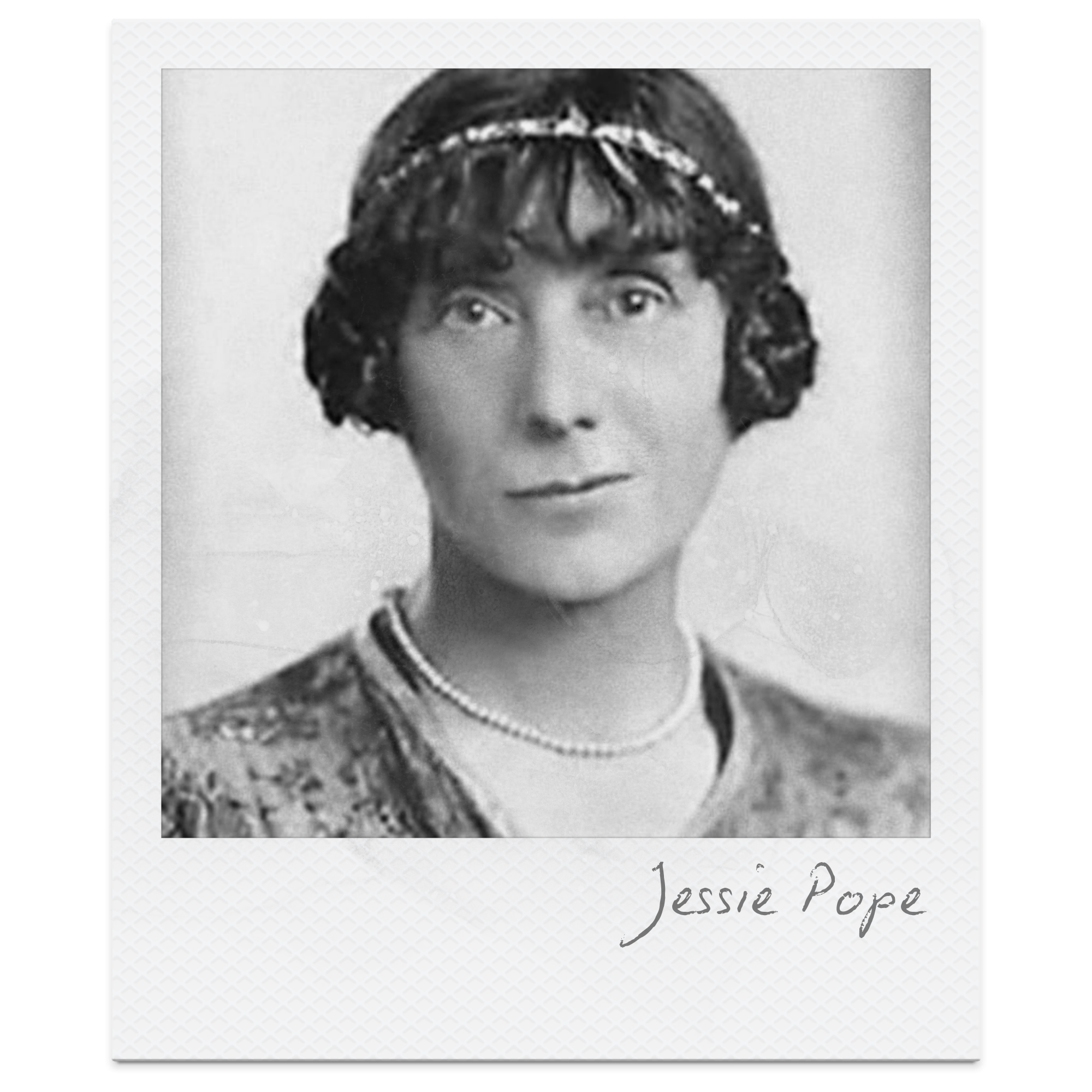
Who Was Jessie Pope?
Jessie Pope (1868–1941) was an English poet, journalist, humourist, and writer best remembered today for her patriotic poetry during the First World War. Although her wartime writing now dominates discussions of her work, Pope had already established a successful literary career long before 1914, particularly through humorous poetry and contributions to popular newspapers and magazines.
She was born in Leicester on 18 March 1868, the daughter of a successful businessman. Pope was educated at North London Collegiate School, one of the leading schools for girls in Victorian Britain. At a time when educational and professional opportunities for women remained restricted, she went on to develop an independent career as a professional writer.
A Popular Writer Before the War
Pope’s literary career did not begin with war poetry.
Before 1914, she was known particularly for light verse, humorous poetry, journalism, and writing for children. Her work appeared in popular periodicals, including Punch, and she developed a style characterised by wit, rhyme, conversational language, memorable rhythms, and observations of everyday life.
This background is important when reading her later war poetry.
The lively rhythms and accessible language of poems such as “Who’s for the Game?” were not techniques Pope suddenly invented for recruitment purposes. They developed from her existing experience as a popular writer who understood how to make poetry immediate, entertaining, memorable, and easy to read.
Her work belonged to a literary culture in which newspapers and magazines were enormously influential. Poetry did not exist only in prestigious volumes or academic settings; it circulated through the same publications people read for news, humour, commentary, entertainment, and discussion of contemporary events.
Pope therefore wrote for a broad popular audience rather than exclusively for a literary elite.
Jessie Pope and the First World War
When the First World War began in 1914, Pope turned some of her attention towards the conflict.
Her wartime poems appeared in newspapers and were later collected in volumes including Jessie Pope’s War Poems (1915) and More War Poems (1915).
Some of her best-known poems encouraged men to enlist by appealing to ideas of courage, masculinity, patriotism, competition, and social responsibility.
In “Who’s for the Game?”, for example, war is compared to a sporting contest. The poem asks who will participate, who will accept the challenge, and who might prefer to remain safely outside it.
The technique reflects an important reality of the early war years. Before the introduction of conscription in 1916, Britain depended heavily upon voluntary recruitment, making persuasion an important part of the national war effort.
Pope’s poetry participated in that culture.
However, she was writing from the home front, not from personal experience of trench warfare. This distinction became increasingly important to her later reputation, particularly when her work was compared with poetry written by soldiers who had experienced the Western Front directly.
Pope and Wilfred Owen
Pope’s modern reputation is closely connected with Wilfred Owen.
An early manuscript of Owen’s “Dulce et Decorum Est” carried the dedication “To Jessie Pope etc.” Owen later altered and eventually removed the direct reference, but the surviving manuscript has created a lasting connection between the two poets.
Their work is now frequently studied in contrast.
Pope’s recruitment poetry can employ the language of sport, courage, participation, and patriotic responsibility, while Owen’s poem exposes the physical horror of warfare and attacks the idealised belief that dying for one’s country is inherently glorious.
This contrast has sometimes resulted in Pope being presented simply as the opposite of Owen or as a symbol of irresponsible wartime propaganda.
Her historical position is more complicated.
Pope was one participant within a much larger culture of patriotic writing, recruitment campaigns, newspaper commentary, public speeches, posters, songs, and social expectations. Studying her work helps us understand the ideas circulating within British society, particularly during the early years of the war.
A Woman Writing About a Male War
Pope’s position as a female writer encouraging male enlistment also makes her work particularly significant.
Women could contribute to the war effort in numerous ways, including nursing, factory work, voluntary organisations, agriculture, transport, and other forms of wartime employment, but they were not serving as frontline combat soldiers in the British Army.
Pope therefore wrote about military courage from a position she could not personally occupy.
Her poems sometimes draw upon contemporary expectations of masculinity, suggesting that willingness to enlist demonstrates bravery, strength, sporting spirit, and responsibility, while reluctance risks appearing cowardly or passive.
This makes her poetry valuable for studying the relationship between gender and wartime recruitment.
Rather than simply asking what Pope believed, readers can examine the social assumptions her poetry uses to persuade its audience.
Later Life and Reputation
Pope continued writing after the First World War, although her wartime poems eventually became the part of her career most familiar to later readers.
She married Edward Babington Smith in 1929 and died in Devon on 14 December 1941, during the Second World War.
Her literary reputation changed considerably after her death.
As poets such as Wilfred Owen and Siegfried Sassoon became increasingly central to the way the First World War was remembered, Pope’s patriotic poetry was often interpreted as an example of the attitudes their writing opposed.
Yet this is also why Pope remains worth studying.
Her work preserves a very different literary response to the conflict. It reveals how war could be presented through the language of games, courage, duty, competition, patriotism, and masculine identity, particularly within the recruitment culture of the early war years.
Reading Pope alongside the soldier-poets therefore gives us a more complete picture of First World War literature. Instead of assuming that everyone understood the conflict through the later language of disillusionment and futility, her writing reminds us that the war generated competing ideas about service, sacrifice, responsibility, heroism, and national duty.
Historical and Social Context
Jessie Pope’s war poetry emerged from the social and political atmosphere of Britain during the First World War, particularly the early years of the conflict when the British Army depended heavily upon voluntary enlistment.
To understand her writing fairly, it is important not to isolate Pope as though she alone encouraged men to fight. She was one voice within a much larger culture of patriotic writing and wartime persuasion. Poets, journalists, politicians, newspapers, musicians, advertisers, public speakers, and government campaigns all participated in shaping attitudes towards military service.
Patriotic poetry was not unusual in 1914.
Nor was it necessarily regarded by contemporary readers in the overwhelmingly negative terms later associated with the word propaganda.
Britain and the Outbreak of War
Britain entered the First World War on 4 August 1914, following Germany’s invasion of neutral Belgium.
The outbreak of war produced a complicated range of responses, but there was substantial public support for the war effort. Ideas of national duty, defence, honour, patriotism, loyalty to King and Country, and protection of Belgium could carry genuine emotional force.
Later knowledge of the trenches and enormous casualty figures can make it difficult to recover this earlier perspective.
People in 1914 did not know that the war would continue for more than four years or that it would eventually become associated with industrialised slaughter, prolonged trench warfare, psychological trauma, and the deaths of millions.
Pope’s early wartime writing needs to be understood within that uncertainty.
Voluntary Recruitment and the Call to Enlist
Britain did not initially introduce conscription.
Instead, the government relied upon men volunteering for military service. Lord Kitchener, appointed Secretary of State for War, oversaw the expansion of the British Army through a huge recruitment campaign.
Posters, newspapers, public meetings, songs, speeches, photographs, advertisements, and literature encouraged men to enlist.
The campaign frequently appealed to familiar social values:
courage, masculinity, patriotism, adventure, friendship, honour, duty, and responsibility towards family and country.
Pope’s poetry uses many of the same ideas.
In “Who’s for the Game?”, military participation is framed through the language of sport. War becomes something in which a courageous man should be willing to take part rather than remain safely on the sidelines.
To modern readers, the comparison can appear disturbingly inappropriate.
Within the culture of 1914–15, however, sporting language was a powerful and recognisable way of talking about masculinity, teamwork, courage, discipline, competition, and fair play.
Pope was drawing upon an existing cultural vocabulary.
Pope Was Not the Only Patriotic War Poet
It is particularly important to place Pope within the much wider tradition of patriotic First World War poetry.
She was far from the only poet to represent military service through ideas of honour, courage, national identity, duty, or meaningful sacrifice.
Early wartime poetry included a wide range of patriotic voices. Rupert Brooke, for example, became one of the most famous poets of the early war through sonnets that presented military sacrifice in highly idealised and spiritual terms. Other writers produced poems supporting recruitment, celebrating soldiers, mourning the dead, defending Britain’s involvement in the conflict, or encouraging perseverance.
Nor were patriotic attitudes confined to civilians.
Many soldiers volunteered willingly, and some continued to believe strongly in the importance of the war even after experiencing combat.
The familiar modern opposition between patriotic civilians and disillusioned soldiers is therefore too simple.
First World War literature contains patriotism and protest, idealism and bitterness, grief and humour, religious faith and doubt, enthusiasm and disillusionment.
Pope represents one important part of that much larger literary landscape.
Propaganda and Popular Culture
The word propaganda also requires careful handling.
Today, it often implies deliberate deception or manipulation. Historically, propaganda can be understood more broadly as communication designed to shape public opinion or encourage particular attitudes and behaviours.
During the First World War, governments on all sides used propaganda extensively.
British wartime propaganda encouraged recruitment, maintained public morale, justified the war effort, emphasised enemy aggression, promoted war loans, encouraged food conservation, and attempted to sustain support for the conflict.
But persuasion did not come only from official government material.
Popular culture also participated.
Newspapers, magazines, cartoons, songs, postcards, sermons, speeches, fiction, and poetry all helped create narratives through which people understood the war.
Pope’s poems therefore belong within a much larger ecosystem of wartime communication.
Calling them propaganda can be useful, particularly when analysing their persuasive techniques, but it should not suggest that Pope was uniquely responsible for creating the values they express.
Gender, Masculinity, and Social Pressure
Gender is especially important when studying Pope.
British men were surrounded by powerful expectations concerning masculinity, courage, physical strength, duty, emotional control, and willingness to protect others.
Recruitment campaigns could exploit these expectations.
Men who enlisted could be presented as courageous and responsible. Those who did not might face questions about their masculinity or patriotism.
Women sometimes participated in this social pressure. One notorious example was the White Feather campaign, in which some women presented white feathers — traditional symbols of cowardice — to civilian men who were not wearing military uniform.
Pope’s poetry operates within this gendered culture.
Her speakers can challenge men to prove themselves, using the possibility of appearing cowardly or passive as part of the persuasive force of the poem.
For modern readers, this creates an uncomfortable dynamic: a woman who could not herself be required to fight encouraging men to demonstrate courage through enlistment.
That tension deserves critical attention.
However, Pope should again be understood within the gender expectations of her historical moment rather than treated as uniquely responsible for them.
Women and the War Effort
Women’s relationship with the First World War was also more complicated than the simple distinction between men fighting and women remaining safely at home.
Women contributed extensively to the war effort.
They worked as nurses, factory workers, agricultural labourers, clerical workers, drivers, volunteers, and members of wartime organisations. The expansion of women’s employment transformed parts of British social and economic life.
Women also experienced the war through bereavement, anxiety, separation, financial disruption, caring responsibilities, and the loss or injury of husbands, sons, brothers, friends, and other relatives.
Pope did not experience trench warfare.
But neither should the home front be imagined as completely disconnected from the conflict.
Her particular significance lies in the fact that she wrote from one side of the enormous divide between imagining military service and physically experiencing combat.
The Sporting Metaphor
The sporting imagery in Pope’s poetry deserves particular historical attention.
British public-school culture had long connected organised sport with the development of desirable masculine characteristics such as discipline, courage, leadership, endurance, teamwork, and loyalty.
The language of games therefore offered an immediately recognisable metaphor for warfare.
Teams became military units.
Participation became enlistment.
Courage meant joining the game.
Remaining outside could appear equivalent to refusing to support one's team.
The metaphor could be extremely persuasive.
But the realities of industrialised warfare exposed its limitations.
A football or cricket match operates according to agreed rules and normally ends with the participants returning home.
Trench warfare involved artillery, machine guns, gas, mutilation, psychological trauma, and death.
The enormous distance between those realities is one reason Pope’s sporting imagery became increasingly troubling when read alongside the poetry of combatants such as Owen and Sassoon.
Changing Attitudes as the War Continued
The cultural atmosphere of 1914 was not identical to that of 1916, 1917, or 1918.
As the conflict continued, Britain experienced enormous casualties, bereavement, wounded veterans, economic pressure, and increasing knowledge of the conditions faced by soldiers.
Major battles such as the Somme intensified awareness of the human cost of the conflict.
This does not mean that Britain simply moved from universal enthusiasm to universal opposition.
Many people continued to support the war effort, and attitudes varied enormously according to individual experience and circumstance.
But the context surrounding patriotic recruitment poetry changed.
Language that might have seemed energetic and encouraging during the early volunteer period could appear very different after years of mass casualties.
The introduction of conscription in 1916 also changed the recruitment environment itself. The state no longer depended entirely upon persuading men to volunteer.
Pope, Owen, and Historical Memory
Jessie Pope’s modern reputation has been profoundly affected by the later prominence of Wilfred Owen.
Owen’s poetry has become central to British cultural memory of the First World War, particularly its representation of physical suffering, psychological trauma, wasted youth, and the inadequacy of patriotic rhetoric.
Because an early version of “Dulce et Decorum Est” was addressed to Pope, she can easily become a convenient symbol of everything Owen appears to oppose.
But history is more complicated than that contrast.
Pope was not the sole creator of recruitment propaganda, nor was she the only writer to represent war patriotically. Owen did not speak for every soldier, just as Pope did not speak for every civilian.
Reading them together is valuable precisely because their writing reveals different moments, experiences, and ways of imagining the same conflict.
Pope allows modern readers to recover something of the cultural environment in which volunteering could be represented as courageous, patriotic, socially admirable, and even exciting.
Owen and Sassoon reveal what could happen when those ideals encountered the realities of prolonged industrialised warfare.
Understanding both perspectives gives us a richer picture of the First World War than turning one poet into the voice of truth and another into its villain.
Literary Context and Movement
Jessie Pope’s poetry belongs to a very different literary tradition from the experimental writing often associated with the early twentieth century. She was primarily a popular poet, journalist, and writer of light verse, producing accessible work for newspapers and magazines rather than positioning herself within an avant-garde literary movement.
Her war poetry developed from this existing style. Regular rhyme, energetic rhythms, humour, direct address, conversational language, and memorable phrases had already characterised her writing before 1914. During the First World War, Pope adapted these techniques to subjects including recruitment, patriotism, military service, and life during wartime.
Understanding this background is important because poems such as “Who’s for the Game?” were designed to communicate quickly with a broad contemporary audience. Their apparent simplicity is closely connected to the popular publishing culture in which Pope worked.
Popular Poetry and Periodical Culture
Before radio and television became dominant forms of mass communication, newspapers and magazines played an enormous role in British cultural life.
Poetry regularly appeared alongside journalism, cartoons, stories, advertisements, political commentary, and humour. Readers did not necessarily encounter poems only through dedicated poetry collections.
Pope was highly experienced within this environment.
Her work appeared in publications including Punch, and she developed a style suited to popular reading: concise, rhythmic, humorous, and immediately understandable.
This helps explain one of the most recognisable characteristics of her wartime poetry.
Pope usually does not ask readers to decode difficult symbolism or complex literary allusions. She often establishes the subject quickly and addresses the reader directly.
The poem needs to catch attention and remain memorable.
During wartime, those qualities could also make poetry highly effective as persuasion.
Light Verse and Humour
Pope was particularly associated with light verse, a form of poetry usually characterised by wit, humour, playful language, rhyme, and accessible subject matter.
Light verse should not automatically be dismissed as inferior or unserious poetry. Its effectiveness often depends upon precision, timing, rhythm, verbal wit, and control of audience response.
Pope brought these techniques into her war writing.
The result can be uncomfortable for modern readers because the lively quality of the verse may appear dramatically at odds with the seriousness of warfare.
However, that contrast is central to understanding her literary method.
Pope could make enlistment appear energetic, communal, competitive, and exciting because she used forms already associated with entertainment and popular culture.
Her style therefore demonstrates how literary form can influence the way a subject is perceived.
Sporting Language and the Tradition of the Game
One of Pope’s most distinctive literary techniques is her use of sporting imagery.
In “Who’s for the Game?”, war becomes a game in which the reader is challenged to participate. The metaphor draws upon a wider British cultural tradition connecting sport with courage, teamwork, discipline, loyalty, masculinity, and fair play.
This was not a metaphor unique to Pope.
Sporting language appeared widely within British culture and could easily be transferred to discussions of military service. Both sport and warfare could be described using ideas of teams, leadership, courage, competition, endurance, and willingness to accept physical risk.
Pope uses this familiar vocabulary to make an unfamiliar and frightening decision — joining the armed forces — appear more recognisable.
The literary effectiveness of the metaphor therefore lies partly in its simplicity.
Its limitations become visible when the metaphor is compared with the realities of industrialised warfare.
Direct Address and the Reader
Pope frequently establishes a direct relationship with her audience.
Questions such as “Who’s for the game?” do more than introduce a subject. They demand a response.
The reader is placed in a position where a choice appears necessary: Will you participate or remain outside? Are you courageous or hesitant? Are you part of the group or watching from safety?
This makes direct address an important persuasive technique.
Rather than describing military service abstractly, Pope can make enlistment appear to be a personal decision confronting the individual reader.
Her frequent use of rhetorical questions reinforces this effect. The apparent question may contain an implied preferred answer, subtly directing the reader towards the behaviour the poem celebrates.
Rhythm, Rhyme, and Memorability
Pope’s war poems often use regular rhythms and clear rhyme schemes.
These features contribute to their accessibility, but they can also reinforce their persuasive qualities.
Regular rhythm creates momentum. Rhyme makes lines easier to remember. Repetition reinforces important ideas. Short stanzas allow arguments to develop quickly.
At times, the resulting poems resemble popular songs, chants, advertisements, or spoken appeals more closely than the complex meditative poetry later associated with writers such as Owen.
That distinction is significant.
Pope was writing within a culture where poetry could function as popular communication. A poem that could be read quickly, repeated, quoted, or remembered possessed considerable cultural reach.
Patriotic and Recruitment Poetry
Pope belongs within a broader tradition of patriotic First World War writing.
She was not the only poet to represent military service positively, nor were patriotic attitudes limited to writers who had never experienced military life.
The early years of the war produced poetry concerned with national identity, honour, duty, sacrifice, courage, and service. Writers approached these ideas in different ways.
Rupert Brooke, for example, produced a very different kind of patriotic poetry. His sonnets use elevated lyrical and spiritual language to imagine sacrifice for England, whereas Pope frequently employs colloquial language, humour, sport, and direct persuasion.
Both demonstrate that patriotic war poetry itself was not a single literary style.
Pope’s particular contribution belongs to the more immediate world of popular recruitment culture.
Pope and the Soldier-Poets
Pope’s literary reputation changed dramatically as poets such as Wilfred Owen and Siegfried Sassoon became central to the literary memory of the First World War.
Their poetry often appears to dismantle precisely the kind of language Pope employs.
The contrast is especially striking with sporting imagery.
Pope can present war as a game; Owen presents bodies physically destroyed by it.
Pope can appeal to courage and participation; Sassoon can expose the psychological and physical consequences experienced by those who participate.
However, these differences should not be used to create an overly simple division between false patriotic poetry and truthful soldier poetry.
They represent different perspectives, experiences, purposes, and stages within the cultural history of the war.
Reading them together allows us to examine how literary representations of conflict can change according to who is speaking, when they are writing, whom they are addressing, and what they want their writing to achieve.
Jessie Pope and Wilfred Owen
The literary relationship between Pope and Wilfred Owen is particularly important because of the early manuscript dedication of “Dulce et Decorum Est” to “Jessie Pope etc.”
Owen’s poem can be read as a powerful challenge to idealised representations of military sacrifice. Its exhausted soldiers, violent gas attack, physical suffering, and traumatic memory make the language of glorious death impossible to accept without scrutiny.
The contrast with Pope is therefore valuable.
But Pope’s significance should not depend entirely upon Owen.
Studying her work in its own literary context reveals how popular verse could participate in wartime persuasion, while studying the two poets together reveals how radically different literary techniques can shape readers’ understanding of the same historical event.
A Different Branch of First World War Poetry
Jessie Pope is important partly because she complicates the category of First World War poetry.
The term can easily become associated almost exclusively with trench poets writing about mud, death, trauma, futility, and disillusionment.
Yet the literature produced during the war was much broader.
It included patriotic verse, recruitment poetry, satire, elegy, protest poetry, religious poetry, humorous writing, poems by women, poems from the home front, and writing by soldiers with widely differing attitudes towards the conflict.
Pope represents one part of that diversity.
Her poetry shows how popular literary techniques — rhyme, rhythm, humour, sporting metaphor, rhetorical questions, and direct address — could be used to make particular ideas about military service persuasive and memorable.
Her work therefore provides an important counterpoint to the soldier-poets who later came to dominate the literary canon.
Rather than reading Pope only to decide whether her representation of war was accurate, we can ask a more revealing literary question:
How does a writer use language and form to persuade an audience to see war in a particular way?
Core Themes Across Jessie Pope’s Writing
Jessie Pope’s First World War poetry repeatedly explores ideas of patriotism, courage, masculinity, duty, participation, and national responsibility. Unlike the later poetry of Wilfred Owen and Siegfried Sassoon, her best-known wartime poems generally approach conflict from the perspective of the home front, focusing less on the physical experience of battle than on the decision to participate in the war.
Her poetry is therefore particularly valuable for examining the social language surrounding enlistment. Through sporting metaphors, rhetorical questions, energetic rhythms, and direct appeals to the reader, Pope reveals how military service could be connected with broader cultural expectations about what it meant to be courageous, masculine, patriotic, and socially responsible.
Patriotism and National Duty
Patriotism is one of the clearest themes in Pope’s wartime writing.
Military service is frequently associated with responsibility towards the nation. The individual is encouraged to see the war not simply as a distant political conflict but as something requiring a personal response.
This reflects the culture of voluntary recruitment during the early years of the First World War. Before conscription was introduced in Britain in 1916, recruitment depended upon persuading men that joining the armed forces was something they should choose to do.
Pope’s poetry participates in this process by connecting enlistment with positive values such as loyalty, bravery, enthusiasm, and duty.
Patriotism therefore becomes active rather than passive. Supporting the nation is not merely something a person feels; it is something a man may be expected to demonstrate through action.
Masculinity and Courage
Pope’s recruitment poetry frequently draws upon contemporary expectations of masculinity.
The ideal man is presented as courageous, active, willing to take risks, and prepared to fulfil his responsibilities. Hesitation can therefore become more than a personal decision: it risks suggesting an absence of the qualities society expects from men.
This gives poems such as “Who’s for the Game?” much of their persuasive force.
The reader is not simply being asked whether he wants to become a soldier.
He is implicitly being asked:
Are you brave enough to join?
The connection between military service and masculine identity reflects broader social attitudes of the period. Courage, endurance, physical strength, loyalty, and emotional control were frequently associated with idealised manhood.
Pope uses those assumptions rather than needing to explain them.
War as Sport and Competition
One of Pope’s most recognisable themes is the representation of war as a game or sporting contest.
Sport provides a familiar language through which military service can be understood. A war has sides, participants, leaders, risks, challenges, and the possibility of victory.
This metaphor makes enlistment appear active and exciting.
The soldier becomes a player rather than a victim, while joining the war becomes participation rather than submission to danger.
Sport also carries important cultural associations with teamwork, courage, fair play, physical strength, loyalty, and masculine identity.
Yet this metaphor becomes deeply uncomfortable when compared with the realities of the Western Front.
Games have rules. Players normally survive them. Warfare involves death, mutilation, trauma, and destruction.
The gap between war imagined as sport and war experienced as combat is therefore one of the most important tensions modern readers can explore in Pope’s poetry.
Participation and the Fear of Being Left Behind
Pope frequently constructs war as something in which the reader must decide whether to participate or remain outside.
This creates a strong distinction between those who join and those who watch.
Her rhetorical questions can make neutrality seem difficult. If courageous men are joining the “game,” the person who remains behind risks appearing passive, hesitant, or cowardly.
Participation therefore becomes connected with belonging.
The individual is invited to become part of a collective national effort rather than remain on the sidelines.
This reflects the intense social pressures surrounding voluntary recruitment, particularly during the early stages of the war.
Pope’s poetry demonstrates how persuasion can operate not through direct commands but through the fear of being excluded from the courageous group.
Gender and Social Expectations
Gender is central to the way Pope’s wartime poetry works.
As a woman, Pope could encourage men to enlist without facing the same expectation of frontline military service herself. This creates an important tension within her writing.
Her poetry can reinforce the idea that men prove their masculinity through courage, action, physical risk, and military participation.
Women can also appear within the broader recruitment culture as observers whose admiration or judgement helps establish what counts as desirable male behaviour.
For modern readers, this raises difficult questions about who has the authority to encourage sacrifice.
However, Pope’s writing also provides valuable evidence of the gender expectations operating within wartime society. Rather than treating these assumptions as uniquely hers, we can examine how her poetry draws upon values already familiar to her audience.
Persuasion and Social Pressure
Pope’s poetry demonstrates the thin boundary that can exist between encouragement and pressure.
Her speakers frequently sound cheerful and conversational rather than threatening. Yet beneath the energetic tone lies a clear distinction between desirable and undesirable behaviour.
Joining represents courage, participation, patriotism, and commitment.
Remaining behind can suggest fear, passivity, or unwillingness to contribute.
This makes Pope particularly useful for studying persuasive language.
She does not need to tell readers explicitly that they are cowards if they refuse to enlist. Instead, rhetorical questions and contrasts can lead readers towards that conclusion themselves.
The poem therefore makes social expectation part of its argument.
The Home Front and the Imagination of War
Unlike Owen or Sassoon, Pope did not write from personal experience of frontline combat.
Her war poetry consequently reveals something important about how conflict could be imagined from a distance.
War can become a game, challenge, national adventure, or opportunity to demonstrate courage because its physical realities remain largely outside the poem.
This does not mean that Pope knew nothing about wartime suffering or that everyone on the home front imagined war in the same way.
Instead, it highlights the difference between representing an idea of war and representing the sensory experience of combat.
That distinction becomes particularly powerful when Pope is read alongside the soldier-poets.
The contrast reveals how radically perspective can shape literary representation.
Heroism and Sacrifice
Pope’s poetry also participates in contemporary ideas about heroism and sacrifice.
Military service offers an opportunity for the individual to contribute to something larger than himself. Courage becomes meaningful because it serves the nation and the wider community.
This differs significantly from the treatment of sacrifice in much of Owen’s poetry.
Where Pope can associate participation with honour and courage, Owen repeatedly forces readers to confront the physical body that must actually be sacrificed.
Neither perspective should automatically be treated as representing every wartime experience.
Instead, their contrast demonstrates how the same concept — sacrifice — can acquire dramatically different meanings depending upon the writer’s perspective and purpose.
Optimism and the Early-War Mentality
The energetic tone of Pope’s best-known poems also reflects an important aspect of early-war culture.
Readers who know how the First World War ended inevitably approach the conflict with hindsight. They know about the Somme, Passchendaele, shell shock, enormous casualty figures, and four years of industrialised warfare.
Pope’s early wartime readers did not possess that knowledge.
Her poetry can therefore preserve a sense of confidence, urgency, enthusiasm, and belief in purposeful participation that became more difficult to sustain as the conflict continued.
This makes her writing historically valuable even when modern readers find its assumptions uncomfortable.
It captures one way in which the war could be imagined before its full human cost had become clear.
The Distance Between Language and Reality
Perhaps the most important theme to emerge when Pope is read today is the relationship between language and reality.
Her sporting metaphors, energetic rhythms, humorous tone, and appeals to courage demonstrate how language can shape the way people imagine events they have not personally experienced.
A war described as a game feels different from a war described through gas attacks.
A soldier described as a player feels different from a soldier described as wounded or traumatised.
Enlistment described as joining in feels different from enlistment described as accepting the possibility of death.
This does not make Pope’s poetry historically worthless.
It makes it particularly revealing.
Her work allows readers to examine how metaphor, tone, rhythm, gender expectations, and cultural values can make one interpretation of war appear natural or persuasive.
That is one of the most important reasons Jessie Pope continues to deserve a place within the study of First World War literature.
Jessie Pope’s Literary Significance
Jessie Pope’s literary significance lies not only in the content of her First World War poetry, but in what her writing reveals about the relationship between literature, popular culture, propaganda, recruitment, gender, and mass communication during the early twentieth century.
Her work provides an important counterpoint to the poetry of Wilfred Owen and Siegfried Sassoon. While their writing has become central to later representations of war as traumatic and destructive, Pope allows readers to examine another part of the literary landscape: the language through which participation in the war could be made to appear patriotic, courageous, exciting, socially desirable, and necessary.
Poetry as Mass Communication
Pope’s career reminds us that poetry in the early twentieth century was not confined to poetry books or literary circles.
Poems appeared in newspapers and magazines, alongside news reports, cartoons, advertisements, political commentary, fiction, and entertainment. Pope was already an experienced periodical writer before 1914 and understood how to communicate with a broad popular audience.
This matters when studying wartime propaganda.
Ideas about the war were distributed through many interconnected forms: posters, newspapers, magazines, speeches, sermons, songs, photographs, postcards, cartoons, advertisements, and poetry.
Pope’s work demonstrates how poetry could participate in this wider network.
A short, rhythmic poem printed in a popular publication could be read quickly and shared widely. Rhyme, repetition, rhetorical questions, humour, and familiar metaphors could make its message easier to remember.
Her work therefore allows us to study not only the message of wartime persuasion, but how that message travelled.
The Literary Techniques of Propaganda
Pope is also significant because her poetry provides a clear example of how literary techniques can become persuasive techniques.
In poems such as “Who’s for the Game?”, metaphor changes the way the reader imagines military service. War becomes sport; enlistment becomes participation; soldiers become players; hesitation becomes remaining on the sidelines.
The technique simplifies an extraordinarily complicated decision into a familiar choice.
Her use of direct address and rhetorical questions makes that choice feel personal. Regular rhythm creates momentum. Rhyme increases memorability. Informal language makes the speaker appear accessible rather than authoritative.
These are literary techniques, but they also demonstrate some of the mechanisms through which propaganda can work.
Propaganda does not necessarily persuade by presenting a formal political argument. It can operate through emotion, identity, repetition, metaphor, humour, social expectation, and the desire to belong.
Pope’s poetry makes those processes unusually visible.
Popular Literature as Historical Evidence
Pope’s writing is also valuable because popular literature can preserve attitudes that later cultural memory obscures.
Modern representations of the First World War are strongly influenced by images of trenches, mud, shell shock, mass casualties, disillusionment, and wasted youth. Those images are historically important, but they can make it easy to assume that people in 1914 understood the war in exactly the same way.
Pope’s poetry demonstrates otherwise.
Her writing preserves some of the values circulating during the period of voluntary recruitment: patriotism, sporting courage, masculine responsibility, participation, collective identity, and national duty.
This does not mean that her poetry represents what every British person believed.
It means that her work provides evidence of the kinds of ideas that could be recognisable and persuasive to contemporary audiences.
Literature therefore becomes a form of cultural evidence.
Expanding the Canon of First World War Poetry
Studying Pope also challenges a narrow definition of First World War poetry.
The literary canon has traditionally given particular prominence to male combatant poets such as Owen and Sassoon. Their work is enormously important, but the literature of the war was produced by a much wider range of writers.
It included soldiers and civilians, men and women, patriotic writers and protesters, professional poets and popular journalists.
Pope represents the literature of the home front and popular press, giving readers access to a perspective that cannot be recovered through trench poetry alone.
Including her therefore produces a more complicated literary history.
First World War poetry becomes not one unified message about the conflict but a conversation between competing representations of it.
Gender and the Language of Recruitment
Pope is particularly significant for the study of gender.
Her poetry demonstrates how ideas about masculinity could be used as a form of wartime persuasion. Courage, action, physical risk, sporting spirit, and willingness to serve become markers of desirable male behaviour.
Because Pope was a woman writing to and about men, the gender dynamic becomes especially visible.
Her poems raise questions about who encourages military participation, who is expected to fight, and how social approval or disapproval can influence individual choices.
This makes her work useful far beyond a simple discussion of patriotism.
It allows readers to examine how societies construct expectations around masculinity, femininity, courage, duty, and sacrifice.
Pope and the Changing Reputation of War Poetry
Pope’s literary reputation also demonstrates how the canon changes over time.
During the war, she was a successful popular writer whose work circulated among contemporary readers. Later, as Owen and Sassoon became increasingly influential in British education and cultural memory, patriotic poetry was often viewed through the lens of the disillusioned soldier-poets.
Pope consequently acquired a very different role.
Rather than being remembered primarily as a successful writer of popular verse, she became famous as the kind of patriotic voice against which Owen appeared to write.
The early dedication of “Dulce et Decorum Est” to “Jessie Pope etc.” strengthened that association.
Her changing reputation therefore demonstrates an important principle of literary study:
Literary significance is not fixed.
Writers can be celebrated, forgotten, rediscovered, criticised, or reinterpreted as later generations develop different ideas about which texts matter and why.
Why Comparing Pope and Owen Matters
The contrast between Pope and Wilfred Owen remains extremely useful, provided it is not reduced to a simple opposition between a “wrong” poet and a “right” one.
Their work demonstrates how perspective and literary technique shape representation.
Pope uses energetic rhythm, sporting metaphor, direct address, and rhetorical questions to make participation appear attractive.
Owen uses disturbing sensory imagery, physical detail, disrupted movement, and traumatic memory to make readers confront what combat can actually involve.
The difference allows students to ask much richer questions:
Who is speaking?
What experience does the writer possess?
Who is the intended audience?
What response does the poem attempt to create?
How does language influence the way an audience imagines war?
Those questions move literary analysis beyond deciding whether a poem is simply “pro-war” or “anti-war.”
Understanding How War Is Represented
Ultimately, Pope’s literary importance lies partly in the fact that her work allows us to see representation being constructed.
War does not enter literature in a neutral form.
Writers choose metaphors.
They choose what to include and what to omit.
They decide whether soldiers appear as players, heroes, victims, individuals, comrades, casualties, or symbols.
They choose whether death is foregrounded or left outside the poem.
Pope’s poetry makes those choices particularly visible because later readers know how dramatically the realities of the First World War could differ from the sporting and competitive language used to describe it.
Her work therefore remains valuable not despite the discomfort it can create, but partly because of that discomfort.
Jessie Pope gives modern readers an opportunity to examine how poetry participated in wartime persuasion, how propaganda circulated through popular culture, how social expectations could be embedded within apparently simple verse, and how later generations reshape the literary memory of war.
Studied alongside Owen, Sassoon, and other First World War writers, her work helps create a fuller picture of a conflict that was fought not only through armies and weapons, but through words, images, stories, values, and competing attempts to define what the war meant.
Go Deeper into Jessie Pope and First World War Poetry
Understanding Jessie Pope’s historical context and literary career allows us to look more closely at the ways poetry participated in recruitment, patriotism, popular culture, and wartime persuasion. Her poems are particularly useful when studied alongside writers who represented the conflict from very different perspectives.
If you want to explore Pope and First World War literature in greater depth, start with the following:
◆ “Who’s for the Game?”
Explore Pope’s use of sporting metaphor, rhetorical questions, direct address, rhythm, and masculine stereotypes to present enlistment as a challenge and encourage participation in the war.
◆ “The Call”
Examine how Pope uses questions, repetition, patriotism, and social expectations to distinguish between those willing to answer their country’s call and those who remain behind.
◆ “War Girls”
Explore a different aspect of Pope’s wartime writing through her representation of women’s changing roles during the First World War, including the expansion of female employment traditionally associated with men.
◆ Jessie Pope and Wilfred Owen: Comparing “Who’s for the Game?” and “Dulce et Decorum Est”
Compare two dramatically different representations of warfare, considering perspective, audience, imagery, tone, metaphor, patriotism, physical suffering, and the writers’ different relationships with combat.
◆ Propaganda and Recruitment During the First World War
Explore how posters, newspapers, magazines, poetry, songs, speeches, and other forms of popular culture were used to shape attitudes towards enlistment and the wider war effort.
◆ Women and the First World War
Examine the changing roles of women during the conflict and consider how employment, nursing, voluntary work, bereavement, recruitment culture, gender expectations, and the home front shaped women’s experiences of war.
◆ Masculinity, Courage, and the First World War
Explore how ideas about bravery, duty, sport, physical strength, cowardice, honour, and masculine identity influenced recruitment and appear across First World War literature.
◆ Patriotism and Protest in First World War Poetry
Compare the many ways writers responded to the conflict, from patriotic and recruitment poetry to satire, protest, mourning, trauma, and disillusionment, rather than treating First World War poetry as a single literary viewpoint.
For more poetry, author studies, historical context, and close literary analysis, explore the Literature Library.
Final Thoughts
Jessie Pope’s poetry offers an important window into the culture of the First World War, particularly the early years of voluntary recruitment when patriotism, masculinity, courage, sport, and national duty could all be used to encourage men to enlist. Her writing reminds us that poetry was not separate from wartime culture: it circulated through newspapers and magazines, participated in public debate, and could help shape the language through which readers understood the conflict.
Reading Pope in context also prevents her from becoming a convenient villain in the story of First World War poetry. She was not the only writer producing patriotic or persuasive verse, nor did every soldier reject the values her poetry expressed. Instead, her work represents one voice within a much larger and often contradictory literary culture.
This is what makes Pope particularly valuable alongside writers such as Wilfred Owen and Siegfried Sassoon. The differences between their poetry reveal how dramatically perspective, experience, audience, and purpose can change the representation of the same historical event.
Ultimately, studying Jessie Pope allows us to ask a question that extends far beyond the First World War: how can literature shape the way a society understands conflict, courage, duty, and sacrifice?
For more author studies, historical context, poetry analysis, and resources exploring literature across different periods and genres, visit the Literature Library, where you can continue exploring the writers, texts, and ideas that shape English literature.
