100 YA Folklore-Inspired Story Ideas for Your Next Story
Folklore is filled with strange creatures, ancient warnings, haunted landscapes, impossible bargains and stories passed from one generation to the next. For YA writers, those traditions offer endless possibilities for stories about young people discovering that the legends they grew up hearing may contain more truth than anyone realised. A teenager might learn that the creature haunting their village is connected to an old family secret, stumble into a festival governed by rules nobody will explain or discover that the local superstition everyone laughs about exists for a very good reason.
These 100 YA folklore-inspired story ideas draw on folk beliefs, legendary creatures, supernatural traditions, rural communities, local legends, seasonal customs, strange rituals and stories shaped by generations of storytelling. Rather than simply retelling individual folktales, the ideas use folklore as inspiration for fantasy, mystery, horror, romance, gothic fiction, historical stories and contemporary YA. Explore the Fairytale & Folklore Writing Hub for more folklore prompts, mythical settings, legends, creatures and worldbuilding inspiration.
Whether you are planning a YA novel, developing a short story, creating a classroom writing activity or simply searching for an unusual premise, use these ideas as foundations for stories of your own. Change the culture, location, historical period or supernatural rules; invent your own local legends; or explore what happens when ancient beliefs collide with modern teenage life. For even more inspiration across fantasy, horror, mystery, romance, science fiction and beyond, explore the Creative Writing Archive.
1. Local Legends & Village Folklore
Every community has stories that belong specifically to that place: the road nobody walks after dark, the ruined house children dare one another to enter, the creature supposedly living beneath the lake or the stranger who appears before something terrible happens. These YA story ideas explore teenagers discovering that the legends surrounding their hometowns are connected to real events, hidden histories and supernatural forces that never disappeared.
1. Everyone in a remote village knows never to cross the old stone bridge after sunset because a girl supposedly drowned beneath it centuries ago. When seventeen-year-old Mara crosses it on a dare, she meets the girl sitting perfectly dry on the opposite bank — and she knows Mara's name.
2. Teenagers in a coastal town have spent generations daring one another to ring the bell inside an abandoned lighthouse at midnight. When four friends finally do it, every fishing boat in the harbour returns the following morning except one — carrying passengers who disappeared from the town fifty years earlier.
3. A mountain village believes that hearing three knocks against your bedroom window means someone in your family will die before winter. Sixteen-year-old Ewan hears the knocks in the middle of summer, but when he tells his grandmother, she insists the legend has been misunderstood for generations: the knocks do not predict a death. They offer someone the chance to prevent one.
4. Every child in a small town grows up hearing stories about a woman who wanders the surrounding fields searching for something she lost. When a teenage girl follows the apparition one night, the ghost leads her to an unmarked grave containing an object that belonged to her missing father.
5. A village holds an annual competition in which teenagers race through the forest to touch an ancient standing stone and return before midnight. Nobody remembers why the tradition began. This year, the winner returns carrying a message carved into the stone in a language she has never learned — warning that the village has broken its side of an agreement.
6. Local legend claims that anyone who sees the black dog wandering the moor will suffer terrible misfortune. When a lonely sixteen-year-old begins encountering the creature every evening, she notices something strange: disasters happen whenever she ignores where the dog tries to lead her.
7. Generations of children have searched for the entrance to a supposedly abandoned village hidden somewhere in the hills. When five teenagers finally find it, the houses are occupied by people dressed exactly like the figures in century-old photographs from their local museum — and the villagers insist the teenagers themselves disappeared many years ago.
8. In a lakeside town, everyone knows the story of a creature that drags swimmers underwater if they enter the lake after sunset. When a teenager is pulled beneath the surface, the creature saves her from something much larger living at the bottom — and demands that she warn the town that it is waking.
9. A teenage boy moves to his mother's isolated childhood village and discovers that nobody will explain why his family name has been scratched from gravestones, school records and memorials throughout the town. The only person willing to speak to him is an elderly storyteller who claims his ancestors were once responsible for keeping something outside the village boundaries.
10. Once every generation, somebody in a rural community supposedly sees a procession of silent figures walking along a road that disappeared beneath farmland centuries ago. When seventeen-year-old Nia witnesses it, she recognises several people among the procession — including classmates who are still alive.
2. Folklore Creatures & Supernatural Beings
Folklore creatures rarely fit neatly into the roles of monster or friend. They may protect particular places, punish broken rules, demand bargains, imitate humans or follow customs that make perfect sense within their own worlds. These YA ideas bring teenagers into contact with supernatural beings whose stories have been distorted, forgotten or deliberately changed by the humans who learned to fear them.
11. A teenage girl living on a remote island has always been warned never to follow seals that gather unusually close to shore. When she finds a boy her age unconscious on the beach with a sealskin hidden beneath nearby rocks, her grandmother orders her to burn it before he wakes.
12. Every family in a woodland village leaves a bowl of milk beside the hearth each night for a household spirit nobody claims to believe in anymore. When sixteen-year-old Theo forgets the offering, he wakes to discover that every door and window in the house has vanished — and something furious is moving inside the walls.
13. A boy rescued from a river as a child has always been terrified of deep water without understanding why. On his seventeenth birthday, a strange girl emerges from the river and tells him that humans stole him from her family years ago — and she has finally come to take her brother home.
14. A teenage shepherd discovers an injured creature with antlers, human hands and the ability to speak his name. The village elders insist it must be killed immediately, but the creature claims the elders have spent generations hunting its kind to prevent anyone discovering who originally owned the valley.
15. A girl working at her family's struggling seaside café notices the same mysterious teenage boy sitting outside every morning before sunrise. He never orders anything, never seems cold and always disappears before the tide turns. When she finally follows him, she watches him walk directly into the sea.
16. Children in a northern village are taught that strange lights appearing over the marshes lure travellers to their deaths. When seventeen-year-old Safiya becomes lost there during a storm, one of the lights deliberately guides her home. The next evening it appears outside her bedroom window, waiting for her to follow it somewhere else.
17. A teenager discovers a tiny creature secretly repairing broken objects around her grandmother's cottage at night. When her grandmother falls ill, the creature reveals that it has protected their family for generations — but its agreement ends when the eldest woman in the household dies.
18. Every spring, villagers tie ribbons to trees along the forest boundary to prevent the beings beyond it from entering. When a rebellious teenager removes one as a joke, a girl identical to her best friend appears at school the following morning — while her real friend has vanished.
19. A young musician learns a melody from an elderly stranger at a village festival and plays it during a school performance. Halfway through the song, creatures invisible to everyone else begin gathering around the stage, and one of them tells her that humans have not been permitted to play that music for three hundred years.
20. A teenage boy has spent his childhood hearing frightening stories about the enormous creature supposedly sleeping beneath the mountain above his town. When mining causes part of the mountain to collapse, he discovers the creature is real — but rather than attacking the town, it asks why humans have stopped bringing the offerings that once kept something far more dangerous underground.
3. Family Folklore, Inherited Secrets & Generational Curses
Some folklore never makes it into books or local museums because it belongs to a single family. Strange rules are passed from grandparents to grandchildren, old stories explain unusual traditions and warnings survive long after everyone has forgotten what they were meant to prevent. These YA ideas explore teenagers discovering that the peculiar customs within their families are connected to inherited magic, supernatural bargains and secrets their relatives have protected for generations.
21. Every daughter in seventeen-year-old Elara's family receives a silver key on her sixteenth birthday and is warned never to discover what it opens. When her grandmother dies, Elara finds an identical key around her neck — alongside a handwritten list of every woman in the family who ignored the warning and disappeared.
22. A teenage boy has always thought it ridiculous that his family covers every mirror in the house before midnight on the final day of each month. When he deliberately leaves one uncovered, his reflection remains visible after he walks away — and begins desperately trying to tell him something.
23. For generations, the eldest child in a family has inherited the ability to see spirits. When sixteen-year-old Priya develops the gift, she expects ghosts. Instead, she begins seeing the same unknown woman standing silently beside every member of her family except her younger brother.
24. A girl grows up hearing her grandmother insist that nobody in their family should ever accept flowers from a stranger. At seventeen, she receives an anonymous bouquet containing a rare wildflower that supposedly disappeared from the region a century ago — and her mother immediately begins packing their belongings.
25. Every generation of one family produces a child who disappears on their eighteenth birthday and returns exactly one year later without having aged or remembering where they went. With her own eighteenth birthday approaching, a teenager begins receiving letters from the cousin who vanished twenty years earlier and never came back.
26. A teenage boy inherits his grandfather's collection of handwritten folk songs and discovers one unfinished verse repeatedly crossed out in every notebook. When he sings the missing words he uncovers beneath the ink, somebody knocks on the front door claiming to be his grandfather's older brother — a boy who supposedly died seventy years ago.
27. The women in a girl's family can predict the future by interpreting patterns in spilled salt, broken glass and dying flowers. Her predictions have always been harmless until every omen she reads begins pointing towards the same impossible event: her own mother murdering someone before the end of summer.
28. A teenager raised by her aunt discovers that every photograph taken before her fifth birthday has been destroyed. The only surviving picture shows her standing beside a woman nobody will identify and holding the hand of a strange child with antlers hidden beneath his hair.
29. For centuries, one family has followed a peculiar rule: the youngest child must never sleep beneath the family roof on the longest night of the year. When a snowstorm prevents seventeen-year-old Rowan from leaving, something arrives after midnight to collect the payment his ancestors promised.
30. A teenage girl inherits her grandmother's cottage and a book containing hundreds of handwritten rules: never whistle near the well, leave the kitchen window open during thunderstorms, place bread beneath the hawthorn tree every Sunday. She ignores them until supernatural disturbances begin across the village — and realises the rules were never superstitions. They were maintenance instructions.
4. Festivals, Rituals & Seasonal Traditions
Communities can preserve traditions for centuries without remembering why they began. A harmless festival game might once have been a test, a seasonal celebration could disguise an ancient bargain and a familiar procession may follow a route chosen for reasons nobody discusses anymore. These YA ideas explore young characters discovering the forgotten meanings behind the customs they have participated in all their lives.
31. Every midsummer, teenagers in a rural town weave flower crowns and float them down the river to predict who they will marry. Seventeen-year-old Maeve's crown travels upstream instead, disappearing into the forest. The next morning, a boy she has never seen before arrives wearing it.
32. During an annual winter festival, one teenager is chosen by lottery to wear an elaborate wooden mask and lead the midnight procession. This year, sixteen-year-old Jonah is selected — and once the mask is placed over his face, he can hear the voices of everyone who wore it before him begging him not to complete the route.
33. A coastal village celebrates the first storm of autumn by throwing handmade lanterns into the sea. When a teenager secretly keeps hers, she discovers a name written inside it the following morning — belonging to a classmate who disappears before sunset.
34. Every harvest, villagers construct an enormous figure from the final sheaves of wheat and burn it at midnight. When seventeen-year-old Cass discovers something moving inside this year's figure moments before the fire is lit, the village elders refuse to let her cut it open.
35. An isolated community celebrates the beginning of spring by leaving every door unlocked overnight so good fortune can enter. A teenage girl wakes before dawn to find muddy footprints leading through every house in the village — except hers.
36. During a centuries-old festival, young people leave handwritten secrets inside hollow trees and return the following year to burn them unread. When seventeen-year-old Imogen retrieves hers, someone has replaced it with a confession describing a murder that has not happened yet.
37. Every year, the oldest teenagers in a mountain village climb to a ruined shrine and leave an object representing their childhood before returning as adults. When a girl reaches the shrine, she finds hundreds of abandoned objects — and several belongings to teenagers who supposedly completed the ritual but were never seen again.
38. At the town's annual masked celebration, everyone must remain disguised from sunset until sunrise and nobody is permitted to reveal another person's identity. Sixteen-year-old Leo recognises his missing sister among the dancers, even though she disappeared during the same festival three years earlier.
39. A village marks the longest night of winter by setting an extra place at every dinner table for deceased relatives. When seventeen-year-old Amara's family sits down to eat, somebody is already occupying the empty chair — and only Amara seems surprised to see him.
40. Every thirteen years, a remote town holds an elaborate festival celebrating the legendary hero who supposedly saved the community from a monster. While helping prepare the celebrations, a teenager discovers the oldest surviving account tells the opposite story: the villagers killed their protector, and the festival was originally created to apologise before its descendants returned.
5. Folk Magic, Healers & Old Superstitions
Folk magic often survives through ordinary objects and everyday rituals: herbs gathered at particular times, charms hidden above doorways, protective symbols carved into wood or warnings about seemingly harmless actions. These YA ideas explore young people inheriting forgotten knowledge, questioning old superstitions and discovering that the small traditions dismissed by everyone around them may be the only things keeping dangerous forces under control.
41. A teenage girl apprenticed to her village healer is taught dozens of remedies involving herbs, charms and whispered words, but her grandmother insists there is one illness they must never attempt to cure. When her younger brother develops its unmistakable symptoms, she secretly searches for the forbidden remedy.
42. Everyone in seventeen-year-old Finn's family touches the wooden frame above their front door before leaving the house. He has always assumed it is an eccentric family habit until he forgets one morning and discovers that nobody outside the house can recognise him.
43. A teenager helping clear her late grandmother's home discovers hundreds of tiny cloth bags hidden inside walls, beneath floorboards and above windows. She opens one and finds nothing but dried herbs, three black threads and a child's tooth. That night, something begins trying to enter the house.
44. An elderly healer teaches sixteen-year-old Anya how to identify which plants can cure illness, reveal lies and protect travellers from spirits. When the healer suddenly disappears, every plant in the surrounding forest begins growing in places where it should not — forming a trail towards the mountains.
45. A boy raised in a deeply superstitious fishing community deliberately breaks every local rule to prove they are meaningless: he whistles aboard a boat, turns a loaf of bread upside down and leaves shore on a forbidden day. Nothing happens until the sea begins returning objects belonging to fishermen who have been missing for generations.
46. Seventeen-year-old Rosa discovers that her grandmother secretly earns money removing curses from people throughout the town. When Rosa demands to be taught, her grandmother refuses because the women in their family do not destroy curses — they transfer them somewhere else.
47. A teenager buys an old silver charm from a market stall after the seller promises it protects whoever wears it from bad luck. Her life immediately improves, but increasingly terrible things begin happening to the people closest to her.
48. Every newborn in a rural community receives a red thread tied around one wrist and wears it until their eighteenth birthday. When sixteen-year-old Malik's thread accidentally snaps two years early, he begins seeing creatures standing beside certain people — including one that has followed his mother everywhere for as long as he can remember.
49. A girl learns that the strange symbols her grandfather carved into furniture were not decorative patterns but protective marks. After developers demolish his abandoned workshop, the same symbols begin appearing overnight across the town, scratched into doors by people who swear they did not make them.
50. The village healer chooses an apprentice only once every thirty years by leaving a bundle of herbs outside the chosen person's home. When seventeen-year-old Kit receives the bundle, he discovers that three other teenagers received identical ones — and according to tradition, only one apprentice is supposed to survive the training.
6. Folklore Mysteries & Hidden Histories
Legends can preserve truths long after names, dates and official records have disappeared. A children's rhyme might describe a forgotten crime, a ghost story could identify someone deliberately erased from history and an impossible local legend may be the only surviving account of what really happened generations ago. These YA ideas combine folklore with mystery as young characters use old stories to investigate disappearances, buried secrets and histories their communities would rather leave forgotten.
51. Children in a small town have sung the same skipping rhyme for generations, although nobody knows what its strange verses mean. When seventeen-year-old Beth notices that each line corresponds to a location around town, she follows them in order and discovers the belongings of five teenagers who disappeared forty years earlier.
52. A village legend tells of a bride who drowned herself after being abandoned on her wedding day. While researching the story for a school project, a teenager discovers that the bride's body was never found — and every historical record mentioning her was altered by the same wealthy family that still controls the village.
53. Local folklore claims that a ghostly horse appears on the road before someone disappears. When sixteen-year-old Callum sees it outside his best friend's house, he has three days to discover what connects every previous disappearance before the legend repeats itself.
54. A teenager cataloguing objects for a tiny local museum discovers that several supposedly unrelated folklore exhibits — a silver bell, a child's shoe, a carved wooden bird and a broken comb — all belonged to the same girl. According to every official record, that girl never existed.
55. Every child in a coastal town knows the legend of a sunken village beneath the bay whose church bells can supposedly be heard before a storm. When the bells begin ringing during perfectly clear weather, a teenage diver discovers recently placed flowers among the underwater ruins.
56. A group of friends decide to investigate a local ghost story for their school podcast and discover that every version changes one crucial detail: the identity of the person who died. When they find the earliest surviving account, the supposed ghost is not the victim but the only witness.
57. An old folk song tells the story of seven sisters who vanished into a forest and were transformed into trees. After one of those ancient trees is destroyed in a storm, human bones are discovered beneath its roots — alongside a necklace belonging to a girl who disappeared only six months earlier.
58. A teenager researching her town's annual folklore festival finds photographs showing the same unidentified teenage girl attending every celebration since 1924. When she finally spots the girl in the crowd at this year's festival, the stranger tells her to stop researching before somebody notices what she has discovered.
59. According to local legend, a ruined manor was abandoned after its owner challenged a supernatural stranger to a game and lost everything before sunrise. When four teenagers sneak inside, they find a game already arranged on a table — along with pieces carved to look exactly like them.
60. For centuries, villagers have told children that the nearby forest swallowed an entire settlement because its inhabitants angered the spirits living there. When a teenager discovers the settlement on an eighteenth-century map, she realises it did not disappear at all: its name was deliberately removed from every later map, and several families in her village still carry the surnames of the supposedly vanished inhabitants.
7. Dark Folklore & Folk Horror
Folklore becomes particularly unsettling when traditions survive because people are afraid of what might happen if they stop. Remote communities, forbidden landscapes, ancient sacrifices and rituals nobody is permitted to question can create YA stories where growing up also means discovering the disturbing compromises made by previous generations. These ideas explore teenagers confronting the darker side of inherited beliefs — and deciding whether some traditions deserve to survive.
61. Every autumn, a remote village chooses one teenager to spend the night alone inside an abandoned cottage at the edge of the forest. Everyone who completes the tradition refuses to discuss what happened there. When seventeen-year-old Erin is chosen, she discovers messages carved into the walls by previous teenagers telling her not to trust whoever comes to collect her at sunrise.
62. Nobody in a farming community is permitted to enter the fields between sunset and dawn during harvest week. When a teenage boy hears his missing younger sister calling his name from among the crops, he breaks the rule and discovers dozens of people standing motionless between the rows — including villagers who supposedly died years ago.
63. A coastal town has offered the sea one handmade wooden figure every winter for centuries. After a storm destroys this year's offering before the ceremony, seventeen-year-old Isla discovers why every figure has a human name carved beneath its feet: they represent the person the sea is being persuaded not to take.
64. Every house in an isolated village has a small locked door built into one exterior wall. Children are taught never to open them, and adults refuse to explain where they lead. When sixteen-year-old Noah finally unlocks his family's door, he finds another version of the village on the other side — completely abandoned except for an older version of himself.
65. A teenage girl moves to her father's childhood village and notices that nobody goes outside when the church bell rings thirteen times after midnight. When she looks through her bedroom window during the next ringing, she sees every adult in the village walking silently towards the woods.
66. Once every seven years, families in a mountain community place bowls containing a drop of each child's blood outside their homes. Seventeen-year-old Soren's parents call it an old superstition, but when he secretly replaces his blood with his brother's, something arrives during the night and takes the wrong boy.
67. The oldest tree in a village is covered with hundreds of strips of cloth tied to its branches, each supposedly representing a wish. When a teenager removes the strip her deceased mother tied there eighteen years earlier, she discovers that the tree does not grant wishes — it keeps them from coming true.
68. Teenagers in a rural town are warned never to answer if someone calls their name from the forest after dark. When seventeen-year-old Lena hears her best friend's voice calling from beyond the trees, she ignores it — only to discover the following morning that her friend genuinely disappeared there during the night.
69. A village celebrates surviving a centuries-old famine with an enormous feast at which every resident must eat at least one bite of a traditional dish. When a vegetarian teenager secretly refuses, she becomes the only person who can remember the stranger who arrives during dessert and begins asking whether the village is ready to pay for another year.
70. Every generation, one family leaves its eldest child at a stone circle overnight and collects them at sunrise. Seventeen-year-old Alex expects an embarrassing family ritual until he discovers another teenager waiting inside the circle who claims she was left there during the same ceremony in 1826.
8. Folklore Romance & Impossible Bargains
Folklore romances are rarely simple. Humans fall in love with spirits, shapeshifters and inhabitants of hidden worlds, while supernatural bargains can bind people together long before they have any say in the agreement. These YA ideas explore first love alongside ancient promises, divided loyalties and impossible choices, asking what happens when two young people belong to worlds that were never supposed to meet.
71. A teenage girl finds a sealskin hidden inside a locked chest after her grandmother dies and learns that her family has kept it for generations. Its original owner arrives to reclaim it — a boy her age who insists that returning the skin will finally free both their families from a century-old bargain.
72. Every midsummer, one human teenager is invited to dance with the inhabitants of a hidden hill until sunrise. Seventeen-year-old Cora attends expecting an elaborate local tradition and falls for a boy who warns her that if she dances with him a third time, she will belong to his world forever.
73. A boy from a family of monster hunters secretly befriends the shapeshifting girl he was raised to fear. When his eighteenth birthday approaches, he learns that his initiation requires him to hunt and kill one member of her family.
74. A teenage girl saves a stranger from drowning and discovers that he belongs to the river her village has feared for generations. He can visit the human world only until the first frost, and every day he remains causes the river to rise higher around the village.
75. Two rival families have exchanged gifts at an ancient boundary stone every spring for hundreds of years without knowing who receives them. When seventeen-year-old Freya leaves a handwritten note instead, somebody replies — beginning a secret correspondence with a boy whose family supposedly vanished from the valley generations ago.
76. A girl accidentally promises her "next great love" to a forest spirit in exchange for saving her younger brother's life. Years later, she falls in love for the first time and discovers the spirit has returned to collect exactly what she promised — but nobody agrees on what the words of the bargain actually mean.
77. A teenager discovers that the mysterious boy she keeps meeting at an abandoned railway station is a ghost who appears for only thirteen nights every year. He believes solving the mystery of his death will set him free, but as the final night approaches, she realises freedom may mean never seeing him again.
78. Every eldest daughter in a coastal family is expected to marry someone from the same village. Seventeen-year-old Nessa discovers the tradition began with a bargain between her ancestor and a sea spirit — and the boy she has fallen for belongs to the family the women were specifically forbidden to love.
79. A young musician hears someone answering whenever she plays her violin beside an ancient woodland. She eventually meets the supernatural boy creating the second melody, but their music is reopening a pathway between the human world and a hidden realm that both their families worked together to close.
80. On her eighteenth birthday, a girl learns that an ancestor promised the first daughter born with her distinctive birthmark to the guardian of a nearby mountain. Expecting a monster, she climbs to confront him and instead finds another teenager who inherited the opposite side of the same bargain — and has spent his entire life being told that she is coming to imprison him.
9. Folklore in the Modern World
Old beliefs do not disappear simply because the world becomes more modern. A supernatural creature can hide in a crowded city just as easily as an ancient forest, while social media, smartphones and modern technology create entirely new ways for forgotten legends to spread. These YA ideas bring folklore into contemporary life, exploring what happens when teenagers encounter ancient traditions in schools, cities, online communities and places where nobody expects the old stories to survive.
81. A teenager creates a social media account documenting strange local superstitions and deliberately breaks each one for views. The videos go viral, but after she completes the thirteenth challenge, followers begin spotting the same unidentified figure standing somewhere in the background of every recording.
82. Students at a city secondary school share an urban legend about a girl who appears in bathroom mirrors if her name is spoken three times. When sixteen-year-old Zara records herself attempting the ritual, nothing happens — until the girl begins appearing in the reflections of every photograph Zara takes.
83. A teenage delivery cyclist notices that one customer orders the same unusual collection of food every Friday night and always asks for it to be left beside an ancient tree surrounded by tower blocks. When he arrives early one evening, he discovers dozens of tiny offerings already arranged beneath its branches.
84. A girl moves into a new-build housing development and begins finding bundles of herbs, feathers and red thread buried beneath the garden. Her grandmother recognises them as protective charms and warns that the developers should never have removed the standing stones that once surrounded the land.
85. An anonymous account begins posting videos about forgotten creatures from local folklore. Seventeen-year-old Dylan assumes the elaborate footage is fake until one video shows a creature standing outside his own bedroom window — uploaded three hours before it actually arrives.
86. A teenager working a summer job at a shopping centre discovers that security guards leave food outside one locked maintenance room every night. When she asks why, they laugh and call it an old staff tradition. She stops leaving the offering for a week and the building begins rearranging itself after closing time.
87. After downloading a new navigation app, a girl notices an unnamed road appearing whenever she drives home after midnight. One night she follows it and arrives at a village absent from every modern map, where residents are fascinated by her phone but already know her family name.
88. A group of teenagers start a podcast investigating supposedly supernatural locations around their city. Their most popular episode concerns an abandoned underground station, but listeners begin messaging to say they remember using the station every day — despite official records claiming it never existed.
89. A teenager's grandmother has always warned her never to answer unknown phone calls after midnight. She assumes the rule is simply outdated paranoia until she answers one and hears her own voice whispering instructions about what she must do before sunrise.
90. A boy discovers that his family's supposedly embarrassing collection of household superstitions works perfectly on modern technology: salt stops corrupted files spreading, iron prevents certain messages arriving and turning a phone screen face-down keeps something from seeing through it. When every device in his school receives the same mysterious notification, he may be the only person who knows how to stop whoever sent it.
10. Forgotten Folklore & Legends Returning
Stories survive only while somebody continues telling them. Gods lose their names, supernatural creatures disappear from memory and rituals become meaningless traditions whose original purpose is eventually forgotten. But forgetting something does not necessarily destroy it. These YA ideas explore teenagers encountering legends returning after generations of silence and discovering that a modern world which no longer remembers the old stories may also have forgotten how to protect itself from them.
91. A teenager finds an unidentified statue hidden in the basement of a local museum. Nobody can identify the figure, but after she posts a photograph online, people across the country begin dreaming about the same forgotten god — and waking with its name written on their hands.
92. Every copy of an old regional folktale ends with several pages deliberately removed. Seventeen-year-old Ben finds an intact edition in his grandfather's attic and reads the missing ending aloud, unknowingly completing a story that previous generations deliberately prevented anyone from finishing.
93. A girl researching endangered languages records the last elderly speaker of a local dialect telling a story nobody has written down. When the woman dies the following morning, the creature described in the recording begins appearing in places where the language was once spoken.
94. An ancient footpath is uncovered during construction of a new motorway, revealing hundreds of offerings buried beneath it. After archaeologists remove them, teenagers from nearby towns begin sleepwalking along the original route towards a destination erased from every surviving map.
95. A teenage artist finds strange creatures repeatedly appearing in the margins of a medieval manuscript she is digitising for a summer internship. When she sketches one herself, the creature disappears from the manuscript — and something begins scratching inside the walls of her bedroom.
96. Nobody remembers why an isolated village has thirteen empty houses that cannot be sold, demolished or entered. When a housing shortage forces the council to reopen them, seventeen-year-old Amelie moves into one with her family and discovers that the houses were never built for humans.
97. A boy discovers an old collection of children's games that nobody plays anymore. After teaching one to his friends, they accidentally summon a supernatural figure that once appeared whenever children completed the final round — except the surviving instructions never explain how the game was supposed to end.
98. The ancient spring beneath a city has been sealed underground for more than a century. When redevelopment brings the water back to the surface, teenagers who drink from it begin remembering places, people and supernatural beings that have been erased from local history.
99. A girl discovers that every supernatural creature in her grandmother's stories has gradually disappeared because nobody believes in them anymore. When her grandmother dies, the creatures begin arriving at the girl's house one by one, claiming she is now the only person left who remembers enough of their stories to keep them alive.
100. Across the country, forgotten customs suddenly begin repeating themselves without human involvement: bonfires ignite on ancient festival nights, bells ring in ruined churches, offerings appear beside wells and abandoned processions walk roads that no longer exist. A group of teenagers from different communities discover that each event belongs to a different piece of almost-forgotten folklore — and together the returning traditions form a warning about something humanity once knew well enough to fear.
Step Inside a Folklore Story with The Kindling Collection
What if, instead of simply writing about an old village tradition, you could uncover one piece by piece?
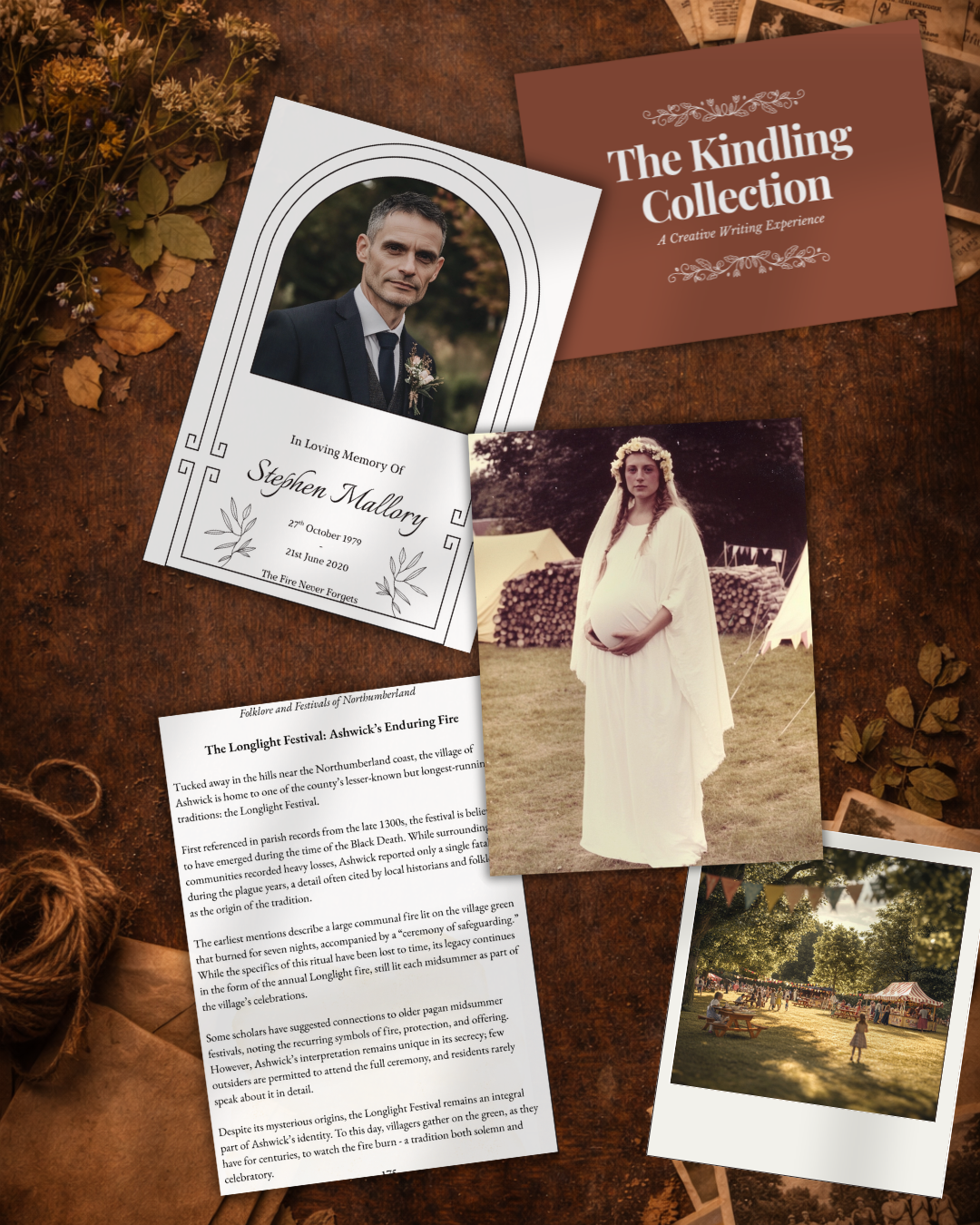
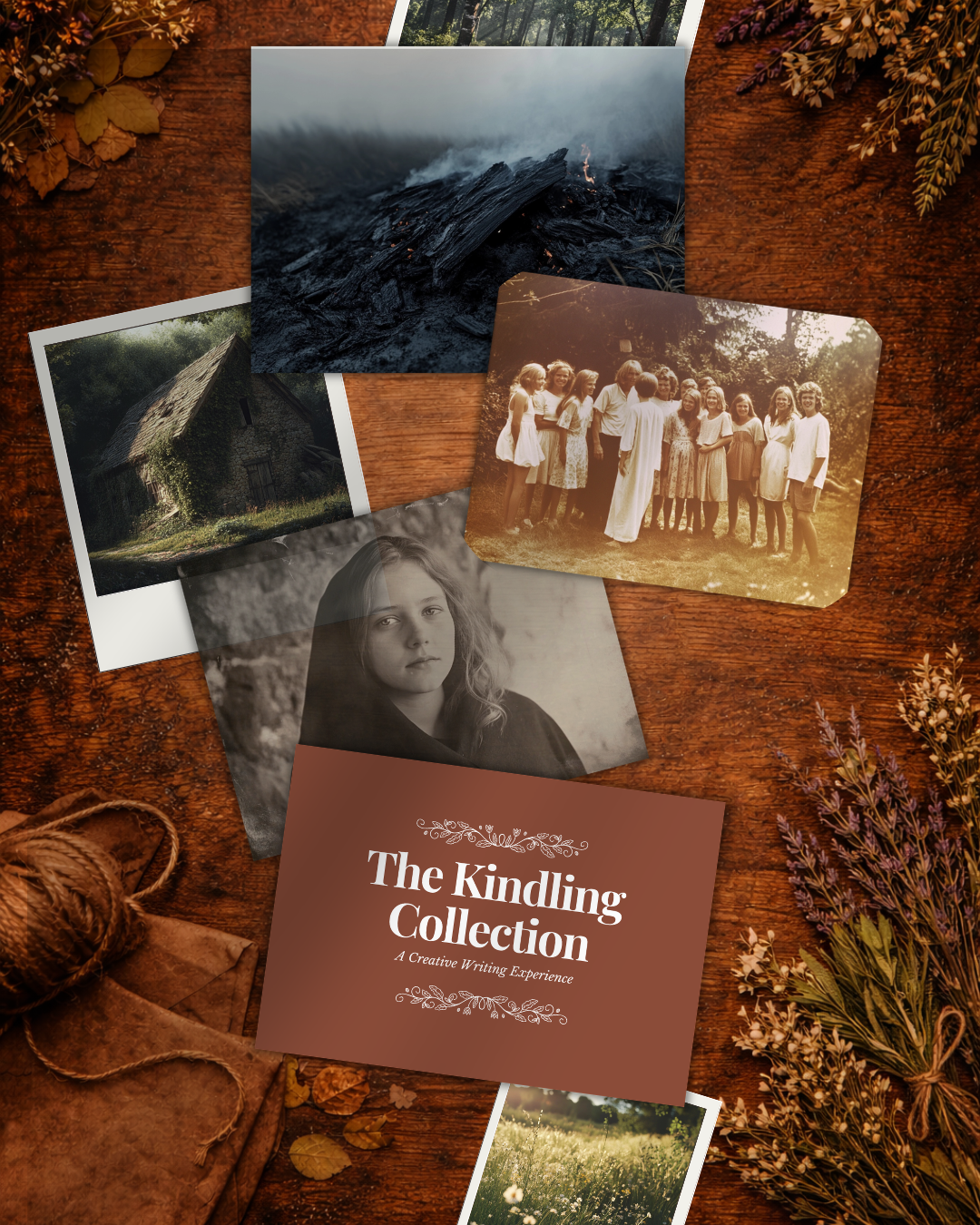
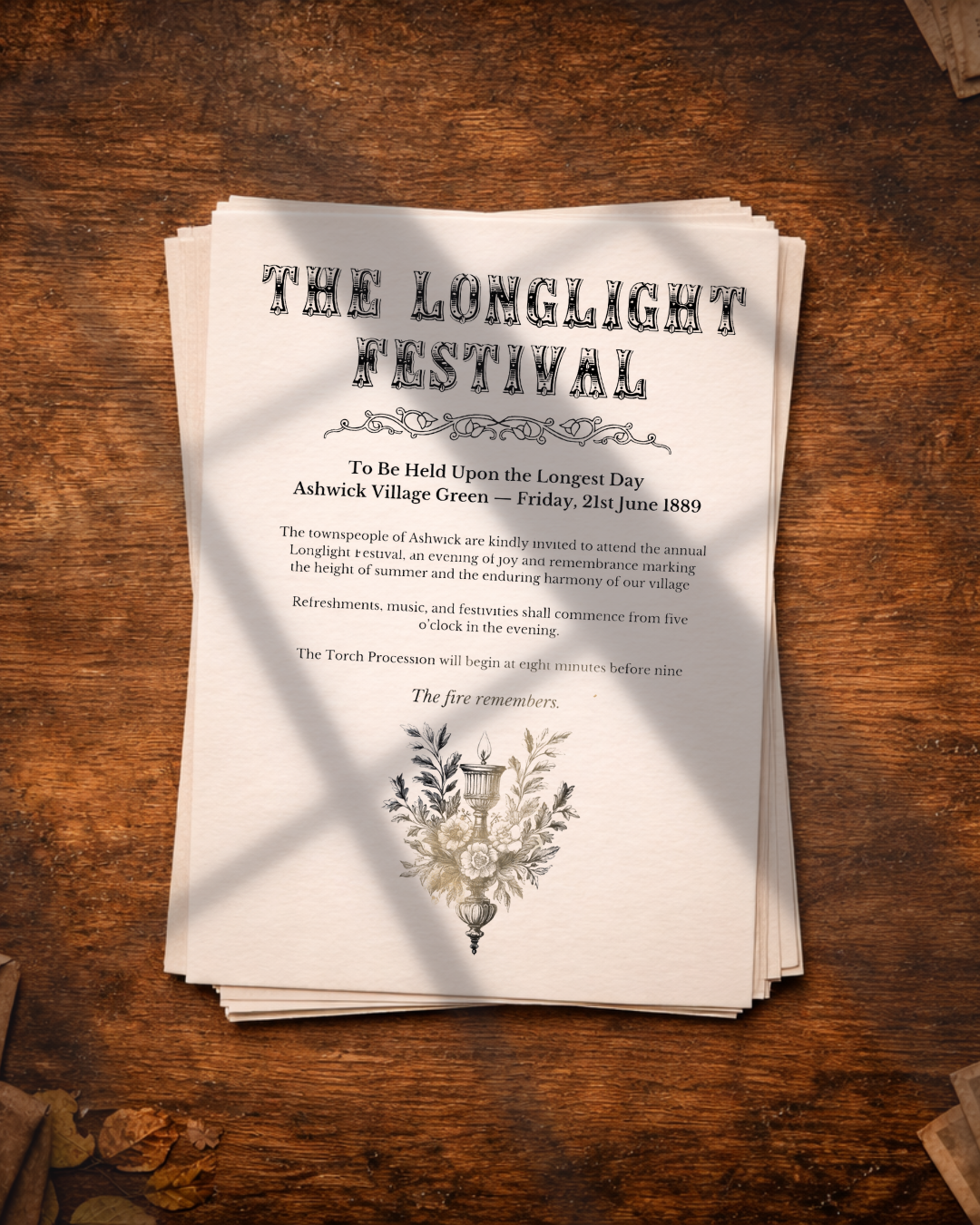
In the village of Ashwick, the Longlight Festival has been celebrated for generations. There are wildflowers and music, bonfires and ancient customs, familiar rituals repeated year after year.
And every year, someone is chosen.
The Kindling Collection is an immersive storyworld archive inspired by folklore, folk horror, ritual, superstition and isolated communities with traditions nobody dares question. Rather than giving you one finished version of the story, it invites you to investigate Ashwick for yourself through more than 50 printable documents and artefacts, including letters, diary entries, photographs, festival posters, drawings, church documents and warnings.
Some fragments make the Longlight Festival sound harmless.
Others suggest something has been hidden for generations.
Why do certain names disappear from the records? Why won't some villagers discuss what happens during the festival? And what do you believe when the documents themselves contradict one another?
There is no single solution waiting at the end. Follow the clues, question the stories people tell and decide for yourself what happened in Ashwick — then use the archive as inspiration for your own folklore, mysteries, characters, traditions and strange communities.
Explore The Kindling Collection and discover what is hiding behind the Longlight Festival.
Go Deeper into Writing YA Folklore-Inspired Stories
Folklore-inspired fiction works best when the supernatural feels woven into the history of the world rather than added simply to create magic. Legends should have been told before your protagonist was born, rituals should have reasons for existing and even the strangest superstition can carry the memory of something people once understood. For YA stories, that creates an especially interesting conflict: young characters are beginning to question the beliefs, rules and traditions inherited from the adults around them while discovering that rejecting the past is not always as simple as it seems.
◆ Start with the Belief, Not the Creature – Instead of beginning with a monster and building a story around it, begin with what people believe. Perhaps villagers refuse to whistle after sunset, teenagers leave coins beside a particular well or every household keeps one window open during the first storm of winter. Once the belief exists, ask what created it.
◆ Give Every Rule a History – Folklore is filled with instructions: never answer a voice calling from the woods, do not step inside a fairy ring, leave an offering at the boundary or avoid a particular road after dark. Decide who first discovered the rule, what happened to them and how accurately their warning survived.
◆ Let Traditions Change Over Time – A ritual practised for centuries may no longer resemble its original form. A sacrifice could become a festival, a protective charm could become decoration or a solemn warning could become a children's game. The gap between what a tradition once meant and what people think it means now can create your entire plot.
◆ Make the Setting Part of the Folklore – Connect your legends to specific landscapes. Rivers, mountains, forests, islands, caves, wells, crossroads and ruined buildings can all accumulate stories. Ask why this supernatural belief belongs to this particular place and what would change if the landscape itself were disturbed.
◆ Use Repetition to Build Unease – Repeated phrases, annual rituals, recurring dreams, familiar songs and actions performed in a precise order can make folklore feel inherited. Establish the pattern first, then create tension by changing one small part of it.
◆ Think About Who Tells the Story – Folklore changes as it passes between people. Children might tell one version, grandparents another and official local history something completely different. Contradictory versions can become clues, especially if somebody has deliberately changed the story.
◆ Keep Some Things Unexplained – You do not need to create a scientific explanation for every supernatural event. Sometimes the unanswered question is what makes a folklore-inspired story memorable. Your protagonist might learn how to survive the creature without ever discovering exactly what it is or where it came from.
◆ Make the Conflict Genuinely YA – Your protagonist should not simply be a teenager witnessing an adult folklore story. Connect the supernatural conflict to independence, identity, friendship, first love, family expectations, belonging or deciding which parts of an inherited world they want to carry forward.
◆ Create Generational Disagreement – Adults and teenagers do not have to interpret traditions in the same way. One generation may protect a ritual because they remember what happens without it, while another sees it as outdated or cruel. Neither side necessarily has to be entirely right.
◆ Explore the Cost of Tradition – Ask who benefits from keeping an old custom alive and who pays for it. A ritual that protects an entire village may still be unjust if one family must make the sacrifice every generation.
◆ Treat Supernatural Beings as More Than Monsters – Give creatures their own rules, territories, loyalties and motivations. A being can be dangerous without being evil, helpful without being trustworthy or terrifying simply because human and supernatural ideas of fairness are completely different.
◆ Research the Tradition Behind Your Inspiration – If you are drawing directly from existing folklore, explore its origins, cultural context and different versions rather than relying only on modern popular interpretations. Folklore can vary considerably between communities and storytellers, and those variations can provide richer possibilities for your story.
◆ Be Thoughtful When Borrowing from Living Traditions – Folklore is connected to real communities, histories and beliefs. If you are working with a tradition outside your own cultural experience, research beyond the creature or legend itself and consider the context in which the story is told. Traditional motifs and underlying folklore may be available to draw upon, but modern retellings, translations and adaptations can contain separately protected creative material.
◆ Invent Folklore for Your Own World – You do not always need to adapt an existing legend. Create local sayings, children's rhymes, seasonal festivals, household superstitions, supernatural warnings and contradictory origin stories. The key is making them feel as though generations of people have shaped them rather than having them exist solely for your protagonist's plot.
◆ Ask What Happens When Someone Breaks the Pattern – Once you have established the tradition, rule or belief at the centre of your story, disrupt it. Let somebody refuse the offering, arrive late to the festival, open the forbidden door or ask the question everyone else has learned not to ask. The moment an inherited pattern breaks is often where the story truly begins.
Final Thoughts
Folklore survives because people keep telling it. Stories change as they move between families, communities and generations, but the fears, warnings, mysteries and questions inside them continue to resonate. For YA writers, that creates a particularly rich foundation: young characters can inherit a world filled with traditions they did not create, rules nobody fully explains and stories they must decide whether to believe, challenge or carry forward themselves.
Use these 100 YA Folklore-Inspired Story Ideas as starting points rather than fixed plots. Take the premise that catches your attention and transform it: move the legend somewhere new, invent a different supernatural being, change the meaning of the ritual, combine several traditions or create an entirely original piece of folklore for your fictional community. A bowl of milk beside the hearth, a ribbon tied to an ancient tree or a warning never to answer your name after dark can become the beginning of an entire story once you ask why the tradition exists.
Most importantly, make your folklore feel as though it existed before your protagonist arrived. Give your world old songs, half-remembered warnings, contradictory legends, seasonal rituals and superstitions people follow without knowing why. Then introduce a young character willing to question them. Sometimes the adults will have preserved an important truth. Sometimes they will have protected something that should have ended generations ago. And sometimes everyone will discover that the story they thought they understood was never the real story at all.
For more legends, magical traditions, fairytale inspiration, settings, prompts and worldbuilding ideas, explore the Fairytale & Folklore Writing Hub.
Or browse the complete Creative Writing Archive for more story ideas, characters, settings, names, prompts and writing inspiration across genres.
Choose Your Next Adventure