70 First Contact Sci-Fi Writing Prompts: Alien Encounters, Signals & New Worlds
First contact is one of science fiction's most fascinating possibilities: the moment humanity discovers that we are not alone. It might begin with a signal travelling across thousands of light-years, an impossible object appearing within the Solar System, evidence uncovered beneath the surface of another world or two intelligent species simply standing opposite one another for the first time. Whether the encounter is peaceful, terrifying, confusing or completely accidental, everything changes the moment another civilisation answers back.
The best first contact stories explore far more than the discovery of extraterrestrial life. They ask how humans might communicate with a species that thinks differently from us, how governments and scientists would respond, what an alien civilisation might make of humanity and whether either side could ever truly understand the other. First contact can inspire enormous interstellar adventures, intimate character-driven stories, scientific mysteries, political conflicts and quiet moments of wonder — sometimes all within the same story.
Below you'll discover 70 First Contact Writing Prompts, including plot ideas, story titles, opening lines, closing lines, characters, settings and cinematic picture prompts. Encounter mysterious transmissions, alien diplomats, unexplored worlds, unfamiliar languages and civilisations humanity never expected to find. For even more futuristic inspiration, explore the Sci-Fi Writing Hub, or browse the Creative Writing Archive for hundreds of writing prompts, characters, settings and story ideas across every genre.
1. Plot Prompts
First contact can happen deliberately or completely by accident. These prompts explore encounters ranging from distant signals and scientific discoveries to diplomatic meetings, unexpected visitors and moments when humanity realises another civilisation has been watching us for far longer than anyone imagined.
Astronomers detect a repeating signal from a nearby star, but when they finally decode it, they discover it is addressed to a specific person on Earth.
The first alien spacecraft to enter the Solar System ignores every government transmission and travels directly towards a tiny, isolated island.
Explorers land on a seemingly uninhabited planet and discover a table set with food beside their landing site.
Humanity spends decades preparing for first contact, only for the arriving civilisation to reveal that humans are the first intelligent extraterrestrial species they have ever encountered.
A linguist joins the first diplomatic mission to an alien civilisation whose language changes depending on the position of its moons.
An extraterrestrial probe discovered beneath Antarctic ice contains recordings of Earth made thousands of years before humans developed written language.
The first alien visitors refuse to speak to politicians, scientists or military leaders and instead request a meeting with Earth's children.
A deep-space research crew encounters an enormous alien vessel drifting between stars. Its inhabitants are alive, but they appear to have no idea that other intelligent life could exist.
Humanity receives its first confirmed extraterrestrial transmission: a detailed set of instructions warning us never to answer the next signal.
Two exploration vessels arrive simultaneously on an uncharted planet — one human and one alien — leaving both crews to realise they have just become participants in first contact.
2. Story Title Ideas
First contact titles can evoke wonder, uncertainty, discovery or unease. A single mysterious word can suggest an enormous unknown, while longer titles can capture the significance of the moment humanity's understanding of the universe changes forever.
Arrival
Others
Contact
First Light
The Visitors
Signal Received
When They Answered
We Were Not Alone
The Silence Between Stars
The Day the Universe Answered
3. Opening Lines
A strong first contact opening can capture the exact moment something impossible becomes real. Begin with a signal, discovery, encounter or tiny unexplained detail that tells the reader humanity's place in the universe is about to change.
“The signal repeated every eleven minutes, and on the seventh transmission it said my name.”
“Nobody noticed the second moon until it started moving.”
“Humanity's first message from another civilisation contained only three words: Please stay quiet.”
“The creature emerged from the ocean just after sunrise and waited patiently for someone to approach.”
“We had travelled seventeen light-years looking for them, only to discover they had been waiting for us.”
“At 04:13, every radio telescope on Earth turned towards the same empty patch of sky.”
“The first alien I ever met was considerably more frightened of me than I was of her.”
“There was already a flag planted beside the landing site, and it wasn't ours.”
“For eighty-seven years, the message had been travelling towards Earth.”
“The spacecraft landed in an ordinary field on an ordinary Tuesday afternoon.”
4. Closing Lines
First contact endings can leave humanity frightened, hopeful, transformed or facing an even greater mystery. These lines are designed to suggest that the first encounter was never really an ending at all, but the beginning of something much larger.
“For the first time in human history, we looked at the stars and knew someone was looking back.”
“Their ship disappeared beyond the Moon, leaving only a promise that they would return.”
“We had spent centuries wondering whether we were alone; nobody had thought to ask whether we were ready not to be.”
“Somewhere beneath another sky, a child was learning the word human.”
“The translation wasn't perfect, but we understood the final sentence: Come and find us.”
“By morning, there were lights appearing above every major city on Earth.”
“They had come looking for intelligent life, and somehow they had decided we qualified.”
“The universe hadn't become smaller after meeting them; it had become impossibly larger.”
“We watched their ship climb into the clouds and wondered which of us would cross the distance next.”
“First contact was over. Everything that came afterwards would be harder.”
5. Character Ideas
First contact stories bring together scientists, explorers, diplomats and ordinary people who suddenly find themselves representing an entire species. The most interesting characters don't necessarily know the right thing to do — they simply happen to be standing there when history changes.
A linguist who has spent their career studying extinct human languages and is unexpectedly chosen to help decode humanity's first extraterrestrial message.
An astronaut who becomes the first human to physically encounter intelligent alien life after a routine expedition goes dramatically off course.
A radio astronomer who has spent thirty years searching for extraterrestrial signals and initially refuses to believe the one finally appearing on her screen.
An alien diplomat whose knowledge of humanity comes entirely from television broadcasts intercepted decades earlier.
A child living near the remote location where an extraterrestrial spacecraft quietly lands without attracting worldwide attention.
A xenobiologist who discovers that the first alien organism brought to Earth responds differently to every person who approaches it.
A government interpreter expected to negotiate with visitors whose concept of ownership, borders and nations is completely different from humanity's.
An alien explorer who has secretly observed Earth for years and has become far more emotionally attached to humanity than their mission permits.
A spacecraft commander ordered to abandon an alien settlement after discovering that making contact could permanently alter its developing civilisation.
A journalist invited to document humanity's first official meeting with another species who begins to suspect the public is not being shown everything that happened.
6. Setting Ideas
First contact can transform almost any setting into the centre of the universe. Remote observatories, alien shorelines, crowded cities and distant planets each create very different encounters, allowing the setting itself to shape how two intelligent species first experience one another.
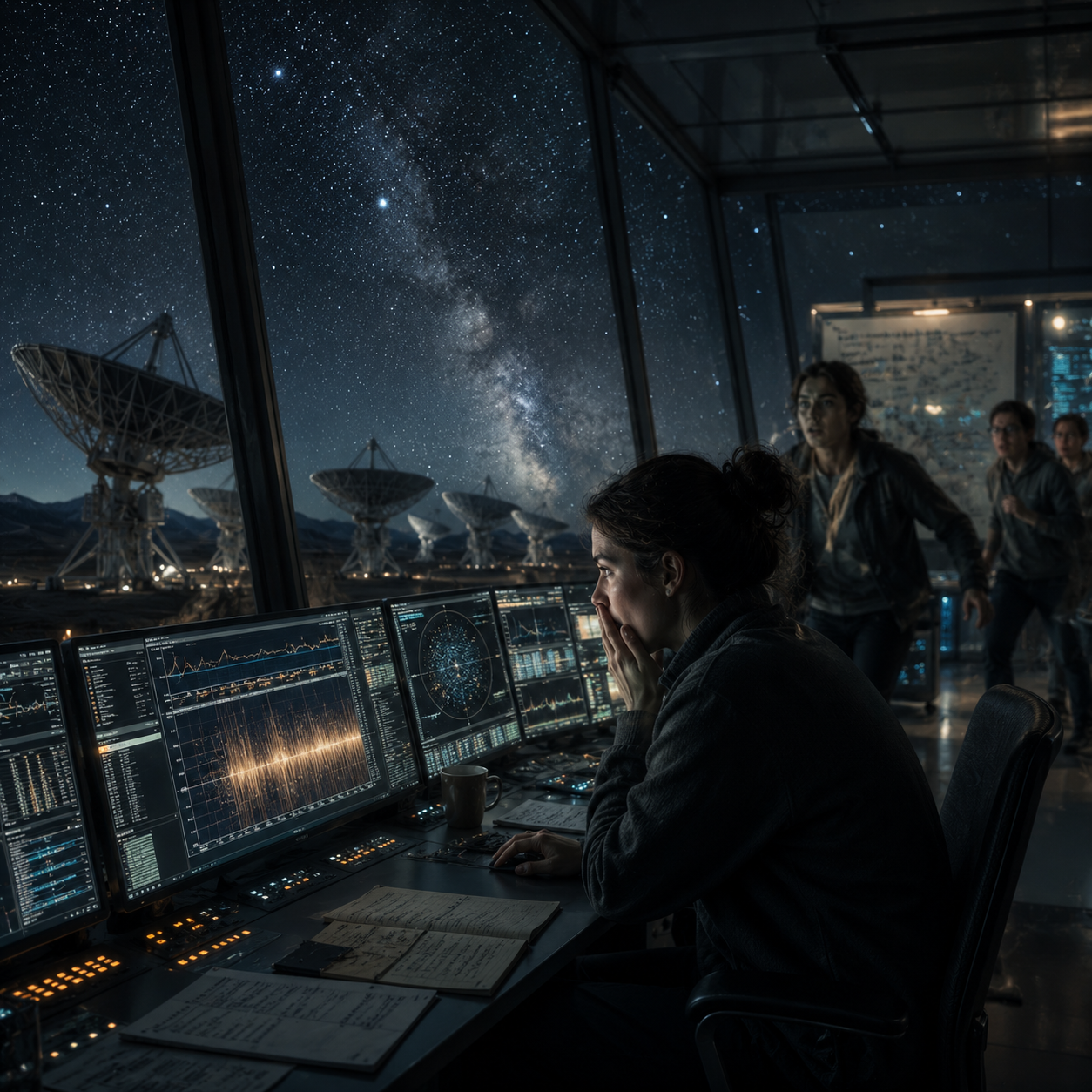
A remote radio astronomy station surrounded by desert, where an artificial signal arrives during the middle of the night.
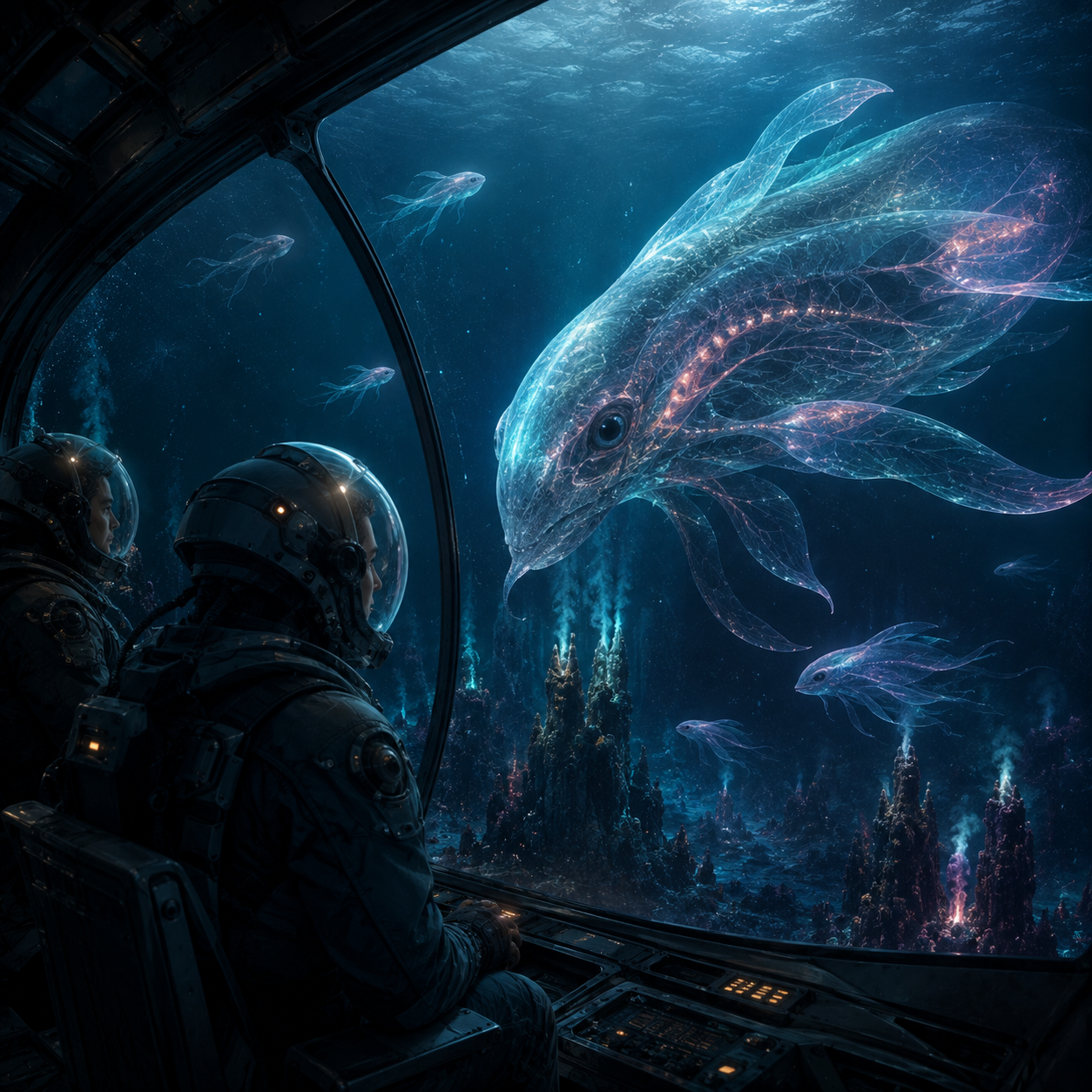
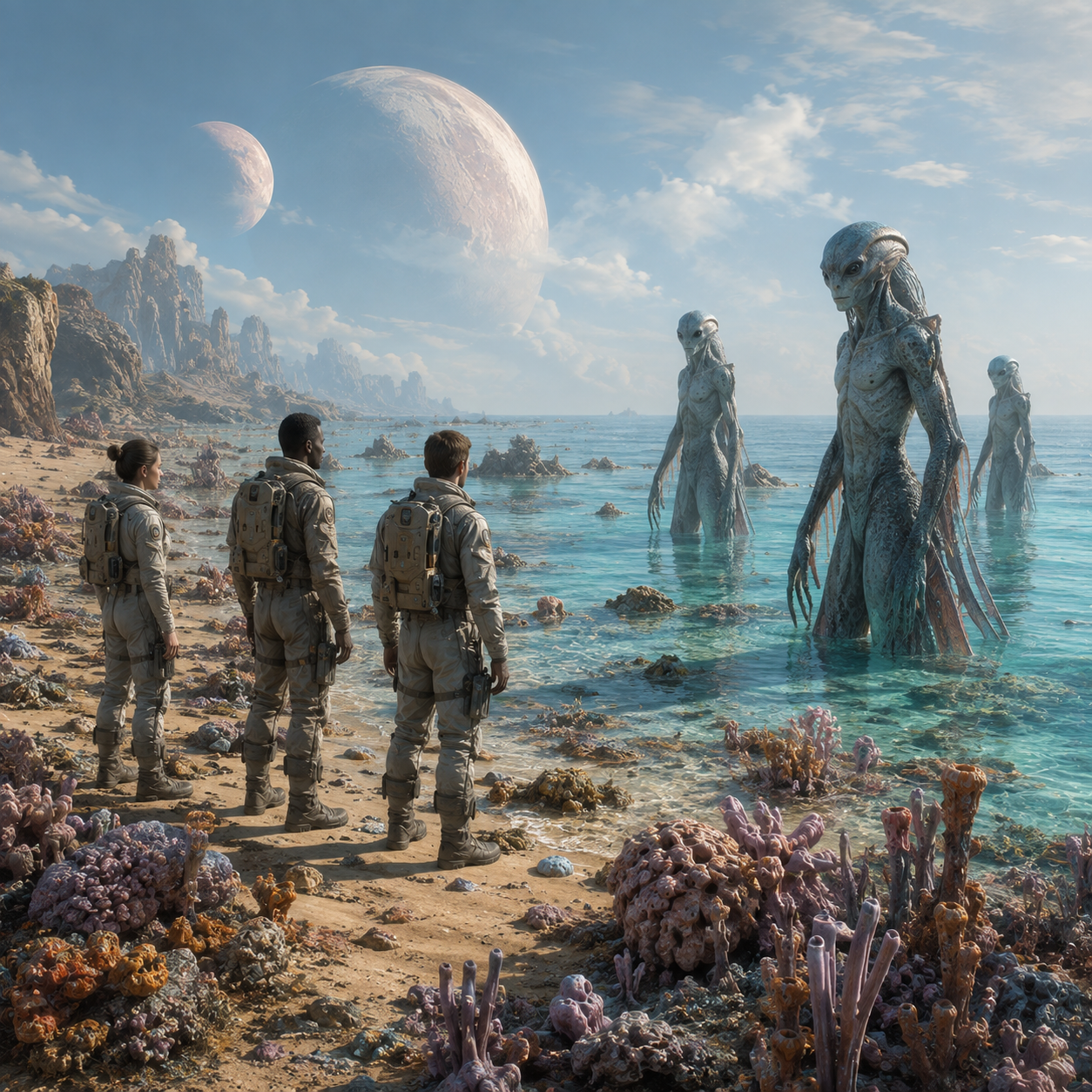
The turquoise shoreline of an alien ocean where human explorers and amphibious extraterrestrials cautiously approach one another for the first time.
A vast international first-contact centre constructed around an alien spacecraft that landed years earlier but has never opened.
An unexplored planet covered in enormous pale grasslands where two scientific expeditions from different civilisations unexpectedly meet.
A lunar research base where scientists watch an unidentified spacecraft quietly enter orbit around the Moon.
A seemingly abandoned alien city whose lights illuminate one street at a time as human explorers move through it.
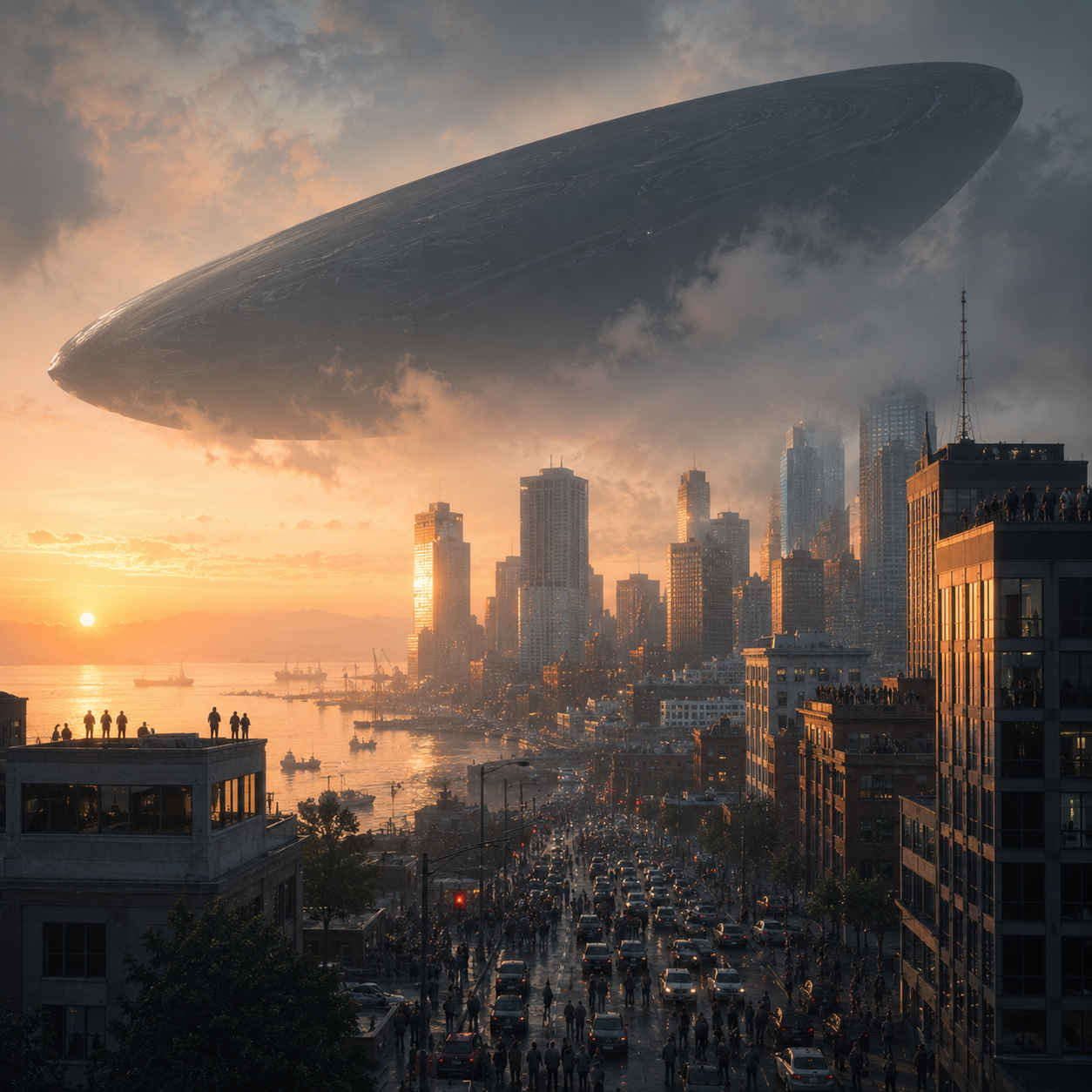
A crowded city square where thousands of people gather beneath an extraterrestrial vessel hovering silently overhead.
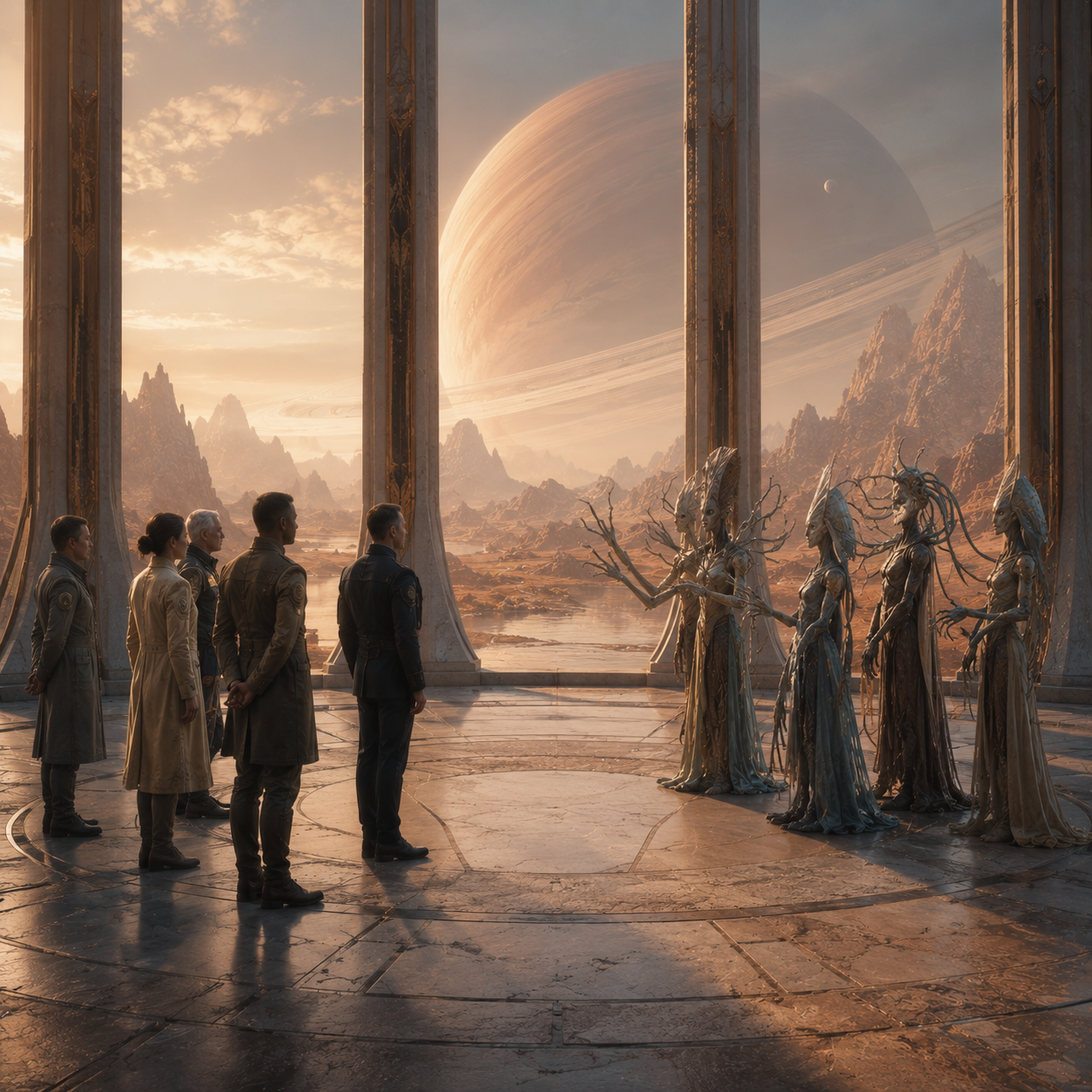
A deep-space station positioned between human territory and an unknown region of space, hastily transformed into the site of the first interspecies diplomatic meeting.
A frozen exoplanet where researchers uncover an ancient structure containing evidence that its builders once visited Earth.
A peaceful agricultural valley where humanity's first extraterrestrial visitors land far from governments, laboratories and military bases.
7. Picture Prompts
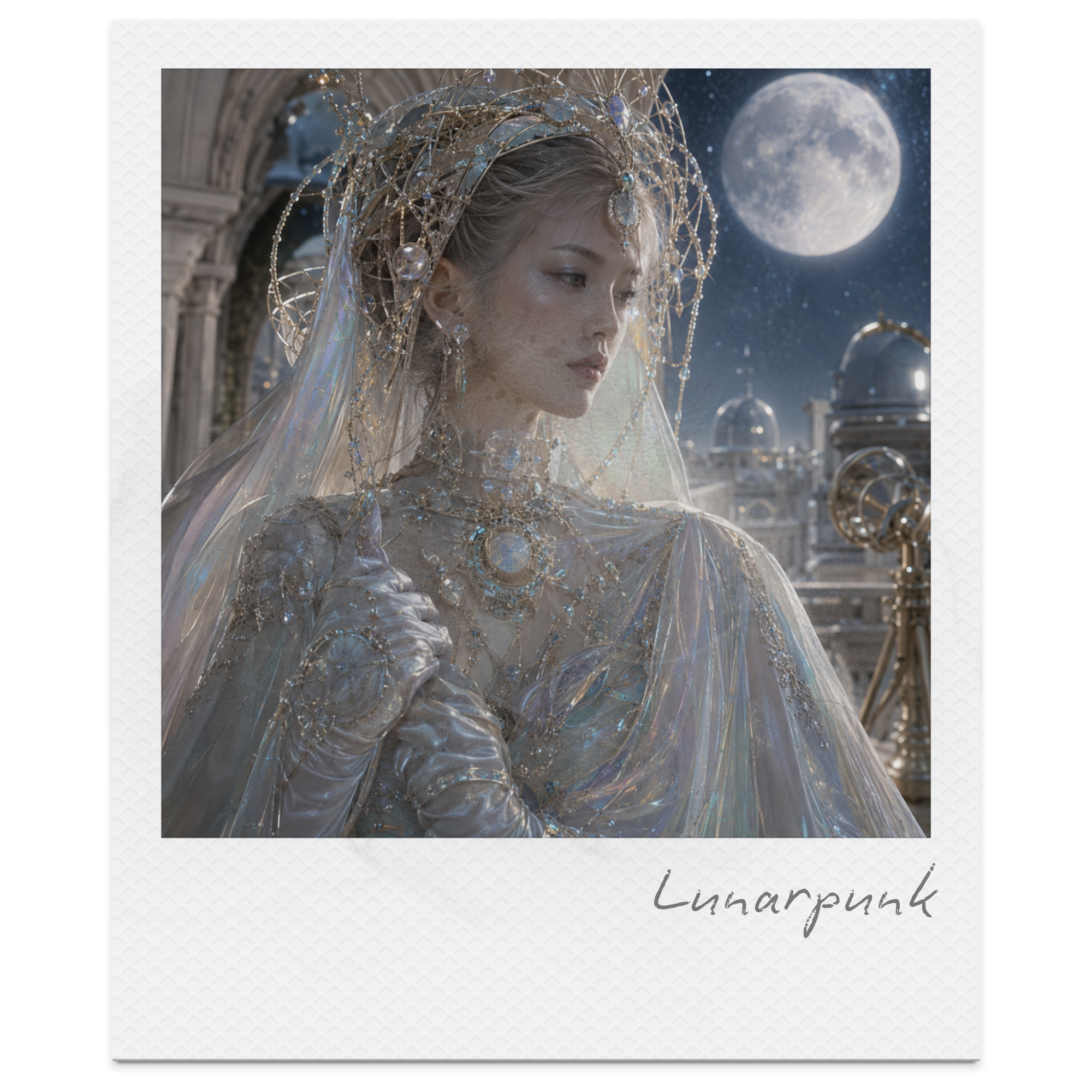
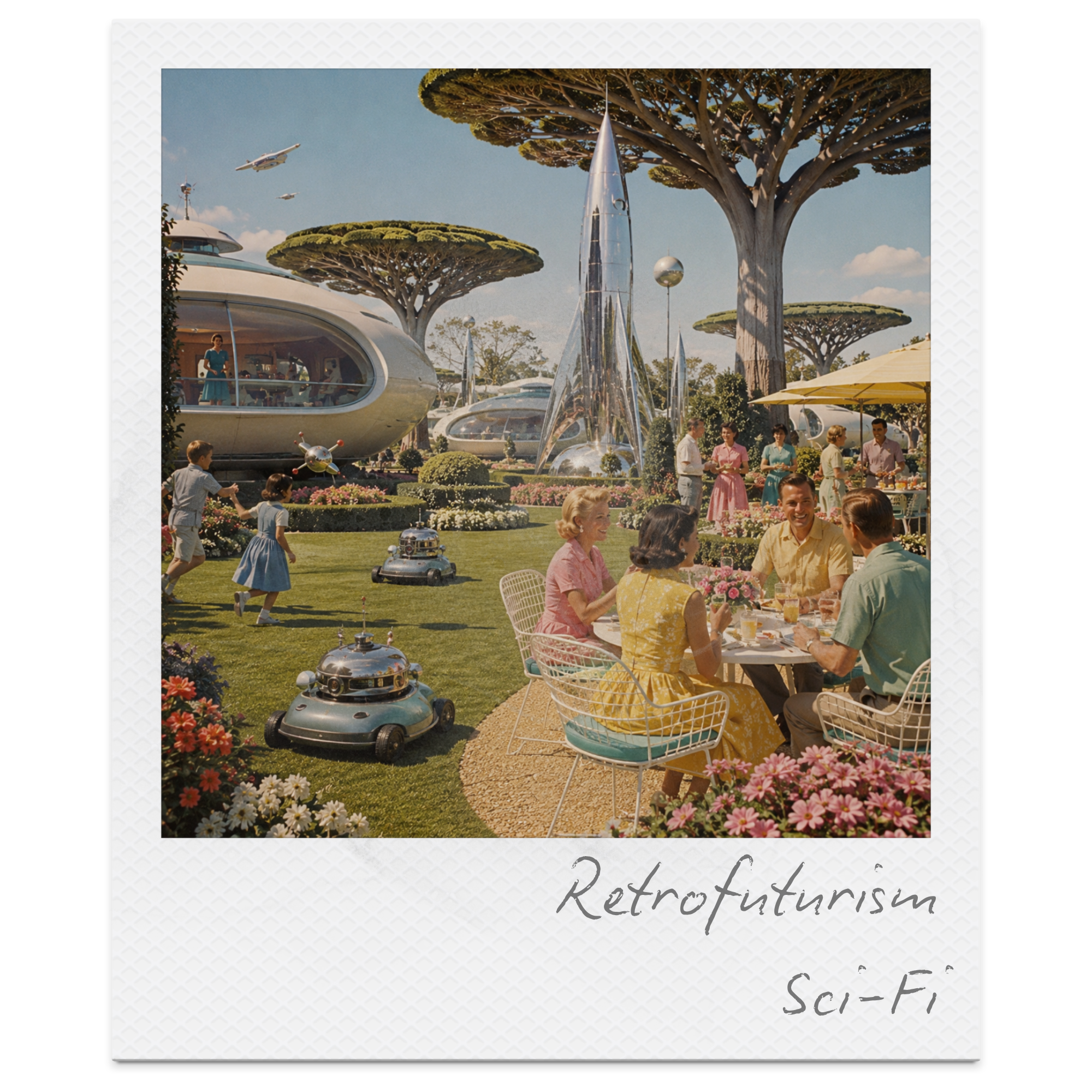
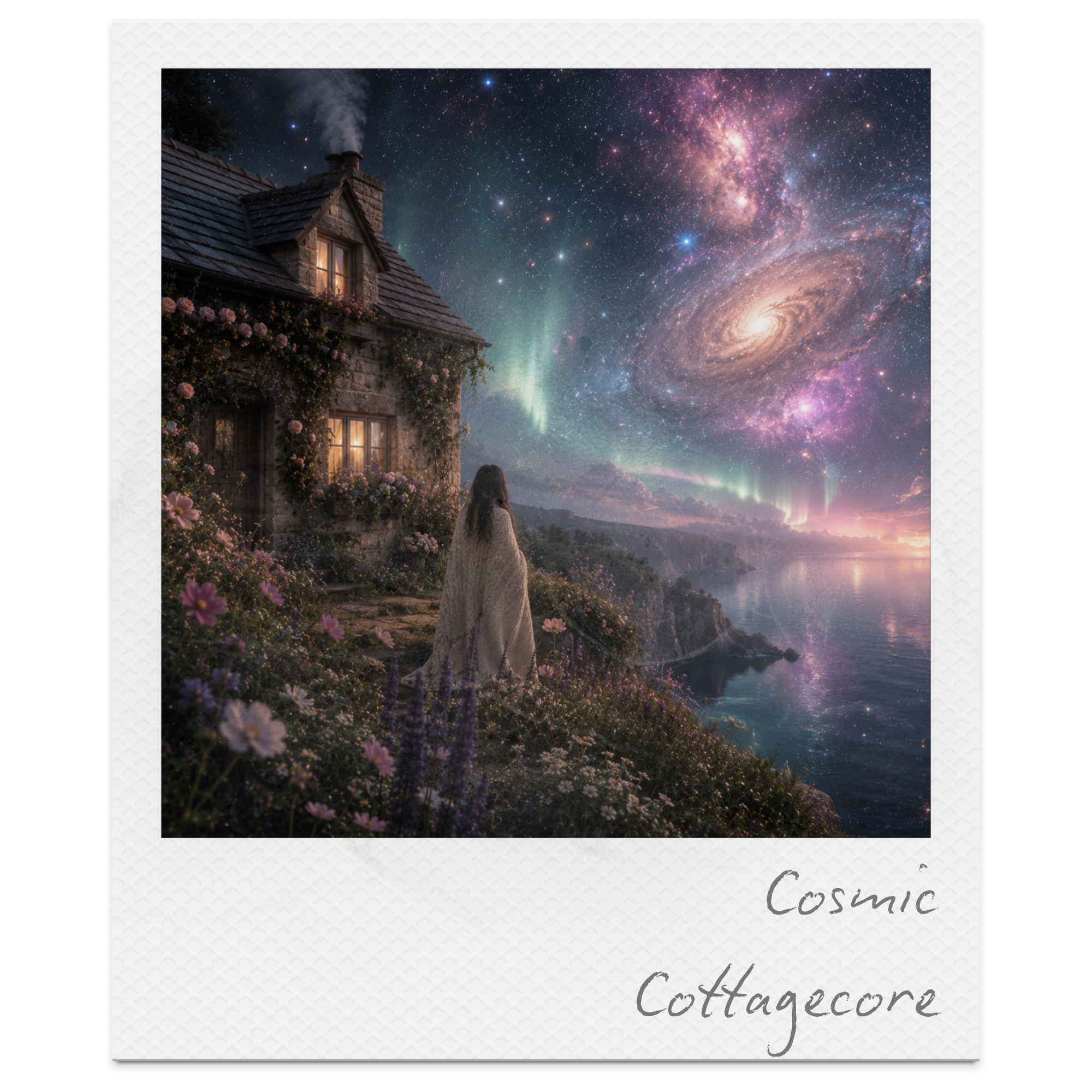
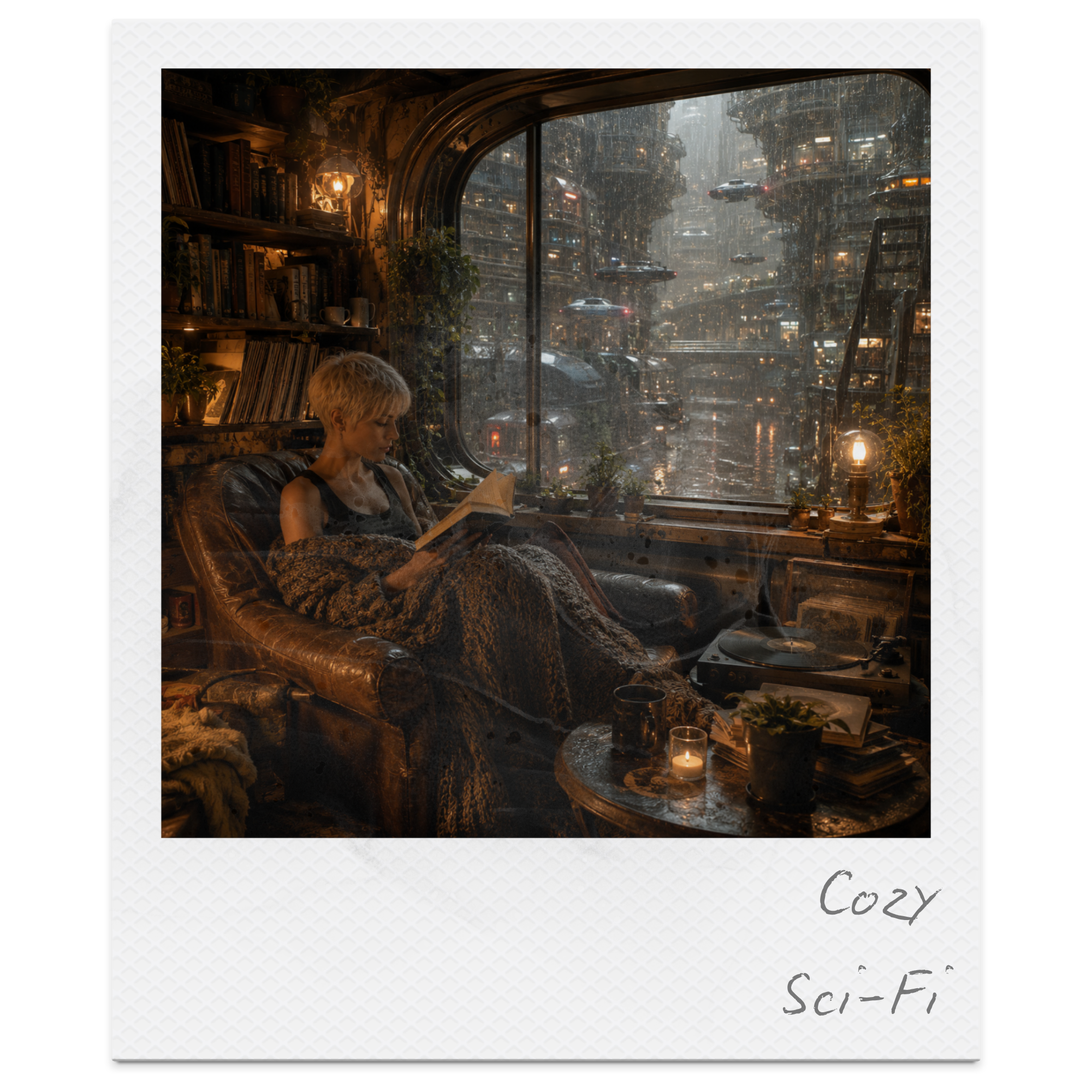
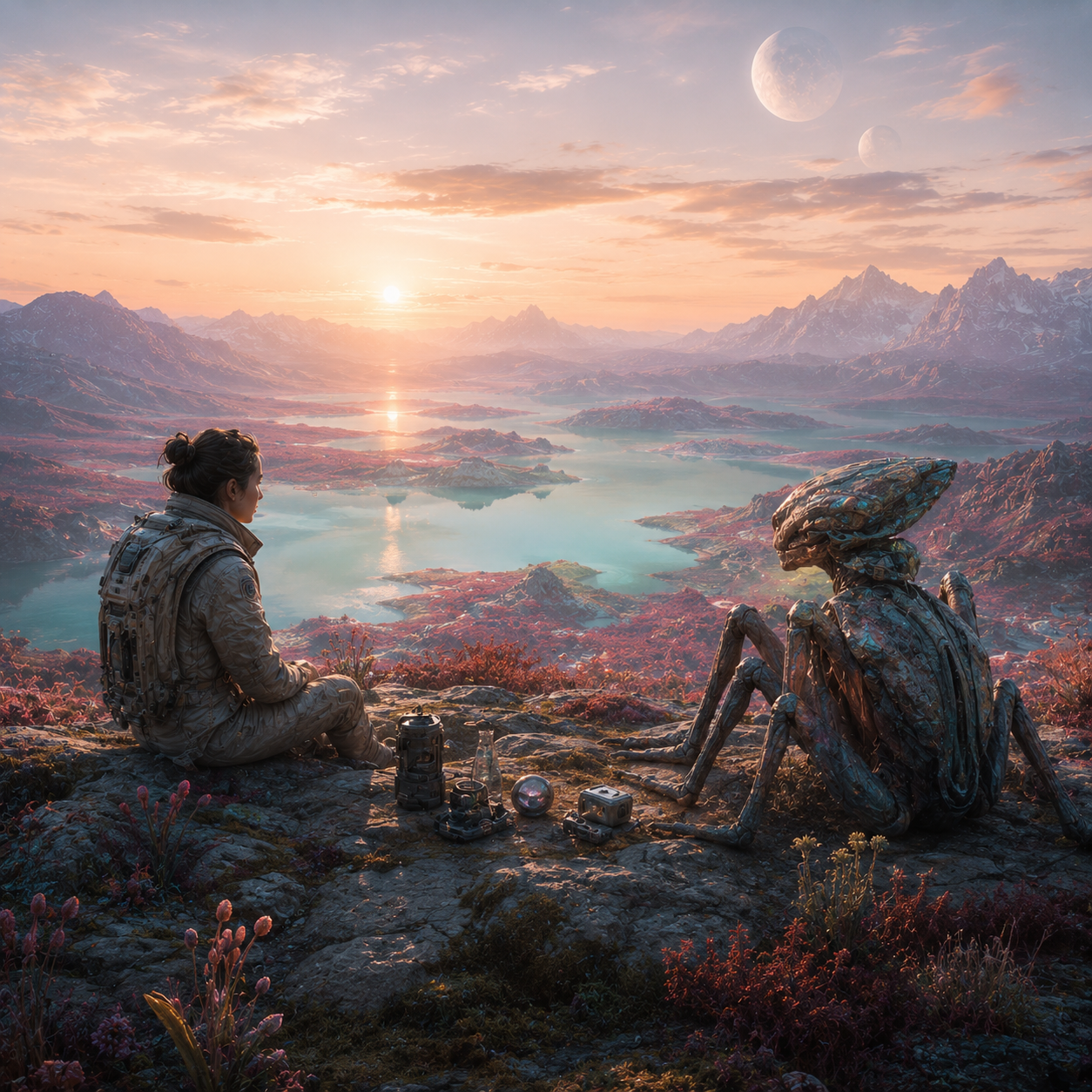
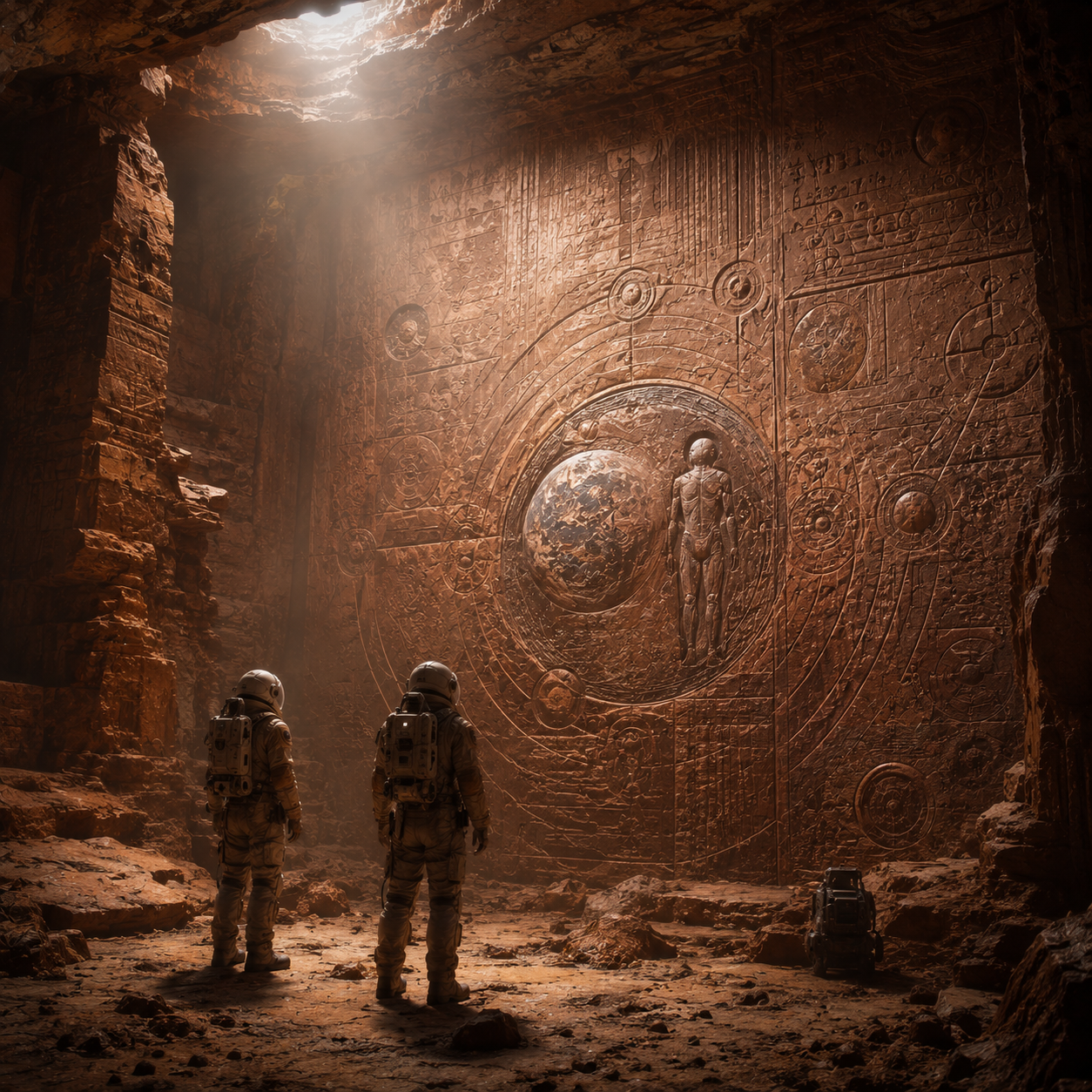
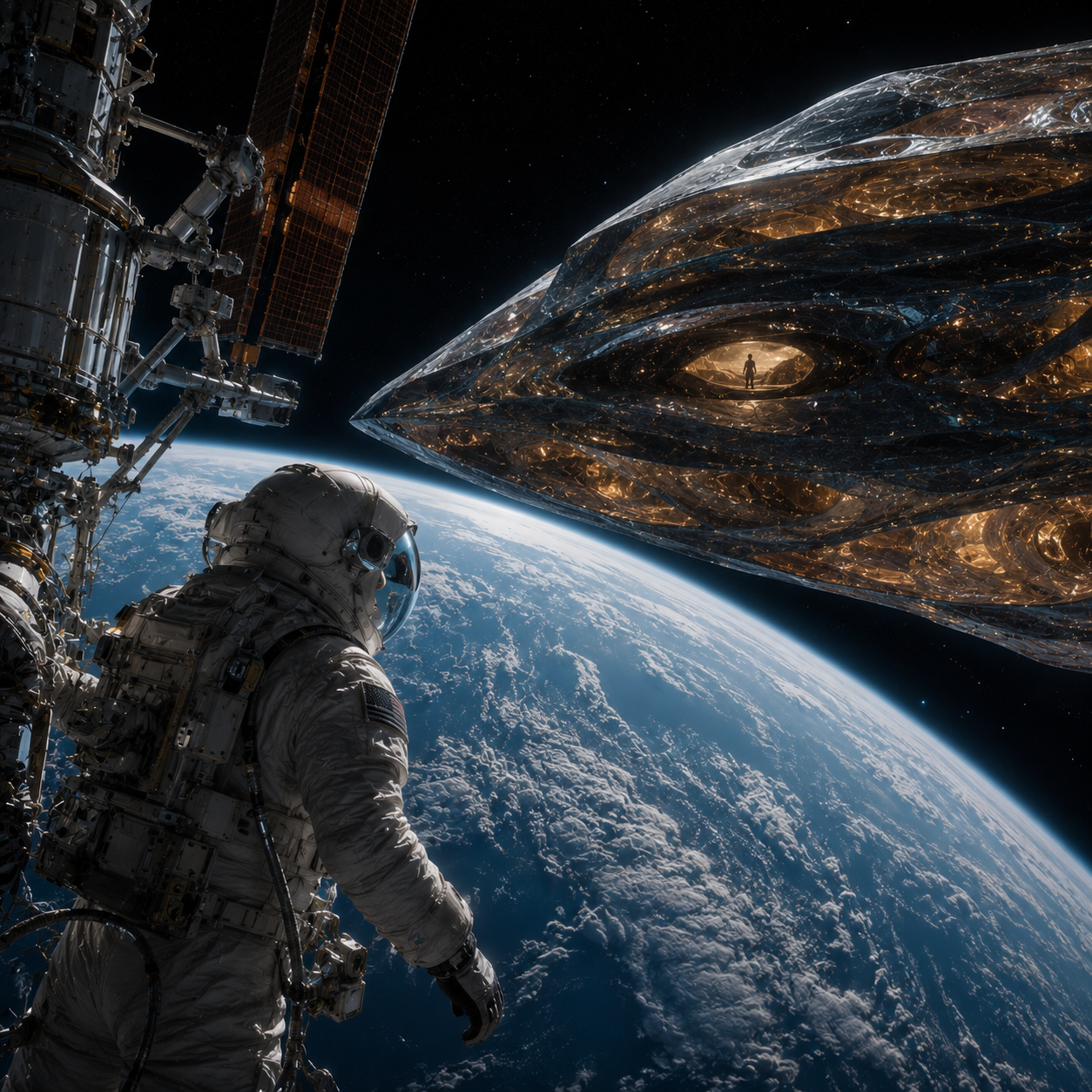
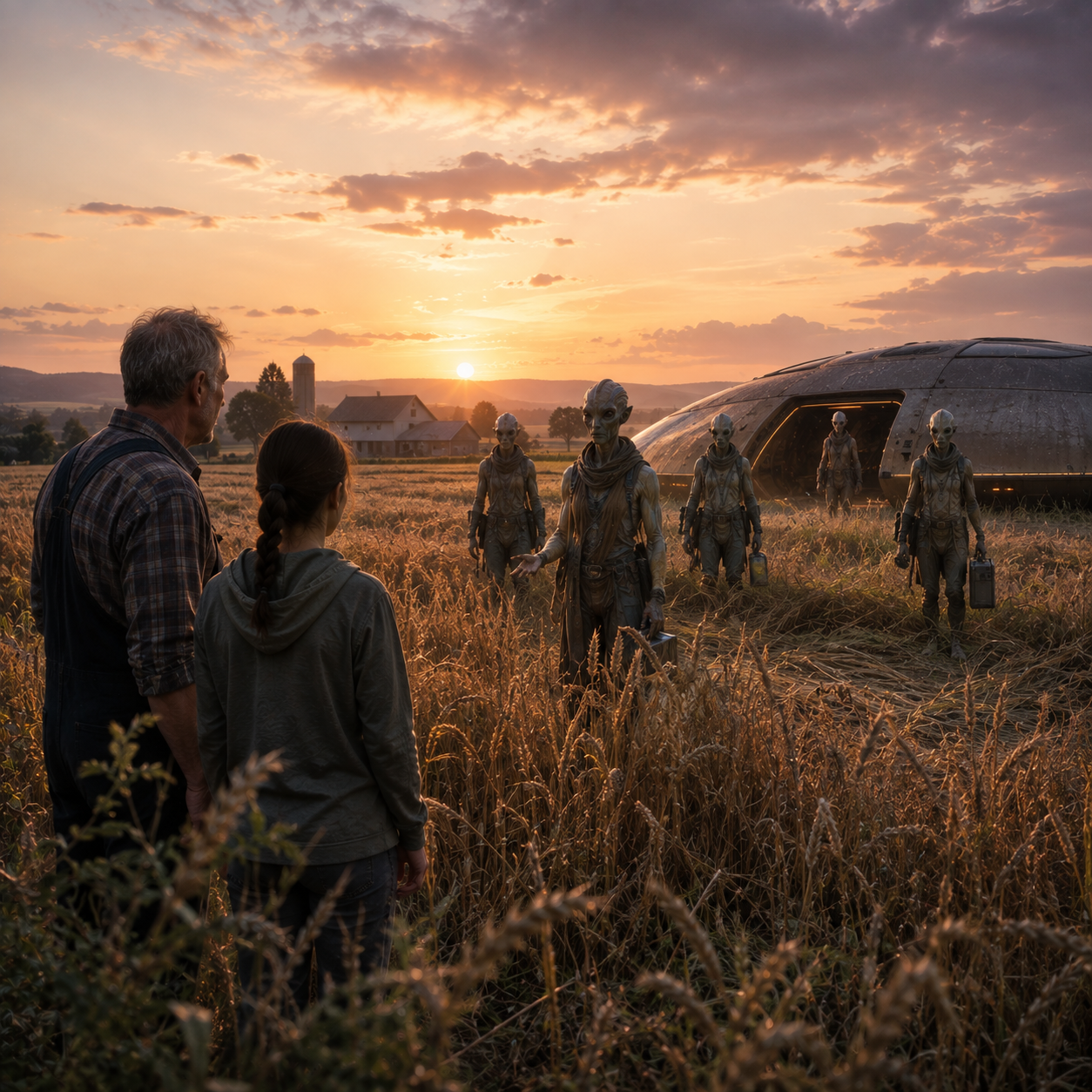
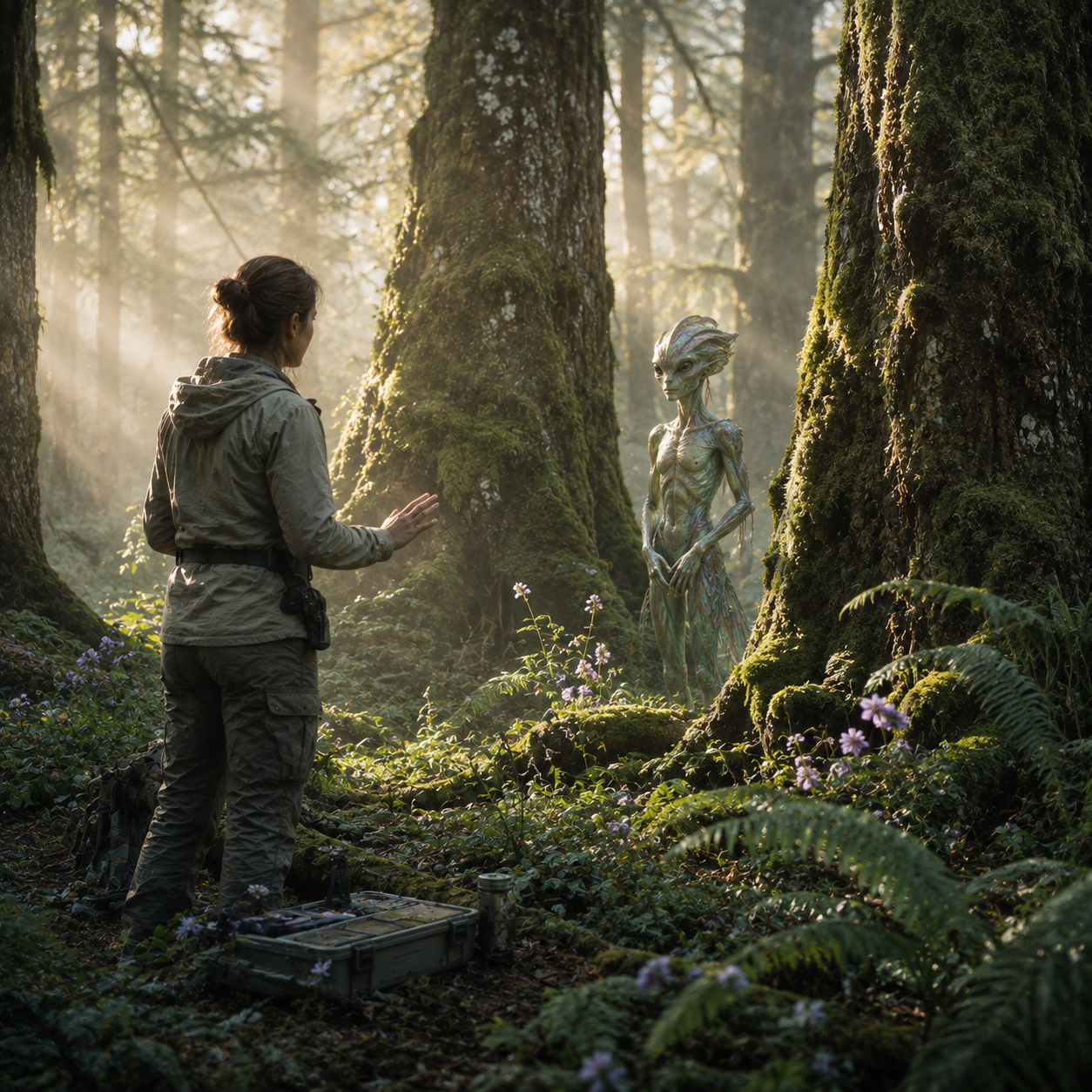
First contact imagery should capture the scale and wonder of encountering another intelligence without relying entirely on invasion or destruction. These scenes focus on discovery, communication, unfamiliar worlds and the extraordinary moment when two species realise they are no longer alone.
Go Deeper into First Contact Sci-Fi Writing
First contact stories are ultimately about encountering something humanity has never experienced before. The aliens themselves might be fascinating, but the real depth often comes from everything surrounding that first encounter: attempts at communication, cultural misunderstandings, scientific discoveries, political consequences and the gradual realisation that neither civilisation understands the other as well as it thinks. Whether your first contact happens across a laboratory table or between spacecraft millions of miles from Earth, the encounter should change both the characters and the world around them.
◆ Decide what first contact actually means. It doesn't have to begin with an alien spacecraft landing on Earth. Humanity might discover an artificial signal, microbial life, an abandoned structure, an extraterrestrial probe or evidence that another civilisation visited thousands of years ago. You could even reverse the familiar scenario and make humans the mysterious visitors arriving on someone else's world.
◆ Make your aliens genuinely unfamiliar. Think beyond appearance. How do they communicate, organise communities, experience time, form relationships or understand individuality? A species with completely different biology and evolutionary history may have concepts that humans struggle even to recognise, never mind translate.
◆ Make communication difficult. Translation technology can be useful, but instant perfect communication removes one of first contact's richest sources of tension. Meaning might depend on colour, movement, scent, mathematics, sound or something humans initially fail to recognise as language at all. Even when individual words can be translated, cultural meaning can still be misunderstood.
◆ Think about who gets to represent humanity. Scientists might prioritise knowledge, governments may worry about security, businesses could see commercial opportunities and religious communities might interpret contact differently again. Meanwhile, billions of ordinary people would have opinions of their own. First contact becomes particularly interesting when nobody agrees on what humanity should say.
◆ Give the aliens their own reasons for making contact. They shouldn't exist solely to reveal something about humanity. Perhaps they are explorers, refugees, scientists, traders or diplomats. Maybe they intercepted our broadcasts accidentally. Perhaps they have been searching for intelligent life for centuries. Give them objectives that would exist even if humans had never appeared.
◆ Explore the ordinary consequences of an extraordinary discovery. First contact would affect more than astronauts and world leaders. Think about schools, news reports, social media, science, religion, art, tourism and everyday conversations. What happens when an ordinary person looks into the night sky after learning for certain that someone else is out there?
◆ Avoid making every encounter immediately hostile. Conflict doesn't require an alien invasion. Two peaceful species can still misunderstand one another, compete for the same resources or disagree about fundamental ideas. Curiosity, caution, fascination, fear and diplomacy can create just as much tension as warfare.
◆ Use the environment as part of the encounter. Meeting another civilisation on Earth creates a very different story from discovering one beneath an alien ocean or inside a distant space station. Gravity, atmosphere, temperature, disease and biology might determine whether the two species can even safely occupy the same room.
◆ Consider the imbalance between civilisations. One species may be centuries or millennia ahead of the other. Think carefully about what knowledge could be shared and what might be withheld. A technology considered ordinary by one civilisation could completely destabilise another, creating difficult questions about responsibility, interference and power.
◆ Remember that first contact is only the beginning. The first message, handshake or meeting might be the dramatic moment your story builds towards, but consider what happens afterwards. Embassies might open. Scientists could exchange knowledge. Trade routes may develop. Humans might travel to alien worlds. New conflicts, friendships and cultures could emerge. The most interesting question may not be are we alone? but what happens once we know we aren't?
Explore First Contact Across Time
First contact doesn't always have to happen between different planets.
Travel far enough into the future and humanity itself might become almost unrecognisable. Languages evolve. Cultures disappear. New societies emerge. Technology transforms everyday life. A traveller stepping hundreds or thousands of years beyond their own century could find themselves facing people whose world feels every bit as unfamiliar as an alien civilisation.
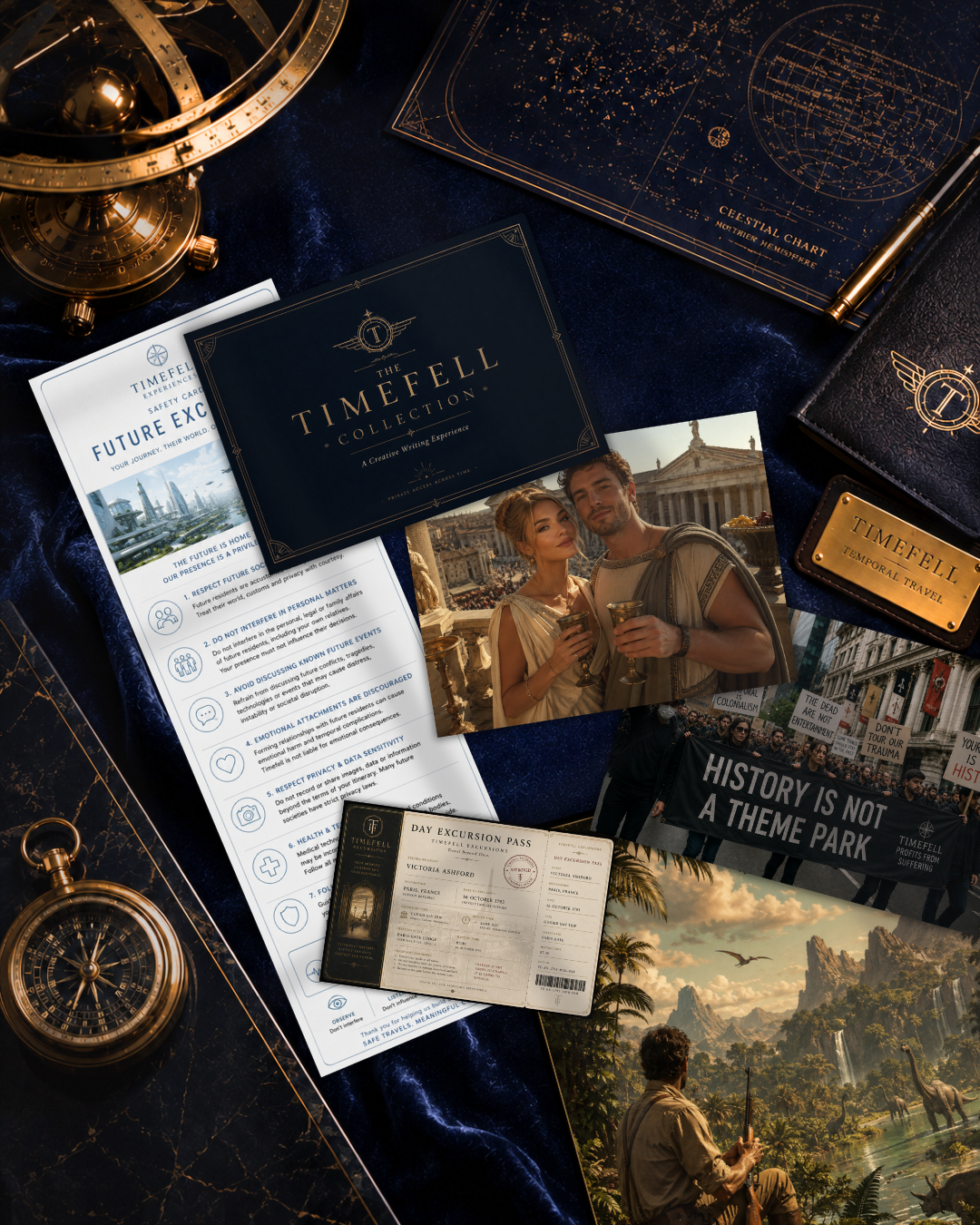
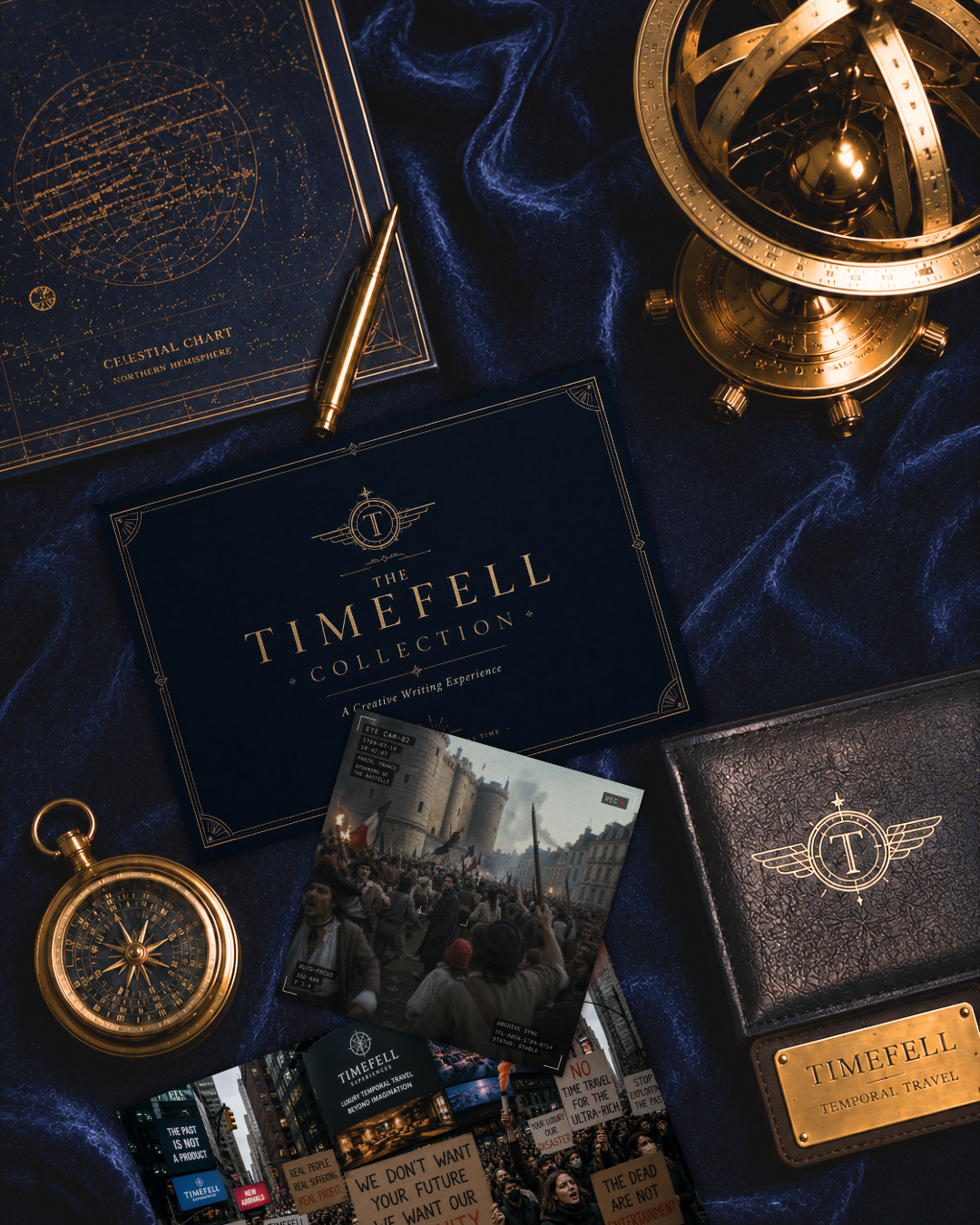
The Timefell Collection lets you explore a world where encounters like these have become possible.
Time travel became public in 2020.
By 2046, it had become a business.
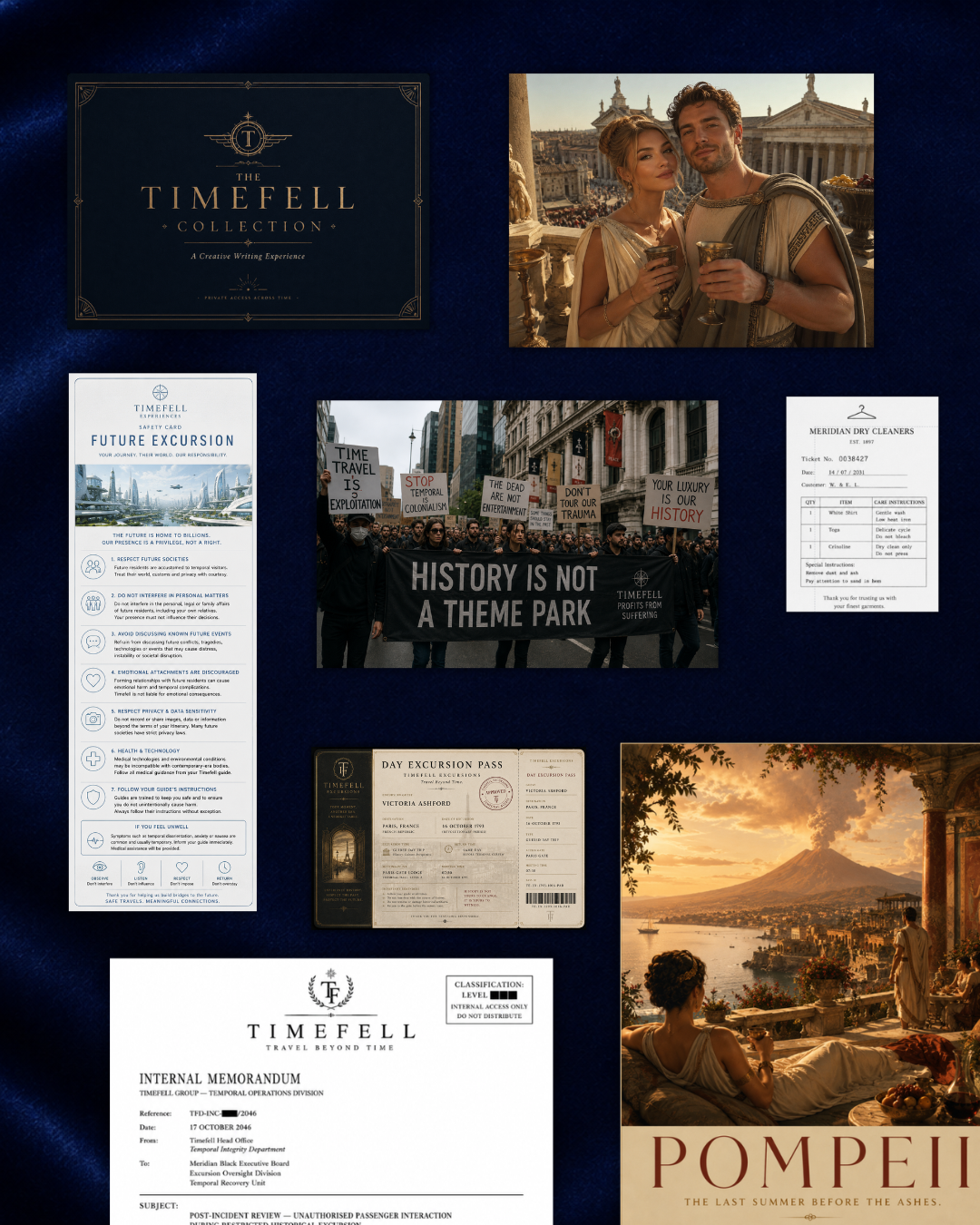
Ancient cities welcome paying visitors. Dinosaurs roam protected reserves. Luxury cruises travel between centuries. Future societies open their gates to carefully managed excursions beyond the present day.
For those who can afford it, every era is a destination.
But not every story appears in the brochure.
Inside The Timefell Collection, you'll uncover more than 50 interconnected fictional artefacts, including travel posters, boarding passes, newspaper articles, diary entries, hotel records, reviews, private correspondence and handwritten notes. Together, they reveal a much larger story about the travellers moving through time — and the things the official records don't quite explain.
Why have certain excursions disappeared from public view? What experiences are reserved for Meridian Black members? Why do some travellers become obsessed with returning?
And what happens when two people separated by centuries meet for the very first time?
Explore the archive, follow the hidden connections or use the world as inspiration for your own stories about discovery, unfamiliar societies and impossible encounters.
→ Explore The Timefell Collection
Final Thoughts
First contact stories allow us to imagine one of humanity's biggest unanswered questions: what would happen if we discovered that we were not alone? Whether that discovery begins with a distant signal, an alien spacecraft, an unexpected encounter on another world or evidence left behind by a long-vanished civilisation, the possibilities extend far beyond the moment of discovery itself.
The most memorable first contact stories explore what happens when two completely different ways of understanding the universe collide. Communication, curiosity, fear, diplomacy, scientific discovery and cultural misunderstanding can all shape what comes next. Use the prompts above individually, combine characters and settings from different sections, or take a single encounter and build an entire civilisation around it.
If you're ready to explore even more possibilities beyond Earth, visit the Sci-Fi Writing Hub for more futuristic prompts, characters, settings and worldbuilding inspiration. You can also browse the Creative Writing Archive to discover hundreds of creative writing prompts across science fiction, fantasy, horror, mystery, romance, historical fiction and more.
Choose Your Next Adventure