Lament by Gillian Clarke: Summary, Themes & Analysis
Loss, environmental destruction, war, and human responsibility are central to Lament, where Gillian Clarke uses repetition, imagery, and listing to create a powerful expression of grief for both the natural world and human suffering. The poem moves through a series of victims — animals, people, and landscapes — to show how conflict and pollution are interconnected, building a sense of collective loss and shared responsibility. If you are studying or teaching Songs of Ourselves Volume 1 for CIE English Literature (0475), you can explore in-depth analyses of every poem on the 2026 and 2027 Paper 1 syllabus in the Songs of Ourselves Volume 1 Hub, or a wider range of texts in the Literature Library.

Context of Lament
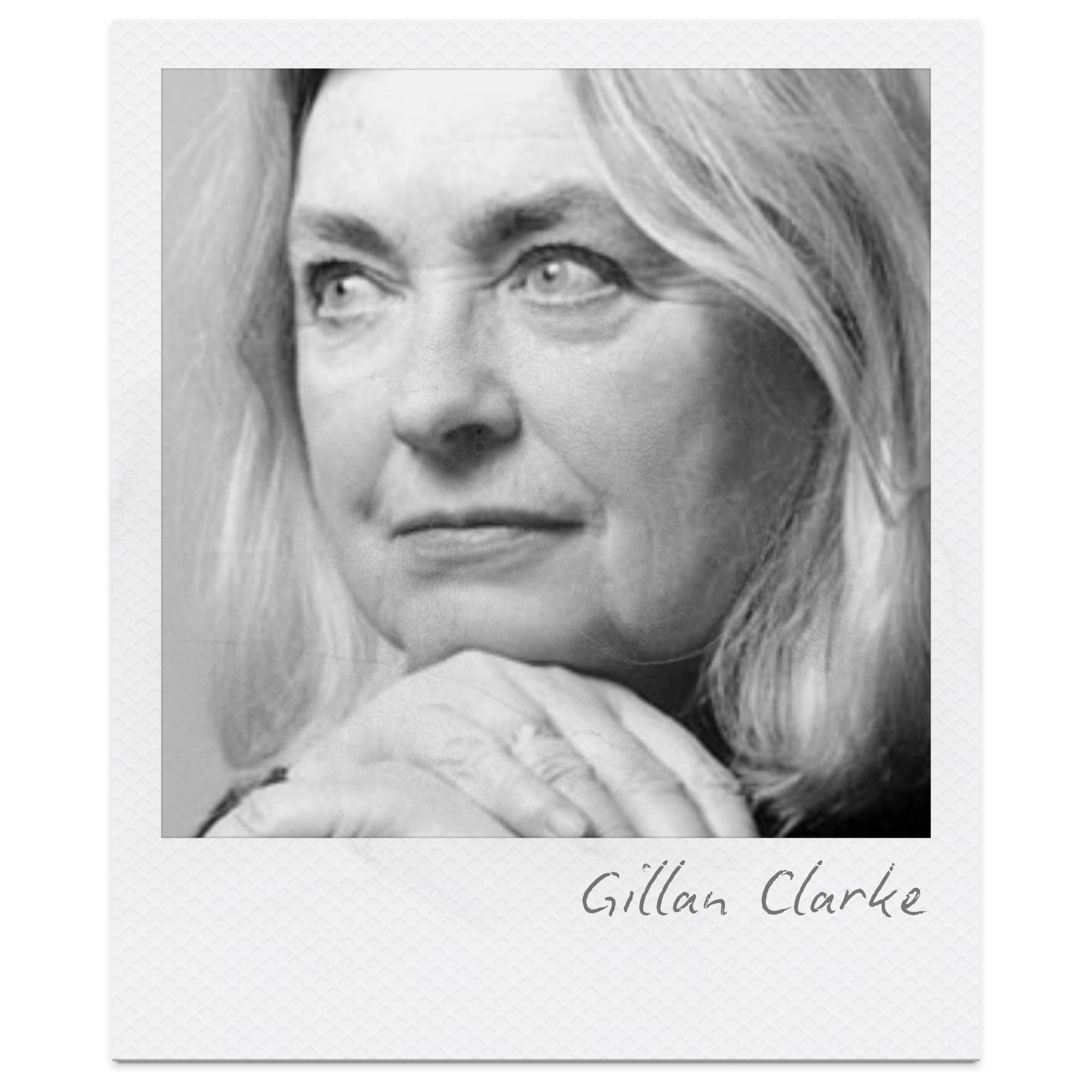
Gillian Clarke is a contemporary poet whose work often explores the relationship between human behaviour, nature, and responsibility, particularly in the context of environmental damage and conflict. Writing in the late 20th century, Clarke was influenced by growing global awareness of ecological crisis and industrial pollution, as well as the impact of modern warfare on both people and the natural world.
Lament is widely read as a response to environmental disaster, particularly oil pollution and its devastating effects on marine life. References to creatures such as turtles, cormorants, and whales reflect real-world ecological damage, while the inclusion of figures like “Ahmed at the closed border” and “the soldier” connects this destruction to human conflict and displacement.
By linking war, environmental damage, and human suffering, Clarke suggests that these are not separate issues but part of a wider pattern of destruction caused by human action, reinforcing the poem’s central message of shared responsibility and loss.
Lament: At a Glance
Form: Free verse with repeated refrain (“For…”)
Mood: Mourning, solemn, accusatory
Central tension: Human progress and conflict vs the destruction of nature and life
Core themes: Environmental destruction; war and conflict; human responsibility; loss and grief; interconnected suffering
One-sentence meaning: The poem presents a collective lament for the natural world and humanity, using repetition and imagery to show how environmental damage and war are deeply interconnected forms of loss caused by human actions.
Quick Summary of Lament
The poem opens by mourning the suffering of the natural world, beginning with the “green turtle” and expanding to other sea creatures affected by pollution and environmental damage. Clarke then shifts through a series of images — birds, oceans, and contaminated landscapes — using repetition to build a sense of widespread destruction and grief.
As the poem develops, human figures such as “Ahmed at the closed border” and “the soldier” are introduced, linking environmental damage to war, displacement, and human conflict. The final lines broaden this sense of loss further, lamenting not only physical destruction but also the breakdown of communication and meaning in “the ashes of language,” suggesting that the damage extends beyond the natural world into human society itself.
Form, Structure, and Metre in Lament
The poem’s controlled structure and stripped-back style shape its meaning by creating a tone of ritual mourning, where repetition replaces traditional rhythm to emphasise loss.
Title
The title Lament signals a formal expression of grief, often associated with mourning the dead. This prepares the reader for a tone of sorrow, but the poem expands this idea beyond individual loss to a collective mourning for people, animals, and the environment. As the poem progresses, the title takes on greater weight, suggesting not just sadness but a deliberate act of witnessing and remembering destruction.
Form and Structure
The poem is written in free verse and organised into seven tercets (three-line stanzas). This regular stanza pattern contrasts with the chaos of the subject matter, creating a sense of order imposed on devastation. Each stanza begins with the repeated phrase “For the…”, a clear use of anaphora, which gives the poem a litany-like structure, similar to a prayer or funeral chant.
This repetition unifies the poem while also emphasising the scale of loss, as each stanza adds another layer to the speaker’s mourning. The short, contained tercets break the poem into manageable units of grief, allowing the reader to process each image while building a cumulative sense of overwhelming damage.
Rhyme Scheme and Poetic Pattern
There is no fixed rhyme scheme, which removes any sense of resolution or closure that rhyme might provide. Instead, the poem relies on the repetition of structure and phrasing to create cohesion. The recurring opening “For the…” acts as a structural anchor, replacing rhyme with rhythmic repetition, reinforcing the idea of an ongoing, unresolved lament.
Metre and Rhythmic Movement
The poem does not follow a regular metrical pattern, but its rhythm is shaped by the repetition and phrasing of each line. The consistent opening structure creates a slow, measured pace, echoing the rhythm of a ceremonial recitation. For example:
“For the GREEN TUR- | tle WITH her PUL- | sing BUR- | den”
While not strictly metrical, the natural stress patterns often fall into heavy, weighted beats, reflecting the seriousness of the subject. The absence of a strict metre allows the language to remain direct and unembellished, ensuring that the focus stays on the stark imagery of destruction rather than on musical pattern.
This restrained rhythm contributes to the poem’s impact, creating a tone that feels controlled, solemn, and cumulative, as each line adds to the overall sense of loss.
The Speaker in Lament
The speaker in Lament is deliberately impersonal and almost absent, creating a voice that feels collective, detached, and authoritative rather than individual. There is no use of “I,” and the repeated structure “For the…” removes focus from the speaker entirely, placing attention on the victims of destruction instead. This creates the effect of a ceremonial voice, similar to a prayer or public act of mourning, where the speaker becomes a witness rather than a participant.
The tone is solemn, restrained, and accusatory, shaped by the consistent listing of suffering. By avoiding personal emotion or commentary, the speaker allows the imagery — “pulsing burden,” “funeral silk,” “uniform of fire” — to carry the emotional weight. This controlled voice makes the poem feel more powerful, as the lack of overt judgement suggests that the evidence of destruction speaks for itself.
At the same time, the speaker’s role as an observer creates a sense of moral responsibility. By naming each victim — animals, people, and environments — the poem becomes an act of acknowledgement and remembrance, forcing the reader to confront the scale of loss. The speaker’s absence, therefore, is significant: it transforms the poem into a collective lament, where the focus is not on who is grieving, but on what has been lost and why it matters.
Stanza-by-Stanza Analysis of Lament
This section explores how Gillian Clarke develops meaning through imagery, repetition, and structure, tracking how the poem builds a cumulative sense of environmental and human loss. Each stanza adds another layer to the lament, expanding the scale of destruction.
Stanza 1: Corruption of Natural Life
The poem opens with the image of a sea creature associated with fertility and continuity, immediately establishing vulnerability. The phrase “pulsing burden” suggests both life and fragility, while the idea of a breeding ground being contaminated introduces the central theme of environmental disruption. The final image of eggs in a “nest of sickness” creates a powerful contrast between natural reproduction and pollution, showing how human actions corrupt even the earliest stages of life.
Stanza 2: Beauty Masking Death
Clarke shifts to a seabird coated in oil, described through the metaphor “funeral silk.” This transforms pollution into an image of ceremonial death, while the reference to iridescence creates a disturbing contrast between visual beauty and destruction. This juxtaposition highlights how environmental damage can appear aesthetically striking while being lethal, reinforcing the idea that the true impact of human activity is often hidden beneath surface appearances.
Stanza 3: Expanding to Human Suffering
The focus widens from nature to humanity, linking environmental destruction with war and displacement. The image of a contaminated sea is paired with a named individual at a border, grounding the poem in real human experience. The description of a soldier associated with fire suggests violent, unnatural death, connecting warfare to the same destructive forces affecting the natural world. This stanza establishes that human conflict and environmental damage are interconnected.
Stanza 4: Systems of Responsibility
Clarke moves beyond victims to include those involved in creating destruction. References to weapon-makers and participants in conflict suggest a chain of shared responsibility, rather than isolated blame. The inclusion of young or ordinary individuals highlights how people can become part of destructive systems for reasons such as belonging or attraction, complicating the idea of guilt. This stanza shifts the poem from observation to implicit critique.
Stanza 5: Silencing of the Natural World
The return to marine life emphasises the scale of ecological damage. The image of creatures affected by sound and violence suggests a world where nature is overwhelmed and silenced. The phrase describing an animal rendered unable to respond introduces the idea that destruction not only kills but also removes voice and agency, reinforcing the poem’s tone of helplessness.
Stanza 6: Global and Ongoing Damage
The poem expands further to include birds and migration, suggesting that the effects of destruction are widespread and continuous. The reference to long journeys paired with slow death creates a sense of prolonged suffering, rather than sudden catastrophe. Environmental imagery such as a dimmed sun and polluted air reflects a world fundamentally altered, while the mention of anger suggests that human emotion itself contributes to ongoing harm.
Stanza 7: Total Devastation and Breakdown
The final stanza presents a vision of near-total destruction, with images of burnt land, poisoned oceans, and extinguished light. The escalation from individual suffering to global collapse creates a powerful sense of finality. The closing reference to “the ashes of language” suggests that even communication and meaning have broken down, leaving a world where loss cannot fully be expressed. This ending reinforces the poem’s central idea that the damage is not only physical but also cultural and existential.
Key Quotes and Methods in Lament
This section explores how Gillian Clarke uses carefully selected language to construct meaning, focusing on technique → effect → impact.
“the green turtle with her pulsing burden”
◆ Technique – metaphor and emotive imagery
◆ Effect – presents the turtle as both life-giving and vulnerable
◆ Impact – emphasises the fragility of nature, making its destruction feel more significant
“her eggs laid in their nest of sickness”
◆ Technique – juxtaposition and metaphor
◆ Effect – contrasts natural reproduction with contamination
◆ Impact – highlights how environmental damage corrupts life at its source
“the cormorant in his funeral silk”
◆ Technique – metaphor
◆ Effect – transforms oil pollution into an image of ceremonial death
◆ Impact – reinforces the idea that environmental destruction is both unnatural and final
“the veil of iridescence on the sand”
◆ Technique – visual imagery and irony
◆ Effect – presents pollution as visually beautiful
◆ Impact – exposes the deceptive appearance of environmental damage
“the ocean’s lap with its mortal stain”
◆ Technique – personification and metaphor
◆ Effect – presents the sea as nurturing yet corrupted
◆ Impact – shows how even life-sustaining environments are damaged
“the soldier with his uniform of fire”
◆ Technique – metaphor and violent imagery
◆ Effect – links identity with destruction and burning
◆ Impact – connects human conflict to the same destructive forces affecting nature
“the boy fusilier who joined for the company”
◆ Technique – contrast and understated tone
◆ Effect – presents innocence alongside involvement in war
◆ Impact – highlights how ordinary individuals become part of destructive systems
“the whale struck dumb by the missile’s thunder”
◆ Technique – auditory imagery and metaphor
◆ Effect – suggests overwhelming force and silence
◆ Impact – emphasises how violence removes voice and agency from the natural world
“the long migrations and the slow dying”
◆ Technique – juxtaposition and pacing
◆ Effect – contrasts movement with gradual death
◆ Impact – reinforces the idea of prolonged, unavoidable suffering
“the veiled sun and the stink of anger”
◆ Technique – imagery and symbolism
◆ Effect – suggests obscured light and polluted atmosphere
◆ Impact – reflects a world physically and emotionally damaged by human actions
“the burnt earth and the sun put out”
◆ Technique – apocalyptic imagery
◆ Effect – presents large-scale environmental destruction
◆ Impact – creates a sense of total devastation and finality
“vengeance, and the ashes of language”
◆ Technique – abstract imagery and symbolism
◆ Effect – links violence with the breakdown of communication
◆ Impact – suggests that destruction extends beyond the physical world into human meaning and expression
Key Techniques in Lament
Clarke constructs the poem through a combination of repetition, imagery, and structural control, creating a sustained tone of mourning while emphasising the scale and interconnectedness of destruction.
◆ Anaphora and Repetition – The repeated opening “For the…” in almost every stanza creates a litany-like structure, echoing a prayer or funeral chant. This repetition reinforces the poem as an act of mourning, while also creating a relentless, cumulative rhythm. The effect is that each new image feels like another name added to a list of victims, emphasising the scale and inescapability of loss.
◆ Listing and Asyndeton – Clarke presents a sequence of victims without conjunctions, particularly in lines grouping animals and people together. This use of asyndeton removes pauses that would normally provide closure, making the destruction feel continuous and overwhelming. The list appears as though it could go on indefinitely, reinforcing the idea that the damage is limitless and ongoing.
◆ Metaphor – The poem relies heavily on metaphor to transform environmental damage and violence into vivid, symbolic images. Phrases such as “funeral silk” and “uniform of fire” reframe pollution and war as ceremonial or identity-defining forces, while “ashes of language” extends destruction into the realm of communication and meaning. These metaphors deepen the poem’s message, showing that loss is both physical and abstract.
◆ Imagery (Visual, Auditory, and Sensory) – Clarke uses striking sensory imagery to make destruction tangible. Visual images such as oil-covered birds and a dimmed sun create a sense of environmental devastation, while auditory references like explosive sound suggest overwhelming force. The combination of sensory details immerses the reader, making the suffering feel immediate and real.
◆ Juxtaposition and Contrast – The poem repeatedly contrasts natural life with human destruction, such as fertility alongside contamination or beauty alongside death. This juxtaposition highlights how human actions distort and damage the natural world. The contrast between innocence (animals, migration, reproduction) and violence (war, pollution, fire) sharpens the poem’s moral impact.
◆ Personification – Natural elements are given human qualities, for example in references to the ocean or nature as something that can be harmed or altered. This personification emphasises the idea that the environment is not passive but vulnerable and affected, encouraging the reader to view ecological damage as a form of violence against life itself.
◆ Symbolism – Many images operate symbolically, with animals representing innocence and natural balance, while elements such as oil, fire, and pollution symbolise human interference and destruction. The final image of “ashes of language” symbolises the breakdown of communication and meaning, suggesting that the consequences of conflict extend beyond the physical into the cultural and existential.
◆ Tone: Lamenting and Accusatory – The tone remains controlled and restrained, but the accumulation of images creates an underlying sense of accusation. By avoiding explicit judgement, Clarke allows the repeated evidence of destruction to speak for itself, making the poem’s message feel more powerful and unavoidable.
◆ Structure as Meaning – The poem’s regular tercets and repeated openings impose order on chaos, reflecting an attempt to make sense of widespread destruction. However, the lack of resolution or closure mirrors the ongoing nature of the damage, reinforcing the idea that this is not a completed event but a continuing crisis.
◆ Absence of Rhyme and Fixed Metre – The use of free verse avoids musical regularity, creating a stripped-back, direct tone. This lack of traditional poetic pattern ensures that attention remains on the content and imagery, rather than on aesthetic form, reinforcing the seriousness of the subject.
Together, these techniques allow Clarke to construct a poem that is cumulative, immersive, and morally forceful, presenting destruction as widespread, interconnected, and impossible to ignore.
How the Writer Creates Meaning and Impact in Lament
Clarke creates meaning through a combination of repetition, imagery, and structural control, shaping the poem into a sustained act of mourning that exposes the scale and interconnectedness of destruction.
◆ Language and Imagery – Clarke uses vivid, often unsettling imagery to make destruction tangible. Phrases such as “pulsing burden,” “funeral silk,” and “uniform of fire” combine natural and violent imagery, showing how life is distorted by human actions. This imagery moves from fertility and innocence to death and contamination, emphasising the contrast between what should exist and what has been created.
◆ Structure and Progression – The poem follows a clear cumulative structure, moving from individual creatures → wider ecosystems → human victims → global devastation. The repeated opening “For the…” creates a ritualistic pattern, while each stanza adds another layer of loss. This progression builds a sense of escalation, making the destruction feel increasingly overwhelming and unavoidable.
◆ Voice and Tone – The absence of a personal speaker creates a detached, ceremonial voice, allowing the poem to function as a collective lament. The tone remains controlled and restrained, but the repetition of suffering introduces an underlying accusatory force, encouraging the reader to recognise human responsibility without direct statement.
◆ Sound and Rhythm – Although written in free verse, the poem develops rhythm through anaphora and phrasing, creating a slow, measured pace similar to a funeral chant. This rhythm reinforces the tone of mourning, while the lack of rhyme prevents any sense of resolution, reflecting the ongoing nature of the damage.
◆ Juxtaposition and Contrast – Clarke repeatedly places natural life alongside destruction, such as reproduction beside pollution or beauty beside death. This contrast highlights how human activity disrupts natural processes, making the damage feel more shocking and morally significant.
◆ Symbolism and Expansion of Meaning – The poem’s imagery moves beyond literal events to symbolic meaning. The final reference to “the ashes of language” suggests that destruction affects not only the physical world but also communication, culture, and understanding. This expands the poem’s impact, presenting loss as both environmental and existential.
Through these methods, Clarke constructs a poem that is cumulative, controlled, and deeply affecting, encouraging the reader to recognise the full extent of destruction and the human responsibility behind it.
Themes in Lament
Clarke explores a range of interconnected themes, using repetition, imagery, and structure to present destruction as widespread, cumulative, and deeply rooted in human action.
Environmental destruction and ecological crisis
Clarke presents the natural world as vulnerable to human actions, using imagery of pollution, contamination, and death to show how ecosystems are damaged at every level. From the “green turtle” to the “veiled sun,” the poem constructs a vision of widespread ecological collapse, emphasising that environmental damage is systemic and ongoing.
War and human conflict
The inclusion of figures such as “the soldier” and “Ahmed at the closed border” links environmental destruction with warfare and displacement. Clarke suggests that violence against people and violence against nature are interconnected, reinforcing the idea that conflict is part of a broader pattern of human destruction.
Human responsibility and collective guilt
The poem implies shared responsibility through its cumulative structure and impersonal voice. By listing victims alongside those involved in systems of destruction, Clarke highlights how individuals contribute, directly or indirectly, to wider harm, suggesting that guilt is collective rather than individual.
Interconnected suffering
A central idea in the poem is that all forms of suffering are linked. The movement from animals to people to global devastation reinforces the idea that destruction in one area inevitably affects others, creating a unified vision of loss.
Loss and mourning
The poem functions as a sustained lament, using repetition and structure to create a tone of ritual mourning. This grief extends beyond individual victims to encompass entire ecosystems and human systems, presenting loss as both personal and universal.
Breakdown of communication and meaning
The final reference to “the ashes of language” suggests that destruction extends beyond the physical world into communication and understanding. Clarke implies that extreme violence and environmental collapse can erode meaning itself, leaving a world where loss cannot be fully expressed or processed.
Alternative Interpretations of Lament
Clarke’s poem can be understood through multiple interpretative lenses, each revealing different aspects of its meaning and impact.
Ecological interpretation: a warning about environmental collapse
From an ecological perspective, Lament can be read as a warning about environmental destruction caused by human activity. The focus on polluted oceans, damaged wildlife, and altered natural systems reflects real-world ecological crises, suggesting that the poem is not only mourning loss but also urging awareness and responsibility.
Political interpretation: critique of war and systems of power
The poem can also be interpreted as a critique of war and political systems. References to soldiers, borders, and weapon-makers highlight the structures behind violence, suggesting that destruction is organised and sustained by institutions as well as individuals.
Moral interpretation: collective responsibility and complicity
A moral reading emphasises shared responsibility and complicity. The impersonal voice and cumulative listing create a sense that no single individual is to blame, but that many people are involved in systems of destruction. This interpretation positions the reader as part of that collective responsibility.
Existential interpretation: the breakdown of meaning
The final image of “the ashes of language” allows for an existential reading, where the poem suggests that extreme destruction undermines not only life but also meaning itself. In this interpretation, Lament becomes a poem about the collapse of communication, understanding, and the ability to process loss, reinforcing the depth of its impact.
Exam-Ready Insight for Lament
This section shows how to turn your understanding of Lament into a strong, exam-focused response for IGCSE Literature (0475), with a clear focus on how meaning is created through methods.
What strong responses do
◆ focus closely on the question
◆ analyse methods (language, structure, and sound), not just ideas
◆ explain how effects are created, not just what is described
◆ track shifts in scale and focus across the poem
◆ use short, precise quotations to support interpretation
Conceptual argument
A strong thesis for Lament might be:
Clarke presents destruction as widespread and interconnected through a controlled, repetitive structure that links environmental damage with human conflict, using imagery, listing, and an impersonal voice to create a cumulative sense of loss and shared responsibility.
Model analytical paragraph
Clarke presents the destruction of the natural world as both intimate and widespread through imagery and repetition. In the image of the turtle carrying a “pulsing burden,” the metaphor emphasises vulnerability and life, making the threat to it more disturbing. This is immediately undermined by the idea of eggs placed in a “nest of sickness,” where natural reproduction is corrupted by pollution. The repeated structure beginning with “For the…” reinforces this pattern, turning each image into part of a larger lament. As the poem progresses, this technique links individual suffering to wider devastation, particularly when human figures are introduced alongside environmental damage. Through this combination of imagery and repetition, Clarke shows that destruction is not isolated but part of a continuous, interconnected process, shaping the reader’s understanding of responsibility and loss.
Teaching Ideas for Lament
This poem is ideal for exploring how writers use language, structure, and voice to construct meaning, while also developing discussion-based and analytical classroom approaches.
1. Collaborative Analytical Paragraph (Paired Writing)
Give students a focused question, for example:
How does Clarke present the scale of destruction in Lament?
Students work together to produce a single paragraph, combining their ideas and interpretations. They should:
◆ select and embed quotations
◆ identify methods (language, structure, sound)
◆ explain meaning → purpose → impact
Because both students contribute, they can challenge and refine each other’s ideas, leading to a stronger, more developed response. This approach reinforces that analytical writing develops through discussion and refinement, not just individual effort.
2. Structured Group Close Analysis (Role-Based)
Instead of traditional annotation, assign students specific roles in small groups for a stanza-by-stanza reading of the poem:
◆ Structure specialist – tracks progression and shifts in scale
◆ Language analyst – explores imagery and word choices
◆ Methods expert – identifies poetic devices and techniques
◆ Tone tracker – comments on voice and emotional shifts
Each group analyses a stanza, then feeds back to the class. As responses are shared, build a full interpretation together.
This approach makes close reading active and collaborative, while still developing precise analytical skills.
3. Silent Debate
Set up a silent debate around the question:
Is Lament more a poem about environmental destruction or human conflict?
Students respond to prompts in writing, building on and challenging each other’s ideas. They should:
◆ use quotations as evidence
◆ respond directly to others’ interpretations
◆ develop and refine arguments over time
This encourages deeper thinking and ensures all students participate. For guidance on structuring this activity, see this post on how to run an effective silent debate in your classroom.
4. Creative Writing: Expanding the Lament
Ask students to write a short piece extending the poem’s idea of collective mourning.
Prompt:
Write a modern “lament” for something lost or damaged in today’s world.
Students should aim to:
◆ use repetition to create structure
◆ include vivid imagery
◆ develop a clear, controlled tone
◆ show how meaning is shaped through language choices
This activity helps students apply techniques such as repetition, imagery, and tone in their own writing. Many Literature texts provide strong models for this, supporting both analytical and creative skills. For more ideas and structured prompts, explore the Creative Writing Archive.

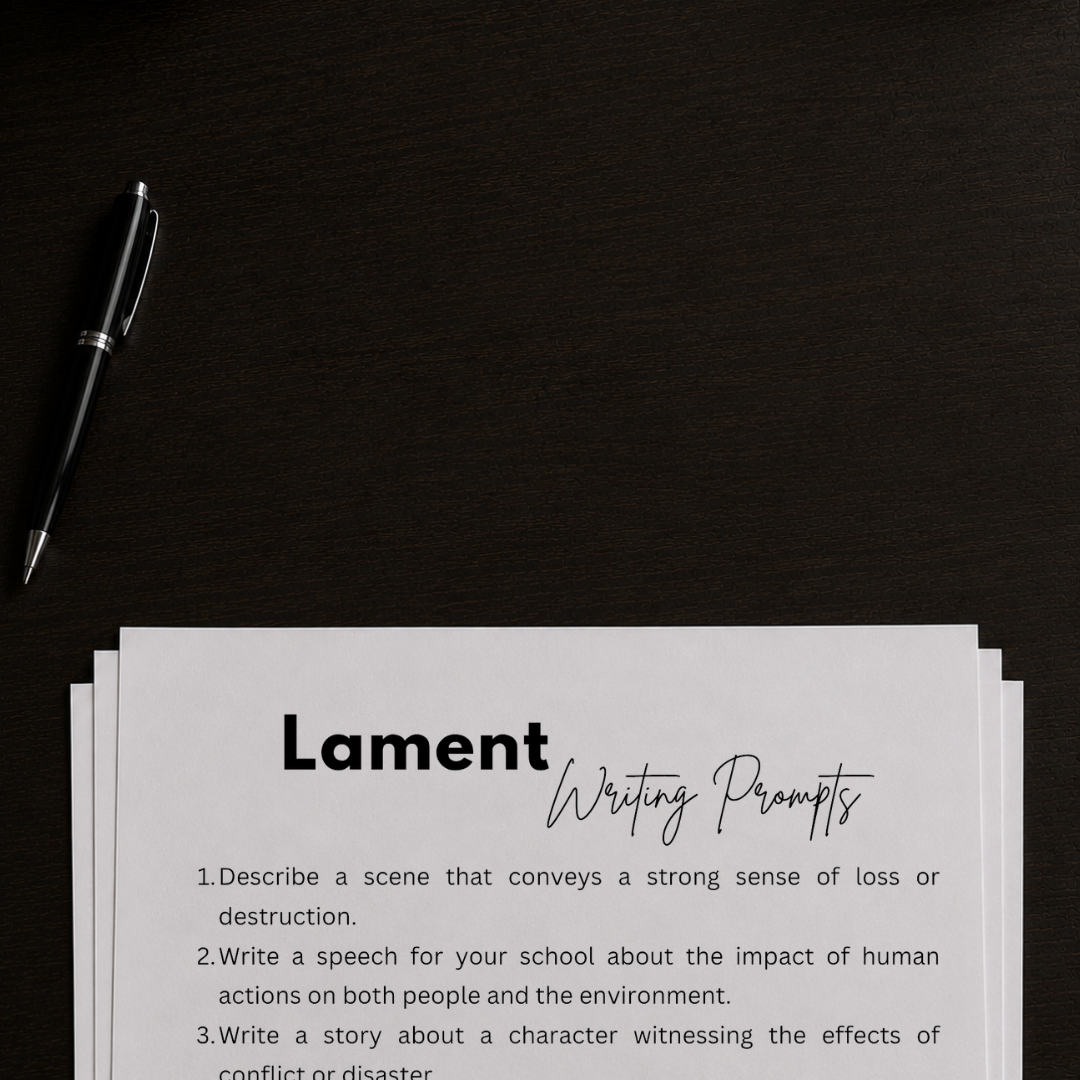
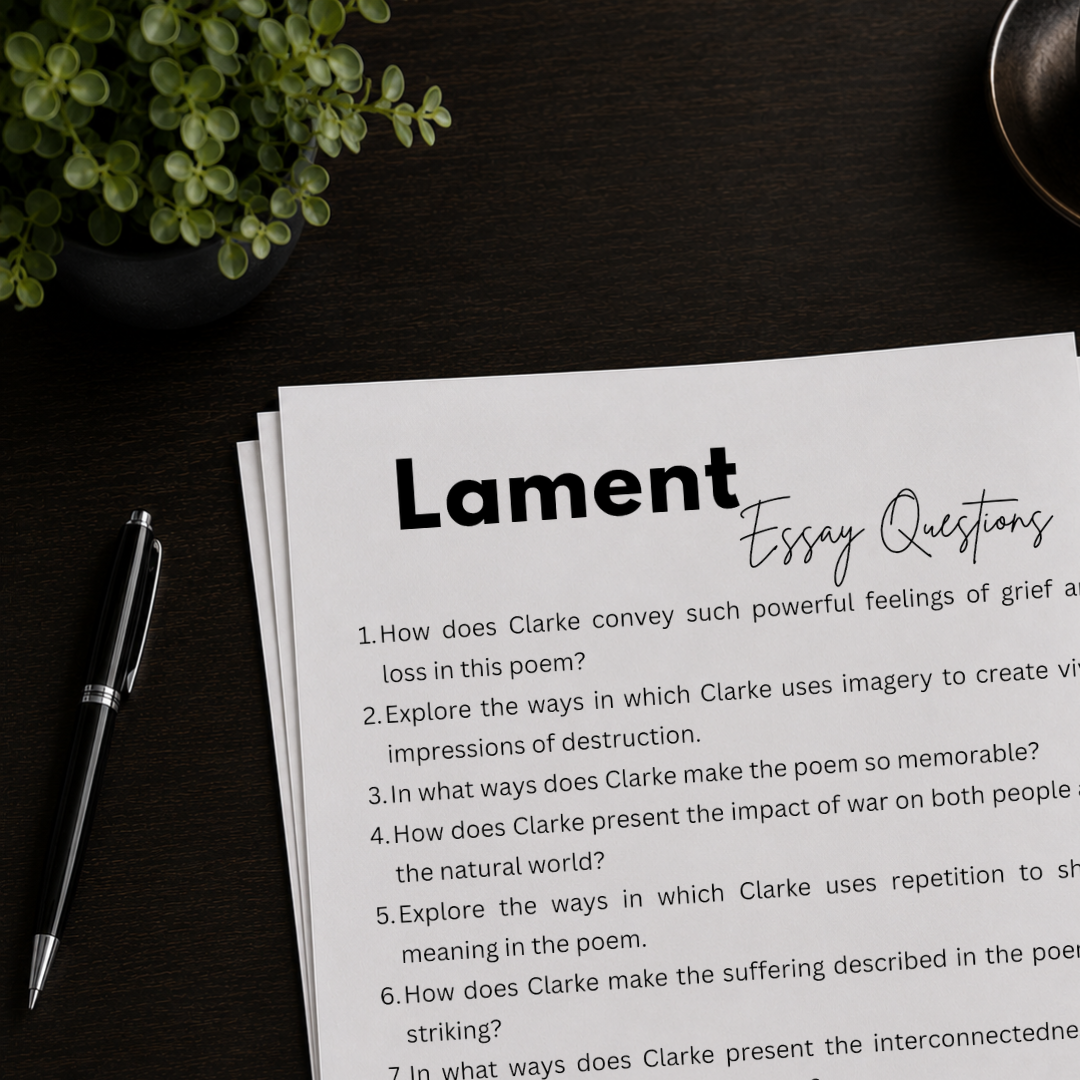
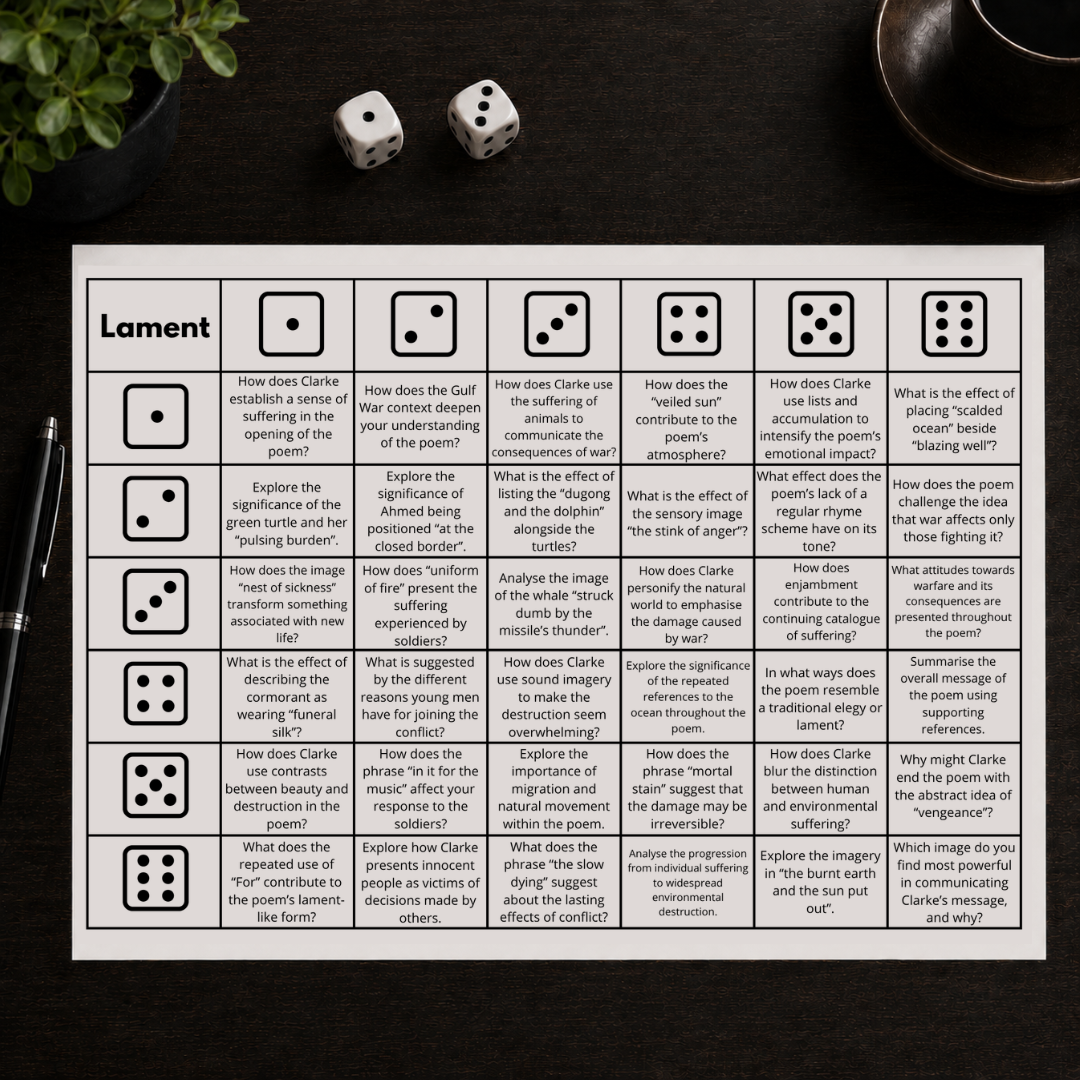
Lament Teaching Resources
If you’re teaching Lament and want to take these activities further, I’ve created a complete Lament by Gillian Clarke Teaching Resource Pack designed for CIE IGCSE English Literature (0475 & 0922, 2027 syllabus).
The pack builds on the discussion, close analysis, creative writing, and independent interpretation explored above, giving you ready-to-use activities that can be used across individual lessons, revision sessions, or a complete sequence of study.
Inside the pack, you’ll find:
◆ Poetry analysis task cards exploring language, structure, imagery, tone, symbolism, context, and personal response
◆ 10 exam-style essay questions for developing analytical responses
◆ 10 creative writing prompts supporting skills needed for the Language Paper
◆ A Roll the Dice discussion board for quick, low-prep classroom discussion
◆ Silent debate activities designed to encourage students to develop and challenge interpretations
◆ Teacher instructions for straightforward classroom implementation
The activities are designed to help students move beyond identifying techniques and towards explaining how Clarke constructs meaning, while developing the confidence to form, discuss, and defend their own interpretations of the poem.
Explore the Lament by Gillian Clarke Teaching Resources → instant digital download!
Go Deeper into Lament
To deepen your understanding of Lament, it’s useful to compare how other writers explore conflict, responsibility, environmental damage, and collective suffering. These connections help develop more conceptual and comparative responses.
◆ War Photographer by Carol Ann Duffy – explores how suffering is documented and mediated, linking to Clarke’s focus on witnessing and the presentation of destruction, as well as the emotional distance between events and observers.
◆ The Soldier by Rupert Brooke – presents an idealised view of war, offering a strong contrast to Clarke’s depiction of widespread, dehumanising destruction, allowing comparison of tone and perspective.
◆ Futility by Wilfred Owen – explores the fragility of life and the destructive impact of war, linking to Clarke’s focus on loss and the breakdown of natural cycles.
◆ Hunting Snake by Judith Wright – examines the relationship between humans and nature, providing a contrast between respectful observation and destructive interference.
◆ The Chimney Sweeper by William Blake – reveals hidden suffering beneath appearances, linking to Clarke’s focus on unseen or ignored victims of larger systems.
◆ A Wife in London by Thomas Hardy – explores the personal impact of war, complementing Clarke’s broader, more collective perspective on loss.
By exploring these connections, you can compare how writers use voice, imagery, and structure to present suffering, helping you move towards top-band, conceptual responses.
Final Thoughts
Lament is a powerful, cumulative exploration of loss, using repetition, imagery, and controlled structure to create a sustained act of mourning. By moving from individual creatures to global devastation, Clarke shows how environmental damage, war, and human responsibility are deeply interconnected, transforming the poem into both a lament and a warning.
The poem’s impact lies in its restraint and clarity. Rather than directly stating judgement, Clarke allows the repeated images of suffering to build an implicit moral force, encouraging the reader to recognise the consequences of human actions. The final reference to the breakdown of language suggests that the damage is not only physical but also cultural and existential, leaving a lasting sense of unease.
Ultimately, Lament remains memorable for its simplicity, structure, and emotional weight, offering a clear yet complex reflection on destruction and responsibility. For more poetry analysis and comparison, explore the Songs of Ourselves Volume 1 hub and the Literature Library.
Choose Your Next Text