Song: Love Armed by Aphra Behn: Summary, Themes & Analysis
Aphra Behn’s Song: Love Armed presents a striking exploration of love as power, emotional imbalance, and constructed desire, depicting Cupid not as an innocent figure but as a force shaped by human traits. Through contrast, symbolism, and a sharply divided speaker perspective, the poem reveals how love becomes dangerous when built from unequal contributions—tenderness from one and cruelty from another. Behn creates meaning by exposing the way emotional vulnerability can be exploited, resulting in a dynamic where one lover suffers while the other remains untouched. If you are studying or teaching Songs of Ourselves Volume 1 for CIE English Literature (0475), you can explore in-depth analyses of every poem for Paper 1 in the Songs of Ourselves Volume 1 Hub, or a wider range of texts in the Literature Library.

Context of Song: Love Armed
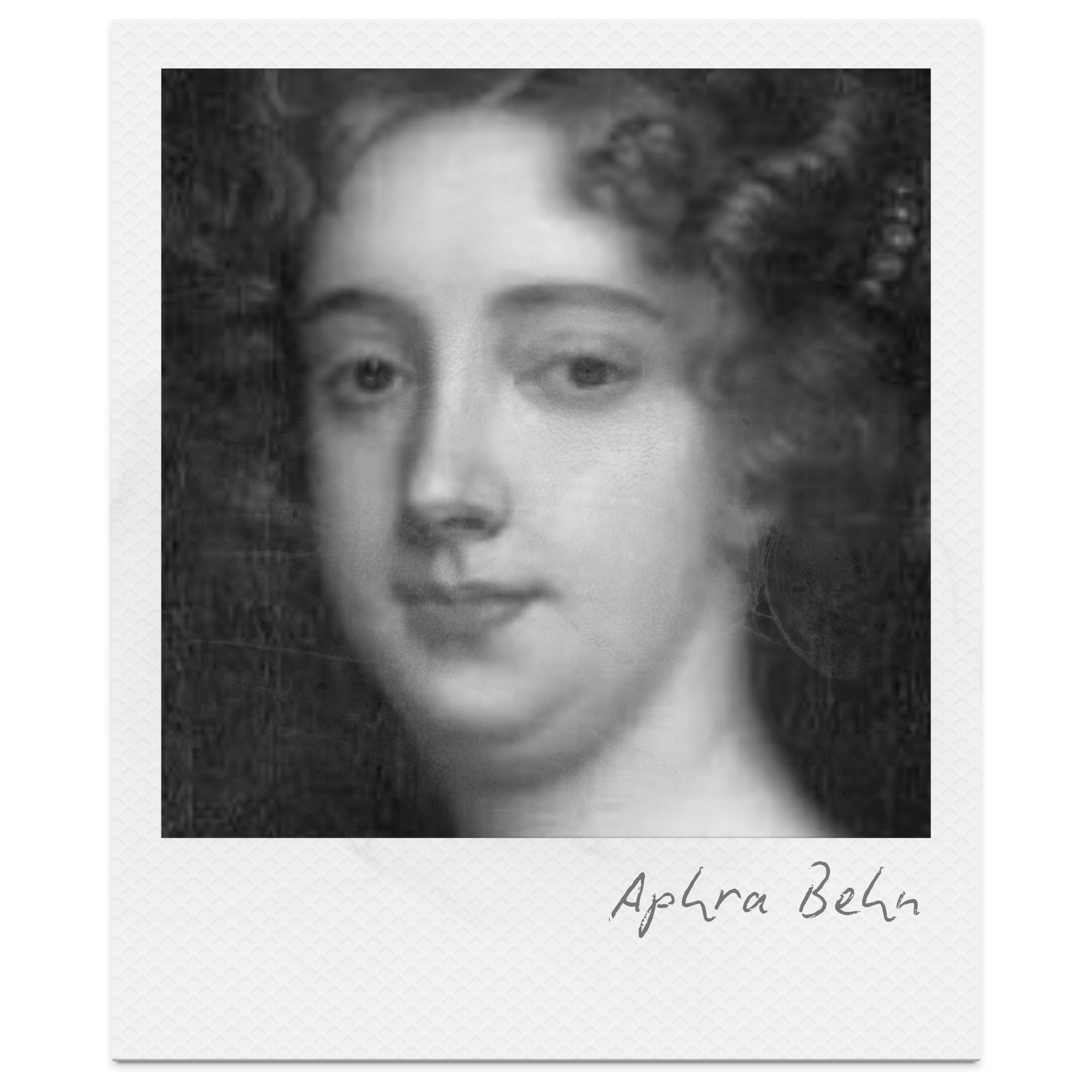
Aphra Behn, writing in the late 17th century during the Restoration period, was one of the first professional female writers in England, often challenging traditional ideas about gender roles, love, and power. In a literary culture that frequently idealised love as noble or virtuous, Behn instead presents a more critical perspective, exposing the emotional dynamics beneath romantic relationships, particularly from a female point of view.
Song: Love Armed reflects this context by portraying love as something deliberately constructed through human qualities such as desire, cruelty, tenderness, and emotional vulnerability. Rather than presenting love as natural or balanced, the poem suggests it is shaped by unequal contributions, where one partner’s openness enables another’s dominance, highlighting the theme of emotional imbalance and the consequences of manipulative power within relationships.
Song: Love Armed: At a Glance
Form: Lyric poem (song)
Mood: Playful, ironic, resentful
Central tension: The imbalance between emotional vulnerability and emotional power in love
Core themes: Love as power, emotional imbalance, desire and cruelty, vulnerability, manipulation
One-sentence meaning: The poem suggests that love becomes destructive when it is shaped by unequal emotional contributions, leaving one person harmed while the other remains powerful and untouched.
Quick Summary of Song: Love Armed
The poem opens by presenting Cupid in a position of triumph, surrounded by “bleeding hearts,” immediately establishing love as something both powerful and destructive. The speaker explains that Cupid creates new forms of emotional pain, drawing his fire from the beloved’s “bright eyes” while scattering it playfully across the world. However, it is from the speaker that Cupid takes desire, suggesting that the intensity of love—and its ability to cause harm—originates in the speaker’s own emotional investment.
As the poem develops, the speaker contrasts what each lover contributes: from herself come sighs, tears, fears, and vulnerability, while from the beloved come pride, cruelty, and the “killing dart.” This division reveals a profound emotional imbalance, where one provides feeling and the other power. The poem concludes with the speaker recognising that together they have “armed” love itself, elevating it to a destructive force, yet only her “poor heart” suffers, while the beloved remains victorious, untouched, and free.
Title, Form, Structure, and Metre
Behn’s formal choices shape both the tone and meaning of the poem, presenting love as controlled, patterned, and yet subtly unstable. The regularity of the structure reflects the seemingly inevitable nature of emotional experience, while small disruptions suggest tension beneath the surface.
Title
The title Song: Love Armed immediately frames love as something both constructed and weaponised. The word “song” suggests lightness, performance, and even entertainment, which contrasts sharply with the poem’s focus on pain and emotional damage. Meanwhile, “armed” presents love as an active force of violence and power, implying that it has been deliberately equipped to wound—an idea that is fully developed as the speaker reveals how both lovers contribute to its destructive nature.
Form and Structure
The poem is a lyric “song,” written in two balanced eight-line stanzas, creating a sense of symmetry and control. This structure mirrors the idea that love operates through a kind of system or exchange, with each stanza reinforcing the pattern of division between the speaker and the beloved. The progression is carefully structured: the first stanza establishes Cupid’s power and origins, while the second clarifies how that power has been formed through unequal contributions. The final lines deliver a clear shift into personal consequence, emphasising that although both have “armed” love, only the speaker suffers.
Rhyme Scheme and Poetic Pattern
The poem follows a regular alternating rhyme scheme. The first stanza can be read as ABABCDCD, for example:
sat (A)
flowed (B)
create (A)
showed (B)
This pattern creates a musical, controlled rhythm, reinforcing the idea of love as something orchestrated. In the second stanza, the pattern continues but places increasing emphasis on repeated sounds such as “thee,” “cruelty,” “deity,” “free,” creating a tightening effect. This subtle repetition draws attention to the beloved’s dominance and reinforces the speaker’s sense of inescapable emotional entrapment.
Metre and Rhythmic Movement
The poem is predominantly written in iambic tetrameter, meaning each line typically contains four iambs (unstressed followed by stressed syllables), creating a steady da-DUM rhythm:
From ME | he TOOK | his SIGHS | and TEARS
This regular beat gives the poem a controlled, almost song-like quality, reflecting how love appears structured and inevitable. However, Behn introduces small variations to create emphasis. For example, the opening line:
LOVE in | fan-TAS | tic TRI- | umph SAT
begins with a trochaic inversion (DUM-da), placing immediate stress on “Love” and establishing its dominance from the outset. These subtle rhythmic shifts prevent the poem from becoming overly mechanical and instead highlight key ideas, particularly the power and violence associated with love.
The Speaker in Song: Love Armed
The speaker presents herself as a self-aware, emotionally wounded lover who retrospectively analyses the dynamics of her relationship. Rather than simply expressing heartbreak, she adopts a tone of controlled bitterness and ironic detachment, framing her experience through the extended metaphor of Cupid as a “Tyrannic” force. This allows her to shift from personal emotion to analytical observation, suggesting that she now understands how her own emotional openness—her “sighs,” “tears,” “languishments,” and “fears”—has actively contributed to the power that harms her.
At the same time, the speaker constructs the beloved as emotionally distant and dominant, the source of “pride,” “cruelty,” and the “killing dart.” This division is not neutral—it exposes a deliberate imbalance in which the speaker supplies feeling, while the beloved supplies control. Crucially, the speaker recognises her complicity in this dynamic: “Thus thou and I, the God have armed.” The voice, therefore, is not purely victimised but critically reflective, revealing a deeper understanding that love’s destructive power is not inevitable, but constructed through unequal emotional exchange.
Stanza-by-Stanza Analysis of Song: Love Armed
This section offers a close reading of each stanza, focusing on how Behn uses imagery, contrast, and structural development to construct meaning. By analysing the poem step by step, we can see how the portrayal of love shifts from an abstract, almost theatrical force to a deeply personal experience of emotional imbalance and suffering, revealing how power is created and sustained within the relationship.
Stanza 1: Love as a Tyrannical Force
The opening stanza presents Cupid as a figure of absolute power, introduced through the elevated image of “Fantastic Triumph,” which evokes a ceremonial or military victory. This imagery immediately frames love as something dominant and celebrated, yet the surrounding “bleeding hearts” undercut this triumph, suggesting that his success depends on widespread suffering. The juxtaposition between grandeur and pain establishes love as both glorified and destructive, reinforcing the idea that emotional harm is central to its power.
Behn develops this further through the description of Cupid creating “fresh pains” and displaying “Tyrannic power,” explicitly characterising love as cruel and deliberate rather than accidental. The metaphor of “fire” taken from the beloved’s “bright eyes” suggests attraction and surface beauty, while the speaker’s contribution—“desire”—is positioned as the deeper, more dangerous force “enough to undo the amorous world.” This contrast reveals how love is constructed from unequal elements: the beloved provides allure, but the speaker provides the emotional intensity that makes love overwhelming. As a result, the stanza establishes the central idea that love’s destructive power is not inherent, but created through the combination of external charm and internal vulnerability.
Stanza 2: Love Constructed Through Imbalance
The second stanza develops the idea of love as something deliberately constructed, using a clear pattern of parallelism and contrast to divide what each lover contributes. The repeated structure—“From me… / From thee…”—creates a rhythmic sense of exchange, but this is immediately revealed to be unequal. The speaker provides “sighs,” “tears,” “languishments,” and “fears,” all associated with emotional vulnerability and suffering, while the beloved supplies “pride,” “cruelty,” and the “killing dart,” symbols of power, control, and emotional harm. This structural pairing reinforces the idea that love is not mutual, but built on opposing qualities that create imbalance.
The stanza then shifts into a moment of self-awareness, as the speaker recognises, “Thus thou and I, the God have armed,” explicitly acknowledging that both have contributed to love’s destructive force. However, this recognition intensifies the injustice rather than resolving it. The final lines deliver a stark contrast in outcome: the speaker’s “poor heart” is “harmed,” while the beloved remains “the Victor… and free.” This concluding opposition highlights the central tension of the poem—love empowers one while destroying the other—and leaves the reader with a clear sense of emotional inequality, where vulnerability leads to suffering and detachment leads to dominance.
Key Quotes and Methods in Song: Love Armed
Behn’s use of extended metaphor, structural contrast, and violent imagery reveals how love is constructed as a force of unequal power, where emotional vulnerability becomes a source of harm.
“Love in Fantastic Triumph sat, / Whilst Bleeding Hearts around him flowed”
◆ Technique: Extended metaphor / juxtaposition
◆ Meaning: Love is presented as a triumphant, almost regal force surrounded by suffering
◆ Purpose: To contrast celebration with pain, exposing the cost of love’s dominance
◆ Impact: Forces the reader to question idealised views of love, recognising its dependence on emotional harm
“Fresh pains he did create, / And strange Tyrannic power he showed”
◆ Technique: Personification / loaded diction
◆ Meaning: Love actively produces suffering and exerts oppressive control
◆ Purpose: To present love as deliberate and cruel, rather than accidental
◆ Impact: Reinforces the idea of love as a destructive force that cannot be trusted
“From thy Bright Eyes he took his fire, / Which round about, in sport he hurled”
◆ Technique: Symbolism / contrast in tone
◆ Meaning: The beloved provides beauty and attraction, which becomes a playful but harmful force
◆ Purpose: To show how surface allure contributes to love’s power
◆ Impact: Highlights the imbalance between appearance and consequence, where harm is inflicted casually
“But ’twas from mine he took desire / Enough to undo the Amorous World”
◆ Technique: Hyperbole / contrast
◆ Meaning: The speaker’s emotional intensity fuels love’s destructive potential
◆ Purpose: To emphasise the depth of feeling contributed by the speaker
◆ Impact: Suggests that vulnerability is what makes love overwhelming and dangerous
“From me he took his sighs and tears, / From thee his Pride and Cruelty”
◆ Technique: Parallelism / antithesis
◆ Meaning: The lovers contribute opposing qualities—emotion versus power
◆ Purpose: To structurally reinforce the imbalance within the relationship
◆ Impact: Makes the inequality unavoidable for the reader, clarifying how suffering is produced
“From me his Languishments and Fears, / And every Killing Dart from thee”
◆ Technique: Violent metaphor / lexical contrast
◆ Meaning: The speaker provides emotional weakness, while the beloved provides the means to harm
◆ Purpose: To intensify the division between vulnerability and control
◆ Impact: Reinforces the idea that love is weaponised through unequal contributions
“Thus thou and I, the God have armed, / And set him up a Deity”
◆ Technique: Religious imagery / extended metaphor
◆ Meaning: Love is elevated to divine status through human actions
◆ Purpose: To show that love’s power is constructed, not natural
◆ Impact: Encourages a critical reading of love as something humans are responsible for creating
“But my poor Heart alone is harmed, / Whilst thine the Victor is, and free”
◆ Technique: Juxtaposition / emotive contrast
◆ Meaning: The speaker suffers while the beloved remains unaffected
◆ Purpose: To conclude with a clear statement of emotional inequality
◆ Impact: Leaves the reader with a sense of injustice, reinforcing the poem’s critique of unequal love
Key Techniques in Song: Love Armed
Behn uses a range of structural, linguistic, and figurative techniques to present love as a force that is not natural or balanced, but deliberately constructed, weaponised, and unequal in its effects.
◆ Extended Metaphor (Love as a Tyrant / Warlord) – The poem sustains a central metaphor in which Love (Cupid) is presented as a “Tyrannic” ruler presiding over “Bleeding Hearts” and a “Fantastic Triumph.” This transforms love from an abstract emotion into a figure of political and military power, suggesting domination, control, and conquest. The metaphor allows Behn to expose love as something that thrives on suffering, reinforcing the idea that emotional pain is not incidental but fundamental to its power.
◆ Personification – Love is personified as an active, conscious force that “did create” pain and “showed” power. This gives love agency, presenting it as deliberately cruel rather than accidental. By attributing human—and specifically tyrannical—qualities to love, Behn challenges idealised notions of romance and instead frames it as oppressive and manipulative.
◆ Parallelism and Structural Contrast – The repeated pattern “From me… / From thee…” creates a clear structural division between the two lovers. This parallelism highlights the imbalance at the heart of the relationship: the speaker contributes emotion and vulnerability, while the beloved contributes pride and cruelty. The technique reinforces the idea that love is built through opposing forces, not mutual exchange.
◆ Juxtaposition – Behn consistently places opposing ideas side by side, such as “Fantastic Triumph” and “Bleeding Hearts,” or “my poor Heart” and “the Victor… free.” These contrasts expose the gap between appearance and reality, showing how love can seem powerful or celebratory while actually producing pain and inequality.
◆ Violent Imagery and Semantic Field of Warfare – Words such as “Bleeding,” “Tyrannic,” “Killing Dart,” and “armed” create a sustained semantic field of violence and conflict. This reframes love as a form of emotional warfare, where one party is wounded and the other emerges victorious, reinforcing the destructive nature of romantic imbalance.
◆ Symbolism (Fire and the Dart) – The “fire” taken from the beloved’s eyes symbolises attraction and surface beauty, while the “Killing Dart” represents the capacity to wound emotionally. Together, these symbols show how love combines allure and harm, suggesting that what draws people in is inseparable from what ultimately hurts them.
◆ Hyperbole – The claim that desire is “Enough to undo the Amorous World” exaggerates the speaker’s emotional intensity. This emphasises the overwhelming nature of desire, suggesting that it has the power to destabilise not just individuals but the wider world of love itself.
◆ Religious Imagery – The idea that the lovers have “set him up a Deity” elevates Love to divine status. This suggests that love’s authority is not natural but constructed and worshipped, encouraging the reader to question why such a destructive force is given so much power.
◆ Sound Patterning (Rhyme and Assonance) – The regular rhyme scheme and repeated vowel sounds (e.g. “thee,” “cruelty,” “deity,” “free”) create a controlled, musical quality. This contrasts with the poem’s violent content, reinforcing the tension between order and emotional chaos, and subtly emphasising the inescapability of the speaker’s situation.
◆ Tone (Ironic and Reflective) – Although the poem adopts a formal, almost playful “song” structure, the tone is deeply ironic. The speaker’s measured, reflective voice contrasts with the intensity of the suffering described, suggesting a level of self-awareness and critical distance that deepens the poem’s meaning.
How the Writer Creates Meaning and Impact in Song: Love Armed
Behn creates meaning and impact in Song: Love Armed through the interplay of language, structure, voice, and sound, constructing love as a force shaped by imbalance and emotional inequality rather than mutual affection.
Firstly, Behn’s use of imagery and symbolism presents love as inherently violent and destructive. The repeated references to “Bleeding Hearts,” “Tyrannic power,” and the “Killing Dart” establish a clear semantic field of conflict, transforming love into a form of emotional warfare. This imagery is reinforced by the extended metaphor of Cupid as a ruler or conqueror, suggesting that love exerts control and thrives on suffering, rather than harmony.
Structurally, meaning is created through contrast and parallelism, particularly in the repeated pattern “From me… / From thee…”. This division clearly separates the contributions of each lover, emphasising the unequal exchange at the heart of the relationship. The speaker provides emotion, while the beloved provides power, and this imbalance is reinforced by the poem’s progression towards the final contrast between “my poor Heart” and “the Victor… free.” The structure therefore mirrors the emotional dynamic it describes, making the imbalance unavoidable for the reader.
Behn also uses voice to shape interpretation. The speaker’s tone is controlled and reflective, suggesting a degree of self-awareness rather than immediate emotional outburst. This creates a sense that the speaker is analysing her own suffering, recognising that love’s destructive force has been constructed through the combined actions of both lovers. This reflective voice deepens the poem’s impact, as it moves beyond personal complaint to a broader commentary on the nature of love.
Finally, sound and rhythm contribute to meaning. The regular iambic tetrameter and consistent rhyme scheme create a smooth, almost song-like quality, which contrasts with the poem’s violent imagery. This tension between musical form and painful content reinforces the idea that love can appear ordered and appealing on the surface while concealing deeper emotional harm. Together, these methods allow Behn to present love not as a natural or balanced force, but as something shaped by unequal emotional contributions, with damaging consequences.
Themes in Song: Love Armed
Behn explores how love operates not as a balanced or natural force, but as something shaped by power, imbalance, and emotional inequality, revealing its capacity to harm as well as attract.
Love as Power and Control
The poem presents love as a force of domination, embodied in the figure of Cupid as a “Tyrannic” ruler. Through imagery of triumph and conquest, love is shown to exert control over individuals rather than unite them. This suggests that love functions less as a mutual bond and more as a system in which one party gains power over another, reinforcing the idea of emotional hierarchy.
Emotional Imbalance
A central theme is the unequal distribution of emotional experience within relationships. The speaker provides “sighs,” “tears,” “languishments,” and “fears,” while the beloved contributes “pride” and “cruelty.” This contrast reveals that love is not reciprocal, but constructed through opposing qualities, where one partner’s vulnerability enables the other’s dominance. The poem suggests that this imbalance is the root of emotional suffering.
Love as a Constructed Force
Behn challenges the idea of love as natural by suggesting it is actively created: “Thus thou and I, the God have armed.” Love is therefore not inevitable, but shaped by human actions and emotions. This idea is reinforced through the extended metaphor of Cupid being “armed,” implying that love’s power comes from what individuals bring into it, particularly their emotional contributions.
Suffering and Vulnerability
The poem emphasises the connection between love and pain, presenting emotional vulnerability as the source of suffering. The imagery of “Bleeding Hearts” and the speaker’s “poor Heart” being “harmed” highlights the physical intensity of emotional distress. Behn suggests that those who feel more deeply are more exposed to harm, reinforcing the risks of emotional openness.
Appearance vs Reality
Through the contrast between the celebratory image of “Fantastic Triumph” and the surrounding suffering, Behn explores how love can appear glorious while concealing its destructive effects. This tension between surface and reality reflects the way attraction and beauty—symbolised by the beloved’s “bright eyes”—can mask deeper emotional consequences.
Gender and Power Dynamics
Although not explicitly stated, the poem reflects broader concerns about gender roles and emotional power in relationships. The speaker’s vulnerability and the beloved’s detachment suggest a dynamic in which emotional expression leads to disadvantage, while emotional control leads to freedom and victory, highlighting the imbalance often experienced in romantic relationships.
Alternative Interpretations of Song: Love Armed
While the poem clearly presents love as imbalanced and destructive, Behn’s use of metaphor and voice allows for multiple interpretations of how and why this dynamic exists.
Psychological Interpretation: Self-Destructive Desire
From a psychological perspective, the poem can be read as an exploration of self-awareness and emotional complicity. The speaker recognises that her own desire, “sighs,” and “fears” have contributed to the power that harms her, suggesting that suffering in love is not purely inflicted but also internally sustained. This interpretation emphasises the idea that intense emotional investment can become self-destructive, with the speaker’s vulnerability amplifying the beloved’s power.
Social Interpretation: Power and Gender Dynamics
The poem can also be read as a critique of gendered power structures within relationships. The speaker’s emotional openness contrasts with the beloved’s pride and cruelty, reflecting a dynamic in which one partner’s emotional expression leads to vulnerability, while the other’s detachment leads to control. In the context of the Restoration period, this may highlight the limited agency available to women in relationships, where emotional investment often results in disadvantage rather than reciprocity.
Philosophical / Existential Interpretation: Love as Illusion
On a broader level, the poem can be interpreted as questioning the very nature of love itself. By suggesting that Cupid is “armed” and elevated to a “Deity” through human actions, Behn implies that love is not a natural or divine force, but a constructed illusion that people choose to believe in. This interpretation presents love as something humans create, sustain, and suffer under, raising the possibility that its power is ultimately based on perception rather than reality.
Exam-Ready Insight for Song: Love Armed
This section shows how to turn your understanding of Song: Love Armed into a strong, exam-focused response for IGCSE Literature (0475), with a clear focus on how meaning is created through methods.
What strong responses do
◆ focus closely on the question
◆ analyse methods (language, structure, and sound), not just ideas
◆ explain how effects are created, not just what happens
◆ track shifts in tone and perspective across the poem
◆ use short, precise quotations to support points
Conceptual argument
A strong thesis for Song: Love Armed might be:
Behn presents love as a constructed and unequal force, using contrast, parallel structure, and violent imagery to show how emotional vulnerability empowers one lover while leaving the other dominant and untouched.
Model analytical paragraph
Behn presents the imbalance of love through structural contrast and violent imagery to expose emotional inequality. In the repeated pattern “From me… / From thee…,” the parallel structure clearly divides the lovers’ contributions, with the speaker associated with “sighs and tears” and the beloved with “Pride and Cruelty.” This contrast highlights how vulnerability and emotional openness create the conditions for suffering, while detachment leads to control. The metaphor of the “Killing Dart” reinforces this idea, presenting love as a weapon that actively harms, rather than connects. This is further developed in the line “Thus thou and I, the God have armed,” where the speaker recognises that love’s destructive power is not natural but constructed through their unequal contributions. Through these methods, Behn reveals that love operates as a system of power, where one lover is emotionally exposed while the other remains dominant and free.
Teaching Ideas for Song: Love Armed
This poem is ideal for exploring how writers use language, structure, and voice to present ideas about power and emotional imbalance in relationships, while also building collaborative and discussion-based classroom approaches.
1. Collaborative Analytical Paragraph (Paired Writing)
Give students a focused question, for example:
How does Behn present the imbalance of power in love in Song: Love Armed?
Students work together to produce a single paragraph, combining their ideas and interpretations. They should:
◆ select and embed quotations
◆ identify methods (language, structure, sound)
◆ explain meaning → purpose → impact
Because both students contribute, they can challenge and refine each other’s ideas, leading to a stronger, more developed response. This approach helps students understand that effective analytical writing is built through discussion, comparison, and improvement, not just individual effort.
2. Structured Group Close Analysis (Role-Based)
Instead of traditional annotation, assign students specific roles in small groups for a stanza-by-stanza reading of the poem:
◆ Structure specialist – tracks shifts, voice, and progression
◆ Language analyst – explores word choices and imagery
◆ Methods expert – identifies poetic devices and techniques
◆ Tone tracker – comments on voice and emotional shifts
Each group analyses a stanza, then feeds back to the class. As responses are shared, build a full analysis together.
This approach makes close reading more active and collaborative, avoiding a “talk and chalk” lesson while still developing detailed analytical skills.
3. Silent Debate
Set up a silent debate around the question:
Is Song: Love Armed more a criticism of love itself or of imbalance within relationships?
Students respond to prompts in writing, building on and challenging each other’s ideas. They should:
◆ use quotations as evidence
◆ respond directly to others’ interpretations
◆ develop and refine arguments over time
This encourages deeper thinking, ensures all students participate, and allows ideas to develop more thoughtfully than in fast-paced verbal discussion. For guidance on structuring this activity, see this post on how to run an effective silent debate in your classroom.
4. Creative Writing: Rewriting the Voice
Ask students to write a short piece from the perspective of someone in an emotionally unequal relationship.
Prompt:
Write in the voice of a character who gives more emotionally than they receive.
Students should aim to:
◆ use contrast between power and vulnerability
◆ include imagery and symbolism
◆ develop a clear voice
◆ show how meaning is shaped through language choices
This activity helps students put literary methods into practice by using techniques such as imagery, contrast, and voice in their own writing. Many of the texts they study in Literature are strong starting points for creative writing, giving them regular practice with the skills they need for their Language paper. For more ideas and structured prompts, explore the Creative Writing Hub.
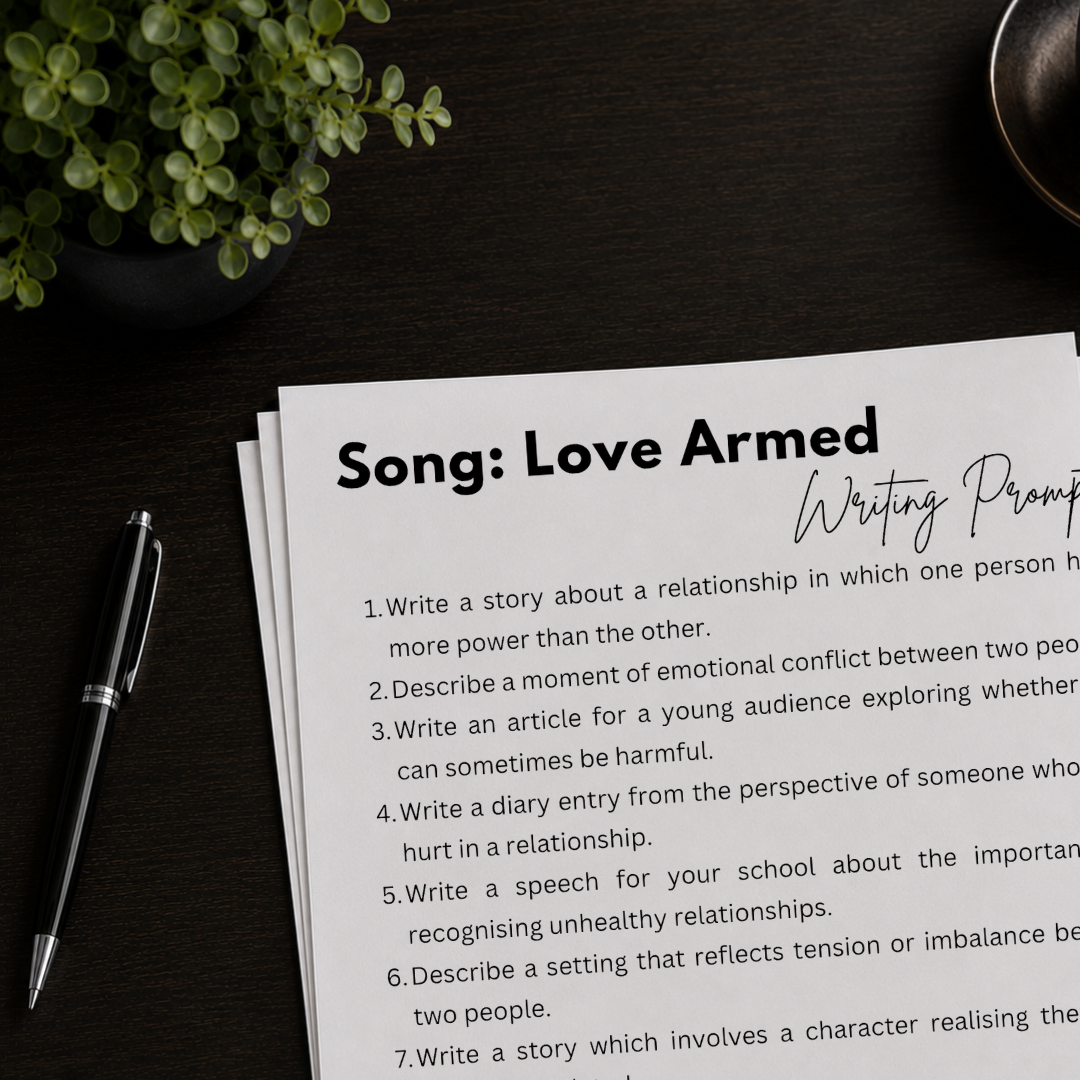
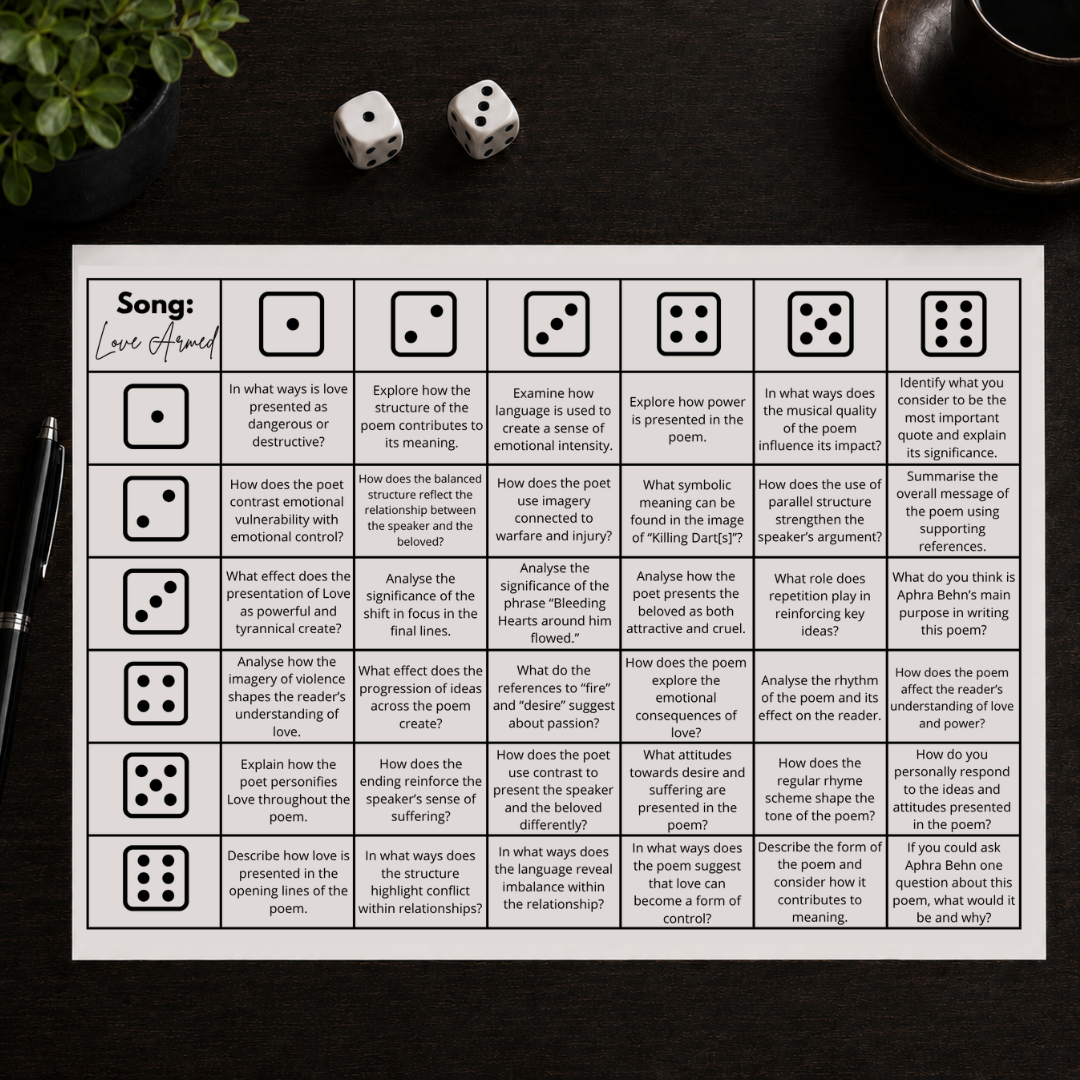
Teach Love Armed with minimal preparation.
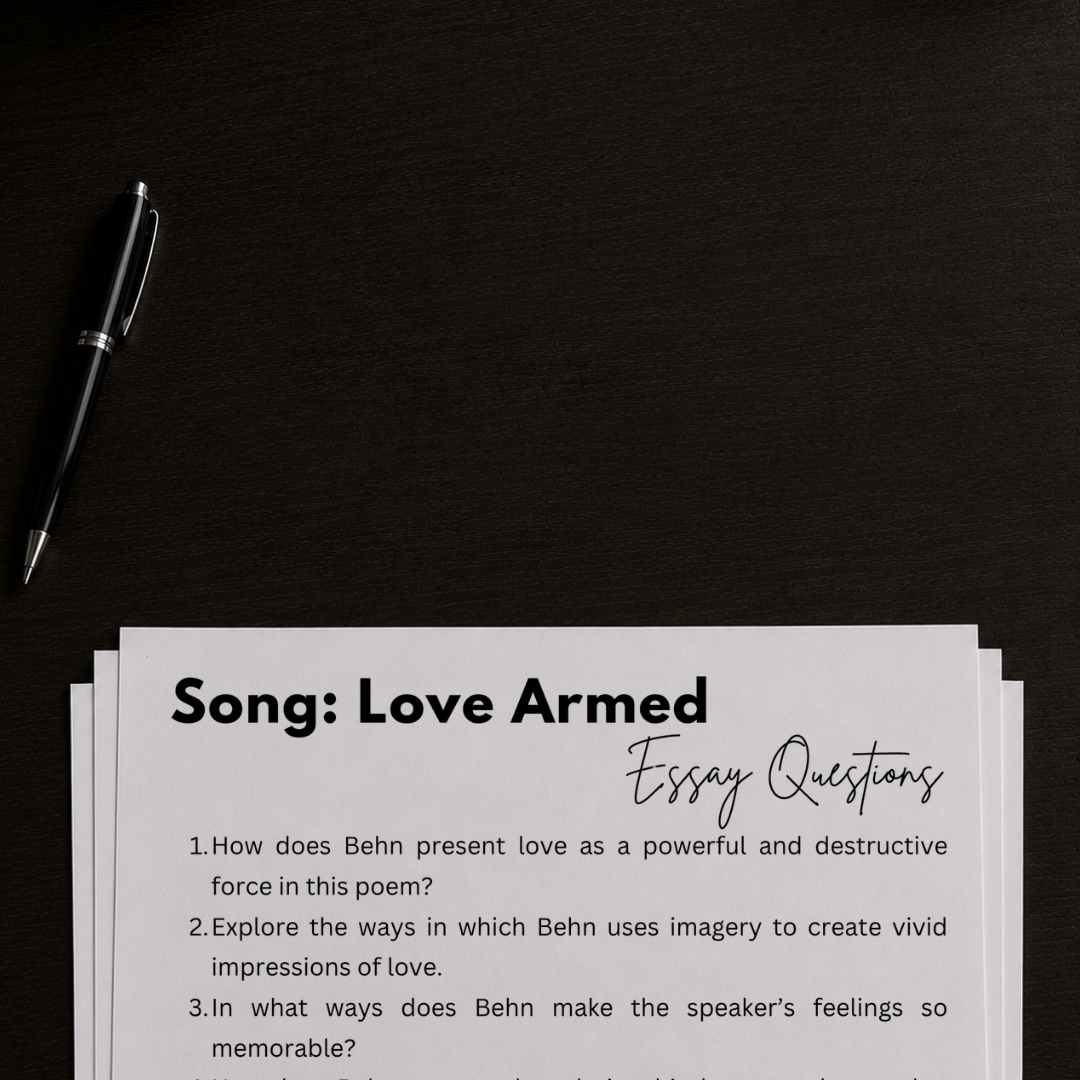
Download the complete teaching resource pack for Love Armed by Aphra Behn — designed for CIE IGCSE English Literature (0475 & 0922, 2027 syllabus) while also working seamlessly across broader secondary English, GCSE, and high school poetry teaching. This ready-to-use bundle includes analytical task cards, exam-style essay questions, creative writing prompts, silent debate activities, and discussion-led lessons designed to help students confidently explore power, love, gender, and conflict through deeper literary analysis. Ideal for developing independent interpretation, sharper understanding of language and poetic methods, and more confident exam responses — without spending hours creating resources and lesson materials from scratch.
Go Deeper into Song: Love Armed
To develop stronger comparative skills, it is useful to explore how similar ideas about love, power, and emotional imbalance are presented across other texts.
◆ The Garden of Love – William Blake
Explores how love becomes restricted and controlled, linking to Behn’s presentation of love as a force shaped by external power rather than freedom.
◆ Remember – Christina Rossetti
Presents a more selfless and balanced view of love, offering a contrast to Behn’s portrayal of unequal emotional exchange.
◆ Sonnet 18 – William Shakespeare
Celebrates love’s ability to preserve and immortalise, contrasting with Behn’s depiction of love as destructive and destabilising.
◆ La Belle Dame sans Merci – John Keats
Explores the idea of love as seductive but harmful, where one figure holds power and the other is left emotionally damaged, closely mirroring Behn’s theme of imbalance.
◆ Porphyria’s Lover – Robert Browning
Presents a disturbing exploration of control and possession in love, where power is asserted in extreme ways, reinforcing the idea that love can become dangerous when unbalanced.
◆ Neutral Tones – Thomas Hardy
Examines the breakdown of a relationship through emotional detachment and bitterness, linking to Behn’s focus on unequal emotional investment and its consequences.
By comparing these texts, students can develop more sophisticated responses that explore how writers present love as power, emotional imbalance, and the consequences of vulnerability and control across different contexts.
Final Thoughts
Song: Love Armed presents love not as a natural or harmonious force, but as something constructed through imbalance, where vulnerability and emotional intensity give rise to power and control. Through its use of extended metaphor, structural contrast, and violent imagery, the poem reveals how love can become destructive, empowering one figure while leaving the other exposed and harmed. Behn’s portrayal challenges idealised views of romance, instead presenting love as a system shaped by what each person brings into it—and the consequences of that exchange.
Ultimately, the poem is memorable for its clarity and precision, showing how meaning is created through carefully controlled methods rather than overt explanation. By exposing the mechanics of love, Behn encourages readers to question its power and recognise the risks of emotional imbalance. For further exploration, revisit the Songs of Ourselves Volume 1 Hub or explore a wider range of literary analysis in the Literature Library.
Choose Your Next Text