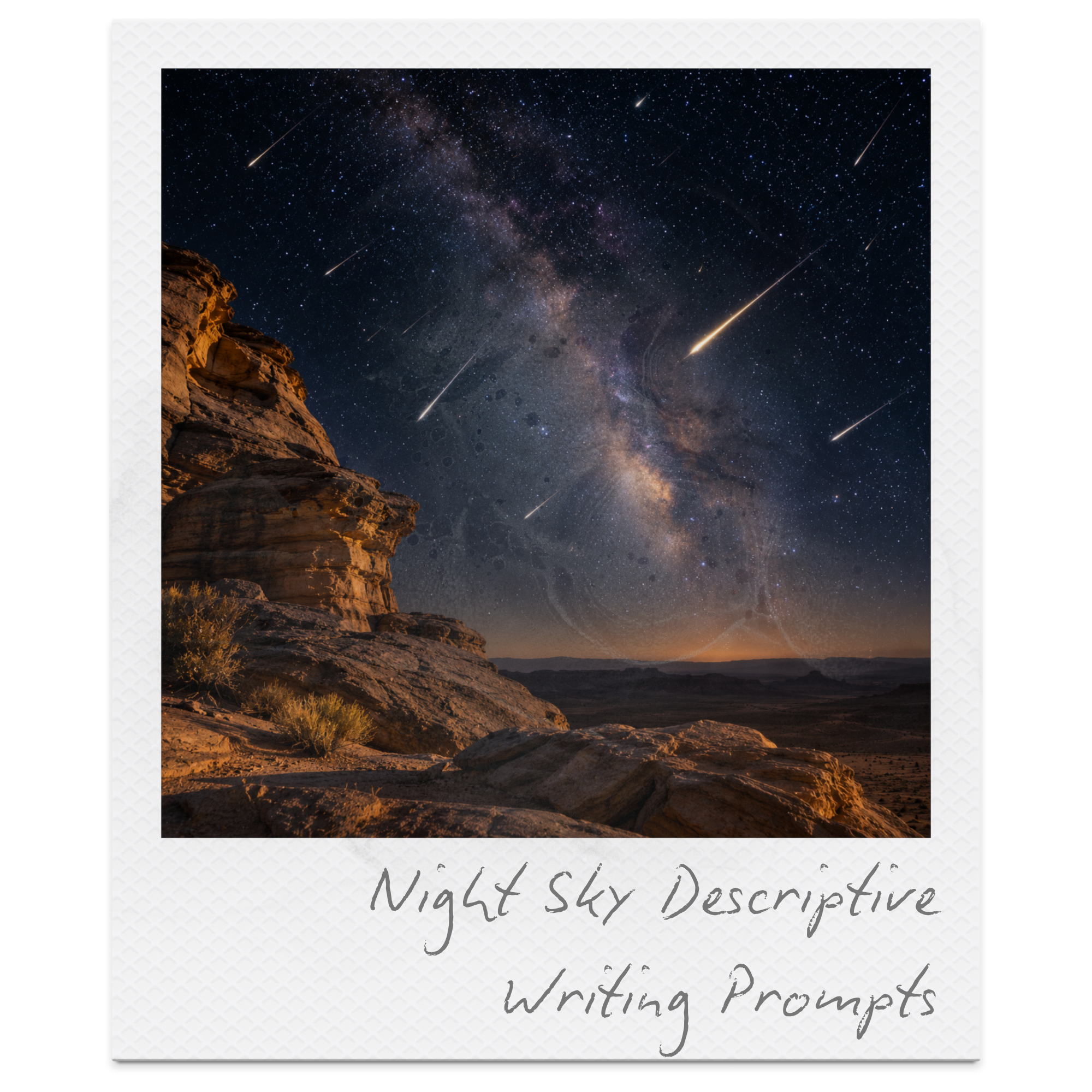
The night sky can completely transform the atmosphere of a scene. It might stretch endlessly above a sleeping countryside, glow with the soft colours of twilight or hang dark and oppressive over an abandoned landscape. From clear, moonlit heavens to storm-filled skies that seem to swallow the stars, the darkness above us offers endless opportunities for vivid and atmospheric description. Yet when writing about the night sky, it is easy to rely on familiar words such as dark, beautiful, starry and mysterious.
Choosing more precise descriptive vocabulary can help you capture the night sky's colour, appearance, depth, movement and mood. A sky might be inky or cloudless, but it could also be luminous, brooding, veiled or otherworldly. The words you choose can make a setting feel peaceful and romantic, haunting and unsettling, or vast and impossibly beautiful.
Below, you'll find 100 Words to Describe the Night Sky, organised into ten categories exploring darkness, colour, clarity, clouds, beauty, mystery, romance, storms and fantasy. Every word includes its meaning, when it works best and an original example sentence, helping you create more evocative descriptions in your own creative writing.
For more vocabulary, sensory description and techniques for bringing settings to life, explore the Descriptive Writing Hub and Descriptive Writing Sparks. You can also discover 100 Words to Describe Stars (+ Examples) for more detailed celestial imagery, or browse the Creative Writing Archive for hundreds of writing prompts, story ideas and resources to inspire your next piece of writing.
Explore the Night Sky
From moonlit beauty to haunting darkness, discover the perfect words for your scene.
1. Words to Describe the Appearance of the Night Sky
The appearance of the night sky can vary dramatically depending on the time, weather, location and surrounding landscape. Some skies stretch overhead like an immense, uninterrupted canopy, while others appear hazy, textured or partially obscured by clouds. Choosing precise vocabulary for the sky's overall appearance can help establish a setting before introducing more specific details such as colour, moonlight or stars.
1. Expansive
Meaning: Covering an exceptionally large area and creating a sense of openness or immense space.
Best for: Wide landscapes, deserts, open countryside and scenes where the vastness of the night sky is particularly striking.
Example: An expansive night sky stretched above the desert, uninterrupted by mountains, buildings or even the faintest suggestion of cloud.
2. Vaulted
Meaning: Appearing to curve overhead like an enormous arch or domed ceiling.
Best for: Grand, architectural or poetic descriptions that emphasise the shape and scale of the heavens.
Example: The vaulted sky rose above the cathedral's broken spires, its immense darkness making the ancient building seem impossibly small.
3. Veiled
Meaning: Partially concealed or softened by a thin covering of mist, cloud or atmospheric haze.
Best for: Misty evenings, partially obscured skies and descriptions that create a sense of secrecy or uncertainty.
Example: A veiled night sky hung above the harbour, its familiar constellations hidden behind a translucent layer of drifting mist.
4. Boundless
Meaning: Appearing to have no visible limits, edges or boundaries.
Best for: Remote landscapes, ocean settings and scenes designed to evoke freedom, isolation or the overwhelming scale of the natural world.
Example: Beyond the last fishing boat, the boundless night sky seemed to merge with the sea until neither horizon nor distance could be distinguished.
5. Canopied
Meaning: Covered or enclosed by something resembling a canopy or overhead shelter.
Best for: Forest settings, enclosed landscapes and descriptions where the sky appears to form a protective or oppressive covering.
Example: The narrow valley lay beneath a canopied sky, its darkness framed by the black silhouettes of towering pine trees.
6. Hazy
Meaning: Appearing blurred, indistinct or slightly obscured by fine particles, moisture or atmospheric conditions.
Best for: Humid evenings, summer nights, polluted cities and scenes where the sky lacks sharpness or clarity.
Example: A hazy night sky spread above the city, its darkness softened by the pale orange glow rising from thousands of streetlights.
7. Mottled
Meaning: Marked by irregular patches of different shades, colours or textures.
Best for: Skies containing scattered clouds, uneven moonlight or contrasting areas of darkness and illumination.
Example: The mottled sky shifted between charcoal and silver as ragged clouds passed across the face of the moon.
8. Panoramic
Meaning: Extending across a broad, uninterrupted field of vision.
Best for: Mountain summits, coastal viewpoints, elevated landscapes and descriptions that emphasise the full sweep of the heavens.
Example: From the ruined watchtower, a panoramic night sky unfolded above the kingdom, stretching beyond the distant mountains in every direction.
9. Seamless
Meaning: Appearing completely continuous, without visible divisions, interruptions or changes in texture.
Best for: Cloudless darkness, minimalist landscapes and scenes where the sky forms a smooth, uninterrupted backdrop.
Example: A seamless night sky stretched above the sleeping fields, its unbroken surface disturbed only by the occasional passing satellite.
10. Immense
Meaning: Extremely large in size, scale or extent, often creating a sense of awe or insignificance.
Best for: Atmospheric landscapes, reflective scenes and descriptions where the sky makes human surroundings appear small or insignificant.
Example: Beneath the immense night sky, the farmhouse looked no larger than a child's toy, its solitary illuminated window almost lost in the surrounding darkness.
2. Words to Describe a Dark Night Sky
Darkness is one of the most defining features of the night sky, but not every darkness feels the same. Some skies are soft and velvety, offering a peaceful backdrop to the sleeping world, while others seem heavy, impenetrable or almost unnaturally black. The depth and intensity of the darkness can make a landscape feel comforting, isolated, threatening or mysterious. These words are particularly useful when you want to describe the quality of the darkness itself rather than simply stating that the sky is dark.
11. Inky
Meaning: Extremely dark and deep in colour, resembling black ink.
Best for: Moonless nights, remote landscapes and descriptions where the sky appears almost completely black.
Example: An inky sky stretched above the abandoned railway station, swallowing the outlines of the surrounding hills until only the platform lamps remained visible.
12. Pitch-black
Meaning: Completely or almost completely black, with little or no visible light.
Best for: Moonless nights, isolated locations and scenes where darkness creates fear, uncertainty or disorientation.
Example: The pitch-black sky offered no moonlight to guide them, leaving the narrow mountain path almost impossible to distinguish from the surrounding rocks.
13. Lightless
Meaning: Containing or appearing to contain no visible source of illumination.
Best for: Oppressive darkness, supernatural settings and scenes where the absence of light feels particularly significant.
Example: A lightless sky hung above the village, its familiar stars and moon concealed beneath an unbroken mass of black cloud.
14. Impenetrable
Meaning: So dense, complete or obscuring that it seems impossible to see through.
Best for: Gothic settings, threatening landscapes and descriptions where the darkness feels like a physical barrier.
Example: The impenetrable darkness above the forest seemed to press against the treetops, concealing everything beyond their jagged silhouettes.
15. Velvety
Meaning: Having a soft, smooth and richly dark appearance reminiscent of velvet.
Best for: Romantic evenings, peaceful countryside scenes and descriptions where darkness feels luxurious rather than threatening.
Example: A velvety night sky unfolded above the gardens, its deep darkness providing a rich backdrop for the pale glow of the crescent moon.
16. Stygian
Meaning: Extremely dark, gloomy or forbidding, traditionally associated with the darkness of the underworld.
Best for: Gothic horror, dark fantasy, mythological settings and scenes requiring an unusually oppressive sense of darkness.
Example: A Stygian sky loomed above the ruined fortress, so profoundly black that the watchmen could scarcely distinguish its broken towers from the heavens.
17. Shadowy
Meaning: Characterised by darkness, indistinct shapes or areas partially concealed from view.
Best for: Twilight transitions, moonlit landscapes and settings where the boundary between light and darkness remains uncertain.
Example: The shadowy sky deepened above the moor, gradually erasing the distant hills until they became little more than darker shapes against the horizon.
18. Sable
Meaning: Deep black in colour, often used in literary or poetic descriptions to suggest rich, elegant darkness.
Best for: Historical fiction, Gothic romance, lyrical prose and atmospheric descriptions with a classical tone.
Example: Beneath the sable sky, the manor's pale stone walls gleamed faintly in the moonlight, while its upper windows remained dark and empty.
19. Abyssal
Meaning: Resembling an abyss in its immense depth, darkness or apparently bottomless extent.
Best for: Cosmic horror, dark fantasy and descriptions that emphasise the frightening vastness of the heavens.
Example: The abyssal sky opened above the mountain pass, its immense blackness making the travellers feel as though they were standing at the edge of an endless void.
20. Unilluminated
Meaning: Not lit or brightened by an external source of light.
Best for: Realistic descriptions of heavily overcast nights, landscapes without artificial lighting and scenes where the absence of moonlight is important.
Example: The unilluminated sky stretched above the empty fields, its thick cloud cover hiding the moon and leaving the countryside in near-total darkness.
3. Words to Describe the Colours of the Night Sky
The night sky is rarely a single shade of black. Depending on the time of night, weather conditions, moonlight and surrounding landscape, it can contain subtle variations of blue, purple, grey and even warm amber. The last traces of twilight might leave a violet glow along the horizon, while a moonlit sky can appear almost silver. These words are useful for describing the colours of the night sky with greater precision, helping you establish the time, setting and atmosphere of a scene.
21. Indigo
Meaning: A deep, rich blue with noticeable violet undertones, positioned between blue and purple.
Best for: Early night, lingering twilight, clear skies and descriptions that require a rich, atmospheric colour.
Example: An indigo sky settled above the harbour, its deep blue gradually swallowing the last traces of violet along the western horizon.
22. Midnight-blue
Meaning: An extremely dark shade of blue, approaching black but retaining a visible blue tone.
Best for: Clear night skies, moonlit landscapes and elegant descriptions where the darkness contains subtle colour.
Example: The midnight-blue sky stretched above the sleeping city, its darkness interrupted by the pale crescent of the moon.
23. Violet
Meaning: A rich purple colour with a noticeable blue undertone.
Best for: Late twilight, atmospheric landscapes and descriptions of the sky shortly after sunset.
Example: A violet sky lingered above the distant mountains, slowly deepening as the final light of evening disappeared behind their peaks.
24. Cobalt
Meaning: A strong, vivid shade of blue, often appearing rich and slightly luminous.
Best for: Bright moonlit evenings, the transition from twilight into night and skies that retain a striking blue colour.
Example: The cobalt sky glowed above the whitewashed village, its vivid colour slowly darkening as the church bells marked the passing hour.
25. Charcoal
Meaning: A very dark grey colour resembling burnt wood or charcoal.
Best for: Overcast nights, urban landscapes and skies where clouds create a softer darkness than pure black.
Example: A charcoal sky hung above the industrial district, its heavy grey surface faintly illuminated by the orange glow of the factories below.
26. Amethyst
Meaning: A rich purple or violet colour resembling the gemstone of the same name.
Best for: Romantic twilight scenes, fantasy landscapes and lyrical descriptions of unusually colourful evening skies.
Example: An amethyst sky arched above the palace gardens, its purple depths gradually fading into the darker blue of approaching night.
27. Slate-grey
Meaning: A muted, dark grey colour, often containing subtle blue undertones.
Best for: Cloudy nights, coastal landscapes, winter settings and descriptions of unsettled weather.
Example: The slate-grey sky stretched above the harbour, its low clouds reflecting the cold light of the moon as fishing boats returned to shore.
28. Azure
Meaning: A clear, bright shade of blue traditionally associated with the daytime sky.
Best for: The earliest stages of evening, high-latitude summer nights and scenes where the sky remains unusually bright after sunset.
Example: Even at eleven o'clock, an azure glow lingered above the northern coastline, where the summer sun had barely dipped beneath the horizon.
29. Silver-grey
Meaning: A pale grey colour with a soft, silvery quality, often created by reflected light.
Best for: Moonlit clouds, misty landscapes and nights when the sky appears unusually luminous.
Example: A silver-grey sky spread above the frozen lake, its thin clouds illuminated by the full moon until the entire landscape seemed washed in pale light.
30. Amber-tinged
Meaning: Showing a subtle yellow-orange colour or glow resembling amber.
Best for: Urban night skies, distant city lights and scenes where artificial illumination changes the natural colour of the darkness.
Example: An amber-tinged sky hung above the sleeping town, its low clouds reflecting the warm glow of streetlights long after the shops had closed.
4. Words to Describe a Clear Night Sky
A clear night sky can reveal extraordinary detail, from the faintest stars scattered across the heavens to the delicate outline of the Milky Way. Without clouds, mist or atmospheric haze obscuring the view, the sky can appear remarkably sharp, open and transparent. However, clarity does not always mean brightness. Some clear skies are intensely dark, while others glow softly beneath the moon. These words are useful for describing cloudless conditions, exceptional visibility and the striking appearance of an unobstructed night sky.
31. Cloudless
Meaning: Completely free from visible clouds.
Best for: Clear evenings, open landscapes, astronomical observations and scenes where the entire night sky is visible.
Example: A cloudless night sky stretched above the observatory, revealing thousands of stars that had remained hidden throughout the previous week of rain.
32. Unobstructed
Meaning: Not blocked, concealed or interrupted by anything that prevents a clear view.
Best for: Mountain summits, open countryside, coastal landscapes and descriptions emphasising an uninterrupted view of the heavens.
Example: From the summit, the unobstructed night sky extended in every direction, with nothing but distant mountain peaks breaking the horizon.
33. Crystalline
Meaning: Exceptionally clear, sharp or transparent, resembling the clarity of crystal.
Best for: Cold winter nights, mountain landscapes and descriptions where the sky appears unusually crisp and brilliant.
Example: A crystalline night sky arched above the frozen valley, every constellation appearing so sharply defined that the stars seemed almost within reach.
34. Pristine
Meaning: Completely clean, pure or untouched by anything that might diminish its original condition.
Best for: Remote wilderness, unpolluted landscapes and skies unaffected by artificial light or atmospheric haze.
Example: Above the isolated mountain village, a pristine night sky revealed the Milky Way in a broad, luminous band stretching from horizon to horizon.
35. Lucid
Meaning: Clear and easily perceived, without confusion, obscurity or indistinctness.
Best for: Literary descriptions, exceptionally clear evenings and scenes where the sharpness of the heavens creates a sense of heightened awareness.
Example: The lucid night sky revealed every familiar constellation, allowing the old navigator to identify his position without consulting a single instrument.
36. Transparent
Meaning: Allowing light to pass through with little apparent obstruction, creating an impression of exceptional clarity.
Best for: Thin, clear atmospheres, high-altitude settings and descriptions emphasising the visibility of distant celestial objects.
Example: The atmosphere seemed almost transparent beneath the night sky, revealing faint stars that would have been invisible from the city below.
37. Unblemished
Meaning: Completely free from visible marks, imperfections or interruptions.
Best for: Smooth, cloudless skies and poetic descriptions where the absence of clouds creates a sense of purity or perfection.
Example: An unblemished night sky stretched above the sleeping countryside, its deep blue surface undisturbed by even the smallest passing cloud.
38. Lim pid
Meaning: Perfectly clear and free from cloudiness or obscurity, particularly when describing air, water or light.
Best for: Elegant literary descriptions, calm weather and nights when atmospheric conditions allow exceptional visibility.
Example: Beneath the limpid night sky, the distant planets shone steadily above the hills, their light undistorted by mist or drifting cloud.
39. Unclouded
Meaning: Not covered or obscured by clouds, allowing a clear view of the sky beyond.
Best for: Clear weather following storms, peaceful evening landscapes and scenes where improving visibility is significant.
Example: By midnight, the sky had become completely unclouded, revealing the pale moon above the rooftops and a scattering of stars beyond.
40. Star-filled
Meaning: Containing or appearing to contain a great number of visible stars.
Best for: Rural landscapes, remote locations, moonless nights and descriptions where clear conditions reveal an abundance of celestial light.
Example: A star-filled night sky stretched above the desert camp, so crowded with distant lights that the darkness between them seemed almost impossible to find.
5. Words to Describe a Cloudy Night Sky
Clouds can dramatically alter the appearance and atmosphere of the night sky. Thin layers of cloud might soften the moonlight and conceal distant stars, while thick, low-hanging clouds can make the heavens feel heavy, enclosed or threatening. The movement, density and arrangement of clouds can also create striking contrasts between darkness and light, particularly when the moon appears briefly through an opening. These words are useful for describing overcast conditions, shifting cloud formations and night skies where the weather plays an important role in establishing the mood of a scene.
41. Overcast
Meaning: Completely or almost completely covered by clouds, preventing a clear view of the sky beyond.
Best for: Gloomy evenings, unsettled weather and realistic descriptions of nights when the moon and stars are hidden.
Example: An overcast night sky hung above the village, its thick blanket of grey cloud concealing every star and leaving the narrow streets in darkness.
42. Shrouded
Meaning: Completely or partially concealed beneath a covering that obscures what lies beyond.
Best for: Gothic landscapes, misty nights and descriptions where cloud cover creates secrecy, isolation or an unsettling atmosphere.
Example: The night sky remained shrouded beneath a mass of dark clouds, hiding the moon as the funeral procession crossed the deserted churchyard.
43. Bro ken
Meaning: Interrupted by irregular gaps or openings, particularly within a larger covering of cloud.
Best for: Partially cloudy skies, changing weather and scenes where brief glimpses of moonlight or stars become important.
Example: A broken night sky revealed fragments of silver moonlight between the clouds, illuminating the ruined castle in brief, uneven flashes.
44. Layered
Meaning: Arranged in several distinct levels or overlapping bands.
Best for: Complex cloud formations, atmospheric landscapes and descriptions that emphasise depth or texture in the sky.
Example: The layered night sky stretched above the coastline, with thin silver clouds drifting beneath a heavier bank of charcoal-grey cloud.
45. Obscured
Meaning: Hidden or made difficult to see by something positioned in front of it.
Best for: Nights when clouds conceal celestial objects, descriptions of poor visibility and scenes where the absence of moonlight contributes to the atmosphere.
Example: The obscured night sky offered no glimpse of the moon, leaving the old lighthouse standing alone against a featureless expanse of grey.
46. Patchy
Meaning: Covered irregularly, with some areas affected while others remain clear.
Best for: Changeable weather, scattered cloud cover and skies where stars appear and disappear through shifting openings.
Example: A patchy night sky stretched above the fields, revealing clusters of stars whenever the drifting clouds separated.
47. Billowing
Meaning: Swelling, rolling or expanding in large, rounded masses, often suggesting continuous movement.
Best for: Dramatic cloud formations, windy evenings and scenes where clouds appear to gather or expand across the heavens.
Example: Billowing clouds filled the night sky above the mountains, their enormous shapes briefly outlined by the moon before disappearing into darkness.
48. Moon-dappled
Meaning: Marked by irregular patches of moonlight, particularly where clouds create alternating areas of brightness and shadow.
Best for: Romantic landscapes, woodland settings and descriptions where broken cloud cover allows moonlight to appear intermittently.
Example: A moon-dappled night sky spread above the valley, its shifting patches of silver light illuminating the treetops before vanishing beneath the clouds.
49. Cloud-laden
Meaning: Heavily filled or burdened with clouds, often suggesting dense coverage or approaching bad weather.
Best for: Oppressive landscapes, unsettled evenings and descriptions where the weight of the clouds makes the sky feel unusually low.
Example: The cloud-laden night sky seemed to sag above the rooftops, its heavy grey masses threatening rain long before the first drops began to fall.
50. Streaked
Meaning: Marked by long, narrow lines or bands that contrast with the surrounding surface.
Best for: Wispy cloud formations, windy conditions and skies where moonlight highlights the shapes of passing clouds.
Example: The night sky was streaked with pale, featherlike clouds that drifted across the moon, leaving long ribbons of silver against the darkness.
6. Words to Describe a Beautiful Night Sky
The beauty of the night sky can inspire wonder, admiration and a powerful sense of connection with the natural world. Some skies are breathtaking because of their extraordinary colours and celestial displays, while others possess a quieter beauty, illuminated by a delicate crescent moon or the soft glow of distant stars. These words are particularly useful for romantic scenes, reflective moments, fantasy landscapes and descriptions where the night sky becomes a source of fascination or awe.
51. Breathtaking
Meaning: So extraordinarily beautiful or impressive that it produces a strong feeling of wonder or amazement.
Best for: Spectacular celestial displays, remote landscapes and scenes where a character encounters an unforgettable night sky.
Example: A breathtaking night sky unfolded above the mountain summit, its countless stars forming a luminous river that stretched across the heavens.
52. Enchanting
Meaning: Delightfully beautiful or captivating, often possessing a quality that seems almost magical.
Best for: Fairytale settings, romantic landscapes and scenes where the night sky creates a sense of wonder or enchantment.
Example: An enchanting night sky shimmered above the palace gardens, its pale moonlight transforming the marble fountains into pools of silver.
53. Resplendent
Meaning: Magnificent in appearance, particularly because of striking beauty, brilliance or rich visual detail.
Best for: Grand celestial displays, elaborate fantasy settings and descriptions that emphasise the extraordinary splendour of the heavens.
Example: The resplendent night sky blazed above the desert, its brilliant constellations stretching across the darkness like an immense celestial tapestry.
54. Luminous
Meaning: Glowing with or appearing to emit a soft, visible light.
Best for: Moonlit evenings, illuminated clouds and night skies that possess a gentle radiance rather than complete darkness.
Example: A luminous night sky stretched above the frozen lake, its pale glow reflected across the ice until the boundary between earth and heaven seemed to disappear.
55. Ethereal
Meaning: Extremely delicate, beautiful or otherworldly, as though belonging to a realm beyond ordinary experience.
Best for: Dreamlike landscapes, magical settings and descriptions where the sky possesses an almost supernatural beauty.
Example: An ethereal night sky glowed above the mist-covered valley, its delicate ribbons of moonlight drifting between the clouds like something glimpsed in a dream.
56. Mesmerising
Meaning: So fascinating or beautiful that it holds someone's attention completely.
Best for: Extraordinary night skies, reflective scenes and moments when a character becomes absorbed in the beauty of the heavens.
Example: The mesmerising night sky held her motionless on the hillside, watching as the northern lights unfolded in shifting curtains of green and violet.
57. Iridescent
Meaning: Displaying subtle, shifting colours that appear to change depending on the light or viewing angle.
Best for: Auroras, unusual atmospheric phenomena, moonlit clouds and imaginative descriptions of colourful celestial displays.
Example: An iridescent night sky shimmered above the Arctic coastline, its rippling bands of green and purple reflected in the still black water.
58. Majestic
Meaning: Possessing impressive beauty, grandeur or dignity that inspires admiration and awe.
Best for: Mountain landscapes, sweeping celestial panoramas and scenes where the night sky appears magnificent in scale.
Example: A majestic night sky rose above the ancient mountains, its immense sweep of stars dwarfing the ruined watchtowers scattered along the ridge.
59. Opalescent
Meaning: Displaying a soft, milky glow with delicate, shifting hints of colour, resembling the appearance of an opal.
Best for: Moonlit clouds, atmospheric haze, fantasy landscapes and skies illuminated by unusual celestial light.
Example: An opalescent night sky stretched above the sleeping harbour, its thin clouds glowing with delicate shades of pearl, lavender and silver.
60. Sublime
Meaning: Possessing such extraordinary beauty, grandeur or power that it inspires profound admiration, wonder or even a sense of insignificance.
Best for: Literary descriptions, philosophical reflections and scenes where the vastness of the night sky creates an overwhelming emotional response.
Example: Beneath the sublime night sky, the travellers fell silent, overwhelmed by the immense sweep of the Milky Way and the countless distant worlds concealed within its light.
7. Words to Describe a Mysterious & Eerie Night Sky
The night sky can become a powerful source of unease when familiar celestial features appear strange, threatening or inexplicably altered. An unnatural glow above an abandoned town, a moon concealed behind sinister clouds or a darkness that seems to deepen beyond what should be possible can transform an ordinary landscape into something deeply unsettling. These words are particularly useful for Gothic fiction, psychological horror, dark fantasy and supernatural stories where the sky contributes to a growing sense of mystery, dread or impending danger.
61. Ominous
Meaning: Suggesting that something unpleasant, dangerous or disastrous is about to happen.
Best for: Approaching disasters, Gothic settings, supernatural warnings and scenes where the sky appears to foreshadow danger.
Example: An ominous night sky loomed above the deserted village, its low clouds glowing a dull crimson as the church bells began ringing without anyone inside.
62. Uncanny
Meaning: Strange or unsettling in a way that feels almost familiar but subtly wrong.
Best for: Psychological horror, supernatural mysteries and scenes where the night sky behaves in an inexplicable or disturbing manner.
Example: The uncanny night sky contained every familiar constellation, yet each appeared slightly displaced, as though the heavens themselves had shifted while the town slept.
63. Sinister
Meaning: Appearing threatening, malevolent or suggestive of something harmful.
Best for: Gothic horror, dark fantasy and descriptions where the sky seems to possess a threatening or almost malicious presence.
Example: A sinister night sky hung above the asylum, its swollen black clouds gathering around the moon until the building's narrow windows disappeared into shadow.
64. Spectral
Meaning: Ghostly, pale or resembling something supernatural rather than entirely physical.
Best for: Haunted landscapes, ghost stories and scenes involving strange celestial light or supernatural phenomena.
Example: A spectral night sky glowed above the abandoned cemetery, its sickly white illumination casting the gravestones into long, distorted shadows.
65. Foreboding
Meaning: Creating a strong feeling that something dangerous, frightening or unfortunate is about to occur.
Best for: Suspenseful scenes, approaching conflict and moments when the atmosphere suggests an impending catastrophe.
Example: The foreboding night sky darkened above the fortress, its motionless clouds gathering in enormous black formations that seemed to wait for something terrible to begin.
66. Eldritch
Meaning: Strange, eerie or supernatural in a way that inspires fear, particularly through associations with ancient or incomprehensible forces.
Best for: Cosmic horror, occult fiction, dark fantasy and descriptions of skies altered by unnatural or otherworldly powers.
Example: An eldritch night sky unfolded above the ruined temple, its unfamiliar constellations forming impossible patterns that seemed to rearrange themselves whenever the priests looked away.
67. Baleful
Meaning: Appearing threatening, hostile or suggestive of harmful intentions.
Best for: Gothic fiction, supernatural omens and scenes where the heavens seem to watch over events with malevolent intent.
Example: A baleful night sky glowered above the battlefield, its blood-red moon emerging from the clouds as the last surviving soldiers searched for their dead.
68. Portentous
Meaning: Suggesting that something significant, momentous or potentially disastrous is about to happen.
Best for: Historical fantasy, prophecies, celestial omens and scenes where unusual skies signal important events.
Example: The portentous night sky burned with an unfamiliar green light, and throughout the kingdom, astronomers abandoned their instruments to kneel in prayer.
69. Unnerving
Meaning: Causing anxiety, discomfort or unease, often without an immediately obvious explanation.
Best for: Psychological suspense, isolated settings and scenes where subtle changes in the sky create an atmosphere of uncertainty.
Example: An unnerving night sky stretched above the empty motorway, completely devoid of stars despite the absence of clouds, as though every distant light had been extinguished at once.
70. Apocalyptic
Meaning: Resembling or suggesting a catastrophic event involving widespread destruction or the end of the world.
Best for: Dystopian fiction, supernatural disasters, cosmic horror and scenes where the sky reflects an approaching or unfolding catastrophe.
Example: An apocalyptic night sky blazed above the capital, its enormous clouds illuminated from beneath by distant fires while fragments of burning debris streaked across the heavens.
8. Words to Describe a Peaceful & Romantic Night Sky
The night sky can create an atmosphere of extraordinary peace, intimacy and quiet beauty. A gentle wash of moonlight, the soft emergence of distant stars or the stillness of a cloudless evening can transform an ordinary setting into somewhere deeply romantic or comforting. In creative writing, these quieter qualities of the night sky are particularly effective for moments of reflection, emotional connection, reconciliation and solitude. These words can help you capture the gentle atmosphere of a night that feels peaceful, tender or filled with possibility.
71. Serene
Meaning: Completely calm, peaceful and undisturbed by anything that might create tension or unrest.
Best for: Quiet countryside settings, reflective scenes and moments when the night sky creates a feeling of tranquillity.
Example: A serene night sky stretched above the lakeside cottage, its pale crescent moon reflected perfectly in the motionless water below.
72. Tranquil
Meaning: Free from disturbance, agitation or noise, creating a feeling of deep calm.
Best for: Peaceful landscapes, intimate conversations and scenes where the stillness of the night reinforces a character's emotional state.
Example: Beneath the tranquil night sky, the two sisters sat together on the garden steps, listening to the distant river and watching the last lights disappear from the village.
73. Dreamlike
Meaning: Possessing the soft, beautiful or slightly unreal qualities associated with dreams.
Best for: Romantic encounters, nostalgic memories and settings where the night feels removed from ordinary reality.
Example: A dreamlike night sky glowed above the Venetian canal, its delicate moonlight turning the water to silver as the last gondola passed beneath the bridge.
74. Tender
Meaning: Suggesting gentleness, affection or emotional warmth.
Best for: Romantic scenes, moments of reconciliation and descriptions where the night sky reflects a character's feelings of love or vulnerability.
Example: The tender night sky seemed to soften around them, its faint lavender glow lingering above the rooftops as they exchanged their first uncertain kiss.
75. Soothing
Meaning: Creating a feeling of comfort, relaxation or relief from anxiety and emotional distress.
Best for: Reflective scenes, moments of recovery and settings where the natural world offers reassurance or emotional calm.
Example: A soothing night sky stretched above the quiet garden, its familiar constellations offering her a small measure of comfort after the difficulties of the day.
76. Gentle
Meaning: Soft, mild or delicate in appearance, without harshness or dramatic intensity.
Best for: Moonlit landscapes, peaceful evenings and descriptions where the sky contributes to a soft, welcoming atmosphere.
Example: A gentle night sky settled over the orchard, its thin clouds glowing faintly as the rising moon illuminated the branches of the apple trees.
77. Idyllic
Meaning: Extremely peaceful, beautiful or picturesque, suggesting an idealised sense of happiness and contentment.
Best for: Romantic countryside settings, summer evenings and scenes where the landscape appears almost perfectly peaceful.
Example: An idyllic night sky stretched above the Tuscan vineyard, its scattered stars shining over the terracotta rooftops and the long rows of sleeping vines.
78. Hushed
Meaning: Appearing unusually quiet, subdued or still, as though the surrounding world has fallen silent.
Best for: Intimate conversations, contemplative moments and descriptions where silence becomes an important part of the atmosphere.
Example: Beneath the hushed night sky, the monastery gardens lay perfectly still, their stone pathways illuminated by a narrow ribbon of moonlight.
79. Intimate
Meaning: Creating a feeling of closeness, privacy or personal connection.
Best for: Romantic encounters, secluded gardens and scenes where the night sky seems to enclose characters within a private world.
Example: The intimate night sky above the walled courtyard made the distant city seem impossibly far away, leaving them alone with the fountain's gentle murmur and the warmth of each other's hands.
80. Restful
Meaning: Encouraging relaxation, peace or a sense of physical and emotional ease.
Best for: Sleeping villages, quiet rural landscapes and scenes that suggest safety, contentment or the end of a long day.
Example: A restful night sky spread above the farmhouse, its soft moonlight falling across the empty fields as the last downstairs lamp was extinguished.
9. Words to Describe a Stormy & Dramatic Night Sky
A stormy night sky can transform a familiar landscape into something wild, threatening or spectacular. Towering thunderclouds, sudden flashes of lightning and rapidly shifting darkness can create a powerful sense of movement and tension. Even before a storm breaks, the appearance of the sky can suggest that something dangerous is approaching. These words are particularly useful for dramatic landscapes, Gothic fiction, adventure stories and scenes where the weather reflects conflict, uncertainty or heightened emotion.
81. Tempestuous
Meaning: Characterised by violent storms, turbulent weather or intense atmospheric disturbance.
Best for: Powerful thunderstorms, dramatic coastal landscapes and scenes where the night sky reflects emotional turmoil or approaching danger.
Example: A tempestuous night sky raged above the harbour, its enormous thunderclouds illuminated by lightning as fishing boats struggled towards the safety of the shore.
82. Turbulent
Meaning: Characterised by disorderly, restless or violent movement.
Best for: Rapidly changing weather, powerful winds and descriptions where clouds appear to twist, collide or move unpredictably.
Example: The turbulent night sky churned above the mountain pass, its dark clouds racing across the heavens as the first violent gusts swept through the valley.
83. Thunderous
Meaning: Associated with thunder or producing a deep, powerful rumbling sound.
Best for: Intense thunderstorms, dramatic confrontations and scenes where the sound of approaching weather contributes to the atmosphere.
Example: A thunderous night sky stretched above the battlefield, its rolling explosions drowning out the distant commands of the officers below.
84. Tumultuous
Meaning: Filled with violent movement, confusion or disorder.
Best for: Chaotic storm systems, rapidly shifting clouds and descriptions where the sky appears restless or uncontrollable.
Example: The tumultuous night sky seemed to tear itself apart above the cliffs, great masses of cloud colliding as lightning illuminated the crashing waves beneath them.
85. Lightning-streaked
Meaning: Marked by bright, branching flashes of lightning that cut across the sky.
Best for: Electrical storms, dramatic night landscapes and scenes where sudden bursts of light reveal otherwise hidden surroundings.
Example: A lightning-streaked night sky flashed above the ruined abbey, briefly revealing the broken statues and shattered windows before plunging them back into darkness.
86. Roiling
Meaning: Moving in a vigorous, swirling or churning manner, particularly when describing clouds, smoke or turbulent weather.
Best for: Developing thunderstorms, heavy cloud formations and scenes where the sky appears to boil with movement.
Example: Roiling clouds consumed the night sky above the city, their immense black formations folding over one another as the storm gathered strength.
87. Menacing
Meaning: Appearing threatening or suggesting that danger is approaching.
Best for: Gathering storms, suspenseful scenes and descriptions where the weather creates a sense of impending disaster.
Example: A menacing night sky loomed above the isolated farmhouse, its low clouds advancing across the fields as the distant rumble of thunder grew steadily louder.
88. Wind-torn
Meaning: Appearing ragged, fragmented or violently disturbed by strong winds.
Best for: Coastal storms, exposed mountain landscapes and descriptions of clouds being driven rapidly across the heavens.
Example: The wind-torn night sky revealed fleeting glimpses of the moon between ragged clouds that raced above the lighthouse and vanished into the darkness beyond.
89. Electrified
Meaning: Appearing charged with electrical energy or illuminated by flashes of lightning.
Best for: Intense electrical storms, dramatic weather phenomena and scenes where the atmosphere feels charged with tension.
Example: An electrified night sky flickered above the distant mountains, its clouds pulsing with silent flashes of white light long before the thunder reached the valley.
90. Cataclysmic
Meaning: Suggesting an immense, violent or catastrophic upheaval.
Best for: Extreme storms, natural disasters, epic fantasy battles and scenes where the weather appears powerful enough to devastate the surrounding landscape.
Example: A cataclysmic night sky erupted above the capital, its towering clouds split by enormous bolts of lightning as the ancient city walls trembled beneath the force of the storm.
10. Words to Describe the Night Sky in Fantasy & Creative Writing
In fantasy and imaginative writing, the night sky can become much more than a backdrop to the world below. It might reveal the presence of ancient magic, reflect the power of forgotten gods, conceal impossible celestial phenomena or signal the beginning of a prophecy. Unlike realistic descriptions, fantasy allows writers to imagine skies that behave according to entirely different natural laws, from heavens filled with unfamiliar constellations to supernatural darkness that seems almost alive. These words are particularly useful for epic fantasy, mythology, science fiction, cosmic horror and stories where the night sky plays an important role in the world's history, religion or magic.
91. Celestial
Meaning: Relating to the heavens, outer space or objects and phenomena associated with the sky.
Best for: High fantasy, mythology, divine settings and descriptions where the night sky possesses religious or supernatural significance.
Example: A celestial night sky unfolded above the sacred mountain, its seven luminous moons forming a perfect circle around the constellation worshipped by the kingdom's ancient priests.
92. Arcane
Meaning: Mysterious, secret or understood by only a small number of people, particularly in connection with ancient knowledge or magic.
Best for: Magical phenomena, forgotten civilisations and fantasy worlds where the heavens contain hidden messages or supernatural knowledge.
Example: An arcane night sky shimmered above the ruined observatory, its unfamiliar constellations forming symbols that appeared only when the last surviving sorcerer spoke their names.
93. Astral
Meaning: Relating to the stars, celestial bodies or, in mystical contexts, a supernatural realm associated with the heavens.
Best for: Cosmic fantasy, magical dimensions, celestial beings and descriptions of skies connected with supernatural planes of existence.
Example: An astral sky stretched above the floating citadel, its luminous currents flowing between distant stars like rivers of silver fire.
94. Primordial
Meaning: Existing from the earliest stages of creation or belonging to a time before the familiar world developed.
Best for: Creation myths, ancient gods, prehistoric fantasy and descriptions where the heavens appear older than civilisation itself.
Example: A primordial night sky burned above the newly formed world, its enormous red stars illuminating mountains that had never known the footsteps of living creatures.
95. Runic
Meaning: Resembling or containing runes, particularly mysterious symbols associated with ancient writing, magic or supernatural power.
Best for: Magical constellations, celestial prophecies and fantasy settings where the arrangement of the heavens contains hidden meaning.
Example: A runic night sky appeared above the northern kingdom, its stars rearranging themselves into ancient symbols whenever the royal bloodline faced extinction.
96. Transcendent
Meaning: Existing beyond ordinary physical experience or surpassing the limits of the natural world.
Best for: Divine encounters, spiritual revelations, cosmic fantasy and scenes where the heavens reveal something beyond human understanding.
Example: A transcendent night sky opened above the temple, revealing countless luminous realms suspended beyond the stars as the goddess descended to reclaim her forgotten throne.
97. Enchanted
Meaning: Affected, transformed or controlled by magic, often possessing extraordinary qualities beyond those found in the natural world.
Best for: Fairytale kingdoms, magical forests and fantasy settings where supernatural forces alter the appearance or behaviour of the heavens.
Example: An enchanted night sky shimmered above the sleeping forest, its three moons changing colour whenever a traveller crossed the invisible boundary into the faerie kingdom.
98. Preternatural
Meaning: Beyond what is normal or naturally expected, suggesting an extraordinary or seemingly supernatural quality.
Best for: Dark fantasy, cosmic horror and descriptions where the night sky behaves in ways that defy ordinary explanation.
Example: A preternatural night sky stretched above the abandoned city, its stars remaining perfectly motionless while the moon travelled backwards across the heavens.
99. Prophetic
Meaning: Connected with predicting, revealing or symbolising events that have not yet occurred.
Best for: Ancient prophecies, divine warnings, royal successions and fantasy worlds where celestial phenomena are believed to reveal the future.
Example: The prophetic night sky turned crimson on the eve of the coronation, fulfilling an ancient warning that the kingdom would fall when the heavens wore the colour of blood.
100. Sentient
Meaning: Possessing awareness, perception or the ability to experience sensations, thoughts or feelings.
Best for: Cosmic horror, experimental fantasy and worlds where the heavens themselves are living or conscious entities.
Example: The sentient night sky watched the kingdom through a thousand shifting stars, extinguishing each constellation whenever the people below dared to speak the name of their forgotten god.
Go Deeper into Describing the Night Sky
Describing the night sky effectively is about more than choosing beautiful adjectives. Think about how the sky changes throughout the evening, what your character can actually see and how the darkness influences the atmosphere of your scene.
◆ Use darkness to create contrast. A pitch-black sky can make a single illuminated window feel welcoming or a distant silhouette appear threatening. For more atmospheric vocabulary, explore 100 Words to Describe Darkness (+ Examples).
◆ Consider the moon and stars. A cloudless sky filled with brilliant constellations creates a different impression from one illuminated by a solitary crescent moon. Explore 100 Words to Describe Stars (+ Examples) for more precise celestial imagery.
◆ Let the weather shape the scene. Fast-moving clouds, approaching thunderstorms and shifting moonlight can introduce movement and tension. Even subtle changes in cloud cover can transform a peaceful landscape into something unsettling.
◆ Match the sky to your story's atmosphere. A serene, silver-grey sky might complement a romantic encounter, while an ominous, lightless sky can heighten suspense. For darker inspiration, explore Gothic Writing Prompts, or discover magical celestial settings through Celestial Fantasy Writing Prompts.
◆ Experiment with perspective and sensory detail. Rather than describing the sky in isolation, consider how it affects the landscape below. Does moonlight illuminate a frozen lake? Does the darkness conceal the surrounding mountains? Try the Descriptive Writing Sparks generator for practical exercises that encourage more imaginative and precise descriptions.
Final Thoughts: Bringing the Night Sky to Life
The night sky is one of the most versatile settings in creative writing. It can feel peaceful and romantic, vast and beautiful, or deeply unsettling. The most effective descriptions do more than establish what the sky looks like; they reveal something about the world beneath it and the characters experiencing it.
Whether you choose serene, ominous, tempestuous or celestial, consider the atmosphere you want to create. A single carefully chosen word can often communicate more than an elaborate description, particularly when paired with precise imagery and meaningful sensory details.
For more inspiration, explore the Descriptive Writing Hub for vocabulary, techniques and atmospheric writing ideas, or try Descriptive Writing Sparks to challenge yourself with new settings, perspectives and creative exercises.
You can also browse the Creative Writing Archive for hundreds of original story ideas, writing prompts and resources across fantasy, Gothic fiction, horror, romance and more.
Above all, remember that the night sky doesn't have to be merely beautiful. Sometimes its greatest storytelling power lies in what it reveals, what it conceals and what your characters believe might be waiting beyond the darkness.