Darkness is rarely just the absence of light. It can gather in the corners of an abandoned house, settle like velvet over a sleeping landscape, swallow the last traces of a woodland path or stretch across the sky in the moments before a storm. Sometimes it offers comfort, privacy and stillness. At other times, it becomes something oppressive and unfamiliar, transforming ordinary surroundings into places where even the smallest movement feels threatening.
For writers, the challenge is finding language that captures these different qualities without relying on the same familiar descriptions. A room might be dim, shadowy or unlit, but those words create very different impressions. Darkness can be dense enough to seem almost tangible, broken by fragments of moonlight, softened by mist or disturbed by shapes that appear to move at the edges of vision. The vocabulary you choose influences not only what readers imagine, but how they feel about the scene unfolding around them.
In Gothic fiction and horror, darkness frequently becomes an instrument of suspense. It conceals entrances, distorts familiar objects and encourages characters to question what they can see. In fantasy, it might suggest ancient magic, enchanted forests or the boundaries of an unknown world. In literary fiction and poetry, darkness can evoke grief, loneliness, secrecy, tranquillity or the quiet beauty of nightfall. The same landscape can feel peaceful or profoundly unsettling depending on how its shadows, silences and remaining sources of light are described.
This collection of 100 words to describe darkness explores ten different moods, environments and descriptive approaches, from impenetrable blackness and shifting shadows to gentle twilight, supernatural gloom and poetic imagery. Each word includes its meaning, suggestions for when to use it and an original example sentence to demonstrate how it might work in creative writing.
Whether you're describing a candlelit Victorian corridor, a moonless forest, an abandoned building or a peaceful night beneath the stars, these words will help you move beyond simply calling something dark and create descriptions filled with atmosphere, texture and emotional depth.
For more inspiration, explore the Descriptive Writing Hub for vocabulary, sensory techniques and original writing examples, or visit the Gothic Writing Hub for haunted settings, psychological suspense and atmospheric storytelling. You can also browse the Creative Writing Archive for further prompts, exercises and ideas across a wide range of genres.
How to Use This Darkness Vocabulary Guide
Describing darkness effectively involves more than finding alternatives to words such as dark, black or shadowy. The most evocative descriptions consider how darkness changes a setting, influences a character's perception and creates a particular emotional atmosphere. A moonless forest, a candlelit bedroom and an abandoned underground passage might all be dark, but each demands a different descriptive approach.
As you explore these 100 words, think about the effect you want your description to achieve. The following considerations can help you choose vocabulary that feels deliberate, precise and atmospheric.
Consider the Mood You Want to Create
Darkness does not always need to feel frightening. It can be peaceful, intimate, mysterious, melancholic or threatening. Words such as velvety and hushed might suggest the comforting stillness of a bedroom at midnight, while oppressive, Stygian and lightless can transform a similar space into something deeply unsettling.
Before choosing a word, ask yourself what you want the reader to feel. The strongest descriptions reinforce the emotional atmosphere of the scene rather than simply identifying its physical appearance.
Think About Light, Shadow and Visibility
Darkness becomes particularly interesting when it interacts with light. A distant lantern might reveal the outline of a doorway without illuminating what lies beyond it. Moonlight might turn familiar furniture into strange silhouettes, while a dying candle could make the corners of a room seem to expand.
Consider whether your character can distinguish shapes, recognise movement or judge distances. Words describing partial visibility often create more suspense than those suggesting complete blackness, because they leave room for uncertainty and imagination.
Use the Senses Beyond Sight
Although darkness is primarily visual, its presence can change how characters experience their surroundings. Without reliable sight, a character might become increasingly aware of creaking floorboards, damp stone beneath their fingertips, cold air against their skin or the faint movement of something nearby.
Combining carefully chosen vocabulary with sound, touch, temperature and spatial awareness can make darkness feel tangible rather than merely decorative.
Match Your Vocabulary to the Setting and Genre
A Gothic manor might contain sepulchral corridors and tenebrous chambers, while a fantasy landscape could be enveloped in enchanted or otherworldly gloom. A contemporary thriller might benefit from more restrained language, allowing an unlit staircase or shadow-filled hallway to become disturbing through context.
You do not need to choose the most elaborate word available. Sometimes a simple description creates a stronger impression than an unusual adjective, particularly when the surrounding details already establish the atmosphere.
Let Darkness Contribute to the Story
The most memorable descriptions do something beyond establishing the time of day. Darkness might conceal a threat, protect a secret, reflect a character's grief or create a moment of unexpected tranquillity. It can also change as a scene progresses, becoming more oppressive, less familiar or strangely comforting.
As you work through the vocabulary below, experiment with replacing familiar descriptions and consider how each alternative changes the mood, imagery and meaning of your sentence. The goal is not to use as many descriptive words as possible, but to find the ones that make your imagined world feel vivid, distinctive and emotionally convincing.
1. Deep, Absolute & Impenetrable Darkness
Some darkness seems to extend endlessly, swallowing familiar shapes, obscuring distances and leaving the imagination to fill the spaces that sight can no longer reach. It might belong to a moonless wilderness, a forgotten underground chamber or a corridor where the last candle has burned out. In these settings, darkness becomes more than a background detail: it changes how characters move, what they perceive and how vulnerable they feel.
The following ten words are particularly useful for describing profound, enveloping or seemingly impenetrable darkness, whether you want to evoke isolation, mystery, claustrophobia or the unsettling sensation of being surrounded by something you cannot see.
1. Stygian
Meaning: Extremely dark, gloomy or forbidding; associated with the River Styx and the underworld of Greek mythology.
Best for: Gothic fiction, subterranean settings, supernatural horror and descriptions of darkness with an almost mythological intensity.
Example: A Stygian darkness filled the passage beyond the crypt, so complete that the lantern's trembling flame seemed no brighter than a dying star.
2. Pitch-black
Meaning: Completely or almost completely black, with little or no visible light.
Best for: Moonless nights, unlit rooms, underground tunnels and scenes where characters lose their ability to navigate by sight.
Example: The cellar was pitch-black, and she descended the final steps with one hand against the wall, counting each breath until her feet touched the cold stone floor.
3. Inky
Meaning: Resembling black ink in its depth, colour or apparent density.
Best for: Night skies, dark water, distant landscapes and atmospheric descriptions where darkness appears smooth, fluid or enveloping.
Example: Beyond the garden wall, the countryside dissolved into an inky expanse, broken only by the faint silver thread of a distant river.
4. Lightless
Meaning: Entirely without light or illumination.
Best for: Sealed chambers, abandoned buildings, deep caves and environments where the absence of light feels unnatural or absolute.
Example: Behind the iron door lay a lightless chamber in which the air was unnaturally cold and every sound seemed to disappear before reaching the walls.
5. Tenebrous
Meaning: Dark, shadowy or obscure, often with a mysterious or ominous quality.
Best for: Literary Gothic fiction, ancient interiors, cathedral architecture and richly atmospheric descriptions.
Example: The tenebrous hall stretched beyond the reach of the candles, its carved pillars emerging from the gloom like the trunks of an ancient, petrified forest.
6. Impenetrable
Meaning: Impossible to see through, enter or penetrate; when applied to darkness, suggesting an obscuring depth that vision cannot overcome.
Best for: Dense forests, oppressive night scenes, mysterious landscapes and moments when darkness conceals something important.
Example: An impenetrable blackness waited beneath the staircase, swallowing the narrow beam of his torch before it could reveal what lay beyond.
7. Cimmerian
Meaning: Profoundly dark or perpetually gloomy; derived from the Cimmerians of classical mythology, whose legendary homeland was associated with deep darkness.
Best for: Mythological fantasy, ancient ruins, underground kingdoms and elevated literary descriptions of seemingly eternal gloom.
Example: They entered a Cimmerian wilderness where the mountains blotted out the stars and the valleys had not known the warmth of sunlight for centuries.
8. Opaque
Meaning: Not allowing light to pass through; used figuratively to describe darkness that seems dense, solid or impossible to see beyond.
Best for: Thick fog, smoke-filled interiors, supernatural darkness and scenes where blackness appears almost material.
Example: An opaque darkness pressed against the windows, hiding the orchard so completely that the house seemed suspended in an endless, empty void.
9. Abyssal
Meaning: Relating to an abyss or its immense depths; suggestive of profound, seemingly bottomless darkness.
Best for: Deep oceans, vast caverns, cosmic horror, underground spaces and descriptions that emphasise terrifying depth.
Example: Far beneath the ruined bridge, the river vanished into an abyssal gloom, its surface indistinguishable from the black stone surrounding it.
10. Unfathomable
Meaning: Impossible to measure, comprehend or fully understand; used to suggest darkness of immeasurable depth or mysterious extent.
Best for: Vast landscapes, psychological horror, supernatural mysteries and descriptions where darkness creates a sense of the unknown.
Example: The doorway opened onto an unfathomable darkness, and for one terrible moment she could not tell whether she was looking into an empty room or something infinitely larger.
Writing Tip: When describing extreme darkness, consider how it affects a character's sense of distance and direction. A completely black room can feel enormous because its boundaries are invisible, while a narrow passage may become claustrophobic when its walls can only be discovered through touch. Pairing precise vocabulary with these physical uncertainties often creates a stronger atmosphere than simply describing a place as frightening.
2. Shadows, Silhouettes & Shifting Darkness
Darkness becomes particularly evocative when it is interrupted by fragments of light. A candle might cast enormous shadows across a narrow corridor, while moonlight transforms familiar furniture into strange, almost human shapes. In these half-lit environments, the imagination begins to question what the eyes can actually see.
Shadows are especially useful in Gothic fiction, psychological horror and mystery because they create uncertainty without revealing an immediate threat. They can conceal movement, distort proportions or suggest that something is present just beyond the limits of perception.
These ten words explore partial darkness, indistinct shapes and the shifting boundaries between light and shadow.
11. Shadowy
Meaning: Filled with shadows or only partially illuminated, making objects and surroundings difficult to distinguish clearly.
Best for: Dim corridors, wooded paths, mysterious interiors and scenes involving uncertain visibility.
Example: A shadowy figure stood beneath the archway, its features concealed by the darkness pooling between the ancient stones.
12. Silhouetted
Meaning: Appearing as a dark outline against a lighter background, with internal details obscured.
Best for: Figures standing against windows, moonlit landscapes, dramatic entrances and mysterious character descriptions.
Example: The woman remained silhouetted against the pale bedroom window, perfectly still as the curtains stirred around her.
13. Dappled
Meaning: Marked by irregular patches of light and shade, often created when sunlight or moonlight passes through leaves or other objects.
Best for: Forests, gardens, woodland paths, moonlit clearings and atmospheric natural settings.
Example: Dappled moonlight scattered across the woodland floor, leaving the narrow path broken into shifting fragments of silver and black.
14. Umbral
Meaning: Relating to shadows or the darkest part of a shadow; derived from the Latin word umbra, meaning shadow.
Best for: Literary Gothic fiction, eclipses, supernatural imagery and poetic descriptions of deep shadow.
Example: An umbral veil seemed to descend across the chapel, gathering beneath the pews and swallowing the last traces of evening light.
15. Murky
Meaning: Dark, gloomy or difficult to see through, often because of cloudiness, obscurity or insufficient light.
Best for: Fog-covered streets, dark water, neglected buildings and mysterious landscapes.
Example: Through the murky gloom of the conservatory, she could just distinguish the broken fountain and the tangled shapes of plants that had long since outgrown their pots.
16. Flickering
Meaning: Appearing to move, brighten or darken irregularly as a light source fluctuates, causing surrounding shadows to change.
Best for: Candlelit rooms, firelit interiors, lantern-lit passages and suspenseful scenes involving unstable illumination.
Example: Flickering shadows climbed the wallpaper as the candle struggled against the draught, making the painted faces seem to turn towards the door.
17. Mottled
Meaning: Marked with irregular patches of different shades or colours, creating a broken or uneven appearance.
Best for: Decaying interiors, forest floors, old stonework and surfaces where darkness and light create uneven patterns.
Example: The corridor walls were mottled with darkness, their peeling plaster interrupted by pale rectangles where portraits had once hung.
18. Obscured
Meaning: Hidden, concealed or made difficult to perceive by darkness, shadow or another obstruction.
Best for: Concealed objects, mysterious figures, distant buildings and scenes where withholding visual information creates suspense.
Example: The staircase disappeared into an obscured upper landing, where the darkness seemed to conceal more rooms than the house could possibly contain.
19. Shrouded
Meaning: Covered or concealed as though wrapped in a veil, cloth or protective covering; often used figuratively for darkness, mist or mystery.
Best for: Gothic landscapes, abandoned houses, hidden valleys and descriptions suggesting secrecy or concealment.
Example: The manor stood shrouded in darkness, its upper windows barely visible through the branches of the neglected yew trees.
20. Penumbral
Meaning: Relating to the partially shaded region between full light and complete shadow; associated with the softer outer shadow of an eclipse.
Best for: Twilight scenes, half-lit interiors, supernatural thresholds and literary descriptions of uncertain visibility.
Example: In the penumbral light beneath the staircase, the carved wooden banister appeared to twist into the shape of a reaching hand.
Writing Tip: Shadows become most unsettling when they reveal just enough information to invite interpretation. Rather than immediately describing a threatening figure, consider showing an unfamiliar outline beneath a door, a movement reflected in a window or a shadow that appears to change while its source remains perfectly still. The uncertainty allows readers to imagine possibilities that may be more disturbing than an explicit revelation.
3. Gothic, Sinister & Threatening Darkness
In Gothic fiction, darkness often carries an emotional weight that extends beyond the absence of light. It can make a familiar room feel hostile, transform an ordinary landscape into a place of danger or suggest that something terrible has happened just beyond the reader's understanding.
The most effective sinister descriptions rarely depend on declaring a setting frightening. Instead, they create discomfort through oppressive atmosphere, unsettling associations and the gradual distortion of familiar surroundings. A darkened corridor becomes more threatening when it seems to resist illumination; an abandoned house becomes more disturbing when its silence feels deliberate.
These ten words are particularly useful for creating menacing, oppressive and psychologically unsettling darkness, especially in Gothic fiction, supernatural mysteries and atmospheric horror.
21. Ominous
Meaning: Suggesting that something unpleasant, threatening or disastrous may be about to happen.
Best for: Foreshadowing, approaching storms, haunted settings and scenes that establish an expectation of danger.
Example: An ominous darkness gathered beneath the trees, deepening long before the sun had disappeared behind the distant hills.
22. Oppressive
Meaning: Uncomfortably heavy, overwhelming or difficult to endure, creating a sense of confinement or psychological pressure.
Best for: Claustrophobic interiors, oppressive weather, psychological horror and settings that seem to overwhelm a character.
Example: The oppressive gloom of the drawing room seemed to thicken with every passing minute, until even the ticking clock sounded strangely muffled.
23. Sepulchral
Meaning: Resembling or associated with a tomb, burial chamber or place of death; often suggesting coldness, silence and funereal gloom.
Best for: Crypts, abandoned churches, Gothic mansions, burial grounds and descriptions with strong associations of death.
Example: A sepulchral darkness filled the ruined chapel, where broken statues watched over pews buried beneath decades of dust.
24. Baleful
Meaning: Threatening, menacing or suggestive of harmful intentions.
Best for: Supernatural encounters, threatening landscapes, sinister atmospheres and scenes where darkness seems almost conscious.
Example: A baleful gloom settled over the courtyard, and the narrow windows of the eastern tower glimmered like watchful eyes.
25. Foreboding
Meaning: Suggesting or anticipating an approaching misfortune, danger or disturbing event.
Best for: Suspenseful openings, abandoned locations, approaching storms and moments preceding an unsettling discovery.
Example: The foreboding darkness beyond the garden gate seemed to deepen as she approached, concealing the path she had followed every evening since childhood.
26. Malevolent
Meaning: Having or suggesting a desire to cause harm, suffering or misfortune.
Best for: Supernatural horror, haunted houses, cursed landscapes and descriptions that personify darkness as a hostile presence.
Example: A malevolent darkness lingered beneath the attic door, seeming to recoil from the candlelight before gathering once more along the threshold.
27. Funereal
Meaning: Associated with funerals, mourning or death; suggesting a solemn, sombre or deathlike atmosphere.
Best for: Victorian Gothic fiction, abandoned estates, mourning scenes, cemeteries and melancholic supernatural stories.
Example: Funereal shadows lay across the deserted ballroom, where the chandeliers hung motionless above a floor still marked by the outlines of vanished furniture.
28. Brooding
Meaning: Suggesting deep, troubled thought or a dark, threatening mood; often used to describe atmospheres that seem heavy with unresolved tension.
Best for: Gothic landscapes, storm clouds, isolated buildings and descriptions that suggest hidden emotional or narrative conflict.
Example: A brooding darkness surrounded the old house, pressing against its shuttered windows as though the surrounding woodland were waiting for something to emerge.
29. Sombre
Meaning: Dark, subdued, serious or melancholy in appearance or mood.
Best for: Mourning scenes, melancholic Gothic fiction, deserted interiors and descriptions of quiet emotional heaviness.
Example: The library lay in sombre darkness, its towering shelves and faded portraits barely distinguishable beneath the last grey light of evening.
30. Uncanny
Meaning: Strange or unsettling in a way that feels mysteriously unfamiliar, particularly when something ordinary appears subtly wrong.
Best for: Psychological horror, supernatural mysteries, distorted domestic spaces and scenes involving unexplained disturbances.
Example: An uncanny darkness filled the nursery, leaving every toy visible in the moonlight except the rocking horse, whose shadow had somehow disappeared.
Writing Tip: To make Gothic darkness feel genuinely threatening, combine an atmospheric word with a small detail that contradicts the reader's expectations. A room might be oppressive because its windows refuse to admit daylight, or uncanny because a shadow appears without anything to cast it. These subtle disturbances can create stronger suspense than repeatedly describing a setting as terrifying, allowing the atmosphere to suggest danger before the story reveals its source.
4. Soft, Gentle & Comforting Darkness
Not every darkened room conceals a threat, and not every night is filled with unease. Darkness can offer privacy, stillness and relief from the demands of daylight. It might settle over a sleeping village, soften the familiar outlines of a bedroom or wrap a quiet garden in the peaceful silence of evening.
In romantic fiction, poetry and reflective literary writing, darkness often creates a sense of intimacy or emotional shelter. Rather than obscuring the world in a frightening way, it allows colours to fade, distractions to disappear and small details to become more meaningful. The glow of a bedside lamp, the warmth of a fire or the distant lights of a town can seem especially beautiful against a gentle night.
These ten words explore darkness that feels soft, restful, intimate or quietly beautiful, offering alternatives to the threatening imagery often associated with Gothic descriptions.
31. Velvety
Meaning: Soft, smooth and rich in texture, resembling velvet; often used figuratively to describe darkness that feels luxurious or enveloping.
Best for: Romantic night scenes, peaceful landscapes, intimate interiors and poetic descriptions of evening.
Example: A velvety darkness settled over the garden, softening the outlines of the roses and turning the distant hills into gentle folds of black.
32. Hushed
Meaning: Very quiet, subdued or still, suggesting an atmosphere in which ordinary sounds have faded.
Best for: Sleeping houses, peaceful villages, late-night reflections and scenes of emotional intimacy.
Example: The bedroom lay in hushed darkness, disturbed only by the soft breathing of the sleeping child and the occasional whisper of rain against the glass.
33. Mellow
Meaning: Soft, gentle and pleasantly subdued, without harshness or intensity.
Best for: Warm evening scenes, autumn nights, candlelit rooms and descriptions of peaceful transitions from daylight into darkness.
Example: A mellow darkness filled the cottage as the fire burned low, leaving the wooden beams and old stone hearth washed in a fading amber glow.
34. Dusky
Meaning: Somewhat dark or dim, particularly in the period around sunset when daylight is fading.
Best for: Twilight landscapes, romantic settings, evening gardens and descriptions of the gradual arrival of night.
Example: The dusky garden glimmered beneath the first stars, its winding paths still faintly visible between the lavender beds and climbing roses.
35. Tranquil
Meaning: Calm, peaceful and undisturbed, without agitation or threatening movement.
Best for: Quiet countryside scenes, reflective writing, peaceful bedrooms and descriptions of restorative solitude.
Example: Tranquil darkness spread across the lake, where the reflection of a single illuminated window trembled gently upon the water.
36. Muted
Meaning: Softened, subdued or reduced in intensity, particularly in relation to light, colour or atmosphere.
Best for: Interiors at dusk, rainy evenings, understated romantic scenes and descriptions of fading visibility.
Example: The sitting room rested in muted darkness, its familiar furniture reduced to soft outlines beneath the pale glow of the streetlamp.
37. Cloistered
Meaning: Secluded, sheltered or enclosed, suggesting separation from the activity and disturbances of the outside world.
Best for: Monasteries, libraries, secluded bedrooms, enclosed gardens and intimate settings that feel protected from the world.
Example: Within the cloistered darkness of the old library, the distant sounds of the city faded until only the turning of pages disturbed the stillness.
38. Lulling
Meaning: Soothing or calming in a way that encourages relaxation, drowsiness or sleep.
Best for: Bedtime scenes, peaceful journeys, gentle nightfall and descriptions that associate darkness with rest.
Example: The lulling darkness of the railway carriage drew her towards sleep as the countryside slipped silently past the window.
39. Enfolding
Meaning: Surrounding or wrapping something gently, as though embracing or enclosing it.
Best for: Intimate landscapes, romantic scenes, peaceful nightfall and poetic descriptions that personify darkness as protective.
Example: An enfolding darkness embraced the little village, drawing its scattered cottages beneath a quiet canopy of stars.
40. Serene
Meaning: Calm, untroubled and peaceful, often suggesting a sense of beauty or emotional composure.
Best for: Moonlit landscapes, reflective poetry, tranquil gardens and descriptions of night as a source of comfort.
Example: Serene darkness lay across the sleeping valley, where the last lights of the farmhouse shone like distant embers beneath the mountains.
Writing Tip: When describing peaceful darkness, focus on what the absence of light allows a character to experience. Familiar surroundings may become softer, distant sounds more noticeable and small sources of warmth or illumination more significant. Gentle darkness can also create an effective contrast with later moments of suspense, making a sudden disturbance feel more unsettling because the reader has first experienced the setting as safe.
5. Darkness in Forests & Natural Landscapes
Darkness behaves differently in the natural world. Beneath a dense forest canopy, it gathers between tree trunks and conceals the uneven ground. Across an open moor, it stretches towards the horizon, making distances difficult to judge. In mountain valleys, darkness may arrive long before sunset, while beneath the surface of a lake, it deepens gradually until the water seems to have no visible bottom.
Natural darkness can feel peaceful, mysterious, majestic or threatening depending on the landscape and the character experiencing it. A woodland that offers shelter during daylight might become disorientating after sunset, while a remote wilderness can inspire wonder through its immense scale and isolation.
These ten words explore the distinctive darkness of forests, mountains, water and wild landscapes, helping writers create natural settings that feel vivid, atmospheric and physically convincing.
41. Canopied
Meaning: Covered or sheltered by an overhead layer, such as the interwoven branches and leaves of trees.
Best for: Ancient forests, woodland paths, overgrown gardens and descriptions of darkness created by dense vegetation.
Example: The canopied darkness of the forest deepened as the branches intertwined overhead, leaving the narrow path untouched by the afternoon sun.
42. Wooded
Meaning: Covered with or containing numerous trees; when used in descriptions of darkness, suggesting shade created by surrounding woodland.
Best for: Rural landscapes, forest boundaries, secluded valleys and settings where trees restrict the available light.
Example: Beyond the pasture, the wooded darkness began abruptly, its tangled branches forming a dense black boundary against the fading sky.
43. Gloaming
Meaning: Twilight or the period of fading light between sunset and nightfall, especially associated with poetic descriptions of evening.
Best for: Scottish landscapes, rural fiction, atmospheric poetry, moorlands and woodland scenes at dusk.
Example: In the gloaming, the hills lost their familiar colours, and the narrow track across the moor seemed to dissolve into the heather.
44. Sylvan
Meaning: Relating to forests or woodland, often suggesting a natural, secluded or gently enchanting atmosphere.
Best for: Ancient woods, fantasy forests, pastoral landscapes and descriptions of secluded woodland darkness.
Example: A sylvan gloom lingered beneath the towering oaks, where moss-covered stones and fallen branches disappeared into the green-black shadows.
45. Crepuscular
Meaning: Relating to twilight or the dim light around dawn and dusk; also used to describe animals active during these periods.
Best for: Woodland transitions, wildlife scenes, naturalistic descriptions and atmospheric landscapes between day and night.
Example: In the crepuscular gloom, the woodland stirred with the movement of unseen creatures, their faint rustling carried through the cooling air.
46. Verdant
Meaning: Green with abundant vegetation, often suggesting lushness and vigorous natural growth.
Best for: Dense forests, tropical landscapes, overgrown ruins and descriptions where darkness takes on a deep green quality.
Example: A verdant darkness filled the ravine, where enormous ferns and trailing vines concealed the stream beneath layers of tangled foliage.
47. Sombre-hued
Meaning: Coloured in dark, subdued or melancholy shades.
Best for: Mountain landscapes, stormy coastlines, autumn forests and descriptions of natural scenery dominated by muted colours.
Example: The sombre-hued mountains rose beyond the loch, their lower slopes already swallowed by the gathering darkness of evening.
48. Mist-laden
Meaning: Filled or heavily covered with mist, which can soften light, obscure distances and create a dim atmosphere.
Best for: Forest valleys, marshlands, lakeshores, mountain passes and mysterious natural landscapes.
Example: A mist-laden darkness drifted between the pines, blurring the woodland path until the nearest trees appeared to float above the ground.
49. Submerged
Meaning: Completely beneath the surface of water or another substance; used figuratively to suggest something engulfed by darkness.
Best for: Underwater scenes, flooded caverns, deep lakes and descriptions of landscapes overwhelmed by encroaching night.
Example: The submerged darkness beneath the lake concealed the ancient stone steps, which vanished into the water long before they reached the ruined doorway.
50. Primeval
Meaning: Belonging to the earliest ages of the world; suggesting something ancient, original or untouched by human civilisation.
Best for: Ancient forests, prehistoric landscapes, remote wildernesses and atmospheric descriptions of nature's age and mystery.
Example: A primeval darkness lingered beneath the enormous trees, where fallen trunks lay buried in moss and the forest seemed untouched by the passing of centuries.
Writing Tip: To describe darkness in nature convincingly, consider what creates it. Dense branches might block the sun, steep mountains may cast long shadows across a valley, and mist can scatter the remaining light until familiar landmarks disappear. Combining accurate environmental details with evocative vocabulary helps readers understand the physical landscape while experiencing its atmosphere. You can also use the contrast between open and enclosed spaces: darkness beneath a forest canopy often feels intimate or claustrophobic, while darkness across a vast moor or mountain range can create a sense of isolation and insignificance.
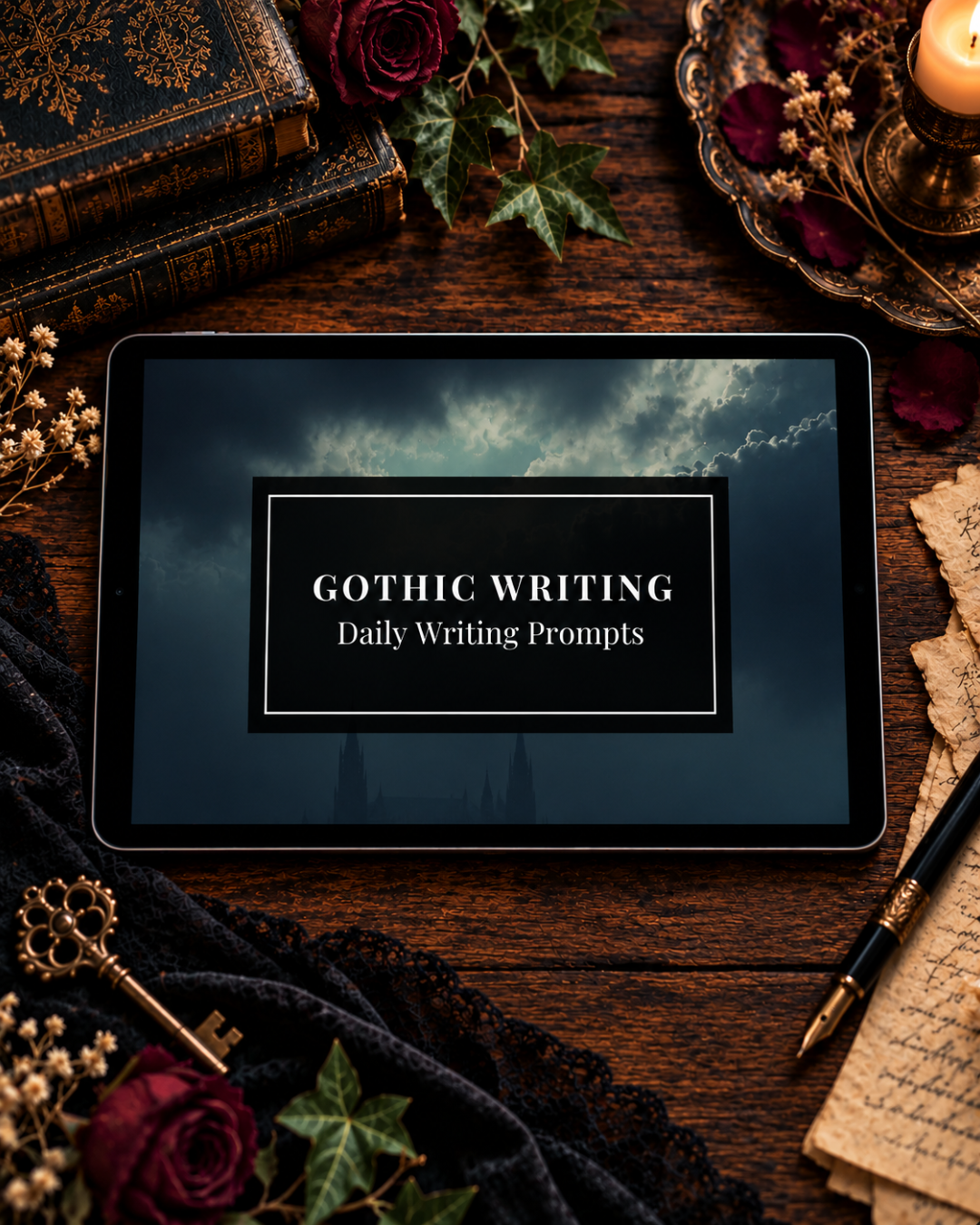
30 haunting stories. 30 dark and mysterious worlds. Endless possibilities for gothic storytelling.
Step into a world of crumbling mansions, forgotten secrets, ghostly apparitions and unsettling mysteries with this collection of 30 Gothic Daily Writing Prompts, designed to inspire imaginative storytelling, develop descriptive writing skills and build confidence in creative writing.
From abandoned castles and shadowy corridors to family curses, supernatural encounters and secrets buried for centuries, these atmospheric writing prompts encourage students and independent writers to explore the darker side of storytelling.
Each prompt provides a creative starting point alongside structured writing guidance, helping writers experiment with suspense, atmosphere, character development and the conventions of gothic fiction.
Ideal for English lessons, creative writing workshops, classroom starters, homework and independent writing practice.
What's Inside?
Each of the 30 gothic writing prompts offers multiple ways to approach a story, allowing students to develop their own interpretations and creative ideas.
Atmospheric Gothic Illustrations: Evocative visual prompts that encourage close observation, sensory description and imaginative storytelling.
Opening Lines: Intriguing story starters designed to establish atmosphere, introduce mystery and help students begin writing.
Closing Lines: Haunting final sentences that encourage students to consider narrative structure, suspense and the impact of a story's ending.
Plot Ideas: Gothic-inspired scenarios that introduce intriguing characters, mysterious events and opportunities for creative exploration.
Picture-Based Writing Activities: Guided questions that develop visual literacy, inference, descriptive language and interpretation.
Writing Tips and Discussion Questions: Structured activities that encourage students to explore narrative possibilities, develop their ideas and make deliberate writing choices.
Scaffolding Gothic Creative Writing in the Classroom
Gothic fiction offers wonderful opportunities to explore atmosphere, symbolism, suspense and the relationship between setting and emotion. However, students can sometimes struggle to transform an interesting idea into a developed story.
This collection provides flexible scaffolding for students with different levels of writing confidence and experience.
Students who need more guidance can draw on the illustrations, opening lines, plot ideas and discussion questions to build their stories step by step.
More confident writers can use the same prompts as a springboard for original narratives, experimenting with unreliable narrators, psychological tension, ambiguity and unexpected endings.
The activities can help teachers support:
Differentiated learning: Students can select the level of support they need.
Descriptive writing: Explore sensory imagery, pathetic fallacy and atmospheric settings.
Gothic conventions: Investigate mystery, isolation, supernatural elements, decay and the unknown.
Narrative structure: Develop effective openings, rising tension, climaxes and memorable endings.
Character development: Explore hidden motivations, internal conflict, fear and uncertainty.
Critical thinking and discussion: Encourage interpretation, inference and collaborative exploration of ideas.
Writing confidence: Provide accessible starting points for reluctant writers while challenging more experienced students.
Rather than offering a single prescribed story, each prompt encourages students to explore their own interpretations of gothic themes and imagery.
Flexible Activities for Teachers and Writers
Use these gothic writing prompts for:
Daily creative writing practice and classroom starters
Gothic literature and creative writing units
English and literacy lessons
Descriptive writing and atmosphere exercises
Short story writing and narrative development
Creative writing clubs and workshops
Paired discussions and collaborative storytelling
Homework, extension tasks and independent writing
Homeschooling and personal writing challenges
Each prompt can be completed as a short activity, developed into a longer gothic narrative or revisited to explore different storytelling techniques.
What You'll Receive
Your purchase includes one downloadable ZIP file containing:
1. PDF Version
A PDF featuring 30 illustrated gothic writing prompts, accompanying activities and writing guidance. Ideal for viewing, printing or displaying in the classroom.
2. Microsoft PowerPoint Version
A PowerPoint copy of the slides, providing an additional format for presenting and using the activities.
3. Google Slides Access
Both files include links and step-by-step instructions for accessing the Google Slides version, allowing you to use the collection online.
All materials are digital downloads. No physical product will be shipped.
A New Gothic Mystery Every Day
Whether you're introducing students to gothic fiction, helping reluctant writers find their confidence or encouraging more experienced storytellers to experiment with atmosphere and suspense, these prompts offer countless opportunities for dark and imaginative writing.
Enter the shadows. Uncover a secret. Begin a story.
Your next story is waiting...
Bring Gothic Darkness to Life with 30 Illustrated Writing Prompts
A forgotten mansion where the candles extinguish themselves. A shadow that moves independently of its owner. A moonless garden concealing a secret that has remained buried for centuries. Once you've discovered the vocabulary to describe darkness, the next challenge is transforming that atmosphere into an unforgettable story.
If you're ready to explore the darker side of creative writing, my Gothic Daily Writing Prompts | 30 Illustrated Creative Writing Activities collection offers 30 imaginative opportunities to experiment with Gothic settings, supernatural mysteries, haunting imagery and psychological suspense.
Available for just £2, this instantly downloadable collection includes atmospheric Gothic illustrations, intriguing opening and closing lines, original plot ideas, picture-based writing activities, and guided questions to help you develop characters, settings and stories.
Whether you're a teacher planning creative writing lessons, a student developing descriptive writing skills or an independent writer looking for fresh inspiration, each activity provides a starting point for exploring the conventions of Gothic fiction. The collection includes PDF and PowerPoint versions, alongside access to Google Slides, making it flexible for classroom teaching and personal writing practice.
Looking for something beyond Gothic fiction? Explore my wider Daily Writing Prompts collection, featuring imaginative activities across different genres, alongside seasonal and holiday-inspired writing prompts. From fantasy and mystery to festive storytelling and darker seasonal themes, there's plenty of inspiration for your next creative writing session.

6. Night Skies, Moonlight & Celestial Darkness
The darkness of the night sky possesses a different quality from the shadows of a forest or the gloom of an abandoned room. It can feel immense, peaceful, mysterious or profoundly unsettling, depending on what remains visible within it. A sky scattered with stars might suggest wonder and possibility, while a moonless horizon can make the world seem strangely empty.
Celestial darkness is particularly evocative because it creates contrasts between illumination and obscurity. Moonlight turns ordinary landscapes silver, clouds conceal distant constellations, and the last traces of sunset can leave the horizon glowing long after the ground has disappeared into shadow. In fantasy, Gothic fiction, romance and poetry, these details can establish atmosphere while also reflecting a character's emotional state.
These ten words explore the darkness of night skies, moonlit landscapes and celestial phenomena, offering vocabulary for descriptions that range from delicate and luminous to vast and mysterious.
51. Nocturnal
Meaning: Relating to or occurring during the night; associated with the atmosphere, activity or distinctive qualities of nighttime.
Best for: Night landscapes, nocturnal wildlife, atmospheric poetry and scenes that emphasise the world after sunset.
Example: A nocturnal stillness settled over the harbour, broken only by the gentle knocking of fishing boats against their moorings and the distant cry of a seabird.
52. Starless
Meaning: Without visible stars, often because of cloud cover, atmospheric conditions or an unusually dark sky.
Best for: Ominous night scenes, remote landscapes, stormy weather and descriptions of isolation beneath an empty sky.
Example: Above the deserted coastline stretched a starless sky, so uniformly black that the horizon vanished where the sea met the heavens.
53. Moonless
Meaning: Without visible moonlight, creating a night in which natural illumination may be greatly reduced.
Best for: Gothic landscapes, wilderness journeys, clandestine encounters and scenes where darkness conceals familiar surroundings.
Example: On the moonless hillside, the abandoned watchtower appeared only when lightning briefly revealed its broken silhouette against the clouds.
54. Lunar
Meaning: Relating to the moon, its light, appearance or influence.
Best for: Moonlit landscapes, celestial fantasy, romantic night scenes and descriptions involving the contrast between pale light and surrounding darkness.
Example: A lunar glow rested upon the marble statues, leaving their faces luminous while the garden paths remained hidden in deep shadow.
55. Silvered
Meaning: Covered, illuminated or made to appear silver in colour, often through the reflection of moonlight.
Best for: Moonlit forests, lakes, rooftops, winter landscapes and delicate atmospheric descriptions.
Example: The silvered rooftops of the sleeping village gleamed beneath the moon, their chimneys casting long black shadows across the frost.
56. Astral
Meaning: Relating to stars or the celestial realm; sometimes associated with mystical or otherworldly interpretations of the heavens.
Best for: Cosmic fantasy, celestial imagery, mystical landscapes and poetic descriptions of the night sky.
Example: An astral darkness opened above the mountain summit, its distant constellations burning with a brilliance that made the surrounding wilderness seem impossibly small.
57. Eclipse-darkened
Meaning: Made darker by an eclipse, particularly when the moon passes between the Earth and the sun.
Best for: Supernatural omens, fantasy rituals, apocalyptic imagery and dramatic celestial events.
Example: Beneath the eclipse-darkened sky, the fields fell into an unnatural twilight, and the birds returned to their nests as though evening had arrived hours too early.
58. Indigo
Meaning: A deep blue-violet colour, often used to describe the rich, dark tones of the sky during twilight or early night.
Best for: Romantic landscapes, twilight scenes, atmospheric poetry and descriptions that use colour to suggest the gradual arrival of darkness.
Example: The indigo sky deepened above the orchard, where the first stars appeared between the branches of the old apple trees.
59. Midnight-blue
Meaning: An extremely dark shade of blue, resembling the colour of a clear night sky.
Best for: Celestial descriptions, moonlit landscapes, dreamy fantasy settings and scenes that require a softer alternative to black.
Example: A midnight-blue darkness stretched above the sleeping city, interrupted by the golden domes of distant churches and the faint shimmer of scattered stars.
60. Crepuscule
Meaning: Twilight or the dim period between daylight and darkness, particularly around sunset.
Best for: Literary fiction, poetic landscapes, reflective scenes and descriptions of the transition from evening into night.
Example: During the last moments of crepuscule, the distant mountains became delicate silhouettes, their jagged peaks fading into the violet-grey sky.
Writing Tip: When describing the night sky, consider how much light remains and where it originates. Moonlight, starlight, artificial illumination and the lingering glow of sunset all create different effects upon a landscape. Rather than describing the sky in isolation, show how celestial light transforms the world beneath it: a river becomes a silver ribbon, windows gleam against dark hillsides, or familiar buildings disappear beneath an unusually starless sky. These relationships between sky and landscape make descriptions feel more immersive and visually convincing.
7. Supernatural, Uncanny & Unnatural Darkness
Some fictional darkness refuses to behave as darkness should. It gathers where light ought to reach, moves independently of the objects around it or appears to possess an awareness of those who enter its boundaries. A room may remain dark despite the arrival of daylight, while a shadow might stretch towards a character without anything nearby to cast it.
In supernatural horror, Gothic fantasy and speculative fiction, darkness can become an active force rather than a passive environmental condition. It might conceal a doorway into another world, signal the presence of an unseen entity or suggest that the familiar laws of nature have begun to unravel.
These ten words explore darkness that feels impossible, enchanted, sentient or fundamentally wrong, helping writers create unsettling atmospheres without immediately revealing the supernatural forces at work.
61. Preternatural
Meaning: Beyond what is normal or natural, suggesting something extraordinary, inexplicable or seemingly supernatural.
Best for: Gothic mysteries, haunted locations, inexplicable phenomena and scenes where ordinary darkness behaves in an unusual way.
Example: A preternatural darkness filled the observatory, remaining perfectly still even as the morning sunlight poured through the shattered dome.
62. Otherworldly
Meaning: Strange, ethereal or seemingly belonging to a realm beyond ordinary human experience.
Best for: Dark fantasy, supernatural encounters, enchanted landscapes and mysterious places that feel disconnected from reality.
Example: An otherworldly darkness shimmered between the standing stones, revealing faint shapes that vanished whenever she attempted to focus upon them.
63. Eldritch
Meaning: Strange, eerie or frightening in a supernatural or uncanny way, particularly when suggesting ancient and inexplicable forces.
Best for: Cosmic horror, ancient curses, forbidden rituals and descriptions of darkness associated with unknowable powers.
Example: An eldritch gloom seeped from the open sarcophagus, carrying the scent of cold earth and extinguishing every flame within the burial chamber.
64. Sentient
Meaning: Capable of sensation, awareness or perception; when applied to darkness, suggesting that it possesses a consciousness of its own.
Best for: Supernatural horror, living shadows, cursed spaces and fantasy settings where darkness acts as an independent entity.
Example: The sentient darkness withdrew whenever he raised the lantern, only to creep forward again when his attention turned towards the locked door.
65. Phantasmal
Meaning: Resembling a phantom, apparition or illusion; ghostly, insubstantial or unreal in appearance.
Best for: Ghost stories, spectral landscapes, dream sequences and descriptions where darkness seems to contain fleeting apparitions.
Example: Phantasmal shadows drifted across the ballroom walls, briefly forming the outlines of dancers before dissolving into the surrounding gloom.
66. Spectral
Meaning: Resembling or relating to a ghost, often suggesting something pale, eerie or supernatural.
Best for: Haunted interiors, ghostly apparitions, supernatural mysteries and atmospheric descriptions of strange light within darkness.
Example: A spectral glow emerged from the darkness beneath the lake, illuminating the submerged windows of a village that had vanished a century before.
67. Chthonic
Meaning: Relating to the underworld or the depths beneath the earth, particularly in mythology and ancient religious traditions.
Best for: Underworld fantasy, ancient deities, subterranean horror and darkness associated with buried or primordial forces.
Example: From the chthonic depths beneath the temple rose a darkness that carried the distant sound of voices speaking in a language no living person remembered.
68. Unhallowed
Meaning: Not sacred or blessed; often suggesting something profane, cursed or associated with evil.
Best for: Desecrated churches, forbidden rituals, cursed burial grounds and Gothic settings involving corrupted sacred spaces.
Example: An unhallowed darkness clung to the ruined altar, untouched by the shafts of sunlight that illuminated the rest of the abandoned church.
69. Enchanted
Meaning: Affected by magic or supernatural influence, often suggesting something mysterious, wondrous or bewitched.
Best for: Dark fairytales, magical forests, fantasy landscapes and scenes where darkness possesses unusual or magical properties.
Example: The enchanted darkness of the orchard concealed an impossible number of paths, each leading back to the same ancient tree beneath which the traveller had fallen asleep.
70. Uncanny-valley
Meaning: Referring to the unsettling sensation produced by something that appears almost human or familiar but contains subtle abnormalities; most accurately applied to humanlike figures rather than darkness itself.
Best for: Psychological horror, distorted perceptions, supernatural doubles and scenes where darkness makes familiar human shapes appear subtly wrong.
Example: In the dim hallway, the portrait acquired an uncanny-valley quality: its painted face seemed almost alive, yet its eyes remained fixed upon a point just beyond her shoulder.
Writing Tip: Supernatural darkness is often most effective when it violates one ordinary expectation. Shadows should follow the position of a light source, but what happens when they move against it? A room should brighten when its curtains are opened, but what if the darkness remains? By establishing a familiar physical rule and then quietly breaking it, you can create a disturbing atmosphere without relying on dramatic supernatural revelations. The contrast between what should happen and what actually occurs allows the reader's imagination to do much of the work.
8. Emotional, Symbolic & Metaphorical Darkness
Darkness is not always something a character can see. In literature, it frequently becomes a metaphor for grief, uncertainty, guilt, loneliness or the parts of human experience that resist understanding. A character might describe the world as dark even while standing in brilliant sunlight, revealing more about their emotional state than their physical surroundings.
Symbolic darkness is particularly powerful because it allows setting and emotion to interact. A neglected garden might reflect a character's unresolved grief, while a dimly lit room could suggest secrecy, isolation or the gradual loss of hope. Rather than explicitly explaining what someone feels, a writer can allow the atmosphere to communicate those emotions indirectly.
These ten words explore darkness as an emotional, psychological and symbolic presence, offering vocabulary for descriptions that reveal character, deepen themes and create layers of meaning beyond the literal setting.
71. Melancholic
Meaning: Characterised by a deep, reflective sadness, often associated with longing, loss or quiet emotional suffering.
Best for: Literary fiction, reflective poetry, grief narratives and descriptions where darkness mirrors sorrow or nostalgia.
Example: A melancholic darkness settled over the empty kitchen, where the clock continued its patient ticking and two cups remained on the table, although only one would ever be used again.
72. Desolate
Meaning: Empty, abandoned or bleak; also describing an overwhelming feeling of loneliness, grief or emotional devastation.
Best for: Stories of loss, isolated landscapes, abandoned homes and descriptions that connect physical emptiness with emotional suffering.
Example: The desolate darkness of the station seemed to stretch beyond the deserted platforms, swallowing the railway tracks that had once carried him home.
73. Hollow
Meaning: Empty inside; figuratively suggesting emotional emptiness, absence or a profound lack of meaning.
Best for: Psychological fiction, bereavement, emotional isolation and descriptions of spaces that reflect an internal sense of loss.
Example: A hollow darkness filled the house after the funeral, not because the lamps had been extinguished, but because every familiar room seemed to have lost its purpose.
74. Bleak
Meaning: Cold, bare, cheerless or lacking hope, often suggesting emotional or environmental harshness.
Best for: Dystopian fiction, winter landscapes, psychological realism and descriptions of despair or hopelessness.
Example: The bleak darkness beyond the hospital window offered no comfort, only the distant glow of traffic moving through a city that seemed entirely indifferent to her grief.
75. Broodingly
Meaning: In a deeply thoughtful, troubled or ominous manner, suggesting emotions or tensions that remain unresolved.
Best for: Psychological descriptions, emotionally charged settings and passages where darkness reflects unspoken thoughts.
Example: The darkness gathered broodingly around the empty fireplace, as though the room itself were contemplating everything its occupants had refused to say.
76. Despairing
Meaning: Expressing or characterised by a complete loss of hope.
Best for: Tragic fiction, emotionally intense scenes, psychological horror and descriptions of darkness that symbolises hopelessness.
Example: A despairing darkness seemed to close around her as she read the final sentence of the letter, leaving the bright afternoon beyond the window strangely distant.
77. Inscrutable
Meaning: Impossible or extremely difficult to understand, interpret or read.
Best for: Literary mysteries, psychological fiction, morally ambiguous characters and descriptions of darkness that symbolises uncertainty or hidden meaning.
Example: The inscrutable darkness of the study concealed the expression of the man seated opposite her, leaving his silence more troubling than any answer he might have offered.
78. Haunted
Meaning: Persistently troubled by memories, regrets, fears or the lingering influence of the past; also associated with supernatural presences.
Best for: Trauma narratives, Gothic fiction, memory-driven stories and descriptions where darkness evokes unresolved experiences.
Example: A haunted darkness lingered in the childhood bedroom, where the familiar wallpaper and faded curtains seemed to preserve every argument that had once passed between its walls.
79. Despondent
Meaning: Feeling or expressing deep discouragement, low spirits or a loss of hope.
Best for: Character-centred fiction, depressive atmospheres, stories of disappointment and descriptions reflecting emotional exhaustion.
Example: The despondent gloom of the boarding house seemed to seep into his thoughts, until even the promise of morning felt like another obligation to endure.
80. Existential
Meaning: Relating to human existence, meaning, identity and the fundamental uncertainties of life.
Best for: Philosophical fiction, cosmic horror, introspective poetry and descriptions where darkness represents the unknown or the apparent insignificance of human existence.
Example: An existential darkness opened within him as he stared into the immense night sky, suddenly conscious of how briefly a human life flickered against the age of the universe.
Writing Tip: Symbolic darkness is most effective when it grows naturally from a character's experience rather than being imposed upon the setting. A grieving character may notice the absence of light in a once-familiar home, while someone burdened by guilt might perceive ordinary shadows as threatening. Consider how two characters experiencing the same physical darkness might interpret it differently. One could find comfort in the privacy of night, while another might feel overwhelmed by its silence. This contrast allows darkness to reveal personality, emotional history and internal conflict without relying on direct explanation.
9. Darkness in Buildings, Rooms & Abandoned Places
Interior darkness has an intimacy that open landscapes rarely possess. Within a building, walls and ceilings restrict movement, doorways conceal adjoining spaces, and familiar objects become difficult to recognise when the light begins to fade. A room that feels ordinary during daylight can become unsettling at night, particularly when its corners disappear into shadow or its architecture seems to change in the absence of illumination.
Abandoned buildings offer especially rich opportunities for atmospheric description. Dust-covered windows, boarded entrances, collapsed staircases and forgotten furniture all influence how light moves through a space. Darkness might gather beneath exposed rafters, fill the gaps between broken floorboards or conceal the far end of a corridor that appears to stretch beyond the building's exterior dimensions.
These ten words explore the enclosed, architectural and often unsettling darkness of interior spaces, helping writers describe everything from neglected Victorian houses to underground passages and forgotten rooms.
81. Unilluminated
Meaning: Not illuminated or lit, particularly in a space where artificial or natural light might otherwise be expected.
Best for: Abandoned buildings, dark corridors, stairwells and descriptions of rooms without functioning lights.
Example: The unilluminated staircase rose through the centre of the house, its upper steps disappearing into a darkness untouched by the weak daylight below.
82. Cavernous
Meaning: Resembling a cavern in size, depth or spaciousness, often suggesting a large interior that feels hollow or difficult to illuminate.
Best for: Empty warehouses, grand halls, underground chambers, abandoned factories and vast Gothic interiors.
Example: A cavernous darkness filled the deserted railway depot, where the distant roof beams vanished above rows of rusting locomotives.
83. Recessed
Meaning: Set back or situated within a hollow or indentation in a wall or other surface.
Best for: Architectural descriptions, Gothic corridors, concealed alcoves, doorways and interiors where shadows gather in structural recesses.
Example: Within the recessed darkness of the hallway, a narrow doorway stood half-open, revealing a strip of wallpaper that did not match the rest of the house.
84. Windowless
Meaning: Having no windows, and therefore lacking direct natural light.
Best for: Underground rooms, hidden chambers, storage spaces, secret passages and claustrophobic interior settings.
Example: The windowless room remained in darkness even at midday, its low ceiling and bare plaster walls making the silence feel almost physical.
85. Dust-veiled
Meaning: Covered or obscured by a layer of dust, suggesting neglect and a softened or diminished quality of light.
Best for: Abandoned houses, forgotten attics, neglected libraries and interiors where dust alters visibility and atmosphere.
Example: A dust-veiled gloom settled over the attic, where broken picture frames and forgotten trunks stood beneath the sloping roof like relics of another century.
86. Vaulted
Meaning: Having an arched ceiling or roof, often creating a lofty enclosed space associated with Gothic or historical architecture.
Best for: Cathedrals, crypts, medieval halls, underground passages and imposing architectural interiors.
Example: The vaulted darkness of the cathedral rose above the congregation, its highest arches lost in shadow despite the candles burning along the nave.
87. Claustrophobic
Meaning: Creating a feeling of uncomfortable confinement, restricted movement or anxiety associated with enclosed spaces.
Best for: Narrow corridors, underground tunnels, sealed rooms and psychological horror involving restricted environments.
Example: A claustrophobic darkness crowded the passage, where the low ceiling forced him to stoop and the rough stone walls brushed against his shoulders.
88. Cobwebbed
Meaning: Covered with cobwebs, often suggesting abandonment, age, neglect or long periods without disturbance.
Best for: Forgotten rooms, abandoned mansions, old cellars and Gothic interiors where accumulated neglect contributes to the atmosphere.
Example: The cobwebbed darkness beneath the staircase concealed a collection of children's shoes, each pair arranged neatly beside the next despite the decades of dust.
89. Stifling
Meaning: Oppressively hot, airless or difficult to endure; figuratively suggesting an atmosphere that feels suffocating or restrictive.
Best for: Sealed rooms, neglected attics, underground spaces and descriptions where darkness combines with heat or poor ventilation.
Example: Stifling darkness filled the boarded-up conservatory, where the smell of damp soil and rotting leaves hung heavily in the unmoving air.
90. Labyrinthine
Meaning: Resembling a labyrinth; complex, confusing and difficult to navigate because of numerous passages or interconnected spaces.
Best for: Gothic mansions, underground tunnels, abandoned institutions, ancient castles and disorientating architectural settings.
Example: The labyrinthine darkness of the abandoned asylum swallowed one corridor after another, until every turning seemed to lead towards another identical row of locked doors.
Writing Tip: When describing darkness inside buildings, use architecture to shape the reader's experience. Low ceilings and narrow passages can make darkness feel oppressive, while enormous halls and high vaulted roofs create uncertainty through their invisible boundaries. Think about how the available light enters the space: a boarded window might admit a single narrow beam, while a cracked doorway could reveal a faint glow from another room. These details make interior darkness feel physically convincing and allow the building itself to contribute to the atmosphere. In Gothic fiction, the most effective locations often seem to conceal more than their architecture should reasonably allow.
10. Poetic, Literary & Atmospheric Darkness
Some of the most memorable descriptions of darkness are not concerned with how little light remains, but with the impression that darkness leaves upon the imagination. It might resemble a dark sea, spill across a landscape like liquid ink or settle over a city with the weight of an enormous curtain. Through carefully chosen imagery, writers can transform an ordinary nighttime setting into something beautiful, melancholic, mysterious or deeply unsettling.
Poetic descriptions often give darkness qualities that it does not literally possess. It becomes fluid, textured, immense or strangely alive, interacting with the landscape and influencing the emotional rhythm of a passage. These effects can be particularly powerful in literary fiction, Gothic writing, fantasy and poetry, where atmosphere contributes as much to the reader's experience as action or dialogue.
These final ten words explore the colour, movement, texture and imaginative possibilities of darkness, offering vocabulary for descriptions that feel distinctive, evocative and rich in literary imagery.
91. Ebon
Meaning: Black or resembling ebony, a dense, dark wood; a literary adjective used to evoke rich, intense blackness.
Best for: Gothic poetry, dark fantasy, elegant nightscapes and descriptions that require an elevated alternative to black.
Example: An ebon night descended upon the harbour, turning the anchored ships into dark silhouettes beneath the distant shimmer of lighthouse beams.
92. Sable
Meaning: Deep black in colour; a literary and poetic term often associated with darkness, mourning and the rich blackness of certain fabrics or furs.
Best for: Victorian Gothic fiction, melancholic poetry, night skies and descriptions that combine darkness with elegance or solemnity.
Example: The sable folds of evening gathered around the old estate, concealing its neglected gardens beneath a darkness as rich and heavy as mourning silk.
93. Obsidian
Meaning: Resembling obsidian, a naturally occurring volcanic glass typically associated with a glossy, intensely black surface.
Best for: Dark fantasy, reflective water, polished stone, supernatural landscapes and descriptions of darkness with a smooth or glasslike appearance.
Example: The lake lay beneath an obsidian sky, its perfectly still surface reflecting the stars with such clarity that the boundary between water and heavens seemed to disappear.
94. Noctilucent
Meaning: Appearing to glow or shine at night; particularly associated with rare high-altitude clouds that remain illuminated after sunset.
Best for: Celestial poetry, atmospheric landscapes, magical realism and descriptions of delicate luminosity within surrounding darkness.
Example: Noctilucent clouds shimmered above the northern horizon, their delicate silver-blue ribbons glowing against the deepening darkness of the summer night.
95. Lambent
Meaning: Softly glowing, flickering or playing lightly over a surface, particularly in reference to gentle flames or reflected light.
Best for: Candlelit interiors, moonlit water, magical landscapes and descriptions where delicate illumination contrasts with darkness.
Example: A lambent glow travelled across the flooded marble floor, revealing fragments of the ruined palace before dissolving into the darkness beneath its arches.
96. Ink-washed
Meaning: Appearing as though covered or coloured with diluted ink; a figurative expression suggesting soft, flowing shades of darkness.
Best for: Literary landscapes, atmospheric poetry, misty cities and descriptions that resemble watercolour or ink paintings.
Example: The ink-washed hills faded into the distance, each successive ridge becoming a softer shade of charcoal beneath the approaching night.
97. Nebulous
Meaning: Hazy, cloudlike or indistinct in form; also suggesting something vague, uncertain or difficult to define.
Best for: Dream sequences, mist-filled landscapes, cosmic imagery and descriptions of darkness without clear boundaries.
Example: A nebulous darkness drifted through the ruined greenhouse, blurring the broken glass and tangled vines until the entire structure seemed to exist somewhere between memory and dream.
98. Veiled
Meaning: Partially concealed or obscured as though covered by a thin layer of fabric; often suggesting mystery, softness or incomplete visibility.
Best for: Romantic landscapes, Gothic mysteries, moonlit gardens and poetic descriptions of partially hidden scenery.
Example: The distant mountains stood veiled in darkness, their pale summits briefly emerging whenever the clouds released a fragment of moonlight.
99. Undulating
Meaning: Moving or appearing to move in smooth, continuous waves.
Best for: Rolling landscapes, dark seas, shifting mist, dreamlike settings and descriptions that give darkness a sense of fluid movement.
Example: An undulating darkness spread across the wheat fields as the wind bent the tall stalks, sending wave after wave of shadow towards the abandoned farmhouse.
100. All-encompassing
Meaning: Surrounding, including or affecting everything, leaving no apparent space untouched.
Best for: Immersive Gothic descriptions, vast nightscapes, psychological fiction and scenes where darkness dominates the entire environment.
Example: An all-encompassing darkness settled over the valley, erasing the roads, the river and the scattered farmhouses until the world seemed reduced to the sound of wind moving through unseen trees.
Writing Tip: Poetic darkness becomes most effective when imagery is chosen with a clear purpose. Comparing night to silk might create an atmosphere of intimacy or elegance, while describing darkness as ink suggests fluidity, depth or the gradual disappearance of detail. Consider the associations carried by your chosen words and whether they reinforce the mood of your scene.
You can also create atmosphere through contrast. A lambent flame may appear more delicate against an ebon night, while a noctilucent sky becomes extraordinary precisely because of the darkness surrounding it. Rather than filling every sentence with elaborate adjectives, select one or two striking images and allow the remaining details to support them. Restraint often makes poetic descriptions more memorable, giving the reader space to experience the atmosphere rather than simply observe it.
How to Describe Darkness Without Repeating “Dark”
One of the most common challenges in descriptive writing is finding ways to establish a dark atmosphere without repeatedly relying on words such as dark, black, dim or shadowy. Although these words are perfectly useful, excessive repetition can flatten a description, particularly when the setting is intended to feel mysterious, atmospheric or emotionally significant.
The solution is not simply to replace familiar adjectives with more elaborate alternatives. Effective descriptions of darkness focus on what the absence of light changes: how objects appear, how characters navigate their surroundings, which sounds become noticeable and what emotions the setting begins to evoke.
Rather than telling the reader that a place is dark, you can demonstrate darkness through its effects. A staircase might disappear before reaching the next floor. A familiar room might become difficult to recognise. A character might reach for a wall that seems much farther away than expected.
The following techniques will help you create more varied, immersive and evocative descriptions of darkness.
1. Describe What Darkness Conceals
One of the simplest ways to establish darkness is to focus on what can no longer be seen. Rather than describing the darkness itself, show how it erases familiar objects, obscures distances or prevents a character from understanding their surroundings.
This approach is especially effective in Gothic fiction and suspense because uncertainty encourages the reader to imagine what might exist beyond the visible scene.
Instead of:
The corridor was very dark, and she could not see the end.
Try:
The corridor stretched beyond the reach of her candle, its distant doorways disappearing one by one into an indistinguishable blackness.
The second description gives darkness a practical effect. It changes the character's perception of the corridor and creates uncertainty about its dimensions.
You can develop this technique by considering which details disappear first. Colours often become difficult to distinguish before shapes vanish entirely. Distant objects lose their definition, while nearby surfaces might remain visible as faint outlines.
In a particularly unsettling scene, a character may recognise individual objects without being able to understand how they relate to the space around them.
2. Use Light to Reveal the Darkness
Darkness often becomes more vivid when contrasted with a small source of illumination. Candles, lanterns, moonlight, distant windows and the glow of a dying fire can reveal the boundaries between what is visible and what remains concealed.
A single illuminated object can also draw the reader's attention towards an otherwise ordinary detail, making the surrounding darkness feel deeper.
Instead of:
The room was dark except for a candle.
Try:
The candle illuminated a narrow circle of floorboards, leaving the furniture beyond it suspended in uncertain shapes.
Notice how the description establishes both light and darkness without relying on repeated adjectives.
Consider the quality of your light source. Candlelight flickers, creating unstable shadows. Moonlight can reveal shapes while draining them of colour. A torch produces a concentrated beam, exposing one detail while leaving everything outside its reach invisible.
The smaller or less reliable the light source, the more opportunities you have to create suspense through selective visibility.
3. Introduce Sound When Sight Becomes Unreliable
When characters cannot rely on their vision, other senses become increasingly important. Sounds that might ordinarily pass unnoticed can become prominent, particularly in unfamiliar or threatening surroundings.
A floorboard creaking in an illuminated room may seem insignificant. The same sound in complete darkness can suggest movement, proximity or the presence of something unseen.
Instead of:
It was dark and frightening inside the abandoned house.
Try:
Somewhere beyond the staircase, a floorboard gave a slow, deliberate creak. She waited for another, but the silence returned before she could determine which room it had come from.
This description creates an impression of darkness through the character's inability to locate the sound.
Consider using:
Distant sounds: Footsteps, dripping water, bells or voices that cannot be precisely located.
Nearby sounds: Breathing, rustling fabric, scratching or the movement of an unseen object.
Environmental sounds: Wind beneath doors, rain against windows, branches scraping stone or old timbers settling.
Unexpected silence: The sudden absence of familiar background noise, particularly in places where sound should be present.
Silence can be as effective as noise. A woodland that abruptly falls quiet may feel more unsettling than one filled with unfamiliar sounds.
4. Give Darkness Texture, Weight and Temperature
Darkness is not physically solid, yet figurative language allows writers to describe it as though it possesses material qualities.
It might hang like heavy fabric, flow like ink, settle like dust or gather in the corners of a room. These comparisons can make an otherwise abstract condition feel immediate and tangible.
Instead of:
Thick darkness surrounded the old cottage.
Try:
Night settled around the cottage like damp wool, muffling the distant road and pressing its cold weight against the windowpanes.
The comparison creates a sense of heaviness, confinement and discomfort while also introducing temperature and sound.
Different textures produce different emotional effects. Darkness compared to velvet or silk may feel luxurious, intimate or comforting. Darkness resembling tar, smoke or stagnant water might suggest suffocation, contamination or danger. Darkness described as mist or gauze can feel delicate, elusive or dreamlike.
Choose comparisons that support the atmosphere you want rather than adding figurative language simply for decoration.
5. Show How Darkness Changes Familiar Objects
A particularly effective Gothic technique is to describe ordinary objects becoming unfamiliar as the light fades.
Furniture, clothing, trees and architectural features can acquire strange proportions or resemble entirely different things. The reader understands that the objects have not necessarily changed, but the character's perception of them has.
Instead of:
The bedroom looked creepy in the dark.
Try:
The coat hanging behind the door had become the outline of a motionless stranger, its empty sleeves reaching almost to the floor.
This technique creates unease without requiring a supernatural explanation.
You might transform a wardrobe into a towering silhouette, a curtain into the suggestion of a figure, or a tree's branches into outstretched fingers.
For greater subtlety, allow the character to recognise the object after a moment of uncertainty. The brief misinterpretation can establish vulnerability and heighten suspense, particularly if a later shape proves less easily explained.
6. Use Movement to Make Darkness Feel Alive
Although darkness does not move independently, changing light and shadow can create the impression that it is spreading, retreating, gathering or advancing.
Verbs are especially valuable here because they allow you to create atmosphere without adding more descriptive adjectives.
Compare these two sentences:
The dark shadows were everywhere in the room.
Shadows crept beneath the furniture and climbed the walls as the fire dwindled.
The second sentence creates a more dynamic scene by showing how the changing firelight alters the appearance of the room.
Experiment with verbs such as crept, pooled, seeped, swallowed, gathered, drifted, spread, engulfed, receded and dissolved.
Each verb suggests a slightly different behaviour. Darkness that pools feels heavy and contained, while darkness that seeps suggests gradual intrusion. Darkness that swallows creates a stronger impression of disappearance or threat.
In supernatural fiction, these verbs can also suggest that darkness possesses an intention of its own.
7. Connect Darkness to Your Character’s Emotional State
Darkness becomes more meaningful when it reflects or contrasts with the emotions of the person experiencing it.
A character who feels safe may welcome the privacy of night, noticing the quiet streets, softened colours and comforting glow of familiar windows. Someone experiencing grief might interpret the same scene as empty and indifferent.
Instead of:
The darkness made him feel lonely.
Try:
Across the valley, the lights of distant houses appeared one by one. He watched them from the unlit kitchen, imagining the conversations unfolding behind each window.
The character's isolation emerges through contrast rather than direct explanation.
This technique is particularly useful in literary fiction, poetry and character-driven Gothic narratives. It allows descriptions to contribute to characterisation while avoiding unnecessary statements about what a character feels.
You can also create emotional complexity by deliberately contrasting atmosphere and emotion. A peaceful night might surround a character awaiting terrible news, while a frighteningly dark room could offer someone their first moment of privacy and relief.
8. Experiment with Sentence Length and Rhythm
Atmosphere is influenced not only by the words you choose, but also by the rhythm of your sentences.
Longer, flowing sentences can create a sense of gradual immersion, allowing darkness to unfold across a landscape or interior. Short sentences can interrupt that movement, drawing attention to a sudden sound, discovery or moment of uncertainty.
For a slow, atmospheric description:
Beyond the final row of cottages, the road descended towards the marshes, where the last traces of evening dissolved into the reeds and the distant water reflected nothing of the sky above.
For a sharper moment of suspense:
The lantern went out. Somewhere ahead, something moved.
Neither approach is inherently better. The strongest descriptive passages often vary their rhythm to control how quickly the reader experiences the scene.
Try using longer sentences to establish the environment, then introduce a shorter sentence when the character notices something unexpected.
9. Choose Specific Details Instead of Excessive Adjectives
It can be tempting to describe a Gothic setting as dark, sinister, ominous, oppressive and terrifying within a single sentence. However, stacking atmospheric adjectives often tells the reader how to interpret the scene without providing the details that would make those emotions convincing.
A more effective approach is to select one precise descriptive word and support it with carefully observed details.
Instead of:
The old mansion was incredibly dark, gloomy, sinister and frightening.
Try:
The mansion stood beyond the locked gates, its windows boarded from within and its upper floors concealed beneath the branches of enormous yew trees.
The second version allows the architecture and surroundings to establish the atmosphere.
Ask yourself whether each adjective contributes something distinct. If two words communicate essentially the same impression, consider removing one and replacing it with an image, action or sensory detail.
This is particularly important when writing longer descriptive passages. Readers are more likely to remember a single unusual detail than a succession of similar atmospheric words.
10. Let Darkness Change as the Scene Progresses
Darkness does not need to remain constant throughout a scene. It can deepen as daylight fades, shift with the movement of clouds, retreat before a rising moon or become more difficult to navigate as a character moves farther from a light source.
Describing these changes creates progression and prevents the setting from feeling static.
For example, a forest scene might begin with recognisable paths and patches of fading sunlight. As evening approaches, the gaps between the trees become indistinct. Eventually, the character can identify the path only by the texture of the ground beneath their feet.
You can also reverse this progression. A scene might begin in complete darkness, then gradually reveal its surroundings as a character's eyes adjust or a distant light becomes visible.
In Gothic and supernatural writing, changes in darkness can carry narrative significance. A shadow might lengthen against the direction of the setting sun, or a room might remain unilluminated despite the arrival of morning.
The key is to make darkness participate in the scene rather than simply surround it. As visibility changes, so can the character's confidence, understanding and sense of safety.
Bringing These Techniques Together
The richest descriptions of darkness rarely rely upon a single technique. Instead, they combine carefully chosen vocabulary with changes in visibility, sensory details, emotional associations and deliberate sentence rhythms.
Consider this short passage:
The last of the evening light withdrew from the staircase, leaving the upper landing beyond the reach of the hall lamp. She could still distinguish the banister and the pale rectangle of a closed door, but the portraits along the wall had disappeared into shadow. Somewhere above her, a clock began to strike. She counted five chimes before realising that the house contained no working clocks.
The passage uses darkness to obscure familiar objects, introduces a limited light source, establishes spatial uncertainty and creates suspense through an unexpected sound. Rather than repeatedly telling the reader that the house is dark or frightening, it allows the details to produce those impressions.
When revising your own descriptive writing, look for sentences that merely announce the presence of darkness. Ask what your character can no longer see, what becomes newly noticeable and how the environment influences their thoughts or actions.
The most evocative darkness is not necessarily the deepest or most frightening. It is the darkness that changes how the reader experiences the world of your story.
10 Original Descriptive Writing Examples of Darkness
The most effective descriptions of darkness do more than establish that a setting is poorly illuminated. They shape the reader's experience of a place, revealing its atmosphere through carefully chosen details, sensory impressions and the relationship between light and shadow.
A Gothic corridor might feel threatening because its farthest doorway remains invisible, while a moonlit garden could evoke tranquillity through the delicate contrast between silver light and deep shadow. Darkness can also reflect grief, conceal danger, create intimacy or transform an ordinary location into something strangely unfamiliar.
The following ten original descriptive passages demonstrate different approaches to writing about darkness. Each explores a distinct setting, mood or literary technique, offering inspiration for Gothic fiction, fantasy, horror, poetry and atmospheric storytelling.
1. The Darkness of an Abandoned Victorian Mansion
Gothic Atmosphere · Architectural Detail · Suspense
The last of the daylight had abandoned the upper floors, leaving the grand staircase suspended between the pale entrance hall and a darkness that seemed to have no end. Along the landing, the portraits of forgotten ancestors emerged in fragments: a powdered forehead, the gleam of a painted jewel, a hand resting upon the arm of a chair. Their faces remained concealed. A draught moved through the house, carrying the faint smell of extinguished candles and damp plaster. Somewhere beyond the staircase, a door closed with the soft, deliberate click of a latch. The sound travelled through the empty rooms and faded. Nothing followed it. Yet the shadows beneath the landing seemed somehow deeper than they had been a moment before.
Why this description works: The passage uses selective visibility to create uncertainty, revealing individual details while concealing the wider environment. Architectural features establish the setting, while the unexplained closing door introduces suspense without revealing an immediate threat. The darkness becomes unsettling because it prevents the reader from fully understanding the space.
2. A Moonless Forest at Midnight
Natural Darkness · Sensory Detail · Isolation
Without the moon, the forest had lost its distances. Trees that had stood several yards apart during daylight now crowded together in an indistinguishable mass, their branches woven into a black canopy overhead. The path remained visible only as a faint interruption in the undergrowth, a narrow strip of earth that disappeared whenever the traveller looked too far ahead. Wet leaves softened his footsteps. Somewhere among the pines, water dripped steadily from branch to branch, and the occasional crack of dead wood made him stop and listen. He could smell the cold, mineral scent of the stream, though he could no longer remember which direction it lay. Above him, the stars were hidden. Below, the ground sloped gradually into a darkness he could neither measure nor recognise.
Why this description works: Rather than relying on threatening adjectives, the passage establishes vulnerability through the loss of familiar landmarks. Sound, smell and touch become increasingly important as vision becomes unreliable. The darkness feels immersive because it changes the character's ability to navigate the landscape.
3. A Peaceful Bedroom on a Rainy Night
Gentle Darkness · Comfort · Intimacy
The bedroom had softened into darkness, its familiar corners disappearing beneath the quiet blue-grey of the rainy evening. A small lamp glowed beside the bed, illuminating the open pages of a novel and the delicate steam rising from a forgotten cup of tea. Beyond the curtains, rain whispered against the window, sometimes gathering into heavier drops that slipped slowly down the glass. The wardrobe, the chair and the little table beside the door had become indistinct shapes, yet their presence was reassuring rather than strange. Nothing demanded attention. Nothing needed to be done before morning. As the lamp clicked off, the room settled into a velvety stillness, and the distant sounds of the world seemed to withdraw beyond the walls.
Why this description works: Darkness is presented as protective rather than threatening. Familiar objects, gentle sounds and small sources of warmth establish a sense of security. The passage demonstrates how subdued lighting and soft sensory details can make nighttime feel restful and intimate.
4. A Forgotten Underground Passage
Claustrophobia · Physical Sensation · Gothic Horror
The passage narrowed so gradually that he did not notice until his shoulders began to brush against the stone. The lantern illuminated a few feet of uneven floor, beyond which the tunnel disappeared into a lightless curve. Moisture gathered upon the walls and ran beneath his fingers as he steadied himself. The air tasted of limestone and stagnant water. Every movement disturbed the silence: the scrape of his boots, the faint clink of the lantern handle, the shallow rhythm of his breathing. When he stopped, the sounds stopped with him. Then, somewhere in the darkness ahead, came the slow drip of water. He waited. Another drop followed, closer this time. He raised the lantern, but the passage revealed nothing except the same wet stones and the black opening beyond them.
Why this description works: The setting becomes oppressive through restricted movement, damp surfaces and limited illumination. The progression from a distant sound to one apparently closer creates tension without introducing a visible threat. The passage demonstrates how darkness can intensify a character's awareness of their physical surroundings.
5. A City Disappearing into Evening
Urban Atmosphere · Melancholy · Light and Contrast
Evening descended upon the city in layers. First, the upper windows of the office buildings turned from gold to grey, reflecting the last light of a sky already darkening behind the rooftops. Then the narrow streets filled with shadow, and the people crossing them became silhouettes beneath the pale glow of shopfronts. Traffic lights changed at empty junctions. Rain gathered in the gutters, carrying fragments of neon across the pavement in trembling ribbons of red and blue. From the apartment window, the city appeared both crowded and strangely remote, its thousands of illuminated rooms suggesting lives unfolding beyond reach. She watched the lights appear, one after another, until the buildings themselves had disappeared and only their windows remained.
Why this description works: The gradual transition from daylight to darkness gives the passage movement and progression. Artificial light creates visual contrast, while the final image of illuminated windows introduces an emotional dimension. The darkness does not make the city empty; it makes its inhabitants seem distant and inaccessible.
6. An Ancient Forest Beneath an Enchanted Night
Dark Fantasy · Magical Atmosphere · Wonder
Beneath the oldest trees, night possessed a colour that belonged neither to black nor blue. It gathered in deep green folds around the roots, shimmered faintly upon the moss and moved like submerged water between the enormous trunks. Pale fungi glowed along fallen branches, illuminating delicate patterns in the bark, while tiny lights drifted through the undergrowth without casting shadows. Far above, the canopy concealed the stars, yet the forest seemed to possess a secret illumination of its own. The traveller passed beneath an arch of twisted branches and noticed that the darkness ahead was filled with slow-moving flecks of gold. They gathered briefly around her outstretched hand before dissolving into the air. Somewhere beyond the trees, something enormous breathed, and the forest lights trembled in answer.
Why this description works: The passage gives darkness unusual colours, textures and movement, establishing a magical environment without explaining its rules. Small sources of illumination contrast with the vast forest canopy, while the final sound introduces mystery. Darkness becomes an essential part of the fantasy world's identity.
7. Darkness as a Reflection of Grief
Symbolic Darkness · Emotional Writing · Literary Fiction
The house grew darker every evening, although the clocks insisted that sunset arrived no earlier than it had before. She no longer opened the curtains in the sitting room. The furniture remained exactly where it had always stood, and the books still occupied their familiar shelves, but the rooms seemed to have lost the warmth that once held them together. At dusk, the photograph on the mantelpiece disappeared into shadow before anything else. She knew its position without looking. Sometimes she sat opposite it until the window became a pale rectangle against the surrounding gloom, listening to the sounds of neighbouring families returning home. When the last light faded, she remained where she was. There was nothing in the darkness she feared. It was the thought of turning on the lamp and finding the room unchanged that she could not bear.
Why this description works: Darkness reflects the character's emotional experience rather than functioning as a conventional threat. Familiar domestic objects acquire symbolic significance, and the absence of light becomes connected to the absence of a loved one. The final sentence reveals the emotional meaning of the scene without explicitly naming the character's grief.
8. A Supernatural Darkness That Defies Light
Uncanny Horror · Unnatural Darkness · Psychological Suspense
The darkness beneath the nursery door had been there since morning. At first, Eleanor assumed the curtains were closed, but when she entered the room she found them drawn wide, admitting the pale October sunlight. The floorboards were illuminated. The wallpaper, the little iron bedstead and the wooden toys arranged along the shelves were perfectly visible. Only the corner beside the wardrobe remained black. It was not a shadow. No furniture obstructed the light, and the darkness possessed an unnaturally precise boundary, as though someone had painted a portion of the room out of existence. Eleanor approached it slowly. The closer she came, the colder the air became. She extended her hand towards the wall. Before her fingers touched the darkness, something within it moved away.
Why this description works: The passage establishes a familiar physical rule and then violates it. Sunlight illuminates the room normally, making the unexplained patch of darkness impossible to dismiss. The supernatural element is introduced gradually, with the final movement suggesting awareness without revealing what occupies the shadow.
9. A Storm Gathering over a Remote Moor
Gothic Landscape · Foreboding · Weather
Across the moor, the evening sky darkened beneath an advancing bank of cloud. The last sunlight lingered along the western horizon, illuminating the wet heather with a dull copper glow, but the hills beyond had already disappeared into shadow. Wind moved through the coarse grass in long, restless waves, bending the reeds beside the black pools and carrying the distant smell of rain. The solitary farmhouse stood upon a rise, its whitewashed walls faintly visible against the approaching storm. No smoke rose from its chimney. No lamp burned behind its narrow windows. As the first drops struck the stones, a deeper darkness passed over the moor, and the farmhouse vanished from sight long before the rain became heavy enough to conceal it.
Why this description works: The atmosphere develops through the interaction between weather, landscape and diminishing light. The farmhouse provides a focal point, while its unlit windows suggest abandonment or absence. The final image creates foreboding through an ordinary environmental change made subtly unusual.
10. The Darkness Before Dawn
Poetic Atmosphere · Stillness · Hope
Before dawn, the world seemed to exist in a silence deeper than sleep. The garden lay beneath a soft, blue-black darkness, its hedges reduced to indistinct shapes and its narrow paths silvered with dew. Beyond the fields, the hills formed a single dark line against the paling horizon. Nothing moved except the faint mist drifting above the river, where the water carried the last reflections of the stars. Then, almost imperceptibly, the darkness began to loosen. The branches of the apple trees emerged from the gloom. A gate became visible at the end of the garden. Somewhere beyond the orchard, a blackbird gave its first uncertain note. The sun had not yet risen, but the night was already surrendering the world.
Why this description works: The passage treats darkness as a temporary, changing condition rather than a fixed atmosphere. Gradually emerging details create a gentle sense of progression, while the first birdsong introduces sound at the moment of transition. The personification of night in the final sentence gives the description a poetic conclusion without overwhelming the natural imagery.
What These Descriptions Teach Us About Writing Darkness
Although each passage explores a different setting and atmosphere, they demonstrate a shared principle: darkness becomes memorable when it changes the reader's experience of the scene.
In the Gothic mansion, darkness conceals architectural details and creates uncertainty. In the moonless forest, it removes the landmarks needed for navigation. The peaceful bedroom demonstrates how night can provide comfort, while the underground passage uses restricted visibility to intensify physical discomfort. The supernatural nursery introduces horror by allowing darkness to behave in a way that should be impossible.
Notice, too, that the descriptions do not depend upon an endless succession of elaborate adjectives. Instead, they use specific objects, carefully selected sensory details, changes in illumination and the occasional striking comparison to establish atmosphere.
When developing your own descriptive passages, consider the relationship between setting, mood and character. Ask what darkness conceals, what it reveals and how its presence influences the person experiencing it. A single setting can produce entirely different descriptions depending on whether the character feels safe, frightened, lonely, curious or hopeful.
The strongest atmospheric writing does not merely describe what a place looks like. It allows readers to imagine what it would feel like to stand there, surrounded by the same shadows, sounds and uncertainties.
5 Darkness Descriptive Writing Exercises
Understanding how darkness influences atmosphere is one thing; using it effectively in your own writing is another. The best way to develop atmospheric description is to experiment with the relationship between visibility, sensory detail, emotional perspective and the gradual revelation of information.
These five descriptive writing exercises are designed to help you move beyond familiar phrases such as pitch-black room or dark and frightening forest. Each focuses on a different technique explored in this guide, encouraging you to create original passages in which darkness contributes to the setting, mood and unfolding narrative.
Whether you are writing Gothic fiction, supernatural horror, fantasy, poetry or literary prose, these challenges offer opportunities to practise precise vocabulary, evocative imagery and purposeful description.
Exercise 1: Describe a Room Without Using the Word “Dark”
Focus: Indirect description, light and visibility
Imagine a character entering an unfamiliar room shortly after sunset. There are no functioning electric lights, and the only illumination comes from a small window overlooking an enclosed courtyard.
Your challenge is to describe the room without using the words dark, darkness, black, gloomy or shadowy.
Instead, establish the atmosphere through what the character can and cannot see. Perhaps the furniture appears as indistinct shapes, the ceiling disappears beyond the available light or a familiar object becomes difficult to recognise.
Consider how the remaining daylight enters the room. Does it reveal a narrow strip of floorboards? Does it catch the edge of a mirror? Are there corners that remain completely concealed?
Your writing challenge: Write a descriptive passage of 150–200 words in which the reader understands how poorly illuminated the room is without being told directly.
To develop your description further:
Include three specific objects whose appearances have changed because of the limited light.
Introduce one sensory detail unrelated to sight.
Use a precise verb to describe the movement or disappearance of illumination.
End with a detail that makes the character reconsider their first impression of the room.
Opening inspiration:
The final strip of daylight reached no farther than the edge of the carpet. Beyond it, the furniture had begun to lose its familiar shapes...
What this exercise teaches: Atmospheric description often becomes stronger when you remove the most obvious vocabulary. By focusing on the effects of limited illumination, you encourage readers to construct the setting through their own imagination.
Exercise 2: The Same Landscape, Two Different Moods
Focus: Emotional atmosphere, word choice and perspective
Choose a natural setting: a forest clearing, a remote beach, a mountain valley, an overgrown garden or a narrow country lane.
Imagine visiting this place at midnight.
For your first description, the darkness should feel peaceful, beautiful or reassuring. Perhaps the character has escaped a crowded city, found a place to think or returned to a landscape associated with happy memories.
For your second description, the physical setting must remain exactly the same, but the atmosphere should become threatening or unsettling.
You cannot introduce a monster, an unexplained sound or a dramatic change in weather. Instead, transform the mood through vocabulary, sentence rhythm, selective attention and the character's interpretation of their surroundings.
Your writing challenge: Write two contrasting descriptions of approximately 100–150 words each.
To develop your description further:
Keep the time, location and weather consistent across both passages.
Choose five details that appear in both versions, such as a tree, gate, stream, path or distant building.
Change the emotional associations of those details without changing their physical appearance.
Experiment with sentence length to create either tranquillity or tension.
Opening inspiration — peaceful:
The narrow path disappeared beneath the trees, inviting her into the cool stillness of the woodland...
Opening inspiration — threatening:
The narrow path disappeared beneath the trees, and she hesitated where the last of the open sky ended...
What this exercise teaches: Atmosphere does not exist independently of character and perspective. The same landscape can feel comforting or frightening depending on which details a writer emphasises and how those details are presented.
Exercise 3: The Candle That Is Slowly Dying
Focus: Progressive darkness, suspense and sensory detail
A character is alone in an old building during a power cut. Their only source of light is a single candle, and it is almost burned down.
The scene begins while the candle still provides enough illumination to recognise the immediate surroundings. As the passage progresses, the flame weakens, flickers and eventually goes out.
Your task is to describe the gradual loss of visibility while allowing the character's awareness of the room to change.
Avoid simply announcing that the candle is getting smaller or that the room is becoming darker. Instead, show the consequences: familiar objects disappear, distances become uncertain and sounds that previously seemed insignificant begin to demand attention.
Your writing challenge: Write a passage of 200–250 words that moves through three distinct stages of illumination.
Stage One — Fading Light: Establish the room and identify what the candle still reveals. Give the reader enough information to imagine the space clearly.
Stage Two — Unstable Light: Allow the flame to flicker. Describe how shadows change, objects become distorted and the character's confidence begins to falter.
Stage Three — Complete Darkness: Extinguish the candle. Continue the description using sound, touch, temperature and spatial awareness rather than visual details.
Opening inspiration:
The candle had burned almost to the brass holder, leaving a shallow pool of wax around the trembling wick. Each time the flame leaned towards the window, the shadows along the opposite wall stretched a little farther...
What this exercise teaches: Darkness can provide narrative progression. By allowing illumination to change gradually, you create a sequence of visual and sensory transformations that naturally build suspense.
Exercise 4: Something Is Wrong with the Shadows
Focus: Supernatural atmosphere, subtle horror and the uncanny
Imagine a familiar location: a kitchen, school corridor, bedroom, library or railway waiting room. The space is dimly illuminated but otherwise entirely ordinary.
At first, everything appears normal. The light falls where it should, familiar objects cast recognisable shadows and nothing suggests that the location is dangerous.
Then the character notices one small impossibility.
Perhaps a chair casts two shadows despite there being only one light source. A figure's silhouette remains against the wall after the person has moved away. A narrow strip of darkness beneath a door grows wider even though the door remains closed.
The supernatural disturbance must be subtle. Your character should initially attempt to explain it away rather than immediately recognising something impossible.
Your writing challenge: Write a Gothic or supernatural descriptive passage of 200–300 words in which a single unnatural detail gradually undermines the character's understanding of the setting.
To develop your description further:
Establish the ordinary lighting conditions before introducing anything unusual.
Choose one physical rule that the darkness will violate.
Allow the character to observe the disturbance more than once.
Avoid revealing a ghost, creature or supernatural explanation.
End with an image or observation that makes the original disturbance even more troubling.
Opening inspiration:
The hallway lamp illuminated the staircase and the narrow table beneath the mirror. Everything appeared exactly as it had the previous evening, except for the shadow beside the umbrella stand. It pointed towards the light.
What this exercise teaches: Supernatural horror often becomes more effective when a familiar environment behaves in one subtly impossible way. The reader's discomfort comes from recognising the contradiction rather than being told that something frightening is present.
Exercise 5: A Journey Through Five Kinds of Darkness
Focus: Vocabulary, atmosphere, transitions and sustained description
For this final exercise, imagine a character travelling through five different environments during a single night.
The journey might take place in a Gothic novel, a dark fantasy world, a contemporary mystery or a dreamlike literary narrative. The locations can be realistic or imaginative, but each must present darkness in a different way.
Your character must pass through the following settings:
1. A peaceful garden at dusk: The last daylight is fading, and darkness feels gentle, intimate or restorative.
2. A dense woodland: The trees restrict visibility, creating a sense of enclosure and uncertainty.
3. An abandoned building: Architectural features conceal parts of the interior, while unfamiliar sounds become increasingly noticeable.
4. A place touched by the supernatural: Darkness behaves in a way that cannot be explained by ordinary light and shadow.
5. An open landscape before dawn: The first signs of returning daylight transform the setting and offer an opportunity for emotional or narrative resolution.
Your writing challenge: Write a continuous descriptive passage of approximately 400–500 words, moving through all five environments without using darkness in exactly the same way twice.
To develop your description further:
Select at least ten words from the vocabulary collection, using them where they fit naturally.
Give each location a distinct sensory identity.
Include at least three different sources of illumination across the journey.
Vary your sentence lengths to reflect changes in mood and pace.
Allow the character's emotional response to evolve as the journey progresses.
End with a final image that contrasts meaningfully with the opening description.
Opening inspiration:
The garden was already surrendering its colours when she stepped beyond the cottage gate. A soft evening stillness lay across the flowerbeds, and the last sunlight lingered upon the upper branches of the apple trees. Beyond the garden wall, however, the forest had fallen into a deeper kind of night...
What this exercise teaches: Effective descriptive writing requires variety and control. By moving between different environments, you practise adapting vocabulary, sensory detail and figurative language to the needs of each scene. The challenge also encourages you to create atmosphere across a sustained passage rather than relying on a single striking sentence.
How to Improve Your Darkness Descriptions Through Revision
Once you have completed one or more exercises, return to your writing and examine how effectively the darkness contributes to the scene.
Begin by identifying every use of dark, darkness, black, shadow and related vocabulary. Repetition is not automatically a problem, but consider whether each instance adds something useful. Sometimes a more precise word will improve the description; at other times, replacing an adjective with an action or sensory detail will create a stronger effect.
Next, look at the relationship between visibility and atmosphere. Can the reader understand what the character is able to see? Are the light sources consistent? Does the description change as the character moves through the setting?
Pay particular attention to sensory detail and emotional perspective. If every sentence concentrates on what the environment looks like, consider introducing sound, temperature, texture or the character's physical response. If the passage feels atmospheric but emotionally distant, think about what the character notices and why those details matter to them.
Finally, read the passage aloud. Notice where sentences feel overloaded with descriptive language or where the rhythm becomes repetitive. Removing an unnecessary adjective, shortening a sentence or allowing a single image to stand alone can make the atmosphere considerably more powerful.
The aim of these exercises is not to make every description elaborate or intensely Gothic. It is to develop the ability to use darkness deliberately, creating settings that feel distinctive, emotionally convincing and alive within the imagination of the reader.
Go Deeper: Explore Atmospheric, Gothic & Descriptive Writing
Learning how to describe darkness is only one part of creating an immersive fictional world. The most memorable settings combine carefully chosen vocabulary with sensory detail, emotional atmosphere, meaningful symbolism and the gradual development of tension. Whether you're writing a haunted mansion, a moonlit forest or a quiet scene of personal reflection, these techniques can help transform an ordinary description into something that lingers in the reader's imagination.
If you'd like to continue developing your descriptive writing, explore the Descriptive Writing Prompts collection, where you'll find creative exercises, scene-building challenges and picture prompts designed to strengthen imagery, observation and sensory language. For something more spontaneous, try Descriptive Writing Sparks, a free interactive generator offering unusual combinations of settings, textures, sounds, lighting and atmospheric writing constraints.
Develop Richer Gothic Atmosphere
Darkness is one of the defining features of Gothic literature, but its effectiveness often depends on the details surrounding it. Crumbling architecture, oppressive silence, concealed spaces and unsettling contrasts between beauty and decay can make even an ordinary location feel mysterious.
For more atmospheric techniques, explore Figurative Language for Death and Decay, which examines how metaphors, similes, personification and symbolism can transform ruined buildings, forgotten gardens and abandoned objects into evocative literary imagery.
If you're interested in creating suspense rather than simply describing a frightening setting, Gothic Suspense Writing Exercises offers ten practical challenges exploring psychological dread, unreliable perception, unseen presences and delayed revelations. These exercises are particularly useful for experimenting with darkness that conceals information or makes familiar surroundings appear subtly wrong.
You can also explore the wider Gothic Writing collection for atmospheric prompts, haunted settings, mysterious characters and story ideas inspired by the traditions of Gothic fiction.
Create Dark Forests and Unforgettable Landscapes
Natural darkness presents its own descriptive possibilities. A dense woodland can become claustrophobic when its canopy blocks the sky, while an open landscape beneath a moonless night may create a sense of vulnerability or isolation.
For woodland settings, Forest Description Prompts provides sensory challenges, atmospheric scenes and picture-based inspiration for developing more convincing natural landscapes. If your writing moves into fantasy or folklore, Enchanted Forest Vocabulary explores 100 descriptive words for magical woodlands, ancient trees, shifting light and mysterious forest atmospheres.
You might also enjoy Enchanted Forest Description Prompts, which introduces creative challenges involving impossible landscapes, hidden clearings, changing paths and the unsettling secrets concealed within magical forests.
For a darker direction, explore Folk Gothic, where ancient woodlands, isolated villages, forgotten traditions and sacred landscapes provide inspiration for stories in which the natural world feels deeply connected to mystery and fear.
Explore Supernatural Darkness and Haunted Places
Sometimes the most disturbing darkness is not the deepest, but the darkness that behaves in a way it shouldn't. A shadow might move against its light source, a familiar room may contain an impossible space, or an abandoned building might seem to remember the people who once lived there.
For supernatural settings, explore Ghost Story Settings, featuring haunted manors, abandoned institutions, forgotten villages, ancient churches and other locations shaped by hidden histories and lingering presences.
If you'd prefer to begin with a complete story premise, Gothic Story Ideas offers inspiration involving cursed estates, mysterious inheritances, family secrets, ghostly apparitions and psychological unease.
Alternatively, experiment with Gothic Story Sparks, a free interactive writing prompt generator that combines eerie settings, unsettling characters, mysterious objects, secrets, plot hooks and unexpected discoveries to inspire original Gothic fiction.
For stories centred on forgotten buildings and the mysteries they conceal, Abandoned Places offers another opportunity to explore how decay, isolation and lingering traces of human activity can influence atmosphere.
Experiment with Darkness in Poetry
Darkness can also become a powerful poetic symbol, representing grief, longing, uncertainty, mortality or the hidden aspects of human experience.
Explore Dark Poetry Prompts for writing inspiration built around emotional conflict, isolation, fear, loss and symbolic imagery. These prompts encourage you to move beyond literal descriptions and consider how darkness might represent an internal experience.
For a more traditional Gothic aesthetic, Gothic Poetry Prompts explores haunted estates, forgotten cemeteries, storms, candlelit corridors and melancholy landscapes.
And if you're drawn to the beauty of the night sky, Celestial Poetry Prompts offers opportunities to write about moonlight, constellations, eclipses, distant galaxies and the relationship between darkness, wonder and the infinite.
Find Your Next Creative Writing Idea
Whether you're developing a Gothic novel, experimenting with atmospheric poetry or practising descriptive writing for the first time, the most important skill is learning to make every detail purposeful.
Return to the vocabulary collection whenever you need a more precise word, revisit the descriptive examples for inspiration, or challenge yourself to create a setting in which darkness contributes directly to the mood and meaning of your story.
For even more inspiration, browse the Creative Writing Archive, where you'll find genre-based prompts, story ideas, writing guides, interactive generators and imaginative resources spanning Gothic fiction, horror, fantasy, folklore, romance, poetry and beyond.
The next time you write a scene set after sunset, consider what the darkness reveals about the world you've created. Sometimes the most powerful descriptions emerge not from what the reader can see, but from everything that remains just beyond their sight.
Final Thoughts: Finding Beauty, Mystery & Meaning in Darkness
Darkness is far more than the absence of light. In creative writing, it can transform familiar landscapes into mysterious places, conceal dangers, soften the edges of a peaceful room or give physical form to emotions that are difficult to express. A moonless forest, a candlelit corridor and a quiet bedroom at midnight may all be dark, but each offers an entirely different atmosphere, emotional experience and storytelling possibility.
The key to describing darkness effectively is precision, variety and purpose. Rather than relying on familiar adjectives, consider how light interacts with your setting, what becomes hidden or distorted, and how the surrounding sounds, textures and temperatures influence the scene. Think about the character experiencing the darkness, too. What feels comforting to one person may seem deeply threatening to another.
Use these 100 words to describe darkness as a starting point rather than a checklist. Experiment with unfamiliar vocabulary, combine visual description with other senses, and explore how metaphor, personification and sentence rhythm can shape the reader's experience. Sometimes an elaborate description will suit the moment; elsewhere, a single carefully chosen image will create a far more powerful impression.
Above all, remember that the most evocative descriptions of darkness do more than tell readers what they cannot see. They make them feel the presence of everything that might be waiting beyond the light.
Choose Your Next Adventure