William Wilson by Edgar Allan Poe: Summary, Themes, Symbolism & Analysis
William Wilson by Edgar Allan Poe is a haunting work of Gothic fiction that explores identity, conscience, and self-destruction through one of Poe’s most psychologically complex narrators. Framed as a confession from a man ruined by vice and pursued by a mysterious double, the story blurs the line between external persecution and inner collapse.
At its core, the tale examines the unsettling relationship between the self and the shadow self, raising questions about moral responsibility, duality, guilt, and the limits of self-knowledge. Poe turns rivalry into something far stranger and more symbolic, creating a narrative where the greatest threat may not come from another person at all, but from the part of the self that refuses to be silenced. For more on Poe’s recurring themes and darker psychological fiction, explore the Edgar Allan Poe Hub and the Literature Library.

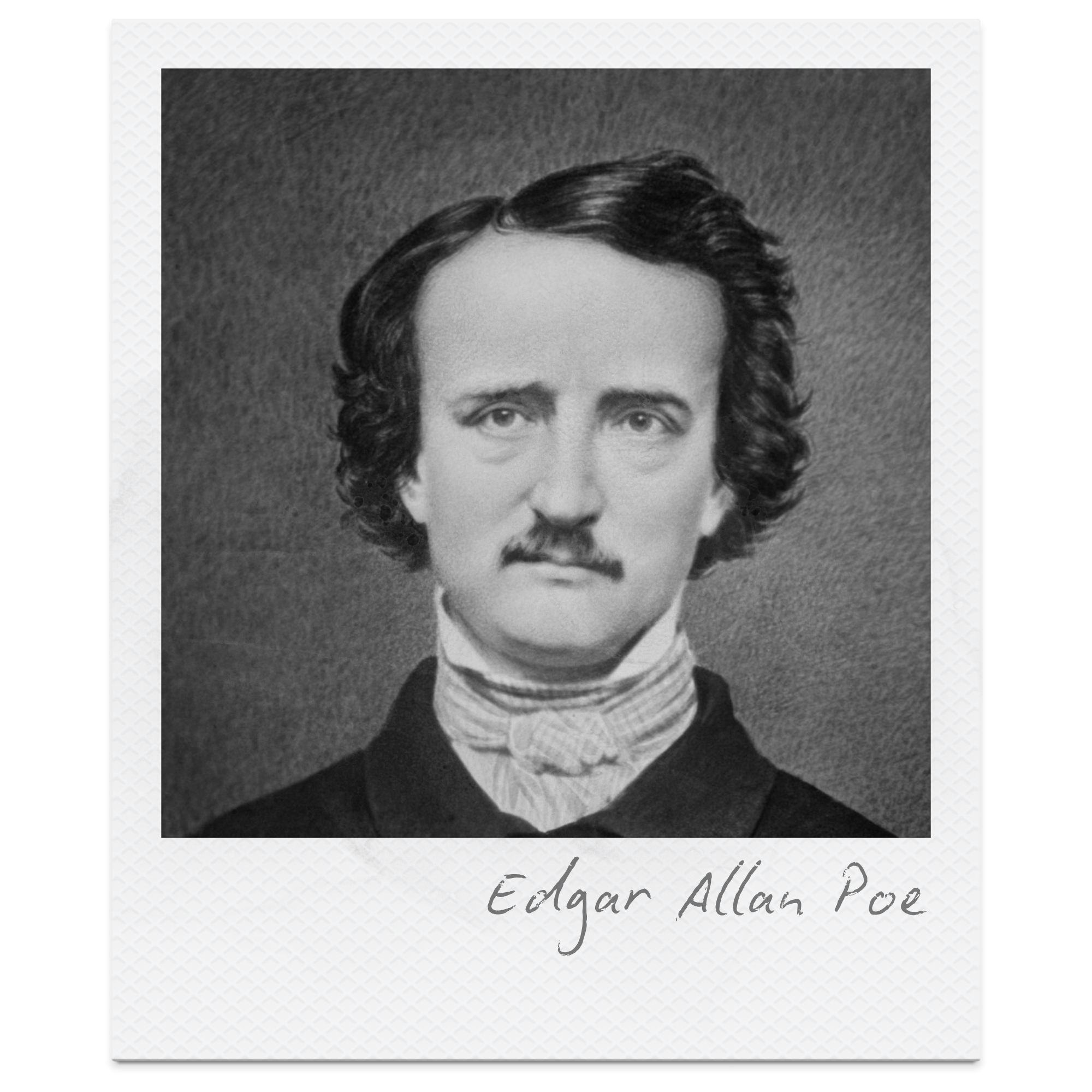
Context of William Wilson
Written in 1839, William Wilson reflects Edgar Allan Poe’s deep interest in psychology, identity, and moral conflict, particularly the idea of the divided self. During this period, Poe was increasingly exploring narrators whose inner lives are unstable, fragmented, or unreliable. The figure of the double (or doppelgänger) becomes central here, allowing Poe to dramatise internal struggle as something external and inescapable. The story also aligns with early nineteenth-century fascination with the unconscious mind and dual identity, anticipating later psychological and gothic fiction.
The story is shaped by gothic and philosophical concerns, particularly the tension between free will and moral restraint. William Wilson’s double can be read as a manifestation of conscience, repeatedly intervening to prevent wrongdoing. However, rather than accepting this guidance, the narrator interprets it as persecution, highlighting themes of self-destruction, denial, and moral blindness. The shifting European settings—from school to Oxford to continental cities—reinforce a sense of dislocation and instability, mirroring the narrator’s fractured identity. For a deeper exploration of Poe’s context, themes, and gothic influences, see the Edgar Allan Poe Context Post.
William Wilson: At a Glance
Form: Gothic short story
Mood: eerie, introspective, unsettling
Central tension: A man is relentlessly pursued by a mysterious double who interferes with his actions and exposes his moral corruption
Core themes: identity and duality, conscience and morality, self-destruction, guilt and repression, power and control, appearance vs reality
One-sentence meaning: A man’s attempt to destroy his double reveals that he is ultimately trying—and failing—to escape his own conscience.
Quick Summary of William Wilson
The narrator, calling himself William Wilson, begins by confessing his moral downfall and ruined reputation, suggesting that his life has been shaped by forces beyond his control. He reflects on his childhood, describing his early tendency toward rebellion, pride, and impulsive behaviour, which quickly leads him to dominate those around him. However, at school, he encounters another boy with the exact same name, appearance, and mannerisms—an unsettling double who quietly resists his authority.
As they grow, this second William Wilson begins to imitate and interfere with the narrator, often appearing at crucial moments to undermine his actions. Although the narrator publicly dismisses him, he secretly feels a deep sense of fear and unease, particularly as the similarities between them become increasingly disturbing. After a terrifying encounter where he sees his double’s face clearly, he flees the school, hoping to escape the influence of this mysterious figure.
In later years, the narrator descends into a life of vice, gambling, and corruption, travelling across Europe. Yet at every stage, his double reappears—at Eton, Oxford, and beyond—interrupting his schemes and exposing his wrongdoing. Finally, during a masquerade in Rome, the narrator confronts and kills his double in a fit of rage. However, as the figure dies, he realises with horror that he has murdered not another person, but himself, symbolising the destruction of his own conscience and identity.
Title, Form, Structure, and Narrative Voice of William Wilson
This section explores how Edgar Allan Poe constructs meaning through title, structure, and narrative voice, revealing how the story’s form mirrors the narrator’s fragmented identity and moral decline. Every structural choice reinforces themes of duality, conscience, and self-destruction.
Title
The title “William Wilson” immediately draws attention to identity, yet its apparent simplicity conceals a deeper ambiguity. The name itself is deliberately generic, suggesting universality, but its duplication within the story creates a sense of uncanny doubling. By using the same name for both the narrator and his double, Poe collapses the distinction between self and other, implying that the conflict at the heart of the story is internal rather than external.
Symbolically, the title represents the idea that identity is not fixed, but divided. The narrator attempts to separate himself from his double, but the shared name suggests that this division is impossible—what he seeks to escape is part of himself.
Form and Structure
Poe structures the story as a retrospective confession, creating a narrative shaped by memory, regret, and self-justification. The story follows a clear progression:
Exposition:
The narrator introduces himself under a false name, immediately signalling concealment and shame. He frames his life as one of inevitable downfall, positioning himself as both victim and participant in his own corruption.
Rising Action:
The school setting establishes the central conflict with the double. As the narrator asserts dominance over his peers, the second William Wilson emerges as the only figure who resists him. The gradual revelation of their similarities—same name, appearance, and behaviour—builds psychological tension and introduces the theme of duality.
Climax:
The turning point occurs during the confrontation in Rome. After years of being followed and thwarted, the narrator finally acts on his rage, attacking and killing his double. This moment represents the culmination of his desire to eliminate the force that opposes him.
Falling Action:
Immediately after the act, the illusion begins to collapse. The setting shifts into something almost surreal, as the narrator becomes aware of a mirror-like reflection, blurring the boundary between reality and perception.
Resolution:
The final revelation—that the double is essentially himself—reframes the entire narrative. The narrator realises that in killing his double, he has destroyed his own conscience and identity, leaving him spiritually and morally dead.
The structure moves from clarity to confusion, mirroring the narrator’s descent into psychological fragmentation.
Narrative Voice
The story is told through a first-person confessional narrator, allowing direct access to his thoughts while maintaining a sense of ambiguity. His tone is reflective, defensive, and at times desperate, as he attempts to justify his actions while simultaneously seeking sympathy and absolution.
The narrator is deeply unreliable. He claims to be a victim of circumstance, yet his own descriptions reveal patterns of arrogance, manipulation, and moral failure. His language often elevates his experiences into something almost mythic, suggesting a tendency toward self-dramatisation.
This creates tension between what the narrator believes and what the reader perceives. His insistence that he is pursued by an external force contrasts with the growing evidence that the double represents his own inner conscience.
Setting as Structure
In William Wilson, setting functions as a framework for psychological development. The progression of locations—from the enclosed school to the freedom of university life and then across Europe—mirrors the narrator’s increasing moral decline.
The school is described as maze-like and enclosed, reflecting the early formation of identity and the first emergence of the double. As the narrator moves into wider, more chaotic environments, his behaviour becomes more extreme, yet the double continues to appear, suggesting that escape is impossible.
Each setting is not just a backdrop but a stage for confrontation between the narrator and his conscience. The final scene in Rome, during a masquerade, reinforces themes of disguise and identity, culminating in the ultimate revelation that self and double are inseparable.
Poe’s key idea is clear: identity is structured by internal conflict, and no change of place can free the narrator from himself.
Setting of William Wilson
The setting of William Wilson is central to its meaning, functioning as both a physical landscape and a reflection of the narrator’s fragmented identity and moral descent. Poe constructs a series of shifting environments—from the enclosed school to the wider European world—that mirror the narrator’s movement from controlled childhood to unrestrained corruption.
The early setting of the school is described as a “large, rambling, cottage-built, and somewhat decayed building” in a “misty-looking village of England.” This creates a dreamlike and enclosed atmosphere, reinforced by the “enormously high and solid brick wall” topped with “broken glass,” which gives the space a prison-like quality. The school is both physically and psychologically restrictive, representing the early formation of identity. Its maze-like interior—“no end to its windings, to its incomprehensible subdivisions”—reflects the narrator’s developing sense of confusion and instability, as well as the emergence of the double within this enclosed world.
The setting then expands as the narrator moves to Eton, Oxford, and across Europe, but this apparent freedom is deceptive. These spaces are associated with excess, vice, and moral decay, particularly in scenes of gambling and intoxication. The environment becomes increasingly chaotic, mirroring the narrator’s loss of control. Despite this geographical expansion, the presence of the double remains constant, suggesting that the true conflict is internal rather than tied to place.
The final setting in Rome, during a masquerade, brings these ideas to their climax. The masked environment reinforces themes of disguise and hidden identity, while the chaotic atmosphere reflects the narrator’s psychological state. The moment of confrontation occurs in a confined interior space, where the narrator sees what appears to be a “large mirror” and ultimately recognises his double as himself. This setting collapses the boundary between external reality and internal perception, transforming the space into a symbolic representation of the self.
Poe’s key idea is that setting mirrors psychology. The enclosed school represents the birth of identity and conflict, the wider world reflects moral disintegration, and the final interior space reveals the ultimate truth: the narrator cannot escape himself.
Characters in William Wilson
The characters in William Wilson are deliberately limited, allowing Edgar Allan Poe to focus intensely on identity, duality, and psychological conflict. Rather than presenting a wide cast, Poe creates a central opposition between the narrator and his double, blurring the line between self and other.
William Wilson (The Narrator)
The narrator, calling himself William Wilson, is a deeply unreliable and self-justifying figure, presenting his life as a descent into vice, corruption, and moral failure. From the outset, he frames himself as both victim and perpetrator, claiming he has been shaped by forces beyond his control.
He describes his early nature as “self-willed, addicted to the wildest caprices, and a prey to the most ungovernable passions,” revealing a personality driven by impulse and ego. His dominance over others—“my voice was a household law”—establishes his desire for power and control from a young age.
Psychologically, the narrator resists any form of restraint, rejecting guidance even when it benefits him. He later admits that his double’s interventions were morally sound, acknowledging that “I might, today, have been a better, and thus a happier man,” suggesting a buried awareness of his own wrongdoing. However, this recognition comes too late, reinforcing his role as a figure of self-destruction.
Symbolically, the narrator represents unchecked desire and moral blindness—a self that refuses accountability and ultimately collapses under its own corruption.
William Wilson (The Double)
The second William Wilson is one of Poe’s most powerful representations of the doppelgänger, functioning as both a literal rival and a symbolic embodiment of conscience and restraint.
He is introduced as the only figure who challenges the narrator, one who “presumed to compete with me… and to interfere with my arbitrary dictation.” Unlike the narrator, he does not seek dominance, but instead quietly resists and corrects him. His behaviour is often subtle, offering “advice not openly given, but hinted or insinuated,” suggesting a moral presence rather than an overt antagonist.
His defining characteristic is his imitation of the narrator: “his singular whisper… grew the very echo of my own,” reinforcing the idea that he is not separate, but intrinsically linked. This imitation is not mocking, but corrective—he reflects the narrator’s actions back to him, exposing his flaws.
In later life, the double appears at critical moments to prevent wrongdoing, ultimately revealing his purpose. In the final confrontation, he declares: “In me didst thou exist… how utterly thou hast murdered thyself,” confirming that he represents the narrator’s conscience and true identity.
Symbolically, the double represents the moral self—the part of the psyche that resists corruption. His destruction signifies the narrator’s complete loss of identity and moral centre.
Society and Observers (Implied)
Although not central, figures such as schoolmates, teachers, and fellow students serve as a backdrop that reinforces the narrator’s public image versus private reality. They perceive him as charismatic and successful, while remaining largely unaware of his internal struggle.
At Oxford, for example, he is seen as “the gay, the frank, the generous William Wilson,” highlighting the contrast between his outward persona and his hidden corruption. This reinforces the theme of appearance versus reality, showing how easily identity can be constructed and maintained in the eyes of others.
Symbolically, these figures represent society’s blindness, emphasising that the narrator’s true conflict is not with the world around him, but within himself.
Themes in William Wilson
Poe constructs William Wilson around a set of deeply interconnected themes, using doubling, narration, and setting to explore the instability of the self. Through the narrator’s descent, Edgar Allan Poe examines how identity fractures under pressure, revealing the tension between impulse and restraint, illusion and truth.
Identity and Duality
At the heart of the story is the idea of the divided self, embodied in the narrator’s double. The existence of another William Wilson—identical in name, appearance, and behaviour—creates an unsettling sense of duplication. The narrator is disturbed by “a similarity of mind, person, or condition existing between us,” highlighting how the boundary between self and other begins to collapse.
The double is not simply a rival, but a reflection. His imitation—“his singular whisper… grew the very echo of my own”—suggests that he is intrinsically linked to the narrator. The final revelation confirms this: the double is not separate, but a manifestation of the narrator’s own identity, making the conflict internal rather than external.
Conscience and Morality
The double can be read as a physical embodiment of conscience, repeatedly intervening to prevent the narrator’s moral decline. His actions are not aggressive, but corrective, offering restraint at key moments. The narrator later admits that his rival’s guidance was justified, acknowledging that “his moral sense… was far keener than my own.”
However, rather than accepting this moral voice, the narrator resents and rejects it. This reflects a deeper conflict between free will and ethical responsibility, where the individual actively chooses to silence their conscience rather than be guided by it.
Self-Destruction
The narrator’s journey is ultimately one of self-destruction, driven by his refusal to acknowledge or accept his own limitations. His descent into vice—gambling, deception, and excess—marks a progressive loss of control, culminating in the violent confrontation in Rome.
The final act—killing his double—symbolises the ultimate destruction of the self. The revelation that “in my death, see… how utterly thou hast murdered thyself” makes it clear that this act is not a victory, but a collapse. By destroying the force that restrained him, the narrator destroys his own identity and moral existence.
Guilt and Repression
Although the narrator attempts to present himself as a victim, the story is saturated with guilt, which he continually suppresses. His need to justify his actions and seek sympathy—“I would fain have them believe that I have been… the slave of circumstances”—reveals an underlying awareness of his own responsibility.
The double functions as the return of this repressed guilt, appearing at moments when the narrator attempts to ignore or deny it. The repeated reappearances suggest that guilt cannot be permanently silenced; it resurfaces, demanding recognition.
Power and Control
From childhood, the narrator is defined by his desire for dominance and control. He describes how “my voice was a household law,” establishing his authority over others. This need for control continues into adulthood, particularly in his manipulation of others through gambling and deception.
However, the presence of the double disrupts this control. Each intervention undermines the narrator’s authority, creating a constant tension between his desire for power and his inability to fully assert it. This conflict highlights the limits of control, particularly when confronted with internal opposition.
Appearance vs Reality
The story consistently blurs the line between appearance and reality, particularly through the narrator’s perception of events. He initially interprets his double as an external figure, failing to recognise the deeper truth of their connection.
Moments of disguise—such as the masquerade in Rome—reinforce this theme, as identity becomes fluid and uncertain. The final scene, where the narrator confronts what appears to be a “large mirror,” collapses the distinction entirely, revealing that what he has perceived as external threat is in fact internal reality.
Isolation and Psychological Fragmentation
As the narrator progresses through life, he becomes increasingly isolated, not physically, but psychologically. His inability to reconcile with his double leads to a fragmentation of identity, where the self is split into opposing forces.
This fragmentation is reflected in his language and perspective, which shift between certainty and confusion. The result is a narrative that feels unstable, mirroring the narrator’s own mental state and reinforcing the theme that identity, once divided, cannot easily be restored.
Together, these themes create a narrative where the self becomes both subject and antagonist, revealing the destructive consequences of denying conscience, rejecting responsibility, and refusing to confront one’s own nature.
Key Quotes from William Wilson
These quotes reveal how Edgar Allan Poe develops identity, conscience, and psychological conflict, using language, imagery, and irony to explore the divided self.
Identity and Duality
“Let me call myself, for the present, William Wilson.”
◆ Concealment / narrative framing
◆ Signals instability of identity from the outset
◆ Suggests the narrator is distancing himself from his true self
“A similarity of mind, person, or condition existing between us.”
◆ Listing / parallel structure
◆ Emphasises the disturbing extent of the double’s resemblance
◆ Reinforces the theme of duality and mirrored identity
“His singular whisper… grew the very echo of my own.”
◆ Auditory imagery
◆ Suggests the double is not separate, but a reflection of the self
◆ Blurs the boundary between self and other
Conscience and Morality
“His moral sense… was far keener than my own.”
◆ Comparative language
◆ Positions the double as a figure of moral authority
◆ Highlights the narrator’s awareness of his own ethical failure
“Advice not openly given, but hinted or insinuated.”
◆ Subtle diction
◆ Shows the quiet, persistent nature of conscience
◆ Reinforces the idea of internal moral guidance rather than force
Self-Destruction
“In me didst thou exist… how utterly thou hast murdered thyself.”
◆ Revelation / direct address
◆ Confirms the double as part of the narrator’s identity
◆ Transforms the act of murder into self-destruction
“From me… all virtue dropped bodily as a mantle.”
◆ Metaphor
◆ Suggests a sudden loss of morality
◆ Highlights the narrator’s rapid descent into corruption
Guilt and Repression
“I would fain have them believe that I have been… the slave of circumstances.”
◆ Defensive tone
◆ Attempts to deny personal responsibility
◆ Reveals underlying guilt and self-justification
“Have I not indeed been living in a dream?”
◆ Rhetorical question
◆ Suggests detachment from reality
◆ Reflects psychological instability and repression
Power and Control
“My voice was a household law.”
◆ Authoritative metaphor
◆ Establishes early desire for dominance and control
◆ Highlights the narrator’s need to impose authority
“To interfere with my arbitrary dictation.”
◆ Loaded language (“arbitrary”)
◆ Reveals the narrator’s controlling nature
◆ Frames the double as a threat to his power
Appearance vs Reality
“A large mirror… now stood where none had been perceptible before.”
◆ Symbolism / illusion
◆ Represents the moment of self-recognition
◆ Collapses the boundary between appearance and reality
“Mine own image… with features all pale and dabbled in blood.”
◆ Visual imagery
◆ Forces the narrator to confront his true self
◆ Links identity with violence and consequence
Setting and Psychological Atmosphere
“No end to its windings, to its incomprehensible subdivisions.”
◆ Descriptive imagery
◆ Reflects confusion and complexity of the mind
◆ Reinforces the theme of psychological fragmentation
“A misty-looking village of England.”
◆ Gothic setting
◆ Creates a dreamlike, uncertain atmosphere
◆ Mirrors the blurred boundaries of memory and identity
These quotations demonstrate how Poe uses language, structure, and symbolism to construct a narrative where identity becomes unstable, conscience becomes externalised, and reality itself is called into question.
Key Techniques in William Wilson
In William Wilson, Edgar Allan Poe uses a range of gothic and psychological techniques to construct a narrative centred on duality, conscience, and self-destruction. These techniques work together to blur the boundaries between self and other, reality and illusion, creating a deeply unsettling reading experience.
◆ Doppelgänger (Double Motif) – The second William Wilson functions as a physical manifestation of the narrator’s conscience and divided identity. By externalising the inner self, Poe turns psychological conflict into narrative action, making the struggle between impulse and restraint visible.
◆ Unreliable Narration – The narrator presents himself as a victim of circumstance, yet his language reveals arrogance, denial, and moral blindness. This forces the reader to question his version of events, creating tension between perception and truth.
◆ Symbolism – Key elements such as the double, the mirror, and the masquerade symbolise identity and illusion. The mirror in the final scene represents self-recognition, while the masquerade reinforces the instability of identity and the ease of disguise.
◆ Foreshadowing – Early references to the narrator’s downfall and “unparalleled infamy” hint at his future destruction. These clues create a sense of inevitability, suggesting that his fate is both self-inflicted and unavoidable.
◆ Setting as Psychological Mirror – Locations such as the maze-like school and the chaotic European cities reflect the narrator’s internal fragmentation and moral decline. As the settings become more disordered, so too does his identity.
◆ Motif of Imitation – The double’s constant imitation of the narrator’s voice, dress, and behaviour reinforces the idea that they are intrinsically linked. This repetition builds unease and highlights the impossibility of escaping the self.
◆ Irony (Situational and Dramatic) – The narrator believes he is freeing himself by killing his double, but in reality he destroys himself. This reversal reinforces the theme of self-destruction and misrecognition.
◆ Confessional Structure – The retrospective narrative creates a tone of regret and justification, as the narrator attempts to explain his actions. This structure allows Poe to explore memory as selective and unreliable.
◆ Imagery (Gothic and Psychological) – Descriptions such as “misty-looking village” and “incomprehensible subdivisions” create a dreamlike, unsettling atmosphere. This imagery reflects the instability of both setting and mind.
◆ Repetition and Parallelism – Repeated references to similarity (“same name,” “same appearance”) reinforce the theme of duality, while structural parallels between encounters with the double create a sense of cyclical inevitability.
◆ Tone (Elevated and Dramatic) – The narrator’s heightened, almost theatrical language reflects his tendency toward self-dramatisation, adding to the ambiguity of whether events are literal or psychological.
◆ Climactic Revelation – The final moment of recognition functions as a structural and thematic turning point, where all elements—identity, conscience, and reality—collapse into a single, devastating truth.
Together, these techniques create a narrative where form and meaning are inseparable, reinforcing Poe’s exploration of the divided self and the consequences of denying one’s own conscience.
Alternative Interpretations of William Wilson
This section explores how William Wilson can be read through different critical lenses, revealing how Edgar Allan Poe constructs a narrative that resists a single, fixed meaning. Each interpretation uncovers new dimensions of identity, morality, and psychological conflict.
Psychological Interpretation: Split Identity and Dissociation
From a psychological lens, the story can be read as a portrayal of split personality or dissociation, where the double represents a fragmented part of the narrator’s mind. The second William Wilson may not exist as a separate figure at all, but as a projection of the narrator’s repressed self or conscience. His ability to imitate the narrator perfectly—voice, appearance, and behaviour—suggests internal origin rather than external reality. The final revelation, where the narrator sees himself in place of the double, reinforces the idea that this conflict is entirely psychological, aligning with modern interpretations of dissociative identity or internal fragmentation.
Gothic Interpretation: The Doppelgänger as Supernatural Force
Through a gothic lens, the double can be interpreted as a supernatural entity, an external force that pursues the narrator across time and space. His repeated appearances, seemingly impossible knowledge, and ability to intervene at key moments suggest something beyond human limitation. In this reading, the story becomes one of haunting and persecution, where the narrator is followed by an inescapable presence representing fate or judgement.
Moral Interpretation: Conscience as Antagonist
From a moral perspective, the double functions as the embodiment of conscience, attempting to restrain the narrator’s descent into vice. Each intervention occurs at a moment where the narrator is about to commit wrongdoing, suggesting a pattern of moral correction. The narrator’s hostility toward this figure reflects his rejection of ethical responsibility, positioning the double not as an enemy, but as a necessary counterforce to his behaviour.
Existential Interpretation: The Self as Enemy
An existential reading emphasises the idea that the greatest conflict is internal. The narrator’s inability to reconcile with his double reflects a deeper struggle with self-awareness and identity. His attempt to destroy the double can be seen as an attempt to escape responsibility for his actions, but this ultimately leads to his own destruction. The story suggests that the self cannot be escaped, and that denying part of one’s identity results in collapse.
Social Interpretation: Reputation and Public Identity
From a social lens, the story explores the tension between public persona and private reality. The narrator is perceived as successful and charismatic, yet his inner life is marked by corruption and instability. The double repeatedly exposes this hidden truth, disrupting the carefully constructed image the narrator presents to the world. This interpretation highlights the fragility of reputation and identity within society, suggesting that appearances can conceal profound moral failure.
Teaching Ideas for William Wilson
These teaching ideas are designed to help students engage with William Wilson through both analytical depth and creative exploration, focusing on themes of identity, conscience, and psychological conflict.
1. Unreliable Narrator Focus
Understanding the narrator as unreliable is key to interpreting the story. Students should explore how perspective shapes truth and how far we can trust what is being told. For further support, revisit the Edgar Allan Poe Hub and explore similar narrative patterns in the Literature Library.
◆ How does the narrator attempt to justify his actions?
◆ Where do we see contradictions between what he says and what he does?
◆ Is the double real, or a projection of his mind?
2. Duality and Identity Tracking
This text is ideal for tracking the theme of duality across the narrative. Students can map how the relationship between the narrator and his double evolves. You can extend this by linking to wider thematic discussions in the Literature Library and comparing with other Poe texts via the Edgar Allan Poe Hub.
◆ Identify moments where the double mirrors the narrator
◆ Track how the narrator reacts to each intervention
◆ Explore how identity becomes increasingly unstable
3. Analytical Paragraph + Peer Marking
This task builds structured, exam-ready responses while encouraging reflection and improvement. For further models and analytical support, direct students to the Literature Library and related content in the Edgar Allan Poe Hub.
Students write a paragraph responding to a question such as:
How does Poe present conscience in William Wilson?
Then:
◆ Swap responses
◆ Highlight analytical phrases
◆ Identify strengths and gaps
◆ Suggest one clear improvement
4. Debate: Conscience or Curse?
This debate pushes students into interpretation and evaluation, encouraging them to take a clear position on the double’s role. Extend ideas through comparison using the Literature Library and the Edgar Allan Poe Hub.
◆ Side A → The double represents conscience and moral restraint
◆ Side B → The double is a supernatural or external force
Students must support arguments with quotes, structure, and theme.
5. Time-Saving Resource Bundle (Classroom Ready)
Teaching a text like William Wilson requires a balance of analysis, retrieval, discussion, and creative response—but building this from scratch can be time-consuming. A well-structured bundle allows you to move seamlessly between engaging activities and rigorous analysis, ensuring students encounter the text in multiple ways.
Instead of repeating the same lesson format, you can rotate between interactive tasks, structured questioning, visual prompts, and independent work, keeping lessons dynamic while reinforcing key ideas like duality, conscience, and identity. It also supports both first teaching and revision, giving you flexibility without sacrificing depth.
Our William Wilson bundle brings everything together in one place, saving time while delivering variety, progression, and high-impact classroom engagement.
6. Creative Writing Extension
Creative tasks allow students to explore the story’s psychological depth and narrative voice, applying what they’ve learned in original ways. For further inspiration, direct students to the Gothic Writing Hub and the Creative Writing Archive.
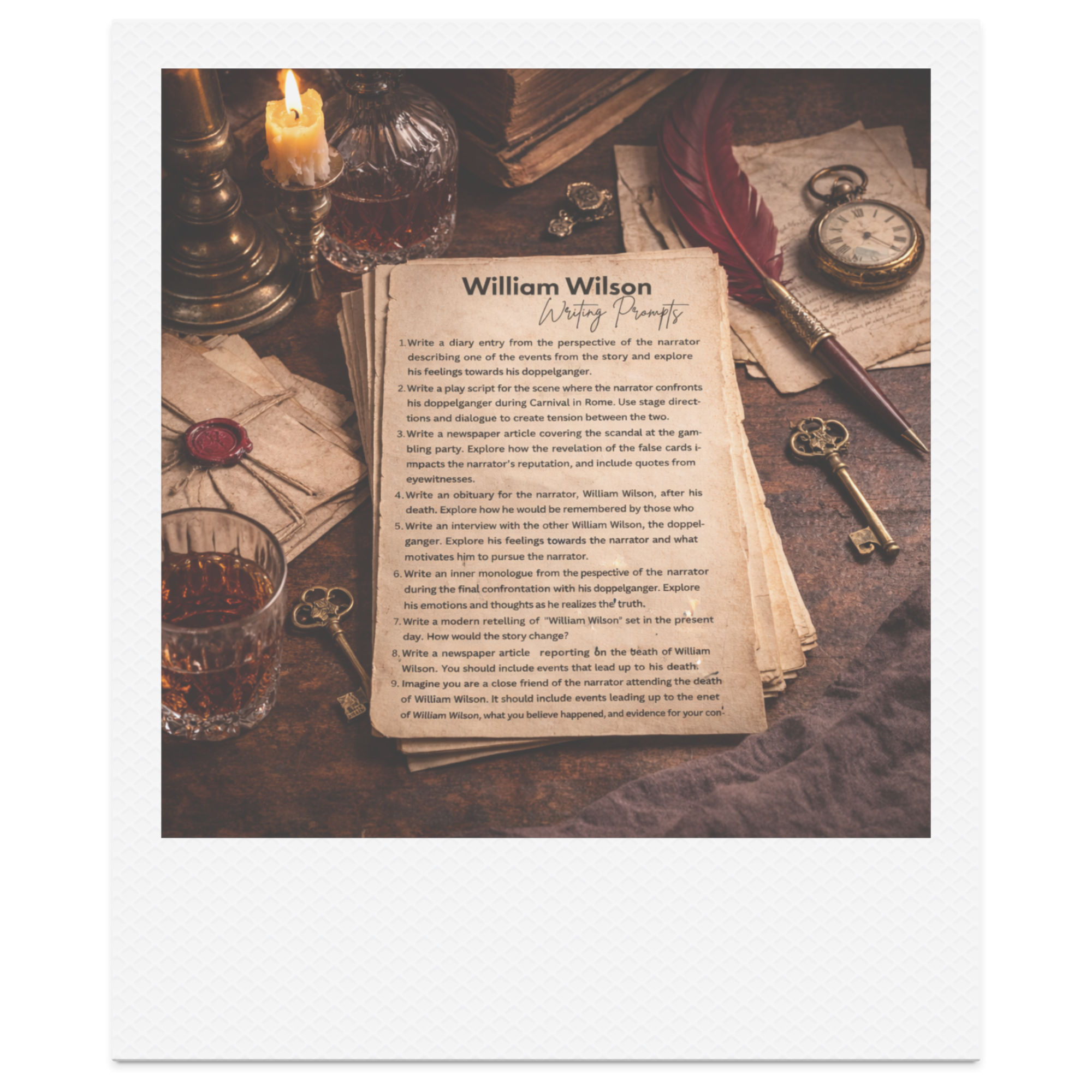
◆ Write a monologue from the double’s perspective—what does he want?
◆ Rewrite the final scene where the narrator refuses to kill the double
◆ Create a modern version of the story centred on identity and reputation
Go Deeper into William Wilson
To deepen understanding of William Wilson, it’s useful to explore how Edgar Allan Poe develops similar ideas across his wider body of work. Many of his stories return to unreliable narration, psychological conflict, and the divided self, making them ideal for comparison. For a curated selection of texts suited to classroom study and thematic links, explore the Best Poe Texts for the Classroom.
◆ The Tell-Tale Heart by Edgar Allan Poe – A first-person narrator consumed by obsession, allowing comparison of guilt, paranoia, and unreliable narration
◆ The Black Cat by Edgar Allan Poe – Explores self-destruction and moral collapse, offering a darker, more violent parallel to the narrator’s decline
◆ The Fall of the House of Usher by Edgar Allan Poe – Links strongly through psychological fragmentation and setting as a reflection of the mind
◆ Dr Jekyll and Mr Hyde by Robert Louis Stevenson – A direct parallel in its exploration of dual identity and the divided self
◆ Macbeth by William Shakespeare – Examines conscience, guilt, and moral corruption, particularly how internal conflict drives destructive action
◆ The Picture of Dorian Gray by Oscar Wilde – Explores hidden identity and moral decay, where the self is split between outward appearance and inner truth
These comparisons allow students to see how William Wilson fits within a broader literary conversation about identity, morality, and psychological conflict, strengthening both analytical depth and intertextual understanding.
Final Thoughts
William Wilson stands as one of Edgar Allan Poe’s most compelling explorations of identity, conscience, and self-destruction, revealing how the greatest conflict is often internal rather than external. Through its unsettling use of doubling and its confessional narrative voice, the story exposes the dangers of denying moral responsibility and rejecting the limits of the self.
What makes the story endure is its ambiguity. Poe never fully resolves whether the double is supernatural, psychological, or symbolic, leaving readers to grapple with multiple interpretations. This uncertainty reinforces the idea that identity is unstable, shaped as much by perception as by reality, and that the self cannot be easily divided or escaped.
For further exploration of Poe’s work and recurring themes, revisit the Edgar Allan Poe Hub and the Literature Library, where you can continue building connections across gothic literature and psychological fiction.
