Some towns are remembered for their picturesque streets, welcoming communities and charming local festivals. Others are known for traditions that seem to belong to another century: peculiar ceremonies performed at midnight, annual celebrations nobody can explain, or ancient customs that every resident observes without question. Behind the most ordinary village green or cobbled market square, an extraordinary story might be waiting to unfold.
These 100 strange small-town traditions explore the curious, enchanting and occasionally sinister customs that give fictional communities their distinctive identities. From forgotten harvest rituals and eccentric village competitions to mysterious processions, peculiar superstitions and unsettling ceremonies, each tradition offers a glimpse into a town shaped by its history, beliefs and closely guarded secrets.
For more inspiration, explore our Fairytales & Folklore Writing Hub for ancient legends, magical customs and traditional storytelling, or visit the Mystery Writing Hub for intriguing plots, suspicious communities and secrets waiting to be uncovered. Discover further inspiration throughout our Creative Writing Archive, or develop your next fictional community with our Mystery Story Sparks, Fantasy Story Sparks and Gothic Story Sparks, designed to inspire original characters, atmospheric settings and compelling narratives.
Organised into ten thematic sections, this collection features 100 original small-town traditions, each with its own distinctive identity, intriguing backstory and three original story ideas. With 300 creative writing prompts to explore, these peculiar customs offer inspiration for everything from cosy village mysteries and magical realism to atmospheric Gothic fiction and disturbing folk horror.
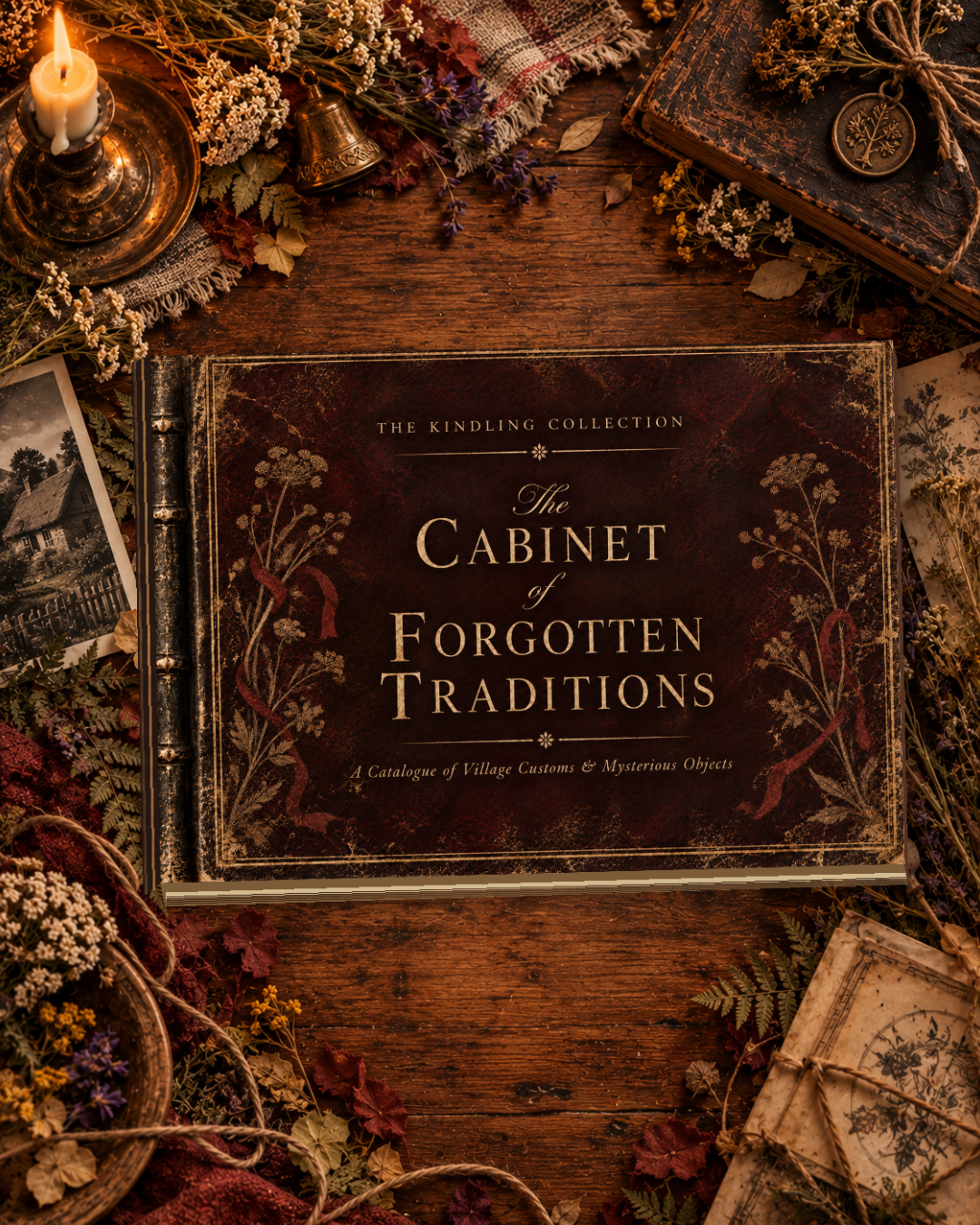
Some traditions are passed down through generations.
Others are quietly abandoned.
And some are forgotten for a very good reason.
In the secluded village of Ashwick, the old ways have always mattered.
There are customs that must be observed, songs that must be sung and objects whose purpose nobody seems willing to explain.
A ceremonial harvest mask woven from dried wheat and wildflowers, its mouth stitched shut with red thread.
A sealed witch bottle discovered beneath the foundations of a demolished cottage, containing rusted nails, bent pins and human hair.
Thirteen mismatched iron keys, each bearing a different symbol, none fitting a single known lock.
And among the ashes, the blackened remnants of objects that somebody once considered important enough to preserve.
Or perhaps important enough to destroy.
Each discovery offers another glimpse into Ashwick's forgotten traditions.
Some objects were used in celebrations.
Others were hidden away.
Not every custom has survived in the village's collective memory.
And those who remember the old ways are not always willing to discuss them.
Kindling: The Cabinet of Forgotten Traditions is an immersive, beautifully illustrated collection of mysterious folk objects, unsettling rural customs and fragments of forgotten village history.
Inspired by British folklore, folk horror, rural superstitions, seasonal rituals and the strange traditions that survive in isolated communities, this fictional cabinet invites you to explore a world where the boundary between celebration and superstition is not always clear.
Each artefact has its own history, circumstances of discovery and curious details. Some are accompanied by local beliefs or fragments of testimony. Others offer little explanation beyond the object itself.
Why would someone stitch the mouth of a ceremonial mask shut?
What was the witch bottle intended to protect against?
Why were thirteen keys gathered together when none opens a known door?
What happened to the objects recovered from the ashes?
And what becomes of a village when its oldest traditions are no longer understood?
There are no definitive answers.
No complete account of Ashwick's past.
No certainty that the surviving explanations tell the whole story.
Only peculiar objects, half-remembered customs and unsettling fragments of folklore waiting to inspire stories of your own.
What's Inside?
◆ 13 beautifully illustrated folk artefacts, each with its own mysterious history, unusual details and circumstances of discovery
◆ The collector's introductory letter, inviting you into the world of Ashwick and its forgotten traditions
◆ Detailed illustrated catalogue pages featuring curious objects, botanical embellishments, folklore and unsettling observations
◆ Mysterious village discoveries, from ceremonial masks and witch bottles to strange keys, ritual objects and unexplained remnants
◆ Atmospheric archival material, including photographs and visual fragments that bring the traditions and history of Ashwick to life
◆ An illustrated cabinet inventory documenting the peculiar objects gathered from the village
◆ Creative writing inspiration and exploration activities to help you develop characters, mysteries, folk horror stories and imagined histories
◆ Instant digital download in printable PDF format
Who Is It For?
Perfect for:
◆ Folk horror writers and dark fiction enthusiasts
◆ Writers inspired by folklore, superstitions and forgotten traditions
◆ Novelists, short-story writers and creative storytellers
◆ Teachers looking for unusual visual writing prompts and imaginative classroom resources
◆ Fans of rural mysteries, unsettling villages and atmospheric storytelling
◆ Worldbuilders creating fictional communities, local legends and seasonal customs
◆ Journalers, solo roleplayers and lovers of immersive fictional archives
◆ Anyone fascinated by cabinets of curiosities, mysterious artefacts and the stranger side of folklore
What Makes This Different?
This isn't a traditional collection of writing prompts.
It's a cabinet of objects that a village has left behind.
Every artefact suggests a tradition, a belief or an event that somebody once considered important.
But the explanations are incomplete, the surviving evidence is fragmentary, and Ashwick's residents have not always been forthcoming about the customs of their ancestors.
Examine the harvest mask and consider why its mouth was sewn shut.
Investigate the witch bottle buried beneath an old cottage.
Study the thirteen keys and imagine what they might once have opened.
Explore the fragments recovered from the ashes and question why they were burned.
Consider the people who made these objects, the villagers who used them and those who eventually decided they should be hidden, abandoned or forgotten.
Perhaps the harvest mask was part of an innocent midsummer celebration.
Perhaps the witch bottle was buried to protect a household from something its occupants feared.
Perhaps the keys belonged to families bound together by an old village agreement.
Perhaps the objects found in the ashes were destroyed during a ceremony that nobody now remembers.
Or perhaps Ashwick's most unsettling traditions were never intended to be understood by outsiders.
You decide what these objects mean.
Use the collection to inspire a folk horror short story, invent an isolated village with its own peculiar customs, develop a mystery surrounding a forgotten ritual or imagine the lives of those who once possessed these extraordinary objects.
Create your own explanations.
Question the surviving accounts.
Follow the fragments of folklore wherever they lead.
Perhaps the villagers have simply forgotten their oldest traditions.
Or perhaps they remember far more than they are willing to admit.
Digital download: An illustrated PDF collection designed in A4 landscape format, with individual artefact entries and additional archival material. No physical product will be shipped.
Kindling: The Cabinet of Forgotten Traditions – Unearth the Secrets of Ashwick
Some traditions are preserved because they bring communities together. Others survive because nobody dares to abandon them. In the secluded village of Ashwick, generations have observed peculiar customs, guarded ancient superstitions and concealed objects whose original purposes have been quietly forgotten.
Kindling: The Cabinet of Forgotten Traditions invites you into this unsettling world through an immersive collection of thirteen beautifully illustrated folk artefacts, each offering tantalising fragments of the village's mysterious past.
Discover a ceremonial harvest mask woven from wheat and wildflowers, its mouth stitched shut with red thread. Examine a witch bottle buried beneath an abandoned cottage, filled with rusted nails, bent pins and human hair. Study thirteen mismatched iron keys, each marked with an unfamiliar symbol, and consider what secrets might lie behind the objects recovered from a long-forgotten fire.
Accompanied by an introductory collector's letter, atmospheric catalogue pages, archival imagery and an illustrated inventory, this downloadable cabinet transforms forgotten folklore into a rich source of creative writing inspiration.
Unlike conventional writing prompts, Kindling offers no definitive explanations. Writers are invited to investigate the evidence, invent the traditions behind each discovery and develop their own rural mysteries, folk horror narratives and richly imagined fictional communities.
Explore Kindling: The Cabinet of Forgotten Traditions and discover what Ashwick's villagers have chosen to remember — and what they would rather forget.
For more immersive storytelling inspiration, explore our Storyworld Archives, a collection of fictional worlds brought to life through mysterious documents, evocative artefacts and intriguing histories. Discover our atmospheric Cabinets of Curiosities, where every object holds the beginnings of another extraordinary story.

Ancient Folklore & Forgotten Customs
In some small towns, the oldest traditions are also the least understood. Passed down through generations, these peculiar customs preserve fragments of forgotten histories, ancient superstitions and promises made long before anyone living can remember. From ceremonial offerings and mysterious processions to unusual celebrations marking the changing seasons, each ritual reveals something about the community that continues to observe it. Yet beneath these seemingly harmless acts of remembrance, there may be secrets that the townspeople have spent centuries trying to protect.
1. The Night of the Unlit Windows
Every year, on the final night of October, the residents of Bellweather extinguish every candle, lamp and electric light before sunset. Curtains remain open, and families sit together in darkness until the church bell rings thirteen times at midnight. According to local folklore, the custom began after a winter plague, when villagers believed that something wandering the streets was searching for signs of life. Nobody remembers who first rang the thirteenth bell, but the town council still fines households that break the tradition.
Story Ideas:
A newcomer leaves her kitchen light burning and wakes to discover that every house on her street has been abandoned overnight.
When the church bell rings only twelve times, an elderly resident insists that the town must find whoever has prevented the final chime before sunrise.
A historian discovers that the tradition predates the plague by three centuries, and that the earliest accounts describe the darkness as an invitation rather than a defence.
2. The Bread Beneath the Bridge
On the first morning of spring, every household in Alderwick bakes a small round loaf and places it beneath the oldest bridge before the river reaches its morning high tide. The bread must contain a pinch of salt from the previous year's supply, and no two loaves may be identical. The tradition supposedly honours a wandering miller who saved the town from starvation, although parish records contain no evidence that such a man ever existed. By midday, the loaves have always disappeared, even when the river is too shallow to carry them away.
Story Ideas:
A baker deliberately leaves a loaf containing a hidden message and receives a reply written in a language that has not been spoken locally for centuries.
After a severe drought exposes the bridge's foundations, children discover hundreds of perfectly preserved loaves arranged inside a sealed stone chamber.
A struggling family cannot afford the ingredients for their annual offering, prompting an elderly neighbour to reveal why the town has never permitted anyone to go without bread.
3. The Keeping of the Last Leaf
In the hillside town of Thornmere, autumn does not officially end until the final leaf falls from an ancient elm in the market square. Each November, residents gather beneath its branches to witness the event, and the person who catches the leaf becomes the Keeper of Winter. For the following three months, they must maintain a fire in their home and offer shelter to anyone who knocks after dark. The custom is regarded as a quaint expression of hospitality, although former Keepers rarely discuss what happens during their winter of service.
Story Ideas:
A young woman catches the final leaf and discovers that the strangers seeking shelter all claim to have known her grandmother, who died before she was born.
When the elm refuses to shed its final leaf, the town's oldest residents begin preparing for a winter they insist must never arrive.
A former Keeper publishes a memoir describing the visitors who came to his door, only for every copy to be purchased and destroyed by the town council.
4. The Procession of the Empty Chair
Every seventh summer, the villagers of Mereford carry an elaborately carved wooden chair through the streets at dawn. The chair is dressed in fresh linen, decorated with white ribbons and placed at the head of a communal breakfast, where an untouched meal is served before anyone else may eat. Local tradition claims that the ceremony commemorates the town's first mayor, who vanished during a terrible storm. However, the chair bears no family crest, and its unusually narrow proportions suggest it was never intended for an adult.
Story Ideas:
During the procession, a photographer captures an image showing a small figure seated in the chair, although every witness insists it remained empty.
A furniture conservator discovers that the chair was constructed using timber from a ship that disappeared decades before Mereford was founded.
When a visiting child casually sits in the chair, the villagers abandon their breakfast and begin arguing over whether an ancient promise has finally been fulfilled.
5. The Counting of the Hearthstones
On the shortest day of the year, families in Greyhaven remove a single stone from their fireplace and carry it to the village square. There, the stones are counted, recorded and returned before sunset. The tradition is said to have originated during a medieval census, when the number of occupied hearths determined how much grain the community received from its landlord. Yet the official count has remained exactly 147 for as long as anyone can remember, despite centuries of changing populations and demolished houses.
Story Ideas:
A newly appointed parish clerk discovers that the annual count includes stones belonging to houses destroyed in a fire two hundred years earlier.
When the total reaches 148 for the first time, the villagers refuse to identify the family responsible for the additional hearthstone.
A genealogist tracing her ancestors discovers that every family which has left Greyhaven still possesses a stone identical to those counted in the ceremony.
6. The Festival of Borrowed Names
For one day each June, the residents of Little Wrenford abandon their ordinary names and exchange identities through a ceremonial drawing of folded paper slips. Shopkeepers answer to the names of schoolchildren, neighbours introduce themselves as strangers, and even gravestones are temporarily covered with borrowed inscriptions. The custom supposedly began as a way of confusing malicious spirits that followed families through generations. Although the festivities now include music, dancing and elaborate costumes, it remains deeply impolite to address anyone by their real name before midnight.
Story Ideas:
A woman draws the name of a child who disappeared forty years earlier and discovers that the child's former possessions have mysteriously appeared in her home.
Two residents exchange names during the festival and find that their legal documents, family photographs and personal histories have somehow changed to match.
A visiting journalist uncovers evidence that the festival originally allowed villagers to confess crimes without revealing their identities.
7. The Thirteen Knots of Bracken Hill
At the beginning of each harvest, the inhabitants of Bracken Hill tie thirteen knots into a length of red wool and hang it above their front doors. Each knot represents a hardship the community survived during its earliest years: famine, fire, disease, flood and nine disasters whose names have been lost. The wool remains in place until the harvest is safely gathered, when it is burned in a communal bonfire. No household may tie a fourteenth knot, although an old village rhyme warns that one day another will be needed.
Story Ideas:
Following an unexplained crop failure, a farmer discovers that someone has secretly added a fourteenth knot to every household's wool.
A schoolteacher investigating the tradition uncovers thirteen historical disasters, but learns that several occurred hundreds of years after the custom supposedly began.
When a young girl invents a new verse for the village rhyme, the elders recognise its description of a catastrophe that has not yet happened.
8. The Washing of the Boundary Stones
Every April, the people of Ashcombe walk the ancient boundary of their town carrying buckets of spring water, brushes and small bunches of rosemary. They carefully wash twelve weathered stones marking the limits of the original settlement, reciting the names of neighbouring fields as they go. The custom began long before modern maps, supposedly to prevent disputes over land ownership. Yet the villagers insist that the stones must never be moved, even when roads are widened or buildings constructed around them.
Story Ideas:
A surveyor discovers that the twelve boundary stones form a perfect circle around a location that does not appear on any historical map.
When roadworks accidentally destroy one of the stones, residents begin finding unfamiliar buildings standing just beyond the town's former boundary.
A local historian learns that the annual washing ceremony was originally performed from the opposite side of the stones, suggesting the boundary was intended to keep something inside.
9. The Giving of the First Shadow
On the morning of the spring equinox, the villagers of Hollowby gather outside their homes before sunrise and place a small personal possession where their first shadow will fall. Children leave ribbons or wooden toys, adults offer buttons, keys or handwritten notes, and elderly residents traditionally choose something inherited from their parents. The objects are collected by the town's appointed Shadow Keeper and locked inside a chest beneath the village hall. According to local belief, the ceremony ensures that nobody will face the coming year entirely alone.
Story Ideas:
After inheriting the position of Shadow Keeper, a young archivist discovers that the chest contains possessions belonging to people who have not yet been born.
A widower leaves his late wife's wedding ring in his shadow and receives an invitation to meet her at a place they visited together fifty years earlier.
When a resident refuses to surrender an object, the villagers reveal that the ceremony was established after a generation of children began disappearing without leaving shadows.
10. The Night the Bells Are Buried
Once every fifty years, the residents of Dunhollow remove the smallest bell from their church tower and bury it in a shallow grave at the edge of the cemetery. For three nights, no bells may be rung, and the villagers communicate the hours by striking wooden boards outside their homes. On the fourth morning, the bell is unearthed, polished and returned to the tower during a ceremony attended by every family. Local accounts describe the tradition as an act of remembrance, although the earliest surviving records refer to it as a necessary period of silence.
Story Ideas:
During the burial ceremony, the bell begins ringing beneath the soil, prompting the villagers to evacuate the cemetery before nightfall.
A church restoration project reveals that the bell has been replaced repeatedly over the centuries, with each previous bell buried beneath an unmarked grave.
When the town's fiftieth-year ceremony is cancelled because of severe flooding, an elderly bell-ringer reveals that the silence was never intended to honour the dead, but to prevent something from hearing the living.
Strange Seasonal Festivals & Celebrations
Throughout the year, small towns come alive with peculiar festivals, elaborate celebrations and seasonal customs that have survived for generations. Some commemorate forgotten victories or welcome the changing seasons, while others involve extraordinary costumes, unusual competitions and ceremonies whose original meanings have become obscured by time. These fictional celebrations offer opportunities to explore the relationship between community identity, local folklore and collective memory. Yet behind the colourful decorations and seemingly innocent festivities, even the most charming village festival might conceal an extraordinary secret.
11. The Festival of the Paper Moons
Every February, the residents of Silverwick construct enormous moons from paper, willow branches and candlelit glass, suspending them above the streets for seven consecutive nights. Each household contributes a smaller moon bearing the name of someone they wish to remember, and the celebrations culminate in a procession towards the frozen lake. At midnight, the paper moons are lowered onto the ice and left until morning. Local folklore claims the festival began during a winter when the real moon failed to appear for thirteen nights, although no neighbouring community recorded anything unusual.
Story Ideas:
A young astronomer visiting Silverwick discovers that the paper moons reproduce the exact positions of celestial bodies that will not be visible from Earth for another century.
When an elderly resident dies shortly before the festival, her family discovers that someone has already constructed a moon bearing her name and dated it fifty years earlier.
During an unusually warm February, the lake refuses to freeze, forcing the villagers to reveal why the paper moons must never touch the water.
12. The Day of the Upside-Down Market
On the first Saturday of May, the inhabitants of Tumbleford transform their market square into a bewildering celebration where nothing may be bought or sold in the ordinary fashion. Customers must offer something they no longer need in exchange for an object they have never owned, while stallholders display their goods upside down and refuse to explain their prices. The tradition supposedly commemorates a travelling merchant who saved the town from bankruptcy by exchanging worthless possessions for valuable supplies. At sunset, every remaining item is placed inside a locked wooden cart and wheeled beyond the town boundary.
Story Ideas:
A struggling antiques dealer exchanges a broken pocket watch for a portrait of herself painted more than a century before her birth.
When the mysterious wooden cart is stolen, residents begin receiving the possessions they exchanged during festivals held decades earlier.
A visiting economist discovers that Tumbleford's annual market has quietly prevented a powerful family from reclaiming ownership of the entire town.
13. The Harvest of Golden Ribbons
Each September, the residents of Marigold End decorate their orchards with hundreds of golden ribbons, tying one around every tree that has produced fruit during the summer. On the final evening of the harvest, unmarried villagers gather to cut a ribbon from a tree of their choosing, believing its length will predict the number of years before they find love. The custom is celebrated with cider, music and dancing, although the oldest orchard remains strictly forbidden to participants. According to local legend, the trees there were planted by a woman who waited seventy years for a lover who never returned.
Story Ideas:
A young woman cuts a ribbon from the forbidden orchard and discovers that it bears the name of a man she has never met, along with tomorrow's date.
When every ribbon in the village turns black overnight, the harvest committee attempts to conceal an event that occurred during the festival fifty years earlier.
A widowed orchard keeper discovers that the supposedly romantic tradition began as a method of identifying young people selected for arranged marriages between rival families.
14. The Lanterns of the Returning Tide
In the coastal town of Brinehaven, the first spring tide of March is celebrated with hundreds of blue lanterns suspended from fishing boats, harbour walls and cottage windows. Each lantern contains a handwritten wish, folded seven times and sealed with a drop of seawater. At midnight, the villagers extinguish every flame except the lantern hanging from the oldest lighthouse, which must remain burning until dawn. The celebration supposedly honours fishermen who returned safely after a disastrous storm, although the town's oldest songs describe ships arriving without their crews.
Story Ideas:
A lighthouse keeper discovers that the lantern wishes have begun appearing in the handwriting of sailors who disappeared at sea generations earlier.
When the lighthouse flame goes out for the first time in living memory, seven abandoned fishing boats drift into the harbour carrying freshly written messages.
A marine archaeologist finds evidence that Brinehaven's annual celebration originally marked the arrival of a mysterious vessel rather than the return of the town's fishermen.
15. The Great Midsummer Pillow Fight
Every midsummer, the usually respectable residents of Puddlewick gather on the village green for an enormous pillow fight that lasts precisely forty-seven minutes. Participants wear their finest nightclothes, carry pillows stuffed with locally grown lavender and compete to capture a ceremonial brass bedstead positioned beside the maypole. The festivities supposedly began when two feuding families settled a century-long dispute without violence, although nobody can explain why the competition must end at exactly seventeen minutes past noon. The winning household receives the village's oldest embroidered pillowcase, which may never be washed.
Story Ideas:
A newcomer wins the pillowcase and discovers an elaborate map embroidered beneath its lining, revealing a network of forgotten tunnels beneath the village.
When the ceremonial bedstead disappears overnight, two elderly families revive a feud that the annual celebration was supposedly created to resolve.
A local history student discovers that the original pillow fight was organised to distract an occupying army while villagers secretly evacuated a group of political prisoners.
16. The Feast of the Thirteen Tables
On the final Sunday of November, the inhabitants of Emberley arrange thirteen long tables along their main street, each decorated to represent a different period in the town's history. Families prepare dishes using inherited recipes, and every resident must dine at a table other than the one associated with their own ancestors. The thirteenth table, dressed entirely in white linen, remains empty throughout the evening. According to tradition, it is reserved for the families who founded Emberley but whose names were deliberately omitted from the earliest parish records.
Story Ideas:
A genealogist discovers that her family belongs to the missing thirteenth group and receives an invitation to a private supper beneath the town hall.
When an unexpected guest sits at the empty table, the villagers begin serving dishes that have not been prepared in Emberley for three hundred years.
A celebrated chef researching the festival uncovers evidence that the inherited recipes contain coded instructions for locating a treasure concealed during a civil war.
17. The Parade of the Winter Beasts
Every December, the residents of Frostmere construct enormous animal costumes from straw, wool, antlers and painted wood, transforming the village into a procession of fantastical creatures. Children lead the parade carrying bells, while adults dressed as bears, wolves, hares and unfamiliar beasts perform elaborate dances outside each household. The custom is said to welcome the spirits of the surrounding forest into the village before the deepest winter snows. Yet one costume, an enormous white creature with seven wooden horns, is never displayed in daylight, and its wearer is chosen in secret.
Story Ideas:
A costume maker repairing the seven-horned beast discovers that its wooden frame contains bones belonging to an animal unknown to modern zoology.
When the person selected to wear the white costume refuses to participate, the villagers discover enormous footprints circling their homes the following morning.
A documentary filmmaker learns that the winter parade once served as a disguise for villagers smuggling food and medicine to families hiding in the forest.
18. The Blossom Queen's Last Dance
Every April, the people of Applecross crown a Blossom Queen beneath the oldest flowering tree in the village. Chosen by lottery from residents celebrating their eighteenth birthday, the Queen wears a gown decorated with fresh apple blossoms and leads the community through twelve traditional dances. The thirteenth dance is performed alone, after which the Queen places her floral crown inside a silver box and leaves the festivities without speaking. Although the ceremony is regarded as a celebration of youth and renewal, no Blossom Queen has ever been permitted to hold the title twice.
Story Ideas:
A young woman discovers that every previous Blossom Queen has received an anonymous letter exactly thirteen years after her coronation.
When the chosen Queen disappears before the final dance, her younger sister discovers that the silver box contains photographs of women who look identical despite being born centuries apart.
A folklorist researching the festival uncovers evidence that the Blossom Queen was once responsible for deciding which village families would receive land, food and protection during difficult winters.
19. The Festival of the First Thunder
In the remote valley town of Stormleigh, the first thunderstorm of summer signals the beginning of a three-day celebration. Residents hang copper bells from their windows, bake cakes shaped like storm clouds and gather in the square to perform a peculiar dance involving bright yellow umbrellas. The festival honours a legendary storm that supposedly ended a devastating drought, and children are taught that the first thunderclap marks the moment when the valley awakens. Curiously, the celebration has never been cancelled, even during summers when neighbouring towns experienced months of clear skies.
Story Ideas:
A meteorologist arrives to investigate Stormleigh's extraordinary weather patterns and discovers that the first thunderstorm occurs at exactly the same minute every year.
When a child rings one of the copper bells before the first thunderclap, the valley experiences a storm that appears to move backwards through time.
A retired schoolteacher discovers that the festival's umbrella dance is actually a carefully preserved system of signals once used to warn villagers about approaching danger.
20. The Midnight Carnival of Lost Things
On the final night of August, the residents of Wickerby transform their village square into a miniature carnival dedicated entirely to objects that have been lost. Stalls display single gloves, broken jewellery, forgotten photographs, abandoned toys and countless other possessions collected throughout the year. Visitors may reclaim anything they recognise, provided they can describe the circumstances of its disappearance. At midnight, the remaining objects are carried to an old stone well and lowered into the darkness, accompanied by a song that nobody is permitted to write down.
Story Ideas:
A woman attending the carnival discovers her childhood diary among the lost possessions, although she remembers burning it twenty years earlier.
When the old well is drained for repairs, workers uncover thousands of objects belonging to people who have never visited Wickerby, including several who have not yet been born.
A local police officer investigating a missing-person case discovers that the carnival's collection includes personal belongings from every disappearance recorded in the surrounding county over the past century.
Unsettling Village Rituals & Ceremonies
Beyond the cheerful festivals and familiar celebrations of village life, some communities preserve rituals that are far more difficult to explain. Performed beneath moonlight, behind locked doors or in places deliberately concealed from outsiders, these ceremonies often involve peculiar offerings, elaborate processions and obligations inherited across generations. Their participants may regard them as sacred expressions of local identity, necessary precautions against misfortune or simply traditions that must never be questioned. Yet the most unsettling village rituals are often those whose true purpose has been forgotten, leaving only the certainty that something terrible might happen if they are abandoned.
21. The Procession of the Faceless
Every thirteen years, the residents of Blackthorn Hollow gather at midnight wearing identical white linen masks without openings for their eyes or mouths. Guided by a single bell-ringer, they walk silently through the village before entering the surrounding woodland, where they remain until dawn. No torches are permitted, and participants must hold a length of black ribbon connecting them to the person ahead. According to local tradition, the procession commemorates villagers who became lost during a winter storm, although nobody can explain why the masks must be burned immediately afterwards.
Story Ideas:
A visiting photographer secretly follows the procession and discovers that the masked villagers are walking towards an abandoned settlement that appears on no modern map.
When a participant loses hold of the ribbon, she removes her mask and finds herself surrounded by people wearing the faces of villagers who died decades earlier.
A young man discovers that the number of masks prepared for the procession always exceeds the town's population by exactly thirteen.
22. The Offering at Widow's Well
On the first moonless night of November, the women of Briarcombe gather beside an ancient well hidden within the grounds of a ruined manor. Each brings a small object representing something she wishes to forget, wrapping it in black cloth before lowering it into the water. The ceremony is conducted without witnesses, and participants are forbidden to discuss their offerings afterwards. Local legend attributes the custom to a widow who surrendered her memories of a terrible tragedy in exchange for peace, although the well was sealed by the parish council more than a century ago.
Story Ideas:
A woman attending the ceremony for the first time discovers that the object she intended to surrender has already been placed beside the well, accompanied by a note in her handwriting.
When the sealed well is opened during restoration work, investigators find hundreds of objects linked to crimes that were never reported to the police.
An elderly participant begins recovering memories she supposedly surrendered decades earlier and realises that the village's most respected families have been concealing the same event.
23. The Ceremony of the Seventh Door
In the old market town of Eldermere, seven doors along the high street are painted crimson and maintained at public expense. Every winter solstice, the town's oldest resident walks between them carrying a silver key, knocking three times on each before continuing to the next. The seventh door, belonging to a house demolished during the nineteenth century, is represented by a freestanding wooden frame erected in the market square. The ceremony supposedly ensures the town's prosperity, although nobody is permitted to pass through the final doorway until the following morning.
Story Ideas:
A newly appointed caretaker discovers that the silver key opens a hidden compartment in each door, revealing seven pieces of a confession written by the town's founder.
When the oldest resident dies hours before the ceremony, a child volunteers to take her place and discovers that something is waiting on the other side of the seventh doorway.
A property developer removes one of the crimson doors during renovations, causing the remaining six to appear in unfamiliar locations throughout the town.
24. The Vigil of the Hollow Candles
Each February, the inhabitants of Crowsford gather inside their parish church to observe a night-long vigil illuminated by candles made from beeswax and dried rosemary. Every candle is hollow, containing a tightly rolled strip of paper upon which a villager has written a secret they have never confessed. At dawn, the candles are extinguished and buried beneath the churchyard's oldest yew tree without being opened. The ritual is said to protect the community from dishonesty, although the village priest has never been permitted to attend.
Story Ideas:
A churchwarden discovers that several candles contain detailed confessions to crimes that have not yet occurred.
When the ancient yew tree falls during a storm, hundreds of unburned candles are uncovered, including one bearing the name of a woman who disappeared that morning.
A newly arrived priest challenges the exclusion of the clergy and uncovers evidence that the vigil was established to conceal a scandal involving the church's original benefactor.
25. The Dance Beneath the Gallows Oak
On the anniversary of the town's founding, twelve residents of Gallows End perform a slow circular dance beneath an enormous oak standing at the crossroads. The dancers wear black gloves and carry small wooden figures carved to resemble people, exchanging them whenever the church clock strikes. No music accompanies the ceremony, and the spectators must remain completely silent until the final figure is placed inside a locked iron chest. The custom supposedly honours twelve innocent villagers executed during a period of civil unrest, although the official records list thirteen deaths.
Story Ideas:
A local historian discovers that the wooden figures represent the descendants of the original executioners rather than the condemned villagers.
When a dancer drops her figure, the spectators recognise its face as that of a missing child whose disappearance has never been explained.
A carpenter commissioned to replace the ageing figures discovers a thirteenth carving concealed inside the oak, depicting someone who is still alive.
26. The Binding of the Red Thread
Every spring, the people of Redmarsh gather around an ancient standing stone and tie lengths of crimson thread between its weathered surface and the branches of nearby hawthorn trees. Each household contributes a thread containing seven carefully spaced knots, representing the promises made by their ancestors when the village was established. The threads remain untouched until the autumn equinox, when they are cut and burned in a communal fire. Although the ceremony is described as a celebration of unity, villagers refuse to explain why the stone must never be left completely unbound.
Story Ideas:
A young woman discovers that her family's thread contains an eighth knot, prompting her grandmother to reveal an obligation inherited by every firstborn daughter.
After vandals cut the threads overnight, the villagers awaken to find the standing stone surrounded by deep footprints belonging to no recognisable animal.
An archaeologist investigating the stone discovers that the earliest threads were woven from materials that could not have been available when the village was founded.
27. The Supper of the Silent Guests
On the final evening of January, the residents of Hallowmere prepare an additional place at their dining tables and leave their front doors unlocked until midnight. The empty setting must include a bowl of warm soup, a slice of bread and a glass of water, none of which may be touched by the household. Families eat their meals in silence, listening for footsteps or the sound of a chair being moved. The custom is believed to honour travellers who perished during a devastating blizzard, although local accounts suggest that the original ceremony involved inviting strangers inside rather than leaving food for absent guests.
Story Ideas:
A family discovers that their untouched supper has been eaten, although security footage shows nobody entering the house.
When a visiting relative breaks the silence to ask about the tradition, every household in the village hears the same unfamiliar voice answering from its empty chair.
A social historian uncovers evidence that the silent suppers once provided a secret network of shelter for people fleeing religious persecution.
28. The Burial of the Black Mirror
Once every twenty-five years, the residents of Ravenswick gather in the cemetery to bury a large black mirror beneath an unmarked stone slab. The mirror is carried through the streets wrapped in velvet, accompanied by six villagers chosen from families who have lived in the town for at least five generations. Before its burial, each participant must stand before the covered glass and whisper the name of someone they wish to protect. The ceremony supposedly commemorates a local glassmaker whose mirrors were believed to reveal approaching misfortune, although no surviving example of his work has ever been displayed publicly.
Story Ideas:
A restoration specialist examining the mirror discovers that its reflective surface shows the cemetery as it appeared a century earlier, including a grave bearing her own name.
When one of the six appointed carriers refuses to participate, the town council reveals that the mirror must be buried by descendants of the people responsible for an unsolved murder.
A curious teenager uncovers the mirror before the ceremony and discovers that every person reflected in its surface is accompanied by someone who cannot be seen directly.
29. The Night of the Three Knockings
In the isolated village of Wren's Hollow, every household observes a peculiar ceremony on the anniversary of a devastating nineteenth-century landslide. At precisely eleven o'clock, residents knock three times on their front doors from inside their homes, then retreat to the furthest room without looking through the windows. The ritual is repeated at midnight and again at one in the morning, after which families gather for breakfast as though nothing unusual has occurred. According to village folklore, the knockings were originally intended to guide survivors towards shelter, although historical accounts suggest that the landslide happened during daylight.
Story Ideas:
A newcomer performs the ritual incorrectly and receives three answering knocks from inside a cupboard that has been locked for decades.
A geologist studying the landslide discovers that the village's oldest houses were constructed over a network of tunnels containing hundreds of sealed doors.
When the church clock stops before the final knocking, residents begin hearing frantic footsteps moving between their houses, followed by voices calling the names of people who died in the disaster.
30. The Choosing of the Hollow King
Every nine years, the inhabitants of Hollowfen select one resident to serve as the Hollow King during a ceremony held inside an abandoned chapel beyond the village boundary. The chosen person wears a crown woven from dead reeds and sits upon a stone throne while the community presents symbolic gifts of bread, salt, iron and soil. At dawn, the crown is burned, the throne is washed with spring water and the Hollow King returns to ordinary life. Although the position carries no official authority, former participants are forbidden from standing for public office, owning land within the village or discussing what they witnessed inside the chapel.
Story Ideas:
A newly chosen Hollow King discovers that every previous holder of the title has disappeared exactly nine years after their coronation.
When the ceremony's stone throne is unearthed during archaeological excavations, researchers discover that it was originally designed to restrain its occupant rather than honour them.
A woman whose father once served as Hollow King discovers that the ceremonial gifts are actually payments specified in an ancient agreement between the villagers and the owners of the surrounding marshland.
Mysterious Rules & Unwritten Traditions
Every small town has its peculiar expectations, but some communities observe rules that extend far beyond ordinary neighbourly etiquette. From streets that must remain empty after sunset to objects that can never be moved, these strange traditions govern everyday life with an authority nobody seems willing to challenge. Outsiders may dismiss them as harmless eccentricities, while lifelong residents follow them with an almost instinctive obedience. The most intriguing mysteries begin when someone breaks an unwritten rule and discovers why it existed in the first place.
31. Never Take the Left Path at Dusk
In the woodland town of Fernwick, a narrow footpath divides into two identical trails beneath an ancient beech tree. Residents insist that walkers must always take the right-hand path after sunset, regardless of their destination. The left path remains clearly marked on local maps and is regularly maintained by the council, yet nobody will admit to using it after dark. According to an old village saying, both paths lead home in daylight, but only one remembers where home is when the sun goes down.
Story Ideas:
A lost tourist takes the left path at dusk and arrives in Fernwick to discover that everyone recognises her as a woman who disappeared forty years earlier.
When the council installs a sign directing walkers towards the left path, residents begin receiving letters from relatives who have been dead for decades.
A cartographer discovers that the left path appears on maps dating back six centuries, despite the surrounding woodland having been planted only fifty years ago.
32. The Rule of the Open Curtains
Every evening at precisely nine o'clock, the residents of Whitcombe draw back their curtains and leave their front windows uncovered for exactly eleven minutes. The tradition supposedly originated during a nineteenth-century epidemic, when neighbours checked that vulnerable households remained occupied and safe. Although the practice has become a symbol of community solidarity, residents are forbidden from standing directly in front of their windows during the appointed interval. Visitors who question the rule are told that the town prefers to see its houses rather than the people living inside them.
Story Ideas:
A newcomer accidentally stands in her illuminated window and discovers that every household opposite has placed an identical photograph of her on its mantelpiece.
When a power cut prevents the nightly ceremony, an elderly resident reveals that the tradition was established to identify houses that had been secretly abandoned.
A photographer documenting the custom notices that one window displays a different room every evening, although the house has been empty for twenty years.
33. The Forbidden Fourth Toast
In the riverside town of Alderford, every wedding, birthday celebration and public banquet follows an unusual rule: no gathering may include more than three formal toasts. The first honours the living, the second remembers the dead and the third celebrates those yet to come. A fourth toast is considered deeply offensive, and hosts are expected to end a celebration immediately if anyone proposes one. The custom supposedly began after a disastrous wedding feast, although the surviving parish records contain no mention of the event.
Story Ideas:
During her wedding reception, a bride's estranged father proposes a fourth toast and reveals the existence of a marriage contract signed before she was born.
A visiting historian discovers that the forbidden toast was traditionally dedicated to a fourth category of people whose names were deliberately removed from the town's records.
When a drunken guest raises a fourth glass at a harvest supper, every clock in the banquet hall stops and an unexpected visitor arrives claiming to have been invited.
34. No Mirrors Facing the Street
The residents of Glassmere observe an unusual household rule: no mirror may be positioned where it reflects the street through an open window or doorway. Estate agents warn prospective buyers about the custom, and local furniture shops offer complimentary mirror-hanging consultations to ensure compliance. According to village folklore, the rule originated when a travelling glassmaker sold mirrors that reflected events before they occurred. Although his workshop burned down centuries ago, the town still requires every newly installed mirror to face an interior wall.
Story Ideas:
A young couple unknowingly place a large mirror opposite their front window and begin witnessing scenes from the lives of people who occupied their house a century earlier.
When a property developer refuses to follow the rule, residents discover that the reflections in his showroom windows depict a street that no longer exists.
An antique dealer uncovers evidence that the prohibition was introduced to prevent villagers from identifying a murderer who could only be seen in reflections.
35. The Last Train Must Leave Empty
Every night, the final train departing the remote station at Crowhurst must leave without passengers. The railway company maintains the service despite years of financial losses, and the stationmaster personally checks every carriage before signalling its departure. Local tradition claims that the rule commemorates a train carrying evacuees that vanished during the Second World War, although official railway records show no such incident. Curiously, the empty service always returns the following morning with its windows covered in condensation, even during the warmest months.
Story Ideas:
A stranded commuter boards the forbidden train and discovers that its passengers are all travelling towards events that have not yet happened.
When budget cuts threaten to cancel the service, the stationmaster reveals that the train's annual operating costs are paid by an anonymous account established more than a century earlier.
A railway enthusiast examining historical timetables discovers that the empty train has been departing Crowhurst since before the railway line was constructed.
36. The House That Must Never Be Sold
At the centre of Briarfield stands a narrow brick house that has remained unoccupied for generations. Although its windows are cleaned, its garden maintained and its roof repaired at public expense, the property has never appeared on the housing market. An unwritten agreement prevents any resident from purchasing, renting or entering the building, and every new mayor receives a sealed envelope containing instructions for its upkeep. The house is said to belong to the town itself, although no surviving deed identifies its original owner.
Story Ideas:
A newly elected mayor opens the sealed envelope and discovers that it contains instructions for preparing the house for the arrival of a resident who has been missing for two hundred years.
When a housing shortage prompts the council to auction the property, every bidder receives an anonymous warning describing a private event from their childhood.
A solicitor investigating the ownership records discovers that the house has been inherited by the same person repeatedly under different names for more than three centuries.
37. Never Count the Children Aloud
In the village of Little Ashen, teachers, parents and community organisers observe a peculiar rule: children must never be counted aloud in public. School registers use written marks rather than spoken numbers, birthday parties avoid announcing attendance totals, and photographs of large groups are traditionally arranged in uneven rows. The custom supposedly originated during an epidemic when villagers believed that speaking the number of surviving children invited further misfortune. Although modern residents dismiss the superstition, even the most sceptical parents become uncomfortable when someone begins counting.
Story Ideas:
A substitute teacher counts her pupils aloud during a school trip and discovers that the class contains one more child than appears on the official register.
A census officer investigating discrepancies in the village population discovers that the number of children has remained unchanged for more than a century.
When a visiting magician incorporates a counting trick into a school performance, several parents recognise the final number as the total recorded before a long-forgotten tragedy.
38. The Rule of the Unanswered Bell
Every Thursday evening, a small brass bell rings from somewhere within the old quarter of Dunmere. Residents are forbidden from answering it, searching for its source or mentioning the sound until the following morning. The bell has no official owner, and no surviving map identifies a bell tower in the neighbourhood. According to local tradition, the sound once signalled the arrival of travelling judges who settled disputes without written records. The town council now describes the custom as a harmless piece of folklore, although Thursday evening meetings are never scheduled.
Story Ideas:
A journalist follows the sound of the bell and discovers a hidden courtroom where residents are being tried for decisions they have not yet made.
When the bell rings on a Wednesday instead, an elderly magistrate insists that someone has invoked a law abolished more than two hundred years earlier.
A sound engineer records the bell and discovers that the recording contains a whispered list of names, including several belonging to people who have recently disappeared.
39. The Empty Seat at Every Meeting
In the small town of Hartleigh, every public gathering must include one unoccupied chair placed beside the person presiding. From council meetings and school assemblies to charity committees and village celebrations, the empty seat is treated as an essential part of local protocol. The tradition supposedly honours an unnamed benefactor whose generosity saved Hartleigh from financial ruin. Yet the chair must always face the audience rather than the speaker, and nobody is permitted to remove it before the meeting has formally concluded.
Story Ideas:
A newly appointed headteacher discovers that the empty chair has appeared in every school photograph for a century, although the furniture itself has been replaced many times.
During a heated council debate, a stranger enters the chamber and sits in the reserved chair, prompting the oldest councillor to surrender his position without explanation.
A local archivist uncovers evidence that the empty seat was originally reserved for a representative of a neighbouring settlement that vanished from official records.
40. The Road Nobody May Name
A narrow cobbled road runs through the oldest part of Wychford, connecting the market square to a ruined stone gateway. Although residents use the route daily, nobody refers to it by name, and official maps identify it only as an unlabelled passage. Street signs are prohibited, businesses avoid including the road in their addresses, and delivery drivers are instructed to use neighbouring streets instead. The custom supposedly dates to a legal dispute over ownership, although the oldest town records suggest that the road once possessed several different names, all deliberately crossed out.
Story Ideas:
A novelist researching Wychford discovers that speaking the road's original name causes residents to remember a district that was demolished before any of them were born.
When a navigation company assigns the road a name automatically, visitors begin arriving at houses that do not exist on the town's official maps.
A young solicitor uncovers an ancient contract stating that whoever successfully names the road becomes the legal owner of everything built along it, including properties belonging to the town's wealthiest families.
Peculiar Competitions & Village Games
Behind the cheerful rivalry of village fairs and annual competitions, some small towns preserve games with rules so peculiar that outsiders struggle to understand them. These eccentric traditions might involve impossible challenges, unusual prizes, inherited family rivalries or elaborate contests whose original purposes have long been forgotten. While many are celebrated with laughter, music and considerable local pride, others carry unexpected consequences for those who participate. From absurd sporting events to mysterious competitions that determine the fortunes of an entire community, these strange village games offer fertile ground for comedy, mystery and unsettling folklore.
41. The Great Midnight Spoon Race
Every August, the residents of Puddleford gather beneath the full moon for a peculiar race involving silver spoons, boiled eggs and a winding course through the village's oldest streets. Competitors must complete seven laps without dropping their eggs, but the spoons are inherited family possessions and cannot be replaced. The winner receives a silver thimble engraved with the names of previous champions, while the loser must host the following year's competition. According to local folklore, the race began when a servant escaped a wealthy household carrying a stolen spoon that supposedly contained the family's greatest secret.
Story Ideas:
A young woman inherits her grandmother's racing spoon and discovers a miniature map engraved inside its bowl, leading to a room concealed beneath the village manor.
When every competitor drops their egg at precisely the same corner, the villagers discover that the cobbled street has begun sinking above a forgotten underground chamber.
A visiting athlete wins the race using a borrowed spoon, prompting two rival families to challenge the legitimacy of a competition that has determined local inheritance rights for generations.
42. The Annual Liar's Crown
In the market town of Bellcross, residents compete each spring to tell the most extraordinary lie without laughing, hesitating or contradicting themselves. Contestants stand upon an ancient wooden platform and deliver elaborate stories before a panel of judges selected from the town's oldest families. The winner receives a crown of gilded oak leaves and is granted the ceremonial title of Master of Falsehoods for one year. Although the competition is celebrated as harmless entertainment, an obscure rule forbids participants from telling a story about something that has genuinely happened within the town.
Story Ideas:
A schoolgirl wins the competition with an outrageous tale about a murder, only for investigators to discover that every detail matches an unsolved crime.
When the reigning champion dies unexpectedly, his collection of winning stories reveals a coded history of the town's most carefully concealed scandals.
A visiting novelist enters the competition and discovers that the judges are less interested in the quality of her lies than in determining whether she knows a particular family secret.
43. The Cheese Rolling of Widow's Hill
Every September, the villagers of Crumbleton gather on a steep hillside to chase an enormous wheel of blue cheese towards a stone archway at the bottom. The competition is notoriously dangerous, and participants wear padded coats decorated with embroidered mice for protection. The first person to reach the arch receives the cheese, a commemorative silver bell and the right to graze one animal on the village common for the following year. Local tradition claims the contest began when a widow rolled her final cheese downhill rather than surrender it to a greedy landlord, although nobody can explain why the archway must remain locked throughout the race.
Story Ideas:
A competitor crashes through the locked archway and discovers a hidden passage leading to a cellar filled with centuries-old wheels of cheese.
When the village's champion deliberately loses for the first time in thirty years, his family reveals that winning the race carries an obligation nobody outside their household understands.
A food historian discovers that the annual cheese contains an ingredient no longer grown locally, raising questions about the mysterious farm that supplies it.
44. The Tournament of the Wooden Knights
Once every five years, the residents of Ashenford construct life-sized wooden knights and parade them through the streets before staging an elaborate tournament in the market square. Each knight represents one of the town's founding families, and participants compete by manoeuvring their figures through a series of obstacles without allowing them to touch the ground. The winning family receives possession of an ancient iron helmet until the next tournament. Although the event resembles a cheerful medieval pageant, the wooden knights must be carved from trees grown within the town boundary, and no figure may be given a human face.
Story Ideas:
A carpenter commissioned to repair a damaged knight discovers a human skeleton concealed inside its wooden frame.
When a new family enters the tournament with a thirteenth knight, the descendants of the original founders attempt to prevent the competition from taking place.
A local historian discovers that the tournament's obstacles reproduce the movements of soldiers during a battle that official records insist never occurred.
45. The Great Village Silence
Every June, the inhabitants of Quietmere compete to remain silent for an entire day, beginning when the church clock strikes six in the morning. Participants wear small wooden badges and communicate through gestures, written notes and an elaborate system of coloured ribbons. Anyone who speaks is immediately disqualified, while the last remaining competitor receives a golden key and the privilege of opening the village's annual summer fair. The tradition supposedly commemorates a period when the town was occupied by foreign soldiers, although its oldest surviving rulebook contains an unusual prohibition against singing, whistling or speaking to anyone who calls from beyond the village boundary.
Story Ideas:
A newcomer wins the competition and discovers that the golden key opens a locked room containing recordings of conversations that have not yet taken place.
When a child hears her missing father's voice calling from the surrounding woodland, she must decide whether to break the silence and answer him.
A linguist studying the village's elaborate ribbon signals discovers that they form a complete language used to communicate information the residents refuse to discuss aloud.
46. The Race of the Floating Lanterns
On the first Saturday of July, the people of Willowmere gather beside the river to launch miniature wooden boats carrying coloured lanterns. Each competitor must construct a vessel using materials found within the village, and the boats are released simultaneously at sunset. The first lantern to pass beneath the old mill bridge without extinguishing its flame wins a small silver compass and the title of River Champion. The competition is particularly popular with children, although the oldest residents insist that no boat may be painted entirely white.
Story Ideas:
A boy paints his boat white despite the prohibition and watches it travel upstream against the current towards an abandoned mill.
When the winning lantern returns to its owner three nights later, its hull contains a message written by a child who disappeared during the previous year's race.
An environmental scientist investigating unusual river currents discovers that the lantern race follows a route once used to transport secret messages between rival communities.
47. The Contest of the Seven Impossible Tasks
Every decade, the residents of Merrythorn organise a competition consisting of seven apparently impossible challenges devised by the village elders. Previous tasks have included carrying water in a sieve, finding a needle in a field of wheat and persuading the church clock to strike an hour early. Competitors are encouraged to solve the challenges through ingenuity rather than strength, and the winner receives a carved wooden fox that has passed between families for more than three centuries. The contest is regarded as a celebration of cleverness, although nobody has ever completed all seven tasks.
Story Ideas:
A resourceful teenager completes the final challenge and discovers that the wooden fox contains instructions for claiming an inheritance hidden since the English Civil War.
When a competitor solves six tasks using methods nobody anticipated, the elders hastily introduce a seventh challenge that appears to describe a recent disappearance.
A mathematics teacher researching the competition discovers that the seven tasks correspond to problems contained in a medieval manuscript believed to have been destroyed.
48. The Battle of the Flower Carts
Each May, the neighbouring villages of Rosewick and Thornbury compete in an elaborate procession of flower-covered carts. Teams spend months constructing fantastical displays, ranging from enormous floral dragons to miniature castles and moving mechanical gardens. The carts meet at a bridge dividing the two communities, where judges award points for craftsmanship, originality and the number of locally grown flowers used. The winning village receives a ceremonial golden watering can, while the losing community must maintain the bridge's flowerbeds for the following year. Beneath the cheerful rivalry lies a centuries-old agreement that neither village may cross the bridge during the competition without permission.
Story Ideas:
A young florist discovers that the floral designs contain symbols identifying families who secretly migrated between the rival villages during a period of religious persecution.
When the bridge collapses before the competition, both communities refuse to cancel the event, revealing that the annual procession fulfils a condition in an ancient land agreement.
A mechanical flower cart unexpectedly reveals a concealed compartment containing letters exchanged between two lovers whose forbidden relationship supposedly began the villages' feud.
49. The Hunt for the Golden Acorn
On the first morning of autumn, the residents of Oakenshaw gather in the surrounding woodland to search for a small golden acorn hidden by the previous year's winner. The search may last from sunrise until sunset, and participants are forbidden from carrying maps, compasses or electronic devices. Whoever discovers the acorn receives a ceremonial cloak embroidered with oak leaves and the right to choose the location of the following year's village feast. According to tradition, the first golden acorn was carved from a piece of treasure discovered beneath an ancient tree, although the original has never been examined by historians.
Story Ideas:
A young girl discovers two identical golden acorns and learns that one belongs to a competition held by a neighbouring village that vanished more than a century ago.
When the previous year's winner disappears before revealing the hiding place, the search becomes an investigation into a series of cryptic clues left throughout the woodland.
A metal detectorist discovers that the golden acorn contains a fragment of an artefact stolen from a museum decades earlier, implicating several respected village families.
50. The Tournament of the Empty Throne
Every twelve years, the inhabitants of Kingsmere gather for a week-long competition to determine who will sit upon an ancient wooden throne displayed in the town hall. Participants compete in storytelling, riddles, music, craftsmanship and a final challenge devised by the reigning champion. The winner is crowned the King or Queen of Kingsmere for a single day and granted the ceremonial privilege of issuing one proclamation that the town council must publicly consider. Curiously, the throne itself remains empty during the coronation, and the winner is required to stand beside it rather than sit.
Story Ideas:
A young woman wins the tournament and announces that she intends to sit upon the throne, prompting the council to reveal an ancient document prohibiting anyone from occupying it.
When a historian discovers that the throne once belonged to a genuine medieval ruler, the town's eccentric competition becomes the subject of an international dispute over a lost royal inheritance.
A former champion returns after twelve years and claims that the final challenge was deliberately designed to identify someone capable of uncovering a secret hidden beneath the town hall.
Superstitions, Omens & Protective Traditions
In some small towns, everyday life is governed by an intricate collection of superstitions, peculiar warnings and protective customs passed down through generations. A bird appearing at the wrong window, an unexpected change in the weather or a particular object found on the doorstep might be interpreted as a sign of approaching fortune or disaster. While outsiders may dismiss these beliefs as quaint remnants of rural folklore, the communities that preserve them often regard their observance as essential to maintaining peace and prosperity. These strange small-town traditions explore the delicate boundary between coincidence, inherited wisdom and the possibility that certain warnings should never be ignored.
51. The Black Feather Warning
In the remote village of Ravenshade, finding a black feather on one's doorstep is considered an omen of approaching misfortune. Rather than removing it immediately, residents must place a silver coin beside the feather and leave both untouched until sunrise. If the feather disappears overnight, the danger is believed to have passed; if it remains, the household must observe seven days of silence after sunset. The tradition supposedly began when a flock of ravens warned villagers of an approaching army, although local records suggest the birds appeared several weeks after the invasion.
Story Ideas:
A young woman discovers a black feather outside her home every morning, despite following the protective ritual precisely, and begins receiving anonymous warnings about events that have not yet occurred.
When every household in Ravenshade receives a feather on the same night, the village elders disagree over whether the omen predicts a communal disaster or the return of someone long believed dead.
An ornithologist investigating the tradition discovers that the feathers belong to a species of bird that became extinct more than two centuries earlier.
52. The Salt Circle of Winter's End
On the final evening of February, the residents of Whitebarrow scatter a continuous circle of salt around their homes before sunset. The circle must remain unbroken until the first church bell rings the following morning, and no visitor may cross it during the night. According to local folklore, the custom protects households from the wandering spirits of winter, which are believed to search for somewhere to shelter before spring arrives. Although most villagers now regard the ritual as symbolic, the local shopkeeper still distributes free salt to families unable to afford their own.
Story Ideas:
A family returning from holiday discovers that someone has drawn a second salt circle inside their locked house, surrounding a bedroom that has remained empty for years.
When a severe storm washes away the protective circles, villagers begin finding unfamiliar footprints leading towards their homes but none leading away.
A social historian discovers that the ritual originated during a period of religious persecution, when salt circles secretly identified households willing to shelter fugitives.
53. The Thirteen Steps of Good Fortune
In the hillside town of Luckenford, an ancient stone staircase leads from the market square to a small chapel overlooking the valley. Residents believe that climbing its thirteen steps while carrying a copper penny will bring good fortune, provided they never look behind them or count the steps aloud. At the summit, the penny must be placed beneath a loose stone before the visitor enters the chapel. The custom attracts tourists throughout the year, although longtime residents insist that the staircase should never be climbed after midnight.
Story Ideas:
A tourist climbs the staircase at midnight and discovers fourteen steps instead of thirteen, with the final step leading to a chapel that appears abandoned.
When a local child collects the pennies hidden beneath the chapel stone, she begins experiencing extraordinary good fortune accompanied by increasingly troubling consequences for her neighbours.
An architectural historian discovers that the staircase was originally constructed to lead downwards into a subterranean chamber rather than upwards towards the chapel.
54. The Watching of the White Hare
Every spring, the villagers of Harefield gather at dawn on the first Sunday after the equinox to watch for a white hare crossing the surrounding meadows. Its appearance is believed to predict a prosperous year, while its absence warns of poor harvests, illness or unexpected hardship. Families traditionally leave small offerings of oats and wildflowers beside their garden gates, hoping to encourage the creature's visit. According to local legend, the white hare first appeared to a shepherdess who saved the village from famine, although nobody has ever succeeded in photographing it.
Story Ideas:
A wildlife photographer captures an image of the white hare and discovers that its shadow resembles a human figure carrying a lantern.
When the hare fails to appear for the first time in living memory, the villagers discover that every historical account of its absence coincides with the disappearance of a prominent local family.
A young farmer follows the hare into an abandoned orchard and uncovers a collection of letters revealing how the village's oldest superstition was deliberately created to conceal a valuable secret.
55. The Bells Against the Fog
In the marshland settlement of Mistbourne, every household keeps a small brass bell beside its front door. Whenever thick fog rises from the surrounding wetlands, residents ring their bells three times before closing their windows and extinguishing any outdoor lights. The custom supposedly originated when villagers used the bells to guide lost travellers towards safety, although modern residents insist that nobody should leave their homes once the ringing begins. The oldest bells bear unusual symbols rather than family names, and their owners are forbidden from exchanging them.
Story Ideas:
A newcomer purchases an antique bell at a local auction and discovers that ringing it during the fog causes an unfamiliar cottage to appear at the end of her garden.
When a household's bell is stolen, the family begins hearing its distinctive sound coming from somewhere deep within the marshes.
A historian studying the bells discovers that their symbols correspond to the names of settlements destroyed during a catastrophic flood, suggesting that Mistbourne was not the only village to observe the tradition.
56. The Three Red Threads of Protection
Whenever a child is born in the mountain village of Emberfell, three lengths of red thread are tied around the wooden frame of the family's front door. The first represents health, the second happiness and the third safe passage through life's difficulties. The threads must remain in place until the child's seventh birthday, when they are carefully removed and woven into a small protective charm. Although the custom is regarded as a touching expression of parental love, villagers become visibly distressed if one of the threads breaks before its appointed time.
Story Ideas:
A mother discovers that the threads protecting her newborn have been replaced overnight with black wool, prompting an elderly neighbour to reveal a forgotten interpretation of the custom.
When a seven-year-old boy refuses to surrender his protective threads, his family discovers that he has been receiving warnings from someone who claims to live inside the walls of their house.
A textile conservator examining generations of protective charms discovers that the oldest examples contain coded family histories documenting children who were secretly adopted during a period of famine.
57. The First Rain Must Be Collected
In the drought-prone town of Rainford, every household places a blue ceramic bowl outside its front door when the first rain of April begins to fall. The collected water is stored in a sealed bottle until the following spring, when it is poured onto the roots of the oldest tree in the garden. The tradition supposedly honours a miraculous rainfall that saved the settlement's original inhabitants from starvation. Yet families whose bowls remain empty are expected to report the occurrence to the town clerk, who records their names in a ledger that has been maintained for more than two hundred years.
Story Ideas:
A young woman discovers that her bowl remains completely dry during a torrential downpour, despite every other household collecting water.
When the town clerk's ancient ledger is stolen, residents begin receiving anonymous letters describing disasters associated with previous years when the first rain failed to reach particular houses.
A climate researcher discovers that the water preserved in Rainford's oldest bottles contains traces of minerals found only in a mountain range thousands of miles away.
58. The Omen of the Crooked Candle
On the first night of December, families in Candlewick place a single handmade candle in their kitchen windows and allow it to burn until midnight. If the flame remains steady, the household is promised a peaceful winter; if it flickers violently, unexpected visitors are believed to be approaching. A candle that bends or melts unevenly is considered particularly ominous, and its remains must be buried beneath the nearest crossroads before sunrise. The tradition is said to have originated with a travelling fortune-teller who correctly predicted a devastating fire, although the village has never permitted the use of candles made outside its boundaries.
Story Ideas:
A candle bends into the shape of a human hand, leading a family to discover a hidden message concealed inside the wax.
When every candle in the village burns with an unnatural blue flame, an elderly candlemaker reveals that the same phenomenon occurred shortly before a notorious disappearance.
A chemist investigating the village's unusual candles discovers that their wax contains pollen from a plant that has not grown in the region for centuries.
59. The Stone That Must Be Turned
At the entrance to the coastal village of Saltmere stands a weathered standing stone marked with two carved faces: one smiling and the other weeping. On the morning of every new moon, three appointed villagers rotate the stone so that its smiling face points towards the sea. The ceremony is believed to protect fishermen from storms and ensure that lost vessels find their way home. Although the stone weighs several tonnes, local accounts insist that it can be turned easily during the ritual, provided the appointed participants have fulfilled their ceremonial obligations.
Story Ideas:
When the stone refuses to move, the three appointed villagers begin accusing one another of concealing a broken promise that could endanger the entire fishing fleet.
A marine archaeologist discovers that the stone's weeping face depicts the coastline as it appeared before a devastating medieval flood.
After a tourist secretly turns the stone towards the village, residents begin finding objects washed ashore from ships that disappeared hundreds of years earlier.
60. The Last Candle of the Dying Year
On New Year's Eve, the residents of Wintercombe extinguish every light in their homes except a single candle placed beside the front door. At one minute before midnight, families gather around the flame and whisper something they hope to leave behind in the departing year. When the church clock strikes twelve, the candle must be extinguished by hand, and a fresh one lit immediately from a communal lantern carried through the streets by the town's oldest resident. The tradition supposedly represents renewal and the passing of misfortune, although the lantern's flame is said to have burned continuously for more than three centuries.
Story Ideas:
A young woman whispers the name of someone she wishes to forget and wakes on New Year's Day to discover that nobody in the village remembers the person ever existed.
When the communal lantern is accidentally extinguished, the townspeople uncover a hidden chamber beneath the church containing hundreds of candles labelled with the names of former residents.
A historian researching the ceremony discovers that the lantern was originally carried by a condemned prisoner who received a pardon in exchange for keeping its flame alive until dawn.
Secrets, Silence & Forbidden Knowledge
Some of the strangest small-town traditions are built around the things a community refuses to discuss. Behind ordinary village gatherings, peculiar anniversaries and seemingly harmless customs lie collective agreements designed to protect reputations, conceal uncomfortable histories or preserve knowledge considered too dangerous to share. These traditions may be maintained through loyalty, fear or an inherited sense of obligation, with each generation learning which questions must never be asked. For writers of mystery, Gothic fiction and psychological suspense, such customs offer intriguing possibilities for exploring collective guilt, unreliable histories and the unsettling power of communal silence.
61. The Day Nobody Remembers
Every September, the residents of Hollowbrook observe a peculiar tradition known as the Day of Forgetting. Shops remain closed, schoolchildren are given the day off, and families gather privately without exchanging gifts, preparing special meals or attending public ceremonies. Nobody is permitted to record the date in a diary, take photographs or discuss what happened during previous observances. The custom supposedly commemorates a tragedy that occurred during the town's earliest years, although every surviving historical account contains a conspicuous gap covering the same twenty-four-hour period.
Story Ideas:
A journalist investigating Hollowbrook discovers that the missing date appears in the personal diaries of people living hundreds of miles away, each describing an entirely different catastrophe.
When a teenage girl secretly records the Day of Forgetting, she discovers that the footage shows her family participating in a ceremony she has no memory of attending.
A retired teacher uncovers evidence that the tradition was established to protect the descendants of villagers involved in a notorious miscarriage of justice.
62. The Burning of the Unopened Letters
On the first Sunday of November, the inhabitants of Ashenby gather beside the village pond to burn sealed letters that have been delivered to their homes throughout the preceding year. The envelopes are made from distinctive grey paper, bear no return addresses and must never be opened by their recipients. Each household places its letters inside a communal iron brazier while the village clerk records the number surrendered. The tradition supposedly began after a nineteenth-century scandal involving forged correspondence, although the oldest surviving records describe the letters as warnings rather than messages.
Story Ideas:
A young woman opens one of the forbidden letters and discovers a detailed account of a crime she has not yet committed.
When the annual burning is interrupted by heavy rain, several residents discover that their unopened letters contain identical photographs of an unfamiliar house.
A postal historian traces the grey envelopes to a printing company that closed more than a century earlier and discovers that every recipient belongs to one of seven founding families.
63. The Silence of the Thirteenth Bell
In the market town of Greyminster, the church bells ring twelve times at noon every Sunday, followed by a deliberate minute of silence. During this interval, residents stop speaking, shopkeepers pause their transactions and even the local radio station suspends its broadcast. The custom commemorates an unnamed bell-ringer who supposedly saved the town during a devastating fire. Yet the church's oldest records reveal that the tower once contained thirteen bells, and the missing bell was removed following a secret meeting of the parish council.
Story Ideas:
A bell restoration specialist discovers that the missing thirteenth bell was inscribed with the names of villagers who disappeared during the fire.
When a visiting musician accidentally rings a reconstructed thirteenth bell, the townspeople begin recalling an event that has been deliberately omitted from their family histories.
A local historian uncovers evidence that the minute of silence was originally intended to prevent residents from hearing a confession broadcast from the church tower.
64. The Feast Without a Guest List
Every autumn, the inhabitants of Wychmere hold an elaborate banquet inside their nineteenth-century assembly hall. Invitations are delivered anonymously, and guests must arrive wearing plain black masks that conceal their identities until the final course. Seating arrangements are determined by a handwritten list prepared by the town's oldest resident, although nobody is permitted to examine it. The custom supposedly celebrates the reconciliation of families divided by a historic feud, yet several tables remain reserved for guests whose names have never appeared in the parish registers.
Story Ideas:
A woman attending the banquet discovers that her place card bears the name of her estranged mother, who supposedly died twenty years earlier.
When the handwritten guest list disappears, the organisers realise that several people have entered the hall wearing masks identical to those of invited residents.
A genealogist discovers that the seating arrangements reproduce the family relationships of people involved in an unsolved nineteenth-century murder.
65. The Keeper of the Unspoken Names
In the secluded village of Blackmere, one resident is appointed every twenty years to serve as the Keeper of Names. During a private ceremony, the outgoing Keeper whispers a list of names to their successor, who must memorise them without writing anything down. The names are never spoken publicly, and villagers are forbidden from giving them to newborn children. According to local folklore, the tradition preserves the memory of families lost during a terrible epidemic, although the number of forbidden names has increased with every generation.
Story Ideas:
A newly appointed Keeper recognises one of the forbidden names as belonging to a child who recently enrolled at the village school.
When the outgoing Keeper dies before completing the ceremony, the village elders begin searching for a forgotten document containing the original list.
A linguist studying the tradition discovers that the names belong to people who were deliberately erased from historical records after exposing a powerful family's crimes.
66. The Locked Room Lottery
Every December, the residents of Thornwick gather in the town hall to draw a single name from an antique wooden box. The chosen person receives a brass key and must spend one hour alone inside a locked room on the building's upper floor. Nobody is permitted to ask what happens during the visit, and previous participants are forbidden from entering the room again. The tradition is described as a ceremonial privilege granted to one fortunate resident each year, although those selected frequently move away within the following twelve months.
Story Ideas:
A young man enters the locked room and discovers a collection of photographs documenting events from his life that have not yet occurred.
When the same woman's name is drawn for the third consecutive year, the town council attempts to cancel the lottery rather than allow her to enter again.
A building surveyor discovers that the locked room does not appear on the town hall's original architectural plans and contains evidence of a secret tribunal that operated there for decades.
67. The Ceremony of the Sealed Book
On the anniversary of its founding, the town of Elderswick displays an enormous leather-bound book inside a glass cabinet in the public library. Residents gather to witness the mayor turn a single page, although the book remains sealed with an iron clasp and its contents are never revealed. The ceremony is followed by a communal breakfast and a reading of the town's official history. According to tradition, the book contains the names of every family that contributed to Elderswick's establishment, although several generations of librarians have been forbidden from examining it.
Story Ideas:
A newly appointed librarian discovers that the sealed book contains detailed accounts of events that occurred long after its supposed creation.
When the iron clasp breaks during the annual ceremony, the mayor discovers that the book's pages have been systematically removed and replaced with blank parchment.
A historian comparing the official town history with neighbouring parish records uncovers evidence that the book was created to document an agreement involving the disappearance of an entire settlement.
68. The Night of the Covered Portraits
Every March, the inhabitants of Crowhaven cover all portraits, photographs and paintings depicting human faces before sunset. Public monuments are draped in black cloth, family photographs are turned towards the wall, and even illustrated advertisements are removed from shop windows. The coverings remain in place until dawn, when the town's oldest resident walks through the streets ringing a small silver handbell. The custom supposedly originated after a celebrated portrait painter was accused of depicting villagers in ways that revealed their private sins, although none of his original paintings has survived.
Story Ideas:
A visiting art conservator discovers that several covered portraits have changed overnight, showing their subjects at ages they have not yet reached.
When a family forgets to cover a photograph of their missing daughter, the image begins revealing details of the place where she is being held.
An art historian uncovers evidence that the original painter was commissioned to create portraits identifying members of a secret organisation responsible for controlling the town's affairs.
69. The Agreement of the Seven Families
In the remote village of Sevenoaks, descendants of seven founding families gather every ten years to renew an ancient agreement. Each representative places a small iron ring inside a wooden chest and signs a document whose contents are never disclosed to the wider community. The ceremony takes place in a ruined chapel, where the participants remain until sunrise before returning to their ordinary lives. Although the agreement supposedly concerns the maintenance of communal land, the families have continued to observe it long after the property was transferred to public ownership.
Story Ideas:
A young woman unexpectedly inherits her family's place at the ceremony and discovers that the agreement requires each generation to conceal the identity of an eighth founding family.
When one representative refuses to sign, the remaining families begin revealing secrets that threaten to destroy the village's carefully maintained reputation.
A solicitor examining the agreement discovers that its original terms granted the seven families ownership of something far more unusual than land, including rights over the town's historical records and the identities of its residents.
70. The Last Confession of Winter
On the final evening of February, the residents of Frostwick gather inside the village hall to participate in a ceremony known as the Last Confession. Each person writes a secret, regret or wrongdoing on a small piece of paper and places it inside an ornate wooden chest. At midnight, the chest is carried to the frozen lake and locked inside a stone boathouse until the following year. The custom is said to offer symbolic forgiveness before the arrival of spring, although the papers are never burned or destroyed, and the identity of the person holding the boathouse key remains unknown.
Story Ideas:
A woman discovers that someone has submitted a confession describing her husband's disappearance, including details never released to the public.
When unusually warm weather prevents the lake from freezing, the villagers refuse to conduct the ceremony, prompting several residents to reveal secrets they have concealed for decades.
A newly appointed police officer investigates the stone boathouse and discovers that the collected confessions have been used for generations to influence local elections, property disputes and criminal investigations.
Strange Weddings, Births & Funeral Customs
The most important moments in life are often accompanied by traditions that reveal a community's deepest beliefs about love, family, mortality and belonging. In isolated towns and villages, weddings might involve elaborate tests of devotion, newborn children may receive unusual blessings, and funerals can become extraordinary ceremonies shaped by centuries of folklore. Some customs are touching expressions of remembrance, while others conceal ancient obligations, family rivalries or unsettling beliefs about the boundary between life and death. These peculiar rites of passage offer rich inspiration for family sagas, historical mysteries, magical realism and atmospheric Gothic fiction.
71. The Wedding of the Seven Keys
In the picturesque village of Lockmere, every newly married couple receives seven antique keys during their wedding ceremony. Each key is presented by a different member of the community and symbolises an essential quality of marriage: trust, patience, honesty, forgiveness, loyalty, courage and hope. Before leaving the church, the couple must select one key to keep and surrender the remaining six to the village's appointed Key Keeper. According to local tradition, the chosen key determines the greatest challenge the marriage will face, although nobody is permitted to reveal which locks the keys were originally designed to open.
Story Ideas:
A bride chooses the key representing honesty and discovers that it opens a locked drawer containing letters from her husband's previous marriage, which he insists never took place.
When a couple refuses to surrender the remaining six keys, the Key Keeper reveals that the ceremony was established to prevent descendants of two feuding families from reclaiming a disputed inheritance.
A locksmith examining the ceremonial keys discovers that all seven were made for doors inside a manor house demolished more than two centuries earlier.
72. The Cradle Beneath the Hawthorn
Whenever a child is born in the village of Hawthorn End, the family places an empty wooden cradle beneath an ancient flowering tree on the morning of the child's seventh day. The cradle is decorated with white ribbons, fresh herbs and a small silver bell, while relatives gather to offer blessings for the newborn's future. At sunset, the cradle is carried home, but the bell must remain hanging from the tree until the child's first birthday. The custom supposedly honours a mysterious woman who cared for abandoned infants during a devastating famine, although no surviving record identifies her.
Story Ideas:
A mother discovers that the silver bell left for her daughter has been replaced with one bearing the name of a child who disappeared from the village fifty years earlier.
When the ancient hawthorn fails to blossom, the villagers reveal that the tree has never remained bare during a year in which a child was born.
A genealogist discovers that the mysterious woman commemorated by the tradition was accused of stealing children from wealthy families and secretly placing them with poorer households.
73. The Funeral of the Empty Shoes
In the remote town of Greywick, mourners attending a funeral place an empty pair of shoes beside the deceased person's coffin. Each pair represents a journey the departed will never complete, and relatives traditionally choose shoes associated with an important moment in the person's life. After the burial, the shoes are collected and arranged along the cemetery wall, where they remain until the following spring. The custom supposedly began when a group of miners died far from home and their families buried empty boots in place of their bodies, although the cemetery contains considerably more pairs than recorded burials.
Story Ideas:
A woman attending her father's funeral discovers a pair of unfamiliar children's shoes among the offerings, leading her to investigate a sibling whose existence was concealed from the family.
When the cemetery's collection of shoes is stolen, the villagers begin receiving parcels containing footwear belonging to people who have not yet died.
A museum curator examining the oldest shoes discovers that several were manufactured decades after the people they supposedly commemorate were buried.
74. The Bride Who Must Cross the River
Every wedding in the riverside village of Willowcross includes an unusual journey in which the bride must cross the river alone before joining her future spouse. Traditionally, she travels in a small wooden boat decorated with wildflowers, carrying a sealed letter written by her mother or another older relative. Upon reaching the opposite bank, she places the letter inside a stone niche beneath the bridge without reading it. The custom is said to symbolise the passage from one family into another, although local folklore warns that a bride who opens her letter before crossing will never find happiness in her marriage.
Story Ideas:
A bride opens her letter and discovers that her mother has written a confession concerning the disappearance of a previous bride during the same ceremony.
When the river floods on the morning of a wedding, the groom's family insists that the ceremony proceed, revealing an ancient agreement tied to ownership of the surrounding farmland.
A young woman discovers that the letters preserved beneath the bridge contain generations of warnings about a particular family, including one addressed to her by a grandmother she never knew.
75. The Naming of the First Star
In the hilltop village of Starlingford, newborn children are not formally named until the first clear evening following their birth. Families gather outside beneath the night sky, where the child's grandparents identify the first visible star and announce a name chosen in its honour. The ceremony is accompanied by the lighting of a small blue lantern, which must remain burning beside the child's cradle until sunrise. According to local belief, the star becomes a lifelong guardian, although villagers insist that certain stars must never be chosen, regardless of how brightly they shine.
Story Ideas:
A child is born during an extraordinary period of cloud cover, and her family discovers that the village's oldest records contain instructions for naming children when no stars can be seen.
When a grandfather names his grandson after a forbidden star, the family begins receiving letters addressed to the child using a name nobody remembers selecting.
An astronomer studying the tradition discovers that the forbidden stars correspond to a constellation that disappeared from historical charts after an unexplained celestial event.
76. The Thirteen Wedding Bells
In the market town of Bellhaven, newly married couples must ring thirteen small bells before leaving the church. Twelve bells are arranged along the aisle, each representing a month of the couple's first year together, while the thirteenth hangs alone above the entrance. The final bell must be rung simultaneously by both partners, and its sound is believed to reveal the strength of their future marriage. A clear note promises happiness, while a dull or broken sound is regarded as a warning that the couple must renew their vows before the following winter.
Story Ideas:
A couple rings the thirteenth bell and hears a voice whispering a date that neither recognises, prompting an investigation into a wedding that ended in tragedy.
When the final bell refuses to sound, the bride's grandmother reveals that the same thing happened during her own wedding and that she has concealed the consequences for sixty years.
A church historian discovers that the thirteenth bell was originally used to announce marriages that had been forbidden by the town's ruling families.
77. The Mourning of the Paper Birds
Whenever someone dies in the village of Wrencombe, their relatives fold one hundred paper birds and suspend them from the branches of an ancient willow beside the churchyard. Each bird contains a written memory, a favourite saying or a small detail about the deceased person's life. The birds remain hanging for forty days before being collected and placed inside a wooden chest maintained by the village archivist. The tradition is intended to preserve the stories of ordinary people, although families are forbidden from reading birds created by anyone outside their household.
Story Ideas:
A grieving daughter discovers that several paper birds contain memories of her mother written by someone who claims to have known her under a different identity.
When the willow is damaged during a storm, hundreds of forgotten birds are scattered across the village, revealing secrets that threaten several prominent families.
An archivist cataloguing the collection discovers that the oldest paper birds contain accounts of events that occurred long after the people they commemorate had died.
78. The Passing of the Silver Spoon
In the village of Silvermere, every newborn child receives a silver spoon that has belonged to their family for at least three generations. During a ceremony held on the child's first birthday, the spoon is placed in a bowl of spring water alongside a sprig of rosemary and a small white stone. The eldest living relative then uses the spoon to offer the child their first taste of honey, symbolising a life blessed with kindness and prosperity. Families who cannot produce an inherited spoon must borrow one from the village collection, although certain spoons are reserved for children born under unusual circumstances.
Story Ideas:
A mother borrowing a spoon for her adopted daughter discovers that it bears the child's original surname, which was supposedly unknown to anyone in the village.
When a valuable family spoon disappears before the ceremony, its theft exposes a dispute over an inheritance concealed for more than a century.
A silversmith restoring the village collection discovers that several spoons contain tiny engraved messages identifying children who were secretly exchanged between families.
79. The Last Walk Through the Village
In the secluded town of Elderbrook, every funeral includes a final procession along a route chosen by the deceased during their lifetime. The coffin is carried past places of personal significance, while residents stand outside their homes holding small bunches of rosemary and lavender. At three designated crossroads, the procession pauses while a family member recounts a memory associated with the departed. The tradition is said to ensure that nobody leaves the world without being properly remembered, although an old local rule forbids the procession from passing the same building twice.
Story Ideas:
A deceased historian leaves instructions for a funeral route that leads through abandoned streets and ends at a house demolished decades earlier.
When a procession accidentally passes the same cottage twice, an elderly resident reveals that the prohibition originated after a funeral in which the coffin mysteriously returned to its starting point.
A young woman organising her estranged father's funeral discovers that his chosen route connects several locations associated with an unsolved disappearance.
80. The Ceremony of the Unbroken Ribbon
Every child born in the mountain village of Ribbonfell receives a length of blue silk tied around their wrist during a blessing performed by the community's oldest resident. The ribbon is gradually lengthened as the child grows, with additional pieces carefully sewn into place by relatives on each birthday. On reaching adulthood, the young person must carry the complete ribbon to a stone archway overlooking the valley and tie it around one of the ancient iron hooks embedded in the masonry. The ceremony symbolises the end of childhood and the beginning of independence, although ribbons belonging to residents who have left the village are never removed.
Story Ideas:
A young woman preparing for the ceremony discovers that her ribbon contains a section of fabric embroidered with the name of someone who disappeared before she was born.
When a returning resident finds that his childhood ribbon has been cut from the archway, the villagers reveal that the act represents a punishment reserved for those who have broken an ancient communal promise.
A textile historian examining the ribbons discovers that their patterns form a detailed record of family relationships, including marriages, births and disappearances deliberately omitted from official documents.
Eccentric Community Traditions & Local Legends
Not every strange small-town tradition is rooted in fear or superstition. Some communities take extraordinary pride in customs that seem delightfully absurd to outsiders, from honouring unusual local heroes to maintaining elaborate ceremonies whose original purposes have been forgotten. Others preserve legends so deeply woven into village identity that distinguishing historical fact from collective invention becomes almost impossible. These eccentric traditions offer opportunities for whimsical fantasy, cosy mysteries, magical realism and stories about the peculiar ways communities preserve their shared histories.
81. The Mayor of the Cats
Every April, the residents of Purrington elect a cat to serve as their honorary mayor for the following twelve months. Candidates are nominated by local households, campaign posters appear in shop windows, and a public vote determines which feline will receive a miniature velvet sash and a ceremonial silver collar. The winning cat is expected to attend village festivals, oversee the opening of the summer fair and appear in the annual town photograph. The tradition supposedly began when a stray cat repeatedly interrupted council meetings until the councillors jokingly appointed it mayor, although the town's oldest records suggest that the original feline held considerably more influence than its modern successors.
Story Ideas:
When the newly elected feline mayor repeatedly visits an abandoned cottage, its owner discovers a collection of documents revealing a forgotten inheritance.
A journalist investigating Purrington's eccentric elections discovers that the winning cats have belonged to descendants of the same family for more than a century.
When two rival cats receive exactly the same number of votes, the village descends into an increasingly ridiculous political dispute involving campaign scandals, disputed ballots and an unexpected third candidate.
82. The Festival of the Giant Teapot
In the market village of Brewford, residents celebrate their tea-making heritage by constructing an enormous decorative teapot in the centre of the square each summer. Local artists compete to design its exterior, while bakers prepare elaborate afternoon teas served beneath colourful bunting. At the height of the festival, the village's oldest resident pours a single cup of tea from the teapot's oversized spout, an engineering feat that attracts visitors from across the county. According to local legend, the tradition commemorates a travelling merchant who once settled a bitter feud between two families over a shared pot of tea.
Story Ideas:
A young engineer commissioned to repair the giant teapot discovers a concealed compartment containing letters that contradict the village's celebrated founding legend.
When a rival village announces plans to build an even larger teapot, Brewford's residents become embroiled in a comically extravagant competition that threatens to bankrupt both communities.
A food historian researching the original merchant discovers that his celebrated tea blend contained an ingredient associated with a valuable botanical discovery.
83. The Annual Painting of the Blue Door
At the end of a narrow lane in Cobalt End stands a small cottage with a front door painted an unusually vivid shade of blue. Every spring, the entire village gathers to repaint the door, using a carefully guarded colour formula passed down between generations of local decorators. The cottage has been unoccupied for decades, yet residents maintain its garden, polish its brass knocker and leave fresh flowers beside the doorstep. The tradition supposedly honours a beloved schoolteacher who once lived there, although the oldest villagers insist that the precise shade of blue must never be altered.
Story Ideas:
A visiting artist attempts to reproduce the famous colour and discovers that the original paint contains a rare pigment once used to mark valuable smuggled goods.
When a new council orders the cottage repainted white, residents uncover a legal document granting ownership of the property to whoever can correctly recreate its original colour.
A young decorator discovers that each successive layer of blue paint conceals a different inscription, collectively telling the story of a romance spanning more than a century.
84. The Great Scarecrow Parliament
Every September, the residents of Strawford construct elaborate scarecrows representing fictional politicians, historical figures and eccentric local personalities. The figures are arranged in rows across the village green, where they form a mock parliament complete with a wooden speaker's chair and miniature ballot boxes. Throughout the festival, villagers submit humorous proposals for improving community life, which are debated by performers speaking on behalf of the scarecrows. The winning proposal is presented to the real parish council, although an old rule insists that the scarecrow occupying the speaker's chair must never represent a living resident.
Story Ideas:
A mischievous teenager creates a scarecrow resembling the unpopular council chairman and accidentally exposes a corruption scandal through the mock parliamentary debate.
When an anonymous scarecrow appears in the speaker's chair, residents recognise its clothing as belonging to a former mayor who vanished decades earlier.
A documentary filmmaker discovers that several apparently ridiculous proposals passed by the scarecrow parliament anticipated genuine improvements introduced years later.
85. The Legend of the Walking Lighthouse
The coastal town of Lantern's End celebrates an unusual local legend claiming that its lighthouse once moved across the cliffs during a violent storm. Every summer, residents construct a miniature lighthouse on wheels and parade it through the streets, stopping at locations where the original structure supposedly appeared. Children carry paper lanterns, musicians perform traditional sea shanties, and the procession ends with a feast overlooking the harbour. Although historians dismiss the story as an entertaining maritime myth, the town possesses several nineteenth-century maps depicting the lighthouse in different locations.
Story Ideas:
A cartographer comparing historical maps discovers that the lighthouse's changing position follows the route of a vanished coastal road.
When the miniature lighthouse disappears during the festival, a group of children follow its tracks towards a hidden cove containing the remains of a wrecked merchant vessel.
A retired sailor reveals that the legend originated from a secret network of movable warning lights used by smugglers to misdirect customs officers.
86. The Village of Borrowed Gardens
In the picturesque settlement of Greenhollow, residents exchange responsibility for their gardens for one week every May. Names are drawn from a decorated wooden barrel, and participants must tend their assigned gardens without changing their existing designs or removing established plants. The tradition encourages neighbourly cooperation and has produced some famously unusual friendships between residents who would otherwise rarely meet. According to local history, the custom began when a devastating illness left many households unable to maintain their land, prompting the community to organise a collective gardening effort.
Story Ideas:
A young woman tending a neighbour's garden discovers a carefully concealed collection of objects buried beneath the roses, each associated with a different resident.
When an elderly gardener is assigned the neglected grounds of an abandoned manor, he uncovers a rare plant believed to have vanished from Britain more than a century earlier.
Two feuding neighbours are forced to exchange gardens and gradually discover that their families have been preserving different halves of the same extraordinary botanical collection.
87. The Midnight Birthday of the Town Clock
Every year, the inhabitants of Clockford gather in the market square at midnight to celebrate the birthday of their ancient mechanical clock. The ceremony includes a candlelit cake, a performance by the village brass band and a public reading of the clock's repair history. At the stroke of twelve, the appointed Clock Keeper opens a small panel beneath the clock face and places a handwritten message inside its mechanism. The tradition supposedly began when the clock continued working during a devastating winter storm that destroyed much of the town, although nobody can explain why the messages must be written by hand or why previous notes are never removed.
Story Ideas:
A young apprentice repairing the clock discovers hundreds of messages describing important events before they occurred.
When the clock unexpectedly stops on its birthday, the village learns that its mechanism contains a second, concealed dial marking a date nobody recognises.
A historian examining the repair records discovers that the clock was installed decades before the town officially existed.
88. The Annual Trial of the Village Ghost
In the historic town of Spectreford, residents stage a theatrical courtroom trial every October to determine whether their most famous ghost should be permitted to continue haunting the old courthouse. Local actors portray witnesses, lawyers and the accused spirit, while audience members serve as jurors. The proceedings are deliberately absurd, featuring accusations of stolen biscuits, unexplained draughts and excessive midnight rattling. The tradition supposedly began when a magistrate jokingly attempted to prosecute a ghost blamed for disrupting his court, although the original trial documents have mysteriously disappeared.
Story Ideas:
During the annual performance, an unfamiliar actor appears as the accused ghost and delivers testimony containing details of an unsolved murder.
A law student researching the festival discovers that the original ghost trial concerned a living defendant who was legally declared dead before the proceedings began.
When the audience votes to banish the ghost for the first time in a century, the courthouse becomes unexpectedly peaceful, prompting residents to investigate who has been responsible for its supposed hauntings.
89. The Day of the Extraordinary Hats
On the first Saturday of June, the residents of Hattersby celebrate their former hat-making industry by wearing the most extravagant headwear they can imagine. Shopkeepers construct towering creations from feathers, flowers and recycled materials, while children compete to design hats inspired by local legends. The festival culminates in a parade through the market square, where the winner receives an antique hatpin displayed in a velvet-lined case. Although the celebration is generally light-hearted, tradition forbids anyone from wearing a completely black hat, a rule attributed to a mysterious milliner who disappeared during the town's industrial heyday.
Story Ideas:
A fashion student creates a black hat in defiance of tradition and discovers that its design matches a portrait of the missing milliner hidden inside the old factory.
When the ceremonial hatpin is stolen, a retired detective investigating the theft uncovers evidence of an elaborate counterfeit jewellery operation dating back to the Victorian era.
A young designer discovers that the festival's winning hats have reproduced patterns from an ancient manuscript, suggesting that the tradition preserves a forgotten form of coded communication.
90. The Legend of the Sleeping Giant
The village of Giant's Rest lies beneath a long, rounded hill that locals insist is the resting place of an enormous sleeping giant. Every midsummer, residents gather to decorate the hillside with colourful ribbons, arrange flowers along its slopes and perform a traditional song believed to keep the giant peacefully asleep. Children are encouraged to invent stories about the giant's adventures, while visitors are invited to leave small painted stones beside a weathered boulder known as the Giant's Pillow. Although geologists identify the hill as an ordinary glacial formation, village folklore maintains that its shape has changed slightly over the centuries.
Story Ideas:
A young geologist surveying the hill discovers a network of ancient tunnels arranged in the shape of a human skeleton, raising questions about the origins of the village legend.
When construction work threatens the hillside, a group of children organises a campaign to protect the sleeping giant and uncovers evidence of an important archaeological site.
A folklorist comparing stories from neighbouring villages discovers that each community describes a different part of the same enormous figure, suggesting that the legend once extended across the entire valley.
Dark Traditions & Sinister Village Secrets
Beneath the picturesque cottages, cobbled streets and seemingly peaceful routines of some small towns lie traditions that are far more disturbing than their residents care to admit. What begins as an eccentric local custom may conceal generations of cruelty, carefully orchestrated disappearances or agreements made to protect a community at someone else's expense. These sinister rituals often survive because nobody remembers who established them, or because those who understand their purpose have too much to lose by revealing the truth. From isolated villages bound by ancient bargains to communities hiding crimes beneath respectable ceremonies, these dark traditions offer chilling inspiration for Gothic horror, folk horror and psychological mysteries.
91. The Choosing of the Winter Stranger
Every December, the inhabitants of Coldharrow invite a stranger to spend the longest night of the year inside their village. The chosen visitor receives a warm meal, a comfortable room at the inn and a beautifully wrapped gift from each household. At midnight, the stranger is escorted to an isolated cottage beyond the village boundary, where they must remain until sunrise without opening the door. According to local folklore, the tradition honours a traveller who once saved Coldharrow from starvation, although the village's oldest records describe the ceremony as a payment rather than an act of gratitude.
Story Ideas:
A travelling photographer accepts the invitation and discovers that every previous Winter Stranger has been photographed standing outside the same cottage, including several people officially reported missing.
When the chosen stranger refuses to enter the cottage, the villagers begin turning against one another as they struggle to fulfil an obligation whose consequences nobody fully understands.
A historian discovers that the tradition originated from an agreement between Coldharrow and a neighbouring settlement that was deliberately abandoned following a devastating winter.
92. The Harvest of the Black Apples
In the secluded orchard town of Blackthorn Vale, one ancient apple tree produces fruit with skin so dark it appears almost black. Every autumn, the villagers gather beneath its branches to collect the harvest, which is divided equally among the oldest families. Each household must place one apple on its mantelpiece until the winter solstice, when the fruit is buried beneath the roots of a different tree. Nobody is permitted to eat the black apples, and the orchard is surrounded by a high stone wall that remains locked throughout the rest of the year. The custom supposedly protects the town from famine, although the tree's fruit has never been examined by anyone outside the community.
Story Ideas:
A botanist invited to study the orchard discovers that the black apples contain traces of a substance associated with a series of unexplained deaths.
When a hungry child eats one of the forbidden apples, she begins describing events from the childhoods of villagers who have never spoken to her.
A landowner attempts to sell the orchard and discovers that its original deed includes a condition requiring the annual harvest to continue, regardless of who owns the property.
93. The Night of the Locked Gates
Once every twenty years, the residents of Ironwick close the heavy gates at both ends of their village and refuse entry or exit until dawn. Every household must remain occupied, all public buildings are locked, and the streets are illuminated by hundreds of oil lamps maintained by appointed volunteers. The tradition is officially described as a commemoration of the village's survival during a medieval siege. Yet the gates were constructed centuries after the supposed attack, and the oldest surviving instructions insist that the locks must be secured from the inside.
Story Ideas:
A young police officer stationed in Ironwick discovers that the village's population records show one additional resident after every Night of the Locked Gates.
When a family attempts to leave before the ceremony, the villagers reveal that the gates were originally built to prevent something within Ironwick from reaching the surrounding countryside.
A documentary filmmaker discovers that the twenty-year interval corresponds to a series of unexplained disappearances in neighbouring towns, raising questions about the village's official history.
94. The Feast of the Forgotten Daughter
Every spring, the inhabitants of Mourningford prepare an elaborate banquet in honour of a young woman whose name has been deliberately removed from the town's history. A single place is laid at the head of the table, decorated with white flowers and a silver goblet that nobody is permitted to touch. During the meal, the oldest woman in the village recites a traditional lament, while the remaining guests eat in complete silence. The ceremony supposedly commemorates a daughter who sacrificed her inheritance to save the community from ruin, although surviving property records suggest that the town's wealth was acquired through considerably darker circumstances.
Story Ideas:
A young woman researching her ancestry discovers that the forgotten daughter was not a single person but a title given to girls selected from the village's poorest families.
When the ceremonial silver goblet disappears, a series of anonymous accusations exposes the involvement of respected local families in a historical crime.
A visiting musician recognises the traditional lament as a song associated with a notorious seventeenth-century witch trial and discovers that its original lyrics contain a confession.
95. The Burial of the Unwanted Things
On the final night of October, the residents of Graveford gather at an abandoned quarry to bury objects they wish to remove from their lives. Broken jewellery, old photographs, letters and personal possessions are placed inside small wooden boxes and lowered into a communal pit. The tradition is said to symbolise the release of grief, regret and painful memories, although participants must surrender their boxes to the village elders without revealing their contents. By morning, the pit has been filled and the ground carefully restored, leaving no visible trace of the ceremony.
Story Ideas:
A woman discovers that an object she buried as a teenager has reappeared in an antique shop, accompanied by evidence linking her family to an unsolved disappearance.
When the quarry is purchased for redevelopment, construction workers uncover hundreds of boxes containing possessions belonging to people who were never officially recorded as residents.
A grieving father attempts to recover his daughter's buried belongings and discovers that the village elders have been secretly cataloguing the objects for generations.
96. The Ceremony of the Hollow Masks
In the isolated village of Maskenby, every resident receives a hand-carved wooden mask upon reaching adulthood. The masks are fashioned by a single family of craftsmen and are worn during an annual ceremony held inside the abandoned village theatre. Each participant must exchange masks with another resident before the evening concludes, although nobody is permitted to reveal whose mask they have received. The custom supposedly encourages humility by reminding villagers that social standing and personal identity are temporary. Yet the oldest masks bear marks associated with punishments, and several have been deliberately sealed inside the theatre's walls.
Story Ideas:
A young carpenter restoring the theatre discovers that the sealed masks correspond to villagers who were publicly accused of crimes but never brought to trial.
When a newcomer refuses to exchange her mask, she discovers that the ceremony has been used for generations to conceal the identities of people responsible for administering secret punishments.
A collector purchases an antique mask and discovers a concealed inscription identifying its original owner as someone who supposedly died before the village was founded.
97. The Keeper of the Last Light
At the edge of the moorland village of Darkfen stands a solitary stone tower containing a lantern that must remain illuminated throughout the night. Every seven years, a new Keeper is appointed to tend the flame, living alone in a small cottage beside the tower and recording its condition in a leather-bound journal. The position is considered an honour, although previous Keepers rarely return to ordinary village life after completing their service. According to local legend, the light guides travellers away from dangerous marshland, despite the tower standing beside a road that has been closed for more than a century.
Story Ideas:
A newly appointed Keeper discovers that the lantern illuminates a narrow path across the moor that cannot be seen during daylight.
When the flame unexpectedly goes out, the villagers reveal that the tower was constructed to warn them whenever an ancient burial ground beneath the moor had been disturbed.
A researcher examining the Keepers' journals discovers that each contains descriptions of the same unfamiliar visitor, recorded across several centuries without any apparent change in appearance.
98. The Trial of the Nameless Accused
Every fifty years, the residents of Judgement Hollow assemble inside their oldest barn to conduct a ceremonial trial. A wooden figure representing an unnamed criminal is placed before a panel of twelve villagers, while witnesses recite accusations preserved in an ancient manuscript. The proceedings conclude with a unanimous verdict, after which the figure is carried beyond the village boundary and burned. The tradition supposedly commemorates the conviction of a murderer whose identity was deliberately concealed to protect surviving relatives, although nobody can explain why the accusations change slightly with every ceremony.
Story Ideas:
A law student attending the trial discovers that the accusations describe crimes committed in the village during the preceding fifty years rather than events from its distant past.
When one juror refuses to deliver a guilty verdict, the villagers reveal that the ceremony was established to conceal the identities of those responsible for a historical execution.
A historian examining the manuscript discovers that the original defendant was acquitted, suggesting that the ceremonial burning was introduced to suppress evidence of the town's collective wrongdoing.
99. The Village That Must Never Sleep
In the remote settlement of Wakefield Hollow, at least one household must remain awake throughout every night of the year. Families participate in a carefully maintained rota, keeping their windows illuminated and recording unusual sounds or movements in a communal ledger. The custom supposedly originated when a series of fires threatened the village, prompting residents to organise a permanent night watch. Although modern fire alarms have rendered the practice unnecessary, the rota remains compulsory, and households that refuse their assigned duties are quietly excluded from community life.
Story Ideas:
A young woman volunteering for the night watch discovers that the communal ledger contains detailed observations of people who have been dead for decades.
When a severe snowstorm isolates Wakefield Hollow and the entire village accidentally falls asleep, residents awaken to find that several buildings have changed position.
A social researcher discovers that the night-watch tradition was established to monitor a particular family whose members were believed to possess knowledge capable of destroying the village's reputation.
100. The Final Tradition of Hollow's End
Every hundred years, the residents of Hollow's End gather in the market square to perform a ceremony known simply as the Final Tradition. Each household contributes a personal possession to a great wooden chest, while the village's oldest resident reads aloud a list of promises made by previous generations. At midnight, the chest is sealed and carried into a stone chamber beneath the town hall, where it joins the offerings of centuries past. The ceremony is believed to renew the agreement that allowed the village to flourish, although nobody outside the council knows precisely what was promised. The oldest surviving account ends with a troubling instruction: should the final promise ever be broken, Hollow's End must surrender everything it has borrowed.
Story Ideas:
A newly elected councillor discovers that the village's prosperity was founded upon an ancient agreement requiring each generation to conceal the fate of a neighbouring community.
When the ceremonial chest is opened prematurely, residents discover possessions belonging to people who have not yet been born, including an object recognised by a visiting stranger.
A historian researching the centenary ceremony uncovers evidence that Hollow's End has been destroyed and rebuilt several times, with each reconstruction carefully designed to conceal the remains of the previous settlement.
Go Deeper: How to Turn Strange Small-Town Traditions into Compelling Stories
A peculiar village custom is an intriguing starting point, but the most memorable stories explore the people, histories and consequences behind it. Use these five writing tips to transform an unusual tradition into a fully developed fictional world.
1. Give Every Tradition a History
Consider who established the custom, why it began and how its meaning has changed over generations. A harmless harvest celebration might conceal an ancient bargain, while an unusual village rule could originate from a forgotten tragedy. Explore Folklore Story Ideas and Fairytale Traditions & Customs for further inspiration.
2. Create a Community Worth Exploring
Develop the relationships, rivalries, occupations and local landmarks that make your village distinctive. Who maintains its traditions? Who secretly resents them? Who benefits from keeping them alive? Use Fantasy Village Names and Fairytale Town & Village Ideas to develop memorable settings with their own identities.
3. Make Breaking the Rules Matter
The most compelling traditions carry consequences. Decide what happens when a character refuses to participate, challenges an inherited belief or discovers that a supposedly harmless ritual serves a darker purpose. Explore Fairytale Crime & Punishment and Gothic Secrets for inspiration involving forbidden behaviour, concealed motives and unsettling revelations.
4. Build Atmosphere Through Small Details
An empty village square, an unfamiliar symbol carved above a doorway or the sudden silence of a crowded festival can suggest that something is wrong without revealing the danger immediately. Use sensory details and carefully controlled pacing to create suspense. Try Gothic Suspense Writing Exercises or Folklore Setting Ideas to strengthen your descriptions.
5. Decide Whether the Legend Is True
Not every mystery needs a supernatural explanation. Perhaps the villagers genuinely believe in an ancient curse, or perhaps the tradition protects a powerful family from exposure. You could even leave readers uncertain. Explore Folklore Mystery, Cozy Mystery and Folk Horror to experiment with different interpretations of the same strange custom.
Final Thoughts: Every Small Town Has Its Secrets
From curious seasonal celebrations and eccentric village competitions to ancient superstitions and sinister midnight rituals, strange small-town traditions offer endless possibilities for imaginative storytelling. Even the most ordinary custom can become extraordinary when you begin questioning its origins, the people who preserve it and what might happen if someone refuses to participate.
Whether you're creating a charming village filled with peculiar characters, a mysterious community guarding generations of secrets or an isolated settlement bound by forgotten folklore, the most compelling stories often begin with a simple question: Why has everyone agreed to keep doing this?
For more inspiration, explore our Fairytales & Folklore Writing Hub, filled with magical customs, ancient legends and enchanting story ideas, or visit the Mystery Writing Hub to discover hidden histories, suspicious communities and intriguing mysteries waiting to be unravelled.
After all, every village has its traditions. Some are simply better left unexplained.
Choose Your Next Adventure