100 Fairytale Traditions & Customs with Story Ideas: Magical Rituals, Strange Celebrations & Forgotten Beliefs
Fairytale worlds are built on more than enchanted forests, wicked witches and kingdoms ruled by ancient magic. They are shaped by the strange traditions, peculiar customs and long-forgotten beliefs of the people who inhabit them. In one village, every child might receive a secret name whispered into a hollow tree. In another, brides must leave a silver coin beneath the oldest bridge, while an entire kingdom might extinguish its candles on the longest night of the year to prevent something terrible from finding its way home. These small rituals and curious practices give imaginary worlds their history, character and sense of wonder, suggesting generations of stories, fears and superstitions hidden beneath everyday life.
From the dangerous bargains and peculiar rules of traditional folklore to the enchanted celebrations and ancient ceremonies found in fairytales, customs often reveal what a society values, fears or desperately wishes to protect. A seemingly harmless wedding tradition might conceal an old curse, a harvest festival could commemorate a bargain nobody remembers making, or a peculiar mourning ritual might be the only thing preventing the dead from returning. For creative writers, fairytale traditions and customs offer endless opportunities to develop imaginative cultures, explore magical beliefs, create compelling conflicts and inspire stories in which even the simplest village practice carries extraordinary consequences. If you're looking to explore the magic, mystery and darker possibilities of enchanted worlds, our Fairytales & Folklore Writing Hub is filled with inspiration, while our Fairytale Story Sparks offer imaginative starting points for your next story.
In this collection of 100 Fairytale Traditions and Customs with story ideas, you'll discover magical rituals, unusual celebrations, mysterious superstitions, royal ceremonies, forbidden practices and unsettling folk beliefs to inspire your own fictional worlds. Each tradition includes three creative writing ideas to help you transform an intriguing custom into a story filled with mystery, magic, wonder or darkness. Whether you're building an enchanted kingdom, inventing the folklore of a forgotten village or searching for inspiration for your next twisted fairytale, these ideas will help you imagine societies where every tradition has a history, every ritual has a purpose and some customs are best left unquestioned. For even more immersive storytelling inspiration, explore our Creative Writing Archive, where curious objects, mysterious documents and forgotten fragments are waiting to inspire extraordinary tales.
1. Birth, Childhood & Coming-of-Age Traditions
In fairytale kingdoms, the arrival of a child might be celebrated with enchanted gifts, secret ceremonies or peculiar rituals intended to protect them from the attention of dangerous supernatural beings. Childhood could be governed by ancient superstitions, while the transition into adulthood might involve impossible tasks, mysterious journeys or bargains with creatures that dwell beyond the village boundaries. These fairytale birth, childhood and coming-of-age traditions offer opportunities to explore family secrets, inherited magic, forbidden identities and the expectations placed upon young people in enchanted societies.
1. The Whispering of the First Name
Every newborn is given two names: one spoken aloud for the world to hear and another whispered into the hollow of an ancient tree. The secret name is believed to hold the child's true destiny, and only their parents and the tree are permitted to know it. Should anyone else discover the name, they may gain power over the child's future.
Story Ideas:
A young woman discovers that somebody has been calling her secret name from the forest every night.
The ancient naming tree is cut down, releasing the forgotten names of hundreds of villagers.
A child is born whose secret name has already been carved into the tree centuries before their birth.
2. The Thirteenth Cradle Gift
When a child is born, twelve members of the community must place a gift beside their cradle before sunrise. The gifts are traditionally simple objects believed to influence the child's character and fortunes. A thirteenth gift, however, is strictly forbidden, for it is said to come from someone who was never invited into the world of the living.
Story Ideas:
A mother discovers thirteen gifts beside her baby's cradle, although only twelve visitors entered the house.
A young prince learns that his extraordinary abilities came from a mysterious thirteenth gift.
An entire village refuses to celebrate the birth of a child after an unwanted gift appears at the naming ceremony.
3. The Night of Unlit Windows
On the seventh night after a child's birth, every window in the household must remain dark until dawn. According to local belief, wandering spirits search for newborns by following the glow of candlelight, hoping to exchange them for children of their own. Families gather in darkness, speaking only in whispers until the first birds begin to sing.
Story Ideas:
During the seventh night, a frightened child lights a candle and sees dozens of tiny faces pressed against the windows.
A family deliberately illuminates their house, hoping the wandering spirits will return a child stolen years earlier.
A young mother discovers that the creatures outside are not searching for her baby but trying to warn her about something inside the house.
4. The Birthday of Borrowed Shadows
On their tenth birthday, children must stand beneath the village clocktower at midday and watch their shadows. It is believed that a child's shadow reveals the kind of person they will become, sometimes appearing taller, stranger or entirely different from its owner. The ceremony is considered a harmless curiosity, although certain results are never discussed openly.
Story Ideas:
A boy's shadow belongs to an enormous creature with antlers, and the village elders immediately order his family to leave.
Two children discover that their shadows have exchanged places during the ceremony.
A girl casts no shadow at all, despite everyone remembering that she had one the previous morning.
5. The Festival of First Footsteps
When a child takes their first steps, their family must scatter seven different substances across the threshold, including flour, salt, flower petals and ashes. The pattern of footprints left behind is believed to predict the paths the child will follow throughout their life. Some footprints promise prosperity or adventure, while others are considered warnings of terrible misfortune.
Story Ideas:
A toddler leaves behind the footprints of a grown man, complete with the impression of a missing toe.
A family's celebration turns to panic when their child's footprints lead towards the house rather than away from it.
A village fortune-teller secretly alters the footprints of newborn children to influence their destinies.
6. The Choosing of the Childhood Guardian
At the age of seven, every child must enter a moonlit orchard and select a guardian from among the creatures that gather there. Some return accompanied by talking birds, peculiar woodland animals or tiny household spirits. Others emerge alone, claiming that their guardian cannot be seen by ordinary eyes.
Story Ideas:
A girl returns from the orchard with a guardian that everyone recognises but nobody will name.
A boy chooses a creature that has been waiting for him through seven generations of his family.
The guardians begin disappearing, leaving their children vulnerable to something approaching from beyond the orchard.
7. The Ceremony of the Unfinished Tale
On the evening before their thirteenth birthday, every child must tell a story before the village elders. The tale must remain unfinished, with its ending written on a piece of parchment and sealed inside a wooden box. According to tradition, the ending must not be revealed until the storyteller reaches adulthood, when it is believed to offer guidance about their future.
Story Ideas:
A young woman opens her childhood story and discovers that its ending describes events that happened only yesterday.
A boy refuses to reveal the ending of his tale because the story concerns the disappearance of everyone in his village.
The elders discover that every child born in the same year has written exactly the same ending.
8. The Red Thread of Childhood
Every child wears a red thread around their wrist from birth until their sixteenth birthday. The thread is believed to protect them from enchantments, wandering spirits and creatures that steal the innocence of the young. During a special coming-of-age ceremony, the thread is cut and buried beneath the family hearth, symbolising the child's entrance into adulthood.
Story Ideas:
A girl's red thread refuses to break during her coming-of-age ceremony, even when cut with enchanted scissors.
A young man discovers that the thread he wore throughout childhood was binding something dangerous inside him.
A village begins to panic when every child's protective thread turns black overnight.
9. The Trial of the Three Doors
Upon reaching adulthood, young people must enter an ancient stone building containing three doors. Behind each waits a different challenge intended to test courage, kindness or wisdom. Nobody is permitted to reveal what happens inside, and those who complete the trial receive a silver key that they must carry for the rest of their lives.
Story Ideas:
A young woman enters the building and discovers a fourth door bearing her name.
A boy returns from the trial carrying a golden key instead of a silver one, causing the elders to declare him cursed.
Three childhood friends complete the trial together but discover that one of them has returned as a completely different person.
10. The Leaving of the Childhood Shoes
Before leaving home for the first time, every young person must place their childhood shoes beneath a particular tree at the edge of the village. The custom symbolises leaving innocence behind and stepping into the wider world. Travellers are forbidden from looking back after making their offering, for it is said that something may be waiting to follow them home.
Story Ideas:
A young traveller returns years later to discover that her childhood shoes have grown into the roots of the tree.
A boy looks back after leaving his shoes and sees a younger version of himself standing beneath the branches.
The village tree begins producing hundreds of tiny shoes, each belonging to a child who has not yet been born.
2. Marriage, Courtship & Love Customs
In enchanted kingdoms, love is rarely a simple matter of two hearts finding one another. Courtship might be governed by ancient bargains, wedding ceremonies could involve peculiar offerings, and marriages may bind families to promises made generations earlier. From romantic rituals beneath moonlit trees to sinister traditions that conceal curses and forbidden agreements, these fairytale marriage, courtship and love customs offer opportunities to explore devotion, betrayal, family expectations, magical bonds and the dangerous consequences of breaking promises.
11. The Ribbon of Seven Promises
Before a wedding, the couple must tie seven ribbons around the branches of a flowering tree, each representing a promise they intend to keep throughout their marriage. According to tradition, the ribbons will remain bright as long as the promises are honoured. Should one fade or unravel, it is believed that the corresponding promise has already been broken.
Story Ideas:
A bride discovers that all seven ribbons have turned black before the wedding ceremony begins.
A couple's ribbons remain perfectly preserved for a hundred years after their mysterious disappearance.
A young woman secretly ties an eighth ribbon to the tree, making a promise that her future husband must never discover.
12. The Courtship of Borrowed Faces
During the annual Festival of Masks, unmarried villagers wear enchanted disguises that conceal their identities until midnight. Couples who fall in love before the masks are removed are believed to have formed a bond beyond beauty, wealth or social standing. However, tradition warns that some masks belong to visitors who are not entirely human.
Story Ideas:
A young woman falls in love with a masked stranger who vanishes when the midnight bells begin.
A prince discovers that the person he has been courting is someone he publicly despises.
A girl removes her mask at midnight and discovers that her real face has disappeared.
13. The Bride's Silver Offering
Every bride must leave a silver coin beneath the oldest bridge in the kingdom before crossing it on her wedding day. The offering is said to ensure a prosperous marriage and safe passage into her new life. Nobody remembers who first demanded the payment, although brides who fail to leave their coins are said to hear footsteps following them across the bridge.
Story Ideas:
A bride refuses to leave her offering and discovers that the bridge leads somewhere entirely different.
A fisherman finds hundreds of silver coins beneath the bridge, each bearing the face of a bride who mysteriously vanished.
A young woman discovers that the creature collecting the coins has been waiting centuries for someone to offer something other than silver.
14. The Night of the Unspoken Vow
On the evening before their wedding, engaged couples must spend an entire night together without speaking a single word. The silence is believed to reveal whether their hearts truly understand one another. If either person breaks the vow before sunrise, the marriage must be postponed for a year.
Story Ideas:
A groom hears his bride whispering warnings in her sleep, although she insists she has remained silent.
A couple discovers that an unseen third person has been sitting between them throughout the night.
A young woman deliberately breaks the vow after realising that her fiancé's reflection is moving independently of him.
15. The Exchange of Winter Flowers
In a remote mountain kingdom, lovers traditionally exchange flowers grown beneath the snow rather than rings. These rare blossoms are believed to bloom only for those whose affection is genuine. Once exchanged, the flowers must be kept alive until the wedding, or the engagement is considered broken.
Story Ideas:
A young gardener discovers that the flowers she grows for royal engagements bloom only when the couples are lying about their feelings.
A princess receives a black winter flower from an unknown admirer.
Two lovers find that their flowers have begun growing together, despite being kept hundreds of miles apart.
16. The Feast of Empty Chairs
At every wedding feast, one chair must remain empty for a guest who cannot attend. The chair is decorated with flowers, and a portion of food is placed before it. Some claim the custom honours deceased relatives, while others believe it is an invitation to the mysterious being who first taught humanity the meaning of marriage.
Story Ideas:
During a royal wedding, the empty chair is suddenly occupied by a stranger who claims to have come for the bride.
A bride discovers that the untouched meal is being eaten whenever nobody is looking.
An elderly woman reveals that the empty chair was originally intended for the bride's first husband, who has not yet been born.
17. The Lovers' Candle Vigil
Couples wishing to marry must light two candles from the same flame and keep them burning until dawn. If both candles survive the night, the union is considered blessed. If one burns out prematurely, the couple must seek the advice of the village wise woman before proceeding.
Story Ideas:
A couple's candles burn with different coloured flames, revealing a secret about their families.
A bride's candle refuses to extinguish, continuing to burn for weeks without growing shorter.
A young man discovers that his candle has been replaced with one belonging to a stranger.
18. The Binding of the Wedding Shadows
During the wedding ceremony, the couple must stand together beneath the midday sun while a ceremonial ribbon is placed across their joined shadows. The ritual is believed to unite their fortunes and ensure that neither faces life's hardships alone. In some kingdoms, the ceremony is forbidden because the binding cannot be undone, even after death.
Story Ideas:
A bride discovers that her shadow is already bound to someone else's.
A couple's shadows separate during the ceremony and begin walking away in opposite directions.
A widow finds that her deceased husband's shadow still follows her everywhere she goes.
19. The Choosing of the Marriage Cup
Before accepting a proposal, a person must drink from one of three ceremonial cups: gold for love, silver for duty or clay for freedom. The chosen cup determines the conditions of the marriage agreement and the expectations placed upon both partners. In certain villages, choosing the clay cup is considered a grave insult.
Story Ideas:
A princess chooses the clay cup during a politically arranged marriage, threatening peace between two kingdoms.
A young man discovers a fourth cup hidden beneath the ceremonial table.
A bride drinks from the golden cup and suddenly remembers a marriage she has never experienced.
20. The Anniversary of the First Kiss
In one enchanted village, married couples must return each year to the exact place where they first kissed. There, they exchange a small handmade gift and recount the story of their meeting. It is believed that forgetting the anniversary allows the memories of their love to slowly disappear.
Story Ideas:
A woman returns to the place of her first kiss and finds a stranger who remembers being married to her.
An elderly couple discovers that the location of their first meeting has vanished from every map.
A young husband realises that his wife has been repeating the same anniversary for hundreds of years.
3. Death, Mourning & Burial Traditions
Death in fairytales often marks the beginning of another story rather than its conclusion. Across imaginary kingdoms, mourning customs might protect the living from restless spirits, guide souls towards mysterious destinations or preserve the memories of those who have passed. Some traditions offer comfort and remembrance, while others hint at ancient fears surrounding the boundary between life and death. These fairytale death, mourning and burial traditions provide opportunities for ghost stories, family mysteries, supernatural bargains and unsettling discoveries about what happens after the final breath.
21. The Last Story Told
When someone dies, their family must gather before sunrise and tell one story about the deceased. Each story is written on a strip of parchment and placed inside a wooden box that is buried beside the grave. According to tradition, these memories accompany the departed into the next world, ensuring they are never entirely forgotten.
Story Ideas:
A grieving daughter discovers a story in her mother's burial box that nobody in the family remembers telling.
A village elder dies, but nobody can recall a single memory of his life.
A young man opens an ancient burial box and finds a story describing his own future death.
22. The Mourning of Seven Bells
For seven evenings following a death, the village bell must ring once at sunset. Each toll represents a stage of the soul's journey away from the living world. If the bell fails to sound, the deceased is believed to remain trapped between worlds until the ceremony is completed.
Story Ideas:
On the seventh evening, the village bell rings eight times.
A bellringer discovers that the bell tolls by itself whenever someone in the village is about to die.
A family desperately attempts to repair the broken bell before their loved one's spirit becomes permanently trapped.
23. The Window Left Open
On the night following a death, one window in the household must remain open until dawn so the departed soul can leave freely. Families place a candle beside the opening to guide its journey. Closing the window too early is believed to trap the spirit inside the house.
Story Ideas:
A widow closes the window during a storm and begins hearing her husband's footsteps in the attic.
A child sees something climbing into the house through the open mourning window.
A family discovers that their deceased relative has returned every night to close the window from the outside.
24. The Garden of Forgotten Names
In one kingdom, the names of the dead are never carved onto gravestones. Instead, families plant a particular flower above each grave, with its colour and shape representing the person's life. The tradition is intended to allow the departed to rest without being summoned by those who know their names.
Story Ideas:
A gardener discovers a flower growing above an empty grave that bears the unmistakable features of the queen.
A young woman attempts to identify her ancestors by deciphering the language of the cemetery flowers.
Every flower in the royal burial garden turns white overnight, signalling that the dead have forgotten who they were.
25. The Feast for the Returning Dead
Once each winter, families prepare a meal for their deceased relatives and leave it untouched until morning. The tradition is believed to allow the dead to visit their former homes without frightening the living. By sunrise, the food must be buried rather than eaten.
Story Ideas:
A child hides beneath the table during the feast and watches unfamiliar figures arrive to eat.
A woman prepares a meal for her dead husband and discovers an additional place setting waiting beside his.
A village awakens to find that every offering has been replaced with a small bone.
26. The Burial of the Broken Mirror
When a person dies, the oldest mirror in their home must be broken and buried beneath the threshold. The custom is believed to prevent the deceased from becoming trapped inside their own reflection. Families who cannot afford to replace the mirror must live without one until the next full moon.
Story Ideas:
A grieving son refuses to break his mother's mirror and begins seeing her reflection standing behind him.
A mirror buried centuries earlier is uncovered during renovations, revealing a face that still appears to be alive.
A village discovers that its mirrors are showing reflections of people who have not yet died.
27. The Procession of Silent Shoes
During a funeral procession, mourners must wear soft shoes that make no sound against the ground. According to local belief, loud footsteps attract wandering spirits who may attempt to join the procession and claim the deceased as one of their own.
Story Ideas:
A funeral procession hears heavy footsteps following behind, although every mourner is walking silently.
A shoemaker discovers that the shoes he made for a funeral have returned to his workshop filled with grave soil.
A young girl realises that one of the mourners is wearing iron boots beneath a long black cloak.
28. The Keeping of the Final Breath
In certain mountain villages, the last breath of a dying person is traditionally captured inside a small glass bottle. The bottle is sealed with wax and kept by the family as a symbol of remembrance. Breaking it is believed to release the final words the deceased never managed to speak.
Story Ideas:
A woman accidentally breaks her grandmother's bottle and hears a warning about the man she intends to marry.
A collector discovers hundreds of sealed bottles containing the final breaths of people who are still alive.
A dying king's final breath refuses to enter the ceremonial bottle.
29. The Lanterns of the Lost
Every autumn, villagers release paper lanterns onto the river in memory of those who died far from home. The lanterns are said to guide wandering souls towards their families. If a lantern returns upstream, it is believed that the departed has unfinished business among the living.
Story Ideas:
A girl's lantern returns carrying a message written in her missing father's handwriting.
Hundreds of lanterns begin floating upstream towards a village where nobody has died for decades.
A ferryman discovers that one particular lantern has followed his boat every autumn since childhood.
30. The Year Without a Name
After the death of a ruler, the kingdom must spend an entire year referring to the deceased monarch only as 'the departed'. Their portraits are covered, their personal possessions sealed away and their name removed from public records. The tradition is said to prevent the dead ruler from attempting to reclaim the throne.
Story Ideas:
A princess discovers that her father's name has been erased from her own memories.
A newly crowned queen breaks the tradition and summons something that has been waiting beneath the palace.
A historian discovers that the kingdom has observed the mourning year for a monarch who never existed.
4. Seasonal Festivals & Celebrations
Festivals bring fairytale communities together, marking the changing seasons, celebrating important events and preserving traditions passed down through generations. Some might involve enchanted feasts, spectacular lantern processions or joyful gatherings beneath flowering trees, while others commemorate forgotten disasters, supernatural bargains or ancient victories over creatures of darkness. These fairytale festivals and celebrations can provide atmospheric settings for stories, reveal the values of imaginary societies and create opportunities for extraordinary events to interrupt familiar rituals.
31. The Festival of a Thousand Lanterns
On the first evening of spring, every household releases a lantern into the sky, each carrying a written wish for the coming year. The lanterns are believed to drift towards the stars, where mysterious celestial beings decide which wishes deserve to be granted. Wishes written in red ink are forbidden, although nobody remembers why.
Story Ideas:
A young girl releases a red-ink wish and watches every lantern in the village turn towards her.
A lantern falls from the sky carrying a wish written by someone who died a hundred years earlier.
A kingdom discovers that its wishes have been granted by a creature demanding payment.
32. The Feast of the First Snow
When the first snow falls, villagers gather for a communal feast prepared entirely from food preserved during the summer. The oldest resident must offer the first portion to the winter spirits by placing it outside the village gates. Until the offering has been accepted, nobody may begin eating.
Story Ideas:
The winter offering remains untouched for the first time in living memory.
A child discovers a mysterious guest seated at the feast who claims to be the spirit of winter itself.
The first snow arrives in midsummer, forcing the village to perform the ceremony months before it is prepared.
33. The Night of Reversed Roles
Once a year, the social order of the kingdom is temporarily reversed. Servants become masters, children make household decisions and the poorest villager is crowned ruler for a single evening. The celebration is intended to remind everyone that fortune is unpredictable and no position in life is permanent.
Story Ideas:
A servant crowned queen for the evening refuses to surrender her authority at midnight.
A young prince discovers that the annual celebration conceals a secret test of the royal family's character.
The temporary ruler makes a seemingly harmless decree that permanently changes the kingdom.
34. The Dance of the Harvest Shadows
At the end of the harvest, villagers gather around a great bonfire and dance until their shadows appear to move independently. According to tradition, the shadows represent the spirits of the land joining the celebration. The final dance must end before the fire burns out.
Story Ideas:
A young woman discovers that her shadow has continued dancing after she has stopped.
The harvest shadows refuse to return to their owners, leaving the villagers unable to enter their homes.
A stranger arrives at the festival casting three shadows, each dancing to a different rhythm.
35. The Festival of Floating Crowns
During the summer solstice, children weave crowns from wildflowers and set them afloat upon the village river. The crowns are believed to carry away the worries and sorrows of the previous year. A crown that sinks immediately is considered a sign that its maker is carrying a secret too heavy to release.
Story Ideas:
A girl's flower crown floats upstream and returns woven with unfamiliar black flowers.
Every crown sinks during the festival, leaving the villagers convinced that disaster is approaching.
A young boy discovers a crown made from flowers that grow only in the royal cemetery.
36. The Day of Open Doors
Once each year, every household must leave its front door open from sunrise until sunset, offering food and hospitality to anyone who passes. The custom celebrates generosity and community, although folklore warns that refusing a stranger may bring seven years of misfortune.
Story Ideas:
A family welcomes a weary traveller who reveals himself to be the king they believed dead.
A woman opens her door to find a guest who visited her grandmother on the same day fifty years earlier.
A village closes its doors for the first time in centuries after learning that something has begun accepting the invitations.
37. The Midnight Apple Feast
On the final night of autumn, villagers gather in an orchard to eat apples beneath the moonlight. Each person must choose a fruit without looking, and the taste is believed to predict the coming winter. Sweet apples promise prosperity, sour ones warn of hardship, and fruit without seeds is considered an omen of extraordinary change.
Story Ideas:
A girl bites into an apple and discovers a tiny golden key hidden at its centre.
Every apple in the orchard tastes of salt, causing the village elders to cancel the winter celebrations.
A young man finds that his apple contains a miniature version of the village, complete with moving inhabitants.
38. The Celebration of the Missing Day
Every hundred years, a kingdom observes a festival commemorating a day that vanished from its history. During the celebration, clocks are stopped, mirrors are covered and nobody is permitted to discuss events from the previous year. The tradition is intended to prevent the missing day from returning.
Story Ideas:
A young historian discovers records proving that the missing day contained an entire royal reign.
The kingdom awakens to find that the festival has lasted two days, although nobody remembers the first.
A girl begins receiving letters dated on the day that supposedly never existed.
39. The Parade of the Winter Beasts
At the darkest point of winter, villagers construct enormous animal figures from branches, straw and painted cloth. The figures are carried through the streets to frighten away creatures believed to emerge during the longest nights. At dawn, the beasts are burned in a ceremonial fire.
Story Ideas:
One of the enormous festival creatures begins moving before anyone has climbed inside it.
A child discovers that the beasts are not intended to frighten something away but to disguise the villagers from it.
The ceremonial figures refuse to burn, and strange footprints appear around them the following morning.
40. The Festival of Forgotten Wishes
On the final evening of the year, villagers write down wishes they no longer desire and burn them in a communal fire. The custom is believed to free people from old ambitions, disappointments and regrets. Wishes that refuse to burn are traditionally buried beneath the village square.
Story Ideas:
A young woman discovers that a childhood wish she abandoned years ago has suddenly come true.
The fire refuses to consume one villager's wishes, revealing that they were never truly his.
A mysterious stranger offers to grant every forgotten wish in exchange for a single memory from each villager.
5. Magic, Witchcraft & Supernatural Customs
In fairytale societies, magic might be woven into the smallest aspects of everyday life, from household blessings and protective charms to ceremonies performed beneath particular phases of the moon. Some communities may celebrate their witches and wise women, while others fear magical abilities or impose strict rules upon anyone who possesses them. These magical traditions and supernatural customs offer opportunities to explore enchanted societies, ancient agreements, dangerous powers and the uneasy relationships between ordinary people and the extraordinary forces surrounding them.
41. The Blessing of the Household Broom
On the first morning of every month, families sweep their homes from the back door towards the front, gathering dust, fallen leaves and other debris into a small bundle. The bundle is burned outside to carry away misfortune. Sweeping in the opposite direction is believed to invite unwanted magic into the house.
Story Ideas:
A woman discovers that her broom has gathered a handful of tiny silver teeth from an otherwise spotless floor.
A child sweeps in the forbidden direction and opens a doorway to a house that should not exist.
A village witch reveals that the monthly ritual has been protecting the community from an ancient enchantment.
42. The Moonwater Ceremony
During the first full moon of spring, villagers place bowls of water beneath the open sky to absorb the moon's blessing. The water is later used for healing, protection and important household ceremonies. Water that turns dark before sunrise must be returned to the earth without being touched.
Story Ideas:
A young healer discovers a face staring back from the surface of her moonwater.
Every bowl in the village turns black except one belonging to a child with no known magical abilities.
A witch uses moonwater to reveal a hidden kingdom reflected in the night sky.
43. The Witch's Annual Offering
Every village must leave a basket of bread, honey and seasonal herbs outside the home of its resident witch once a year. The offering is considered payment for the quiet protection she provides throughout the seasons. Villages without a witch must leave their baskets at the nearest crossroads.
Story Ideas:
A village's witch disappears, but the annual offerings continue to vanish from her doorstep.
A young woman inherits the witch's cottage and discovers that the offerings are intended for something living beneath it.
A starving village refuses to make its offering and awakens to find every protective charm broken.
44. The Naming of the First Spell
When an apprentice successfully performs their first spell, they must give it a name and record it in the village's Book of Beginnings. The spell is never performed again by its creator, symbolising the importance of growth and restraint. Apprentices who repeat their first magic are believed to become trapped by their earliest desires.
Story Ideas:
A young witch accidentally repeats her first spell and begins reliving the day she learned magic.
An apprentice discovers that someone has erased the name of her first spell from the village book.
A powerful sorcerer searches for the first spell he ever cast, believing it contains the secret to reversing a terrible mistake.
45. The Midnight Exchange
On certain moonless nights, villagers may leave a small possession at a crossroads and return at dawn to find something different in its place. The custom is believed to be a harmless exchange with wandering fairies, although the objects received are rarely what their new owners expect.
Story Ideas:
A girl leaves a broken comb and receives a miniature crown that makes everyone bow before her.
A man exchanges his wedding ring and discovers that his wife no longer remembers marrying him.
A village finds that every object left at the crossroads has been returned, accompanied by a warning.
46. The Circle of Unspoken Wishes
During the winter solstice, villagers gather around a circle of standing stones and silently make a wish. Nobody is permitted to speak their wish aloud, even after it has been granted. According to tradition, the stones listen to desires rather than words and sometimes misunderstand what people truly want.
Story Ideas:
A young woman wishes to see her lost brother again and discovers him standing among the stones, unchanged after fifty years.
A child accidentally speaks his wish aloud, causing the standing stones to begin moving.
A witch discovers that the stones have been granting wishes to someone who has never entered the circle.
47. The Ceremony of the Seven Knots
When a dangerous enchantment threatens a household, the family must tie seven knots into a length of black cord while reciting the names of their ancestors. Each knot is believed to bind a portion of the unwanted magic. The cord must then be buried somewhere the family will never return.
Story Ideas:
A family uncovers a knotted cord beneath their new home and begins experiencing the misfortunes of its previous owners.
A girl discovers that her grandmother has been secretly untying one knot every year.
The seventh knot refuses to hold, revealing that the enchantment is stronger than anyone imagined.
48. The Night of Wandering Familiars
Once a year, witches must release their animal familiars to roam freely from sunset until dawn. The tradition allows the creatures to renew their connections with the natural and supernatural worlds. Any familiar that fails to return is believed to have chosen a new master.
Story Ideas:
A witch's black cat returns accompanied by a creature that looks exactly like her.
Every familiar in the kingdom disappears on the same night.
A young apprentice discovers that her familiar has returned carrying a letter from a witch who died centuries ago.
49. The Harvesting of Starlight
In one mountain kingdom, skilled magicians climb to the highest peaks during meteor showers and collect fallen starlight inside crystal jars. The light is used to power protective enchantments throughout the year. Collecting more than one jar is forbidden, for it is believed that the stars remember those who steal from them.
Story Ideas:
A young magician discovers a jar containing the light of a star that has not yet fallen.
The kingdom's protective enchantments begin failing when every stored fragment of starlight turns red.
A sorceress who has secretly collected hundreds of jars receives a visitor claiming to have come from the stars.
50. The Burning of the Old Spells
At the end of every seventh year, witches must destroy one spell they have created, ensuring that magic continues to change rather than accumulate endlessly. The chosen spell is written on parchment and burned in a ceremonial flame. Once destroyed, the spell can never be performed again by anyone who knew it.
Story Ideas:
A witch destroys a forgotten spell and accidentally removes an entire village from existence.
A young apprentice discovers that her mentor intends to burn the only spell capable of saving her sister.
An ancient sorcerer refuses to destroy his final spell, claiming that it is the only thing keeping the world intact.
6. Royal Courts, Nobility & Kingdom Traditions
Royal courts in fairytales are places of magnificent celebrations, elaborate ceremonies, dangerous secrets and traditions that may have survived for centuries. The lives of kings, queens, princes and princesses might be governed by unusual rules, while ordinary citizens may be expected to participate in rituals that reinforce the kingdom's history and hierarchy. These fairytale royal customs and kingdom traditions provide opportunities to explore political intrigue, forbidden succession, magical authority and the unsettling secrets hidden behind palace walls.
51. The Crowning of the Empty Throne
Before a new monarch is crowned, the royal throne must remain empty for three days while the kingdom observes a period of silence. During this time, nobody may sit upon any chair within the palace. The tradition is believed to allow the spirit of the kingdom itself to decide whether the new ruler is worthy.
Story Ideas:
On the final day, palace servants discover someone sitting upon the supposedly empty throne.
A princess refuses to participate after learning what happened to the last monarch rejected by the throne.
The royal throne disappears during the three-day ceremony, leaving the kingdom without a recognised ruler.
52. The Royal Birthday Petition
On the monarch's birthday, every citizen may submit one request written on blue parchment. The ruler must grant three petitions before sunset, regardless of the petitioner's social standing. The tradition is intended to remind the crown of its responsibility to the people.
Story Ideas:
A beggar petitions the king to return the daughter he stole twenty years earlier.
A young servant submits a request demanding that the queen reveal her true identity.
The monarch receives a petition written in his own handwriting, asking to be released from the throne.
53. The Feast of the Golden Apple
At the beginning of each reign, a golden apple is placed at the centre of the royal banquet table. The monarch must cut it into equal portions and share it with representatives of every province. According to legend, the apple's sweetness reflects the prosperity the kingdom will enjoy.
Story Ideas:
The golden apple is rotten inside, although its exterior remains flawless.
A young princess discovers that the apple contains a seed capable of growing an entirely new kingdom.
One provincial representative refuses to eat their portion, revealing a forgotten feud with the royal family.
54. The Choosing of the Royal Companion
Every heir to the throne must select a companion from outside the nobility before their eighteenth birthday. The companion serves as a lifelong adviser, entrusted with speaking uncomfortable truths that courtiers may fear to express. The tradition is intended to prevent rulers from becoming isolated from ordinary life.
Story Ideas:
A prince chooses a village thief who knows a dangerous secret about the royal family.
A princess discovers that every royal companion throughout history has vanished before their monarch's death.
A young farmer is chosen as companion by an heir who has not yet been born.
55. The Night of Covered Mirrors
On the anniversary of the kingdom's founding, every mirror within the palace must be covered until sunrise. The tradition commemorates an ancient victory over a mysterious enemy said to have entered the royal court through reflections. Removing a covering before dawn is considered treason.
Story Ideas:
A servant uncovers a mirror and sees a second royal court holding its own celebration.
A young prince discovers that his reflection has remained visible beneath the covered glass.
The queen orders every mirror destroyed after receiving a message from the kingdom's forgotten founder.
56. The Ceremony of the King's Bread
Once each winter, the monarch must personally bake a loaf of bread and share it with the poorest household in the capital. The custom symbolises humility and the ruler's responsibility to provide for the kingdom. The family chosen must offer the monarch something in return, however small.
Story Ideas:
A king visits a poor family and is offered a key to a room hidden beneath his own palace.
A queen discovers that the chosen household has been the same family for hundreds of years.
The ceremonial bread turns to stone before the monarch can share it.
57. The Royal Garden of Promises
Whenever a monarch makes a solemn promise to the kingdom, a tree must be planted in the palace gardens. The trees are tended by royal gardeners and may never be cut down. According to tradition, each tree reflects the fate of the promise it represents.
Story Ideas:
A princess discovers a dead tree representing a promise her father insists he has kept.
The royal garden begins growing trees for promises that have not yet been made.
A gardener finds a hidden grove containing hundreds of trees planted by a monarch erased from history.
58. The Trial of the Silver Crown
Before ascending the throne, every heir must wear an ancient silver crown for one entire night while remaining alone in the royal chapel. The crown is believed to reveal visions of the kingdom's past and future. Those who remove it before sunrise surrender their claim to the throne.
Story Ideas:
A princess emerges from the chapel refusing to become queen after witnessing the future of her kingdom.
The crown shows a young prince a future in which his supposedly dead brother is king.
A servant accidentally places the crown upon her head and receives visions intended for the royal heir.
59. The Day of the Unlocked Palace
Once each spring, the palace gates are opened to every citizen, who may explore designated rooms, enjoy royal gardens and attend public performances. The tradition celebrates the belief that the palace belongs to the kingdom rather than the monarch alone. Certain doors, however, remain locked under all circumstances.
Story Ideas:
A child discovers that one forbidden door has been left open and hears someone calling her name.
A visiting villager recognises a portrait of himself painted centuries before his birth.
The palace gates refuse to close at sunset, allowing mysterious visitors to enter after dark.
60. The Passing of the Crown's Shadow
When a monarch dies, their crown is placed upon a velvet cushion beneath the setting sun. The shadow cast by the crown is traced onto parchment and preserved in the royal archives. The shape is believed to reveal whether the kingdom will prosper under its next ruler.
Story Ideas:
The crown casts the shadow of a horned creature rather than a royal ornament.
A young archivist discovers that the crown's shadow has changed in every historical record.
During the ceremony, the crown casts no shadow at all, despite the setting sun.
7. Village Life & Everyday Folk Customs
Not every fairytale tradition involves grand ceremonies, powerful magic or mysterious supernatural beings. Some of the most memorable customs emerge from the ordinary rhythms of village life: sharing food, welcoming strangers, settling disagreements, celebrating neighbours and preserving peculiar family habits. These fairytale village traditions and everyday folk customs help create believable communities with distinctive values, relationships and histories, while offering opportunities for stories in which seemingly harmless practices conceal extraordinary secrets.
61. The Sharing of the First Loaf
Whenever a household bakes bread for the first time in a new home, the first loaf must be divided among its nearest neighbours. The custom symbolises friendship, hospitality and the promise of mutual assistance. Keeping the entire loaf is considered an insult to the community.
Story Ideas:
A family moves into an abandoned cottage and discovers that one neighbour has been waiting decades for their offering.
A young baker finds a tiny golden object hidden inside the first loaf she prepares.
A village refuses to accept bread from a newly arrived family, revealing an ancient prejudice.
62. The Evening of Borrowed Stories
Once a month, villagers gather in the communal hall to exchange stories about their lives. Each person must tell a tale that belongs to somebody else, ensuring that the experiences of neighbours are remembered and shared. The tradition is intended to strengthen understanding between generations.
Story Ideas:
A young woman tells a story about a neighbour and discovers that the events have not yet happened.
An elderly villager claims that someone has been stealing the stories of the dead.
A stranger arrives with a tale that every resident remembers living through, although none can explain how.
63. The Threshold Stone
Every household keeps a small stone beside its front door, traditionally collected from the place where the family first settled. Visitors must touch the stone before entering, symbolising peaceful intentions. Removing another family's threshold stone is considered a serious offence.
Story Ideas:
A family's threshold stone begins glowing whenever a particular neighbour approaches.
A child discovers that the stone outside her home contains a tiny moving landscape.
A thief steals the village's oldest threshold stone and accidentally releases something imprisoned beneath it.
64. The Market of Unwanted Things
Twice each year, villagers hold a market where nothing may be purchased with money. Instead, unwanted possessions are exchanged for objects of similar personal value. The tradition encourages generosity and prevents useful belongings from being forgotten.
Story Ideas:
A girl exchanges a broken music box for a key that opens any door except her own.
A merchant offers a beautiful mirror that nobody remembers bringing to the market.
A woman trades away an old family photograph and discovers that the person pictured has disappeared from everyone's memories.
65. The Neighbour's Candle
When a family experiences hardship, their neighbours place a candle in the front window for seven evenings. The custom signals that the household is not facing its difficulties alone. Families who receive candles are expected to offer the same kindness to others when their fortunes improve.
Story Ideas:
A woman returns home to find every window in the village illuminated for her, although she has suffered no known misfortune.
A young man discovers a candle burning in the window of an abandoned house.
The village candles begin extinguishing one by one whenever a particular stranger passes.
66. The Ceremony of the First Harvest Basket
At the beginning of harvest season, every family contributes something to a communal basket placed in the village square. The contents are shared among households that have suffered poor crops or difficult circumstances. The custom ensures that nobody begins winter entirely without provisions.
Story Ideas:
A village discovers an unfamiliar fruit in the basket that causes anyone who eats it to dream of the same place.
A young farmer learns that the basket has been receiving offerings from a family that vanished generations earlier.
The communal basket is found empty each morning despite being guarded throughout the night.
67. The Day of Mended Things
Once each spring, villagers gather to repair broken furniture, torn clothing, damaged tools and other possessions. The celebration honours craftsmanship and the belief that useful things deserve second chances. Objects that cannot be repaired are transformed into decorations for the communal hall.
Story Ideas:
A seamstress repairs an ancient cloak and discovers a map stitched into its lining.
A carpenter mends a broken chair that begins appearing in different houses overnight.
A village craftsman restores a damaged clock and accidentally causes the previous day to repeat.
68. The Naming of the Village Well
Every village well is given a name when it is first dug, and residents traditionally greet it before drawing water. The custom is believed to encourage gratitude for the natural resources that sustain the community. Wells that run dry are ceremonially thanked before being sealed.
Story Ideas:
A village well begins answering when people greet it by name.
A young woman discovers that the well's name belongs to a person who vanished centuries earlier.
The water turns bitter after someone deliberately changes the well's name.
69. The Winter Window Paintings
Before the first frost, families decorate their windows with painted scenes of the things they hope to welcome into their homes during winter. Some depict warm fires, plentiful meals or happy reunions, while others show animals, stars or protective symbols. The paintings are washed away when spring arrives.
Story Ideas:
A child paints a mysterious visitor who appears at the family door the following evening.
A village's window paintings begin changing overnight to show scenes nobody remembers creating.
A lonely woman paints a family around her hearth and discovers unfamiliar footprints inside her home.
70. The Passing of the Village Key
Every seven years, the oldest resident presents a ceremonial iron key to the youngest adult in the village. The key symbolises the responsibility of protecting the community's traditions and remembering its history. Although nobody knows which lock it opens, losing the key is considered a terrible omen.
Story Ideas:
A young woman inherits the key and discovers a locked door beneath the village square.
The oldest resident refuses to surrender the key, claiming that the youngest adult is not entirely human.
A village discovers that its ceremonial key has been replaced with one made from bone.
8. Forests, Nature & the Changing Seasons
In fairytales, forests are rarely ordinary places. Ancient trees may remember forgotten promises, rivers might demand offerings, and the changing seasons could be governed by agreements between humans and mysterious beings. Communities living close to enchanted landscapes often develop customs intended to honour, protect or appease the natural world. These fairytale nature traditions and forest customs offer opportunities to explore magical environments, ecological relationships, supernatural guardians and the consequences of disturbing ancient balances.
71. The Greeting of the Oldest Tree
At the beginning of spring, villagers gather beneath the oldest tree in the surrounding forest and offer a song of gratitude. Each household ties a small piece of coloured cloth to its branches, representing a hope for the coming year. Cutting a branch from the tree is forbidden.
Story Ideas:
A girl discovers that the tree has begun growing pieces of cloth bearing names of people who have not yet been born.
The oldest tree disappears overnight, leaving a deep hole filled with silver water.
A village elder reveals that the tree was once a person who made a terrible bargain to protect the forest.
72. The River's First Gift
Before crossing a river for the first time each year, travellers must leave a small gift upon its banks. The offering might be a flower, polished stone or handmade object, symbolising respect for the river's unpredictable nature. Travellers who cross without making an offering are believed to lose something important before reaching the opposite shore.
Story Ideas:
A young traveller crosses without an offering and discovers that she has forgotten her own name.
A river begins returning every gift it has received, accompanied by strange objects from its depths.
A ferryman learns that the river has been collecting offerings to build something beneath the water.
73. The Festival of Sleeping Seeds
During the final days of winter, villagers gather to bury seeds in small decorated boxes beneath the snow. The ceremony celebrates patience and the promise of renewal. The boxes are uncovered in spring, and the first seeds to sprout are believed to reveal which families will enjoy good fortune.
Story Ideas:
A child's box produces a plant bearing tiny silver bells instead of flowers.
Every seed in the village sprouts overnight during the coldest winter in memory.
A young gardener discovers that one family's seeds have been growing into miniature trees containing human faces.
74. The Moonlit Mushroom Hunt
Once each autumn, villagers enter the forest at moonrise to gather rare mushrooms that appear only for a single night. The mushrooms are used in ceremonial meals and traditional medicines. Participants must remain silent while collecting them, for the forest is said to listen carefully to human voices.
Story Ideas:
A young forager hears someone calling her name despite the strict rule of silence.
A village discovers mushrooms growing in the shape of tiny houses, each resembling a home that has recently disappeared.
A boy returns from the hunt carrying a basket filled with mushrooms that glow like captured stars.
75. The Binding of the Orchard Trees
When fruit trees begin flowering, villagers tie pairs of branches together using strips of linen. The custom is believed to encourage abundant harvests and strengthen the bonds between neighbouring households. The linen must remain in place until the first fruit is picked.
Story Ideas:
An orchard begins producing fruit containing fragments of forgotten memories.
A young woman discovers that two trees have grown together around a sealed wooden chest.
Every tied branch breaks overnight, warning the village of an approaching disaster.
76. The Listening of the Autumn Leaves
On the first windy evening of autumn, families gather beneath the trees and listen to the rustling leaves. According to tradition, the forest offers advice to those patient enough to understand its language. Children are encouraged to write down anything they believe they hear.
Story Ideas:
A girl hears the leaves whispering the name of a missing villager.
A young scholar discovers that the sounds of the autumn forest form a language spoken by an extinct civilisation.
The trees begin repeating a warning that nobody can understand until it is almost too late.
77. The Return of the First Bird
When the first migratory bird returns in spring, villagers must leave their doors open for one hour to welcome the changing season. The custom celebrates renewal and the safe return of travellers. A bird entering a home during the ceremony is considered a sign that important news is approaching.
Story Ideas:
A white bird enters a widow's house carrying a letter written by her deceased husband.
No birds return to the kingdom one spring, causing the villagers to fear that the seasons have stopped changing.
A young girl discovers that the first bird of spring is actually a transformed human seeking help.
78. The Night of the Forest Lights
During midsummer, villagers place small candles along the edge of the forest to guide friendly woodland spirits towards a communal celebration. The lights must be extinguished before midnight to ensure that more dangerous creatures remain within the trees.
Story Ideas:
A child discovers a second line of candles leading deeper into the forest.
The village lights refuse to extinguish, attracting visitors who have not been seen for centuries.
A young woman follows a mysterious light and discovers a celebration taking place in a village that vanished long ago.
79. The Offering of the Last Flower
At the end of summer, every household must leave one flower unpicked in its garden. The custom is intended to honour the creatures and insects that depend upon the land. According to folklore, the final flower belongs to the spirit of the garden itself.
Story Ideas:
A gardener picks the last flower and discovers a tiny sleeping figure hidden inside its petals.
A village's final flowers bloom throughout winter, despite the surrounding snow.
A young woman finds that the last flower in her garden has grown into a tree bearing unfamiliar fruit.
80. The Winter Promise to the Forest
Before the first snowfall, villagers gather at the forest boundary and promise to take only what they need during winter. The ceremony is intended to preserve the balance between the community and the natural world. Those who break the promise are said to become lost whenever they enter the trees.
Story Ideas:
A woodcutter takes one branch too many and discovers that every path through the forest leads back to the same clearing.
A village breaks its promise during a harsh winter and awakens to find the forest growing through its houses.
A young girl learns that the forest has been keeping a record of every promise made to it.
9. Superstitions, Omens & Forbidden Practices
Fairytale societies are often shaped by beliefs that blur the boundary between ordinary superstition and genuine supernatural danger. A broken mirror might predict misfortune, a particular bird could announce an unexpected visitor, or an innocent household habit may conceal a rule that nobody dares question. These fairytale superstitions, omens and forbidden customs offer opportunities to create suspense, establish mysterious cultural beliefs and explore what happens when characters challenge traditions that have survived for generations.
81. The Rule of the Third Knock
In certain villages, nobody may answer a door after hearing three knocks in quick succession. According to local superstition, ordinary visitors always knock twice or four times, while three knocks announce someone who has travelled from a place beyond the living world.
Story Ideas:
A young woman hears three knocks and recognises her missing brother's voice calling from outside.
A village discovers that every household has received three knocks on the same night.
A child answers the forbidden knock and welcomes a visitor who claims to have been invited centuries earlier.
82. The Omen of the White Crow
Seeing a white crow is considered an omen of extraordinary change, although its meaning depends upon the direction in which the bird flies. A crow travelling east promises new beginnings, while one flying west warns of something being lost. A white crow that remains perfectly still is believed to announce an impossible event.
Story Ideas:
A princess sees a white crow flying backwards across the palace gardens.
A young farmer discovers a flock of white crows gathering above a house that has been abandoned for generations.
A village wise woman reveals that the white crow is not predicting the future but attempting to change it.
83. The Forbidden Thirteenth Step
In one mountain village, every staircase must contain an even number of steps. A staircase with thirteen steps is considered particularly dangerous, for it is believed to lead travellers somewhere other than their intended destination. Builders who accidentally create such a staircase must dismantle it before sunset.
Story Ideas:
A girl counts thirteen steps on a staircase that has always contained twelve.
A carpenter discovers an additional staircase hidden inside a house he has lived in for forty years.
A young servant climbs the forbidden thirteenth step and enters a palace where everyone believes she is queen.
84. The Breaking of the Morning Egg
Before beginning an important journey, travellers must crack an egg into a bowl and examine its contents. A clear yolk promises safe passage, while unusual shapes or colours are interpreted as warnings. Eggs containing two yolks are believed to predict the arrival of an unexpected companion.
Story Ideas:
A traveller cracks an egg and discovers a tiny silver ring inside.
Every egg in the kingdom contains two yolks on the morning of the prince's disappearance.
A young woman finds a miniature map floating inside her ceremonial egg.
85. The Silence Beneath the Willow
Nobody in the village is permitted to speak while passing beneath the branches of the oldest willow tree. The superstition claims that the tree collects spoken secrets and repeats them to anyone willing to listen. Children are warned never to whisper beneath its leaves.
Story Ideas:
A young girl hears the willow revealing a secret about her supposedly ordinary family.
A traveller speaks beneath the tree and discovers that his words have been repeated across the entire kingdom.
The willow begins whispering secrets belonging to people who have not yet been born.
86. The Rule of the Empty Plate
At every family meal, an empty plate must be placed at the table until the first course has been served. The custom is believed to prevent hungry spirits from entering the home uninvited. Removing the plate too early is considered a dangerous act of disrespect.
Story Ideas:
A family discovers food appearing upon the empty plate despite nobody serving it.
A child removes the plate and sees an unfamiliar figure take its place at the table.
A village abandons the custom and begins experiencing mysterious disappearances during family meals.
87. The Omen of the Backward Clock
A clock that suddenly begins running backwards is believed to warn that someone nearby has broken an important promise. According to superstition, the clock will continue reversing until the promise is acknowledged. In severe cases, every clock in the household may be affected.
Story Ideas:
A woman's clocks begin running backwards on the morning of her wedding.
An entire kingdom discovers that its clocks have reversed by exactly one hundred years.
A clockmaker learns that his newest creation is counting down towards a promise he has not yet made.
88. The Forbidden Reflection at Midnight
In certain kingdoms, looking into a mirror at midnight is believed to reveal the face of someone who will profoundly change your life. The practice is forbidden because the reflection may belong to a person who should never be allowed to enter the living world.
Story Ideas:
A young woman sees her own face in the mirror, but decades older and covered in scars.
A prince discovers the reflection of a stranger standing behind him, although the room is empty.
A girl looks into a mirror at midnight and sees an entire kingdom reflected where her bedroom should be.
89. The Counting of the Fallen Stars
Whenever a shooting star crosses the sky, villagers must count silently to seven before making a wish. The superstition claims that wishes made too quickly are overheard by mischievous spirits who enjoy twisting human desires. Failing to count correctly is believed to bring unpredictable consequences.
Story Ideas:
A child makes a wish before finishing the count and discovers that it has been granted in a terrifying way.
A village witnesses seven shooting stars falling simultaneously, leaving nobody certain when to make their wishes.
A young astronomer discovers that the stars are falling in a deliberate pattern intended to communicate a warning.
90. The Rule of the Unfinished Song
In one isolated kingdom, nobody may sing the final verse of an ancient lullaby. The song has been passed down for generations, but its ending is deliberately omitted from every written version. According to tradition, completing the melody will awaken something that has been sleeping since the kingdom's founding.
Story Ideas:
A young musician discovers the missing verse hidden inside an old musical instrument.
A child begins singing the forbidden ending despite never having heard it before.
A village awakens to find that every bird in the surrounding forest is singing the same unfinished melody.
10. Forgotten, Strange & Sinister Traditions
Some fairytale traditions are so peculiar, unsettling or mysterious that their original purpose has been forgotten entirely. Communities may continue performing elaborate rituals out of habit, fear or unquestioning loyalty to their ancestors, unaware of the dangerous bargains and extraordinary events that first inspired them. These strange and sinister fairytale customs are particularly useful for dark fantasy, gothic fairytales, folk horror and stories exploring inherited guilt, forbidden knowledge and the terrifying consequences of disturbing ancient traditions.
91. The Night of the Thirteen Empty Beds
Once every thirteen years, each household must prepare an additional bed and leave it untouched until sunrise. The custom is believed to honour travellers who vanished during a terrible winter centuries earlier. Nobody is permitted to enter the spare room after midnight.
Story Ideas:
A young woman discovers that the empty bed has been slept in, although the room was locked.
A village awakens to find that every spare bed contains a neatly folded set of unfamiliar clothes.
A child enters the forbidden room and meets someone who claims to have been waiting for the family for generations.
92. The Feast of the Nameless Guest
At the end of each harvest, the village invites a mysterious stranger to attend a ceremonial feast. The guest must remain masked and may not reveal their name. According to tradition, the stranger represents those forgotten by history, although nobody knows how the guest is chosen.
Story Ideas:
A young woman is selected as the nameless guest and discovers that the mask cannot be removed.
The stranger arrives wearing the face of someone who died the previous winter.
A village refuses to hold the feast, and an uninvited guest appears at every household instead.
93. The Ceremony of the Buried Clock
Every fifty years, the oldest clock in the kingdom must be buried beneath the palace courtyard. The custom is believed to protect the kingdom from repeating a terrible event that occurred long ago. The clock must remain wound and ticking when it is placed underground.
Story Ideas:
A palace gardener hears hundreds of clocks ticking beneath the courtyard.
The ceremonial clock stops before it can be buried, causing the entire kingdom to lose an hour.
A young historian discovers that the clocks are counting down towards the same moment in the future.
94. The Procession of the Hollow Masks
On the darkest night of winter, villagers wear masks carved from pale wood and walk silently through the streets. The masks have no eyeholes, and participants must be guided by the person walking ahead of them. The procession is believed to confuse wandering spirits searching for familiar faces.
Story Ideas:
A girl removes her mask and discovers that everyone in the procession has disappeared.
A village's masks begin whispering the names of people who have never lived there.
A young man realises that the person guiding him through the procession is not his neighbour but someone long dead.
95. The Annual Burning of the Family Portrait
Once every generation, each household must burn its oldest family portrait and replace it with a new one. The custom is believed to prevent the past from exercising too much influence over the living. Portraits that refuse to burn must be sealed behind the walls of the family home.
Story Ideas:
A young woman discovers that the oldest portrait depicts her standing among ancestors who died centuries before her birth.
A family burns its portrait and finds that one relative has vanished from every other image.
A child hears scratching from behind a wall where a portrait was sealed generations earlier.
96. The Choosing of the Winter Stranger
At the beginning of winter, every village selects one resident to live alone in a cottage beyond the settlement until spring. The chosen person receives food and supplies but must not return before the first flowers bloom. The tradition is said to protect the village from an ancient winter curse.
Story Ideas:
A young woman is chosen and discovers that the cottage is already occupied.
A village's winter stranger returns early, claiming that something terrible is approaching through the snow.
A child learns that nobody selected for the tradition has ever returned as the same person.
97. The Day of Forgotten Faces
Once every hundred years, villagers must spend an entire day wearing identical masks and refusing to acknowledge one another by name. The custom is believed to prevent a supernatural being from identifying the descendants of those who once betrayed it. At sunset, the masks are burned without being removed.
Story Ideas:
A girl removes her mask and discovers that nobody recognises her face.
A stranger arrives wearing a mask identical to those of the villagers but refuses to participate in the ceremony.
The masks begin changing shape, revealing faces belonging to people who vanished centuries earlier.
98. The Offering Beneath the Village Square
Every year, villagers place a sealed wooden box beneath a loose stone in the centre of the village square. Each household contributes one small object, although nobody is permitted to examine the contents once the box is closed. The tradition is believed to maintain an ancient agreement with something buried beneath the settlement.
Story Ideas:
A child opens the box and discovers that every object inside belongs to someone who has disappeared.
A village forgets to make its annual offering and awakens to find the square covered in deep cracks.
A young historian discovers that the objects are being arranged into a message beneath the ground.
99. The Midnight Counting of the Children
On the final night of the year, every household must count its children aloud before midnight. The custom is believed to ensure that no child has been exchanged for a supernatural impostor during the previous twelve months. Families must repeat the count until every child answers to their name.
Story Ideas:
A mother counts four children, although she remembers giving birth to only three.
A village discovers that every household has one additional child on the same night.
A young girl refuses to answer when her name is called, claiming that someone else has already spoken for her.
100. The Ceremony of the Last Door
Once every century, the villagers gather before an ancient door standing alone in a field beyond the settlement. Each household must contribute a key, and the oldest resident attempts to unlock the door before sunrise. According to tradition, the ceremony ensures that whatever lies beyond the door remains safely imprisoned for another hundred years.
Story Ideas:
A young woman discovers that the door has opened before the ceremony begins.
The oldest resident refuses to turn the key, claiming that the creatures behind the door are the village's true ancestors.
A child finds a second door standing in the forest, identical to the first but already unlocked.
Some objects should never be collected.
Others refuse to be forgotten.
Deep within the Kingdom of Rosenwald, a mysterious collector has spent thirty-seven years gathering objects of unusual provenance, uncertain purpose and, in several instances, deeply unsettling reputation.
A mechanical nightingale sings with a voice that is not its own.
A silver brush continues to grow hair.
A pair of bridal slippers remembers a wedding nobody wishes to discuss.
And a queen's beautiful porcelain sugar bowl conceals a terrible secret.
Each object has a history.
Some have several.
Not all of them can be trusted.
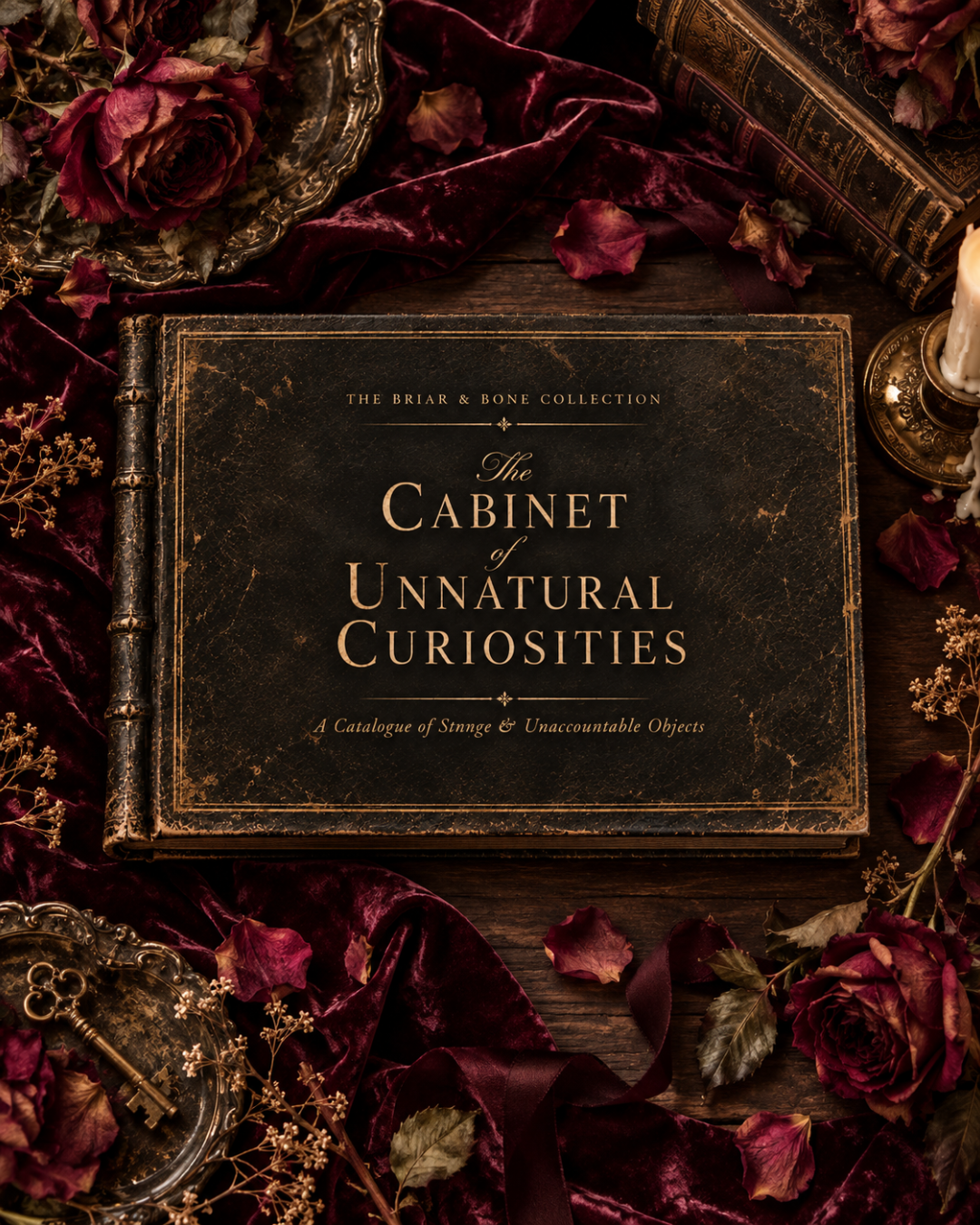
Briar & Bone: The Cabinet of Unnatural Curiosities is an immersive, 21-page illustrated catalogue of enchanted objects, forgotten treasures and mysterious artefacts from the dark fairytale Kingdom of Rosenwald.
Inspired by Victorian cabinets of curiosities, Gothic literature and twisted fairytales, this fictional collection brings together intricate specimen illustrations, collector's observations, mysterious photographs, preserved curiosities and fragments of a world where even the most beautiful possessions may conceal something sinister.
Who placed a human heart inside the mechanical nightingale?
Why were the feathers carefully labelled with names and ages?
What happened to the owners of the objects that were never reclaimed?
Why have certain photographs been removed?
And what secrets has the collector chosen not to record?
There are no definitive explanations.
No complete histories.
No guarantee that the collector is telling the truth.
Only strange objects, forgotten stories and unanswered questions waiting to be explored.
What's Inside?
◆ 21 beautifully illustrated digital pages from the fictional Kingdom of Rosenwald
◆ 11 detailed specimen entries featuring cursed objects, enchanted possessions and mysterious artefacts
◆ Intricate illustrations, classifications, provenance records and the collector's observations
◆ Collections of preserved flowers, feathers and other unusual curiosities
◆ Atmospheric photographs, mysterious locations and fragments of forgotten histories
◆ An illustrated inventory of additional objects and incomplete records
◆ An exploration guide with creative writing ideas and classroom activities
◆ Instant digital download in PDF format
Who Is It For?
Perfect for:
◆ Fantasy writers and worldbuilders
◆ Gothic fiction and dark fairytale enthusiasts
◆ Novelists, short-story writers and creative storytellers
◆ Teachers looking for imaginative visual writing prompts
◆ Mystery lovers and fans of supernatural folklore
◆ Journalers, roleplayers and curious minds
◆ Anyone who loves antique curiosities, fictional archives and strange forgotten histories
What Makes This Different?
This isn't a traditional collection of writing prompts.
It's a cabinet of curiosities.
Every specimen offers another glimpse into Rosenwald's mysterious past, but the histories are incomplete, the evidence is uncertain and the collector's observations cannot always be trusted.
Examine the nightingale's mechanical heart.
Study the preserved feathers.
Investigate the queen's sugar bowl.
Search the photographs for missing details.
Read the collector's observations and decide which accounts you believe.
Perhaps an object is genuinely enchanted.
Perhaps its reputation has grown from superstition.
Perhaps somebody has deliberately concealed the truth.
Or perhaps the strangest explanation is the correct one.
You decide what these objects mean.
Use the collection to inspire a Gothic short story, develop a dark fairytale, invent a mysterious character or build an entire fantasy world around its forgotten artefacts.
Follow the clues.
Question the collector.
Imagine the histories that were never recorded.
Which curiosity will you investigate? What story will you uncover?
Digital download: 21-page illustrated PDF collection, designed in A4 landscape format. Some pages contain multiple individual artefacts. No physical product will be shipped.
Step Inside the Cabinet of Unnatural Curiosities: A Dark Fairytale Writing Adventure
What if the strange traditions, forgotten superstitions and mysterious magical objects of a fairytale kingdom weren't simply ideas on a page, but extraordinary artefacts waiting to be discovered?
Imagine opening an old collector's cabinet and finding a mechanical nightingale with a terrible secret, a pair of bridal slippers connected to a mysterious wedding, or a queen's porcelain sugar bowl concealing something deeply sinister. Who owned these peculiar objects? What strange customs, forbidden rituals or forgotten bargains might explain their existence? And what happens when an apparently ordinary possession reveals a much darker story?
Welcome to Briar & Bone: The Cabinet of Unnatural Curiosities, an immersive creative writing collection inspired by the darker side of fairytales and folklore.
Hidden within the fictional Kingdom of Rosenwald, this mysterious cabinet brings together a collection of unusual treasures, enchanted possessions and unsettling curiosities gathered by a collector with a fascination for the extraordinary. Each artefact offers a tantalising glimpse into a world of ancient superstitions, peculiar traditions, royal secrets and magical mysteries, but its true story is yours to uncover.
Unlike ordinary lists of writing prompts, The Cabinet of Unnatural Curiosities invites you to become the storyteller, investigator and creator of your own dark fairytale. Rather than telling you exactly what happened, its illustrated artefacts offer intriguing fragments of evidence, strange details and unanswered questions that encourage you to imagine the possibilities.
Perhaps an object was once used in a forbidden wedding ceremony, belonged to a royal family with a terrible secret or played a part in a village tradition that nobody dares practise anymore. Perhaps the collector has misunderstood its significance entirely. One curious object might inspire a gothic mystery, another a sinister folktale, and another an enchanted adventure filled with unexpected twists.
Inside this 21-page illustrated digital collection, you'll discover:
Mysterious fairytale artefacts – peculiar objects with evocative histories, curious details and secrets waiting to be imagined.
Beautifully atmospheric illustrations – visual inspiration to help bring your characters, settings and stories to life.
An immersive dark fairytale setting – explore fragments of the Kingdom of Rosenwald and imagine the customs, beliefs and hidden histories of its inhabitants.
Open-ended storytelling possibilities – use individual artefacts to inspire short stories, creative writing exercises, character backstories or entire fictional worlds.
A printable creative writing resource – return to the cabinet whenever you need an unusual object, unexpected mystery or spark of inspiration.
Whether you're a creative writer searching for something beyond conventional prompts, a fantasy enthusiast who loves mysterious objects and enchanted worlds, or a teacher looking for an imaginative way to encourage storytelling, this collection offers a different way to approach creative writing.
And the best part? There are no predetermined answers. The mechanical nightingale might be a treasured royal possession, a dangerous magical invention or the only witness to a forgotten crime. The bridal slippers might belong to a missing princess, a cursed bride or someone who never existed at all. Every object can inspire countless stories, and no two writers need imagine the same one.
If these 100 fairytale traditions and customs have inspired you to invent strange celebrations, magical beliefs and unsettling rituals of your own, The Cabinet of Unnatural Curiosities is the perfect next step. Take those ideas beyond the page, discover the objects that might have survived your imaginary world's forgotten traditions, and begin creating the stories behind them.
For just £3.50, you can open the cabinet, explore its peculiar treasures and discover a whole new world of dark fairytale storytelling inspiration.
Explore Briar & Bone: The Cabinet of Unnatural Curiosities
The cabinet is open. Its secrets are waiting. What story will you uncover?

Go Deeper: How to Use Fairytale Traditions & Customs in Your Creative Writing
The most memorable fairytale traditions do more than make an imaginary world feel magical. They reveal what its people believe, how communities function, which behaviours are celebrated or forbidden, and what might happen when somebody challenges the rules. Whether you're creating a whimsical woodland village, an enchanted royal court or a deeply unsettling folk horror setting, these five creative writing techniques will help you transform unusual customs into meaningful parts of your stories.
◆ Give Every Tradition a History, Even If Nobody Remembers It. The most intriguing customs often survive long after their original purpose has been forgotten. Perhaps villagers leave bread beneath an ancient tree because their ancestors once made a bargain with a forest spirit, or a royal family covers every mirror during winter to prevent an imprisoned queen from returning. Consider who established the tradition, what originally inspired it and how its meaning might have changed over generations. You could even create several conflicting explanations, allowing different characters to interpret the same custom in completely different ways. For more inspiration, explore our 100 Folklore Story Ideas, where local legends, mysterious rituals and forgotten histories can provide the foundations for your own imaginary traditions.
◆ Use Customs to Reveal the Values and Hierarchies of Your Fairytale Society. Traditions offer a wonderful opportunity to show readers how a fictional community operates without relying on lengthy explanations. A kingdom where rulers must serve their poorest citizens once a year might value humility, while one where only noble families may participate in magical ceremonies could reveal deep social divisions. Think about who benefits from a custom, who is excluded, who enforces its rules and whether everyone genuinely believes in its importance. The smallest everyday practices can reveal enormous differences in wealth, power, freedom and opportunity. Our Fairytale Kingdom Worldbuilding Questions and Fairytale Jobs & Occupations offer further inspiration for developing the people, social structures and everyday realities of your enchanted worlds.
◆ Turn an Ordinary Celebration into an Extraordinary Story. A village festival, wedding ceremony or seasonal gathering can provide the perfect setting for an unexpected discovery, dangerous encounter or dramatic turning point. Begin with a tradition that everyone considers perfectly normal, then introduce something that disrupts it. Perhaps the annual harvest feast welcomes an unfamiliar guest, a royal wedding reveals a centuries-old curse, or the ceremonial lanterns refuse to rise into the sky. Consider how different characters might respond: some could dismiss the event as coincidence, others might interpret it as an omen, and a few may know exactly what it means. For more imaginative celebrations and enchanted settings, explore our Fairytale Balls, Fairytale Town & Village Ideas and 100 Fairytale Story Ideas.
◆ Explore What Happens When Somebody Breaks the Rules. Fairytales are filled with warnings, forbidden actions and seemingly unreasonable instructions, making unusual traditions particularly useful for creating tension and conflict. Perhaps nobody may enter the forest after sunset, a bride must never look behind her during the wedding procession, or every household must leave an empty chair beside the fire. Decide whether breaking the custom carries genuine supernatural consequences or whether the rule exists to maintain control, conceal a crime or protect a powerful secret. Your protagonist might deliberately challenge an unjust tradition, accidentally violate an ancient agreement or discover that the consequences are very different from what everyone has been taught. Explore our Fairytale Crime & Punishment, Fairytale Curses & Bargains and Fairytale Magic Worldbuilding Questions for more ways to develop magical laws, forbidden practices and the consequences of breaking them.
◆ Let Traditions Inspire Characters, Mysteries and Entire Stories. Rather than treating customs as decorative worldbuilding details, make them central to your characters' experiences and decisions. A young woman might refuse to participate in a marriage ceremony that has governed her family for centuries. A village historian could investigate why an apparently harmless festival requires thirteen empty chairs. A child might discover that the household ritual performed every winter is actually keeping something dangerous imprisoned beneath the floorboards. Consider how the same tradition might inspire a whimsical fairytale, a gothic mystery, a romantic fantasy or a deeply unsettling folk horror story simply by changing the character's perspective and the consequences involved. Our Folklore Mystery, Folk Gothic and Horror Fairytales resources offer further inspiration for exploring the secrets, fears and supernatural possibilities hidden within traditional beliefs.
The key is to make your traditions feel as though they existed long before your story began and will continue long after it ends. Give them histories, contradictions, variations and consequences, and your fairytale world will begin to feel like a living place rather than simply a backdrop for magical adventures.
Final Thoughts: Every Fairytale Tradition Has a Story to Tell
The most enchanting fairytale worlds are shaped not only by their magical creatures, mysterious kingdoms and extraordinary adventures, but by the traditions and customs woven into everyday life. From peculiar wedding ceremonies and ancient royal rituals to forgotten village superstitions and celebrations held beneath the light of the moon, these small details give imaginary societies their character, history and sense of wonder. They suggest generations of people who have loved, feared, celebrated and made promises long before your story begins.
As you explore these 100 fairytale traditions and customs with story ideas, remember that even the simplest ritual can become the foundation of an extraordinary tale. A harmless childhood ceremony might conceal a forgotten prophecy, a seasonal festival could bring an unexpected visitor into a quiet village, or a centuries-old custom might survive because nobody dares discover what happens when it is abandoned. Think about how traditions shape your characters' beliefs, influence their choices and create conflicts between personal desires and the expectations of their communities. Sometimes the most compelling story begins with a character who asks a question nobody else has ever dared to consider: Why do we still do this?
Whether you're creating a whimsical fairytale filled with wonder, a richly imagined fantasy kingdom or a dark folklore mystery rooted in ancient beliefs, let these traditions inspire you to build worlds that feel lived in, layered and full of possibilities. Explore our Fairytales & Folklore Writing Hub for more magical storytelling inspiration, experiment with our Fairytale Story Sparks and Folklore Story Sparks to discover unexpected characters, settings and plot twists, or browse the Creative Writing Archive for even more imaginative ideas to develop your next story.
Above all, remember that every custom has an origin, every celebration preserves a memory, and every superstition began with someone believing there was something worth fearing.
Some traditions are kept for good luck. Others are kept because nobody remembers what happens when they stop.
Which tradition will inspire your next fairytale?
Choose Your Next Adventure