100 Fairytale Society Worldbuilding Questions: Royalty, Magic, Social Hierarchies & Hidden Injustices
What if the poorest villager in your kingdom possessed more magical power than the royal family? What if children born beneath a certain moon were forbidden from inheriting property, or a fairy's blessing determined somebody's place in society? And what if the beautiful, peaceful kingdom at the heart of your fairytale was only peaceful because nobody dared question its rules?
Every enchanting fairytale kingdom has a society beneath its glittering castles, bustling marketplaces and ancient forests. There are rules about who may marry, who may inherit a throne, who deserves an education and whose voice matters. There are witches living beyond the village boundaries, servants who know the royal family's darkest secrets, and ordinary people whose lives are shaped by laws they had no part in creating. Some societies welcome magic, while others fear it. Some reward kindness and courage, while others place more value on beauty, bloodlines or obedience.
These 100 Fairytale Society Worldbuilding Questions will help you explore the people, institutions, beliefs and social structures that make your fictional world feel alive. From royal hierarchies and magical discrimination to family expectations, unusual occupations, forbidden relationships and hidden injustices, each question invites you to think beyond the familiar once upon a time and consider what everyday life might really look like in an enchanted kingdom.
Whether you're creating a whimsical storybook village, a sinister woodland community, a glittering fairy court or a dark fantasy kingdom built upon centuries of secrets, these questions will help you develop societies with their own customs, conflicts, contradictions and possibilities for extraordinary stories. For more inspiration, explore our Fairytales & Folklore Writing Hub, discover magical settings and characters in our Fairytale Story Sparks, or browse the Creative Writing Archive for even more ideas to bring your fictional worlds to life.
Because behind every happily ever after lies an entire society — and not everybody gets to live happily ever after.
1. Royalty, Nobility & Social Hierarchies
In fairytales, kingdoms are often ruled by beautiful queens, powerful kings and princes destined to inherit the throne. But beneath the glittering crowns and magnificent castles lies a complicated society of nobles, servants, merchants, peasants and people whose place in the world may have been decided long before they were born. Some kingdoms measure status through wealth and ancestry, while others might value magical abilities, extraordinary beauty, ancient promises or the favour of supernatural beings.
Use these questions to explore how power, privilege and social expectations shape your fairytale society. Consider not only who sits upon the throne, but who is excluded from the royal court, who quietly controls the kingdom from the shadows and what might happen if somebody born into the lowest ranks dared to challenge the established order.
1. What determines a person's social status in your fairytale kingdom?
Is their position inherited through noble bloodlines, earned through wealth and service, or determined by something more unusual, such as the circumstances of their birth, the colour of their eyes, a magical blessing or the number of generations their family has lived within the kingdom? Can somebody rise above the position they were born into, or is the social hierarchy almost impossible to escape?
2. What gives the royal family the right to rule?
Do the people believe their monarch was chosen by the gods, descended from an ancient magical bloodline or appointed through a centuries-old bargain with the fairies? Perhaps every ruler must demonstrate a particular supernatural gift, survive a dangerous coronation ritual or receive the approval of an enchanted object before their claim to the throne is recognised.
3. How are noble families distinguished from ordinary citizens?
Beyond their wealth and grand estates, what privileges, obligations and restrictions separate the nobility from everybody else? Are certain colours, fabrics, jewels, titles or magical objects reserved exclusively for noble families? Perhaps only aristocrats may own white horses, enter enchanted gardens or speak directly to the royal family, while commoners face severe punishment for imitating their betters.
4. Who holds power in the kingdom without officially wearing a crown?
Could the royal physician, an elderly governess, a powerful merchant, the keeper of the royal treasury or a mysterious fairy godmother wield more influence than the monarch? Consider the individuals and institutions that quietly shape royal decisions, control access to the throne or possess secrets capable of destroying an entire dynasty.
5. What happens when somebody from a lower social class enters the royal court?
Is a talented seamstress welcomed because she can spin enchanted silk, or is she treated with suspicion because she does not understand courtly etiquette? How would nobles respond to a commoner receiving royal favour, marrying into an aristocratic family or acquiring a title? Perhaps a single breach of etiquette could ruin a person's reputation, while an unexpected act of kindness could change their fortunes forever.
6. How does your society decide who is worthy of inheriting the throne?
Does the crown automatically pass to the eldest child, the firstborn son, the most magically gifted heir or whoever completes a dangerous royal challenge? What happens if the rightful successor is a child, a changeling, an illegitimate descendant or somebody who refuses to rule? Consider whether succession laws protect the kingdom or create opportunities for betrayal, manipulation and rebellion.
7. What responsibilities do the wealthy and powerful have towards ordinary people?
Are nobles expected to provide food during harsh winters, protect nearby villages from supernatural creatures or offer sanctuary to travellers? Perhaps aristocratic families must fulfil ancient obligations to the land, such as feeding a sleeping dragon beneath their castle or maintaining the enchantments that protect the kingdom. What happens when a noble family neglects its duties but continues enjoying its privileges?
8. How does somebody lose their social position, title or royal favour?
Can a noble family be stripped of its status for treason, unpaid debts, a broken marriage agreement or an ancestor's forgotten crime? Perhaps a fairy's curse can transform an aristocrat into a servant overnight, or an ancient law declares that anyone who fails to recognise the monarch's reflection must surrender their title. What becomes of people who have never known a life without privilege?
9. How do different social classes experience the same kingdom?
What does a royal wedding, a poor harvest, a magical plague or a royal decree mean to somebody living in the palace compared with a servant, a travelling merchant or a family on the edge of an enchanted forest? Consider how access to food, medicine, education, protection and magic changes depending on somebody's position in society. Could the kingdom's celebrated prosperity conceal terrible suffering beyond the castle walls?
10. What would happen if the kingdom's social hierarchy were suddenly overturned?
Imagine that an ancient enchantment expires, every royal title becomes meaningless or a magical decree grants commoners the same privileges as the nobility. Would the kingdom embrace a fairer society, descend into chaos or discover that the old hierarchy was protecting a dangerous secret? Who would fight to preserve the established order, and who might finally have an opportunity to reshape the kingdom?
2. Families, Childhood & Growing Up
In fairytales, childhood can be a time of wonder, danger and extraordinary expectations. Children might be promised to supernatural beings before they are born, raised by mysterious guardians or expected to fulfil ancient family obligations. Meanwhile, parents, grandparents, siblings and stepparents all occupy different positions within a society shaped by magic, inheritance and tradition.
Use these questions to explore how families function in your fairytale world, what society expects from its youngest members and how childhood experiences influence the adults they eventually become. Think about the differences between growing up in a royal palace, a remote woodland cottage or a village where every family has a secret.
11. What does your fairytale society consider a proper family?
Are households traditionally made up of parents and children, or are extended families, adopted relatives and unrelated companions equally recognised? Perhaps children are raised collectively by their village, elderly neighbours are considered honorary grandparents, or magical guardians are legally recognised as family members. How does society treat households that do not fit its expectations?
12. How does society determine when a child becomes an adult?
Is adulthood marked by a particular birthday, a first magical ability, the completion of an apprenticeship or an encounter with a supernatural creature? Perhaps children must spend a night alone in an enchanted forest, receive a blessing from the village elders or prove they can recognise a fairy in disguise. What happens to those who fail, refuse or never receive the expected sign?
13. What expectations are placed upon children from different social classes?
Are royal children raised to govern, merchant children expected to inherit family businesses and village children required to work from an early age? Perhaps magically gifted children are removed from their families for special training, while children born without magic are considered unsuitable for certain occupations. How much freedom do young people have to choose their own futures?
14. How are orphaned, abandoned or unwanted children treated?
Does the kingdom provide orphanages, charitable households or official guardians, or are vulnerable children left to survive through the kindness of strangers? Perhaps abandoned children are traditionally taken in by witches, woodland spirits or fairy godmothers. Are these arrangements celebrated as acts of compassion, or does society regard such children with suspicion?
15. What responsibilities do parents have towards their children?
Are parents expected to arrange suitable marriages, secure apprenticeships, protect children from magical bargains or provide a particular inheritance? Perhaps a parent who fails to teach their child an ancient family skill risks losing custody, or every family must present its newborns to the royal court. Who decides whether a parent has fulfilled their obligations?
16. How are stepfamilies, adoptive families and guardians viewed?
Does society consider blood relationships more important than affection, loyalty and care? Can an adopted child inherit a noble title, or does the law favour even the most distant biological relative? Perhaps a fairy godmother possesses greater legal authority over a child than their surviving parent, creating complicated questions about love, obligation and control.
17. What happens when a child is born with an unusual or dangerous magical gift?
Is the child celebrated, feared, hidden away or claimed by a powerful institution? Perhaps families receive generous rewards for reporting magical births, while concealing an enchanted child is considered treason. How might the child's abilities affect their siblings, friendships, education and future place in society?
18. How much independence are children and teenagers permitted?
Can young people travel between villages, enter the forest, choose their friends or leave home without permission? Are daughters and sons subject to different restrictions? Perhaps children are forbidden from speaking to strangers after sunset, while teenagers are expected to undertake dangerous journeys that adults refuse to attempt.
19. How do families pass down property, responsibilities and secrets?
Does the eldest child inherit everything, or are possessions divided equally among siblings? Perhaps family homes can only pass to descendants who know a particular spell, and certain heirlooms must remain with the youngest daughter. What happens when inheritance customs clash with affection, fairness or an ancestor's final wishes?
20. What happens when somebody rejects the future their family has chosen for them?
Could a prince refuse the throne, a witch's daughter reject magic or a miller's son abandon the family trade? Would their decision bring shame, financial hardship or supernatural consequences upon the household? Consider whether society offers any respectable way to break from family expectations without losing one's place in the community.
3. Marriage, Courtship & Relationships
Fairytale romances often end with weddings, royal celebrations and promises of everlasting happiness. Yet the societies surrounding these relationships may have complicated expectations about who can marry, how couples are chosen and what responsibilities accompany love. A marriage might unite rival kingdoms, settle an ancient debt or fulfil a bargain made generations earlier.
These questions explore the social rules governing romance, marriage, friendship and personal relationships. Consider how love might flourish within a restrictive society, what happens when affection conflicts with duty and whether a fairytale's celebrated happily ever after would be equally happy for everyone involved.
21. Who is permitted to marry whom in your fairytale society?
Are marriages restricted by social class, magical ability, species, family ancestry or royal permission? Perhaps humans and fairies are forbidden from marrying, or noble families can only unite with households possessing particular enchanted bloodlines. What happens when two people fall in love across a boundary their society refuses to recognise?
22. How are romantic partners traditionally chosen?
Do individuals choose their own partners, or are marriages arranged by families, matchmakers, village elders or supernatural beings? Perhaps enchanted mirrors reveal suitable matches, or every unmarried person receives a mysterious invitation to an annual matchmaking ball. How much influence does personal attraction have over the final decision?
23. What does society consider an appropriate courtship?
Must potential partners exchange gifts, complete public challenges, obtain family approval or observe strict rules about meeting alone? Perhaps a suitor must demonstrate kindness to three strangers, survive a night in a haunted orchard or present an impossible object before proposing marriage. What happens when somebody ignores these expectations?
24. How does marriage change a person's social position?
Can marrying a prince transform a commoner into royalty, or do certain titles remain inaccessible regardless of marriage? Does one partner automatically gain control over the other's property, magical abilities or inheritance? Perhaps marriage between different magical communities grants extraordinary privileges while also imposing dangerous obligations.
25. What rights do unmarried people have compared with married couples?
Can unmarried adults own homes, inherit property, raise children or hold positions of authority? Are lifelong bachelors, unmarried women and people who choose not to marry treated as independent citizens or regarded with suspicion? Perhaps a village believes every unmarried person beyond a certain age is secretly promised to the fairies.
26. How does society view relationships between humans and supernatural beings?
Are friendships, romances and marriages with witches, merfolk, fairies or shapeshifters accepted, celebrated or forbidden? Perhaps such relationships require special legal agreements, and children born from them possess uncertain rights. How do families and communities respond when someone chooses a partner from another world?
27. What expectations exist within a marriage?
Are spouses expected to share responsibilities, produce heirs, maintain family reputations or fulfil specific magical duties? Perhaps one partner must surrender their true name, while another becomes responsible for protecting the household from supernatural visitors. Which expectations are considered sacred, and which might individuals quietly resent?
28. Can people leave unhappy marriages or break formal engagements?
Does society recognise divorce, separation or the cancellation of marriage agreements? Perhaps ending an engagement requires repayment of every gift exchanged, while dissolving a magically binding marriage involves an almost impossible task. What happens to someone whose family, reputation or livelihood depends upon remaining married?
29. How are friendships and loyalties valued alongside romantic relationships?
Are friendships considered private matters, or do families and social classes determine who may associate with whom? Could a servant's friendship with a princess be viewed as dangerous, or a lifelong promise between childhood companions carry greater social weight than a marriage? How might loyalty to friends conflict with family duty or romantic love?
30. What happens when somebody publicly rejects society's expectations about love?
Imagine a princess refusing every royal suitor, a noble marrying a village healer or two people choosing companionship over a politically advantageous marriage. Would society celebrate their courage, condemn their selfishness or punish their families? Could one unconventional relationship inspire others to question the kingdom's oldest rules?
4. Work, Wealth & Everyday Life
Beyond the royal palaces and enchanted forests, ordinary people must earn their living, feed their families and find ways to survive. Fairytale societies might depend upon blacksmiths, bakers, seamstresses, shepherds and travelling merchants, alongside more unusual occupations such as curse-breakers, dragon keepers, dream collectors and royal wish interpreters.
Use these questions to imagine the practical realities of life in your fairytale world. Explore how wealth is distributed, which occupations are respected, how magic affects employment and what everyday comforts or hardships distinguish one community from another.
31. What occupations are essential to keeping your fairytale society functioning?
Does the kingdom rely upon ordinary farmers, builders and craftspeople, or do magical professions perform tasks that would otherwise require hundreds of workers? Perhaps every village employs a professional curse-remover, while royal households retain specialists who mend broken enchantments. Which occupations would cause society to collapse if their workers suddenly disappeared?
32. How does somebody learn a trade or enter a profession?
Are children apprenticed to experienced craftspeople, trained within their families or selected by magical institutions? Perhaps a person's future occupation is determined by an enchanted object at birth, or guilds refuse entry to anyone without a particular family name. What opportunities exist for somebody who discovers an unexpected talent later in life?
33. What determines whether an occupation is respected or looked down upon?
Are royal servants admired for their proximity to power, while essential workers such as gravediggers, chimney sweeps and rat catchers are shunned? Perhaps magical healers are celebrated, but the people who collect ingredients for their remedies are considered unclean. How do these attitudes affect the workers themselves?
34. How is wealth measured and exchanged?
Does society use coins, precious stones, magical favours, promises or objects with sentimental value? Perhaps a person's wealth is measured by the number of wishes they possess, the years remaining in their life or the blessings attached to their family home. Who controls the system, and what happens when someone cannot pay their debts?
35. How does magic affect ordinary businesses and traditional trades?
Can a witch produce bread without flour, a fairy weave cloth overnight or a spell transform worthless objects into gold? If magical workers can perform tasks instantly, what happens to the people who depend upon those trades for their livelihoods? Are there laws preventing unfair magical competition, or does society simply accept the consequences?
36. What does an ordinary working day look like for different members of society?
When do people wake, work, eat and rest? Do villagers follow the rising sun, the ringing of castle bells or the movements of enchanted stars? Perhaps certain occupations can only be performed after dark, while workers in magical industries must obey unusual safety precautions. How does daily life differ between wealthy households and struggling families?
37. What happens when somebody becomes too poor to support themselves?
Does the kingdom provide assistance, or must people rely upon relatives, neighbours, charities and supernatural bargains? Perhaps every village maintains a communal food store, but those who accept help must repay their debt through service. Are poverty and misfortune viewed with compassion, suspicion or moral judgement?
38. Who owns the land, forests, rivers and other valuable resources?
Do ordinary villagers possess their own property, or does everything belong to the crown, nobility or supernatural guardians? Perhaps woodland spirits claim ownership of every tree, and fishermen must negotiate with river creatures before casting their nets. What happens when competing claims make ordinary survival difficult?
39. How are markets, shops and travelling merchants regulated?
Can anyone open a business, or must traders purchase licences from guilds, royal officials or magical authorities? Perhaps every marketplace contains a section reserved for enchanted goods, and merchants are legally responsible for any curses attached to their wares. What protections exist against dishonest traders, dangerous bargains and counterfeit magical objects?
40. What would happen if ordinary workers refused to perform their duties?
Imagine the kingdom's bakers closing their ovens, the royal seamstresses refusing to sew or the enchanted forest's woodcutters abandoning their work. Would the ruling classes negotiate, threaten punishment or attempt to replace them with magic? What might such a rebellion reveal about the true foundations of the kingdom's wealth and power?
5. Magic, Magical Beings & Social Status
Magic can transform the structure of an entire society. In one kingdom, witches might occupy respected positions as healers and advisers, while in another they are feared and driven into the wilderness. Fairies may be treated as royalty, merfolk as outsiders and people born without magical abilities as second-class citizens.
These questions explore the relationship between magical power, identity and social privilege. Consider who controls supernatural abilities, how different beings coexist and what happens when the possession of magic determines a person's rights, opportunities or value.
41. Who is legally permitted to practise magic in your fairytale society?
Can anyone learn spells, or is magic restricted to licensed witches, royal bloodlines, religious authorities or approved magical guilds? Perhaps every spell must be recorded in an official register, while unlicensed enchantments are treated as serious crimes. Who decides which forms of magic are acceptable?
42. How does society treat people who are born without magic?
Are non-magical citizens considered ordinary members of the community, or are they disadvantaged in education, employment and marriage? Perhaps magical ability is so common that lacking it is regarded as a disability, while another kingdom considers non-magical people uniquely trustworthy. How do these attitudes influence someone's sense of identity?
43. What rights do fairies, witches, merfolk and other supernatural beings possess?
Can they own property, vote in village councils, inherit titles or marry human citizens? Perhaps certain magical beings are protected by ancient treaties, while others are treated as dangerous creatures rather than people. What happens when a supernatural community demands equal recognition under the kingdom's laws?
44. How does society distinguish between acceptable and forbidden magic?
Are healing spells celebrated while curses are outlawed, or does the law judge magic according to who performs it rather than what it accomplishes? Perhaps royal enchantments are considered sacred, while identical spells practised by village witches are condemned. Who benefits from these distinctions?
45. How are magical children educated and supervised?
Do they attend ordinary schools, study with private tutors or enter specialised academies? Perhaps children with dangerous abilities must wear protective charms, while particularly gifted pupils are recruited into royal service. What happens when a child's family refuses to surrender control over their education?
46. Can magical abilities be bought, inherited, transferred or taken away?
Does society recognise magic as personal property, a family inheritance or a gift that belongs to the community? Perhaps wealthy families purchase blessings for their children, while poor citizens sell years of their magical potential to survive. What ethical and legal conflicts arise when supernatural power becomes a commodity?
47. How do magical and non-magical communities share public spaces?
Are enchanted beings welcome in ordinary inns, schools and marketplaces, or must they use separate establishments? Perhaps certain buildings are designed to accommodate giants, merfolk or shapeshifters, while others deliberately exclude them. What does the layout of a village reveal about who is considered to belong?
48. Who is responsible when magic causes harm?
If a spell accidentally destroys a home, transforms a neighbour or damages an entire harvest, who must make amends? Is the spellcaster liable, the person who commissioned the enchantment or the institution that trained them? Perhaps magical accidents are judged by a special court where witnesses can be compelled to reveal their true memories.
49. What social advantages come from possessing rare magical abilities?
Could someone who speaks to dragons enter royal service, while a person who sees the future becomes a valuable marriage prospect? Perhaps certain abilities guarantee wealth, protection or political influence. How might society exploit individuals whose gifts are considered too valuable to remain private?
50. What would happen if the kingdom's magical hierarchy suddenly changed?
Imagine every non-magical citizen awakening with extraordinary powers, or the kingdom's most influential witches losing their abilities overnight. Would society become more equal, or would new divisions emerge? Who would attempt to restore the old system, and who might finally discover a freedom they had never experienced?
6. Laws, Justice & Forbidden Behaviour
Every fairytale kingdom has rules, whether they are written upon royal scrolls, carved into ancient stones or whispered as warnings from one generation to the next. Some laws protect ordinary people, while others preserve the privileges of powerful families or maintain agreements with supernatural forces.
Use these questions to explore how justice operates in your fairytale society. Consider who makes the laws, who enforces them, whether punishments are fair and what happens when a rule that appears perfectly reasonable conceals a much darker purpose.
51. Who has the authority to create and change the kingdom's laws?
Does the monarch rule by decree, or must new laws receive approval from noble families, village councils or magical advisers? Perhaps certain ancient laws cannot be altered without the permission of the fairies who originally established them. What happens when different authorities issue contradictory commands?
52. Are the same laws applied equally to every member of society?
Can nobles escape punishment through wealth or influence, while commoners face severe consequences for minor offences? Perhaps magical beings are judged under separate laws, or royal relatives possess immunity from ordinary courts. How do citizens respond when justice depends upon somebody's status?
53. What behaviours are considered crimes in your fairytale kingdom?
Alongside theft and violence, are there unusual offences such as speaking a forbidden name, entering the forest after sunset or accepting gifts from strangers? Perhaps it is illegal to refuse hospitality to a traveller, destroy a fairy ring or break a promise made beneath a full moon. What do these laws reveal about society's deepest fears?
54. How are crimes investigated and guilt established?
Does the kingdom employ guards, magistrates and investigators, or rely upon enchanted mirrors, truth spells and supernatural witnesses? Perhaps an accused person must complete three impossible tasks to prove their innocence. Can magical evidence be trusted, and what happens when an enchantment produces the wrong answer?
55. What punishments are considered appropriate for different offences?
Are criminals fined, imprisoned, exiled or required to perform public service? Perhaps certain crimes result in temporary transformations, the loss of a magical gift or compulsory service to an enchanted creature. Does society regard these punishments as fair, or have cruel traditions become accepted simply because they are old?
56. Who protects citizens from abuse of power?
Can ordinary people challenge royal decisions, report corrupt officials or seek protection from powerful magical beings? Perhaps an independent order of judges answers only to an ancient enchanted book, while village elders possess the right to overrule unjust nobles. What happens when those responsible for protecting citizens become corrupt themselves?
57. How does society deal with promises, bargains and magical contracts?
Are spoken agreements legally binding, or must contracts be witnessed and recorded? Perhaps breaking a promise made to a fairy carries harsher consequences than violating an ordinary law. Can somebody escape an agreement made through deception, desperation or without understanding its true cost?
58. What rights do accused people have before they are punished?
Are individuals presumed innocent, permitted to defend themselves or entitled to assistance from an advocate? Perhaps suspects are forbidden from speaking during trials, while witnesses must surrender a cherished memory before giving evidence. How does the justice system treat people who cannot afford legal help or magical protection?
59. Which laws are secretly designed to protect the interests of the powerful?
Could restrictions on travelling after dark prevent villagers from discovering royal activities, or might a ban on certain spells preserve the monopoly of an influential magical guild? Perhaps a supposedly sacred law exists solely to conceal an ancient crime. Who knows the truth, and what would happen if the public discovered it?
60. What happens when someone breaks an unjust law for a good reason?
Imagine a healer using forbidden magic to save a child, a servant stealing food for a starving village or a princess helping an outlawed supernatural being escape imprisonment. Would the authorities consider their intentions, or insist that the law must always be obeyed? Could one act of defiance change the kingdom's understanding of justice?
7. Religion, Beliefs & Superstitions
Fairytale societies may be shaped by old gods, woodland spirits, ancestral blessings and beliefs about forces that ordinary people cannot see. Some communities might worship a single divine ruler, while others honour the changing seasons, make offerings to local spirits or follow religious traditions passed down through countless generations.
These questions explore how shared beliefs influence society, from political authority and public morality to personal identity and everyday decisions. Consider the differences between genuine faith, inherited superstition and beliefs deliberately encouraged by those who benefit from them.
61. What gods, spirits or supernatural forces does your fairytale society believe in?
Does the kingdom worship ancient deities, revere powerful fairies or believe that every forest, mountain and river possesses its own guardian spirit? Perhaps different villages honour different beings, creating tensions between communities. How do these beliefs shape the way people understand their place in the world?
62. Who acts as the spiritual authority within your society?
Are religious matters overseen by priests, priestesses, village wise women, royal prophets or mysterious woodland guardians? Perhaps every settlement appoints a keeper of sacred stories, while the royal family claims the exclusive right to communicate with divine beings. How much influence do spiritual leaders have over ordinary life and political decisions?
63. How do religious beliefs influence the kingdom's laws and social expectations?
Are certain actions forbidden because they offend the gods, or are citizens expected to observe particular duties as part of their faith? Perhaps marriage agreements, inheritance rights and royal coronations all require religious approval. What happens when somebody's personal beliefs conflict with the laws of the kingdom?
64. What places are considered sacred, and who is permitted to enter them?
Does society protect ancient groves, enchanted springs, mountain shrines or forgotten temples? Perhaps only children may enter a particular woodland sanctuary, while a royal chapel remains forbidden to commoners. What happens when someone crosses a sacred boundary, either deliberately or by accident?
65. How does society interpret good fortune, misfortune and unusual events?
Are unexpected blessings seen as rewards for virtue, while illness, storms and failed harvests are interpreted as supernatural punishments? Perhaps the birth of twins, an unusually coloured animal or a flowering tree in winter carries religious significance. How might these interpretations influence the treatment of innocent people?
66. What role do ancestors and the dead play in the beliefs of the living?
Are deceased relatives believed to watch over their descendants, return as spirits or influence family fortunes? Perhaps noble families claim authority through their ancestors, while ordinary villagers maintain shrines to forgotten generations. What responsibilities do the living owe to those who came before them?
67. How are people with different religious beliefs treated?
Can neighbouring communities worship different gods peacefully, or does the kingdom insist upon a single accepted faith? Perhaps supernatural beings follow ancient spiritual practices that human authorities consider dangerous. What opportunities exist for tolerance, cooperation and conflict between different belief systems?
68. What superstitions influence ordinary decisions and social behaviour?
Do people avoid certain numbers, refuse to travel on particular days or believe that speaking a person's true name invites misfortune? Perhaps villagers will not begin a journey until a bird crosses their path, while royal advisers consult omens before making important decisions. Which beliefs are harmless customs, and which restrict people's freedom?
69. Who benefits from maintaining particular religious beliefs or superstitions?
Could a powerful institution collect offerings in exchange for protection from curses, or might the royal family claim divine approval to discourage rebellion? Perhaps a supposed supernatural warning was invented centuries ago to prevent people from entering a forbidden part of the kingdom. How can sincere faith become entangled with manipulation and control?
70. What happens when an accepted belief is publicly challenged?
Imagine a scholar proving that a feared omen has a natural explanation, a child questioning a sacred story or a supernatural being denying the existence of the gods worshipped in its name. Would society welcome the discovery, reject the evidence or punish the person responsible? How might the challenge transform the kingdom's identity?
8. Villages, Communities & Social Expectations
Fairytale villages often appear charming, with thatched cottages, cobbled streets, bustling markets and neighbours who know one another's names. Yet close-knit communities can be places of extraordinary kindness and equally extraordinary cruelty. Reputation matters, gossip travels quickly and the pressure to conform can be difficult to escape.
Use these questions to explore how ordinary people interact within their communities. Consider the unwritten rules governing hospitality, belonging, friendship, conflict and cooperation, and what happens when somebody refuses to behave as their neighbours expect.
71. What qualities make somebody a respected member of the community?
Is respect earned through generosity, honesty, wealth, age, magical ability or service to others? Perhaps the most admired villagers are those who have survived an encounter with the fairies, while newcomers must live in the settlement for many years before receiving equal recognition. Who decides what makes a person worthy of respect?
72. How are strangers and newcomers welcomed into the village?
Are travellers offered food and shelter, questioned by local officials or expected to provide proof of their origins? Perhaps every newcomer must receive an invitation from an existing resident, or villages refuse entry to anyone arriving after sunset. How do these customs protect the community, and when might they become instruments of exclusion?
73. What unwritten rules govern everyday social behaviour?
Must villagers greet their elders in a particular way, avoid discussing certain subjects or observe strict expectations about visiting neighbours? Perhaps refusing a cup of tea is considered an insult, while looking directly at a village elder is forbidden. How do children learn these rules, and what happens when somebody unknowingly breaks them?
74. How does gossip influence reputation and social standing?
Can a rumour destroy somebody's marriage prospects, business or friendships? Perhaps the village has an unofficial network of storytellers who decide which secrets become public knowledge, while certain families are protected from criticism. What happens when a false accusation spreads faster than the truth?
75. How do communities support people experiencing hardship?
Do neighbours share food, repair damaged homes and care for the elderly, or is assistance reserved for families considered respectable? Perhaps every household must contribute to a communal store, while those receiving help are expected to repay their neighbours through service. What happens when somebody is denied support because of their reputation?
76. Who makes decisions about village life?
Is the community governed by an elected council, hereditary elders, wealthy landowners or a mysterious figure who rarely appears in public? Perhaps every household has one vote, or only people who have lived in the village for three generations may participate. How are disagreements resolved when residents have competing interests?
77. How does society treat people who live alone or apart from the community?
Are solitary residents admired for their independence, pitied for their loneliness or suspected of practising forbidden magic? Perhaps every village has a woman who lives beyond the boundary stones, a hermit who speaks only to animals or an elderly scholar who refuses visitors. What assumptions do neighbours make about those who prefer solitude?
78. What responsibilities do neighbours have towards one another?
Are residents expected to attend communal gatherings, help with harvests, protect local children or participate in village celebrations? Perhaps every household must keep watch over a particular stretch of enchanted woodland, and refusing to take part is considered a betrayal of the community. Where does mutual responsibility end and unreasonable obligation begin?
79. How are disputes between neighbours and families resolved?
Do villagers appeal to elders, negotiate through respected intermediaries or settle disagreements through unusual public challenges? Perhaps two feuding families must share a table until they reach an agreement, or a magical object reveals which party has been dishonest. What happens when a conflict becomes so bitter that ordinary solutions no longer work?
80. What happens when somebody refuses to conform to the community's expectations?
Imagine a villager declining an annual celebration, refusing to marry, befriending a feared outsider or questioning the authority of the elders. Would neighbours tolerate their independence, withdraw their friendship or drive them away? Could one person's refusal reveal that the village's apparent harmony depends upon fear rather than genuine agreement?
9. Education, Knowledge & Storytelling
Knowledge is powerful in fairytales. A forgotten spell can break an ancient curse, a hidden book can expose a royal secret and a story told beside the fire might contain the only warning capable of saving an entire kingdom. Yet not everybody has equal access to education, and some societies carefully control which truths may be learned, recorded or remembered.
Use these questions to explore how your fairytale society teaches its children, preserves its history and decides who deserves access to knowledge. Consider the power of storytellers, teachers, scholars and librarians, as well as the consequences of keeping important information hidden.
81. Who has access to education in your fairytale society?
Do all children attend village schools, or is formal education reserved for nobles, wealthy merchants and magically gifted individuals? Perhaps royal children study languages and history while ordinary children learn practical trades. What opportunities exist for people who wish to learn beyond the expectations of their social class?
82. What subjects are considered essential for children to learn?
Are pupils taught reading, mathematics, history and geography alongside magical etiquette, the identification of enchanted creatures or the dangers of accepting supernatural bargains? Perhaps every child must memorise the kingdom's ancient laws, while certain subjects are deliberately excluded from the curriculum. Who decides what knowledge is worth teaching?
83. How are teachers, tutors and scholars regarded by society?
Are educators respected as guardians of wisdom, or viewed with suspicion because they encourage people to ask difficult questions? Perhaps royal tutors possess enormous influence over future monarchs, while village teachers are poorly paid and expected to obey local authorities. What happens when a teacher challenges an accepted belief?
84. Who controls the books, libraries and written records of the kingdom?
Are libraries open to ordinary citizens, or must readers obtain permission from royal officials, religious authorities or magical guardians? Perhaps the kingdom's most important documents are kept in an enchanted archive that only reveals its contents to certain visitors. What knowledge might powerful people deliberately restrict?
85. How does society preserve its history and collective memory?
Are important events recorded in books, embroidered into tapestries, carved into monuments or passed down through oral storytelling? Perhaps every village appoints a storyteller responsible for remembering the community's past, while royal historians maintain an official version of events. What happens when different accounts contradict one another?
86. What role do stories, songs and legends play in everyday life?
Are fairytales primarily entertainment, or do they teach moral lessons, preserve historical knowledge and warn children about genuine supernatural dangers? Perhaps travelling storytellers are welcomed into every household, while certain songs are forbidden because they reveal uncomfortable truths. How might a familiar childhood tale influence the decisions people make as adults?
87. How does society distinguish reliable knowledge from rumour, superstition and deception?
Do people trust scholars, village elders, magical visions or the testimony of supernatural beings? Perhaps an enchanted mirror is considered incapable of lying, even though it only reveals carefully selected truths. What happens when respected sources of information disagree?
88. What knowledge is forbidden, dangerous or considered unsuitable for ordinary people?
Are there spells that only royal families may learn, historical events that must never be discussed or maps showing places the kingdom officially denies exist? Perhaps children are forbidden from asking about the disappearance of an ancient dynasty, while scholars who investigate certain subjects vanish. Who established these restrictions, and why?
89. How can people gain knowledge outside official institutions?
Do travelling merchants exchange stories, apprentices learn secret skills from their masters or village elders pass down wisdom through riddles and songs? Perhaps witches teach excluded children in hidden woodland schools, or an underground network circulates forbidden books. How do these alternative sources of education challenge established authority?
90. What would happen if a long-hidden truth became common knowledge?
Imagine the discovery of a book revealing that the royal family has no legitimate claim to the throne, that a feared magical species once protected the kingdom or that an important historical event never happened as people were taught. Would society embrace the truth, descend into conflict or attempt to erase the discovery? Who would benefit from rewriting the kingdom's understanding of its own past?
10. Rebellion, Social Change & Hidden Injustices
Not every fairytale kingdom deserves its happily ever after. Beneath the beautiful castles, enchanted gardens and cheerful village celebrations, there may be centuries of inequality, forgotten injustices and people who have never been permitted to question the world they inherited. Some societies change through kindness and cooperation, while others require an act of extraordinary courage, a dangerous rebellion or the collapse of an ancient magical agreement.
Use these final questions to explore the tensions beneath your fairytale society's surface. Consider who benefits from the existing order, whose suffering goes unnoticed and what might happen when ordinary people begin imagining a different future.
91. What inequalities have become so normal that nobody thinks to question them?
Perhaps commoners are forbidden from owning enchanted objects, certain families must provide servants to the royal court or magical creatures are expected to work without payment. Which injustices are defended as tradition, necessity or simply the natural order of things? How might an outsider recognise unfairness that the kingdom's inhabitants have learned to accept?
92. Who benefits most from keeping society exactly as it is?
Does the royal family depend upon inherited privileges, do powerful guilds control access to magic or do wealthy merchants profit from laws that prevent competition? Perhaps an ancient enchantment protects the kingdom's prosperity, but only because one forgotten community pays its price. What would those in power lose if society became fairer?
93. How do ordinary people express dissatisfaction with their rulers and institutions?
Can citizens petition the monarch, organise public demonstrations or challenge decisions through village councils? Perhaps dissatisfied workers leave symbolic objects outside castle gates, while rebellious storytellers spread criticism through apparently innocent fairytales. Which forms of protest are tolerated, and which are considered dangerous?
94. What groups or individuals are quietly working to change society?
Could a secret society of servants be collecting evidence against the nobility, or might a network of witches be helping magical children escape persecution? Perhaps a young royal secretly supports reforms, while an elderly village healer has spent decades protecting people harmed by unjust laws. What different futures do these reformers imagine, and do they agree about how to achieve them?
95. What historical injustice has the kingdom deliberately forgotten?
Was an entire community driven from its homeland, a magical species stripped of its rights or a royal dynasty established through betrayal? Perhaps the kingdom's most celebrated holiday commemorates an event that surviving witnesses remember very differently. Who preserves the truth, and what might happen if the forgotten history becomes public knowledge?
96. How does society respond to people who challenge powerful traditions?
Are reformers celebrated as courageous visionaries, dismissed as troublemakers or accused of threatening the kingdom's stability? Perhaps questioning a centuries-old law is considered an insult to the ancestors, while challenging a magical institution risks awakening an ancient curse. What personal sacrifices must someone make to speak openly against injustice?
97. What would persuade ordinary citizens to support a rebellion?
Would people risk their homes and livelihoods because of hunger, unfair taxation, magical persecution or a particularly cruel royal decree? Perhaps a seemingly insignificant incident, such as the punishment of a beloved village baker, becomes the final injustice people are willing to tolerate. What transforms private dissatisfaction into collective action?
98. How might magical power influence a movement for social change?
Could an enchanted object reveal the truth about corrupt rulers, or might a group of overlooked magical beings possess the power to dismantle an unjust system? Perhaps the royal family controls spells capable of suppressing rebellion, while reformers must decide whether using forbidden magic would make them no better than their oppressors. Can extraordinary power create genuine equality, or does it simply establish a new hierarchy?
99. What happens to ordinary people when the kingdom undergoes a revolution?
If the monarchy falls, noble titles disappear or magical laws are overturned, how do families, businesses and communities adapt? Perhaps former servants become political leaders, while once-powerful aristocrats struggle to survive without their privileges. Who gains new freedoms, who experiences unexpected hardships and what problems remain unresolved after the celebrations end?
100. What would a genuinely happy ending look like for your fairytale society?
Would happiness mean a kind monarch, a more equal distribution of wealth, freedom for magical beings or the complete disappearance of hereditary privilege? Perhaps the kingdom must abandon an ancient tradition, acknowledge a terrible injustice or learn to share power with those it once excluded. Can a society built upon centuries of inequality truly transform, and what might its inhabitants have to sacrifice to create a better future?
Some objects should never be collected.
Others refuse to be forgotten.
Deep within the Kingdom of Rosenwald, a mysterious collector has spent thirty-seven years gathering objects of unusual provenance, uncertain purpose and, in several instances, deeply unsettling reputation.
A mechanical nightingale sings with a voice that is not its own.
A silver brush continues to grow hair.
A pair of bridal slippers remembers a wedding nobody wishes to discuss.
And a queen's beautiful porcelain sugar bowl conceals a terrible secret.
Each object has a history.
Some have several.
Not all of them can be trusted.
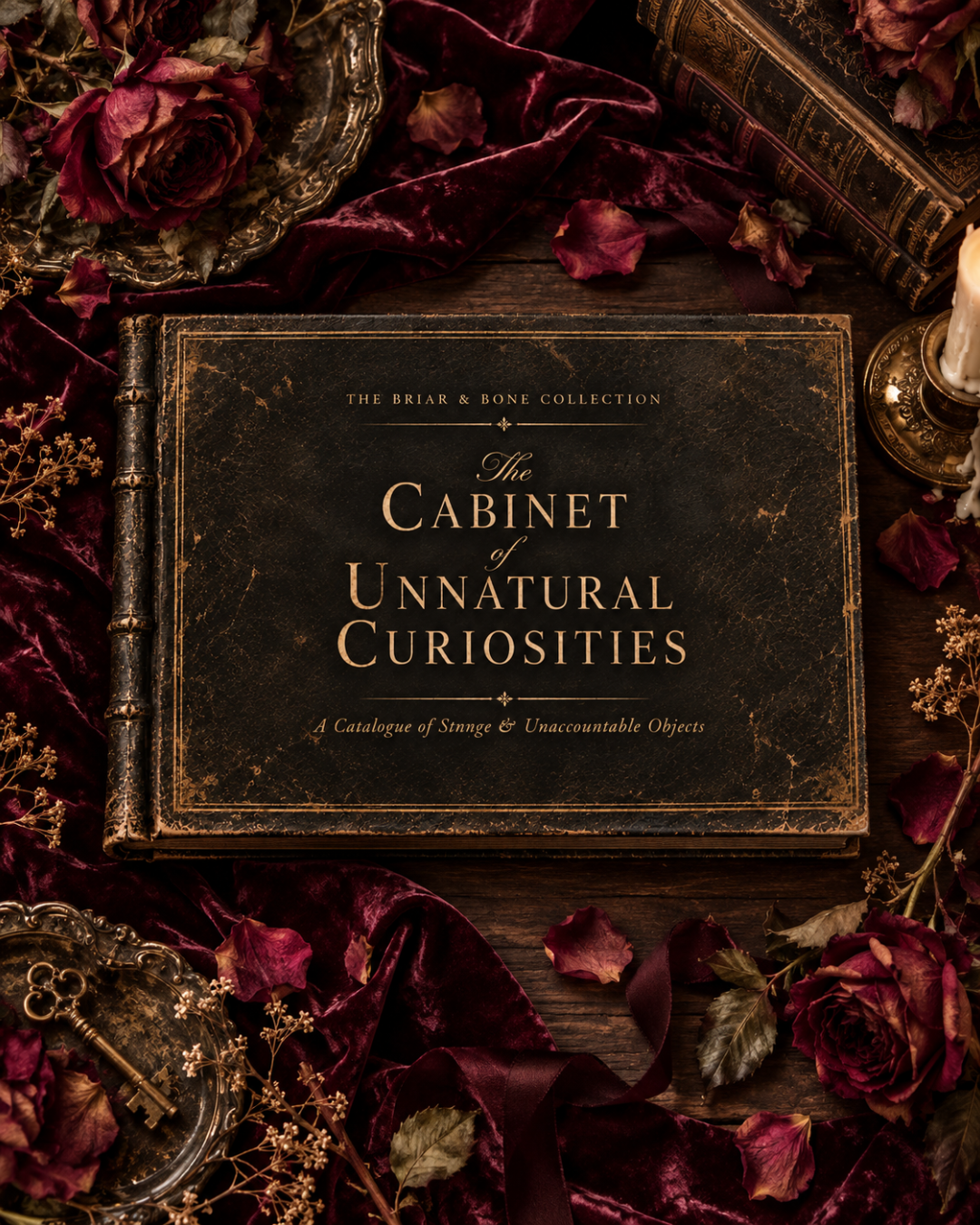
Briar & Bone: The Cabinet of Unnatural Curiosities is an immersive, 21-page illustrated catalogue of enchanted objects, forgotten treasures and mysterious artefacts from the dark fairytale Kingdom of Rosenwald.
Inspired by Victorian cabinets of curiosities, Gothic literature and twisted fairytales, this fictional collection brings together intricate specimen illustrations, collector's observations, mysterious photographs, preserved curiosities and fragments of a world where even the most beautiful possessions may conceal something sinister.
Who placed a human heart inside the mechanical nightingale?
Why were the feathers carefully labelled with names and ages?
What happened to the owners of the objects that were never reclaimed?
Why have certain photographs been removed?
And what secrets has the collector chosen not to record?
There are no definitive explanations.
No complete histories.
No guarantee that the collector is telling the truth.
Only strange objects, forgotten stories and unanswered questions waiting to be explored.
What's Inside?
◆ 21 beautifully illustrated digital pages from the fictional Kingdom of Rosenwald
◆ 11 detailed specimen entries featuring cursed objects, enchanted possessions and mysterious artefacts
◆ Intricate illustrations, classifications, provenance records and the collector's observations
◆ Collections of preserved flowers, feathers and other unusual curiosities
◆ Atmospheric photographs, mysterious locations and fragments of forgotten histories
◆ An illustrated inventory of additional objects and incomplete records
◆ An exploration guide with creative writing ideas and classroom activities
◆ Instant digital download in PDF format
Who Is It For?
Perfect for:
◆ Fantasy writers and worldbuilders
◆ Gothic fiction and dark fairytale enthusiasts
◆ Novelists, short-story writers and creative storytellers
◆ Teachers looking for imaginative visual writing prompts
◆ Mystery lovers and fans of supernatural folklore
◆ Journalers, roleplayers and curious minds
◆ Anyone who loves antique curiosities, fictional archives and strange forgotten histories
What Makes This Different?
This isn't a traditional collection of writing prompts.
It's a cabinet of curiosities.
Every specimen offers another glimpse into Rosenwald's mysterious past, but the histories are incomplete, the evidence is uncertain and the collector's observations cannot always be trusted.
Examine the nightingale's mechanical heart.
Study the preserved feathers.
Investigate the queen's sugar bowl.
Search the photographs for missing details.
Read the collector's observations and decide which accounts you believe.
Perhaps an object is genuinely enchanted.
Perhaps its reputation has grown from superstition.
Perhaps somebody has deliberately concealed the truth.
Or perhaps the strangest explanation is the correct one.
You decide what these objects mean.
Use the collection to inspire a Gothic short story, develop a dark fairytale, invent a mysterious character or build an entire fantasy world around its forgotten artefacts.
Follow the clues.
Question the collector.
Imagine the histories that were never recorded.
Which curiosity will you investigate? What story will you uncover?
Digital download: 21-page illustrated PDF collection, designed in A4 landscape format. Some pages contain multiple individual artefacts. No physical product will be shipped.
Step Inside the Cabinet of Unnatural Curiosities: A Dark Fairytale Worldbuilding Adventure
What if a kingdom's most ordinary possessions could reveal everything about the society that created them? What might a pair of bridal slippers tell you about marriage and social expectations? What could a mechanical nightingale reveal about wealth, craftsmanship and royal privilege? And what secrets might be hidden inside a queen's porcelain sugar bowl?
Welcome to Briar & Bone: The Cabinet of Unnatural Curiosities, an illustrated collection of mysterious objects from the fictional Kingdom of Rosenwald, where beautiful things are not always innocent and every artefact has a story waiting to be discovered.
Perfect for bringing your fairytale society worldbuilding to life, this collection invites you to explore a magical kingdom through the peculiar possessions of its inhabitants. Rather than providing a complete history or a fixed explanation for every object, the cabinet encourages you to imagine the people who owned them, the beliefs that shaped their lives and the strange circumstances that brought these curiosities together.
What might these objects reveal about Rosenwald's society?
Royalty & Social Hierarchies: Who could afford a mechanical nightingale, and what might owning one reveal about wealth, privilege or influence?
Marriage & Relationships: What traditions surround the bridal slippers, and what might happen to somebody who refuses to follow them?
Magic & Superstition: Are these objects enchanted, cursed or simply misunderstood by a society that believes too readily in the supernatural?
Everyday Life: Who crafted these extraordinary possessions, who used them and what do they suggest about the occupations and customs of the kingdom?
Hidden Secrets & Injustices: Could an apparently beautiful object conceal evidence of an ancient wrongdoing, a forbidden relationship or a secret the royal court would rather forget?
With 21 beautifully illustrated pages, this digital collection is designed to spark original stories, encourage creative exploration and inspire richly imagined fairytale worlds. Use the artefacts as starting points for character development, magical mysteries, social conflicts or entire kingdoms built around the beliefs and traditions they suggest.
There are no prescribed answers, no single mystery to solve and no correct interpretation. The stories belong to you.
Discover Briar & Bone: The Cabinet of Unnatural Curiosities
Explore the Cabinet of Unnatural Curiosities here
Every object has a history. Every kingdom has its secrets. What will you discover inside the cabinet?

Go Deeper: How to Build a Believable Fairytale Society
A memorable fairytale society needs more than a beautiful castle, a wicked queen and a village surrounded by enchanted woodland. The most convincing fictional worlds have social structures that influence how people live, what they believe, the opportunities available to them and the choices they make.
The trick is to think beyond the rules themselves. Ask why those rules exist, who benefits from them and how they affect the lives of ordinary people. A kingdom might appear wonderfully prosperous from the palace windows, but what does that prosperity look like from a servant's bedroom, a witch's cottage or a struggling village beyond the royal gardens?
Here are some ways to use these 100 fairytale society worldbuilding questions to create richer settings, more complicated characters and stories filled with magical possibilities.
◆ Start with the People, Not the Palace
It's tempting to begin with the royal family, the kingdom's history or its most powerful magical institutions. But a society becomes much more interesting when you consider how ordinary people experience it.
Imagine a kingdom where every royal wedding is celebrated with seven days of feasting. What happens to the farmers who must supply the food, the seamstresses working through the night and the servants responsible for preparing the celebrations? Do they share in the festivities, or are they expected to sacrifice their own comfort for the happiness of the royal family?
Try creating three characters from different social backgrounds and imagining how each experiences the same event. A princess, a palace servant and a village baker might have completely different opinions about the kingdom they all call home.
For more character inspiration, explore Fairytale Heroes & Heroines, Fairytale Jobs & Occupations and Ordinary Fairytale Hero & Heroine Story Ideas.
◆ Give Your Society Rules That Create Interesting Problems
Social rules are particularly useful for storytelling because they create expectations that characters can follow, question or break.
Perhaps only married women may inherit enchanted property. Perhaps a royal child must surrender their magical abilities before ascending the throne. Or perhaps every village must appoint one resident to serve the fairies for seven years.
Once you've established a rule, ask yourself three questions:
Why was this rule originally created?
Who benefits from keeping it?
What happens when somebody refuses to obey?
A rule that initially seems harmless might conceal an ancient injustice, while a seemingly cruel restriction could have originated as protection against a forgotten supernatural danger.
Explore Fairytale Crime & Punishment, Fairytale Curses & Bargains and Fairytale Traditions & Customs for more inspiration about laws, obligations and the consequences of breaking them.
◆ Think About How Magic Changes Everyday Society
Magic shouldn't exist separately from the people who use it. If your fairytale world contains witches, fairies, enchanted objects and supernatural abilities, consider how their existence changes ordinary life.
Would wealthy families employ witches to protect their homes? Could magical healers make traditional physicians obsolete? Might villages prohibit certain enchantments because they threaten local businesses?
You could even build an entire society around a single magical inequality. Imagine a kingdom where only noble families may own enchanted objects, while commoners are forbidden from possessing anything magical. What happens when a poor child inherits a powerful artefact?
The possibilities become particularly interesting when magic is treated as a social resource rather than simply a convenient solution to a problem.
Our Fairytale Magic Worldbuilding Questions and Fairytale Magical Object Worldbuilding Questions can help you develop the supernatural systems behind these societies.
◆ Explore the Difference Between Public Appearances and Private Reality
Fairytales are filled with beautiful surfaces that conceal something unexpected. A magnificent palace might hide a terrible family secret, while a charming village could be governed by fear and suspicion.
Use this contrast when developing your society.
Perhaps the kingdom is famous for its kindness, yet strangers are never permitted to settle permanently. Maybe its rulers are celebrated for their generosity, while the royal treasury is filled with treasures taken from neighbouring magical communities.
Consider what visitors would notice during their first day in your kingdom, then imagine what they might discover after living there for a year.
This approach is particularly effective for darker stories, where the gradual discovery of a society's hidden rules can create mystery, tension and unease.
Explore Folk Gothic, Folklore Mystery, Horror Fairytales and Dystopian Fairytales for stories built around unsettling communities, concealed histories and beautiful worlds with dangerous secrets.
◆ Let Traditions Reveal the Society's Values
Traditions can tell readers an enormous amount about a fictional society without requiring lengthy explanations.
Imagine a kingdom where the youngest child always inherits the family home, where every royal coronation includes a public act of forgiveness or where villagers leave an empty chair at every wedding for an unseen guest.
Each custom suggests something about the people who practise it. Perhaps they value family loyalty, fear supernatural interference or believe that promises made to the dead must never be forgotten.
Try inventing three traditions for your society: one that brings people together, one that reinforces its social hierarchy and one that somebody secretly wishes to abolish.
Our Fairytale Traditions & Customs collection offers 100 magical rituals, celebrations, beliefs and unusual practices, each accompanied by three story ideas.
◆ Create Contradictions Between What Society Believes and How It Behaves
Realistic fictional societies are rarely perfectly consistent. A kingdom might praise honesty while rewarding courtiers who flatter the monarch. A village might celebrate kindness but refuse to help an unpopular neighbour.
These contradictions make excellent foundations for character conflicts.
Perhaps witches are feared as dangerous outsiders, yet every noble family secretly employs one. Maybe a kingdom teaches that all children are equally precious while granting magical education only to those born into wealthy households.
Ask what your society claims to value, then consider whether its laws, institutions and everyday behaviour reflect those values.
The gap between ideals and reality can reveal hypocrisy, create difficult moral choices and give your characters compelling reasons to challenge the world around them.
◆ Build Conflict Through Social Expectations
Not every fairytale needs a wicked witch, an invading army or an ancient curse to create conflict. Sometimes the most powerful obstacles are the expectations placed upon ordinary people.
A young prince might want to become a carpenter. A village healer might refuse to marry. A fairy might wish to abandon an immortal court and live among humans.
None of these desires is inherently dangerous, but they become sources of conflict when society refuses to accept them.
Think about what your protagonist wants, then identify which social expectations stand in their way. Who would be disappointed, embarrassed, threatened or harmed if they succeeded?
For more inspiration, explore Fairytale Princesses, Fairytale Princes, Fairytale Witches and Fairytale Story Ideas.
◆ Use Objects and Places to Show How Society Works
Worldbuilding doesn't always have to appear through dialogue or explanation. The objects people own, the clothes they wear and the places they inhabit can reveal their social position, beliefs and everyday responsibilities.
Perhaps noble families display enchanted portraits of their ancestors, while villagers keep protective charms above their doors. Maybe only royalty may wear silver shoes, or every household must display a wooden token proving its loyalty to the crown.
Think about the objects that might be found in a palace, a merchant's shop, a witch's cottage or a servant's bedroom. What would they reveal about their owners?
You can also explore the physical spaces that bring people together or keep them apart. A marketplace might welcome everyone, while a beautiful public garden is reserved exclusively for noble families.
For further inspiration, explore Fairytale Magical Objects, Fairytale Town & Village Ideas, Fairytale Castles and Fairytale Kingdom Worldbuilding Questions.
◆ Remember That Different People Will Experience the Same Society Differently
A society that feels safe and prosperous to one character might feel restrictive or frightening to another.
Consider a kingdom protected by powerful enchantments that prevent anyone from leaving its borders. The royal family might regard this as a necessary safeguard, while travelling merchants see it as an inconvenience and ordinary villagers experience it as imprisonment.
Try choosing one important feature of your society and describing it from three different perspectives: somebody who benefits from it, somebody who suffers because of it and somebody who has never questioned it.
This exercise can help you avoid creating a world where every character shares the same opinions, values and experiences.
◆ Let Your Society Change as the Story Unfolds
Your fairytale society doesn't have to remain exactly as it was at the beginning of your story.
A royal marriage might challenge ancient class divisions. The discovery of a forgotten historical document could undermine the monarchy. A magical disaster might force rival communities to cooperate, while one ordinary person's act of defiance could inspire an entire kingdom.
Consider how your protagonist's choices affect the world around them. Do they preserve the established order, reform an unjust institution or discover that their society needs to be rebuilt entirely?
You don't need to end every fairytale with a revolution. Sometimes a small change, such as allowing an excluded child to attend school or persuading a village to welcome an outsider, can provide a meaningful and satisfying conclusion.
The important thing is to remember that societies are shaped by the people who inhabit them, and those people have the power to change them.
One final worldbuilding challenge: Choose five questions from different sections of this article and connect their answers. Perhaps your kingdom's inheritance laws explain why magical education is restricted, which in turn influences marriage customs, village reputations and an emerging rebellion.
When the different parts of your society begin influencing one another, your fairytale world stops feeling like a collection of separate ideas and starts becoming a place with its own history, tensions and possibilities for extraordinary stories.
Final Thoughts: Every Fairytale Kingdom Has a Story Beyond the Castle Walls
The most memorable fairytale worlds are not simply places filled with enchanted castles, mysterious forests and extraordinary magic. They are societies shaped by the people who inhabit them, the beliefs they inherit, the rules they follow and the secrets they choose to keep.
Behind every royal celebration are the servants who prepared it. Beyond every magnificent palace are villages with their own worries, rivalries and traditions. And beneath every happily ever after are questions about who holds power, who belongs, who is forgotten and whether happiness is truly available to everyone.
These 100 Fairytale Society Worldbuilding Questions are designed to help you look beyond the familiar characters and settings of traditional fairytales and imagine the complicated, fascinating worlds surrounding them. You might create a whimsical kingdom where kindness determines social standing, a magical community governed by peculiar traditions or a beautiful realm whose prosperity depends upon a terrible secret.
You don't need to answer every question before beginning your story. Sometimes a single idea — an unusual inheritance law, a forbidden friendship or a village that refuses to welcome outsiders — is enough to inspire an entire fairytale.
For more magical inspiration, explore our Fairytales & Folklore Writing Hub, discover new possibilities with Fairytale Story Sparks and Folklore Story Sparks, or browse our Storyworld Archives for mysterious objects, forgotten histories and immersive fictional worlds waiting to be explored.
Because the most interesting question isn't always what happens once upon a time. Sometimes it's what kind of world made that story possible in the first place.
Happy writing, and may your imaginary kingdoms be filled with wonder, secrets and stories worth telling!