In this guide, you'll discover 30 original Gothic descriptive writing examples, exploring everything from crumbling architecture and desolate landscapes to sinister characters, forgotten objects, oppressive interiors and supernatural encounters. Each passage is accompanied by an explanation of the language and techniques that make it effective, helping you understand how to create atmosphere through sensory imagery, symbolism, contrast, sentence structure and carefully chosen details. You'll also find practical advice for developing your own Gothic descriptions, alongside creative writing exercises that encourage you to experiment with different settings, moods and narrative perspectives.
For more inspiration, explore our Gothic Writing Hub for atmospheric writing guides, character ideas and Gothic storytelling techniques, experiment with the interactive Gothic Story Sparks generator to discover unexpected story possibilities, or browse the Creative Writing Archive for an extensive collection of prompts and resources across different genres. Whether you're writing a Victorian ghost story, a psychological Gothic novel or a contemporary supernatural mystery, these examples will help you create richly imagined worlds that linger in the reader's imagination.
Explore the Gothic Writing Guide
30 atmospheric examples, descriptive techniques and writing exercises.
What Is Gothic Descriptive Writing?
Gothic descriptive writing is a style of literary description that uses atmosphere, imagery, symbolism and carefully chosen sensory details to evoke feelings of mystery, unease, dread or fascination. Closely associated with Gothic literature, it transforms ordinary places, objects and experiences into something emotionally charged, often suggesting that beneath the visible world lies a hidden history, an unspoken threat or a disturbing truth.
Unlike description that simply establishes what a place or person looks like, Gothic description explores how that place or person makes the reader feel. A grand staircase might suggest wealth and elegance, but its worn steps, unnatural silence and portraits of long-dead ancestors could also imply generations of buried secrets. A beautiful garden might appear peaceful until the reader notices that its flowers grow over something that should never have been buried.
The most effective Gothic writing rarely relies upon frightening imagery alone. Instead, it creates uncertainty through the relationship between the familiar and the unfamiliar, the beautiful and the grotesque, the living and the dead. It encourages readers to question what they are seeing, what remains concealed and whether the surrounding environment can truly be trusted.
Ordinary Description vs Gothic Description
Consider how the same setting can be transformed through descriptive choices.
Ordinary description:
The old house stood at the end of a long driveway. Its windows were dirty, the garden was overgrown, and several tiles had fallen from the roof. Inside, the rooms were cold and dusty, and the wooden floorboards creaked beneath each footstep.
Gothic description:
At the end of the neglected avenue, the house emerged from the mist with the weary dignity of something that had outlived its rightful owners. Ivy strangled the stonework, its dark tendrils disappearing beneath the broken eaves, while the tall windows reflected a sky the colour of old pewter. Beyond the entrance, the air carried the stale sweetness of rotting flowers, although no living blooms remained. Each footstep disturbed the silence of the hallway, and somewhere in the rooms above, a floorboard answered with a slow, deliberate creak.
Both passages describe the same essential features: an old house, neglected grounds, damaged architecture and an empty interior. However, the Gothic version gives those details emotional significance.
The house possesses a weary dignity, suggesting age, suffering and an almost human presence. The ivy strangles the stonework, transforming ordinary vegetation into an image of violence and suffocation. The smell of rotting flowers introduces decay through an unexpected sensory detail, while the answering floorboard creates the possibility that the building is not entirely unoccupied.
Crucially, the passage never confirms that anything supernatural is happening. Its unease comes from suggestion, allowing the reader's imagination to fill the silence.
Key Characteristics of Gothic Descriptive Writing
Although Gothic fiction encompasses many different periods, settings and styles, several descriptive qualities appear throughout the genre.
1. Atmosphere and emotional tension
Gothic descriptions establish a mood that influences how readers interpret everything that follows. Silence might feel oppressive rather than peaceful; darkness might suggest concealment rather than simply the absence of light. The emotional atmosphere often matters more than the physical details themselves.
2. Decay, deterioration and the passage of time
Crumbling buildings, neglected gardens, tarnished mirrors and fading portraits suggest the inevitable decline of things once considered permanent. These images can symbolise mortality, lost innocence, collapsing social structures or the persistence of painful memories.
3. Sensory imagery
Sight is only one part of an effective Gothic description. The smell of extinguished candles, the clammy texture of stone, the distant scrape of furniture or the metallic taste of fear can make a scene feel immediate and disturbingly tangible.
4. Symbolism and hidden meaning
Gothic objects and settings frequently carry meanings beyond their physical appearance. A locked door may represent forbidden knowledge. A cracked mirror might suggest fractured identity. A staircase descending into darkness could reflect a character's movement towards an uncomfortable truth.
5. Isolation and confinement
Remote castles, abandoned estates, narrow corridors, underground chambers and desolate landscapes create feelings of vulnerability. Even apparently spacious settings can become claustrophobic when characters feel watched, trapped or unable to escape.
6. Contrast and the uncanny
Gothic writing often makes familiar things unsettling through small contradictions. A nursery remains perfectly arranged decades after its occupants disappeared. A stranger smiles warmly while speaking of something dreadful. A beautiful landscape seems strangely devoid of birdsong. Such details suggest that the ordinary world has shifted slightly out of place.
7. Psychological unease and uncertainty
Rather than revealing every threat, Gothic description often allows fear to emerge from what remains unexplained. Shadows resemble figures, sounds have no identifiable source, and familiar spaces seem subtly altered. The reader shares the character's uncertainty, becoming increasingly alert to details that might otherwise go unnoticed.
These characteristics are not a checklist that every Gothic passage must satisfy. A description might rely upon a single disturbing sound, an unexpected contrast or an evocative image of decay. What matters is the relationship between the descriptive detail and the emotional effect it creates.
The following 30 original Gothic descriptive writing examples demonstrate how these principles can be applied to architecture, landscapes, characters, interiors, sensory experiences and unsettling encounters. Each passage explores a different possibility, showing how Gothic atmosphere can emerge through both elaborate imagery and the quiet suggestion that something is not quite as it seems.
1. Gothic Settings & Architecture: Five Atmospheric Description Examples
Architecture is one of the most recognisable features of Gothic fiction. Crumbling mansions, ruined abbeys, isolated castles and labyrinthine corridors provide more than an atmospheric backdrop: they can reflect the psychological states of characters, conceal disturbing histories and create the impression that the past remains dangerously close to the present.
In Gothic descriptive writing, buildings frequently possess qualities associated with living things. Windows appear to watch, doorways seem reluctant to admit visitors, and ancient walls hold memories that their inhabitants would rather forget. Architectural details such as pointed arches, narrow staircases, weathered stonework and elaborate ornamentation can establish a distinctive visual identity while also suggesting confinement, secrecy or decay.
The following five examples demonstrate different approaches to describing Gothic architecture, from the melancholy grandeur of an abandoned manor to the disorientating geometry of an apparently endless corridor.
Example 1: The Abandoned Gothic Manor
The manor stood beyond the iron gates, half-concealed beneath a wilderness of yew and climbing ivy. Its steep gables pierced the colourless sky, while rows of narrow windows stared across the neglected lawns with the vacant expressions of the long-forgotten dead. Rain had blackened the limestone façade, gathering in the elaborate carvings above the entrance, where the faces of angels had weathered into something considerably less benevolent. Along the western wing, a succession of broken windows exposed rooms furnished only with darkness. The great oak doors remained closed, their brass fittings green with corrosion, and the stone steps had begun to disappear beneath a thick covering of moss. Yet despite the ruinous condition of the house, a single window on the uppermost floor stood open, its pale curtain stirring gently in the otherwise motionless air.
Why This Works
The description combines architectural grandeur with deterioration, establishing the manor as a place where former wealth has surrendered to neglect. Personification gives the windows an unsettling resemblance to human observers, while the corrupted angel carvings introduce a contrast between sacred imagery and something potentially threatening. The final detail, an open window and moving curtain, disrupts the impression of abandonment without confirming whether anyone remains inside.
The passage also moves deliberately from the wider exterior towards one small, suspicious detail. This narrowing of attention encourages the reader to examine the house more closely and creates a natural opening for a mystery.
Example 2: The Ruined Abbey
What remained of the abbey rose from the hillside in fragments of pale stone, its broken arches framing portions of the evening sky like the ribs of some enormous, long-buried creature. The roof had vanished generations earlier, leaving the nave exposed to rain and the slow encroachment of woodland. Grass grew between the flagstones, and slender birch trees had taken root where monks once gathered beneath the vaulted ceiling. Along the northern wall, the remnants of a painted saint gazed down upon the ruins, his face almost entirely erased by damp. Beneath him, an inscription had been worn beyond recognition, although someone had recently cleared the weeds from its base. As dusk settled over the hillside, the last sunlight caught the shattered rose window, casting its fractured pattern across the empty choir stalls. For a moment, the stones seemed to remember the shape of the building they had once supported.
Why This Works
The abbey's architecture is described through images of mortality and memory. Comparing its arches to exposed ribs transforms the ruin into something skeletal, while the vanished roof and encroaching trees demonstrate the gradual triumph of nature over human construction.
Religious imagery introduces another layer of meaning. The damaged saint, forgotten inscription and shattered rose window suggest the loss of faith, knowledge or institutional authority. The recently cleared weeds provide a subtle narrative disturbance: although the abbey appears abandoned, someone may still be visiting it.
The final sentence personifies the building without making it explicitly supernatural, allowing the atmosphere to remain melancholy and mysterious rather than overtly frightening.
Example 3: The Endless Corridor
The corridor extended beyond the reach of the candlelight, its black-and-white floor tiles diminishing into a narrow point of darkness. Identical doors stood at regular intervals along both walls, each fitted with a tarnished brass handle and a small oval keyhole. Above them hung portraits whose faces had darkened beneath generations of smoke and dust, leaving only the occasional glimmer of an eye or a pale suggestion of a mouth. The ceiling was impossibly high, supported by slender columns that seemed to lean inward as the passage continued. With every step, the candle flame bent towards the far end of the corridor, although the air remained perfectly still. After several minutes, the traveller reached a familiar portrait: a woman in a green dress, holding a closed fan. He was certain he had passed her already. Beneath the painting, a fresh scratch marked the plaster where his suitcase had struck the wall.
Why This Works
This passage uses repetition and architectural symmetry to create disorientation. The identical doors, regularly spaced portraits and diminishing floor tiles establish an apparently orderly environment, but that order gradually becomes oppressive.
The unusually high ceiling and inward-leaning columns distort the reader's perception of space. Meanwhile, the candle flame introduces an unexplained physical disturbance, suggesting that the corridor operates according to rules the character does not understand.
The repeated portrait and scratch provide tangible evidence that something is wrong. Rather than stating that the corridor is supernatural or impossible, the description allows the reader to reach that conclusion through the character's observations.
Example 4: The Isolated Castle
The castle occupied the highest ridge of the mountain, its battlements emerging from the cloud like the jagged remains of a broken crown. Below, the valley lay submerged beneath a restless sea of mist, concealing the narrow road that wound towards the fortress gates. The outer walls were built from dark volcanic stone, their surfaces streaked with mineral deposits that resembled the tracks of ancient tears. Towers rose at irregular angles, connected by covered passages and narrow bridges suspended above precipitous drops. No banners moved above the battlements, and no smoke rose from the clustered chimneys. Even the ravens appeared reluctant to settle upon the parapets, circling instead through the cold mountain air. As the approaching carriage climbed the final stretch of road, the castle seemed to grow rather than draw nearer, its enormous silhouette swallowing the last remnants of daylight.
Why This Works
The castle's threatening atmosphere emerges primarily from scale, isolation and its relationship with the surrounding landscape. The mountain ridge and concealed road emphasise the difficulty of reaching or escaping the fortress, while the battlements resemble a broken crown, suggesting fallen power or corrupted authority.
The description uses vertical imagery throughout: high towers, steep drops, elevated bridges and the valley far below. This creates a sense of physical vulnerability, particularly for anyone approaching the castle.
The absence of ordinary signs of habitation is equally important. No banners, smoke or resting birds soften the architecture's severity. The final image exaggerates the castle's apparent size, making the building feel overwhelming without requiring any explicitly supernatural event.
Example 5: The Forgotten Cemetery
Beyond the chapel, a narrow path disappeared between rows of leaning gravestones, their inscriptions softened by centuries of rain. The oldest monuments had sunk unevenly into the earth, leaving only fragments of names visible above the tangled grass. Stone angels stood among the graves with their wings broken and their faces obscured by lichen, while a weathered marble hand emerged from the undergrowth, its pointing finger directed towards a plot that bore no marker. At the cemetery's northern boundary, a mausoleum crouched beneath the branches of an ancient cedar, its entrance sealed with an iron gate. A chain hung loosely across the bars, though the lock itself lay open upon the steps. Inside, darkness gathered beneath the low stone ceiling, concealing the memorial plaques along the walls. Somewhere within the mausoleum, water fell steadily into a shallow pool, each drop sounding unnaturally distinct in the evening silence.
Why This Works
The cemetery combines familiar Gothic imagery with carefully selected details that imply an unfinished story. Weathered gravestones, broken angels and sinking monuments establish the passage of time, while the unmarked grave and pointing marble hand suggest something deliberately concealed.
The open lock creates a more immediate mystery. It introduces the possibility of recent human activity within a setting otherwise dominated by age and abandonment.
Sound becomes especially important in the final sentence. The repeated drops of water emphasise the surrounding silence and draw the reader's attention into the mausoleum's darkness. This use of auditory imagery allows the description to create suspense without introducing a visible threat.
What These Gothic Architecture Examples Have in Common
Although each passage describes a different location, they share several important techniques. Architectural features are selected for their emotional significance, physical deterioration suggests hidden histories, and the descriptions frequently conclude with a small detail that raises an unanswered question.
Notice, too, that the buildings are not interchangeable. The manor conveys decaying privilege, the abbey evokes forgotten faith, the corridor creates psychological confinement, the castle embodies isolation and oppressive power, and the cemetery explores mortality and the persistence of the past.
When writing your own Gothic settings, consider what the architecture reveals about the world of your story. A building's appearance can suggest who constructed it, who once inhabited it, what happened there and what might still remain hidden within its walls.
The strongest Gothic settings do not simply look frightening. They make the reader feel that the place itself has a history worth fearing.
2. Gothic Landscapes & Weather: Five Atmospheric Description Examples
In Gothic literature, the natural world is rarely a passive backdrop. Storms gather as tensions rise, forests conceal dangers that cannot be clearly identified, and vast, desolate landscapes remind characters of their own vulnerability. Even seemingly beautiful surroundings can acquire an unsettling quality when their silence, isolation or unfamiliarity suggests that something is wrong.
Gothic landscapes frequently reflect the emotional experiences of the characters moving through them. A bleak moor might evoke grief or loneliness, while a violent storm can mirror psychological turmoil. However, the relationship between landscape and emotion need not be straightforward. A perfectly still lake may be more disturbing than a raging sea, particularly when its tranquillity seems unnatural.
The following examples explore five distinctive Gothic environments, demonstrating how weather, sensory imagery, symbolism and carefully controlled details can transform natural scenery into a source of suspense, dread or melancholy.
Example 6: The Desolate Moor
The moor stretched beneath a low ceiling of cloud, its uneven surface broken by dark pools of standing water and scattered outcrops of granite. Heather lay flattened beneath the persistent wind, which travelled across the open ground with a thin, mournful whistle. There were no trees to interrupt the horizon, no distant rooftops or chimney smoke to suggest the presence of another living soul. Here and there, pale stones protruded from the peat, their surfaces worn smooth by centuries of rain. As the traveller followed the narrow track, the ground softened beneath his boots, releasing the sour, earthy smell of waterlogged vegetation. Far ahead, something white stood motionless against the dark hillside. It might have been a sheep, or a weathered boundary stone. Yet whenever the mist shifted, its outline appeared unmistakably human, and the distance between them seemed to remain unchanged.
Why This Works
The moor's threatening atmosphere emerges from its openness rather than confinement. The absence of trees, buildings and recognisable landmarks makes the landscape feel exposed and disorientating, demonstrating that Gothic isolation does not require an enclosed setting.
Sensory imagery reinforces the physical discomfort of the environment. The persistent wind, unstable ground and smell of wet peat make the landscape tangible, while the limited colour palette of grey, brown and white contributes to its bleakness.
The distant figure introduces uncertainty through ambiguous visual information. Its identity remains unresolved, allowing the reader to imagine several possibilities. The suggestion that the distance never changes creates an additional disturbance, subtly undermining the reliability of the traveller's perception.
Example 7: The Forest That Swallowed the Light
The forest began abruptly at the edge of the abandoned fields, where the last remnants of daylight disappeared beneath an interlocking canopy of ancient branches. The trees stood unnaturally close together, their trunks twisted into shapes that resembled bent shoulders and clasped hands. Thick moss covered the exposed roots, swallowing the narrow path wherever the ground dipped towards the stream. The air smelled of wet bark, mushrooms and the sweet corruption of fallen leaves. Somewhere beyond the undergrowth, water moved over stones, although the sound seemed to come first from the left and then from somewhere directly behind. As she ventured deeper, the traveller noticed strips of faded red cloth tied around several branches. Each had been knotted carefully, at precisely the height of a human hand. The final strip was still damp, and beneath it, the bark had been freshly scored with three narrow cuts.
Why This Works
The forest creates claustrophobia through the density and arrangement of its trees. Unlike the exposed moor, this landscape restricts visibility, surrounds the character with obstacles and gradually removes the reassuring presence of daylight.
Personification transforms the branches and trunks into vaguely human shapes, suggesting that the forest possesses an awareness of its visitor. The rich smell of decomposition introduces decay without relying upon conventional images of death.
The shifting sound of running water disrupts spatial orientation, while the red cloth provides an unexpected human presence within an apparently deserted environment. The freshly cut marks suggest recent activity, turning atmospheric description into a potential narrative mystery.
Example 8: The Storm Above the Cliffs
The storm advanced across the sea in vast, bruised formations of cloud, swallowing the horizon beneath a darkness that seemed too heavy for the afternoon sky. Far below the cliffs, waves hurled themselves against the black rocks, bursting into white spray that vanished almost immediately beneath the next assault. The wind carried salt and rain through the coarse grass, bending it towards the inland fields as though the entire headland were attempting to retreat. Lightning exposed the ruined watchtower at the cliff's edge, its fractured walls briefly illuminated against the churning water. With each flash, the tower appeared closer to the precipice, its foundations slowly surrendering to the violence below. Then came the thunder, rolling across the headland with a depth that seemed to rise from beneath the earth itself. Between its echoes, another sound emerged: the distant tolling of a bell, although the watchtower had possessed neither chapel nor bell for more than a century.
Why This Works
The storm relies upon dynamic verbs and violent imagery to establish the natural world's overwhelming power. Waves hurl themselves against the rocks, the wind bends the grass, and the approaching clouds appear to consume the horizon. These descriptions make the landscape feel actively hostile.
The passage also uses the Gothic sublime: the simultaneous experience of awe and terror when confronted with something vast, powerful and beyond human control. The cliffs, sea and approaching storm dwarf the ruined watchtower, emphasising the fragility of human structures.
Lightning provides brief moments of visual clarity, revealing the tower before returning it to darkness. The unexplained bell introduces a supernatural possibility through sound, contrasting with the storm's immense noise and giving the reader a specific mystery to carry forward.
Example 9: The Frozen Lake at Midnight
The lake lay beneath the winter moon like a sheet of tarnished silver, its frozen surface stretching towards a distant shoreline almost entirely concealed by mist. Snow covered the surrounding reeds, bending their brittle stems into delicate arches above the ice. Nothing stirred among the trees. Even the wind had abandoned the valley, leaving a silence so complete that the smallest movement seemed an intrusion. Along the near shore, a succession of footprints crossed the snow and continued out onto the lake, where they disappeared beneath a thin dusting of frost. There were no corresponding tracks returning to land. As the traveller approached, a faint cracking sound travelled beneath the ice, followed by another, closer to the centre. Far below the cloudy surface, something pale drifted slowly through the dark water. It turned once, revealing what might have been a face, before passing beyond the reach of the moonlight.
Why This Works
This example creates unease through stillness and restraint. The moonlit lake initially appears beautiful, with delicate winter imagery and a limited palette of silver, white and black. However, the absence of wind, movement and ordinary natural sounds makes the setting feel unnaturally suspended.
The footprints provide a concrete narrative detail. They imply that someone ventured onto the frozen lake but offer no explanation for their disappearance. This transforms the landscape into evidence of an unknown event.
The cracking ice introduces physical danger, while the indistinct shape beneath the surface suggests a more disturbing possibility. Importantly, the description never confirms what the traveller sees. The uncertain identification of a face preserves ambiguity and allows the reader's imagination to intensify the horror.
Example 10: The Garden of Withered Roses
Behind the shuttered house, the garden retained the faint geometry of its former splendour. Gravel paths wound between neglected flowerbeds, their pale stones almost entirely concealed beneath weeds and fallen leaves. An ornamental fountain stood at the centre of the grounds, its marble basin filled with stagnant rainwater and the blackened remains of summer blossoms. Along the southern wall, climbing roses had grown into a dense, thorned wilderness, their stems twisting around the iron trellis like the fingers of something unwilling to release its hold. Most of the flowers had withered, leaving brittle petals scattered across the earth. Yet one rose remained in bloom, its dark crimson petals immaculate despite the November frost. Beneath it lay a pair of rusted gardening shears, half-buried in the soil. When the gardener lifted them, he discovered that their blades were bound together with a narrow ribbon of faded mourning silk.
Why This Works
The garden uses the contrast between former beauty and present decay to establish a melancholy Gothic atmosphere. Its surviving paths, fountain and trellis suggest deliberate cultivation, while the weeds, stagnant water and withered flowers reveal how thoroughly that order has collapsed.
The roses introduce symbolism associated with beauty, love, secrecy and mortality. Their thorned stems become threatening through personification, while the solitary flower surviving the frost creates a visual contradiction that demands attention.
The gardening shears and mourning ribbon suggest a connection between the garden and an undisclosed personal history. Rather than introducing an obvious supernatural threat, the description uses a small, emotionally suggestive object to imply grief, obsession or a secret preserved long after its original significance has been forgotten.
What These Gothic Landscape Examples Have in Common
Each of these landscapes produces a different emotional effect. The moor creates exposure and loneliness, the forest evokes confinement and disorientation, the storm suggests overwhelming natural power, the frozen lake combines beauty with concealed danger, and the neglected garden explores the relationship between decay, memory and loss.
Despite these differences, all five examples use the environment to influence the reader's expectations. Weather affects visibility and movement. Natural sounds become difficult to identify. Familiar objects acquire symbolic significance, and seemingly insignificant details suggest that something has occurred beyond the boundaries of the description.
One particularly useful technique is to establish the landscape's ordinary characteristics before introducing a subtle contradiction. A moor can contain a distant white shape without immediately becoming supernatural. A winter lake can remain beautiful even when something moves beneath its surface. A garden can be melancholy and neglected without appearing threatening until the reader notices a flower that should not have survived.
When describing Gothic landscapes, consider how the natural environment shapes your character's experience. Does it expose them to danger, conceal their destination, distort their senses or reflect an emotion they are unwilling to acknowledge?
The most memorable Gothic landscapes are not simply dark, stormy or desolate. They possess a distinctive atmosphere that makes the reader feel that the natural world is concealing something just beyond the limits of human understanding.
3. Gothic Characters & Appearances: Five Atmospheric Description Examples
In Gothic fiction, a character's appearance can be as unsettling as the architecture surrounding them. A stranger's immaculate clothing might seem strangely inappropriate for their surroundings, an elderly woman's expression might reveal a lifetime of concealed bitterness, or a seemingly ordinary face might possess one small feature that makes it impossible to forget.
Effective Gothic character description rarely depends upon grotesque features or obvious signs of villainy. Instead, it often creates tension through contradiction. Beauty conceals something disturbing, familiar gestures become subtly unnatural, and outward respectability suggests a carefully maintained disguise. The most memorable characters are not necessarily those who look frightening, but those whose appearance raises questions that the reader cannot immediately answer.
Physical details can also reveal a character's relationship with the past. Faded garments, inherited jewellery, scars, unusual habits and expressions shaped by grief can suggest histories that remain unspoken. When these details are combined with carefully controlled movement and sensory imagery, even a brief encounter can acquire an atmosphere of dread.
The following five examples demonstrate different approaches to Gothic character description, from the unsettling elegance of an aristocratic stranger to the almost imperceptible wrongness of a familiar face.
Example 11: The Mysterious Aristocrat
The gentleman stood beside the drawing-room fireplace, one pale hand resting upon the carved marble mantelpiece. He was extraordinarily tall, with narrow shoulders and a severe, finely proportioned face that might have been handsome had it possessed any trace of warmth. His black evening coat was cut in a fashion several decades out of date, yet its velvet collar remained immaculate, untouched by dust or wear. A silver signet ring gleamed upon his smallest finger, bearing a crest so worn that its original design could scarcely be distinguished. When he smiled, the expression appeared first upon his lips and only afterwards, with a curious reluctance, in his dark, watchful eyes. The firelight illuminated the room behind him, throwing the furniture into restless patterns of shadow. Yet the gentleman himself seemed untouched by its warmth, and the hand resting upon the marble remained as colourless and motionless as the stone beneath it.
Why This Works
The aristocrat's unsettling quality emerges from the contrast between refinement and emotional absence. His elegant clothing, formal posture and inherited jewellery suggest wealth, status and tradition, but these familiar signs of respectability are undermined by his unnatural stillness and lack of warmth.
The description uses delayed expression to make an ordinary smile feel disturbing. By separating the movement of his lips from the response of his eyes, the passage suggests that his outward behaviour is carefully performed rather than genuinely felt.
The final comparison between his hand and the marble introduces associations with statues, coldness and death. Nothing explicitly identifies the gentleman as supernatural, but the accumulation of small contradictions encourages the reader to question whether he is entirely human.
Example 12: The Grieving Widow
She wore mourning as though it had become a second skin. Her gown, once fashioned from expensive black silk, had faded to the dull colour of extinguished ashes, and the lace at her throat was yellowed with age. A narrow jet necklace rested against her collarbone, its polished stones catching the weak afternoon light whenever she moved. Her face retained traces of an earlier beauty, though grief had sharpened its delicate features and drawn deep shadows beneath her eyes. Across her lap lay a pair of white gloves, carefully folded and refolded until the fabric had begun to fray. She spoke very little, answering questions with a distracted politeness, but whenever footsteps sounded in the corridor, her entire body became suddenly attentive. Her gaze would settle upon the closed door, and for one brief, terrible moment, hope transformed her expression. Then the footsteps passed, and she returned to the gloves, smoothing their empty fingers with extraordinary tenderness.
Why This Works
This description creates Gothic melancholy through clothing, repeated gestures and restrained emotional detail. The faded mourning garments suggest that the widow's grief has continued far beyond the period in which such clothing would ordinarily be worn.
The white gloves function as a symbolic object. Their emptiness suggests absence, while the widow's repeated handling of them reveals an attachment that she cannot relinquish. Rather than explaining her history directly, the passage allows the reader to infer the significance of the gloves through her behaviour.
The most important moment occurs when she hears footsteps. Her sudden hope introduces the possibility that she is waiting for someone who cannot return. The description does not reveal whether her expectation is rooted in grief, denial or a supernatural experience, preserving the emotional uncertainty characteristic of Gothic fiction.
Example 13: The Sinister Physician
Dr Vale possessed the careful appearance of a man who considered disorder a personal insult. His grey hair was parted with mathematical precision, his spectacles were spotless, and his dark waistcoat displayed not a single misplaced thread. Only his hands betrayed an unusual quality: long, narrow fingers with nails cut so close that the surrounding skin appeared raw. He kept them folded neatly whenever he spoke, although the right forefinger occasionally moved against his thumb in a slow, repetitive motion, as though testing the texture of something invisible. His consulting room smelled faintly of carbolic acid and dried lavender, a combination that could not entirely conceal a sweeter, more troubling odour. When examining a patient, he leaned forward with intense professional interest, studying the smallest changes in expression. Yet his attention seemed to sharpen most noticeably when discomfort appeared. At such moments, the corners of his mouth would tighten into an expression almost indistinguishable from pleasure.
Why This Works
The physician is characterised through an unsettling contrast between professional respectability and concealed cruelty. His immaculate appearance establishes control, discipline and social credibility, making the subsequent details more disturbing.
Particular attention is given to his hands. The closely cut nails and repetitive finger movement suggest an obsessive relationship with touch, precision or experimentation. These details are specific enough to feel memorable without revealing exactly what the physician might have done.
Smell adds another dimension to the description. The combination of antiseptic and lavender initially suggests cleanliness, but the unidentified sweeter odour undermines that impression and hints at something being concealed.
The final observation transforms professional attentiveness into a potential threat. By suggesting that the physician enjoys witnessing discomfort, the passage reveals his sinister nature through behaviour rather than directly labelling him cruel.
Example 14: The Woman in the Veil
She appeared at the far end of the platform shortly before the last train was due, standing beneath a gas lamp whose wavering flame illuminated the edges of her dark travelling cloak. A heavy veil concealed her face, falling from the brim of a narrow hat to the high collar of her dress. Her gloved hands rested upon the handle of a small leather case, and she remained so perfectly still that the drifting steam seemed to move around her rather than through the space she occupied. When the station clock struck eleven, she raised her head towards its face, although the veil made it impossible to determine whether she could see the hands. Beneath the hem of her cloak, a pair of delicate boots stood upon the wet platform. Their leather was pale and unmarked, despite the mud that covered every other traveller's shoes. As the train approached, its lamps swept across her figure. For an instant, the veil became almost transparent, revealing the faint outline of a face turned towards the tracks. Then the light passed, and there was nothing beneath the dark fabric but shadow.
Why This Works
This passage uses concealment and selective visibility to create suspense. The veil prevents both the reader and the observing character from identifying the woman's features, making her presence mysterious before anything overtly unusual occurs.
Her clothing and luggage suggest an ordinary traveller, but several details contradict that interpretation. Her unnatural stillness, spotless boots and apparent indifference to the surrounding steam gradually separate her from the physical environment.
The station setting also introduces a sense of transition. Railway platforms are places of arrival and departure, making them particularly effective locations for Gothic encounters involving separation, loss or the possibility of someone returning from the past.
The final glimpse beneath the veil provides a moment of apparent revelation that immediately becomes more disturbing. By withholding a clear explanation, the passage allows uncertainty to survive beyond the encounter itself.
Example 15: The Familiar Face That Wasn't Quite Right
At first, Eleanor could see nothing unusual about her brother. He stood in the doorway wearing the same brown coat in which he had departed three weeks earlier, his hair damp from the rain and his travelling bag hanging loosely from one hand. His face was familiar in every particular: the slight crookedness of his nose, the pale scar above his eyebrow, the small crease that appeared beside his mouth whenever he smiled. Yet there was something profoundly disquieting in the way he regarded her. His eyes moved across her face with the careful attention of someone studying a portrait, lingering upon each feature before proceeding to the next. When she embraced him, his arms closed around her a fraction too late. He smelled of wet wool and the cold, mineral scent of freshly disturbed earth. Then he spoke her name, softly and affectionately, placing the emphasis upon the wrong syllable. Eleanor drew back. Her brother had never pronounced it that way, not even as a child.
Why This Works
This example draws upon the uncanny, a central concept in Gothic fiction in which something familiar becomes disturbing because it is subtly altered. The brother's appearance is described through recognisable, reassuring details before small behavioural inconsistencies begin to emerge.
The delayed embrace suggests that his reactions are being consciously imitated rather than naturally experienced. His scrutiny of Eleanor's face reinforces the impression that he recognises her appearance without possessing the emotional familiarity expected of a sibling.
Sensory imagery introduces a darker association through the smell of disturbed earth, suggesting burial or death without confirming either possibility.
The incorrect pronunciation of Eleanor's name provides the decisive disturbance. It is a tiny detail, but one with enormous emotional significance because it contradicts a lifetime of shared experience. The passage demonstrates how Gothic horror can emerge from a subtle disruption of intimacy rather than an overtly frightening appearance.
What These Gothic Character Examples Have in Common
These five characters demonstrate that Gothic description becomes particularly effective when physical appearance and behaviour do not entirely agree. The aristocrat's elegance conceals emotional coldness, the widow's composure masks unresolved grief, the physician's respectability disguises disturbing impulses, the veiled traveller appears strangely disconnected from her surroundings, and the returning brother possesses a familiar face without the expected familiarity of manner.
Each passage also selects a small number of distinctive details rather than attempting to describe every physical characteristic. A signet ring, a pair of gloves, a repetitive hand movement, an immaculate pair of boots or an incorrectly spoken name can reveal more about a character than an extensive catalogue of facial features.
The relationship between appearance and implication is especially important. Gothic characters often seem to belong simultaneously to two different worlds: the respectable and the corrupt, the living and the dead, the familiar and the unknown. Description becomes a means of revealing this tension without resolving it too quickly.
When creating your own Gothic characters, consider what they are attempting to conceal and how that hidden truth might emerge through their appearance or behaviour. A character may dress with excessive care, avoid a particular gesture, possess an inexplicable physical detail or react inappropriately to an ordinary situation.
Rather than telling readers that someone is mysterious, sinister or frightening, allow them to notice the contradictions for themselves. Often, the most disturbing Gothic character is the one who appears almost entirely ordinary — except for a single detail that refuses to make sense.
4. Gothic Interiors & Objects: Five Atmospheric Description Examples
In Gothic fiction, the rooms within a building can be even more disturbing than its imposing exterior. A deserted nursery, an untouched dining table or a portrait hanging in an otherwise empty room may suggest more about a place's history than its crumbling walls or shadowed corridors. These intimate spaces contain the possessions, habits and memories of former inhabitants, allowing writers to explore the uncomfortable relationship between ordinary domestic life and the extraordinary events that have disrupted it.
Objects are particularly powerful tools in Gothic descriptive writing because they can acquire significance through their placement, condition or apparent misuse. A stopped clock might suggest a moment frozen in memory. A child's abandoned toy can evoke innocence and loss. A carefully preserved dress may imply an obsession with someone who has long since died. When familiar possessions appear in unfamiliar circumstances, their ordinary purpose becomes overshadowed by the questions they raise.
Gothic interiors also offer opportunities to create atmosphere through confined spaces, restricted light and sensory details. The smell of damp upholstery, the texture of peeling wallpaper, the reflection of candlelight upon tarnished silver and the faint movement of a curtain can all contribute to a setting that feels physically convincing yet psychologically unstable.
The following five examples demonstrate how interiors and objects can become central to Gothic atmosphere, transforming apparently ordinary rooms into places of memory, mystery and unease.
Example 16: The Abandoned Nursery
The nursery occupied the eastern corner of the house, where the morning sun had once illuminated walls painted with faded illustrations of woodland creatures. Now the wallpaper hung in loose strips, exposing patches of grey plaster beneath the smiling faces of rabbits and deer. A small iron bed stood beside the window, its embroidered coverlet drawn so tightly across the mattress that not a single crease disturbed the fabric. Along the opposite wall, a collection of porcelain dolls sat upon a narrow shelf, their glass eyes reflecting the weak daylight. Most had lost their hair or suffered cracks across their painted cheeks, but one remained immaculate, dressed in a white muslin gown with a blue ribbon tied beneath its chin. Beside the fireplace, a wooden rocking horse rested upon the bare floorboards. Its painted saddle had worn away beneath years of use, and one of its leather reins hung loose. As the visitor turned towards the door, the horse gave a faint wooden creak. When she looked back, its curved runners were still moving.
Why This Works
The nursery creates unease through the contrast between childhood innocence and physical deterioration. The cheerful woodland illustrations, embroidered bedding and toys establish a space associated with comfort and protection, while the peeling wallpaper and damaged dolls reveal years of abandonment.
The carefully made bed introduces a contradiction. Its immaculate condition suggests that someone has preserved the room deliberately, raising questions about the child's absence and the emotional significance of the space.
The rocking horse provides the passage's central disturbance. Its movement is introduced only after the room has been described in realistic detail, making the unexplained event more effective. The reader has already accepted the nursery as a believable physical environment, so the small violation of its apparent stillness feels particularly unsettling.
The description also avoids explaining the room's history. The possibility of grief, obsession or a supernatural presence remains open, allowing the objects themselves to suggest a story.
Example 17: The Library of Forgotten Books
The library extended across the entire western wing, its towering shelves disappearing into the darkness above the narrow gallery. Thousands of leather-bound volumes stood shoulder to shoulder, their spines cracked and faded, their gilded titles reduced to scattered fragments of gold. The air possessed the dry, bitter smell of ageing paper, mingled with something sharper that rose from the damp creeping along the outer walls. Beneath a stained-glass window stood a mahogany reading desk, its surface crowded with extinguished candles and loose sheets of manuscript. A single book lay open at the centre, its pages covered in a cramped, angular handwriting that grew progressively smaller towards the bottom of each sheet. Between the final pages, a thin strip of black silk marked a passage written in a different hand. The ink remained dark and glossy, although the surrounding paper had yellowed with age. Across the margin, someone had written a warning: Do not read the final chapter aloud. Beneath the words, the paper was deeply scored, as though the writer had pressed the pen down in anger or terror.
Why This Works
The library draws upon the Gothic association between knowledge and danger. Its immense collection of books initially suggests scholarship, intellectual achievement and the preservation of history, but the decaying shelves and mysterious manuscript gradually transform that knowledge into something potentially threatening.
The contrast between old paper and fresh-looking ink introduces an unsettling inconsistency. It suggests that the warning may have been written more recently than the book itself, creating uncertainty about who has entered the library and why.
The manuscript also functions as an example of forbidden knowledge, a recurring Gothic motif in which curiosity leads characters towards discoveries that may be psychologically or physically dangerous.
The warning provides a narrative hook without revealing the consequences of disobedience. Rather than describing a supernatural event directly, the passage establishes the possibility of one through an object that invites the reader's curiosity.
Example 18: The Candlelit Dining Room
The dining room had been prepared for a gathering that appeared never to have taken place. A long mahogany table occupied the centre of the chamber, its polished surface concealed beneath a yellowing linen cloth. Twelve places had been laid with tarnished silver cutlery and delicate porcelain plates, each positioned with meticulous precision. Crystal glasses stood beside folded napkins, their rims clouded by dust, while a magnificent candelabrum rose from the centre of the table like a cluster of skeletal branches. Above the fireplace hung an enormous portrait of a family assembled upon the very same staircase that now stood beyond the dining-room doors. Their expressions were solemn, their dark clothing severe, and the youngest child held a small white dog against her chest. At the head of the table, one chair had been drawn back from its place. The napkin beside it lay unfolded, and upon the plate rested a single dark rose, its petals curled inward as though scorched by fire. Somewhere behind the walls, the slow ticking of a clock continued, although every visible clock in the room had stopped.
Why This Works
This description uses an interrupted domestic ritual to suggest a disturbing history. The carefully arranged table implies anticipation and hospitality, but the absence of diners transforms the scene into something melancholy and unnatural.
The precise number of place settings and the family portrait establish a connection between the room and its former inhabitants. These details encourage readers to speculate about the gathering, the family's fate and whether the table has remained untouched since a particular event.
The withdrawn chair and scorched rose introduce small irregularities within an otherwise orderly arrangement. Their significance is unclear, but their deliberate placement suggests that they may be connected to an unresolved incident.
Sound becomes important in the final sentence. The unexplained ticking contrasts with the stopped clocks, creating a subtle contradiction that disturbs the apparent stillness of the room.
Example 19: The Locked Chamber
The chamber lay beyond a narrow staircase at the highest point of the house, its heavy oak door secured by three iron bolts. When the final bolt was drawn back, the hinges protested with a long, uneven groan, releasing a breath of air that smelled of cold ashes and dried flowers. Inside, the room was almost entirely bare. A narrow bed stood against the far wall, its mattress stripped to the ticking, and a single wooden chair faced a small window overlooking the gardens. The walls had once been covered in pale blue wallpaper, but great sections had been torn away, exposing dark stains upon the plaster beneath. Across one corner, dozens of shallow scratches marked the surface at approximately shoulder height. Some were arranged in groups of five; others formed incomplete circles that overlapped one another. On the floor beneath the window lay a length of frayed ribbon, its faded colour matching the remnants of fabric still caught beneath a rusted nail in the wall. The window itself was locked from the inside. Its glass was unbroken, and the dust upon the sill remained undisturbed.
Why This Works
The locked chamber creates tension through confinement and the suggestion of past suffering. Its position at the highest point of the house, secured entrance and sparse furnishings establish a space that feels more like a prison than an ordinary bedroom.
The description uses physical evidence to imply an unseen history. Scratches in the plaster, torn wallpaper and fragments of ribbon suggest that someone may have been confined within the room, but the passage avoids explaining the circumstances.
The groups of five scratches introduce the possibility of counting, perhaps marking days, weeks or attempts to escape. Their incomplete patterns raise further questions about the person who made them.
The locked window and undisturbed dust reinforce the room's isolation. These details make the physical environment important to the mystery, inviting the reader to consider how someone might have entered, remained within or eventually left the chamber.
Example 20: The Antique Mirror
The mirror stood between two shuttered windows, its elaborate gilt frame decorated with twisting vines and small, winged figures whose faces had been worn almost beyond recognition. Age had darkened the silvering around its edges, leaving irregular patches where the glass reflected nothing but a cloudy, metallic shadow. The centre remained remarkably clear. It captured the drawing room in exquisite detail: the faded crimson upholstery, the marble fireplace, the vase of dead lilies upon the mantelpiece. Yet the reflected room possessed a strange quality of stillness, as though its furniture existed beneath a different, heavier atmosphere. When Clara moved closer, her reflection followed with perfect accuracy, although the candle flames behind her remained motionless within the glass. She raised one hand and watched its pale counterpart rise to meet her. Then, in the darkened corner of the reflection, a door appeared where no door existed in the room itself. Its handle turned slowly. Clara did not look behind her.
Why This Works
The antique mirror uses a familiar domestic object to create uncertainty about perception and reality. Its elaborate frame and damaged silvering establish age and decay, while the unusually clear central glass introduces a contrast that prepares the reader for something unexpected.
The description initially confirms that the reflection behaves normally, making the motionless candle flames a subtle but significant disturbance. This gradual progression allows the supernatural possibility to emerge through observation rather than sudden revelation.
The nonexistent door introduces the concept of a hidden or alternative space, a recurring Gothic motif associated with concealed knowledge, forbidden rooms and the instability of familiar environments.
The final sentence is particularly effective because it withholds the character's reaction. Clara's refusal to turn around suggests that she recognises the danger of discovering what might be standing behind her. Her restraint allows the reader's imagination to extend the horror beyond the visible scene.
What These Gothic Interior Examples Have in Common
These five interiors demonstrate how ordinary possessions can become unsettling when they appear disconnected from their expected purpose or surroundings. The nursery preserves the traces of an absent child, the library contains knowledge that someone has attempted to conceal, the dining room suggests a gathering interrupted by an unknown event, the locked chamber bears evidence of possible confinement, and the mirror reveals a space that should not exist.
Each example also uses the relationship between objects and their implied owners to develop atmosphere. A room can reveal habits, relationships, social status and emotional attachments even when its inhabitants are absent. The careful arrangement of furniture, the condition of personal possessions and the presence of unexpected objects can all suggest what happened before the scene began.
Notice how the descriptions balance familiar details with small contradictions. An immaculate bed stands in an abandoned nursery. A warning appears in a decaying manuscript. A clock ticks where every visible clock has stopped. A locked chamber contains unexplained marks, and a mirror reflects an impossible doorway.
These details work because they interrupt an otherwise believable environment. The reader understands how the room should function and recognises when something violates those expectations.
When writing Gothic interiors, consider what the objects reveal, what they conceal and why they have been left behind. A single carefully chosen possession can suggest an entire history, particularly when its significance is not immediately explained.
The most atmospheric Gothic rooms feel as though their former occupants have only just departed — or as though some part of them has never truly left.
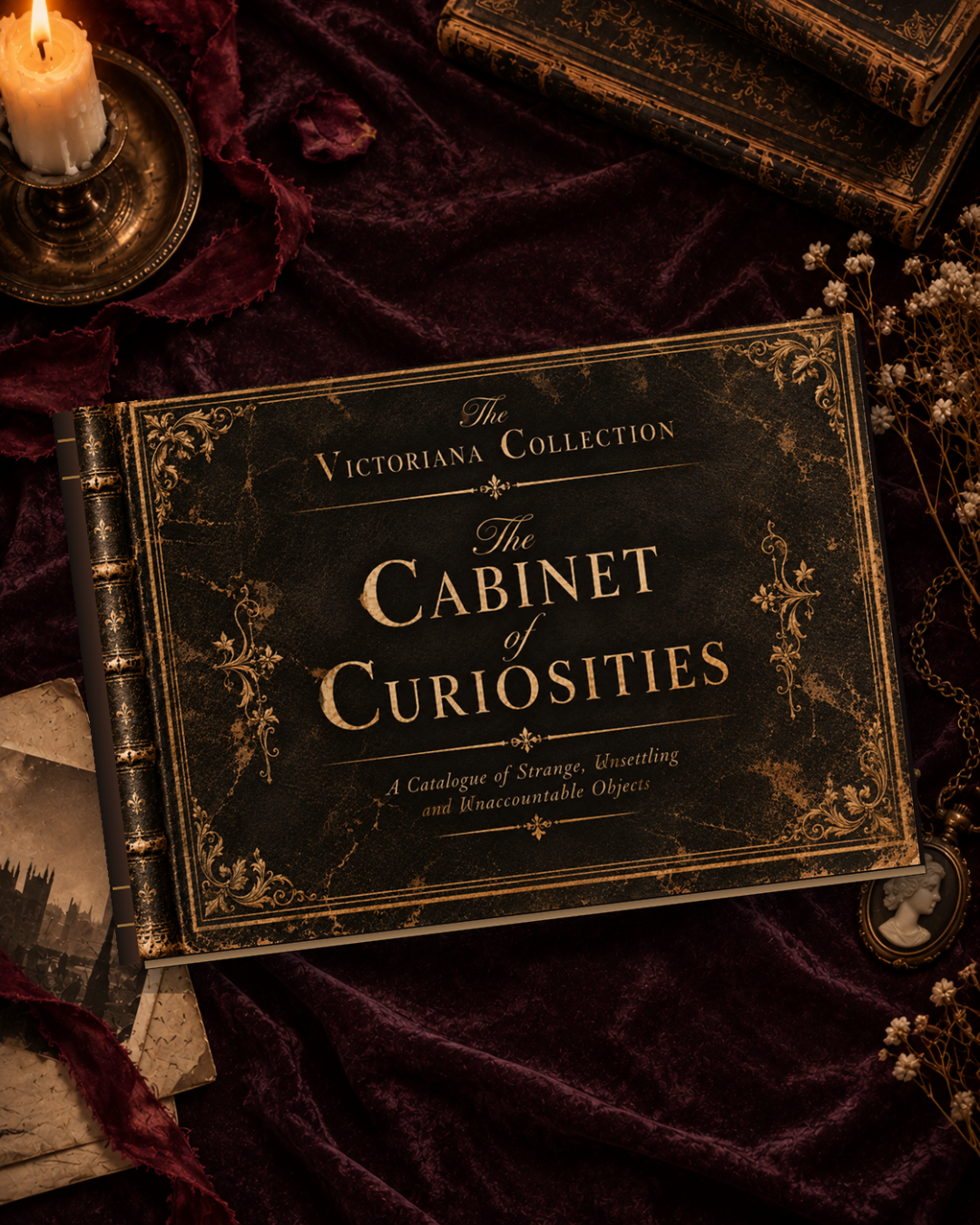
The Victorians were fascinated by death.
They photographed their loved ones, collected unusual specimens, attended séances and surrounded themselves with objects that promised to reveal the mysteries of the natural and supernatural worlds.
But some curiosities were never meant to be understood.
A child's teddy bear, its glass eyes carefully removed, discovered among unclaimed possessions at a Metropolitan Police auction.
An exquisite black mourning dress, commissioned for a little girl whose family insisted she was already dead.
A lepidopterist's collection containing butterflies and moths that resemble no known species, including one with a woman's face upon its wings.
A gentleman's top hat concealing strange symbols embroidered into its lining.
A doll with two faces, one smiling and damaged, the other frightened and hidden from view.
And a collection of mourning memorials commemorating people whose circumstances are considerably stranger than their epitaphs suggest.
Some objects were treasured possessions.
Others were acquired under questionable circumstances.
A few appear to have been deliberately abandoned.
And not every former owner can be accounted for.
Victoriana: The Cabinet of Curiosities is an immersive, beautifully illustrated catalogue of strange, unsettling and unaccountable objects inspired by the darker side of Victorian life.
Drawing upon Gothic literature, Victorian mourning customs, spiritualism, antiquarian collecting, forgotten superstitions and the peculiar fascination with death and the supernatural, this fictional archive brings together thirteen extraordinary curiosities, detailed collector's records, mysterious photographs and fragments of histories that refuse to remain buried.
Each artefact has its own story.
Or, at least, what remains of one.
Why were the glass eyes removed from a child's beloved toy?
Who was the mourning dress really intended for?
What happened to the naturalist who began dreaming of the creatures in his collection?
What purpose did the symbols inside a gentleman's hat serve?
And why would anyone conceal a frightened face beneath a doll's damaged smile?
There are no definitive explanations.
No complete histories.
No guarantee that the objects are quite as ordinary as they first appear.
Only curious possessions, unsettling discoveries and fragments of Victorian lives waiting to be investigated.
What's Inside?
◆ 13 beautifully illustrated Victorian curiosities, each with its own unusual history, mysterious details and circumstances of acquisition
◆ The collector's introductory letter, inviting you into a private world of strange possessions and unaccountable discoveries
◆ Detailed artefact catalogue pages featuring atmospheric illustrations, historical-style descriptions, provenance records and curious observations
◆ Unsettling Victorian objects, including mourning garments, peculiar toys, natural history specimens, personal possessions and items associated with superstition and the supernatural
◆ Atmospheric archival photographs and visual material, offering glimpses into forgotten lives, mysterious locations and the darker corners of Victorian society
◆ An illustrated cabinet inventory, documenting additional curiosities and fragments of the collection
◆ Creative writing prompts and exploration activities to inspire Gothic fiction, supernatural mysteries, historical stories and imaginative investigations
◆ Instant digital download in printable PDF format
Who Is It For?
Perfect for:
◆ Gothic horror writers and dark fiction enthusiasts
◆ Victorian history lovers fascinated by mourning customs, spiritualism and unusual traditions
◆ Novelists, short-story writers and creative storytellers
◆ Teachers looking for atmospheric visual writing prompts and imaginative classroom resources
◆ Fans of haunted houses, Victorian mysteries and supernatural fiction
◆ Historical fiction writers seeking unusual characters, objects and story inspiration
◆ Worldbuilders, journalers and solo roleplayers
◆ Lovers of antique collections, cabinets of curiosities, macabre history and mysterious artefacts
◆ Anyone who enjoys uncovering secrets hidden inside ordinary-looking possessions
What Makes This Different?
This isn't a traditional collection of writing prompts.
It's a cabinet of objects with histories that don't quite make sense.
Every curiosity suggests a former owner, a forgotten incident or an unanswered question.
But the surviving records are incomplete, the provenance is sometimes uncertain, and several objects possess details that cannot be satisfactorily explained.
Examine the eyeless bear and consider who removed its eyes, and why.
Investigate the child's mourning dress and the handwritten note concealed within its sash.
Study the lepidopterist's collection and the extraordinary specimens that occupied its former owner's dreams.
Explore the mourning memorials and imagine the stories behind their unsettling inscriptions.
Inspect the gentleman's top hat and the symbols hidden inside its lining.
Consider the doll whose two faces appear to tell entirely different stories.
Perhaps the eyeless bear was an innocent childhood possession.
Perhaps the mourning dress was commissioned for a child who never died.
Perhaps the lepidopterist discovered something that science could not explain.
Perhaps the peculiar symbols were nothing more than a gentleman's private eccentricity.
Or perhaps these objects have survived because their stories were never properly laid to rest.
You decide what these curiosities mean.
Use the collection to inspire a Victorian Gothic short story, develop a supernatural mystery, create a fictional antiquarian collector or imagine the lives of the people whose possessions have outlasted them.
Follow the provenance.
Examine the evidence.
Question the surviving accounts.
Imagine the secrets that polite Victorian society would rather have kept hidden.
Every object has a history. But would you really want to know the truth?
Digital download: An illustrated 21 page PDF collection designed in A4 landscape format, featuring thirteen individual curiosities and additional archival material. No physical product will be shipped.
Every Object Has a Secret: Explore Victoriana's Cabinet of Curiosities
What if the most disturbing Gothic stories began not with a haunted castle or a shadowy figure, but with an ordinary object whose history refused to make sense?
A child's teddy bear with its glass eyes carefully removed. An exquisite mourning dress commissioned for a little girl whose family insisted she was already dead. A collection of butterflies and moths unlike anything found in the natural world, including one bearing the unmistakable features of a woman's face.
These are just some of the unsettling discoveries waiting inside Victoriana: The Cabinet of Curiosities, an immersive, beautifully illustrated collection inspired by the darker side of Victorian life.
Drawing upon Gothic literature, mourning customs, spiritualism, antiquarian collecting and the Victorian fascination with death, this fictional archive brings together 13 extraordinary curiosities, each accompanied by fragments of an unusual and frequently troubling history.
Inside, you'll discover atmospheric illustrations, detailed artefact records, mysterious photographs, an illustrated inventory and creative writing activities designed to inspire your own Gothic fiction.
But these aren't simply objects to admire. They're mysteries to investigate.
Who removed the bear's eyes? What happened to the naturalist who began dreaming of his specimens? Why would someone conceal a frightened face beneath a doll's damaged smile?
There are no definitive explanations. Every object invites you to imagine its former owner, question its provenance and construct the story that might explain its existence.
Whether you're developing a Victorian ghost story, a supernatural mystery or a tale of obsession and forbidden knowledge, the collection offers a wonderfully macabre starting point for your imagination.
Explore Victoriana: The Cabinet of Curiosities and discover the stories hidden inside these extraordinary objects.

5. Gothic Atmosphere & Sensory Details: Five Evocative Description Examples
Some of the most unsettling moments in Gothic fiction occur when there is very little to see. A faint sound beyond a closed door, an unfamiliar smell lingering in an empty room or the sensation of something brushing against exposed skin can create an atmosphere of dread long before any visible threat appears.
Sensory description allows Gothic writers to move beyond the appearance of a setting and immerse readers in the physical experience of fear. Sound can suggest movement where none should exist. Smell can evoke memories, decay or the disturbing presence of something concealed. Touch can make an unseen danger feel immediate, while darkness and silence force both characters and readers to confront the limits of their perception.
The effectiveness of these details often depends upon restraint. An unexplained footstep may be more frightening than a dramatic confrontation, particularly when the reader has been encouraged to listen closely to an otherwise silent house. Similarly, the faint scent of perfume in an abandoned bedroom can suggest an entire history without revealing a single fact about its former occupant.
The following five Gothic descriptive writing examples demonstrate how auditory, olfactory, tactile and visual imagery can create distinctive forms of unease, transforming ordinary sensory experiences into sources of psychological tension and supernatural possibility.
Example 21: The Sound of Footsteps in an Empty House
The house had settled into its customary midnight silence, disturbed only by the occasional contraction of old timber and the faint ticking of the clock upon the landing. Eleanor lay awake beneath the heavy bedclothes, listening to the rain whisper against the windowpanes. Somewhere below, a floorboard creaked. Then came another sound: the measured tread of footsteps crossing the entrance hall. They were neither hurried nor hesitant, but deliberate, each footfall separated from the next by precisely the same interval. Eleanor counted seven before they stopped beneath the staircase. For several moments, nothing moved. Then the footsteps began again, ascending slowly towards the upper floor. She recognised the peculiar rhythm of the third stair, which always gave a sharp double crack beneath sufficient weight. It sounded exactly as she remembered. Only when the footsteps reached the landing did she recall that the staircase had been demolished the previous winter.
Why This Works
This passage creates suspense almost entirely through auditory imagery. The reader is introduced to ordinary household sounds before the footsteps emerge, making the disturbance feel plausible rather than immediately supernatural.
The measured rhythm of the approaching footsteps creates anticipation. Their regularity suggests intention, while the gradual movement from the entrance hall towards the bedroom reduces the distance between the character and the unidentified presence.
The third stair provides a particularly important detail. Its distinctive sound establishes the physical reality of the house and encourages readers to trust Eleanor's familiarity with her surroundings.
The final revelation changes the meaning of everything that preceded it. By revealing that the staircase no longer exists, the description transforms a recognisable domestic sound into evidence of something impossible. This technique, in which a seemingly ordinary detail acquires disturbing significance through delayed information, is especially effective in Gothic suspense.
Example 22: The Smell of Death and Decay
The cellar air was colder than the rooms above, heavy with the mineral dampness of underground stone. Beneath that familiar smell lingered something sweeter, almost floral, which grew stronger as Margaret descended the narrow steps. At first, she thought of overripe pears left too long in a bowl, their skins collapsing into fragrant brown flesh. Then came another association: the funeral flowers that had filled her mother's bedroom, their perfume thickening as the petals blackened at the edges. The scent seemed to cling to the back of her throat. Along the far wall stood a row of wooden cupboards, their doors swollen by moisture and their brass handles spotted with corrosion. One had been secured with a length of wire. From beneath it, a dark stain had spread across the flagstones, following the shallow grooves towards the drain. Margaret approached reluctantly. The smell was unmistakable now, although she could not understand why it reminded her so strongly of the roses her mother had loved.
Why This Works
The description relies upon olfactory imagery to establish unease before the reader encounters any clear evidence of danger. Smell is particularly useful in Gothic fiction because it can suggest the presence of something hidden while remaining difficult to locate or identify.
The passage begins with the ordinary dampness of a cellar before introducing a sweeter scent. The comparison to decaying fruit makes the smell tangible without immediately identifying its source.
The association with funeral flowers adds emotional significance. Margaret's memory of her mother connects physical decay with grief, making the atmosphere psychologically disturbing as well as unpleasant.
The cupboards, wire and spreading stain provide visual details that gradually reinforce the implications of the smell. However, the description stops before revealing what the cupboard contains.
This restraint allows anticipation to become the central source of horror. The reader is left imagining what might explain the odour, while the final reference to roses preserves the unsettling connection between beauty, memory and mortality.
Example 23: The Touch of Something Unseen
The passage narrowed as it descended beneath the chapel, its stone walls glistening with moisture. Clara kept one hand against the masonry, following the uneven surface through the darkness while her candle struggled against the stale underground air. The stones were cold and rough beneath her fingertips, interrupted occasionally by patches of soft moss and the shallow grooves of ancient inscriptions. Halfway along the passage, something brushed against her wrist. She stopped immediately. The sensation had been delicate, almost affectionate, like the passing touch of another person's fingers. Holding the candle higher, she examined the wall, but there was nothing except damp stone. She continued, more cautiously now, keeping her hand close to her body. A moment later, the touch returned, this time closing gently around her wrist. Five distinct points of pressure settled against her skin. Clara could feel the shape of a hand, including the narrow ridge of a ring upon its smallest finger. Yet when she raised the candle, her wrist remained entirely bare.
Why This Works
This example uses tactile imagery to make an invisible presence feel physically immediate. The reader is first introduced to recognisable sensations: cold stone, rough masonry and soft moss. These details establish a believable sensory environment before the unexplained contact occurs.
The initial touch is deliberately gentle. Rather than causing immediate pain, it resembles an affectionate human gesture, creating unease through the contradiction between familiarity and the impossibility of its source.
The second encounter intensifies the sensation through precise physical details. The five points of pressure and the ridge of a ring make the unseen hand feel disturbingly real.
The absence of any visible figure creates a conflict between touch and sight. Clara can feel something that she cannot see, forcing both character and reader to question which sensory experience should be trusted.
The passage demonstrates that Gothic horror does not always require violence. Intimacy can become threatening when it occurs without consent, explanation or the reassuring presence of another human being.
Example 24: The Darkness Beyond the Candlelight
The candle illuminated only a small circle of the drawing room, leaving the high ceiling and distant corners submerged in a darkness that seemed unusually dense. Within the trembling light, familiar objects retained their ordinary shapes: the curved arm of a velvet chair, the polished edge of a writing desk, the pale marble face of the mantel clock. Beyond that fragile boundary, the furniture dissolved into uncertain outlines. A tall shape beside the window might have been the grandfather clock, although Eleanor remembered moving it into the hall that morning. She lifted the candle, and the darkness withdrew just enough to reveal the folds of a heavy curtain. Relieved, she lowered her hand. At once, the tall shape returned, but this time it stood several feet closer. The flame guttered. For an instant, its light stretched across the floorboards, revealing the shadow of a figure whose feet appeared to be standing directly behind her. Eleanor turned. The candle illuminated an empty room.
Why This Works
The description uses restricted visibility to create uncertainty. Candlelight reveals only fragments of the room, allowing familiar objects to become ambiguous as they pass beyond the illuminated area.
The contrast between light and darkness establishes a clear visual boundary. Within the candle's reach, objects appear recognisable and reassuring; beyond it, their identities become unstable.
The apparently misplaced grandfather clock introduces a subtle disturbance before anything overtly frightening occurs. Eleanor initially finds a rational explanation, allowing the reader to experience a brief moment of relief.
That reassurance is immediately undermined when the shape appears closer. The movement suggests an approaching presence without requiring the description to reveal one.
The final shadow creates a contradiction between the evidence of light and the absence of a visible figure. By leaving the room apparently empty, the passage preserves the possibility that the threat remains concealed within the darkness — or that Eleanor's perception can no longer be trusted.
Example 25: The Unnatural Silence
The village should have been waking. Beyond the bedroom window, pale sunlight touched the slate rooftops and the narrow street that descended towards the harbour. Yet no carts rattled over the cobbles, no doors opened, and no voices drifted from the neighbouring houses. The church bell remained silent, although its hands had passed the hour. Even the gulls had disappeared from the harbour wall, leaving the fishing boats to rock gently against their moorings without a single cry overhead. Thomas opened the window. The morning air smelled of salt and woodsmoke, but the familiar sounds of the village were entirely absent. He struck the window frame with his knuckles and heard the dull impact clearly. When he called towards the street, his voice seemed strangely small, swallowed almost immediately by the motionless air. Across the road, a curtain moved behind an upstairs window. Someone was watching him. Thomas raised his hand in greeting, but the curtain fell, and the silence remained unbroken.
Why This Works
This passage creates unease through the absence of expected sound. Rather than introducing a frightening noise, it establishes a familiar environment and gradually removes the auditory details that should accompany it.
The village initially appears ordinary. Sunlight, rooftops, fishing boats and the smell of woodsmoke suggest the beginning of a typical morning. However, the missing carts, voices, church bell and seabirds create an increasingly disturbing contrast between appearance and experience.
The description also distinguishes between absolute silence and the absence of particular sounds. Thomas can hear his own movements, but the wider village remains inexplicably quiet. This makes the disturbance more specific and unsettling.
The movement of the curtain introduces evidence that the village is not entirely deserted. Someone appears to be present but unwilling to acknowledge him, raising questions about what has happened and why ordinary life has apparently stopped.
The final sentence refuses to explain the silence, allowing it to remain an oppressive presence rather than a mystery immediately resolved.
What These Gothic Sensory Examples Have in Common
These five examples demonstrate that Gothic atmosphere often emerges from a disruption of ordinary sensory expectations. Footsteps sound upon a staircase that no longer exists. A familiar fragrance suggests something concealed and decaying. An invisible hand produces an unmistakable physical sensation. Candlelight reveals a shadow without an apparent source, and an inhabited village becomes disturbingly silent.
Each passage begins by establishing a recognisable sensory environment before introducing a contradiction. This progression matters because readers must first understand what is normal within a setting before they can appreciate what has become abnormal.
Sensory details also influence the pace of Gothic description. A sequence of footsteps can create a measured approach towards danger. An unpleasant smell may grow gradually stronger, suggesting that a character is moving closer to its source. A sudden touch can interrupt an otherwise slow passage, while an extended silence can make the reader anticipate a sound that never arrives.
Another important technique is to allow different senses to contradict one another. A character might hear someone approaching but see an empty corridor, feel a hand upon their shoulder without finding anyone nearby, or recognise the scent of a familiar person in a room that has remained locked for years. Such contradictions make the reader question the reliability of perception itself.
When developing your own Gothic descriptions, consider which sense will create the strongest emotional effect. Sight is useful for establishing architecture and physical detail, but sound can suggest an approaching threat, smell can evoke disturbing memories, and touch can make an unseen presence feel immediate.
You do not need to engage every sense within a single passage. In fact, concentrating upon one carefully developed sensory experience can be more effective than overwhelming the reader with competing details.
The most unsettling Gothic atmosphere often emerges not from what characters can clearly perceive, but from the growing suspicion that their senses are revealing something they would rather not understand.
6. Gothic Horror & Unsettling Encounters: Five Disturbing Description Examples
Gothic horror often reaches its greatest intensity when something previously concealed begins to reveal itself. A figure appears where no living person should stand, an ordinary reflection behaves impossibly, or a familiar place suddenly exposes evidence of a history that has been deliberately forgotten. These encounters challenge the boundary between the natural and supernatural, forcing characters to confront experiences that cannot be explained through ordinary reasoning.
Yet effective Gothic horror does not depend upon sudden violence, grotesque imagery or elaborate supernatural revelations. Some of the most memorable encounters unfold slowly, allowing the reader to recognise the danger before the character fully understands it. A detail that initially appears insignificant may acquire a disturbing new meaning, while an apparently reassuring explanation can become increasingly difficult to sustain.
The relationship between revelation and uncertainty is particularly important. Showing too much can diminish the atmosphere by replacing imagination with certainty. Instead, Gothic writers often reveal just enough to make the impossible seem plausible, leaving readers to contemplate what remains unseen.
The following five examples explore different forms of Gothic horror, from an apparition glimpsed at a window to a disturbing discovery beneath an ancestral home. Each demonstrates how descriptive writing can transform a moment of apparent recognition into something profoundly unsettling.
Example 26: The Figure at the Window
The rain had ceased shortly after midnight, leaving the garden submerged beneath a pale mist that clung to the hedges and drifted across the gravel paths. From her bedroom, Marianne could distinguish the dark shapes of the cypress trees and the broken stone fountain at the centre of the lawn. Beyond them, the abandoned summerhouse stood beneath its canopy of climbing roses, its windows reflecting the weak moonlight. As she prepared to draw the curtains, a movement caught her attention. Someone was standing behind the summerhouse glass. The figure appeared to be a woman dressed in a long, pale gown, her head inclined towards the window as though listening for something beyond it. Marianne leaned closer. The woman's face remained indistinct, but one hand rested against the glass, its fingers spread wide. Slowly, the figure raised her head. Marianne recognised her own face looking back through the window. Then the woman smiled, revealing an expression Marianne had never worn.
Why This Works
This passage develops its horror through gradual recognition and the uncanny. The opening establishes a quiet, believable nighttime landscape before introducing a distant figure whose identity remains uncertain.
The summerhouse creates physical separation between Marianne and the apparition. This distance initially offers a sense of safety, allowing her to observe the figure without feeling immediately threatened.
The pale gown and hand against the glass suggest a conventional ghostly appearance, but the encounter becomes more disturbing when Marianne recognises her own features. The familiar face introduces questions about identity, duplication and the possibility of an alternative self.
The final smile provides the decisive contradiction. Although the figure resembles Marianne, its expression does not belong to her. This distinction transforms recognition into alienation, suggesting that the apparition possesses an identity or intention entirely separate from the woman observing it.
Example 27: The Portrait That Changed
The portrait occupied a narrow space between the library windows, where the afternoon light fell across its darkened varnish. It depicted a young woman seated beside a marble column, her pale blue dress arranged in elaborate folds around a pair of delicate hands. Her expression was solemn, almost sorrowful, and a small silver locket rested against her throat. For generations, the family had referred to her simply as the Unknown Lady, although no one could explain why her portrait had been preserved when so many others had disappeared. As Edward examined the painting, he noticed a faint irregularity beneath the woman's left hand. A second hand appeared to have been painted over, its ghostly outline visible through the ageing pigments. He moved closer, following the shape towards the darkness beneath her chair. There, almost concealed by the frame, was the suggestion of a small face. Edward stepped backwards. The woman's painted eyes were no longer directed towards the artist. They were looking down at the child.
Why This Works
The portrait creates horror through the unsettling possibility that an apparently fixed image can change. Paintings are particularly effective Gothic objects because they preserve the appearance of people who may have been dead for centuries, blurring the distinction between presence and absence.
The passage initially concentrates upon ordinary artistic details: clothing, posture, jewellery and ageing varnish. These establish the portrait as a believable historical object before the hidden second hand introduces an unexpected discovery.
The concealed child's face suggests an erased or suppressed history. The fact that someone appears to have painted over the original composition raises questions about deliberate concealment, family secrets and the significance of the unknown woman.
The final change in the woman's gaze is subtle rather than dramatic. No figure emerges from the canvas, and the portrait does not speak. Instead, the reader is left contemplating whether the painting has altered, whether Edward has misremembered its original appearance or whether the hidden child has always been the true subject of the image.
Example 28: The Visitor Beneath the Bed
The bedroom was small and sparsely furnished, its narrow iron bed positioned against a wall covered in faded green wallpaper. A single candle burned upon the bedside table, illuminating the cracked porcelain washbasin and the neatly folded travelling clothes arranged upon a chair. Beneath the bed, the darkness appeared unusually complete, untouched by the faint light that reached the surrounding floorboards. Thomas had been preparing to sleep when he heard a soft scraping sound from somewhere below the mattress. He knelt beside the bed, expecting to discover a loose board or perhaps a mouse. The space beneath was empty except for a thin covering of dust and a forgotten wooden button. Then, from the darkness nearest the wall, came the quiet sound of someone breathing. Thomas held the candle lower. Two pale eyes opened beneath the bed, followed by the gradual appearance of a face turned sideways against the floor. Its lips moved soundlessly before forming a smile. The face was his own, although its eyes were considerably older.
Why This Works
This example transforms a familiar domestic space into a source of immediate danger. The bedroom is initially described through ordinary furnishings and small details, establishing an environment associated with privacy and rest.
The darkness beneath the bed introduces a confined area that cannot be fully observed. Although the space is physically small, its apparent resistance to candlelight suggests that it may contain something beyond its ordinary dimensions.
The scraping sound provides a plausible reason for Thomas to investigate. His expectation of finding a mouse or loose floorboard offers a rational explanation that makes the subsequent discovery more disturbing.
The appearance of an older version of his own face introduces psychological horror through distorted identity. The encounter suggests an impossible relationship between Thomas and the figure, potentially involving time, mortality or an alternative existence.
The passage ends without explaining the apparition. The reader is left considering not only what the figure might be, but also what its age and expression could imply about Thomas's future.
Example 29: The Procession Through the Fog
The road to the village had vanished beneath a thick evening fog, leaving only the nearest hedgerows visible in the failing light. Margaret walked carefully along the muddy track, guided by the occasional glimpse of the stone wall that bordered the churchyard. Ahead, a faint yellow glow emerged from the mist. At first, she mistook it for a lantern carried by another traveller, but as she approached, additional lights appeared, moving in a slow and orderly procession. Dark figures surrounded a narrow wooden coffin, their faces concealed beneath broad-brimmed hats and heavy mourning veils. No footsteps sounded upon the road, although their garments stirred gently as they passed. Margaret stepped aside, pressing herself against the cold wall. The final mourner turned towards her. Beneath the veil was a woman's face, pale and deeply lined, with eyes swollen from weeping. She lifted one trembling hand and pointed towards the coffin. Margaret looked down. Upon its lid lay a wreath of white lilies and a small brass plate bearing her own name, followed by tomorrow's date.
Why This Works
The procession draws upon traditional Gothic imagery associated with death, mourning and supernatural warnings. Fog restricts visibility, allowing the figures to emerge gradually rather than appearing all at once.
The lanterns provide a visual focus within the obscured landscape, drawing Margaret towards an encounter whose significance she does not yet understand. Their orderly movement contrasts with the absence of footsteps, introducing a subtle contradiction between what she sees and what she hears.
The mourners' concealed faces and formal clothing create an atmosphere of ritual. Their silence makes the procession feel detached from ordinary human activity, suggesting that it belongs to another time or realm.
The final revelation uses foreshadowing and the Gothic preoccupation with mortality. The brass plate bearing Margaret's name and tomorrow's date suggests a possible future death without confirming whether the vision is a warning, prophecy or deception.
By ending with this discovery, the passage transforms an eerie encounter into a deeply personal threat.
Example 30: The Secret Beneath the House
The passage beneath the manor had been concealed behind a panel in the wine cellar, its entrance obstructed by generations of discarded furniture. Beyond it, a narrow flight of stone steps descended into darkness, the walls becoming progressively colder and wetter as Eleanor approached the bottom. The underground chamber was circular, supported by six low pillars carved with unfamiliar symbols. At its centre stood a long wooden table, its surface covered with a brittle linen cloth. Along the walls, dozens of shallow recesses contained small objects: a child's shoe, a silver comb, a broken pocket watch, a porcelain tooth, a length of braided hair. Each rested beneath a handwritten label bearing a name and date. Eleanor recognised several of the names from the family portraits upstairs. Then she reached the final recess. It contained a small brass key tied with a faded blue ribbon, identical to the one she wore around her neck. Beneath it, written in her father's unmistakable handwriting, was her own name. The date was seventeen years earlier, three months before she had been born.
Why This Works
This passage uses the discovery of a hidden space to suggest that the manor's history is far more disturbing than its inhabitants realise. The concealed entrance, descending staircase and underground chamber draw upon familiar Gothic motifs of secrecy, forbidden knowledge and buried family histories.
The collection of personal objects creates an atmosphere of ritual and obsession. Each item appears ordinary in isolation, but their careful arrangement and accompanying labels suggest that they possess a significance beyond their everyday purpose.
The connection to the family portraits establishes a relationship between the chamber and the manor's inhabitants, implying that the collection records something concealed within the family's past.
The final discovery transforms the mystery into a personal threat. Eleanor's key and the impossible date raise questions about her identity, her father's knowledge and the circumstances surrounding her birth.
Rather than revealing the chamber's purpose, the passage concludes at the moment when its implications become most disturbing. This allows the reader to imagine explanations that may be more unsettling than any immediate revelation.
What These Gothic Horror Examples Have in Common
These final five examples demonstrate how Gothic horror often develops through the gradual collapse of familiar explanations. A distant figure becomes an impossible reflection, a portrait reveals evidence of a concealed history, an ordinary bedroom contains an unnatural double, a funeral procession appears to predict a character's death, and a hidden chamber challenges everything its discoverer believes about her own identity.
Although the encounters differ, each relies upon a carefully established physical environment. The summerhouse, library, bedroom, fog-covered road and underground chamber provide recognisable surroundings against which the extraordinary events can unfold. Their descriptive details make the encounters feel grounded, allowing the supernatural elements to emerge as disruptions of an otherwise believable world.
Another shared technique is the controlled release of information. Each passage begins with details that appear ordinary or at least explainable, before introducing increasingly significant contradictions. The reader is encouraged to interpret the evidence alongside the character, often recognising the implications only moments before the final revelation.
The examples also demonstrate the importance of personal significance in Gothic horror. An unexplained apparition may be frightening, but an apparition wearing the observer's face introduces a deeper psychological disturbance. A mysterious funeral becomes more unsettling when the coffin bears the protagonist's name. A collection of strange objects acquires emotional power when one belongs to the person discovering it.
When developing your own Gothic encounters, consider how the extraordinary event might challenge something your character believes to be certain. Their identity, memories, relationships, family history or understanding of reality may all provide opportunities for unsettling revelations.
The most effective Gothic horror does not simply introduce something frightening. It changes the meaning of something the reader previously believed they understood.
By combining atmospheric description with carefully chosen contradictions, sensory detail and emotional significance, you can create encounters that linger in the imagination long after the immediate scene has ended.
What Makes Gothic Descriptive Writing Effective? 10 Essential Techniques
Effective Gothic descriptive writing does more than establish a dark or frightening setting. It creates an emotional experience, using carefully selected language to influence how readers perceive characters, places and events. A ruined building might evoke melancholy, a familiar room might become oppressive, or an apparently insignificant object might suggest a history too disturbing to reveal.
The difference between ordinary description and compelling Gothic prose often lies in the relationship between what is described and what is implied. Rather than announcing that a place is sinister, Gothic writers select details that encourage readers to reach that conclusion themselves. They use atmosphere to establish expectations, sensory imagery to make the scene tangible, and uncertainty to keep the imagination engaged.
The following ten techniques can help you create more atmospheric, evocative and psychologically unsettling Gothic descriptions.
1. Use Personification to Make Settings Feel Alive
Personification gives human qualities to buildings, landscapes and objects, allowing an apparently inanimate environment to feel watchful, hostile or strangely aware of its inhabitants.
Gothic writers frequently describe windows as eyes, doors as reluctant guardians, and corridors as spaces that swallow light or sound. These images suggest that the environment possesses intentions beyond its physical structure.
Ordinary description:
The old house had narrow windows and a large entrance surrounded by overgrown plants.
Gothic description:
The house watched the approaching carriage through narrow, unlit windows, its great doorway half-concealed beneath the grasping fingers of ivy.
The second version transforms architectural features into signs of possible awareness. The house becomes an active presence rather than a passive location.
However, personification is most effective when used selectively. If every object watches, whispers, reaches or threatens, the imagery can become repetitive and exaggerated.
Writing tip: Choose one architectural or natural feature that reflects the emotional atmosphere of your scene. Consider what human quality would make it most unsettling, then develop that association through a precise verb or image.
2. Create Atmosphere Through Carefully Chosen Sensory Details
Gothic description becomes more immersive when readers can hear, smell and physically experience the environment rather than simply visualise it.
Sound is particularly useful for creating suspense. A distant footstep, an irregular ticking clock or the absence of birdsong can suggest that something is wrong without revealing an identifiable threat.
Smell can evoke decay, memory or concealed danger. Touch can introduce physical discomfort through cold stone, damp fabric or the unexpected sensation of contact.
Example:
The corridor smelled of extinguished candles and wet plaster. Beneath the warped floorboards, something scraped slowly against the timber, pausing whenever she stopped to listen.
This passage uses smell and sound to establish an atmosphere without relying upon darkness or conventional Gothic architecture.
The scraping noise also responds to the character's behaviour, suggesting intention without confirming the presence of another person.
Writing tip: Identify the dominant sensory experience in your scene. Rather than including every sense automatically, concentrate on the details that will create the strongest emotional effect.
3. Use Light and Shadow to Control What Readers Can See
Light and darkness are fundamental elements of Gothic imagery, but their effectiveness depends upon more than describing a room as dimly lit.
Restricted visibility allows writers to reveal information gradually. Candlelight might illuminate a portrait while concealing the doorway beside it. Moonlight might reveal an unfamiliar shape in a garden without making its identity clear.
Example:
The candlelight reached the foot of the staircase but no farther. Above it, the banisters disappeared into darkness, their polished surfaces catching occasional fragments of gold. Halfway up, something pale rested upon the railing. It might have been a folded cloth, although its position suggested the fingers of a waiting hand.
The description establishes a visible boundary between certainty and uncertainty. The reader can understand the staircase but cannot clearly identify the object resting upon it.
Notice that the passage does not immediately reveal whether the shape is threatening. Its ambiguity creates the tension.
Writing tip: Consider where your light source is positioned, how far it reaches and which details remain concealed. Use these physical limitations to determine the order in which readers discover information.
4. Use Decay and Deterioration to Suggest Hidden Histories
Decay is one of the most recognisable characteristics of Gothic description. Crumbling buildings, faded portraits, rotting flowers and neglected gardens can suggest mortality, lost grandeur, forgotten relationships and the inevitable passage of time.
However, deterioration becomes more meaningful when it reveals something about a setting's former purpose or inhabitants.
Example:
The ballroom's painted ceiling had begun to collapse, exposing the blackened beams above. Beneath the fallen plaster, fragments of an elaborate floral pattern remained visible, and a single crystal chandelier hung crookedly over the empty dance floor.
The contrast between former elegance and present ruin creates melancholy while suggesting that the building once hosted a very different kind of life.
The chandelier becomes particularly evocative because it survives as a remnant of that earlier splendour.
Writing tip: Give a decaying object or setting evidence of its former beauty, importance or purpose. The contrast between what something was and what it has become often creates a stronger Gothic atmosphere than deterioration alone.
5. Create Psychological Unease Through the Uncanny
The uncanny occurs when something familiar becomes disturbing because it appears subtly altered, displaced or impossible.
A childhood home might contain furniture arranged differently from memory. A familiar voice might speak from an empty room. A reflection might reproduce every movement except one.
These experiences are unsettling because they undermine the reader's confidence in ordinary reality.
Example:
The photograph showed the family gathered beneath the apple tree, exactly as Eleanor remembered. Her mother stood beside the garden bench, her father held the youngest child, and Eleanor herself sat upon the grass. Yet someone else occupied the empty chair behind them: a woman in a dark dress whose face Eleanor recognised from the mirror above her bed.
The photograph initially provides reassurance through familiarity. The additional figure then introduces an impossible contradiction.
Rather than explaining the woman's presence, the passage allows the reader to consider its implications.
Writing tip: Begin with something your character knows intimately. Change one small detail that should be impossible to change, then allow the character's recognition of that contradiction to create the tension.
6. Use Symbolism to Give Ordinary Objects Greater Meaning
Gothic objects frequently represent ideas beyond their immediate physical purpose.
Mirrors can suggest fractured identity or hidden truths. Locked doors may represent forbidden knowledge. Withered flowers can evoke mortality, lost love or emotional deterioration. Clocks might symbolise the passage of time, approaching death or a moment that refuses to remain in the past.
Example:
The wedding dress hung behind the wardrobe door, its ivory silk yellowed with age. Across the bodice, someone had stitched a narrow band of black mourning ribbon, each careful seam disappearing beneath the lace.
The dress traditionally represents celebration and union, but the mourning ribbon introduces an association with death and loss.
The juxtaposition encourages readers to imagine the circumstances that brought these contradictory symbols together.
Symbolism is most effective when it emerges naturally from the story rather than appearing as an obvious decorative device.
Writing tip: Select an object that matters to your character or setting. Consider its ordinary associations, then introduce a detail that complicates or contradicts those meanings.
7. Control Sentence Length to Build Suspense
The rhythm of Gothic prose can influence the reader's emotional response as strongly as the imagery itself.
Longer sentences can create a sense of immersion, drawing attention through a sequence of descriptive details. Shorter sentences can interrupt that rhythm, introducing sudden recognition, uncertainty or alarm.
Example:
The corridor extended through the abandoned wing, its walls lined with portraits whose darkened faces seemed to emerge and disappear as the candlelight moved, while the carpet muffled every footstep and the distant rain whispered against the shuttered windows.
Then someone knocked.
The first sentence establishes an atmospheric environment through accumulated details. The abrupt second sentence interrupts that descriptive rhythm, making the unexpected sound more striking.
Sentence variation can also reflect a character's changing psychological state. A calm observer may notice elaborate details, while a frightened character might become preoccupied with brief, immediate sensations.
Writing tip: Read your descriptive passage aloud. Identify where the reader should linger and where the pace should accelerate. Use sentence length deliberately rather than maintaining the same rhythm throughout.
8. Suggest Threats Rather Than Revealing Everything
One of the most effective principles of Gothic suspense is that uncertainty can be more frightening than certainty.
A clearly identified threat gives readers something concrete to understand. An unexplained sound, an indistinct figure or an impossible detail invites the imagination to construct possibilities that may be far more disturbing.
Example:
Someone had been sitting in the chair beside the fireplace. The cushion retained the shallow impression of a body, and the folded newspaper resting upon its arm was still warm. Yet the room had been locked for thirty years, and the key had remained in Eleanor's possession since her father's death.
The passage does not reveal who occupied the chair. Instead, it presents physical evidence that contradicts the known circumstances.
The reader must reconcile the warmth of the newspaper with the room's long abandonment.
Writing tip: Before revealing a frightening presence, describe its effects upon the environment. Footprints, displaced objects, unfamiliar smells or subtle changes in familiar surroundings can establish tension without immediately identifying the cause.
9. Reflect a Character's Emotional State Through Their Surroundings
Gothic landscapes and interiors frequently echo the emotions of the characters experiencing them. This technique, sometimes associated with pathetic fallacy, can make a setting feel psychologically connected to the narrative.
A grieving character might notice the drooping branches of trees, the faded colours of an abandoned room or the slow movement of rain across a window.
An anxious character might perceive the same environment through sharp shadows, confined spaces and sounds that seem unnaturally loud.
Example:
Beyond the conservatory windows, the garden lay beneath a persistent grey rain. The roses had bowed under the weight of the water, their petals scattered across the path like fragments of discarded letters. Eleanor watched them from the empty room, unable to remember when she had last opened the door.
The setting reflects emotional withdrawal and loss without directly stating that Eleanor is grieving or isolated.
The scattered petals suggest something fragile and irretrievable, while the unopened door reinforces her separation from the outside world.
However, emotional atmosphere does not always need to match the weather. A beautiful spring morning can become deeply unsettling when contrasted with a character's fear or despair.
Writing tip: Consider how your viewpoint character's emotional state influences which details they notice. Two characters entering the same Gothic setting may describe it very differently.
10. End Descriptive Passages with an Unsettling Detail
A Gothic description becomes particularly memorable when its final detail changes how readers interpret everything that came before.
This might involve an unexpected sound, an object in the wrong place, evidence of an unseen presence or a contradiction that challenges the character's understanding of the setting.
Example:
The bedroom remained exactly as it had been on the morning of her departure. The curtains were drawn, the wardrobe doors stood closed, and the small porcelain clock upon the mantelpiece had stopped at twenty minutes past six. Even the book beside the bed remained open at the page she had been reading.
Only the photograph had changed.
Her face had disappeared from it.
The opening details establish preservation and stillness, encouraging readers to imagine a room untouched by time.
The final revelation introduces a disturbing contradiction, transforming an apparently ordinary description into the beginning of a Gothic mystery.
This technique is particularly effective when the unsettling detail is connected to an object already introduced earlier in the passage.
Writing tip: Examine the final sentence of your description. Could it reveal a small but meaningful inconsistency, raise a question or introduce an unexpected implication? A carefully chosen ending can create suspense without requiring an elaborate dramatic event.
Bringing These Gothic Writing Techniques Together
These ten techniques are most effective when they support one another rather than appearing as separate decorative features.
Consider a character entering an abandoned bedroom. Personification might make the doorway seem reluctant to admit them, while sensory imagery introduces the smell of damp linen and extinguished candles. A damaged photograph could suggest a forgotten history, and a subtle contradiction might reveal that someone has recently disturbed the room.
The description does not need to employ every technique. In fact, excessive imagery can overwhelm the scene and diminish its emotional impact. Precision, restraint and purposeful detail are often more effective than elaborate language alone.
When revising your Gothic prose, ask yourself whether each descriptive choice contributes to the atmosphere, reveals something about the character or setting, or develops an unanswered question.
The goal is not simply to make every sentence darker or more ornate. It is to create a coherent emotional experience in which the setting, language and narrative tension work together.
The strongest Gothic descriptive writing allows readers to inhabit a world that feels convincing in its physical details, even as its underlying reality becomes increasingly uncertain.
Gothic Descriptive Writing Exercises: Five Creative Challenges
Understanding the techniques behind Gothic descriptive writing is one thing; learning to use them confidently in your own fiction requires experimentation. The most effective way to develop an atmospheric writing style is to practise transforming ordinary details into something evocative, unsettling or psychologically complex.
The following five exercises explore different aspects of Gothic description, from creating atmosphere through sensory imagery to suggesting hidden histories through objects and architecture. Each activity includes a specific creative challenge, practical guidance and an optional extension for writers who want to develop their ideas further.
You can complete these exercises as standalone descriptive passages, use them as starting points for short stories or adapt them for classroom creative writing activities.
Exercise 1: Transform an Ordinary Setting into a Gothic Location
The Challenge
Choose a familiar, unremarkable location and describe it as though it belongs in a Gothic novel. Your setting might be a supermarket after closing, a school corridor, a railway waiting room, a suburban garden or an ordinary family kitchen.
Your aim is to create an atmosphere of unease without changing the location into something obviously supernatural.
Begin by writing a straightforward description of the setting, concentrating upon its physical appearance and everyday purpose.
Then rewrite the passage using Gothic descriptive techniques.
Consider how the quality of light, the arrangement of objects, the surrounding sounds and the condition of the environment might influence the reader's emotional response.
For example, a familiar school corridor might become unsettling when the fluorescent lights illuminate rows of identical doors, the display boards contain photographs of pupils who appear strangely unfamiliar, and the distant sound of a chair scraping across the floor continues long after the building has emptied.
Writing Requirements
Write approximately 150–200 words.
Include at least three sensory details.
Use personification or figurative language to establish atmosphere.
Introduce one small detail that seems out of place.
Avoid explicitly describing the setting as frightening, haunted or sinister.
Extension: Change the Emotional Atmosphere
Rewrite the same setting to create melancholy rather than fear.
Consider how your descriptive choices change when the location evokes loss, nostalgia or abandonment instead of immediate danger.
What This Develops: Atmospheric description, sensory imagery, personification and the relationship between setting and emotional tone.
Exercise 2: Describe a Character Through One Disturbing Detail
The Challenge
Create a Gothic character who appears entirely ordinary at first glance but possesses one small characteristic that makes their presence unsettling.
Avoid conventional descriptions of villains, monsters or supernatural creatures. Instead, concentrate upon a subtle contradiction between the character's appearance and behaviour.
Your character might be an elderly woman whose shadow moves a fraction behind her, a courteous stranger who never seems to blink, a physician whose hands remain unnaturally cold or a familiar relative who has forgotten a deeply personal detail.
Begin by establishing the character's outward appearance through believable physical details.
Then introduce the unsettling characteristic gradually, allowing the reader to recognise its significance without being told what it means.
The most effective descriptions will make the character seem almost normal, so that the unusual detail becomes increasingly difficult to ignore.
Writing Requirements
Write approximately 150 words.
Include three ordinary physical or behavioural details.
Introduce one unsettling contradiction.
Use body language, gesture or facial expression to develop characterisation.
Avoid explaining the cause of the unusual characteristic.
Extension: Change the Viewpoint
Rewrite the description from the perspective of someone who loves or trusts the character.
How does emotional familiarity influence what the observer notices, overlooks or attempts to explain away?
What This Develops: Character description, the uncanny, psychological tension and indirect characterisation.
Exercise 3: Create Suspense Using Only Sound
The Challenge
Write a Gothic descriptive passage in which the central source of tension is something the character can hear but cannot see.
Your setting might be an empty house, a darkened railway carriage, a forest at night, an underground passage or a room in which the character has been instructed to remain silent.
Begin by establishing the ordinary sounds of the environment. These might include rain, wind, distant traffic, creaking timber or the movement of water.
Gradually introduce an unfamiliar sound that does not fit the setting.
Perhaps footsteps begin following the character but stop whenever they turn around. A distant bell rings from a church that was demolished years earlier. A quiet voice speaks from the other side of a wall, repeating something the character has not yet said.
Control the rhythm of the passage carefully, allowing pauses and silence to become as significant as the sounds themselves.
Writing Requirements
Write approximately 150–200 words.
Make sound the dominant sensory experience.
Establish at least two ordinary background noises.
Introduce one unexplained sound.
Use sentence length and paragraph breaks to control suspense.
End without revealing the source of the disturbance.
Extension: Remove the Sound
Rewrite the passage so that the frightening element is the sudden disappearance of an expected sound.
Consider how silence can suggest danger when readers have already become familiar with the environment's ordinary noises.
What This Develops: Auditory imagery, pacing, suspense, sensory focus and controlled revelation.
Exercise 4: Give an Ordinary Object a Sinister History
The Challenge
Choose an everyday object and describe it as though it conceals a disturbing or emotionally significant past.
Your object might be a pocket watch, a wedding ring, a child's toy, an antique photograph, a pair of gloves, a music box or a handwritten letter.
Begin with its physical appearance. Consider its materials, weight, texture, condition and signs of use.
Then introduce details that suggest its history is more complicated than it first appears.
A pocket watch might contain an inscription bearing a date that has not yet occurred. A photograph might show a familiar person standing beside someone whose face has been carefully removed. A child's toy might contain a hidden compartment filled with letters addressed to someone who never existed.
Rather than explaining the object's history, allow its physical details to imply a story that the reader must begin to construct.
Writing Requirements
Write approximately 150–200 words.
Describe the object using at least three precise physical details.
Include evidence of age, damage or previous ownership.
Introduce one detail that contradicts the object's apparent history.
Suggest an emotional connection between the object and its owner.
Leave at least one important question unanswered.
Extension: Write the Provenance Record
Imagine the object has been discovered in a Victorian cabinet of curiosities.
Write a short archival record documenting its supposed origin, previous owners and unusual characteristics.
Use a formal, factual tone while allowing the implications to become increasingly disturbing.
What This Develops: Symbolism, object-based storytelling, implied backstory and Gothic mystery.
Exercise 5: Write a Gothic Scene That Changes Meaning
The Challenge
Write a descriptive passage that begins with a reassuring or beautiful scene but gradually reveals something profoundly unsettling.
Unlike the previous exercises, this challenge requires you to control the reader's interpretation of the setting.
Begin with an environment that appears peaceful, elegant or comforting. You might describe a sunlit conservatory, a beautifully furnished bedroom, a quiet country church, a family gathering or a garden filled with flowers.
Use descriptive details to establish an atmosphere of safety or familiarity.
Then introduce a series of small contradictions.
Perhaps the flowers have no scent. The family portraits show people who are currently sitting in the room, but their faces have been painted over. A clock continues ticking even though its hands remain motionless. The sunlight illuminates everything except one particular chair.
Your final detail should transform the reader's understanding of the entire scene.
The aim is not to introduce a sudden monster or dramatic confrontation, but to create a moment of recognition in which something previously reassuring becomes disturbing.
Writing Requirements
Write approximately 200–250 words.
Begin with a positive or neutral atmosphere.
Include at least three carefully selected descriptive details.
Introduce two subtle inconsistencies before the final revelation.
Use a mixture of longer descriptive sentences and shorter sentences to control pacing.
End with a detail that changes the meaning of an earlier observation.
Extension: Remove the Final Revelation
Rewrite the passage without its concluding disturbance.
Can you preserve the Gothic atmosphere through implication alone? Consider whether the reader can recognise that something is wrong without receiving definitive confirmation.
What This Develops: Structural suspense, foreshadowing, the uncanny, contrast and the controlled release of information.
How to Improve Your Gothic Descriptions Through Revision
Once you've completed one or more of these exercises, return to your writing and examine how effectively the descriptive details contribute to the atmosphere.
Rather than simply adding more adjectives or elaborate imagery, consider whether your choices are precise, purposeful and consistent with the emotional experience you want to create.
Ask yourself:
Atmosphere: Does the passage establish a distinctive mood without directly naming the emotion?
Sensory imagery: Can readers experience the setting through carefully selected sounds, smells, textures or visual details?
Specificity: Are the descriptions memorable, or could they belong to almost any Gothic setting?
Symbolism: Do particular objects, architectural features or natural details suggest meanings beyond their physical appearance?
Pacing: Does the rhythm of the prose encourage readers to linger, anticipate or become increasingly uneasy?
Uncertainty: Have you left enough unexplained to engage the reader's imagination?
Originality: Does the passage develop its own atmosphere rather than relying entirely upon familiar Gothic imagery?
One useful revision technique is to remove every adjective from a paragraph and examine what remains. If the description loses all its atmosphere, consider whether stronger nouns, verbs, sensory details or more meaningful imagery could do the work instead.
For example, the frightening, sinister corridor tells the reader how to feel, while the corridor narrowed towards a door whose handle turned slowly in the darkness creates an experience that allows fear to emerge naturally.
You might also experiment with rewriting the same passage from different emotional perspectives. A character who feels grief, guilt or longing may interpret a Gothic environment very differently from someone experiencing immediate fear.
Above all, remember that effective Gothic description is not about making every detail frightening. It is about creating a world in which beauty, familiarity and ordinary experience can become charged with mystery, melancholy or dread.
The more confidently you can control that transformation, the more distinctive and compelling your Gothic writing will become.
Go Deeper: Explore More Gothic Writing Guides, Techniques & Story Inspiration
The most compelling Gothic fiction rarely relies upon a single frightening image or atmospheric setting. Its power comes from the relationship between place, character, emotion and the secrets that gradually emerge through the narrative. A crumbling manor becomes more unsettling when its inhabitants behave strangely; an abandoned nursery acquires greater significance when an ordinary object reveals a forgotten history; and a seemingly peaceful landscape can become threatening when the reader begins to question what lies beyond its visible boundaries.
The 30 Gothic descriptive writing examples in this guide offer a foundation for developing those effects, but there are many ways to explore them further. Whether you want to strengthen your sensory descriptions, create more disturbing characters, build suspense or turn an atmospheric passage into a complete story, the following Ink & Insights resources will help you develop different aspects of your Gothic writing.
Strengthen Your Gothic Descriptions & Atmosphere
If you enjoyed exploring the abandoned manor, the mysterious interiors and the sensory details in our examples, these guides examine how to make Gothic settings more immersive and emotionally powerful.
How to Describe a Haunted House: Sensory Writing Guide
A haunted house should feel like more than a collection of dark rooms and creaking floorboards. This guide explores how to build an atmosphere through sight, sound, smell, touch and taste, with 25 original sensory description examples showing how different details can transform the reader's experience of a setting. It's particularly useful if you want to expand a short Gothic description into a fully realised scene, making the architecture, furnishings and atmosphere feel tangible.
How to Create an Eerie Atmosphere in Gothic Writing
Sometimes the most disturbing detail is the one that seems almost insignificant. An unexpected silence, a shifting shadow or a familiar object in the wrong place can create unease without revealing an obvious threat. Explore 10 techniques for developing eerie atmospheres through psychological uncertainty, sensory contradictions, decaying interiors and unexplained disturbances. This is an excellent next step if you want to make your Gothic descriptions more subtle, suspenseful and unsettling.
100 Words to Describe Darkness
Darkness can be oppressive, comforting, mysterious, beautiful or threatening, depending upon how you describe it. This vocabulary guide explores 100 evocative words for different qualities of darkness, from impenetrable shadows and Gothic gloom to moonless landscapes, supernatural obscurity and atmospheric twilight. Use it to expand your descriptive vocabulary, experiment with more precise imagery and avoid relying upon the same familiar adjectives throughout your writing.
Create Unsettling Characters & Psychological Suspense
Gothic atmosphere becomes even more powerful when the people inhabiting a setting possess secrets, contradictions or disturbing qualities of their own. These resources will help you connect descriptive writing with characterisation and narrative tension.
How to Describe a Sinister Character: 10 Techniques with Examples
A Gothic character does not need to look monstrous to inspire fear. An immaculate appearance, an unusual gesture or a momentary change in expression can suggest something deeply troubling beneath the surface. This guide explores 10 characterisation techniques, evocative vocabulary and original descriptive examples to help you create mysterious strangers, morally ambiguous figures and memorable Gothic villains. It's especially useful for developing the kinds of uncanny encounters explored in Examples 11–15.
Gothic Suspense Writing Exercises
Atmosphere establishes the mood of a Gothic story, but suspense gives readers a reason to keep turning the pages. These 10 practical exercises explore unreliable perception, unseen presences, mysterious letters, shifting corridors, unsettling silences and delayed revelations. Use them to experiment with the relationship between descriptive detail and narrative tension, particularly if you want to develop one of your atmospheric passages into a longer scene or short story.
Turn Your Gothic Descriptions into Original Stories
Once you've created an atmospheric setting or an intriguing character, the next challenge is discovering what happens there. These creative resources can help you move from a single descriptive image to a mystery, conflict or complete fictional world.
If you're looking for an unexpected starting point, the Gothic Story Sparks generator brings together eerie settings, unsettling characters, mysterious objects, dark secrets, opening lines, conflicts, plot hooks and disturbing discoveries. Combine different elements to create your own Gothic premise, or use a randomly generated detail to introduce a new direction into an existing story. It's particularly useful when you have a vivid setting but haven't yet discovered the narrative hidden within it.
Explore atmospheric story premises inspired by haunted manor houses, cursed bloodlines, forbidden relationships, forgotten villages, supernatural mysteries and dark family legacies. These ideas can help you develop the broader narrative possibilities suggested by your descriptions, transforming an isolated encounter or unsettling discovery into a story with characters, conflict and consequences.
Explore the Gothic Writing Hub
For even more inspiration, visit the Gothic Writing Hub, where you'll find an extensive collection of writing prompts, story ideas, character resources, worldbuilding guides, Gothic settings and interactive generators.
Explore everything from Victorian Gothic and haunted houses to Gothic romance, psychological horror, cursed families, dark fantasy and supernatural mysteries. Whether you're experimenting with a new Gothic subgenre or developing a longer fictional project, the hub brings together resources to help you build a distinctive world of your own.
You can also browse the Creative Writing Archive for additional descriptive writing inspiration, character ideas, story starters and creative exercises across a wide range of genres.
Gothic writing offers endless opportunities to explore the beautiful, the disturbing and the inexplicable. Follow whichever idea intrigues you most, and see what begins to emerge from the shadows.
Final Thoughts: Bringing Gothic Descriptions to Life
The most memorable Gothic descriptions do more than paint a picture of a crumbling castle, a mist-covered landscape or a shadowy figure standing at the end of a corridor. They create an atmosphere that lingers, inviting readers to look more closely at familiar surroundings and question what might be concealed beneath their surface.
Throughout these 30 Gothic descriptive writing examples, we've explored how architecture, landscapes, characters, objects and sensory details can evoke everything from quiet melancholy to psychological dread. We've also examined the techniques that make Gothic prose effective, from personification and symbolism to the careful manipulation of light, sound, pacing and uncertainty.
Perhaps the most important lesson is that Gothic writing doesn't have to be frightening to be unsettling. A beautiful garden can conceal a disturbing history. An ordinary possession can suggest an extraordinary secret. A familiar face can become deeply unnerving through one almost imperceptible difference.
As you experiment with your own Gothic descriptions, remember that atmosphere emerges from the details you choose, the emotions they evoke and the questions you leave unanswered. You don't need to fill every sentence with darkness, decay or elaborate imagery. Sometimes a single carefully chosen detail can transform an entire scene.
Above all, allow yourself to explore the strange beauty of Gothic fiction. Create places that feel as though they have existed for centuries, characters whose histories remain tantalisingly incomplete, and moments in which the ordinary world becomes just unfamiliar enough to make the reader hesitate.
The best Gothic descriptions don't simply show readers something unsettling. They make them feel that something is waiting just beyond what they can see.
Choose Your Next Adventure