There was a time when Christmas Eve was not complete without a ghost story. As winter darkness settled over the streets, families gathered beside crackling fires, candles flickered against frosted windows, and tales of restless spirits, mysterious visitors and extraordinary happenings were shared long into the night. Outside, snow might be falling upon the rooftops, church bells ringing in the distance, and the world growing wonderfully still. But within those warm, firelit rooms, the boundary between the living and the dead seemed just a little thinner.
The Victorian tradition of telling ghost stories at Christmas gave us some of literature's most memorable supernatural tales. Charles Dickens's A Christmas Carol remains perhaps the most beloved example, weaving together spectral visitations, memories of Christmases past, warnings of what might come and the possibility of redemption. Yet the appeal of a Christmas ghost story extends far beyond frightening apparitions. These are often tales of regret and remembrance, lost love and loneliness, kindness and forgiveness — stories in which the supernatural reveals something profoundly human.
Imagine an elderly gentleman receiving a Christmas card from a friend who died forty years earlier. A lonely child watching a ghostly procession pass through the snow outside a Victorian orphanage. A mysterious traveller arriving at a country inn on Christmas Eve, carrying a message intended for someone long since buried. Or a family gathering around the Christmas table, unaware that one of their guests has not been among the living for generations.
These 70 Christmas Ghost Story Writing Prompts draw inspiration from the atmosphere and storytelling traditions of Victorian Christmases, offering festive hauntings, mysterious encounters, spectral characters, evocative settings, atmospheric opening and closing lines, and illustrated inspiration for your own supernatural tales. Some ideas are melancholy and mysterious, others heartwarming or quietly unsettling, but all celebrate the peculiar magic of a Christmas when the past might return for one final visit.
If you enjoy exploring the supernatural, visit the Paranormal Writing Hub for more ghost stories, restless spirits, mysterious encounters, haunted locations and unexplained phenomena. For tales steeped in ancestral mysteries, crumbling estates and atmospheric historical settings, the Gothic Writing Hub offers another world of possibilities. You can also explore the Creative Writing Archive for story ideas across a wide range of genres, or experiment with the Writing Sparks & Generator Hub when you want an unexpected idea to begin your next tale.
So draw the curtains, stir the embers and imagine the sound of footsteps approaching through the snow. Somewhere beyond the frosted glass, a familiar figure may be waiting beneath the gaslight. Perhaps they have come to deliver a warning, seek forgiveness or fulfil a promise made many Christmases ago.
After all, not every ghost wishes to frighten the living. Some simply want to come home for Christmas.
1. Christmas Ghost Story Plot Hooks
Christmas ghost stories have a particular kind of magic. They bring the extraordinary into familiar festive moments: an unexpected guest at the dinner table, a letter delivered decades too late, a distant carol heard through falling snow. Inspired by the Victorian tradition of telling supernatural tales beside the fire, these prompts explore restless spirits, unfinished promises, forgotten kindnesses and the possibility that Christmas might offer the living and the dead one final chance to meet.
Every Christmas Eve, a wealthy widower lays an additional place at his dining table, although he refuses to explain whom he expects. One snowy evening, an elderly gentleman arrives precisely as the clock strikes twelve, carrying a letter written in the widower's own handwriting fifty years earlier. The visitor claims he has come to collect a promise that was never fulfilled, and that the widower has until Christmas morning to honour it.
A small Victorian parish church has stood abandoned for thirty years, its bell tower condemned after a terrible accident one Christmas morning. Yet every Christmas Eve, the bells ring out across the village, and those who hear them dream of someone they have lost. When a young schoolteacher follows the sound, she discovers a congregation of ghostly figures gathered beneath the ruined roof, waiting for a person who is still among the living.
A struggling family receives an anonymous invitation to spend Christmas at a magnificent country house, where a lavish feast awaits them. Their host is a kindly old gentleman who seems strangely familiar with each guest's private troubles, and the servants appear to know their names before they are introduced. Only after returning home do they discover that the house burned to the ground seventy years earlier, and their mysterious benefactor was among those who perished.
An elderly miser who has spent his life refusing charity awakens on Christmas morning to find his childhood home restored exactly as it was sixty years before. His parents are alive, his brothers and sisters are gathered around the tree, and nobody appears surprised to see him. As the day unfolds, he realises that he has been offered the opportunity to revisit one particular Christmas, when a small act of selfishness changed the course of several lives.
Each Christmas Eve, a lonely dressmaker hears a little girl singing an unfamiliar carol outside her upstairs window. The child disappears whenever the curtains are opened, leaving a single white feather upon the sill. When the dressmaker discovers the same song written inside her late mother's childhood diary, she begins to uncover a family story that was deliberately forgotten, and a Christmas promise that has remained unfulfilled for generations.
On his final journey before retirement, a Victorian railway guard discovers a solitary passenger sitting in a carriage that was locked before departure. The gentleman carries an old-fashioned ticket dated Christmas Eve, 1848, and insists that the train must stop at a station demolished decades ago. When the guard reluctantly agrees, the train slows beside a snow-covered platform where a woman has been waiting for her husband for nearly half a century.
A young governess employed at a grand country estate notices that one figure in the family's Christmas portrait changes position every evening. At first, the mysterious woman merely turns her head towards the fireplace, but by Christmas Eve she has vanished from the painting altogether. That night, the governess hears someone knocking from inside the locked nursery, asking whether the children have received the presents she promised them.
After the death of a beloved village toymaker, beautifully wrapped gifts begin appearing on the doorsteps of children whose families cannot afford Christmas presents. Each toy seems to possess an extraordinary ability to comfort its recipient, but one small wooden horse remains unclaimed. His former apprentice discovers that the final gift was intended for a child the toymaker lost many years before, and that the old man cannot rest until it is delivered.
A recently widowed woman spends her first Christmas alone in a remote cottage, where she finds an unfamiliar pair of muddy boots beside the hearth each morning. On Christmas Eve, an elderly traveller arrives seeking shelter and speaks fondly of the cottage as it existed a century earlier. Before disappearing at dawn, he reveals a secret about her husband's final act of kindness, offering her a comfort she had never expected to find.
An impoverished family inherits a curious silver candlestick containing twelve candles, accompanied by instructions to light one each evening before Christmas. With every flame, a ghostly visitor appears to tell a story about a forgotten member of the family. When the final candle is lit on Christmas Eve, the family must decide whether to preserve an old injustice or surrender the inheritance that could rescue them from poverty.
2. Christmas Ghost Story Title Ideas
The titles of traditional Christmas ghost stories often hint at a curious incident, a mysterious visitor or a long-forgotten family secret. They need not reveal the supernatural mystery immediately; sometimes the most intriguing titles sound like recollections of something peculiar that happened one snowy Christmas many years ago.
Use these titles as inspiration for atmospheric short stories, Victorian fireside tales, supernatural mysteries or bittersweet stories about memory, loss and reunion.
The Gentleman Who Came for Christmas
The Last Carol at Winterbourne Hall
A Visitor on Christmas Eve
The Christmas Bells of Hollowmere
The Ghost in the Parlour
The Christmas That Never Ended
A Place for One More at the Table
The Little Girl Beneath the Gaslight
The Curious Christmas of Mr. Bartholomew Finch
The Twelfth Stroke of Christmas Midnight
3. Christmas Ghost Story Opening Lines
A compelling Christmas ghost story often begins with an apparently ordinary recollection, an unusual family tradition or a narrator who insists that the events they are about to describe really happened. The most effective openings establish a sense of time and place while introducing one small detail that does not quite belong.
These opening lines are designed to evoke Victorian storytelling, inviting readers into candlelit rooms, snowbound villages and Christmas celebrations where the past is never quite as distant as it seems.
"It was on Christmas Eve, in the winter of 1867, that my uncle first received a letter from a gentleman who had been dead for twenty-three years."
"Nobody in the village could remember when the bells of Saint Agnes had last been rung, although every Christmas morning they were heard quite distinctly."
"My grandmother always insisted that we leave the parlour door open on Christmas Eve, for reasons she refused to explain until the final winter of her life."
"The stranger arrived shortly after the Christmas pudding had been served, bringing with him a most extraordinary quantity of snow and an unmistakable smell of lavender."
"I have never believed in ghosts, but I confess that the events of that particular Christmas have made it difficult for me to maintain the opinion."
"There were thirteen stockings hanging above the fireplace that Christmas morning, although only twelve children had ever lived in the house."
"The last time I saw my brother, he was standing beneath a gas lamp on Christmas Eve, waving cheerfully as the snow fell through his coat."
"Every Christmas, my father received a small parcel wrapped in brown paper, and every Christmas he placed it unopened in the locked drawer of his writing desk."
"Had the old gentleman not been humming my mother's favourite Christmas carol, I might never have followed him into the deserted churchyard."
"The Christmas of 1892 began with an invitation, continued with a most peculiar dinner, and ended with the discovery that our gracious hostess had been buried for forty years."
4. Christmas Ghost Story Closing Lines
The final lines of a Christmas ghost story can leave readers with a lingering mystery, a gentle sadness or the warmth of an unexpected reunion. Unlike tales written purely to frighten, traditional festive ghost stories often find their emotional power in forgiveness, remembrance and the idea that love may endure beyond death.
Use these closing lines to inspire your ending, or work backwards from one to discover the characters, secrets and supernatural encounters that might lead towards it.
"And every Christmas thereafter, though the house stood empty, a warm light could be seen burning in the nursery window."
"When the church bells rang at midnight, he smiled for the first time in forty years, knowing at last that he had been forgiven."
"The little wooden horse remained upon the mantelpiece, and no one ever again heard the sound of a child weeping in that house."
"I never discovered who had written the Christmas card, but the handwriting was my father's, and the message contained only three words: 'I am proud.'"
"By morning, the footprints had vanished beneath the fresh snow, but a second cup of tea stood empty beside the hearth."
"And so we continued to lay thirteen places every Christmas, for there are some guests whose absence is felt more keenly than their presence."
"The old clock struck twelve, the candles flickered, and somewhere beyond the parlour door a familiar voice wished us all a merry Christmas."
"It was only many years later that I understood why the stranger had wept when I offered him my father's coat."
"When they opened the parcel at last, they found a silver bell, a faded photograph, and the Christmas wish that had taken a lifetime to come true."
"And if, on a quiet Christmas Eve, you should hear someone singing beneath your window, I beg you not to be afraid, for some spirits return only to remind us that we were loved."
5. Christmas Ghost Story Character Ideas
The characters at the heart of a Victorian Christmas ghost story are often ordinary people confronted with something extraordinary. A lonely widow, a dutiful railway guard, an impoverished apprentice or an elderly gentleman with a lifetime of regrets may discover that the supernatural offers a chance to revisit the past, uncover a forgotten truth or perform one final act of kindness.
These character ideas explore both sides of the haunting: the spirits who return at Christmas and the living people whose lives are changed by their arrival.
The Retired Christmas Postman. An elderly postman who has delivered letters throughout the same village for fifty years begins receiving envelopes addressed to people who died long ago. Each contains a message that could transform the life of someone still living. As Christmas approaches, he discovers a letter addressed to himself, written by the wife he lost during their first winter together. He must decide whether to open it or preserve the memory of the life he believes they would have shared.
The Gentleman in the Green Velvet Coat. A charming Victorian gentleman appears at a different Christmas gathering each year, always arriving without an invitation and departing before midnight. He tells wonderful stories, dances beautifully and seems to know the secret sorrows of everyone present. Nobody notices that his clothes, manners and appearance have remained unchanged for more than a century. He is searching for the descendants of someone he wronged in life, hoping that one final act of generosity might earn him peace.
The Lonely Christmas Governess. A young governess employed at an isolated country estate spends Christmas caring for two children whose father is travelling abroad. Each evening, a gentle woman dressed in mourning clothes appears beside the nursery fireplace to read them stories. The children insist she is their mother, although their employer has never mentioned having a wife. When the governess discovers the truth, she must decide whether the visitor is a loving guardian or a spirit unable to accept that her children are growing up without her.
The Widow Who Keeps Christmas. An elderly widow continues decorating her home for Christmas despite having received no visitors for twenty years. Every Christmas Eve, she prepares a magnificent supper, lays out her finest china and waits beside the window. Her neighbours believe loneliness has affected her mind, unaware that the guests she welcomes each year are members of a family lost in a long-ago tragedy. This Christmas, however, a living stranger arrives at her door, threatening to interrupt a reunion that has continued for decades.
The Apprentice Toymaker. A kind-hearted apprentice inherits a failing toyshop from his eccentric master, together with a peculiar instruction never to lock the workshop on Christmas Eve. When he disobeys, he hears tiny footsteps, cheerful voices and the sound of tools working throughout the night. By morning, the shop is filled with toys bearing the names of children who have not yet been born. The apprentice must discover why his master devoted his life to making presents for children he would never meet.
The Christmas Railway Guard. A dutiful railway guard has spent thirty Christmas Eves working the final train through the countryside, secretly hoping to encounter the wife who vanished from a carriage during a winter storm. He keeps her ticket inside his pocket watch and refuses every opportunity to retire. One Christmas, an unfamiliar conductor informs him that his wife's journey is finally ready to continue. The guard must choose between following her into the unknown or returning to the life he has spent decades neglecting.
The Child Who Remembers Christmases Past. A little girl living in a Victorian boarding house describes Christmas celebrations from decades before her birth with extraordinary accuracy. She remembers forgotten relatives, vanished streets and a beautiful house demolished before her parents were born. When she begins asking for a silver locket buried with its former owner, her family discovers an unsettling connection between the child and a long-dead woman. Her memories may hold the key to a mystery that has troubled two families for generations.
The Miser's Forgotten Brother. A once-prosperous businessman has spent his life resenting the younger brother who inherited their father's affection. On Christmas Eve, a cheerful stranger arrives carrying childhood toys and insisting they share a final supper. The visitor resembles his brother exactly as he appeared before his death and offers to reveal the truth about the inheritance that divided their family. As the evening progresses, the businessman discovers that his brother's greatest sacrifice was one he never knew had been made.
The Keeper of the Christmas Churchyard. An elderly church caretaker maintains the graves of villagers whose families have long since disappeared. Every Christmas Eve, he leaves a sprig of holly upon each neglected headstone and reads aloud the names of the dead. In return, the churchyard's unseen inhabitants leave small gifts beside his cottage door. One year, however, he finds an object belonging to a person who is still alive, and the spirits seem determined that he deliver it before Christmas morning.
The Woman Who Collects Christmas Wishes. A mysterious elderly woman travels between Victorian villages offering to write Christmas wishes for those unable to read or write. Her little red book contains requests made by generations of strangers, including children who died before their wishes could be fulfilled. She has spent more than a hundred Christmases trying to grant them, but one final wish may require her to surrender the only memory she has of her own life.
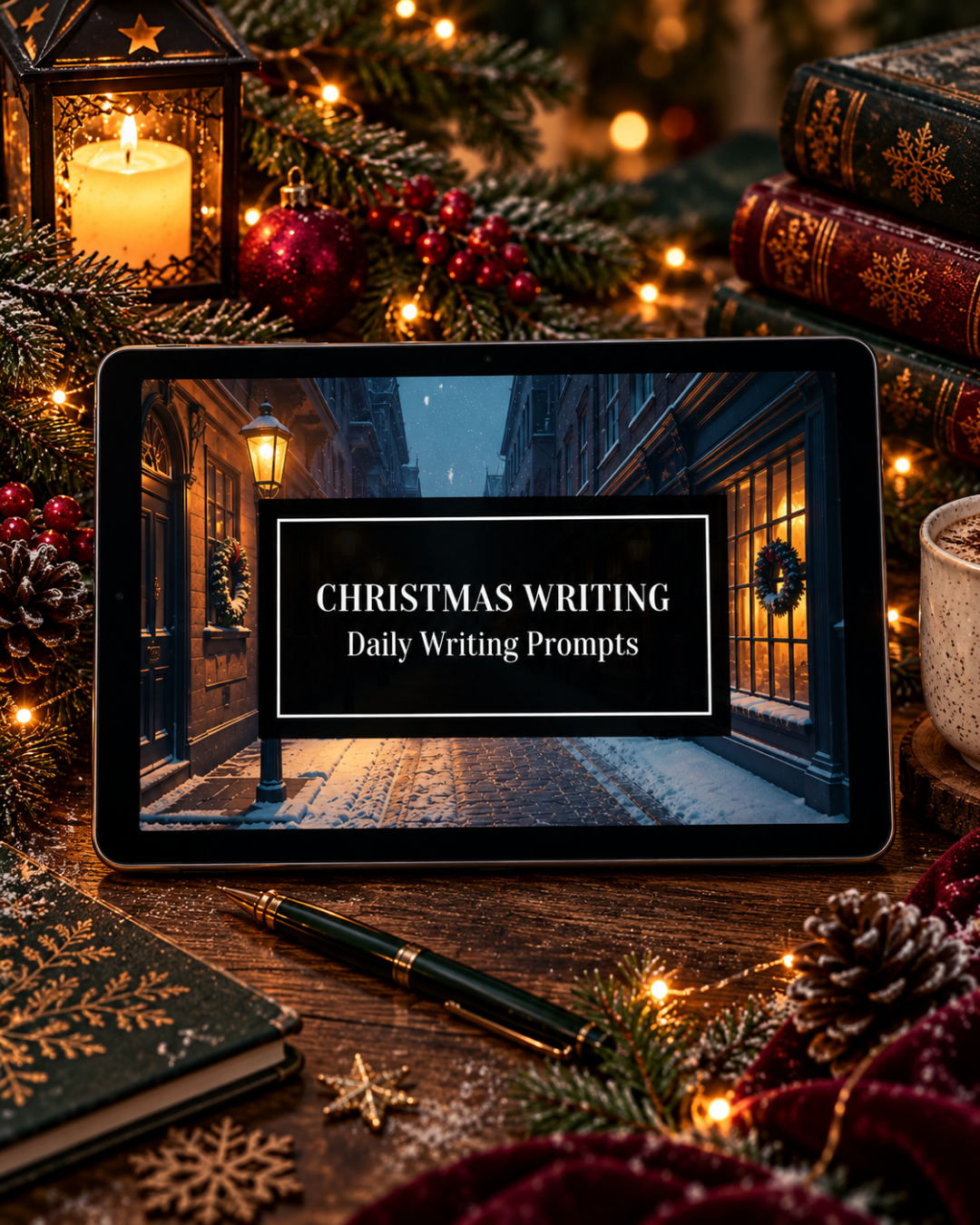
5 festive stories. 5 imaginative writing challenges. Endless Christmas storytelling possibilities.
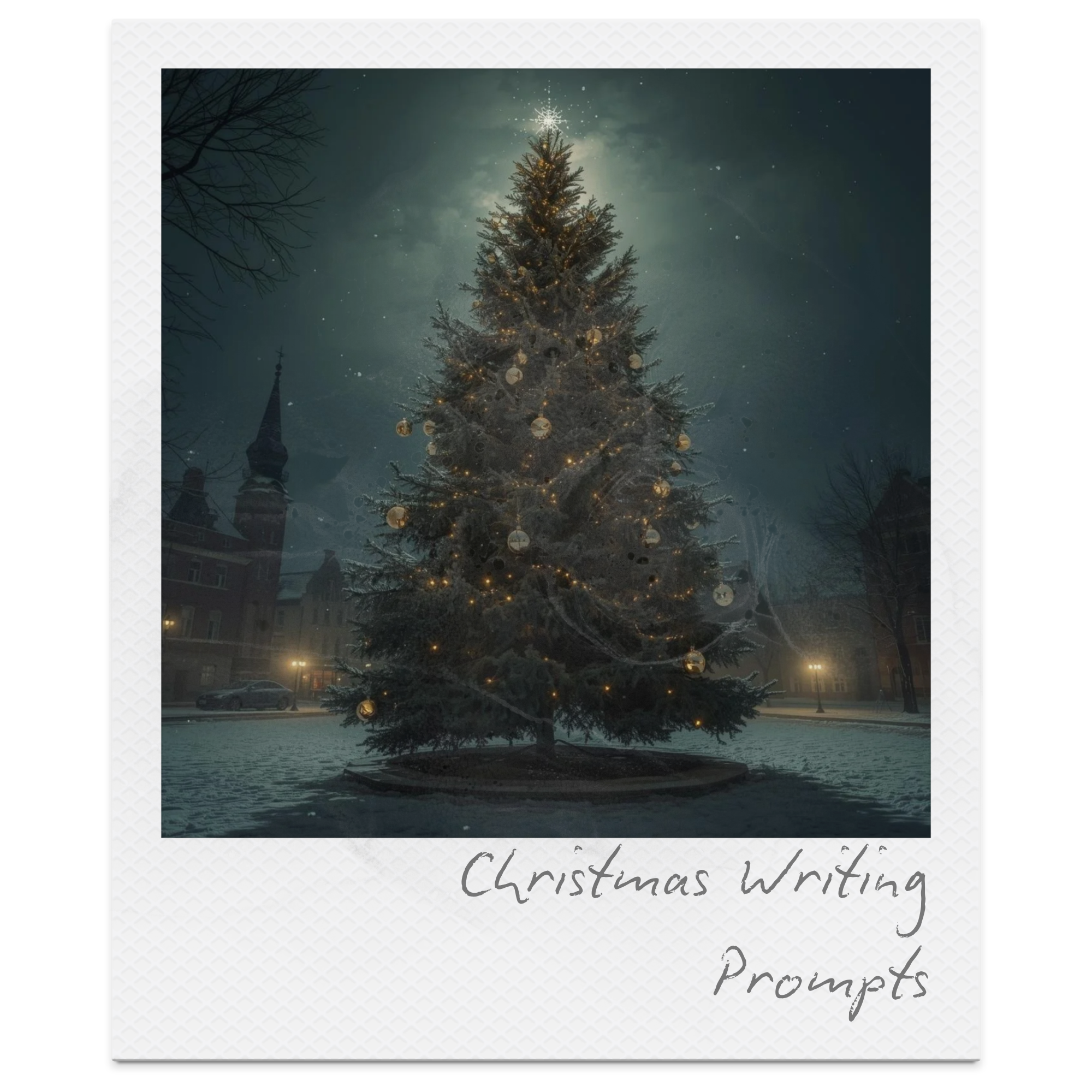
Bring a little mystery, magic and imagination into your Christmas writing activities with this beautifully illustrated collection of 5 Christmas Daily Writing Prompts, designed to spark creativity, develop storytelling skills and build confidence in creative writing.
From a mysterious disappearance during a Christmas parade and a lonely reindeer searching for home to wishes that change reality, silent cathedral bells and a snow-covered town hiding an impossible secret, each prompt invites writers to explore a different festive scenario and create a story of their own.
With 35 pages of illustrated prompts, structured writing guidance, editing tips and thought-provoking discussion questions, this seasonal resource is ideal for Christmas English lessons, festive classroom activities, creative writing workshops, end-of-term projects and independent writing practice.
Combining heartwarming Christmas adventures with atmospheric mysteries and imaginative twists, these activities encourage students to explore different genres, experiment with storytelling techniques and discover unexpected possibilities within familiar festive settings.
What's Inside?
Each of the 5 Christmas writing prompts includes a range of creative starting points and structured activities to support writers at different stages of their storytelling journey.
Atmospheric Christmas Illustrations: Beautifully illustrated festive scenes designed to inspire imaginative storytelling, descriptive writing, visual interpretation and creative discussion.
Opening Lines: Carefully crafted Christmas story starters that help students overcome the challenge of beginning a story and establish an engaging narrative.
Closing Lines: Evocative final sentences that encourage students to experiment with narrative structure, foreshadowing and meaningful story endings.
Plot Ideas: Original Christmas-inspired scenarios featuring mystery, magic, adventure and unexpected conflicts, providing inspiration while leaving plenty of room for individual creativity.
Picture-Based Writing Activities: Guided questions encouraging close observation, sensory description, inference, atmosphere and imaginative thinking.
Writing Tips and Discussion Questions: Structured guidance to help students explore narrative possibilities, develop characters, consider different perspectives and make deliberate creative choices.
Plot Development Activities: Additional guidance for expanding initial story ideas into more developed narratives, exploring character motivation, conflict, tension and resolution.
Editing Guidance: Practical editing checklists encouraging students to review sentence variety, word choice, clarity, consistency and narrative tone.
Each prompt can be approached as a complete guided writing activity or used as a flexible collection of individual creative exercises.
Five Christmas Writing Adventures
This collection features five original Christmas-inspired storytelling challenges, each exploring different themes, moods and narrative possibilities.
1. Frostbite
During a Christmas parade, a teenage girl disappears into the falling snow. The frost where she vanished refuses to melt, and her best friend begins to suspect that someone in the crowd knows what happened.
An atmospheric festive mystery exploring disappearance, friendship, suspense and hidden secrets.
2. The Reindeer That Never Came Home
Left behind on Christmas Eve, a young reindeer sets out beneath the northern lights, hoping to find the others before morning.
A magical Christmas adventure exploring courage, belonging, friendship and the meaning of home.
3. Wish List
People begin receiving mysterious Christmas emails granting their deepest wishes. But every fulfilled wish changes reality in unexpected and irreversible ways.
An imaginative speculative fiction challenge exploring temptation, consequences, desire and the dangers of getting exactly what you wish for.
4. Silent as the Stars
As a town gathers for midnight mass on Christmas Eve, the cathedral bells fall silent and the stars begin to disappear. Something ancient has awakened.
An atmospheric supernatural mystery exploring silence, symbolism, belief and the tension between wonder and fear.
5. The Snow Globe
On Christmas morning, a town awakens beneath endless snowfall. Nobody can leave, communication with the outside world has stopped, and the sky itself seems to have vanished.
A surreal Christmas mystery exploring isolation, uncertainty, false perfection and the unsettling possibilities hidden within an ordinary festive scene.
Together, these five activities encourage writers to explore contrasting storytelling styles, from magical adventures and emotional journeys to suspense, supernatural fiction and imaginative mysteries.
Scaffolding Creative Writing in the Classroom
One of the biggest challenges in teaching creative writing is supporting students who struggle to get started without restricting those who are ready to write independently.
This Christmas collection provides flexible scaffolding that teachers can adapt to different abilities, confidence levels and learning needs.
Students who need additional support can use the supplied illustrations, opening lines, closing lines, plot ideas and guided questions to develop their stories step by step.
More confident writers can use the same materials as inspiration for independent storytelling, experimenting with alternative perspectives, unexpected plot developments, atmospheric descriptions and original interpretations.
The activities can also support:
Differentiated instruction: Allow students to choose the level of guidance they need.
Visual literacy: Develop observation, interpretation and inference through detailed Christmas illustrations.
Descriptive writing: Explore winter landscapes, festive settings, sensory language, atmosphere and mood.
Narrative development: Practise character motivation, conflict, plot structure, suspense and satisfying endings.
Creative interpretation: Encourage students to develop different stories from the same image, opening line or scenario.
Speaking and listening: Use discussion questions for paired conversations, group work and whole-class exploration.
Editing and reflection: Develop confidence in reviewing and improving original writing.
Writing confidence: Provide accessible starting points for reluctant writers while challenging more experienced storytellers.
Rather than prescribing a single correct Christmas story, each prompt encourages students to discover their own creative possibilities.
Flexible Christmas Activities for Teachers and Writers
Use these Christmas writing prompts for:
Christmas-themed English and literacy lessons
Festive creative writing activities and classroom starters
End-of-term writing projects
Five-day Christmas creative writing challenges
Winter descriptive writing exercises
Short story writing and narrative development
Creative writing clubs and workshops
Classroom discussion and collaborative storytelling
Homework, extension tasks and independent learning
Homeschooling and personal festive writing challenges
Each prompt can be used as a standalone activity, expanded into a longer writing project or revisited to explore different storytelling techniques.
Teachers can use all the supplied materials for a structured lesson or select individual elements to suit their students. Independent writers can choose a prompt, set a timer and explore wherever their imagination takes them.
What You'll Receive
Your purchase includes a 35-page Christmas Daily Writing Prompts PDF, featuring all five illustrated creative writing challenges and accompanying guidance.
1. Printable PDF Version
A 35-page PDF containing:
5 illustrated Christmas writing prompts
Opening lines, closing lines and plot ideas
Picture-based writing activities
Guided opening and closing line exercises
Plot development activities
Discussion questions and writing tips
Editing guidance
Classroom instructions and a prompt index
Ideal for viewing, printing or displaying in the classroom.
2. Google Slides Access
The PDF includes a link and step-by-step instructions for accessing the editable Google Slides presentation.
You can make your own copy to personalise, present and use the activities digitally.
Please note: A Google account is required to make a copy of the Google Slides presentation.
All materials are digital resources for personal and classroom use. No physical product will be shipped. Please do not share, resell or redistribute the original files.
Five Festive Stories Waiting to Be Written
Whether you're helping reluctant writers discover their confidence, introducing imaginative Christmas activities into your classroom or looking for something a little different from traditional festive writing exercises, these prompts offer opportunities to explore mystery, magic, atmosphere and original storytelling.
From heartwarming adventures beneath the northern lights to unsettling Christmas mysteries, each activity encourages writers to look beyond the familiar and imagine something extraordinary.
Choose a picture. Explore a possibility. Begin a Christmas story.
Your next festive adventure is waiting...
Bring Your Christmas Stories to Life with Illustrated Writing Prompts
Looking for a little more inspiration to bring your Christmas stories to life? Whether you're writing a mysterious festive tale, exploring a magical winter adventure or planning creative writing activities for your classroom, the Ink & Insights Daily Writing Prompts collections offer beautifully illustrated inspiration and practical guidance to help turn imaginative ideas into complete stories.
Our Christmas Daily Writing Prompts collection includes 5 original illustrated Christmas writing activities, each offering a different festive adventure. From a mysterious disappearance during a Christmas parade to cathedral bells falling silent beneath a disappearing night sky, these prompts combine seasonal magic, atmospheric mysteries and unexpected storytelling possibilities.
Inside the 35-page digital collection, you'll discover atmospheric illustrations, opening and closing lines, original plot ideas, picture-based writing activities, discussion questions, practical writing tips and editing guidance. Each activity provides enough structure to help hesitant writers get started while leaving plenty of freedom for more confident storytellers to develop their own interpretations.
And Christmas is just one of the many possibilities.
Explore our wider Daily Writing Prompts range for genre-themed and monthly collections featuring 30 creative writing prompts, designed to provide a fresh source of inspiration throughout the year. Whether you're developing a regular writing habit, experimenting with different storytelling styles or searching for engaging classroom activities, there's always another story waiting to be discovered.
Perfect for teachers, students, creative writing groups and independent writers, these digital resources make it easier to move beyond the blank page and start creating.
Ready for your next festive writing adventure?
Explore the Christmas Daily Writing Prompts Collection now
Or browse the Daily Writing Prompts collection to discover more illustrated writing inspiration.

6. Christmas Ghost Story Setting Ideas
The setting of a Christmas ghost story should feel like a place where ordinary life and extraordinary possibility might briefly meet. Snow-covered streets, gaslit railway stations, candlelit churches and cosy Victorian parlours create a beautiful contrast between the comfort of Christmas and the mystery of the supernatural.
These settings draw upon the atmosphere of nineteenth-century fireside tales, combining festive details with forgotten histories, mysterious traditions and the possibility that someone from the past may return when the Christmas bells begin to ring.
The Christmas Parlour at Ashcombe House. A beautifully preserved Victorian parlour decorated with evergreen garlands, paper ornaments and a magnificent Christmas tree illuminated by candles. Every Christmas Eve, an additional armchair appears beside the fireplace, and the family hears the rustling of a newspaper being turned by invisible hands. The chair once belonged to a beloved grandfather who died before he could reveal an important family secret. This year, a handwritten note appears upon the empty seat, requesting that the family gather together before midnight.
The Snowbound Coaching Inn. An old coaching inn stands beside a deserted country road, its windows glowing warmly through the falling snow. Travellers shelter beside the fire, sharing ghost stories while an elderly innkeeper serves mulled wine and Christmas pudding. At midnight, a coach arrives carrying passengers dressed in fashions from fifty years earlier, each searching for someone who never completed their journey. The innkeeper recognises one of the travellers and quietly sets another place at the table.
The Forgotten Christmas Railway Station. A tiny Victorian railway station lies abandoned beneath deep snow, its platform clock permanently stopped at eleven minutes to midnight. On Christmas Eve, lamps illuminate the deserted platform, a ticket collector appears in the doorway, and the distant whistle of a steam engine echoes across the fields. The train that arrives carries passengers travelling towards Christmases they never lived to see. Among them is a young woman holding a parcel addressed to a house that no longer exists.
Saint Agnes's Candlelit Chapel. A small stone chapel stands at the edge of a Victorian village, its stained-glass windows depicting scenes from the Nativity. Although the building has been closed for decades, hundreds of candles appear inside on Christmas Eve, illuminating pews filled with indistinct figures. Their voices rise in a carol forgotten by the living, while one empty pew waits for a visitor who has not yet arrived. Local legend claims that the congregation will continue gathering until an injustice committed during the chapel's final Christmas service has been put right.
The Toyshop on Bellweather Lane. A narrow Victorian toyshop occupies the corner of a cobbled street, its windows filled with wooden horses, porcelain dolls, miniature theatres and clockwork soldiers. The shop has supposedly been empty since its owner died, yet every Christmas morning the displays have changed. Children who peer through the glass sometimes recognise toys they once wished for but never received. One winter, a small girl notices a miniature version of her own home in the window, complete with a figure standing beside an upstairs bedroom that has been locked for years.
The Christmas Orphanage at Willowbrook. A red-brick Victorian orphanage stands behind iron gates, its dormitory windows overlooking a snow-covered garden. Each Christmas Eve, the children gather around a modest tree while an unseen visitor leaves small parcels beneath its branches. The oldest residents speak of a kindly woman whose portrait hangs in the entrance hall, although nobody can explain why the painted figure seems younger every year. When a newly appointed matron attempts to end the tradition, the children begin hearing footsteps outside their rooms and a gentle voice calling their names.
The House at the End of Candlewick Street. A narrow Georgian townhouse stands between two busy Victorian shops, its windows permanently shuttered and its front steps covered with fallen leaves. Once a year, on Christmas Eve, the shutters open to reveal a cheerful family celebration taking place inside. Passers-by who stop to watch sometimes recognise faces from their own family histories, including relatives who died before they were born. Those who enter the house are offered the chance to spend one evening with someone they have lost, but they must leave before the Christmas candles burn out.
The Winter Garden of Ravenswick Manor. A magnificent glass conservatory attached to an old country house contains orange trees, winter roses and an ornamental fountain that never freezes. Every Christmas, the family discovers fresh flowers arranged around a marble statue of a young woman who died on her wedding day. On snowy evenings, a pale figure can be seen wandering among the plants, apparently searching for a gentleman who failed to keep his promise. When the manor is sold, the new owners discover that the flowers have begun blooming in a pattern resembling words.
The Christmas Market of Old St. Bartholomew's. A bustling Victorian Christmas market fills a narrow square with stalls selling roasted chestnuts, ribbons, gingerbread, candles and handmade toys. Hidden among the familiar traders is a small stall that appears only after dusk, where an elderly merchant sells objects belonging to Christmases long past. Those who purchase something often find themselves remembering events that happened before they were born. The merchant accepts no money, asking instead for a memory that the buyer is willing to surrender.
The Little Cottage Beyond the Churchyard. A modest stone cottage stands beyond the village cemetery, surrounded by snow-covered hedges and an ancient apple tree. Every Christmas Eve, smoke rises from its chimney, candles glow in its windows and the scent of freshly baked bread drifts across the graves. Yet the cottage has been uninhabited for sixty years, and the woman who once lived there is said to have waited every Christmas for her missing son to return. One winter, a young traveller seeks shelter there and discovers that the cottage's mysterious occupant has been expecting him.
7. Christmas Ghost Story Picture Prompts
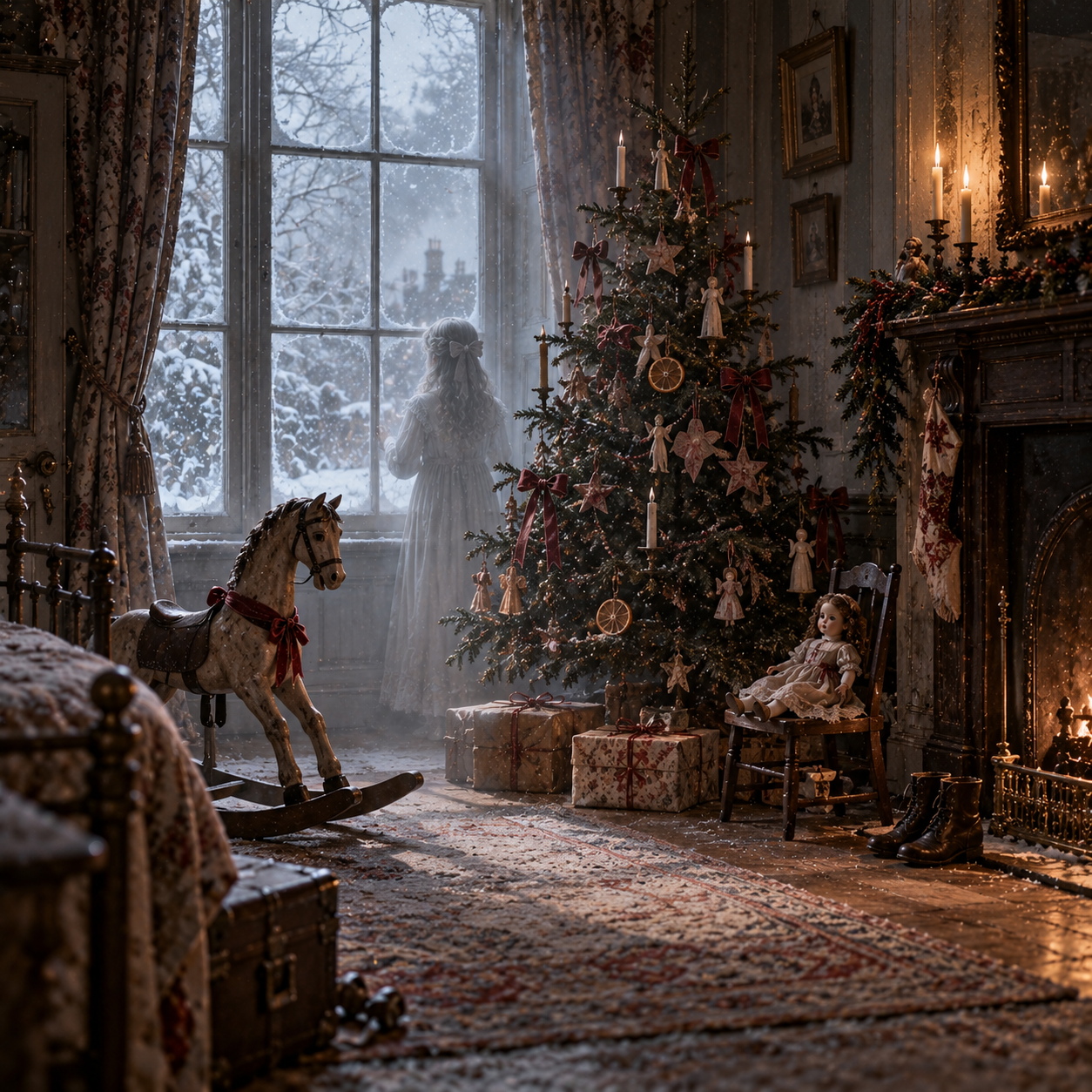
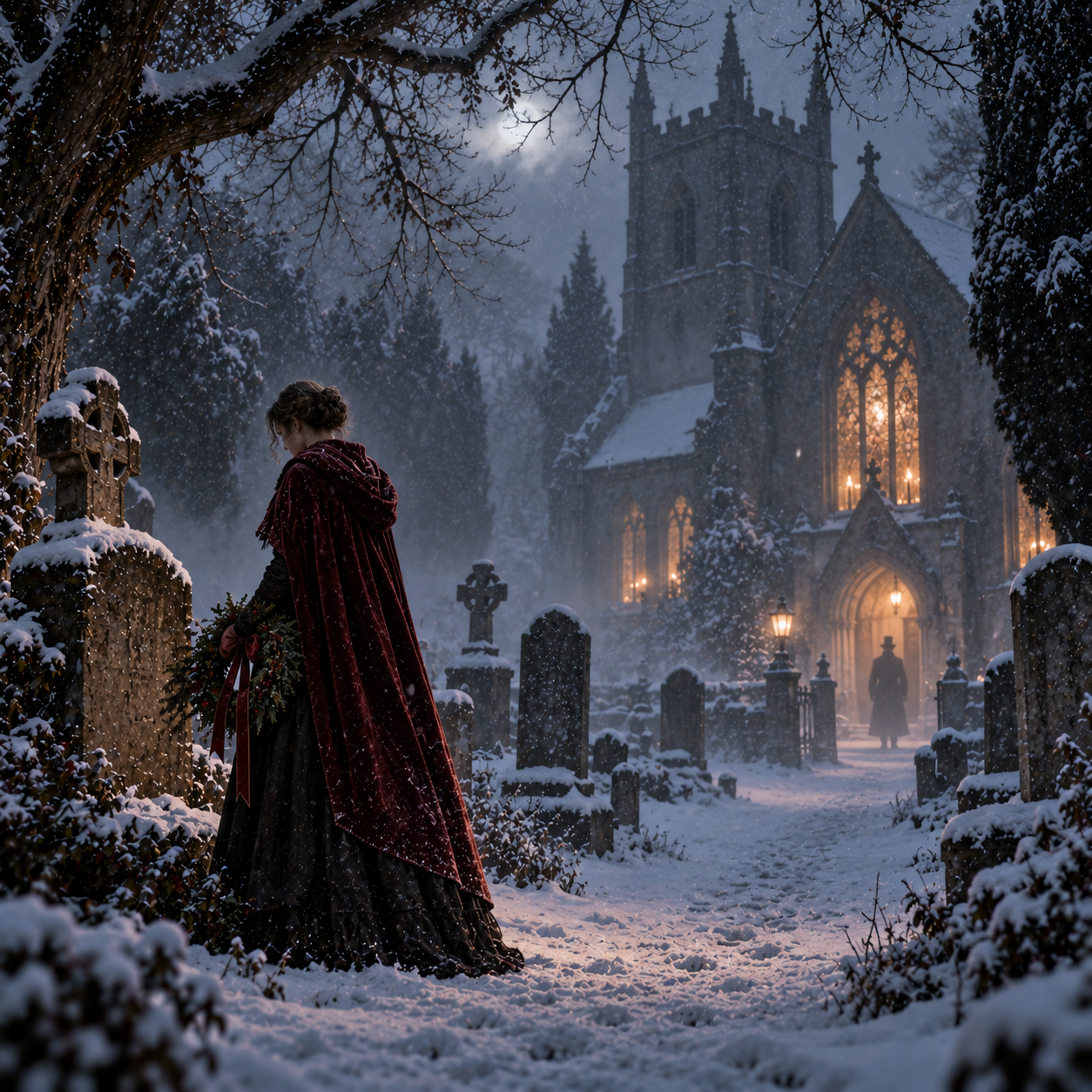
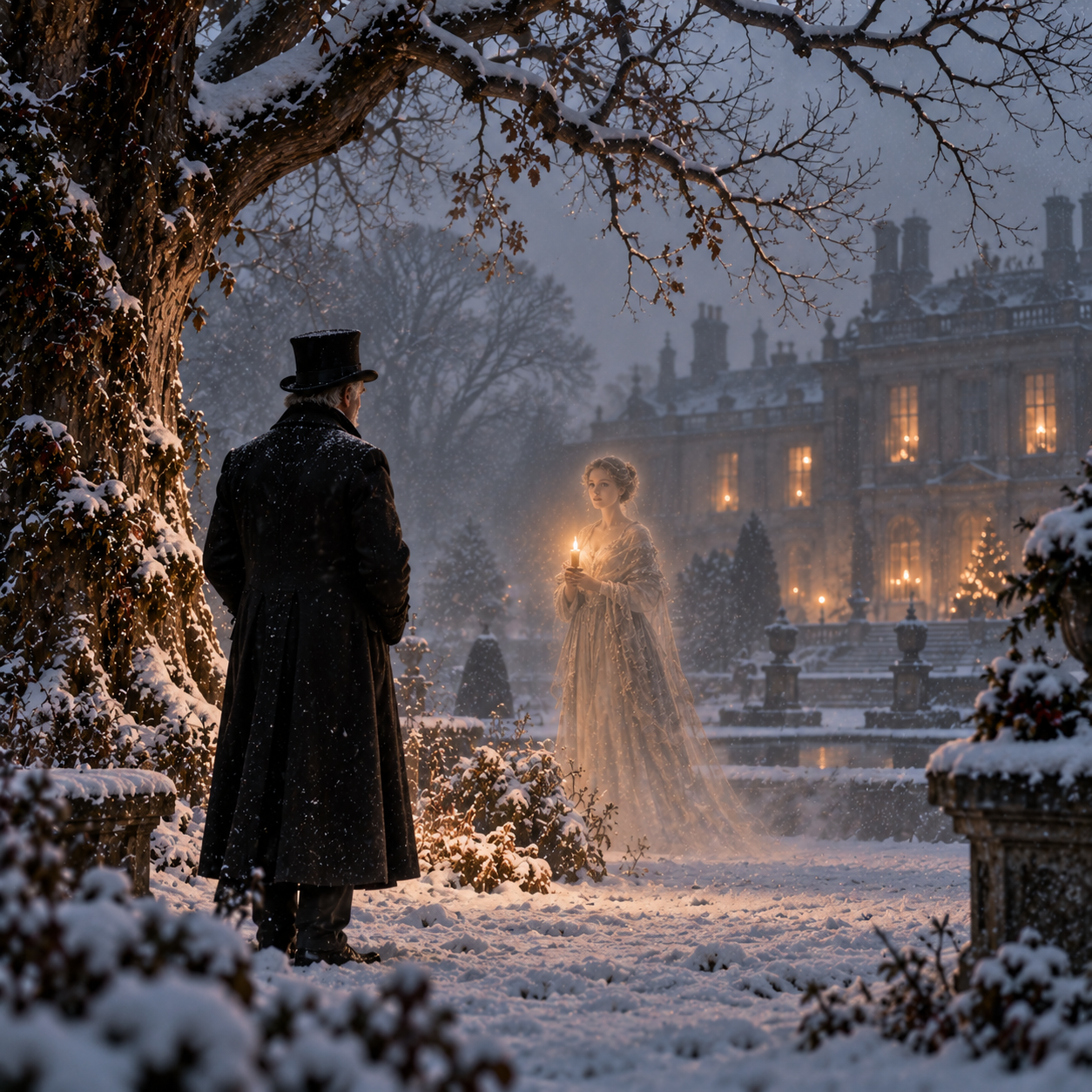
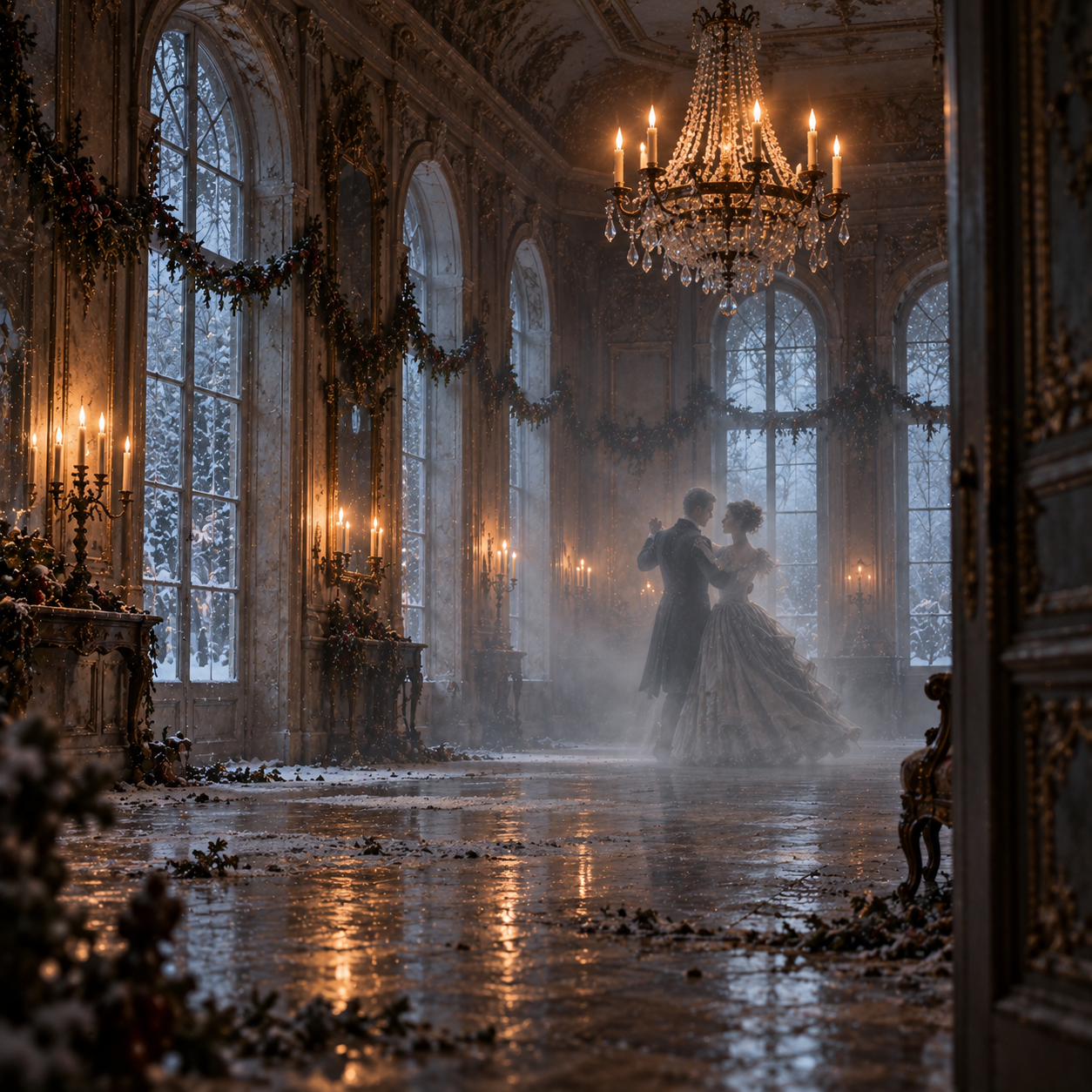
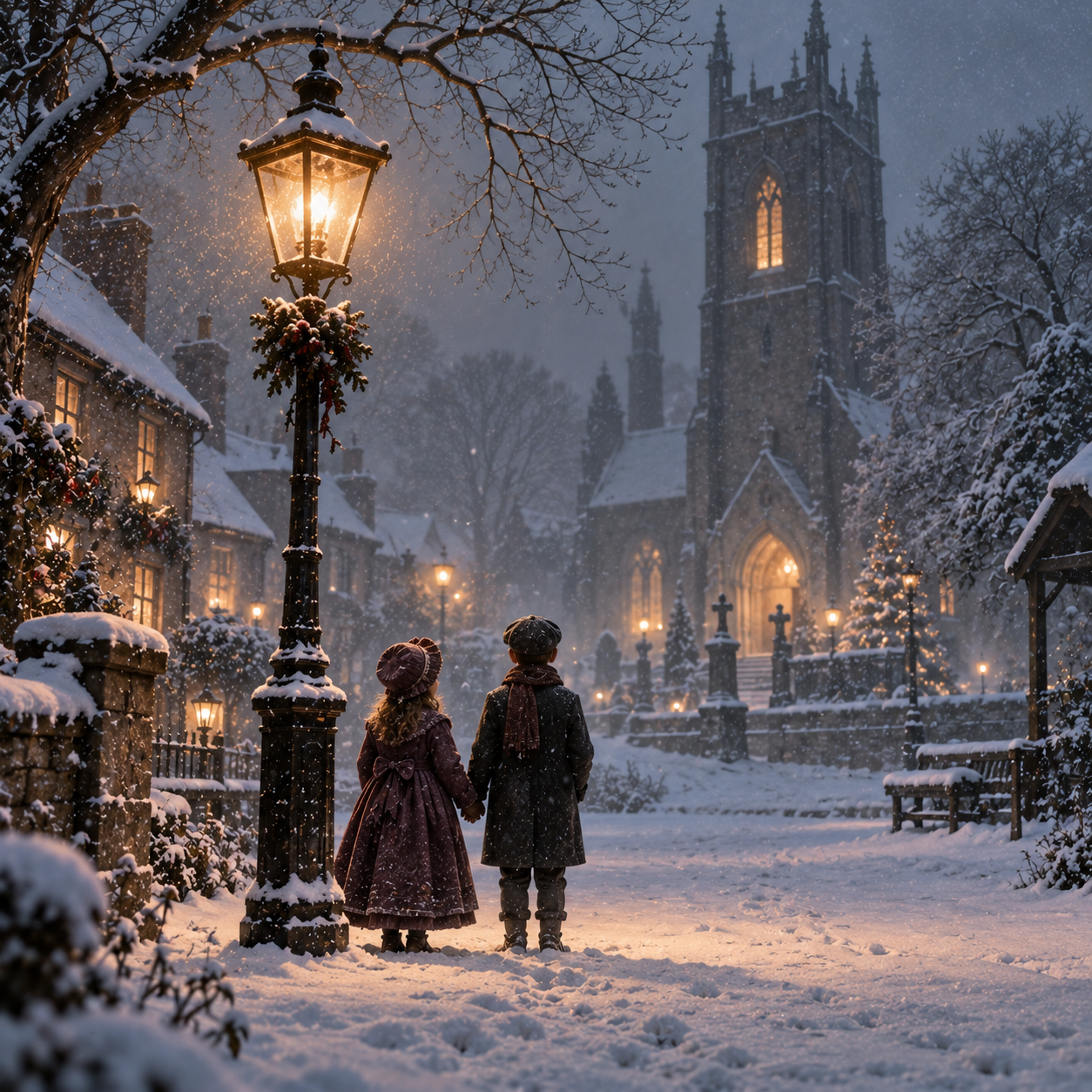
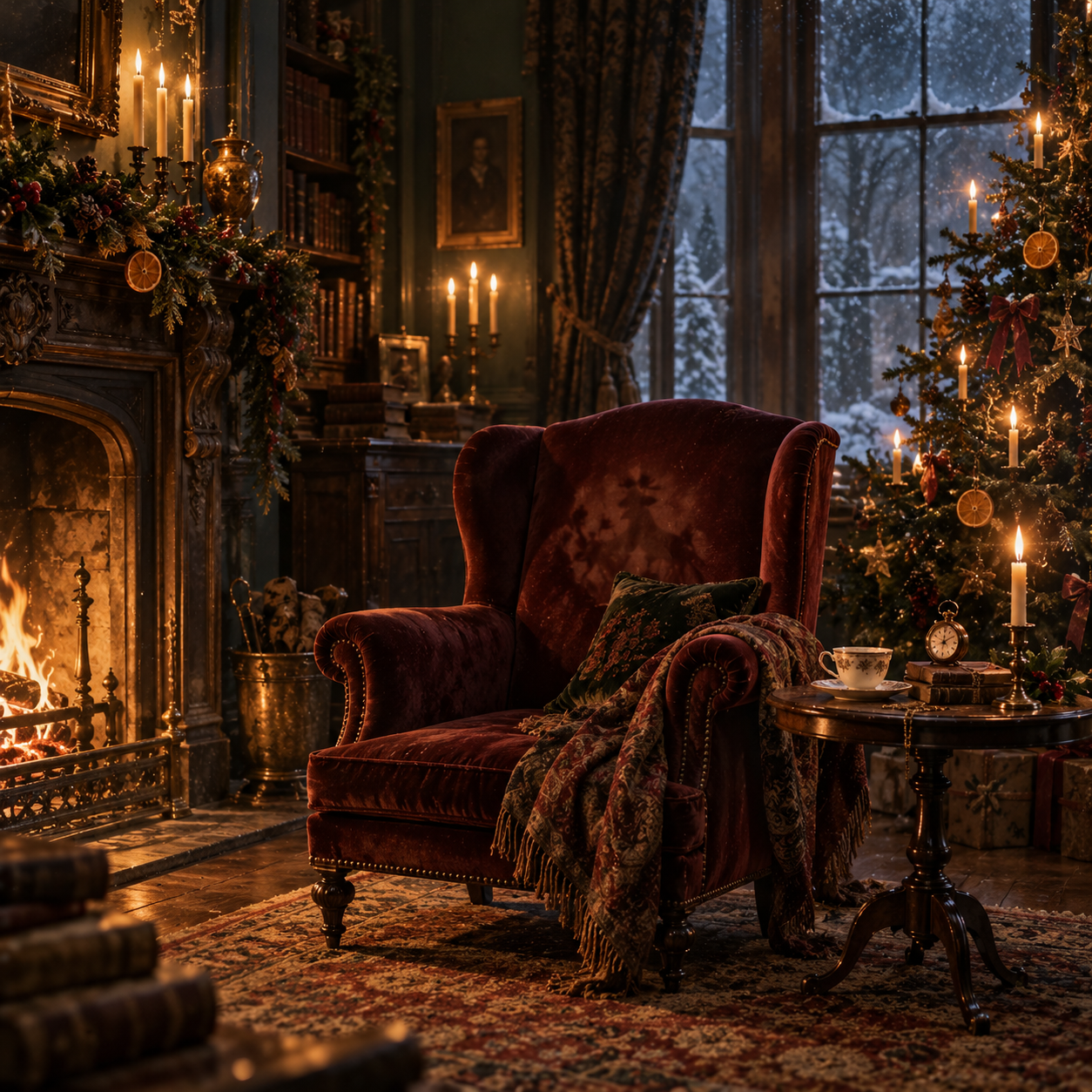
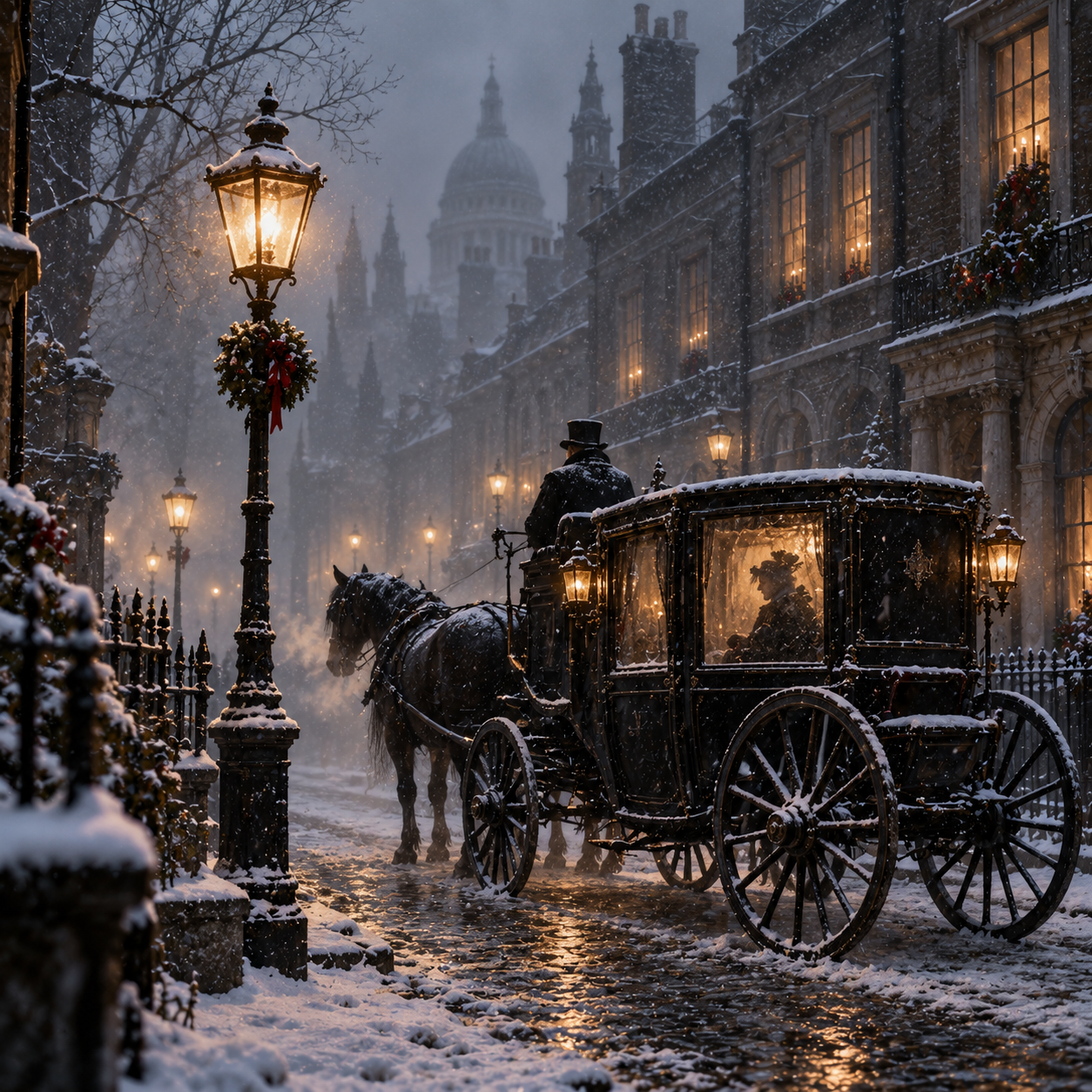
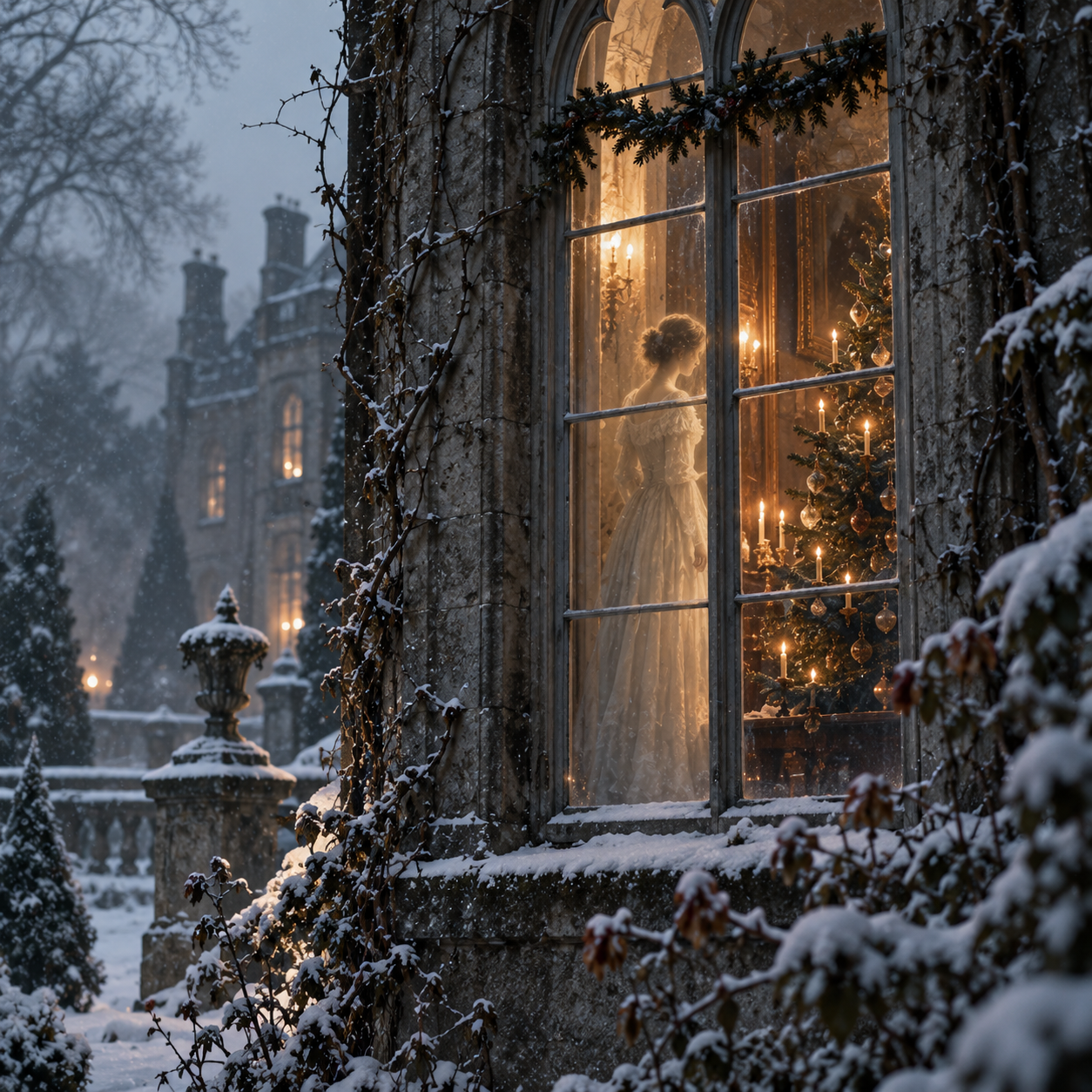
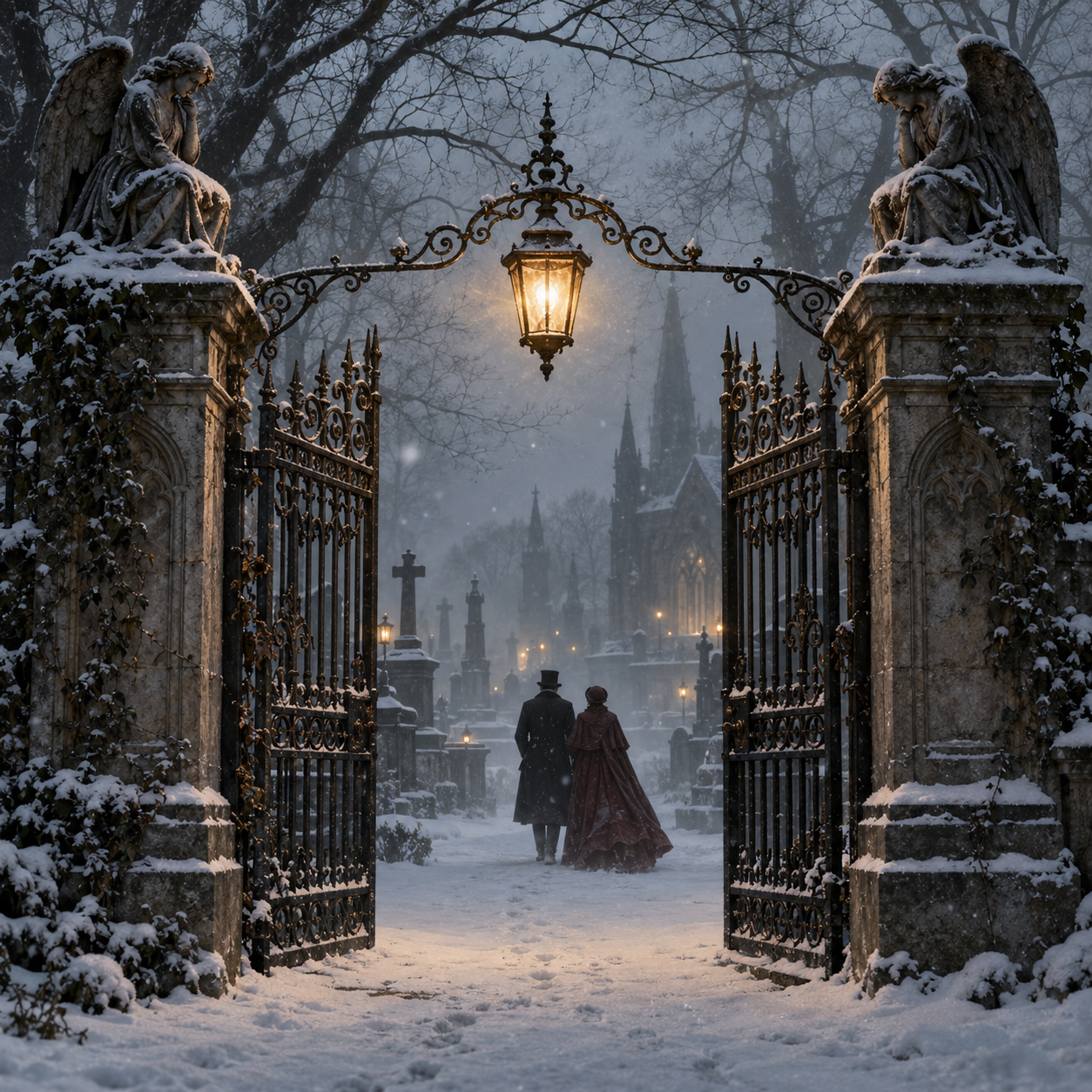
Sometimes a single image can suggest an entire Christmas ghost story. A shadowy figure beneath a Victorian streetlamp, a mysterious visitor standing in a snow-covered doorway or an empty chair beside a glowing fireplace might raise questions that words alone would never have inspired.
Use the ten Christmas ghost story images below as visual writing prompts. Study the atmosphere, expressions, lighting and small details before imagining what has happened — or what might be about to happen. Who belongs in the scene? Who is missing? What secret does the setting hold, and why has this particular moment been captured?
You might begin by describing the scene as though you were a Victorian narrator recalling an extraordinary Christmas many years earlier. Alternatively, choose a character within the image and imagine the events that brought them there. Perhaps they are waiting for a visitor, carrying a message from the past or discovering that the familiar world has changed in some impossible way.
Let the image inspire a story that balances supernatural mystery with the emotional richness of a traditional Christmas ghost tale. Not every apparition needs to be frightening, and not every haunting needs a tragic ending. Sometimes the most memorable stories are those in which the dead return to offer the living something they have been missing: an answer, a warning, a moment of forgiveness or the chance to say goodbye.

Go Deeper: How to Write a Victorian Christmas Ghost Story
The charm of a traditional Christmas ghost story lies in its ability to make the supernatural feel both extraordinary and deeply personal. A ghost might arrive with a warning, reveal a forgotten injustice or offer someone the chance to say goodbye. Yet the most memorable stories are rarely about the apparition alone. They are about the living characters who must confront what its appearance means.
If you want to turn one of these prompts into a complete story, the following techniques will help you capture the atmosphere, mystery and emotional depth of a Dickensian Christmas haunting.
Give Your Ghost a Reason to Return
Before deciding how your ghost appears, consider why it has returned at Christmas. Perhaps a promise was broken, an act of kindness went unacknowledged or someone died believing they had been forgotten. Christmas offers a powerful opportunity to revisit these unresolved emotions because it is a season so closely associated with family, generosity and remembrance.
A spirit seeking forgiveness will create a very different story from one attempting to prevent a tragedy. Explore the possibilities in Ghost Stories, or use Ghost Story Sparks to experiment with apparitions, messages from the dead, unfinished business and unusual supernatural encounters.
Try writing a single sentence explaining what your ghost wants. Then ask what prevents it from finding peace.
Capture the Voice of a Victorian Fireside Tale
Many classic ghost stories feel like accounts passed between friends on a winter evening. A narrator might recall a peculiar Christmas from childhood, describe an incident witnessed by a distant relative or reluctantly confess something they have never dared explain.
Experiment with a storyteller who addresses the reader directly, admits uncertainty or insists upon the truth of an improbable event. You might begin with a family anecdote before gradually revealing why it has remained unforgettable.
For period inspiration, explore Victorian Opening Lines and Victorian Era writing prompts. These can help you develop the language, social customs and everyday details that make a nineteenth-century setting convincing without overwhelming the story with historical exposition.
Make Christmas Essential to the Haunting
A Christmas ghost story should be more than an ordinary haunting decorated with holly. The festive season itself ought to influence the mystery.
Perhaps a family gathers only once a year, allowing a long-buried secret to emerge. A Christmas gift might reach its intended recipient decades too late. A familiar carol could awaken a memory, while an empty chair at the dinner table becomes a symbol of someone whose absence has never been accepted.
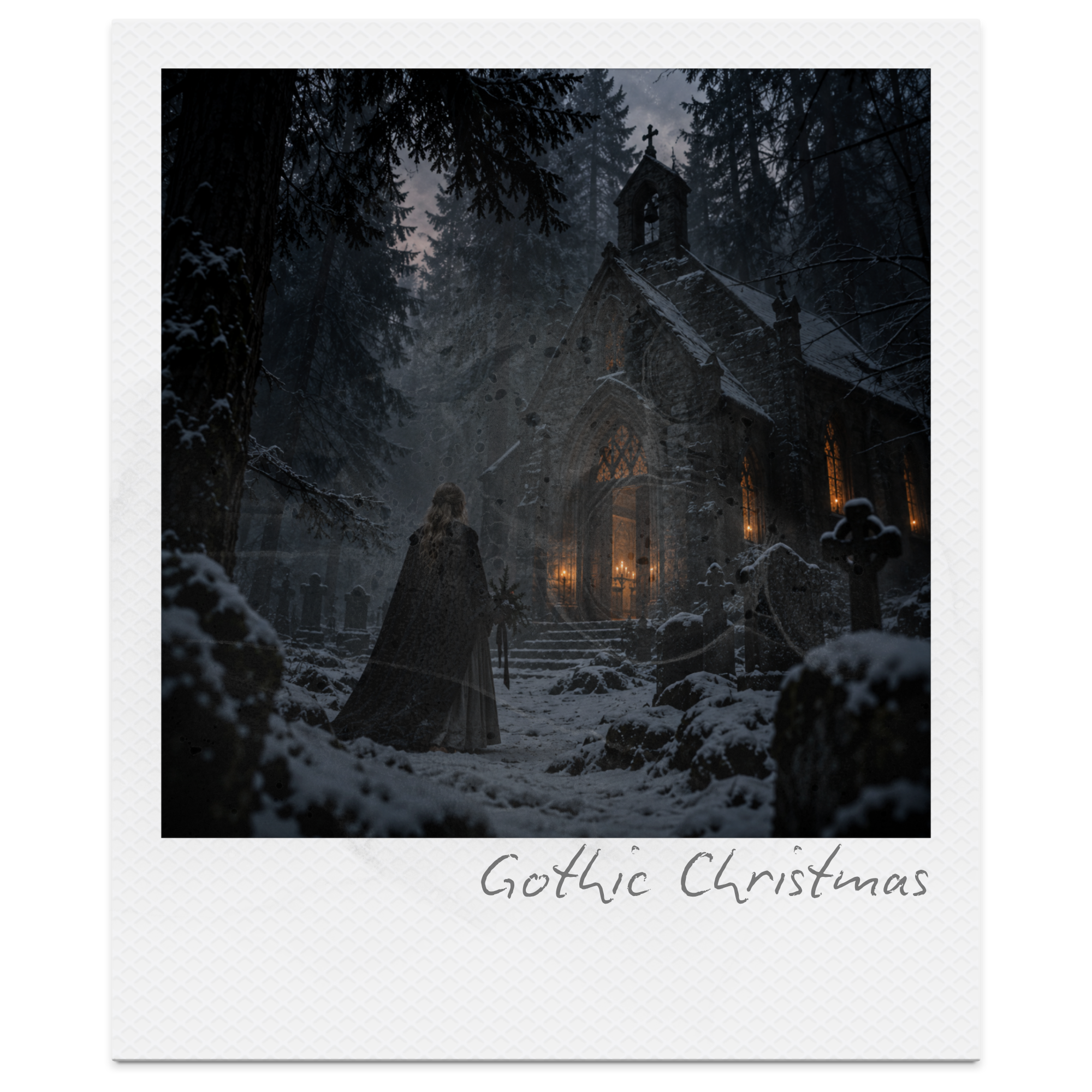
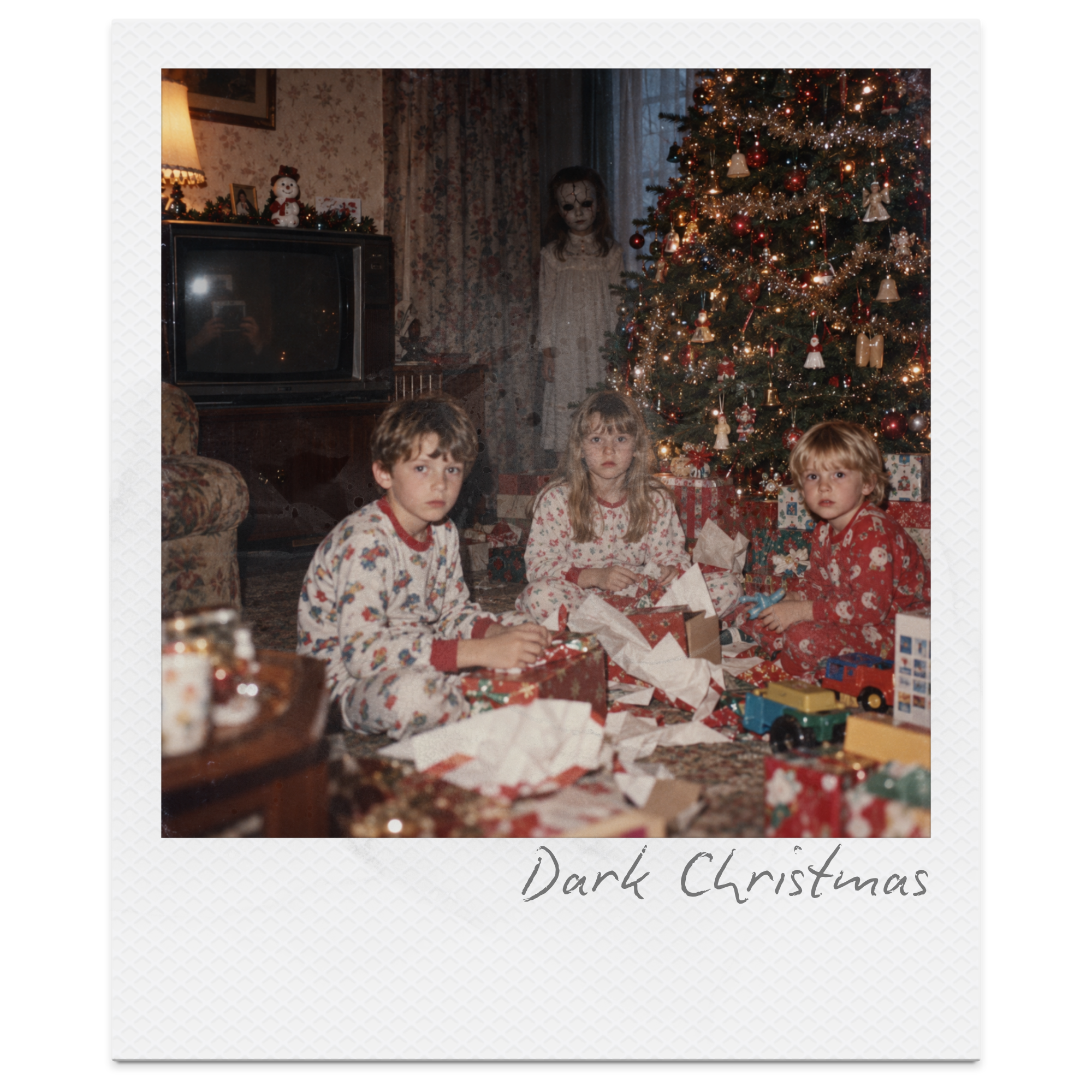
Consider how traditions, celebrations and expectations might intensify your characters' emotions. If you want to explore a more sinister interpretation of festive customs, Gothic Christmas and Dark Christmas offer contrasting approaches to supernatural seasonal storytelling.
Build Atmosphere Through Warmth and Winter
One of the pleasures of a Victorian Christmas ghost story is the contrast between the welcoming interior and the mysterious world beyond its windows.
Imagine a cheerful parlour filled with candlelight, roasting chestnuts and conversation, while snow settles upon the deserted street outside. A familiar face appearing beyond the frosted glass becomes more extraordinary because the room itself feels so safe.
Use sensory details selectively: the ticking of a mantel clock, the scent of evergreen branches, the distant sound of church bells or the cold air that enters when an unexpected visitor opens the door.
Explore Ghost Story Settings for supernatural locations, Gothic Winter for atmospheric seasonal landscapes and Victorian Gothic for period settings shaped by hidden histories and unsettling encounters.
Let the Haunting Reveal Something Human
The supernatural mystery should change the living characters in some meaningful way. A miser might discover the consequences of an old decision. A grieving mother might learn that her child was never truly alone. Two estranged relatives might finally understand the misunderstanding that divided them.
Rather than relying upon a frightening revelation, consider giving your protagonist a difficult emotional choice. Must they confess an old wrongdoing, surrender something precious or forgive someone they believed had betrayed them?
For additional character inspiration, explore Victorian Character Prompts, or use Gothic Character Prompts to develop more troubled figures shaped by grief, secrets and unresolved relationships.
End with Wonder, Melancholy or Redemption
A traditional Christmas ghost story does not need to explain every supernatural detail. Sometimes the most satisfying ending leaves behind a small, impossible piece of evidence: a photograph that has changed, a gift beneath the tree or a familiar signature on a letter.
What matters is that the encounter has achieved something. The ghost may find peace, the living may discover forgiveness, or a long-forgotten act of kindness may finally be remembered.
If you want to experiment with a mystery that remains unresolved, Paranormal Mystery offers inspiration for balancing investigation with supernatural uncertainty. Alternatively, browse Ghost Story Titles for atmospheric ideas that might suggest a different direction for your ending.
A Christmas Ghost Story Writing Challenge
Write a 500-word Christmas ghost story set in Victorian Britain using the following ingredients:
A Christmas gathering interrupted by an unexpected visitor.
An ordinary festive object connected to someone who has died.
A secret or regret that has remained unresolved for many years.
A supernatural encounter that changes how a living character understands the past.
A final sentence that leaves the reader with warmth, sadness or wonder.
Begin with a familiar, comforting Christmas scene. Introduce one detail that seems slightly out of place, then allow the mystery to unfold gradually. Resist the temptation to explain everything immediately, and remember that the most powerful revelation may be an emotional one rather than a frightening twist.
Above all, give your ghost a reason to come home for Christmas.
Final Thoughts
There is something wonderfully timeless about a Christmas ghost story. Perhaps it is the contrast between the warmth of a glowing fireplace and the cold, silent world beyond the window, or the peculiar magic of a season when memories seem closer, old traditions take on new meaning, and the people we have lost feel especially near.
From mysterious visitors arriving through the snow to forgotten promises, spectral carol singers and long-awaited reunions, these 70 Christmas Ghost Story Writing Prompts offer countless possibilities for stories filled with atmosphere, mystery and emotion. Whether you choose to write a traditional Victorian fireside tale, a melancholy supernatural mystery or a heartwarming encounter with a spirit from the past, remember that the most memorable hauntings often reveal as much about the living as they do about the dead.
For more supernatural inspiration, explore the Paranormal Writing Hub for ghosts, hauntings and unexplained encounters, or visit the Gothic Writing Hub for atmospheric mysteries, Victorian settings and haunting family secrets. If you prefer darker storytelling, the Horror Writing Hub offers plenty of unsettling possibilities.
For a more spontaneous approach, try Ghost Story Sparks to generate restless spirits, haunted places and unfinished business, or explore Gothic Story Sparks for mysterious characters, eerie settings and unexpected plot twists.
So light a candle, imagine the snow settling upon a quiet Victorian street, and listen for the distant sound of Christmas bells. Somewhere, an old promise remains unfulfilled, a letter is waiting to be opened, or a familiar figure is making one final journey home.
Because sometimes, the most extraordinary Christmas visitors are those we thought we would never see again.
Choose Your Next Adventure