A Sound of Thunder by Ray Bradbury: Summary, Themes, Meaning & Analysis
A Sound of Thunder by Ray Bradbury is a science fiction short story about time travel, the butterfly effect and the devastating consequences of seemingly insignificant actions. When a wealthy hunter named Eckels travels millions of years into the past to hunt a Tyrannosaurus Rex, one careless step threatens to change the course of history forever.
In this summary and analysis of A Sound of Thunder, we'll explore the story's plot, characters, themes, symbolism, literary techniques, key quotations and shocking ending. From Eckels' terrifying encounter with the dinosaur to the discovery of a crushed butterfly, Bradbury examines the relationship between cause and effect, human arrogance, environmental responsibility and the limits of technological control.
At its core, A Sound of Thunder is more than a cautionary tale about time travel. It explores how small decisions can produce irreversible consequences, questioning humanity's belief that technology gives us the power to control nature, history and the future. Through the story's unsettling conclusion, Bradbury reminds readers that even the smallest actions can reshape entire systems in ways we cannot predict.
For more explorations of Bradbury's speculative fiction, visit the Ray Bradbury Hub, or browse the Literature Library for further literary analysis, short story guides and teaching resources.

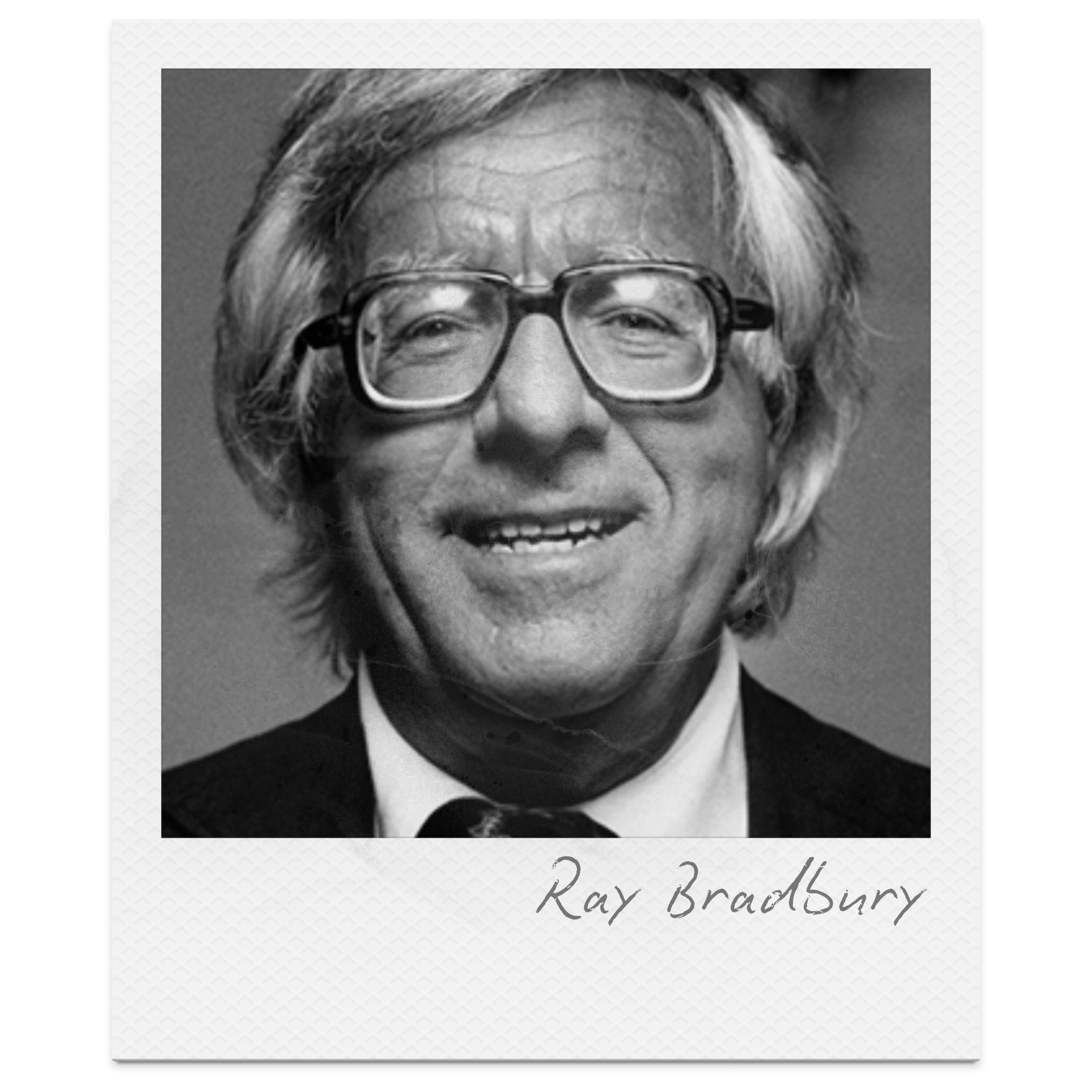
Context of A Sound of Thunder
Ray Bradbury wrote A Sound of Thunder during the mid-twentieth century, a period shaped by rapid technological advancement, the aftermath of World War II, and growing anxieties about scientific power. As a leading voice in science fiction and speculative fiction, Bradbury was less interested in technology itself and more concerned with its moral and philosophical implications. The story reflects Cold War-era fears about unintended consequences, where a single decision—political, scientific, or military—could trigger irreversible global change. This concern aligns closely with Bradbury’s broader body of work, which often critiques human arrogance and overreliance on progress without ethical consideration. For a deeper understanding of these ideas across his writing, see the Ray Bradbury Context Post.
This context directly shapes the story’s central idea: that small actions can produce vast, uncontrollable consequences over time. The concept later popularised as the “butterfly effect” reflects a growing awareness of interconnected systems, whether ecological, political, or social. In Bradbury’s world, time is not stable or forgiving but fragile and reactive, meaning that even a seemingly insignificant act—like stepping off a path—can alter the course of history. The story, therefore, functions not just as a thrilling narrative but as a warning about responsibility, causality, and the limits of human control.
A Sound of Thunder: At a Glance
Form: Short story (science fiction)
Mood: Tense, foreboding, unsettling
Central tension: Human desire for control and thrill versus the fragile, unpredictable consequences of interfering with time
Core themes: Cause and effect, the butterfly effect, human arrogance, responsibility, technology and control, fear and survival
One-sentence meaning: A single careless action can trigger irreversible consequences, revealing how fragile and interconnected reality truly is.
Quick Summary of A Sound of Thunder
In A Sound of Thunder by Ray Bradbury, Eckels, a wealthy hunter, pays to travel back in time with Time Safari Inc. to hunt a dinosaur. Guided by Travis and his team, he is warned to stay strictly on the Path to avoid altering the past. The group travels millions of years back and prepares to shoot a Tyrannosaurus Rex, carefully selected because it is about to die naturally.
When the dinosaur appears, Eckels is overwhelmed with fear and panics, stepping off the Path and running into the jungle. Although the others manage to kill the dinosaur, Travis is furious, realising that Eckels may have disturbed the past. As punishment, Eckels is forced to retrieve the bullets from the dead creature before they return to the future.
Back in their own time, subtle but disturbing changes emerge: the language on the sign has shifted, the atmosphere feels wrong, and a different presidential candidate has won the election. Eckels discovers a crushed butterfly on his boot, realising that this tiny action has altered history. As Travis raises his rifle, the story ends with a final “sound of thunder”, strongly suggesting that Travis shoots Eckels.
Title of A Sound of Thunder
Bradbury’s titles often do far more than simply label a story; they establish tone, suggest conflict, and hint at deeper symbolic meaning. In A Sound of Thunder, the title initially appears to refer to the literal roar of the Tyrannosaurus Rex, evoking power, danger, and an overwhelming natural force that dominates the narrative.
At first, readers expect the “thunder” to be the physical presence of the dinosaur, whose approach shakes the ground and fills the jungle with terror. The phrase captures the scale and intensity of the hunt, reinforcing the idea that humans are confronting something far beyond their control. However, as the story progresses, the meaning of the title begins to shift.
By the end, the “sound of thunder” becomes deeply symbolic and ambiguous. It can be interpreted as the ripple effect of a single action—the crushing of the butterfly—echoing across time like a distant but unstoppable storm. What begins as a literal sound transforms into a metaphor for consequences, causality, and irreversible change.
There is also a layer of irony in the title. The hunters come seeking the thrill of the dinosaur’s thunderous power, yet the most devastating impact comes not from the dinosaur itself, but from something small, silent, and seemingly insignificant. The true “thunder” is not the creature, but the chain reaction set in motion by human carelessness.
The title carries strong thematic resonance, encapsulating the story’s central warning: that even the smallest disturbance can unleash consequences as powerful and far-reaching as thunder across time.
It should also be noted that the title takes on a more literal and disturbing meaning in the story's final moments. After Eckels discovers the crushed butterfly and realises that his actions have changed history, Travis raises his rifle. The final “sound of thunder” strongly suggests a gunshot, implying that Travis kills Eckels. Bradbury deliberately leaves the action unstated, allowing the title to connect the dinosaur's immense power with the violence and irreversible consequences of human actions.
Structure of A Sound of Thunder
Bradbury carefully shapes the structure of A Sound of Thunder to build tension, control revelation, and emphasise the story’s central idea of cause and effect. The narrative moves from anticipation to chaos to unsettling aftermath, mirroring the ripple effect of Eckels’ single mistake.
Opening (Exposition)
The story begins in the futuristic setting of Time Safari Inc., immediately establishing the concept of time travel and its commercialisation. The rules are made clear early—stay on the Path, follow instructions, and avoid altering the past. This section creates a sense of controlled danger, where everything appears regulated and manageable, despite underlying unease.
Rising Action
Tension builds as the group travels back in time and enters the prehistoric jungle. Bradbury slows the pacing here, using detailed description and sensory imagery to heighten suspense. The explanation of the butterfly effect becomes crucial, foreshadowing the consequences of even the smallest mistake. Eckels’ growing fear and instability signal that something will go wrong.
Turning Point / Climax
The climax occurs when the Tyrannosaurus Rex appears, described with overwhelming scale and power. Instead of rising to the challenge, Eckels panics and steps off the Path, triggering the story’s central disruption. This moment is abrupt and chaotic, reflecting how quickly control is lost and how fragile the system truly is.
Falling Action
After the dinosaur is killed, the immediate danger subsides, but tension shifts into something more unsettling. Travis realises the potential consequences of Eckels’ actions and forces him to retrieve the bullets. This section slows again, creating a sense of dread as the focus moves from physical danger to unseen, long-term consequences.
Ending (Resolution)
The story’s resolution is deliberately abrupt and disturbing. Upon returning to the present, subtle changes—such as altered language and a different political outcome—reveal that history has been altered. The discovery of the crushed butterfly confirms the cause. The final line, “a sound of thunder,” closes the story with ambiguity and finality, suggesting both the echo of the past and the irreversible consequences of human action.
Overall, the structure reflects the story’s core message: a seemingly small moment can trigger a chain reaction that reshapes everything.
Setting of A Sound of Thunder
In A Sound of Thunder, setting is not merely a backdrop but a powerful symbolic landscape that shapes tone, meaning, and conflict. Bradbury contrasts the controlled, technological world of the future with the chaotic, primal world of the past, highlighting the tension between human control and natural power.
The story begins in the sterile, futuristic environment of Time Safari Inc., where time travel is commercialised and treated as a controlled experience. The presence of “a mass and tangle… of wires and steel boxes” and the machine that burns “all the years… piled high and set aflame” creates an atmosphere of artificial power. This setting suggests that humans believe they can master time itself, reducing history to something mechanical and manageable.
In stark contrast, the prehistoric jungle is vast, overwhelming, and deeply uncontrollable. Bradbury describes it as “the jungle was the entire world forever and forever,” emphasising its scale and the insignificance of the human figures within it. The sensory detail—“the smell of tar and an old salt sea, moist grasses, and flowers the color of blood”—creates an atmosphere that is both vivid and unsettling, reinforcing the idea that this world is ancient, dangerous, and indifferent to human presence.
The Path itself acts as a crucial symbolic setting, representing the illusion of control. Suspended above the ground, it allows the hunters to move through the past without touching it, suggesting a fragile boundary between interference and preservation. Travis’ warning—“Stay on the Path. Don’t go off it… For any reason!”—highlights how precarious this control is. The Path becomes a physical manifestation of the rules governing time, and stepping off it represents a breach of natural order.
Finally, the altered future at the end of the story is subtly but powerfully unsettling. The office appears familiar, yet wrong, with details like the distorted sign—“TYME SEFARI INC… SEFARIS TU ANY YEER EN THE PAST”—revealing that reality itself has shifted. This distorted setting reflects the consequences of Eckels’ actions, showing that even the most stable environments can be reshaped by a single disruption.
Across the story, Bradbury uses setting to explore the contrast between order and chaos, control and unpredictability, and ultimately to demonstrate how fragile the boundaries between them truly are.
Narrative Voice in A Sound of Thunder
Bradbury uses a third-person narrative voice that closely follows Eckels, shaping how readers interpret events through a limited and often unstable perspective. This approach allows the narrative to shift between moments of detached description and intense psychological immediacy, reinforcing both the spectacle of the setting and the fragility of human response.
The perspective remains largely third-person limited, with the narration frequently aligned to Eckels’ thoughts and reactions. His awe—“Unbelievable… A real Time Machine”—and later panic—“It can’t be killed… We were fools to come”—draw the reader into his emotional experience. This closeness creates sympathy at first, but gradually exposes his fear, weakness, and lack of control, positioning him as both participant and cautionary figure.
At the same time, Bradbury balances this limited viewpoint with moments of objective, almost cinematic description, particularly in the depiction of the dinosaur. The Tyrannosaurus Rex is described with overwhelming physical detail—“a great evil god… a ton of sculptured stone”—which distances the reader from Eckels’ subjective panic and emphasises the sheer power of the natural world. This contrast between internal fear and external reality heightens tension.
The tone of the narrative shifts from excitement and curiosity to dread and unease, mirroring the story’s progression. Early sections carry a sense of controlled wonder, but this gives way to anxiety and inevitability as the consequences of Eckels’ actions begin to unfold. By the end, the voice becomes more restrained and unsettling, allowing small details—such as the altered spelling of the sign—to carry significant weight.
Crucially, the narrative voice also positions the reader to recognise what Eckels initially does not: the importance of small actions and their consequences. Through its selective focus and tonal shifts, the narration creates a sense of dramatic irony, where readers understand the potential impact of Eckels’ behaviour even before the final revelation.
Overall, Bradbury’s narrative voice blends psychological closeness with controlled distance, shaping a reading experience that is both immersive and cautionary, and reinforcing the story’s central warning about human interference and unintended consequences.
The Purpose and Impact of A Sound of Thunder
Bradbury tells A Sound of Thunder as a warning about the dangers of human arrogance, technological overreach, and interference with complex systems beyond our understanding. The story is not simply about time travel, but about the illusion that humans can control consequences once they have set events in motion. The moral of A Sound of Thunder is that even the smallest actions can have irreversible, far-reaching consequences, and that responsibility must accompany power.
The emotional impact of the story shifts from excitement to fear to dread, mirroring Eckels’ journey. The initial thrill of the hunt gives way to panic, and finally to a quiet, unsettling realisation that something fundamental has changed. This progression creates a lingering sense of unease, as readers recognise how easily order can collapse.
Intellectually, the story challenges readers to consider cause and effect on a larger scale, particularly in relation to environmental systems, political decisions, and technological advancement. The idea that a crushed butterfly could alter the outcome of an election forces readers to confront the fragility of reality itself, where outcomes are not fixed but dependent on countless interconnected factors.
There is also a strong sense of moral unease throughout the story. Eckels is not a villain in a traditional sense, yet his failure to follow instructions leads to catastrophic consequences. This ambiguity suggests that ordinary human weakness—fear, carelessness, hesitation—can be just as destructive as deliberate action.
The ending lingers because it offers no resolution or reversal. The final “sound of thunder” is both literal and symbolic, leaving readers with the weight of what cannot be undone. Bradbury ensures that the story’s impact extends beyond its final line, encouraging reflection on how small decisions shape larger outcomes, both in fiction and in the real world.
Characters in A Sound of Thunder
In A Sound of Thunder, characters function as symbolic embodiments of human attitudes toward power, control, and responsibility. Rather than being deeply individualised, they represent contrasting responses to fear, authority, and the unknown.
Eckels
Eckels represents human arrogance, fragility, and irresponsibility. At the beginning, he is confident and eager, boasting about the hunt and drawn to the thrill of power, yet this confidence quickly collapses under pressure. His reaction to the dinosaur—“It can’t be killed… We were fools to come”—reveals his inability to confront the reality of what he has chosen.
His panic leads him to step off the Path, a moment that symbolises human failure to respect boundaries. Even afterwards, he struggles to accept responsibility, insisting, “I haven’t done anything,” despite clear evidence to the contrary. Eckels ultimately embodies the idea that ordinary fear and carelessness can have catastrophic consequences, making him both a flawed individual and a broader warning about human behaviour.
Travis
Travis represents authority, discipline, and the enforcement of rules necessary to maintain balance. As the safari leader, he is strict and uncompromising, fully aware of the dangers involved in time travel. His repeated warnings—“Stay on the Path… For any reason!”—highlight his understanding of the fragile nature of time.
His anger after Eckels’ mistake reflects not just personal frustration but a deeper awareness of the potential consequences: “We don’t know anything! It’s all a mystery!” This admission shows that even those in control are operating with limited knowledge. Travis therefore symbolises both human attempts to impose order and the limits of that control.
Lesperance
Lesperance represents scientific reasoning and cautious observation. His role in marking the dinosaur—“We can’t miss it… we kill only animals with no future”—demonstrates the attempt to apply logic and precision to an inherently unpredictable system.
However, his calmer responses, particularly when he urges Travis to “take it easy,” suggest a more measured perspective. He acknowledges the risks but does not react with the same intensity, positioning him as a figure of balance between control and uncertainty.
Billings and Kramer
Billings and Kramer function as secondary observers, representing the average human response to extraordinary events. Their physical reactions—such as becoming sick after the hunt—highlight the shock and horror of what they have experienced.
They do not significantly influence events, but their presence reinforces the idea that most people are unprepared for the true consequences of power and technological advancement, serving as a contrast to both Eckels’ panic and Travis’ authority.
Collectively, the characters reflect different aspects of human behaviour—fear, control, logic, and helplessness—all contributing to the story’s central warning about the consequences of human action.
Key Themes in A Sound of Thunder
Bradbury’s A Sound of Thunder explores a range of interconnected themes that centre on consequence, control, and human limitation. Each theme reinforces the idea that even the smallest actions exist within a fragile and reactive system.
Cause and Effect
The story is fundamentally driven by the principle of cause and effect, where every action produces consequences that extend far beyond the immediate moment. Travis’ warning—“The stomp of your foot… could start an earthquake… down through Time”—makes clear that no action exists in isolation. Bradbury presents reality as a chain of interconnected events, where disrupting one link can alter everything that follows. The story’s structure itself reflects this, moving from a single mistake to a transformed future.
The Butterfly Effect
Closely tied to cause and effect is the concept later known as the butterfly effect, where a small, seemingly insignificant action creates vast consequences. The crushed butterfly—“very beautiful and very dead”—becomes the central symbol of this idea. Its death leads to altered language, a different political outcome, and a fundamentally changed reality. Bradbury demonstrates that scale does not determine impact, and that even the smallest disturbance can reshape entire systems.
Human Arrogance
Bradbury critiques human arrogance, particularly the belief that technology allows humans to control forces they do not fully understand. Eckels’ initial confidence—his desire to hunt the greatest creature in history—reflects this mindset. However, his later panic exposes the gap between perceived control and actual capability. The story suggests that humans often underestimate the complexity of the systems they attempt to dominate.
Responsibility
With power comes responsibility, a theme embodied in Travis’ strict rules and warnings. The hunters are repeatedly reminded to follow instructions because their actions carry consequences beyond themselves. Eckels’ failure to act responsibly—stepping off the Path—results in irreversible change. Bradbury emphasises that responsibility is not optional; it is a necessary condition of engaging with powerful technologies and environments.
Technology and Control
The Time Machine represents humanity’s attempt to control time itself, reducing it to something that can be navigated, sold, and exploited. However, the story reveals the illusion behind this control. Despite careful planning—sterilised suits, marked dinosaurs, strict pathways—unexpected outcomes still occur. Bradbury suggests that technology can create the appearance of control without guaranteeing it, exposing the limits of human understanding.
Fear and Survival
Eckels’ reaction to the Tyrannosaurus Rex highlights the theme of fear and survival. Faced with overwhelming danger, his instinct is not bravery but escape, leading to his critical mistake. His panic—“Get me out of here… This is too much for me”—demonstrates how fear can override logic and responsibility. Bradbury presents fear as both natural and dangerous, capable of driving actions with devastating consequences.
Power and Nature
The story also explores the relationship between human power and the natural world. The prehistoric jungle and the dinosaur represent forces far beyond human control, described as overwhelming and indifferent. Despite technological advances, humans remain vulnerable within this environment. Bradbury suggests that nature operates on a scale and complexity that resists domination, reinforcing the limits of human authority.
Together, these themes create a cohesive warning: that human actions, no matter how small, exist within complex systems where control is limited and consequences are unavoidable.
Symbolism in A Sound of Thunder
Bradbury uses symbolism throughout A Sound of Thunder to transform objects, settings, and events into carriers of deeper meaning. These symbols reinforce the story’s central ideas about consequence, control, and the fragility of systems.
The Butterfly
The butterfly is the most powerful symbol in the story, representing the fragility of existence and the vast consequences of small actions. Described as “very beautiful and very dead,” it appears insignificant, yet its destruction alters the entire course of history. The butterfly embodies the idea that complex systems depend on even the smallest elements, and that disrupting one part can create irreversible change.
The Path
The Path symbolises the illusion of human control and safety. Suspended above the ground, it creates a boundary between the hunters and the past, suggesting that they can observe without interfering. Travis’ command—“Stay on the Path… For any reason!”—emphasises its importance. However, Eckels’ decision to step off it reveals how fragile this control is, turning the Path into a symbol of rules that must be respected to maintain balance.
The Tyrannosaurus Rex
The Tyrannosaurus Rex represents raw, uncontrollable natural power. Described as “a great evil god” and “a ton of sculptured stone,” it dwarfs human presence and reinforces the insignificance of human ambition. While the hunters believe they can control the encounter, the dinosaur exposes the limits of that belief. It symbolises nature’s dominance and indifference to human intentions.
The Time Machine
The Time Machine symbolises technological ambition and the desire to control time itself. It reduces history to something that can be entered, manipulated, and commodified. However, despite its precision and design, it cannot prevent unintended consequences. This reveals that technology offers only the appearance of control, masking deeper unpredictability.
The Altered Sign
The distorted sign—“TYME SEFARI INC… SEFARIS TU ANY YEER EN THE PAST”—symbolises the breakdown of order, language, and reality itself. Its subtle but unsettling changes reflect how deeply the timeline has been altered. The corruption of language suggests that the effects of Eckels’ action extend beyond visible events, affecting the very structure of society and communication.
The Sound of Thunder
The “sound of thunder” functions as a recurring symbol of power and consequence. Initially, it refers to the approach of the dinosaur, reinforcing its physical dominance. By the end, however, it takes on a broader meaning, representing the echo of irreversible change. The final “thunder” suggests not just the dinosaur, but the lasting impact of Eckels’ actions across time.
Through these symbols, Bradbury reinforces the idea that reality is delicate, interconnected, and vulnerable to disruption, where even the smallest element can carry immense significance.
Key Techniques in A Sound of Thunder
Bradbury uses a range of language and structural techniques to create tension, reinforce themes, and shape the reader’s emotional response.
◆ Foreshadowing — Early warnings about altering the past (“Stay on the Path… For any reason!”) hint at the catastrophic consequences to come, building tension and preparing the reader for Eckels’ mistake.
◆ Imagery — Vivid sensory descriptions such as “flowers the color of blood” and “a great evil god” create an immersive, unsettling atmosphere, emphasising the power and danger of the prehistoric world.
◆ Symbolism — Objects like the butterfly, the Path, and the Time Machine carry deeper meanings about cause and effect, control, and responsibility, reinforcing the story’s central message.
◆ Contrast — Bradbury contrasts the controlled, technological future with the chaotic, natural past to highlight the tension between human control and natural unpredictability.
◆ Repetition — Commands such as “Stay on the Path” are repeated to stress their importance and underline the consequences of disobedience.
◆ Juxtaposition — The enormous Tyrannosaurus Rex is contrasted with the tiny butterfly, emphasising that size does not determine impact and reinforcing the butterfly effect.
◆ Irony — The hunters seek control and thrill, yet their actions lead to unintended consequences, showing the gap between intention and outcome.
◆ Metaphor — The chain reaction described by Travis (“like a Grand Canyon… across Eternity”) illustrates how small actions can create vast, lasting effects.
◆ Short, abrupt ending — The final line, “a sound of thunder,” is deliberately brief and ambiguous, leaving the reader with a lasting sense of unease and unresolved consequence.
◆ Dialogue — Frequent dialogue, particularly Travis’ explanations, conveys key ideas about time, causality, and responsibility while maintaining narrative pace.
Important Quotes from A Sound of Thunder
Quotes in A Sound of Thunder reveal key ideas about power, consequence, and human behaviour, often combining vivid imagery with deeper thematic meaning.
The Fragility of Time
“The stomp of your foot… could start an earthquake… down through Time”
◆ Method — Metaphor and exaggerated imagery present a small action as a massive, unstoppable force
◆ Effect — Emphasises how minor interference can escalate into catastrophic consequences
◆ Link to theme — Reinforces cause and effect and the butterfly effect
“Step on a mouse and you leave your print, like a Grand Canyon, across Eternity”
◆ Method — Simile comparing a footprint to a vast natural landmark
◆ Effect — Highlights the disproportion between action and consequence
◆ Link to theme — Suggests the permanence of human impact on time
Human Arrogance and Control
“You name the animal. We take you there. You shoot it.”
◆ Method — Short, declarative sentences create a tone of confidence and control
◆ Effect — Presents time travel as simple and manageable, masking its dangers
◆ Link to theme — Reflects human arrogance and the illusion of control
“We don’t want to change the Future. We don’t belong here in the Past.”
◆ Method — Direct, authoritative statement establishes rules and boundaries
◆ Effect — Reinforces the seriousness of the mission and the risks involved
◆ Link to theme — Highlights responsibility and limits of human intervention
Fear and Survival
“It can’t be killed… We were fools to come”
◆ Method — Ellipsis reflects hesitation and panic
◆ Effect — Reveals Eckels’ psychological collapse under pressure
◆ Link to theme — Demonstrates how fear overrides logic and responsibility
“Get me out of here… This is too much for me”
◆ Method — Repetition and fragmented speech convey urgency and distress
◆ Effect — Emphasises Eckels’ inability to cope with real danger
◆ Link to theme — Connects to fear and survival instincts
Power of Nature
“a great evil god… a ton of sculptured stone”
◆ Method — Metaphor and hyperbolic imagery elevate the dinosaur to a god-like figure
◆ Effect — Emphasises its overwhelming scale and dominance
◆ Link to theme — Highlights nature’s power over humanity
“Its eyes rolled… empty of all expression save hunger”
◆ Method — Visual imagery and personification
◆ Effect — Presents the dinosaur as driven purely by instinct
◆ Link to theme — Reinforces the idea of nature as indifferent and uncontrollable
The Consequences
“very beautiful and very dead”
◆ Method — Repetition creates a stark, haunting contrast
◆ Effect — Emphasises the fragility and significance of the butterfly
◆ Link to theme — Central to the butterfly effect
“Not a little thing like that! Not a butterfly!”
◆ Method — Exclamatory repetition reflects disbelief and panic
◆ Effect — Shows Eckels’ realisation of the scale of his mistake
◆ Link to theme — Reinforces cause and effect
“There was a sound of thunder”
◆ Method — Ambiguous, symbolic closing line
◆ Effect — Leaves the reader with a sense of finality and unease
◆ Link to theme — Suggests the irreversible consequences of human action
These quotes collectively reveal how Bradbury uses language to explore fear, consequence, and the illusion of control, reinforcing the story’s central warning about the fragility of time.
Alternative Interpretations of A Sound of Thunder
Bradbury’s story supports multiple interpretations, each offering a different lens through which to understand its meaning, purpose, and warning.
Determinism vs Free Will: fate or fragile choice
This interpretation explores whether events are truly changeable or whether outcomes are always inevitable. Travis suggests uncertainty—“Who knows? Who really can say he knows?”—implying that time may resist change or only shift in subtle ways. Eckels’ actions appear to alter the future, yet the story raises the possibility that such consequences were always destined to occur. This creates tension between human agency and predetermined reality.
Political Allegory: warning about leadership and power
The shift in the presidential election—from Keith to Deutscher—can be read as a political warning. The story suggests that fragile systems, such as democracy, can be disrupted by seemingly minor actions. The exaggerated praise of Deutscher as “an iron man… a man with guts” carries an unsettling tone, implying a slide toward authoritarianism. Bradbury may be warning that small changes in society can enable dangerous forms of leadership.
Environmental Interpretation: ecological fragility
From an ecological perspective, the story highlights the interdependence of natural systems. Travis’ explanation of how one dead mouse could disrupt entire ecosystems reflects real-world concerns about biodiversity and environmental balance. The butterfly becomes a symbol of ecological vulnerability, suggesting that human interference—whether through technology or exploitation—can have devastating, long-term environmental consequences.
Psychological Interpretation: fear and human limitation
This reading focuses on Eckels as a representation of human weakness under pressure. His initial confidence collapses into panic, revealing the gap between imagined bravery and real experience. His repeated denial—“I haven’t done anything”—suggests an inability to confront responsibility. The story can therefore be read as an exploration of how fear distorts judgement and leads to irreversible mistakes.
Moral Interpretation: responsibility and consequence
At its core, the story can be interpreted as a moral lesson about accountability. The rules are clear, yet Eckels chooses to ignore them, resulting in catastrophic consequences. This interpretation emphasises that knowledge without responsibility is dangerous, and that individuals must be accountable for their actions, no matter how small they seem.
Technological Critique: illusion of control
Bradbury may also be critiquing the belief that technology can fully control complex systems. Despite careful planning—marked dinosaurs, sterilised equipment, strict rules—the outcome cannot be contained. The story suggests that technology creates a false sense of security, masking deeper unpredictability and reinforcing the limits of human understanding.
These interpretations demonstrate that A Sound of Thunder is not limited to a single meaning, but instead functions as a layered exploration of time, power, responsibility, and human limitation.
Why A Sound of Thunder Still Matters
A Sound of Thunder remains highly relevant because it speaks directly to modern concerns about technology, environmental impact, and unintended consequences. In an age of artificial intelligence, genetic engineering, and global systems, Bradbury’s warning feels increasingly urgent: humans now have the power to influence complex systems without fully understanding the outcomes.
The story’s exploration of the butterfly effect mirrors real-world issues such as climate change, where small actions accumulate into large-scale consequences. Just as Eckels’ single step alters the future, modern human behaviour—whether through pollution, deforestation, or policy decisions—can reshape entire ecosystems. Bradbury’s message highlights the importance of recognising how interconnected and fragile these systems are.
There are also clear parallels with political systems and societal change. The altered election result in the story suggests how easily outcomes can shift, reflecting contemporary concerns about instability, misinformation, and the fragility of democratic processes. A single disruption can have far-reaching consequences, influencing entire populations.
On a human level, the story continues to resonate because it captures something universal: the way fear and impulsive decisions can lead to lasting consequences. Eckels’ panic is not extraordinary—it is deeply human. This makes the story particularly effective in classrooms, where it encourages students to reflect on responsibility, decision-making, and the weight of small actions.
Ultimately, Bradbury’s story endures because it reminds readers that control is often an illusion, and that even the smallest choices can shape the future in ways we cannot predict.
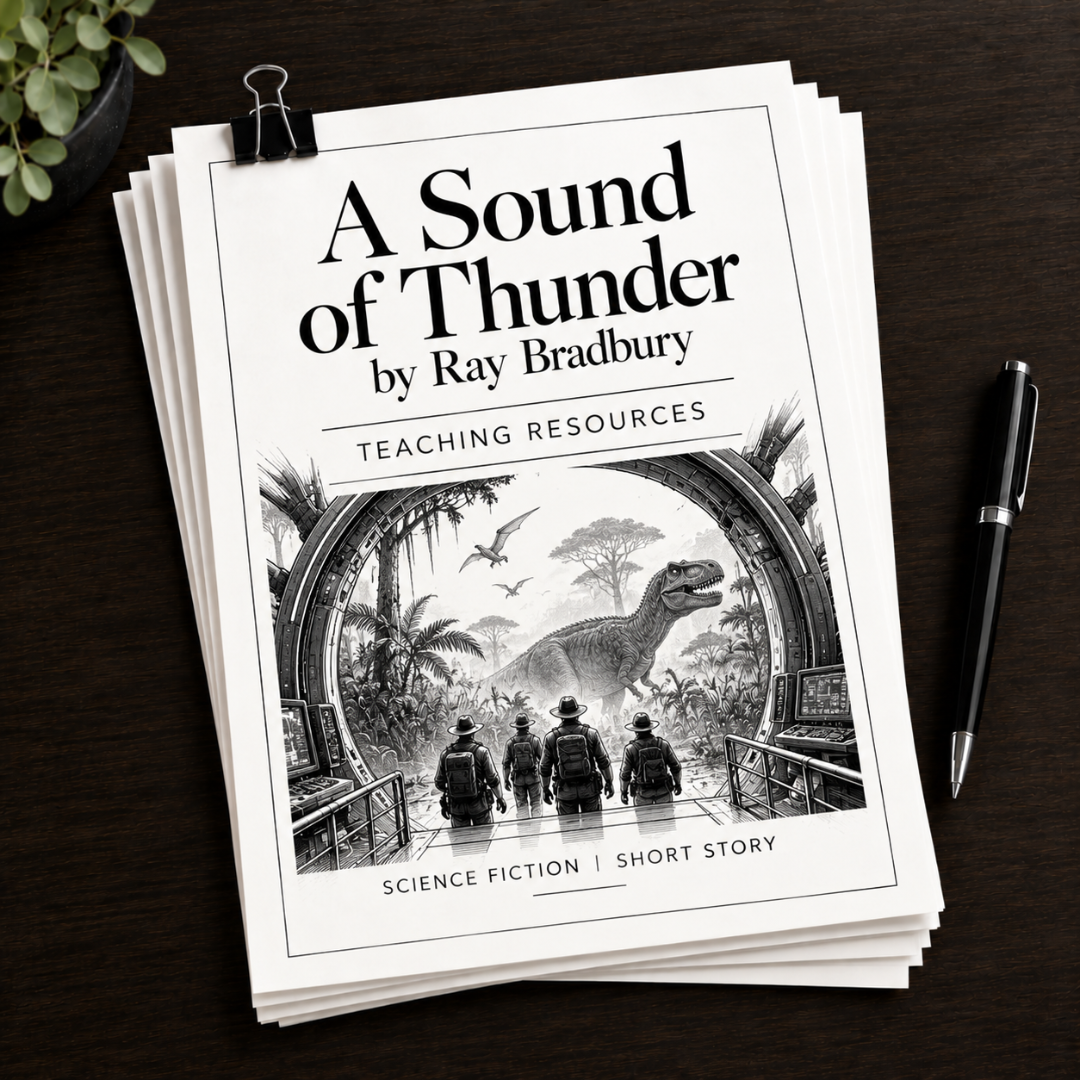
Teach A Sound of Thunder with minimal prep.
If you’re teaching A Sound of Thunder by Ray Bradbury, you don’t need to spend hours creating short story analysis activities, discussion questions, essay tasks, creative writing prompts and classroom resources from scratch.
This comprehensive A Sound of Thunder teaching resources bundle brings together a varied collection of ready-to-use activities designed to take students from their first exploration of Bradbury’s thrilling time-travel story to deeper, more confident independent analysis.
Use the resources across a sequence of lessons or choose individual activities to complement your existing teaching. Students can explore Bradbury’s presentation of time travel, the butterfly effect, cause and consequence, human responsibility, environmental destruction, fear, power, political change, free will and the dangers of interfering with nature, while examining how his choices of foreshadowing, symbolism, imagery, dialogue, characterisation, setting, atmosphere, suspense and narrative structure contribute to the story’s chilling conclusion.
Designed for secondary English, English Language Arts (ELA) and English Literature, the bundle can be used flexibly for whole-class teaching, paired and group discussion, independent learning, homework, revision and creative writing.
Why this works
This is not simply a collection of disconnected worksheets. The bundle combines close reading, literary analysis, discussion, debate, extended writing, creative response and engaging review activities, giving students multiple ways to explore Bradbury’s story while developing increasingly independent interpretations.
Supports close reading and detailed short story analysis
Encourages active discussion, debate and critical interpretation
Develops students’ ability to support ideas with textual evidence
Combines analytical, creative and visual approaches to literature
Explores the relationship between human actions, environmental consequences and historical change
Encourages students to consider how seemingly insignificant decisions can produce extraordinary consequences
Supports analysis of characterisation, setting, symbolism, foreshadowing, imagery, conflict, tone and atmosphere
Develops understanding of the butterfly effect and its significance within the story
Encourages critical thinking about time travel, scientific responsibility and humanity’s relationship with nature
Includes engaging review activities such as Bingo, a crossword and word search
Develops descriptive writing through illustrated prompts and sensory worksheets
Suitable for paired, group, whole-class and independent learning
Provides flexible activities for lessons, homework, revision and extension work
Encourages students to consider the continuing relevance of Bradbury’s warnings about environmental responsibility and unintended consequences
What’s included
Short Story Analysis Task Cards exploring context, plot and structure, title, narrative perspective, themes, imagery and symbolism, language devices, characterisation, word choices, conflict and turning points, tone, setting, mood and personal response
Essay Questions encouraging detailed analytical responses to Bradbury’s presentation of time travel, the butterfly effect, human responsibility, environmental consequences, fear, power, political change, symbolism, characterisation and the story’s unsettling conclusion
Creative Writing Prompts encouraging students to develop original narratives inspired by the story’s time-travel premise, prehistoric setting, alternative histories and speculative fiction ideas
Creative Classroom Tasks offering imaginative ways to explore the story through independent and collaborative responses
Roll the Dice Discussion Boards, available in A4 and A3 formats, providing questions for paired, small-group and whole-class discussion
Silent Debate Statements encouraging students to develop, justify and challenge interpretations of Bradbury’s themes, characters and moral questions
Illustrated Picture Prompts inspired by the story’s prehistoric jungle, Tyrannosaurus rex, time machine, characters and science fiction concepts
Five Senses Descriptive Writing Worksheets accompanying the picture prompts and helping students develop vivid sensory descriptions
A Sound of Thunder Bingo Review Game, including printable Bingo cards and a calling sheet for engaging classroom revision
A Sound of Thunder Crossword reinforcing key vocabulary, characters, events and ideas from the story
A Sound of Thunder Word Search providing an accessible vocabulary and comprehension review activity
21 A Sound of Thunder Colouring Pages featuring intricate illustrations of the prehistoric jungle, floating Path, Tyrannosaurus rex, time travel, the butterfly effect, important story moments and memorable literary quotations
Teacher Instructions for the Roll the Dice and Silent Debate activities, making both resources straightforward to implement
How you can use it
Introduce A Sound of Thunder and develop students’ initial responses to Bradbury’s science fiction story
Explore the conventions of science fiction, time-travel fiction and dystopian literature
Examine the futuristic setting of Time Safari Inc. and its commercial approach to travelling into the past
Analyse the significance of the Time Machine and the possibilities and dangers associated with manipulating time
Explore Bradbury’s presentation of the prehistoric jungle and its overwhelming atmosphere
Investigate the importance of the floating metal Path and the strict instructions given to the hunters
Analyse how Bradbury presents the Tyrannosaurus rex through powerful imagery, figurative language and descriptions of scale
Explore how Bradbury uses sensory imagery to create the sights, sounds, smells and physical sensations of the prehistoric world
Examine Eckels’s characterisation, particularly his confidence, fear, panic and eventual realisation of his mistake
Investigate the relationship between Eckels and Travis, considering authority, responsibility, conflict and consequences
Explore the roles of Lesperance, Billings and Kramer within the hunting expedition
Analyse how Bradbury uses foreshadowing and suspense to prepare readers for the story’s conclusion
Examine the symbolic significance of the butterfly, the Path, the Tyrannosaurus rex and the Time Machine
Investigate the butterfly effect and how a seemingly insignificant action can alter the course of history
Explore the ecological explanation given by Travis and the importance of interconnected living systems
Discuss whether humanity has the right to interfere with the natural world for entertainment or personal gain
Debate whether Eckels is entirely responsible for the consequences of the expedition
Examine the ethical responsibilities of Time Safari Inc. and the dangers of commercialising scientific discoveries
Explore the significance of the presidential election involving Keith and Deutscher
Analyse how Bradbury uses changes in language, atmosphere and political leadership to reveal the altered future
Discuss the relationship between individual actions, political power and historical consequences
Examine the ambiguity and significance of the story’s final sentence
Consider Bradbury’s warnings in relation to environmental destruction, scientific innovation, ecological responsibility and modern technology
Run low-prep paired, group or whole-class discussions using the Roll the Dice questions
Encourage students to debate competing interpretations through Silent Debate
Use the illustrated picture prompts to develop descriptive and sensory writing
Explore the story’s imagery and symbolism through the literary quotation colouring pages
Reinforce vocabulary and comprehension through Bingo, crossword and word search activities
Set independent analytical, creative or revision work
Develop ideas for extended analytical and essay responses
What students gain
Greater confidence analysing A Sound of Thunder independently
A deeper understanding of Ray Bradbury’s presentation of time travel, the butterfly effect, human responsibility and environmental consequences
Stronger ability to analyse symbolism, foreshadowing, imagery, setting, characterisation and narrative structure
Greater awareness of how science fiction can explore ethical, political and environmental concerns
Improved understanding of how writers create suspense, tension and threatening atmospheres
Experience developing and defending interpretations through discussion and debate
Greater confidence selecting and using textual evidence
Stronger analytical and extended writing skills
Improved descriptive writing through sensory and visual activities
Opportunities to explore the story through both analytical and creative thinking
Greater confidence connecting literary themes to questions about scientific responsibility, environmental protection and the consequences of human decisions
Flexible enough for an entire teaching sequence
The variety of resources means the bundle can support far more than a single lesson.
Begin with introductory discussion and close reading, move into focused analysis of Time Safari Inc., the prehistoric jungle, the floating Path, Eckels’s behaviour and Bradbury’s use of foreshadowing, then challenge students through Silent Debate and discussion questions.
Develop extended responses through the essay questions, encourage imaginative thinking through the creative writing activities, or use the picture prompts and Five Senses worksheets to strengthen descriptive writing.
Explore the story’s central symbols through the illustrated colouring pages, including the butterfly, the Tyrannosaurus rex, the Time Machine and the altered future.
Finish the unit with an engaging Bingo review game, crossword or word search, helping students revisit important vocabulary, characters, events and ideas.
Teachers can select the activities that suit their class or combine them to create a broader A Sound of Thunder teaching sequence.
Download Now
Download the complete A Sound of Thunder by Ray Bradbury Teaching Resources Bundle and start using it immediately, from first reading and classroom discussion through to detailed short story analysis, independent interpretation, creative writing and extended analytical responses.
Digital download: Printable PDF resources. No physical product will be shipped.
Teaching A Sound of Thunder? Explore the Complete Resource Bundle
Take your lessons further with the A Sound of Thunder Teaching Resources Bundle, a comprehensive collection of printable activities designed to support close reading, literary analysis, discussion, debate and creative writing.
Explore Bradbury’s presentation of the butterfly effect, time travel, environmental responsibility, fear, power and the consequences of human actions through a varied selection of ready-to-use classroom resources.
The bundle includes:
◆ Short Story Analysis Task Cards
◆ Essay Questions and Creative Writing Prompts
◆ Silent Debate and Roll the Dice Discussion Activities
◆ Creative Classroom Tasks
◆ Illustrated Picture Prompts and Five Senses Worksheets
◆ 21 Literary Colouring Pages
◆ Bingo, Crossword and Word Search Activities
Perfect for secondary English, ELA and English Literature, these resources can be used for whole-class lessons, independent analysis, homework, revision and extension activities.
Get the complete A Sound of Thunder Teaching Resources Bundle for just £5.00 and save time planning your next literature unit.
Explore the A Sound of Thunder Teaching Resources Bundle now!

Go Deeper into A Sound of Thunder
Bradbury’s story opens the door to wider explorations of time, consequence, and human responsibility, making it an ideal starting point for comparative study across science fiction and speculative literature.
For more teaching ideas and text pairings, explore Best Bradbury for the Classroom and Using Black Mirror to Teach Bradbury to extend these themes across different contexts and mediums.
◆ The Veldt by Ray Bradbury — explores technology, control, and unintended consequences within a futuristic domestic setting
◆ There Will Come Soft Rains by Ray Bradbury — examines human absence and technological autonomy, reinforcing ideas about systems continuing beyond human control
◆ The Pedestrian by Ray Bradbury — highlights conformity and surveillance, offering a different perspective on how small deviations disrupt rigid systems
◆ All Summer in a Day by Ray Bradbury — explores cruelty, memory, and irreversible actions, linking closely to cause and effect
◆ The Lottery by Shirley Jackson — explores how accepted systems and small individual actions contribute to larger societal consequences
◆ 1984 by George Orwell — provides a political lens on how power, control, and small shifts can reshape entire societies
Together, these texts deepen understanding of how individual actions interact with larger systems, reinforcing Bradbury’s central warning about consequence and control.
Final Thoughts
A Sound of Thunder remains one of Bradbury’s most powerful and enduring stories because it captures a simple but profound idea: that small actions can shape entire worlds. Through its combination of vivid imagery, tight structure, and unsettling resolution, the story exposes the limits of human control and the dangers of acting without full understanding. What begins as a thrilling concept—hunting in the past—quickly becomes a cautionary tale about responsibility, consequence, and the fragility of reality.
Its lasting impact lies in its relevance. Whether read as a warning about technology, environmental systems, or political change, the story continues to resonate in a world where individual actions can have global effects. Bradbury leaves readers with no easy resolution—only the echo of that final “sound of thunder,” reminding us that once a choice is made, it cannot be undone. For more explorations of Bradbury’s work, visit the Ray Bradbury Hub, or continue your reading through the Literature Library and related texts.
Choose Your Next Text