Suicide in the Trenches by Siegfried Sassoon: Line-by-Line Analysis
A line-by-line analysis of Suicide in the Trenches slows the poem down. Rather than rushing to judgement or theme, it asks the reader to attend closely to what Sassoon chooses to include, what he withholds, and how meaning builds through restraint.
At first glance, the poem appears simple. The language is plain, the lines are short, and the narrative moves quickly. But this surface simplicity disguises a carefully controlled protest. Each line contributes to a gradual shift from innocence, to erasure, to moral accusation.
Reading the poem line by line allows students to see how ordinary details, brief statements, and unembellished language carry emotional weight. Crucially, it reveals how Sassoon refuses to frame the soldier’s death as exceptional, instead embedding it within the routines of war and the silence that follows.
This approach moves beyond paraphrase. A close, line-by-line reading of Suicide in the Trenches shows how meaning is created not through dramatic language, but through contrast, understatement, and control — and why those choices make the poem so unsettling.
Context of Suicide in the Trenches by Siegfried Sassoon
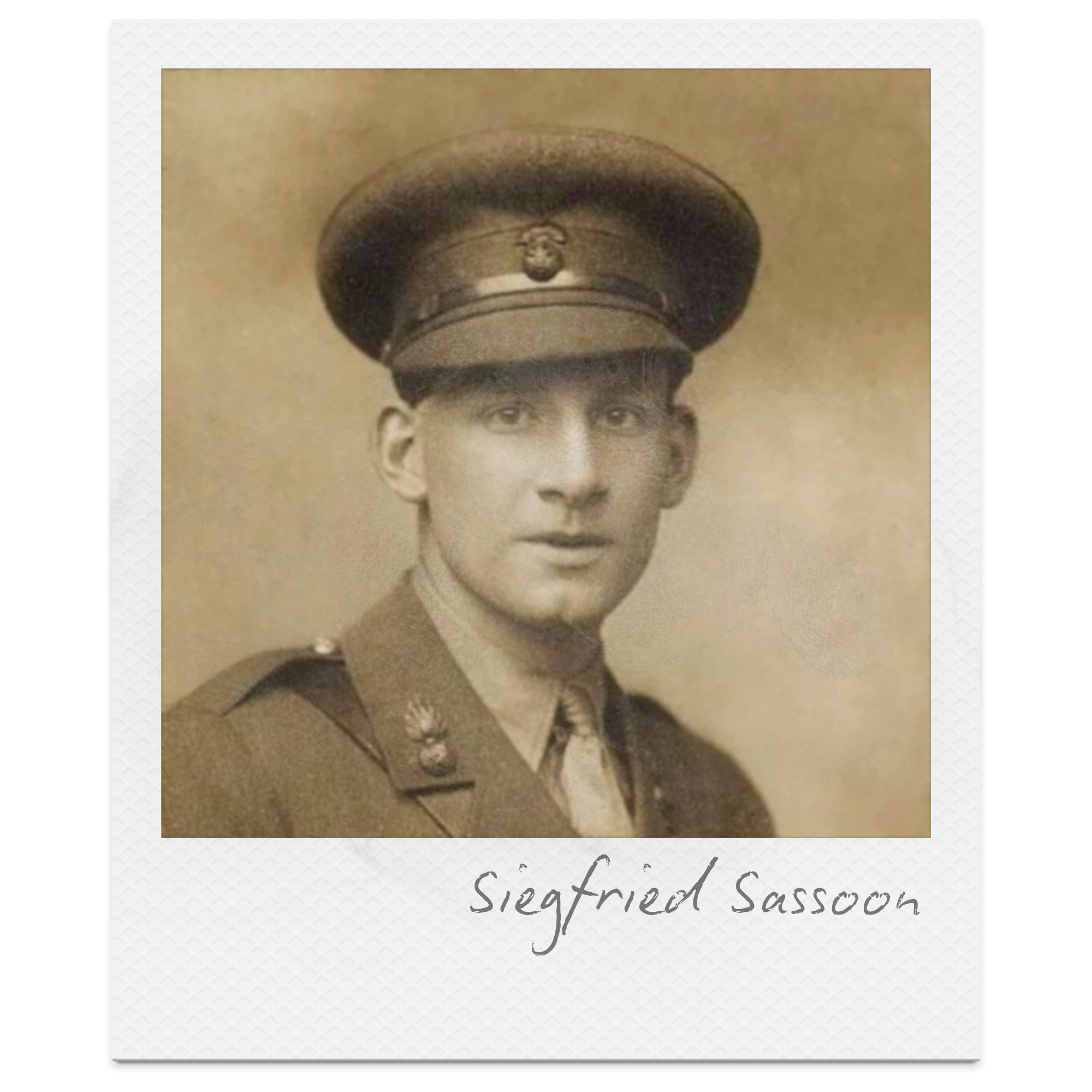
Suicide in the Trenches was published in 1918, during the final year of the First World War, when public confidence in the conflict was beginning to fracture. By this point, Siegfried Sassoon had already emerged as one of the most outspoken and critical voices writing about the war.
Sassoon was not writing from a position of distance. He had served on the Western Front and experienced the realities of trench warfare, including exhaustion, fear, and psychological strain. In 1917, he publicly protested against the continuation of the war, condemning its leadership and purpose. Rather than being punished, he was sent to Craiglockhart War Hospital, where his anger was increasingly shaped into controlled, disciplined poetry.
This context is crucial for understanding the poem’s tone. Sassoon’s war poetry is driven by moral outrage rather than private despair. His focus is not only on the suffering of individual soldiers, but on the wider systems — political, military, and social — that allow that suffering to be ignored or normalised.
For a fuller discussion of Sassoon’s war experience, protest poetry, and historical context, see the dedicated Siegfried Sassoon context post.
What Suicide in the Trenches Is About
Suicide in the Trenches tells the story of a young soldier whose initial cheerfulness is worn down by the realities of trench warfare. The poem begins by presenting him as ordinary and uncomplicated, enjoying small routines and moments of peace.
As conditions worsen, the soldier becomes exhausted and demoralised. The poem describes the misery of the trenches — cold, deprivation, and fear — before revealing that the soldier takes his own life. This act is reported briefly and without elaboration.
Crucially, the poem does not dwell on the death. Instead, it emphasises what follows: silence. The soldier disappears from the narrative, and “no one spoke of him again.” His suffering is quickly absorbed and forgotten.
In the final stanza, the poem shifts its focus away from the soldier and towards the civilian crowds who celebrate soldiers without understanding the cost of war. Rather than asking for sympathy, the poem exposes the gap between public enthusiasm and private suffering, placing responsibility with those who remain safely removed from the front.
The Speaker in Suicide in the Trenches
The speaker of Suicide in the Trenches presents himself as someone who knew the soldier personally. The opening line, “I knew a simple soldier boy,” establishes a first-person perspective, but it is a limited one. The speaker does not claim deep insight into the soldier’s inner thoughts — only observation.
This matters. The speaker describes what he saw and noticed, not what the soldier felt internally. Details such as the soldier’s cheerfulness, routines, and eventual disappearance are presented from the outside. This distance reinforces one of the poem’s central ideas: how easily individual suffering can be overlooked or misunderstood.
The speaker also occupies a position of moral awareness. While he does not intervene in the soldier’s story, he later turns outward to address the civilian crowd directly. This shift suggests that the speaker is not neutral. He is a witness who understands more than those being addressed — and who is willing to assign responsibility.
Importantly, the speaker is not the poet himself, even though Sassoon’s own experiences inform the poem. Treating the speaker as a constructed voice allows readers to focus on how perspective is shaped, controlled, and used to deliver accusation rather than confession.
Understanding the speaker’s role helps clarify the poem’s restraint. The speaker observes, reports, and then condemns — but never sentimentalises. That controlled distance becomes essential to how meaning develops line by line.
Overview of Form, Structure, and Metre
Suicide in the Trenches is written in three quatrains, using a regular structure that remains consistent throughout the poem. Each stanza follows the same pattern, creating a sense of order and control that contrasts sharply with the subject matter.
The poem is written predominantly in iambic tetrameter, giving it a steady four-beat rhythm that feels natural and easy to follow. This rhythm continues even at the poem’s most disturbing moment, refusing to mark the soldier’s death as a dramatic rupture.
Sassoon also uses a consistent AABB rhyme scheme, closing ideas into rhyming couplets that create neatness and containment. Together, form, structure, metre, and rhyme contribute to the poem’s emotional restraint and controlled tone.
If you want to explore how these technical choices shape meaning in more depth, you can read the full analysis of form, structure, and metre in Suicide in the Trenches here.
Stanza 1
The opening stanza establishes the soldier as young, ordinary, and emotionally uncomplicated. Through a series of calm, everyday details, Sassoon presents a version of the soldier before the effects of war take hold, allowing innocence and routine to dominate the poem’s opening.
Line 1: “I knew a simple soldier boy”
The poem opens with a first-person declaration. The speaker claims familiarity with the soldier, but the description remains surface-level. The adjective “simple” suggests innocence rather than stupidity, positioning the soldier as emotionally open and uncomplicated.
The phrase “soldier boy” emphasises youth. He is defined not as a heroic figure, but as someone young and vulnerable, still close to childhood. From the outset, the poem frames the soldier as ordinary, not exceptional.
Key analysis:
◆ “Simple” implies emotional openness rather than lack of intelligence
◆ “Boy” foregrounds youth and vulnerability
◆ The speaker’s certainty (“I knew”) contrasts with how little is revealed
◆ Establishes focus on the individual before erasure
Line 2: “Who grinned at life in empty joy,”
This line develops the soldier’s emotional state. His joy is described as “empty”, a deliberately ambiguous phrase. It may suggest innocence — happiness without depth or reflection — but it can also hint at fragility, a joy that lacks resilience.
The verb “grinned” reinforces surface emotion. The soldier appears cheerful, but the emotion is not interrogated or explored. Sassoon keeps the description deliberately light.
Key analysis:
◆ “Grinned” suggests surface-level happiness rather than deep contentment
◆ “Empty joy” introduces ambiguity without explanation
◆ Sassoon avoids sentimental language
◆ Early suggestion that this joy may not endure
Line 3: “Slept soundly through the lonesome dark,”
Sleep functions as a marker of psychological safety. To “sleep soundly” implies peace, security, and freedom from anxiety. At this stage, the soldier is unaffected by fear or anticipation.
However, the phrase “lonesome dark” subtly complicates the image. Isolation and darkness are present, but they do not yet disturb him. The soldier is still able to remain untouched by loneliness.
Key analysis:
◆ Sleep symbolises emotional calm and stability
◆ “Lonesome dark” introduces isolation without threat
◆ Suggests resilience — or unawareness of what lies ahead
◆ Contrast set up for later disruption
Line 4: “And whistled early with the lark.”
The stanza ends with an image of routine and harmony. Whistling suggests lightness and ease, while the lark is traditionally associated with morning, renewal, and natural order.
Ending the stanza this way reinforces the sense that the soldier fits comfortably within the rhythms of life. This peaceful closure makes the later collapse more unsettling.
Key analysis:
◆ Whistling suggests effortlessness and emotional ease
◆ The lark symbolises morning, routine, and natural harmony
◆ The stanza closes on calm rather than tension
◆ Structural calm prepares the contrast with Stanza 2
Stanza 2
The second stanza marks a decisive shift in the poem. The soldier is no longer defined by routine or innocence, but by the conditions of trench warfare. The movement is rapid: from environment, to suffering, to death, to silence.
Line 1: “In winter trenches, cowed and glum,”
The stanza opens by relocating the soldier into the physical and emotional reality of war. “Winter trenches” immediately evoke cold, discomfort, and endurance rather than action or heroism. The adjectives “cowed” and “glum” describe emotional defeat rather than panic or dramatic fear.
The soldier is presented as subdued and worn down, suggesting a loss of agency rather than a single moment of terror.
Key analysis:
◆ “Winter trenches” foreground endurance and suffering, not combat
◆ “Cowed” suggests submission and diminished confidence
◆ “Glum” implies emotional flatness rather than visible despair
◆ Clear contrast with the cheerfulness of Stanza 1
Line 2: “With crumps and lice and lack of rum,”
This line presents suffering through accumulation. The list moves from “crumps” (shell explosions), to lice, to lack of rum, shifting from external danger to physical discomfort to emotional deprivation.
The effect is deliberately mundane. There is no single dramatic cause of suffering; instead, misery is constant, repetitive, and unavoidable.
Key analysis:
◆ Listing structure creates a sense of ongoing hardship
◆ Movement from violence to discomfort to deprivation
◆ “Lack of rum” suggests removal of comfort or escape
◆ War framed as attritional rather than heroic
Line 3: “He put a bullet through his brain.”
The suicide is delivered with brutal directness. The sentence is short, declarative, and unembellished. There is no metaphor, no emotional commentary, and no pause.
Structurally and linguistically, the act is treated as a statement of fact rather than a dramatic climax. The poem refuses to elevate the moment.
Key analysis:
◆ Plain language denies sentimentality
◆ Absence of metaphor heightens shock
◆ Suicide presented as an outcome, not a spectacle
◆ Reinforces the poem’s emotional restraint
Line 4: “No one spoke of him again.”
The stanza ends not with death, but with silence. This line shifts focus away from the act itself and onto its aftermath — or lack of one. The soldier disappears from both memory and narrative.
The brevity of the line mirrors the ease with which he is forgotten. Structurally, the poem closes the stanza by erasing the individual entirely.
Key analysis:
◆ Silence replaces response or mourning
◆ The passive phrasing removes responsibility
◆ Emphasises erasure rather than tragedy
◆ Prepares the moral accusation of Stanza 3
Stanza 3
The final stanza shifts the poem’s focus away from the soldier entirely and onto the civilian audience. The speaker abandons observation and moves into direct accusation, forcing responsibility outward.
Line 1: “You smug-faced crowds with kindling eye”
The stanza opens with direct address, marking a clear tonal shift. The pronoun “You” confronts the reader directly, collapsing any sense of distance. The phrase “smug-faced crowds” is openly contemptuous, suggesting self-satisfaction and moral complacency.
The image “kindling eye” implies excitement and anticipation. The crowds are not neutral observers; they are emotionally invested in the spectacle of war.
Key analysis:
◆ Direct address pulls the reader into the poem’s moral frame
◆ “Smug-faced” conveys arrogance and self-satisfaction
◆ “Crowds” contrasts with the isolated individual of earlier stanzas
◆ “Kindling eye” suggests excitement, not understanding
Line 2: “Who cheer when soldier lads march by,”
This line specifies the behaviour being condemned. “Cheer” suggests shallow enthusiasm rather than informed support. The phrase “soldier lads” infantilises the soldiers, reinforcing their youth while exposing the crowds’ failure to grasp the consequences of what they celebrate.
The image of marching links war to parade and performance, rather than suffering.
Key analysis:
◆ Cheering replaces thought or responsibility
◆ “Lads” emphasises youth and vulnerability
◆ War framed as spectacle rather than experience
◆ Civilian enthusiasm contrasts sharply with trench reality
Line 3: “Sneak home and pray you'll never know”
The tone sharpens further. The verb “sneak” implies guilt and avoidance, suggesting that these civilians instinctively retreat from the realities they applaud. “Pray” introduces a moral dimension, hinting at hypocrisy.
The line exposes a desire for distance: celebration without consequence.
Key analysis:
◆ “Sneak” implies shame and moral evasion
◆ Religious language introduces hypocrisy
◆ Civilians seek protection from the reality they endorse
◆ Responsibility is actively avoided
Line 4: “The hell where youth and laughter go.”
The stanza — and the poem — ends with a powerful compression of meaning. “Hell” is blunt and absolute, offering no metaphorical cushioning. It reframes the trenches as a place of spiritual and human destruction.
The pairing of “youth and laughter” recalls the opening stanza, completing the poem’s structural arc. What once defined the soldier is now shown to be destroyed.
Key analysis:
◆ “Hell” rejects any heroic framing of war
◆ Juxtaposition of “youth and laughter” highlights loss
◆ Circular structure links final line back to the opening stanza
◆ The poem ends with condemnation, not consolation
Tone in Suicide in the Trenches
The tone of Suicide in the Trenches develops gradually across the poem. Sassoon begins with quiet, observational description, presenting the soldier with calm restraint rather than overt emotion. This controlled tone makes the sudden bluntness of the second stanza more unsettling.
By the final stanza, the tone shifts into controlled bitterness and accusation. The direct address to the civilian crowd strips away distance and exposes moral responsibility. Sassoon’s refusal to sentimentalise suffering ensures that the poem condemns complacency rather than inviting pity.
Themes in Suicide in the Trenches
One of the poem’s central themes is the erasure of the individual. The soldier’s life and death are presented briefly and then followed by silence, emphasising how easily personal suffering is forgotten. The poem also explores the gap between civilian enthusiasm and lived experience, challenging the morality of celebrating war from a position of safety.
Running beneath both is the theme of youth destroyed by conflict. Sassoon presents innocence not as something heroically sacrificed, but as something worn away through endurance, neglect, and indifference. These ideas are developed more fully in the dedicated themes post.
Explore Suicide in the Trenches
This post focuses on a line-by-line reading of Suicide in the Trenches, unpacking how meaning develops through individual words, images, and silences. If you’re teaching or revising the poem in more depth, exploring it from multiple angles can help students build a more secure and flexible understanding.
Click the tiles below to explore related posts on Suicide in the Trenches, including analysis of context, form and structure, language, and key themes.

Teaching Suicide in the Trenches Through Line-by-Line Analysis
Line-by-line analysis works particularly well with Suicide in the Trenches because meaning develops through small details and restraint rather than extended description. Approaching the poem this way helps students move beyond paraphrase and engage more confidently with interpretation.
◆ Slow the poem down deliberately
Read one line at a time and resist summarising the stanza too quickly. Ask students to focus on what each line adds or withholds before moving on.
◆ Use structured group roles
Assign each group a different analytical focus for the same line — for example word choice, tone, implication, or structure. This avoids repetition while modelling multiple ways into the text.
◆ Separate explanation from interpretation
Encourage students to explain what a line is saying before discussing what it suggests. This helps weaker students build confidence and prevents stronger students from skipping straight to abstract claims.
◆ Track shifts across the poem
Ask students to identify where the poem’s tone changes and how this is achieved line by line. Emphasise that the most significant shift happens in the final stanza, not at the moment of death.
◆ Avoid technique-spotting in isolation
Instead of asking students to name devices, prompt them to explain how specific choices shape meaning. Techniques should emerge naturally from discussion, not drive it.
◆ Build towards evaluative writing
Once students are secure, ask them to select one line they find most unsettling and justify their choice using close textual evidence.
Go Deeper into Suicide in the Trenches
Once students are confident explaining individual lines in Suicide in the Trenches, deeper analysis comes from questioning why Sassoon chooses restraint and what the poem refuses to do. These extensions push thinking beyond explanation and into evaluation.
◆ Compare restraint across war poetry
Set the poem alongside a more emotionally expressive war poem and ask students which approach feels more confronting — and why.
◆ Focus on silence rather than imagery
Invite students to track what is not described, particularly around the soldier’s death, and consider how absence shapes meaning.
◆ Revisit the speaker’s role
Ask whether the speaker’s distance strengthens or weakens the poem’s protest. Encourage students to support their views with close reference to specific lines.
◆ Explore moral responsibility
Debate who the poem ultimately condemns: individual civilians, collective society, or wider systems of power.
◆ Link close reading to form
Challenge students to connect their line-by-line observations back to the poem’s regular form and rhythm, evaluating how control sharpens accusation.
Final Thoughts
A line-by-line reading of Suicide in the Trenches reveals how much of the poem’s power lies in what is left unsaid. Sassoon’s restraint forces the reader to attend closely to small details, brief statements, and moments of silence that would otherwise pass unnoticed.
Rather than dramatising suffering, the poem exposes how easily individual lives are reduced to absence. Reading the poem slowly highlights how innocence is worn down, erased, and then quietly forgotten, while responsibility shifts away from the soldier and onto those who remain safely removed from the reality of war.
If you’re studying war poetry more widely, you can explore related poems, context posts, and teaching resources in the Literature Library, where Suicide in the Trenches sits alongside other key First World War texts.
Choose Your Next Text