Form, Structure, and Metre in Suicide in the Trenches
At first glance, Suicide in the Trenches appears almost disarmingly simple. The language is plain, the lines are short, and the poem moves with a steady, familiar rhythm. There is nothing ornate or emotionally charged about its surface. That simplicity, however, is not accidental.
In Suicide in the Trenches, Siegfried Sassoon uses form, structure, and metre as tools of restraint. Rather than dramatise suffering, he contains it. The poem’s controlled form mirrors the way war is often presented to those far from the front — ordered, distant, and emotionally manageable.
This matters because the poem’s most disturbing moment is not framed as a climax. The suicide arrives quickly, almost quietly, embedded within a neat stanza and followed by silence. By refusing disruption, Sassoon forces the reader to confront how easily individual suffering is absorbed and forgotten.
A close analysis of form, structure, and metre in Suicide in the Trenches reveals how that restraint becomes an accusation. The poem does not ask the reader to grieve. Instead, it exposes the systems that normalise violence and allow such losses to pass without protest.
Context of Suicide in the Trenches by Siegfried Sassoon
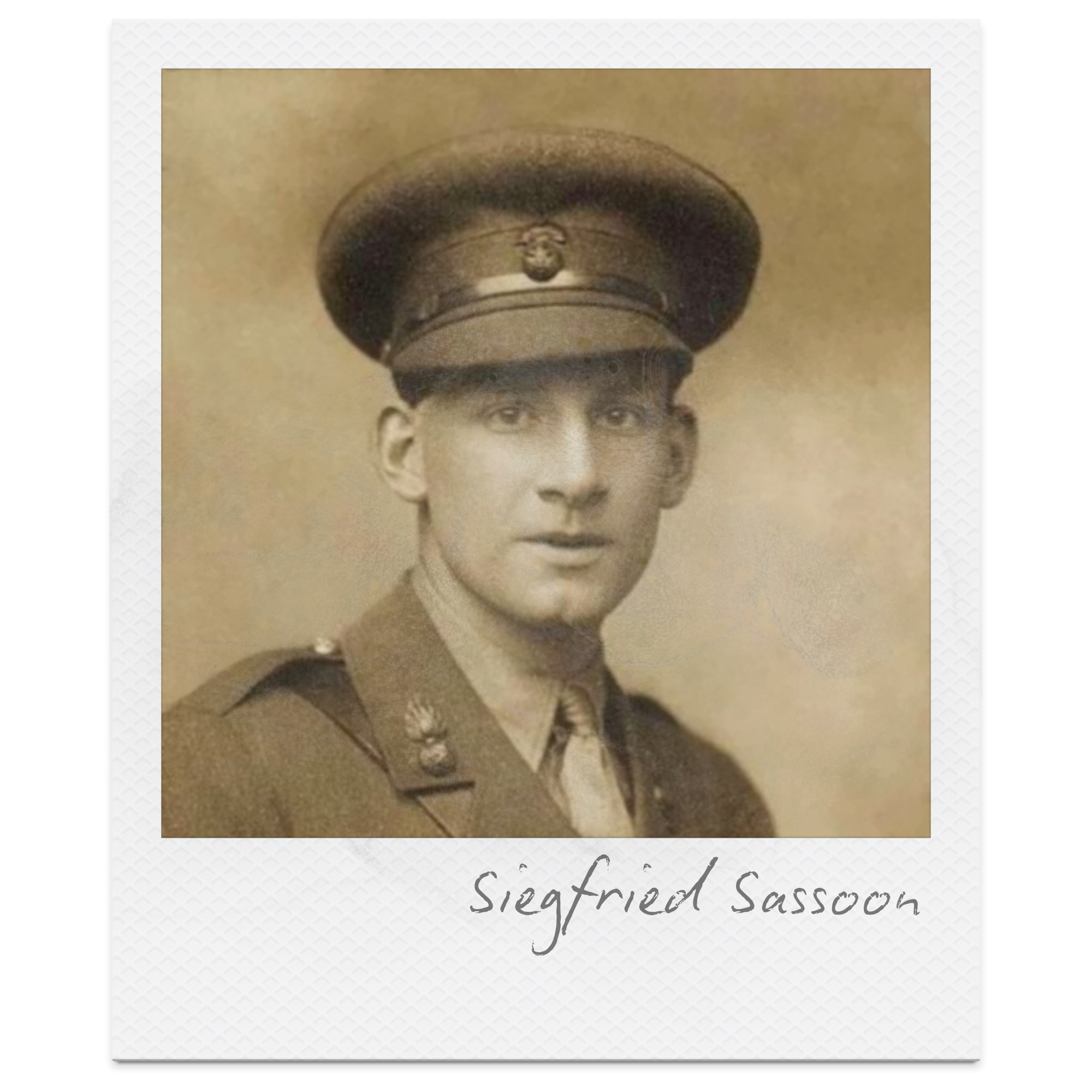
Suicide in the Trenches was published in 1918, towards the end of the First World War, when public confidence in the war effort was beginning to collapse. By this stage, Siegfried Sassoon was already known as one of the most openly critical war poets writing in Britain.
Sassoon had served on the Western Front and had direct experience of trench warfare, including the physical conditions, psychological strain, and emotional exhaustion faced by ordinary soldiers. In 1917, he made a public protest against the continuation of the war, condemning its leadership and purpose. Rather than being court-martialled, he was sent to Craiglockhart War Hospital, where his anger became more sharply focused and controlled in his poetry.
This context is crucial when reading Suicide in the Trenches. Sassoon’s poetry is not driven by personal despair but by moral anger. His focus is not on the inner suffering of the soldier alone, but on the wider systems — political, military, and social — that allow that suffering to continue while remaining safely out of sight.
For a fuller discussion of Sassoon’s war experience, protest poetry, and historical context, see the dedicated Siegfried Sassoon context post.
What Suicide in the Trenches Is About
Suicide in the Trenches presents the brief story of a young soldier whose initial cheerfulness is worn down by the conditions of trench warfare. After enduring cold, deprivation, and emotional exhaustion, the soldier takes his own life. The poem then shifts its focus away from the individual and towards the civilian crowds who celebrate war without understanding its cost, exposing the gap between public enthusiasm and lived experience.
The Title Suicide in the Trenches: Expectations and Meaning
The title Suicide in the Trenches is deliberately blunt. Sassoon names both the act (suicide) and the setting (the trenches) without metaphor, explanation, or emotional framing. This directness immediately signals that the poem will not offer heroism, sacrifice, or consolation.
The word suicide introduces discomfort. It suggests a private, desperate act — one that is often hidden, ignored, or quietly judged. By placing it alongside the trenches, Sassoon forces that private suffering into a public, politicised space. The title alone exposes a central tension in the poem: the clash between public celebration of war and the unseen psychological damage it causes.
Several key themes are established before the poem even begins.
One is the erasure of the individual. The title does not name the soldier, foreshadowing how easily his life — and death — will be reduced to a brief, impersonal moment. Another is the cost of war on youth, implied by the setting rather than stated outright. The trenches become a space where innocence is worn down, not through heroic battle, but through exhaustion and despair.
The title also prepares the reader for moral confrontation. By refusing emotive language, Sassoon avoids inviting sympathy too early. Instead, the poem exposes suffering plainly and leaves responsibility with the reader. This restraint becomes crucial to how the poem operates: meaning is not declared, but revealed through what is left unsaid.
In this way, the title does more than label the poem. It establishes the poem’s central concerns — suffering, silence, and responsibility — and prepares the ground for the controlled form and structure that follow.
Form in Suicide in the Trenches
Suicide in the Trenches is written in three quatrains, a tightly controlled and traditional poetic form. Each stanza contains four lines, creating a sense of balance, order, and predictability. This choice is significant because it contrasts sharply with what actually happens in the poem.
Quatrains are commonly associated with songs, ballads, and simple narrative verse. They are familiar, easy to read, and often used to present events that feel meaningful or worthy of remembrance. Sassoon’s decision to use this form to describe exhaustion, despair, and suicide is therefore unsettling. The calmness of the form sits uneasily alongside the reality it contains.
This contrast becomes most disturbing in the poem’s lack of formal reaction to the soldier’s death. There is no break in structure, no visual disruption on the page, and no change in stanza length. The suicide does not disturb the poem’s shape. Instead, it is absorbed into the same neat pattern as the rest of the soldier’s life.
That lack of formal response mirrors the world beyond the poem. Just as the quatrains remain intact, the wider system continues uninterrupted. Individual suffering is contained, processed, and quickly forgotten. The poem’s controlled form exposes how easily extreme violence can exist inside familiar structures — poetic, social, and moral — without demanding change.
By choosing such a restrained and traditional form, Sassoon refuses to sensationalise suffering. Instead of guiding the reader’s emotions, he forces them to confront the discomfort of order remaining intact in the face of human collapse.
Structure in Suicide in the Trenches
The structure of Suicide in the Trenches is carefully controlled, with meaning shaped through stanza division, line length, and line breaks rather than dramatic development.
The first stanza focuses on the soldier as an individual. The lines are short and self-contained, with most ideas completed within a single line or couplet. This creates a sense of stability and routine, reflecting the soldier’s early innocence and emotional simplicity. Structurally, nothing feels strained or unsettled at this stage.
In the second stanza, the setting shifts to the winter trenches, but the structure remains deceptively steady. The description of suffering and the act of suicide are delivered through brief, controlled lines, preventing the moment from expanding emotionally. The suicide itself is not given its own line or stanza break; instead, it is embedded within the stanza, suggesting how easily such deaths are absorbed into the wider experience of war.
The line “No one spoke of him again” is structurally significant. Its short length and final position within the stanza create a sense of closure and silence. The line break that follows reinforces this erasure, visually and rhythmically cutting the soldier out of the poem.
Throughout the poem, enjambment is minimal, and lines tend to end cleanly. This lack of enjambment prevents momentum from building and reinforces the poem’s emotional restraint. Meaning is contained rather than allowed to spill forward, mirroring the way suffering is controlled and suppressed.
The final stanza introduces a structural shift in focus rather than form. The poem moves from narrative to direct address, turning outward towards the reader and the civilian crowd. Although the stanza length and line pattern remain consistent, responsibility is redistributed. Structurally, the soldier disappears completely, and the poem ends not with his story, but with accusation.
Overall, the structure moves from personal detail, to sudden erasure, to public confrontation. Line length, limited enjambment, and controlled breaks ensure that the poem never releases emotion on the reader’s behalf. Instead, the structure forces discomfort to remain unresolved.
Metre in Suicide in the Trenches
The metre of Suicide in the Trenches is predominantly iambic tetrameter, meaning that most lines are built from four iambic feet. An iamb consists of an unstressed syllable followed by a stressed syllable, creating a natural rising rhythm. When repeated four times, this produces lines of around eight syllables with a steady, forward-moving beat.
This pattern closely resembles natural speech, which is why iambic metre often feels unobtrusive. In Suicide in the Trenches, the iambic tetrameter allows the poem to move smoothly, without drawing attention to its own technique. The rhythm feels easy and almost automatic, encouraging the reader to continue without pausing.
The effect of this becomes clear when examining key lines. For example,
“He put a bullet through his brain”
follows the same iambic stress pattern as earlier descriptions of routine and innocence. The stresses fall where the reader expects them to, and the line moves on without hesitation. There is no disruption in rhythm to mark the moment as exceptional.
This consistency is crucial. By maintaining the same four-beat iambic rhythm at the moment of suicide, Sassoon refuses to frame the death as a dramatic turning point. Instead, the action is absorbed into the poem’s ongoing movement, mirroring how such deaths are treated as part of the ordinary machinery of war.
Across the poem, the steady iambic tetrameter reinforces a sense of normalisation. The rhythm carries the reader forward, preventing reflection or emotional pause. In doing so, the metre contributes to the poem’s wider argument: that horror can exist comfortably inside familiar patterns, especially when those patterns are repeated often enough.
Rhyme Scheme in Suicide in the Trenches
The rhyme scheme of Suicide in the Trenches is AABB in each stanza, meaning that the lines are arranged into rhyming couplets. Each pair of lines ends with a full rhyme, creating a strong sense of closure and predictability.
This regular couplet rhyme scheme contributes to the poem’s deceptively neat and musical quality. Rhyming couplets are often associated with simple songs, nursery rhymes, or light verse, forms designed to be memorable and emotionally accessible. Sassoon’s use of this pattern is therefore deeply unsettling given the subject matter.
The effect of the rhyme scheme is to contain meaning tightly. Each couplet feels complete in itself, encouraging the reader to move smoothly from one idea to the next without lingering. Even in the second stanza, where the soldier’s suffering and suicide are described, the rhyme continues uninterrupted. The line “He put a bullet through his brain” is immediately followed by a rhyming partner, closing the moment off rather than allowing it to expand.
This creates a disturbing contrast. The rhyme provides a sense of order and resolution, while the content offers none. The death is packaged neatly into a pair of lines, mirroring how such losses are quickly processed and forgotten. The rhyme scheme actively works against emotional disruption.
By using a consistent AABB rhyme scheme, Sassoon reinforces the poem’s wider restraint. The musicality softens the brutality of events, making them easier to absorb. In doing so, the rhyme scheme exposes how familiar patterns — poetic and social — can make extreme suffering feel manageable, even forgettable.
Tone in Suicide in the Trenches: An Outcome of Technique
The tone of Suicide in the Trenches is shaped less by emotional outbursts than by restraint and control. While the poem contains emotionally charged language, it avoids overtly emotive or figurative expression, allowing feeling to emerge through contrast, understatement, and structure rather than dramatic display.
The poem’s neat quatrains and predictable structure establish a sense of emotional containment. Even at its most disturbing moment, the poem refuses visual or structural disruption. This creates a tone that feels deliberately controlled, as though emotion is being held back rather than released.
The iambic tetrameter reinforces this restraint. The steady four-beat rhythm carries the reader forward without pause, discouraging reflection or emotional lingering. The suicide is absorbed into the poem’s rhythm, contributing to a tone that feels coldly matter-of-fact rather than openly tragic.
The AABB rhyme scheme further tightens this control. By closing ideas into rhyming couplets, the poem packages suffering neatly, offering a sense of completion where none should exist. The musicality of the rhyme softens brutality, intensifying the poem’s moral unease.
Taken together, form, structure, metre, and rhyme produce a tone of controlled bitterness and moral accusation. Sassoon does not invite the reader to grieve for the soldier. Instead, he exposes how easily suffering is normalised and overlooked. The restraint becomes the judgement.
By the time the poem turns outward in its final stanza, the tone feels earned. The poem has already demonstrated how familiar patterns — poetic and social — allow horror to pass unnoticed. The direct address is not a sudden shift, but the logical outcome of sustained control.
Teaching Suicide in the Trenches: Form, Structure, and Tone
Sassoon’s poem works particularly well in the classroom because its simplicity is deceptive. The techniques are accessible, but the ideas they carry are demanding. Focusing on form and structure helps students move beyond surface responses and into more thoughtful interpretation.
◆ Read the poem aloud before analysing it
Ask students to listen for how smooth and easy the rhythm feels. Discuss why a poem about trench warfare and suicide might sound almost song-like.
◆ Compare content with presentation
Have students identify what happens in the poem, then contrast this with how it is presented on the page. Prompt discussion around why the suicide is not given its own stanza or visual emphasis.
◆ Explore metre through key lines
Isolate “He put a bullet through his brain” and ask students to mark the stresses. Discuss why the rhythm remains steady at this moment, and what effect that has on the reader.
◆ Use the rhyme scheme as a starting point for evaluation
Ask students how the AABB rhyme scheme affects the poem’s tone. Does the musicality soften the message or make it more disturbing?
◆ Link structure to meaning
Track how the poem moves from individual experience, to erasure, to accusation. Ask students where responsibility lies by the final stanza.
◆ Challenge stronger students
Invite them to consider whether the poem would be more or less effective if the form were fragmented or chaotic, and why Sassoon might have resisted that choice.
Explore Suicide in the Trenches
This post focuses on form, structure, metre, and tone in Suicide in the Trenches. If you’re teaching or revising the poem in more depth, exploring it from multiple angles can help students build a more secure understanding.
Click the tiles below to explore related posts on Suicide in the Trenches
Go Deeper: Exploring Form, Structure, and Tone
Once students are secure with form, structure, metre, and rhyme in Suicide in the Trenches, deeper analysis comes from questioning why Sassoon chose restraint rather than disruption. These extensions help move students beyond identification and into evaluation.
◆ Test alternative forms
Ask students to rewrite one stanza in free verse or with irregular line lengths. Discuss what is gained and what is lost when control is removed.
◆ Track moments of restraint
Have students identify where they might expect emotional emphasis — and then examine how Sassoon refuses it. Encourage discussion around why those moments are structurally contained.
◆ Link technique to purpose
Prompt students to connect formal choices to Sassoon’s role as a protest poet. How does control strengthen accusation rather than weaken it?
◆ Compare across war poetry
Set the poem alongside others that use more disrupted or fragmented forms. Ask students to evaluate which approach feels more confronting and why.
◆ Challenge assumptions about emotion
Invite students to consider whether emotional restraint makes the poem more or less powerful. Encourage them to support their views using specific technical evidence.
Final Thoughts
Suicide in the Trenches is often described as a simple poem, but that simplicity is carefully constructed. Sassoon’s use of form, structure, metre, and rhyme ensures that the poem never offers emotional release or comfort. Instead, it exposes how easily suffering can be contained, normalised, and ignored.
The poem’s technical restraint is not a limitation but a judgement. By refusing disruption, Sassoon mirrors the systems that allow young lives to be reduced to silence while public narratives of war continue undisturbed. The soldier’s death is not treated as exceptional — and that is precisely the point.
Reading the poem closely reveals that its power lies not in what it declares, but in what it withholds. The controlled surface forces responsibility outward, leaving the reader to confront their own position in relation to the suffering described. In this way, Sassoon’s protest is quiet, disciplined, and deeply unsettling.
If you’re studying war poetry more widely, you can explore related poems, context posts, and teaching resources in the Literature Library, where Suicide in the Trenches sits alongside other key First World War texts.
Choose Your Next Text