Suicide in the Trenches: Overview, Context, Key Ideas & Teaching Approaches
Suicide in the Trenches is often introduced as a simple and direct war poem, yet its power lies in how much it refuses to explain. Through plain language, regular form, and emotional restraint, Siegfried Sassoon presents a moment of devastating collapse without offering consolation, justification, or moral closure.
Written during the First World War, the poem exposes the gap between public enthusiasm and private suffering, shifting attention away from battlefield heroics and towards erasure, silence, and responsibility. Sassoon does not frame the soldier’s death as sacrifice, nor does he invite easy sympathy. Instead, he constructs a poem that forces the reader to confront where blame is placed and who is allowed to look away.
This post brings together context, key ideas, and teaching approaches for Suicide in the Trenches, positioning it as a gateway text for studying war poetry. Rather than treating the poem as a single, settled message, it explores how meaning is shaped through form, tone, and omission, and why the poem continues to reward discussion, interpretation, and careful reading in the classroom.

Overview: What Makes Suicide in the Trenches Endure
At first glance, Suicide in the Trenches appears straightforward. It tells the story of a young soldier who begins the war cheerful and unaffected, is worn down by trench conditions, and ultimately takes his own life. The poem ends by turning its attention away from the individual and towards the civilians who cheer soldiers as they march past, but remain untouched by the reality of conflict.
This brief narrative, however, carries a weight far beyond its length. Sassoon’s language is plain and controlled, avoiding emotional excess or graphic imagery. The regular structure and simple diction create a sense of order that sits uneasily alongside the poem’s subject matter, forcing readers to confront the normalisation of suffering rather than a single shocking event.
What gives the poem its lasting power is not what it shows, but what it withholds. Sassoon offers no explanation for the soldier’s decision, no expression of grief, and no moment of reflection after his death. Instead, the poem exposes how easily individuals can be erased, how responsibility can be deflected, and how silence allows suffering to pass without challenge.
Because of this restraint, Suicide in the Trenches resists a single interpretation. It can be read as a protest against war, an accusation directed at civilian society, or a critique of the systems that sustain conflict. This openness makes it an enduring and valuable text for exploring war poetry, moral responsibility, and interpretation in the classroom.
Context: Sassoon, Protest Poetry, and the First World War
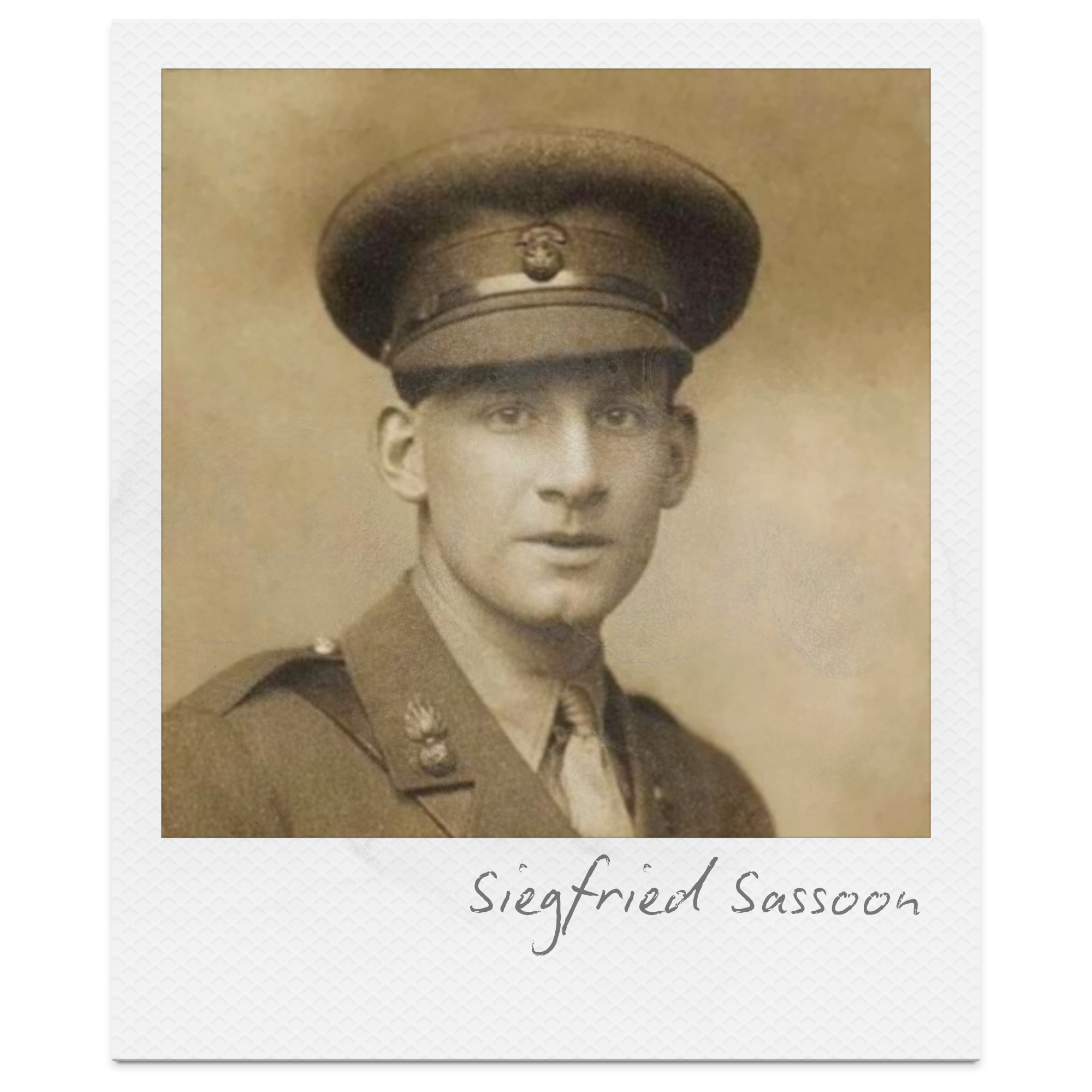
Suicide in the Trenches was written by Siegfried Sassoon during the First World War, after he had served on the Western Front and become increasingly disillusioned with the conflict. Unlike early patriotic war verse, Sassoon’s poetry emerges from direct experience of trench warfare, shaped by exhaustion, anger, and a growing sense that the war was being sustained through ignorance and distance.
By this point in his career, Sassoon had begun to position himself as a protest poet. His work challenges not only military leadership, but also the wider civilian culture that celebrated enlistment while remaining insulated from the consequences. This tension between frontline reality and home-front enthusiasm sits at the heart of Suicide in the Trenches.
The poem reflects a world in which obedience, endurance, and silence are valued over individual wellbeing. Soldiers are expected to cope, civilians are encouraged to cheer, and suffering is absorbed into routine. Sassoon’s restrained tone and refusal to offer consolation mirror this environment, exposing how easily responsibility can be displaced.
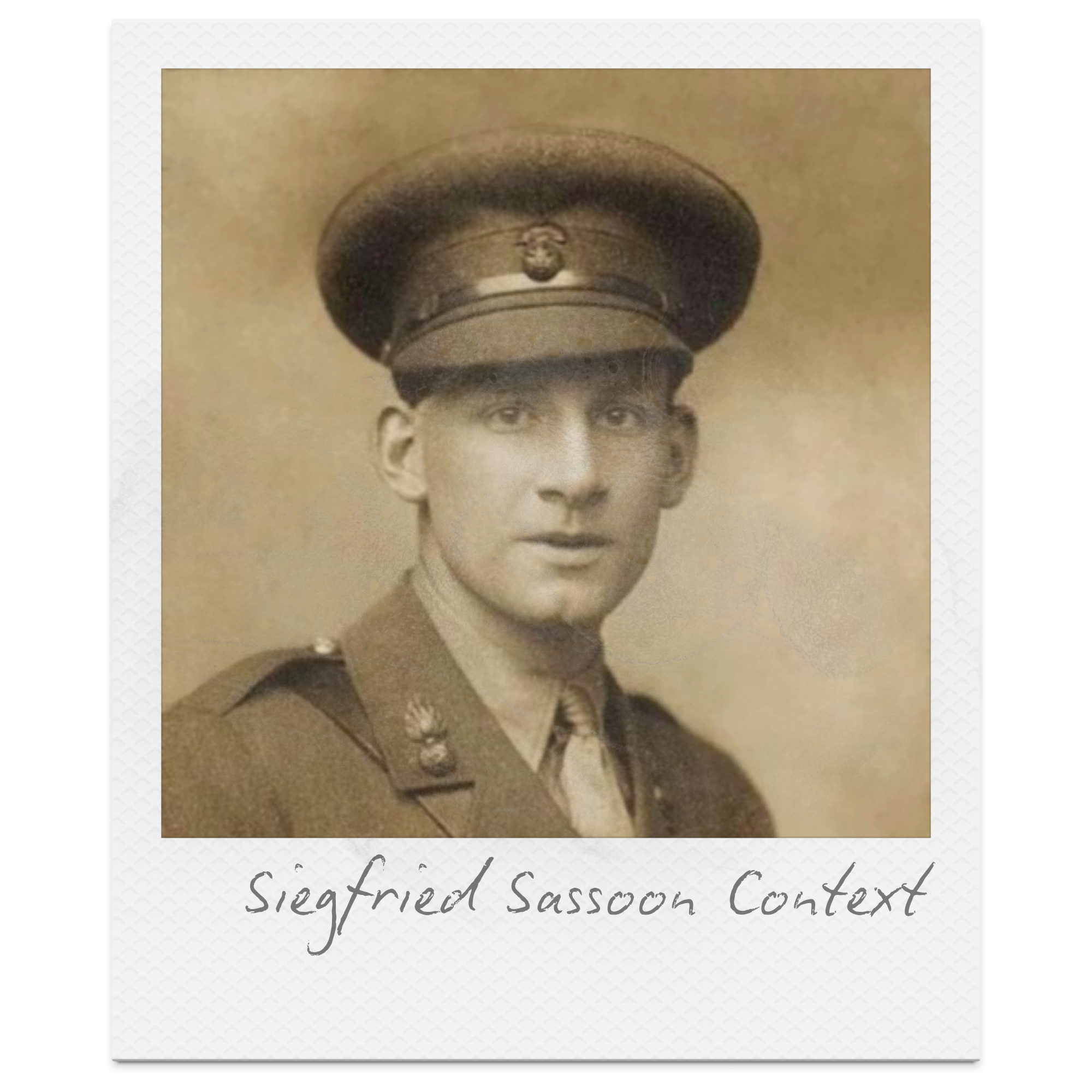
For a fuller exploration of Sassoon’s war service, political stance, and how these shaped his poetry, you can read the Siegfried Sassoon context post, which situates Suicide in the Trenches within his wider body of protest writing and the pressures of the First World War.
Genre and Voice: War Poetry Without Consolation
Although Suicide in the Trenches sits firmly within the tradition of First World War poetry, it resists many of the conventions readers might expect from the genre. Rather than offering heroism, sacrifice, or redemptive meaning, Sassoon presents war as attritional, erasing, and emotionally flattening.
The poem’s voice is deliberately controlled. Sassoon avoids lyrical excess, graphic imagery, or overt expressions of grief. Instead, he adopts a plain, almost conversational tone, describing devastating events with unsettling calm. This restraint is not accidental; it mirrors the emotional numbness demanded of soldiers and the social expectation that suffering should be endured without complaint.
Unlike patriotic war verse, which often frames death as noble or purposeful, Suicide in the Trenches offers no consolation. The soldier’s death is not commemorated, explained, or redeemed. There is no elegy, no moral uplift, and no reassurance that the loss serves a greater cause. This refusal to console places the poem closer to protest poetry than remembrance verse.
Sassoon also disrupts expectations of war poetry by shifting address. The poem begins with an apparently personal reflection, but ends in direct confrontation with civilians. This movement from private observation to public accusation reinforces the poem’s moral pressure, using voice not to comfort the reader, but to implicate them.
Understanding the poem’s genre and voice helps explain why it feels both simple and deeply unsettling. Suicide in the Trenches uses the familiar form of war poetry to do unfamiliar work — exposing how easily language, structure, and tone can normalise suffering rather than challenge it.
Core Ideas in Suicide in the Trenches
Although brief, Suicide in the Trenches is structured around a set of interlocking ideas that shape how the poem is read and taught. These ideas overlap rather than operate in isolation, creating a poem that feels simple on the surface but morally unsettled beneath.
Erasure of the Individual
At the centre of the poem is the quiet disappearance of a single soldier. Sassoon presents a life reduced to routine, then erased entirely after death, exposing how easily individuals are absorbed into silence. This idea sits at the heart of the poem’s emotional impact and is explored in more depth in the Themes in Suicide in the Trenches post.
Civilian Responsibility and Moral Distance
The poem ultimately redirects attention away from the trenches and towards those who remain safely removed from them. By confronting cheering crowds, Sassoon raises questions about complicity, avoidance, and who is allowed not to know. This tension is explored further in the Alternative Interpretations of Suicide in the Trenches post, where responsibility is deliberately contested rather than resolved.
Loss of Innocence
The soldier’s early cheerfulness is not developed into experience or maturity, but worn away through endurance. Sassoon frames innocence as fragile and unsustainable under prolonged pressure, reinforcing the idea that war does not harden characters so much as flatten them. This idea is traced across the poem in the Line-by-Line Analysis.
Silence and Emotional Restraint
One of the poem’s most unsettling features is what it refuses to say. Sassoon offers no explanation, no mourning, and no aftermath. Silence becomes meaningful, shaping tone as much as content. How this restraint is created through regularity, simplicity, and omission is examined closely in the Form, Structure, and Metre post.
The Normalisation of Suffering
Rather than presenting war as a series of shocking events, Sassoon depicts misery as routine. Cold, deprivation, and fear accumulate quietly until collapse feels inevitable. This idea underpins many readings of the poem and links it to wider traditions of anti-heroic war poetry.
Together, these core ideas explain why Suicide in the Trenches resists a single, settled meaning. Sassoon constructs a poem that demands interpretation, asking readers to decide where responsibility lies and what, if anything, can be said in the face of sustained suffering.
How Meaning Is Shaped: Form, Structure, and Tone
One of the reasons Suicide in the Trenches feels so unsettling is the contrast between how calmly it is written and what it describes. Sassoon’s choices around form, structure, and tone do not soften the poem’s message; they sharpen it, forcing the reader to confront suffering without emotional release.
The poem is built around regularity and simplicity. Its steady rhythm and predictable rhyme scheme create a sense of order that sits uneasily alongside the soldier’s collapse. This structural control mirrors the environment of the trenches, where endurance and routine are enforced even as psychological damage accumulates.
Tone is equally restrained. Sassoon avoids graphic imagery, overt anger, or sentimental language. The soldier’s suicide is presented in a plain, declarative sentence, and the poem moves on without pause. This emotional flatness reflects both the numbness expected of soldiers and the wider culture’s willingness to absorb loss without response.
Structurally, the poem also shifts its focus. It begins with an apparently personal observation before widening into direct address, transforming the reader from observer to participant. This movement gives the poem its moral force, using structure to redirect responsibility rather than explain it.
For a closer exploration of how form, structure, metre, and rhyme shape meaning in the poem — including how regularity, line length, and restraint contribute to tone — you can read the full Form, Structure, and Metre in Suicide in the Trenches post.
Interpreting the Poem: Why It Resists a Single Reading
Although Suicide in the Trenches is often taught as a poem with a clear anti-war message, Sassoon deliberately constructs it to resist a single, settled interpretation. The poem offers no explanation for the soldier’s decision, no emotional aftermath, and no clear statement of blame. Instead, meaning emerges through what is emphasised, what is omitted, and where the poem ultimately directs its moral pressure.
Depending on where focus is placed, the poem can be read in several ways. Some interpretations emphasise civilian responsibility, viewing the final stanza as a direct moral accusation. Others focus on systemic failure, arguing that the poem critiques the conditions and structures of war rather than individual choices. A further reading sees the poem as exposing emotional numbness, where both soldiers and civilians become desensitised to suffering.
These interpretations do not cancel each other out. Instead, they reveal how the poem’s restraint creates space for debate. Sassoon refuses to resolve responsibility neatly, forcing the reader to decide where blame lies and how far empathy should extend.
For a fuller exploration of these competing readings — including detailed evidence and classroom debate strategies — you can read the Alternative Interpretations of Suicide in the Trenches post.
Explore Suicide in the Trenches
This pillar post offers an overview of Suicide in the Trenches, but the poem rewards closer attention from multiple angles. Exploring it through form, language, theme, and interpretation helps students build a more secure and flexible understanding of how meaning is shaped.
Click the tiles below to explore focused posts on Suicide in the Trenches, including line-by-line analysis, themes, form, structure and metre, alternative interpretations, and historical context. Each post approaches the poem differently, allowing ideas to be revisited, challenged, and deepened rather than treated as fixed conclusions.
Together, these perspectives show how Sassoon’s restraint, structure, and moral pressure work in combination — and why the poem continues to generate discussion rather than closure.

Teaching Suicide in the Trenches
Teaching Suicide in the Trenches works best when students are encouraged to engage with the poem as something deliberately restrained rather than emotionally dramatic. Sassoon’s control means meaning often emerges through implication, omission, and contrast, making discussion and reflection more effective than rapid annotation.
◆ Begin with surface reading before interpretation
Allow students to articulate what the poem appears to be about before introducing alternative readings. This creates a clear baseline that can later be challenged.
◆ Track shifts in focus rather than isolated techniques
Encourage students to follow how the poem moves from individual experience to public accusation. This helps students understand structure as a carrier of meaning.
◆ Use silence as an analytical focus
Ask students to identify what the poem refuses to explain or describe. Discuss how absence shapes tone and interpretation.
◆ Support interpretive disagreement
Frame disagreement as productive by requiring students to justify their views with textual evidence rather than consensus.
◆ Link form to emotional effect
Explore how regular rhythm and simple language influence the reader’s response, particularly in moments of violence or loss.
◆ Encourage comparative thinking
Position the poem alongside other war poems to examine how different writers assign responsibility, represent death, or use restraint.
These approaches help students move beyond paraphrase and towards evidence-based interpretation, reinforcing that understanding literature involves judgement as well as comprehension.
Using Suicide in the Trenches as a Springboard for Creative Writing
Beyond analysis, Suicide in the Trenches offers powerful opportunities for purposeful, text-rooted creative writing. Sassoon’s restraint, moral pressure, and refusal to explain create deliberate gaps that invite students to write into silence, consequence, and voice.
Because the poem withholds motive, reaction, and aftermath, it encourages writing that explores perspective, responsibility, and emotional truth, rather than plot invention alone.
◆ Letters from the margins
Students can write letters that the poem never includes — from the soldier before enlistment, from a fellow soldier who notices the change, or from someone at home who never hears the truth. These tasks foreground voice, tone, and selective detail.
◆ Persuasive speeches and moral address
The final stanza’s direct confrontation lends itself to persuasive writing. Students can write speeches aimed at civilians, politicians, or future generations, adopting Sassoon’s restrained but accusatory tone.
◆ Interior monologue and suppressed thought
Writing from the soldier’s internal perspective allows students to explore emotional exhaustion and numbness without relying on dramatic confession, mirroring the poem’s control.
◆ Aftermath and silence narratives
Students can imagine what happens after the poem ends — not through action, but through absence: silence at home, routine continuing, or memory fading.
◆ Historical voice with modern clarity
The poem provides a strong model for writing historical fiction that avoids melodrama, focusing instead on understatement, routine, and consequence.
These creative approaches reinforce analytical understanding by requiring students to inhabit the poem’s moral and emotional tensions, rather than simply describe them.
To extend this work beyond the poem, students can explore the creative writing prompt galleries below, which connect Suicide in the Trenches to wider genre traditions. These include Dark Poetry prompts and Historical Fiction prompts, with further genre links added over time as part of the wider Creative Writing Archive.

Go Deeper into Suicide in the Trenches
Once students are secure with the poem’s surface meaning, deeper engagement comes from testing interpretations, tracking responsibility, and interrogating what the poem refuses to explain. Sassoon’s restraint rewards slow reading and deliberate challenge rather than rapid conclusion.
◆ Interrogate where blame is placed
Ask students to trace how responsibility shifts across the poem, from the individual to the crowd, and decide whether Sassoon ultimately condemns people, systems, or shared indifference.
◆ Focus on omission as a deliberate choice
Encourage students to examine what is absent — motive, reaction, explanation — and consider how this silence shapes tone and reader response.
◆ Re-read the final stanza in isolation
Explore how meaning changes when the accusation is read without the earlier stanzas. Does the poem feel more confrontational, or more unsettling?
◆ Test interpretations against structure
Ask whether the poem’s regularity supports or resists its protest. Would disorder strengthen or weaken its message?
◆ Compare restraint across war poetry
Set Suicide in the Trenches alongside another war poem and evaluate how different approaches to tone and imagery affect moral pressure.
These extensions move students beyond recognition into evaluation and judgement, reinforcing the idea that interpretation is not about finding the right answer, but about justifying a convincing one.
Final Thoughts
Suicide in the Trenches endures because it refuses to resolve the discomfort it creates. Sassoon offers no consolation, no explanation, and no moral certainty. Instead, he constructs a poem that demands judgement from the reader, forcing attention onto silence, responsibility, and erasure.
Approached as a pillar text, the poem becomes more than an example of war poetry. It acts as a lens through which questions of authority, obedience, and moral distance can be explored across literature more widely. Its restraint makes it particularly valuable for discussion-led teaching, slow reading, and interpretive debate.
To explore Suicide in the Trenches alongside other war poems, context studies, and teaching resources, you can visit the Literature Library, where this text sits within a wider collection of First World War poetry and protest writing.
Choose Your Next Text