Themes in Suicide in the Trenches by Siegfried Sassoon
The themes in Suicide in the Trenches are developed quietly and deliberately. Rather than building meaning through extended imagery or emotional language, Siegfried Sassoon explores ideas through contrast, restraint, and omission.
Although the poem is short, it raises unsettling questions about how individual suffering is erased, who bears responsibility for war, and what it means to celebrate conflict from a distance. The movement from a single soldier’s life to public silence, and finally to open accusation, gives the poem its lasting force.
Exploring the themes in Suicide in the Trenches helps students move beyond surface responses and towards more thoughtful interpretation. Sassoon does not invite pity or consolation; instead, he exposes the systems and attitudes that allow suffering to pass unnoticed.
Context of Suicide in the Trenches
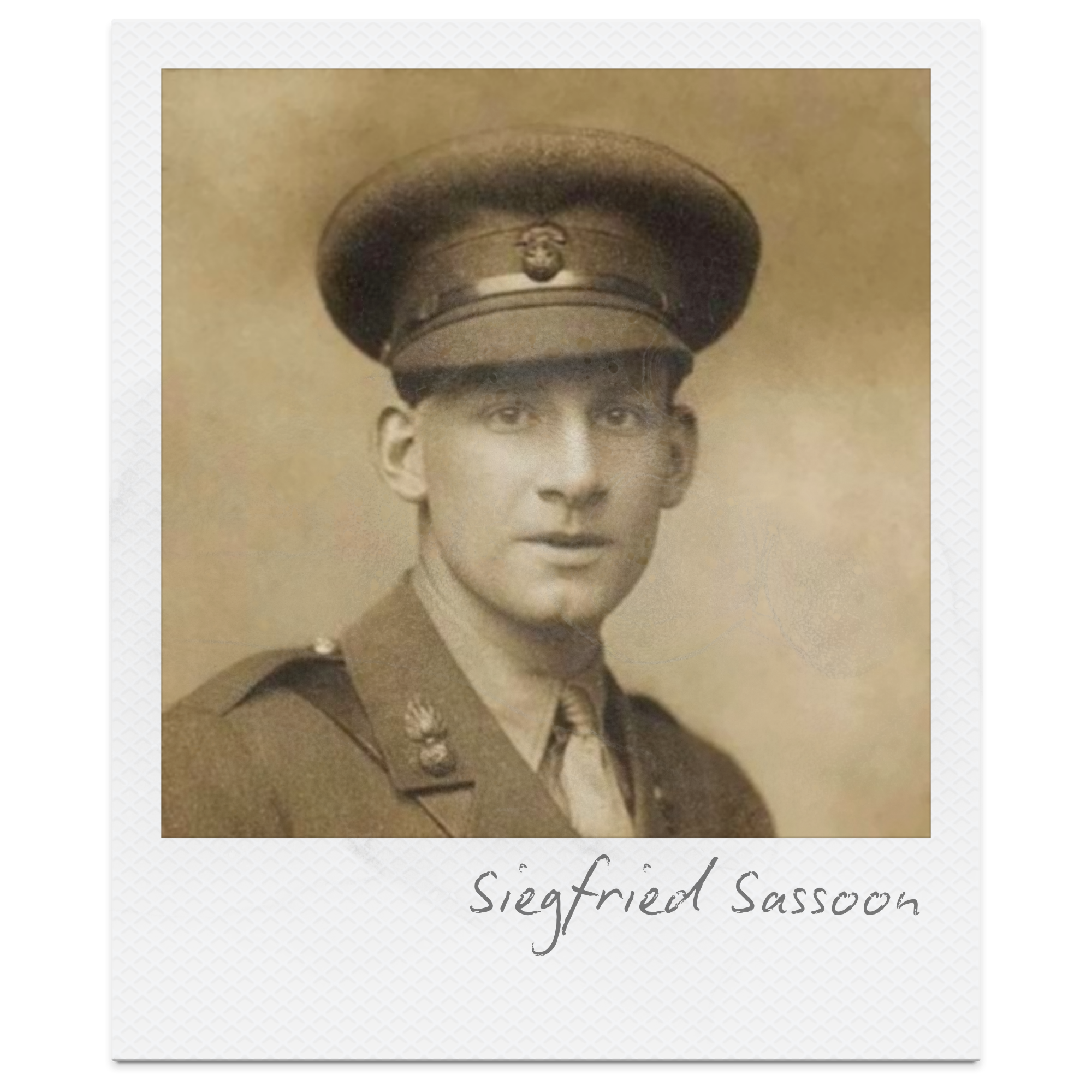
Suicide in the Trenches was published in 1918, near the end of the First World War, when public confidence in the war effort was beginning to fracture. Siegfried Sassoon had served on the Western Front and wrote from direct experience of trench conditions, psychological strain, and loss.
By this point, Sassoon had become a prominent protest poet, openly criticising the continuation of the war and the attitudes that sustained it. His anger was not expressed through emotional excess, but through controlled, disciplined verse that exposes moral failure rather than personal grief.
This context is essential for understanding the poem’s themes. Sassoon’s focus is not only on the suffering of soldiers, but on the wider social responsibility that allows such suffering to be ignored or normalised.
For a fuller discussion of Sassoon’s war experience, protest poetry, and historical background, see the dedicated Siegfried Sassoon context post.
What Suicide in the Trenches Is About
Suicide in the Trenches tells the brief story of a young soldier whose initial cheerfulness is worn down by the realities of trench warfare. The poem moves quickly from innocence and routine to exhaustion, deprivation, and despair.
After enduring the conditions of the trenches, the soldier takes his own life. The poem reports this act without elaboration, before emphasising the silence that follows. His death is absorbed and forgotten.
In the final stanza, the focus shifts away from the soldier and towards the civilian crowds who celebrate war without understanding its cost. The poem exposes the gap between public enthusiasm and private suffering, placing responsibility not with the individual soldier, but with the attitudes that surround him.
Theme 1: The Erasure of the Individual
One of the poem’s most disturbing themes is the erasure of the individual soldier. Sassoon presents a life briefly, removes it abruptly, and then allows it to disappear into silence. The poem does not frame this erasure as tragic inevitability, but as something socially enabled and quietly accepted.
The soldier is introduced as a person before he becomes a casualty. However, his identity is never fully developed, and this limited portrayal mirrors how easily he is forgotten. Sassoon’s restraint reinforces the idea that individual suffering is absorbed into the machinery of war with little resistance.
◆ “I knew a simple soldier boy”
The soldier is defined by youth and ordinariness, not by rank or heroism. He is immediately positioned as replaceable, one among many.
◆ “He put a bullet through his brain.”
The soldier’s death is reported in a single, blunt statement. There is no emotional framing or aftermath, emphasising how quickly life is reduced to fact.
◆ “No one spoke of him again.”
This line completes the process of erasure. Silence replaces remembrance, and the passive phrasing removes any sense of responsibility. Forgetting becomes collective rather than accidental.
Through these moments, Sassoon shows how war does not simply kill individuals, but removes their significance. The soldier is first simplified, then erased, and finally excluded from memory altogether. The poem’s brevity mirrors this process, reinforcing the theme through structure as well as content.
Theme 2: Civilian Complicity and Moral Responsibility
Alongside the erasure of the individual, Suicide in the Trenches delivers a sustained critique of civilian complicity. Sassoon shifts responsibility away from the battlefield and onto those who remain safely removed from it, exposing the moral failure of celebrating war without bearing its consequences.
The final stanza marks a decisive change in focus. The soldier disappears from view, and the poem turns outward. Sassoon does not present civilians as ignorant innocents; instead, he depicts them as actively invested in the spectacle of war, while simultaneously determined to avoid its reality.
◆ “You smug-faced crowds with kindling eye”
The use of direct address confronts the reader and removes emotional distance. The crowds are described as self-satisfied and eager, their excitement revealing a disturbing enthusiasm rather than solemn support.
◆ “Who cheer when soldier lads march by,”
Cheering reduces war to performance. The phrase “soldier lads” emphasises youth and vulnerability, highlighting the contrast between civilian excitement and the soldiers’ actual experience.
◆ “Sneak home and pray you’ll never know”
This line exposes hypocrisy. The verb “sneak” implies guilt and avoidance, while religious language suggests a desire to escape moral responsibility rather than confront it.
◆ “The hell where youth and laughter go.”
The poem ends by redefining war as destructive rather than noble. What civilians celebrate is revealed as a place where innocence is consumed and joy extinguished.
Through this theme, Sassoon insists that responsibility for suffering does not rest solely with those who fight. Instead, it is shared by a society willing to applaud sacrifice from a position of safety, while refusing to acknowledge its cost.
Theme 3: The Reality of Death
Unlike much early war poetry, Suicide in the Trenches presents death without heroism, ritual, or consolation. Sassoon refuses euphemism and avoids framing death as meaningful sacrifice. Instead, it is shown as abrupt, private, and quickly forgotten.
◆ “He put a bullet through his brain.”
The blunt, literal phrasing removes any emotional cushioning. Death is not aestheticised or ritualised; it is reduced to an action and its consequence.
◆ “No one spoke of him again.”
Death is followed not by mourning, but by erasure. The line suggests that remembrance itself is conditional and fragile.
◆ “In winter trenches”
Death is embedded within environment rather than event. The setting suggests that death is not exceptional, but part of daily endurance.
◆ “The hell where youth and laughter go.”
Death is redefined as total loss. What dies is not only the body, but vitality, joy, and possibility.
Through this theme, Sassoon challenges patriotic narratives that assign meaning to death. Instead, he presents it as final, unremarked, and socially inconvenient.
Theme 4: Loss of Innocence
The poem traces the loss of innocence through contrast rather than transformation. Sassoon does not show innocence developing into experience, but being worn down through sustained pressure.
◆ “I knew a simple soldier boy”
The word “boy” foregrounds youth and emotional vulnerability. The soldier is presented as unprepared for the psychological demands of war.
◆ “Who grinned at life in empty joy,”
Early happiness is shallow and fragile. The phrase suggests innocence that lacks depth or resilience.
◆ “Cowed and glum,”
By the second stanza, innocence has been replaced not by maturity, but by emotional defeat. The adjectives suggest suppression rather than growth.
◆ “The hell where youth and laughter go.”
The final line confirms that innocence does not survive war; it is consumed entirely.
Sassoon presents the loss of innocence as inevitable and irreversible, rejecting romantic ideas of growth through conflict.
Theme 5: Isolation and Emotional Withdrawal
Isolation in the poem is both emotional and social, intensifying as the soldier’s suffering goes unacknowledged. Sassoon suggests that isolation does not protect the individual, but enables neglect.
◆ “Slept soundly through the lonesome dark,”
Early isolation is survivable. The soldier can endure loneliness before the war’s effects take hold.
◆ “Cowed and glum,”
The soldier’s emotional state becomes internalised. There is no dialogue or support, only withdrawal.
◆ “He put a bullet through his brain.”
The act of suicide is presented as entirely private, reinforcing the soldier’s isolation at the point of death.
◆ “No one spoke of him again.”
Isolation becomes absolute. The soldier is alone not only in life, but in memory.
Through this theme, Sassoon exposes how isolation allows suffering to remain unseen and unchallenged.
Theme 6: The Horrors of War
Rather than using graphic imagery, Sassoon presents the horrors of war as cumulative, mundane, and psychologically corrosive. The poem suggests that constant deprivation is as destructive as violence.
◆ “In winter trenches”
Cold and discomfort dominate the soldier’s experience, framing war as endurance rather than action.
◆ “With crumps and lice and lack of rum,”
The list blends danger, discomfort, and deprivation, showing how war degrades body and mind simultaneously.
◆ “Cowed and glum,”
Psychological damage is presented as emotional flattening rather than visible breakdown.
◆ “The hell where youth and laughter go.”
War is ultimately defined as a place that consumes vitality and joy, leaving nothing intact.
By refusing spectacle, Sassoon suggests that the true horror of war lies in its ability to normalise suffering until collapse becomes inevitable.
Teaching Suicide in the Trenches Through Themes
Teaching the themes in Suicide in the Trenches works best when students are encouraged to move beyond identifying ideas and towards tracking how those ideas develop across the poem. Sassoon’s restraint means themes often emerge through absence, contrast, and implication, rather than explicit statement.
◆ Assign one theme per group
Give each group a different theme (for example, erasure, civilian responsibility, or loss of innocence) and ask them to track how it develops across all three stanzas. This avoids repetition and encourages ownership.
◆ Link themes to quotation choice
Ask students to justify why a particular quotation best represents a theme. Emphasise that strong quotations often come from moments of silence or understatement, not just dramatic lines.
◆ Compare themes across war poetry
Set one theme (such as the reality of death or horrors of war) alongside another war poem and ask students to compare how each poet approaches it differently.
◆ Separate theme from technique
Encourage students to explain what a theme is before discussing how it is shaped. This helps prevent vague, technique-led responses that lack conceptual clarity.
◆ Build towards evaluative responses
Challenge students to decide which theme they believe is most important in the poem and defend their view using evidence from across the text.
Go Deeper into Suicide in the Trenches
Once students are confident identifying and explaining the poem’s key themes, deeper analysis comes from examining how those ideas interact and which are given greatest weight. These extensions encourage evaluation rather than repetition.
◆ Prioritise the themes
Ask students to rank the themes in order of importance and justify their choices using evidence from across the poem.
◆ Explore tension between themes
Consider how loss of innocence intersects with civilian responsibility, or how erasure depends on silence and social acceptance.
◆ Revisit tone and purpose
Invite students to consider how the poem’s controlled tone shapes the way themes are presented. Does restraint make the protest more effective?
◆ Compare thematic focus across war poetry
Set one theme alongside another war poem and evaluate which approach feels more confronting and why.
◆ Link themes to wider context
Encourage students to connect Sassoon’s thematic concerns to his role as a protest poet and to shifting attitudes towards the war.
Final Thoughts
The themes in Suicide in the Trenches are unsettling precisely because they are presented with such restraint. Sassoon does not rely on graphic imagery or emotional excess; instead, he exposes how erasure, silence, and moral evasion allow suffering to pass unnoticed. The poem’s power lies in its refusal to comfort.
Taken together, the themes reveal a protest that is quiet but uncompromising. Innocence is not sacrificed heroically, death is not redeemed by meaning, and responsibility does not end at the trenches. By turning his focus outward, Sassoon insists that war’s damage is sustained not only by those who fight, but by those who applaud from a distance.
If you’re studying war poetry more widely, you can explore related poems, context posts, and teaching resources in the Literature Library, where Suicide in the Trenches sits alongside other key First World War texts.
Choose Your Next Text