Blood is one of the most powerful and unsettling images a writer can introduce into a story. A single crimson droplet falling onto a white marble floor can suggest danger, while a dark stain spreading across an abandoned room might reveal that something terrible has happened. From the vivid scarlet of a fresh wound to the rust-coloured traces of an old injury, blood possesses distinctive colours, textures and movements that can transform an ordinary description into something deeply atmospheric.
For writers, describing blood effectively involves far more than choosing between red, crimson and scarlet. Blood can trickle, seep, spatter, pool or coagulate, and each movement creates a different visual impression. Its appearance changes according to lighting, surface, quantity and the passage of time. In horror and Gothic fiction, blood frequently becomes a symbol of violence, mortality, corruption and forbidden rituals, while in mystery and thriller writing, even the smallest bloodstain can become an important clue. For more sinister inspiration, explore the Horror Writing Hub, where you'll discover unsettling story ideas, atmospheric settings and creative writing resources designed to build suspense and dread.
Blood also possesses powerful symbolic associations beyond violence and injury. In fantasy, it might represent magical inheritance, ancient oaths or supernatural transformation, while historical and dystopian fiction often use blood imagery to explore sacrifice, oppression and survival. However, effective descriptions require restraint. A few reddish fingerprints upon a locked door may create more tension than an elaborate account of violence, particularly when the reader has no explanation for their presence. The strongest descriptions combine precise vocabulary, meaningful sensory details and an understanding of how the observing character experiences the scene.
This collection of 100 words to describe blood explores ten different aspects of its appearance, movement, texture and literary significance, from vivid colours and fresh bleeding to dried stains, sinister imagery and poetic symbolism. Each word includes a clear meaning, suggestions for when to use it and an original example sentence demonstrating its application in creative writing. For more inspiration, visit the Descriptive Writing Hub for vocabulary collections and practical writing techniques, or explore the Creative Writing Archive for hundreds of original prompts, imaginative settings and storytelling resources across Gothic fiction, horror, fantasy, mystery and more.
Edinburgh, 1828.
The dead were not always permitted to rest in peace.
As the demand for human bodies grew in Edinburgh's anatomical schools, a shadowy trade flourished among graveyards, burial grounds and the narrow closes of the Old Town.
Graves were disturbed.
Bodies disappeared.
Anatomists paid handsomely for specimens whose origins were seldom questioned.
And some of those who entered the anatomy rooms may never have belonged there at all.
A gold mourning ring containing a lock of dark hair, recovered from the possessions of an Edinburgh anatomy lecturer.
A fragment of Blackwood family tartan, believed to have come from the workshop of disgraced coffin makers implicated in the resurrection trade.
A gravekeeper's lantern fitted with an unusual green glass panel, possibly used to signal when a churchyard was safe to enter.
A silver pocket watch stopped at 3:17, concealing a bloodstained fragment of linen.
A glass specimen jar containing a preserved human hand, with a mysterious red thread tied around its little finger.
A pair of tiny coffin shoes, never worn, containing a lock of golden hair and the name of a six-year-old girl.
A plaster death mask of an unidentified young woman, bearing a chilling inscription:
She was breathing.
And a fragment of coffin lid, its inner surface covered in scratches suggesting that someone had desperately tried to escape.
Some objects were recovered from burial grounds.
Others passed through the hands of undertakers, anatomists and private collectors.
A few were discovered in places where they had no reasonable business being.
And not every person associated with these curiosities can be accounted for.
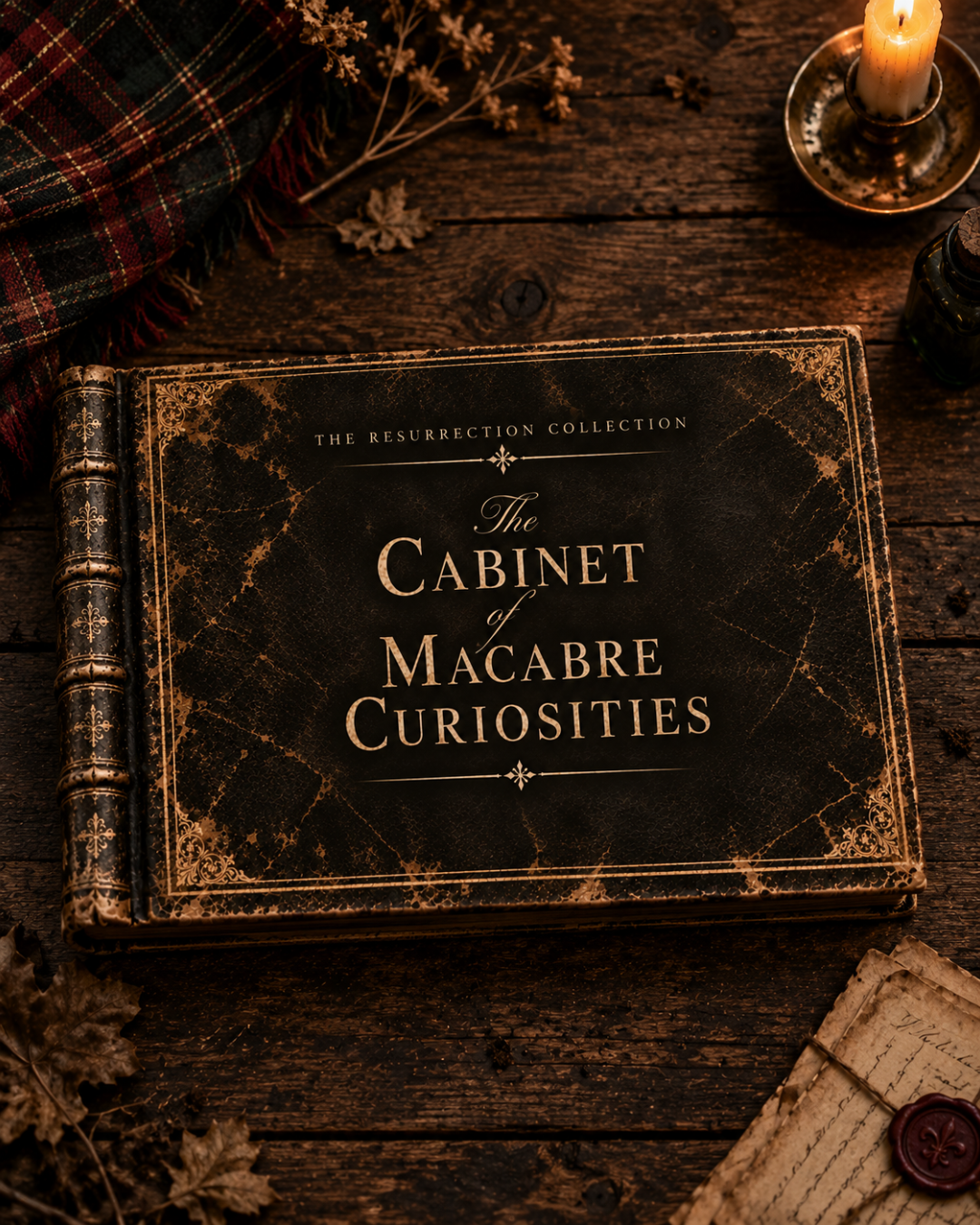
The Resurrection Collection: The Cabinet of Macabre Curiosities is an immersive, beautifully illustrated catalogue of disturbing artefacts, forgotten possessions and mysterious discoveries inspired by Edinburgh's notorious nineteenth-century resurrection trade.
Drawing upon the history of body snatching, Georgian burial customs, anatomical medicine, the darker corners of Edinburgh's Old Town and the unsettling possibilities of Gothic fiction, this fictional archive brings together thirteen macabre curiosities, detailed collector's records, atmospheric archival illustrations and fragments of histories that refuse to remain buried.
Each artefact offers a glimpse into a forgotten life.
Or perhaps a forgotten crime.
Why was a piece of Blackwood tartan recovered from a disgraced coffin-making workshop?
Who carried the gravekeeper's lantern, and what did its unusual green glass signify?
What was concealed inside the anatomist's whisky bottle?
Who was the woman whose hand was preserved in a specimen jar?
Why were a child's coffin shoes kept among an undertaker's possessions?
And who carved the words She was breathing into the back of a death mask?
There are no definitive explanations.
No complete records.
No certainty that every person declared dead had truly died.
Only curious possessions, disturbing discoveries and fragments of Edinburgh's darkest histories waiting to be investigated.
What's Inside?
◆ 13 beautifully illustrated macabre curiosities, each with its own mysterious history, unsettling details and circumstances of acquisition
◆ The collector's introductory letter, introducing a private collection of objects associated with Edinburgh's resurrection trade and anatomical history
◆ Detailed artefact catalogue pages featuring atmospheric hand-drawn illustrations, historical-style descriptions, provenance records and curious observations
◆ Unsettling historical objects, including mourning jewellery, burial relics, grave-robbing equipment, anatomical specimens, medical instruments and mysterious personal possessions
◆ Three illustrated curiosity collections, featuring weathered coffin plates, rusting undertaker's fittings and delicate mourning relics
◆ Atmospheric archival-style illustrations, depicting Edinburgh's graveyards, anatomical theatres, coffin workshops, resurrection men and unidentified individuals
◆ An illustrated collector's inventory, documenting additional anatomical curiosities, mysterious possessions and objects associated with the resurrection trade
◆ Creative writing activities and exploration guidance to inspire historical fiction, Gothic horror, dark mysteries and imaginative investigations
◆ Instant digital download in printable PDF format
Who Is It For?
Perfect for:
◆ Historical fiction writers fascinated by nineteenth-century Edinburgh and its darker history
◆ Gothic horror writers and dark fiction enthusiasts
◆ Lovers of macabre history, grave-robbing mysteries and unusual historical discoveries
◆ Novelists, short-story writers and creative storytellers
◆ Teachers looking for atmospheric visual writing prompts and imaginative historical fiction resources
◆ Fans of anatomical museums, Victorian and Georgian curiosities, and historical mysteries
◆ Mystery and thriller writers seeking unusual clues, suspicious characters and forgotten crimes
◆ Worldbuilders, journalers and solo roleplayers
◆ Lovers of antique collections, cabinets of curiosities and mysterious artefacts
◆ Anyone who enjoys uncovering the disturbing stories hidden inside ordinary-looking possessions
What Makes This Different?
This isn't a traditional collection of writing prompts.
It's a cabinet of objects recovered from a world in which the boundaries between medicine, commerce, death and criminality were dangerously blurred.
Every curiosity suggests a former owner, a questionable transaction, a forgotten incident or a mystery that was never satisfactorily resolved.
But the surviving records are incomplete, the provenance is frequently uncertain, and several objects contain details that raise more questions than they answer.
Examine the Blackwood mourning plaid and consider what happened inside the workshop of the disgraced coffin makers.
Investigate the gravekeeper's lantern and imagine the secret arrangements that might have existed between watchmen and resurrection men.
Study the anatomist's pocket watch and the bloodstained linen concealed inside its case.
Explore the specimen jar and imagine the identity of the woman whose hand was preserved.
Inspect the child's coffin shoes and consider why they were never worn.
Examine the plaster death mask and its terrible inscription.
Study the scratched coffin lid and decide whether its occupant was buried alive, transported while still breathing or the victim of something even more sinister.
Perhaps the lantern was simply an ordinary gravekeeper's possession.
Perhaps the watch belonged to an innocent medical gentleman.
Perhaps the child's shoes were never intended for a burial.
Perhaps the scratches inside the coffin were made long after its original occupant had been removed.
Or perhaps the resurrection trade concealed crimes far more disturbing than the theft of the dead.
You decide what these curiosities mean.
Use the collection to inspire a historical Gothic short story, develop a murder mystery set in Georgian Edinburgh, create a fictional anatomist or resurrection man, or imagine the lives of those whose possessions survived long after their disappearance.
Follow the provenance.
Examine the evidence.
Question the surviving accounts.
Explore the shadowy closes, crowded anatomy rooms and neglected burial grounds of nineteenth-century Edinburgh.
Imagine the secrets that were buried alongside the dead.
And consider what might happen when those secrets are unearthed.
The dead cannot tell their stories. But what if some of them were never dead at all?
Digital download: An illustrated 21-page PDF collection designed in A4 landscape format, featuring thirteen individual macabre curiosities and additional archival material. No physical product will be shipped.
Resurrection: The Cabinet of Macabre Curiosities
Edinburgh, 1828. The dead have secrets, and some are worth killing to protect.
Imagine discovering a bloodstained fragment of linen concealed inside an anatomist's pocket watch. A preserved human hand bound with mysterious red thread. A death mask bearing the chilling inscription She was breathing. What stories might these disturbing objects reveal, and what terrible truths have been deliberately buried?
Welcome to Storyworld Archives, a growing collection of immersive fictional worlds designed to inspire extraordinary creative writing. Rather than beginning with a blank page, writers are invited to explore richly imagined settings, investigate mysterious evidence and uncover the characters, conflicts and secrets hidden within each world. Every discovery offers another possible direction for a story.
Within Storyworld Archives, the Cabinets of Curiosities offer something particularly unusual: themed collections of illustrated artefacts, each with its own history, atmosphere and unanswered questions. These are not conventional writing prompts. They are fragments of fictional worlds waiting to be interpreted, connected and transformed into original narratives.
Resurrection: The Cabinet of Macabre Curiosities transports you to the shadowy streets of nineteenth-century Edinburgh, where anatomical discoveries, grave robbing and whispered accusations blur the boundaries between scientific ambition and Gothic horror. Explore thirteen illustrated curiosities inspired by the city's notorious resurrection trade, from unsettling anatomical specimens to mysterious personal possessions.
Perfect for Gothic fiction, historical mysteries, psychological suspense and dark creative writing, Resurrection offers a million stories in one download.

1. Blood Colours & Shades
The colour of blood is one of its most immediately recognisable characteristics, yet describing it effectively involves far more than reaching for familiar words such as red, crimson or scarlet. Depending upon its freshness, concentration, surrounding light and the surface upon which it appears, blood can display a surprisingly varied range of colours. A fresh droplet might appear brilliantly red against white porcelain, while a stain absorbed into an old carpet may have darkened to a dull, reddish brown.
For writers, colour can help establish the atmosphere and circumstances of a scene. Bright red blood against freshly fallen snow creates an immediate and disturbing contrast, while dark, almost black stains upon the floorboards of an abandoned house might suggest an event that occurred long before the characters arrived. Candlelight can lend blood a warm, glossy appearance, whereas cold daylight may expose its colour with uncomfortable clarity. These visual differences can influence whether a description feels immediate, clinical, mysterious or deeply unsettling.
Blood colour also carries powerful associations across different literary genres. Gothic fiction frequently employs deep reds and dark, oxidised stains to evoke mortality, violence and concealed histories. In fantasy, unusual blood colours might suggest supernatural ancestry, magical transformation or creatures whose physiology differs from that of ordinary humans. Crime fiction and psychological thrillers can use colour as one descriptive detail among others when characters examine suspicious evidence, although appearance alone cannot reliably establish how long blood has been present.
These first ten words explore the colours, shades and visual qualities associated with blood, helping you create descriptions that feel precise, atmospheric and appropriate to the emotional intensity of your scene.
1. Crimson
Meaning: A rich, deep red colour, sometimes possessing a subtle purplish undertone, commonly associated with blood and other intensely coloured substances.
Best for: Gothic fiction, fresh blood, dramatic visual contrasts, historical mysteries, dark fantasy and descriptions requiring a rich, saturated red.
Example: A crimson stain spread slowly across the embroidered tablecloth, its vivid colour standing out against the delicate white roses stitched into the linen.
2. Scarlet
Meaning: A brilliant, vivid red with a slightly warm or orange undertone, generally appearing brighter than crimson.
Best for: Fresh bleeding, striking colour contrasts, dramatic discoveries, horror fiction and scenes involving bright natural illumination.
Example: Three scarlet droplets marked the freshly fallen snow, their brilliant colour forming an unmistakable trail towards the dark entrance of the forest.
3. Vermilion
Meaning: A vivid reddish-orange colour traditionally associated with a brilliant red pigment, suggesting a particularly warm and intense shade.
Best for: Painterly descriptions, stylised horror, fantasy imagery, blood illuminated by warm light and vivid visual contrasts.
Example: Beneath the orange glow of the lantern, the blood upon the marble steps appeared almost vermilion, its warm brilliance contrasting with the cold grey stone.
4. Ruby
Meaning: A deep, brilliant red resembling the colour of a ruby gemstone, often suggesting richness, translucence or reflected light.
Best for: Individual blood droplets, Gothic imagery, poetic descriptions, fantasy fiction and scenes emphasising the visual beauty of something disturbing.
Example: A single ruby-red droplet clung to the tip of the silver dagger, trembling in the candlelight before falling onto the polished wooden floor.
5. Carmine
Meaning: A strong, deep red colour traditionally associated with a pigment derived from cochineal insects, sometimes displaying a slightly cool or purplish tone.
Best for: Historical fiction, Gothic descriptions, artistic imagery, rich red stains and scenes requiring an alternative to crimson.
Example: Carmine streaks marked the pale silk of her evening gown, their saturated colour becoming more conspicuous as she stepped beneath the ballroom chandeliers.
6. Maroon
Meaning: A dark, brownish-red colour, less brilliant than scarlet or crimson and often associated with deep, muted red tones.
Best for: Older bloodstains, dried or partially dried blood, dark fabrics, abandoned interiors and descriptions of subdued, unsettling colour.
Example: A maroon stain had settled into the grain of the wooden floorboards, its darkened edges almost disappearing beneath the accumulated dust.
7. Burgundy
Meaning: A rich, dark red with purple or brown undertones, resembling the colour traditionally associated with Burgundy wine.
Best for: Deep red blood in shadow, Gothic interiors, dark fantasy, richly coloured fabrics and atmospheric descriptions involving subdued lighting.
Example: In the dimness of the abandoned chapel, the blood upon the altar appeared burgundy, its dark surface reflecting the faint movement of the candles.
8. Rust-coloured
Meaning: Having a reddish-brown or orange-brown appearance resembling iron rust, often useful for describing the discolouration of older bloodstains.
Best for: Dried blood, old clothing, historical mysteries, neglected buildings, forensic discoveries and unsettling traces of past violence.
Example: Rust-coloured marks remained upon the cuffs of the abandoned coat, their irregular outlines suggesting stains that repeated washing had failed to remove.
9. Brownish
Meaning: Having a noticeable brown tint or undertone, often describing blood that has darkened through drying or exposure to the surrounding environment.
Best for: Aged stains, realistic descriptions, crime fiction, forensic observations and subtle evidence discovered on fabric, furniture or walls.
Example: Beneath the peeling wallpaper, she discovered a series of brownish streaks that extended towards the skirting board, almost indistinguishable from the water damage surrounding them.
10. Blackened
Meaning: Having become extremely dark in appearance, sometimes approaching black because of drying, heavy concentration, shadow or changes to the surrounding material.
Best for: Old bloodstains, Gothic horror, decaying interiors, sinister discoveries and descriptions emphasising darkness or the passage of time.
Example: Blackened patches marked the stone beneath the cellar window, their irregular shapes barely visible until the detective directed his torch towards the floor.
Writing Tip: How to Describe Blood Colour Effectively
When describing the colour of blood, begin by considering what the observing character can realistically see. A fresh droplet resting upon white porcelain may reveal a vivid red colour and glossy surface, while blood absorbed into dark clothing might be difficult to distinguish without closer examination. The colour should emerge naturally from the circumstances of the scene rather than functioning as an elaborate description added purely for dramatic effect.
Lighting can dramatically influence how blood appears. Bright daylight may emphasise the contrast between fresh blood and pale surroundings, while candlelight can introduce warm reflections that make a dark red surface appear richer. In poorly illuminated rooms, blood may look almost black, particularly when it has collected in a concentrated area. Consider how a character's understanding of what they are seeing might change as they move towards a window, raise a lantern or illuminate a previously concealed surface.
The material upon which blood appears is equally important. Blood resting upon glass, polished metal or glazed porcelain may retain a glossy appearance, whereas blood absorbed into linen, paper or unfinished wood can produce irregular stains with softened edges. A small amount of blood on a dark carpet might be barely noticeable, while the same quantity against white silk could become the most striking detail in the room. These contrasts allow writers to establish visual intensity without relying upon increasingly dramatic adjectives.
Be careful when describing older bloodstains. Although blood commonly darkens towards reddish-brown as it dries and changes over time, its appearance is influenced by several factors, including the surface, environmental conditions and the amount present. A dark stain does not automatically prove that blood is particularly old, and colour alone cannot establish precisely when an injury occurred. In crime fiction, this distinction is especially important when characters are interpreting physical evidence.
Colour can also create symbolic meaning. Crimson against white may suggest innocence disrupted by violence, while a dark stain upon an inherited wedding dress might evoke family secrets, betrayal or an unresolved tragedy. In Gothic fiction, these contrasts can be especially powerful when the surrounding objects already possess emotional significance. A bloodstained letter, childhood toy or religious artefact may feel more disturbing than an anonymous patch of colour because readers recognise what the object represents.
Avoid relying too heavily upon familiar comparisons involving rubies, wine and roses. Although such imagery can be effective, repeatedly describing blood as liquid rubies or crimson wine can make violent scenes feel unnecessarily decorative. Instead, consider what makes the particular image distinctive: the shape of a stain, the way light catches its surface, the material absorbing it or the character's response upon recognising what it is.
For example, rather than writing The floor was covered in bright crimson blood that looked like spilled rubies, you might describe how a narrow red stain crossed the pale floorboards, disappearing beneath a locked door before reappearing on the other side of the threshold.
The second description establishes colour while introducing a visual mystery, allowing the reader to wonder what happened beyond the door.
Remember that blood does not always need to dominate the scene. A faint brownish mark upon a handkerchief might suggest illness or concealed injury, while a small scarlet fingerprint on a letter could become a crucial detail in a murder mystery. Restraint is particularly effective when the presence of blood is unexpected or when its significance has not yet been explained.
Finally, allow the viewpoint character to influence your descriptive choices. A surgeon may notice the amount and appearance of blood with professional detachment, while an inexperienced witness might register only the shocking contrast of red against white. A frightened character may struggle to look directly at a wound, focusing instead upon a single droplet falling onto the floor. These differences make the description part of the character's experience rather than an isolated catalogue of visual details.
The strongest descriptions of blood colour combine precise vocabulary with lighting, surface, atmosphere and narrative purpose. By choosing shades that suit the circumstances and allowing visual details to reveal something meaningful about the scene, you can create imagery that feels vivid, convincing and deeply atmospheric.
2. Blood Texture & Consistency
The texture and consistency of blood can make a description particularly vivid, transforming a simple visual observation into something the reader can almost physically experience. Blood may appear thin and fluid as it runs across a smooth surface, thick and sluggish as it gathers in a shallow depression, or sticky as it begins to dry upon skin or fabric. These differences contribute to the atmosphere of a scene, helping writers communicate the physical presence of blood without relying exclusively upon colour.
For writers, describing blood texture effectively involves considering its condition, surroundings and interaction with different materials. Fresh blood typically has a fluid consistency, although its appearance can change as clotting and drying occur. A droplet upon polished glass may remain rounded and glossy, while blood absorbed into coarse fabric can leave a darker, uneven patch. On skin, partially dried blood may feel tacky, whereas a fully dried stain can become stiff, brittle or crusted. Such details can make descriptions more convincing, particularly when a character touches an unfamiliar substance or discovers evidence of an earlier injury.
Texture is especially useful in Gothic fiction, horror and psychological suspense because it introduces an intimate, sometimes uncomfortable sensory dimension. A character might discover something sticky beneath their fingertips while searching for a light switch, notice a dark crust upon an abandoned surgical instrument or find that the pages of an old manuscript have become stiff where an unidentified substance has dried between them. The reader's discomfort often emerges from the gradual recognition of what the character has encountered, rather than from an elaborate description of violence.
These ten words explore the physical qualities of blood, from its smooth, liquid appearance to the thickened, tacky and crusted textures associated with clotting and drying. Each offers a different way to introduce realistic sensory detail and strengthen the atmosphere of your creative writing.
11. Viscous
Meaning: Having a relatively thick consistency that resists flowing freely, often describing liquids that move more slowly than water.
Best for: Concentrated pools of blood, close-up observations, medical or anatomical settings, Gothic horror and descriptions emphasising slow movement.
Example: A viscous trickle of blood moved across the uneven stone, gathering briefly within the shallow grooves before continuing towards the edge of the examination table.
12. Sticky
Meaning: Having an adhesive or tacky quality that causes a substance to cling to skin, clothing or other surfaces, particularly as moisture begins to evaporate.
Best for: Partially dried blood, tactile descriptions, crime fiction, unsettling discoveries and scenes involving physical contact with a bloodstained object.
Example: Her fingers encountered something sticky beneath the brass door handle, and when she withdrew her hand, a dark red smear marked the tips of her gloves.
13. Tacky
Meaning: Slightly sticky to the touch, often describing a substance that has begun to dry but has not yet become completely solid.
Best for: Drying blood, realistic sensory details, forensic discoveries, psychological suspense and subtle descriptions of an unpleasant surface.
Example: The stain upon the leather armrest had become tacky, clinging faintly to his fingertips when he touched its darkened edge.
14. Coagulated
Meaning: Having undergone clotting, in which liquid blood forms a thicker, gel-like mass through the action of clotting proteins and blood cells.
Best for: Clotted blood, anatomical descriptions, medical scenes, realistic injury details, historical horror and close observations of blood that is no longer freely flowing.
Example: Beneath the overturned chair, a small mass of coagulated blood rested against the skirting board, its uneven surface catching the pale light from the window.
15. Clotted
Meaning: Thickened into a semi-solid mass through the process of coagulation, often producing irregular, gel-like formations rather than a smooth liquid surface.
Best for: Wounds, medical descriptions, Gothic horror, disturbing discoveries and scenes involving the physical aftermath of an injury.
Example: Clotted blood darkened the torn edge of his sleeve, forming irregular patches where the fabric had pressed against the wound.
16. Gelatinous
Meaning: Having a soft, jelly-like consistency, often appearing flexible, semi-solid or slightly translucent.
Best for: Blood clots, anatomical specimens, close-up horror descriptions, medical settings and scenes emphasising an unusual or disturbing texture.
Example: A gelatinous clot rested inside the cracked porcelain basin, its dark red surface trembling slightly when the table was disturbed.
17. Glossy
Meaning: Possessing a smooth, shiny surface that reflects light, particularly when a substance remains wet.
Best for: Fresh blood droplets, reflective surfaces, candlelit Gothic scenes, dramatic visual contrasts and descriptions emphasising moisture.
Example: The glossy surface of the blood reflected the candle flame, creating a tiny, distorted point of light within the dark red droplet.
18. Crusted
Meaning: Covered with or formed into a hardened outer layer, often resulting from a liquid substance drying upon a surface.
Best for: Dried blood, old wounds, bloodstained clothing, abandoned objects, historical fiction and discoveries suggesting an earlier injury.
Example: Crusted blood marked the narrow seam of the surgeon's leather bag, collecting around the stitching where ordinary cleaning had failed to reach.
19. Flaking
Meaning: Breaking away or separating into small, thin fragments, particularly when a dried substance has become brittle or is disturbed.
Best for: Old bloodstains, neglected objects, dried wounds, forensic observations and atmospheric descriptions of decay or abandonment.
Example: The flaking blood upon the wooden handle broke away in tiny reddish-brown fragments when she lifted the instrument from its velvet-lined case.
20. Congealed
Meaning: Having thickened or become semi-solid, often through cooling, clotting or another physical change that reduces a substance's fluidity.
Best for: Thickened blood, Gothic horror, anatomical imagery, stagnant-looking pools and descriptions emphasising an unpleasant, semi-solid appearance.
Example: Congealed blood lay within the shallow recesses of the stone altar, its dark, uneven surface disturbed only by the movement of a solitary insect.
Writing Tip: How to Describe Blood Texture Without Overusing Graphic Detail
When describing blood texture, begin by considering whether the character is observing it visually or experiencing it through physical contact. A distant observer might notice a glossy surface, a thickened patch or a crusted stain, but they would not necessarily know whether the substance felt sticky or tacky. These tactile qualities become more meaningful when a character touches an object, brushes against a surface or discovers something unexpected beneath their fingertips. Allowing the description to emerge through the character's experience makes the sensory detail feel natural rather than unnecessarily intrusive.
The distinction between wet, drying and dried blood can be particularly useful. Fresh blood is generally fluid, although its appearance depends upon the circumstances and quantity present. As clotting occurs, portions may become thicker or form gel-like masses, while blood exposed to air can gradually lose moisture and leave a hardened residue. These processes are not interchangeable, and writers should avoid treating every dark or thickened stain as evidence of a specific amount of elapsed time. Environmental conditions, the surface involved and other factors can influence how blood changes.
Consider how different materials affect texture. Blood absorbed into cotton or linen may stiffen the fibres as it dries, creating a roughened patch that feels different from the surrounding fabric. On polished metal or glass, a small quantity may dry into a relatively thin residue, while blood trapped within the grooves of carved wood can form irregular crusts. A bloodstained leather glove might feel rigid around the fingers, whereas an old stain upon a stone floor may be noticed primarily through its uneven surface.
These interactions are particularly valuable when describing mysterious objects. An abandoned surgical instrument, a bloodstained letter or a piece of clothing recovered from a locked trunk becomes more convincing when the physical details reflect the material involved. Rather than simply announcing that an object is covered in blood, describe where the substance has collected, how it has altered the surface and what the character notices when examining it.
Texture can also create suspense through delayed recognition. A character entering a dark room may initially register a sticky sensation beneath their palm without understanding its cause. Another might notice that a book's pages resist opening, discovering only later that a dark substance has dried along their edges. These moments allow the reader to experience the gradual revelation alongside the character, making a relatively small detail more unsettling than an immediate description of a large quantity of blood.
For example, rather than writing Her hands were covered in disgusting, sticky blood, you might describe how her fingers caught against the wooden banister as she descended the staircase, leaving a faint reddish mark upon the pale paint when she pulled them away.
The second description introduces texture through action while allowing the significance of the discovery to emerge naturally. It also gives the reader a specific visual detail to imagine, rather than relying upon a general statement about unpleasantness.
Be selective with particularly graphic vocabulary. Words such as gelatinous, clotted and congealed can be effective when the physical circumstances justify them, but repeated use may make a scene feel exaggerated or unintentionally grotesque. In psychological horror, a single disturbing texture can be more effective than an extended catalogue of bodily details. A small crusted stain upon a child's abandoned toy, for instance, may evoke considerably more unease than a lengthy description of a violent injury.
The genre and narrative perspective should also influence the level of detail. A medical professional might distinguish between fluid blood, clot formation and dried residue using relatively precise terminology. A frightened witness, however, may describe the same material in simpler terms, noticing only that it looks thick, feels sticky or has hardened against a surface. Historical fiction may require particular care with technical vocabulary, especially when the observing character would not possess modern medical knowledge.
Remember that texture can contribute to atmosphere without becoming the central focus of a scene. In Gothic fiction, a brittle stain upon an old letter might suggest a concealed tragedy, while the glossy surface of a fresh droplet could introduce an immediate sense of danger. In a crime thriller, the stiffened cuff of a discarded shirt might become an important detail during an investigation. The physical quality of the blood should support the narrative rather than distract from it.
Finally, consider the emotional response created by tactile description. Unexpected contact with an unidentified sticky substance may provoke alarm, disgust or confusion, while the discovery of dried blood on a treasured possession might evoke grief or suspicion. The same texture can therefore carry very different meanings depending upon the circumstances and the character experiencing it.
The strongest descriptions of blood texture combine physical accuracy with sensory restraint and narrative purpose. By considering the condition of the blood, the surface it touches and the perspective of the observing character, you can create descriptions that feel convincing, atmospheric and unsettling without relying upon unnecessary graphic detail.
3. Blood Movement & Flow
The movement of blood can transform a static description into something immediate, unsettling and dramatically compelling. A single droplet descending the edge of a knife creates a different impression from blood spreading silently across a tiled floor, while a narrow trickle emerging beneath a locked door can suggest danger before the reader understands what has happened. By describing how blood moves, writers can establish pace, atmosphere and tension without relying exclusively upon the appearance of an injury.
For writers, blood movement offers opportunities to explore the relationship between action, gravity and the surrounding environment. Blood may drip from an elevated surface, seep through fabric, trickle along uneven stone or spread across polished flooring. Its movement depends upon the amount present, the surface involved and the circumstances of the scene. A small droplet may cling briefly to an object before falling, while a larger quantity can follow the contours of a floor or collect within shallow depressions. These details help create physical descriptions that feel convincing rather than exaggerated.
In Gothic fiction and psychological horror, the slow movement of blood can be particularly effective in building suspense. A dark line creeping beneath a bedroom door might suggest an unseen catastrophe, while a succession of droplets falling into an empty basin can introduce an unsettling rhythm. Crime fiction can use the position and distribution of blood as narrative details that prompt questions about an event, although its movement and patterns should not be treated as straightforward proof of precisely what occurred. In fantasy, blood might behave in impossible ways, rising against gravity, tracing enchanted symbols or responding to a supernatural presence.
These ten words explore the different ways blood can move, from individual droplets and narrow streams to spreading stains and sudden releases. Each offers opportunities to create movement, develop suspense and strengthen the sensory atmosphere of your writing.
21. Dripping
Meaning: Falling in separate drops, usually from an elevated surface or object, often at intervals rather than as a continuous stream.
Best for: Suspenseful discoveries, Gothic horror, bloodstained objects, unsettling sounds and scenes involving slow, deliberate movement.
Example: Blood was dripping from the edge of the examination table, each dark droplet striking the tiled floor with a faint sound that seemed unnaturally loud in the deserted room.
22. Trickling
Meaning: Flowing in a small, narrow stream, usually moving slowly along a surface or downwards under the influence of gravity.
Best for: Minor bleeding, blood moving across skin, Gothic imagery, close-up observations and descriptions emphasising gradual movement.
Example: A thin line of blood trickled from the corner of his mouth, following the curve of his chin before disappearing beneath the collar of his white shirt.
23. Seeping
Meaning: Passing slowly through small openings, porous materials or narrow spaces, often becoming visible gradually.
Best for: Bloodstained clothing, concealed injuries, mysterious discoveries, psychological suspense and scenes involving blood emerging through fabric or beneath objects.
Example: Blood began seeping through the folded handkerchief pressed against her palm, gradually staining the embroidered initials a deep, uneven red.
24. Oozing
Meaning: Flowing slowly and steadily from an opening or surface, often suggesting a small quantity of liquid emerging without force.
Best for: Wound descriptions, medical scenes, horror fiction, injuries and close observations of slow bleeding.
Example: Blood oozed from the shallow cut across his knuckles, gathering along the creases of his skin before slipping towards his wrist.
25. Streaming
Meaning: Flowing in a continuous, relatively uninterrupted movement, often forming a visible line or stream.
Best for: Active bleeding, dramatic confrontations, injuries, action scenes and descriptions requiring a stronger sense of movement than trickling.
Example: Blood streamed down the side of his face from a wound near his hairline, crossing his cheek and darkening the collar of his coat.
26. Gushing
Meaning: Flowing out suddenly and in a large quantity, often with considerable force or rapid movement.
Best for: Serious injuries, dramatic emergencies, battlefield scenes, intense horror and moments requiring an immediate sense of danger.
Example: Blood gushed from the wound as he stumbled against the stone wall, leaving a vivid red stain upon the pale fabric of his shirt.
27. Spurting
Meaning: Emerging in sudden, forceful bursts rather than flowing continuously, sometimes describing blood released under pressure.
Best for: Severe injuries, medical emergencies, violent confrontations, realistic action scenes and descriptions of intermittent, forceful bleeding.
Example: Blood spurted briefly from the injured man's arm before the surgeon pressed a folded cloth firmly against the wound and called for assistance.
28. Spreading
Meaning: Extending gradually across a surface or through a material, increasing the area covered as the liquid moves or is absorbed.
Best for: Blood pooling on floors, stains expanding through fabric, atmospheric discoveries, psychological horror and descriptions emphasising gradual visual change.
Example: A dark red stain was spreading across the white tablecloth, slowly obscuring the delicate floral embroidery beneath the overturned glass.
29. Pooling
Meaning: Collecting in a relatively still accumulation of liquid, usually within a shallow depression or upon a surface that prevents it from draining away.
Best for: Crime scenes, Gothic horror, abandoned interiors, dramatic discoveries and descriptions of blood gathering in one place.
Example: Blood was pooling beneath the overturned chair, filling the shallow spaces between the uneven floorboards before reaching the edge of the faded carpet.
30. Trailing
Meaning: Extending behind a moving person or object, or forming a line of marks that indicates a path or direction.
Best for: Mysterious blood trails, crime fiction, suspenseful discoveries, injured characters moving through a setting and Gothic investigations.
Example: Small droplets of blood trailed across the deserted corridor, disappearing around the corner towards a staircase that had supposedly been locked for years.
Writing Tip: How to Describe Blood Movement & Flow Effectively
When describing blood movement, begin by considering the amount of blood present and the physical circumstances that determine how it behaves. A small quantity may form individual droplets, cling to a surface or travel in a narrow trickle, while a larger amount can spread across flooring or gather in a shallow depression. Choosing a verb that reflects the actual movement creates a more convincing description than using dramatic language simply to intensify the scene.
The distinction between dripping, trickling, seeping and oozing is particularly useful. Dripping suggests separate drops falling from an object or surface, while trickling describes a narrow, continuous flow. Seeping usually involves liquid passing slowly through fabric, porous material or a confined opening, whereas oozing suggests a gradual release from a wound or another source. Although these movements can overlap, selecting the most precise word helps readers imagine what is happening.
Consider how gravity influences movement. Blood travelling down someone's arm may follow the contours of the skin, while a droplet hanging from the edge of a table may remain suspended briefly before falling. On an uneven stone floor, liquid can move into shallow grooves or collect against raised edges. A stain spreading across fabric behaves differently because the fibres absorb and distribute moisture. These physical details are especially important when describing close-up observations.
The surrounding environment can make movement more visually distinctive. Blood falling onto polished marble may remain visible as individual droplets, while blood reaching a thick carpet may be absorbed into the fibres. A narrow stream crossing a sloping surface can change direction as it encounters cracks, joints or obstacles. In a historical setting, blood might travel along the grooves of old wooden floorboards, while a modern crime scene could involve smooth tiles, glass or metal.
Movement also influences the pacing of a scene. A single droplet falling at regular intervals can slow the narrative, encouraging the reader to concentrate upon an otherwise insignificant sound. By contrast, a sudden rush of blood during an emergency can create urgency and confusion. Writers can use sentence length and rhythm to reinforce these effects, allowing slow movement to unfold through careful observation while rapid events are described with greater immediacy.
For example, rather than writing Blood was flowing everywhere across the floor, you might describe how a narrow red line emerged beneath the locked door, followed the uneven join between two tiles and gradually widened as it reached the centre of the corridor.
The second description gives the reader a specific movement to follow. It also introduces a mystery: something has happened behind the door, but neither the observing character nor the reader yet understands what.
In Gothic fiction and psychological horror, the movement of blood can become especially unsettling when its source remains concealed. A character might notice droplets falling from the ceiling of an apparently empty room, discover a dark stain slowly emerging through the pages of an old manuscript or watch a thin red line descend the surface of a portrait. These images create tension because they suggest an event or presence that has not yet been explained.
Sound can strengthen descriptions of movement when used selectively. A droplet striking the bottom of a metal basin may produce a faint, recognisable noise, while blood falling onto thick fabric may make almost no audible impression. In a silent environment, even a small repetitive sound can attract a character's attention. Rather than describing every movement visually, consider whether the character might hear something before discovering its source.
Be careful with verbs that imply considerable force. Gushing and spurting suggest more intense bleeding than trickling or oozing, and they should be reserved for circumstances where that movement is plausible. Spurting blood may occur in certain serious vascular injuries, but not every wound produces forceful or rhythmic bleeding. Similarly, blood does not necessarily spread evenly across every surface. Physical accuracy helps maintain the reader's trust, particularly in realistic crime fiction and medical scenes.
Fantasy and supernatural horror offer opportunities to depart deliberately from these expectations. Blood might flow upwards across a wall, gather into unfamiliar symbols or move independently of gravity. Such imagery becomes more effective when the writer first establishes how ordinary blood should behave. A character who watches a droplet stop halfway down a window and begin moving upwards has encountered something impossible precisely because the movement contradicts familiar physical behaviour.
Finally, consider the observing character's emotional response. A detective might follow a blood trail with deliberate attention, examining where it begins and disappears, while a frightened witness may notice only that the stain is moving closer to their feet. A wounded character might become aware of blood travelling beneath their clothing before recognising the seriousness of an injury. These different perspectives allow movement to contribute to characterisation as well as atmosphere.
The strongest descriptions of blood movement combine precise verbs, convincing physical behaviour and meaningful narrative context. By considering how blood travels, where it collects and what its movement reveals or conceals, you can create scenes that feel immediate, atmospheric and dramatically compelling.
4. Blood Drops, Splashes & Stains
The marks left behind by blood can be just as evocative as the blood itself. A solitary droplet upon a pristine white pillow might suggest a concealed injury, while a series of reddish stains across an abandoned staircase could raise disturbing questions about what happened there. Blood does not always appear in obvious pools or continuous streams. Sometimes, its presence is revealed through tiny specks, irregular splashes, smeared fingerprints or discoloured patches that have become part of the surrounding material.
For writers, the shape, size and distribution of bloodstains offer opportunities to create visual interest and narrative intrigue. Blood falling onto a hard surface may leave distinct droplets, while contact with a porous material can produce softer, less defined marks. A hand brushed against a painted wall might leave a streak, whereas blood transferred from an object could create an irregular impression. These differences help establish the physical environment and encourage readers to examine seemingly insignificant details alongside the characters.
Bloodstains are particularly effective in mystery, thriller and Gothic fiction because they suggest events that may have occurred beyond the reader's knowledge. A faded handprint beneath layers of wallpaper, a scattering of dark specks upon a forgotten wedding dress or a reddish mark inside a locked drawer can become the beginning of an unsettling discovery. Such details can also reveal something about a character's emotional state. A detective may study an unfamiliar stain with professional curiosity, while someone returning to a childhood home might recognise the same mark with immediate dread.
These ten words explore the different shapes, patterns and impressions blood can leave behind, from individual droplets and fine specks to smears, streaks and saturated patches. Each provides a way to describe bloodstains with greater precision while allowing their appearance to contribute naturally to the atmosphere and mystery of your scene.
31. Droplet
Meaning: A small, individual drop of liquid, often rounded or slightly elongated depending upon the surface and circumstances.
Best for: Subtle blood evidence, Gothic imagery, close-up descriptions, delicate visual contrasts and mysterious discoveries involving very small quantities of blood.
Example: A solitary droplet of blood rested upon the ivory keys of the abandoned piano, its brilliant red colour startling against the instrument's yellowed surface.
32. Speckled
Meaning: Marked with numerous small spots or specks, often scattered across a surface rather than concentrated in one area.
Best for: Fine bloodstains, clothing, wallpaper, furniture, unsettling discoveries and descriptions involving numerous small marks.
Example: The lace curtains were speckled with tiny reddish marks, barely noticeable until the afternoon sunlight illuminated the delicate fabric.
33. Spattered
Meaning: Marked by small drops of liquid scattered or dispersed across a surface, often producing an irregular distribution of spots.
Best for: Bloodstained walls, crime scenes, violent incidents, forensic descriptions and atmospheric details suggesting a sudden disturbance.
Example: The pale plaster surrounding the fireplace was spattered with dark red droplets, their irregular distribution interrupting the otherwise immaculate drawing room.
34. Splattered
Meaning: Marked by liquid that has struck or spread across a surface, often creating irregular spots, patches or larger scattered stains.
Best for: Dramatic discoveries, horror fiction, bloodstained clothing, action scenes and descriptions emphasising conspicuous, uneven markings.
Example: Blood had splattered across the cracked bathroom mirror, obscuring part of her reflection beneath a scattering of irregular crimson marks.
35. Smeared
Meaning: Spread across a surface through contact or rubbing, often producing a blurred, uneven mark rather than a distinct droplet.
Best for: Bloody fingerprints, disturbed surfaces, injured characters, crime fiction and mysterious evidence suggesting physical contact.
Example: A reddish stain was smeared across the inside of the wardrobe door, as though someone had pressed a bloodied hand against the wood and dragged it sideways.
36. Streaked
Meaning: Marked with long, narrow lines or bands of colour, often created when liquid travels or is drawn across a surface.
Best for: Blood on glass, walls, mirrors, clothing, Gothic interiors and descriptions involving elongated marks.
Example: The tall windows were streaked with dried blood, narrow reddish-brown lines descending through the dust towards the cracked wooden frames.
37. Blotched
Meaning: Covered or marked with irregular patches of colour, often varying in size, shape or intensity.
Best for: Bloodstained fabrics, old documents, damaged clothing, historical mysteries and descriptions of uneven discolouration.
Example: The yellowed pages of the physician's journal were blotched with dark reddish stains, several of which had spread across the handwritten observations.
38. Mottled
Meaning: Displaying irregular patches or variations of colour, creating an uneven, spotted or marbled appearance.
Best for: Partially absorbed bloodstains, aged fabrics, porous surfaces, Gothic artefacts and subtle descriptions of uneven colour.
Example: The linen bandage had become mottled with reddish-brown patches, its once-white surface showing uneven traces of the injury beneath.
39. Imprinted
Meaning: Marked with a recognisable shape or impression left through contact or pressure, sometimes preserving the outline of an object or part of the body.
Best for: Bloody handprints, fingerprints, transferred stains, mysterious clues, Gothic investigations and descriptions of recognisable markings.
Example: A small handprint was imprinted in dried blood upon the nursery wall, its five narrow fingers clearly visible beneath the peeling blue paint.
40. Saturated
Meaning: Thoroughly soaked or filled with liquid, often describing a material that has absorbed a substantial quantity.
Best for: Blood-soaked clothing, bandages, upholstery, heavy staining, medical scenes and descriptions of absorbent materials.
Example: The folded linen beneath the injured man's shoulder was saturated with blood, its original white colour almost entirely concealed by the spreading red stain.
Writing Tip: How to Describe Bloodstains with Precision and Atmosphere
When describing bloodstains, begin by considering the surface upon which the blood has landed. Different materials produce different visual effects, and these distinctions can make a description feel more convincing. Blood resting upon polished glass may retain relatively distinct edges, while blood absorbed into paper, linen or unfinished wood can spread through the material and produce softer, irregular boundaries. A droplet upon glazed porcelain may appear rounded and glossy, whereas the same amount reaching a woollen carpet might disappear into the fibres, leaving only a small patch of discolouration.
The size and distribution of stains can also influence the reader's understanding of a scene. A single droplet invites attention because it appears isolated, particularly when discovered somewhere unexpected. Numerous scattered marks may suggest that something disturbed the surrounding environment, while a broad, saturated patch can indicate that an absorbent material has come into contact with a substantial amount of blood. These observations should remain descriptive rather than automatically becoming conclusions about the event that produced them.
In crime and mystery fiction, it is particularly important to distinguish between what a character can observe and what they can reasonably infer. Bloodstain pattern analysis is a specialised field, and the appearance of a stain does not necessarily establish the precise sequence of events, the position of an injured person or the cause of an injury. A detective might notice droplets on a wall or a smear along a doorframe, but a convincing investigation should acknowledge that several explanations may be possible. Descriptive accuracy often makes a mystery more compelling than an implausibly confident interpretation of physical evidence.
Consider the difference between spattered and smeared blood. Spattering involves droplets dispersed onto a surface, while smearing generally results from contact that spreads blood already present. These words describe different visual effects, and using them interchangeably can make a scene difficult to imagine. Similarly, streaked suggests elongated marks, blotched describes irregular patches and saturated indicates that a material has absorbed a substantial amount of liquid.
Rather than selecting the most dramatic word available, choose the one that best matches the mark you want readers to picture.
For example, instead of writing There was blood all over the bedroom wall, you might describe a cluster of small reddish specks near the bedframe, followed by a single blurred handprint beside the light switch.
The second description gives the reader two distinct visual details to examine. It also creates questions: why are the marks concentrated in different places, and who touched the wall? The writer does not need to answer those questions immediately. Their presence encourages the reader to participate in the unfolding mystery.
Bloodstains can become especially atmospheric when they interrupt an otherwise familiar or beautiful setting. A droplet upon a wedding veil, a reddish fingerprint on the polished cover of a family Bible or a dark stain beneath the lace of an antique doll's dress creates a contrast between the object's ordinary associations and the suggestion of violence. Gothic fiction often draws its unsettling power from precisely this kind of disruption, allowing familiar domestic objects to acquire sinister significance.
The age and condition of the surrounding environment can deepen the effect. A fresh-looking stain upon a recently cleaned floor creates an immediate concern, while an old reddish-brown mark concealed beneath wallpaper might suggest a secret that has survived for generations. However, avoid assuming that colour or dryness alone provides a reliable timeline. Bloodstains change according to environmental conditions, surface properties and other factors, so their appearance should not be treated as a precise measure of age.
Placement can also establish narrative direction. A stain beneath a locked door draws attention towards whatever lies beyond it, while a series of small marks upon a staircase might encourage a character to investigate the upper floor. A bloody fingerprint inside a sealed book could suggest that someone handled it under unusual circumstances. In these examples, the bloodstain becomes more than decoration: it guides the character's movement and helps organise the scene around a developing question.
In psychological horror, consider delaying the moment of recognition. A character might initially mistake a dark stain for spilled ink, dried paint or an old water mark. Only after moving closer, changing the lighting or discovering another clue do they begin to suspect its true nature. This gradual shift in understanding can create suspense without requiring graphic imagery.
Sensory details beyond sight should be used carefully and purposefully. A character may notice the stiffness of bloodstained fabric, the uneven surface of a dried mark or the faint tackiness of a partially dried smear. However, not every stain needs to be touched, smelled or examined closely. Sometimes, the most effective description allows the character to recognise something disturbing from a distance and choose not to investigate further.
Finally, remember that a bloodstain can carry emotional meaning beyond the event that produced it. A small mark upon a childhood possession may evoke grief, while a stain discovered on a stranger's coat might introduce suspicion. A character who recognises a particular object or location may respond very differently from someone encountering the same evidence for the first time. By filtering the description through the character's memories, fears and expectations, you can make even a tiny mark feel narratively significant.
The strongest descriptions of blood drops, splashes and stains combine accurate visual vocabulary with meaningful placement, atmospheric contrast and carefully controlled revelation. Rather than treating bloodstains as generic signs of violence, use their distinctive shapes, surfaces and locations to create questions, suggest hidden histories and draw readers deeper into the world of your story.
5. Fresh Blood & Bleeding
Fresh blood introduces a sense of immediacy that older stains and dried traces rarely possess. Its presence suggests that an injury has recently occurred, that danger may still be nearby or that a character is confronting the consequences of something unfolding in the present moment. A bright red droplet forming upon a fingertip can communicate vulnerability, while blood emerging through the fabric of a sleeve might reveal an injury that someone has attempted to conceal. Even a small amount can become dramatically significant when it appears unexpectedly.
For writers, describing fresh blood involves observing its colour, moisture, movement and relationship to the injured person or surrounding environment. Freshly shed blood generally appears fluid and may possess a reflective surface, although its precise appearance depends upon lighting, quantity and other circumstances. A shallow cut might produce a narrow line of blood, while a more serious injury can result in a substantially greater loss. Choosing details that suit the physical situation helps create descriptions that feel convincing without exaggerating the severity of every wound.
Fresh bleeding can also reveal important aspects of character. A soldier might conceal an injury to avoid alarming their companions, while a frightened child may become transfixed by a small bead of blood forming upon their finger. In historical fiction, the sight of blood might carry associations with illness, dangerous medical practices or mortality. Gothic horror frequently transforms fresh bleeding into a sign of supernatural danger, forbidden rituals or an unseen presence, while thrillers use it to create urgency and uncertainty.
These ten words explore the appearance and immediate physical qualities of fresh blood, from small beads forming upon the skin to vivid, wet stains and active bleeding. Each offers a different way to create realistic sensory detail while strengthening the emotional atmosphere of your scene.
41. Beading
Meaning: Forming into small, rounded droplets upon a surface, particularly when liquid gathers before beginning to move.
Best for: Minor cuts, small injuries, close-up descriptions, delicate visual details and moments when a character first notices that they are bleeding.
Example: Tiny beads of blood formed along the shallow cut in her palm, glistening beneath the kitchen light before merging into a narrow red line.
42. Wellling
Meaning: Rising or gathering gradually from an opening, often describing liquid that becomes increasingly visible at the surface.
Best for: Fresh wounds, restrained injury descriptions, close observations, psychological suspense and scenes emphasising the gradual appearance of blood.
Example: Blood began welling from the narrow cut across his thumb, slowly filling the crease of his skin as he stared at the broken glass scattered across the floor.
43. Glimmering
Meaning: Reflecting a faint or intermittent light, producing a subtle shine rather than a strong, continuous reflection.
Best for: Fresh blood in dim lighting, Gothic interiors, candlelit scenes, close-up imagery and descriptions emphasising small reflective details.
Example: A thin line of fresh blood glimmered upon the silver blade, catching the last light of the setting sun as the weapon lay abandoned among the fallen leaves.
44. Glistening
Meaning: Shining with reflected light because of moisture, often describing a wet or freshly coated surface.
Best for: Fresh blood droplets, newly sustained injuries, cinematic descriptions, Gothic horror and scenes where lighting emphasises the presence of moisture.
Example: Fresh blood glistened across his knuckles, its wet surface reflecting the pale morning light that entered through the shattered greenhouse windows.
45. Wet
Meaning: Covered or saturated with liquid, indicating the presence of moisture rather than a dried or hardened residue.
Best for: Newly bloodstained clothing, recent injuries, tactile observations, realistic descriptions and contrasts between fresh and dried stains.
Example: The sleeve of his white shirt was wet with blood, the fabric clinging uncomfortably to his forearm as he struggled to fasten the buttons of his coat.
46. Fluid
Meaning: Having the ability to flow freely and change shape according to the surface or container it occupies.
Best for: Freshly shed blood, medical observations, anatomical descriptions, close-up imagery and scenes contrasting liquid blood with clotted or dried material.
Example: The blood remained fluid upon the polished tabletop, shifting into the shallow scratches in the wood whenever the old furniture moved.
47. Unclotted
Meaning: Remaining in a liquid state rather than having formed a clot through the body's normal coagulation process.
Best for: Medical descriptions, freshly collected blood, anatomical settings, historical medical fiction and precise observations of blood before clot formation.
Example: A small quantity of unclotted blood remained in the glass vessel, its dark red surface moving gently as the physician lifted it towards the window.
48. Bleeding
Meaning: Losing blood from damaged blood vessels, either externally through a wound or internally within the body.
Best for: Injured characters, medical emergencies, action scenes, realistic physical descriptions and moments requiring an immediate sense of vulnerability.
Example: He was bleeding from a cut above his eyebrow, although he seemed unaware of the red line descending towards his cheek as he searched the wreckage for his sister.
49. Bloodied
Meaning: Marked, stained or covered with blood, often suggesting recent contact with an injury or bloodstained object.
Best for: Injured characters, clothing, hands, weapons, Gothic mysteries, battlefield descriptions and dramatic discoveries.
Example: She emerged from the locked study with bloodied hands, holding a torn piece of lace that had once belonged to her missing mother.
50. Raw
Meaning: Exposed, tender or unhealed, particularly when describing injured tissue or a wound that has not yet developed a protective covering.
Best for: Fresh wounds, scraped skin, realistic injury descriptions, physical vulnerability and scenes emphasising the immediate condition of damaged tissue.
Example: The raw skin across his scraped knuckles was marked with fresh blood, and he winced when the cold rain reached his injured hands.
Writing Tip: How to Describe Fresh Blood & Bleeding Realistically
When describing fresh blood, begin by considering the nature of the injury and what the observing character can reasonably perceive. A shallow scratch may produce only a few small droplets, while a deeper injury can result in more substantial bleeding. Not every wound produces a dramatic stream of blood, and the quantity visible does not always correspond neatly to the seriousness of the injury. A relatively minor scalp wound, for example, can bleed noticeably because of the area's rich blood supply, while some dangerous injuries may involve substantial internal bleeding with little external evidence.
The moment at which blood first becomes visible can be particularly effective in creative writing. Rather than immediately describing an injured character as covered in blood, consider showing a small red bead forming upon the skin or a narrow stain appearing through clothing. This allows the reader to recognise the injury alongside the character and creates an opportunity for a more personal emotional response.
For example, rather than writing She cut her hand and blood immediately poured everywhere, you might describe how a thin red line appeared across her palm, followed by several small droplets that gathered along the crease beneath her thumb.
The second description is more specific and allows the reader to visualise the injury without exaggerating its severity. It also creates a brief moment in which the character might examine the wound, react to pain or realise that something has happened.
Lighting can influence the appearance of fresh blood. Under bright natural light, its red colour and moist surface may be immediately apparent, while dim interiors can make it appear darker or less distinct. Candlelight, lanterns and artificial lighting may create reflections upon wet surfaces, although these effects depend upon the angle and intensity of the light. A character discovering blood in a poorly illuminated room might initially mistake it for another liquid, recognising its nature only after moving closer.
The surface involved is equally important. Fresh blood upon polished metal, glass or porcelain may remain visibly wet and reflective, while blood reaching linen or cotton can be absorbed into the fibres. Clothing may darken as it becomes damp, and the fabric can cling to the skin when sufficiently wet. These details help ground the description in the physical environment rather than treating blood as an isolated visual effect.
Consider how the injured character responds. Pain, fear, shock and concentration can influence what someone notices about their own bleeding. A character absorbed in escaping danger might not immediately register a minor injury, while another may become intensely aware of a small cut because of an existing fear of blood. A medical professional might focus upon controlling the bleeding, whereas an inexperienced witness may struggle to understand what they are seeing.
These differences can reveal personality and emotional state without requiring lengthy explanations.
In Gothic fiction, fresh blood can introduce a particularly unsettling contrast between the ordinary and the extraordinary. A new droplet upon the surface of a centuries-old portrait, a wet fingerprint inside a sealed tomb or a fresh red stain upon an object that has remained untouched for decades creates a mystery through the apparent impossibility of its presence. The blood itself need not behave unnaturally; its location and circumstances can provide the supernatural suggestion.
Historical fiction offers different opportunities. A character in a nineteenth-century medical setting might encounter blood during surgery, anatomical study or the treatment of an injury, but their understanding of its significance would reflect the medical knowledge and practices available to them. Writers should avoid automatically giving historical characters modern terminology or assumptions about infection, circulation and wound management unless those ideas are appropriate to the period and individual.
Be selective when using technical vocabulary. Words such as unclotted and fluid can be useful in medical or anatomical contexts, but they may sound unnatural when placed in the thoughts of a frightened child or an untrained observer. Likewise, bloodied is often more effective when describing the appearance of a person or object, whereas bleeding identifies the ongoing loss of blood. Choosing the appropriate word helps maintain a consistent narrative perspective.
Fresh blood can also contribute to pacing. A slowly forming droplet may encourage the writer to linger upon a moment of recognition, while the discovery of substantial active bleeding can create urgency. Shorter sentences, immediate physical actions and limited sensory observations may suit an emergency better than elaborate metaphorical descriptions. Conversely, a character who is stunned or emotionally detached might focus upon one small visual detail even when the surrounding situation is chaotic.
Avoid assuming that the brightness of blood alone reveals the type or severity of an injury. Although oxygenation can affect blood colour, lighting, depth, quantity and other circumstances also influence its appearance. Similarly, the absence of visible blood does not necessarily indicate the absence of serious injury. In realistic fiction, these distinctions matter because they prevent physical descriptions from becoming misleading.
Finally, remember that fresh blood can carry emotional meaning beyond pain and violence. A small amount of blood may represent sacrifice, vulnerability, survival or an irreversible change in a character's circumstances. In fantasy, it might accompany an oath or magical transformation, while in a family drama it could mark a frightening accident or moment of unexpected tenderness. The surrounding narrative determines whether the image feels horrifying, tragic, intimate or hopeful.
The strongest descriptions of fresh blood combine physical precision with character perspective and emotional purpose. By focusing upon how blood first appears, how it interacts with the surrounding environment and what its presence means to the observer, you can create scenes that feel immediate, believable and dramatically significant without relying upon excessive graphic detail.
6. Dried Blood & Old Stains
Dried blood possesses a different kind of narrative power from fresh bleeding. Where fresh blood suggests immediate danger, an old stain raises questions about events that have already taken place. A reddish-brown mark upon an abandoned coat, a darkened fingerprint inside a forgotten diary or a brittle residue clinging to an antique surgical instrument can suggest violence, injury or a concealed history without revealing exactly what happened. In Gothic fiction and historical mysteries, these traces of the past can become some of the most unsettling details within a scene.
As blood dries, its appearance and texture change. Moisture evaporates, and the remaining material may become darker, firmer or more brittle. Depending upon the surface and environmental conditions, dried blood can leave irregular reddish-brown stains, hardened deposits or faint discolouration that becomes difficult to distinguish from rust, dirt or other substances. Blood absorbed into fabric may stiffen the fibres, while residue upon glass, metal or polished wood can remain visible as a thin, uneven layer. These differences provide writers with opportunities to describe old blood through both visual and tactile details.
Dried blood is especially effective when associated with objects that have survived beyond the circumstances of their original use. A stained wedding dress might suggest a family tragedy, while a blood-marked letter discovered inside a locked writing desk could become the central clue in a historical mystery. In supernatural fiction, an ancient stain might possess an impossible significance, responding to a character's presence or revealing something that has remained concealed for generations. The strongest descriptions allow the surrounding objects, setting and character reactions to contribute to the atmosphere.
These ten words explore the appearance and physical qualities of dried blood, from faded discolouration and hardened deposits to brittle fragments and deeply embedded stains. Each offers a way to describe the lingering evidence of an earlier event while creating a sense of history, mystery and unease.
51. Desiccated
Meaning: Thoroughly dried out through the loss of moisture, often describing material that has become hard, brittle or shrunken.
Best for: Old blood deposits, anatomical specimens, abandoned medical instruments, historical horror and Gothic descriptions of preserved or neglected objects.
Example: Desiccated blood clung to the narrow teeth of the surgical saw, forming a dark, brittle residue that had remained undisturbed inside the physician's cabinet for decades.
52. Oxidised
Meaning: Having undergone a chemical reaction involving oxidation, which can contribute to changes in the colour and appearance of blood as it ages or dries.
Best for: Aged bloodstains, forensic descriptions, historical mysteries, realistic observations and explanations of darkening blood.
Example: The oxidised blood had left a dull reddish-brown stain upon the linen, its original colour altered by exposure to the air and the passage of time.
53. Encrusted
Meaning: Covered with a hardened layer or deposit of material, often forming an uneven coating upon a surface.
Best for: Bloodstained weapons, old surgical equipment, neglected objects, Gothic artefacts and descriptions of accumulated dried residue.
Example: The silver clasp of the travelling case was encrusted with dried blood, its intricate floral engraving almost entirely concealed beneath the hardened deposits.
54. Brittle
Meaning: Hard and easily broken, cracked or fragmented, particularly after a substance has lost moisture.
Best for: Old blood residue, dried stains upon hard surfaces, neglected objects, forensic observations and descriptions emphasising fragility or deterioration.
Example: The brittle residue broke apart when she unfolded the ancient parchment, scattering tiny reddish-brown fragments across the polished surface of the desk.
55. Caked
Meaning: Accumulated into a thick, hardened layer, often when a wet substance dries upon a surface in a relatively concentrated deposit.
Best for: Bloodstained clothing, neglected tools, battlefield objects, Gothic horror and descriptions of heavy dried deposits.
Example: Dried blood was caked around the iron hinges of the wooden chest, filling the narrow spaces between the metal fittings and the splintered timber.
56. Faded
Meaning: Having lost some of its original colour, intensity or visibility, often through prolonged exposure to environmental conditions or repeated cleaning.
Best for: Old bloodstains, historical garments, antique furnishings, forgotten evidence and subtle traces of past events.
Example: A faded reddish mark remained upon the embroidered pillowcase, almost invisible against the yellowed linen until she held it towards the window.
57. Discoloured
Meaning: Having developed an altered or uneven colour, often because of staining, ageing, exposure or chemical changes.
Best for: Old fabrics, bloodstained documents, antique objects, mysterious marks and realistic descriptions where the substance is not immediately identifiable.
Example: The lower corner of the letter was discoloured by an irregular brownish stain, obscuring the final words of a message written more than a century earlier.
58. Ingrained
Meaning: Deeply embedded within the surface or fibres of a material, making a stain or residue difficult to remove.
Best for: Old wooden furniture, fabric, stone, neglected interiors, persistent bloodstains and Gothic descriptions of concealed histories.
Example: An ingrained reddish-brown stain followed the grain of the old floorboards, remaining visible despite the layers of polish applied over the years.
59. Flaking
Meaning: Separating into small, thin pieces as a dried or hardened substance becomes detached from the surface beneath it.
Best for: Old blood residue, aged objects, disturbed stains, forensic observations and descriptions involving fragile dried material.
Example: The flaking residue along the edge of the iron key scattered onto the velvet lining when she lifted it from the locked compartment.
60. Residual
Meaning: Remaining after the greater part of a substance has been removed, dispersed or otherwise disappeared.
Best for: Faint blood traces, cleaned surfaces, historical mysteries, crime fiction and descriptions of evidence that has not been completely eliminated.
Example: Residual traces of blood remained within the carved lettering of the wooden headboard, forming narrow reddish-brown lines that ordinary cleaning had failed to reach.
Writing Tip: How to Describe Dried Blood & Old Stains Effectively
When describing dried blood, consider what makes an old stain different from a fresh one. Fresh blood may attract attention through its colour, moisture and movement, while dried blood is often noticed because it has altered the appearance or texture of an object. A darkened mark upon an old letter, a hardened deposit within the grooves of a knife handle or a stiffened patch of fabric can suggest that something happened long before the character arrived. The description becomes particularly effective when the reader recognises that the evidence has survived beyond the event itself.
Begin with the material upon which the blood has dried. On polished metal, dried blood may remain as a thin deposit or collect within narrow recesses. On unfinished wood, it can penetrate the grain and leave irregular discolouration. Fabric may absorb blood into its fibres, producing stains with uneven boundaries and areas of stiffness. Paper can become marked or distorted by moisture, while porous stone may retain darker patches within its surface. These differences make the description physically convincing and help distinguish one discovery from another.
Texture is particularly useful when describing objects that have been neglected or concealed. A hardened deposit upon an antique instrument may appear encrusted, while a thin layer of dried residue could become brittle and break away when disturbed. A heavily stained piece of clothing might contain caked material around seams or folds, whereas an old handkerchief may display only a faded reddish-brown patch. Selecting the appropriate word helps communicate both the condition of the blood and its relationship to the object.
Consider how the passage of time affects the atmosphere without claiming more certainty than the evidence permits. Blood can darken as it dries and undergoes chemical changes, but its appearance depends upon factors including temperature, humidity, light, quantity and the surface involved. A dark brown stain is not automatically decades old, and a relatively bright stain is not necessarily recent. In realistic crime fiction, a character should not determine the precise age of blood from colour alone.
For example, rather than writing The blood was ancient because it had turned almost black, you might describe a dark reddish-brown stain embedded within the wooden floorboards, its edges softened by years of wear and repeated polishing.
The second description suggests that the mark has been present for a considerable period through its relationship to the surrounding material. It also avoids presenting the colour itself as definitive evidence of age.
Dried blood can be especially effective when discovered upon objects associated with innocence, affection or ordinary domestic life. A faint stain upon a child's christening gown, a reddish fingerprint inside a family photograph album or a discoloured patch upon an embroidered wedding veil introduces a disturbing contrast between the object's original purpose and the possibility of violence. Gothic fiction frequently uses this tension to suggest that familiar households and cherished possessions conceal troubling histories.
The location of a stain can also become a narrative clue. A reddish mark beneath the lining of a travelling trunk might suggest that something was deliberately hidden, while dried blood inside the pages of a journal could imply that the book was present during an unexplained event. A stain concealed beneath wallpaper may encourage a character to investigate earlier alterations to a room. These discoveries work best when the writer allows the character to notice and interpret details gradually rather than immediately revealing their significance.
In historical fiction, dried blood can connect the present narrative to a particular period or practice. A nineteenth-century anatomical collection might contain instruments, specimens or documents bearing old stains, while a battlefield relic could retain evidence of its former use. However, writers should ensure that the surrounding objects, materials and medical terminology suit the historical setting. A carefully researched detail can make a fictional discovery feel much more convincing than a generic description of an old, bloodstained object.
Supernatural fiction offers opportunities to transform dried blood into something more mysterious. An ancient stain might become visible only under moonlight, a blood-marked manuscript might respond to a particular family member or a sealed object might contain traces that appear impossible given its history. These details become especially unsettling when the writer first establishes the ordinary appearance of the dried blood. The supernatural element then emerges as a disruption of something physically familiar.
Be careful not to overload every description with words associated with decay. Desiccated, encrusted, brittle and caked can all create powerful imagery, but using several together may make the writing feel repetitive. Often, one precise adjective accompanied by a specific observation is enough. A description of brittle residue breaking away from a letter may be more memorable than a long sequence of adjectives emphasising its age and unpleasantness.
Character perspective should guide the level of detail. An archivist examining a historical document may notice the way a stain has affected the paper, while a detective might concentrate upon its position and relationship to nearby objects. Someone discovering a bloodstained possession belonging to a deceased relative may barely register its texture because of the emotional significance of the object. The same stain can therefore become a scientific observation, a narrative clue or a deeply personal revelation.
Dried blood can also create suspense through uncertainty. A character might initially mistake an old stain for rust, spilled ink, paint or water damage. Only after noticing its location, discovering another object or examining the surface more closely might they begin to suspect that it is blood. This delayed recognition allows the reader to participate in the discovery and can be more effective than immediately identifying every suspicious mark.
Finally, remember that old bloodstains often derive their emotional power from what they cannot explain. A stain may establish that something unusual happened, but it does not necessarily reveal who was involved, whether an injury was accidental or deliberate, or why the evidence remained hidden. Leaving some of these questions unresolved can strengthen the atmosphere of a mystery, particularly when the stain is associated with an object that possesses its own history.
The strongest descriptions of dried blood combine precise vocabulary, convincing material details and an awareness of narrative significance. By showing how blood has altered an object and allowing its presence to suggest events beyond the reader's knowledge, you can transform a simple stain into a powerful symbol of memory, violence, secrecy or an unresolved past.
7. Blood in Gothic & Horror Fiction
Blood has occupied a distinctive place in Gothic literature for centuries, appearing in stories of haunted castles, forbidden experiments, supernatural transformations and ancestral curses. Unlike descriptions of ordinary injuries, Gothic blood imagery often carries a deeper significance. A crimson stain upon an ancient portrait might suggest a family secret, while blood discovered inside a sealed crypt could imply that something buried has returned to life. In these stories, blood becomes more than a physical substance: it represents mortality, corruption, inheritance, sacrifice and the unsettling possibility that the past refuses to remain buried.
For writers, Gothic blood imagery is particularly effective when it combines recognisable physical details with an atmosphere of uncertainty. A bloodstained letter may initially appear to be evidence of an ordinary crime, only for its contents to suggest something far more disturbing. A dark stain spreading across the walls of an abandoned chapel might evoke violence, religious transgression or supernatural influence. These images work because they connect familiar objects and settings with implications that remain unexplained, encouraging readers to imagine possibilities more frightening than anything explicitly revealed.
Horror fiction can also use blood to explore the boundary between the human body and the unnatural. Vampiric creatures, cursed bloodlines, occult ceremonies and grotesque transformations frequently employ blood as a symbol of life, power or contamination. However, effective horror rarely depends upon graphic imagery alone. A single impossible bloodstain, a crimson fingerprint appearing upon a locked window or a dark substance emerging from the pages of a centuries-old manuscript can create profound unease through suggestion and suspense.
These ten words explore the sinister, disturbing and supernatural associations of blood in Gothic and horror writing. From macabre imagery and sacrificial symbolism to unnatural corruption and ominous discoveries, each offers opportunities to create descriptions that feel atmospheric, meaningful and deeply unsettling.
61. Macabre
Meaning: Disturbing or unsettling because of an association with death, bodily remains, violence or other morbid subjects.
Best for: Gothic horror, anatomical curiosities, graveyard settings, sinister discoveries, historical mysteries and descriptions connecting blood with death.
Example: The physician's macabre collection occupied an entire wall of the study, its glass cabinets containing anatomical specimens, bloodstained instruments and handwritten records of patients whose names had been carefully scratched away.
62. Sanguine
Meaning: Relating to blood or possessing a blood-red colour; in literary contexts, the word can evoke both the physical substance and its symbolic associations.
Best for: Literary Gothic prose, historical fiction, poetic descriptions, supernatural imagery and sophisticated alternatives to familiar blood-colour vocabulary.
Example: A sanguine mark crossed the marble throat of the angel, its deep red colour appearing almost luminous against the weathered stone of the abandoned mausoleum.
63. Gory
Meaning: Characterised by bloodshed or visibly bloody violence, often suggesting graphic or disturbing physical details.
Best for: Visceral horror, battlefield aftermaths, violent discoveries, gruesome crime scenes and descriptions where the physical consequences of violence are central.
Example: The gory remains of the banquet lay scattered across the dining room, but it was the single bloodstained place setting at the head of the table that troubled the detective most.
64. Grisly
Meaning: Inspiring horror, revulsion or dread, particularly through an association with death, injury or disturbing discoveries.
Best for: Gothic mysteries, sinister revelations, murder investigations, psychological horror and descriptions emphasising the emotional impact of bloodshed.
Example: The grisly discovery beneath the chapel floor consisted of a child's leather shoe, a broken silver locket and several strips of linen marked with dark, unmistakable bloodstains.
65. Sacrificial
Meaning: Associated with an offering, surrender or ritual act in which something valuable is given up, sometimes involving blood in fictional religious or supernatural ceremonies.
Best for: Dark fantasy, occult horror, ancient rituals, cursed temples, supernatural bargains and stories exploring devotion, power or forbidden practices.
Example: Sacrificial blood darkened the shallow channels carved into the altar, forming an intricate pattern of unfamiliar symbols that disappeared beneath the stone floor.
66. Accursed
Meaning: Subject to a curse or associated with supernatural misfortune, condemnation or malevolent influence.
Best for: Gothic family histories, cursed bloodlines, haunted estates, dark fantasy, ancestral secrets and supernatural horror.
Example: According to the villagers, the accursed blood of the Ravenscroft family had stained the chapel stones for three hundred years, and no amount of scrubbing had ever removed the mark beneath the altar.
67. Profane
Meaning: Showing irreverence towards something sacred or violating what is considered holy, particularly in religious or supernatural contexts.
Best for: Religious Gothic horror, desecrated churches, forbidden rituals, sacrilegious imagery and scenes involving the corruption of sacred objects.
Example: A profane inscription had been painted in blood across the chapel's gilded doors, its unfamiliar lettering interrupting the prayers carved into the ancient wood.
68. Corrupted
Meaning: Spoiled, contaminated or altered from an original condition, often suggesting moral, physical or supernatural deterioration.
Best for: Body horror, cursed blood, supernatural infections, dark fantasy, Gothic transformations and imagery involving unnatural changes.
Example: The corrupted blood beneath the creature's translucent skin appeared almost black, moving through its veins in slow, unnatural patterns that seemed to change whenever the candlelight flickered.
69. Unholy
Meaning: Associated with evil, sacrilege or forces considered contrary to the sacred, frequently used to describe sinister supernatural phenomena.
Best for: Demonic horror, occult ceremonies, haunted religious settings, dark fantasy and descriptions of blood associated with forbidden powers.
Example: An unholy stain appeared upon the white altar cloth at midnight, spreading into the shape of a hand despite the chapel having remained locked and empty since sunset.
70. Ominous
Meaning: Suggesting that something threatening, dangerous or disastrous may happen, often creating apprehension without revealing the exact nature of the danger.
Best for: Gothic suspense, foreshadowing, mysterious bloodstains, haunted houses, psychological horror and descriptions of unexplained discoveries.
Example: An ominous trail of blood crossed the nursery floor, ending beneath the rocking chair that had begun moving on its own shortly before the household fell silent.
Writing Tip: How to Use Blood Imagery to Create Gothic Atmosphere
When describing blood in Gothic or horror fiction, consider what makes the image frightening beyond its immediate physical appearance. Blood is naturally associated with injury and mortality, but Gothic writing often derives its power from the circumstances surrounding its discovery. A stain upon an ordinary kitchen floor might suggest an accident or act of violence, while the same stain appearing upon the sealed lid of a centuries-old coffin introduces questions about the supernatural. The blood itself has not necessarily changed; its narrative context has transformed its meaning.
One of the most effective techniques is to place blood somewhere it should not exist. A fresh droplet upon the surface of an abandoned portrait, a reddish fingerprint inside a locked tomb or a bloodstained page in a manuscript that has remained untouched for generations creates unease through contradiction. Readers understand the ordinary circumstances in which blood might appear, so an impossible location immediately suggests that something is wrong.
For example, rather than writing The haunted chapel was terrifying because there was blood everywhere, you might describe a narrow red line appearing beneath the painted eyes of a stone saint, continuing down the statue's cheek despite the surface remaining perfectly dry.
The second description introduces an impossible detail without immediately explaining it. The reader is left to consider whether the statue is bleeding, whether someone has manipulated the scene or whether an entirely different supernatural force is responsible. This uncertainty can be considerably more effective than a lengthy description of conventional violence.
Gothic blood imagery also benefits from meaningful contrasts. Blood upon white marble, ivory lace, pale skin or religious vestments creates an immediate visual disruption. However, the strongest contrasts are often symbolic rather than purely aesthetic. A bloodstained wedding veil may suggest corrupted innocence or a marriage founded upon violence, while a crimson mark upon a family Bible might evoke concealed wrongdoing, religious guilt or a hereditary curse. The surrounding object gives the blood significance beyond its colour.
Consider the relationship between blood and the past. Gothic fiction frequently explores ancestral secrets, inherited guilt, decaying aristocratic families and crimes that continue to influence later generations. Blood can symbolise these connections through family lineage, inherited obligations or the consequences of actions committed long before the present narrative begins. A stain that cannot be removed from a family portrait, for instance, might represent an unresolved crime or a truth that successive generations have attempted to conceal.
This approach is especially effective when the physical object has survived for many years. An old surgical instrument, a sealed letter, an antique dress or a forgotten piece of jewellery can carry traces of a previous event into the present. The writer can gradually reveal the object's history, allowing the bloodstain to become part of a larger mystery rather than an isolated attempt to shock the reader.
In supernatural horror, blood may also function as a source of power or transformation. Vampires, revenants, witches and other fictional beings are frequently associated with blood through ideas of vitality, immortality, sacrifice or magical inheritance. Writers can develop these associations by establishing consistent rules within their fictional worlds. If blood possesses supernatural properties, consider what those properties are, who understands them and what consequences follow when they are used.
For example, a fantasy story might feature an ancient family whose blood reveals hidden inscriptions upon stone, while a Gothic horror narrative could involve a portrait that develops new bloodstains whenever a descendant dies. These ideas become more convincing when the supernatural behaviour follows an internal logic rather than changing arbitrarily to suit the plot.
Religious and sacrificial imagery requires particular attention to context. Words such as profane, unholy and sacrificial carry strong associations with sacred traditions, forbidden practices and moral transgression. They are most effective when the surrounding setting supports those meanings. A bloodstain upon an altar may evoke sacrilege in one story, while in another it might represent a fictional ritual with entirely different cultural or spiritual significance. Avoid using religious imagery merely as decorative shorthand for evil; consider what the characters believe and why the act is considered forbidden.
Atmosphere can also emerge through the gradual discovery of blood. A character exploring an abandoned manor might initially notice a dark patch upon the wallpaper, dismiss it as water damage and continue searching. Later, they discover a similar mark upon an old portrait, followed by a reddish fingerprint inside a locked drawer. Each discovery deepens the mystery without requiring the writer to reveal the full explanation immediately.
This technique allows blood imagery to function as a recurring motif. A particular colour, stain shape or object may appear throughout the narrative, gradually acquiring new significance. By the time the reader encounters the image again, its meaning has changed because of what they have learned. Repetition becomes effective when each appearance develops the story rather than merely repeating the same disturbing detail.
Be careful not to confuse Gothic atmosphere with constant graphic violence. A story does not become more frightening simply because every room contains blood, every object is stained and every description relies upon words such as gruesome or horrific. Overuse can reduce the impact of imagery that would otherwise be disturbing. A single carefully placed bloodstain may be more memorable than an entire scene saturated with violent detail.
The viewpoint character's emotional response is equally important. A physician accustomed to anatomical specimens might regard a bloodstained instrument with professional curiosity, while someone who has never encountered such an object may experience immediate revulsion. A character raised within a family associated with an ancient curse might recognise a particular bloodstain with dread, whereas an outsider sees only an unexplained mark. These differences allow Gothic imagery to reveal relationships, beliefs and personal histories.
Consider using sensory restraint to intensify unease. Rather than describing every detail of a disturbing object, allow the reader to focus upon one unusual feature: the unnatural warmth of a bloodstained key, the appearance of fresh moisture upon a long-dried stain or the way a crimson mark seems to change position whenever the character looks away. Such details invite the imagination to complete the horror, often producing a stronger emotional response than explicit description.
Finally, remember that Gothic blood imagery should contribute to the central concerns of the story. In a narrative about inherited guilt, blood may symbolise family history and the consequences of ancestral wrongdoing. In a story about forbidden scientific ambition, it might represent the boundary between life and death. In supernatural horror, it may become evidence of an impossible transformation or the price of a dangerous bargain.
The strongest Gothic descriptions of blood combine physical detail, symbolic meaning and carefully controlled uncertainty. By placing blood within evocative settings, connecting it to the history of objects and characters, and allowing its presence to suggest something beyond ordinary explanation, you can create imagery that feels sinister, atmospheric and genuinely haunting.
8. Blood in Violence, Injury & Suspense
Blood can transform a moment of conflict into something immediate, dangerous and emotionally charged. In thrillers, crime fiction and action narratives, its appearance often signals that a confrontation has escalated beyond threats or that a character's physical safety is at risk. A bloodstained sleeve might reveal an injury concealed during an escape, while a dark mark upon an abandoned weapon could suggest that violence has already occurred. The most effective descriptions do not simply emphasise the quantity of blood present; they reveal something about the circumstances, consequences or emotional significance of the event.
For writers, describing blood in violent or suspenseful scenes requires an understanding of physical detail, narrative pacing and character perspective. Blood may appear suddenly during an altercation, become visible only after the immediate danger has passed or emerge gradually through clothing as a character attempts to conceal an injury. The circumstances of the wound, the character's movements and the surrounding environment all influence what can be observed. A small cut may produce a conspicuous stain upon pale fabric, while a more serious injury may be partially hidden beneath dark clothing.
Suspense often depends upon what remains uncertain. A character discovering blood on a staircase may not know whether the injured person escaped, received assistance or remains somewhere inside the building. A bloodied handprint upon a window could suggest an attempt to attract attention, but it does not explain who made the mark or why. By concentrating upon carefully selected details, writers can create tension without relying upon prolonged descriptions of violence.
These ten words explore vocabulary associated with injury, bloodshed and the physical consequences of violent events. From wounded and lacerated to blood-soaked and haemorrhaging, each provides opportunities to describe danger with greater precision while maintaining the atmosphere and emotional intensity of your scene.
71. Wounded
Meaning: Having sustained an injury, particularly one involving damage to the skin or underlying tissues, which may result in bleeding.
Best for: Injured characters, battlefield scenes, historical fiction, action narratives, medical emergencies and descriptions emphasising vulnerability.
Example: The wounded officer stood beneath the ruined archway, one hand pressed against his bloodstained coat as he watched the last of his soldiers disappear into the mist.
72. Lacerated
Meaning: Torn or cut, often describing an irregular wound involving damaged skin or soft tissue.
Best for: Realistic injury descriptions, medical scenes, accidents, violent confrontations and narratives requiring precise physical terminology.
Example: His lacerated forearm rested upon the examination table, the torn sleeve revealing an uneven wound surrounded by fresh blood.
73. Abraded
Meaning: Scraped or worn away through friction, often describing damage to the outer layers of the skin.
Best for: Falls, accidents, physical struggles, minor injuries, survival fiction and realistic descriptions of scraped skin.
Example: Her abraded palms were marked with small streaks of blood, evidence of the desperate climb across the rough stone wall surrounding the estate.
74. Slashed
Meaning: Cut with a sweeping or forceful movement, often producing an elongated injury or damage to clothing and other materials.
Best for: Action scenes, violent confrontations, damaged garments, historical thrillers and descriptions of injuries involving sharp objects.
Example: The slashed fabric of his waistcoat revealed a narrow bloodstained wound beneath, its torn edges suggesting that the blade had passed dangerously close to his ribs.
75. Punctured
Meaning: Pierced by a pointed object, creating an opening that may be relatively small at the surface despite deeper damage.
Best for: Stab wounds, accidents involving sharp objects, medical descriptions, mysteries and suspenseful discoveries involving concealed injuries.
Example: A small bloodstained opening marked the punctured leather of his glove, but he refused to explain how the injury had occurred or why the missing dagger had been found beneath his bed.
76. Blood-soaked
Meaning: Thoroughly saturated with blood, particularly when describing clothing, fabric, bandages or other absorbent materials.
Best for: Serious injuries, emergency scenes, battlefield aftermaths, Gothic horror and descriptions emphasising heavily stained material.
Example: The blood-soaked bandage lay abandoned beside the washbasin, its pale linen darkened almost completely beneath the flickering light of the oil lamp.
77. Bloodstreaked
Meaning: Marked with narrow lines or streaks of blood, often produced by movement, contact or liquid travelling across a surface.
Best for: Injured faces, hands, clothing, suspenseful encounters, action scenes and descriptions involving distinctive linear markings.
Example: His bloodstreaked face appeared briefly in the carriage window, illuminated by the passing station lamps before the train disappeared into the darkness.
78. Haemorrhaging
Meaning: Experiencing significant bleeding from damaged blood vessels, either externally or internally, often implying a potentially serious medical condition.
Best for: Medical emergencies, realistic thrillers, battlefield injuries, historical medical scenes and descriptions involving dangerous blood loss.
Example: The surgeon recognised that the patient was haemorrhaging and immediately called for assistance, abandoning his examination of the mysterious wound to concentrate upon keeping the injured man alive.
79. Bloodied
Meaning: Stained or marked with blood, often suggesting contact with an injury, violent incident or bloodstained object.
Best for: Injured characters, mysterious arrivals, violent confrontations, Gothic investigations and descriptions where the source of the blood is uncertain.
Example: A bloodied stranger appeared at the inn shortly after midnight, carrying a sealed letter and refusing to surrender the small leather case chained to his wrist.
80. Bloodless
Meaning: Lacking visible blood, sometimes describing an injury, an unusually pale appearance or an event in which no blood is shed.
Best for: Psychological suspense, unsettling contrasts, supernatural horror, concealed injuries and scenes where the absence of blood becomes significant.
Example: The wound upon the stranger's throat appeared impossibly bloodless, its pale edges undisturbed despite the deep tear in the collar of his shirt.
Writing Tip: How to Describe Blood in Violent & Suspenseful Scenes
When describing blood in scenes involving violence or injury, begin by deciding what the reader needs to understand about the event. Is the purpose of the description to establish that a character is in danger, reveal the consequences of a confrontation or introduce evidence of something that happened elsewhere? Blood can serve all of these functions, but its presence should contribute to the narrative rather than becoming an automatic addition to every dramatic scene.
Physical accuracy is particularly important when describing injuries. Different wounds produce different visible effects, and the appearance of blood depends upon factors such as the location, depth and circumstances of the injury. A superficial abrasion may leave small streaks or scattered droplets, while a deeper laceration can produce more substantial bleeding. A puncture wound may have a relatively small external opening despite the possibility of serious underlying damage. Writers should avoid assuming that the size of a visible wound always reflects its severity.
Consider the difference between describing an injury and describing the character's experience of it. An external narrator might identify a lacerated forearm or a blood-soaked sleeve, while the injured character may initially notice only an unfamiliar warmth beneath their clothing or the difficulty of moving an arm. During a frightening confrontation, attention can become focused upon immediate threats rather than physical sensations. The recognition of an injury may therefore occur after the danger has passed.
For example, rather than writing He was badly wounded and bleeding heavily after the fight, you might describe how he reached for the door handle and discovered that his fingers were leaving dark red marks upon the brass. Only then did he look down and notice the spreading stain beneath his torn jacket.
The second description allows the reader to recognise the injury alongside the character. It also creates a brief moment of uncertainty, particularly if the character has been moving through the scene without acknowledging what happened.
Pacing is another important consideration. During a rapid confrontation, lengthy descriptions of blood colour, texture and movement may interrupt the action. Short, specific observations can communicate the essential details while preserving momentum. Once the immediate danger has passed, the narrative can slow, allowing the character to examine an injury, discover bloodstained clothing or recognise the consequences of an earlier event.
A suspenseful scene may benefit from withholding the source of the blood. A character might discover a bloodied coat hanging beside the front door, notice reddish marks upon the staircase or find an unfamiliar handprint on the inside of a window. None of these details necessarily explains who was injured or what occurred. Their narrative power comes from the questions they introduce.
Avoid treating every bloodstain as definitive evidence of violence. A bloodied garment could result from an accident, an attempt to assist someone else or contact with an unrelated injury. Similarly, the absence of visible blood does not prove that a character has escaped harm. Internal injuries and certain forms of trauma may produce little or no external bleeding. In mystery fiction, allowing several plausible explanations can create a more convincing investigation.
The emotional significance of blood should also influence the description. A trained soldier might regard a bloodstained sleeve as an immediate practical concern, while an inexperienced witness may become overwhelmed by the sight of a relatively small injury. A character who discovers blood upon a loved one's clothing may experience fear before knowing whether the person is injured. These different responses help establish personality, relationships and emotional stakes.
In historical fiction, consider how the period influences the treatment and interpretation of injuries. Medical knowledge, available equipment and attitudes towards blood loss have changed considerably over time. A nineteenth-century surgeon, for example, would approach an injury within the medical understanding and practical limitations of that era. Researching these details can make a historical scene more convincing without requiring an elaborate account of every procedure.
Blood can also function as evidence of physical struggle. A torn sleeve marked with blood, a reddish smear upon a doorframe or a bloodstained object discovered beneath furniture may suggest movement or contact during an earlier event. However, writers should avoid presenting the exact cause of such marks as obvious without supporting evidence. Realistic investigations often involve uncertainty, competing interpretations and the gradual accumulation of clues.
In psychological suspense, restraint can be especially effective. A single bloodied fingerprint upon a telephone may be more disturbing than a room filled with graphic imagery because it suggests that someone attempted to make contact under frightening circumstances. A narrow stain inside a locked suitcase could imply that an object has been concealed, while a bloodless wound in a supernatural thriller might suggest that the injured person is no longer entirely human.
Consider how blood interacts with clothing and other materials. Dark fabric may conceal staining until the garment becomes noticeably wet, while pale cotton can reveal even a small quantity. Blood absorbed into a bandage may spread unevenly, and a stain upon leather may appear different from one upon linen. These details can make a scene more visually convincing while helping the reader understand what the character notices.
Be selective with technical vocabulary. Words such as haemorrhaging, lacerated and punctured may suit medical professionals, investigators or an informed narrator, but they can feel unnatural within the thoughts of a character who lacks that knowledge. An inexperienced observer might simply notice a torn sleeve, an open wound or blood appearing beneath a bandage. The vocabulary should reflect the perspective through which the scene is experienced.
Violent imagery can also become less effective through repetition. If every confrontation produces enormous quantities of blood and every injury receives an elaborate description, readers may become accustomed to details that were intended to disturb them. Varying the intensity of description allows individual moments to retain their significance. Sometimes, a character's reaction to a single bloodstain communicates more than a detailed account of the violence that produced it.
Finally, consider the consequences of the injury beyond its immediate appearance. A bloodstained shirt may become evidence in an investigation, a wounded character may be forced to abandon an escape or a concealed injury might expose a carefully maintained deception. These developments give blood a narrative function that extends beyond the moment in which it first appears.
The strongest descriptions of blood in violent and suspenseful scenes combine precise physical vocabulary with controlled pacing, believable character reactions and meaningful consequences. By concentrating upon what the blood reveals, what it conceals and how its discovery changes the situation, you can create scenes that feel urgent, convincing and emotionally compelling without relying upon excessive graphic detail.
9. Blood in Supernatural & Fantasy Writing
In supernatural and fantasy fiction, blood can become something far more extraordinary than a physical substance. It might carry the remnants of ancient magic, reveal a character's true ancestry, awaken forgotten creatures or bind individuals to promises that cannot easily be broken. A single droplet falling upon an enchanted stone could activate a dormant spell, while the blood of an immortal creature might possess properties that ordinary human beings cannot comprehend. These possibilities allow writers to transform familiar imagery into an essential part of their fictional world's mythology.
For fantasy writers, blood frequently represents inheritance, identity and the relationship between power and sacrifice. Magical abilities might pass through particular family lines, while ancient kingdoms could recognise their rightful rulers through rituals involving blood. In darker fantasy, blood may be demanded as payment for forbidden knowledge, supernatural protection or the temporary resurrection of the dead. Such imagery becomes especially compelling when the rules governing blood magic are clearly established and its use carries meaningful consequences.
Supernatural horror approaches blood through a slightly different lens. Vampires, revenants, shapeshifters and other unnatural beings may depend upon blood for survival, transformation or the preservation of their powers. Blood might glow beneath moonlight, move independently of gravity or reveal hidden symbols when brought into contact with an enchanted object. These details can create wonder, dread or fascination, particularly when they challenge the reader's expectations of how blood should behave.
These ten words explore the magical, supernatural and mythological associations of blood, from enchanted bloodlines and mystical rituals to immortal creatures and otherworldly transformations. Each offers opportunities to develop imaginative descriptions while strengthening the atmosphere, symbolism and internal logic of your fantasy world.
81. Enchanted
Meaning: Affected or transformed by magic, often possessing extraordinary properties that distinguish something from its ordinary physical state.
Best for: Magical blood, enchanted artefacts, fantasy rituals, supernatural transformations and descriptions of blood responding to spells or ancient powers.
Example: The enchanted blood shimmered upon the silver dagger, its crimson surface revealing tiny golden symbols that disappeared whenever the blade was removed from the moonlight.
82. Arcane
Meaning: Mysterious, secret or understood by only a small number of people, particularly when associated with specialised magical knowledge or forbidden practices.
Best for: Blood magic, ancient grimoires, secret rituals, dark academia fantasy, occult mysteries and descriptions involving hidden supernatural knowledge.
Example: The arcane ritual required a single drop of royal blood, which the sorceress placed upon the parchment before watching its forgotten lettering rise slowly from the page.
83. Runic
Meaning: Relating to runes or symbols resembling ancient written characters, particularly when used in fantasy to represent magical inscriptions or supernatural languages.
Best for: Blood-written spells, enchanted weapons, magical inscriptions, ancient temples, fantasy worldbuilding and ritualistic imagery.
Example: Runic markings appeared in the blood upon his palm, their unfamiliar shapes shifting beneath his skin as the sealed chamber began to tremble.
84. Eldritch
Meaning: Strange, eerie or otherworldly, often suggesting supernatural forces that are ancient, incomprehensible or deeply unsettling.
Best for: Cosmic horror, dark fantasy, forbidden magic, ancient entities, supernatural blood and descriptions of powers beyond human understanding.
Example: An eldritch light flickered within the creature's blood, illuminating impossible shapes beneath its translucent skin as though an entire constellation had been imprisoned inside its veins.
85. Alchemical
Meaning: Relating to alchemy, the historical tradition of attempting to transform substances and discover hidden principles of matter, often reimagined in fantasy as a form of magical science.
Best for: Magical laboratories, experimental blood rituals, transmutation, historical fantasy, occult manuscripts and supernatural scientific discoveries.
Example: The alchemical blood changed from crimson to molten gold inside the glass vessel, releasing a faint silver vapour as the scholar added the final ingredient.
86. Immortal
Meaning: Existing without the ordinary limitations of mortality, particularly describing beings that do not naturally die or substances associated with their supernatural longevity.
Best for: Vampire fiction, ancient deities, immortal bloodlines, dark romance, mythological fantasy and stories involving supernatural longevity.
Example: The immortal blood of the sleeping queen remained warm within the crystal reliquary, although her body had rested beneath the mountain for more than a thousand years.
87. Ancestral
Meaning: Relating to ancestors, inherited family history or characteristics passed through successive generations.
Best for: Magical bloodlines, hereditary curses, royal succession, family prophecies, epic fantasy and supernatural powers connected to ancestry.
Example: When her ancestral blood touched the stone doorway, the carved figures of forgotten kings opened their eyes, recognising the last surviving descendant of their ancient house.
88. Transmuted
Meaning: Changed from one form, substance or nature into another, especially through magical or alchemical processes in fantasy writing.
Best for: Blood transformations, alchemy, supernatural curses, magical healing, shapeshifting and descriptions of substances undergoing impossible changes.
Example: The blood upon the altar transmuted into hundreds of tiny crimson moths, their translucent wings carrying the names of the dead into the darkness above.
89. Consecrated
Meaning: Made sacred or dedicated to a religious or spiritual purpose, sometimes used in fantasy to describe substances or objects empowered through divine ritual.
Best for: Sacred blood rituals, divine magic, holy relics, fantasy religions, protective enchantments and supernatural ceremonies involving spiritual power.
Example: The consecrated blood glowed softly within the marble basin, casting pale red reflections across the sanctuary as the ancient protective wards awakened.
90. Otherworldly
Meaning: Possessing qualities that seem to belong to another realm or dimension, often appearing strange, supernatural or beyond ordinary human experience.
Best for: Alien blood, fae creatures, supernatural transformations, portal fantasy, cosmic horror and descriptions of unfamiliar magical physiology.
Example: The otherworldly blood of the fallen creature shone with an iridescent blue light, gathering into weightless spheres that drifted upwards towards the shattered ceiling.
Writing Tip: How to Describe Magical Blood & Supernatural Bloodlines
When describing blood in supernatural or fantasy fiction, begin by deciding what makes it different from ordinary blood. Does it possess an unusual colour, respond to magic, contain inherited power or behave according to rules that do not exist in the real world? Establishing its distinctive properties helps transform blood from a decorative fantasy element into a meaningful part of your fictional setting.
One of the most effective approaches is to introduce a familiar physical detail before revealing something impossible. A droplet of blood might initially appear crimson and glossy, behaving exactly as the reader expects. Only when it touches an ancient stone does it begin to glow, rise against gravity or form an unfamiliar symbol. This contrast between ordinary physical behaviour and supernatural transformation makes the magical event more striking.
For example, rather than writing Her magical blood was incredibly powerful and filled with ancient energy, you might describe how a single droplet fell upon the marble floor, paused without spreading and slowly divided into seven smaller beads that arranged themselves into the shape of a forgotten constellation.
The second description demonstrates the supernatural property through an observable event. It also introduces questions about the meaning of the constellation and why the character's blood has responded in such an unusual way.
Consider the relationship between blood and magical inheritance. Fantasy frequently uses bloodlines to explain hereditary abilities, royal legitimacy, ancient curses and supernatural ancestry. However, these ideas become more interesting when they introduce complications rather than simply identifying one family as inherently superior to another. A character might inherit a dangerous power they do not want, discover that their supposed ancestry has been falsified or learn that a magical ability thought to belong exclusively to one bloodline can be acquired through an entirely different means.
Such possibilities allow blood imagery to contribute to character development and political conflict. A kingdom whose rulers are selected through a blood ritual might face a crisis when the ceremony recognises an unexpected claimant. A family curse could pass through generations, but its effects might depend upon choices made by individual descendants. These details transform inherited magic into a source of narrative tension.
Blood magic also benefits from clearly established limitations. If a character can use blood to open any locked door, resurrect the dead or defeat an enemy without meaningful consequences, the magic may remove tension from the story. Consider whether the quantity of blood matters, whether a spell requires consent, whether particular rituals can be performed only under specific circumstances or whether the magic demands a personal sacrifice.
The consequences do not always need to involve physical injury. A ritual might erase a memory, reveal a hidden truth, transfer an obligation or bind two individuals to an unwanted promise. These alternatives can create emotional and moral complications that are more interesting than repeatedly relying upon increasingly graphic descriptions.
The appearance of supernatural blood should also reflect the nature of the creature or magical force involved. A forest spirit might possess blood resembling luminous green sap, while an ancient celestial being could bleed silver light that evaporates before reaching the ground. A creature associated with the sea might have dark, iridescent blood that moves like water even after leaving its body. These details can strengthen the relationship between a fictional species and its environment, history or magical abilities.
However, unusual colour alone does not necessarily make a description memorable. Consider how supernatural blood interacts with surrounding objects. Does it stain ordinary fabric? Does it burn through metal, freeze upon contact with air or remain suspended in weightless droplets? Can it be recognised by its scent, temperature or reaction to light? Selecting one or two distinctive properties can create a more coherent image than giving every magical substance an elaborate collection of unrelated effects.
In Gothic fantasy and supernatural horror, blood can become a symbol of forbidden knowledge. A sealed manuscript might reveal its contents only when touched by a particular descendant, while an ancient laboratory could contain preserved blood that continues to move long after its owner has died. These images become especially unsettling when the writer leaves part of the explanation unresolved. The reader may understand what the blood does without yet knowing why.
Ritualistic imagery can contribute to atmosphere through setting and symbolism. Blood placed upon a stone altar, written into a magical circle or used to activate an enchanted object may suggest sacrifice, devotion or supernatural obligation. The meaning of these acts should emerge from the beliefs and customs of the fictional world. A ritual considered sacred in one culture might be forbidden in another, creating opportunities for conflict and misunderstanding.
Consider how magical traditions influence vocabulary. A scholarly character might describe blood through alchemical or arcane terminology, while a priestess may interpret the same phenomenon as consecrated or divine. A frightened villager could call it cursed, and an ancient creature might possess an entirely different understanding of its significance. Allowing characters to describe supernatural blood according to their knowledge and beliefs makes the world feel more developed.
Historical influences can also enrich fantasy imagery. Alchemy, medieval medicine, folklore and mythology provide a wide range of associations involving blood, transformation and vitality. Writers can draw inspiration from these traditions while adapting them into original fictional systems. Rather than reproducing a familiar ritual without alteration, consider what purpose it serves within your world and how its meaning has changed over generations.
The physical consequences of blood magic should remain consistent. If enchanted blood glows whenever it encounters iron, that reaction should not disappear in a later scene merely because it would reveal a character's identity too early. If a magical bloodline can be recognised through a particular ritual, consider how this knowledge influences politics, secrecy and social relationships. Consistency allows readers to understand the rules and anticipate the consequences when characters attempt to exploit or break them.
Supernatural blood can also function as a recurring visual motif. A particular shade of silver, a pattern of luminous veins or a droplet that refuses to fall might appear throughout the story, gradually acquiring new significance. Early appearances may suggest danger, while later revelations transform the same image into a symbol of protection, kinship or sacrifice. Repetition becomes effective when each occurrence develops the reader's understanding.
Avoid relying too heavily upon familiar fantasy expressions such as ancient blood awakened, power coursed through her veins or the blood of kings. Although these phrases can communicate ideas quickly, they often remain abstract. A specific physical reaction, unusual consequence or distinctive ritual can make the same concept feel more original.
For instance, instead of stating that a character possesses the blood of an ancient royal family, you might show the carved figures upon a ruined palace wall turning their faces towards her as she passes, their stone mouths whispering a name she has never heard.
The connection to ancestry remains clear, but the supernatural revelation emerges through action and atmosphere rather than explanation alone.
Finally, consider the emotional meaning of magical blood. A character might regard their inherited abilities as a gift, a burden, a source of shame or a connection to people they have never known. A supernatural creature might fear the discovery of its unusual blood, while a ruler could become obsessed with preserving a supposedly sacred lineage. These responses make the magical properties personally significant rather than merely spectacular.
The strongest descriptions of blood in supernatural and fantasy writing combine imaginative physical details with consistent magical rules, meaningful symbolism and emotional consequences. By deciding what blood represents within your fictional world and showing how its extraordinary properties influence characters, cultures and conflicts, you can create imagery that feels mysterious, atmospheric and integral to the story itself.
10. Poetic, Symbolic & Figurative Blood Imagery
Blood is one of literature's most enduring symbols, representing far more than physical injury or violence. Across poetry, Gothic fiction, mythology and historical narratives, it has been associated with life, mortality, passion, sacrifice, inheritance and the consequences of human actions. A single drop of blood might represent the loss of innocence, while a stain upon a family heirloom could suggest guilt passed between generations. Through metaphor and symbolism, writers can transform an ordinary physical detail into an image that carries emotional and thematic significance.
For writers, figurative blood imagery offers opportunities to connect the visible world with abstract experiences. Blood may become a symbol of love, loyalty, betrayal or belonging, while its colour and movement can inspire comparisons with flowers, gemstones, rivers and other natural phenomena. A poet might describe blood as the final colour of a dying sunset, while a Gothic novelist could use an indelible stain to represent a secret that refuses to disappear. The effectiveness of these images depends upon their relationship to the wider narrative rather than their decorative beauty alone.
Symbolic associations also change according to cultural, historical and literary context. Blood may signify kinship and ancestry, but it can also represent the violence committed in the name of family or nation. In religious and mythological writing, it may evoke sacrifice, covenant or renewal, while political poetry might use blood to explore oppression, conflict and collective suffering. These meanings are not interchangeable, and the strongest writing allows symbolism to emerge through character, setting and circumstance.
These final ten words explore the poetic and figurative possibilities of blood imagery, from its associations with vitality and kinship to the darker symbolism of sacrifice, guilt and mortality. Each offers a way to create descriptions that communicate emotional meaning alongside visual detail.
91. Vital
Meaning: Essential to life or existence, often suggesting the sustaining force that allows a living being to survive.
Best for: Poetry about life and mortality, fantasy fiction, descriptions of vulnerability, symbolic imagery and writing that connects blood with the fragile nature of existence.
Example: Beneath the translucent skin of her wrist, the vital rhythm of her pulse continued its quiet work, a reminder that life persisted even as the winter darkness gathered around the house.
92. Lifeblood
Meaning: Literally, the blood necessary to sustain life; figuratively, something essential to the existence, strength or continued survival of a person, community or institution.
Best for: Extended metaphors, political poetry, historical fiction, family narratives, fantasy worldbuilding and descriptions of something indispensable.
Example: The river had always been the lifeblood of the valley, carrying trade, nourishment and generations of memories through villages that would have vanished without its waters.
93. Kindred
Meaning: Related through family, ancestry or a shared sense of identity, often suggesting a bond comparable to that of blood relatives.
Best for: Family sagas, ancestral symbolism, Gothic fiction, fantasy bloodlines, poetry about belonging and descriptions of inherited connections.
Example: Though they had been raised on opposite sides of the kingdom, something kindred stirred between the sisters when they stood before their mother's portrait, recognising the same familiar sorrow in one another's eyes.
94. Sacrificial
Meaning: Involving the surrender of something valuable for a greater purpose, belief or obligation, sometimes symbolised through the offering or shedding of blood.
Best for: Tragic poetry, mythological fiction, religious symbolism, heroic fantasy and narratives exploring devotion, duty or personal loss.
Example: The sacrificial blood upon the temple steps had long since faded, but the villagers continued to leave white flowers where their ancestors had surrendered their lives to protect the city.
95. Martyrial
Meaning: Relating to martyrdom or the suffering and death of someone because of their beliefs, principles or devotion to a cause.
Best for: Historical poetry, religious imagery, political writing, tragic fiction and symbolic descriptions of suffering undertaken for a deeply held conviction.
Example: In the ruined cathedral, the martyrial imagery of the stained-glass windows remained intact, each crimson figure commemorating a life surrendered rather than a belief abandoned.
96. Indelible
Meaning: Impossible or extremely difficult to remove, erase or forget; figuratively, describing an experience or memory that leaves a permanent impression.
Best for: Bloodstains as symbols of guilt, Gothic family secrets, psychological fiction, poetry about trauma and narratives exploring irreversible consequences.
Example: The blood had been washed from the marble staircase years earlier, yet its indelible presence remained in her memory, colouring every recollection of the house she had once called home.
97. Hereditary
Meaning: Passed from one generation to another through inheritance, particularly characteristics, conditions, responsibilities or family associations.
Best for: Ancestral curses, family tragedies, Gothic fiction, fantasy bloodlines, inherited guilt and poetry exploring generational identity.
Example: The hereditary curse was said to live within the family's blood, revealing itself whenever the youngest daughter reached the age at which her grandmother had disappeared.
98. Sanguinary
Meaning: Involving or characterised by bloodshed, particularly violent conflict or a strong association with the shedding of blood.
Best for: Historical fiction, war poetry, Gothic literature, political allegory and descriptions of violent events with broader symbolic significance.
Example: The sanguinary history of the kingdom had been concealed beneath heroic songs and gilded monuments, but the names of the forgotten dead remained carved into the stones beneath the palace.
99. Mortal
Meaning: Subject to death or associated with the finite nature of human existence, often used to emphasise vulnerability and the limits of life.
Best for: Elegiac poetry, Gothic fiction, philosophical writing, tragic narratives and symbolic imagery connecting blood with mortality.
Example: A single drop of blood upon the immortal queen's fingertips revealed the mortal truth she had spent centuries attempting to escape: even ancient magic could not preserve everything it touched.
100. Redemptive
Meaning: Associated with redemption, restoration or the possibility of overcoming guilt, suffering or past wrongdoing.
Best for: Religious symbolism, literary fiction, tragic fantasy, poetry about sacrifice, character transformation and narratives exploring forgiveness or renewal.
Example: The redemptive sacrifice was remembered not through statues or triumphal songs, but through the crimson flowers that returned each spring to the field where the last defender had fallen.
Writing Tip: How to Use Blood Symbolism & Figurative Language Effectively
When using blood symbolically, begin by identifying the emotional or thematic idea you want the image to communicate. Blood can represent life, violence, ancestry, passion, guilt, sacrifice or mortality, but attempting to convey all of these meanings simultaneously can make a description feel unfocused. A carefully chosen image becomes more powerful when it develops one or two ideas that are already important to the story.
Consider how the meaning of blood changes according to context. A drop of blood upon a wedding dress might represent the destruction of innocence in a Gothic tragedy, while the same image could suggest survival following a dangerous escape in an adventure narrative. Blood upon a battlefield may symbolise collective suffering, whereas a small stain upon a child's handkerchief might evoke personal vulnerability. The image acquires meaning through the circumstances surrounding it rather than through an inherent symbolic interpretation.
One of the most effective techniques is to connect blood imagery with a recurring object or motif. A family heirloom marked by an old stain might appear throughout a novel, initially suggesting violence but gradually revealing a history of sacrifice or betrayal. A poet could return repeatedly to the colour red, allowing its associations to shift from passion and vitality towards grief and mortality. Such repetition creates cohesion when each appearance develops or complicates the original meaning.
For example, rather than writing The blood represented the terrible guilt that haunted the family, you might describe how generations of descendants had polished the old dining table until its surface shone, yet none had ever succeeded in removing the narrow reddish mark beneath the place where their ancestor once sat.
The second description allows the physical stain to embody the persistence of guilt without explaining the symbolism directly. Readers can interpret the image through the family's actions and the history gradually revealed by the narrative.
Metaphor can also transform blood into something unexpected. Writers frequently compare blood to wine, rubies, roses and rivers, but familiar comparisons become less effective when used without a specific purpose. Instead of choosing an image solely because it shares the colour red, consider what additional associations the comparison introduces.
A river may suggest continuity, movement and the passage of generations. A rose can evoke beauty, love, fragility or the presence of thorns. Wine may carry associations with celebration, excess, ritual or corruption. A gemstone might suggest value, permanence or something precious that has been violently exposed. The most effective metaphor develops these secondary meanings rather than merely repeating a visual resemblance.
For instance, describing blood as a river running through the generations may suggest ancestry and continuity, while a red thread stitched through the family's history creates an image of connection that could also imply constraint, secrecy or an inescapable obligation.
Both metaphors involve blood, but they lead the reader towards different interpretations.
Symbolism becomes particularly effective when it changes over the course of a narrative. A character who initially associates blood with violence may later understand it as evidence of sacrifice or survival. In a family saga, inherited blood might first represent belonging before becoming a source of conflict when a hidden relationship is revealed. These shifts allow the same image to reflect character development and changing emotional circumstances.
In Gothic fiction, blood often symbolises the persistence of the past. An indelible stain can suggest guilt that cannot be erased, while an inherited curse may transform bloodline imagery into a representation of ancestral wrongdoing. However, writers should avoid relying exclusively upon familiar ideas of cursed families and contaminated inheritance. A more original approach might explore characters who reject the obligations imposed upon them by ancestry or discover that the supposed curse has been maintained through fear rather than supernatural power.
Blood symbolism can also contribute to political and historical writing. References to bloodshed may evoke the human cost of war, revolution, persecution or oppression. In these contexts, imagery should remain connected to the experiences of individuals rather than reducing suffering to decorative language. A single personal object, such as a bloodstained letter recovered from a battlefield, may communicate the consequences of conflict more powerfully than an elaborate description of national sacrifice.
Consider the relationship between blood and identity. Expressions such as blood ties, bloodline and blood relative reflect longstanding associations between ancestry and belonging. Literature can reinforce these ideas, but it can also challenge them. A character might discover that chosen relationships are more meaningful than inherited ones, or that loyalty to a family has become an excuse for cruelty. Such conflicts give familiar blood symbolism new emotional depth.
Religious and spiritual imagery requires particular sensitivity to the beliefs represented. Blood may be associated with covenant, sacrifice, purification or redemption in different traditions, but these meanings are not universal. When drawing upon a particular religion or cultural practice, research its specific symbolism rather than treating all ritual blood imagery as interchangeable. In invented fantasy religions, establish what the characters believe and why blood possesses significance within their spiritual world.
Poetry offers additional opportunities to experiment with rhythm, repetition and imagery. The word blood is short, forceful and immediately recognisable, making it particularly effective when placed at the end of a line or isolated within a stanza. Repeating the word can create urgency or emotional intensity, but excessive repetition may weaken its impact. Consider varying the imagery through related ideas such as pulse, heartbeat, veins, inheritance, wounds and stains.
For example, a poem about grief might never explicitly describe a bloody injury. Instead, it could focus upon the pulse beneath a loved one's wrist, the warmth of their hand or the silence that follows the cessation of a familiar heartbeat. These images connect blood with life and mortality while allowing the emotional significance to emerge indirectly.
Colour symbolism can also enrich figurative descriptions. Crimson may suggest passion or violence, while dark reddish-brown stains can evoke age, concealment and the passage of time. White and red contrasts often create associations with innocence and corruption, although these meanings should emerge naturally from the setting and narrative. A red stain upon white linen becomes more meaningful when the linen itself carries emotional significance, such as a wedding veil, christening gown or carefully preserved family heirloom.
Be cautious with abstract language. Words such as mortal, redemptive, hereditary and indelible can introduce important themes, but they are most effective when supported by concrete imagery. Rather than repeatedly explaining that a character's blood represents inherited guilt, show the objects, traditions, memories and choices through which that guilt becomes visible. Readers are more likely to remember a distinctive image than a general statement about symbolism.
The observing character's perspective should also influence the figurative language. A grieving parent may associate blood with fragility and loss, while a ruler obsessed with dynastic succession might understand it through inheritance and legitimacy. A healer could regard blood as evidence of life and vulnerability, whereas a supernatural creature might perceive it as a source of power. These contrasting interpretations can reveal the values and experiences of the characters.
Finally, remember that symbolism does not need to be explained immediately or even fully resolved. A recurring bloodstain, an unusual family ritual or a crimson object appearing at significant moments can acquire meaning gradually as the story develops. Readers often find imagery more satisfying when they are allowed to recognise connections for themselves.
The strongest poetic and symbolic descriptions of blood combine vivid physical imagery with emotional depth and thematic purpose. By choosing metaphors that develop meaningful associations, allowing symbols to evolve and connecting abstract ideas to memorable objects and experiences, you can transform blood from a simple descriptive detail into an image that resonates throughout an entire story.
Go Deeper: Explore Gothic Imagery, Horror & Descriptive Writing
Describing blood effectively is only one part of creating vivid, atmospheric fiction. The most memorable scenes combine carefully chosen vocabulary with sensory detail, meaningful symbolism, compelling characters and an atmosphere that supports the story. Whether you're writing a Gothic mystery, a supernatural horror story or a dark fantasy filled with ancient bloodlines, the following Ink & Insights resources will help you develop your ideas further.
Develop Darker, More Atmospheric Descriptions
If you're interested in the unsettling imagery of blood, mortality and decay, explore Figurative Language for Death and Decay, featuring 50 original metaphors, similes, examples of personification and symbolic descriptions. It's particularly useful for creating imagery involving abandoned graveyards, deteriorating objects, Gothic architecture and the passage of time.
For a broader descriptive vocabulary, 100 Words to Describe Darkness explores shadows, supernatural obscurity, Gothic gloom and atmospheric night settings, complete with meanings, original examples and practical writing techniques. You can also experiment with Descriptive Writing Sparks, a free interactive generator offering creative challenges involving texture, movement, light, atmosphere and sensory detail.
Create Suspense, Fear & Gothic Horror
Bloodstains become particularly effective when they suggest something the reader cannot yet explain. 10 Gothic Suspense Writing Exercises explores techniques including delayed revelations, unsettling discoveries, unreliable perception and the gradual development of psychological dread.
If you're looking for a complete story premise, Gothic Story Ideas offers atmospheric inspiration involving haunted estates, ancestral curses, mysterious inheritances and dark family secrets. Alternatively, try Gothic Story Sparks, a free interactive generator combining sinister settings, strange discoveries, mysterious objects, hidden secrets and unexpected plot twists.
For stories involving disturbing transformations, anatomical experiments or supernatural corruption, explore Body Horror and Body Horror Novel Ideas. These collections offer inspiration for biological nightmares, forbidden experimentation and the unsettling relationship between the human body and the unknown.
Explore Bloodlines, Curses & Supernatural Magic
Blood can become a powerful storytelling device when connected to ancestry, forbidden rituals or inherited supernatural abilities. Cursed Families explores ancestral secrets and inherited fate, while Gothic Secrets offers inspiration involving cursed bloodlines, concealed identities, occult conspiracies and buried family histories.
Fantasy writers can develop these ideas further through Fantasy Magic Worldbuilding Questions, which examines magical origins, powers, limitations, forbidden practices and the consequences of supernatural abilities. For more immediate inspiration, Fantasy Magic System Generator helps you create original systems of magic with distinctive sources, costs, restrictions and story complications.
If you enjoy writing about dangerous enchantments and the price of supernatural power, Cursed Bargains and Dark Fantasy offer further opportunities to explore sacrifice, corruption and the consequences of forbidden magic.
Turn Your Descriptions into Original Stories
Once you've experimented with blood imagery, challenge yourself to build a complete scene around a single unsettling detail. Perhaps a bloodstained letter arrives decades after its author died, a mysterious portrait begins bleeding whenever someone speaks a particular name, or an ancient family discovers that its inherited curse has finally awakened.
For more atmospheric story inspiration, visit the Gothic Writing Hub, Horror Writing Hub and Descriptive Writing Hub, or browse the complete Creative Writing Archive to discover hundreds of prompts, story ideas, interactive generators and imaginative resources for developing your next piece of fiction.
Final Thoughts: Bringing Blood Descriptions to Life
The most effective descriptions of blood do more than communicate colour, texture or movement. They reveal something about the atmosphere, characters and emotional significance of a scene. A single crimson droplet might suggest danger, a faded bloodstain could hint at a long-forgotten crime, and an unnatural glow beneath a character's skin might reveal the presence of ancient magic. By choosing precise vocabulary and considering the context in which blood appears, you can create descriptions that feel vivid, convincing and memorable.
Whether you're writing Gothic horror, historical fiction, dark fantasy, poetry or a suspenseful mystery, remember that restraint is often as powerful as detail. Blood does not need to appear in extraordinary quantities to make an impression. Sometimes, a small stain in an unexpected place, an unsettling contrast or a carefully chosen metaphor can communicate far more than an elaborate description of violence.
Use these 100 words to describe blood as a starting point for experimenting with imagery, symbolism and sensory detail. Consider what each word suggests beyond its literal meaning, how it might influence the reader's emotional response and what it reveals about the world of your story. The strongest descriptions are not simply those that readers can picture, but those that leave them wondering what happened, what it means and what might happen next.
Choose Your Next Adventure