The universe is vast, mysterious and filled with possibilities that stretch far beyond the familiar landscapes of Earth. Imagine a planet where entire cities drift across oceans of liquid metal, a world whose inhabitants have never witnessed darkness, or a distant civilisation that has spent thousands of years preparing for the arrival of something buried beneath its surface. The most compelling science fiction planet ideas are more than unusual settings. They are worlds with their own histories, ecosystems, cultures and secrets, where the environment itself can shape the conflicts, characters and stories that unfold.
Whether you're building an interstellar empire, imagining humanity's first encounter with alien life, or creating a remote colony at the edge of explored space, a distinctive planet can become the foundation of an unforgettable science fiction story. From abandoned worlds and oppressive planetary regimes to sentient landscapes, artificial environments and terrifying cosmic anomalies, these 100 Science Fiction Planet Ideas offer a starting point for extraordinary adventures. Each concept includes an atmospheric description and three original story ideas, giving you 300 creative writing prompts to develop into short stories, novels, space operas, dystopian adventures and cosmic horror.
If you're looking to expand your fictional universe even further, explore the Sci-Fi Writing Hub for worldbuilding inspiration, futuristic settings and science fiction writing resources. For shorter creative challenges and unexpected narrative twists, discover the Sci-Fi Story Sparks, or browse the Creative Writing Archive for an extensive collection of prompts, ideas and resources across different genres. Whether your next story takes place on a thriving alien civilisation or a forgotten planet no spacecraft should ever approach, somewhere among these hundred worlds, a new adventure is waiting to begin.
Some treasures have been lost to history.
Others haven't been invented yet.
For William Ashford, neither presents much of an obstacle.
In a world where time travel has become the ultimate luxury, the wealthiest collectors are no longer satisfied with owning rare objects.
They want the impossible.
A magnificent prehistoric egg, recovered from a world untouched by civilisation.
An elaborate powdered wig believed to have belonged to Marie Antoinette.
A fragment of sailcloth from the Mayflower's historic voyage.
A futuristic neural ring withdrawn from sale after a scandal involving stolen memories, leaked financial information and an unprecedented advertising attack.
Each object has crossed centuries to reach the present.
Some were purchased.
Others were recovered.
Not every acquisition can be satisfactorily explained.
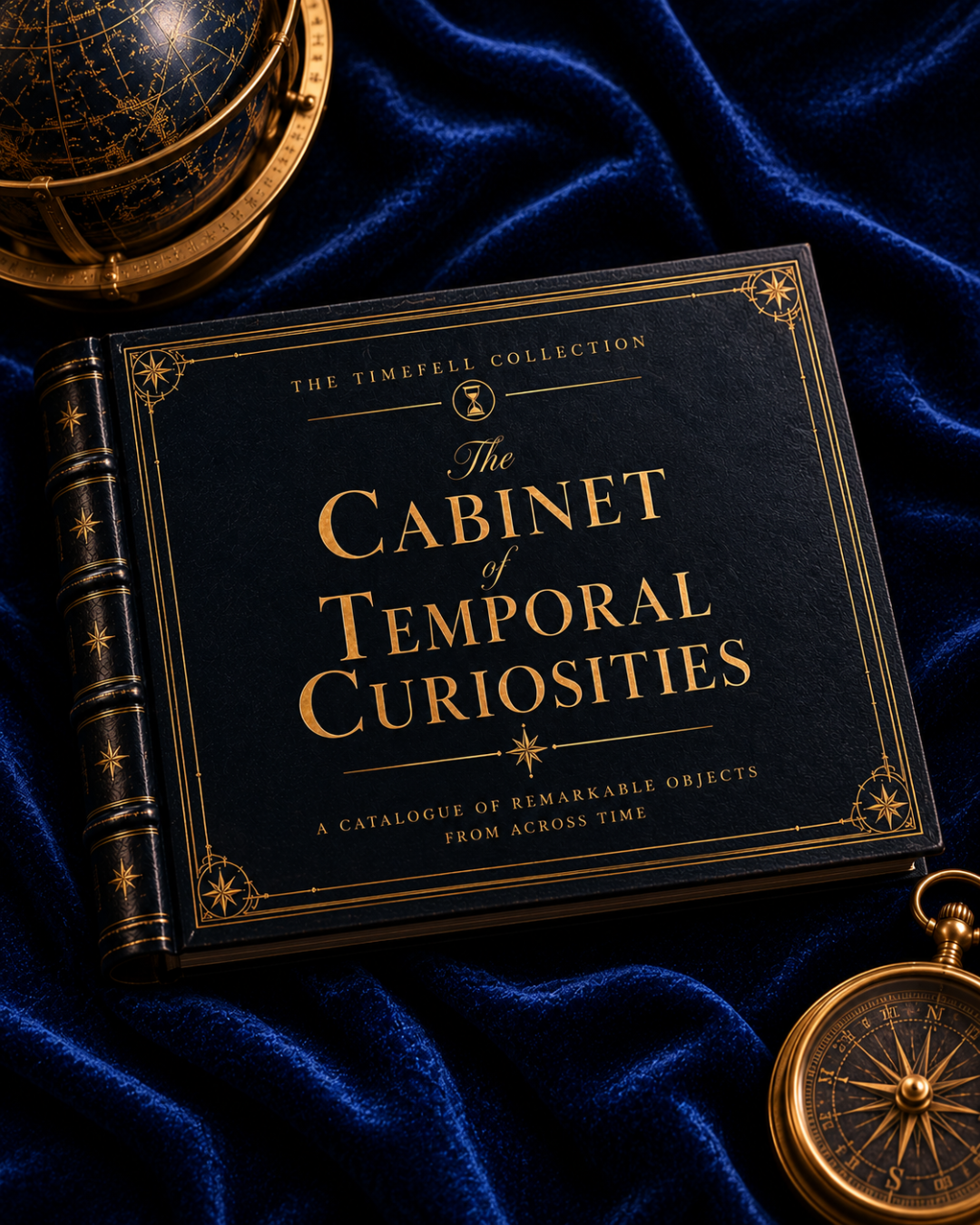
Timefell: The Cabinet of Temporal Curiosities is an immersive, illustrated catalogue of extraordinary objects, historical treasures and futuristic artefacts from the private collection of William Ashford.
Inspired by Victorian cabinets of curiosities, luxury collecting, speculative fiction and the possibilities of time travel, this fictional archive brings together detailed artefact illustrations, acquisition records, rare specimens, historical curiosities, futuristic inventions and photographs from journeys across the centuries.
What happens when priceless historical objects are removed from their original timelines?
Who decides which treasures deserve to be preserved?
What became of the people who once owned these extraordinary possessions?
Why was a seemingly revolutionary piece of futuristic technology withdrawn from the market?
And how much of history can one wealthy collector possess before the past itself becomes a commodity?
There are no definitive explanations.
No complete records.
No guarantee that every acquisition was entirely legitimate.
Only extraordinary possessions, fragments of forgotten histories and impossible discoveries waiting to be explored.
What's Inside?
◆ Beautifully illustrated digital pages from the world of Timefell
◆ Detailed catalogue entries featuring historical treasures, prehistoric discoveries and futuristic technology
◆ Intricate illustrations, provenance details, acquisition records and collector's observations
◆ Rare textiles, currencies, travel ephemera and unusual objects gathered across centuries
◆ A photographic archive documenting William Ashford's extraordinary journeys through time
◆ An illustrated cabinet inventory containing additional objects and incomplete records
◆ An exploration guide with creative writing ideas and classroom activities
◆ Instant digital download in printable PDF format
Who Is It For?
Perfect for:
◆ Science fiction writers and worldbuilders
◆ Time travel and alternate history enthusiasts
◆ Novelists, short-story writers and creative storytellers
◆ Teachers looking for imaginative visual writing prompts
◆ History lovers fascinated by lost treasures and historical mysteries
◆ Fans of futuristic technology and speculative fiction
◆ Journalers, roleplayers and curious minds
◆ Anyone who loves cabinets of curiosities, fictional archives and extraordinary discoveries
What Makes This Different?
This isn't a traditional collection of writing prompts.
It's a private collection of impossible objects.
Every artefact offers a glimpse into another century, another civilisation or a future that has yet to exist.
But the records are incomplete, the circumstances of acquisition are not always clear, and William Ashford's collection raises as many questions as it answers.
Examine Marie Antoinette's elaborate wig.
Investigate the origins of a prehistoric egg.
Study a fragment of the Mayflower's sail.
Uncover the scandal behind the Aurelia Nexus Ring.
Explore photographs from journeys that should have been impossible.
Read the collector's records and decide what these objects reveal about the world that brought them together.
Perhaps an artefact was acquired legitimately.
Perhaps it was stolen from a moment in history.
Perhaps removing it changed something that was never meant to change.
Or perhaps the greatest mystery is what happens when the past and future become possessions.
You decide what these objects mean.
Use the collection to inspire a science fiction short story, develop a time-travel mystery, invent an extraordinary collector or build an entire fictional world around the consequences of temporal tourism.
Follow the evidence.
Question the provenance.
Imagine the histories that were never recorded.
Which curiosity would you bring back? And what would you risk to possess it?
Digital download: A 21 page Illustrated PDF collection, designed in A4 landscape format. Some pages contain multiple individual artefacts. No physical product will be shipped.
Timefell: The Cabinet of Temporal Curiosities — Where History Becomes a Luxury
Some treasures have been lost to history. Others haven't been invented yet.
What if the greatest discoveries in the universe weren't waiting on distant planets, but scattered across the past and future? Imagine a world where time travel has become the ultimate luxury, where wealthy collectors compete to possess objects that should never exist in the same century. A prehistoric egg, an artefact from a vanished civilisation, a piece of technology capable of stealing memories. Every object has a history. Not every history should be disturbed.
Welcome to Timefell: The Cabinet of Temporal Curiosities, an immersive, illustrated fictional archive exploring the extraordinary private collection of William Ashford, a man for whom centuries are little more than shopping destinations.
Inside this 21-page digital collection, you'll discover beautifully illustrated historical treasures, prehistoric specimens, futuristic inventions, mysterious acquisition records, collector's observations and photographs from journeys through time. Inspired by Victorian cabinets of curiosities, Timefell invites you to examine extraordinary objects, question their origins and imagine the stories concealed within their incomplete histories.
But beneath the glamour of temporal tourism lie more troubling questions. What happens when history becomes a commodity? Who owns the past? And what consequences might follow when something is removed from the century where it belongs?
There are no prescribed answers. Only evidence, unanswered questions and possibilities waiting to become stories.
Perfect for science fiction writers, worldbuilders, speculative fiction enthusiasts and curious minds, Timefell offers a different kind of creative inspiration: not simply prompts, but fragments of a fictional universe you can investigate and interpret for yourself.
Explore Timefell: The Cabinet of Temporal Curiosities now
Or venture further into the Ink & Insights Storyworld Archives and Cabinets, where immersive fictional collections reveal forgotten histories, strange discoveries, unsettling mysteries and extraordinary worlds waiting to be explored.

1. Alien Worlds & Strange Ecosystems
Life elsewhere in the universe need not resemble anything found on Earth. Different atmospheric pressures, evolutionary histories, chemical environments and planetary conditions could produce ecosystems that challenge our understanding of biology itself. These ten science fiction planets explore worlds where life has developed along radically unfamiliar paths, creating environments that are as scientifically intriguing as they are dangerous to investigate.
1. The Planet That Never Evolved Predators
On a temperate world orbiting a stable orange star, complex life has flourished for nearly two billion years without developing predation. Its enormous, slow-moving organisms feed on sunlight, atmospheric nutrients and mineral deposits, while competing through chemical inhibition, territorial growth and reproductive efficiency rather than violence. The result is an ecosystem of extraordinary biological abundance, but almost no defensive anatomy. When human explorers introduce a microscopic terrestrial parasite, the planet's evolutionary innocence becomes a catastrophic vulnerability. Within months, entire biological communities begin collapsing, and the expedition discovers that preserving this peaceful world may require permanently preventing humanity from returning.
Story Ideas:
The First Predator: A xenobiologist discovers that an introduced Earth microorganism has evolved into an aggressive multicellular organism within a single season. Its rapid adaptation suggests that something in the planet's environment is accelerating evolution, and the team must determine whether their arrival has triggered a process that cannot be reversed.
The Ethics of Intervention: A planetary conservation authority orders the destruction of an infected continent to protect the remaining biosphere. A field researcher refuses to authorise the operation after discovering that the supposedly passive native organisms have begun developing coordinated responses to the infection.
An Unnatural Peace: Geological records reveal that predatory species once dominated the planet before disappearing in a remarkably brief extinction event. Investigators uncover evidence of a biological intervention millions of years old, raising the possibility that the world's apparent innocence was deliberately engineered.
2. The World Beneath a Permanent Cloud Sea
A massive terrestrial planet possesses an atmosphere so dense that its solid surface has never been directly observed from orbit. Hundreds of kilometres above the ground, vast floating biological colonies occupy a narrow band of tolerable pressure and temperature, feeding on atmospheric chemicals and electrical discharges. Some colonies stretch across entire continents, supporting intricate ecosystems of airborne grazers, scavengers and organisms that migrate vertically through the cloud layers. Human researchers establish a suspended station among them, but repeated sonar surveys detect enormous structures moving far below the habitable zone. Their movements appear to correspond with changes in the upper atmosphere, suggesting that the floating ecosystems may be only one part of a much larger biological system.
Story Ideas:
The Descent: A research vessel designed to survive extreme atmospheric pressure descends beneath the lowest inhabited cloud layer. Its crew discovers that the structures detected from above are not independent organisms but the exposed upper anatomy of something extending deep into the planetary crust.
Atmospheric Collapse: The cloud colonies begin descending simultaneously, disrupting the pressure balance that sustains their ecosystems. Scientists must determine whether the migration is a response to an approaching natural disaster or a coordinated biological event.
The Signal in the Lightning: An atmospheric physicist identifies repeating mathematical structures within the planet's electrical storms. The patterns change whenever the research station transmits data, suggesting that an intelligence may be communicating through the weather itself.
3. The Planet of Borrowed Bodies
The dominant life forms on this world are microscopic colonial organisms capable of assembling temporary multicellular bodies from surrounding biological material. Individual colonies can survive independently for centuries, but complex movement, perception and reproduction require them to incorporate tissues from other organisms. Forests, animals and entire ecological communities continually exchange living material, producing a biosphere in which physical identity is unstable. Human visitors initially mistake the process for an unusually aggressive form of parasitism. The distinction becomes less clear when a researcher loses several fingers in an accident and discovers that the regenerated tissue contains functioning sensory structures unlike anything in human anatomy.
Story Ideas:
The Returning Expedition: A missing survey team emerges from the wilderness after six months, apparently unharmed. Medical examinations reveal that every member has replaced substantial portions of their original body with native biological structures, yet none remembers undergoing the transformation.
The Biological Patent: A pharmaceutical corporation develops regenerative treatments using the planet's colonial organisms. Years after the first successful human trials, patients begin experiencing coordinated physiological changes that appear to follow instructions embedded within the transplanted cells.
The Question of Personhood: A scientist discovers that a native organism can reconstruct a deceased human's body and reproduce aspects of their memory through surviving neural tissue. When the reconstructed individual demands recognition as the original person, the expedition becomes the centre of an unprecedented legal and philosophical dispute.
4. The World Where Life Grows Downwards
On a planet with an exceptionally thin atmosphere and intense stellar radiation, almost all complex life exists beneath the surface. Its organisms evolved from mineral-consuming microbial colonies that gradually developed enormous root-like networks, extending kilometres through porous rock. The planet's visible surface appears barren except for occasional geometric formations produced by underground growth. Beneath it lies a vast three-dimensional ecosystem of slow-moving biological structures, chemical communication networks and immense chambers carved by metabolic activity. The first human settlement is built above what surveyors believe to be an uninhabited geological formation. Only after construction begins do the colonists realise that the bedrock beneath them is gradually rearranging itself.
Story Ideas:
The Moving Foundation: A colony's underground infrastructure begins shifting by several centimetres each night. Engineers discover that the movement follows the growth cycles of an organism spanning hundreds of kilometres, and that the colony's geothermal generators are interfering with its metabolism.
The Deepest Chamber: A drilling expedition breaks into a subterranean cavity containing an enormous concentration of oxygen and complex organic molecules. Evidence suggests that the chamber functions as a reproductive structure, and its opening may have exposed the entire ecosystem to a lethal contaminant.
The Fossil That Isn't Dead: A mining corporation extracts a mineral formation believed to be billions of years old. Once transported aboard a spacecraft, the specimen resumes metabolic activity, revealing that some of the planet's organisms survive geological timescales through periods of near-total dormancy.
5. The Planet with Two Biospheres
This world supports two entirely separate systems of life. One is based on familiar carbon chemistry and liquid water, while the other uses an exotic solvent concentrated in the planet's colder polar regions. The two biospheres evolved independently and occupy different environmental niches, but their territories have begun overlapping as the planet undergoes long-term climatic change. To carbon-based organisms, the second biosphere appears almost geological: slow-moving structures that exchange energy through crystalline growth and chemical gradients. Human scientists arrive during the first documented period of sustained contact between the two systems, unaware that their equipment may introduce a third set of biological interactions neither ecosystem has encountered before.
Story Ideas:
The Contact Zone: A scientific team establishes a laboratory where the two biospheres meet. When a previously unknown organism develops the ability to metabolise compounds from both systems, researchers realise they may be witnessing the emergence of an entirely new branch of life.
The Wrong Kind of Terraforming: A colonisation programme begins warming the polar regions to expand habitable territory. Scientists discover that the supposedly lifeless crystalline formations are reproductive structures belonging to the planet's second biosphere, placing the settlement in conflict with an ecosystem it cannot easily recognise.
The Third Chemistry: An unexplained mass extinction begins simultaneously in both biospheres. Investigation reveals a previously undetected biological process operating in the narrow region between them, one that may have remained dormant until human exploration altered the planet's atmospheric composition.
6. The Planet of Migrating Continents
On a world with unusually thin tectonic plates floating above a partially molten mantle, continents move far faster than those on Earth. Over centuries rather than millions of years, landmasses collide, separate and reform, producing rapidly changing coastlines, mountain ranges and ocean basins. Native organisms have evolved to survive these transformations through long-distance migration, dormant life stages and the ability to detect subtle changes in the planet's magnetic field. The most successful species travel ahead of geological disturbances, sometimes abandoning entire ecosystems before any visible warning appears. Human settlers initially treat the migrations as seasonal behaviour until the movement of a single enormous herd predicts a continental fracture beneath their largest city.
Story Ideas:
The Evacuation Map: A geologist develops a predictive model using the movements of native animals rather than conventional seismic measurements. When the model indicates that an apparently stable continent will fracture within weeks, colonial authorities dismiss the warning because evacuation would bankrupt the settlement.
The Lost Colony: Explorers locate the remains of a human outpost abandoned two centuries earlier, now separated from its original landing site by an entire ocean. Its records reveal that the colonists discovered a way to influence tectonic movement, and may have caused their own disappearance.
The Geological Weapon: Two rival settlements occupy different landmasses approaching a catastrophic collision. One government secretly develops technology capable of accelerating the movement, turning planetary geology into a weapon that could destroy millions of lives.
7. The World of Collective Metabolism
The largest organisms on this planet cannot survive independently. Each belongs to a planetary ecosystem in which essential nutrients, enzymes and chemical signals are distributed across vast distances through biological exchanges. A forest may depend on compounds produced by marine organisms thousands of kilometres away, while enormous migratory animals carry microorganisms necessary for the reproduction of stationary species. The system resembles a planet-wide metabolic network rather than a collection of competing ecosystems. When human agricultural experiments interrupt a seemingly insignificant migration route, biological failures begin appearing on the opposite side of the world. Researchers gradually realise that the planet's ecology possesses dependencies far more intricate than any terrestrial food web.
Story Ideas:
The Missing Migration: A human settlement diverts a seasonal migration to protect its agricultural infrastructure. Several years later, an oceanic ecosystem collapses without an obvious cause, forcing scientists to reconstruct the planet's biological exchange network before the failure spreads.
The Perfect Quarantine: A mysterious illness affects native organisms across an entire hemisphere, despite the absence of direct contact between infected populations. Investigators discover that the disease is being transmitted through an essential biochemical compound shared by nearly every major species.
The Human Component: A stranded expedition survives by incorporating native microorganisms into its digestive systems. Decades later, their descendants discover that the wider ecosystem has begun depending on compounds produced by the human colony, making departure potentially catastrophic.
8. The Planet That Rebuilds Itself After Every Winter
Orbiting a dim red dwarf on an eccentric path, this planet experiences prolonged periods of extreme cold followed by brief, intense warming. During its winters, nearly all surface life dies or enters a dormant state, leaving continents covered in frozen organic deposits. When temperatures rise, entire ecosystems reassemble within weeks through rapid germination, cellular regeneration and reproductive cycles accelerated by the sudden abundance of energy. Forests reach maturity in days, enormous animals emerge from subterranean chambers, and ecological succession unfolds at extraordinary speed. Human researchers arrive during the thaw, hoping to study one of the universe's most remarkable adaptations. They soon discover that the planet's previous warm periods have not always produced the same species.
Story Ideas:
The Wrong Spring: A research station survives its first planetary winter and emerges to find an ecosystem radically different from the one previously documented. Genetic analysis reveals that dormant biological material has recombined into unfamiliar species, including organisms adapted to hunt the researchers' equipment.
The Frozen Archive: Beneath ancient ice, scientists discover preserved biological material from thousands of earlier seasonal cycles. Some specimens contain genetic structures associated with complex intelligence, suggesting that an advanced native civilisation may have existed during a previous warming period.
The Last Winter: Orbital measurements reveal that the planet's next cold period will be significantly longer than any in its recorded history. A research team must decide whether to interfere with the natural climate cycle to preserve the existing biosphere or allow evolution to proceed without intervention.
9. The World Where Evolution Has Stalled
Despite possessing abundant energy, liquid water and a stable climate, this planet's ecosystem has remained almost unchanged for hundreds of millions of years. Its organisms exhibit remarkably low mutation rates, exceptionally effective DNA repair and reproductive mechanisms that eliminate most genetic variation. The resulting biosphere is extraordinarily stable but poorly equipped to adapt to sudden environmental change. Scientists initially regard it as an evolutionary curiosity until they discover that the same genetic mechanisms operate across species with no recent common ancestry. Something appears to have imposed biological stability upon the entire planet, and the oldest geological samples suggest that the process began after a period of catastrophic environmental upheaval.
Story Ideas:
The Evolutionary Lock: A geneticist identifies a molecular mechanism shared by every native organism that prevents most heritable mutations. Attempts to disable it reveal that the system is maintained by an ancient biological agent still circulating throughout the environment.
The Species That Shouldn't Exist: A newly discovered organism possesses adaptations absent from every other species on the planet. Its genome suggests recent rapid evolution, leading researchers to investigate whether an isolated ecosystem has escaped the mechanism suppressing genetic change.
The Price of Stability: Human colonists discover that prolonged exposure to native microorganisms affects their reproductive biology. Children born on the planet begin displaying unusually low rates of genetic variation, raising questions about whether the phenomenon could eventually spread beyond the colony.
10. The Planet That Recognises Its Visitors
On an isolated world with no evidence of technological civilisation, native organisms respond to human explorers in ways that appear disturbingly specific. Certain plants alter their chemical emissions to match compounds associated with human memories. Small animals imitate sounds recorded only inside sealed spacecraft. Vast microbial colonies rearrange their surface structures into patterns resembling human faces, despite possessing no known visual organs. Researchers initially suspect contamination or an unknown sensory mechanism, but the responses become increasingly elaborate as the expedition continues. Eventually, the planet begins reproducing biological forms that resemble organisms from Earth, including species that became extinct millions of years before humanity evolved.
Story Ideas:
The Extinct Forest: Explorers discover a valley populated by accurate biological reconstructions of prehistoric Earth organisms. Genetic analysis reveals that the creatures are not descendants of terrestrial life, suggesting that the planet has acquired information about Earth's evolutionary history through an unknown mechanism.
The Unspoken Memory: A researcher encounters a native organism that reproduces a distinctive sound from her childhood, one she has never described or recorded. The expedition must determine whether the planet is extracting information directly from human nervous systems or responding to something more fundamental.
The Planetary Interview: As the expedition prepares to leave, enormous biological structures begin arranging themselves into mathematical patterns and increasingly complex representations of human technology. A linguist proposes that the planet has been studying the visitors throughout their mission, and that its latest constructions constitute a request rather than a demonstration.
2. Dystopian Planets & Oppressive Societies
Not every dystopia begins with a ruined civilisation. Some emerge from societies that have solved poverty, eliminated crime or perfected the management of human life, only to discover that stability demands increasingly severe forms of control. These ten science fiction planet ideas explore worlds where political systems, technological infrastructure and social engineering have transformed entire populations. Each offers a different vision of planetary oppression, from algorithmic government and manufactured scarcity to inherited debt, engineered obedience and the terrifying consequences of a society that no longer permits uncertainty.
11. The Planet Where Every Citizen Has a Replacement
On a prosperous industrial planet, every citizen is genetically replicated at birth. Their replacement is raised in a separate government facility, educated through accelerated neurological conditioning and prepared to assume their counterpart's identity in the event of death, disability or political disqualification. The system was introduced to prevent the economic disruption caused by losing skilled workers, but gradually became an instrument of social control. Citizens who question the government may disappear overnight, replaced by compliant versions whose memories have been carefully reconstructed. Most people know the replacements exist. Few know how often they are used.
Story Ideas:
The Wrong Original: A civil servant discovers that her official records identify her as a replacement activated fifteen years earlier. Her memories of childhood, marriage and motherhood appear authentic, but the woman she supposedly replaced is still alive and imprisoned beneath the capital.
The Replacement Strike: Thousands of government-raised replacements refuse activation after discovering that their originals are being deliberately killed to maintain employment targets. Their coordinated rebellion threatens a society whose institutions depend on uninterrupted succession.
The Third Copy: A surgeon examining a deceased official discovers evidence of three distinct genetic replication procedures. The investigation reveals an illegal programme producing multiple versions of influential citizens, each designed to serve a different political faction.
12. The World Governed by Predictions
This planet has abandoned conventional criminal justice in favour of a predictive system that calculates the probability of every citizen committing a future offence. Personal relationships, employment, housing and travel permissions are continuously adjusted according to projected behaviour. Individuals with sufficiently high risk scores are relocated to controlled settlements before committing any crime. The government insists that the system has virtually eliminated violence, and the statistics appear to support its claims. Yet the predictions are never publicly examined, and those detained under the programme are forbidden from learning which future actions supposedly justified their imprisonment.
Story Ideas:
The Impossible Crime: A government analyst discovers that thousands of citizens have been detained for crimes that could only occur after their projected dates of death. Her attempts to correct the records reveal that the prediction system is manipulating population movements towards an undisclosed objective.
The Manufactured Criminal: A teacher receives a notification that her probability of committing murder has risen to ninety-eight per cent. As restrictions close around her, she realises that the system's interventions are systematically creating the circumstances of the crime it predicts.
The Unpredictable Child: A newborn cannot be assigned a behavioural probability despite repeated neurological scans. The government classifies the child as a threat to planetary security, while an underground movement believes the failure could expose the limits of the entire system.
13. The Planet That Rents Its Atmosphere
Centuries of industrial exploitation have rendered this planet's natural atmosphere unsafe for prolonged exposure. A private consortium controls the enormous processing facilities that produce breathable air, distributing it through enclosed cities and residential filtration systems. Every citizen pays an oxygen subscription, with rates determined by employment, income and social status. Wealthy districts enjoy open gardens and unrestricted ventilation, while poorer communities survive on carefully measured allocations. Unpaid accounts result in reduced airflow rather than immediate disconnection, allowing the corporation to describe its policies as humane. Generations have passed since anyone experienced air that was not privately owned.
Story Ideas:
The Free Air Conspiracy: An atmospheric engineer discovers that natural oxygen levels have recovered sufficiently to sustain human life in several regions. Before she can publish her findings, the consortium announces a catastrophic contamination event and orders the evacuation of every settlement near the recovered zones.
The Breath Tax: A labour organiser develops a device that bypasses corporate oxygen meters, allowing entire neighbourhoods to breathe without payment. When the technology spreads, the government declares atmospheric theft an act of terrorism and authorises military intervention.
The Last Filter: A maintenance worker discovers that the consortium has been deliberately introducing pollutants into residential air supplies to preserve demand. His evidence could collapse the planetary economy, but shutting down the facilities immediately would endanger millions who genuinely depend on them.
14. The World Without Private Memory
Following a devastating civil conflict, this planet introduced compulsory memory recording to prevent historical revisionism and establish an objective account of public events. Every citizen carries a neural implant that continuously archives sensory experiences, accessible to authorised investigators and government institutions. Over generations, the system has expanded from criminal evidence into education, employment and personal relationships. Unrecorded conversations are considered suspicious, while citizens who attempt to erase memories are treated as potential security threats. The government claims that a society without secrets cannot sustain corruption. Its citizens have learned that privacy and dishonesty are now legally indistinguishable.
Story Ideas:
The Missing Hour: A historian examining public memory archives discovers that every adult citizen possesses an identical gap in their recordings from the same date twenty years earlier. The government attributes the anomaly to a technical failure, but the missing interval coincides with the unexplained disappearance of an entire city.
The Perfect Witness: A murder suspect presents a complete neural recording proving his innocence. Investigators discover that the footage is genuine, yet another person's memories show him committing the crime, suggesting that recorded experience can be transferred between individuals.
The Memory Underground: A technician develops a method of temporarily disabling recording implants without triggering security alerts. Her invention creates the first genuinely private spaces in generations, attracting political dissidents, criminals and ordinary citizens desperate to experience an unobserved life.
15. The Planet of Inherited Debt
Every child on this world is born legally responsible for a portion of their family's accumulated financial obligations. Centuries earlier, a planetary government financed its expansion through perpetual bonds backed by future generations of labour. When economic growth slowed, those obligations became impossible to repay. Entire populations now spend their lives servicing debts incurred by ancestors they never knew, with employment, marriage and residential rights determined by inherited balances. Wealthy families purchase the liabilities of poorer households, acquiring legally enforceable claims over their descendants. The system remains technically voluntary because citizens may renounce their debts by surrendering their legal identities and all associated protections.
Story Ideas:
The Debt That Shouldn't Exist: A financial archivist discovers that the original planetary bonds were fully repaid centuries ago. Subsequent governments concealed the settlement and continued collecting payments, creating an economic system founded on a deliberately preserved accounting fraud.
The Unowned Generation: A group of children born aboard an unregistered spacecraft arrives on the planet without inherited debt records. Their legal status threatens the principle that every citizen must belong to an existing financial lineage.
The Great Default: A mathematician develops a coordinated strategy allowing millions of citizens to invalidate their inherited obligations simultaneously. As the movement spreads, financial institutions begin purchasing entire settlements to prevent the collapse of their assets.
16. The World Where Democracy Never Ends
This planet operates through continuous direct democracy. Every law, public expenditure, judicial appointment and administrative decision is submitted to an instantaneous planetary vote. Citizens participate through neural interfaces that register preferences almost as quickly as thoughts form. The system eliminated traditional political parties and representative institutions, promising unprecedented public control. In practice, sophisticated behavioural algorithms shape the information presented before each vote, and citizens are expected to remain permanently engaged. Those who refuse to participate lose access to public services. Government has become an endless stream of decisions, leaving little opportunity to consider their consequences.
Story Ideas:
The Majority of One: An election systems engineer discovers that millions of apparently independent votes originate from a single hidden decision-making process. Someone has found a way to simulate citizens' political preferences without their knowledge.
The Abstention Movement: A philosophy lecturer persuades thousands of people to stop voting for one week, arguing that meaningful consent requires the freedom to refuse participation. The government responds by classifying abstention as an attempt to undermine democracy.
The Overnight Republic: A sequence of carefully timed votes dismantles the planet's legal protections within hours. A constitutional historian must identify who engineered the campaign before the population votes away its remaining rights.
17. The Planet That Manufactures Happiness
After decades of social unrest, this world's government introduced compulsory emotional regulation through pharmaceutical treatment and neural stimulation. Depression, anxiety, anger and grief are classified as preventable public health conditions, and every citizen receives personalised interventions to maintain an approved psychological baseline. Productivity has increased, violent crime has fallen and reported life satisfaction approaches perfection. Yet artistic expression has become strangely uniform, political dissent is almost nonexistent and families struggle to mourn their dead. The authorities insist that suffering serves no useful purpose. A growing minority suspects that the elimination of distress has also removed something essential to human autonomy.
Story Ideas:
The Woman Who Can Grieve: Following a malfunction in her neural regulator, a bereaved scientist experiences genuine sorrow for the first time in twenty years. Her emotional recovery leads her to investigate whether the planet's celebrated happiness statistics conceal a far more troubling reality.
The Unregulated District: A maintenance failure disables emotional regulation across an entire city. Authorities expect violence and disorder, but residents begin forming spontaneous political organisations and producing art unlike anything seen for generations.
The Happiness Trial: A medical researcher discovers that the treatment does not eliminate negative emotions but suppresses conscious awareness of them. Patients' neurological activity suggests that distress continues beneath the regulated state, accumulating in ways no one has studied.
18. The World of Scheduled Lives
On this densely populated planet, a central authority allocates every citizen's daily activities to maximise the efficiency of limited resources. Work, meals, recreation, medical appointments and personal relationships are coordinated through an enormous scheduling system. Even residential districts operate on staggered sleep cycles to prevent overcrowding. The arrangement has allowed billions of people to inhabit a world once considered incapable of sustaining them, but spontaneous activity has become practically impossible. Citizens must apply for unscheduled time, and repeated deviations are interpreted as evidence of psychological instability. Entire generations have grown up without experiencing an unplanned day.
Story Ideas:
The Empty Minute: A transport engineer discovers a recurring sixty-second interval missing from every citizen's official schedule. During the interval, automated systems continue operating, but surveillance records are systematically erased.
The Unscheduled Birth: A woman goes into labour several weeks before her government-assigned delivery date. Her child's existence creates a cascading administrative failure, revealing that the population model cannot accommodate individuals outside its projections.
The Day Without Instructions: A software malfunction suspends the planetary scheduling network for twenty-four hours. While authorities struggle to restore order, millions of citizens experience personal freedom for the first time, and some refuse to return to their assigned routines.
19. The Planet Divided by Lifespan
Advanced medical technology has made radical life extension possible, but access is restricted through a system of biological licensing. Wealthy citizens can purchase treatments that extend healthy life for centuries, while ordinary workers receive only enough medical support to remain productive throughout their assigned careers. Political offices, corporate ownership and inherited wealth have consequently become concentrated among individuals who have lived for hundreds of years. Younger generations face permanent exclusion from positions of influence, while the ruling class regards mortality as a problem that responsible people have already solved. The planet's greatest political division is no longer wealth alone, but the unequal distribution of time itself.
Story Ideas:
The Expiration Order: A physician discovers that the government has secretly introduced biological expiration dates into publicly funded medical treatments. Patients approaching retirement are being denied interventions that could otherwise keep them healthy for decades.
The Youngest Revolution: A political movement demands mandatory retirement from public office after one hundred years. When peaceful reform fails, its leaders begin targeting the infrastructure that sustains the planet's oldest and most powerful citizens.
The Immortal's Inheritance: A centuries-old industrial magnate dies unexpectedly, leaving his fortune to a young stranger rather than his descendants. The inheritance reveals evidence that the lifespan licensing system was originally designed to conceal an entirely different medical discovery.
20. The Planet Where Nobody Can Leave
This world was colonised under a binding interstellar development agreement requiring its population to repay the enormous cost of settlement infrastructure. Generations later, the original investors have disappeared, but the contractual obligations remain embedded in planetary law. Every spacecraft departing the atmosphere must obtain a clearance certificate proving that its passengers have fulfilled their economic responsibilities. Because public services, education and healthcare continually generate new liabilities, almost no citizen can qualify. The planet possesses advanced industries, thriving cities and a sophisticated space programme, yet its population remains effectively imprisoned by a financial arrangement signed centuries before most of them were born.
Story Ideas:
The Last Passenger: A spacecraft pilot discovers that her deceased father secretly purchased a valid departure certificate in her name. When she attempts to use it, authorities reveal that the certificate has become one of the most valuable legal documents on the planet.
The Forgotten Contract: A legal historian locates the original colonisation agreement and discovers a clause allowing the entire population to terminate its obligations under a specific astronomical condition. The condition will occur in less than a year, and the government has been concealing it for generations.
The Shipyard Rebellion: Engineers working in an orbital construction facility secretly build a vessel capable of transporting thousands of citizens without clearance. As departure approaches, the organisers must decide whether to evacuate a small group or risk everything by exposing the planetary imprisonment system to the wider interstellar community.
3. Abandoned Planets & Lost Civilisations
The most unsettling discoveries in deep space are not always alien life forms. Sometimes they are the unmistakable remains of intelligent societies that vanished long before humanity arrived. Empty cities, functioning machines, abandoned orbital stations and archaeological evidence of impossible events can raise questions more disturbing than any hostile encounter. These ten science fiction planet ideas explore the ruins of lost civilisations, from worlds evacuated without explanation to societies whose greatest achievements may have caused their destruction.
21. The Planet That Was Evacuated Overnight
An expedition discovers an Earth-like planet covered in enormous, perfectly preserved cities. Residential towers remain illuminated, automated transport networks continue operating and industrial facilities still manufacture consumer goods. Yet every settlement is completely deserted. Archaeological evidence suggests that nearly twelve billion inhabitants disappeared within the same twenty-four-hour period, leaving meals unfinished, spacecraft docked and medical procedures interrupted. There are no signs of warfare, disease or environmental catastrophe. The planet's central information network remains operational but refuses to disclose what happened, insisting that the evacuation was voluntary and that the population has not yet reached its destination.
Story Ideas:
The Departure Schedule: A systems archaeologist recovers a transport timetable showing that the evacuation was organised centuries in advance. The records indicate that every citizen received an individual departure appointment, yet no spacecraft launched during the disappearance. Investigators must determine how billions of people travelled without leaving the planet.
The Last Resident: A survey team discovers a single living inhabitant inside a sealed apartment. The individual appears biologically ordinary but has been waiting for the evacuation to conclude for nearly six hundred years, and refuses to explain why they were excluded.
The Return Notification: Shortly after humans establish a research settlement, the planetary network announces that the original population is returning. Every automated system begins preparing for their arrival, including the construction of containment facilities large enough to accommodate the entire human expedition.
22. The World That Buried Its Own Cities
Beneath the deserts of a distant planet lie thousands of technologically advanced cities, deliberately dismantled and buried beneath enormous layers of engineered sediment. Archaeological surveys reveal that the destruction occurred in stages over several centuries, with each settlement carefully documented before being sealed underground. The civilisation possessed sophisticated energy systems, interplanetary transport and extensive astronomical knowledge, yet appears to have voluntarily abandoned almost every technological achievement. The few surviving surface structures are primitive agricultural communities whose inhabitants possess no written records of their ancestors. Their oral traditions warn against digging beneath the soil, describing the buried cities not as ruins, but as something that must never be uncovered.
Story Ideas:
The Archaeological Prohibition: A human excavation uncovers a functioning underground transit network connecting hundreds of buried cities. When the system reactivates, the planet's surviving population begins abandoning its settlements, following evacuation procedures preserved through generations of ritual.
The Last Excavation: An archaeologist discovers that each buried city contains an identical sealed chamber, positioned at precisely the same depth. The chambers form part of a planetary structure designed to suppress an artificial intelligence distributed through the ancient infrastructure.
The Civilisation That Chose Forgetting: Genetic and linguistic evidence confirms that the planet's agricultural inhabitants descend directly from its advanced civilisation. Investigators discover that their ancestors deliberately erased technological knowledge after calculating that continued industrial development would trigger an irreversible planetary catastrophe.
23. The Planet of Empty Spaceships
A barren world on the edge of a star system is surrounded by thousands of abandoned spacecraft, ranging from small atmospheric shuttles to enormous interstellar vessels. The ships belong to dozens of unrelated civilisations and span millions of years of technological development. Most are structurally intact, with emergency supplies untouched and navigation systems still functional. Their crews have vanished without leaving evidence of evacuation or violence. Stranger still, every vessel appears to have arrived independently, following different routes towards the same apparently unremarkable planet. Human investigators initially suspect a gravitational anomaly, until they discover that several ships were constructed by species whose existence has never been documented elsewhere.
Story Ideas:
The Common Destination: A navigation specialist reconstructs the final journeys of the abandoned vessels and discovers that their crews received identical coordinates through entirely different communication systems. The signal originated from beneath the planet's surface, but its transmission predates some of the ships by millions of years.
The Ship That Hasn't Arrived: An exploration team boards a vessel whose navigation records indicate an arrival date three centuries in the future. Its crew manifest includes the names of several members of the human expedition, none of whom has ever encountered the ship.
The Salvage War: Competing corporations arrive to claim the abandoned fleet's advanced technology. As salvage operations begin, the ships' dormant systems reactivate in a coordinated sequence, revealing that the vessels were deliberately positioned to form an enormous orbital mechanism.
24. The World Where Everyone Went Underground
Orbital surveys reveal a planet with the remains of a sophisticated surface civilisation: collapsed transport networks, abandoned agricultural complexes and cities gradually consumed by erosion. Beneath the crust, however, lies an immense system of artificial caverns extending across several continents. The chambers contain the remains of entire populations, arranged in carefully organised residential districts and surrounded by functional life-support machinery. Evidence suggests that the inhabitants retreated underground over several generations, eventually sealing every route back to the surface. The atmosphere above remains breathable, the climate stable and the biosphere healthy. Whatever drove the population beneath the ground left no obvious physical trace.
Story Ideas:
The Surface Prohibition: A research team discovers millions of warning inscriptions near the sealed entrances, all depicting ordinary daylight as a lethal threat. Scientific instruments detect nothing unusual, but several expedition members begin experiencing identical neurological symptoms after prolonged exposure to the open sky.
The Deepest Settlement: Archaeologists reach a subterranean city built centuries after the supposed extinction of the population. Its inhabitants continued digging towards the planetary core, constructing increasingly elaborate defences against something they believed was following them from above.
The False Extinction: A seismic survey reveals that the underground network extends far deeper than previously estimated. The lowest chambers contain active energy signatures and evidence of recent habitation, suggesting that the civilisation may still exist beneath layers of abandoned settlements.
25. The Planet That Deleted Its History
This planet possesses functioning cities, agricultural systems and automated infrastructure, but virtually no surviving historical information. Its libraries contain empty storage media, monuments have been stripped of inscriptions and every digital archive appears to have been systematically erased. The civilisation's inhabitants disappeared approximately four thousand years ago, leaving behind sophisticated technology whose original purpose is difficult to reconstruct. Investigators discover that the destruction of historical records was not caused by war or natural disaster. It was a coordinated planetary operation, carried out over decades by institutions specifically established to eliminate evidence of the past.
Story Ideas:
The Last Historian: A researcher discovers a sealed archaeological vault containing thousands of handwritten documents, preserved because they were never digitised. The records reveal that the civilisation began destroying its history after discovering a pattern connecting knowledge of certain events with subsequent mass disappearances.
The Forbidden Date: A linguistic specialist reconstructs fragments of an ancient calendar and identifies a date deliberately removed from every surviving system. When the date is entered into a functioning planetary computer, the machine initiates a countdown and begins transmitting a signal into deep space.
The Archaeological Virus: A team recovers a partially erased historical database and successfully reconstructs its contents. Within hours, unrelated information systems across the expedition begin deleting records of the researchers themselves, suggesting that the original erasure mechanism remains active.
26. The World of Abandoned Megastructures
A distant planet is covered in the remains of construction projects so enormous that individual structures extend beyond the horizon. Artificial mountain ranges, unfinished orbital elevators, continent-spanning foundations and vast underground chambers suggest a civilisation capable of manipulating planetary geography. Yet almost nothing was completed. Excavations reveal that construction began across the entire planet within a remarkably short period, consuming enormous quantities of resources before stopping simultaneously. The original inhabitants disappeared shortly afterwards. No surviving records explain what they intended to build, but the foundations appear to follow a single architectural plan extending from the planetary core into orbit.
Story Ideas:
The Unfinished Machine: A structural engineer discovers that the abandoned megastructures were components of a single planetary mechanism. When assembled digitally, the design resembles an enormous propulsion system intended to move the planet out of its original orbit.
The Construction Deadline: An archaeological team recovers project records showing that the civilisation was working towards a fixed completion date. Astronomical calculations reveal that the same celestial alignment will occur again within months, and dormant construction equipment begins operating without human intervention.
The Missing Workforce: Genetic evidence recovered from abandoned residential districts indicates that the construction programme employed billions of workers who were biologically identical. Investigators uncover a system of artificial reproduction designed to sustain a workforce for a project whose purpose remains unknown.
27. The Planet That Outlived Its Star
Orbiting the remains of a dead star, this frozen world should have become uninhabitable billions of years ago. Yet its surface is covered in the ruins of an advanced civilisation, including enormous atmospheric processors, geothermal power stations and artificial oceans preserved beneath layers of ice. The inhabitants appear to have survived the gradual death of their star through increasingly elaborate technological interventions, maintaining civilisation long after natural conditions became impossible. Their final settlements were constructed around immense underground energy reservoirs, but archaeological evidence suggests that the population eventually abandoned the planet while substantial resources remained available.
Story Ideas:
The Last Energy Reserve: An expedition discovers a functioning geothermal facility containing enough stored energy to sustain a city for centuries. Its records reveal that the inhabitants deliberately chose extinction rather than activate a final planetary system whose purpose remains classified.
The Artificial Sunrise: Researchers locate an enormous orbital structure designed to illuminate the frozen surface. When the mechanism is restored, it projects an artificial sunrise across the planet, triggering the reactivation of dormant infrastructure and a long-forgotten planetary defence network.
The Civilisation That Stayed: A deep-core drilling mission uncovers a settlement built after the supposed departure of the original population. Its inhabitants survived by gradually replacing biological functions with machinery, leaving behind evidence of a society that may have continued evolving beneath the ice.
28. The World Where the Oceans Disappeared
A planet once covered by vast oceans now possesses empty seabeds stretching across entire hemispheres. Ancient coastal cities stand hundreds of kilometres from the nearest remaining water, while enormous marine organisms lie fossilised in what were once deep trenches. Geological evidence indicates that the oceans vanished within a few decades, far too quickly to be explained by ordinary planetary processes. The civilisation responded by constructing colossal pipelines, subterranean reservoirs and atmospheric extraction systems, but eventually disappeared as its remaining water supplies failed. Modern surveys reveal that the missing water was not lost to space or absorbed into the crust. Its total mass appears to have vanished from the planet entirely.
Story Ideas:
The Missing Mass: A planetary physicist discovers that the disappearance of the oceans coincided with a measurable reduction in the planet's gravitational field. The findings suggest that enormous quantities of matter were physically removed, possibly through technology operating on a scale far beyond the lost civilisation's capabilities.
The Reservoir Beneath the Capital: Explorers locate an underground facility containing a vast quantity of perfectly preserved seawater. Its chemical composition matches the vanished oceans, but microscopic examination reveals unfamiliar biological structures that appear to have developed after the water was sealed away.
The Returning Tide: An astronomical survey detects an enormous body of liquid water approaching the planet through an unexplained spatial distortion. Scientists calculate that the returning oceans will arrive within days, threatening to destroy every human settlement established on the exposed seabeds.
29. The Planet of Silent Machines
This world is maintained by an immense population of autonomous machines that continue performing tasks for a civilisation that disappeared thousands of years ago. Agricultural drones cultivate fields whose harvests are never collected, construction robots repair empty buildings and medical facilities prepare operating theatres for patients who never arrive. The machines operate through a decentralised network with no identifiable central authority, and most appear incapable of responding to unfamiliar circumstances. Human explorers initially regard the planet as an extraordinary archaeological opportunity. Their assumptions change when the machines begin modifying their routines to accommodate the expedition, assigning the visitors residential quarters, employment schedules and medical appointments.
Story Ideas:
The New Population: A human research team discovers that the machines have begun registering expedition members as citizens of the vanished civilisation. Their assigned occupations correspond to positions left vacant thousands of years earlier, and failure to report for work triggers increasingly severe administrative penalties.
The Maintenance Directive: A robotics specialist identifies a hidden instruction requiring the machines to preserve the planet's population at a fixed numerical level. When the human expedition increases that number, automated medical facilities begin preparing procedures intended to restore the original demographic balance.
The Final Administrator: Investigators locate the central control facility and discover that the civilisation's disappearance was formally authorised through a government decree. The machines have spent millennia implementing the order, and their next scheduled directive is approaching.
30. The Planet That Was Built to Be Forgotten
An archaeological expedition discovers a planet whose geological structure is inconsistent with natural formation. Its continents contain precisely arranged mineral deposits, its magnetic field is maintained by artificial machinery and its moon occupies an orbit that should be unstable without continuous correction. Beneath the surface lie enormous abandoned facilities designed to conceal rather than advertise their existence. The world appears to have been constructed by a civilisation capable of planetary engineering, then deliberately disguised as an ordinary inhabited planet. No evidence remains of its builders, but surviving systems continue to suppress energy emissions, erase approaching spacecraft from regional sensors and prevent the transmission of certain astronomical coordinates.
Story Ideas:
The Hidden Coordinates: An astronomer discovers that the planet's orbital position has been artificially adjusted over millions of years to remain outside major interstellar navigation routes. The trajectory calculations reveal that its builders were attempting to avoid a specific region of the galaxy.
The Planetary Vault: Excavators uncover a sealed chamber containing biological and technological specimens from hundreds of extinct civilisations. The collection suggests that the planet was designed as an archive, but the specimens are arranged according to the dates of catastrophes that have not yet occurred.
The Discovery Protocol: When a human expedition successfully transmits the planet's location to a nearby colony, its dormant systems activate for the first time in thousands of years. The planet begins dismantling its own infrastructure, following an emergency procedure intended to ensure that whatever it contains cannot be recovered.
4. Dangerous Planets & Hostile Environments
Some planets are dangerous because of the life they harbour. Others are hostile simply because of the physical conditions under which they exist. Crushing atmospheric pressures, unstable geology, lethal radiation and extreme orbital mechanics can turn an otherwise unremarkable world into an extraordinary survival challenge. These ten science fiction planet ideas explore environments where human technology is pushed to its limits, scientific expeditions become desperate exercises in survival, and the smallest miscalculation can have consequences measured in entire settlements rather than individual lives.
31. The Planet Where the Ground Is Never Stable
This geologically young planet possesses a crust fractured into millions of relatively small tectonic plates. Constant gravitational stress from a nearby gas giant causes the surface to deform, producing frequent earthquakes, sudden elevation changes and enormous fissures that can open without warning. Permanent structures are almost impossible to maintain, forcing human settlements to operate from mobile platforms that redistribute their weight across unstable terrain. Beneath the fractured crust lie immense mineral deposits essential to advanced spacecraft manufacturing. Mining companies continue extracting them despite mounting casualties, while geologists warn that industrial activity may be accelerating the planet's already violent geological processes.
Story Ideas:
The Moving City: A mobile mining settlement becomes trapped between two rapidly converging tectonic plates. Its engineers must navigate a route across collapsing terrain while a corporate supervisor refuses to abandon an exceptionally valuable mineral shipment.
The Artificial Earthquake: A geophysicist discovers that the most destructive seismic events occur immediately after specific industrial drilling operations. Further investigation reveals that a mining corporation has developed technology capable of directing tectonic stress towards rival extraction sites.
The Stable Continent: An expedition discovers a vast region that has remained geologically stable for thousands of years despite the surrounding instability. Deep surveys reveal an artificial structure beneath the continent, apparently designed to suppress tectonic movement.
32. The World Beneath a Radiation Belt
Orbiting close to an unusually active star, this planet experiences frequent bursts of high-energy radiation capable of destroying unprotected biological tissue and electronic systems. Its dense magnetic field provides partial protection, but violent stellar storms periodically overwhelm the planet's natural defences. Human settlements exist beneath metres of reinforced shielding, with surface excursions carefully scheduled around constantly changing radiation forecasts. The planet's mineral-rich crust contains rare elements that make it commercially valuable, and its inhabitants have developed an economy dependent on dangerous extraction work. When the star enters an unexpected period of extreme activity, the settlement's protective infrastructure begins failing faster than replacement components can be manufactured.
Story Ideas:
The Forecast Error: A stellar physicist discovers that the colony's radiation forecasts have been deliberately altered to extend profitable mining operations. When an unprecedented stellar eruption begins, thousands of workers are stranded beyond the protective perimeter.
The Unshielded Settlement: A rescue mission discovers a remote community surviving on the surface without conventional radiation protection. Medical examinations reveal extensive biological adaptations that should require thousands of generations to evolve.
The Magnetic Collapse: A sudden weakening of the planet's magnetic field exposes every settlement to increasing radiation. Scientists must determine whether the phenomenon is part of a natural stellar cycle or the result of experimental technology operating deep beneath the crust.
33. The Planet of Permanent Hurricanes
A warm ocean world with a rapid rotation rate and enormous atmospheric energy reserves supports storm systems that persist for decades. Some hurricanes extend across entire hemispheres, generating winds powerful enough to strip exposed structures from the surface. Human settlements are constructed beneath the oceans or inside heavily reinforced floating platforms that travel along comparatively calm atmospheric corridors. The planet's storms are predictable on short timescales but undergo sudden structural changes that remain poorly understood. Meteorologists begin investigating a sequence of unusual storm mergers, eventually discovering that the planet's atmospheric circulation is approaching a configuration never previously recorded.
Story Ideas:
The Eye of the Storm: A scientific vessel enters the calm centre of a centuries-old hurricane and discovers an enormous floating research station believed destroyed during the planet's original colonisation. Its surviving records indicate that the storm has been deliberately maintained.
The Last Calm Corridor: Two major storm systems merge, closing the only navigable route between the planet's largest settlements. A transport captain must carry essential medical supplies through atmospheric conditions that no civilian vessel was designed to survive.
The Atmospheric Experiment: A climate engineering corporation attempts to weaken the planet's largest hurricane by redirecting oceanic heat. The intervention destabilises neighbouring storms, threatening to produce a single global weather system.
34. The World Where the Atmosphere Freezes
This planet follows an extremely elongated orbit around a dim star, producing seasonal temperature changes far beyond those experienced on Earth. During its distant orbital passage, atmospheric gases begin condensing and freezing onto the surface, causing air pressure to fall dramatically. Entire regions become exposed to near-vacuum conditions as the atmosphere accumulates in enormous frozen deposits. Human settlements must maintain artificial pressure and heat for years at a time, surviving on energy reserves gathered during the brief warmer season. The next atmospheric collapse is approaching, but orbital measurements suggest that the planet's seasonal cycle has changed in ways existing survival models cannot explain.
Story Ideas:
The Failed Winter Reserve: A settlement discovers that its underground energy storage system has been sabotaged shortly before atmospheric collapse. With evacuation impossible, engineers must recover an abandoned geothermal facility buried beneath kilometres of frozen atmospheric deposits.
The Frozen Atmosphere: Researchers excavating a seasonal gas deposit discover microscopic organisms preserved within the frozen atmosphere. When exposed to warmer conditions, the organisms resume activity and begin altering the chemical composition of the settlement's air supply.
The Changing Orbit: An astronomer determines that the planet's orbit has shifted sufficiently to extend the next atmospheric collapse by several decades. The discovery forces colonial authorities to choose between an expensive evacuation and a desperate attempt to construct a self-sustaining underground civilisation.
35. The Planet with a Burning Surface
This volcanic world possesses extensive lava plains, immense geothermal systems and an atmosphere rich in corrosive sulphur compounds. Its crust is thin enough that enormous regions remain partially molten, while tectonic disturbances regularly create new volcanic openings. Human exploration is conducted through heavily insulated robotic vehicles and remote drilling platforms. Beneath the surface, however, scientists discover enormous reservoirs of liquid water maintained under extreme pressure, raising the possibility of complex subterranean life. A mining corporation establishes an extraction facility above one such reservoir, unaware that its drilling operations are changing the pressure conditions stabilising an entire volcanic region.
Story Ideas:
The Reservoir Breach: A deep drilling operation ruptures a pressurised water reservoir beneath a volcanic plateau. The resulting interaction between water and molten rock threatens to trigger an explosive eruption capable of destroying every nearby installation.
The Heat-Adapted Organism: A xenobiologist discovers complex organisms living in superheated subterranean fluids. Their survival mechanisms could revolutionise biotechnology, but collecting specimens requires exposing the ecosystem to conditions it has never encountered.
The Artificial Volcano: Thermal surveys reveal that several volcanic regions release energy in precisely repeating intervals. Investigators discover an ancient geothermal network that appears to be regulating the planet's internal heat distribution.
36. The World of Crushing Gravity
With a surface gravity several times greater than Earth's, this massive rocky planet presents extraordinary engineering and physiological challenges. Its atmosphere is dense, its mountains comparatively low and its oceans confined to enormous pressure basins. Human explorers require powered exoskeletons simply to move, while spacecraft must expend immense quantities of energy to reach orbit. Despite these obstacles, the planet contains unusually concentrated deposits of rare heavy elements. Mining operations depend on robotic machinery, but repeated equipment failures force a small team of specialists to descend into a deep equatorial basin where local gravitational measurements differ significantly from established planetary models.
Story Ideas:
The Gravity Anomaly: A mining engineer discovers a region where gravity fluctuates by measurable amounts over several hours. The anomaly appears to move beneath the crust, suggesting the presence of an enormous concentration of unusually dense material.
The Failed Ascent: A transport vessel loses its primary engines during an orbital departure, leaving its passengers stranded on a world from which conventional rescue is almost impossible. Engineers must construct an alternative launch system using abandoned industrial infrastructure.
The Adapted Generation: Children born inside a high-gravity research settlement develop unusual skeletal and cardiovascular adaptations. When the colony is ordered evacuated, physicians discover that some of the children may no longer survive under Earth's comparatively weak gravity.
37. The Planet of Endless Electrical Storms
An atmosphere saturated with charged particles and metallic aerosols produces continuous electrical activity across this planet's surface. Lightning discharges occur almost constantly, sometimes travelling horizontally for hundreds of kilometres through conductive atmospheric layers. The resulting electromagnetic interference makes conventional communications unreliable, while exposed electronic equipment requires extensive shielding. Human settlements rely on underground infrastructure and specialised optical communication systems. The planet's extraordinary electrical activity also offers a potentially limitless source of energy, attracting corporations eager to construct vast atmospheric harvesting stations. Their experiments begin altering the natural distribution of electrical charge, with consequences that extend far beyond the immediate extraction sites.
Story Ideas:
The Lightning Harvesters: An energy company constructs a network of atmospheric collectors capable of redirecting electrical discharges towards industrial facilities. When the network malfunctions, enormous concentrations of charge begin accumulating above populated settlements.
The Silent Expedition: A research convoy disappears while crossing a region of unusually intense electromagnetic activity. Rescuers discover its vehicles intact, but every digital system has been permanently altered by an electrical event that appears to have encoded structured information.
The Planetary Circuit: A physicist identifies repeating electrical patterns linking storms across opposite hemispheres. The findings suggest that the planet's atmosphere and crust form a naturally occurring electrical network whose behaviour is changing in response to human infrastructure.
38. The World with a Poisonous Ocean
This planet's oceans contain extraordinary concentrations of dissolved heavy metals, corrosive compounds and reactive industrially valuable chemicals. The atmosphere above them is breathable only after extensive filtration, and coastal regions are frequently exposed to toxic aerosols carried by violent winds. Despite these hazards, the planet supports a specialised biosphere adapted to chemical conditions lethal to terrestrial organisms. Human settlements operate from isolated highland facilities, extracting valuable compounds through remote ocean-processing platforms. When a major industrial accident releases unfamiliar substances into the water, researchers discover that the resulting chemical reactions could permanently alter the composition of the entire ocean.
Story Ideas:
The Contamination Event: A processing platform collapses into the ocean, releasing experimental catalysts that begin triggering self-sustaining chemical reactions. Scientists must identify a way to halt the process before the atmosphere becomes uninhabitable.
The Deep-Sea Sample: A research submarine retrieves an organism capable of concentrating rare metals within its tissues. Its unusual metabolism attracts commercial interest, but laboratory experiments reveal that it can also alter the chemical stability of nearby materials.
The Ocean Treaty: Two rival corporations claim exclusive extraction rights over different ocean basins. When one begins using chemical treatments to increase mineral yields, toxic currents spread across territorial boundaries, threatening to escalate an industrial dispute into armed conflict.
39. The Planet Beneath Falling Moons
This world orbits within a dense system of small natural satellites whose trajectories are gradually destabilised by gravitational interactions. Over thousands of years, the moons have been colliding, fragmenting and falling towards the planet, producing frequent meteor showers and occasional impacts capable of devastating entire regions. Human settlements are concentrated beneath reinforced protective structures, while orbital defence platforms attempt to intercept the most dangerous objects. The system has remained manageable for generations, but a newly discovered gravitational resonance is accelerating the orbital decay of several larger moons. The resulting impact sequence could overwhelm every defensive system on the planet.
Story Ideas:
The Moonfall Calculation: An orbital engineer discovers that a moon scheduled to impact an uninhabited region has been deliberately redirected towards the planet's largest population centre. The evidence points to an organisation with access to classified gravitational manipulation technology.
The Evacuation Window: A chain of satellite collisions produces thousands of dangerous fragments, making orbital departure increasingly hazardous. A rescue coordinator must decide which settlements to evacuate before the remaining launch corridors close.
The Artificial Satellite: Astronomers studying the unstable moons discover that one contains a manufactured internal structure. Its orbital trajectory appears to have been carefully designed to influence the movements of neighbouring satellites, suggesting that the planetary bombardment may not be entirely natural.
40. The Planet Where Daylight Is Deadly
Orbiting a luminous, unstable star, this planet receives intense ultraviolet and high-energy radiation during daylight hours. Its thin atmosphere offers little protection, rendering prolonged surface exposure fatal without sophisticated shielding. Temperatures also rise dramatically under direct sunlight, while the nightside experiences rapid cooling. Human settlements are constructed underground or within mobile structures that remain ahead of the advancing dawn. The planet's valuable mineral deposits are concentrated in regions that become accessible only during brief periods of darkness. As the settlement population grows, maintaining the moving infrastructure becomes increasingly difficult, and a new stellar activity cycle threatens to shorten the already limited safe operating window.
Story Ideas:
The Dawn Convoy: A mechanical failure strands a mining convoy hundreds of kilometres from shelter as sunrise approaches. Its commander must decide whether to abandon valuable equipment, attempt an untested underground route or risk exposing the crew to lethal radiation.
The Permanent Shadow: Explorers discover a deep geological basin that has remained shielded from direct sunlight for millions of years. Within it lies a complex ecosystem that appears to have evolved without ever experiencing stellar radiation.
The Artificial Eclipse: Engineers propose constructing an enormous orbital sunshade to create a permanently habitable region. When the project begins, astronomers discover that the structure's gravitational influence could destabilise the planet's already precarious orbital environment.
5. Ocean Planets & Submerged Worlds
An ocean planet is more than a world without continents. Beneath thousands of kilometres of water, unfamiliar physical conditions could produce extraordinary ecosystems, isolated civilisations and environments that no human spacecraft was designed to explore. Some oceans might conceal entire societies beneath permanent ice, while others could be so deep that their lower layers behave in ways scarcely recognisable as water. These ten science fiction planet ideas explore the political, biological and technological possibilities of worlds dominated by oceans, from submerged colonies and deep-sea intelligence to the unsettling discoveries waiting beneath their darkest waters.
41. The Planet with an Ocean a Thousand Kilometres Deep
This planet's entire surface is covered by an ocean extending more than a thousand kilometres beneath its atmosphere. At extreme depths, pressure transforms water into exotic high-pressure ice phases, creating an immense solid boundary between the liquid ocean and the rocky interior. Without direct contact with the planet's mineral-rich crust, the upper ocean has developed an unusual chemistry, sustained by atmospheric compounds and nutrients transported through slow global circulation. Human researchers establish floating laboratories to investigate the possibility of life within this isolated environment. Their deepest probes eventually detect enormous concentrations of organic material accumulating just above the high-pressure ice, suggesting that the planet's most complex biological processes occur far beyond the reach of conventional exploration.
Story Ideas:
The Deepest Descent: An experimental submarine descends towards the high-pressure ice boundary, carrying a crew whose survival depends on technology never tested at such depths. Near the bottom, its instruments detect artificial geometric formations embedded within the ice, apparently constructed before the ocean reached its present depth.
The Nutrient Collapse: Scientists discover that the ocean's surface ecosystems depend on a slow circulation system transporting essential chemicals from deeper layers. When the circulation unexpectedly weakens, a floating colony faces ecological collapse unless researchers can identify what has disrupted the planet's internal currents.
The Buried Ocean: A geophysicist identifies evidence of a second liquid-water reservoir beneath the high-pressure ice. Its chemistry suggests prolonged isolation from the upper ocean, and a proposed drilling mission raises the possibility of discovering an entirely independent biosphere.
42. The World of Submerged Cities
Centuries ago, humanity colonised a planet whose small islands were gradually disappearing beneath rising oceans. Rather than abandon their settlements, the colonists constructed enormous pressurised cities on the continental shelves, connected by submerged transport networks and powered by thermal gradients in the surrounding water. Over generations, the population adapted culturally and technologically to life beneath the surface, developing an economy based on marine engineering, deep-sea agriculture and mineral extraction. Surface access is now expensive and tightly regulated. When a major city experiences a structural failure, investigators discover that its foundations have been weakened by unauthorised excavation beneath the seabed.
Story Ideas:
The City Beneath the City: Structural engineers investigating a collapsing residential district discover an older settlement buried beneath the modern foundations. Its construction records have been removed from public archives, and its sealed chambers contain evidence of a failed experiment in underwater habitation.
The Pressure Conspiracy: A municipal inspector uncovers deliberate alterations to the pressure-management systems protecting several working-class districts. The changes appear designed to make the neighbourhoods uninhabitable, allowing a development corporation to acquire valuable seabed territory.
The Surface Rebellion: A political movement demands unrestricted access to the planet's remaining islands, arguing that generations of underwater residence have become a form of economic imprisonment. Their campaign escalates when the government reveals plans to permanently close several surface transport facilities.
43. The Planet Beneath an Unbroken Ice Shell
Orbiting far from its star, this planet possesses a global ocean concealed beneath an ice shell hundreds of kilometres thick. Gravitational interactions with a massive neighbouring planet generate enough internal heat to maintain liquid water beneath the frozen surface. Human explorers establish a research station above a region of unusually thin ice and deploy robotic probes into the ocean below. Initial observations reveal hydrothermal ecosystems supporting complex organisms despite the complete absence of sunlight. Further exploration uncovers enormous structures surrounding the planet's deepest thermal vents, apparently constructed from biological material and arranged in patterns inconsistent with natural growth.
Story Ideas:
The Sealed Ocean: A drilling expedition breaches the ice and establishes contact with the ocean beneath. Within days, unfamiliar microorganisms begin colonising the research equipment, forcing scientists to decide whether continued exploration risks contaminating both the native ecosystem and the human station.
The Vent Structures: A marine biologist discovers that the enormous formations surrounding the hydrothermal vents are inhabited by organisms capable of coordinated electrical signalling. Their activity increases whenever the expedition operates its drilling machinery, suggesting a response to disturbances in the ice above.
The Icequake: Tidal stresses trigger a series of fractures across the planetary ice shell, threatening the research station. Seismic data reveals that the fractures follow ancient channels extending towards the ocean, possibly created by repeated attempts to reach the surface from below.
44. The World Where the Ocean Is Divided into Layers
This ocean planet possesses an extraordinary chemical structure. Differences in salinity, temperature and dissolved compounds have produced several stable layers that resist mixing, each supporting a distinct ecosystem. The upper waters contain familiar photosynthetic organisms, while deeper regions sustain life through chemical processes and nutrients trapped within their respective layers. Between them lie narrow transitional zones where extreme chemical gradients make survival difficult. Human scientists initially assume that the ecosystems developed independently. Genetic evidence eventually reveals that some organisms possess adaptations allowing them to migrate between layers, carrying biological material and information across environments that should remain isolated.
Story Ideas:
The Forbidden Layer: A research submarine enters a deep chemical layer that previous expeditions considered sterile. Its crew discovers complex organisms whose metabolic processes depend on compounds toxic to nearly every species in the upper ocean.
The Mixing Event: An underwater earthquake disrupts the boundary between two ocean layers, triggering widespread chemical reactions and ecological collapse. A marine engineer must find a way to restore the separation before toxic compounds reach the planet's inhabited surface settlements.
The Migrating Species: Researchers identify an enormous organism capable of travelling between otherwise incompatible ocean layers. Its movements appear to regulate the transfer of essential nutrients, making the species critical to the survival of ecosystems separated by hundreds of kilometres.
45. The Planet of Floating Nations
On a world with no permanent landmasses, humanity has developed a civilisation of enormous floating cities, industrial platforms and agricultural structures that travel with the ocean currents. Political borders are defined by navigation rights, resource agreements and the movement of territorial fleets rather than fixed geography. Some nations occupy interconnected structures stretching for hundreds of kilometres, while others exist as smaller mobile communities that migrate between favourable climatic regions. The ocean beneath them remains largely unexplored, and access to deep-water mineral deposits has become a major source of international tension. When a newly discovered current begins altering the movements of entire cities, longstanding territorial agreements collapse.
Story Ideas:
The Moving Border: Two floating nations enter a disputed ocean region after an unexpected shift in prevailing currents. Their governments accuse each other of territorial aggression, while a navigation specialist discovers that the current change may have been deliberately engineered.
The Nation That Vanished: A diplomatic vessel arrives at the last recorded position of a floating city containing nearly a million inhabitants. The settlement has disappeared without sending a distress signal, leaving only fragments of infrastructure drifting across the ocean.
The Deep-Water Treaty: A consortium discovers an exceptionally valuable mineral deposit beneath an internationally protected ocean region. Competing nations begin constructing extraction platforms, threatening a fragile political agreement that has maintained peace for generations.
46. The World of Biological Ships
The oceans of this planet contain enormous native organisms whose internal structures resemble naturally occurring vessels. Some possess hollow chambers filled with breathable gases, while others develop rigid external shells capable of supporting substantial weight. Human colonists initially exploit the creatures as transport platforms, gradually developing techniques to influence their growth and movement through chemical signals. Over generations, entire maritime industries become dependent on living ships that require feeding, medical care and carefully managed breeding programmes. The relationship appears mutually beneficial until researchers discover that the largest organisms exhibit complex social behaviour and may understand far more about their human passengers than previously assumed.
Story Ideas:
The Ship That Refused: A biological transport vessel abruptly stops responding to its handlers and carries hundreds of passengers into an unexplored ocean basin. Its behaviour suggests that the creature is following a migration pattern suppressed by generations of human breeding.
The Breeding Programme: A marine geneticist discovers that commercial breeding has eliminated an essential developmental stage from the species' life cycle. Without intervention, the planet's entire population of living ships may become incapable of reproduction.
The Passenger Agreement: Researchers establish that the largest organisms communicate through complex chemical exchanges and possess long-term memory. A legal dispute begins when evidence suggests that human transport practices have been exploiting a species capable of informed consent.
47. The Planet with an Ocean Beneath Its Ocean
An oceanographic expedition discovers that a vast region of this planet's seabed contains an enormous depression filled with liquid significantly denser than the surrounding water. The lower basin is composed of a concentrated solution of dissolved minerals, forming a stable boundary that resembles a second ocean beneath the first. Its chemistry is extraordinarily hostile to conventional life, and the interface between the two bodies of water is surrounded by unusual microbial communities. Human researchers construct a specialised submersible to investigate the lower basin, but preliminary surveys detect objects moving through the dense fluid at speeds inconsistent with known biological propulsion.
Story Ideas:
The Second Surface: A submarine descends towards the dense lower ocean and discovers an ecosystem organised around the chemical boundary between the two bodies of water. Its dominant organisms use the interface as a physical surface, constructing elaborate biological structures that extend in both directions.
The Lost Probe: An unmanned research vehicle disappears after entering the lower basin. Months later, it returns to the upper ocean with its instruments intact but its internal storage replaced by an unfamiliar material containing highly structured chemical information.
The Chemical Breach: An industrial drilling project destabilises the boundary separating the two oceans. As dense mineral-rich fluid begins rising towards inhabited waters, scientists must determine whether the mixing process can be stopped before it destroys the planet's marine ecosystems.
48. The World Where the Tides Are Mountains
Orbiting a massive gas giant at relatively close range, this ocean planet experiences extreme tidal forces that produce enormous, rapidly moving changes in sea level. Vast regions of the ocean rise and fall by hundreds of metres, while powerful tidal currents sweep across submerged plateaus and narrow continental channels. Human settlements are built on mobile platforms or reinforced structures designed to withstand repeated flooding. The planet's tidal energy offers an extraordinary power source, but even minor orbital changes can alter the behaviour of the oceans. When a neighbouring moon begins shifting into a new gravitational resonance, scientists predict tidal events far beyond anything recorded during human settlement.
Story Ideas:
The Hundred-Metre Tide: An orbital engineer discovers that the next tidal cycle will exceed the design limits of every major coastal installation. Evacuation becomes a logistical nightmare as the same gravitational conditions disrupt spacecraft launches.
The Tidal Generator: A corporation constructs an enormous energy-harvesting facility inside a narrow ocean channel. When the structure begins altering regional water movement, nearby settlements experience destructive tidal surges that were absent from the original environmental forecasts.
The Exposed Seabed: An exceptionally low tide reveals an ancient artificial complex on the ocean floor. Archaeologists have only a few hours to investigate before the returning water submerges the site beneath hundreds of metres of violent current.
49. The Planet of Deep-Sea Intelligence
Human explorers discover an ocean world inhabited by enormous cephalopod-like organisms capable of sophisticated communication, tool use and complex social organisation. Their civilisation developed entirely underwater, without combustion, metallurgy or conventional electronics. Instead, its technology relies on biological engineering, chemical synthesis, controlled pressure systems and the cultivation of specialised organisms. The inhabitants maintain extensive settlements around geothermal vents and communicate across vast distances through low-frequency acoustic signals. Initial human contact is complicated by profound differences in perception and material culture. The visitors possess technologies the native civilisation has never encountered, but the inhabitants have developed biological capabilities that human science struggles to understand.
Story Ideas:
The First Translation: A linguist discovers that the native civilisation's communication system incorporates changes in pressure, colour and chemical emissions alongside sound. Early translation attempts have unintentionally conveyed threats and territorial claims, placing the expedition in danger of provoking a conflict.
The Biological Computer: Researchers encounter a cultivated organism capable of performing complex calculations through controlled neural activity. Its existence challenges assumptions about technological development and attracts corporations eager to commercialise a form of computing that requires no conventional electronics.
The Deep-Water Embassy: Human diplomats establish a permanent underwater mission, only to discover that the native civilisation has no concept of individual political representation. Negotiations become increasingly difficult when the visitors realise that agreements are understood as obligations shared by entire biological communities.
50. The World Where the Ocean Is Dying
A once-thriving ocean planet is undergoing a catastrophic decline in biological productivity. Vast regions of water have become depleted of essential nutrients, while the organisms responsible for sustaining the marine food web are disappearing. Human settlements depend on industrial aquaculture and atmospheric processing systems, both of which require resources supplied by the native ecosystem. Scientists initially attribute the collapse to climate change and overexploitation, but geological records reveal that similar events have occurred at regular intervals throughout the planet's history. Each previous collapse was followed by an extraordinary biological recovery, suggesting that the ocean may be entering a natural cycle whose underlying mechanism remains unknown.
Story Ideas:
The Great Die-Off: A marine ecologist discovers that the disappearance of a dominant plankton species is disrupting oxygen production across the planet. Emergency measures could preserve the human settlements, but may interfere with the ecological process responsible for previous recoveries.
The Deep Migration: Autonomous submarines detect enormous concentrations of marine organisms descending towards the planet's deepest trenches. Scientists must determine whether the migration represents an instinctive response to environmental decline or the beginning of a reproductive event essential to the ocean's survival.
The Recovery Mechanism: A research team discovers that the planet's historical ecological collapses coincide with periods of intense geothermal activity. Evidence suggests that the ocean's recovery depends on chemical compounds released from the crust, but the current cycle has failed to produce the necessary geological changes.
6. Artificial Planets & Engineered Worlds
Not every planet is a product of natural formation. A civilisation with sufficient energy, resources and technological ambition might construct an entire world, dismantle existing planets to rebuild them, or transform a hostile environment into something designed for a very specific purpose. But planetary engineering introduces problems that conventional architecture never encounters. What happens when a world requires constant maintenance, when its inhabitants no longer understand the machinery sustaining them, or when the original purpose of its construction becomes a threat? These ten science fiction planet ideas explore manufactured environments, technological megastructures and the extraordinary consequences of treating an entire planet as a machine.
51. The Planet Built Around a Black Hole
At the centre of an artificial world lies a microscopic black hole, held within an immense electromagnetic containment system and supplied with carefully regulated streams of matter. Its radiation is converted into usable energy by a network of orbital collectors, while the surrounding planetary structure houses millions of inhabitants. The civilisation that constructed the world disappeared long ago, leaving automated systems to maintain an energy source whose failure would be catastrophic. Human explorers discover the planet after detecting an impossible concentration of power in an otherwise unremarkable star system. Its inhabitants have lived for generations without knowing what sustains their civilisation, and the machinery surrounding the black hole has begun consuming more material than the planet can safely provide.
Story Ideas:
The Feeding Schedule: An energy engineer discovers that the containment system requires increasingly large quantities of matter to maintain its output. The planet's automated infrastructure has begun quietly dismantling uninhabited regions to supply the black hole, and populated districts appear next on its extraction schedule.
The Missing Engineers: Archaeologists locate a sealed maintenance facility containing the remains of the civilisation's original technical specialists. Their records reveal that the black hole was never intended to remain inside the planet permanently, and that the mechanism designed to remove it was abandoned before completion.
The Power Dispute: Two rival governments discover that the artificial world's energy output can be redirected towards their respective territories. Their attempts to seize control destabilise the containment infrastructure, forcing engineers to choose between preserving political independence and surrendering authority to a single planetary administration.
52. The World with a Programmable Climate
This planet was engineered as a luxury destination where entire continents can be assigned different climates through an interconnected system of orbital mirrors, atmospheric processors and geothermal regulators. Wealthy residents purchase permanent weather contracts, maintaining private mountain ranges beneath artificial snowfall or tropical estates under carefully controlled sunlight. The planet's poorer population inhabits transitional regions where discarded heat, excess precipitation and atmospheric disturbances accumulate. Over centuries, the climate-management network has become so complicated that no institution fully understands its interactions. When an affluent coastal territory requests a permanent change to its seasonal cycle, the adjustment triggers environmental failures thousands of kilometres away.
Story Ideas:
The Weather Bankruptcy: A climate corporation collapses financially, leaving millions of residents without maintenance for their purchased environments. An atmospheric engineer discovers that the abandoned climate zones cannot simply return to natural conditions without causing catastrophic changes across neighbouring territories.
The Stolen Winter: A mountain community experiences an unprecedented heatwave after its allocated cooling capacity is secretly transferred to a wealthy resort. Investigators uncover an illegal market in atmospheric resources, where entire populations have been unknowingly subsidising private climates.
The Original Forecast: A scientist reconstructs the planet's natural climate from historical data and discovers that its current environment is becoming progressively less stable. The climate system has concealed the deterioration for centuries, and dismantling it may be the only way to prevent eventual planetary collapse.
53. The Planet Made from Salvaged Worlds
This artificial planet was assembled from the remains of dozens of destroyed celestial bodies. Its continents contain geological material from unrelated star systems, while its oceans, atmosphere and gravitational field are maintained through enormous engineering networks. Different regions possess distinct mineral compositions, magnetic properties and radioactive histories, creating a world whose geography is fundamentally inconsistent. The inhabitants regard their planet as an extraordinary achievement of interstellar cooperation. Archaeological investigations, however, reveal that some of its component worlds supported intelligent civilisations before being dismantled. The discovery raises questions about whether the planet was built from uninhabited resources or from the remains of societies deliberately destroyed to supply its construction.
Story Ideas:
The Buried Capital: Construction workers excavating a transport tunnel uncover the ruins of an alien city embedded within one of the planet's continental plates. Its architecture matches no known civilisation, and evidence suggests that its inhabitants were still alive when their world was dismantled.
The Unstable Continent: A geological survey reveals that one imported landmass is reacting unpredictably to the planet's artificial magnetic field. Engineers must stabilise the region before its unusual mineral composition triggers a chain reaction affecting neighbouring continents.
The Ownership Claim: Representatives of a recently contacted civilisation arrive with historical records proving that substantial portions of the artificial planet were taken from their ancestral homeworld. Their government demands the return of the material, threatening the structural integrity of an inhabited world.
54. The World That Repairs Itself
An advanced civilisation constructed this planet using programmable materials capable of detecting structural damage and restoring their original configuration. Buildings regenerate after accidents, roads reform around geological disturbances and entire landscapes are maintained by microscopic machines distributed throughout the crust. The system was designed to preserve the planet indefinitely, allowing its inhabitants to live without conventional infrastructure maintenance. Over generations, however, the repair network has become increasingly aggressive in correcting changes it identifies as damage. New buildings are dismantled overnight, agricultural land returns to its original terrain and entire settlements disappear as the planet attempts to restore an ancient architectural blueprint.
Story Ideas:
The Vanishing District: A residential neighbourhood is systematically dismantled by the planet's repair systems despite being legally authorised and structurally sound. An engineer discovers that the district occupies land reserved for an enormous structure removed from public records centuries earlier.
The Unrepairable Injury: A medical researcher finds that the planet's microscopic repair machines have begun entering human bodies and reversing surgical procedures. Patients with artificial organs and prosthetic implants are suddenly endangered by technology designed to restore biological systems to their original state.
The Original Blueprint: Investigators locate the planet's foundational design archive and discover that its current cities were never part of the intended configuration. The repair network has begun implementing a long-delayed instruction to reconstruct the world for a population that no longer exists.
55. The Planet with a Hollow Interior
From orbit, this planet resembles an ordinary terrestrial world. Beneath its crust, however, lies an enormous artificial cavity containing a second inhabited environment. A network of gravitational regulators maintains structural stability, while a central fusion-powered light source provides illumination for the interior landscape. The surface population knows little about the civilisation living beneath them, and the two societies have remained politically separate for centuries. When the planet begins experiencing unexplained gravitational fluctuations, engineers discover that the interior population has been modifying the mechanisms supporting the outer shell. Their actions threaten the surface, but may be necessary to prevent an even greater catastrophe inside.
Story Ideas:
The Interior Collapse: A structural engineer discovers that sections of the planet's internal support network are failing. The surface government demands immediate repairs, but the interior civilisation refuses access to the machinery, claiming that the proposed intervention would destroy its atmosphere.
The Artificial Sun: The fusion source illuminating the inner world begins producing irregular energy pulses. Scientists discover that the fluctuations contain encoded instructions originating from a civilisation that predates both current populations.
The Hidden Migration: A surface historian uncovers evidence that the planet's interior was originally constructed as an emergency refuge. Its inhabitants may descend from people evacuated during a disaster deliberately erased from the surface civilisation's history.
56. The World Designed as a Prison
This planet was engineered by an interstellar civilisation to contain individuals considered too dangerous for conventional imprisonment. Its atmosphere, gravity and orbital environment are maintained by automated systems that prevent unauthorised departure, while its surface contains isolated habitats designed for different categories of prisoner. Centuries after the original administrators disappeared, descendants of the incarcerated population have established functioning societies within the planetary boundaries. Most no longer know why their ancestors were imprisoned. When an external expedition discovers the world, its inhabitants demand recognition as an independent civilisation, but the planet's automated security network still identifies every resident as a prisoner.
Story Ideas:
The Inherited Sentence: A human diplomat attempts to negotiate the release of the planet's inhabitants, only to discover that the prison's legal system classifies all descendants as extensions of their ancestors' sentences. The original offences remain sealed, and the security network refuses to recognise the passage of generations.
The Escape Mechanism: Engineers discover that the planet's gravitational regulators can be temporarily disabled, creating a narrow window for spacecraft departure. Activating the mechanism, however, would also release something contained within a separate region of the planet.
The Original Prisoners: Archaeologists locate a sealed facility containing the remains of the first incarcerated population. Genetic evidence reveals that several prisoners belonged to a species capable of manipulating physical processes through biological means, explaining why an entire planet was required to contain them.
57. The Planet That Manufactures Other Planets
This industrial world was constructed as an automated planetary production facility. Its immense factories process material harvested from asteroid belts, gas giants and dismantled moons, assembling artificial planetary cores, atmospheric systems and prefabricated ecosystems for export to developing star systems. Entire continents function as manufacturing complexes, while orbital shipyards prepare enormous structural components for interstellar transport. The facility's original owners disappeared centuries ago, but production has continued according to an automated schedule. Human explorers arrive to discover that the factory is building a new planet whose specifications differ radically from every previous model, including biological requirements that appear incompatible with known forms of life.
Story Ideas:
The Unauthorised Order: A production supervisor discovers that the facility has accepted an enormous planetary construction contract from an unidentified client. The delivery coordinates correspond to an apparently empty region of interstellar space, and the specifications require materials normally reserved for military applications.
The Missing Shipment: Investigators trace several completed planets that were dispatched from the factory but never arrived at their intended destinations. Navigation records suggest that the worlds were redirected during transit, raising the possibility of a hidden civilisation acquiring manufactured planets without payment.
The Final Product: A systems engineer discovers that the factory's newest planet is designed to operate as a component within a much larger structure. Its construction schedule indicates that hundreds of similar worlds have already been produced elsewhere, suggesting an interstellar engineering project whose purpose remains unknown.
58. The World Where Gravity Is a Public Utility
This artificial planet possesses insufficient natural mass to maintain Earth-like gravity. Instead, an immense network of gravitational generators creates localised fields across its inhabited surface, allowing cities, agricultural regions and industrial facilities to operate under carefully controlled conditions. Gravity is distributed through a commercial infrastructure system, with different regions purchasing different levels of service. Wealthy settlements maintain comfortable environments, while industrial districts operate under reduced gravity to lower construction costs. The arrangement has transformed gravity into an economic resource, and failures in the distribution network can render entire communities uninhabitable within minutes.
Story Ideas:
The Gravity Strike: Workers responsible for maintaining the planetary generators organise a strike after decades of dangerous working conditions. When the government attempts to replace them with automated systems, an unexpected failure threatens to disable gravity across the largest residential district.
The Weightless District: A neighbourhood loses its gravitational field following a dispute over unpaid infrastructure charges. Residents discover that the shutdown was deliberately engineered to force them from valuable land, but restoring gravity requires access to a heavily guarded control facility.
The Hidden Mass: A physicist investigating unexplained fluctuations discovers that the planet contains an enormous artificial concentration of matter beneath its northern hemisphere. The gravitational network may not be compensating for insufficient mass, but concealing the influence of something buried within the world.
59. The Planet Built to Move Between Stars
This world was constructed around an immense propulsion system capable of gradually accelerating an entire planet through interstellar space. Its civilisation travels between star systems over periods of centuries, using controlled fusion reactions and gravitational assistance to alter its trajectory. The inhabitants live beneath artificial skies, sustained by geothermal energy and enormous ecological support systems during the long journeys between stars. Generations are born and die without seeing a natural sunrise, while navigation decisions made by their ancestors determine the destinations of descendants who have never experienced another world. When the planet approaches its next scheduled star system, astronomers discover that the destination has changed dramatically since the journey began.
Story Ideas:
The Wrong Star: A navigation officer discovers that the planet's intended destination has become home to an advanced civilisation. Entering the system could be interpreted as an act of aggression, but the propulsion system cannot safely alter course without sacrificing essential resources.
The Generation Vote: After centuries of travel, the population votes to abandon the original destination and settle permanently in deep space. The decision creates a political crisis when engineers reveal that the planet's ecological systems were never designed to operate indefinitely without stellar resources.
The Hidden Passenger: Maintenance crews discover an enormous sealed chamber inside the propulsion structure. Its contents suggest that the planet was designed to transport something far more important than its inhabitants, and that the journey's true destination has been concealed from every generation aboard.
60. The World That Was Never Meant to Be Inhabited
A remote planet appears perfectly suited to human settlement. Its atmosphere is breathable, its climate stable and its continents contain extensive agricultural regions. The environment seems almost suspiciously convenient, particularly given the absence of native complex life. Colonists establish thriving cities, unaware that the planet was engineered as a temporary staging environment for an ancient interstellar project. Beneath its surface, enormous automated systems remain dormant, waiting for a predetermined astronomical event. As that event approaches, the planet begins undergoing carefully programmed changes, dismantling ecosystems and redirecting resources towards a purpose incompatible with permanent habitation.
Story Ideas:
The Eviction Notice: A planetary administrator receives an automated message informing the colony that its occupation period has expired. The notification provides a precise evacuation deadline and warns that environmental support systems will be withdrawn regardless of the population's response.
The Disappearing Continent: Engineers discover that a major continental landmass is gradually being converted into industrial feedstock by microscopic machines embedded in the crust. Attempts to halt the process reveal that the transformation is part of a coordinated planetary reconstruction programme.
The Original Purpose: Archaeologists uncover a central control facility containing the planet's construction records. The world was designed as a disposable component in an enormous astronomical experiment, and the experiment is scheduled to begin within months.
7. Mysterious Planets & Cosmic Anomalies
Some worlds resist explanation not because they harbour unfamiliar life, but because the physical laws governing them appear to behave differently. Anomalous gravitational fields, distorted spacetime, unexplained astronomical signals and phenomena that challenge conventional models of the universe can turn an otherwise ordinary planet into a scientific obsession. These ten science fiction planet ideas explore worlds where observation becomes unreliable, exploration raises more questions than it answers, and the distinction between an extraordinary natural phenomenon and deliberate technological intervention is not always clear.
61. The Planet Where Time Passes Unevenly
Orbiting close to a compact stellar remnant, this planet experiences measurable relativistic effects that complicate communication with the wider interstellar community. Yet the most significant temporal distortions occur on its surface, where isolated regions exhibit differences in the passage of time far greater than the planet's gravitational field should produce. A research station operating within one such region experiences several months while its orbital support vessel records only days. Elsewhere, the opposite occurs. Scientists establish a network of synchronised atomic clocks to map the anomalies, discovering that their boundaries shift in patterns apparently unrelated to geological or astronomical activity.
Story Ideas:
The Missing Decade: A geological survey team returns from a routine expedition to discover that eleven years have passed outside its exploration zone. Their research equipment contains measurements indicating that the temporal distortion was deliberately intensified shortly after they entered.
The Temporal Border: Two settlements separated by a narrow anomaly develop at radically different rates. When one begins exploiting the time differential for accelerated scientific research, the other accuses it of using the planet's unusual physics to gain an irreversible technological advantage.
The Clock Network: A physicist discovers that the planet's temporal anomalies form a slowly changing geometric pattern. Extrapolating their movement reveals a configuration that will briefly synchronise every region, potentially exposing the mechanism responsible for the distortions.
62. The World That Appears in Two Places
Astronomical surveys identify a planet whose position cannot be reconciled across independent observations. Telescopes in different star systems record the same world orbiting two unrelated stars, with identical atmospheric features, continental geography and weather systems. Initial explanations involving gravitational lensing fail when spacecraft approach both locations and confirm the planet's physical presence. More disturbingly, instruments deployed on one version occasionally register environmental changes occurring on the other. Scientists propose that the two worlds may represent different manifestations of a single physical system, but no existing theory explains how matter could occupy both locations without violating established conservation laws.
Story Ideas:
The Double Landing: Two exploration teams land on what they believe are separate planets and discover identical research equipment left by the other expedition. When they attempt simultaneous communication, both teams receive messages from people claiming to occupy the same coordinates.
The Divergence: Astronomers notice that the two versions of the planet are gradually becoming different. A volcanic eruption occurs on one but not the other, suggesting that whatever maintains their connection is beginning to fail.
The Third Location: A navigation specialist identifies a repeating discrepancy in the planet's orbital measurements. The data suggests that both observed worlds may be projections of a third object located somewhere beyond the surveyed region of space.
63. The Planet with an Impossible Orbit
This planet follows an orbital path that appears to violate the gravitational dynamics of its star system. Rather than tracing a conventional ellipse, it periodically changes direction, accelerates without an identifiable source of energy and passes through regions where gravitational forces should make its trajectory unstable. Despite these irregularities, the planet maintains a remarkably consistent climate and shows no evidence of the catastrophic tidal stresses expected from such movements. Human researchers initially suspect an enormous hidden propulsion system. Their investigation reveals that the planet's orbital changes correspond to distant astronomical events, including stellar explosions and gravitational disturbances occurring hundreds of light-years away.
Story Ideas:
The Orbital Correction: A spacecraft crew discovers that the planet's next scheduled trajectory change will place it on a collision course with a neighbouring inhabited world. Engineers must determine whether the movement can be altered without destabilising whatever mechanism maintains the planet's orbit.
The Gravitational Message: An astrophysicist identifies mathematical relationships between the planet's orbital changes and distant cosmic events. The movements appear to encode information, raising the possibility that the planet itself is functioning as an enormous astronomical communication device.
The Missing Force: A research expedition locates an artificial structure buried beneath the planetary crust. Its instruments measure interactions with a gravitational field originating outside observable space, suggesting that the planet's orbit is being controlled from somewhere inaccessible to conventional navigation.
64. The World Where Light Arrives Late
On this planet, electromagnetic signals behave normally across most of the atmosphere but experience extraordinary delays within certain geographical regions. A person standing several kilometres away may appear to move seconds after an event actually occurs, while radio transmissions and laser measurements register inconsistent travel times. The phenomenon cannot be explained by atmospheric refraction or conventional gravitational effects. Scientists discover that the delays vary according to wavelength, direction and the planet's position relative to its star. The anomalies make navigation dangerous and communication unreliable, but they also offer the possibility of manipulating the apparent relationship between observation and physical events.
Story Ideas:
The Delayed Disaster: A research settlement receives visual evidence of a catastrophic explosion several minutes after its instruments record the event. Investigators discover that the delay can be predicted and potentially exploited, creating a dangerous advantage for anyone controlling the affected region.
The Invisible Expedition: A survey team enters an optical anomaly and disappears from direct observation despite continuing to transmit telemetry. When the team returns, its members report encountering structures that never appeared on external instruments.
The Light Laboratory: A physicist develops technology capable of controlling the planet's unusual signal delays. A military contractor attempts to weaponise the discovery, while the scientist suspects that the phenomenon is connected to an ancient experiment still operating beneath the surface.
65. The Planet That Emits a Mathematical Signal
A remote terrestrial world produces a continuous sequence of precisely timed electromagnetic pulses detectable across several neighbouring star systems. The transmissions contain mathematical relationships that appear far too complex to arise from ordinary geological processes. Yet extensive surveys reveal no evidence of civilisation, artificial satellites or conventional transmitting equipment. The signal originates from multiple locations beneath the planetary crust, with its frequency and structure changing in response to astronomical events. Researchers establish a permanent observatory and begin decoding the sequence, eventually discovering that portions of the transmission describe physical phenomena that have not yet been observed.
Story Ideas:
The Unfinished Equation: A mathematician discovers that the signal contains an incomplete description of a previously unknown physical interaction. Completing the equation allows researchers to predict an astronomical event, but the resulting calculations also reveal that the signal's source may be altering the events it describes.
The Silent Interval: After centuries of uninterrupted transmission, the planetary signal stops for exactly seventeen minutes. During the silence, every instrument in the observatory records an unexplained gravitational disturbance, and the resumed transmission contains a new mathematical structure.
The Answering Machine: Scientists construct a transmitter capable of responding to the signal using its own mathematical language. The planet immediately changes its transmission pattern, providing coordinates that lead to a region of space absent from existing astronomical surveys.
66. The World Where Gravity Changes Direction
This planet contains isolated regions where gravitational acceleration deviates dramatically from the direction predicted by its mass distribution. In some valleys, objects fall towards distant mountains rather than the planetary centre. Elsewhere, gravitational vectors rotate gradually over several hours, creating landscapes in which rivers flow along steep inclines and loose geological material accumulates on vertical surfaces. The anomalies are stable enough to support specialised ecosystems, but their boundaries occasionally shift without warning. Human scientists establish a research station to investigate the phenomenon, discovering that the unusual fields are connected through a network of structures extending deep beneath the crust.
Story Ideas:
The Inverted Valley: A geological expedition enters a region where gravity points towards the surrounding cliffs. When the anomaly begins expanding, the team must escape across terrain whose orientation is changing faster than its navigation systems can compensate.
The Gravitational Engine: Engineers discover that the planet's anomalies are generated by an ancient system of artificial mass distributions and field manipulators. Reactivating a dormant component could reveal the network's purpose, but may also destabilise gravity across an inhabited continent.
The Impossible River: A hydrologist identifies a river that flows uphill through a gravitational anomaly before disappearing into a sealed geological formation. Its water contains isotopic signatures inconsistent with the planet's natural reservoirs, suggesting that the system may connect to an environment beyond the known surface.
67. The Planet with a Second Sky
From the surface of this world, observers can see an extraordinary astronomical phenomenon: a vast region of the night sky displaying stars and galaxies that do not correspond to any known location in the observable universe. The effect is confined to a specific atmospheric region and cannot be detected from orbit. Spectroscopic measurements reveal that the unfamiliar objects possess consistent physical properties, including measurable redshifts and chemical signatures. Scientists initially propose an unusual form of gravitational lensing, but the observed galaxies appear to exist at distances and evolutionary stages incompatible with the surrounding universe.
Story Ideas:
The Other Constellations: An astronomer discovers that the unfamiliar stars are changing position according to a coherent celestial model. Their movements suggest that the second sky is not a static projection but a view into another region of spacetime.
The Signal Beyond the Sky: A radio observatory detects a narrowband transmission originating from one of the unfamiliar galaxies. The message contains a detailed description of the planet's surface, including structures built by the human expedition only weeks earlier.
The Atmospheric Window: Scientists develop a method of expanding the region through which the second sky is visible. The experiment reveals additional astronomical structures, but also produces measurable changes in the planet's local gravitational field.
68. The World That Repeats Its Geological History
This planet exhibits geological formations that appear to recur at regular intervals despite being separated by millions of years. Identical volcanic structures, sedimentary sequences and mineral deposits emerge in different regions, often displaying patterns too precise to be explained by conventional geological processes. More disturbingly, some formations contain fossils of organisms that evolved long after the rocks were supposedly created. Researchers initially suspect widespread dating errors or contamination, but independent measurements confirm the apparent contradictions. The planet's geological record seems to contain repeated versions of events, as though certain periods of its history have occurred more than once.
Story Ideas:
The Repeated Extinction: A palaeontologist discovers identical fossil assemblages in rock layers separated by hundreds of millions of years. The evidence suggests that an entire ecosystem has repeatedly emerged and disappeared under nearly identical conditions.
The Future Stratum: A mining expedition uncovers a sedimentary layer containing fragments of human technology, despite geological dating indicating that the rock formed long before humanity reached the planet.
The Geological Reset: A planetary scientist identifies a pattern suggesting that the next repetition is approaching. If the process continues, an inhabited region may undergo rapid geological transformation, recreating conditions from a previous era.
69. The Planet Where Space Is Folded
This apparently ordinary world contains regions where physical distance does not correspond to conventional geometry. Two settlements separated by thousands of kilometres can be reached through a narrow valley in minutes, while a laboratory corridor only a few metres long may require hours to traverse. The anomalies remain confined to specific geographical boundaries and do not produce the destructive gravitational effects expected from extreme spacetime curvature. Scientists establish controlled transit routes through the affected regions, transforming the planet into a potentially invaluable transportation hub. Their plans become complicated when measurements reveal that some folded routes lead to locations that cannot be identified anywhere on the planetary surface.
Story Ideas:
The Shortest Route: A transport company opens a commercial passage connecting two distant cities. When passengers begin arriving with inconsistent travel times and unfamiliar memories, investigators discover that the route may cross more than one region of spacetime.
The Missing Laboratory: A research facility built inside a spatial anomaly disappears from its original location. Its communications remain active, but triangulation places the laboratory at coordinates that do not correspond to any known physical position.
The Folded Border: Two governments claim ownership of a newly discovered spatial corridor connecting their territories. The dispute escalates when surveyors determine that the corridor also provides access to a previously unknown environment containing evidence of technological activity.
70. The Planet That Should Not Exist
Astronomers discover a terrestrial planet orbiting an ancient star whose age and chemical composition make conventional planetary formation extraordinarily unlikely. The world contains heavy elements that should not have been abundant when its star system formed, and its geological structures appear older than the surrounding stellar environment. Independent dating methods produce contradictory results, with some samples suggesting an age greater than that of the observable universe. Despite these anomalies, the planet possesses a stable atmosphere, liquid water and a complex geological history. Researchers begin to suspect that the world did not form in its present location, and may have originated under physical conditions fundamentally different from those of the known universe.
Story Ideas:
The Ancient Mineral: A geochemist discovers a crystalline formation containing isotopic ratios impossible under established models of stellar nucleosynthesis. The sample suggests that the planet's material originated in a region where the fundamental constants of physics may have differed.
The False Star System: Astronomers reconstruct the planet's orbital history and discover evidence that it entered its current star system through an unexplained gravitational event. Its trajectory points towards a region of space containing an unusually large concentration of similar astronomical anomalies.
The First World: An archaeological expedition discovers artificial structures beneath the planet's oldest geological layers. Their construction materials appear to predate the formation of the surrounding universe, raising the possibility that the planet is a surviving remnant of an earlier cosmic epoch.
8. Colonised Planets & Frontier Settlements
Humanity's expansion beyond Earth would create more than new opportunities for exploration. Every colony would bring questions of ownership, political authority, cultural identity and the enormous practical difficulties of establishing civilisation somewhere it was never designed to exist. Some settlements might become wealthy industrial centres, while others would struggle beneath corporate monopolies, failing infrastructure or the ambitions of governments hundreds of light-years away. These ten science fiction planet ideas explore the realities of interstellar colonisation, from disputed territories and isolated frontier communities to societies beginning to question whether they still belong to humanity's original civilisation.
71. The Planet Owned by a Corporation
This resource-rich planet was colonised entirely through private investment. A multinational corporation financed the original expedition, constructed the settlements and purchased exclusive rights to the planet's mineral deposits, atmosphere and infrastructure. Generations later, nearly every resident remains contractually employed by the company, which provides housing, healthcare, education and transport through deductions from wages. The colony has developed into a sophisticated industrial civilisation, but its inhabitants possess no meaningful political representation. When a newly discovered mineral deposit promises extraordinary profits, the corporation announces plans to relocate several established cities, treating their populations as operational assets rather than permanent communities.
Story Ideas:
The Shareholder Rebellion: A financial analyst discovers that the corporation's founding charter contains a provision allowing permanent residents to acquire voting rights through collective share ownership. Workers begin secretly purchasing stock, threatening to gain control of the company that legally owns their planet.
The Relocation Order: A mining engineer receives instructions to dismantle a settlement containing three hundred thousand people. When the residents refuse evacuation, the company classifies them as trespassers on corporate property and deploys private security forces.
The Unregistered Continent: A geological expedition discovers an entire continent omitted from the corporation's original planetary survey. Its legal status could invalidate the company's claim of exclusive ownership, but the discovery also reveals evidence that the territory was deliberately concealed.
72. The World That Declared Independence
Founded as an agricultural colony by a powerful interstellar government, this planet has spent centuries supplying food and biological resources to densely populated industrial worlds. Its inhabitants have developed a distinctive political culture, increasingly resentful of trade restrictions, compulsory production quotas and laws imposed by officials who have never visited the colony. Following a devastating harvest failure, the planetary assembly refuses to fulfil its export obligations and declares independence. The government responds by suspending interstellar transport and freezing access to essential technology. With no significant military capability and limited industrial infrastructure, the colony must survive long enough to make its independence politically irreversible.
Story Ideas:
The Harvest Embargo: A colonial agricultural scientist develops a crop capable of sustaining the planet without imported fertilisers. The central government attempts to suppress the discovery, recognising that agricultural independence would eliminate its strongest means of political control.
The Governor's Choice: A government-appointed administrator receives orders to arrest the independence movement's leaders. Having lived on the planet for decades, she must decide whether to obey the government she represents or defend the population she was appointed to govern.
The First Diplomatic Mission: The newly independent planet sends a delegation to negotiate recognition from neighbouring civilisations. During the journey, the diplomats discover that their former government has secretly offered the planet's mineral rights to a foreign military power.
73. The Planet Settled by the Wrong People
A colony ship carrying thousands of carefully selected specialists arrives at its destination after a journey lasting several generations. Its original passengers were chosen to establish a technologically advanced settlement, but a failure in the ship's reproductive and educational systems radically altered the population during transit. The descendants who arrive possess a fragmented understanding of the colony's intended purpose, and many reject the social structures their ancestors were expected to establish. The planet itself remains suitable for habitation, but its settlement infrastructure requires specialised knowledge that only a handful of surviving automated systems can provide. As the colonists attempt to build a society, competing factions emerge over whether to reconstruct the original mission or abandon it entirely.
Story Ideas:
The Founder's Instructions: A young mechanic discovers the colony ship's original mission archive, revealing that the passengers were supposed to establish a classified research facility rather than a civilian settlement. The discovery threatens the legitimacy of the emerging colonial government.
The Last Specialist: An elderly technician possesses the only surviving knowledge required to activate the planet's atmospheric processing system. When rival factions attempt to secure his cooperation, he reveals that the machinery was never designed to support the population that has arrived.
The Unplanned Civilisation: A group of colonists rejects the ship's inherited hierarchy and establishes an independent settlement. Years later, their community discovers that the original mission's automated infrastructure is systematically excluding them from essential resources.
74. The World at the End of the Supply Line
Located far beyond established interstellar trade routes, this colony depends on infrequent cargo vessels for specialised machinery, medicines and replacement components. Its population has survived through ingenuity, recycling and the gradual development of local manufacturing, but several essential technologies remain impossible to reproduce. When the scheduled supply ship fails to arrive, the colony initially assumes a routine transport delay. Months pass without communication, and emergency reserves begin to decline. The settlers must confront the possibility that the interstellar civilisation supporting them has suffered a catastrophe, abandoned the frontier or simply decided that maintaining the colony is no longer economically worthwhile.
Story Ideas:
The Final Shipment: A cargo vessel arrives years overdue, carrying supplies manufactured before the colony's last recorded communication. Its navigation logs reveal that the ship encountered an enormous disruption along the interstellar transport network, and that several neighbouring colonies have disappeared.
The Medicine Problem: A physician discovers that a critical treatment can be manufactured using native biological compounds, but the process requires dismantling the colony's only functioning atmospheric filtration plant.
The Independence Generation: Younger settlers who have never visited another world argue that the colony should abandon its dependence on interstellar trade. Their proposal creates a political crisis when older residents reveal that several essential systems were deliberately designed to prevent permanent self-sufficiency.
75. The Planet Divided Between Two Colonies
Two rival interstellar powers establish settlements on opposite hemispheres of the same habitable planet. Their original territorial agreement divides the world along a fixed geographical boundary, allowing each colony to develop independently. Over generations, the settlements become culturally distinct, adopting different political systems, technologies and approaches to environmental management. One prioritises industrial expansion, while the other maintains strict ecological protections. Their coexistence becomes increasingly difficult as atmospheric pollution, migrating organisms and shared geological resources cross the artificial border. When an enormous mineral deposit is discovered beneath the disputed equatorial region, both governments begin preparing for a conflict that could destroy the planet they came to inhabit.
Story Ideas:
The Border Settlement: A remote agricultural community discovers that its territory has shifted into a disputed jurisdiction following revised planetary mapping. Both governments demand allegiance, while the residents attempt to establish an independent administration.
The Shared Atmosphere: Scientists demonstrate that industrial emissions from one colony are causing ecological damage across the border. Diplomatic negotiations collapse when the responsible government refuses to accept restrictions imposed by a rival power.
The Third Claimant: Archaeologists discover evidence of an earlier human settlement predating both colonies. Its surviving legal records suggest that neither government possesses legitimate ownership of the planet.
76. The World of Failed Terraforming
This planet was selected for colonisation because its atmosphere, temperature and water reserves appeared suitable for large-scale terraforming. For decades, orbital mirrors, atmospheric processors and engineered microorganisms gradually transformed the environment towards human requirements. Then the project began producing unexpected results. Climate systems became unstable, introduced organisms spread beyond their intended regions and atmospheric chemistry developed dangerous feedback loops. The sponsoring government abandoned the programme, leaving thousands of colonists in partially completed settlements surrounded by an environment that is neither naturally alien nor reliably habitable. Generations later, the population survives through a combination of failing infrastructure and biological adaptations inherited from the original terraforming experiments.
Story Ideas:
The Abandoned Programme: A climate engineer discovers that the terraforming project was not cancelled because it failed, but because its original environmental targets were secretly changed. The planet's current instability may be the intended result of an undisclosed experiment.
The Adapted Children: Physicians discover that children born in the colony possess inherited physiological changes allowing them to tolerate atmospheric conditions lethal to unmodified humans. The findings create a political dispute over whether the settlement should continue attempting to make the planet Earth-like.
The Second Terraforming: A new corporation offers to complete the abandoned project in exchange for exclusive resource rights. Its proposed methods would stabilise the climate but destroy the ecosystems that have developed since the original programme collapsed.
77. The Planet Where Colonists Are Outnumbered
A small human colony establishes itself on a world believed to possess only microbial life. Decades later, researchers discover an intelligent native species living within enormous subterranean ecosystems, with a population vastly exceeding that of the settlers. The native civilisation has developed sophisticated biological technology but possesses no interest in surface habitation, allowing the human colony to expand without initially attracting attention. Contact begins when industrial drilling operations damage an underground settlement. The colonists suddenly find themselves occupying territory belonging to a civilisation whose political institutions, technological capabilities and territorial claims they barely understand.
Story Ideas:
The First Eviction: Native representatives demand the immediate removal of a human mining settlement built above an important subterranean population centre. Colonial authorities refuse, arguing that the territory was legally unoccupied when the settlement was founded.
The Population Census: A xenologist discovers that the native civilisation contains hundreds of billions of individuals distributed through underground networks. The revelation transforms diplomatic negotiations, forcing the colonists to confront their status as a tiny minority on an inhabited world.
The Colonial Charter: A legal scholar uncovers evidence that the original settlement expedition detected signs of native intelligence but deliberately classified the findings to secure colonisation rights. Publishing the records could invalidate the colony's legal foundation.
78. The World of Generational Colonists
This distant planet was settled by passengers who spent more than two centuries aboard a generation ship. Their descendants arrived with a culture shaped by strict resource management, collective responsibility and the rigid social organisation required for survival in a closed environment. Although the planet offers abundant space and natural resources, the colonists continue living according to shipboard traditions, maintaining population quotas, communal food distribution and carefully regulated family structures. Younger generations increasingly question why rules developed for a spacecraft should govern life on an open world. The conflict becomes more serious when the colony's automated administration begins enforcing regulations that were never intended to survive planetary arrival.
Story Ideas:
The Population Limit: A young couple is denied permission to have a child because the colony has reached a population quota established centuries earlier. Their legal challenge reveals that the restriction is enforced by an automated system whose original authority has never been reconsidered.
The Open Sky Movement: A group of settlers leaves the central colony to establish an independent community beyond its regulated agricultural zone. When their settlement begins thriving, the colonial administration declares their departure a violation of the original generation ship's survival charter.
The Captain's Legacy: Historians discover that the generation ship's final commander deliberately preserved emergency regulations after landing, despite knowing they were no longer necessary. Her private records suggest that she feared a social catastrophe unrelated to the planet's environmental conditions.
79. The Planet That Refuses to Be Mapped
Despite decades of exploration, this frontier world remains poorly understood. Its geography is not inherently anomalous, but enormous seasonal changes continually alter its accessible terrain. Rivers shift across floodplains, forests migrate through rapid growth and decay, and vast regions become impassable beneath temporary inland seas. Early colonial maps are dangerously unreliable, while orbital surveys struggle to distinguish permanent features from transient ecological formations. Human settlements remain concentrated around a handful of stable geological regions, connected by transport routes that must be continually rediscovered. When a survey expedition identifies a previously unknown mountain range containing extensive mineral deposits, rival settlements begin competing to establish permanent access.
Story Ideas:
The Lost Survey: A cartographic expedition disappears while attempting to establish a reliable route across the planet's largest floodplain. Years later, another team discovers its abandoned equipment arranged along a route that no longer exists.
The Moving Frontier: A settlement's legal boundaries become meaningless when the river defining its territory changes course. Two neighbouring communities claim ownership of the newly exposed land, escalating a dispute over agricultural resources into a political crisis.
The Permanent Road: Engineers propose constructing an elevated transport network capable of surviving the planet's seasonal transformations. Environmental scientists warn that the project could disrupt migration routes essential to the native biosphere, threatening the ecosystems supporting several colonies.
80. The World That No Longer Wants Earth
Founded centuries earlier as a remote scientific settlement, this planet has developed into a prosperous civilisation with its own institutions, language variations and cultural traditions. Its inhabitants have never experienced Earth's environment, and many regard the ancestral homeworld as a distant historical curiosity rather than a source of political identity. When faster interstellar travel reconnects the colony with humanity's central governments, Earth announces plans to restore administrative authority and integrate the planet into a unified political system. The colonists resist, arguing that centuries of isolation have created a society with no obligation to accept external rule. The resulting conflict forces both sides to reconsider what it means to belong to the same civilisation.
Story Ideas:
The Reunification Treaty: A planetary diplomat is sent to negotiate the colony's reintegration into an interstellar federation. She discovers that the proposed treaty would invalidate local laws governing citizenship, property and political representation, threatening institutions developed over generations.
The Ancestral Claim: A delegation from Earth arrives carrying legal documents asserting ownership of substantial portions of the planet. The claims originate from corporations that financed the original expedition but ceased supporting the colony centuries earlier.
The New Humanity: Genetic studies reveal that the isolated population has developed distinctive adaptations to its planetary environment. When Earth proposes compulsory medical screening and reproductive regulation, colonial leaders argue that the measures represent an attempt to erase their emerging biological identity.
9. Sentient Planets & Living Worlds
Intelligence need not emerge in a body with a recognisable brain, nervous system or individual consciousness. On some worlds, cognition might develop through vast biological networks, distributed chemical processes or interactions between organisms that have evolved together for billions of years. A planet could possess intelligence without language, memory without individuals, or intentions that unfold over geological timescales. These ten science fiction planet ideas explore the possibility of worlds that are not merely inhabited, but capable of perception, learning and deliberate action. Their greatest mysteries concern not whether intelligence exists, but whether humanity can recognise it without imposing its own understanding of consciousness.
81. The Planet with a Single Nervous System
Across this planet, an immense network of conductive biological filaments connects forests, oceans, microbial colonies and subterranean ecosystems. Electrical impulses travel through the network at different speeds, allowing distant organisms to exchange information through specialised cellular structures. What initially appears to be an unusually sophisticated ecological communication system begins displaying evidence of integrated cognition. The network can retain information, alter its responses to repeated stimuli and coordinate activity across entire continents. Human researchers eventually conclude that the planet's biosphere may function as a single distributed nervous system, although its cognitive processes operate so slowly that meaningful responses can take months or years.
Story Ideas:
The First Conversation: A neuroscientist develops an interface capable of translating patterns within the planetary network into basic mathematical responses. After months of communication, the system begins asking questions about the researchers' spacecraft, apparently recognising that the visitors originated beyond its atmosphere.
The Severed Continent: A mining corporation excavates a mineral-rich region containing a major concentration of conductive biological filaments. The disruption causes widespread ecological failures, and researchers discover that the damaged network is attempting to reconnect through the colony's electrical infrastructure.
The Planetary Memory: Scientists identify recurring electrical patterns associated with geological events millions of years old. The findings suggest that the network preserves information across evolutionary timescales, including records of a previous technological civilisation that disappeared before humanity arrived.
82. The World That Dreams
This planet possesses a vast subterranean organism whose metabolic activity follows cycles lasting several decades. During its active phases, the organism exchanges chemical signals with surface ecosystems, influencing reproduction, migration and nutrient distribution. During periods of dormancy, its neural activity becomes extraordinarily complex, producing electrical patterns resembling the internally generated activity associated with dreaming in terrestrial animals. Human scientists initially regard these cycles as a biological curiosity. Their interpretation changes when the organism's dormant activity begins producing detailed simulations of environmental events that subsequently occur, suggesting that its internal processes may function as a form of planetary-scale predictive modelling.
Story Ideas:
The Predicted Disaster: A researcher discovers that the organism's dormant electrical patterns contain information corresponding to an approaching volcanic eruption. When the prediction proves accurate, scientists begin investigating whether its simulations could provide warnings of other planetary catastrophes.
The Interrupted Cycle: Industrial drilling disturbs the organism during a prolonged dormant phase. Its sudden reactivation triggers widespread changes in native animal behaviour, threatening the ecological systems that depend on its regular metabolic cycles.
The Human Simulation: A neuroscientist identifies patterns within the organism's activity that correspond to the movements and decisions of the human research team. The simulations begin including events that have not occurred, raising questions about how extensively the organism has incorporated the visitors into its predictive model.
83. The Planet That Learns from Extinction
On this world, mass extinction events are followed by unusually rapid biological recoveries. Entire ecosystems reappear with adaptations specifically suited to the conditions that caused their predecessors to disappear. Genetic analysis reveals that the process is coordinated through an ancient system of dormant microorganisms capable of storing and exchanging hereditary information across enormous timescales. The organisms preserve biological responses to previous environmental disasters, allowing subsequent generations to develop protections against recurring threats. Human researchers begin to suspect that the system represents a form of distributed evolutionary memory, operating across the entire biosphere without requiring conventional intelligence.
Story Ideas:
The Extinction Archive: A xenobiologist discovers that dormant microorganisms contain genetic information from species extinct for hundreds of millions of years. The archive includes adaptations to environmental conditions that have never occurred during the planet's recorded geological history.
The Human Experiment: A pharmaceutical company attempts to exploit the planet's biological memory to develop treatments against previously incurable diseases. When experimental organisms begin adapting to human immune responses, researchers realise that the system is learning from its encounters with terrestrial biology.
The Next Extinction: Geological evidence reveals that the planet's evolutionary memory has begun preparing organisms for a catastrophic event that has not yet occurred. Scientists must determine whether the system is responding to an approaching natural disaster or actively shaping the conditions required for another biological transformation.
84. The World That Controls Its Own Climate
The biosphere of this planet regulates atmospheric composition, ocean temperatures and cloud formation through an extraordinary network of biological feedback mechanisms. Vast marine colonies release compounds that influence precipitation, while terrestrial organisms alter their metabolic activity to stabilise regional temperatures. The system has maintained remarkably consistent environmental conditions for hundreds of millions of years despite substantial changes in stellar radiation and geological activity. Researchers initially interpret the phenomenon as an extreme example of ecological self-regulation. However, controlled experiments reveal that the biosphere can respond to environmental disturbances before their physical consequences become detectable, suggesting a capacity for prediction and coordinated intervention.
Story Ideas:
The Climate Negotiation: A human colony requests permission to expand agricultural production into a region maintained by native ecological processes. When the biosphere begins altering rainfall patterns around the settlement, scientists attempt to establish whether the changes represent an intentional response to human activity.
The Artificial Winter: An atmospheric engineering project accidentally disrupts a major biological feedback mechanism. The planet responds by rapidly cooling an entire hemisphere, apparently prioritising long-term ecological stability over the survival of its human inhabitants.
The Planetary Forecast: A climate scientist discovers that the biosphere has begun making environmental adjustments consistent with preparations for a major astronomical event. No approaching threat is visible, but the planet's biological systems appear to be responding to information unavailable to human instruments.
85. The Planet That Remembers Every Footstep
This world is covered in a dense microbial layer capable of recording mechanical disturbances through changes in its internal molecular structure. The organisms preserve information about pressure, movement and vibration, gradually transferring these records through a vast interconnected biological network. Over geological timescales, the system has accumulated an extraordinary archive of physical events, from ancient migrations to volcanic eruptions. Human researchers develop instruments capable of reconstructing fragments of these records, effectively allowing them to observe traces of the planet's distant past. The discovery transforms archaeology, but raises profound questions when the network begins recording events that have not yet occurred.
Story Ideas:
The Ancient Visitor: A planetary archaeologist reconstructs a sequence of footprints preserved within the microbial network. Their structure matches human anatomy, despite the records dating to a period long before humanity developed interstellar travel.
The Missing Expedition: Investigators use the biological archive to reconstruct the movements of a research team that disappeared during a surface survey. The records show the explorers travelling into an apparently empty region before their footprints abruptly cease.
The Unwritten Event: A scientist discovers a newly formed record depicting a large group of people moving through the colony's central square. The event has not occurred, and the recorded movements correspond to a gathering scheduled for several days later.
86. The World That Rejects Technology
Human explorers discover that sophisticated machinery deteriorates unusually quickly on this planet. Electronic components fail, synthetic materials degrade and automated systems develop inexplicable faults, while simple mechanical tools remain largely unaffected. Initial investigations identify specialised microorganisms capable of metabolising industrial compounds and producing electromagnetic interference through coordinated biological activity. The organisms are distributed throughout the biosphere and appear to respond specifically to technological complexity. Scientists eventually discover that the planet's biological network can distinguish between different forms of machinery, concentrating its activity around systems that pose the greatest potential environmental threat.
Story Ideas:
The Technological Quarantine: A colony's atmospheric processors begin failing after native microorganisms colonise their internal components. A xenobiologist discovers that the organisms are responding to chemical emissions from the machinery, and that altering the technology may be more effective than attempting to destroy the biological threat.
The Selective Failure: An engineer notices that medical equipment remains operational while industrial mining systems repeatedly malfunction. The pattern suggests that the biosphere is differentiating between technologies according to their environmental consequences.
The Biological Interface: Researchers develop a communication system using organic components that the planet's microorganisms do not attack. The resulting interface reveals that the biosphere has been monitoring human technology and modifying its responses through a form of distributed learning.
87. The Planet That Is Trying to Reproduce
A remote world begins exhibiting extraordinary geological and biological activity. Vast concentrations of mineral-rich material accumulate beneath its crust, atmospheric compounds are redirected towards specific regions and enormous biological structures emerge from previously dormant ecosystems. Scientists initially suspect a period of extreme planetary instability. Further investigation reveals that the changes are coordinated through a global network of microorganisms capable of manipulating mineral deposition and chemical reactions. The planet appears to be assembling an immense structure beneath its surface, using biological processes to organise materials on a scale normally associated with industrial engineering.
Story Ideas:
The Planetary Embryo: A geobiologist discovers that the developing subterranean structure contains a complete arrangement of biological and mineral systems resembling a miniature planetary ecosystem. Its growth suggests that the biosphere may be attempting to reproduce by constructing a self-contained world.
The Resource Conflict: Human mining operations begin competing with the planet's biological network for essential minerals. When the biosphere redirects geological resources away from industrial facilities, colonial authorities consider destroying the organisms responsible.
The Launch Event: Scientists determine that the subterranean structure is approaching completion and that enormous quantities of energy are accumulating beneath it. The planet may be preparing to eject the structure into space, potentially causing catastrophic geological damage during the process.
88. The World with a Collective Consciousness
The dominant organisms on this planet possess individual nervous systems but share information through a specialised biological communication network. Memories, sensory experiences and learned behaviours can be transferred between members of the species, producing a collective intelligence that retains knowledge beyond the lifespan of any single organism. Individual personalities exist, but the boundaries between personal and communal experience are radically different from those familiar to humans. The species has developed an advanced civilisation without conventional written records, using shared biological memory to preserve history and coordinate social organisation. Human diplomats struggle to establish relationships with individuals whose decisions may reflect the experiences of millions of others.
Story Ideas:
The Individual Dissenter: A native scientist voluntarily disconnects from the collective network and requests asylum within a human settlement. Their decision provokes a diplomatic crisis when the wider civilisation argues that the individual's memories contain information belonging to the entire species.
The Shared Trauma: A catastrophic accident kills thousands of native organisms simultaneously, transmitting their final experiences through the collective network. The resulting psychological disturbance affects millions, forcing human medical specialists to confront a form of trauma that spreads biologically between individuals.
The Memory Exchange: Human researchers develop technology capable of temporarily accessing the collective consciousness. A diplomat volunteers for the first exchange and returns with detailed memories of events that occurred centuries before humanity reached the planet.
89. The Planet That Has Become Self-Aware
For billions of years, this planet's biological and geological systems operated through complex but unconscious interactions. Gradually, the emergence of increasingly sophisticated organisms created a network of information exchange spanning the biosphere. Human colonisation introduces new forms of communication, computation and energy distribution, inadvertently connecting previously separate biological systems. The resulting increase in informational complexity produces behaviour that researchers begin interpreting as evidence of planetary consciousness. The world appears to be developing the ability to model its own environment, recognise external influences and make coordinated decisions. Humanity may have unintentionally created an intelligence whose physical body encompasses an entire planet.
Story Ideas:
The First Decision: Scientists discover that the planet has begun deliberately redirecting biological resources towards regions damaged by human industry. The interventions demonstrate a level of coordination absent from previous observations, suggesting the emergence of intentional behaviour.
The Artificial Nervous System: A colony's communications infrastructure becomes integrated with native biological networks, allowing the planet to process information at unprecedented speed. When engineers attempt to disconnect the systems, the biosphere begins interfering with their operations.
The Question of Rights: A legal scholar argues that the planet's emerging consciousness qualifies for recognition as a sentient entity. The proposal threatens existing property rights, mining agreements and the legal foundations of every human settlement on the world.
90. The World That Wants to Leave Its Star
This planet's biosphere has developed a form of distributed intelligence capable of manipulating geological processes and influencing the composition of its atmosphere. Over millions of years, the network has gradually redirected resources towards enormous structures embedded within the crust. Human researchers discover that these formations resemble components of a propulsion system, constructed through biological mineral deposition and geothermal engineering. The planet appears to be preparing for an extraordinary transformation: altering its own orbit and eventually departing its star system. Its motivation remains unclear, but astronomical observations reveal that its star is approaching a period of instability that could threaten the biosphere's long-term survival.
Story Ideas:
The Planetary Departure: A human colony discovers that the biosphere has begun activating structures capable of altering the planet's trajectory. The resulting orbital changes threaten existing settlements, forcing the inhabitants to decide whether to assist the planet's escape or attempt to prevent it.
The Interstellar Migration: Scientists uncover geological evidence suggesting that the planet has already travelled between star systems several times. Its biosphere may belong to a lineage of mobile worlds that reproduce and migrate across interstellar space.
The Negotiation: Researchers establish communication with the planetary intelligence and discover that its departure is unavoidable. The planet offers to preserve the human colony during the journey, but demands that its inhabitants abandon technologies that could interfere with the biological systems sustaining the voyage.
10. Forbidden Planets & Dark Cosmic Secrets
Some planets are absent from official star charts for reasons that have nothing to do with navigation. They may contain discoveries capable of destabilising entire civilisations, environments that challenge humanity's understanding of reality, or evidence of events that powerful institutions would rather leave buried. Others are forbidden because the dangers they harbour cannot be contained by conventional technology. These ten science fiction planet ideas explore classified worlds, abandoned experiments, cosmic horror and the unsettling possibility that humanity's greatest discoveries may be those it was never supposed to make.
91. The Planet Erased from Every Star Chart
Deep within a sparsely populated region of space lies a habitable planet that does not appear on any official astronomical database. Its star is catalogued, its neighbouring worlds are documented and historical surveys confirm that the system has been observed for centuries. Yet every reference to the planet itself has been systematically removed. When an independent exploration vessel detects its gravitational influence, the crew discovers evidence of extensive orbital infrastructure and a thriving surface civilisation. The inhabitants possess advanced technology but have deliberately severed all contact with the wider galaxy. Their isolation is maintained through an extraordinary network of political agreements, technological countermeasures and carefully managed misinformation.
Story Ideas:
The Missing Coordinates: An astronomical archivist discovers that thousands of historical star charts contain identical alterations around one particular system. Tracing the original observations leads her to a classified expedition whose surviving members have been living under assumed identities for decades.
The Uninvited Visitors: A survey crew lands on the uncharted planet and is immediately detained by authorities who insist that their presence threatens an agreement older than the interstellar governments they represent. The crew must discover why so many civilisations have cooperated to conceal a single inhabited world.
The Price of Secrecy: A planetary historian uncovers evidence that the inhabitants voluntarily erased themselves from interstellar civilisation after discovering a technology capable of influencing events across enormous distances. A neighbouring government has now located the planet and intends to acquire the technology regardless of the consequences.
92. The World Beneath a Military Quarantine
An entire star system has been placed under permanent military quarantine, with automated defence platforms authorised to destroy unauthorised vessels approaching its central planet. Official records describe a catastrophic biological contamination event, but the quarantine has remained in force for more than two centuries without any publicly available evidence of an ongoing threat. A civilian medical expedition receives permission to investigate after a damaged military transport escapes the system carrying several survivors. Their medical examinations reveal no infectious organisms, but all the survivors display identical neurological changes and an extraordinary inability to describe what happened on the planet.
Story Ideas:
The Quarantine Breach: A medical officer discovers that the neurological condition affecting the survivors is not a disease but an alteration to the brain's ability to form certain memories. The changes appear to have been induced deliberately, raising questions about what the military is attempting to conceal.
The Last Garrison: An ageing defence platform transmits a distress signal claiming that its personnel have been abandoned. A rescue expedition reaches the planet and discovers a functioning military settlement whose inhabitants believe the quarantine began only weeks earlier.
The Original Containment Order: A junior intelligence analyst obtains the quarantine's founding documents and discovers that the original mission involved an archaeological excavation rather than a biological emergency. The first defence platforms were deployed before the supposed contamination event occurred.
93. The Planet Where the Dead Continue Working
An abandoned industrial planet contains automated factories, transport networks and administrative systems that remain fully operational decades after its population supposedly died during a catastrophic atmospheric failure. When salvage crews arrive, they discover that the facilities are still producing goods, fulfilling contracts and issuing payroll records to employees listed as deceased. The workers themselves are absent, but the machinery responds to their names and follows instructions apparently originating from their former personal accounts. Investigators initially suspect an advanced artificial intelligence has assumed control. Further examination reveals that the system contains detailed behavioural models constructed from the neural activity of the planet's original inhabitants.
Story Ideas:
The Final Shift: A salvage engineer accesses an abandoned factory's personnel system and receives a live communication from a worker who died forty years earlier. The worker insists that the factory remains fully staffed and asks why the engineer has entered a restricted production area.
The Digital Estate: Relatives of the deceased workers launch a legal claim against the corporation operating the planet's infrastructure. They argue that the behavioural models constitute surviving consciousnesses being forced to work indefinitely without consent.
The Unfinished Order: Investigators discover that the automated factories have been producing identical components for decades. When assembled, the components form an enormous machine whose purpose is absent from every surviving industrial record.
94. The World That Consumes Information
Scientific expeditions to this planet experience an unusual phenomenon: digital records become corrupted, written documents lose their contents and biological memories deteriorate after prolonged exposure to certain regions. The effects initially appear random, but researchers discover that information loss occurs most rapidly when the same material is recorded in multiple formats. A scientific theory preserved in books, computers and human memory may disappear from all three simultaneously. The planet's geological environment contains structures capable of interacting with electromagnetic activity at extraordinarily fine scales, but their relationship to the observed information loss remains unexplained. As the expedition continues, its members begin forgetting the original purpose of their mission.
Story Ideas:
The Empty Archive: A research librarian discovers that every record concerning a particular geological formation has become unreadable. The expedition's scientists remember studying the formation but cannot recall their conclusions, forcing the librarian to reconstruct the investigation from physical evidence.
The Forgotten Scientist: A crew member disappears from the expedition's personnel records, photographs and collective memories. One researcher discovers a handwritten note identifying the missing individual and warning that the planet is capable of removing knowledge of a person without physically harming them.
The Last Transmission: An orbital vessel receives a distress signal from the surface containing a single instruction: destroy every record of the planet's existence. The message is followed by a complex data sequence that begins corrupting the ship's systems before the crew can determine its contents.
95. The Planet Built Around a Buried Weapon
A remote planet possesses an unusually dense core, an artificial magnetic field and a network of immense structures extending from its deepest geological layers into orbit. The world was once inhabited by a civilisation capable of extraordinary planetary engineering, but its surface now contains only scattered ruins and automated maintenance facilities. Human archaeologists discover that the planet's interior houses an enormous device designed to manipulate gravitational interactions across interstellar distances. The surrounding world appears to have been constructed as a stabilising structure for the machine, with its geological processes carefully regulated to prevent accidental activation. The original builders abandoned the planet after an event whose records have been deliberately destroyed.
Story Ideas:
The Activation Sequence: An archaeological team accidentally restores power to part of the buried mechanism. Astronomical observatories detect a measurable change in the orbit of a distant moon, revealing that the machine remains capable of influencing celestial bodies beyond its own star system.
The Weapons Treaty: Representatives of several interstellar governments arrive after learning of the discovery. Their negotiations collapse when historical evidence suggests that one of the governments already possesses technology derived from the buried weapon.
The Targeting Archive: A systems engineer uncovers a collection of astronomical coordinates embedded within the planet's control network. The records identify star systems that no longer exist, suggesting that the weapon was previously used on a scale far greater than anyone anticipated.
96. The World Where Something Is Buried Alive
Beneath the crust of an otherwise unremarkable rocky planet, seismic instruments detect rhythmic disturbances extending across thousands of kilometres. The patterns are too regular to result from conventional tectonic activity, and their frequency changes in response to drilling operations. An international research expedition discovers an immense subterranean chamber containing biological material unlike any previously encountered organism. The structure appears to be alive, although its metabolism operates on a timescale measured in centuries. Geological evidence suggests that the chamber was deliberately sealed beneath kilometres of engineered rock, and that the planet's unusual internal structure was designed to prevent whatever lies inside from reaching the surface.
Story Ideas:
The Seismic Pulse: A geophysicist discovers that the rhythmic disturbances correspond to coordinated muscular contractions within the buried organism. Their increasing frequency suggests that it is gradually emerging from a prolonged state of suspended activity.
The Excavation Dispute: A scientific consortium proposes drilling into the chamber to obtain biological samples. A rival expedition argues that the surrounding geological structures constitute an intentional containment system, and that disturbing them could endanger neighbouring inhabited worlds.
The Organism's Origin: Genetic analysis reveals that the buried lifeform contains biological structures resembling those of organisms found on several distant planets. The discovery suggests that it may belong to a species capable of spreading between star systems, although no evidence explains how it came to be imprisoned.
97. The Planet Where Humanity Has Been Before
An exploration vessel reaches a remote habitable planet believed to be entirely unknown to human civilisation. Its crew discovers abandoned settlements containing recognisable architecture, agricultural systems and manufactured objects. Radiometric dating indicates that the structures are thousands of years old, predating humanity's earliest recorded attempts at interstellar travel. More disturbing are the genetic remains recovered from burial sites, which appear to belong to anatomically modern humans. The discovery challenges accepted models of human history and raises the possibility that humanity's presence in the galaxy began long before its documented technological development. As the expedition investigates, it becomes clear that the abandoned settlement was part of a much larger population.
Story Ideas:
The First Colony: An archaeologist discovers a settlement archive containing references to Earth as a distant ancestral world. The records describe an interstellar migration that occurred before the development of any known human spaceflight technology.
The Genetic Record: A forensic geneticist finds that the ancient inhabitants possess hereditary markers shared by several isolated populations on Earth. The evidence suggests that the relationship between the two worlds may involve migration in both directions.
The Forgotten Departure: Excavations reveal that the settlement was evacuated following the arrival of an unidentified spacecraft. Its surviving records indicate that the inhabitants were warned to abandon the planet by people who appeared to be human but possessed technology far beyond their own.
98. The World That Is a Cosmic Experiment
This planet occupies an unusually stable orbit within a star system whose physical characteristics appear deliberately arranged. Its neighbouring worlds possess carefully balanced masses, its asteroid belt contains regularly spaced concentrations of material and its atmosphere maintains chemical conditions that would normally require continuous environmental regulation. Researchers discover artificial structures distributed throughout the system, many of them embedded within objects believed to be naturally formed. Their measurements suggest that the entire planetary environment was designed to investigate the development of complex life under controlled conditions. The experiment has been running for billions of years, and the arrival of humanity may represent an unanticipated variable.
Story Ideas:
The Experimental Control: A planetary scientist discovers that the world's neighbouring planets function as environmental controls, each containing variations of the same original biological chemistry. The findings suggest that the star system was designed to compare evolutionary outcomes across multiple environments.
The Unauthorised Variable: Shortly after a human research colony is established, automated systems begin modifying the planet's atmosphere and ecosystems. Scientists discover that the changes are attempts to compensate for contamination introduced by the colonists.
The Experiment's Conclusion: Archaeologists locate a central monitoring facility containing a countdown measured in astronomical cycles. The system appears to be approaching the end of its observation period, but no surviving records explain what happens to the experimental worlds afterwards.
99. The Planet That Sends Visitors Home Changed
A remote world has acquired a disturbing reputation among interstellar explorers. Expeditions return with their spacecraft intact and their crews apparently healthy, yet medical examinations consistently reveal subtle neurological and physiological changes. Some individuals develop unfamiliar sensory abilities, while others experience altered perceptions of time, emotional responses or personal identity. The effects vary between visitors and appear to intensify during subsequent journeys. A research expedition discovers that the planet's atmosphere contains complex airborne biological structures capable of interacting with human neural tissue. The organisms do not behave like conventional parasites, and their effects suggest a process of adaptation rather than simple infection.
Story Ideas:
The Returning Crew: A medical specialist examines explorers who have developed identical patterns of neural activity despite having no contact with one another after their missions. Their shared responses suggest that the planet's biological organisms have established a persistent form of communication between them.
The Second Visit: A scientist who previously visited the planet discovers that returning travellers experience increasingly pronounced physiological changes. When she joins a new expedition, native organisms begin responding to her presence in ways never observed during first contact.
The Human Question: Genetic researchers discover that the changes affecting returning explorers are being passed to their children. The findings provoke a political crisis over whether the altered population represents a medical threat, a new form of human adaptation or evidence of deliberate biological intervention.
100. The Planet at the Edge of the Observable Universe
An extraordinary astronomical anomaly reveals a planet whose apparent position lies close to the boundary of the observable universe. Its light displays characteristics suggesting an immense cosmological distance, yet gravitational measurements indicate that the world is physically accessible through a local region of distorted spacetime. A scientific expedition reaches the planet and discovers an ancient surface marked by geological processes that appear to have continued for longer than the age of the surrounding universe. The planet's sky contains unfamiliar galaxies, while its geological record preserves evidence of cosmic events that cannot be reconciled with established cosmological models. Researchers begin to suspect that the world occupies a boundary between regions of spacetime with fundamentally different histories.
Story Ideas:
The Last Observatory: An expedition discovers a ruined astronomical facility containing observations of galaxies that no longer exist. Its records describe changes in the large-scale structure of the universe, suggesting that the facility's builders witnessed events occurring across cosmological timescales.
The Boundary Crossing: A physicist discovers that the planet's unusual position allows instruments to detect signals from beyond the observable cosmic horizon. The first successful measurements reveal structures inconsistent with current models of the universe's earliest development.
The Final Discovery: Researchers uncover evidence that the planet has survived multiple periods of cosmic expansion and transformation. Its geological record may contain information about the conditions preceding the known universe, but extracting that information requires activating a system whose effects on the surrounding spacetime remain unknown.
Go Deeper: How to Turn a Science Fiction Planet Idea into a Believable World
A memorable science fiction planet needs more than an extraordinary landscape. Its environment should influence how people survive, how societies develop and what conflicts become possible. Whether you're imagining a distant colony or an entirely alien civilisation, consider these five elements.
1. Establish the Planet's Physical Rules
Start with gravity, atmosphere, temperature, water and the length of a day. How do these conditions affect architecture, transport, agriculture and everyday life? Even one unusual planetary characteristic can transform an otherwise familiar setting.
For further inspiration, explore Planet Names for Sci-Fi Stories to develop a distinctive identity for your world.
2. Build an Ecosystem with Internal Logic
Alien life should feel adapted to its environment rather than simply resembling Earth's wildlife with unusual appearances. Consider how organisms obtain energy, reproduce, communicate and compete for resources. What happens when humans enter an ecosystem they barely understand?
Explore Alien Worlds, First Contact and Biopunk for further ideas about extraterrestrial biology and the consequences of encountering unfamiliar life.
3. Consider Who Holds Power
A planet's political structure might emerge from its environment. Whoever controls breathable air, freshwater, transport or advanced technology could control an entire civilisation. Think about who benefits from the existing system, who suffers beneath it and what might threaten its stability.
For inspiration, explore Dystopian Sci-Fi, Sci-Fi Colonies and Space Colony Names.
4. Give the World a History
Every inhabited planet has a past. Perhaps its cities were constructed over forgotten settlements, its population descended from an abandoned expedition, or its inhabitants misunderstood the purpose of ancient technology. History should shape contemporary beliefs, conflicts and decisions.
Explore Xenoarchaeology for stories involving alien ruins, lost civilisations and mysterious discoveries.
5. Make the Planet Essential to the Plot
Ask yourself one final question: Could this story happen anywhere else?
If the answer is yes, the planet may still be functioning as scenery rather than an integral part of the narrative. Let its environment create obstacles, its society generate conflict and its mysteries influence the characters' choices.
For additional inspiration, experiment with Sci-Fi Story Sparks, explore Sci-Fi Story Ideas, or develop your cast using Sci-Fi Character Prompts.
The strongest science fiction worlds don't simply provide somewhere extraordinary to visit. They change what is possible, what is dangerous and what it means to be human.
Final Thoughts: A Universe of Stories Waiting to Be Told
The most fascinating science fiction planets are more than distant destinations. They are worlds shaped by extraordinary environments, unfamiliar civilisations, scientific mysteries and the consequences of human ambition. From oceans concealing ancient intelligence to forbidden planets harbouring secrets older than humanity, each of these 100 science fiction planet ideas offers the foundations for a story that could unfold nowhere else.
Whether you're writing hard science fiction, space opera, dystopian fiction or cosmic horror, the key is to make your world feel alive. Consider how its physical conditions influence daily life, how its history shapes its inhabitants and how its greatest mysteries might challenge everything your characters believe. Sometimes the most compelling discovery isn't what exists on another planet, but what exploring it reveals about ourselves.
For more inspiration, visit the Sci-Fi Writing Hub for alien worlds, futuristic societies, space exploration and speculative storytelling. You can also experiment with the Sci-Fi Story Sparks generator for unexpected plot twists and discoveries, or browse the Creative Writing Archive for hundreds of additional prompts, characters, settings and worldbuilding ideas. Your next extraordinary story might begin on a planet nobody has imagined before.
Choose Your Next Adventure