Jessie Pope's WW1 Poetry: Patriotism, Propaganda & Why We Should Teach Her
Jessie Pope is often remembered as the patriotic poet whose enthusiastic portrayal of the First World War stands in stark contrast to the suffering and disillusionment expressed by Wilfred Owen. In literature classrooms, her poetry is frequently introduced alongside Dulce et Decorum Est, providing students with an example of the recruitment propaganda that Owen so fiercely challenged. Yet there is far more to Jessie Pope's war poetry than its usefulness as a comparison with Owen.
Pope's writing offers a fascinating insight into the attitudes, expectations and social changes that shaped Britain during the First World War. Her energetic appeals to patriotism and military service reflect an influential strand of public opinion during the early years of the conflict, when ideas of duty, honour and national pride helped shape the language of recruitment. Her poems provide valuable opportunities to explore how literature can persuade, influence and reflect the society in which it is written.
But Pope's poetry also reveals another side of wartime Britain. In War Girls, she celebrates women taking on new responsibilities and occupations, offering students a perspective on the changing roles of women during the conflict. Read alongside Who's for the Game? and The Call, the poem encourages a broader discussion of gender expectations, national identity, wartime service and the different ways people contributed to the war effort.
Teaching Jessie Pope should therefore involve more than simply presenting her as the opposite of Wilfred Owen. Her poetry deserves to be examined within its own historical and literary context, allowing students to question its assumptions, analyse its persuasive techniques and consider what it reveals about the experiences and attitudes of people living through the First World War.
In this guide, we'll explore Jessie Pope's role as a wartime poet, the major themes and techniques of her writing, and why her work remains valuable in the literature classroom. We'll also examine three of her most significant war poems — Who's for the Game?, The Call and War Girls — with links to detailed analyses, classroom activities and teaching resources.
For a broader exploration of the literature of the conflict, visit our First World War Poetry Hub, or discover more poetry analyses, literary guides and classroom inspiration in our Literature Library.

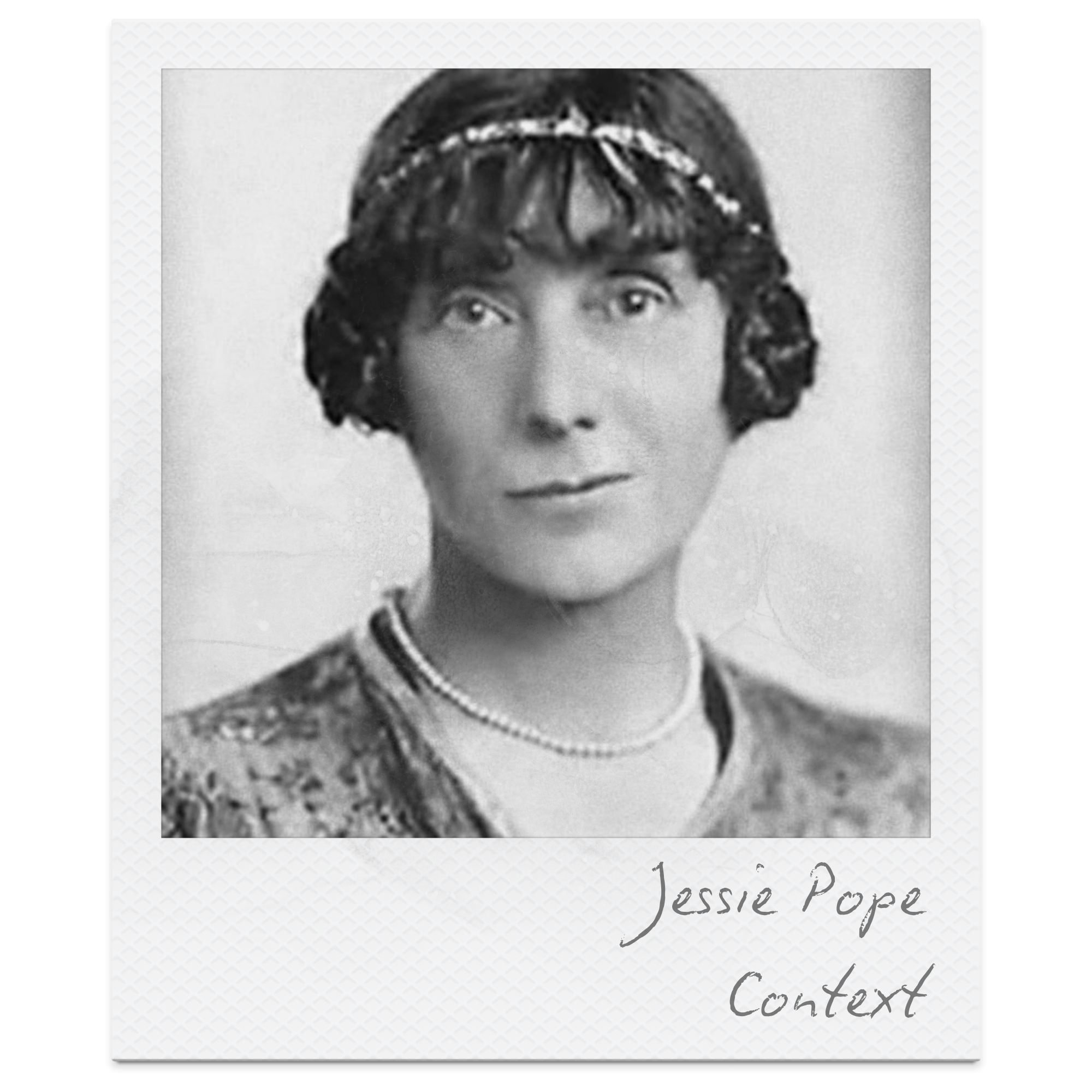
Who Was Jessie Pope?
Jessie Pope (1868–1941) was a British poet, journalist and writer whose work became particularly well known during the First World War. Before the conflict, she had established a career writing humorous verse, articles and stories for popular magazines and newspapers. Her accessible language, lively rhythms and playful treatment of everyday subjects helped shape the distinctive style she would later bring to her wartime poetry.
Following the outbreak of war in 1914, Pope began writing patriotic poems that encouraged military enlistment and celebrated national service. Her work appeared in popular publications and was collected in volumes including Jessie Pope's War Poems (1915) and More War Poems (1915).
Today, Pope is frequently discussed in relation to Wilfred Owen, whose poetry exposed the physical suffering and psychological consequences of trench warfare. However, her writing also provides valuable evidence of the patriotic expectations, cultural attitudes and changing social roles associated with wartime Britain.
Understanding Pope's background and the circumstances in which she wrote helps students examine her poetry as both a literary work and a historical source.
Explore our Jessie Pope Context Guide for a more detailed biography, historical background and information about her role in First World War literature.
Jessie Pope and the Mood of Britain in 1914
When Britain entered the First World War in August 1914, the conflict was accompanied by powerful expressions of patriotism, national duty and public enthusiasm. Although reactions varied considerably, recruitment campaigns, newspaper reporting and popular literature helped promote the idea that military service was an honourable responsibility and an opportunity for men to demonstrate courage, loyalty and masculinity.
During the early months of the war, many people expected the fighting to be relatively short. Public discussion frequently drew upon familiar ideals of heroism, sacrifice and service to the nation, while recruitment advertisements encouraged eligible men to volunteer. Sporting imagery, appeals to masculine pride and references to duty became recognisable features of wartime persuasion.
Jessie Pope's poetry reflects this atmosphere of patriotic expectation and recruitment pressure.
In Who's for the Game?, Pope presents enlistment through the familiar language of competitive sport. War becomes a challenging but exciting contest, and the reader is encouraged to participate rather than remain on the sidelines. The poem's rhetorical questions, energetic rhythm and conversational tone transform the decision to enlist into a test of courage and character.
Similarly, The Call addresses potential recruits directly, appealing to their sense of responsibility and suggesting that joining the armed forces is a measure of personal worth. The poem demonstrates how persuasive language could associate military service with social approval, masculine identity and national belonging.
However, it is important to distinguish between the patriotic attitudes expressed in such writing and the experiences of the population as a whole.
Britain in 1914 was not united by a single response to war. Enthusiasm existed alongside anxiety, uncertainty, opposition and concern for family members. Attitudes also changed as the conflict continued, casualties increased and the realities of prolonged warfare became increasingly apparent.
Pope's poetry therefore provides a particularly useful starting point for historical and literary discussion. Rather than treating her poems as an accurate description of what war was like, students can examine them as examples of how war was represented, promoted and understood within influential sections of British society.
This distinction becomes especially important when comparing Pope with poets such as Wilfred Owen and Siegfried Sassoon. Their writing often presents radically different experiences and perspectives, but those differences can help students understand the complexity of wartime attitudes rather than reducing First World War poetry to a simple opposition between patriotism and protest.
Why Should We Teach Jessie Pope's Poetry?
Jessie Pope is frequently introduced in the literature classroom as a contrast to Wilfred Owen. Her patriotic recruitment poems appear to offer an idealised vision of military service, while Owen's writing exposes the suffering, brutality and psychological consequences of war.
Although this comparison is valuable, teaching Pope exclusively through her relationship with Owen risks overlooking the wider historical, social and literary significance of her work.
Her poetry offers students opportunities to explore propaganda, persuasion, gender expectations, public attitudes and the relationship between literature and society. Studied within its historical context, Pope's writing can encourage students to move beyond straightforward judgements and develop a more nuanced understanding of the First World War.
1. Understanding Early Wartime Patriotism
Many students encounter the First World War primarily through poetry describing trench warfare, suffering, grief and disillusionment. While these perspectives are essential, they do not fully explain the public attitudes that surrounded the outbreak of war.
Pope's poetry helps students investigate why military service was presented as desirable, honourable or necessary, particularly during the early stages of the conflict.
Her poems provide opportunities to examine the language of national duty, masculine courage and collective responsibility, while encouraging students to consider the influence of newspapers, recruitment campaigns and popular culture.
Teachers can use Pope's writing to explore the difference between the experience of war and the public representation of war, helping students understand how attitudes developed and changed throughout the conflict.
2. Exploring Propaganda and Persuasive Language
Pope's recruitment poetry is particularly valuable for teaching students how writers influence their audiences.
In Who's for the Game?, sporting metaphors make military service appear familiar, competitive and exciting. Direct address and rhetorical questions involve the reader personally, while the poem's lively rhythm creates an impression of confidence and enthusiasm.
In The Call, Pope similarly appeals to the reader's sense of duty, identity and social responsibility.
These poems allow students to identify persuasive techniques and, more importantly, evaluate their effects.
Rather than simply labelling Pope's writing as propaganda, students can consider questions about audience, purpose, emotional appeal and the social pressures created through language.
This makes Pope's poetry especially useful for developing critical reading skills that extend beyond the study of First World War literature.
3. Examining Women's Changing Roles During the War
One of the strongest reasons to study Jessie Pope beyond her recruitment poetry is War Girls.
While Who's for the Game? and The Call focus on encouraging men to enlist, War Girls celebrates women undertaking work and responsibilities that challenged established expectations of female behaviour.
The poem draws attention to women working in occupations traditionally associated with men, presenting their contribution to the war effort with energy and admiration.
For students, this opens up a different perspective on the First World War.
Instead of examining only the experiences of soldiers, they can consider the ways conflict affected civilian life, employment opportunities and ideas about gender.
The poem also raises important questions about the extent of women's independence during wartime. Did these new responsibilities represent lasting social change, or were they understood primarily as temporary contributions during a national emergency?
Teaching War Girls alongside Pope's recruitment poetry reveals a more complex writer than the familiar image of the patriotic propagandist alone might suggest.
4. Developing More Meaningful Comparisons with Wilfred Owen
Comparing Jessie Pope with Wilfred Owen remains an important part of teaching First World War poetry, but the comparison becomes more valuable when students understand both writers within their historical contexts.
In Who's for the Game?, war is represented through the language of sport, competition and masculine courage. In Dulce et Decorum Est, Owen challenges idealised representations of military service through disturbing imagery, physical suffering and bitter irony.
Students can explore how the writers' different experiences, purposes and intended audiences shape their presentation of conflict.
However, teachers can also encourage students to consider why these contrasting perspectives existed and how public attitudes towards the war changed over time.
Rather than approaching the poems with the predetermined conclusion that one writer was right and the other wrong, students can investigate how literature reflects, reinforces and challenges the beliefs of its society.
This approach supports more sophisticated comparative analysis, particularly when examining tone, imagery, purpose, context and the presentation of patriotism.
5. Encouraging Critical Thinking About Literature and History
Perhaps the greatest value of teaching Jessie Pope lies in the questions her poetry encourages students to ask.
Can a poem be historically significant even when its message is uncomfortable to modern readers? How should we evaluate writing produced during a period of intense public pressure? What can literature reveal about the beliefs and expectations of a society, even when those beliefs are not universally shared?
Pope's poetry invites students to distinguish between understanding a writer's perspective and agreeing with it.
It also demonstrates why historical context matters. Without understanding the recruitment campaigns, gender expectations and patriotic culture of wartime Britain, students may struggle to appreciate why Pope's poems were written or how contemporary audiences might have responded.
Jessie Pope deserves a place in the First World War poetry classroom not simply because she provides a contrast to Wilfred Owen, but because her writing helps students understand the society, attitudes and expectations that surrounded the conflict.
By studying Who's for the Game?, The Call and War Girls together, students can explore recruitment propaganda, masculine identity, women's wartime contributions and the complex relationship between literature and historical experience.
Jessie Pope's War Poetry: Three Poems Worth Teaching
Teach Who’s for the Game? with minimal prep.
If you’re teaching Who’s for the Game? by Jessie Pope, you don’t need to spend hours creating discussion questions, poetry analysis activities, essay tasks and creative responses from scratch.
This complete Who’s for the Game? teaching resource bundle brings together a varied collection of ready-to-use activities designed to take students from their first exploration of the poem to deeper, more confident independent analysis.
Use the resources across a sequence of lessons or choose individual activities to complement your existing teaching. Students can explore Pope’s presentation of war, recruitment, patriotism, courage, masculinity, social pressure and propaganda, while examining how her choices of sporting imagery, rhetorical questions, direct address, rhyme, rhythm, structure and tone shape the poem’s persuasive presentation of enlistment.
Designed for secondary English and English Literature, the bundle can be used flexibly for whole-class teaching, paired and group discussion, independent learning, homework, revision and analytical writing.
Why this works
This is not simply a collection of disconnected worksheets. The bundle combines close analysis, discussion, debate, extended writing and creative response, giving students multiple ways to engage with the poem while developing increasingly independent interpretations.
Supports close reading and detailed poetry analysis
Encourages active discussion, debate and interpretation
Develops students’ ability to support ideas with textual evidence
Combines analytical and creative approaches to poetry
Suitable for paired, group, whole-class and independent learning
Provides flexible activities for lessons, homework and revision
Explores Pope’s use of sporting imagery, rhetorical questions, direct address, metaphor, rhyme, rhythm, structure and tone
Encourages students to consider the relationship between the poem and its First World War recruitment context
What’s included
Poetry Analysis Task Cards exploring context, form and structure, title, speaker, themes, imagery, language devices, sound techniques, lexical choices, shifts, tone, setting, mood and personal response
36-question Roll the Dice Discussion Board exploring recruitment, propaganda, sporting imagery, courage, cowardice, patriotism, masculinity, social pressure, language, structure, tone and Pope’s overall message
10 Silent Debate statements designed to encourage students to form, justify and challenge interpretations of the poem
15 essay questions covering key areas of analysis including war as a game, recruitment, patriotism, courage, cowardice, sporting imagery, rhetorical questions, direct address, rhyme, rhythm, structure and tone
10 creative writing prompts including recruitment speeches, counter-propaganda, podcast scripts, letters, dialogue, advertisements, poetry, historical fiction, radio broadcasts and short stories
9 creative classroom tasks, including a WWI recruitment campaign, podcast script, illustrated poem, persuasive speech, documentary storyboard and script, soldier’s response, propaganda analysis gallery, newspaper advertisement and propaganda-versus-reality collage
Teacher instructions for the Roll the Dice and Silent Debate activities, making both activities quick and straightforward to implement
How you can use it
Introduce Who’s for the Game? and develop students’ initial responses
Explore the social and historical context of First World War recruitment
Analyse Pope’s presentation of war as a game, competition and adventure
Explore how sporting imagery makes enlistment appear exciting and appealing
Examine themes including war, patriotism, courage, masculinity, duty, recruitment and social pressure
Analyse Pope’s use of rhetorical questions, direct address, metaphor and emotive language
Investigate the contrast between joining the “game” and taking “a seat in the stand”
Explore how the poem constructs ideas about courage and cowardice
Examine the significance of the suggestion that a soldier might “come back with a crutch”
Analyse how Pope personifies the country as “looking and calling for you”
Explore rhyme, rhythm, pace, structure and persuasive tone
Investigate how the poem can be read in relation to WWI recruitment and propaganda
Run low-prep paired, group or whole-class discussions
Encourage students to debate competing interpretations rather than search for a single “correct” reading
Set independent analytical, creative or revision work
Develop ideas for extended analytical and essay responses
What students gain
Greater confidence analysing Who’s for the Game? independently
A deeper understanding of Jessie Pope’s presentation of recruitment and the First World War
Stronger ability to analyse persuasive language, imagery, form and structure
Greater understanding of how propaganda and social pressure can influence an audience
Experience developing and defending interpretations
Improved discussion and analytical writing skills
Greater confidence selecting and using textual evidence
Opportunities to approach the poem through both analytical and creative thinking
Flexible enough for an entire teaching sequence
The variety of resources means the bundle can support far more than a single lesson. Begin with discussion and historical context, move into focused analysis of sporting imagery, persuasive language and structure, challenge students through Silent Debate, develop extended responses through the essay questions, or finish the unit with one of the creative tasks.
Teachers can select the activities that suit their class or combine them to create a broader Who’s for the Game? teaching sequence.
Download Now
Download the complete Who’s for the Game? by Jessie Pope Teaching Resources Bundle and start using it immediately, from first reading and classroom discussion through to detailed poetry analysis, independent interpretation and extended writing.
Jessie Pope's First World War poetry offers students three particularly valuable areas of exploration: the persuasive language of military recruitment, the expectations placed upon men during wartime, and the changing roles of women on the home front.
Although her poems share a patriotic perspective, each approaches the conflict from a different angle. Studying Who's for the Game?, The Call and War Girls together allows students to examine the relationship between literature, propaganda and the social expectations of wartime Britain.
Who's for the Game?: Recruitment, Patriotism and Propaganda
Who's for the Game? is one of Jessie Pope's best-known recruitment poems. Using the familiar language of sport, Pope presents military service as an exciting challenge that requires courage, determination and a willingness to participate.
The poem's extended sporting metaphor encourages readers to associate enlistment with competition, teamwork and masculine pride. Through rhetorical questions, direct address and an energetic rhythm, Pope creates a persuasive appeal that makes remaining at home appear less admirable than volunteering to fight.
For teachers, the poem provides an excellent opportunity to examine how propaganda uses familiar cultural references to influence an audience. Students can investigate how Pope minimises the dangers of warfare, appeals to contemporary expectations of masculinity and encourages readers to view enlistment as a personal responsibility.
It also offers a particularly effective comparison with Wilfred Owen's Dulce et Decorum Est, allowing students to explore contrasting representations of military service, patriotism and sacrifice.
Read our Who's for the Game? Analysis Guide for a detailed exploration of the poem's themes, language, imagery, structure and historical context.
Teaching Resources: Explore our Who's for the Game? classroom activities, including poetry analysis task cards, essay questions, creative writing prompts, creative tasks, Roll the Dice discussion activities and Silent Debate statements.
Teach The Call with minimal prep.
If you’re teaching The Call by Jessie Pope, you don’t need to spend hours creating discussion questions, poetry analysis activities, essay tasks and creative responses from scratch.
This complete The Call teaching resources bundle brings together a varied collection of ready-to-use activities designed to take students from their first exploration of the poem to deeper, more confident independent analysis.
Use the resources across a sequence of lessons or choose individual activities to complement your existing teaching. Students can explore Pope’s presentation of military recruitment, patriotism, propaganda, masculinity, courage, cowardice, national duty, social pressure and personal choice, while examining how her use of rhetorical questions, direct address, repetition, rhyme, rhythm, colloquial language, contrasts, structure and tone shapes the poem’s persuasive message.
Designed for secondary English and English Literature, the bundle can be used flexibly for whole-class teaching, paired and group discussion, independent learning, homework, revision and analytical writing.
Why this works
This is not simply a collection of disconnected worksheets. The bundle combines close analysis, discussion, debate, extended writing and creative response, giving students multiple ways to engage with the poem while developing increasingly independent interpretations.
Supports close reading and detailed poetry analysis
Encourages active discussion, debate and interpretation
Develops students’ ability to support ideas with textual evidence
Combines analytical and creative approaches to poetry
Suitable for paired, group, whole-class and independent learning
Provides flexible activities for lessons, homework and revision
Explores Pope’s use of rhetorical questions, direct address, repetition, rhyme, rhythm, colloquial language, contrasts, structure and tone
Encourages students to consider the relationship between the poem and its First World War context, including recruitment campaigns, patriotic expectations and contemporary attitudes towards military service
Supports thoughtful exploration of masculinity, courage, cowardice, social pressure, propaganda and the relationship between individual choice and national duty
What’s included
Poetry Analysis Task Cards exploring context, form and structure, title, speaker, themes, imagery, language devices, sound techniques, lexical choices, shifts, tone, setting, mood and personal response
36-question Roll the Dice Discussion Board (A3) exploring military recruitment, patriotism, masculinity, courage, cowardice, rhetorical questions, repetition, direct address, rhyme, rhythm, language, structure, tone and Pope’s overall message
10 Silent Debate statements designed to encourage students to form, justify and challenge interpretations of the poem
15 essay questions covering key areas of analysis including recruitment, propaganda, patriotism, masculinity, courage, shame, social pressure, rhetorical questions, direct address, repetition, form, structure and tone
10 creative writing prompts encouraging imaginative responses to the poem’s themes and First World War setting through persuasive speeches, historical fiction, letters, diary entries, poetry and dramatic writing
9 creative classroom tasks including recruitment poster design, podcast scripts, illustrated poetry, playscripts, documentary storyboards, contrasting diary entries, WWI uniform design, propaganda collages and newspaper front pages
Teacher instructions for the Roll the Dice and Silent Debate activities, making both activities quick and straightforward to implement
How you can use it
Introduce The Call and develop students’ initial responses
Explore the historical context of the First World War, including voluntary enlistment, recruitment propaganda and patriotic expectations
Analyse the significance of the title “The Call” and its suggestion of duty, invitation and personal responsibility
Examine the opening rhetorical question “Who’s for the trench—” and how Pope immediately challenges her intended audience
Explore the repeated direct address “my laddie” and its possible effects on young male readers
Investigate how Pope presents military service as an exciting opportunity through references to action, competition and victory
Analyse the significance of “Who’s going out to win?” and its presentation of warfare as a contest
Explore how “save his skin” suggests negative attitudes towards men who prioritise their personal safety
Examine the reference to the “khaki suit” and how military clothing becomes associated with identity and enlistment
Investigate how the phrase “show his grit” connects courage, physical strength and traditional expectations of masculinity
Explore the implications of “rather wait a bit” and how Pope presents hesitation as something potentially shameful
Analyse how Pope uses rhetorical questions, direct address and repetition to challenge readers and encourage enlistment
Examine how the poem’s rhyme and energetic rhythm contribute to its persuasive and memorable qualities
Explore themes including patriotism, military recruitment, masculinity, courage, cowardice, national pride, social pressure and personal choice
Investigate the reference to “earn the Empire’s thanks” and its relationship to patriotic duty and imperial identity
Explore the imagery of “Banners and rolling drums” and how the anticipated victory procession makes military service appear rewarding
Analyse the significance of “bite his thumbs” and its suggestion that those who refuse to enlist may experience regret or exclusion
Examine how the poem contrasts the imagined rewards of military service with the possibility of being judged for remaining at home
Investigate the development of Pope’s persuasive message across the three-stanza structure
Explore how the poem’s lively, challenging and occasionally mocking tone influences its intended audience
Consider how The Call reflects the conventions and objectives of First World War recruitment propaganda
Discuss the contrast between Pope’s idealised presentation of enlistment and the historical realities of trench warfare
Debate whether the poem genuinely offers young men a choice or uses social pressure to make refusal appear unacceptable
Examine how the poem reflects contemporary expectations surrounding masculinity, courage and patriotic responsibility
Run low-prep paired, group or whole-class discussions
Encourage students to debate competing interpretations rather than search for a single “correct” reading
Set independent analytical, creative or revision work
Develop ideas for extended analytical and essay responses
What students gain
Greater confidence analysing The Call independently
A deeper understanding of Jessie Pope’s presentation of recruitment, patriotism and military service during the First World War
Stronger ability to analyse rhetorical questions, direct address, repetition, rhyme, rhythm, form and structure
Greater understanding of how poetry can be used to persuade, influence and shape public attitudes
Increased awareness of the relationship between historical context, poetic methods and meaning
A deeper appreciation of how expectations surrounding masculinity, courage and national duty influence individual decisions
Experience developing and defending interpretations
Improved discussion and analytical writing skills
Greater confidence selecting and using textual evidence
Opportunities to approach the poem through both analytical and creative thinking
Flexible enough for an entire teaching sequence
The variety of resources means the bundle can support far more than a single lesson. Begin with discussion and historical context, move into focused analysis of recruitment propaganda, rhetorical questions, direct address, masculinity and the poem’s persuasive structure, challenge students through Silent Debate, develop extended responses through the essay questions, or finish the unit with one of the creative tasks.
Teachers can select the activities that suit their class or combine them to create a broader The Call teaching sequence.
The resources also provide opportunities to make connections with other First World War poems, particularly those exploring patriotism, recruitment, propaganda, military service, courage, disillusionment and the human cost of conflict.
The Call works particularly well alongside Jessie Pope’s Who’s for the Game? and War Girls, as well as contrasting perspectives from poets such as Wilfred Owen and Siegfried Sassoon.
Download Now
Download the complete The Call by Jessie Pope Teaching Resources Bundle and start using it immediately, from first reading and classroom discussion through to detailed poetry analysis, independent interpretation and extended writing.
Digital download: Printable PDF resources. No physical product will be shipped.
The Call: Duty, Masculinity and the Pressure to Enlist
In The Call, Jessie Pope presents military enlistment as a test of courage, duty and personal responsibility. Rather than describing the realities of battle, the poem focuses on persuading its audience to volunteer, using direct questions and repeated appeals to the reader's sense of honour.
Pope's conversational language creates the impression of a personal challenge. The speaker repeatedly addresses potential recruits, encouraging them to consider whether they are willing to fulfil the expectations placed upon them by their country and society.
The poem is particularly useful for exploring the relationship between propaganda and masculine identity. Students can examine how Pope associates military service with bravery and social approval, while implying that reluctance to enlist may indicate weakness or a failure of duty.
Teachers can also use The Call alongside Who's for the Game? to compare different persuasive strategies within Pope's recruitment poetry. Both poems appeal to patriotic responsibility, but their imagery, tone and methods of persuasion provide opportunities for close comparative analysis.
Read our The Call Analysis Guide for a closer examination of the poem's themes, language, structure and recruitment message.
Teaching Resources: Explore our The Call classroom activities, including poetry analysis task cards, essay questions, creative writing prompts, creative tasks, Roll the Dice discussion activities and Silent Debate statements.
Teach War Girls with minimal prep.
If you’re teaching War Girls by Jessie Pope, you don’t need to spend hours creating discussion questions, poetry analysis activities, essay tasks and creative responses from scratch.
This complete War Girls teaching resource bundle brings together a varied collection of ready-to-use activities designed to take students from their first exploration of the poem to deeper, more confident independent analysis.
Use the resources across a sequence of lessons or choose individual activities to complement your existing teaching. Students can explore Pope’s presentation of women, work, independence, gender roles, social change, patriotism and wartime responsibility, while examining how her choices of imagery, repetition, rhyme, rhythm, structure, language and tone shape the poem’s energetic portrayal of women during the First World War.
Designed for secondary English and English Literature, the bundle can be used flexibly for whole-class teaching, paired and group discussion, independent learning, homework, revision and analytical writing.
Why this works
This is not simply a collection of disconnected worksheets. The bundle combines close analysis, discussion, debate, extended writing and creative response, giving students multiple ways to engage with the poem while developing increasingly independent interpretations.
Supports close reading and detailed poetry analysis
Encourages active discussion, debate and interpretation
Develops students’ ability to support ideas with textual evidence
Combines analytical and creative approaches to poetry
Suitable for paired, group, whole-class and independent learning
Provides flexible activities for lessons, homework and revision
Explores Pope’s use of imagery, repetition, rhyme, rhythm, contrast, structure and tone
Encourages students to consider the relationship between the poem and its First World War and social context
What’s included
Poetry Analysis Task Cards exploring context, form and structure, title, speaker, themes, imagery, language devices, sound techniques, lexical choices, shifts, tone, setting, mood and personal response
36-question Roll the Dice Discussion Board exploring women’s work, independence, gender expectations, wartime change, clothing, relationships, language, repetition, rhyme, structure, tone and Pope’s overall message
10 Silent Debate statements designed to encourage students to form, justify and challenge interpretations of the poem
15 essay questions covering key areas of analysis including women’s changing roles, independence, gender expectations, work, clothing, femininity, repetition, rhyme, rhythm, structure and tone
10 creative writing prompts including historical fiction, podcast scripts, diary writing, journalism, dialogue, descriptive writing, poetry, letters, interviews and short stories
9 creative classroom tasks, including a recruitment poster series, podcast script, illustrated poem, playscript, documentary storyboard and script, diary entry, fashion and uniform design, newspaper article and then-and-now collage
Teacher instructions for the Roll the Dice and Silent Debate activities, making both activities quick and straightforward to implement
How you can use it
Introduce War Girls and develop students’ initial responses
Explore the social and historical context of the First World War
Investigate how women’s lives and employment changed during wartime
Analyse Pope’s presentation of women as active, capable and independent
Explore themes including gender, work, independence, social change, femininity and wartime responsibility
Examine the significance of “No longer caged and penned up”
Explore the range of occupations Pope presents and what they reveal about changing gender roles
Analyse the significance of women’s uniforms, clothing and physical appearance
Investigate Pope’s repeated use of “girl” and its effect on the presentation of women
Explore the tension between women’s new independence and the anticipated return of the “khaki soldier-boys”
Analyse repetition, rhyme, rhythm, structure, contrast and tone
Run low-prep paired, group or whole-class discussions
Encourage students to debate competing interpretations rather than search for a single “correct” reading
Set independent analytical, creative or revision work
Develop ideas for extended analytical and essay responses
What students gain
Greater confidence analysing War Girls independently
A deeper understanding of Jessie Pope’s presentation of women during the First World War
Stronger ability to analyse language, imagery, repetition, form and structure
Greater understanding of changing gender roles and women’s wartime work
Experience developing and defending interpretations
Improved discussion and analytical writing skills
Greater confidence selecting and using textual evidence
Opportunities to approach the poem through both analytical and creative thinking
Flexible enough for an entire teaching sequence
The variety of resources means the bundle can support far more than a single lesson. Begin with discussion and historical context, move into focused analysis of gender, language, repetition and structure, challenge students through Silent Debate, develop extended responses through the essay questions, or finish the unit with one of the creative tasks.
Teachers can select the activities that suit their class or combine them to create a broader War Girls teaching sequence.
Download Now
Download the complete War Girls by Jessie Pope Teaching Resources Bundle and start using it immediately, from first reading and classroom discussion through to detailed poetry analysis, independent interpretation and extended writing.
War Girls: Women's Changing Roles During WW1
While Jessie Pope is most frequently associated with poetry encouraging men to enlist, War Girls offers a different perspective on Britain's wartime experience.
Rather than concentrating on military recruitment, the poem celebrates women undertaking occupations and responsibilities that had traditionally been associated with men. Through its lively rhythm, confident tone and descriptions of women at work, Pope presents female participation in the war effort as energetic, capable and worthy of recognition.
For teachers, War Girls provides an opportunity to move beyond the familiar representation of women as passive figures waiting for soldiers to return. Students can explore the contribution of women to wartime industries and services, the disruption of established gender expectations, and the relationship between national necessity and social change.
However, the poem also invites critical discussion. Although Pope celebrates women's capabilities, students can consider whether the opportunities created by wartime employment necessarily translated into lasting equality or independence.
Studying War Girls alongside Who's for the Game? and The Call also reveals an interesting contrast within Pope's own writing. Her recruitment poems emphasise men's responsibility to serve through military action, while War Girls recognises women's contributions through work on the home front.
This makes War Girls particularly valuable for developing a broader understanding of the First World War and challenging the idea that Pope's literary significance lies solely in her recruitment propaganda.
Read our War Girls Analysis Guide for a detailed exploration of the poem's themes, imagery, language, structure and presentation of women's wartime roles.
Teaching Resources: Explore our War Girls classroom activities, including poetry analysis task cards, essay questions, creative writing prompts, creative tasks, Roll the Dice discussion activities and Silent Debate statements.
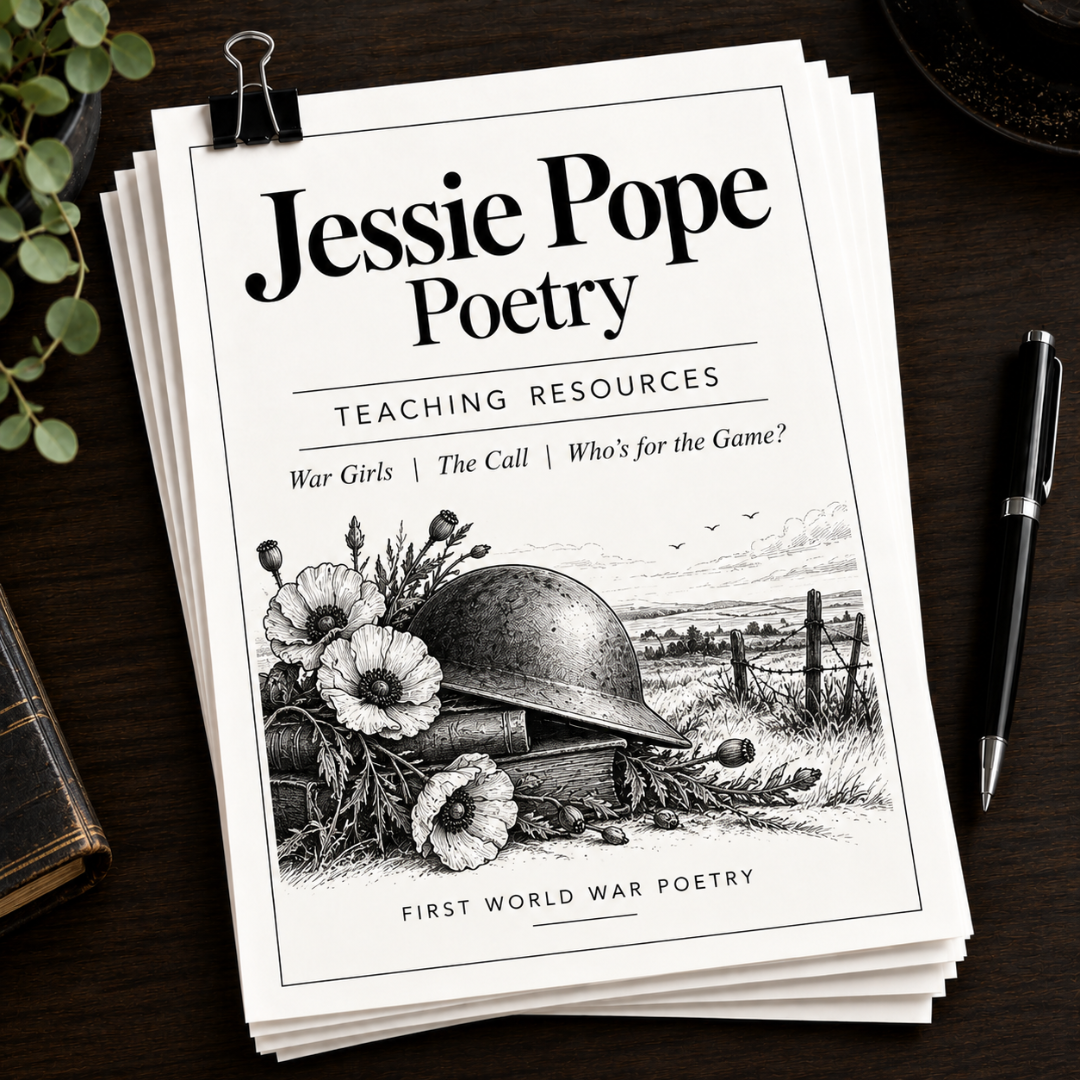
Teach three of Jessie Pope's First World War poems with minimal prep.
If you're teaching War Girls, The Call or Who's for the Game? by Jessie Pope, you don't need to spend hours creating discussion questions, poetry analysis activities, essay tasks and creative responses from scratch.
This comprehensive Jessie Pope Poetry Teaching Resources Bundle brings together ready-to-use teaching activities for three of Pope's First World War poems, helping students explore how poetry reflects, reinforces and challenges attitudes towards patriotism, military recruitment, propaganda, masculinity, femininity, gender expectations, courage and national duty.
The collection includes resources for:
War Girls – exploring women's changing roles during the First World War, wartime employment, independence, gender expectations and the relationship between women's contributions and traditional ideas about femininity.
The Call – examining military recruitment, patriotic duty, masculinity, courage, cowardice, social pressure and the persuasive techniques used to encourage young men to enlist.
Who's for the Game? – investigating the presentation of war as a sporting competition, the appeal to patriotism and masculine courage, and the use of persuasive language to make military service appear exciting and desirable.
Together, these three poems offer an opportunity to examine Jessie Pope's distinctive approach to wartime poetry, including how she uses energetic rhythms, repetition, direct address, rhetorical questions, familiar language and patriotic appeals to influence her readers.
Designed for secondary English and English Literature, the bundle can be used flexibly across a complete Jessie Pope teaching sequence or as individual resources within a wider First World War poetry unit.
Why this works
This is more than a collection of disconnected worksheets. The bundle combines close analysis, discussion, debate, extended writing, historical exploration and creative response, allowing students to develop their understanding of each poem individually before making meaningful comparisons across Pope's wartime writing.
Provides ready-to-use resources for three Jessie Pope poems
Supports close reading and detailed poetry analysis
Encourages active discussion, debate and independent interpretation
Develops students' ability to support arguments with textual evidence
Combines analytical and creative approaches to poetry
Encourages comparisons between poems, themes and persuasive techniques
Explores the relationship between poetry, propaganda and public attitudes during the First World War
Examines contrasting expectations of men and women during wartime
Supports analysis of rhetorical questions, direct address, repetition, imagery, rhyme, rhythm, structure and tone
Suitable for paired, group, whole-class and independent learning
Provides flexible activities for lessons, homework, revision and enrichment
Saves planning time while offering varied opportunities for student engagement
What's included
The bundle brings together the teaching resources for War Girls, The Call and Who's for the Game?, providing a varied selection of activities for each poem.
Poetry Analysis Task Cards
Explore the poems through focused analytical questions covering:
Historical and literary context
Titles and speakers
Themes and central messages
Language, imagery and poetic devices
Rhetorical questions and persuasive techniques
Rhyme, rhythm and sound
Form and structure
Tone, mood and shifts
Personal interpretation and evaluation
Roll the Dice Discussion Boards
Interactive discussion boards featuring 36 questions per poem, designed to encourage students to explore language, themes, historical context and alternative interpretations.
Use these activities for paired discussion, small-group work, revision or whole-class exploration.
Silent Debate Activities
Thought-provoking statements designed to encourage students to develop, justify and challenge interpretations using evidence from the poems.
Students can explore competing viewpoints about patriotism, gender expectations, recruitment propaganda, courage and the presentation of military service.
Essay Questions
A varied collection of analytical essay questions supporting close reading, literary interpretation and extended writing.
Questions explore themes, language, poetic methods, historical context and the effectiveness of Pope's persuasive techniques.
Creative Writing Prompts
Imaginative writing opportunities inspired by the poems' historical settings, themes and perspectives.
Activities encourage students to experiment with historical fiction, persuasive writing, diary entries, letters, dramatic writing and alternative viewpoints.
Creative Classroom Tasks
Engaging activities combining visual design, creative interpretation, historical exploration and critical thinking.
Tasks include recruitment posters, podcast scripts, illustrated poetry, playscripts, documentary storyboards, diary entries, visual collages and newspaper writing.
Teacher Instructions
Guidance for implementing the Roll the Dice and Silent Debate activities, making them straightforward to incorporate into existing lessons.
How you can use it
Introduce Jessie Pope and her role as a First World War poet
Explore the historical context of British recruitment campaigns, wartime propaganda and patriotic expectations
Analyse how Who's for the Game? uses sporting imagery to present military service as an exciting challenge
Examine the significance of competition, teamwork and masculine courage in Who's for the Game?
Investigate how The Call uses repeated rhetorical questions to challenge young men to enlist
Explore the effects of direct address through the repeated phrase “my laddie”
Analyse how The Call presents courage, hesitation and the fear of being judged
Examine the significance of the references to the Empire, victory and military glory
Explore how War Girls celebrates women undertaking responsibilities traditionally associated with men
Analyse the significance of “No longer caged and penned up” and its implications for women's pre-war experiences
Investigate how War Girls presents independence, capability and changing social expectations
Examine the relationship between wartime employment and traditional expectations of femininity
Compare how men and women are represented across Pope's three poems
Explore how Pope uses rhetorical questions, repetition, rhyme and rhythm to make her messages memorable
Compare the speakers' attitudes towards patriotism, national duty and participation in the war
Examine how the poems encourage readers to associate wartime participation with personal worth and social approval
Investigate the relationship between persuasive language and recruitment propaganda
Explore how historical context influences the interpretation of Pope's poetry
Debate whether Pope's poems celebrate individual courage or reinforce social expectations
Consider how the poems present the war while largely avoiding its violence, suffering and destruction
Compare Pope's optimistic representations of wartime participation with the experiences presented by other First World War poets
Make connections with Wilfred Owen and Siegfried Sassoon, particularly their contrasting presentations of war, patriotism and military service
Run low-prep paired, group and whole-class discussions
Encourage students to debate competing interpretations rather than search for a single “correct” reading
Develop comparative analytical responses across the three poems
Set independent analytical, creative or revision work
Build a complete Jessie Pope teaching sequence using a combination of the included activities
What students gain
Greater confidence analysing War Girls, The Call and Who's for the Game? independently
A deeper understanding of Jessie Pope's poetry and its First World War context
Stronger ability to analyse rhetorical questions, direct address, repetition, imagery, rhyme, rhythm, form and structure
Greater awareness of how poetry can persuade, influence and reinforce public attitudes
Improved understanding of patriotism, propaganda, recruitment and national duty
A deeper appreciation of changing gender roles and social expectations during the First World War
Greater confidence comparing themes, language and perspectives across multiple poems
Increased awareness of the relationship between historical context, poetic methods and meaning
Experience developing, defending and challenging literary interpretations
Improved discussion, analytical writing and comparative essay skills
Greater confidence selecting and using textual evidence
Opportunities to approach poetry through both analytical and creative thinking
Flexible enough for an entire teaching sequence
The variety of resources means this bundle can support far more than a single lesson.
Begin by introducing Jessie Pope and the historical context of First World War recruitment and propaganda, before exploring each poem individually.
Use Who's for the Game? to investigate how sporting imagery and competitive language encourage enlistment. Move to The Call to examine rhetorical questions, direct address and the social pressures surrounding military service. Explore War Girls to consider how the war created new opportunities for women while challenging traditional expectations about gender.
Once students have developed their understanding of each poem, use the discussion boards, Silent Debate statements and essay questions to encourage comparative analysis of Pope's language, themes, tone and persuasive methods.
The creative writing prompts and classroom tasks provide opportunities to consolidate learning through imaginative interpretation, visual projects and historical exploration.
Teachers can select individual activities to complement existing lessons or combine them to create a broader Jessie Pope First World War poetry teaching sequence.
The resources are also particularly useful when studying Pope alongside Wilfred Owen, Siegfried Sassoon and other First World War poets, encouraging students to consider how different writers represented military service, patriotic duty, gender expectations and the realities of conflict.
Download Now
Download the complete Jessie Pope Poetry Teaching Resources Bundle and explore three of her First World War poems through engaging discussion, detailed literary analysis, creative writing and classroom activities.
From first reading and historical context to independent interpretation, comparative analysis and extended writing, this collection provides flexible resources to support a varied and engaging poetry teaching sequence.
Digital download: Printable PDF resources. No physical product will be shipped.
Jessie Pope Poetry Teaching Resources & Classroom Activities
Teaching Jessie Pope's First World War poetry offers opportunities to explore patriotism, recruitment propaganda, gender expectations and the changing experiences of wartime Britain. Whether you're introducing Who's for the Game?, analysing the persuasive techniques of The Call, or exploring women's changing roles in War Girls, having a varied collection of classroom activities can help students engage with the poems from different perspectives.
Our Jessie Pope WW1 Poetry Teaching Resources Bundle brings together ready-to-use activities for all three poems, helping teachers develop students' close reading, analytical writing, discussion and creative thinking skills without spending hours preparing individual lessons.
What's Included in the Jessie Pope Teaching Bundle?
The collection features a range of activities designed for independent work, paired discussion, group tasks and whole-class exploration:
Poetry Analysis Task Cards — Focused questions covering historical context, form and structure, speaker, themes, imagery, language, tone and sound.
Essay Questions — 15 exam-style questions designed to develop structured literary analysis and extended written responses.
Creative Writing Prompts — 10 imaginative and reflective prompts encouraging students to engage creatively with the poems.
Creative Tasks — 9 varied classroom projects offering alternative ways to explore the poetry.
Roll the Dice Discussion Boards — 36 differentiated questions encouraging collaborative analysis and discussion.
Silent Debate Statements — 10 thought-provoking statements designed to encourage critical thinking, interpretation and evidence-based responses.
Teacher Instructions — Clear guidance for using the Roll the Dice and Silent Debate activities effectively.
Why Use the Jessie Pope Poetry Bundle?
The activities can be used to teach individual poems or to build a sequence of lessons exploring Pope's representation of the First World War.
Students can investigate the persuasive techniques of Who's for the Game? and The Call, compare their representations of masculine duty and military service, and examine how War Girls offers a different perspective on wartime contribution and changing gender roles.
The resources also support comparisons with Wilfred Owen and other First World War poets, encouraging students to evaluate contrasting attitudes towards patriotism, sacrifice and the realities of conflict.
Whether you're planning a complete Jessie Pope poetry unit, preparing students for comparative essays or looking for engaging activities to complement your existing lessons, the bundle provides flexible resources for different classroom needs.

Jessie Pope vs Wilfred Owen: Comparing Attitudes Towards War
One of the most common approaches to teaching Jessie Pope's poetry is to compare Who's for the Game? with Wilfred Owen's Dulce et Decorum Est. The poems offer strikingly different representations of the First World War, making them particularly valuable for exploring patriotism, propaganda, imagery and the relationship between literature and historical experience.
However, the most meaningful comparisons go beyond presenting Pope as a patriotic propagandist and Owen as the voice of truth. Both poets wrote for different purposes and from different perspectives, and understanding these differences helps students develop more sophisticated interpretations of their work.
Patriotism vs the Realities of War
In Who's for the Game?, Pope presents military service as an exciting opportunity to demonstrate courage, loyalty and masculine strength. Her sporting metaphors encourage readers to imagine war as a competitive challenge, while her direct appeals suggest that enlistment is a responsibility that honourable men should willingly accept.
Owen's Dulce et Decorum Est, by contrast, confronts readers with the physical suffering and psychological trauma experienced by soldiers. His descriptions of exhaustion, a gas attack and a dying man expose the brutality concealed by idealised representations of military service.
These contrasting perspectives provide opportunities to explore the relationship between public expectations of war and the experiences of those who fought.
Language, Imagery and Persuasion
Although their messages differ, both poets use language deliberately to influence their audiences.
Pope relies upon rhetorical questions, direct address, sporting imagery and energetic rhythms to encourage participation and reinforce patriotic expectations. Her language makes enlistment appear familiar, admirable and socially desirable.
Owen uses disturbing sensory imagery, harsh descriptions and bitter irony to challenge romanticised ideas of military sacrifice. His presentation of suffering encourages readers to question the patriotic rhetoric used to justify participation in war.
Students can therefore investigate not only what each poet communicates, but how their language shapes the reader's emotional and intellectual response.
Jessie Pope and Wilfred Owen: Key Comparisons
| Feature | Jessie Pope — Who's for the Game? | Wilfred Owen — Dulce et Decorum Est |
|---|---|---|
| Attitude to War | Presents enlistment as an honourable challenge. | Exposes suffering and challenges idealised sacrifice. |
| Purpose | Encourages men to volunteer. | Condemns romanticised representations of war. |
| Tone | Energetic, encouraging and challenging. | Exhausted, disturbing and bitter. |
| Imagery | Sport, competition and participation. | Physical suffering, exhaustion and a gas attack. |
| Persuasive Techniques | Rhetorical questions, direct address and social pressure. | Graphic imagery, direct address and irony. |
| Perspective | Civilian recruitment viewpoint. | Experience informed by military service. |
Teaching the Comparison Critically
When teaching these poems together, encourage students to consider the historical circumstances surrounding their composition, the audiences they address and the different experiences that informed their writing.
Rather than simply asking which poet presents the more accurate view of war, students might investigate why Pope's recruitment poetry could appeal to readers during the early stages of the conflict, or how Owen's experiences influenced his rejection of patriotic idealisation.
It is also worth considering the limitations of the comparison. Pope's War Girls, for example, demonstrates that her wartime writing was not exclusively concerned with encouraging men to enlist. Studying a wider selection of her poems helps students appreciate the diversity of experiences and attitudes represented in First World War literature.
Read our Dulce et Decorum Est Analysis Guide for a detailed exploration of Owen's imagery, language, themes and presentation of warfare.
For teachers planning comparative lessons, our Dulce et Decorum Est Teaching Resources provide classroom activities to support close analysis, discussion, creative responses and extended writing.
Final Thoughts
Jessie Pope's First World War poetry deserves to be studied as more than a convenient contrast to Wilfred Owen. Her writing offers valuable insights into the patriotism, recruitment campaigns and social expectations that shaped wartime Britain, while poems such as War Girls reveal another important dimension of the conflict: the changing roles and responsibilities of women.
By exploring Who's for the Game?, The Call and War Girls together, students can develop a more nuanced understanding of how literature reflects and influences public attitudes. Pope's poetry encourages critical discussion about propaganda, gender, national identity and the different experiences of those living through the First World War.
For more poetry analyses, historical context and classroom teaching resources, explore our WW1 Poetry Hub. You can also discover more literary guides, teaching ideas and resources in our Literature Library.
