Zero Hour by Ray Bradbury: Summary, Themes, Meaning & Analysis
Ray Bradbury’s Zero Hour explores childhood innocence and manipulation, trust and betrayal, and the terrifying vulnerability of adults within a science fiction framework. Through the seemingly harmless game of “Invasion,” Bradbury presents a world where children become the perfect instruments for an unseen force, blurring the line between play and reality.
At its core, the story examines the dangers of complacency, underestimation, and the assumption that children are powerless. As the narrative unfolds, everyday domestic life gives way to a chilling realisation that the greatest threat comes from within the home itself. This makes Zero Hour a powerful addition to the Ray Bradbury Hub and a compelling text within the broader Literature Library, where questions of control, perception, and human vulnerability remain deeply relevant.

Context of Zero Hour
Ray Bradbury’s Zero Hour reflects mid-20th century anxieties surrounding invasion, hidden threats, and psychological warfare, shaped by the cultural climate of post-war America and the emerging tensions of the Cold War. During this period, fears were not only centred on external enemies but also on the possibility of internal infiltration, where danger could come from within seemingly safe, domestic spaces. Bradbury draws on this context to reimagine invasion not as a military assault, but as something more subtle and insidious, aligning with his broader concerns explored in the Bradbury Context Post.
Within the story, this context deepens its central warning: the greatest threats are often those that go unnoticed, underestimated, or dismissed. By positioning children as the agents of invasion, Bradbury challenges assumptions about power, awareness, and vulnerability, suggesting that adults’ confidence in their own control is misplaced. The story ultimately reflects a world in which security is an illusion, and where the failure to take seemingly insignificant dangers seriously can lead to sudden and irreversible consequences.
Zero Hour: At a Glance
Form: Short story (science fiction)
Mood: Playful, deceptive, increasingly ominous
Central tension: Childhood innocence versus hidden manipulation and invasion
Core themes: Childhood and power; trust and betrayal; invasion and infiltration; complacency and control; illusion versus reality
One-sentence meaning: When adults dismiss children as harmless, they fail to see how easily innocence can be exploited, allowing danger to enter unnoticed.
Quick Summary of Zero Hour
The story follows Mink, a young girl absorbed in a game called “Invasion,” played with other children across the neighbourhood. The children gather tools, build strange devices, and take instructions from an unseen figure named Drill, whom they treat as real. While the adults remain busy with their daily routines, they dismiss the game as harmless imagination, unaware of its growing intensity.
As the day progresses, subtle details suggest that the game is more than play. Mink describes how the invaders plan to take over Earth using children as a “fifth column,” exploiting the fact that adults never pay attention to them. Strange events begin to occur, including objects behaving unnaturally and children becoming increasingly secretive and serious about their task.
At exactly five o’clock—“zero hour”—the invasion begins. Explosions erupt across the neighbourhood as Mink leads unseen beings into her home. Realising too late that the threat is real, her mother attempts to hide, but the invaders enter the house. The story ends with Mink opening the attic door and revealing the arrival of the alien force, as the line between game and reality completely collapses.
Title of Zero Hour
Ray Bradbury’s titles often do more than label the story: they establish tone, suggest conflict, create expectations, introduce symbolism, and hint at irony.
At first, Zero Hour suggests a precise moment of action, often associated with military operations or planned attacks. The phrase carries connotations of timing, coordination, and inevitability, leading the reader to expect a clear, dramatic event where something significant will occur.
As the story unfolds, the meaning of the title becomes more unsettling. The carefully planned “zero hour” is not controlled by adults or institutions, but by children, whose game conceals a real and imminent threat. The expectation of organised, visible conflict shifts into something far more subtle and deceptive, where the moment of action arrives without warning or recognition.
Symbolically, the title represents the collapse of illusion and control, marking the exact point where complacency gives way to consequence. It also reflects the idea of a tipping point, where small, unnoticed actions accumulate into irreversible change.
Ultimately, Zero Hour carries a strong sense of inevitability and finality, suggesting that once this moment is reached, it is already too late to intervene. The title lingers as a warning that danger does not always announce itself—sometimes it arrives quietly, disguised as something harmless, until the moment it cannot be stopped.
Structure of Zero Hour
Ray Bradbury structures Zero Hour to move from playful normality to mounting unease and finally to sudden, irreversible invasion, using contrast and escalation to reveal how easily danger can go unnoticed.
Opening (Exposition)
The story begins with a lively, energetic opening, focusing on children playing across ordinary suburban spaces. Their game, “Invasion,” is presented as harmless, filled with excitement and imagination, while adults continue their routines, confident in a world of peace and stability. This contrast establishes early dramatic irony, as the reader senses significance in what adults dismiss.
Rising Action
Tension builds through subtle shifts in tone and increasing detail about the game. Mink’s references to Drill, dimensions, and a planned invasion introduce elements of the uncanny, while the children’s seriousness contrasts with adult complacency. The narrative uses withheld information and fragmented explanations, allowing unease to grow without full clarity.
Turning Point / Climax
The turning point occurs as the idea of the game fully transforms into a credible threat, particularly when Mink explains the strategy of using children as a “fifth column.” The climax arrives at “zero hour,” when the invasion begins and explosions erupt across the neighbourhood, confirming that the children’s actions have real consequences.
Falling Action
The pace accelerates rapidly as Mrs. Morris begins to understand the danger. Her sudden panic and attempt to escape mark a shift from dismissal to realisation, creating a sense of desperation and urgency. The controlled domestic environment collapses into confusion and fear.
Ending (Resolution)
The story ends with an abrupt and chilling resolution, as the invaders enter the house and Mink calls out to her parents. The final moment—“Peekaboo”—combines childlike innocence with horror, reinforcing the collapse of game and reality. The lack of resolution intensifies the after-effect, leaving the reader with a sense of inevitability and loss of control.
Overall, the structure moves from innocence to revelation to invasion, using contrast, escalation, and an abrupt ending to highlight the dangers of underestimation and complacency.
Setting of Zero Hour
Ray Bradbury uses setting to show how danger can exist within ordinary environments, transforming familiar spaces into sites of hidden threat and invasion. The story is grounded in a peaceful suburban world, which makes the unfolding events more unsettling.
The opening presents a calm, idyllic neighbourhood, where “the streets were lined with good green and peaceful trees” and “the city hummed” with everyday activity. Adults move through a world of technological comfort and stability, with “rockets hover[ing] like darning needles in the blue sky,” suggesting a society that believes itself secure and advanced. This creates a strong contrast between perceived safety and actual vulnerability.
The children occupy the lawns, gardens, and domestic spaces, turning them into sites of secret activity. Mink works near “the rose bush,” speaking to an unseen presence, while the children gather tools and construct strange devices in plain sight. These familiar settings become zones of concealment, where invasion is quietly prepared without adult awareness. The contrast between visibility and invisibility reinforces the idea that danger is hidden within the everyday.
Inside the home, the setting shifts to a controlled domestic interior, filled with automated systems and routines. Mrs. Morris moves through a space of comfort and order, using devices like the “kitchen butler,” which reflects a world reliant on technology and predictability. However, this sense of control is gradually undermined as strange sounds emerge, including the persistent “buzzing,” signalling the intrusion of something alien and uncontrollable.
The attic becomes the final, symbolic setting of fear and attempted escape. As Mrs. Morris retreats there, it represents a last effort to regain control and safety, yet this space is quickly invaded. The presence of “heavy footsteps” and a “queer cold light” transforms the house into a site of occupation rather than protection, showing that no space is truly secure.
Overall, the setting moves from peaceful normality to hidden disruption to complete invasion, reinforcing Bradbury’s warning that danger does not arrive from distant places—it emerges within the spaces we trust most.
Narrative Voice in Zero Hour
Ray Bradbury uses a third-person narrative voice that shifts subtly between perspectives, allowing the reader to experience both childlike excitement and adult complacency, while gradually revealing the gap between them.
The story begins with a tone that reflects childlike energy and enthusiasm, capturing the children’s world through lively, sensory detail. Their movements are described with intensity and excitement, creating a sense of playfulness and imagination. However, this tone is not entirely aligned with their understanding, creating an early sense of dramatic irony, as the reader begins to question what lies beneath the game.
As the narrative develops, the perspective moves closer to Mrs. Morris, introducing a more reflective and uncertain tone. Through her viewpoint, the story explores dismissal, doubt, and gradual unease, as small details—such as Mink speaking to unseen figures or the strange “buzzing”—begin to disrupt the sense of normality. The voice captures her attempt to apply logic and rationality, even as her instincts suggest something is wrong.
The narrative also maintains a degree of distance and limitation, never fully explaining the nature of Drill or the invading force. This creates a sense of ambiguity and tension, as the reader is forced to interpret events alongside the characters, without complete understanding. The children’s dialogue, particularly Mink’s fragmented explanations, reinforces this sense of partial knowledge, where meaning is present but not fully grasped.
There is a strong undercurrent of irony throughout the voice, particularly in the contrast between adult certainty and reality. Statements about the world being stable and secure are presented in a tone that exposes their fragility, positioning the reader to recognise the false confidence of the adult perspective.
By the final moments, the narrative voice shifts into heightened urgency and fear, mirroring Mrs. Morris’s realisation. The calm, observational tone gives way to panic and fragmentation, culminating in the chilling simplicity of “Peekaboo,” where the voice returns to a childlike register but now carries a sense of threat and finality.
Overall, the narrative voice creates a layered experience of innocence, irony, and dread, guiding the reader from playful surface to the unsettling recognition that the children understand far more than the adults believe.
The Purpose and Impact of Zero Hour
Ray Bradbury uses Zero Hour to deliver a powerful warning about complacency, underestimation, and misplaced trust, showing how easily danger can emerge when it is dismissed as harmless. The story exposes the fragility of a society that believes itself secure, revealing that threats are most dangerous when they are ignored.
The emotional impact of the story lies in its shift from playful innocence to sudden terror. The children’s excitement initially feels harmless, even joyful, but this tone becomes deeply unsettling as the reader realises the seriousness of their actions. This contrast creates a strong sense of shock and betrayal, as something associated with safety—childhood—becomes the source of danger.
Intellectually, the story challenges assumptions about power and awareness. Adults believe they are in control, yet they fail to recognise what is happening in front of them. The use of children as agents of invasion highlights how easily authority can be undermined by blind spots and overconfidence, reinforcing the idea that control is often an illusion.
There is also a deep sense of moral unease, particularly in the portrayal of the parent-child relationship. The story raises unsettling questions about whether children truly understand the consequences of their actions, or whether they are simply following instructions without moral awareness. This ambiguity intensifies the after-effect, as the invasion is not driven by malice alone, but by manipulation and belief.
The ending lingers because it offers no resolution—only the quiet, chilling confirmation that the invasion has succeeded. The return to childlike language in “Peekaboo” creates a disturbing contrast, leaving the reader with a sense that normality has been completely replaced, and that it is already too late to resist.
The moral of Zero Hour is clear: when people dismiss small, seemingly harmless signs of danger—especially in those they underestimate—they create the conditions for their own downfall.
Characters in Zero Hour
Ray Bradbury presents characters as embodiments of power, perception, and vulnerability, using them to explore how authority can be undermined and how easily control can shift.
Mink
Mink represents childhood innocence combined with dangerous belief, acting as the central figure through whom the invasion is carried out. Her language reflects both playfulness and seriousness, as she insists, “This is a matter of life and death!,” revealing how completely she is absorbed in the game. Her loyalty to Drill and the invasion is clear when she explains, “They’re going to let us run the world,” showing her belief in reward and empowerment. Mink also embodies blind trust, as she follows instructions without questioning their consequences, ultimately becoming the agent through which the invasion succeeds.
Mrs. Morris
Mrs. Morris represents adult complacency and delayed realisation, embodying the failure to recognise danger in time. She initially dismisses the children’s behaviour, responding with amusement and logic, defining “logic” as “knowing what things are true and not true.” However, this reliance on rationality becomes a weakness, as she ignores the warning signs around her. Her growing unease is revealed through her shifting tone, culminating in panic as she realises the truth too late. She represents the collapse of perceived control, as her authority as a parent proves ineffective against the invasion.
Mr. Morris
Mr. Morris functions as a reinforcement of adult certainty and denial, maintaining confidence in the stability of the world. His reaction—“What’s wrong?” and “Nothing but pipes and hammers”—shows his belief that there is no real threat, even as events escalate. He dismisses his wife’s fears, representing the persistence of rational denial in the face of emerging danger. His inability to recognise the situation highlights the theme of false security, where adults assume control simply because they do not perceive a threat.
The Children
The children as a group symbolise collective belief and vulnerability to influence, acting as a unified force within the invasion. Their enthusiasm—“Yayyyy!” and their constant movement—creates a sense of energy and purpose, yet this energy is directed by an unseen authority. Their willingness to exclude older children, stating “You’re old,” reflects the importance of impressionability, as only the youngest are able to fully believe and participate. The group represents how easily individuals can be mobilised when they share a common belief, particularly when guided by something they trust.
Drill
Drill represents hidden authority and manipulation, functioning as the unseen architect of the invasion. Although never directly visible, his influence is evident through Mink’s repetition of his ideas, such as the need for “help from your enemy” and the use of children as a “fifth column.” His use of complex language—words like “impregnable” and “dimensions”—suggests intelligence and strategic thinking. Drill embodies the theme of invisible control, showing how power can operate without being seen, directing actions through belief and influence rather than force.
Key Themes in Zero Hour
Ray Bradbury explores a range of interconnected themes, using childhood, technology, and perception to reveal deeper anxieties about control, vulnerability, and hidden threat.
Childhood and Power
The story challenges assumptions about childhood by presenting children as powerful agents of change rather than passive figures. Mink and the other children are deeply involved in the invasion, following instructions with seriousness and purpose. Mink’s claim that “They’re going to let us run the world” reflects a shift in power, where children are no longer controlled but become the ones in control. Bradbury suggests that power lies not in age, but in belief and influence, making children uniquely dangerous.
Trust and Betrayal
A central tension lies in the breakdown of trust between parents and children. Adults assume children are harmless, while children use this trust to carry out the invasion unnoticed. Mink reassures her mother—“I’ll be sure you won’t be hurt much”—a line that combines affection with betrayal. This duality highlights how trust can be exploited, turning relationships into points of vulnerability.
Invasion and Infiltration
The story redefines invasion as something internal rather than external, occurring within homes rather than across borders. The idea of a “fifth column” is central, as the invaders rely on children already embedded within society. Mink explains that adults “never look under rosebushes or on lawns,” emphasising how infiltration succeeds through invisibility and neglect. Bradbury presents invasion as a process of quiet entry and gradual takeover, rather than open conflict.
Complacency and Control
Adults in the story believe they are in control, living in a world described as stable and secure, where “there were no traitors among men.” This confidence leads to complacency, preventing them from recognising danger. Mrs. Morris attempts to rely on logic and routine, but these prove ineffective against a threat she cannot understand. The story suggests that control is often an illusion sustained by ignorance, and that complacency creates vulnerability.
Illusion versus Reality
The children’s game blurs the boundary between imagination and reality, making it difficult for adults to distinguish between the two. What appears to be harmless play is, in fact, a real invasion. The moment of “zero hour” marks the collapse of this illusion, where the truth becomes undeniable. Bradbury uses this theme to show how easily reality can be misinterpreted or ignored when it does not align with expectations.
Fear of the Unseen
The invaders themselves are largely invisible or undefined, creating a sense of fear rooted in the unknown. Their presence is suggested through sounds, movements, and the children’s behaviour rather than direct description. This lack of clarity heightens the tension, reinforcing the idea that the most dangerous threats are those that cannot be clearly seen or understood.
Manipulation and Influence
Drill’s control over the children highlights the power of influence and persuasion. By using language and ideas that appeal to children—promising freedom, power, and excitement—he is able to guide their actions without resistance. Mink repeats his ideas, including the need for “help from your enemy,” showing how easily individuals can adopt beliefs that are not their own. Bradbury suggests that influence, rather than force, is the most effective form of control.
Symbolism in Zero Hour
Ray Bradbury uses objects, spaces, and repeated images as symbolic carriers of meaning, turning ordinary elements into reflections of invasion, control, and perception.
The Game of “Invasion”
The game itself symbolises the collapse of illusion versus reality. What appears to be harmless play becomes a vehicle for real destruction, showing how easily imagination can be weaponised. Mink’s insistence that it is “a matter of life and death” signals that the game operates on a level far beyond childhood fantasy. The “game” becomes a symbol of how danger can be disguised as innocence, allowing it to go unnoticed until it is too late.
The Rosebush
The rosebush symbolises hidden threat within beauty and normality. Mink repeatedly speaks to Drill near “the rose bush,” a traditionally gentle, domestic image. This contrast highlights how something dangerous can exist within safe, familiar environments, reinforcing the idea that invasion is not external but embedded within everyday life.
The Tools and Objects
The children’s use of everyday items—“knives and forks and pokers and old stovepipes and can openers”—symbolises the transformation of the ordinary into the dangerous. These objects, typically harmless, become part of the invasion apparatus, suggesting that threat does not require advanced weaponry but can emerge from what is already present. This reflects the theme of infiltration through the familiar.
The Yo-Yo
The yo-yo symbolises dimensional instability and unseen reality. When it vanishes—“It vanished”—and reappears, it suggests that the children are interacting with something beyond normal physical laws. This moment represents the presence of another dimension or hidden force, reinforcing the idea that reality is not fixed but can be altered or penetrated.
“Zero Hour”
The phrase “Zero hour” symbolises the moment of irreversible transformation, where illusion collapses into reality. It marks the exact point at which complacency fails and the consequences of inaction become unavoidable. As a symbol, it represents not just timing, but the idea that once a certain threshold is reached, events cannot be undone.
The Attic
The attic symbolises false refuge and final vulnerability. Mrs. Morris retreats there believing it to be a place of safety, yet it becomes the final point of confrontation. The presence of “heavy footsteps” and the melting lock transform it into a space of entrapment rather than protection, reinforcing the idea that there is no escape from a threat that has already infiltrated the home.
The Voices and Sounds
The recurring sounds—“buzzing,” “humming,” and the children’s laughter—symbolise the growing presence of the alien and the uncontrollable. These sounds begin subtly but intensify as the invasion approaches, representing the shift from background noise to overwhelming force. They signal that something is wrong long before it is fully understood, reinforcing the theme of ignored warning signs.
Key Techniques in Zero Hour
Ray Bradbury uses language and structure to create tension, unease, and dramatic irony, gradually transforming a scene of childhood play into one of invasion and horror.
◆ Dramatic irony — the reader recognises the significance of the children’s actions long before the adults do, creating tension between appearance and reality
◆ Foreshadowing — early references to “Invasion,” “zero hour,” and the idea of a “fifth column” hint at the coming attack, building a sense of inevitability
◆ Contrast — Bradbury juxtaposes childhood innocence with violent intent, and peaceful suburban life with hidden danger, emphasising the collapse of normality
◆ Dialogue-driven exposition — key ideas are revealed through Mink’s fragmented speech, allowing complex concepts like dimensions and strategy to emerge gradually
◆ Motif of sound — recurring sounds such as “buzzing,” “humming,” and children’s laughter signal the growing presence of the alien, shifting from background noise to threat
◆ Withheld information — the true nature of Drill and the invaders is never fully explained, creating ambiguity and tension
◆ Escalation of tone — the narrative moves from playful energy to unease and finally to panic, mirroring Mrs. Morris’s growing awareness
◆ Abrupt ending — the sudden conclusion with “Peekaboo” creates a chilling after-effect, denying closure and reinforcing the inevitability of the invasion
Important Quotes from Zero Hour
Ray Bradbury uses key moments of dialogue and description to reveal childhood belief, adult complacency, and the shift from game to invasion.
Childhood Innocence and Hidden Power
“The most exciting game ever!”
◆ Method — superlative, enthusiastic diction reflects childlike excitement
◆ Effect — disguises the seriousness of events, creating dramatic irony
◆ Link to theme — highlights childhood and power, where innocence conceals danger
“This is a matter of life and death!”
◆ Method — exaggerated phrasing typical of children’s speech
◆ Effect — blurs the boundary between play and reality, foreshadowing truth
◆ Link to theme — reinforces illusion versus reality, where the game is real
Invasion and Strategy
“You got to have help from your enemy.”
◆ Method — simplified, instructional tone communicates strategic logic
◆ Effect — reveals the calculated nature of the invasion through child-friendly language
◆ Link to theme — connects to invasion and infiltration, especially the “fifth column”
“And then, one day… they thought of children!”
◆ Method — narrative pacing and pause emphasise a moment of realisation
◆ Effect — creates a chilling shift as children become the key to invasion
◆ Link to theme — reinforces trust and betrayal and childhood and power
Complacency and False Security
“There were no traitors among men… the world was based upon a stable ground.”
◆ Method — declarative, absolute language reflects overconfidence
◆ Effect — heightens irony, as the statement is immediately undermined
◆ Link to theme — highlights complacency and control, exposing false security
“Parents learn to shut their ears.”
◆ Method — metaphor suggests deliberate ignorance
◆ Effect — reveals how adults actively ignore warning signs
◆ Link to theme — reinforces complacency, enabling the invasion
Growing Unease and Realisation
“Those children haven’t anything dangerous out there, have they?”
◆ Method — rhetorical question signals uncertainty and doubt
◆ Effect — marks the shift from confidence to anxiety
◆ Link to theme — shows the breakdown of control and awareness
“Something about dim-dims… dimensions.”
◆ Method — fragmented speech reflects partial understanding
◆ Effect — suggests knowledge beyond the child’s comprehension, increasing unease
◆ Link to theme — links to illusion versus reality and hidden knowledge
Climax and Horror
“Heavy footsteps. Twenty, thirty, forty, fifty of them.”
◆ Method — cumulative listing builds rhythm and escalation
◆ Effect — creates a sense of overwhelming, unstoppable force
◆ Link to theme — reinforces invasion and inevitability
“The attic lock melted.”
◆ Method — simple declarative sentence describing impossible action
◆ Effect — signals the collapse of physical and psychological barriers
◆ Link to theme — highlights loss of control and technological superiority
“Peekaboo.”
◆ Method — childlike language placed in a threatening context
◆ Effect — creates a chilling contrast between innocence and horror
◆ Link to theme — reinforces illusion versus reality, where play becomes deadly
Alternative Interpretations of Zero Hour
Ray Bradbury invites multiple readings, as the story’s ambiguity allows for different interpretations of childhood, power, and invasion.
Psychological Interpretation: fear of losing control over children
The story can be read as a reflection of parental anxiety, where adults fear losing authority over the next generation. Mink’s certainty and independence—insisting on the importance of the game and rejecting adult interference—suggest a breakdown in parental control. The invasion becomes a metaphor for the fear that children will grow beyond adult influence, making decisions that adults cannot understand or prevent.
Political Interpretation: Cold War infiltration and internal threat
From a political perspective, the story reflects fears of internal infiltration, particularly the idea of a “fifth column” operating within society. Rather than attacking from outside, the invaders use children already embedded within communities. This mirrors Cold War anxieties about hidden enemies, suggesting that the greatest danger comes not from visible conflict, but from unseen forces working within.
Feminist Interpretation: motherhood, dismissal, and silenced intuition
A feminist reading focuses on Mrs. Morris’s perspective, particularly how her growing unease is initially dismissed. Although she senses that something is wrong, she attempts to suppress her instincts in favour of logic and normality, reflecting broader patterns of women’s intuition being undervalued or ignored. Her final panic can be seen as the eruption of repressed awareness, suggesting that earlier attention to her instincts might have changed the outcome.
Existential Interpretation: illusion of stability and sudden collapse
The story can be interpreted as a commentary on the fragility of human certainty. The adults live in a world they believe to be stable, where “the world was based upon a stable ground,” yet this belief is quickly destroyed. The invasion represents the idea that security is an illusion, and that systems humans trust can collapse without warning, leaving them powerless.
Contemporary Interpretation: influence, media, and unseen control
In a modern context, the story resonates with concerns about influence and manipulation, particularly how ideas spread among young people. Drill’s control over the children mirrors the way external forces—whether media, technology, or online spaces—can shape beliefs and behaviour. The children’s unquestioning acceptance highlights the danger of unseen influence, where control operates through persuasion rather than force.
Why Zero Hour Still Matters
Ray Bradbury’s Zero Hour remains deeply relevant because it exposes how complacency, distraction, and misplaced trust can allow serious threats to go unnoticed—especially when they appear harmless or familiar.
In a modern context, the story resonates with concerns about influence over young people, particularly through technology, media, and online spaces. Just as Drill manipulates the children through ideas and belief, contemporary systems can shape behaviour in ways that adults may not fully see or understand. The idea that power operates through persuasion rather than force highlights ongoing anxieties about how easily individuals—especially the young—can be influenced.
The story also reflects patterns of human behaviour, where people dismiss warning signs because they do not fit expectations. Mrs. Morris briefly senses that something is wrong, yet she suppresses it in favour of logic and routine, mirroring how individuals often ignore discomfort or doubt. This reinforces the danger of underestimating the familiar, particularly when it challenges existing beliefs.
On a broader level, the story speaks to issues of systems, power, and control, showing how authority can be undermined from within. The invasion succeeds not because it is powerful, but because it is unnoticed, exploiting blind spots in perception and trust. This idea remains relevant in discussions of security, influence, and societal vulnerability.
Ultimately, the story still matters because it captures a simple but unsettling truth: the greatest dangers are often the ones we refuse to take seriously until it is too late.
Teaching Ideas for Zero Hour
Bring this text into the classroom through its exploration of childhood, control, and hidden invasion, using it to prompt discussion around power, influence, and perception.
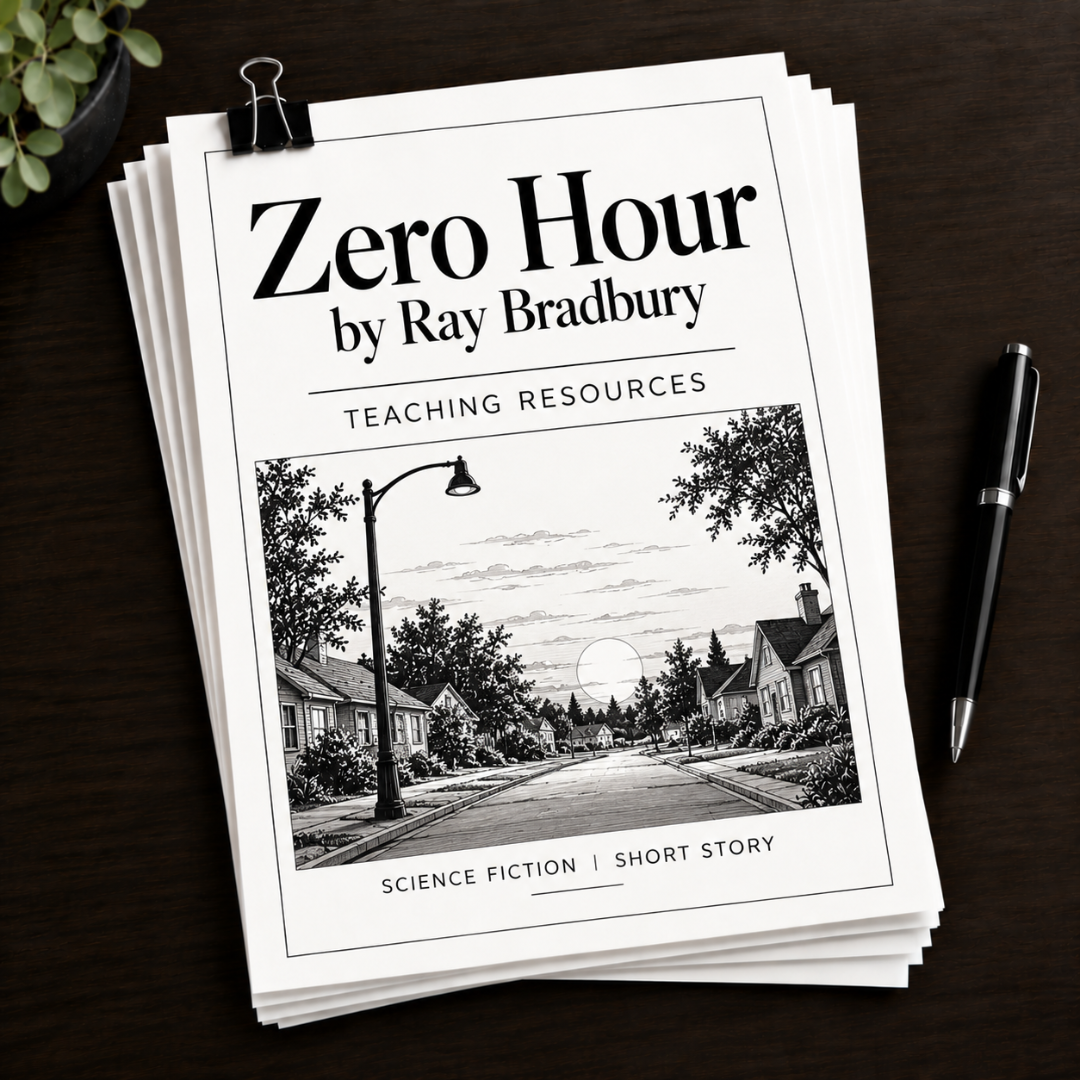
Teach Zero Hour with minimal prep.
If you’re teaching Zero Hour by Ray Bradbury, you don’t need to spend hours creating short story analysis activities, discussion questions, essay tasks, creative writing prompts and classroom resources from scratch.
This comprehensive Zero Hour teaching resources bundle brings together a varied collection of ready-to-use activities designed to take students from their first exploration of Bradbury’s unsettling science fiction story to deeper, more confident independent analysis.
Use the resources across a sequence of lessons or choose individual activities to complement your existing teaching. Students can explore Bradbury’s presentation of childhood innocence, imagination, alien invasion, manipulation, trust, family relationships, parental authority and the dangers of underestimating children, while examining how his choices of foreshadowing, irony, symbolism, dialogue, characterisation, setting, atmosphere and narrative structure contribute to the story’s disturbing conclusion.
Designed for secondary English, English Language Arts (ELA) and English Literature, the bundle can be used flexibly for whole-class teaching, paired and group discussion, independent learning, homework, revision and creative writing.
Why this works
This is not simply a collection of disconnected worksheets. The bundle combines close reading, literary analysis, discussion, debate, extended writing, creative response and engaging review activities, giving students multiple ways to explore Bradbury’s story while developing increasingly independent interpretations.
Supports close reading and detailed short story analysis
Encourages active discussion, debate and critical interpretation
Develops students’ ability to support ideas with textual evidence
Combines analytical, creative and visual approaches to literature
Explores the relationship between childhood innocence, imagination and manipulation
Encourages students to question assumptions about trust, authority and vulnerability
Supports analysis of characterisation, setting, symbolism, foreshadowing, irony, dialogue, conflict, tone and atmosphere
Includes engaging review activities such as Bingo, a crossword and word search
Develops descriptive writing through illustrated prompts and sensory worksheets
Suitable for paired, group, whole-class and independent learning
Provides flexible activities for lessons, homework, revision and extension work
Encourages students to consider the continuing relevance of Bradbury’s warnings about manipulation and misplaced trust
What’s included
16 Short Story Analysis Task Cards exploring context, plot and structure, title, narrative perspective, plot summary, themes, imagery and symbolism, language devices, characterisation, word choices, conflict and turning points, tone, setting, mood and personal response
15 Essay Questions encouraging detailed analytical responses to Bradbury’s presentation of childhood, imagination, alien invasion, manipulation, family relationships, irony, characterisation and the story’s disturbing conclusion
10 Creative Writing Prompts encouraging students to develop original narratives inspired by the story’s science fiction, psychological and imaginative ideas
9 Creative Classroom Tasks offering imaginative ways to explore the story through independent and collaborative responses
36-question Roll the Dice Discussion Board providing differentiated questions for paired, small-group and whole-class discussion
10 Silent Debate Statements encouraging students to develop, justify and challenge interpretations of Bradbury’s themes, characters and messages
20 Illustrated Picture Prompts inspired by the story’s setting, atmosphere, characters and science fiction ideas
20 Five Senses Descriptive Writing Worksheets accompanying the picture prompts and helping students develop vivid, sensory descriptions
Zero Hour Bingo Review Game, including printable Bingo cards and a calling sheet for engaging classroom revision
Zero Hour Crossword reinforcing key vocabulary, characters, events and ideas from the story
Zero Hour Word Search providing an accessible vocabulary and comprehension review activity
Zero Hour Colouring Pages offering a creative, visual way to engage with the story and its imagery
Teacher Instructions for the Roll the Dice and Silent Debate activities, making both resources straightforward to implement
How you can use it
Introduce Zero Hour and develop students’ initial responses to Bradbury’s unsettling story
Explore the conventions of science fiction, alien invasion narratives and psychological horror
Examine the ordinary suburban neighbourhood and how Bradbury transforms a familiar setting into a threatening environment
Analyse the significance of the children’s game of Invasion and its role in the unfolding events
Explore how Bradbury presents Mink Morris as an imaginative, enthusiastic and apparently innocent child
Investigate the mysterious Drill and his manipulation of the children
Analyse the contrast between the children’s excitement and the adults’ failure to recognise the approaching danger
Explore how Bradbury uses dialogue to reveal information and create tension
Examine the significance of childhood innocence, trust and vulnerability in the success of the invasion
Investigate how foreshadowing and suspense prepare readers for the story’s conclusion
Analyse the presentation of parental authority, adult complacency and family relationships
Explore the relationship between imagination, reality and manipulation
Discuss whether the children understand the consequences of their involvement in the invasion
Examine the significance of Mrs. Morris’s reactions to Mink’s behaviour and the invasion game
Debate the extent to which the adults are responsible for failing to recognise the threat
Explore how the ending challenges expectations about childhood innocence and the safety of the family home
Consider Bradbury’s warnings in relation to trust, manipulation, conformity and the dangers of underestimating others
Run low-prep paired, group or whole-class discussions using the Roll the Dice questions
Encourage students to debate competing interpretations through Silent Debate
Use the illustrated picture prompts to develop descriptive and sensory writing
Reinforce vocabulary and comprehension through Bingo, crossword and word search activities
Set independent analytical, creative or revision work
Develop ideas for extended analytical and essay responses
What students gain
Greater confidence analysing Zero Hour independently
A deeper understanding of Ray Bradbury’s presentation of childhood, imagination, manipulation and human behaviour
Stronger ability to analyse foreshadowing, irony, symbolism, dialogue, setting, characterisation and narrative structure
Greater awareness of how science fiction can explore contemporary social concerns
Improved understanding of how writers create suspense, tension and unsettling atmospheres
Experience developing and defending interpretations through discussion and debate
Greater confidence selecting and using textual evidence
Stronger analytical and extended writing skills
Improved descriptive writing through sensory and visual activities
Opportunities to explore the story through both analytical and creative thinking
Greater confidence connecting literary themes to questions about trust, authority and human vulnerability
Flexible enough for an entire teaching sequence
The variety of resources means the bundle can support far more than a single lesson.
Begin with introductory discussion and close reading, move into focused analysis of Mink Morris, Drill, the invasion game, the adults’ reactions and Bradbury’s use of foreshadowing, then challenge students through Silent Debate and differentiated discussion questions.
Develop extended responses through the essay questions, encourage imaginative thinking through the creative writing activities, or use the picture prompts and Five Senses worksheets to strengthen descriptive writing.
Finish the unit with an engaging Bingo review game, crossword or word search, helping students revisit important vocabulary, characters, events and ideas.
Teachers can select the activities that suit their class or combine them to create a broader Zero Hour teaching sequence.
Download Now
Download the complete Zero Hour by Ray Bradbury Teaching Resources Bundle and start using it immediately, from first reading and classroom discussion through to detailed short story analysis, independent interpretation, creative writing and extended analytical responses.
Digital download: Printable PDF resources. No physical product will be shipped.
Explore Our Complete Teaching Resources Bundle
Bring Zero Hour into your classroom with a comprehensive collection of ready-to-use teaching resources, worksheets and activities designed to make exploring Ray Bradbury's unsettling science fiction story engaging, accessible and straightforward.
Whether you're introducing the story for the first time, exploring its deeper meanings or preparing students for extended literary analysis, the Zero Hour Teaching Resources Bundle provides everything you need to build a varied and engaging sequence of lessons without spending hours preparing materials from scratch.
The bundle includes:
◆ Short Story Analysis Task Cards — explore plot, characterisation, themes, symbolism, language and narrative techniques
◆ Essay Questions — develop critical thinking, close reading and evidence-based analytical writing
◆ Creative Writing Prompts & Tasks — encourage imaginative responses, alternative endings and fresh perspectives on the story
◆ Roll the Dice & Silent Debate Activities — stimulate discussion, interpretation and collaborative learning
◆ 20 Picture Prompts & Five Senses Worksheets — develop descriptive writing through visual and sensory activities
◆ Bingo, Crossword & Word Search — reinforce comprehension, vocabulary and key ideas through engaging review activities
◆ 20 Illustrated Colouring Pages — explore important characters, scenes and symbols through creative visual responses
Designed for secondary English, English Literature and ELA classrooms, these printable PDF resources are suitable for whole-class teaching, group activities, independent learning, homework, revision and extension tasks.
Spend less time planning and more time exploring the story. From Mink's mysterious game of Invasion to the chilling final moments of Zero Hour, the bundle helps students develop a deeper understanding of Bradbury's themes, techniques and storytelling.
Explore the complete Zero Hour by Ray Bradbury Teaching Resources Bundle below and discover everything included.
2. Tension and Structure
The story builds tension through the gradual shift from playful innocence to hidden threat, where the ordinary becomes increasingly unstable.
◆ Normality to unease — energetic opening masks deeper danger
◆ Withheld information — partial explanations create growing suspicion
◆ Perspective shift — movement from child certainty to adult doubt
◆ Sudden climax — invasion arrives abruptly at “zero hour”
3. Symbolism Focus
The story uses symbolic elements to explore invasion, perception, and control, particularly through everyday objects and spaces.
◆ The game — represents illusion masking real danger
◆ The rosebush — symbolises hidden threat within the familiar
◆ The attic — reflects false safety and final vulnerability
◆ The sounds (buzzing/humming) — signal the growing presence of the unseen
4. Creative Writing Extension
Students can explore invasion, perspective, and hidden threat through creative writing tasks linked directly to the text, encouraging them to extend Bradbury’s ideas or reimagine key moments. Creative writing prompts linked specifically to Zero Hour are available here.
And for a wider range of genres, tropes, and themes, explore the Creative Writing Archive.

Go Deeper into Zero Hour
Ray Bradbury’s Zero Hour opens up wider conversations about invasion, control, and unseen threat, making it a powerful entry point into Bradbury’s exploration of technology, society, and human vulnerability. For further classroom connections, explore Best Bradbury for the Classroom and Using Black Mirror to Teach Bradbury.
◆ The Veldt by Ray Bradbury — explores children gaining power through technology and the breakdown of parental control
◆ The Pedestrian by Ray Bradbury — examines complacency, conformity, and societal blind spots
◆ There Will Come Soft Rains by Ray Bradbury — presents a world where systems continue without human awareness or control
◆ Black Mirror - Netflix series — offers modern parallels through stories of manipulation, technology, and unseen influence
◆ Lord of the Flies by Lord of the Flies — explores childhood, power, and the breakdown of societal control
Together, these texts deepen understanding of how power can shift unexpectedly, reinforcing Bradbury’s warning about the dangers of underestimating the familiar.
Final Thoughts
Ray Bradbury’s Zero Hour offers a chilling exploration of childhood, control, and the dangers of underestimation, revealing how easily power can shift when it is overlooked. By placing the threat within the familiar world of children and domestic life, Bradbury exposes the fragility of authority, trust, and perceived safety.
The story’s lasting impact lies in its ability to transform innocence into something deeply unsettling, showing how illusion, complacency, and hidden influence can lead to sudden and irreversible consequences. Its themes continue to resonate in modern discussions of power and perception. For further exploration, visit the Ray Bradbury Hub, the Literature Library, or explore related texts that expand on these ideas.
Choose Your Next Text