Snow has an extraordinary ability to transform the world. Familiar streets disappear beneath pristine white blankets, bare branches become delicate sculptures of frost, and ordinary landscapes acquire an almost otherworldly beauty. A gentle snowfall can soften the noise of a busy city, turning an otherwise unremarkable evening into something peaceful and magical. Yet snow can also be merciless, burying roads, concealing dangerous terrain and reducing an immense wilderness to an endless expanse of indistinguishable white.
For writers, describing snow effectively involves far more than calling it white, cold or beautiful. Snow has texture, movement, weight and sound. It can drift lazily through the air, gather in enormous sculpted banks, glitter beneath winter sunlight or sweep across an exposed mountainside in blinding sheets. Fresh powder behaves differently from compacted snow, while a frozen crust beneath someone's boots creates an entirely different sensory experience from the wet, heavy snowfall of an approaching thaw. Each detail offers an opportunity to make a winter setting more vivid, immersive and emotionally convincing.
The atmosphere of a snowy landscape also changes dramatically depending on the story being told. In fantasy, snow might conceal an enchanted kingdom, preserve the ruins of an ancient civilisation or mark the arrival of a winter that has lasted for centuries. In Gothic fiction and horror, a blizzard can isolate characters from the outside world, erase familiar landmarks or reveal footprints that should not exist. Romance and literary fiction might explore the intimacy of a snowbound cottage, the melancholy beauty of an empty winter garden or the quiet anticipation of the year's first snowfall.
Snow is equally powerful in poetry and descriptive writing, where its appearance can suggest innocence, silence, renewal, isolation, memory or loss. A landscape covered in untouched snow might feel full of possibility to one character and unbearably empty to another. Even the same snowfall can evoke entirely different emotions depending on whether it is observed through a warm bedroom window, experienced during a difficult journey or remembered years after a significant event.
This collection of 100 words to describe snow explores ten different aspects of winter weather and snowy landscapes, from delicate powder and sparkling snowflakes to violent blizzards, frozen wildernesses, Gothic winter imagery and poetic descriptions. Each word includes its meaning, suggestions for when to use it and an original example sentence demonstrating how it can enrich your creative writing.
Whether you're describing the first snowflakes settling over a village, an isolated mountain pass during a storm, a mysterious forest buried beneath winter or a peaceful garden glittering in the morning sunlight, these words will help you move beyond familiar descriptions and create winter scenes filled with atmosphere, sensory detail and imaginative depth.
For more inspiration, explore the Descriptive Writing Hub for vocabulary, sensory writing techniques and original descriptive examples, or visit the Creative Writing Archive for seasonal story prompts, atmospheric settings and imaginative writing activities across a wide range of genres. You can also check out our 70 Winter Writing Prompts, featuring snowbound mysteries, frozen adventures, intriguing characters and evocative winter settings.
1. Fresh, Soft & Powdery Snow
Freshly fallen snow possesses a particular beauty that is difficult to capture with a single adjective. It settles over rooftops, gathers along bare branches and softens the familiar contours of a landscape, transforming uneven fields and ordinary streets into seemingly untouched expanses of white. Depending on the temperature and weather conditions, snow might fall as delicate individual crystals, gather into enormous featherlike flakes or accumulate in loose, airy layers that scatter at the slightest disturbance.
For writers, the texture of fresh snow offers opportunities to create atmosphere through movement, sound and sensory detail. Fine powder might drift from the branches of a pine tree, while heavier flakes settle upon a character's coat before melting into the fabric. Snow can suggest innocence, tranquillity and the promise of a new beginning, but its apparent perfection can also become unsettling when it conceals familiar paths or reveals a single unexplained set of footprints.
These first ten words explore the softness, delicacy and distinctive textures of freshly fallen snow, helping you describe everything from peaceful winter mornings to enchanting fantasy landscapes and atmospheric scenes of quiet isolation.
1. Powdery
Meaning: Consisting of fine, loose, dry particles resembling powder; often used to describe freshly fallen snow that has not yet become compacted or wet.
Best for: Fresh snowfall, ski slopes, alpine landscapes, untouched woodland clearings and descriptions emphasising the lightness of snow.
Example: A layer of powdery snow covered the woodland path, lifting in delicate white clouds whenever the wind passed between the pines.
2. Fluffy
Meaning: Soft, light and airy in appearance or texture, resembling down, feathers or loosely gathered fibres.
Best for: Gentle snowfall, picturesque villages, cosy winter scenes, children's stories and descriptions of large, loosely clustered snowflakes.
Example: Fluffy snowflakes drifted past the cottage windows, settling upon the garden wall until its uneven stones disappeared beneath a thick white cushion.
3. Feathery
Meaning: Delicate, light or resembling the soft structure of a feather; particularly evocative when describing the movement or appearance of falling snow.
Best for: Slow snowfall, delicate snowflakes, romantic winter scenes, poetic imagery and atmospheric descriptions of gentle movement.
Example: Feathery flakes floated through the still evening air, catching briefly in her hair before dissolving against the warmth of her skin.
4. Downy
Meaning: Exceptionally soft and light, resembling the fine feathers beneath a bird's outer plumage.
Best for: Pristine snowfall, quiet countryside landscapes, peaceful winter mornings and poetic descriptions that emphasise softness and comfort.
Example: A downy covering of snow rested upon the orchard, softening the crooked branches and turning the abandoned beehives into little white mounds.
5. Pristine
Meaning: Perfectly clean, fresh and unspoiled, without marks, disturbances or signs of previous activity.
Best for: Untouched snowfields, isolated landscapes, winter wildernesses, fantasy settings and scenes in which an undisturbed surface carries narrative significance.
Example: Beyond the garden gate stretched a pristine expanse of snow, unmarked by footprints or wheel tracks, as though nobody had entered the village for days.
6. Untrodden
Meaning: Not yet walked upon or disturbed by footsteps; particularly effective for describing snow-covered paths and landscapes untouched by human activity.
Best for: Remote wildernesses, mysterious woodland paths, abandoned villages, Gothic winter settings and descriptions suggesting solitude or secrecy.
Example: The untrodden snow beneath the chapel windows lay perfectly smooth, although someone had left a lantern burning inside during the night.
7. Granular
Meaning: Composed of small, distinct grains or particles; when applied to snow, suggesting a coarse or grainlike texture rather than delicate, newly formed flakes.
Best for: Snow that has changed through temperature fluctuations, compacting or partial melting, detailed outdoor descriptions and realistic winter survival scenes.
Example: The granular snow crunched beneath his boots, its coarse crystals scattering across the frozen track as he climbed towards the mountain refuge.
8. Crystalline
Meaning: Resembling crystals in structure, clarity or geometric form; particularly appropriate for describing the intricate shapes of individual snow crystals.
Best for: Close-up descriptions of snowflakes, magical winter imagery, scientific observation, fantasy landscapes and delicate poetic detail.
Example: Crystalline snowflakes gathered along the black iron railings, each tiny structure briefly visible before the rising sun began to soften their intricate edges.
9. Gossamer
Meaning: Extremely fine, delicate and almost weightless, resembling thin silk threads or the fragile strands of a spider's web.
Best for: Very light snowfall, ethereal winter landscapes, fairytale settings, dream sequences and poetic descriptions of snow suspended in the air.
Example: A gossamer veil of snow drifted across the frozen meadow, so delicate that the dark grasses remained visible beneath its pale covering.
10. Unblemished
Meaning: Perfectly clean or free from marks, imperfections and disturbances; suggesting a surface whose original appearance remains intact.
Best for: Undisturbed winter landscapes, symbolic descriptions of purity, mysterious footprints, isolated settings and scenes contrasting beauty with hidden danger.
Example: The unblemished snow surrounding the abandoned farmhouse gleamed beneath the morning light, concealing the broken glass and scattered belongings buried beneath its surface.
Writing Tip: When describing freshly fallen snow, think about how its texture changes the way characters interact with their surroundings. Light powder may scatter in the wind, cling to clothing or collapse beneath a footstep, while denser snow can retain the impressions of boots, animal tracks and fallen objects. These physical details help make a winter landscape feel convincing rather than merely decorative.
Consider using snow's untouched appearance to establish mood or introduce a narrative question. A pristine garden might suggest tranquillity and isolation, but a single line of footprints leading towards a locked door can transform that peaceful image into the beginning of a mystery. Equally, the soft accumulation of snow upon familiar objects can communicate the passage of time, the stillness of a sleeping village or the gradual disappearance of a world beneath winter's quiet covering.
2. Heavy Snowfall, Blizzards & Winter Storms
Snow is not always delicate or beautiful. Under the right conditions, it becomes an overwhelming force, obscuring entire landscapes, disrupting familiar routines and transforming even the shortest journey into a struggle against the elements. A gentle flurry can develop into a relentless snowstorm, while fierce winds lift fallen snow from the ground and send it sweeping across roads, fields and mountain passes. In these conditions, the distinction between earth and sky can disappear, leaving travellers surrounded by a shifting, seemingly endless expanse of white.
For writers, heavy snowfall offers opportunities to create tension, isolation and physical danger. A blizzard can trap characters inside a remote house, separate companions during an expedition or conceal the approach of an unexpected visitor. The most convincing descriptions consider not only the appearance of the storm but also its effects: the loss of visibility, the sting of wind-driven ice against exposed skin, the gradual accumulation of snow against doors and windows, and the unnerving silence that sometimes follows a violent change in weather.
These ten words explore the movement, intensity and destructive potential of heavy snowfall, helping you create winter storms that feel physically convincing, dramatically powerful and rich in atmosphere.
11. Blinding
Meaning: So intense or visually overwhelming that it becomes difficult or impossible to see clearly; frequently used to describe heavy snowfall that severely restricts visibility.
Best for: Blizzards, mountain expeditions, dangerous winter journeys, survival fiction and scenes involving disorientation or sudden danger.
Example: Blinding snow swept across the mountain road, erasing the distant headlights until the driver could barely distinguish the white line beneath the bonnet.
12. Driving
Meaning: Moving forcefully in a particular direction, usually propelled by strong winds; when applied to snow, suggesting flakes or icy particles striking surfaces with considerable force.
Best for: Exposed hillsides, coastal storms, Arctic expeditions, wilderness survival and descriptions emphasising the physical impact of wind-driven snowfall.
Example: Driving snow struck the windows of the isolated farmhouse, rattling the old panes and gathering in pale ridges along the narrow ledges outside.
13. Swirling
Meaning: Moving rapidly in circular or twisting patterns, often under the influence of changing air currents.
Best for: Gusty snowfall, narrow city streets, mountain passes, woodland clearings and atmospheric scenes where snow moves unpredictably through the air.
Example: Swirling snow filled the deserted square, circling the frozen fountain before rising in restless white spirals towards the darkened windows above.
14. Relentless
Meaning: Continuing without interruption, reduction or apparent possibility of stopping; suggesting persistence that becomes exhausting or overwhelming.
Best for: Prolonged snowstorms, isolated communities, survival narratives, psychological suspense and descriptions of winter weather that gradually overwhelms a setting.
Example: The relentless snowfall continued through the night, burying the garden fence and rising halfway up the kitchen door before the first grey light of morning appeared.
15. Torrential
Meaning: Falling or moving with extraordinary force and abundance, as though pouring in a torrent; used figuratively for exceptionally heavy snowfall, although more commonly associated with rain.
Best for: Dramatic descriptions of unusually intense snowfall, extreme weather scenes and moments when snow seems to overwhelm the landscape in enormous quantities.
Example: Torrential snowfall engulfed the mountain village, filling the narrow streets with such astonishing speed that the inhabitants could no longer reach the houses opposite their own.
16. Windblown
Meaning: Carried, scattered or shaped by the wind; particularly useful for describing snow that has been displaced from where it originally fell.
Best for: Exposed moorlands, Arctic landscapes, snowdrifts, abandoned roads and realistic descriptions of winter weather in open terrain.
Example: Windblown snow streamed across the empty airfield, gathering against the abandoned hangars and revealing patches of black tarmac where the strongest gusts had swept the ground bare.
17. Whirling
Meaning: Moving rapidly around a central point or in repeated circular motions, often suggesting energetic, chaotic or disorientating movement.
Best for: Violent gusts, blizzard conditions, dramatic fantasy scenes, mountain storms and descriptions that emphasise confusion or loss of direction.
Example: Whirling snow surrounded the travellers as they crossed the ridge, turning their companions into fleeting silhouettes that vanished whenever the wind changed direction.
18. Whiteout
Meaning: A weather condition in which snow, cloud and diffuse light make it difficult or impossible to distinguish the ground from the sky or identify familiar landmarks.
Best for: Polar expeditions, mountain survival, aviation scenes, isolated wildernesses and realistic descriptions of extreme winter disorientation.
Example: Within minutes, the storm had become a complete whiteout; the horizon vanished, the snow beneath their boots lost its definition, and the rescue hut disappeared somewhere beyond an impenetrable wall of white.
19. Ferocious
Meaning: Extremely fierce, violent or intense, suggesting a force that is difficult to withstand or control.
Best for: Severe blizzards, dramatic winter landscapes, survival adventures, Gothic isolation and descriptions that personify a storm as hostile or threatening.
Example: A ferocious snowstorm battered the coastal village, tearing loose shutters from their hinges and forcing icy drifts through the gaps beneath every door.
20. Squalling
Meaning: Characterised by sudden, violent bursts of wind, often accompanied by snow, rain or other precipitation; suggesting rapidly changing and turbulent weather.
Best for: Mountain passes, exposed coastlines, unpredictable winter weather, maritime settings and scenes involving abrupt changes in storm intensity.
Example: Squalling snow swept across the harbour in sudden bursts, briefly concealing the lighthouse before the wind shifted and revealed its pale beam above the black water.
Writing Tip: When describing a blizzard or severe snowstorm, focus on how the weather progressively changes a character's ability to understand and navigate their surroundings. A distant mountain might disappear first, followed by the nearest trees, the road ahead and eventually the character's own footprints. This gradual loss of visual reference can create a powerful sense of isolation without requiring you to describe the storm as frightening.
Remember that the intensity of snowfall and the strength of the wind are not always the same. Heavy snow can fall through relatively calm air, while strong winds may lift snow already lying on the ground, creating dangerous drifting and severely reduced visibility even when little new snow is falling. Distinguishing between falling, blowing and drifting snow will make your descriptions more physically convincing.
You can also build suspense through contrast. Imagine a violent blizzard suddenly weakening, leaving an isolated house surrounded by extraordinary silence. The characters might feel relief until they notice that the snow has completely buried the path to the road, or that a fresh set of footprints crosses the garden despite the storm having made travel seemingly impossible.
The most effective winter storms do more than establish dramatic weather. They change what characters can see, hear and accomplish, creating obstacles, forcing decisions and sometimes transforming the direction of the story itself.
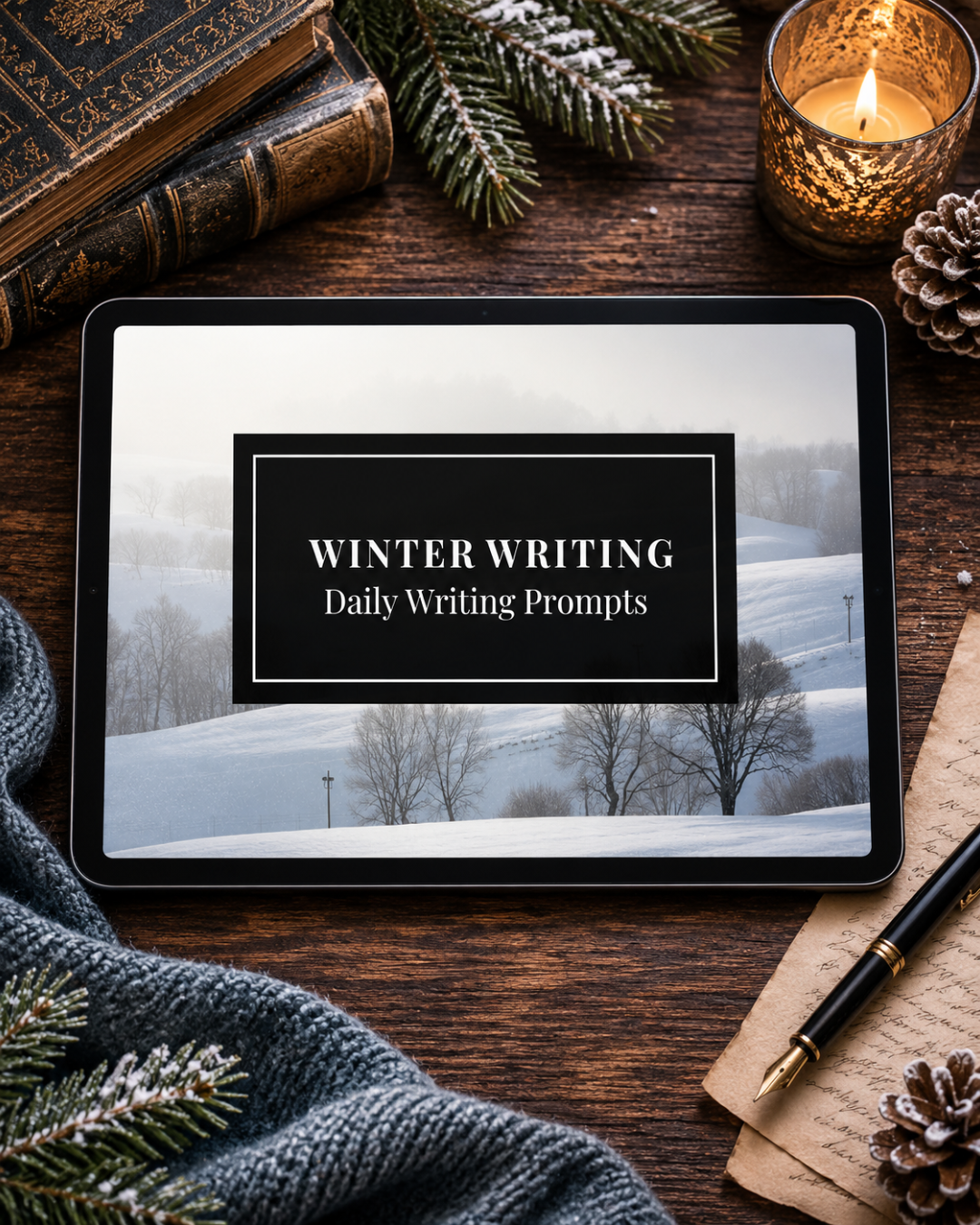
30 winter stories. 30 imaginative writing challenges. Endless storytelling possibilities.
Step into a world of frozen landscapes, mysterious disappearances, ancient winter magic and extraordinary adventures with this beautifully illustrated collection of 30 Winter Daily Writing Prompts, designed to spark creativity, develop storytelling skills and build confidence in creative writing.
From a mysterious crow delivering messages from beyond the grave and a snow globe that reveals the future to forgotten cities beneath frozen lakes, enchanted winter kingdoms and creatures lurking beyond the treeline, each prompt invites writers to explore a different winter-inspired scenario and create a story of their own.
With 185 pages of illustrated prompts, structured writing guidance, editing tips and thought-provoking discussion questions, this comprehensive seasonal resource is ideal for winter English lessons, creative writing workshops, descriptive writing activities, extended storytelling projects and independent writing practice.
Combining atmospheric winter mysteries with magical adventures, supernatural encounters, fantasy worlds and imaginative speculative fiction, these activities encourage students to explore different genres, experiment with storytelling techniques and discover extraordinary possibilities within the coldest season.
What's Inside?
Each of the 30 winter writing prompts includes a range of creative starting points and structured activities to support writers at different stages of their storytelling journey.
Atmospheric Winter Illustrations: Beautifully illustrated snowy landscapes, mysterious buildings, enchanted forests, frozen worlds and imaginative scenes designed to inspire descriptive writing, visual interpretation and original storytelling.
Opening Lines: Carefully crafted winter story starters that help students overcome the challenge of beginning a story, establish atmosphere and introduce intriguing narrative possibilities.
Closing Lines: Evocative final sentences encouraging students to experiment with narrative structure, foreshadowing, symbolism, resolution and memorable story endings.
Plot Ideas: Original winter-inspired scenarios featuring fantasy, mystery, adventure, supernatural encounters, suspense and speculative fiction, providing inspiration while leaving plenty of room for individual creativity.
Picture-Based Writing Activities: Guided questions encouraging close observation, sensory description, inference, atmospheric writing and imaginative interpretation.
Writing Tips and Discussion Questions: Structured guidance helping students explore narrative possibilities, develop characters, consider different perspectives and make deliberate creative choices.
Opening and Closing Line Activities: Additional exercises exploring how beginnings establish expectations, how endings create impact and how individual sentences influence an entire narrative.
Plot Development Activities: Practical guidance for expanding initial story ideas into developed narratives, exploring character motivation, conflict, tension, stakes and resolution.
Editing Guidance: Practical editing checklists encouraging students to review sentence variety, word choice, clarity, consistency and narrative tone.
Each prompt can be approached as a complete guided writing activity or used as a flexible collection of individual creative exercises.
Thirty Winter Writing Adventures
This collection features 30 original winter-inspired storytelling challenges, exploring everything from haunting seasonal mysteries and atmospheric suspense to magical adventures, forgotten worlds and extraordinary discoveries.
1. The Crow and the Candle
On the coldest night of the year, a crow appears at an old chapel carrying a ring that once belonged to the caretaker's late wife. As a solitary candle burns lower, the boundary between the living and the dead begins to disappear.
An atmospheric supernatural mystery exploring grief, remembrance, symbolism and the possibility of communication beyond death.
2. The Snowglobe
A girl discovers an old snow globe containing a miniature house she doesn't recognise. Each time she shakes it, something inside changes, until she realises the mysterious object is revealing events that haven't happened yet.
An imaginative winter mystery exploring fate, memory, suspense and the unsettling consequences of seeing the future.
3. When the Fires Went Out
For a hundred winters, an isolated village has survived by protecting the embers of an eternal flame. When the household fires begin mysteriously extinguishing themselves, a young blacksmith must discover what is stealing their warmth before the final ember disappears.
A dark fantasy adventure exploring survival, ancient traditions, community and the tension between light and darkness.
4. Ice in the Attic
After a winter storm, two siblings discover frost spreading across the walls of their grandmother's locked attic. An old photograph reveals someone who shouldn't exist, and each night the unnatural ice creeps closer to the bedrooms below.
A haunting winter mystery exploring family secrets, supernatural phenomena, memory and atmospheric suspense.
5. Frostline
A scientist investigating unusual weather patterns discovers a mysterious line of frost advancing through a mountain valley. Everything it touches begins to freeze, including people's memories. But the approaching frost isn't responding to temperature. It's responding to fear.
An imaginative speculative fiction challenge exploring psychological tension, environmental mystery and the relationship between emotion and the unknown.
6. Wolves Beneath the Pines
In a frozen world struggling to survive, a young guard protects the last settlement from creatures roaming the surrounding forest. As food supplies dwindle and the howling grows closer, he begins to suspect the greatest danger isn't waiting beyond the walls.
A tense survival story exploring isolation, mistrust, moral choices and the dangers hidden within a desperate community.
7. Winter's End
After ten years of endless winter, the snow finally begins to melt. As an isolated community prepares to rebuild, strange discoveries emerge from beneath the ice, suggesting the terrible cold may have been protecting them from something far worse.
A post-apocalyptic mystery exploring survival, renewal, hidden histories and the frightening consequences of uncovering the past.
8. The City Under Ice
In a future where the surface world has become uninhabitable, an archivist journeys beneath a frozen lake to recover the memories of a lost civilisation. Deep below the ice, she discovers evidence that the abandoned city may not be abandoned after all.
An atmospheric science fiction adventure exploring lost civilisations, isolation, discovery and the mysteries preserved beneath the ice.
9. The Boy Who Collected Winter
A mysterious boy travels between villages collecting fragments of the season: frost from windows, the sound of winter winds and the final breath of a snowstorm. As his collection grows, winter begins disappearing from the world.
A magical fantasy story exploring the natural world, change, sacrifice and the delicate balance of the seasons.
10. The Prince of Winter
A mortal enters the enchanted Winter Court and encounters a mysterious prince whose powers are fading with the approaching spring. Drawn into an extraordinary bargain, they must decide whether to preserve his frozen kingdom or allow the seasons to change.
A romantic fantasy-inspired adventure exploring enchantment, sacrifice, loyalty and the conflict between love and the natural order.
11. The Creature in the Snow
When a blizzard traps a group of teenagers in a remote winter lodge, something ancient begins stalking them through the surrounding snow. It copies their voices, imitates their movements and leaves impossible footprints, until nobody knows who or what to trust.
An unsettling winter horror challenge exploring isolation, paranoia, survival and the terrifying possibilities concealed within a snowstorm.
Together, these activities encourage writers to explore contrasting storytelling styles, from magical adventures and emotional journeys to suspense, supernatural fiction, speculative storytelling and imaginative mysteries.
Scaffolding Creative Writing in the Classroom
One of the biggest challenges in teaching creative writing is supporting students who struggle to get started without restricting those who are ready to write independently.
This winter collection provides flexible scaffolding that teachers can adapt to different abilities, confidence levels and learning needs.
Students who need additional support can use the supplied illustrations, opening lines, closing lines, plot ideas and guided questions to develop their stories step by step.
More confident writers can use the same materials as inspiration for independent storytelling, experimenting with alternative perspectives, unexpected plot developments, atmospheric descriptions and original interpretations.
The activities can also support:
Differentiated instruction: Allow students to choose the level of guidance they need.
Visual literacy: Develop observation, interpretation and inference through detailed winter illustrations.
Descriptive writing: Explore snowy landscapes, frozen environments, sensory language, atmosphere and mood.
Narrative development: Practise character motivation, conflict, plot structure, suspense and satisfying endings.
Genre exploration: Introduce fantasy, mystery, supernatural fiction, science fiction, horror and speculative storytelling through accessible creative activities.
Creative interpretation: Encourage students to develop different stories from the same image, opening line or scenario.
Speaking and listening: Use discussion questions for paired conversations, group work and whole-class exploration.
Editing and reflection: Develop confidence in reviewing and improving original writing.
Writing confidence: Provide accessible starting points for reluctant writers while challenging more experienced storytellers.
Rather than prescribing a single correct winter story, each prompt encourages students to discover their own creative possibilities.
Flexible Winter Activities for Teachers and Writers
Use these winter writing prompts for:
Winter-themed English and literacy lessons
Seasonal creative writing activities and classroom starters
30-day winter creative writing challenges
Winter descriptive writing and sensory language exercises
Short story writing and narrative development
Fantasy, mystery and speculative fiction writing
Gothic atmosphere and suspense writing activities
Picture-based creative writing lessons
Creative writing clubs and workshops
Extended writing projects and independent storytelling
Classroom discussion and collaborative writing
Homework, extension tasks and independent learning
Homeschooling and personal creative writing challenges
Each prompt can be used as a standalone activity, expanded into a longer writing project or revisited to explore different storytelling techniques.
Teachers can use all the supplied materials for a structured lesson or select individual elements to suit their students. Independent writers can choose a prompt, set a timer and explore wherever their imagination takes them.
What You'll Receive
Your purchase includes a 185-page Winter Daily Writing Prompts PDF, featuring all 30 illustrated creative writing challenges and accompanying guidance.
1. Printable PDF Version
A 185-page PDF containing:
30 illustrated winter writing prompts
Opening lines, closing lines and plot ideas
Picture-based writing activities
Guided opening and closing line exercises
Plot development activities
Discussion questions and writing tips
Editing guidance
Classroom instructions and a prompt index
Ideal for viewing, printing or displaying in the classroom.
2. Google Slides Access
The PDF includes a link and step-by-step instructions for accessing the editable Google Slides presentation.
You can make your own copy to personalise, present and use the activities digitally.
Please note: A Google account is required to make a copy of the Google Slides presentation.
All materials are digital resources for personal and classroom use. No physical product will be shipped. Please do not share, resell or redistribute the original files.
Thirty Winter Stories Waiting to Be Written
Whether you're helping reluctant writers discover their confidence, introducing imaginative winter activities into your classroom or looking for something a little different from traditional seasonal writing exercises, these prompts offer opportunities to explore mystery, magic, atmosphere and original storytelling.
From frozen villages guarding their final embers to forgotten cities beneath the ice, enchanted winter courts and mysterious creatures moving through the snow, each activity encourages writers to look beyond the familiar and imagine something extraordinary.
With 30 illustrated challenges and structured writing support, students can experiment with different genres, develop their storytelling skills and discover just how many stories can emerge from a single winter scene.
Choose a picture. Explore a possibility. Begin a winter story.
Your next winter adventure is waiting...
Bring Snowy Landscapes to Life with 30 Illustrated Winter Writing Prompts
A village where the last fires are mysteriously extinguishing. A forgotten city waiting beneath the ice of a frozen lake. A snow globe that reveals events before they happen. A remote winter lodge where something beyond the treeline has learned to imitate human voices.
The most memorable winter stories begin with more than a beautiful snowy landscape. They give that landscape a secret, a conflict or an extraordinary possibility waiting to be discovered.
If you're ready to transform your descriptive vocabulary into imaginative storytelling, my Winter Daily Writing Prompts | 30 Illustrated Creative Writing Activities collection offers 30 original winter-inspired writing challenges spanning fantasy, mystery, supernatural fiction, adventure and atmospheric suspense.
Across 185 pages, you'll discover beautifully illustrated winter scenes, evocative opening and closing lines, intriguing plot ideas, picture-based writing activities and carefully structured questions designed to help you develop characters, settings and original narratives. Each activity also includes practical writing guidance and editing support, encouraging writers to experiment with sensory description, atmosphere, narrative tension and imaginative detail.
Whether you're a teacher planning engaging winter English lessons, a student developing your descriptive writing skills or an independent writer searching for your next story idea, the collection offers flexible opportunities to explore the creative possibilities of the season. The activities can be used individually, incorporated into classroom lessons or developed into a complete 30-day winter writing challenge.
The digital download includes a 185-page printable PDF and access to an editable Google Slides presentation, making it suitable for classroom teaching, independent writing and digital learning.
From enchanted winter kingdoms and ancient mysteries to frozen wildernesses and unexpected discoveries, these prompts encourage you to look beyond the snow-covered scenery and imagine the extraordinary stories concealed within it.
Explore the 30 Illustrated Winter Writing Prompts
Looking for more creative inspiration? Browse the Daily Writing Prompts Collection for illustrated activities exploring different genres, seasonal themes and imaginative storytelling possibilities.

3. Snow-Covered Landscapes & Scenery
A landscape transformed by snow can feel almost unrecognisable. Familiar roads become pale ribbons winding between frozen fields, distant hills lose their definition beneath enormous white expanses, and villages appear to retreat into the surrounding countryside as rooftops, gardens and boundary walls disappear beneath accumulating drifts. Snow simplifies the colours and contours of a landscape, yet it also reveals details that might otherwise go unnoticed: the dark geometry of bare branches, the delicate shadows cast across a frozen meadow or the faint impressions of animal tracks crossing an empty field.
For writers, snowy scenery offers opportunities to establish scale, atmosphere and a strong sense of place. A remote mountain range might appear magnificent and inviting beneath brilliant winter sunlight, while the same peaks could become threatening when heavy clouds obscure their summits. A snow-covered village might suggest warmth and community through its illuminated windows, or isolation and abandonment when its streets remain silent and its chimneys produce no smoke. The language used to describe the landscape determines whether readers experience it as peaceful, mysterious, majestic or deeply unsettling.
These ten words explore the appearance, structure and distinctive features of snow-covered environments, helping you create immersive winter settings that extend beyond simply describing everything as white.
21. Snowbound
Meaning: Surrounded, blocked or isolated by heavy snow, often making travel or communication difficult or impossible.
Best for: Remote villages, isolated cottages, mountain communities, winter mysteries, survival fiction and stories involving characters trapped by severe weather.
Example: The snowbound village lay silent beneath the mountains, its narrow streets buried so deeply that only the upper halves of the garden gates remained visible.
22. Blanketed
Meaning: Covered by a continuous layer resembling a blanket; often used to describe snow spread evenly across a landscape or collection of objects.
Best for: Countryside scenes, picturesque villages, peaceful winter mornings, forests and descriptions emphasising the uniform covering created by snowfall.
Example: The valley lay blanketed in snow, its patchwork fields transformed into a single pale expanse interrupted only by the dark lines of hedgerows and distant woodland.
23. Undulating
Meaning: Rising and falling in smooth, continuous curves or waves, particularly when describing the contours of land or accumulated snow.
Best for: Rolling hills, open moorlands, windswept snowfields, remote wildernesses and poetic descriptions of winter scenery.
Example: Beyond the frozen stream, undulating snowfields stretched towards the horizon, their gentle ridges catching the last amber light of the setting sun.
24. Drifted
Meaning: Accumulated or deposited in irregular heaps and ridges through the movement of wind; particularly appropriate for snow gathered against obstacles or across exposed ground.
Best for: Rural roads, mountain passes, abandoned buildings, coastal landscapes and realistic descriptions of wind-shaped snow.
Example: Drifted snow rose against the stone walls of the farmhouse, filling the narrow lane and almost concealing the rusted iron gate that marked the entrance.
25. Sculpted
Meaning: Shaped into a distinct form or contour, as though deliberately carved or moulded; used figuratively for snow altered by wind, accumulation or changes in temperature.
Best for: Alpine landscapes, windswept ridges, snow-covered architecture, fantasy settings and descriptions emphasising the intricate shapes created by winter weather.
Example: Along the mountain ridge, sculpted banks of snow curved around the exposed rocks, their smooth white surfaces resembling enormous waves frozen at the moment of breaking.
26. Expansive
Meaning: Covering or extending across a large area, creating an impression of openness, breadth or considerable scale.
Best for: Open snowfields, Arctic tundra, frozen plains, distant mountain landscapes and descriptions that establish isolation or the immensity of the natural world.
Example: An expansive snowfield stretched beyond the abandoned watchtower, so vast and featureless that the distant mountains appeared to float above its white horizon.
27. Terraced
Meaning: Arranged in a series of successive levels or steps, often describing natural slopes, cultivated hillsides or architectural structures.
Best for: Snow-covered hillsides, mountain settlements, formal gardens, ancient ruins and landscapes where snow emphasises distinct levels or contours.
Example: The terraced gardens descended towards the frozen lake, each snow-covered level marked by a low stone wall and the dark silhouettes of dormant rose bushes.
28. Windswept
Meaning: Exposed to strong winds, often resulting in a bare, weathered or uneven appearance; when applied to snowy landscapes, suggesting areas where snow has been redistributed or stripped away.
Best for: Exposed moorlands, mountain summits, coastal headlands, isolated settlements and descriptions of harsh winter environments.
Example: The windswept plateau rose above the treeline, its shallow snow broken by patches of black rock and long ridges of ice hardened beneath the prevailing wind.
29. Panoramic
Meaning: Offering a broad, extensive view of the surrounding landscape, often encompassing distant scenery across a wide field of vision.
Best for: Mountain viewpoints, sweeping winter vistas, travel writing, fantasy worldbuilding and descriptions intended to establish the scale of a setting.
Example: From the ruined battlements, a panoramic winter landscape unfolded beneath them: frozen rivers winding between white fields, distant villages clustered around church spires and mountains fading into the pale northern sky.
30. Unbroken
Meaning: Continuous, uninterrupted or without visible divisions; particularly evocative when describing large areas of snow untouched by tracks, vegetation or other distinguishing features.
Best for: Remote wildernesses, snow-covered plains, isolated valleys, winter exploration and scenes emphasising emptiness, tranquillity or disorientation.
Example: An unbroken expanse of snow extended from the edge of the forest to the distant mountains, its perfect stillness disturbed only by the long blue shadow of a solitary pine.
Writing Tip: When describing a snow-covered landscape, consider how snow changes the shapes, boundaries and visual relationships within the setting. A familiar road might disappear beneath a smooth white covering, while a low stone wall becomes visible only as a raised line across a field. Snow can simplify a complicated landscape, making individual objects stand out more clearly against their surroundings.
Try building your description from the largest features towards the smallest details. Begin with the distant mountains, broad valley or snow-covered village, then gradually draw the reader's attention towards a particular building, tree, pathway or unusual mark in the snow. This approach helps establish a convincing sense of scale while allowing you to introduce details that may become important to the story.
Pay attention to colour and contrast, too. Snow is rarely a uniform, featureless white. Beneath a clear sky, shadows may appear blue or violet, while low winter sunlight can introduce delicate shades of gold, pink and amber. Dark trees, exposed stone, frozen water and illuminated windows become particularly striking against a pale landscape.
Finally, consider how the same scenery might be interpreted differently by different characters. An expansive snowfield could inspire wonder in someone seeing it for the first time, but feel dangerously empty to a traveller who has lost their way. By combining precise landscape vocabulary with perspective and emotion, you can make winter scenery contribute to characterisation and narrative atmosphere rather than functioning as a decorative backdrop.
4. Frost, Ice & Frozen Surfaces
Snow rarely exists in isolation. Across a winter landscape, it mingles with frost, gathers upon frozen ground and settles over surfaces transformed by prolonged cold. Delicate ice crystals spread across windowpanes, thin sheets of ice form over puddles and streams, and exposed branches acquire intricate white coatings that glitter beneath the morning sun. These details can make a winter setting feel more convincing, revealing not only what the landscape looks like but also how the temperature has altered the world around it.
For writers, frost and ice introduce a different sensory quality from freshly fallen snow. Where powdery snow suggests softness and silence, frozen surfaces can appear brittle, glasslike, treacherous or unnaturally still. Ice cracks beneath a character's weight, frozen grass snaps underfoot, and a thin glaze of frost transforms an ordinary staircase into a dangerous obstacle. In Gothic fiction, frost spreading across the inside of a window might suggest an inexplicable presence, while in fantasy, crystalline formations can make a familiar landscape appear enchanted.
These ten words explore the textures, patterns and physical qualities of frost and ice, helping you create winter descriptions that feel vivid, varied and atmospheric.
31. Frostbound
Meaning: Held, covered or immobilised by frost or freezing conditions; suggesting a landscape or object firmly caught in winter's grip.
Best for: Frozen countryside, isolated villages, winter fantasy, Gothic landscapes and descriptions emphasising prolonged or severe cold.
Example: The frostbound orchard stood beyond the manor walls, its bare branches rigid against the pale morning sky and its fallen fruit preserved beneath a brittle crust of ice.
32. Rimed
Meaning: Covered with rime, a deposit of ice formed when supercooled water droplets freeze upon contact with a cold surface, often producing a rough or feathery white coating.
Best for: Mountain landscapes, frozen forests, exposed fences, winter wildernesses and precise descriptions of ice accumulating on objects.
Example: The rimed branches of the fir trees bent beneath their white coating, giving the forest the strange appearance of a place carved entirely from frost.
33. Hoary
Meaning: Greyish-white in appearance, particularly when covered with frost; traditionally used in descriptions of winter landscapes, aged surfaces and frost-coated vegetation.
Best for: Literary fiction, Gothic settings, winter poetry, ancient woodland and atmospheric descriptions with a slightly archaic or traditional quality.
Example: Hoary hedgerows bordered the deserted lane, their tangled thorns silvered by frost and their last shrivelled berries dark against the winter morning.
34. Glazed
Meaning: Covered with a smooth, thin, often shiny layer; when describing winter conditions, usually referring to a coating of ice formed upon a surface.
Best for: Frozen roads, icy pavements, bare branches, dangerous winter journeys and descriptions emphasising smoothness or reflected light.
Example: The cobbled courtyard lay glazed with ice, its uneven stones shining beneath the lanterns as though someone had poured a sheet of dark glass across the ground.
35. Encrusted
Meaning: Covered with a hard outer layer or crust, often formed through the gradual accumulation and freezing of moisture.
Best for: Frozen buildings, ship railings, mountain equipment, icy rocks, winter survival scenes and descriptions of prolonged exposure to freezing conditions.
Example: The abandoned fishing boats were encrusted with ice, their ropes stiffened into pale coils and their wooden hulls sealed beneath layers of frozen spray.
36. Brittle
Meaning: Hard but easily broken, cracked or shattered under pressure; particularly effective for describing thin ice, frozen vegetation or delicate frost formations.
Best for: Frozen puddles, frost-covered grass, winter soundscapes, suspenseful scenes and descriptions involving fragile surfaces.
Example: A brittle skin of ice covered the puddles along the woodland track, breaking into delicate fragments beneath her boots with a sharp, hollow crack.
37. Glasslike
Meaning: Resembling glass in smoothness, transparency, brightness or reflective quality.
Best for: Frozen lakes, clear ice, polished winter surfaces, fantasy settings and descriptions emphasising reflection or unnatural stillness.
Example: The lake lay glasslike beneath the mountains, its transparent ice revealing dark stones and motionless reeds suspended in the water below.
38. Filigreed
Meaning: Decorated with fine, intricate patterns resembling delicate ornamental metalwork; used figuratively to describe elaborate natural formations.
Best for: Frost-covered windows, intricate ice crystals, magical winter scenes, decorative imagery and poetic descriptions of delicate frozen patterns.
Example: The bedroom window was filigreed with frost, its elaborate white patterns spreading from the corners like miniature ferns and curling vines.
39. Serrated
Meaning: Having a jagged or saw-toothed edge, with repeated sharp projections or notches.
Best for: Broken ice, frozen riverbanks, icicles, mountain scenery, dangerous terrain and descriptions emphasising sharpness or threatening shapes.
Example: Serrated fragments of ice lined the riverbank, their jagged edges catching the weak sunlight where the current had broken through the frozen surface.
40. Translucent
Meaning: Allowing light to pass through while preventing objects behind the material from being seen clearly.
Best for: Thin ice, icicles, frozen waterfalls, delicate frost formations, magical settings and descriptions exploring the relationship between light and frozen surfaces.
Example: Translucent icicles hung from the ruined chapel roof, their cloudy interiors glowing faintly gold whenever the afternoon sunlight passed through them.
Writing Tip: When describing frost and ice, pay attention to the difference between surfaces that appear similar but behave differently. A frozen lake may look perfectly smooth, while the ice covering a shallow puddle might be thin enough to shatter beneath a footstep. Frost can create delicate, intricate patterns, whereas accumulated ice may form thick, uneven layers around branches, railings and exposed stonework.
Use these physical distinctions to introduce sound and movement into your descriptions. Snow often muffles footsteps, but ice can produce sharp cracks, brittle snaps, hollow knocks and unexpected echoes. A character crossing a frozen courtyard might hear the crunch of frost beneath their boots, while someone standing beside a lake might become aware of deep, unfamiliar sounds travelling through the ice.
Consider the way light interacts with frozen surfaces, too. Clear ice may reveal submerged objects, cloudy ice can obscure what lies beneath, and frost crystals can scatter sunlight into countless tiny points of brightness. These effects can establish atmosphere without relying on repeated descriptions of whiteness or cold.
Finally, remember that ice can function as more than scenery. A frost-covered window might conceal a message written upon the glass, a frozen river could prevent a character from escaping, or a sheet of ice beneath fresh snow might turn an apparently safe pathway into a hidden danger. In supernatural fiction, frost appearing where it should not exist can be especially effective: a delicate white pattern spreading across a warm room, or a character's breath suddenly becoming visible beside a closed door.
By combining precise vocabulary with sensory details and narrative consequences, you can make frost and ice feel like active elements of your winter setting rather than simply decorative additions.
5. Sparkling, Glittering & Beautiful Snow
Few winter sights are as captivating as snow illuminated by sunlight, moonlight or the gentle glow of distant windows. Beneath a clear morning sky, countless ice crystals catch the light, transforming ordinary fields into shimmering expanses that seem scattered with diamonds. At dusk, snow can take on delicate shades of lavender, rose and pale gold, while beneath a full moon, frozen landscapes acquire an almost otherworldly luminosity. Even the simplest winter scene can become extraordinary when light interacts with the snow's crystalline surface.
For writers, these luminous qualities offer opportunities to create wonder, enchantment and striking visual imagery. Sparkling snow can suggest the magic of a fantasy kingdom, the romance of a secluded winter garden or the extraordinary stillness of a landscape untouched by human activity. Yet beauty can also become unsettling. A brilliantly illuminated snowfield might conceal a dangerous frozen lake, while an impossibly radiant forest could suggest that something supernatural has altered the natural world.
These ten words explore the brilliance, colour and visual beauty of snow, helping you move beyond familiar descriptions of glittering whiteness to create winter scenes filled with light, texture and atmosphere.
41. Iridescent
Meaning: Displaying subtle, shifting colours that appear to change according to the angle of the light or the viewer's position.
Best for: Magical winter landscapes, close-up descriptions of snow crystals, fantasy settings, poetic imagery and scenes involving unusual lighting effects.
Example: An iridescent shimmer passed across the snow-covered meadow, its surface briefly revealing delicate hints of blue, rose and violet as the morning sunlight moved between the clouds.
42. Glistening
Meaning: Shining with a soft, reflected brightness, often suggesting a surface that is wet, icy or covered with tiny points of light.
Best for: Sunlit snowfields, melting snow, frozen gardens, winter romance and atmospheric descriptions of light reflecting from snow or ice.
Example: Glistening snow covered the palace steps, each shallow indentation catching the pale winter sunlight until the entire staircase appeared dusted with crushed glass.
43. Scintillating
Meaning: Sparkling or flashing with numerous small, brilliant points of light; particularly effective for describing the changing reflections produced by ice crystals.
Best for: Brilliant winter sunshine, enchanted landscapes, alpine scenery, elaborate poetic descriptions and moments intended to evoke wonder.
Example: The scintillating snowfield stretched towards the distant mountains, thousands of tiny reflections flashing across its surface whenever the thin clouds parted overhead.
44. Luminous
Meaning: Appearing to emit light or possessing a soft, radiant brightness; when applied to snow, often suggesting the way its pale surface reflects and diffuses surrounding illumination.
Best for: Moonlit landscapes, twilight snowfall, magical forests, romantic winter scenes and descriptions of snow glowing against darker surroundings.
Example: Beneath the full moon, the luminous snow illuminated the abandoned garden, revealing the shapes of buried flowerbeds and the faint outline of a path leading towards the lake.
45. Opalescent
Meaning: Displaying a soft, milky lustre with subtle shifting colours, resembling the delicate visual qualities of an opal.
Best for: Dreamlike winter settings, fantasy landscapes, sunrise and sunset descriptions, delicate snow crystals and poetic imagery involving colour and light.
Example: An opalescent sheen covered the frozen valley at dawn, the snow reflecting faint washes of pink and blue beneath a sky still holding the last traces of night.
46. Silvery
Meaning: Resembling silver in colour, brightness or reflective quality, often suggesting a cool, pale metallic sheen.
Best for: Moonlit snow, twilight landscapes, winter forests, Gothic settings and descriptions emphasising cool tones or understated elegance.
Example: Silvery snow lay across the monastery rooftops, its faint brightness separating the ancient stone buildings from the darkness of the surrounding mountains.
47. Dazzling
Meaning: So intensely bright or visually striking that it temporarily overwhelms the eyes or makes it difficult to look directly at something.
Best for: Bright alpine mornings, expansive snowfields, winter adventures, dramatic landscapes and descriptions of strong sunlight reflecting from snow.
Example: The dazzling snow stretched across the mountain plateau, reflecting the midday sun so fiercely that she narrowed her eyes and turned towards the dark line of fir trees for relief.
48. Pearlescent
Meaning: Possessing a soft, lustrous sheen resembling the surface of a pearl, often with delicate variations in colour and brightness.
Best for: Gentle winter light, romantic scenery, elegant descriptive prose, fantasy landscapes and snow illuminated by dawn or dusk.
Example: A pearlescent glow settled over the snow-covered rooftops, their rounded white surfaces catching the first pale light of morning above the sleeping town.
49. Prismatic
Meaning: Displaying or producing a range of colours through the separation or refraction of light, as occurs when light passes through a prism.
Best for: Close-up descriptions of ice crystals, sparkling frost, magical winter imagery and scenes involving small rainbow-coloured flashes of light.
Example: Prismatic flashes appeared among the ice crystals scattered across the snowbank, tiny fragments of colour flickering between the white ridges as the sunlight struck them.
50. Resplendent
Meaning: Magnificent or impressive in appearance, particularly through extraordinary beauty, brightness or splendour.
Best for: Grand winter landscapes, royal fantasy settings, enchanted palaces, mountain scenery and descriptions intended to convey awe or exceptional visual beauty.
Example: The mountain kingdom stood resplendent beneath its winter covering, its white towers rising above the glittering forests while the snow-covered peaks shone like polished silver against the blue sky.
Writing Tip: When describing beautiful snow, consider the source, direction and intensity of the light rather than relying exclusively on words such as sparkling, shimmering or glittering. Snow beneath strong midday sunlight will look very different from snow illuminated by a distant lantern or the fading colours of sunset. Bright sunlight can create sharp contrasts and intense reflections, while moonlight often produces a softer, cooler appearance.
Experiment with the colours that appear within winter landscapes. Although snow is generally perceived as white, its appearance changes according to surrounding light, shadows and atmospheric conditions. A field might seem pale blue beneath an overcast sky, golden in the last sunlight of evening or faintly violet where the shadows of trees stretch across its surface. These subtle variations help create more convincing and visually interesting descriptions.
You can also use luminous imagery to establish emotional atmosphere. A softly glowing winter garden might suggest romance, nostalgia or tranquillity, while an impossibly brilliant snowfield could feel strange and threatening, particularly if its beauty contrasts with the danger confronting your characters. In fantasy writing, unusual colours and reflections can hint at enchantment without requiring an explicit explanation.
Be selective with elaborate vocabulary. Words such as iridescent, opalescent and prismatic describe particular visual effects, so they work best when the scene genuinely supports those qualities. A single precise image will usually be more memorable than a succession of decorative adjectives.
For example, rather than writing, The beautiful, sparkling, glittering snow shone everywhere, you might describe how the low winter sun scattered a thousand brief points of light across the untouched meadow, while the long blue shadows of the trees stretched towards the frozen stream.
By connecting the beauty of snow to specific lighting conditions, colours and physical details, you can create imagery that feels distinctive, immersive and emotionally meaningful.
6. Gothic, Sinister & Unsettling Snow
Snow has a remarkable ability to make familiar places feel strange. A landscape that appears peaceful beneath winter sunlight can become deeply unsettling after darkness falls, when abandoned buildings emerge from the whiteness, familiar pathways disappear and the silence seems almost deliberate. Snow conceals as much as it reveals. It buries evidence, muffles approaching footsteps and transforms ordinary surroundings into places where distance, direction and even the passage of time become difficult to judge.
In Gothic fiction, horror and psychological suspense, snow can become an essential part of the story's atmosphere. A remote manor might stand surrounded by untouched snow despite the sound of footsteps outside its windows. An isolated village could disappear behind a curtain of falling flakes, cutting its inhabitants off from the world beyond. A frozen landscape might appear unnaturally beautiful, its perfect stillness concealing something ancient, hostile or impossible to explain. The contrast between snow's traditional associations with purity and the darker events unfolding beneath it can be especially powerful.
These ten words explore the sinister, oppressive and uncanny qualities of winter landscapes, helping you describe snow that creates unease, suggests hidden danger or intensifies the psychological tension of a scene.
51. Desolate
Meaning: Empty, bleak and seemingly abandoned, often suggesting loneliness, exposure or the absence of comfort and human activity.
Best for: Abandoned villages, remote Gothic estates, isolated winter roads, post-apocalyptic landscapes and scenes emphasising loneliness or emotional emptiness.
Example: The desolate snowfield stretched beyond the ruined abbey, its pale surface interrupted only by a row of weathered gravestones leaning towards the distant, leafless trees.
52. Shrouded
Meaning: Covered, concealed or enveloped by something resembling a shroud; particularly evocative when snow obscures the recognisable features of a landscape or object.
Best for: Gothic graveyards, abandoned buildings, mysterious woodland, winter ghost stories and descriptions associating snow with concealment or death.
Example: The cemetery lay shrouded in snow, its crooked headstones reduced to indistinct shapes beneath the moonlight, while the narrow path between them had vanished entirely.
53. Sepulchral
Meaning: Resembling or relating to a tomb or burial place; suggesting death, oppressive stillness or a solemn, funereal atmosphere.
Best for: Gothic horror, haunted estates, abandoned churches, winter graveyards and descriptions where snow creates an atmosphere associated with death.
Example: A sepulchral stillness settled over the snow-covered churchyard, where the dark entrance to the family crypt remained open beneath a thickening fringe of ice.
54. Ominous
Meaning: Suggesting that something unpleasant, threatening or disastrous may be about to happen.
Best for: Psychological suspense, supernatural horror, isolated winter settings, approaching snowstorms and scenes that foreshadow danger.
Example: An ominous silence descended upon the village as the snowfall thickened, and one by one the lights disappeared from the houses lining the frozen square.
55. Spectral
Meaning: Ghostlike, pale or resembling an apparition; often used to describe something that appears insubstantial, mysterious or supernatural.
Best for: Winter ghost stories, Gothic landscapes, moonlit snowfall, supernatural encounters and descriptions of indistinct figures or shapes emerging through snow.
Example: Spectral shapes drifted between the snow-laden trees, appearing for an instant beneath the moon before dissolving into the white darkness beyond the garden wall.
56. Funereal
Meaning: Resembling or appropriate to a funeral; suggesting mourning, solemnity, death or an atmosphere of profound sadness.
Best for: Gothic tragedy, winter cemeteries, abandoned settlements, melancholic horror and descriptions linking snowy landscapes with grief or loss.
Example: A funereal hush enveloped the snow-covered village, its empty streets and darkened windows giving the impression that the entire settlement had gathered to mourn an unseen death.
57. Suffocating
Meaning: Creating a sensation of being unable to breathe or escape; used figuratively to describe an atmosphere that feels oppressive, overwhelming or psychologically confining.
Best for: Claustrophobic winter horror, snowbound houses, psychological thrillers, prolonged blizzards and descriptions of isolation or confinement.
Example: The suffocating whiteness pressed against every window of the buried cottage, leaving its occupants unable to distinguish morning from evening or imagine the world beyond the walls.
58. Uncanny
Meaning: Strange or unsettling in a way that feels difficult to explain, particularly when something familiar appears subtly wrong or unnatural.
Best for: Psychological horror, supernatural mysteries, abandoned villages, dreamlike winter landscapes and scenes involving inexplicable changes to familiar surroundings.
Example: An uncanny perfection marked the snow surrounding the old house; every surface was smooth and untouched, although the children had heard someone walking beneath their bedroom windows throughout the night.
59. Bleak
Meaning: Cold, exposed, barren or lacking warmth and comfort; also suggesting an atmosphere of hopelessness, hardship or emotional desolation.
Best for: Gothic moorlands, isolated mountain settlements, dystopian winter landscapes, survival fiction and descriptions of harsh or unwelcoming environments.
Example: Beyond the iron gates lay a bleak winter landscape of frozen fields and skeletal trees, with nothing moving beneath the low grey sky except a few black birds circling the distant woods.
60. Deathly
Meaning: Resembling or associated with death, particularly through extreme pallor, stillness, silence or an unnatural absence of life.
Best for: Haunted winter settings, Gothic mansions, supernatural suspense, isolated landscapes and descriptions of disturbing silence or lifelessness.
Example: A deathly stillness held the snow-covered gardens, where the frozen fountain stood motionless and not a single footprint disturbed the path leading to the locked conservatory.
Writing Tip: When describing sinister snow, resist the temptation to make every detail overtly frightening. Gothic atmosphere is often most effective when something beautiful or ordinary acquires an unsettling quality through context. A pristine covering of snow might initially suggest peace, but that same undisturbed surface becomes disturbing when a character knows somebody crossed the garden only moments earlier.
Use snow's ability to conceal and transform familiar landmarks. A path disappearing beneath fresh snowfall can leave a character uncertain of their surroundings, while a familiar building might become almost unrecognisable when its windows, steps and entrance are obscured. These changes can create a subtle sense of disorientation, particularly when combined with darkness, isolation or unreliable perception.
Silence is another powerful element of winter horror. Snow can absorb and muffle sound, making an otherwise familiar environment seem strangely distant. A character might notice that the usual noises of a village have disappeared: no footsteps in the street, no creaking carts, no voices from neighbouring houses. Against this quiet background, a single unexplained sound becomes far more significant.
Consider using contrasts between colour and atmosphere. A brilliant white landscape surrounding a dark, abandoned house creates an immediate visual tension. A single red ribbon caught in a snow-covered hedge, a black doorway standing open or a line of footprints ending abruptly in the middle of a frozen field can become memorable Gothic images without elaborate supernatural descriptions.
You can also allow snow to reflect a character's psychological state. Someone overwhelmed by grief might experience the surrounding whiteness as empty and lifeless, while a frightened traveller could perceive the same landscape as threatening, its indistinct shapes resembling figures waiting just beyond the edge of vision. The snow itself does not need to change; the character's interpretation gives it emotional significance.
For example, rather than writing The snow was creepy and the forest looked frightening, you might describe how the trees stood motionless beneath their white coverings, their dark trunks disappearing into the mist, while a narrow trail of footprints crossed the clearing and stopped beneath a branch too high for anyone to reach.
The strongest Gothic winter descriptions combine precise physical details with implication. Allow the snow to hide something, reveal something unexpected or make an ordinary place feel subtly wrong. By giving readers enough information to imagine the landscape while leaving its most disturbing possibilities unexplained, you can create an atmosphere of sustained unease that lingers long after the scene has ended.
7. Gentle, Peaceful & Romantic Snow
Not every winter landscape needs to be dramatic, dangerous or mysterious. Sometimes, the beauty of snow lies in its quietness: the gentle descent of flakes beyond a candlelit window, the soft accumulation of white along a garden wall or the peaceful stillness of a village waking beneath its first snowfall. Snow can soften the edges of the world, disguising familiar imperfections and creating an atmosphere of intimacy, nostalgia and temporary escape from everyday life.
In romance, literary fiction and reflective poetry, snowfall often provides a setting for meaningful emotional moments. Two characters might walk together through a snow-covered park, their conversation unfolding beneath the glow of old-fashioned streetlamps. A childhood home might appear unchanged beneath its familiar winter covering, awakening memories of people and places long since lost. A solitary figure watching snow settle across an empty garden might experience a rare moment of contentment, or recognise the quiet sadness of something coming to an end.
These ten words explore the gentler qualities of snow, helping you create winter scenes filled with tenderness, tranquillity, intimacy and emotional warmth. They are particularly useful when you want the landscape to complement a character's feelings rather than overwhelm the narrative.
61. Serene
Meaning: Calm, peaceful and undisturbed, suggesting an atmosphere free from agitation, conflict or unnecessary movement.
Best for: Peaceful winter mornings, romantic countryside settings, reflective poetry, quiet villages and descriptions of snow-covered landscapes that inspire contentment.
Example: A serene stillness rested over the snow-covered village, where thin trails of chimney smoke rose into the pale morning sky and the first golden lights appeared behind frosted windows.
62. Tranquil
Meaning: Characterised by deep calm, quietness and freedom from disturbance; often used to describe places or moments that encourage relaxation and reflection.
Best for: Secluded gardens, frozen lakes, winter retreats, romantic walks, nature writing and scenes emphasising peaceful surroundings.
Example: The tranquil garden lay beneath a delicate covering of snow, its winding paths softened into pale curves and its frozen pond reflecting the bare branches of an ancient willow.
63. Hushed
Meaning: Unusually quiet or subdued, as though sounds have been softened or deliberately restrained.
Best for: Gentle snowfall, intimate conversations, sleeping villages, romantic winter evenings and descriptions of the sound-dampening effects of snow.
Example: The streets were hushed beneath the falling snow, and their footsteps seemed strangely private as they walked together past the softly illuminated shop windows.
64. Ethereal
Meaning: Extremely delicate, beautiful or seemingly otherworldly, suggesting a quality too light or extraordinary to belong entirely to ordinary life.
Best for: Dreamlike winter landscapes, magical realism, romantic fantasy, moonlit snowfall and poetic descriptions of delicate beauty.
Example: An ethereal curtain of snow descended through the silver evening light, blurring the distant trees until the garden seemed suspended somewhere between memory and dream.
65. Dreamlike
Meaning: Resembling a dream in appearance, atmosphere or experience, often suggesting softness, unreality or a gentle distortion of familiar surroundings.
Best for: Romantic reunions, nostalgic memories, fantasy settings, quiet snowfall and scenes where a character feels detached from ordinary time.
Example: The dreamlike snowfall softened the edges of the old town, turning its narrow streets and glowing windows into a scene she might have remembered from a childhood Christmas.
66. Delicate
Meaning: Fine, light or fragile in structure or appearance, often suggesting something easily disturbed or requiring gentle handling.
Best for: Individual snowflakes, light snowfall, romantic winter imagery, close-up descriptions and scenes emphasising the fleeting beauty of snow.
Example: Delicate snowflakes settled upon the roses left outside the cottage door, their intricate shapes disappearing almost as soon as they touched the dark red petals.
67. Weightless
Meaning: Appearing to possess no weight or heaviness, suggesting effortless movement or suspension in the air.
Best for: Slowly falling snowflakes, calm winter evenings, poetic descriptions, romantic scenes and imagery emphasising lightness or freedom.
Example: Weightless flakes floated between the bare branches, turning lazily in the still air before settling upon the shoulders of her woollen coat.
68. Veiled
Meaning: Partially concealed or softened by a thin covering, as though hidden behind a veil; particularly evocative when snowfall gently obscures distant objects.
Best for: Romantic winter landscapes, atmospheric gardens, softly falling snow, distant architecture and descriptions involving mystery without overt danger.
Example: The distant church was veiled in falling snow, its familiar spire fading into the pale afternoon sky while the warm lights of the village flickered below.
69. Muted
Meaning: Softened, subdued or reduced in intensity, particularly in relation to sound, colour or brightness.
Best for: Overcast winter mornings, peaceful snowfall, reflective literary fiction, subdued landscapes and descriptions of the quiet visual effects of snow.
Example: Muted shades of blue and grey settled over the snow-covered fields, while the farmhouse windows glowed amber against the fading winter light.
70. Tender
Meaning: Gentle, affectionate or expressive of warmth and care; used figuratively to describe snowfall that seems soft, protective or emotionally comforting.
Best for: Romantic fiction, nostalgic scenes, sentimental poetry, intimate character moments and descriptions that personify snow in a gentle way.
Example: Snow fell with a tender softness over the sleeping town, gathering upon windowsills and garden benches as though winter itself were carefully tucking the world beneath a white blanket.
Writing Tip: When describing peaceful or romantic snow, think about how the weather influences the emotional atmosphere of a scene. Snowfall can create a sense of separation from the wider world, particularly when characters are sheltered inside a warm room or walking together through otherwise deserted streets. The contrast between the cold outdoors and the warmth of human connection can be especially effective in romance and reflective fiction.
Use sensory details beyond the appearance of falling snow. Consider the gentle crunch of footsteps along a quiet path, the warmth of a scarf pulled around someone's neck, the faint smell of woodsmoke drifting from nearby houses or the way snowflakes melt against a character's eyelashes. These details help readers inhabit the moment rather than simply observe a picturesque landscape.
Light is particularly important when establishing a romantic winter atmosphere. Snow beneath a streetlamp might appear golden, while flakes passing a candlelit window can briefly catch the light before disappearing into darkness. Moonlight can make a garden feel intimate and secluded, while the soft colours of dawn may suggest hope, renewal or the beginning of something new.
Remember, too, that peaceful does not necessarily mean happy. A tranquil winter landscape can evoke nostalgia, longing or bittersweet memories just as effectively as contentment. A character returning to their childhood home might find comfort in the familiar appearance of snow-covered rooftops, even while recognising how much their life has changed. Similarly, two people sharing a quiet moment beneath falling snow may experience the beauty of the setting more intensely because they know the moment cannot last.
Try using the landscape to reflect emotional changes without explicitly naming every feeling. Instead of writing She felt peaceful and happy as they walked through the snow, you might describe how she slowed her steps beneath the falling flakes, listening to the soft rhythm of his boots beside hers, and realised that neither of them had spoken for several minutes because there was nothing they needed to say.
Finally, avoid making every romantic winter scene excessively decorative. A few carefully chosen details will usually create a stronger impression than an abundance of elaborate adjectives. A single snowflake caught in someone's eyelashes, two sets of footprints crossing an empty square or the glow of a familiar window at the end of a frozen street can communicate tenderness and intimacy more effectively than a lengthy description of a beautiful landscape.
By combining gentle vocabulary with sensory detail, character perspective and meaningful emotional contrasts, you can create winter settings that feel comforting, intimate and memorable without losing their natural simplicity.
8. Snow in Forests, Mountains & Wilderness
Beyond the shelter of towns and villages, snow transforms the natural world into a landscape of extraordinary contrasts. Dense evergreen forests become almost cathedral-like beneath their winter coverings, mountain ridges rise sharply against pale skies, and remote valleys disappear beneath immense accumulations of snow. In these environments, winter reveals the scale and power of the landscape. A single traveller crossing an open snowfield can appear insignificant beneath towering peaks, while a narrow trail winding between snow-laden trees might suggest either the promise of discovery or the possibility of becoming hopelessly lost.
For writers, wilderness settings offer opportunities to combine visual beauty with physical realism. Snow behaves differently beneath a dense forest canopy, on an exposed mountain summit or across a sheltered valley. Wind can strip a ridge almost bare while depositing enormous drifts in the hollow below. Heavy snow can bend branches towards the ground, conceal streams and fallen trees, or preserve the tracks of animals moving through otherwise untouched woodland. These details help establish a convincing environment while providing natural obstacles, clues and opportunities for exploration.
These ten words explore the distinctive features of snowy forests, mountains and remote wildernesses, helping you create settings that feel vast, immersive and alive with the possibilities of winter adventure.
71. Alpine
Meaning: Relating to high mountains, particularly the Alps, or resembling the mountainous environments, vegetation and climatic conditions associated with them.
Best for: Mountain adventures, ski resorts, fantasy kingdoms, remote settlements, high-altitude landscapes and descriptions of dramatic winter scenery.
Example: The alpine valley lay beneath towering peaks, its snow-covered chalets clustered beside a frozen river while dark fir forests climbed the lower mountain slopes.
72. Subalpine
Meaning: Relating to the mountainous zone immediately below the alpine region, often characterised by coniferous forests, cold temperatures and long periods of snow cover.
Best for: Mountain forests, wilderness expeditions, realistic nature writing, remote hiking trails and descriptions of landscapes near the upper limits of tree growth.
Example: A subalpine forest stretched along the mountainside, its stunted pines half-buried beneath winter snow and its narrow trails disappearing into the shadow of the higher peaks.
73. Snow-laden
Meaning: Heavily covered or weighed down with accumulated snow, particularly when describing branches, trees, rooftops or other surfaces supporting a substantial covering.
Best for: Evergreen forests, woodland pathways, heavy snowfall, winter fantasy and descriptions emphasising the weight and accumulation of snow.
Example: Snow-laden branches arched above the woodland trail, forming a low white canopy that occasionally released a sudden shower of powder whenever the wind stirred.
74. Corniced
Meaning: Having an overhanging ridge or projection of snow, particularly along a mountain crest where wind has deposited snow beyond the supporting ground.
Best for: High mountain landscapes, mountaineering scenes, wilderness survival, dangerous ridgelines and realistic descriptions of wind-shaped snow formations.
Example: The corniced ridge curved above the valley, its enormous overhang of wind-packed snow extending beyond the rock beneath it like the frozen crest of a breaking wave.
75. Glaciated
Meaning: Shaped, covered or affected by glaciers or past glacial activity; often used to describe landscapes containing characteristic features such as broad valleys, cirques and glacially carved mountains.
Best for: Mountain geography, Arctic landscapes, expedition narratives, fantasy worldbuilding and descriptions of ancient, ice-shaped terrain.
Example: The glaciated valley opened beneath the northern peaks, its broad floor concealed by winter snow and its steep rock walls rising towards a succession of frozen waterfalls.
76. Tundral
Meaning: Relating to or characteristic of tundra, a cold, largely treeless environment found in Arctic regions and at high elevations.
Best for: Arctic expeditions, polar landscapes, remote wildernesses, survival fiction and descriptions of exposed, treeless terrain.
Example: Across the tundral plain, the snow lay in long, wind-shaped ridges, interrupted only by scattered rocks and the distant silhouettes of reindeer moving beneath the grey sky.
77. Snowclad
Meaning: Covered or clothed in snow; a literary adjective particularly suited to mountains, hills and other prominent landscape features.
Best for: Mountain panoramas, fantasy landscapes, epic adventures, descriptive poetry and majestic winter scenery.
Example: Snowclad mountains rose beyond the dark forest, their distant summits catching the last light of evening while the valley below slipped into shadow.
78. Treacherous
Meaning: Dangerous because of hidden or unpredictable hazards, particularly when a surface or route appears safer than it actually is.
Best for: Mountain expeditions, frozen wildernesses, survival adventures, hidden crevasses, snow-covered trails and descriptions of dangerous winter terrain.
Example: The treacherous snow concealed loose stones and narrow fissures along the mountainside, forcing the travellers to test every step before continuing towards the pass.
79. Immense
Meaning: Exceptionally large in size, extent or scale, often suggesting something so vast that it is difficult to comprehend fully.
Best for: Mountain ranges, Arctic snowfields, remote valleys, epic fantasy settings and descriptions emphasising the overwhelming scale of the natural world.
Example: An immense wilderness of snow and stone extended beyond the mountain pass, its distant ridges fading into the clouds with no visible road, settlement or sign of human life.
80. Trackless
Meaning: Without visible paths, trails or tracks; suggesting a landscape that is difficult to navigate or apparently untouched by travellers.
Best for: Remote forests, polar expeditions, wilderness survival, mysterious winter journeys and descriptions emphasising isolation or unexplored territory.
Example: The trackless forest stretched northwards beneath its heavy covering of snow, the narrow gaps between the trees offering no indication of where the old hunting path had once passed.
Writing Tip: When describing snowy wildernesses, consider the relationship between the landscape and the character moving through it. A mountain range might appear magnificent from the safety of a distant village, but become physically exhausting and intimidating when a traveller must climb its frozen slopes. Similarly, a peaceful forest can feel very different when its familiar pathways disappear beneath deep snow.
Think carefully about how snow accumulates in different environments. Beneath evergreen trees, the ground may be partly sheltered from snowfall, while exposed clearings collect deeper layers. Wind can scour snow from mountain ridges and deposit it in sheltered hollows, creating enormous differences in depth across a relatively small area. Including these variations will make your landscape feel more realistic and help avoid describing every surface as uniformly covered.
Use the physical structure of the environment to guide your descriptions. In a forest, draw attention to the contrast between dark trunks and white branches, the narrow corridors between trees and the occasional fall of accumulated snow from the canopy. In mountainous terrain, focus on steep slopes, distant summits, exposed rock, shadowed valleys and the changing visibility created by altitude and weather. Across open tundra, the absence of trees and familiar landmarks can become a defining feature of the scene.
Wildlife can also bring a snowy wilderness to life. A trail of pawprints crossing an otherwise untouched clearing, the sudden movement of a bird among frozen branches or the distant shape of an animal against a pale hillside can introduce subtle signs of activity. These details are especially effective when the landscape initially appears empty or lifeless.
Remember that wilderness vocabulary can contribute directly to narrative tension. A corniced ridge might create a hidden danger during a mountain crossing, while a trackless forest could force characters to navigate using landmarks that gradually disappear as the snowfall intensifies. A remote valley might offer temporary shelter, only to reveal that the surrounding slopes make escape impossible.
For example, instead of writing The mountains were huge and covered in snow, and the forest was difficult to walk through, you might describe how snowclad peaks rose above the subalpine forest, their immense ridges disappearing into low cloud, while the narrow trail beneath the pines had vanished beneath drifts deep enough to swallow a traveller's boots.
The most convincing wilderness descriptions balance beauty with practical detail. By showing how snow changes the terrain, affects movement and alters a character's perception of distance and safety, you can create winter environments that feel genuinely expansive, atmospheric and integral to the story.
9. Melting, Slushy & Dirty Snow
Snow does not remain beautiful forever. As temperatures rise, the pristine white covering of winter begins to change, collapsing into uneven heaps, darkening along roadsides and revealing the muddy ground beneath. Footprints fill with water, icicles drip from rooftops, and the once-perfect surface of a snow-covered field becomes pitted, patchy and discoloured. In towns and cities, traffic and pedestrians transform fresh snowfall into dirty slush, while in the countryside, the gradual retreat of snow exposes flattened grass, waterlogged soil and the first signs of approaching spring.
For writers, melting and deteriorating snow offers a different kind of descriptive opportunity. These less picturesque details can make a winter setting feel more realistic, particularly in urban fiction, contemporary romance, crime writing and stories exploring the transition between seasons. A street lined with filthy snowbanks might establish an atmosphere of exhaustion or neglect, while the slow disappearance of snow from a garden could symbolise renewal, the passage of time or the gradual revelation of something previously concealed.
These ten words explore the changing textures and appearances of snow as it melts, compacts and becomes contaminated, helping you describe winter landscapes that feel lived-in, imperfect and constantly changing.
81. Slushy
Meaning: Consisting of a wet, semi-liquid mixture of snow and water, often formed when temperatures rise or when snow becomes disturbed by traffic and footsteps.
Best for: Urban winter scenes, thawing roads, pavements, realistic contemporary fiction and descriptions of uncomfortable or inconvenient winter weather.
Example: Slushy snow filled the gutters along the high street, splashing against pedestrians' boots as passing cars sent dirty water across the pavement.
82. Sodden
Meaning: Thoroughly soaked or saturated with water, suggesting heaviness, discomfort and an inability to absorb any more moisture.
Best for: Melting snow, wet clothing, thawing landscapes, winter journeys and descriptions emphasising the unpleasant effects of prolonged dampness.
Example: The sodden snow sagged beneath the garden hedges, its once-fluffy surface reduced to heavy, waterlogged clumps that collapsed whenever the wind disturbed the branches.
83. Waterlogged
Meaning: Completely saturated with water, often to the point that a material or surface becomes heavy, unstable or unable to drain properly.
Best for: Thawing fields, melting snowbanks, flooded pathways, muddy gardens and realistic descriptions of late-winter conditions.
Example: Waterlogged snow covered the meadow in uneven patches, releasing thin streams of meltwater that trickled towards the overflowing ditch beside the road.
84. Mottled
Meaning: Marked with irregular patches, spots or areas of different colours or shades, creating an uneven or blotchy appearance.
Best for: Dirty snowbanks, partially melted fields, urban landscapes, thawing woodland and descriptions of snow mixed with exposed earth or debris.
Example: The snow along the railway embankment had become mottled with brown earth and black soot, its uneven surface revealing the first flattened grasses of the approaching thaw.
85. Grimy
Meaning: Covered or stained with accumulated dirt, soot or other unpleasant substances, suggesting neglect or contamination.
Best for: City streets, industrial landscapes, roadside snowbanks, urban crime fiction and descriptions contrasting winter's beauty with everyday pollution.
Example: Grimy heaps of snow lined the narrow alley, stained by exhaust fumes and scattered rubbish until scarcely a trace of their original whiteness remained.
86. Compacted
Meaning: Pressed firmly together into a denser, harder mass, usually through repeated pressure, weight or movement.
Best for: Busy pavements, heavily used paths, ski trails, frozen roads and descriptions of snow altered by human or animal activity.
Example: Compacted snow covered the market square, its hard, uneven surface polished by hundreds of footsteps and marked with shallow grooves left by delivery carts.
87. Crusted
Meaning: Covered with a hardened outer layer or crust, often formed when the surface of snow partially melts and subsequently refreezes.
Best for: Late-winter fields, mountain trails, thaw-and-freeze conditions, wilderness survival and descriptions of snow with contrasting surface and underlying textures.
Example: The crusted snow broke beneath his boots, its thin frozen surface giving way to softer layers that swallowed his feet almost to the ankles.
88. Patchy
Meaning: Distributed unevenly, with irregular areas of coverage separated by gaps or exposed surfaces.
Best for: Early spring landscapes, thawing gardens, woodland clearings, countryside descriptions and scenes illustrating the gradual disappearance of winter.
Example: Patchy snow lingered beneath the orchard trees, while the exposed ground between the white remnants glistened with rain and newly thawed mud.
89. Receding
Meaning: Gradually withdrawing, diminishing or moving away; when applied to snow, describing the retreat of its coverage as melting exposes the landscape beneath.
Best for: Seasonal transitions, mountain snowlines, spring landscapes, reflective fiction and descriptions symbolising change or renewal.
Example: The receding snow revealed the old stone steps beneath the cottage garden, their moss-covered edges emerging slowly from the winter covering as the days grew warmer.
90. Pockmarked
Meaning: Covered with small pits, depressions or irregular hollows, creating a rough, uneven appearance.
Best for: Melting snowbanks, late-winter streets, thawing fields, weathered snow surfaces and detailed descriptions of deteriorating winter conditions.
Example: The remaining snowbanks were pockmarked with shallow hollows, each depression holding a little pool of grey water beneath the weak afternoon sunlight.
Writing Tip: When describing melting or dirty snow, pay attention to the physical changes that occur as winter gives way to warmer weather. Snow rarely disappears evenly. Areas exposed to sunlight may melt quickly, while shaded corners, north-facing slopes and sheltered hollows can retain substantial accumulations long after the surrounding ground has become visible. These variations can make a landscape feel more authentic and help establish the time of year without explicitly stating the season.
Consider the difference between urban and rural environments. In towns and cities, melting snow often becomes discoloured by traffic, grit, mud and accumulated debris. Pavements turn slippery, gutters fill with water, and pedestrians must navigate dirty heaps left behind by snowploughs. In rural settings, the thaw may reveal flattened vegetation, saturated soil, swollen streams and the first patches of green emerging beneath retreating snow.
Use sound and movement to convey the transformation. Water dripping from a roof, the soft collapse of a melting snowbank, the splash of boots through slush or the occasional crack of refreezing ice can create a distinctive late-winter soundscape. These details contrast effectively with the muffled quietness associated with fresh snowfall.
Melting snow can also carry symbolic significance. Its disappearance might suggest the end of hardship, the return of hope or the gradual recovery of a character who has endured a difficult period. Conversely, the thaw can reveal unpleasant truths: discarded possessions, damaged buildings, buried evidence or the consequences of events concealed beneath the winter covering.
In mystery and Gothic fiction, this final possibility can be especially effective. A garden that appeared perfectly peaceful throughout the winter might reveal an unfamiliar object as the snow retreats, while a frozen pond could expose something hidden beneath its surface. The changing landscape becomes a natural way to introduce discoveries without relying on coincidence.
For example, rather than writing The snow was melting and everything looked dirty, you might describe how grimy snowbanks sagged along the pavement, their pockmarked surfaces dripping steadily into the gutters, while narrow strips of exposed earth appeared beneath the hedges where the first signs of spring had begun to emerge.
Remember that imperfect winter scenery can be just as evocative as pristine snowfall. By describing the weight, colour, texture and gradual disappearance of snow, you can create realistic settings that communicate seasonal change, emotional transition and the passage of time.
10. Poetic, Symbolic & Atmospheric Snow
Snow has occupied a distinctive place in literature and poetry for centuries, appearing as a symbol of purity, silence, transformation, isolation, memory and death. Its ability to alter the appearance of familiar surroundings makes it particularly effective for exploring emotional and psychological change. A landscape disappearing beneath falling snow might suggest the erasure of the past, while the first snowfall of winter could represent renewal, innocence or the beginning of an unfamiliar chapter in a character's life.
For poets and descriptive writers, snow also offers an extraordinary range of visual and sensory possibilities. Its whiteness can create striking contrasts with darkness, colour and movement, while its gradual accumulation can evoke the passage of time or the quiet persistence of natural forces. Snow may appear as a veil, a burial shroud, a blank page or a protective covering, depending on the imagery surrounding it. The same winter landscape can communicate hope, grief, nostalgia or profound loneliness without requiring the writer to explain those emotions directly.
These final ten words explore the more literary, symbolic and atmospheric qualities of snow. Rather than focusing exclusively on its physical appearance, they offer ways to describe how snowfall changes the mood of a scene, reflects a character's inner world or acquires a deeper significance within a story or poem.
91. Ephemeral
Meaning: Lasting for only a short time; fleeting, temporary or destined to disappear.
Best for: Melting snowflakes, seasonal transitions, romantic poetry, reflective fiction and descriptions exploring the fragility of beauty or happiness.
Example: The ephemeral beauty of the morning snowfall vanished beneath the afternoon sun, leaving only a few pale remnants beneath the garden hedges where the children had played.
92. Immaculate
Meaning: Perfectly clean, pure or without visible imperfection; often carrying associations of innocence, moral purity or idealised beauty.
Best for: Symbolic winter landscapes, religious imagery, literary fiction, fantasy settings and descriptions contrasting outward perfection with concealed corruption.
Example: An immaculate covering of snow surrounded the old manor, concealing the neglected gardens and broken statues beneath a whiteness that seemed almost deliberately deceptive.
93. Transient
Meaning: Existing or continuing for a limited period before passing away or changing; particularly useful when emphasising the temporary nature of a condition or experience.
Best for: Seasonal poetry, philosophical reflection, literary fiction, melting snow and descriptions exploring change, impermanence or the passage of time.
Example: The transient snowfall settled upon the windowsill and disappeared almost immediately, each delicate flake leaving a tiny dark mark upon the weathered stone.
94. Melancholic
Meaning: Expressing or evoking a gentle, reflective sadness, often associated with longing, memory or an awareness of loss.
Best for: Winter elegies, nostalgic scenes, literary fiction, reflective poetry and descriptions connecting snowfall with grief or loneliness.
Example: A melancholic snowfall drifted through the deserted garden, settling upon the empty swing and the narrow path where they had once walked together every winter evening.
95. Elegiac
Meaning: Expressing sorrow, remembrance or mourning, particularly for something or someone that has been lost.
Best for: Poetry about grief, memorial scenes, winter cemeteries, literary fiction and descriptions of landscapes associated with absence or remembrance.
Example: Snow fell with an elegiac quietness over the neglected graves, softening the carved names and gathering upon the flowers that had been left there long after their colours faded.
96. Liminal
Meaning: Relating to a threshold, boundary or transitional state between two conditions, places or stages of existence.
Best for: Magical realism, psychological fiction, dreamlike winter landscapes, stories about transformation and descriptions of the transition between seasons or states of being.
Example: The liminal landscape between forest and frozen lake seemed to belong to neither land nor water, its snow-covered reeds rising from the ice like the remnants of a world caught between two seasons.
97. Veiling
Meaning: Covering, obscuring or partially concealing something, often creating an impression of mystery, distance or separation.
Best for: Symbolic descriptions of concealment, Gothic poetry, dream sequences, atmospheric snowfall and scenes exploring hidden memories or forgotten histories.
Example: The veiling snow gradually erased the village from view, hiding the church spire, the distant rooftops and finally the narrow road that had brought her home.
98. Reverent
Meaning: Showing or suggesting deep respect, solemnity or awe; used figuratively to give snowfall a ceremonial or almost sacred quality.
Best for: Spiritual imagery, contemplative poetry, sacred landscapes, memorial scenes and descriptions of profound stillness.
Example: Snow descended with a reverent stillness upon the ancient abbey, gathering along the broken arches and weathered statues as though the winter sky were honouring something the world had forgotten.
99. Obliterating
Meaning: Completely destroying, removing or erasing something from sight or recognition; when applied to snowfall, suggesting the disappearance of familiar details beneath accumulating snow.
Best for: Psychological fiction, dystopian landscapes, winter storms, symbolic descriptions of forgetting and scenes where snow conceals evidence or erases traces of the past.
Example: The obliterating snowfall swallowed the old road, buried the boundary stones and gradually erased every visible sign of the village that had stood in the valley for centuries.
100. Redemptive
Meaning: Suggesting renewal, restoration, forgiveness or the possibility of overcoming past suffering or wrongdoing; used figuratively to describe snow as a symbol of emotional or spiritual transformation.
Best for: Literary fiction, symbolic winter imagery, stories about forgiveness, reflective poetry and descriptions of new beginnings following conflict or loss.
Example: The first snow of December seemed almost redemptive, settling over the fire-damaged gardens and broken walls until the ruined estate appeared, for one quiet morning, capable of becoming beautiful again.
Writing Tip: When using snow symbolically, begin by considering what it represents within the particular story or poem. Snow does not possess one fixed meaning. Its whiteness might suggest innocence to one character and emptiness to another. Its silence could offer comfort, conceal danger or evoke the absence of someone who is no longer present. The most effective symbolism emerges naturally from the relationship between the landscape, the characters and the events unfolding around them.
Think about the ways snow can conceal, preserve and transform. A fresh covering might hide the evidence of something terrible, temporarily restoring the appearance of innocence to a damaged place. Footprints preserved in snow can become reminders of someone's presence, while their gradual disappearance may suggest forgetting, separation or the passage of time. Snow accumulating upon an abandoned building can communicate years of neglect, even when the snowfall itself has lasted only a few hours.
You can also use the changing seasons to develop a larger symbolic pattern. The arrival of winter might coincide with emotional withdrawal, grief or uncertainty, while the gradual thaw could accompany reconciliation or renewed hope. However, these associations need not be predictable. A character might experience the first snowfall as a moment of liberation, while the arrival of spring brings an unwelcome return to responsibilities they hoped to escape.
Consider the contrast between snow's apparent permanence and its actual fragility. An immense winter landscape may seem eternal, yet individual snowflakes disappear almost instantly against warm skin. This contrast makes snow particularly effective for exploring memory, mortality, fleeting happiness and the impermanence of human experience.
In poetry, experiment with metaphor and personification, but ensure that the imagery contributes to the meaning of the piece. Snow might become a blank page upon which a character imagines a different future, a veil concealing painful memories or a shroud covering something that cannot be recovered. Each image creates a different emotional relationship with the landscape.
For example, rather than writing The snow represented her sadness and the loss of her childhood, you might describe how snow gathered along the empty garden swing, filling the shallow impressions left by forgotten footsteps, until even the narrow path to the old playhouse disappeared beneath the white covering.
The second description allows the imagery to communicate absence, memory and change without explaining its symbolism directly.
Finally, remember that poetic vocabulary is most effective when used with restraint. Words such as elegiac, liminal and redemptive can help establish a particular tone, but their meanings should be supported by the surrounding imagery. A landscape becomes elegiac because it evokes mourning, not simply because the adjective has been attached to it. Similarly, snow becomes redemptive through its relationship to the character's experiences and the wider narrative.
By combining carefully chosen vocabulary with imagery, emotional perspective and subtle symbolism, you can transform snow from a simple feature of the setting into a meaningful element of your writing. Whether it represents the beauty of a fleeting moment, the silence of grief or the possibility of beginning again, snow can carry emotional significance far beyond its physical appearance.
Go Deeper: Explore Winter Writing, Descriptive Vocabulary & Atmospheric Storytelling
Finding the right words to describe snow is only the beginning. The most memorable winter writing combines carefully chosen vocabulary with sensory detail, emotional atmosphere and a strong sense of place. A snow-covered forest might become the setting for an enchanted adventure, a frozen lake could conceal the beginnings of a mystery, and an isolated house surrounded by falling snow might provide the perfect backdrop for a Gothic ghost story.
Whether you want to practise your descriptive writing, develop an original winter story or explore the symbolic possibilities of snow in poetry, the following resources will help you turn atmospheric vocabulary into richer, more imaginative writing.
Develop Your Descriptive Writing Skills
Beautiful descriptions depend on more than an extensive vocabulary. They require careful observation, precise sensory details and an understanding of how setting influences the reader's experience.
Explore Descriptive Writing Prompts for creative exercises involving weather, landscapes, textures, sounds and atmosphere. These activities encourage you to move beyond general adjectives and experiment with the specific details that make a scene distinctive.
For an additional vocabulary challenge, 100 Words to Describe Darkness explores the language of shadows, twilight, moonless landscapes and Gothic gloom. It makes a particularly useful companion to this snow vocabulary guide when writing winter scenes that unfold after sunset or during the long darkness of northern winters.
You can also experiment with Descriptive Writing Sparks, a free interactive generator that introduces unexpected settings, sensory challenges, atmospheric details and creative constraints. Try generating a descriptive exercise and adapting it to a snowy landscape, using the vocabulary in this article to make your writing more precise.
Explore Winter Writing Prompts & Snowy Adventures
Once you've developed a vivid winter setting, the next challenge is discovering what happens within it.
Start with 70 Winter Writing Prompts, a collection of snowbound mysteries, frozen adventures, unusual characters, atmospheric settings and illustrated picture prompts. These ideas provide opportunities to experiment with everything from gentle winter storytelling to dramatic survival narratives.
If you're drawn to enchanted landscapes and extraordinary worlds, explore Arctic Fantasy, where frozen kingdoms, mysterious northern landscapes, ancient glaciers and magical adventures provide inspiration for original fantasy fiction.
For more detailed worldbuilding, Frozen Fantasy Kingdom Ideas explores imaginative realms shaped by snow, ice and extreme climates. From glacier cities and aurora kingdoms to hidden winter valleys and geothermal settlements, these settings encourage you to consider how a frozen environment influences architecture, culture, travel and everyday life.
Frozen Fairytales offers another direction, bringing together snow witches, ice queens, enchanted palaces, winter bargains and magical secrets hidden beneath the ice. These ideas are especially useful when you want to combine beautiful snowy descriptions with folklore, wonder and the darker possibilities of traditional fairytales.
Create Darker Winter Atmospheres
Snow can be just as effective at creating fear and uncertainty as it is at suggesting beauty and tranquillity. Its ability to conceal familiar landmarks, isolate characters and transform ordinary places makes it particularly powerful in Gothic fiction and supernatural storytelling.
Explore Gothic Winter for atmospheric writing prompts inspired by snowbound manor houses, frost-covered cemeteries, abandoned villages, frozen forests and ancient monasteries. These settings offer opportunities to develop suspense through isolation, silence and the unsettling contrast between beautiful winter scenery and hidden danger.
For even more remote and threatening landscapes, Arctic Gothic explores abandoned polar expeditions, isolated research stations, glacier-carved cathedrals, haunted lighthouses and the psychological effects of extreme northern environments. These ideas are particularly effective for stories in which the landscape becomes an obstacle, a source of mystery or an almost overwhelming presence.
If you enjoy festive supernatural fiction, Christmas Ghost Stories combines Dickensian hauntings, Victorian winter settings, mysterious visitors, grief, memory and unfinished business. Snow-covered streets and candlelit houses provide the atmospheric backdrop for stories where the past refuses to remain buried.
You might also explore Gothic Suspense Writing Exercises, which offer practical techniques for developing uncertainty, delayed revelations, unsettling silences and psychological tension. Try adapting one of the exercises to a snowbound setting, using footprints, restricted visibility or the unexpected absence of sound to introduce a mystery.
Experiment with Winter Poetry & Symbolism
Snow is especially powerful in poetry because it can communicate emotion through a small number of carefully chosen images. A single melting snowflake might suggest impermanence, while an untouched snowfield could represent innocence, loneliness or the possibility of beginning again.
Explore Christmas Poetry Writing Prompts for inspiration involving winter landscapes, childhood memories, festive traditions, love, loneliness and seasonal wonder. These prompts encourage you to experiment with imagery, symbolism, personification and the emotional associations of familiar winter scenes.
For a darker approach, Dark Poetry Prompts explores grief, isolation, fear, mortality and the quieter shadows of human experience. Consider how snow might become a metaphor for emotional distance, forgotten memories, concealed truths or the passage of time.
You can also use Gothic Poetry Prompts to explore the relationship between winter landscapes and haunting imagery, combining frozen graveyards, abandoned buildings, melancholy settings and supernatural suggestion to create atmospheric poems.
Put Your Snow Vocabulary into Practice
Choose one of the resources above and create a winter scene using at least five words from this vocabulary guide. Rather than simply placing the words into your description, consider how each one changes the reader's understanding of the setting.
You might describe the same snow-covered garden in three different ways: first as a peaceful romantic landscape, then as the setting for a Gothic mystery, and finally as a place associated with grief or remembrance.
Keep the physical features of the garden consistent, but change the lighting, sensory details, imagery and vocabulary to establish a different atmosphere each time.
The aim is not to use as many unusual words as possible. It is to discover how precise language can transform the same winter landscape into entirely different imaginative experiences.
Final Thoughts: Bringing Snow to Life Through Descriptive Writing
Snow is far more than a white covering upon the landscape. It can transform familiar streets into unfamiliar places, soften the harsh outlines of a winter forest, conceal the secrets of an abandoned house or turn an ordinary moment into something quietly extraordinary. From the delicate beauty of freshly fallen snow to the ferocity of a mountain blizzard, the language you choose determines how readers experience the world you create.
Throughout these 100 words to describe snow, we've explored ten different aspects of winter scenery: soft and powdery snowfall, powerful storms, snow-covered landscapes, frost and ice, glittering beauty, Gothic unease, peaceful winter moments, frozen wildernesses, melting snow and poetic symbolism. Each category offers a different way to approach descriptive writing, reminding us that even the most familiar natural phenomenon contains an extraordinary variety of textures, movements, colours and emotional possibilities.
The secret to writing memorable snow descriptions is not simply choosing the most beautiful or unusual adjective. It is choosing the word that captures precisely what you want your reader to see, hear and feel. Glistening snow suggests something very different from grimy snow. A hushed village creates a different atmosphere from a snowbound settlement, while an immaculate winter landscape might suggest innocence, concealment or unsettling perfection depending on the story surrounding it.
As you develop your descriptions, consider the relationship between setting, atmosphere and character. How does the snow affect movement, visibility and sound? What details would your viewpoint character notice? Does the landscape offer comfort or threaten their safety? Could the gradual accumulation or disappearance of snow reflect a change taking place within the narrative?
Above all, remember that effective descriptive writing invites readers to experience a scene rather than simply admire its vocabulary. A few carefully chosen details—the delicate crunch of fresh snow beneath a character's boots, the sudden silence of a forest after heavy snowfall, or the last stubborn patch of winter beneath a garden hedge—can create a more lasting impression than a paragraph crowded with elaborate adjectives.
Whether you're writing a romantic winter encounter, an atmospheric Gothic mystery, an enchanted fantasy kingdom or a reflective poem about memory and change, let your vocabulary serve the story you want to tell.
The most beautiful descriptions of snow don't simply show readers what winter looks like. They make them feel what it means to be there.
Choose Your Next Adventure